




Abstract
Swedish athletes from ethnic minority backgrounds have increasingly reported experiences of everyday racism and discrimination in sport, with a recurring theme being the questioning of their national identity and authentic ‘Swedish-ness’. These experiences reflect broader patterns of right-wing populism and anti-immigration sentiment in contemporary Sweden, which increasingly permeate sporting contexts. Through qualitative news frame analysis, this article examines the case of Jimmy Durmaz following Sweden's 2018 FIFA World Cup match against Germany. Post-match, Durmaz received an avalanche of online abuse targeting his ethnic origin and questioning his legitimacy to represent Sweden. This incident prompted a national outcry against racism and xenophobia, with print media and the national team mounting a unified anti-racist response. Drawing on the theoretical framework of civic and ethnic nationalism, we demonstrate how the Durmaz case reveals the conditional and performative nature of multicultural acceptance in Swedish sport, where athletes’ belonging becomes contingent upon sporting success and conformity to civic ideals. The analysis shows how sporting disappointment, occurring amidst increasingly normalised anti-immigration discourse, activated latent ethnic nationalist anxieties that questioned Durmaz's authentic ‘Swedish-ness’ despite his birth in Sweden and long-standing national team contributions. The swift civic nationalist counter-mobilisation by teammates, media, and political leaders illustrates ongoing tensions between competing conceptions of nationhood in contemporary Sweden. While contemporary Swedish society shows few signs of declining anti-immigration sentiment in either youth or adult sport, the nationwide unified response to such attitudes demonstrates possibilities for collective cultural resistance against exclusionary nationalism. This case illuminates how sporting events can serve as both catalysts for xenophobic backlash and sites of anti-racist solidarity, reflecting broader tensions over national identity and belonging in contemporary European societies.
Introduction
Over the past decade, Swedish athletes from ethnic minority backgrounds have increasingly spoken out about their experiences of everyday racism and discrimination throughout their lives and professional careers. A recurring theme in these accounts is the questioning of their national identity and ‘Swedish-ness’. For example, in a March 2024 interview with The Guardian, former footballer Henrik Larsson reflected on the racism he faced during his formative years, his sense of otherness, and not feeling like a ‘real Swede’. His remarks sparked significant media attention in Sweden. In response, prominent Aftonbladet columnist, Simon Bank, published an editorial titled ‘I’m terribly sorry, Henke’, addressing Larsson's experiences within the broader context of Swedish national identity and the country's shifting political landscape. Similar narratives have been shared by other former Swedish athletes of ethnic minority backgrounds, including footballer Martin Dahlin, long jumper Michel Tornéus, and NHL ice hockey player Johnny Oduya. These testimonies underscore the persistence of racialised perceptions in Sweden, a nation whose demographic composition has been gradually transforming since the 1950s.
It is important to note, however, that Sweden is not unique in this regard. Scholars have demonstrated that athletes’ national belonging and loyalty are frequently contested in other contexts as well. In the United Kingdom, for instance, the media debate around so-called ‘Plastic Brits’ highlighted widespread public questioning of whether foreign-born athletes could truly represent the nation (Jansen and Skey, 2020). Similar tensions have emerged in South Korea, where naturalised players in national teams were portrayed in the press as inauthentic or insufficiently loyal (Choi, 2023). In China, too, the integration of naturalised footballers has triggered heated public discussions about who can legitimately embody the nation on the sporting stage (Han, 2022). Furthermore, Oonk (2020) demonstrates that such controversies reflect deeper struggles over ‘thick’ versus ‘thin’ forms of citizenship, where athletes are scrutinised not only for their sporting performance, but also for their perceived cultural and ethnic alignment with the nation.
This article examines the complex and often contested relationship between athletes and their national representation, focusing on the case of Jimmy Durmaz and the events that followed Sweden's 2018 FIFA World Cup match against Germany. Using qualitative news frame analysis, we investigate the political and cultural repercussions of the torrent of online abuse directed at Durmaz, which targeted his ethnic background and questioned his legitimacy as a representative of Sweden. Theoretically, we employ a civic/ethnic nationalism framework to analyse how these competing conceptions of national belonging are situationally activated through the symbolic bodies of racialised athletes (Seippel, 2017). Specifically, we examine how sporting disappointment triggered ethnic nationalist rhetoric that positioned Durmaz as an outsider, while the subsequent counter-mobilisation invoked civic nationalist principles emphasising birthright, citizenship, and democratic values. This analytical approach allows us to illuminate the conditional nature of multicultural inclusion in Swedish sport and to situate the Durmaz incident within the broader context of Sweden's rightward political shift and the normalisation of exclusionary nationalist discourse. The Durmaz case serves as a critical lens for exploring the growing intersections of right-wing populist politics, nationalism, and sport in contemporary Sweden.
Emergence of Swedish populism
From the mid-nineteenth century until the onset of the Second World War, Sweden was predominantly a country of emigration. However, this trend reversed during and after the war, as Sweden began to receive significant numbers of refugees and labour migrants. In the post-war decades, particularly during the 1950s, Sweden experienced substantial labour immigration from countries such as Finland, Italy, Greece, the former Yugoslavia, and Turkey. By the late 1960s, the focus of immigration shifted from labour migration to humanitarian and refugee arrivals, including individuals fleeing from countries like Chile and Vietnam. During this period, Swedish immigration policy was primarily assimilationist in orientation, aiming to integrate migrants into the dominant cultural framework (Kupsky, 2017).
A significant policy shift occurred in 1975 under the Social Democratic government led by Prime Minister Olof Palme (1969–1976), which officially moved from an assimilation model to a multicultural approach (Kupsky, 2017). This ideological, legal, and institutional transformation marked Sweden's formal embrace of multiculturalism, recognising immigrants’ rights to maintain their cultural identities while participating fully in Swedish society. In part due to this progressive policy stance, Sweden developed an international reputation for solidarity and a liberal approach to migration (Fernandéz, 2020). Nevertheless, in light of continued migratory flows, debates surrounding integration and multiculturalism have remained central to Swedish political and societal discourse (Kupsky, 2017).
Despite policies to support multiculturalism and liberal approaches to migration, both structural (Groglopo et al., 2023) and everyday racism (Hällgren, 2005) have been present in Sweden. The Swedish political landscape has also been gradually transforming and shifting to the right. For example, in the 2010 Swedish elections, the populist and nationalist Sweden Democrats gained parliamentary representation for the first time. For many observers, it was profoundly disturbing that a political party with documented origins in white nationalism and supremacy had now secured parliamentary representation (Hübinette and Lundström, 2011). This electoral breakthrough marked a troubling legitimisation of an organisation whose ideological foundations explicitly embraced ethnonationalist principles and racist tendencies – a development that challenged fundamental assumptions about the established boundaries of acceptable political discourse and the presumed resilience of post-war democratic norms against extremist incursions (Kenes, 2021). The rising presence of Sweden Democrats in the political landscape was indicative of the ongoing resurgence of populist, radical-right parties across Europe and the world (Kenes, 2021).
In the landscape of populist politics, Sweden was relatively slow to shift towards the political right. Rydgren and van der Meiden (2019) identify several factors that contributed to the moderate adoption of right-wing sentiments. Historically, Swedish politics was largely shaped by social class and socio-economic issues, with sociocultural and immigration policies playing a lesser role in voter priorities. Additionally, mainstream political parties viewed the Sweden Democrats as too extreme, at the margins of the political landscape, and, thus, considered them having limited political influence. However, in the wake of the major humanitarian crisis in Syria and the Middle East, triggering an extensive refugee wave in 2015 (Fernandéz, 2020), populist and nationalist rhetoric gained momentum in the political debate (Elgenius and Rydgren, 2019; Vahter and Jakobson, 2023). The political shift had a profound impact on the Social Democrats (SAP), a party that had once championed multiculturalism and cosmopolitanism as the core of its political strategy. For instance, during the height of the refugee crisis in 2015–2016, which placed significant pressure on Sweden's asylum system, the SAP introduced more stringent immigration policies (Fernandéz, 2020).
Whilst migration was central to the rise of right-wing populism, there were other socio-cultural factors for its public appeal. In the case of Sweden, Elgenius and Rydgren (2019) argue that the Sweden Democrats’ electoral ascendance stems from their strategic deployment of a three-pronged political narrative: identifying perceived social problems, attributing clear blame to specific actors, and offering seemingly straightforward solutions. This narrative framework functions as a coherent ideological response to the dislocations of globalisation and increased immigration, positioning the party as defenders of Swedish national identity against existential threats. Their discourse constructs a crisis of cultural dissolution where traditional Swedish values, social cohesion, and welfare systems are portrayed as undermined by multicultural policies and immigration. This is a political framing that resonates with voters experiencing economic insecurity and cultural anxiety amidst rapid societal transformation and is characteristic of other populist regimes across the globe (see Molnár, 2023). Such a populist political narrative is underpinned by an ethnic-pluralist (ethnopluralism) ideology, which purports that different cultures and ethnicities can never co-exist peacefully and, therefore, need to be kept separated (Elgenius and Rydgren, 2019). Elgenius and Rydgren (2019) argue that ‘…ethno-nationalism and xenophobia have been the most important niches presenting radical right-wing parties with expanding political opportunities’ (p. 588). This strategic pivot towards essentialist conceptions of national identity represents a fundamental reframing of what constitutes ‘Swedish-ness’, i.e., privileging ethnic lineage and cultural homogeneity over civic participation and democratic values. By elevating ethnicity to the primary determinant of authentic national belonging, this discourse effectively narrows the boundaries of legitimate citizenship, establishing hierarchies of belonging that position immigrants and ethnic minorities as perpetual outsiders regardless of their civic engagement, legal status, or cultural integration. This ethno-nationalist framework, thus, challenges Sweden's post-war rhetoric as an inclusive, universalist society by introducing exclusionary criteria for full membership in the national community (Elgenius and Rydgren, 2019).
Theorising nationalism in sport: civic, ethnic, and the Swedish case
The concept of nationhood has been extensively theorised within social and political debate, particularly concerning nation-building processes and nationalist movements. Bairner (2001) emphasises that conceptions of what constitutes a nation are multidimensional, encompassing elements such as shared language, geographical boundaries, ethnic composition, religious traditions, and collective historical experiences. Consequently, Bairner (2001) argues that comprehending the interactions between sports and nationalism requires careful consideration of the various dimensions of nationalist movements, including distinctions between secessionist, unificatory, and expansionist currents.
Scholarly discourse frequently distinguishes between the ‘nation’, often associated with organic connections to territory such as birthright, and the ‘state’, which typically refers to legal and administrative membership through citizenship. However, this binary framework proves insufficient for fully understanding the nuanced relationship between nationality and political structures (Bairner, 2001). Among the theoretical perspectives on nationalism, two predominant positions have emerged in contemporary scholarship: ethnic nationalism and civic nationalism (Arnold, 2021). These contrasting approaches provide alternative foundations for understanding the development and character of nation-states, and prove particularly productive for analysing how national belonging is contested in sporting contexts.
Ethnic nationalism is predicated on assumptions regarding the primordial and natural origins of the nation, typically anchored to specific geographical territories, linguistic traditions, and often markers of ethnicity or race (Bairner, 2001). This perspective operates through binary inclusion/exclusion mechanisms (i.e., one either inherently belongs or does not), an approach frequently critiqued as unenlightened and exclusionary. However, Bairner and May (2021) offer an important theoretical refinement, noting that nationalism viewed through a primordial lens is not necessarily static or permanently fixed, but rather functions as ‘a constantly changing artefact produced by the culture of any given territory’ (p. 1852). This nuanced understanding suggests that while primordial perspectives frame national belonging as an objective reality embedded in individuals’ identities in particular temporal and societal contexts, these supposedly natural formations themselves undergo continuous transformation and reinterpretation.
The concept of civic nationalism can be traced back to the emergence of nations and nation-states during the nineteenth century, entities founded on political constructs rather than territorial or linguistic commonalities (Bairner, 2001). The focus on citizenship within these political entities means that, in principle, anyone can become a member of the civic state given the right credentials. That is, civic nationalism appears to be more inclusive than its ethnic counterpart.
Scholars typically distinguish ethnic and civic nationalism as analytically distinct, but empirically overlapping, forms of national belonging (see Bairner, 2001; Molnár and Whigham, 2021; Smith, 1993). Whilst depicting nationalism as an ideal-type dichotomy works well as a heuristic device, it is pertinent to recognise that, in practice, caveats trouble this neat arrangement. Critics argue that the civic/ethnic binary can obscure how most national projects combine elements of both, and how political actors strategically deploy either language for exclusionary or integrative ends (for instance, invoking ‘civic’ rhetoric to mask cultural gatekeeping). For instance, Brubaker (2009) suggests treating the civic and ethnic dualism as ends of a continuum and as rhetorical resources rather than as mutually exclusive, fixed categories.
Nevertheless, applying this framework to sport fandom is analytically productive as sport is a highly performative arena in which everyday rituals (flags, chants, anthems) reproduce both mundane and spectacular forms of national belonging, what Billig (1995) called ‘banal nationalism’, so fans routinely enact both civic and ethnic signifiers in emotion-fuelled combination. That is, sport is an excellent empirical site for observing how different nation-types are mobilised in practice (see Weber, 2021). Historically, sport in general, and football in particular, has had the tendency to develop close associations with racism and xenophobia, with far-right groups exploiting such associations to advance their ethnonationalist agendas (Arnold, 2021). As Arnold (2021) notes, there has been a persistent tension, both within and between nations, over where sport should be seen on the spectrum of ethnic/civic nationalism. For instance, sport has served as a platform for promoting inclusive and civic national identities: anti-racism initiatives in football, ethnically integrated teams, and major international sporting events, such as the 2012 London Olympics and the 2006 FIFA World Cup in Germany. On the other hand, sport has frequently been deployed as a mechanism to support and legitimise political regimes. A prominent historical example is the state-sponsored, Stasi-supported doping programme in former East Germany, which formed part of the broader East-West sports rivalry during the Cold War (Dennis, 2012). Contemporary parallels can also be observed, such as in Hungary, where sport has increasingly become intertwined with nationalist politics. Molnár (2023) observes how, under the growing influence of the right-wing populist Fidesz party, the political significance of sport has intensified since 2010 and been actively used to solidify an ethnic nationalist perspective. Molnár (2023: 318) writes that: Fidesz and its leader, Viktor Orbán, representing right-wing populist political directions, have been effectively using sport, elite athletes and the renovation of sport facilities both in and outside of Hungary to (re)define Hungarianhood…
These examples illustrate how sport functions as a contested terrain (Hartmann, 2024) where both civic and ethnic nationalist projects compete for dominance, with political actors strategically deploying sporting symbolism to either reinforce ethnic exclusivity or promote civic inclusion, thereby consolidating national narratives and bolstering political legitimacy according to their ideological objectives.
Applying this theoretical framework to Sweden reveals particular tensions between the country's civic nationalist self-image and underlying ethnic nationalist currents. Sweden, alongside other Nordic countries, developed what scholars have termed an ‘unconscious bias’ of Nordic exceptionalism through the evolution of its welfare state and multicultural policies. This perspective fostered a national self-image centred on principles of equality, equity, and inclusion, promoting the notion of equal opportunities for all citizens regardless of background (Elgström and Delputte, 2016; Rydgren and van der Meiden, 2019). Such orientation suggests a predominantly civic view of nationalism that ostensibly minimises the influence of alternative nationalistic perspectives. This civic nationalist orientation manifested prominently in Swedish sport. A notable example is Ludmila Enquist, a Russian hurdler, who migrated to Sweden in the 1990s, received expedited citizenship, won Olympic gold in 1996, and secured a world championship the following year. Enquist briefly achieved iconic status in Swedish national consciousness. However, when she subsequently tested positive for banned substances, public perception rapidly shifted. In popular discourse, she reverted to being characterised as a Russian athlete, morally incongruent with the Nordic narrative of exceptionalism.
The pattern evident in the Enquist case, whereby sporting success grants conditional inclusion while failure triggers ethnic re-categorisation, extends beyond Sweden's borders, suggesting a structural feature of how multicultural democracies negotiate national belonging through sport. Canadian sprinter Ben Johnson (Jackson, 1998) provides a telling parallel. Born in Jamaica and naturalised as a Canadian citizen, Johnson was celebrated as a Canadian national hero following his record-breaking performance at the 1988 Seoul Olympics. However, when he tested positive for performance-enhancing drugs, the narrative swiftly reversed. Media and public discourse re-racialised Johnson, casting him as a foreign body within the Canadian sporting landscape and distancing his identity from the national ideal. The recurrence of this dynamic across different national contexts, from Swedish to Canadian, from Nordic social democracy to North American liberalism, indicates that neither Sweden's welfare state traditions nor its rhetoric of exceptionalism immunise it against the conditional logic of ethnic nationalism. Like Enquist in Sweden, Johnson's fall from grace illuminated the limits of multicultural inclusion and the enduring power of ethno-cultural boundaries in shaping national identity through sport. For Sweden, the significance lies not in its uniqueness but in how Swedish civic nationalism, despite its progressive credentials, operates through the same exclusionary mechanisms observable elsewhere: athletes with migrant backgrounds must continuously prove their belonging through performance, while ethnic majority athletes carry an unquestioned presumption of authentic national identity.
These cases illustrate a persistent intra-political tension between civic and ethnic perspectives of nationhood within sporting contexts. While official discourse predominantly embraces civic nationalism's inclusive ideals, underlying ethnic conceptions of Swedish-ness can and do emerge during moments of controversy, revealing the complex interplay between these competing nationalist standpoints and a fault line across Swedish society. This theoretical framework of civic/ethnic nationalism thus provides essential analytical tools for understanding the Durmaz case, as it illuminates how sporting disappointment can activate latent ethnic nationalist sentiments even within ostensibly civic nationalist societies, and how the symbolic bodies of racialised athletes become sites where these competing conceptions of national belonging are contested.
Nationalism, media and sport
The nationalism–sport–media nexus represents a historically embedded and deeply interconnected relationship that simultaneously reinforces national identity, belonging, and collective pride while exposing underlying social tensions and exclusionary practices (Kim, 2024). This triadic, complex relationship has evolved significantly with the advent of digital media platforms, creating new spaces for both community building and hate expression (Barroso and Barroso, 2023) that fundamentally alter how sporting nationalism is experienced and contested.
The emergence of online hate speech in sports provides particularly stark evidence of how nationalist sentiments are deployed to develop and broadcast exclusionary dynamics. In a review of online hate in sports, Kearns et al. (2023) identified racism as the most prominent form of hate expression, with athletes from marginalised groups serving as primary targets. Online attacks appear to function as deliberate attempts to delegitimise athletes’ claims to national representation, reflecting underlying ethnic nationalist ideologies about authentic belonging and the right to represent a nation's collective identity. The hate speech and messages were characteristically event-triggered, often coming from the athletes’ own supposed ‘fans’, and manifested across both anonymous profiles and verified social media accounts, suggesting that exclusionary nationalism permeates multiple levels of fan engagement (Kearns et al., 2023).
There remains a notable paucity of scholarly engagement with racism in Swedish football (cf. Fundberg, 2017; Scott, 2015). Existing research highlights how media representations of racialised players have reinforced normative whiteness even when celebrating individual athletes. In his study of African footballers in Sweden, Scott (2015) highlights that racialised players, across both grassroots and elite levels, have long been subjected to various forms of abuse. Scott (2015) notes that media representations of racialised players have received some attention, albeit through a lens that often reinforces normative whiteness. While figures such as Henrik Larsson and Martin Dahlin were occasionally celebrated and described, for instance, as ‘Black Magic’, such portrayals nonetheless reflect a racialised gaze, steeped in unspoken Westernised and white normative assumptions. Lindberg (2025), in a case study involving Ghanaian male footballers in Sweden, identified multiple processes of racialisation, including racialised discourses surrounding the body and playing style, as well as narratives of commodification and the trope of the athlete as a ‘saviour from poverty’. These media framings contribute to an environment where racialised athletes occupy conditional positions within the national imaginary and celebrated when successful, but vulnerable to (re)othering during moments of failure or controversy.
Consequently, it can be argued that media coverage of sporting events operates as a powerful mechanism of national identity construction, defining who belongs to the imagined community and under what conditions (Angelini et al., 2017; Nicholson et al., 2016). Sports journalists, commentators and leaders of national sport governing bodies function as cultural gatekeepers, employing linguistic strategies that either emphasise athletes’ national credentials (e.g., ‘our Swedish striker’) or subtly question their authenticity (e.g., ‘the foreign-born defender’) (cf. Billings et al., 2011; Black and Whigham, 2020, van Sterkenburg and Spaaij, 2015). These discursive linguistic choices become especially pronounced during moments of athletic failure, when media narratives can shift from inclusive celebration to exclusionary blame, revealing the conditional nature of multicultural acceptance in sporting contexts. The combination of racist abuse experienced directly by players and the racialised media representations that frame their participation creates a dual mechanism through which ethnic nationalist boundaries are policed in Swedish sport.
The dynamics outlined above materialised dramatically in the case of Jimmy Durmaz following Sweden's 2018 World Cup match against Germany. This incident provides a crucial empirical illustration of how the theoretical tensions between civic and ethnic nationalism manifest in practice, as a single on-field error triggered an avalanche of racialised abuse that engulfed the nation and ultimately sparked widespread civic mobilisation against xenophobia.
The Durmaz case
Jimmy Durmaz, born in Örebro, Sweden, in 1989 to Aramean parents of Turkish and Lebanese origin, began his footballing journey in Bollklubben Forward before moving to Malmö Fotbollförening in 2008. At Malmö, he quickly established himself as a dynamic winger, contributing to the club's Allsvenskan (men's professional football in Sweden) title in 2010. His pitch performances earned him a transfer to Gençlerbirliği in Turkey's Süper Lig in 2012, where he spent two seasons. In 2014, Durmaz joined Olympiacos in Greece, winning two league titles and a Greek Cup. He continued his international career with a transfer to Toulouse FC in France's Ligue 1 in 2016, where he remained for three seasons. In 2019, he returned to Turkey to play for Galatasaray, though his appearances were limited, leading to a loan and eventual transfer to Fatih Karagümrük S.K. In 2023, Durmaz returned to Sweden to play for AIK, before moving back to Turkey in 2024 to join Etimesgut Belediyespor. Alongside his club career, Durmaz earned 49 caps for the Swedish national team between 2011 and 2019, representing his country at UEFA Euro 2016 and the 2018 FIFA World Cup. It is pertinent to note that Durmaz, before the 2018 World Cup – the focus of this work – had been known as a technically skilled player with a calm demeanour, and there had been no disciplinary issues, or stylistic traits that would have been the foundation of the animosity he received after the incident described below.
On 23 June, Durmaz conceded a late free kick in Sweden's World Cup match against Germany, which led to a last-minute goal and Sweden's loss. While individual errors are a routine part of sport, Durmaz, who is of Assyrian descent, became the target of disproportionate backlash. He faced an avalanche of racist abuse and threats on social media, revealing how athletes from minority backgrounds are often scapegoated and subject to racial abuse when not producing expected outcomes. This case highlights the enduring entanglement of nationalism, ethnicity, and sport, and demonstrates how sport can become a site where broader social tensions around belonging, identity, and racism are played out, often at the expense of the immigrant other (Molnár, 2023). In The Guardian on 24 June 2018, Durmaz expressed the personal costs of the racial abuse he had received due to his World Cup performance: When someone threatens me, when they call me darkie, bloody Arab, terrorist, Taliban … then that limit has been passed. And what is even worse, when they go after my family and my children and threaten them … who the hell does that kind of thing?
Whilst other athletes have also experienced racial abuse, Durmaz's case is both unique and significant in that it enveloped the entire Swedish nation and united the national team in expressing their support for Durmaz and disapproval of hate, which seemingly turned the avalanche of abuse into nation-wide resistance to right-wing voices. Additionally, the fact that the incident happened after a high-stakes World Cup match amplified its visibility and attracted significant media attention. Consequently, this study focused on exploring how a single sporting moment, i.e., Durmaz's free-kick against Germany in the 2018 World Cup, triggered and shaped nationalist expressions in Swedish media discourse over the subsequent week.
Methods
The methodological approach is inspired by qualitative news frame analysis (Lindström and Marais, 2012). The notion of frames as schemata of interpretation of events is derived from Goffmann, who argued that journalists are using frames to organise strips out of the everyday world (Lindström and Marais, 2012). The notions of frames have been elaborated in later media analysis research, and Lindström and Marais (2012) note that journalists’ frames can be based on, for instance, societal norms and values or the journalists’ ideological orientation. In media research, frames can be used as analytical lenses where five common media frames have been identified: human impact; powerlessness; economics; moral values; and conflict (Lindström and Mariais, 2012). Here, the human impact and moral values frames are in focus, mediated through the concepts of civic and ethnic nationalism. Lindström and Marais (2012) suggest a seven-step approach to qualitative news frame analysis: (1) Choose a medium/topic, (2) Determine a time-frame, (3) Draw a sample, (4) Identify a unit of analysis, (5) Selection of a frame typology, (6) Operational definitions, and (7) Identifying news frames. Their framework was adopted and followed for analysing relevant mass media narratives to explore connections between sport, politics and nationalism.
Data collection and analysis
Given the importance of print media in Swedish sport journalism, it was decided to use daily newspapers as the medium for analysis. The empirical data were retrieved from articles published in four Swedish daily newspapers with the largest readership: Aftonbladet (The Evening Paper), Expressen (The Express), Dagens Nyheter (Today's News), and Svenska Dagbladet (The Swedish Daily). The search for articles was conducted through the database ‘Retriever Research’, which is connected to the Swedish Media Archive, storing over 5.000.000 articles, press releases, and radio broadcasts from newspapers and magazines, mostly from the Nordic countries.
We deployed Retriever Research to locate relevant articles. The main search term employed was: ‘Jimmy Durmaz’. The time frame was limited and crucial, since it related to a series of specific events following the 2018 World Cup match between Sweden and Germany between 23 June and 1 July. In total, the search yielded 77 newspaper articles and 147 pages of text (for a breakdown of articles per newspaper, see Table 1). As Retriever Research was unable to access articles from Expressen and Svenska Dagbladet behind subscription paywalls, the number of articles from those newspapers was lower in the total sample.
Newspapers and their political leanings.
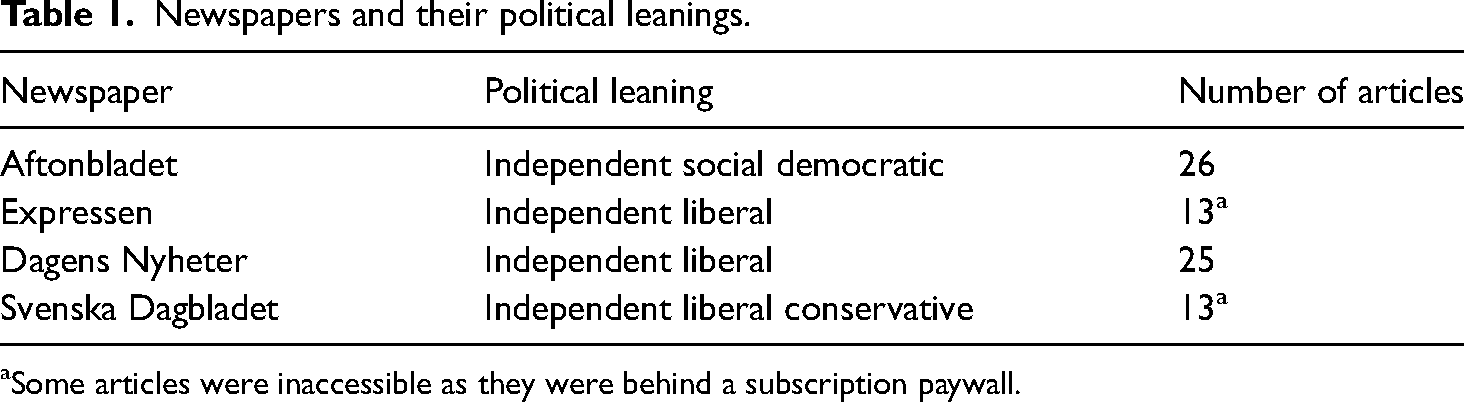
Some articles were inaccessible as they were behind a subscription paywall.
For the analytical framework of news frame identification, Lindström and Marais (2012) distinguish between two primary analytical strategies: rhetorical devices, which examine linguistic elements such as metaphors and descriptive language, and technical devices, which encompass visual and structural components, including photo captions and headlines. This study employs the rhetorical device strategy to identify how civic and ethnic dimensions of nationalism are expressed through language within the newspaper articles in relation to the Durmaz free-kick fiasco at the 2018 World Cup.
Following Lindström and Marais's (2012) systematic approach, the analysis proceeded through three distinct phases: (1) multiple comprehensive readings of the material accompanied by descriptive notation of content pertaining to nationalism; (2) focused re-reading to identify recurring nationalist themes and patterns; (3) intensive interpretive analysis to establish the dominant themes and examine how specific aspects of nationalism manifest within each thematic category.
This methodological approach enabled both the identification of explicit nationalist discourse, and the detection of more subtle nationalist undertones embedded within the media coverage, providing a comprehensive understanding of how nationalism was constructed and communicated in the aftermath of this significant sporting moment.
Results
Using a news frame analysis of Swedish media coverage, three dominant themes emerged from reporting on the Durmaz incident: (1) sporting disappointment as a trigger for ethnic nationalism, (2) ethnicity-based online abuse, and (3) civic mobilisation response.
Sporting disappointment as a trigger for ethnic nationalism
In post-match newspaper coverage, journalists expressed disappointment over Sweden's loss, with some attributing the outcome in part to Durmaz's conceded free kick, which was described as unnecessary and indirectly responsible for the defeat. However, the free kick was not the sole focus of media attention. For instance, Dagens Nyheter (24 June) emphasised a controversial penalty incident earlier in the match, stating: ‘Germany scored the decider of the game well into stoppage time and everything just feels empty and heavy and quiet in my head. Where was VAR [Video Assistant Referee] when you needed it this time?’ This perceived refereeing error received more extensive coverage across multiple articles than Durmaz. Overall, while Durmaz's action was mentioned and critiqued as part of a broader analysis of the match, it was not singled out as the definitive cause of the loss, neither was Durmaz's Assyrian background mentioned. In Aftonbladet (24 June), for example, Durmaz's mistake was referenced in just one sentence without connecting the loss to his ethic background: ‘It was the World Champions [Germany] who received a stupid free kick by Jimmy Durmaz with just a few seconds left’.
The newspaper coverage following Sweden's World Cup defeat did not explicitly blame Durmaz for the loss, nor did it directly incite the wave of hate messages that appeared online. Instead, it can be argued that public disappointment over the team's performance, combined with (re)emerging nationalist sentiments within Swedish society, provided fertile ground for the expression of ethnic nationalist rhetoric on social media, positioning Durmaz as the racialised and migrant ‘other’. In the wake of the online abuse targeting Drumaz, several newspapers responded with clear condemnation. For example, Svenska Dagbladet (25 June) featured a columnist stating: ‘A mistake in a football game can never justify the type of hate and threats that Jimmy Durmaz has received. Never!… The polarisation of society over the last years has elicited a tuned-up atmosphere, where the one with the loudest voice is heard the most’. Similarly, Aftonbladet (26 June) emphasised the pervasiveness of racism in Swedish society with an article titled ‘Racism is not back – it was never gone’, in which the journalist observed: ‘Sneaky racism [direct translation] is moving freely: in locker rooms, in workplaces, in pubs, in small towns, in big cities. Preferably, subtly, bordering on the forbidden’. These reflections suggest that social media operates as a permissive and largely unregulated space, a form of ‘safe haven’ for the articulation of everyday, covert racism that often goes unchallenged in public discourse.
An article in Dagens Nyheter (7 July) linked the backlash against Durmaz to the Sweden Democrats’ notion of an ‘inherited essence’, which is a belief suggesting that certain individuals, regardless of their birthplace or citizenship, will never be perceived as truly Swedish. In the context of football, this essentialist ideology, in-line with ethno-nationalism, implies that players with migrant backgrounds risk remaining perpetually marked as ‘non-Swedish’, even when representing the national team. Such narratives can serve as a cultural trigger for racialised hostility and online abuse towards ethnic minority athletes. This interpretation is particularly salient given that the Durmaz incident occurred less than two months before the Swedish national election, during a period when the Sweden Democrats were gaining momentum and political discourse had become increasingly polarised and amplified. The timing and tone of the public debate further illuminate how sport, and a national team in this case, can become a symbolic arena where broader anxieties about belonging, identity, and nationhood are contested, and oft muted anti-immigration sentiments are expressed.
Ethnicity-based online abuse
As online abuse against Durmaz escalated to unprecedented levels, media attention swiftly shifted towards the scale and intensity of the digital attack. Durmaz himself initially downplayed the situation, stating: ‘I haven’t checked [my account], I always have hate comments on my Instagram’ (Aftonbladet, 24 June). However, the magnitude and severity of the comments following the match far exceeded the usual volume of online hostility he had experienced. Within minutes of the game's conclusion, over 3000 comments had appeared on his Instagram account, many of which were overtly racist and threatening. A reporter from Dagens Nyheter (24 June) confirmed the extraordinary scale of the abuse, marking it as a significant turning point in the discourse surrounding racism in Swedish sport: ‘If you look through Durmaz's Instagram, you will see many comments containing threats and racism’.
Initially, much of the online backlash appeared to come from emotionally charged young male fans reacting impulsively to the defeat. However, Jimmy Durmaz's experience was different as regards both the volume and racialised nature of the abuse. Other Swedish players who had made equally consequential mistakes during the match did not receive comparable levels of online hostility. As noted in Svenska Dagbladet (26 June), this disparity revealed deeper social undercurrents: ‘This is not about football. It is about Sweden. A country where Swedish-ness will always be reserved for certain citizens. For minorities, it means to deserve Swedish-ness: comply with requirements and perform’.
Undeniably, the flood of online hate that followed the game included thousands of comments, many of which were tied to racist and nationalist sentiments and often originated from accounts affiliated with young men. A media analyst stated in Dagens Nyheter (27 June): ‘If you look more closely at the comments and who wrote them, they are almost exclusively from authentic accounts, by young Swedish guys’. Yet not all the abuse was football-related. Some posts were more generally xenophobic, drawing on broader societal prejudices. In the days following the incident, debates emerged across Swedish media regarding the scale, nature, and meaning of the online hate. While many argued the racism was real and deeply embedded in societal structures, others questioned the framing. For example, in Dagens Nyheter (26 June), a media strategist claimed that amplifying the racist narrative could inadvertently empower extremists: ‘It's crazy to declare war and fight to take back something that wasn't even taken from us. That's giving the racists full marks’. Furthermore, a journalist who analysed the first 3000 Instagram comments found that they were posted by authentic accounts; 800 were later deleted, and just over 30 were explicitly racist (Svenska Dagbladet, 27June). The police also suspected some of the threats originated from right-wing extremists, trying to take advantage of the situation and incite social divisions. For instance, a police representative said: ‘We can see tendencies that right-wing extremists have taken advantage of the situation and in different ways participated in the discussion’ (Aftonbladet, 27 June).
In the aftermath of the match, the Swedish Football Association (SvFF) reported several serious threats made against Durmaz via their own social media platforms. Particularly troubling, however, was the involvement of two executives from the Swedish Professional Football Leagues [Föreningen Svensk Elitfotboll] (SEF), who posted critical comments on social media that appeared to allude to the ethnic backgrounds of Durmaz and another national team player of colour. Among several newspapers, Aftonbladet (27 June) reported a controversial exchange posted on the executives’ Facebook page: ‘Can we agree that Jimmy Durmaz just played his last game with the national team?’ To which one responded: ‘Only if it applies to [Isaac] Kiese-Thelin too’.
The SEF executives later denied that these remarks referred to the players’ ethnic backgrounds. However, the insinuation was difficult to ignore, as at the time, there were only three players in the national squad with migrant backgrounds, and two of them (Durmaz and Kiese-Thelin) were explicitly named, with the latter mentioned seemingly without any contextual justification.
Aftonbladet also noted that when the Swedish World Cup squad was first announced, Mats Enquist – the official who made the comment about Kiese-Thelin – had retweeted a post from a right-wing populist account that mocked the perceived need for diversity in the national team. Their remarks provoked widespread condemnation, including from the president of the SvFF, who warned: ‘Those kinds of comments risk fuelling dark forces’ (Expressen, 27 June). The incident underscored the persistent undercurrents of racial bias within Sweden's national football institutions. Durmaz later expressed that he was particularly hurt by the comments, noting their origin within the football establishment. Although one of the officials issued a public apology, it was not directed personally at Durmaz. Several weeks after the World Cup, Durmaz voiced his continued disappointment, stating on national broadcaster TV4: ‘It [SEF] has been very quiet … this has affected me most after the World Cup’. His reflection highlighted the emotional impact of the silence from leadership figures. Ultimately, the episode confirmed how racism in sport can manifest within the very organisations charged with upholding equity and promoting inclusivity in the game.
Civic mobilisation response
As the situation unfolded, Swedish newspapers began to point to widespread counter-reactions to the ethnically charged nationalist hate targeting Durmaz. Following the initial wave of online abuse, Durmaz's Instagram account was flooded with messages of solidarity, with estimates ranging from 27,000 to 39,000 supportive comments condemning racism and expressing national unity. In an unprecedented and highly symbolic move, the Swedish national team publicly took a collective stance against racism the day after the match. The entire team stood behind Durmaz as he delivered a powerful speech: ‘I am Swedish and wear the jersey and our flag with pride. We stand united, we are Sweden’ (Dagens Nyheter, 25 June). This moment marked a significant political gesture in Swedish sport, illustrating how athletes and teams can actively resist racism and reconfigure national identity on inclusive, civic terms.
The public response to Durmaz's statement and the Swedish national team's collective solidarity against racism was powerful and prompted extensive commentary across major newspapers. Numerous columns praised the gesture and used it as an opportunity to reflect on the broader societal context, especially on the rise of ethnic nationalism and racism in Sweden. A recurring theme in the media discourse was the interrogation of the concept and meaning of Swedish-ness. Many commentators emphasised that Swedish national identity should not be defined by ethnicity alone, but rather by principles of citizenship, democratic values, and a sense of belonging. Several articles expressed concern over the troubling reality that a Swedish-born citizen and national team player had to publicly affirm his Swedish-ness. The need for Durmaz's public speech was described as both unsettling and indicative of deeper societal fractures. A column in the Expressen (25 June) captured the essence of such social fractures in relation to the Durmaz case succinctly: For those who have observed how nationalistic and racist opinions have moved their positions forward during the last years, this might not come as a total surprise. But it does not make the attacks on Durmaz less scary. It does not either make the manifestation from the national team in Gelendzijk less absurd. Because you hear the warning bells, right? You see the madness, right? When the national team feels obligated to pause their preparations for a monumentally important World Cup game to make a stance that their right winger in fact is Swedish, then the political climate shift has reached a new level … we see a worrying tendency in Sweden, an obsession with talking about who is Swedish and not, where people are ranked and categorized in both bizarre and unpleasant manners.
The Swedish national team's anti-racist statement quickly gained international attention. For example, in Dagens Nyheter (27 June), former footballer Eric Cantona publicly expressed his support for Durmaz. In the politically charged atmosphere just two months ahead of the national election, the team's statement also sparked political reverberations. The Swedish Prime Minister, Stefan Löfvén, along with leaders from several political parties, voiced their support shortly after the incident.
A few days later, a public demonstration in solidarity with Durmaz and against racism was held in Stockholm. The event was organised by Locker Room Talk (https://lockerroomtalk.se), an organisation promoting inclusivity in sport and one that Durmaz had long supported. The demonstration featured speeches from political leaders and performances by prominent Swedish artists. Political messages were explicitly conveyed, as illustrated by the leader of the Green Party, Isabella Lövin, who stated: ‘On Saturday I was pissed off. To attack him with hate and racism because of his background does not belong in football or in Swedish society’ (Dagens Nyheter, 30 June).
Overall, the week marked a turning point, initiating new conversations within the Swedish national team and across society at large. Reflecting on the events, Durmaz remarked: ‘It has happened to me, but it has happened to so many more in Sweden. We have turned this into something positive, and the fact that the question is being raised, that is huge’ (Expressen, 30 June).
Discussion
While organised sport in Sweden is often framed as a vehicle for inclusion and democratic values (Bairner and Darby, 2001; Toftegard Stöckel et al., 2010; Karlsson et al., 2022), and serves as a vehicle for projecting collective identity (Ljunggren, 2024; Fahlén and Stenling, 2016), recent political developments and trends have moved in a more conservative, nationalistic, and populist direction (Elgenius and Rydgren, 2019; Nilsson, 2022). The long-standing narrative of Swedish exceptionalism, grounded in inclusion, multicultural citizenship, and civic nationalism, has increasingly come under pressure (Kenes, 2021; Elgström and Delputte, 2016). In the case of Durmaz, this narrative was not only challenged but troubled, as the incident exposed the conditional and fragile nature of multicultural acceptance within Swedish sport and the underlying tension between civic nationalist rhetoric and ethnic nationalist practice.
The Durmaz incident highlights the precarious position of minority athletes in national sports, where moments of sporting disappointment swiftly activate anxieties about nationhood and belonging. Sport, as a site for the enactment of national identity, provides a highly visible, emotionally charged arena where questions of inclusion and exclusion meet head-to-head (Bairner, 2001). The hate campaign against Durmaz demonstrates how, under the pressure of defeat, ethnic nationalist logics can reassert themselves, questioning the authenticity of athletes with migrant backgrounds and ascribing of form of ‘thin citizenship’ (Oonk, 2020) to them regardless of their formal national moorings.
Thus, the Durmaz case illustrates an ongoing tension between civic/ethnic nationalisms (Brubaker, 1992; Smith, 1993). The online abuse directed at Durmaz reflected an ethnic conception of Swedishness, treating ancestry and cultural origin as the decisive markers of belonging. In contrast, the Swedish press and national team mobilised a civic narrative, emphasising Durmaz's birth in Sweden, his long-standing contributions to national football, and the principles of equality and inclusivity underpinning Swedish democracy. The simultaneity of these two national narratives underscores the fluidity of national identity in sport and the argument that civic and ethnic sentiments are not mutually exclusive, but can be strategically mobilised by different actors in moments of heightened tension (Maguire, 2011).
Analysing this case through the lens of ethnic/civic nationalism reveals the conditionality of multicultural inclusion in sport. Durmaz's position within the national community became contingent upon performance, loyalty, and conformity to civic ideals. Similar dynamics have been documented in other national contexts, such as the treatment of Mesut Özil in Germany or Mario Balotelli in Italy, where athletes’ legitimacy was questioned in ways rarely experienced by white players (Cleland and Cashmore, 2016). Sweden is, therefore, not an outlier, but part of a broader European trend in which athletes with migrant heritage serve as litmus tests for contested definitions of nationhood.
Furthermore, the incident unfolded during a politically charged moment in Swedish society. The Sweden Democrats, a party long associated with anti-immigration and Islamophobic rhetoric (Kenes, 2021; Nilsson, 2022), achieved record electoral success in both the 2018 and 2022 general elections, surpassing 20% of the national vote. Their rise has significantly reshaped public discourse, normalising exclusionary narratives around immigration, integration, and national identity (Elgenius and Rydgren, 2019; Vahter and Jakobson, 2023). Since the Durmaz incident in 2018, the political climate has further shifted towards the political right. What was once a dominant civic nationalist discourse, emphasising tolerance, multiculturalism, and inclusive belonging, has increasingly been eclipsed by a more insular and assertive ethnic nationalism (Ekman and Krzyżanowski, 2021).
We argue that this shift signals more than a rhetorical recalibration; it marks a profound redefinition of the boundaries of Swedishness itself. A more recent and telling example from the world of sport is the case of gymnast Tonya Paulsson, born to a Taiwanese mother, who in 2024 chose to switch national allegiance to Taiwan following a protracted dispute with the Swedish national team. In an interview with Aftonbladet (24 November 2024), Paulsson reflected on the backlash: ‘I was prepared to receive criticism, but I wasn’t prepared for the volume of racist comments… The hardest part has been that so many adults wrote that my passport should be revoked … that I’m a burden on the welfare system’. Her experience underscores how racialised notions of loyalty and belonging continue to shape public perceptions of national identity, particularly when athletes of migrant heritage assert agency or deviate from expected narratives of gratitude and assimilation (Kearns et al., 2023).
Therefore, we argue that the Drumaz case unfolded in a political environment marked by the rise of the Sweden Democrats, whose anti-immigration platform reflects broader European populist trends (Rydgren and van der Meiden, 2019). The timing is significant and, arguably, the abuse directed at Durmaz was not (and is not) an isolated act of fan frustration, but part of a wider climate in which exclusionary nationalism was increasingly normalised. The entanglement of sport and politics in this case demonstrates how populist discourses of cultural threat are amplified through sporting controversies, transforming athletic mistakes into symbolic battlegrounds over who truly belongs to the nation.
This case, therefore, shows how civic and ethnic logics of national identity are not static but activated situationally, often through the symbolic bodies of racialised athletes. It also highlights the limits of civic nationalism, which, while inclusive in principle, still required Durmaz to publicly reassert his Swedishness, an expectation not placed upon white Swedish teammates. This suggests that civic inclusion may remain conditional and fragile, particularly in societies grappling with populist pressures and rising ethno-nationalist right-wing sentiments.
Conclusion
Populism and nationalism have been on the rise across Europe, reshaping political landscapes and public discourse. Many countries with traditionally liberal-democratic values and institutions are witnessing a shift towards the political right and a resurgence of primordial ethno-nationalism. This trend can be seen as the consequence of a complex constellation of factors, including increased migration, the pressures of globalisation, economic stagnation, and widespread insecurity linked to international conflicts. These developments often generate moral panics, which further intensify public anxieties and reactionary politics.
This article has examined how these political shifts manifest in sport through the 2018 Jimmy Durmaz case following Sweden's FIFA World Cup match against Germany. Drawing on qualitative news frame analysis and a civic/ethnic nationalism framework, our investigation produced three interconnected findings illuminating the conditional nature of multicultural belonging in Swedish sport.
First, our analysis reveals how sporting disappointment triggered ethnic nationalist rhetoric. While newspapers did not explicitly blame Durmaz for Sweden's loss, public disappointment combined with rising nationalist sentiments created fertile ground for racialised hostility on social media. The backlash positioned Durmaz as a perpetual outsider whose legitimacy was questioned through his ethnic origin. This demonstrates that multicultural inclusion operates conditionally: athletes with migrant backgrounds must continuously prove belonging through performance, standards rarely applied to ethnically Swedish teammates. The incident exposed the performative nature of belonging, wherein citizenship proves insufficient protection against ethnic re-categorisation during collective disappointment.
Second, the case illustrates the scale of ethnicity-based online abuse directed at minority athletes. Over 3000 comments appeared on Durmaz's Instagram, many overtly racist and threatening. Significantly, other Swedish players who made comparable mistakes received no such hostility, confirming Durmaz was targeted for his ethnic background, not for his sporting mistake. The abuse reflected ethnic nationalist ideologies treating ancestry as decisive markers of authentic Swedish-ness, ascribing ‘thin citizenship’ to athletes with migrant heritage. Moreover, such sentiments permeated Swedish football's institutional leadership, as evidenced by officials’ comments questioning players’ ethnic credentials. This demonstrates that exclusionary nationalism has increasingly normalised within Swedish sporting discourse, particularly amid Sweden Democrat ascendancy preceding the 2018 election.
Third, the civic mobilisation response illuminates sport as a site of anti-racist resistance. The Swedish national team's unprecedented collective statement, with teammates standing behind Durmaz represented a powerful civic nationalist counter-narrative. This response, amplified through media coverage, political endorsements, and public demonstrations, invoked principles of birthright citizenship and democratic values. The mobilisation generated extensive debate about Swedish-ness, with commentators emphasising that national identity should be defined by civic principles rather than ethnic descent. This reveals the situational activation of competing nationalist frameworks: ethnic nationalist abuse was countered by civic mobilisation, demonstrating these are fluid rhetorical resources strategically deployed during heightened tension.
Thus, the Durmaz case demonstrates that civic and ethnic conceptions of national belonging are not static but situationally activated responses to sporting outcomes and political contexts. The simultaneity of ethnic abuse and civic mobilisation underscores how progressive societies can harbour latent ethnic nationalist logics surfacing during collective stress. Sport provides an arena where competing conceptions crystallise around racialised athletes’ symbolic bodies, who serve as litmus tests for contested definitions of authentic belonging. Our analysis highlights the conditional nature of multicultural inclusion even within civic nationalist societies. That Durmaz needed to publicly affirm his Swedish-ness reveals civic nationalism's limits and fragility.
Critically, the case cannot be understood apart from its political context. Occurring two months before Sweden's 2018 election during the Sweden Democrats’ ascendancy and normalised anti-immigration discourse, the incident demonstrates how sporting controversies become amplified sites for political struggles over legitimate national belonging. Sport operates as contested terrain where populist discourses of cultural threat find concrete expression through debates about individual athletes’ legitimacy, reflecting broader European patterns wherein right-wing movements strategically deploy sporting nationalism to advance ethno-pluralist agendas.
While the Durmaz incident generated significant attention and solidarity, it is essential to recognise its limited structural impact. Underlying patterns of conditional belonging, everyday racism, and normalised xenophobia remain deeply embedded. What was once extreme discourse has become increasingly normalised. Elite athletes possess platforms unavailable to countless young people facing similar abuse at grassroots levels where exclusion goes undocumented. The case demonstrated that crisis moments can create openings for resistance and reassertion of inclusive civic values, yet such mobilisations remain fragile and contested, unable to fundamentally alter structural conditions enabling exclusionary nationalism without broader institutional transformation.
Future research should build on these findings by examining the everyday experiences of minority athletes beyond elite sport, with particular attention to youth and grassroots levels where exclusion often goes undocumented. Comparative studies across European contexts would help clarify whether Sweden's dynamics reflect broader regional trends or distinct national trajectories. Moreover, further work is needed to explore the role of digital media in both amplifying xenophobic sentiment and enabling counter-narratives of inclusion and solidarity. Longitudinal research examining whether high-profile incidents like the Durmaz case produce lasting shifts in public discourse or institutional practice would be particularly valuable. Finally, research should investigate how athletes, sporting organisations, and civil society actors might mobilise sport as a platform for anti-racist resistance, and whether such efforts can contribute to more sustainable forms of social change beyond the temporary solidarity that emerges in response to spectacular incidents of abuse.
Footnotes
Acknowledgements
We would like to thank the reviewers for their thoughtful and thought-provoking comments on the initial draft of this manuscript. Their constructive feedback and insightful suggestions have significantly enhanced the clarity, depth, and overall quality of the final paper.
Data availability statement
Data sharing is not applicable to this article, as the data were collected from open news archives.
Declaration of conflicting interests
The authors declared no potential conflicts of interest with respect to the research, authorship, and/or publication of this article.
Ethical considerations and informed consent statements
The nature of the empirical work entailed that no ethical approval or informed consent was required.
Funding
The authors disclosed receipt of the following financial support for the research, authorship, and/or publication of this article: The research has been internally funded.
