



Abstract
This study explores the meanings given to race/ethnicity by Polish commentators covering games of the Polish national football team on TV. There will be an explicit focus on how such patterns of representation might intersect with those given to national identities in the context of international football. Our analysis reveals that commentators habitually reproduce the racialized stereotype of the ‘natural Black athlete’, particularly in the representation of Black African football players. White players remain more ‘invisible’ in the commentary, yet also here the intersection with national or wider regional backgrounds inflects the patterns of representation. For instance, White Portuguese and White Bosnian players are represented in a fashion that suggests they are placed outside of hegemonic Polish understandings of White (sporting) masculinity. This reveals the contingency and complexity of discourses of Whiteness in the Polish context. The findings reveal that the normativity of European Whiteness is also reflected in the meanings given to Polishness by the commentators, which are imbued with notions of psychological (masculine) Whiteness.
Introduction
For the past 40 years, a substantial amount of research has focused on sport media and discourses surrounding race/ethnicity 1 that media professionals like sport journalists draw on in the representations of athletic events (see: Rainville and McCormick, 1977; Sabo et al., 1996; Bruce, 2004; Rada and Wulfmeyer, 2005; Campbell and Bebb, 2020). These works recognize that sport media are a potentially powerful site for the reification (or challenging) of hegemonic ideas about race/ethnicity in wider society. This is mainly due to the increasing mediatization of sports, their huge (global) audiences, and the increasing visibility of athletes from diverse racial/ethnic backgrounds (Hylton, 2009). These previous works have shown that sport media often (usually subtly and implicitly) describe athletes’ attributes and qualities in stereotypical ways (Hall, 1997; Carrington, 2011).
In the US and UK, where most of the previous research was conducted, this stereotypical representation has generally taken the form of a so-called ‘Black Brawn – White Brain’ dichotomy (Buffington and Fraley, 2008), where athletes classified as Black are often represented by commentators in terms that emphasize their supposedly innate physical qualities, such as speed and strength, even though such notions have long been biologically discredited (Azzarito and Harrison, 2008; Hylton, 2009). On the other hand, White athletes remain more ‘invisible’ in the commentary, or they are more often made sense of in terms of cognitive skills. Recent years have seen more research output from other national contexts in which the dominant Anglophone Black-White dichotomy to define ‘race’ does not apply to the same extent, or coalesces with other dominant racial/ethnic, cultural, national, and religious categories and hierarchies. These works have enriched the field by showing that, on the one hand, transnational racial/ethnic formations inform sport media representations in various national contexts alike, especially where it concerns the stereotype of the ‘natural Black athlete’. On the other hand, representations also are context-specific. For instance, Ličen (2015) found Slovenian commentators to explicitly assert Slovenian nationhood, and Longas Luque and Sterkenburg (2020) suggested that in the Spanish context ambiguous Spanish Whiteness could explain the absence of a disproportionate focus on Black physicality.
International men's football proves to be a culturally significant site where male athletes from various racial/ethnic backgrounds compete in front of huge (media) audiences under the banner of their respective nations. Previous research has explored the connections between international sports, its mass mediatization, projects of nation-building, and national identity (see: Maguire and Poulton, 1999; Hilvoorde et al., 2010). Yet, works that pay more explicit attention to the intersections between the representations of race/ethnicity and national identity in sport media are much sparser, especially in the Central-Eastern European (CEE) context which will be the focus of this paper. This region proves particularly interesting since in many of its national contexts a resurgent ethno-nationalism explicitly points to the mutual constitution of racialized hierarchies, and discourses of national belonging and deservingness (Elgenius and Garner, 2021; Krzyżanowski, 2020). Deservingness here refers to the discursive (re)construction of hierarchies and borders of the national imaginary by majority groups (Elgenius and Garner, 2021). However, little attention has been paid to how this mutual constitution might be discursively (re)produced in sport media. Various scholars have pointed to this relative absence of explorations of ‘race’ and Whiteness in studies focusing on Poland and the CEE more broadly (Baker, 2018; Imre, 2014). The present article aims to explicitly explore how global racial formations and attachments to Whiteness and Europeanness are often latently (re)produced in quotidian cultural artefacts such as televised football.
This paper will explore whether and how football commentators “speak through” (Bruce, 2004: 863) racialized/ethnicized discourses in their coverage of men's football players of various racial/ethnic and national backgrounds. The paper focuses on coverage of matches that involve the Polish national team. Our previous content analysis of televised Polish club football identified that commentators drew on stereotypical racialized discourses in their representations of Black footballers, mainly through an emphasis on physical capabilities (Van Lienden and Van Sterkenburg, 2020). This suggests that global racial/ethnic constellations and hierarchies concerning Blackness are also replicated in the context Poland.
This paper will focus on televised international men's football, given its role in presenting meanings to race/ethnicity and nationality in Poland - due to the racial/ethnic diversity on the pitch and the popularity of the national men's football team as a national symbol. The paper will also look at the extent to which and how the meanings given to race/ethnicity on the one hand, and national identities on the other overlap with or differ from Polish everyday discourses surrounding these issues. The research questions of this paper can now be formulated as follows: What discourses do Polish football commentators on TV draw on in representing players from different racial/ethnic backgrounds in international football games that include the Polish national team?
Theoretical framework
Race/ethnicity in sport media
Race and ethnicity are concepts that are now widely regarded as socially constructed (Carrington, 2011). Their cultural existence and ‘validity’ are maintained through discourses or clusters “of ideas, images and practices, which provide ways of talking about, forms of knowledge and conduct” in a given society (Hall, 1997: 6). This does not mean that racial/ethnic boundaries and hierarchies do not have material effects. It is, however, through the socially produced ‘reality’ of race/ethnicity (Bonilla-Silva, 2015) that these material effects come into being. Some scholars distinguish race and ethnicity as two distinct concepts, with race often referring to physiognomic traits of people (skin color and other physical markers) and ethnicity referring to cultural traits such as language, customs, and religious identity. In this paper we will use the concepts as conflated (race/ethnicity) to reflect how in everyday discourses, this definitional distinction becomes less pronounced (see: Sterkenburg, 2019). Although one can take primacy over the other depending on the context, people often interweave ‘racial’ and ‘ethnic’ markers when discussing notions of identity (Hylton and Lawrence, 2015). This is also often the case in the Polish context, as will be elaborated upon below.
Hegemonic epistemological formations based on race/ethnicity are discursively stabilized and reinforced, in part, through media representations. At the same time, hegemonic discourses are constantly challenged by and adapting to newly emerging discourses (Hall, 1997). Occasionally, studies found hegemonic racial/ethnic stereotypes to be challenged in sports media content (Sabo et al., 1996; Longas Luque and Van Sterkenburg, 2020), showing that sport media also has the potential to be a progressive site. However, most previous research has shown that sport media is a popular site in which enduring hegemonic ideas about race and ethnicity are habitually (re)produced via (often implicit and subtle) racially/ethnically coded commentary (Hylton, 2009; Campbell and Bebb, 2020). While commentators in the mediated broadcasts may not intently rely on stereotypical discourses, they often tend to “speak through” (Bruce, 2004: 863) wider circulating racial/ethnic ideologies, especially in the context of immediacy of live sport broadcasts. Within such a context, commentators need to react instantly to what happens on the pitch and tend to draw on easily accessible hegemonic discourses. Sport media professionals have also generally been found to rarely reflect on the use of these racial/ethnic stereotypes in their reporting or minimize their impact (Bruce, 2004; Sterkenburg et al., 2021).
Previous research has mainly focused on representations of male athletes, and showed that Black male athletes are often made sense of in terms that stress their supposedly innate physical capabilities, while White (male) athletes are usually more ‘invisible’ in the commentary or psychological capabilities are emphasized (Carrington, 2011; Buffington and Fraley, 2008). While content analyses of large volumes of sports commentary have contributed significantly to the study of race/ethnicity in sports, they often limited themselves to a Black-White binary even though this dichotomy may not be most fitting for various contexts (Van Sterkenburg et al., 2010). Recent research has increasingly complemented these works by focusing on more nationally or locally informed racial/ethnic categorizations to move beyond this dichotomy and to do justice to the shifting boundaries and meanings of racial/ethnic categories in various contexts. These works helped to show the plurality of racialized/ethnicized representations in sport media. Generally, they indicate that global racial/ethnic constellations such as the Black-White binary and its associated discourses ‘travel’ and are reconstructed in a great variety of football contexts including the Polish (Van Lienden and Van Sterkenburg, 2020), Japanese (Ogasawara, 2004), and Slovenian (Ličen, 2015). Simultaneously, this binary is supplemented with other categorizations through its intersection with more localized articulations of race/ethnicity and other matrices of power. These works also show that in many national contexts such contextual articulations of race and ethnicity cannot be explored in a nuanced manner without attending to their intersections with discourses on nationality.
National football and race/ethnicity
Hall (2017) notes that similar to – and never independently from - race/ethnicity, the nation is given meaning through discursive practices that work to construct a hegemonic idea of nationhood and national belonging, whilst competing with and incorporating alternative discourses. Not surprisingly, therefore, a rich body of literature has explored the key symbolic role of mediated international sporting spectacles in shaping and reinforcing dominant and ‘banal’ understandings of national identity (Billig, 1995; Mauro, 2020; Piller, 2017). Works have also shown that the Polish national football team is popularly understood to serve as an embodiment and representation of the nation and its values (Jaskułowski and Majewski, 2016; Maguire et al., 2009).
Elgenius and Garner (2021) argue that previous works have often overlooked how race/ethnicity is a constituent factor in dominant discourses about national belonging. This mutually entangled production of racial/ethnic and national categories and hierarchies can also be witnessed in the Polish public context, where, as Krzyżanowski (2020) argues, a resurgence of ethno-nationalism has gone hand in hand with the increasing legitimacy of racializing discourses. The limited number of previous studies that have explicitly focused on this intersection in sport media discourses have found how racial/ethnic ‘Otherness’ of minority racial/ethnic groups in Germany (Gehring, 2016), Italy (Kyemereh, 2020) and Australia (Bruce and Wensing, 2012; Rowe, 2015) can be temporarily subsumed or superficially embraced in sport media discourses during significant sporting achievements where minorities are seen as part of ‘the nation’. At the same time, especially in times of poorer sporting achievements, the racial/ethnic ‘Otherness’ of athletes may lead to them being de-legitimized from the national imaginary or lumped together as the ‘racial’ Other (Mauro, 2020).
These works, thus, show how discourses of national belonging and deservingness in these (chiefly Western) national contexts operate through discourses of Whiteness. Whiteness can be conceptualized as ideological discourses that sustain White privilege by upholding White identities as normative, thereby rendering them invisible and non-racial (Dyer, 1997; Hylton, 2009). Research has explored how Whiteness is given meaning and embodied in various national and local contexts and how popular culture serves as a site where Whiteness is normalized (Essed and Trienekens, 2008). In most European national contexts, Essed and Trienekens (2008: 63) argue, race/ethnicity and Whiteness play an important role in meaning-making but remain invisible, “inherently subsumed” and “repressed under the coverage of cultural and religious markers”. This has also been noted for the Polish context, where Whiteness has been identified as latently embedded in dominant discourses on Polishness and Europeanness (Jaskułowski, 2020; Balogun, 2020).
Mediated representations of the Polish national football team might serve as a site where Whiteness and race/ethnicity are given meaning and is particularly relevant due to their popularity in wider Polish society. Games of the national football team are watched by millions of viewers on average, and the Polish national football team has in recent years become a source for expressions of what Billig (1995) coins ‘banal’ nationalism in wide swaths of Polish society (Kossakowski et al., 2020). Jaskułowski and Majewski (2016) also note how audiences often perceive the Polish national team as a symbolic representation and embodiment of the nation and its perceived qualities.
It is important to briefly reflect on the role of the Polish national football team in wider Polish society. EURO 2012, jointly organized by Poland and Ukraine, is generally recognized as the consolidation of a process in which the national football team has become associated with more celebratory, seemingly apolitical, and ‘banal’ expressions of nationalism (Jaskułowski and Majewski, 2016; Kossakowski et al., 2020). This came after years of poor results and the gradual phasing out of hooligan elements surrounding the national team. Such expressions of nationalism associated with the Polish national team are thus relatively novel in comparison with some other (Western) European contexts and its novelty can be explained when looking at recent Polish history. During football's inception in partitioned Polish territories (1795−1918) and under Communist rule (1945−1989), football has also served as a source of Polish nationalism. However, due to the lack of a sovereign and independent Polish state, such bottom-up expressions were either repressed by authorities or – in case of the Communist authorities – designed to fit the mold of the regime, as the national team functioned first and foremost as a political tool for the Communist cause (Lenartowicz and Karwacki, 2005). This did not influence the popularity of football in general in Poland, which always remained high, but it illustrates how the history and ideological functions of football in Poland should be read through the tumultuous and often tragic general Polish history of changing borders, foreign and imposed rule, and transformation from a multi-ethnic to a homogeneous state (Lenartowicz and Karwacki, 2005; Kossakowski et al., 2020).
Hegemonic understandings of race/ethnicity and Whiteness in Poland
Football discourses are related to societal discourses and vice versa, it is therefore important to lay out the dominant understandings of race/ethnicity and Whiteness in wider Polish society. In Polish everyday discourses, ‘race’ is popularly understood as phenotype and framed in a Black-White dichotomy, which is a characteristic racial binary in many Western countries (Nowicka, 2018). Historical conjunctures and social engineering projects have allowed Poland to self-identify as an exceptionally homogeneous White and mono-ethnic country. Kossakowski et al. (2020) state that 95% of the population self-identifies as White, Roman Catholic and ethnically Polish.
The general absence of engagement with racism in the Polish context is not dissimilar to discursive strategies found in other parts of Europe. However, the genealogy of race/ethnicity in the Polish context (and the CEE region more broadly) to a large extent differs from the West primarily because of the general absence of colonial possessions during the colonial period, the understanding of racism as a uniquely Western imperialist vice in hegemonic discourses during the period of Communist rule, and the dominant ethno-cultural understanding of national identity where Polishness is (implicitly) equated with being White. These elements together serve to bolster popular discourses of racial exceptionalism and are often used to occlude a thorough engagement with how racialized imaginaries and Whiteness operate in Poland.
There has been an increasing academic investment in deconstructing this persistent racial exceptionalism in Central-Eastern Europe (Imre, 2014; Polynczuk-Alenius, 2020) Jaskułowski (2019) and Polynczuk-Alenius (2020) have shown how popular conceptions of Polishness are constructed through and undergirded by notions of shared ethnicity and religion. These ‘ethnic’ markers readily slip into definitions that identify Polishness in more ‘racial’ or biological markers such as common ancestry, blood relations, and, Whiteness (Jaskułowski, 2020; Polynczuk-Alenius, 2020). This points to an intersection of racism and nationalism in popular Polish self-definitions (Polynczuk-Alenius, 2020). This can be said to exemplify the “hidden trajectory of race” that Imre (2014: 130) argues characterizes many popular national identity constructions in CEE. In other words, ethnicity and nationalism are conflated and imbued in part with ‘racial’ (naturalizing) discourses, but ‘race’ is rarely part of popular vocabularies except for when it concerns Black people (Nowicka, 2018). This paper attempts to elucidate this hidden trajectory by bringing ‘race’ to the fore in exploring Polish football media representations.
Racial/ethnic groups in Poland and Polish football
Jaskułowski (2019: 55) argues that the dominant ethno-religious imaginary of Polishness - originating in the late 19th century but re-solidifying after the fall of the Communist regime in 1989- has “substantial exclusionary potential”. This contrasts with some earlier periods in Polish history – especially that of the Polish-Lithuanian Commonwealth in the late 18th century – which were marked by a relative tolerance towards religious and ethnic minorities (Davies, 1996). Historically, Jewish and Roma populations have often functioned as ‘internal Others’ in dominant Polish imaginaries and – in varying degrees - continue to do so (Jaskułowski, 2019). In recent years, the social group of Muslims have largely taken the main role of the stereotypical ‘Other’ in discourses that sometimes recycle older anti-Semitic tropes, as Krzyżanowski (2020) shows. The social group of Muslims, as do most of the social groups that are discursively constructed as threatening ‘Others’, have a marginal presence in Polish society and it has been argued that the general absence of regular encounters with racial/ethnic ‘Others’ has resulted in a limited availability of oppositional discourses that go against hegemonic racialized/ethnicized imaginaries (Mayblin et al., 2016).
Previous research has also shown how global racialized imaginaries of Black people – in particular sub-Saharan Africans - have found their way in the Polish ‘cultural repertoire’ and how the racial Black-White dichotomy is discursively reproduced and sustained (Balogun, 2020; Nowicka, 2018; Mayblin et al., 2016). These works have explored discourses on colonial aspirations in 1920s Poland (Balogun, 2018), and the enduring stereotypical depictions of Black people in popular Polish cultural products (Nowicka, 2018). These works thus show there is ample discursive space in the exceptionally homogeneous Polish population for global and local racialized/ethnicized discourses concerning (often non-White) ‘Others’. Opinion polls suggest that especially the social groups of ‘Arabs’ and ‘Africans’ are perceived negatively, showing how processes of Othering in the Polish context draw on 'racial' characteristics such as skin color while rendering normative and investing in hegemonic discourses of Whiteness (Böröcz and Sarkar, 2017; IPSOS, 2016)
Our previous work into Polish sport media found that Black footballers were overrepresented in commentary pertaining to physical capabilities. Sport media thus (re)construct a Black-White binary that aligns with the common way in which ‘race’ is understood in Polish wider society (Van Lienden and Van Sterkenburg, 2020). The racialized/ethnicized frames the commentators drew on also sometimes intersected with other social identity markers such as national identity or wider geographical background. For instance, representations of Polish players emphasized assumed psychological traits such as bravery and leadership, while White Southern European players were overrepresented in commentary emphasizing their assumed hot-temperedness and lack of self-control (Van Lienden and Van Sterkenburg, 2020). This suggests that commentators also use national identity and wider geographical backgrounds as modalities to make sense of football players of different racial/ethnic origins, though this seems to particularly apply to White players thereby (re)constructing ‘different shades of whiteness’ (Long and Hylton, 2002). White footballers appear to be less readily reduced to ‘raced’ characteristics (such as physical qualities) than Black players (Van Lienden and Van Sterkenburg, 2020).
Methodology
We analyzed 12 televised international football games of the Polish national team, that were broadcasted on Poland's national TV network Telewizja Polska (TVP) between June 2018 and September 2020. Twelve broadcasts were analyzed as at that point thematic saturation was reached, meaning that themes and categorizations started repeating themselves methodically across broadcasts and no additional undiscovered themes and categorizations emerged. Only games were selected that were played in official tournaments or qualifications, so excluding friendlies that presumably drew smaller audiences. Rather than for instance online broadcasts or football talk shows, we focus on live televised football games because of the sizeable audiences televised games draw. To illustrate, the games against Senegal, Colombia and Japan – played at the World Cup 2018 – attracted roughly between 7 to 11 million viewers (S.A., Telewizja Polska, 2018), from a population of around 38 million. The games against Austria, Israel, Latvia, North Macedonia and Slovenia were qualifiers for the EURO 2020 tournament and the games against Italy, Portugal, The Netherlands and Bosnia were played in the UEFA Nations League. These games also drew considerable audiences –averaging around 3 to 6 million viewers per game (Wirtualnemedia, 2021; TVP, 2021). All games were commented upon by two commentators, with one taking the role as sportscaster commenting upon the play-by-play action, and the other providing more interpretive commentary. All commentators were White males. In our analyses we do not provide more information on individual commentators for this paper focuses first and foremost on representational patterns that we detected among all the analyzed matches, rather than one specific commentator or one specific match. In our analysis we focused only on the live commentary, primarily because of the sizeable audiences of these broadcasts. Moreover, as said earlier, previous work suggests that in the immediacy of live broadcasting commentators more readily draw on racialized/ethnicized discourses (Bruce, 2004). The games were transcribed and later coded in a specific two-step design using Atlas.TI coding software. This method relied partly on inductive and partly on deductive coding techniques.
The method employed in the first step of the coding process was a “qualitative verbal categorical content analysis” (Sterkenburg et al., 2012: 428). This involved identifying dominant conceptual themes in which we could categorize all interpretive comments pertaining to individual players. With interpretive comments we mean value-laden assessments by the commentators that had an either positive or negative character. Previous research suggests that in praise and criticism, commentators are more likely to differentiate amongst athletes based on race/ethnicity (Rada and Wulfmeyer, 2005). The coded comments were inductively grouped in six overarching themes, three of which can also be found in a previous study on Polish televised football (Van Lienden and Van Sterkenburg, 2020). These are the categories ‘general/evaluative’, ‘technical’, ‘physical’. The three newly emerging overarching themes were ‘cognition’, ‘character’ and a category we labeled as ‘national meaning-making’.
Comments in the theme ‘general/evaluative’ either positively or negatively evaluated a player in a general manner (with no specific reference to a particular in-field action). Typical comments in this theme were “He had a very good season” (coded as positive) and “He could not really prove himself” (negative). The theme ‘technical’ included comments that referred to in-field actions and football skills. Typical comments in this theme were “That is a beautiful pass” (positive) or “This loss of possession by [him] is too easy” (negative). The theme ‘physical’ included comments pertaining to the physical capabilities and attributes of players. A typical positive comment in this theme would be “[He] is a very strong and fast player”. A characteristic negative comment in this theme would be “He didn't have enough strength”. The theme of ‘cognition’ contained comments in which the commentators refer to the on-field cognition, positioning, and solution-making qualities. Typical comments in this theme would be “[He] makes good choices” (positive) and “It seems to me he misjudged the situation here” (negative). The category ‘character’ includes comments made about the character of players. A typical positive comment in this theme would be: “Nice guy, intelligent and graduated”. A typical negative comment would be: “[He] was frightened in my opinion”. The last category of ‘national meaning-making’ differs somewhat from the preceding five since it does not focus on comments made about specific players, but on the discursive strategies that commentators relied on to enhance nationalistic identification of the viewers with the Polish national team. Examples of this are the use of personal pronouns when describing the team, such as “our national team” or “our nation”.
The second step in the coding process involved linking comments in the dominant conceptual themes to how the players would be racially/ethnically categorized in everyday Polish discourses. Previous works have noted how coding for race/ethnicity can be complicated (Campbell and Bebb, 2020). In this paper we racially/ethnically coded the players according to popular racial/ethnic categorizations in wider Polish society, and not through predefined categories as many previous studies did (see: Rada and Wulfmeyer, 2005). Popular racial/ethnic categorizations in Poland, as mentioned above, primarily take shape in the form of a Black-White dichotomy. Additionally, some other popular everyday categorizations were used in the coding process. These – complexly layered and often intersecting – categorizations were based on nationality (e.g. Italian, Portuguese etc.), wider geographic region (e.g. Asian, Middle Eastern, European), and religious affiliation (e.g. Christian, Jewish, Muslim). These dominant categories were deductively derived from everyday racial/ethnic categorizations often used in Poland within popular Polish (sport)news outlets and academic literature. Information on background of players was found through online sources such as Transfermarkt.com. Throughout the coding process we were open for new racial/ethnic categorizations to emerge. Ambiguous comments were discussed within the research team and with an external (Polish) research associate through extensive debriefing sessions until consensus was reached on interpretation of these comments. The coding process was qualitative in nature, yet some of the dominant patterns that we detected in the commentary below will be presented in tables and percentages. We did this to better illustrate the frequency of said patterns in the commentary and to help with contextualizing the findings (for more on the use of tabulations in qualitative research, see Silverman, 2014). Our focus, however, was on finding consistent patterns across the various broadcasts and comparing these to findings from other content analyses. Because of this approach, we used saturation as a criterion to establish the validity of our findings, rather than statistical significance, in order to prevent undue attention being paid to comments that might have occurred frequently in one or two given matches (also see: Sterkenburg et al., 2012).
Results
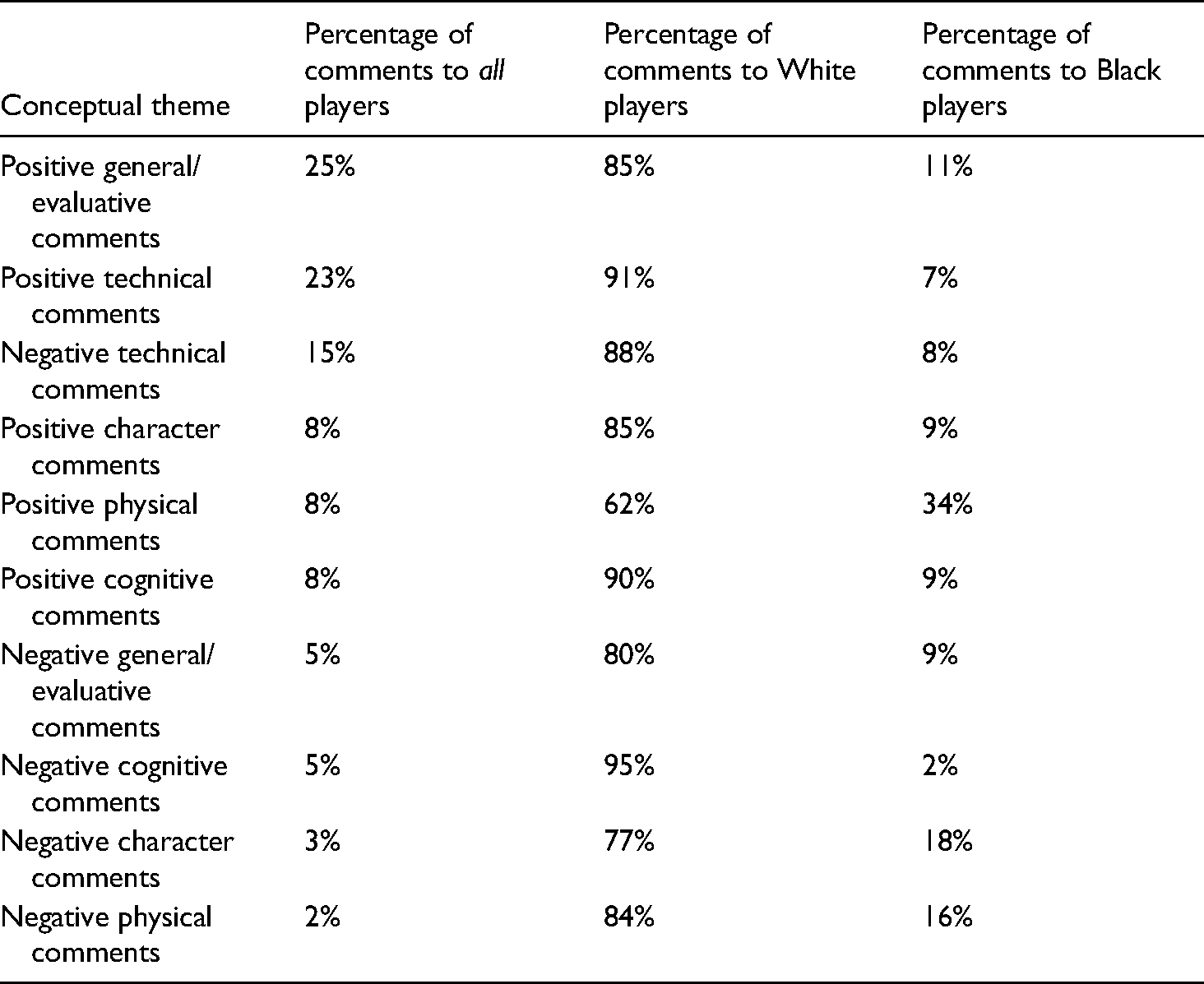
In the 12 matches under analysis, a total of (n = )2483 comments were coded and assigned to one of the overarching dominant conceptual themes. Table 1 shows how these comments were divided over the dominant conceptual themes. Comments in the theme ‘national-meaning making’ (referring to commentary in which the commentators gave meaning to Polishness) were coded separately as they concerned a more general characteristic of Polish football commentary and not to individual players. On average 85% of all commentary pertained to White players, and 11% to Black players. The rest of the commentary concerned Arab players of the Israeli team and Japanese players. These percentages helped to identify where representational patterns diverged considerably from the averages.
Percentages of commentary per conceptual theme for White and Black football players.
Black speed, brawn and its geographic inflections
The data show that Black players – notwithstanding their national affiliation – are overrepresented in positive comments pertaining to physicality. On average around 11% of all commentary was directed at Black players, but they were awarded with 34% of all praise when it came to the category of physicality. These comments often concerned Black players’ speed (“a very fast player”) and physical build (“It's not easy to win against [them] in the air”). The overrepresentation of Black players in the physicality theme suggests that in Polish televised football, commentators (re)construct and rely on the racialized trope of ‘the male Black athlete’ that is in part constructed around the notion of assumed Black physical superiority (Carrington, 2011). The relevance of the ‘Black natural athlete’ frame for Polish commentators is underscored by our previous work into representations in Polish club football, in which we found a similar reliance on notions of Black physicality (Van Lienden and Van Sterkenburg, 2020). This is significant for it points to the relevance of ‘race’ in the context of Polish sport media representations and, consequently, contradicts popular claims that meanings given to ‘race’ play no role in Polish everyday discourses.
Commentators also occasionally focused on physical markers such as hairstyles and age for Black players in ways that we did not detect for White players. For instance, the commentators state that Black Portuguese player Renato Sanches “does not look like [21]”, the hairstyles of Black Dutch player Nathan Ake and Black Austrian player Valentino Lazaro were remarked upon in ‘jokey’ comments such as “Do you plan to get a haircut like that?” and “His new hairstyle is reminiscent of Gullit, haha”. The casting of doubt on Renato Sanches’ age (see results) illustrates how the ‘Black athlete’ trope on the one hand praises the Black player's supposed ‘extraordinary’ physicality, but – especially when, as our findings suggest, repeatedly emphasized – does so in a reductionist and racialized fashion that sometimes also connotes ‘unfairness’ and ‘abnormality’. It might also reflect the racialized link commentators make between Portugal-born Black player Renato Sanches and age falsification incidents that have been documented for African countries such as Guinea and Nigeria (Barrie, 2019). The commentary on Black players’ age and hairstyles can be understood as another element in these discourses that give undue weight to Black players’ physical appearances.
The data show some relevant findings where race/ethnicity and nationality intersect within the group of Black players. For instance, Senegalese players (who are all Black) and Black Portuguese players received respectively 20% and 19% of all the commentary aimed at Black players, yet if we only look at the physicality theme within the group of Black players, they received respectively 32% and 26% of the comments. It suggests that commentators draw on the ‘natural Black athlete’ stereotype especially for athletes from these national backgrounds. For Black Dutch players, we found that, in comparison with other Black players, there was less of a focus on physicality. Whereas they received 26% of the commentary devoted to Black players, within the theme of Black physicality this percentage dropped to 13%. Nonetheless, when compared with their White Dutch teammates – whose physicality was not all commented upon by the commentators - they remained relatively overrepresented in comments regarding physicality.
Differentiated whiteness
The commentary on White football players was more equally divided across the conceptual themes (‘physicality’, ‘character’, ‘cognitive’, ‘technical, ‘general/evaluative’). We did not find overrepresentations of White players within a single theme as we found for Black players within the theme of physicality. Still, overrepresentation of White players could be found in a few themes, yet by smaller margins. The data show an overrepresentation of comments praising and criticizing White players’ cognitive skills. Here, White players receive 95% of all negative assessments and 91% of positive assessments, compared to the 85% of comments they received in the overall commentary. Their share in the theme of ‘technicality’ was also higher than expected based on their share in the overall commentary (85%), especially in praising their technical skills (91% of all positive technical comments were directed at White players). White athletes are, thus, represented more often in commentary stressing ‘learned’ qualities which aligns with the ‘White brain’ frame that has been noted in studies in other national contexts as a recurring frame through which White athletes are made sense of by commentators (Billings and Eastman, 2002; Campbell and Bebb, 2020).
What stands out especially is that commentators do not describe all White players similarly, this becomes evident when we attend to the intersection of race/ethnicity and nationality. Diversified White representations come to the fore in various themes. To illustrate, regarding comments praising White players’ physicality, White Portuguese (19% of all commentary given to White Portuguese players referred to their physicality) and Bosnian players (15%), receive relatively more attention compared to, for instance White Dutch and North Macedonian players, where commentators did not mention their physical qualities once. The multiplicity of representations of White players contrasts with the representation of Black players, who – as we have seen – are more uniformly reduced to bodily (‘raced’) attributes in the commentary. The representational range of White athletes seems to be wider and inflected more readily by other elements of their national and sporting identities, similar to what Campbell and Bebb (2020) found in British sport media.
Marking Polishness
Lastly, the data provided interesting insights into Polish commentators’ discursive practices in giving meaning to the Polish national team. It was noteworthy that while Polish players were discussed less often than the other groups of White players in terms of character, the data also show that when the character of Polish players was mentioned (either commending or critical) it was done in very distinct terms that were reserved only for Polish players, such as: “tough boy”, “fighting spirit” (both regarding Jacek Góralski), and “like a commando” (regarding Artur Jędrzejczyk). These terms that have associations with a specific kind of (tough) masculinity were practically exclusively invoked when the commentators referred to Polish players. Furthermore, the commentators often used possessive pronouns when referring to the Polish national team (“our boys”, “our stadium”, “our captain”) thus enhancing identification of the audience with the Polish national team and the Polish nation. This is also illustrated by the use of emotionally charged statements such as “38 million hearts, transcending the divisions, beating in the same one rhythm today like the 11 who are on the pitch in white and red [colors of the Polish national team's jersey]”. Since the Polish team is popularly perceived as an embodiment of the nation (Jaskułowski and Majewski, 2016; Maguire et al., 2009) this representational pattern might also reflect current dominant meanings given to the Polish men's football team and to Polishness.
Discussion
In this section we will discuss the discourses that commentators drew on as referred to in the results and explore possible interpretations. We situate our findings within previous transnational academic literature on sport media and works focusing on racial/ethnic discourses in wider Polish society. We first focus on the overrepresentation of Black players in the ‘physicality’ theme. Secondly, we focus on the variegated discourses that were drawn upon to make sense of White players. In the last section we concentrate on the meanings given by the commentators to ‘Polishness’.
Black speed, brawn and its geographic inflections
Our findings suggest that, in the Polish context, sport media are a platform through which stereotypical and racialized discourses concerning Blackness are (re)constructed. (Re)constructions of the ‘natural Black athlete’ stereotype have also been found in many previous studies that have mainly focused on the global West (Rada and Wulfmeyer, 2005; Sterkenburg et al., 2012; Campbell and Bebb, 2020). Taking Poland's racial/ethnic homogeneity into account, it raises the question: How do such racialized depictions of Black athletes come to feature in Polish sport media? One interpretation is that the ‘Black athlete’-trope can be said to ‘travel’ due to the globalization of (sport) media. Other works suggest that these representations can also be situated in racialized imaginaries circulating in wider Polish society. These works found that racialized stereotypes of Black people as ‘wild’ and ‘savage’ have long featured in Polish popular discourses and ‘cultural repertoires’ (Balogun, 2020; Nowicka, 2018). These discourses are embedded in transnational racial/ethnic imaginaries and as such not dissimilar to those found in the West (Nowicka, 2018). The discourses of Black physicality can thus be said to (re)construct and ‘naturalize’ the Black-White dichotomy through which ‘race’ is popularly understood in Poland.
Our data show that commentators most often relied on the trope of the ‘natural Black athlete’ in relation to Senegalese players. Black European and Black Colombian players were generally represented in a more variegated fashion. Such differentiations in Black representations possibly spring from their intersection with different national (sporting) contexts. Racialized stereotypes surrounding Black people in Polish everyday discourses seem to be particularly concentrated on Black Africans (Balogun, 2020; Nowicka, 2018). The emphasis on Senegalese players’ physicality could, thus, be situated within these broader racialized discourses concerning Black Africans. Black athletes from European countries such as The Netherlands are from more proximate and well-known (football) countries. This could result in their representations coalescing not only around their ‘Black athleticism’, but more readily intersect with national (sporting) stereotypes such as, for instance, the supposedly ‘typical’ Dutch technicality. This suggests that when commentators have access to other well-known discursive frames to give meaning to Black athletes – such as assumed national characteristics – the representation of Black athletes becomes more heterogeneous. However, their supposed superior physicality remained the overriding component that commentators repeatedly emphasized.
Differentiated whiteness
Previous works note how in a dichotomous Black-White understanding of ‘race’, sports media (often implicitly) give meaning to Whiteness in opposition to discourses on Black physicality (Hylton, 2009). Our findings suggest that in the representations by the Polish commentators, Whiteness also got embodied in discourses that praise the cognition and technicality of White athletes. Another distinguishing element in the representation of White athletes is that they remain relatively invisible, meaning that White athletes are less uniformly reduced to specific qualities than Black athletes. This allows for representational frames to coalesce more around specific individual, national, or sporting traits and qualities. This multiplicity can also reflect the (re)construction of intra-White hierarchies by the commentators. These hierarchical ‘shades of Whiteness’ (Hylton and Lawrence, 2015) appear to come to the fore especially when the commentators are talking about White Portuguese and White Bosnian players. As our results show, these players were discussed in terms of physical capabilities more often than other White players.
Together with findings from our previous content analysis on club football, where we found that White Southern European players were relatively often commented upon negatively in relation to their psychological traits (Van Lienden and Van Sterkenburg, 2020), findings in our current study also suggest that Polish commentators seem to represent White Southern (Eastern) European athletes as embodying and performing certain traits and qualities that fall outside of normative and unremarked White sporting masculinities in Poland. Arat-Koç (2010) describes how Western-situated discourses of ‘true’ Europeanness and Whiteness have traditionally placed both Portugal and the Balkan region in ambiguous positions and consequently have only partly included them in hegemonic notions of Whiteness. Commentators may (re)produce these notions of ambiguous Whiteness by paying disproportionate attention to the physical qualities of White players from these countries. A similar, disproportionate, focus on White Southern European players’ physicality was detected in a UK audience study by Hylton and Lawrence (2015). In conjunction with the distinctive discourses commentators drew on to make sense of Polish players (see below), these representational patterns might reflect processes of so-called ‘flexible othering’ (Arat-Koç, 2010).
Marking Polishness
When considering the symbolic function of the Polish national team – which is popularly seen as “an incarnation of national identity and a visible and physical representation of ‘Polishness’, its virtues and, at times, its vices” (Jaskułowski and Majewski, 2016: 560) - the distinctive discourses that were drawn upon to praise the character of Polish players might also signal how the commentators give meaning to ‘Polishness’. Taking into account the attachment to Whiteness in Polish national identity constructions, it might also shed light on how Whiteness is given meaning in the Polish context.
Previous studies have signaled how studies of the CEE often overlook ‘race’ and attachments to Whiteness in the CEE (Baker, 2018; Imre, 2014). These studies show how the availability of the subject position of ‘White Europeanness’ in discourses on national identity in the region can result in the (re)production of racializing discourses and hierarchies in the Polish context, also in relative absence of racial/ethnic minorities and history of colonialism. These works also argue that attachments to the idea of Western-situated ‘White Europeanness’ in Poland are ambiguous due to the region's Easterness within Europe, as ‘Easterness' is sometimes associated with backwardness in hegemonic Western situated discourses. The distinctive praise for the psychological qualities of the Polish players might reflect this process to ascertain claims on European Whiteness. These terms primarily coalesced around the supposed toughness and (militaristic) dedication of Polish players (see results, for example ‘he's a tough boy’, or ‘he's a player like a commando, he listens to every order’). These terms were practically exclusively reserved for Polish players. This suggests the salience of these terms for commentators when giving meaning to Polish (masculine) identity. Such praise for the mental qualities of the players of the Polish team may be read as assertion of certain characteristics and skills that have a long history in dominant representations of (Christian) Whiteness (Dyer, 1997). These qualities are also closely connected to notions of toughness and work-ethic that constitute popular imageries of (White) Polish masculinity (Böröcz and Sarkar, 2017). Jakubowska and Ličen (2017) and Van Lienden and Van Sterkenburg (2020) have described such racialized and gendered character of representations of sporting nationalism in Poland in previous works as well. It suggests that football commentators, when giving meaning to the Polish national football team draw on discourses that construct a specific Polish masculinity that appears to be firmly embedded in dominant Western-situated discourses of Whiteness, in conjunction with the recreation and reinforcing of various White contingencies and hierarchies, as could be seen in the comments regarding White Portuguese and Bosnian players.
Conclusion
The findings in this study show that meanings given to race/ethnicity and national identity cannot be treated as isolated elements in an analysis of media coverage of national teams. In the Polish context, discourses surrounding race/ethnicity undergird representations of athletes, and a Black-White dichotomy appears the most fundamental marker of (re)constructing racial difference amongst football players for the commentators. This can be witnessed in the often-reproduced stereotype of the ‘natural Black athlete’, something that was also found in a previous content analysis on televised club football in Poland (Van Lienden and Van Sterkenburg, 2020). Yet, this study shows that such racialized dichotomies and hierarchies intersect with national hierarchies. In other words, within the Black-White dichotomy various ‘shades’ or contingencies are recreated by the commentators based – in part – on national identities. For future work, we argue it is important to elucidate such contingent racialized hierarchies in their intersections with other subjectivities, not only nationality (as we did in this study) but also social class and gender. It will provide more insights in the heterogeneity of conditions and articulations of racialized representations in sport media.
Our study also contributes to the burgeoning literature on what has been termed ‘peripheral’ or ‘contingent’ Whiteness in non-Western regions in Europe (Arat-Koç, 2010; Polynczuk-Alenius, 2020). Studies on sport media representations, especially when they focused on large volumes of sports commentary as we did in our study, have long theorized Whiteness as monolithic and homogeneous rather than contingent and layered (Sterkenburg et al., 2010),. In the present study this can be seen in the commentators’ focus on the psychological (masculine) Whiteness of the Polish athletes, while non-normative qualities and characteristics are used to describe White Portuguese and Bosnian athletes. These representations can be read in light of what Arat-Koç (2010) calls ‘flexible othering’, where rather than challenging the dominant Western-situated hierarchies of Europeanness, countries which are – within hegemonic notions of Europeanness – considered to be ‘in the margins’ of Europe actively work to align themselves with dominant conceptions of Europeanness and Whiteness. This has been noted before in Polish identity constructions (Mayblin et al., 2016; Polynczuk-Alenius, 2020), and this study suggests that sport media is a platform in which such processes are also visible.
We like to conclude with a few recommendations for future research. Firstly, many sport media studies including this one, have focused on racial/ethnic stereotypes in sport media content. Although a crucial element in the cultural circulation of discourses, future research should also focus on other nodes within this circulation, such as audience receptions and production processes. While some relevant audience reception studies have been published in the Netherlands and the UK (Sterkenburg and Walder, 2021; Hylton and Lawrence, 2015), more understanding is needed about how media audiences negotiate mediated and racialized representations of athletes, especially in the under-researched national contexts of the CEE. On the production side, there is a general lack of studies that focus on how journalists, commentators, and producers themselves think about and discuss race/ethnicity in the newsroom. Recently, Sterkenburg et al. (2021) have shown how sport journalists often do not reflect on their own commentary. In the Polish context, such a study into sport media production could be useful for exploring how sport journalists perceive racial/ethnic stereotypes in reporting, and how the use of stereotypes relates to work routines and newsroom hierarchies. Lastly, the increasing use of social media as a site for ‘everyday football talk’ and its relation to the (re)construction of racial/ethnic stereotypes would be an important site for future research We recommend that such these future works are undertaken in a variety of national contexts to get a clearer sense on how representations of global racial/ethnic formations interact with more localized racial/ethnic structures of representation in sport media.
Footnotes
Acknowledgements
We thank Filip Pitera for his assistance in the transcription and in his participation in peer-debriefing sessions during the analysis phase of this paper.
Funding
This research is part of the Dutch Scientific Council-funded research project ‘How Racist is Televised Football and do Audiences React?’(project number: 016.VIDI.185.174)
Declaration of Conflicting Interests
The author(s) declared no potential conflicts of interest with respect to the research, authorship, and/or publication of this article.
Funding
The author(s) disclosed receipt of the following financial support for the research, authorship, and/or publication of this article: This work was supported by the Nederlandse Organisatie voor Wetenschappelijk Onderzoek (grant number 016.VIDI.185.174).
Supplemental material
Supplemental material for this article is available online.
