



Abstract
Globally, women lag behind men in sports participation and physical activity, a phenomenon that is also evident in Saudi Arabia. Recently, the Saudi government has invested significantly in sports and health through its Vision 2030 strategy, which aims to strengthen the Kingdom's presence in sports, public health, entertainment and tourism. This is evident in the hosting of major sporting events and the transformation of the national physical activity infrastructure. To date, little research has explored developments in women's sport in Saudi Arabia. In response to this gap, this study investigates socio-cultural factors influencing Saudi women's participation in sport and physical activity through critical adaptation and application of the analytical concept of social inclusion. Over the span of 10 months of fieldwork, data were collected through participatory observations and 12 individual interviews with officials, managers and stakeholders in the Saudi sports sector with a particular focus on football. Data analysis revealed three key socio-cultural themes shaping women's participation in sport. First, pioneering women leaders have fostered a strong sense of ownership, organic development and community involvement. Second, the promotion of national socialisation, heritage and nationalism in Saudi women's sport is perceived as balancing traditional customs and national pride. Thirdly, the growing recognition of sport as a tool for empowerment in Saudi Arabia highlights the importance of family involvement, career development and increasing female participation in technical roles. This research seeks to contribute to the literature on women's participation in sports in Saudi Arabia, gender dynamics in the context of transformative social change and social inclusion theory.
Keywords
Introduction
In Saudi Arabia, the start of the government's promotion of women's sport followed from the ambitious national development strategy Saudi Vision 2030. Unveiled in April 2016 by the then Deputy Crown Prince Mohammed bin Salman (MBS), who spearheaded this reform agenda, Vision 2030 represents a comprehensive economic modernisation initiative aimed at diversifying the economy and promoting social reforms (Saudi Vision 2030, 2016). Prior to 2017, opportunities for girls and women to participate in sports in Saudi Arabia were extremely limited (Lysa, 2020). Significant moves towards promoting women's sports were the licencing for women's gyms and introduction of PE classes in girls’ public schools in 2017. Princess Reema bint Bandar was the first woman appointed to a leadership position in the national General Sports Authority, today's Ministry of Sport, in 2016, followed by more women in the consecutive years (AlNogemi et al., 2021). These reforms aimed to provide girls and women with dedicated spaces to engage in physical activity and sports in a supportive environment. The Kingdom facilitated further opportunities through allowing women to attend stadiums and to drive, hosting international sporting-events and increasing work opportunities for women in sport (Shahab et al., 2021). It is evident that Vision 2030 and the women's sports ecosystem are tightly intertwined in multiple layers (Hvidt, 2019). Due to its binary nature (Pfister and Bandy, 2015), sport is a suitable field to empower women and showcase movements towards gender equality, one of the Vision 2030 goals (Saudi Vision 2030, 2016). Al-Khalifa and Al-Khalifa (2022) argued that the impact of sport activities is intended for both the domestic society and the international audience to possibly ‘shape basic beliefs, perceptions and preferences’ on Saudi Arabia (Nye, 2011, p.14). Svoboda et al. (2024) underscored the positive impact of recent reforms on Saudi society by highlighting that Saudi sport stakeholders reflect positively on the state authorities, as well as societal trends in society which ‘regard the social and cultural background of the transformation process’ (p.7). Saudi investments in sports have, however, sparked international controversy and debates on sportswashing (Skey, 2022), which Chadwick (2022, p.12) defines as ‘a means by which a country can deflect audiences’ attention away from less favourable perceptions of a country via a programme of investment in sport’. For example, Saudi Arabia's attempt to sponsor the 2023 FIFA Women's World Cup was denied due to criticism of the country's human rights record (Amnesty International, 2023). However, two years later, in 2025, the World Tennis Association and the Saudi Arabian Public Investment Fund introduced the first-ever paid maternity leave for professional tennis players (PIF, 2025). In an interview with Fox News in September 2023, Saudi Arabia's Crown Prince MBS responded to accusations of sportswashing by stating, ‘If sportswashing increases my GDP by 1%, then we'll continue with it’ (Fox News, 2023). While the concept of sportswashing in women's sports is debated, this study aims to understand the impact of investments in women's sports at a national level.
There is a critical need for a comprehensive study of the social and cultural factors impacting women's sports in Saudi Arabia, particularly in the context of Vision 2030, as this research represents one of the first attempts to address the research question of: How socio-cultural factors influence women's sports in Saudi Arabia as part of Vision 2030? Thereby, the study draws on the perspectives from stakeholders and organizational actors, exploring how social inclusion of women in sports is addressed in the Kingdom of Saudi Arabia. It employs ethnography and the theoretical framework of social inclusion to inductively explore and understand, based on local knowledge, factors that influence women's participation in sport. For this, I developed a model that incorporates the interplay of processes of social inclusion tailored to the Saudi context. After the methodology section, I discuss socio-cultural factors along three identified streams of social inclusion. Therefore, I aim to contribute to a better understanding of factors impacting participation and success in societal transformation, and how these factors and the local knowledge of multiple stakeholders around them are centred in the reform process. This research seeks to provide a significant contribution to the literature on women's sport participation in Saudi Arabia and gender dynamics in transformative social change.
Sport participation and gender
International sports entities, such as the United Nations Educational, Scientific and Cultural Organization recognize the critical role of gender equality in and through sports (UNESCO, 2024). Initiatives like the Sustainable Development Goals emphasize equal access to sports for all, regardless of gender; and women's empowerment thereby places a crucial role in equal participation of women in society (Lemke, 2016). However, the marginalization of women in sports persists. Gender roles, stereotypes, lack of access and stigmas hinder women's participation (Pfister and Bandy, 2015). According to Jakubowicz (2011), a government's interest in social inclusion is based on the assumption that social cohesion may be jeopardised when social groups lack sufficient connections to the wider society, both socially and economically. Saudi Arabia is a state with internal tension (Svoboda et al., 2024); fostering social cohesion can hence boost internal stability. Based on Toffoletti and Palmer's (2015) call to widen the analysis of participation of Muslim women in sport, understood as the playing of sport, by also considering consumption and representation, this study regards participation (and engagement) broader by looking beyond participation as athlete and incorporating multiple perspectives from the level of administration and management.
Sport and social inclusion
It has been argued by Hussain and Cunningham (2024; 2021) and Toffoletti and Palmer (2015) that research on Muslim women athletes’ sport participation often adopts a deficit model. The deficit model is an approach wherein marginalised communities are viewed as uniformly lacking and in need of development (Coakley, 2011; Coalter, 2013; Nols et al., 2017). Adherents of this model frequently posit that the advancement of marginalised communities through sport can only be achieved by conforming to the Western sporting paradigm (Hussain and Cunningham, 2021). Consequently, this perspective leads to an epistemologically constrained understanding of the challenges faced by various marginalised groups, such as Muslim women, within the sporting context of the Global South (Hussain and Cunningham, 2021). This bias persists in the study of the Muslim community within the sports context (Samie, 2013). Methodologically, a long-term, ethnographic immersion enabled me, as the author, to observe, participate in and co-produce meaning with local knowledge-holders. Furthermore, ethnography provided an understanding of social inclusion in women's sports in Saudi Arabia that was contextual, relational and aware of power. Study participants revealed knowledge and agency, positioning themselves as co-creators of inclusion practices. Epistemologically, I attempted to de-centre Western assumptions and highlight local meanings of social inclusion. Based on the empirical data, I developed a social inclusion model, which I use to elaborate on the socio-cultural factors influencing female participation in and through sport in Saudi Arabia, while I believe the model could be adopted and applied globally. The Saudi case is thereby of particular interest because the increase of societal participation of women is an overall aim of Vision 2030; meanwhile, sport is seen as a facilitator to promote participation of women in and outside sport. The social inclusion model by Donnelly and Coakley's (2002) informs this study by going beyond removing barriers and emphasising five key contributors: 1) Valued Recognition is described as ‘conferring recognition and respect on individuals and groups’ (p.6) through Vision 2030, which envisions a greater role for women in the Kingdom's development (Ettinger, 2023). 2) Material Wellbeing pertains to the issue of access to the material in order to facilitate full participation in community life, ensuring access to resources in Saudi women's sport (Sambidge, 2022). 3) Proximity is predicated on the notion of sharing physical and social spaces to provide opportunities for interaction, facilitating interactions through shared environments, supported by shifts in women's rights. 4) Human Development is about the process of cultivating the skills, capacities, choices and talents of individuals, with the objective of enabling them to live a fulfilling life, fostering skills through the Leadership Development Institute (LDI; Shahab et al., 2021). 5) Involvement and Engagement means having the right support to make decisions that affect oneself, one's family and one's community and being engaged in community life, empowering women in decision-making, exemplified by Princess Reema bint Bandar Al Saud (ibid). This study develops a model exploring the throughputs of social inclusion (Coalter, 2007; Schaillée et al., 2019), focusing on how Vision 2030 reform resources are used in organisational processes. The aim is to contribute to the debate on social inclusion through sports participation for women in Saudi Arabia, emphasizing the socio-cultural factors influencing women both in and outside of sports, rather than the outcomes of interventions.
Why the Saudi case is of particular interest: the Saudi sport system and female participation in sport
Prior to continuing with the following sections of methodology and findings, it is necessary to outline and understand the importance of women's societal participation in Saudi Arabia to its government, and to what extent sport is regarded as a facilitator to promote and shift that participation. Under the crown prince of Saudi Arabia, MBS, the Kingdom states an aim to shift towards a ‘moderate, balanced Saudi Islam by minimizing the role of Saudi religious institutions’ in order to hold the Kingdom's heritage, shaping daily life as well as the sports landscape (French, 2023). Another notable aspect is that the Saudi system of sports and education is deeply gendered (Al-Khalifa and Farello, 2020), with girls and women often preferring to engage in sports within female-only spaces (Alruwaili, 2020). This gendered landscape reflects broader societal norms that shape the way women interact with sport. Ménoret (2005) argued that Saudi national identity is a delicate balance between regionalism and globalization, blending traditional values with contemporary influences. This balance is also evident in the realm of sport. Recent studies have highlighted that the Saudi sports ecosystem is undergoing a fluid transformation, where Western models both inform and are reshaped by local characteristics, creating a dynamic interplay between global and local forces (Svoboda et al., 2024; Taylor et al., 2023).
The global movement for women's independence, marked by increased labour force participation and declining fertility rates in Saudi Arabia (World Bank Group, 2022), has changed women's social roles. More women are seeking professional and personal fulfilment outside traditional domestic roles, including sports. This reflects broader socio-cultural trends towards empowerment and autonomy. Shahab et al. (2021) emphasise the need to change the narrative around women's participation in sport, highlighting the importance of female leadership and visibility. The role of sport in promoting health, such as combating obesity, increasing life expectancy (Al-Hazzaa and AlMarzooqi, 2018) and reducing sedentary lifestyles (Alqahtani et al., 2021), is well documented in Saudi Arabia. Since the introduction of licensing for women's gyms in 2017, access remains limited due to high costs and urban concentration, with many women opting for activities such as walking in shopping centres. A review of physical activity initiatives from 2000 to 2018 revealed a clear need for more opportunities for Saudi girls and women to address growing health concerns (Al-Hazzaa & AlMarzooqi, 2018).
The sport of football provides a suitable case to analyse socio-cultural factors influencing women's sport participation in Saudi Arabia, due to its early establishment grassroots and elite sport, as well as its high relevance in governmental support. As a case within the broader sports eco-system in Saudi Arabia, football is the most popular sport in the Kingdom (Saaty, 2021) and has been widely played by Saudi women in urban areas, Jeddah, Riyadh and Dammam on a low profile since 2006 (Lysa, 2020). Football also represents a very masculine sport; hence it constitutes a valuable field for examining contemporary gender relations in Saudi Arabia. In addition, football is one of the most profitable sports and a crucial part of Vision 2030, by hosting international tournaments and attracting more international investors.
In the following sections, the present study will investigate multiple factors that influence women's participation in and through sport, focusing primarily on football. In doing so, it will consider the reforms in Saudi Arabia and the multifaceted aims of investments. The paper concludes with implications for the women's sport development movement, using social inclusion as an analytical framework, with the aim of assisting governments, researchers and activists in using sport to increase women's social participation globally.
Methods
Using a constructivist interpretivist methodology, to allow different interpretations of experiences within the specific context, the primary aim of this research is to explore the complex perspectives of officials, managers and stakeholders within Saudi women's sport. As Saudi Arabia remains an unexplored field in sport research, contextualising analyses in sport is particularly important to avoid ‘works [that] reproduce fabled understandings of an exotic, oriental other’ (Knez and Hunter, 2011, p.113). Hence, to overcome biases and a westernized stereotypical reproduction of Saudi society, the research design of ethnography provided the tools to consider and centralize the perspectives and voices of people in their own local context (Atkinson et al., 2001; Fetterman, 2020). Coming from a European background, I have been living in Saudi Arabia for 2.5 years, which offers both opportunities and challenges for data collection and research as a whole. In terms of opportunities, my first immersion into the sector in 2022 has simplified access to relevant stakeholders, enabling an ‘easier entrée’ (Berger, 2015, p.223). Challenges involved the lack of Arabic fluency which imposed difficulties in fully understanding the setting of immersion and accessing possible research participants. To mitigate this constraint, a female interpreter supported me during the fieldwork.
Data collection procedure
The empirical data of this study was collected through participatory observation, informal conversations and interviews with a total of 12 individuals involved in the Saudi sports sector. The broad participants’ backgrounds chosen provide conceptual richness, incorporating perspectives from elite and grassroots sports, as well as the public and private sectors. As the author of this article, I immersed myself in extensive ethnographic fieldwork into the Saudi sports scene over a period of 10 months in 2023 and 2024 in Riyadh, with additional trips to sporting events in Taif and Jeddah. Precisely, I joined four football teams in the Women's Premier League and First Division (the second tier) for periods ranging from two weeks to six months. During this time, I participated as a player and occasionally as an observer. I collected fieldnotes during and shortly after the sessions and events in a diary, capturing descriptions of what I saw and my interpretations of what I had seen, as well as the emotions I felt throughout the event. Interviews were conducted in English with 12 officials, managers, coaches and one historian. Interviewees were identified through purposive and snowball sampling, with an emphasis on capturing the views of female and male participants (Table 1).
List of interviews and focus group participants, their professional role, gender and language of the interviews or focus group discussions.
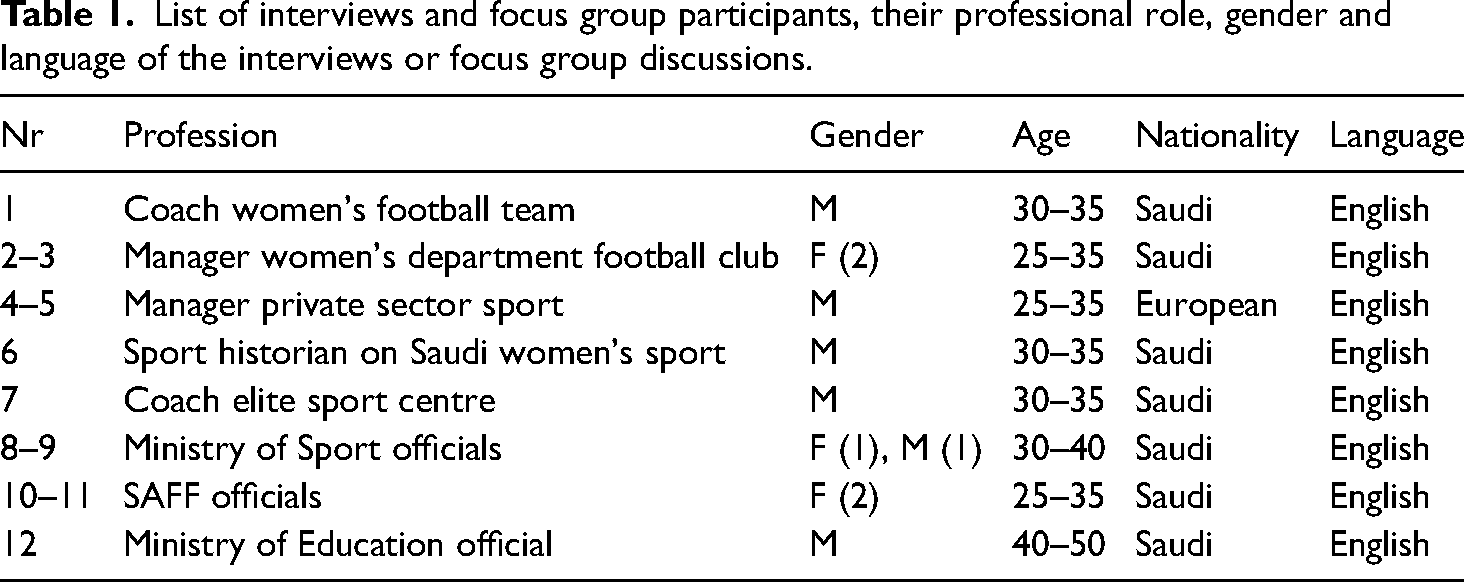
Interview topics encompassed the background of participants and entities they represent, their views on the most urgent issues in Saudi women's sports, their key opportunities and challenges and what strategies the participants use to reach their goals in the Saudi sports field. In addition, participatory observations were particularly valuable for unveiling aspects of a culture entrenched in unspoken rules, subconscious norms or topics considered taboo, providing insights that might be overlooked in explicit discussions. The ethnographic and interview data was supported by information gathered from Saudi Vision 2030 (2016), resulting in data triangulation that enriched the analysis.
Ethical considerations
After gaining approval from the Norwegian Centre for Research Data, I obtained authorisation to collect data from the LDI under the Saudi Ministry of Sport as well as a supporting letter from LDI for requesting interviews with potential interlocutors. Each participant gave their written consent before participating in the research. Unless otherwise stated, research participants were assured that their identities and personal statements would be kept anonymous (Kaiser, 2009). It is worth noting that not all participants agreed to be audio-recorded due to personal concerns.
Data analysis
The study sought to gain an in-depth understanding of the dynamics and nuances of women's sport from the perspective of those directly involved in official, management and coaching positions. Data were coded inductively through thematic analysis using the qualitative software program NVivo (Braun and Clarke, 2022) and grouped into the pillars of social inclusion by Donnelly and Coakley (2002). Reflexive memoing was employed consistently throughout the analytical process. As the sole coder, I recorded detailed memos following each coding session to document emerging analytical insights, interpretive questions and reflections on my positionality as a researcher. Codes included themes of sport across generations, role of family, pioneer leaders, sense of belonging, structure of sport-eco system, fragmentation, heritage, nationalism and governmental reform.
Limitations
The fieldwork has been primarily confined to the urban context, with limited engagement in semi-urban or rural settings. A further limitation of the study is that the study participants are comprised primarily of representatives of the middle and higher classes. Nevertheless, the most recent reforms in women's sports have been spearheaded by women who, due to their personal background, have been well-positioned to effect change and disrupt gender stereotypes and roles. This is primarily as a result of their education, familial background and societal status. Recent developments in the domain of women's sports have been observed to be increasingly aligned with elite sporting activities, which are primarily focused on a select demographic of the upper class, both within Saudi Arabia and on a global scale (Andersen & Bakken, 2018). It is acknowledged that the relationship between the researcher and the participants may have had an influence on the data collected. Many of the interviewees appeared to speak in official capacities that were aligned with institutional or state narratives. It is possible that they tailored their responses to reflect state-sanctioned views on women's empowerment through sport, especially within the framework of Saudi Vision 2030. Nevertheless, Saudi Vision 2030 has explicitly addressed the issue of women's rights, suggesting a probable positive response to the policy reforms. As Tripp (2018) and Thompson (2019) assert, critiques in autocratic states are articulated in indirect ways and interpreted through a subtle interplay of connotations and implications.
Findings
Data analysis revealed that the study participants referred to three overarching socio-cultural themes when discussing women's participation in sport and physical activity. Firstly, Sense of ownership and organic growth, which elaborates the importance of pioneer women, continuity and the sense of belonging in Saudi women's sport. Secondly, Fostering national socialisation, heritage and nationalism, which outlines presence and importance of Saudization, traditional sports and nationalism in Saudi sports, and thirdly, (Re)comprehension of sport's role and its implications, which discusses the particularities of introducing sport in multiple sectors, for example, health, entertainment, sport, demanding divergent behaviours from the respective target group. In summary, most of the interviewees shared experiences from both times before Vision 2030 and since its launch (Figure 1).
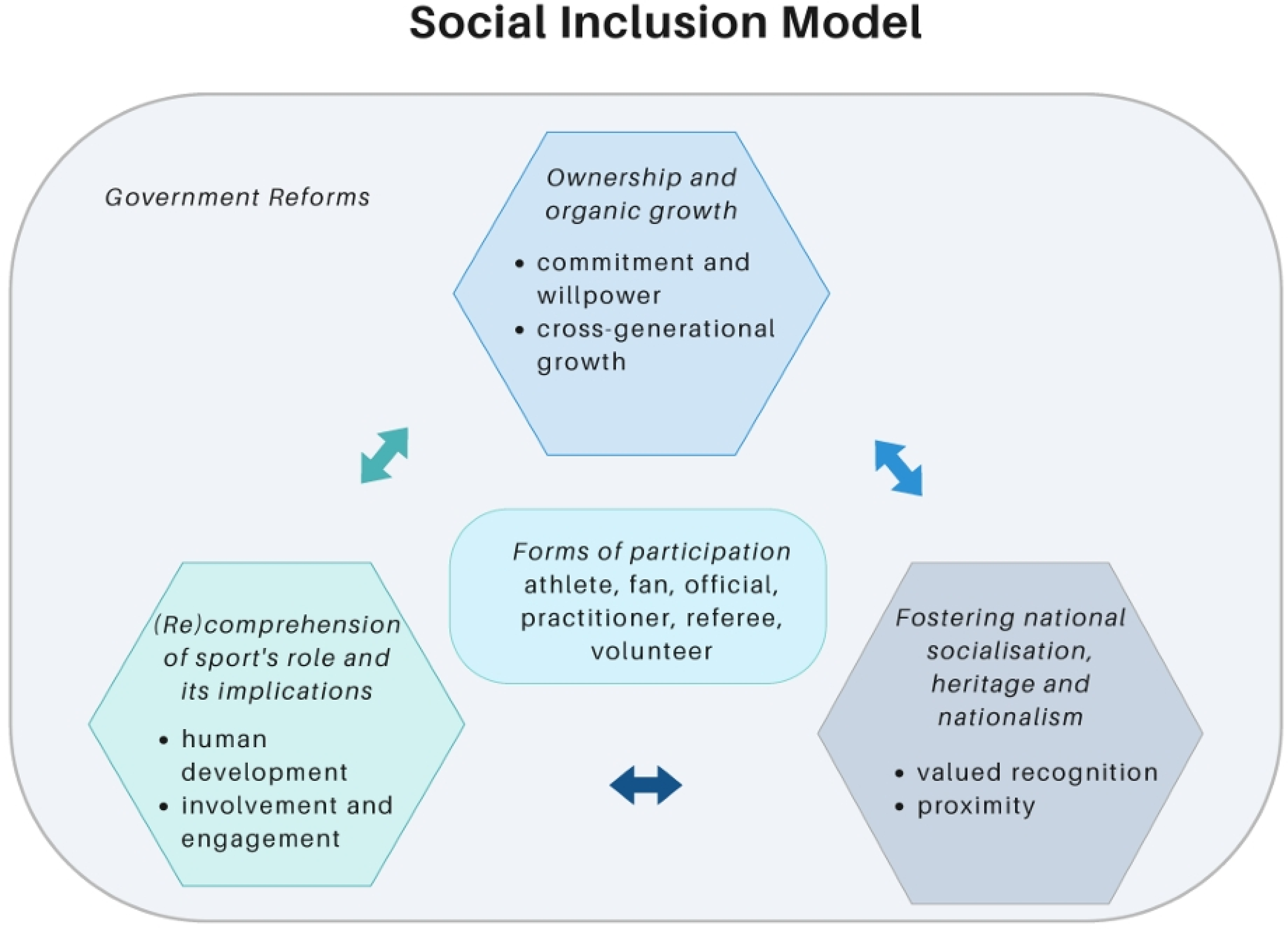
Model on social inclusion of (Saudi) women in and through sport (inspired by Donnelly and Coakley, 2002; Toffoletti and Palmer, 2015).
Sense of ownership and organic growth
As outlined in the previous pages, there is evidence that Saudi women have been playing football in Saudi Arabia since 2006 on a low profile, if not longer, particularly in the urban areas of Riyadh, Jeddah and Dammam. Similarly, universities introduced activities as part of the curricula or organized moderate physical activities for social causes, such as walks or runs to raise awareness for social causes. First, it is important to highlight that many of the women in charge for these activities in the past have been appointed for leadership positions within the Saudi sport ecosystem since 2017.
The current Head of Women's Department of the Saudi Arabian Football Federation described the first appearance of the Saudi women's national futsal team back in October 2019 in the 6th Gulf Cooperation Council Women's Games 2019 and how she has been incorporated into multiple roles, first from being a team player to also being the team manager. Let me tell you how it all begun. (…) When we were allowed to participate in this tournament, the first ever international appearance of the Saudi Women's Futsal National Team, I was a player. Adwa [Adwa AlArifi, today's Deputy Minister of Sport] asked me to also be the team's manager. So, I had two roles assigned. I did everything, I washed the bibs, I drove to the gas station to fill up the balls with air. (Head of Women's Department, Saudi Arabian Football Federation, Riyadh)
Similarly, the Director of the LDI, the educational arm of the Saudi Ministry of Sport, Dr Mezna Almarzooqi has been promoting women's physical activity in its early stages at a public university: After my studies abroad, when I was very involved in recreational sports such as running, I organised the first runs at a [replaced name] university in the Kingdom. Each run had a charitable cause, such as breast cancer prevention, and we collected donations. I tried to set up an NGO, but it was difficult. (Director of the Leadership Development Institute, Ministry of Sports, Riyadh)
Both quotes illustrate how women in leadership positions have played a pivotal role in the grassroots development of women's sport in the Kingdom. By taking on numerous responsibilities on the ground, they have now moved into roles where they are responsible for overseeing and directing these initiatives. Further, both women also reflected on the importance of encouraging and convincing women, and sometimes their families, to participate in these low-profile activities. The data suggests that women in the Saudi sports sector are highly resilient and persistent, having overcome significant barriers in the past and successfully pushed boundaries over time. It shows that the growth of women's football and sports has been driven by the ongoing and continuous efforts of pioneering women who have been advocating for sporting activities and opportunities long before the recent reforms under Vision 2030.
The following field note from a football session highlights that, alongside the continuity of women's sports, there is also a strong sense of belonging and ownership being fostered. This was emphasized by a coach during a session with a first division football team: The First Division team is about to kick off the league, the 2nd edition of the women's league, both Premier League and First Division. Many of the players have been playing for the last few years in unofficial settings and joined the first edition last year. They train three times a week and have high ambitions for the team and the club. The players have started negotiations with the club management about their wages. At the start of training, we gather in a circle and the coach tries to calm some of the resentment: ‘Ladies, you're making history. You're part of the generation that's making history, you're one of the first women to officially play in Saudi Arabia. You should be proud of yourselves’. (fieldnote)
Throughout my engagement with various teams and community groups, a strong sense of belonging was consistently observed. Teams represented in the Premier League by well-known clubs such as Al Nassr, Al Shabab, Al Hilal, Al Ittihad and Al Ahli were all originally community-based teams. It is also noteworthy that the majority of players remain within their community and, consequently, with their clubs, despite encountering difficulties and experiencing failure. The Al Riyadh team, which was promoted to the Premier League for the first time in the 2023/24 season, was unable to maintain its position and was relegated in the same year; however, most of the players chose to stay with the team.
As previously outlined, numerous interviewees reflected on their experiences both prior to and following the formal introduction of women's sports opportunities under Vision 2030. For instance, the CEO of the Saudi Universities Sports Federation acknowledged the initial absence of capacity and expertise when women's activities commenced in 2019. To address these challenges, they opted for a national, organic growth approach rather than relying on international inputs, introducing various degree programmes and traineeships into the curricula for students. Of course, when we started [in 2019], we would not have the number of referees and enough numbers of leaders, sports managers and so on. But now we do because we have colleges and sport sciences colleges and sport science academic departments that have a lot of female graduates. So, it was a temporary problem that we have overcome in a short amount of time compared to other countries because we have the resources. (Official at Saudi University Sports Federation, Ministry of Education, Riyadh)
As evidenced in the global football context, particularly within the Saudi men's league, Saudi sports entities seek to acquire expertise from international coaches and players. However, as underpinned by a Saudi women's football coach, stakeholders within the women's sports ecosystem place significant emphasis on personality, characteristics and social skills, as opposed to a narrow focus on technical abilities. This assertion is supported by the following dialogue: When I scout international players, I ensure they are leaders. They should be more than a player on the pitch, they should be role models, and share skills to the Saudi players, like discipline, like being on time, or the importance of the right nutrition and sufficient sleep. On the follow-up question How do you find out if a player is a leader?, he replied: I talk to them, meet them online, try to understand their values and personality. You can tell when a player is genuinely interested in coming to Saudi or only shows interest in the offer. (Head Coach, 1st Division Women's Team, Riyadh)
This quote underscores two fundamental tenets. Primarily, the promotion of sports is regarded holistically, transcending the confines of mere technical prowess and encompassing human development, health and social well-being. Secondly, it accentuates a mounting interest in professionalism, particularly in domains that show promise for enhancement but have yet to be tapped, such as the non-technical facets of football, which were overlooked in the nascent stages of development.
In line with Donnelly and Coakley's (2002) model of social inclusion, the pillar of Material Well-being – embodied by human resources and notable financial investments in enhancing women's sports infrastructure and recruiting international staff – has played a crucial role in rapidly establishing opportunities for women in sports under Vision 2030. However, these resources are seen as temporary measures in the broader scope of organic growth. Furthermore, the pillar of Involvement and Engagement underscores the importance of empowering individuals and ensuring their participation in decision-making processes that impact them and their communities, which was previously highlighted by Shahab and colleagues (2021). Women who have been integral to the organic growth of various sports or physical activities hold significant roles, and their first-hand experience with the challenges and their commitment ensure continuity and a strong sense of belonging. Therefore, it is essential to include women in decision-making positions to achieve the broader objectives related to sports in Vision 2030.
Fostering national socialisation, heritage and nationalism
Saudi Arabian society is very diverse and young. The General Authority of Statistics' (GASTAT) report of 2024 shows a total population of 35.3 million people, of which 55.6% are Saudi nationals and 44,4% non-Saudis (GASTAT, 2024). It must be noted that among the Saudi population there is almost gender equality in numbers, however, among the large part of non-Saudi, 77.2% are male. Further, 63% of Saudis were under the age of 30 according to a 2022 census. Among the young Saudi population, a high youth unemployment rate is prevalent, for example, with 16.15% in Quarter 3 of 2023 (General Authority for Statistics, 2023). In order to reduce this unemployment rate, Saudization, also known as Nitaqat, was introduced. This policy aimed at increasing the employment of Saudi nationals in various sectors to mitigate high rates of youth unemployment, which mandates that companies and enterprises employ Saudi nationals to a certain extent within their workforce (Lucien et al., 2023). In Saudi Arabia, sport is increasingly seen as a pathway to enhance employability, aligning with Saudization goals. International expertise is often brought in to help build structures around new policies in the sports sector. Coaches, managers and staff are viewed as ‘international experts’ paired with local ‘apprentices’ during periods of transformation. Recently, there has been a stronger focus on transferring knowledge quickly to Saudi counterparts, as indicated by the football federation's requirement for coaches to hold AFC licences (SAFF policy, 2023). To support this, SAFF offers AFC licence workshops for residents in Saudi Arabia. Additionally, there is an emphasis on having a significant percentage of Saudi nationals in the league, especially in the women's league, where the 2023/24 season allowed only four international players and two Saudi-born residents on the pitch. Each team in the Women's Premier League must have at least five Saudi players under professional contracts. Enhancing Saudization and national socialization are key pillars in Saudi (women's) sport policy. In order to accomplish sports participation in terms of numbers, Saudi sport entities take best practices into consideration, as indicated by managers in the field: In your school life, you obviously participate in sports, but as soon as you go out of school, you often drop out of the sports system. We work with a professor abroad who is basically specialized on closing that gap. How can you actually keep people in this place? (Manager Private Sector Sport, Riyadh) We always use benchmarks. We work a lot with international experts. (Manager Women's Department Football Club, Riyadh)
While including the international expertise one official of the Ministry of Sport underscores: Let me add something. We’re not inventing the wheel, we are aware of that and learn from best practices in other countries, in other parts of the world. However, whatever model we acknowledge as enabler in sport development here in the Kingdom, we always adjust and adopt it to our own traditions and customs. (Official, Ministry of Sports, Riyadh)
According to the official's understanding, the incorporation of traditional sports in events and the persistence of gender-segregated spaces (see Alruwaili, 2020), as well as customs such as the wearing of leggings by women in all official sports matches and events, highlight the emphasis of the country on maintaining Islamic culture and values (see Al-Khalifa & Al-Khalifa, 2022 on GCC countries). Elaborating on the pervasive issue of gender segregation in both public and private domains in Saudi Arabia, the assurance of gender-segregated spaces, which includes the closure for filming or photography, is of paramount importance. The importance of this private and safe space is emphasised in university sports: Why did we accomplish all these numbers of women participating in sport activities? It's because we play it smart. So, the conservative women would have proper environment for them to participate in sports. Isn't this the purpose of providing activities? If, for example, we do open environment with pictures and videos and stuff like that, 90% of the women would not participate. So, what we do, provide the proper environment that we have a high number of participants. (Official at Saudi University Sports Federation, Ministry of Education, Riyadh)
Whilst the phenomenon of gender segregation undoubtedly encompasses more conservative women and potentially engenders a greater degree of inclusivity across multiple performance levels, my utilisation of participatory observation also revealed an inclination to disrupt the established segregation. At a first division training session, where a futsal session was being held as the summer months approached. I had just arrived to conduct a focus group discussion when one of the coaches whispered in my ear, giggling slightly, if I wanted to stay and play against the men's team that was about to arrive. The hall was still filled with the junior/senior women's team, some mothers waiting for their daughters to change and leave the pitch. It was obvious that the senior players who wanted to stay were standing innocently by the side of the pitch, waiting for the junior players and mothers to leave before they re-entered the pitch. (fieldnote)
This data indicates that stakeholders negotiate in informal spaces the formalized gender segregation that is highly prevalent in formal organized sport. Similar observations align with the required attire. When attending football trainings in closed, private spaces, like schools, players often wore shorts. However, at official matches, they always wore leggings underneath the shorts. Another example from my fieldwork is the following: On another occasion at an embassy event, a female Ministry of Sport official was gathering with all participants in a very approachable manner in the lounge area before the event officially started, having the headscarf (hijab) laying over her shoulders. When giving a speech, the official put on the hijab just before she commenced speaking to the audience. (fieldnote)
This data demonstrates that certain customs and traditions are subject to negotiation and mediation at various levels, with the formal level of sport activities and events being predominantly influenced by these customs. It is noteworthy that, from my perspective as a researcher, none of the participants perceived these customs as limitations or restrictions. Instead, there was a sense of pride among all participants in adhering to and inheriting such national customs and traditions, particularly in public and formal settings. This phenomenon can be attributed to the demand for ‘moderate Islam’ and the ideal of being a good Muslim, both of which are significantly influenced by national pride. It is evident that nationalism and national identity play a substantial role in sports in Saudi Arabia. The day after Saudi Founding Day, we started the training by gathering on the pitch. One player brought a huge Saudi flag that she was waving in the middle of the crowd. We all loudly sang the Saudi anthem before training kicked off. (fieldnote)
This event highlights that national pride is very prevalent and embedded in Saudi Arabia. Similarly, a sports manager reported from an incident: When we were hosting a sport event in Hail, we faced a big backlash when a woman was portrayed in one of the advertisement videos. It was only for a few seconds Interviewer: Do you think they don’t want women participating in sports at all in the more conservative regions? They are not there yet. It's a process that takes time. However, they are supporting women's athletes representing Saudi Arabia abroad. Interviewer: Why? Because they are proud, they represent their nation, but they don’t want it in their own local area. (Manager Private Sector, Riyadh)
Despite the reported rejection to promote women's sport in the local area due to various reasons, the dimension of national pride gleams, which might shift perceptions in the local setting when Saudi female athletes showcase representation and success in international sporting events.
The identified pillar of social inclusion, Fostering national Socialisation, Heritage and Nationalism of women in Saudi sports, should not be necessarily regarded as gender-specific. Rather, it allows us to reflect on how certain customs and traditions in perhaps more conservative societies can be addressed in order to break down stigma, conservative attitudes and social norms and expectations that prevent a certain group from participating in sports. In the Saudi context, the advancement of nationals in the workforce across various levels in sports is paramount for identity formation and national socialisation, thereby fostering connections, for instance, between non-Saudi and Saudi players, or male and female sports management professionals. Moreover, data indicate that among groups that maintain an aversion to women's participation in sports, their perceptions undergo a transformation once these female athletes represent their nation. The utilisation of national pride and nationalism as drivers to address the perception of women's sports among groups that refuse such activities is a salient factor in this regard. Finally, while globalisation flourishes in the domain of professional sports, the Saudi government and its population place significant emphasis on certain customs and traditions, including dress code, gender segregation and traditional sports, with a view to ensuring the retention of the country's heritage. As outlined, Vision 2030 recognizes women, sport and women inside the sports sector. The valued recognition (Donnelly and Coakley, 2002) by Vision 2030 sets the ground for women empowerment and their inclusion in society. Meanwhile, centralized structures persist in the sport ecosystem (Svoboda et al., 2024), the society shows a great nation's pride, which acknowledges and promotes women to represent the country. This proximity to the nation and their own community fosters social inclusion (Donnelly and Coakley, 2002), as well as outlined previously a sense of ownership and organic growth.
(Re)Comprehension of sport's roles and its implications
In the contemporary discourse surrounding sports involvement and engagement, there is a burgeoning emphasis on empowerment and the provision of necessary support structures to enable individuals to actively participate in decision-making processes that impact not only themselves but also their families and communities (Donnelly and Coakley, 2002). This paradigm shift underscores the recognition of sports not merely as a recreational pursuit but as a vehicle for social and economic empowerment. Within this framework, sports serve as an avenue for skill development, fostering leadership qualities, teamwork and resilience, thereby enhancing the employability prospects of young Saudis. This section will discuss how the understanding of women's sport's role can be further broadened in order to enhance and expand women's participation in sports, on the case of Saudi Arabia.
When conducting interviews a very prevalent and re-occurring theme was the awareness and support of sport's benefits across generations, as well as the importance of family within the Kingdom. For instance, a large part of the Saudi University Sports Federation's activities includes awareness-raising activities in public spaces: Half a million people participate in our programmes. A good percentage of them are families. We even go to malls. This is us going to malls, doing some testing, some activities, awareness, everything. (Official at Saudi University Sports Federation, Ministry of Education, Riyadh)
Yamani (2000) highlights the unique and vital role of mothers in Saudi Arabia. A sport historian illustrated the significant role of mothers on girls during this historical event: Dalma Rushdi Malhas was the first Saudi woman to participate in an Olympic event, in the Youth Olympic Games in 2010 in Singapore. She competed in show jumping and equestrianism. Her mother was an athlete herself and has been a driving force in supporting her daughter to reach this level. (Independent Sport Historian, Riyadh)
The 2010 event, with the prospect of the 2012 Summer Olympics, sparked national debates about whether the country would permit and officially support women's participation in major events. Shortly before the 2012 Olympics in London, the Kingdom formally announced that women would be participating in the Games, showcasing the first governmental shifts in terms of international participation of Saudi women.
The significant role of mothers remains crucial today. Managers who either facilitate after-school activities or consult in governmental strategies reflected on: When we offer after-school sports, the mothers come to the coaches and ask, ‘what is the plan for today?’. We say we don't know yet, we give the children several options and let them decide. They (the mothers) don't like that answer. In order to develop women's sport in KSA, the education of mothers is very important. The mothers are mainly the ones who bring the girls to the activities, and it helps a lot if they understand the concept of sport and physical education. Of course, the fathers are also important, but when it comes to girls, the education of mothers is essential. (Manager Private Sector, Riyadh) For example, women around their early-mid-thirties are an important target group for us, as they have direct impact on their young children. When we achieve to increase their activity level, we have also an impact on the numbers of children who are active. (Manager Private Sector, Riyadh)
These quotes also underpin how parents perceive sport primarily as a source for formal education, less for joy and recreation for their daughters. The interviewee stressed the necessity to educate or involve parents to change perceptions on the asset and value of female participation in sport. Another approach to increasing family involvement is the promotion of fan engagement, which was outlined by the Head of Women's Football Department at SAFF: The next milestone for us (in the SAFF women's department) is to increase fan engagement. We need to bring the families into the stadiums, organize meet-and-greets with the players, and offer programs for all family members, the parents, siblings, and children. (Head of Women's Department, Saudi Arabian Football Federation, Riyadh)
Beyond the aspect of promoting sports across generations, there was also a high emphasis on pathway development and how to involve one individual throughout a lifespan to actively participate in sports: I think there is definitely a huge passion for sports [in Saudi Arabia]. But it's often not the passion in terms of participation, it's just observing, consuming sports. And they're still facing a challenge of translating that. How do you translate a consumer into participating? […] There is a lack of understanding in the Saudi sports sector how participation connects to performance. It's a dual pyramid. What the national sports strategy outlines now is a really good blueprint on how you develop the sports sector, but it misses that point of pathway, pathway framework. So, who are the stakeholders that are playing a role in a certain stage of life, where you enter sport, where you exit sport, where you re-enter sport. And that is also then translated into one of the other problems is it's a very fragmented stakeholder landscape. (Manager Private Sector, Riyadh)
The rapid growth of sports in Saudi Arabia, particularly in the domain of women's sports, has precipitated numerous shifts and enhancements in terms of numbers of participation, facilities and programmes over a comparatively brief period. Nevertheless, this phenomenon has concomitantly given rise to a fragmentation within the sports system, a circumstance that may result in deficiencies in certain areas. Due to the prevailing gender segregation, a significant proportion of officials, managers and coaches are female, thereby increasing the participation of women in these activities. This phenomenon is particularly pronounced among prominent sports entities, such as the national sports federations, where a significant proportion of managerial and supervisory roles are held by women. However, a sports manager has highlighted the persisting presence of a notable disparity: The only really missing gap, and that's not a fault of the government, is coaches, female coaches. So, to really get now female participation to the next level, you need more female coaches. And actually, women that consider sport as a career in the technical sense, not working in the ministry, not working in the Olympic Committee or the Federation, it's actually the coaching aspect. Because there's still, in Riyadh it might not be a problem, but in most of the other areas of Saudi, if you don't have a female coach, then women will not go to training. So really the push for female coaches across all schools, that's a very important missing stepstone at the moment. (Manager Private Sector, Riyadh)
The findings suggest that awareness of the benefits of sports participation – whether as an athlete (improved health), fan (community connection) or coach (technical career) – is still developing in Saudi society. Fan engagement, particularly among women in women's sports, is a new concept and could be enhanced by involving families and targeting women of all generations. This supports Hargreaves’ (2000) assertion that the diversity of Muslim women and the circumstances that influence their participation must be recognised. The shortage of female coaches, especially outside urban areas, highlights the need to integrate coaching roles into institutional curricula, such as university programmes. This contrasts with the athlete context, where a shift in perception is needed – from viewing sport as a commodity to recognising it as a tool for health development (see Al-Hazzaa & Almarzooqi, 2018), women's empowerment and life skills. These changes could foster a greater sense of belonging and ownership, contributing to a broader sense of community affiliation and a unique national movement.
The various factors contributing to the social inclusion of women in sports are illustrated in Figure 1, drawing on Donnelly and Coakley's (2002) model of social inclusion and Toffoletti and Palmer's (2015) argument for broadening the concept of sport participation.
Conclusion
The case of Saudi Arabia offered a unique and unprecedented example of transformation, particularly in women's sport. The shift from minimal participation to a highly ambitious and expansive women's sports sector is taking place on a considerable scale, affecting multiple levels of Saudi society. This study provided a rare opportunity to examine the dynamics of large-scale transformation in a way that is not typically possible in other contexts. By delving into the intricacies of this transformation, the research provides valuable insights not only into the specific case of Saudi Arabia but also into broader processes of gendered reform and societal change.
Theoretically, this research critically adapted and applied social inclusion as an analytical concept in sport participation research, specifically to identify socio-cultural factors that influence women's sport and physical activity in Saudi Arabia. This was done for three main reasons: (1) it avoids limiting (Orientalist) categories such as the deficiency model and highlights universal trends such as human development and increasing work opportunities for women in sport; (2) it goes beyond oversimplified views of marginalisation and gender inequality to address issues such as intergenerational participation and coaching capacity, which are crucial for women's sport development; and (3) it refines the definition of social inclusion by extending Donnelly and Coakley's (2002) categories and focusing on ‘throughputs’ to social inclusion (Schaillée et al. 2019; Coalter, 2007). This concept offers valuable insights for future empirical work, potentially addressing questions such as how women in other contexts experience factors affecting their participation in sports.
Empirically, this study makes a significant contribution to the debate on women's sports participation in Saudi Arabia by identifying the socio-cultural factors that influence women's participation in sport. Women's participation reflects the complex interaction of state policies, socio-cultural norms and evolving identities. Previous studies, such as Al-Othman Al-Haidar (2004), highlighted the tension between traditional societal expectations and liberal views on women's sport, although this conflict has diminished in Saudi Arabia due to the active role of the young population in driving social change. Factors such as continuity, national pride and belonging are encouraging the organic growth of women's sport. The progression of Vision 2030 builds on the women's sports movement prior to 2016. In line with Al-Khalifa and Al-Khalifa (2022), this study emphasises national and internal motivations for promoting women's sports, suggesting that viewing sport as a tool for human development rather than a commodity may increase participation. National socialisation, heritage and overcoming resistance in rural areas are key to growth, although fragmentation in the sports sector remains a limiting factor. The interplay of the identified domains of social inclusion, ownership and organic growth, fostering national socialisation, heritage and nationalism, and (re)comprehension of sport's roles works reciprocally.
In conclusion, this research notes that some developments have been rapid, while others take more time, a pattern seen in other sectors such as the sector of arts (Proctor and Al-Senussi, 2024). This interplay of fast and slow social change is important for policymakers to understand, as it may help them to identify areas where change is happening more quickly or slowly, enabling them to address neglected areas or societal groups. The data further suggests that an intergenerational approach and a broad understanding of sport participation could benefit policy design, attract women from diverse backgrounds and provide low-threshold opportunities for sport participation in Saudi society.
Footnotes
Data Availability
All data is provided within the article.
Declaration of Conflicting Interests
The author(s) declared no potential conflicts of interest with respect to the research, authorship, and/or publication of this article.
Funding
The author(s) disclosed receipt of the following financial support for the research, authorship, and/or publication of this article: Ethical Approval was attained by the authors for human subject research by the Norwegian Centre for Research Data.
