



Abstract
Since 2018, video assistant referee (VAR) has rapidly been implemented in men's elite football across Europe, the Americas, and Asia. VAR is to a lesser extent implemented in women's football. As football is a highly gendered field, where men primarily referee men's matches and women referee women's matches, this study examines in what ways the implementation of VAR in elite football refereeing is gendered. The analytical framework is a Science and Technology Studies (STS)-informed approach, combining domestication theory with gendered technoscience. Methodologically, the study is based on fieldwork of the VAR training of Norwegian elite referees throughout 2022, ahead of the implementation of VAR in Norway in 2023. The findings show how the implementation of VAR works to the advantage of some referees (men) while disadvantaging others (women). Men and women in elite football refereeing are affected differently by the implementation of VAR, in two pivotal ways. First, a more demanding workload due to the implementation of VAR works to increase gendered aspects of workload which affects women referees. Second, gendered differences in elite refereeing recruitment are amplified by the implementation of VAR, marginalizing women referees to a larger extent than before. The analysis demonstrates the gendered tensions and negotiations of implementing VAR in Norwegian elite football, and how it creates barriers for women referees. Ultimately, this article shows how technological innovations in sports often imply gendered consequences that work to disadvantage women.
Video assistant referee (VAR) has been a part of international elite football since being included in the laws of the game in 2018/19 (FIFA, n.d.). Since then, VAR has expanded to a multitude of leagues around the world. For instance, of the European Football Association (UEFA) top 30 ranked national leagues in men's elite football, only Sweden has rejected implementing VAR (Rumsby, 2024).
Formally, the purpose of VAR is to minimize ‘clear and obvious’ errors related to four key situations: (a) goal/not goal, (b) penalty/not penalty, (c) possible red cards, and (d) mistaken identity (if the on-field referee gives a card to the wrong player) (IFAB, 2023). The VAR system consists of a minimum of one VAR referee, an Assistant-VAR-referee (AVAR), and a Replay Operator (RO), located off-field in a VAR facility. The VAR role is attributed to individuals acting as on-field head referees, usually in the same division as VAR is used. AVAR is usually on-field assistant referees in the same division. Refereeing (on-field or in the VAR room) in games with VAR is crucial for referees who aspire to an international refereeing career. However, head referees should act as VAR, not AVAR, to improve their chances of refereeing internationally, where increasing demands of accuracy in refereeing are a constant discussion. Thus, implementing VAR is framed as a measure to help get rid of bias in refereeing. For instance, it helps reduce biases favouring teams playing in their home ground (home advantage) (Rogerson et al., 2024).
However, while VAR is supposed to reduce bias in refereeing, technologies come with their own inherent bias, for instance, bias by omission (Skitka et al., 1999) or categorization (Kordzadeh and Ghasemaghaei, 2022). Therefore, technologies like VAR are not objective or neutral, given they are developed by someone, for someone (Fox et al., 2006). Consequently, technological systems always work to the advantage of some, while disadvantaging others. Studies show that those advantaged are most often men (Hilbert, 2011; Wajcman, 2010). The increasing use of technology in football takes place in a refereeing context where gender differences are evident, for instance in terms of representation (Reid and Dallaire, 2019), abuse (Grubb et al., 2023; Webb et al., 2020) and lack of organizational support and career opportunities (Kim and Hong, 2016; Reid and Dallaire, 2019). This double binding disadvantages women in terms of engagement with technology, but also in other organizational aspects such as payment and recruitment. Therefore, it is reasonable to believe that implementing novel technology will affect men and women referees differently. This article aims to examine this in Norwegian elite football, from a gender perspective.
The case of Norway is fruitful for the study of the gendering of refereeing technologies for two reasons. First, VAR was recently implemented in Norwegian football, opening possibilities for examining implementation as it happens. Second, the paradoxical situation of gender equality in the Nordic context, which is also relevant in refereeing. Although ranked as one of the most gender-equal countries in terms of, for instance, education, work life and civil rights (WEF, 2019), the underrepresentation of women in football refereeing persists in Norway, where nine of 40 elite head referees are women (Roksvåg, 2022). Further, there are significant gendered differences in working conditions, although no elite referees in Norway are full-time referees. For instance, head referees in the men's elite are paid four times more than in the women's elite division (Arntzen, 2019), and currently, no women act as head referees in the men's elite (Roksvåg, 2022). Additionally, and pivotal for this study, the men's elite division is the only league in Norway with VAR, used from the 2023 season (Nettavisen, 2021). The decision not to implement VAR in the women's elite division illustrates a global developmental trend where the expectations are for women's football to grow, yet with inferior conditions and institutional support (Culvin and Bowes, 2023). With the increasing professionalization of women's football in various countries, more scholars have turned their attention to how different aspects of professional football are gendered and how it often differ across national contexts. For instance, in the case of Norwegian women's football, Skogvang (2006) argues that the process of professionalization developed through four phases: from show matches in the 1920s, to the struggle for inclusion in national associations in the 1970s, increase in popularity including international successes with the national team culminating in a World Championship title in 1995, to the establishment of an elite national league for women in 2007. Still, significant disparities in conditions and resources – such as access to club and medical staff, full-time player contracts, and media coverage – persist between men's and women's football in Norway, with the introduction of VAR being the latest example.
The implementation of VAR in Norwegian elite men's football has led to a need for more referees per match 1 (Øgår, 2022). To be promoted to the men's elite division, women referees must officiate lower-league men's football in addition to the women's elite division. In contrast, men only need to referee lower-league men's football to advance within the men's system, and those officiating in the men's elite division are not required to referee in the women's elite division. This demonstrates a gendered division of labour and a hierarchy where the men's elite division is considered more prestigious to referee compared to the women's elite division. These mechanisms are expressions of an established set of cultural practices, rather than formalized policies and regulations. As it is a requirement to be a head referee in the men's elite division to act as VAR referee, which currently is a role exclusively undertaken by men, it becomes relevant to examine the intertwining of gender and technology in Norwegian elite refereeing.
This article examines the intertwining of gender and technology in Norwegian elite refereeing, using video assistant referee (VAR) as an empirical case. Specifically, the research question explored is: In what ways is the implementation of VAR in Norwegian elite football refereeing gendered?
In the following section, I present research on technology in sport and VAR in football, and gender and refereeing in football. The analytical framework utilizing the concept of domestication is then outlined. Further, the methods section describes how the field work was conducted. Lastly, the analysis of the empirical material is discussed before I present some concluding remarks and suggestions for further research.
Literature review
Research examining football refereeing, gender and VAR is lacking. However, there are two relevant research fields for studying what ways the implementation of VAR in Norwegian elite football refereeing is gendered: (1) sports technology, VAR and football, and (2) gender in football refereeing. First, I present research on technology in sport and VAR in football, before presenting research regarding women in refereeing.
Sports technology, VAR and football – gender blind research fields?
Sports technology is a well-established research field (Luczak et al., 2020; Pino-Ortega and Rico-González, 2021; Robertson et al., 2023). Much of the literature is situated within medical sciences (Powell et al., 2021; Rigamonti et al., 2020), engineering (Cooper and De Luigi, 2014; Shalaby and Saad, 2020) and IT and computer science (Novak and Novak, 2021; Richter et al., 2024). However, studies are often conducted in men's elite sports. In part, this is due to technologies requiring significant economic resources, and the commercialization gap between men's and women's elite sports (Cardinale and Varley, 2017). When studies do include women's sport or women, most grant little attention to the relationship between gender and technology (Fox et al., 2006). In other words, there are few sociological investigations of the gendering of sports technologies such as VAR (Tjønndal, 2023).
Although there are few sociological studies, the relationship between technology and gender in sport is not completely overlooked (Cole, 1993; Fouché, 2012; Jönsson, 2010). For instance, the feminist technoscience tradition often related to Haraway's (1991) concept of the cyborg has worked to illustrate how science, technology and gender are pivotal for the understanding of women's experiences in sport (Henne, 2020). Henne also argues that although feminist analyses of technology in sport exist, they are limited (2020). The same can be said of research regarding VAR: There is a lack of studies examining how the implementation of VAR may impact gendered power relations in refereeing (Skirbekk, 2024).
Previous research regarding VAR has focused on the improvement of referee decision-making. Many of these studies are quantitative and investigate how the implementation of VAR impacts the outcome of refereeing decisions (Errekagorri et al., 2020; Han et al., 2020; Lago-Peñas et al., 2019; Spitz et al., 2021). Of these, most conclude that even though the number of certain outcomes increases or decreases, VAR's overall impact on refereeing decisions is minimal. While investigating VAR's impact on referee decisions is important, these studies do not contribute to the understanding of how referees learn, use or experience VAR. Collins (2010, 2019) has argued that the implementation of VAR changes the nature of football and that VAR might challenge the authority of the on-field referees and impact decision-making. For instance, notions of accuracy are contested, and situations can have different outcomes depending on the individual referee's judgement (Collins, 2019), which implies challenges when concluding what to penalize.
Further, since VAR decisions prolong decision-making (Collins, 2010, 2019), concerns regarding the ‘flow of the game’ affect how supporters experience VAR (Fisne et al., 2021; Hamsund and Scelles, 2021; Scanlon et al., 2022). For example, Hamsund and Scelles (2021) study in the British Premier League found that fans were generally positive about VAR but concerned with the excessive time spent concluding decisions. Following Scanlon et al. (2022), fans felt that VAR changed the game to the extent that ‘it's not even football anymore’ (p.1084). These findings illustrate how experiences of technology are embodied. Currently, VAR research appears gender-blind, both regarding the lack of women and women's sport in research, and the relationship of gender and technology being overlooked. Thus, there is a need to examine the complex dynamics between the increasing implementation of VAR and gendered aspects in elite football refereeing.
Gender and football refereeing
Concerning refereeing and gender, studies often focus on women's experiences as football referees in a male-dominated profession (Jones and Edwards, 2013; Kim and Hong, 2016; Reid and Dallaire, 2019, 2020). Studies emphasize gendered barriers women experience as referees, for instance being subjected to sexist abuse, especially when refereeing men's football (Jones and Edwards, 2013). Abuse is experienced by both men and women referees (Webb et al., 2021), but women are often the target of abuse related to being women referees (Grubb et al., 2023). Following Jones and Edwards (2013), organizational policies perpetuate beliefs of women referees as being different from men when it comes to skills and performances. In turn, this influences barriers such as economic reimbursement, career opportunities, and lack of organizational and peer support.
Kim and Hong (2016) discovered women referees in South Korea tend to quit refereeing due to negative attention. Negative attitudes happen in an environment where women referees experience a lack of peer- and organizational support, especially in work-family conflicts regarding pregnancy and childcare (Kim and Hong, 2016; Wicker et al., 2024). This often results in having to choose between refereeing and private life in ways not needed by men refereeing. In Canada, women experienced similar challenges, fortified by there being few women referees (Reid and Dallaire, 2019, 2020). Introducing VAR within these circumstances causes difficulties if organizations do not take into consideration the inherent biases of technology and technology implementation. For instance, women are underrepresented in sport science data, leading to biases related to what is often called the sex data gap (Cowley et al., 2021). Another example relates to the dominance of men in the sports tech industry, where women are seldom involved in the development of novel sport technologies (Sigurꝺardóttir. 2019).
Analytical framework
The analytical framework in this study is based on the Science and Technology Studies (STS)-tradition. In this section, I shortly introduce STS before explaining the concept of domestication (Lie and Sørensen, 1996).
The STS tradition is a sociotechnical perspective claiming there is no objective data or technology, allowing nuanced explorations of how technologies are used in various contexts (Ask and Søraa, 2021). Thus, technology is socially constructed and perceived as a social actor (Sørensen, 2005). Though technologies may not consciously ‘think like human actors’ they communicate and affect society through conveying values of what is normal and not normal (e.g. standard settings of devices), wanted and unwanted, thereby supporting or hindering certain ways of doing (Ask and Søraa, 2021: 52). The interplay between what technology can do, and how it is used, displays covered meanings in our understandings of gender and technology (Ask and Søraa, 2021), which can vary depending on the situation and actor (Akrich, 1992, Skjølsvold, 2015: 19). Examining interpretation, use, context and the intertwining with gender is crucial to prevent gender differences being reproduced or amplified by the implementation of technology. Therefore, I combine domestication with elements of feminist technoscience research tradition to enable an analysis of the intertwining of gender and technology.
The intertwining of technology and gender largely departs from feminist technology studies and the feminist technoscience tradition which argues that gender and technology are continuously constructed in relation to each other. The feminist technoscience tradition is multifaceted and allows for different understandings of how the relationship between gender and technology is created, experienced and upheld (Berg and Lie, 1995; Fox et al., 2006; Haraway, 1991; Lie and Sørensen, 1996; Wajcman, 2010; Wajcman et al., 2020). For instance, the works of Haraway (1991) and Barad (1998) make for different approaches to gender and technology than Lie and Sørensen's domestication (1996) or Wajcman's gendered technoscience (2007). Berg and Lie (1995) contend technology is gendered by being designed and used in gendered contexts and illustrate how women do not necessarily interact with technology in a similar way as men. Further, digital technologies have been shown to affect gender relations and contribute to discrimination of women in society (Fox et al., 2006), allowing for what Hilbert (2011) calls a ‘digital gender divide’. For instance, Fox (2006) demonstrates how the profession of engineering is the centre of development and application of technology while being the most male-dominated profession in the United States, contributing to creating structures where gender differences occur in participation, sector of employment, field, and rank. Consequently, technology is designed by and for men (Fox et al., 2006), causing technology to be largely associated with men and masculinity (Wajcman et al., 2020).
Therefore, technology is gendered causing a need to explore how gender and technology are simultaneously negotiated and constructed. In this article, I draw on Wajcman and her work emphasizing the fluidity of the gender-technology relationship, and her argument that it is feminist politics (not technologies itself) that is the key to achieving gender equality (Wajcman, 2007). Implementing novel technology causes instability (Ask and Søraa, 2021), tensions and negotiations which could challenge gendered power relations and foster social change (Haraway, 1991; Wajcman, 2010). A theoretical concept permitting the study of these tensions and negotiations is domestication.
Domestication
Within STS, domestication is a concept concerned with how learning and using technology happens through the enactment of both individuals and technology (Skjølsvold, 2015). Through complex negotiations between human and non-human actors, technologies are ‘tamed’ and become an integral part of everyday life (Berker et al., 2005). In the case of Norwegian football, actors could be referees, VAR instructors, the VAR protocol, the Norwegian Football Association (FA), players, managers, fans, FIFA or the VAR certification. Pivotal for successful domestication is that technology is experienced as meaningful in the given context (Sørensen, 2005). For instance, controversies regarding VAR in football concern many fans experiencing the disruption to the ‘flow of the game’ is too immense, while FIFA perceives and legitimizes VAR as meaningful through being a possible solution for reducing errors in elite football (FIFA, n.d.).
This article is inspired by Ask and Søraa (2021) who argue that the point of departure regarding domestication should be ‘that what happens during implementation, what is changed, how it is changed, who initiates change and what stays the same—as well as changes that were not planned’ (p. 22). Specifically, domestication is made up of three dimensions (Lie and Sørensen, 1996). First, the practice dimension relates to how habits and patterns of use are changed and adapted when domesticating new technology. Such as, which tasks are created or changed? How often, where and when are tasks carried out? Second, the cognitive dimension is dedicated to what (types of) knowledge one has or is required to have, and how knowledge is developed and transferred between users. For instance, what formal and informal coursing takes place? Who gets to be part of knowledge-transferring networks? Last, the symbolic dimension seeks to explain how technologies are interpreted, understood, and assigned meaning through the values and meanings part of using the technology. For example, is using technology voluntary, or forced upon actors? What is the experienced purpose? These three dimensions are not linear, rather they are intertwined (Ask and Søraa, 2021). So, the knowledge (cognitive) of a certain technology, affects its use (practice), and in turn how the technology is understood (symbolic). At the same time, interpretation (symbolic) impacts how and what knowledge an actor has (cognitive), which affects how the technology is used (practice).
Methods
This section outlines the methodological approach of the article. Additionally, a description of the analytical approach and ethical reflections follows.
Fieldwork
My fieldwork is influenced by the ethnomethodological perspective (Heritage, 1984) and interactionism (Järvinen and Mik-Meyer, 2005). I consider this a fruitful approach for investigating how referees and the Norwegian FA handle the implementation of VAR because it allows insight into how actors position themselves, create social order and construct their social identities in interaction with others in a situational constitution (Heritage, 1984). Since social order is produced through utterances and conversation by being recognizable and accountable, the attention is not merely on whatactors utter, but also on what actors do when uttering something. In other words, how social order is produced through actions (utterances) is understood as interactionally meaningful (Järvinen and Mik-Meyer, 2005). Meanings and experiences are affected by the researcher's position within the context's institutional and material frames. With this in mind, I aimed at an ‘apprentice role’ 2 in the field (Wadel, 2014: 41). This means taking on a role as someone who wants to learn about practices, structures and relations in the field. The role allows the researcher to ask naïve and sometimes blunt questions, serving as a fruitful approach to get insights that participants often find self-explanatory (Wadel, 2007).
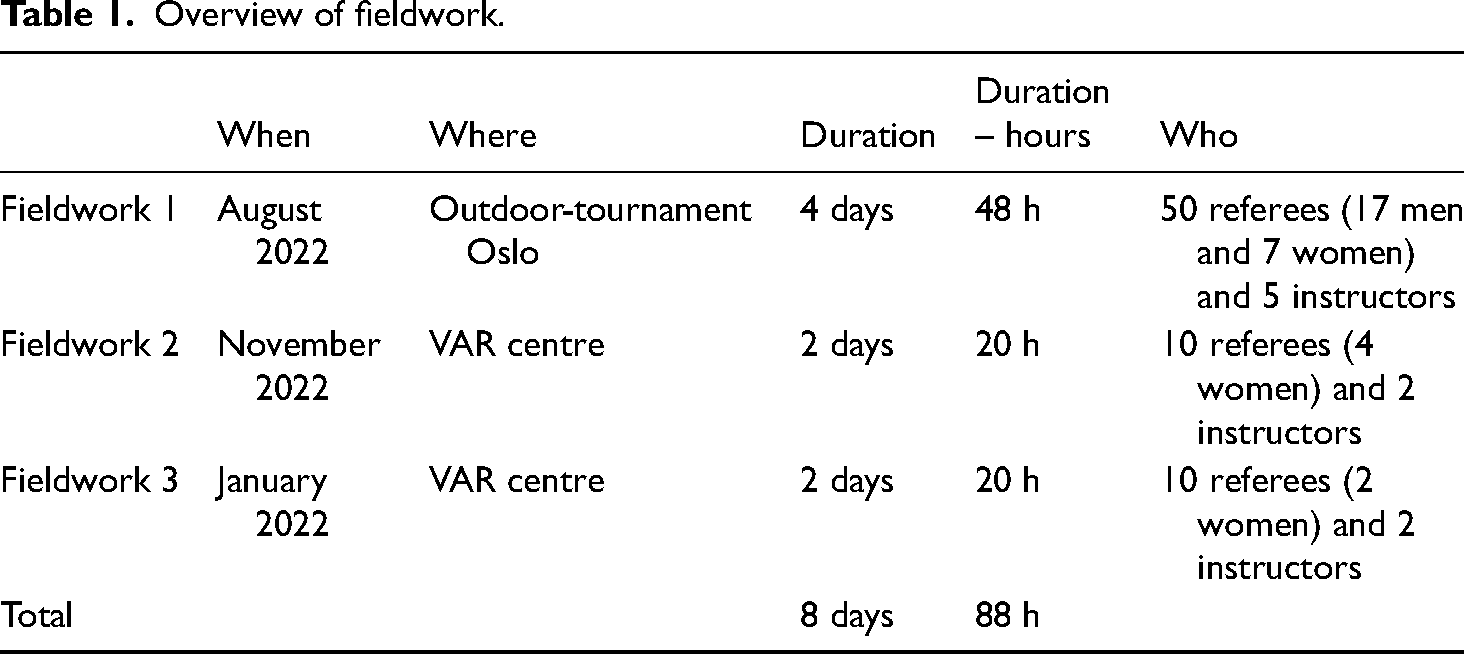
I conducted fieldwork of VAR training at two different locations, at three different dates, with the same group of participants (Table 1). Fieldwork began at eight in the morning and ended at roughly eight in the evening (fieldwork 1), and nine to seven (fieldworks 2 and 3). The first location was an international outdoor youth football tournament. By the pitch was a tent sizeable for 20 referees and a camera crew when on breaks. Thirty meters away was the VAR bus, with two VAR stations operating simultaneously. The second and third fieldwork happened at a new office-like VAR centre in Oslo, consisting of eight VAR stations and a lunchroom. Below is an overview of the fieldwork:
Overview of fieldwork.
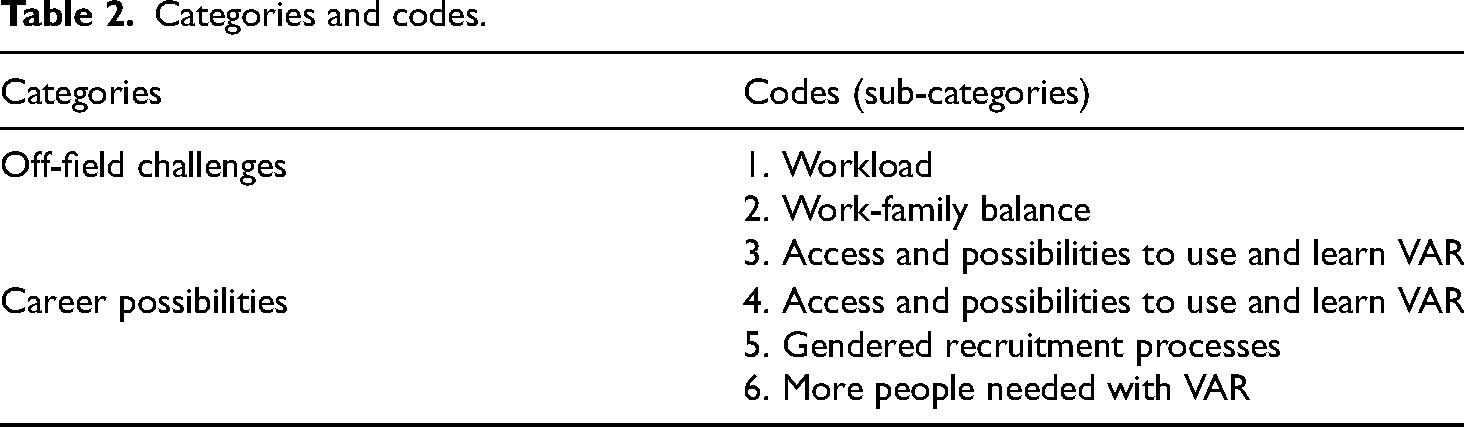
Categories and codes.
Participants
The participants are elite referees and instructors chosen by the Norwegian FA to be part of the VAR education in Norway. The group consist of 50 elite referees, of whom 10 are women, and five instructors. My criteria for including them were: (1) they are elite football referees and instructors, and (2) they took part in the VAR training. During the first fieldwork, 25 were present the first two days and the remaining 25 the last two. Additionally, all five VAR instructors present were men. Due to a hectic schedule, I did not get to speak to all the referees undergoing VAR training. The referees circulated between being on-field referees, VAR referees (in the VAR bus) and having breaks. At the VAR centre, the group consisted of four women and 13 men (fieldwork 2), and two women and eight men (fieldwork 3), while two men were instructors in both gatherings. All referees were 20+ years old, with the oldest ones being 40+. None were full-time referees but had other professions within a range of public and private sector positions, thus needing flexibility from their employers to facilitate refereeing. All had at least 3 years of college degree, and most had a partner and/or children.
Analytical approach
The analytical approach chosen is collective qualitative analysis (Eggebø, 2020), which aims to develop an understanding of empirical material collectively through four steps. The first step is working through the material by presenting abstracts of text to each other. For my colleagues to be able to do this I began transcribing field notes from my notebook to a Word document. Next, the field notes were read by me and two colleagues. Then followed step two, mapping data (Eggebø, 2020), which includes coding and categorizing (Bratberg, 2014). We then discussed and constructed possible themes and topics, before sorting these, which is step three (Eggebø, 2020). The fourth step is to make a disposition and outline a work plan (Eggebø, 2020). This process resulted in the construction of four main categories: (1) on-field challenges, (2) on-field opportunities, (3) off-field challenges, and (4) career possibilities. In this article, off-field challenges and career possibilities are the focal points. The main categories are presented below:
Ethical considerations
Ethical approval was given by the Norwegian Centre for Research Data (Sikt) ahead of the fieldwork. On-site I explained the purpose of the project, stressed that they could inform me if they did not want field notes written about them or their actions, and assured anonymity in any published material. I also stressed their anonymity for ‘internal’ reasons as the participants have great knowledge of each and there is a need to protect them from being identified by each other (Røthing, 2002). Hence, individuals represented in the analysis are constructed based on a combination of quotes and characteristics from several participants. Further, individuals appear in situations constructed with a similar strategy combining all three fieldwork. This approach is what Thagaard (2010) calls ‘symbolic replacements’ (p. 224). Søndergaard (1996) have used a similar approach where multiple names present quotes from a single participant, to make it harder to identify others in the group. Symbolic replacements can be a fictional individual (name, age, work made up or combined) presenting a quote where multiple participants have expressed similar utterances.
Analysis
The analysis is divided into three thematic sections showing how the domestication of VAR entails: (1) VAR and referees: an ambivalent affair, (2) gender, VAR and refereeing workload and (3) legitimization of gendered recruitment processes in elite football refereeing.
VAR and referees: an ambivalent affair
Implementing VAR poses new possibilities and challenges for referees. This became apparent through my fieldwork, as illustrated in situation 1: Situation 1: I, Mandy and John (referees), and Barry (instructor) are having lunch after a VAR test match. We discuss how VAR will change the refereeing role. John: ‘If I don’t make it as an international referee I could be a VAR-referee instead. But of course, everybody wants to referee on-field as much as they can’ Researcher: ‘Could this mean there is a “shorter” path to elite refereeing?’ Mandy: ‘Yes, and there is a need for more referees…You could even be a VAR-referee while injured. Or maybe even during pregnancy!’. Barry adds that this implies new requirements: Barry: ‘But it demands a lot of training, also outside the pitch. Media-training will be a part of the refereeing role. Otherwise broadcasters will bring in other kinds of experts to evaluate VAR. And us’. Barry smiles mentioning “other kinds of experts”. John: ‘That might challenge the referees’ authority! It must be us explaining situations, not apologizing’.
Situation 1 shows how VAR implies new career opportunities, but also extra tasks and uncertainty. John goes on to explain that VAR might change referees’ ambitions towards acting exclusively as VAR referees. This expresses how some referees understand VAR as a new career path and changes the refereeing role in terms of there being a new role: VAR referee. Changes also appear with the need for media training and challenges of referees’ legitimacy. This underscores the argument that technology and individuals transform each other in domestication processes (Lie and Sørensen, 1996). Even though John and Mandy argue that VAR implies possibilities, VAR might also entail aspects not wanted by the referees, such as acting exclusively as VAR referees. Thus, the practice dimension (Ask and Søraa, 2021) of domestication legitimizes VAR as a possible career opportunity, even though John says that ‘everyone wants to referee on-field’. This can be understood as making sense of a situation of uncertainty, as John is unsure whether he will make it internationally as an on-field referee. Thus, the acceptance of VAR as a new actor happens through legitimizing career possibilities implied with new tasks (practice) and what these tasks mean for the individual referee (symbolic) (Lie and Sørensen, 1996).
Situation 1 also demonstrates how Mandy perceives VAR as beneficial for women referees, suggesting they could act as VAR when pregnant. Through doing this, VAR is legitimized as contributing to the opportunities of all referees, and as a technology fostering social change (Haraway, 1991). In theory, VAR could act to change gendered power relations existing in refereeing (Jones and Edwards, 2013; Kim and Hong, 2016) and contribute to new gender dynamics (Wajcman, 2010). However, gendered power relations prevail if VAR use amongst women is related to being pregnant in a context where pregnancy is perceived as an inconvenient injury.
Thus, social change does not happen by itself. The increased workload required of referees as a consequence of VAR, exemplified by media training in situation 1, appears to cause novel gendered challenges. Here, my interpretation is that VAR adds extra work in a situation where women already work more than men, for less pay. First, women referees often feel a need to prove their role as elite referees (Jones and Edwards, 2013; Reid and Dallaire, 2020). Second, and as demonstrated below, women need to act in a ‘double career’ in men's and women's football, while competing against their male counterparts. Simultaneously, women have lower economic reimbursement than men (Arntzen, 2019), creating additional issues combining refereeing with everyday life. This exemplifies how VAR causes gendered tensions, often related to organizational conditions already known to hinder women referees from advancing especially in men's football (Kim and Hong, 2016).
Gender, VAR and refereeing workload
This section shows how tensions regarding workload aspects related to family and civilian jobs are amplified by VAR, and how this impacts men and women in refereeing differently: Situation 2: Some referees are seated in the tent looking a bit frustrated mentioning that refereeing is too time-consuming. Jamie (referee) stands beside, watching an ongoing game. I walk over and ask about VAR next season. Jamie: ‘if we are supposed to ref and act as VAR during a weekend, we have to be compensated more than today. Otherwise it will not work’. We observe the game in silence, before I ask: Jamie: ‘Well…being a ref you need to have a flexible job. I am lucky as I have an agreement with my employer which allows me to take days off if needed. Spend time with my kids for example… Harder if you are a teacher. But I am away from home as much as I feel I can be. It would be hard to justify to my partner to watch the kids and not pursue an own career because I am away even more next season’. Researcher: ‘Would it be better to ref full-time? Jamie: ‘No, I have spent years studying, so I want to do what I do’.
Situation 2 shows how refereeing is part of an everyday life balancing act which includes family, a job and leisure time. The increased workload imposed on referees with the implementation of VAR makes the elite refereeing role harder to account for towards family members and work relations, even with a flexible job and forgiving partner, such as Jamie seems to have. Previous research demonstrates how leadership roles in sports require unlimited time, availability, and a support crew at home (Hellborg, 2024; Pedersen, 2001). These demands are often easier met by men, due to women traditionally having household responsibilities, lower economic reimbursement, and lack of encouragement to pursue these positions (Sogn, 2023). No Norwegian referees are full-time referees, and women referees earn significantly less than men (Arntzen, 2019), while being expected to referee both women's and men's elite football. The double-career of refereeing men and women, combined with more demanding requirements of VAR training and acting as both VAR- and on-field referees, makes it harder for women referees to incorporate VAR as part of their everyday life.
Another challenge for women concerns how they will practice VAR while refereeing in the women's elite division (where VAR is not implemented). These uncertainties further complicate ‘accounting’ (Heritage, 1984) for the increased workload, as Barry and Alex’s discussion below shows: Situation 3: Me and the referees are seated at a long table, while a TV on the wall shows the scheduled games for VAR-educated referees next season. Barry (instructor) explains that women referees in the women's elite division will not act as VAR, but possibly as AVAR in certain games. Alex, a woman refereeing women's elite and the men's third tier reacts: Alex: ‘If that's the case, we need to have a chat about workload. I refereed 41 games last season!’. Barry: ‘You might not be allowed to do that. The number of games as on-field referee will be limited to about 16. Workload will be about the same’ Alex: ‘Am I supposed to referee only 16 next year?’ Barry: ‘You have to learn to say no [to games]’ The atmosphere in the meeting room is tense. Upon leaving the meeting room Barry offers Alex a one-on-one chat later. She accepts and walks away, visibly upset. I approach her and she explains: Alex: ‘It's not considered that I often referee in the men's third division the day after refereeing in the women's elite. I feel I must work harder, and still be overlooked in promotion on the men's side. Instead, I get told that I don’t run enough at the end of games. Well, might have to do with me refereeing 90 minutes the day before, doesn’t it?’
Barry presents a schedule where women referees ‘fill in the gaps’ where referees are needed as AVAR. He tries to legitimize this as an investment in women refereeing, which does not make sense to Alex. The workload is initially a problem, in a context where she refereed 41 games. The extra work of her ‘double career’ as a referee in both women's and men's football, regardless of VAR, is not recognized by the Norwegian FA. Thus, Norwegian women referees experience similar tensions as women referees elsewhere, who seldom receive appropriate organizational support and acknowledgement (Kim and Hong, 2016). Following Sogn (2023), Alex's situation exemplifies how increasingly complex and time-consuming requirements have gendered implications in sports leadership. The implementation of VAR in Norway shows how the interaction and negotiation with technology have different consequences for men and women (Berg and Lie, 1995), resulting in an undermining of women in elite refereeing. Due to the new schedule where Alex loses on-field games, VAR is hindering her international career, which makes it harder for her to legitimize (Heritage, 1984) spending (more) time refereeing, and even taking unpaid leave from (a better paid) job. In contrast, men refereeing (e.g. John and Mandy, situation 1), express VAR as something mainly positive for their careers. Hence, workload aspects show it is not given how technologies such as VAR are assigned meaning and understood (Akrich, 1992), and that this creates tensions relating to more than financial concerns.
Using women referees as AVARs is legitimized (Heritage, 1984) by Barry with a notion that the VAR role is preserved for referees in the men's elite division. It seems impossible for women to reach the position of refereeing in men's elite due to aspects of the new extra work, refereeing women's and men's football, and double careers adding to existing challenges of balancing family-life, refereeing and day-time jobs (Hellborg, 2024; Sogn, 2023). In the case of Alex, pursuing a men's elite and international career, refereeing 41 games the previous year since she referees both men's and women's football, which her men colleagues do not need to do. When these gender differences are not acknowledged by the Norwegian FA, and impact recruitment and promotion, the status quo is maintained: Only men are ‘good enough’ to referee the men's elite division. Since the men's elite division exclusively uses VAR, this constitutes a situation where VAR is preserved for men but still affects Alex and other women's refereeing careers negatively. This implies a reproduction of organizational discrimination, which is nothing new for women referees (Reid and Dallaire, 2019, 2020; Jones and Edwards, 2013; Kim and Hong, 2016). For instance, assigning women as AVARs is a product of organizational structures being reproduced, and the negotiations of contradicting opinions of Barry and Alex regarding the importance of AVAR practice as a career boost is an example of VAR having different symbolic meaning (Ask and Søraa, 2021). Implementing VAR without being conscious of how gender comes into play, quickly leads to the reproduction of gendered recruitment processes, as demonstrated in the next section.
Legitimization of gendered recruitment processes in elite refereeing
The data from the fieldwork shows how recruitment processes to become a VAR referee, meaning who gets access to be trained and use VAR, (re)produce gendered meanings through how the practice, symbolic and cognitive dimensions of domestication come into play. Being included in VAR training is a (formal) first step. Below, Kim speaks of the uncertainty regarding the inclusion: Situation 4: Kim and I chat during a break. We’re seated alone, with the other referees outside the tent. Researcher: ‘Why were you specifically selected to be part of VAR education?’ Kim: ‘I don’t know. Haven’t gotten any information…Guess it's about skills and performance’. I wonder about this vague recruitment process, but before I get to ask, Kim continues: Kim: ‘Actually, we don’t know. Why is there for example only two non-FIFA
3
referees from the women's elite division here, but plenty non-FIFA referees from the men's elite?’. Researcher: ‘What does it mean for your career as an elite referee that you’re part of this, then?’ Kim: ‘I consider it a good sign that I am here’.
This situation shows how Norwegian women referees’ experiences align with findings in previous research, that despite poorer working conditions (Kim and Hong, 2016) the requirements for women are higher. As Kim explains, it is sufficient for men to referee in the two top divisions of men's football nationally to get VAR certification, while women in most cases must be ranked as international (FIFA) referees. VAR comes with increasing requirements in addition to hindering women's international careers, as shown in situation 3. This causes a recruitment process increasing the ‘digital gender divide’ (Hilbert, 2011) that reproduces (and accelerates) gender differences in refereeing in two ways. First, men are recruited for VAR training due to fitting established perceptions of what an ‘elite referee’ looks like. Following Reid and Dallaire (2019, 2020), this notion is common in elite football refereeing. Second, women referees must at the same time work even harder to be eligible for selection at all, however not reaping the career benefits their male colleagues do if they are included. The difference in recruitment criteria is another example of the Norwegian FA constituting a context undermining women referees.
Vague selection criteria and the understanding of men and technology as intertwined (Wajcman, 2010), legitimizes domesticating VAR as a system that reinforces a gender skewed recruitment pattern favouring men. Lacking acknowledgement of these gendered implications diminishes the potential for VAR to be a technology fostering social change (Haraway, 1991). After the meeting in situation 3, I approached Barry to hear his thoughts about why the recruitment and VAR roles are planned this way (situation 5): Situation 5: Barry (instructor) stares out the window of the VAR-centre. I ask about plans for recruiting referees to round two of VAR-education. Barry: ‘Head referees in the men's second division will be called up next. The ones who aren’t here already of course. It is important not having a divide between referees in that division’. I nod, remembering my chat with Kim earlier.
Researcher: ‘Do you plan to do the same for the women refereeing the women's elite, who has not yet got VAR?’
Barry: ‘The ones we educate will do currently. VAR is more extensively implemented in the men's elite division, so we must prioritize those who are on their way there. If there is shortage in the women's elite playoff games (with VAR), referees from the men's second division can act as VAR also there’.
Arguing ‘who is on their way there’ Barry contributes to the upholding of gendered recruitment structures (Jones and Edwards, 2013; Reid and Dallaire, 2019), through an understanding of elite referees in the men's elite division as men, and VAR as something they exclusively use. This creates a cycle where VAR is an argument for who gets to referee certain games (men) while excluding women due to not having VAR certification, which they will not get as they are not potential referees in the men's elite division. Consequently, this way of negotiating shows how it becomes ‘obvious’ that if VAR is implemented in women's elite playoffs men will ‘act as VAR also there’. Additionally, stating ‘important not having a divide…in that division’, referring to the men's second division, implicitly makes a gendered divide unproblematic.
VAR then, limits, instead of facilitates, women referees’ chances to become elite referees, especially in the men's game, adding to existing gendered challenges (Jones and Edwards, 2013). Considering there is a need for more referees with VAR (Øgår, 2022), it appears paradoxical that a domestication process is taking place without being conscious of the ways VAR contribute to increasing gender differences in and excludes women from, elite refereeing.
Conclusion
The aim of this study was to examine in what ways the implementation of VAR in Norwegian elite football refereeing is gendered. The analysis shows that women and men referees are impacted differently by VAR. For men, VAR represents a career opportunity by increasing the demand for referees and offering new pathways to join the international elite in refereeing, as noted by John and Mandy in situation 1. For women, however, VAR represents an additional barrier in several ways. As shown with Alex (situation 3), the increased workload demanded by the implementation of VAR adds to the existing requirement placed upon her to referee both men's and women's football, which is not required by men's refereeing. Thus, it becomes more demanding for women referees to incorporate VAR as part of their refereeing careers. Adding to these barriers, unequal pay makes it burdensome for women referees to incorporate VAR into an already demanding work situation.
The gendered recruitment process in elite refereeing is another barrier that seems to be amplified by the introduction of VAR. Illustrated with Kim, situation 4 shows how VAR works to exclude women from being promoted to referee in the men's elite division, as vague selection criteria favour men in VAR recruitment processes. At the same time, not being foreseen a career in men's elite football in the first place, women referees are hardly included in VAR training at all. Barry (situation 5) demonstrates how this is legitimized due to VAR not being used in the women's elite division, thus eliminating the ‘need for women’ with VAR education. Consequently, women referees are caught in a cycle where they cannot compete against men in recruitment processes.
These findings demonstrate how novel technologies in sport refereeing work to the advantage of some while disadvantaging others, resulting in gendered tensions between involved actors. In the case of VAR, this happens through an intricate intertwining and negotiation of technology, gender and organizational structures. Theoretically, the concept of domestication allows for examinations of how the implementation of novel technology implies new practices, for instance, related to who is acting as VAR referee and when, how existing practices are changed, for instance, the experienced purpose of the VAR role, and which new cognitive learning processes are demanded, for instance, media training and who gets to take part in it. However, domestication theory falls short regarding how these processes might be gendered. Here Wajcman's concept of gendered technoscience is valuable in combination with domestication theory, through emphasizing gendered structures related to technology. Specifically, how technology is both a source and consequence of gender relations (Wajcman, 2010), implying a fluid and situated relationship between gender and technology. This relationship becomes clearer through the analytical focus of domestication on processes that are embedded with gender relations, for instance through negotiations and tensions, which have been the focus of this article. Thus, my analysis outlines how the combination of domestication and gendered technoscience (Wajcman, 2007) is a fruitful tool to uncover how gendered tensions and negotiations, for instance regarding organizational barriers for women referees, are exacerbated when novel technologies are implemented in inequitable organizations. This allows grasping the gendering of technology, and how seemingly mundane changes justified for certain aims can have unintended consequences, especially in sporting contexts where gender might not seem as evident, something which VAR exemplifies.
When Haraway (1991) and other pioneers within the STS perspective began examining the relationship between gender and technology, sport was not the field where technologies seemed most relevant to examine. However, as the technologisation of sport has developed immensely in recent years, many of the established feminist critiques of technology have become relevant in the context of sport. Therefore, combining domestication (STS theory) with intersectional theories might be useful for further examinations of VAR and other novel technologies in sports refereeing and yield further insights into the field. Thus, future research could combine gender perspectives with domestication when examining the implementation and use of novel technologies, to investigate the broader implications of the intertwining of gender and technology in elite sports refereeing. This could also be applied to other stakeholder groups in elite sport, such as coaches and athletes.
Based on my findings, it is both timely and necessary to further examine how gendered biases and differences are (re)produced in policy documents regarding the use of technological tools (such as the VAR protocol), the development of the technology itself, and how mismatches are created between purposes and practices when implementing novel technologies in sport.
Footnotes
Declaration of conflicting interests
The author declared no potential conflicts of interest with respect to the research, authorship, and/or publication of this article.
Funding
The author received no financial support for the research, authorship, and/or publication of this article.
