




Abstract
This study explores how wheelchair motocross (WCMX) riders represent themselves on the popular social media platform, Instagram. Situating this work in critical disability studies and using the method of interviews and social media post-election with 10 WCMX riders, this study highlights how WCMX riders use self-representations on Instagram to showcase their sporting identities, and at once, frame disability in affirmative ways that challenge ableism. However, findings also illuminate how some WCMX riders felt pressure to present themselves in inspiring manners. These pressures entrenched in the political economies of Instagram, as I argue, may not only affect the mental health and wellbeing of the WCMX riders, but how audiences come to understand disability. These findings highlight the complexities of self-representations on Instagram and draw attention to how social media can be a potential site of social change and a site where certain understandings of disability are (re)produced.
Introduction
Though action sports have received increased research attention over the last few decades, the extent to which individuals from marginalised communities participate in different action sport cultures remains limited (Wheaton and Thorpe, 2022). One such community that has remained on the peripheries of researchers studying action sports has been disabled people. Action sports, or what others have referred to as lifestyle or extreme sports, broadly refer to a range of (primarily) individualised and largely informal sports that differentiate from traditional, rule-bound, competitive, and regulated Western sporting cultures (Thorpe and Wheaton, 2013). Popular action sports include skateboarding, surfing, parkour, bicycle motocross (BMX), and as this study explores, wheelchair motocross or ‘WCMX’.
WCMX is an adaptive action sport that blends elements from skateboarding and BMX and consists of individuals using customised wheelchairs to perform tricks and stunts in skatepark and street-based settings. The action sport was first popularised by Aaron Fotheringham in the 2000s and has since grown in popularity. Although numbers are tough to come by, some sources have suggested that WCMX is one of the ‘fastest growing’ adaptive action sports in the United States of America (ASF, 2024: para 1). In fact, in recent years, WCMX competitions and exhibition events have been included in both the X Games and Dew Tour programmes, which continue to be recognised as two of the largest action sport mega events in the world (Thorpe and Dumont, 2022). Despite this growth, however, little research has explored WCMX or WCMX riders’ participation in different cultural, material, and digital settings. Focusing on the latter, and considering the popularity of social media among action sport participants (Thorpe, 2017), this study aimed to explore WCMX riders’ engagements with and representations on the popular social media platform, Instagram.
Disability, action sport, and (social) media
Media portrayals of disabled athletes have been a topic of interest among sport scholars for decades. Studies, for instance, have illustrated how sport media outlets often frame disabled athletes as ‘victims’ or ‘courageous individuals’ who battle against the odds to ‘overcome’ their disabled fates (Howe, 2008; Peers, 2012). Such media depictions not only have the potential to reinforce negative perceptions and stereotypes about disability but can produce supercrip narratives that perpetuate neoliberal rhetoric that asserts that, with enough hard work and determination, disabled athletes can triumph over their disabled fates (Berger, 2008). Others like Grue (2016) have labelled these media depictions as inspiration porn and have illustrated how disabled people are often marked as sources of inspiration in media for able-bodied audiences. Though inspiration porn is sprinkled into everyday mainstream media, in sport, inspiration porn and supercrip narratives are omnipresent (Haller and Preston, 2016; Martin, 2022). While such portrayals can unequivocally (re)produce problematic understandings about disability, others have noted how, for some, inspirational media representations can be empowering. Work from Hardin and Hardin (2004) for instance, explored wheelchair athletes’ perceptions of supercrip narratives in sport media and revealed that while some wheelchair athletes rejected the supercrip model, others felt empowered and inspired by them. Relatedly, work from Lindemann and Cherney (2008), who explored the embodiments communicated by wheelchair rugby athletes in the popular film Murderball, demonstrated how wheelchair rugby was framed as an empowering and communicative act, where athletes were able to challenge ableist views of disability through their hypermasculine and daredevil-like sporting performances.
The topic of media depictions in action sports has also garnered research attention over the years. Early work from Wheaton and Beal (2003) explored action sport participants’ interpretations and readings of subcultural sport media and illustrated how magazines and videos acted as key sites where action sport participants could accrue subcultural knowledge and at once, obtain and display subcultural capital. Subculture capital, as Thornton (1995) denotes, is the cultural knowledge, commodities, and performances exhibited by members of a subculture that can raise their status and position themselves as different from members of other groups. Thornton asserts that by correctly and consistently engaging in subcultural performances, members can gain authenticity and subcultural capital. Unlike Bourdieu's original theorisations of cultural capital, where the role of media was never fully considered, Thornton acknowledged and emphasised the role of media in the governance and circulation of subcultural capital. One way that subcultural capital has been bestowed upon action sport participants has been through engagements with and portrayals of risk-taking behaviours in media (Atencio et al., 2009; Beal and Wilson, 2004; Buckingham, 2009; Chivers Yochim, 2010). These risk-taking depictions are often praised and celebrated by action sport participants and consumers and used by participants to obtain status within their respective sport cultures (Atencio et al., 2009; Buckingham, 2009; Dupont, 2020). These representations, however, are not exclusive to subcultural media but can also be found in do-it-yourself (DIY) media creations, like zines and blogs. Work from MacKay and Dallaire (2013), for instance, detailed how a group of sportswomen known as ‘the Skirtboarders’ used an online blog to showcase their sporting identities and subcultural status while simultaneously producing media depictions that challenged the pervading sexist media depictions of women in skateboarding.
Although earlier studies highlighted action sport participant engagements with DIY media creations, the advent of social media applications, like Instagram, fundamentally altered how action sport participants and audiences consume and produce media (Thorpe, 2017). Instagram first launched in 2010, and according to recent statistics, has over two billion active users and is on pace to reach 2.5 billion active users this year – making it the fourth most popular social media platform globally (Shewale, 2024). The application allows users to take, edit, and upload photos or videos to a mobile application. From here, other users can view, comment on, ‘like’, or engage with posts in different ways – clicking hashtags or following links to other sources. Posts on Instagram uniquely forefront visual content in the form of photographs or videos and can include supplementary information such as captions (blurbs of text), links, geo-tags (geographical location), hashtags, and audio. Posts not only allow users to generate their own DIY content but, in essence, can provide users with a greater sense of control and agency over how they represent themselves (Toffoletti and Thorpe, 2018). It is between this control and Instagram's foci on visual content, that action sport participants have flocked to the platform to create, share, and consume content (Thorpe, 2017).
This shift in how athletes both consume and produce media via Instagram has garnered research interest, with studies detailing how action sport athletes are increasingly using Instagram and their online representations to build community and challenge social issues. Early work from Olive (2015), for instance, illustrated how women surfers used Instagram and their online representations to disrupt dominant gender ideologies, and to assert themselves as a voice of authority in the surfing world. Years later, work from Ahmad and Thorpe (2020) detailed how Muslim sportswomen used social media and online representations to build community and challenge stereotypical portrayals of Muslim women. That same year, Dupont (2020) shared how skateboarders can use Instagram and self-representations to develop, maintain, and perform certain authentic skate identities, by way of depicting themselves engaging in risk-taking behaviours.
Against this work, however, others have more cautiously outlined some of the complexities of athlete self-representation on social media. Toffoletti and Thorpe's (2018) research on sportswomen's self-representations on Facebook and Instagram revealed that while social media may offer sportswomen a greater sense of control over how they are represented, the political economies of social media and the pressure to generate media attention and market themselves for economic opportunities can influence how they represent themselves and their sporting identities online. Echoing this work, others have demonstrated how action sport participants have increasingly used social media and self-representations on social media to market themselves and attract potential sponsors (Evers, 2019; Nichols, 2021). Put another way, action sport participants have started to use their symbolic and subcultural capital on social media to procure economic capital (Wheaton and Thorpe, 2022).
While limited, research on disability sport and parasport has highlighted similar trends regarding disabled athletes’ representations on social media. For example, research has highlighted how disabled athletes can use self-representations on social media to showcase their sporting identities (Toffoletti, 2018) and bring awareness to disability sport (French and Le Clair, 2018). Relatedly, work from Mitchell et al. (2021) illuminated how disabled athletes can use self-representations on Instagram to counteract negative stereotypes and assumptions about disability. Indeed, social media can offer disabled athletes unique opportunities to challenge dominant beliefs and negative stereotypes through self-representations. However, as research has detailed, such representations can also be complex and contradictory, particularly within the conditions set by the political economies of social media – economies that often focus on ‘likes’, marketing, the politics of looking, and the able-bodied gaze (Pullen et al., 2023). Research from Pullen et al. (2023) for instance, illustrated how the gender commodity culture and attention economy of Instagram influenced female paralympians’ decision to post feminised and sexualised self-representations on Instagram in efforts to generate greater visibility and branding opportunities. Moreover, work from Toffoletti (2018) explored disabled sportswomen's self-representations on Instagram and found that while many disabled sportswomen used social media to generate greater media exposure and visibility, they often felt pressure to conform to particular understandings of femininity in their online portrayals. This work highlights that while social media and self-representations can be used to challenge dominant understandings of disability and to generate greater disability visibility, the ways in which disabled athletes represent themselves are often constructed within the conditions set by the political economies of social media.
It is with this literature in mind that this study was developed to learn more about how disabled action sport participants not only represent themselves on social media, but to explore the types of messages being conveyed through their online depictions. Steered by these research aims, I now overview the methodology used in this work.
Methodology
This study is grounded in critical disability studies (CDS). CDS is a diverse, interdisciplinary set of theoretical approaches designed to analyse disability as a cultural, historical, relative, social, and political phenomenon (Goodley, 2011). Those who use CDS seek to capture and interpret the lived experiences of disability while challenging traditional conceptions of disability and difference more widely (Goodley, 2011). CDS can allow researchers the opportunity to rethink the conventions, assumptions, and aspirations of theory, disability, and activism in today's world and, at once, seek to describe, trace, and expose how sociopolitical constructions of disability and ableism can shape and affect the lives and experiences of disabled people (Meekosha and Shuttleworth, 2009; Shildrick, 2009; Smith and Bundon, 2018). Ableism, as Wolbring (2008) explains, ‘is a set of beliefs, processes, and practices that produce a particular understanding of oneself, one's body, and one's relationship with others of humanity, other species, and the environment, and includes how one is judged by others’ (252–253). This judgement, or the prejudicial attitudes and discriminatory behaviours exhibited towards disabled people on a personal level (based on the idea that they are inferior to others) has been labelled disablism (Thomas, 1999). Although both terms fundamentally describe disability discrimination, the emphasis of each differs. While disablism emphasises discrimination against disabled people, ableism emphasises discrimination in favour of non-disabled people (Goodley 2014). These discriminatory attitudes can accumulate to a point where disabled people come to internalise and believe these stereotypes through a process known as internalised ableism (Campbell, 2008). The internalisation of these ideas, in turn, can not only affect the mental health and wellbeing of disabled people but can lead to marginalisation in sport and society (Campbell, 2008).
According to Smith and Bundon (2018), one key idea that unites CDS is a commitment to research that exposes how ableism and disablism shape and influence the experiences of disabled people and, in so doing, engages in activism and advocacy that promotes affirmative ways of understanding disability as more just social arrangements. As Swain and French (2000) detail, an affirmative approach takes a ‘non-tragic’ view of disability and ascribes to the benefits of lifestyle and life experiences of disabled people and their disabled identities. In other words, an affirmative approach to disability rejects the assumption that disability is a negative attribute and, instead, ‘views disability as a difference that can be celebrated and can enrich life’ (McCormack and Collins, 2012: 156). Taking an affirmative approach and drawing on key concepts and assumptions from CDS, in this work, I explore how WCMX riders represent themselves on Instagram while critically exploring the types of messages conveyed through their online portrayals.
Method
Qualitative interviews and an adapted form of auto-driven photo-elicitation were used to address the research aims of this study. While the method of photo-elicitation and using photos as data and interview prompts is hardly new within the sociology of sport and disability studies (see Curry, 1986; Newbury, 1996; Snyder and Kane, 1990), new advances in technology and easier access to equipment and social media applications like Instagram, has enabled researchers the opportunity to use innovative tools and techniques in their research (Goodyear and Bundon, 2021). Toll and Norman (2021), for instance, used an adapted version of auto-driven photo elicitation to examine how young women garnered digital body capital on Instagram. Unlike other auto-driven photo-elicitation approaches where participants are asked to take photos to answer specific research questions, the participants in their study were asked to share and discuss pre-existing Instagram posts with the researchers. This process, according to Toll and Norman (2021), allowed them space to explore the lives and social worlds of the participants and provided them with the opportunity to explore the practices, meanings, and affectivities that were generated through the creation of the posts.
Given the significance of and widespread use of Instagram within action sports and among action sport athletes (Thorpe, 2017), I, too, opted to use this adapted form of auto-driven photo-elicitation, alongside qualitative interviews to address the aims of the study. Throughout the interview process, and guided by a semi-structured interview guide, I invited participants to share and discuss Instagram posts that they found meaningful or thought represented them and their experiences as a WCMX rider. From here, I then asked participants to discuss different aspects of their posts, the reasons why they chose to share them with me, and queried about any underlying messages the posts were meant to convey or audiences they were intended to reach. This technique not only gave participants a more active role in the research process (Phoenix, 2010) but allowed me to learn more about their social worlds, and the reasons why they chose to represent themselves and their identities on social media in certain ways.
Participants
Following institutional ethical approval, I began to recruit participants. Considering the topic matter and aims of the study, I created a research-related Instagram account and used purposeful sampling (Patton, 2022) to contact potential participants via direct messages on the platform. From September 2021 to November 2021, I recruited 10 WCMX riders. Information about the participants is detailed in Table 1.
Impairment types varied among riders. Six riders had spinal cord injuries, one had spina bifida, one had cerebral palsy, one had multiple sclerosis, and one had rheumatoid arthritis. Of the 10 participants, seven had acquired their impairment, while three were congenital. Of those who acquired their impairment, all but one participant (Ronja) noted how they were action sport participants prior to the acquisition of their impairment. Participants came from different countries. One was from Canada (CAN), one was from Chile (CHL), four were from Germany (GER), one was from the Netherlands (NETH), and three were from the United States of America (USA).
In addition to this demographic data, information was also obtained about the participants’ engagements with social media platforms. All but one participant (Erik) noted how Instagram was their ‘most used’ social media platform. Erik noted that although he used Instagram, he used Facebook more. When asked to quantify how much time they spent (on average) on social media platforms a week the responses varied from ‘once a week’ to ‘120 plus minutes daily’. Information about the number of followers that each participant had on Instagram was also collected. On average, participants had 3813 followers.This information not only provides context to the participant's social media engagements but provides details about their online followings.
Data analysis
Once informed consent was obtained, interviews were scheduled and conducted. Interviews ranged between 42 and 109 min (78-min average) and were conducted in English. Due to geographical distances and the ongoing COVID-19 global pandemic, all interviews were conducted via Zoom and, with the participant's permission, were audio recorded. Audio recordings were then transcribed verbatim and coupled with the participant's shared Instagram posts. In total, 24 posts were included and analysed in the dataset.
Participants were given the option of how they would like to be represented in the study and could choose to either use their first name or a pseudonym. The rationale behind this decision was guided by the fact that many riders already had public profiles that would be difficult to anonymise and due to the fact that anonymising the riders’ identities may contradict their own commitments to public advocacy on issues related to disability rights and access and inclusion (Trevisan, 2016). All 10 participants elected to use their real names. Similarly, participants were given the option to share and discuss posts from their Instagram accounts and the option to anonymise the content of their post(s). However, no participants elected to do so. Although these details were outlined and agreed upon in the consent form, verbal consent was also obtained at the end of each interview to further confirm the participant’s consent to use their Instagram posts in academic outputs.
Reflexive thematic analysis (RTA) (Braun and Clarke, 2022) was used to analyse the dataset. RTA, as Braun and Clarke (2022) outline, is a method used for ‘developing, analysing and interpreting patterns across a qualitative dataset, which involves systematic processes of data coding to develop themes’ (4). This iterative process involves a great degree of reflexivity and requires its possessor to not only develop themes that tell stories about the dataset but necessitates the need for the researcher to consider how their positionality may shape how the data is read and interpreted (Braun and Clarke, 2022). Work from Brighton (2016) has detailed the importance of reflexivity among non-disabled researchers conducting research on, with, and about disabled people, and has argued that researching disability sport is an ‘embodied activity’ (175) that requires the researcher to be cognisant of the ways that their corporeal realities (and able-bodied presence) can influence not only how one acts (and is responded to) in the field, but how knowledge is produced. To account for my positionality, I used reflexive journaling (Meyer and Willis, 2019). These reflections traced and described how my positionality, as a young, white, able-bodied and able-minded, male researcher influenced how I interacted with the participants and read the dataset, and considered how my own experiences as an action sport participant influenced the ways in which I understood the data. These critical reflections occurred before and after interviews and were used throughout data analysis to capture my own thoughts, feelings, emotions, and biases, and were used to connect, expose, and extrapolate on how disabled riders’ experiences, attitudes, and behaviours were shaped by larger social, political, cultural, and historical forces, using a critical constructionism paradigm (Tamminen and Poucher, 2020). This paradigm works in unison with my chosen CDS perspective and focuses on the intersections of power relations, individual experiences, and the construction of knowledge through discourse and social action (Shildrick, 2009). Therefore, in using this research paradigm and drawing on the method of reflexive journaling and RTA, I was able to weave myself and my experiences into the stories and experiences being shared by the participants and used this space to reflect upon how my positionality may have influenced my interpretations of the dataset.
To analyse the social media posts, I drew on the work and ideas of Toll and Norman (2021) and their relational approach to analysing both social media posts and narrative data. Social media posts shared by the participants were used to elicit interview data and were used as sites of data. Using RTA, the narrative data (generated from the interviews) and social media posts were analysed at the same time. This process involved coding and analysing both datasets and entailed close readings of the posts and its content, including the types of visual representations featured within it, and the use of (or lack thereof) hashtags, geo-tags, audio, and captions. This iterative process was highly reflexive and involved movement across the entire dataset, whereby different bits of data were read in relation to one another and, at once, contextualised using my chosen CDS theoretical perspective. By way of this relational approach, I was able to situate myself (and my positionality) within the dataset and was able to use key assumptions and ideas from CDS to develop a ‘complex and textured story’ (Toll and Norman, 2021: 65) about the dataset and WCXM riders’ self-representations on Instagram.
Results
In this study, I was interested in learning more about WCMX rider self-representations on Instagram and the underlying messages of their online representations. Two themes were developed throughout data analysis that address these aims. The themes are as follows: (1) Skill, Progress, and Capabilities, and (2) Risk-Taking Behaviours. Each theme is outlined below, and interview excerpts and Instagram posts are woven in to illustrate each theme.
Skill, progress, and capabilities
WCMX riders detailed how they elected to create and share posts on Instagram that displayed their skill, progress, and capabilities as disabled athletes, as Katherine illustrated in discussion about Figure 1.
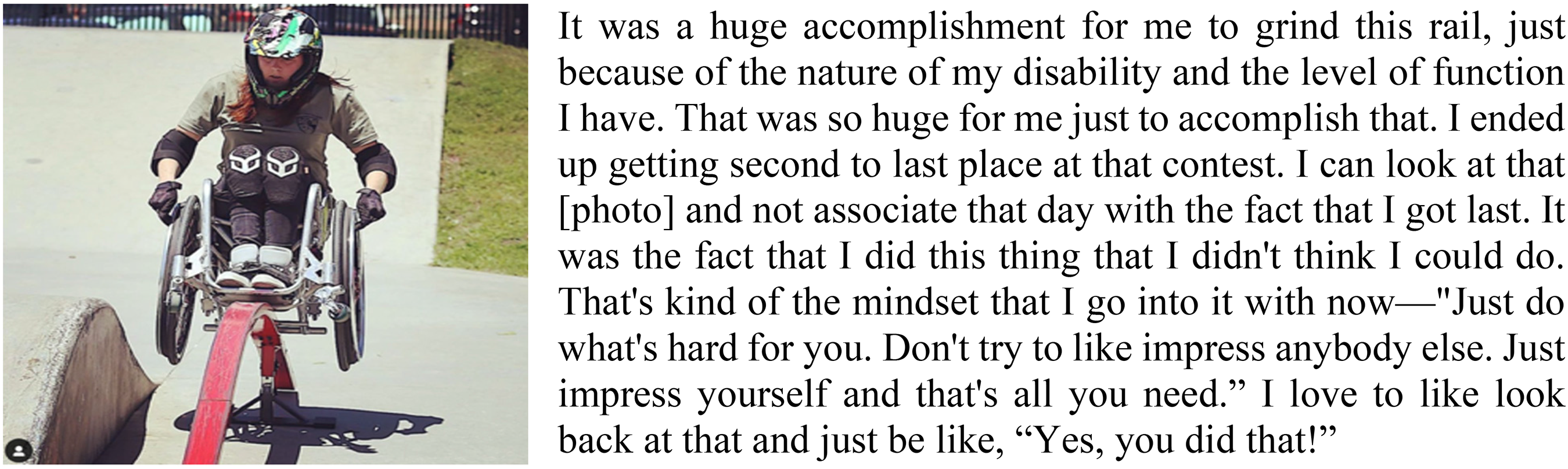
Rainbow rail grind.
Similarly, posts like the one shared by David in Figure 2 documented the trials and tribulations of WCMX and featured the rider performing or learning new tricks, skills, and stunts.
Discussions with David and others illuminated why so many WCMX riders were attracted to Instagram and detailed how many riders used their posts and visual representations on the platform to ‘destroy stereotypes’ and challenge ableist ideas and assumptions. When Instagram came out, I was like, “Okay, finally, they're focusing on the pictures!” For my approach, if I want to change minds and destroy stereotypes [its] by showing pictures. Instagram works just fine, it's my main tool. So, all the photos and videos I produce, I put on Instagram, because it focus[es] on what you see and not so much the bottom message. On social media today, you scroll, and scroll, and scroll, [and] you stop when you see a photo and you think “Wow.” I think that's why Instagram works so well.
If I have any kind of targeted audience, it's towards non-disabled people, and people that are disabled and looking for a community but with a very clear eye towards de-stigmatising disability and educating people – especially parents of disabled children. I want them to see disabled adults on social media, and kind of follow their lead and not the lead of doctors, or teachers or whoever from outside of the community.
For others, like Darryl, self-representations of skill and progress on Instagram were used to show his capabilities as a disabled person and WCMX rider, and at once, to inspire others. If you do post something you are really proud of, you get lots of support and people are encouraging. I kind of call it “inspiration porn.” That can really boost your ego. For me, [Instagram] is also a great tool to show what is capable.
According to Darryl, inspirational portrayals on Instagram not only have the capacity to enhance WCMX riders’ self-esteem and self-confidence, but as Sebastian detailed, can help riders generate greater visibility and market themselves to attract potential sponsorship opportunities. Instagram is a tool and important for me. Instagram is a possibility in my life. It's the only way to get sponsors to see me and [for] more people to see the hard work and difficulties of the sport.
Though WCMX riders acknowledged the potential of self-representation on the platform, several participants discussed the underlying pressures they felt when engaging with and posting content on the platform. Darryl, for instance, noted how, at times, he felt a certain pressure to create and produce positive, inspirational, and uplifting content on Instagram. For a long time, I felt like I had to, you know, post these pictures, and show people that I'm living my life, but it almost became a lie, it became a mask. It looked like I was doing great, but my mental health was absolutely disastrous, and I was severely depressed, suicidal, [and] just had to put on a show that I looked like I was doing good.
If you're ever in a funk and a mental depression, and you know, Instagram's the highlight reel – nobody puts anything really negative on there. It's just like, everything they're doing, or happy about, or like, “I'm doing this!” The cons of that are, it's like, “Well, I'm not doing that. How do I get there?” You kind of get lower on yourself and your self-esteem gets a little bit deteriorated.
These discussions from WCMX riders illuminate how self-representations can operate in complex ways that can affect how disabled athletes and audiences alike come to understand disability.
Risk-taking behaviours
Many WCMX riders used Instagram and self-representations on the platform to display risk-taking behaviours. Jonte, for instance, discussed how displays of risk-taking behaviours on Instagram made for engaging content that was praised and celebrated by followers. Dropins [on] big quarter[pipes] obviously is a cool thing, and every time you do it you have a big adrenaline rush. Obviously, it comes good for like Instagram, because people are impressed when wheelchairs drop in [on] really big ramps and stuff.
While many WCMX riders, like Katherine and Sebastian, elected to share photographs of themselves engaging in risk-taking behaviours, several participants, including Dorian, shared posts that contained video clips of them engaging in risk-taking behaviours, as discussed and represented in Figure 5.
According to Dorian, one of the reasons why he chose to post this clip was, in part, to challenge the assumption that wheelchair users are ‘fragile people’. A similar rationale was articulated by others, like Timon, who noted how the content he created and shared on Instagram was used to showcase the sport and challenge the belief that individuals are ‘confined’ to their wheelchairs.
Although many riders elected to display risk-taking endeavours in more overt ways, some disabled riders elected to display ideas of risk in more subtle ways, such as posting photos of risky or dangerous spaces that they had or wanted to engage with, as Dorian further shared in Figure 6.
Discussion
This study explored WCMX rider self-representations on Instagram. Grounded in CDS, this study illustrated how WCMX riders used Instagram and their self-representations on the platform to portray their skills, progress, and capabilities. This entailed the rider using visual representations to document the trials and tribulations of the sport and featured them performing or learning new tricks and stunts. These self-representations were not only curated to showcase WCMX and the skill of WCMX riders but were used to educate followers on topics related to disability and, at once, challenge ableist ideas and assumptions about disability and wheelchair use. As Papadimitriou (2008) notes, wheelchairs are stigmatised and often understood as a ‘symbol of limitation or incapacity’ (692). Fuelled by these ideas, WCMX riders noted how they would use their posts and portrayals of skill to challenge the stigma attached to wheelchair use, ableism, and disability more generally. Weaving these findings together with ideas from CDS illustrates how WCXM riders may be able to use Instagram and their self-representations on the platform to challenge ableist ideas and assumptions and highlights how social media (and self-representations) can be leveraged by marginalised sport participants to challenge dominant discourses in sport and beyond (Ahmad and Thorpe, 2020; MacKay and Dallaire, 2013; Mitchell et al., 2021).
Some WCXM riders outlined how their self-representations of skill, progress, and capabilities on Instagram were used to help generate visibility and, market themselves to potential sponsors. While other scholars have documented how action sport participants have increasingly used their cultural and symbolic capital on social media platforms for economic purposes (Evers, 2019; Nichols, 2021; Thorpe, 2017), few have considered the economic potential of social media for marginalised sport participants, like disabled athletes. This point is notable when you consider that disabled athletes are typically presented with fewer sponsorship opportunities than non-disabled athletes (Patatas et al., 2018). However, as findings from this work have detailed, WCMX riders have increasingly used Instagram and their self-representations on the platform to market themselves and their skills in efforts to attract and secure sponsors. This presents a unique economic venture for disabled athletes who have been historically ostracised and given limited economic support and opportunities in mainstream sport, disability sport, and the wider action sport industry.
According to some WCMX riders, their online portrayals of skill, progress, and capabilities were meant to invoke ideas of inspiration and motivation to their audiences. In fact, some WCMX riders, like Darryl, outlined how their self-representations could be viewed as ‘inspiration porn’ and a site where supercrip narratives were (re)produced (Berger, 2008; Grue, 2016). Such media portrayals have been heavily critiqued by disability (sport) scholars who have argued how supercrip media portrayals can influence how audiences and disabled people alike come to view and understand disability (Howe, 2011; Silva and Howe, 2012). However, discussions with WCMX riders illuminated a slightly different narrative – that saw potential in these media depictions and resulted in many actively producing inspiring content for their followers to consume, praise, and celebrate. According to participants, such portrayals not only have the capacity to inspire and show what is capable in a wheelchair but can also be used to boost one's self-esteem and self-confidence. In other words, the creation of inspirational and motivational content on Instagram – often by way of the display of skillful performances – was not necessarily viewed negatively, but rather, as something that was empowering and motivational (Hardin and Hardin, 2004; Lindemann and Cherney, 2008).
Though this was the case for many, several participants drew critical attention to how they felt pressured to create and share inspirational content when posting on Instagram. This pressure, in part, may have stemmed from the riders’ desire to create and share inspiring content for able-bodied audiences (Grue, 2016) or may have been done in an effort to attract sponsorship opportunities (Beldame et al., 2024). Regardless of motives, it was apparent that several WCMX riders felt pressure to produce likeable and inspiring content on Instagram. As detailed, inspiring content from WCXM riders may be empowering for some (Hardin and Hardin, 2004), but for others, can invoke certain feelings of guilt and envy and lead to lower self-esteem, or has also been termed as internalised ableism (Campbell, 2008). This pressure to represent themselves in inspiring manners appeared to not only affect the mental health and wellbeing of some WCMX riders but could have the capacity to shape and influence how followers and audiences come to understand disability, wheelchair use, and supercrip narratives.
Weaving these findings together with CDS and previous literature illustrates an interesting paradox. On one side, many WCMX riders used their self-representations of skill, progress, and capabilities on Instagram to inspire others and challenge ableism. However, on the other side, discussions with participants illuminated how many riders felt pressure to post inspiring and uplifting content to Instagram to fit the political economies of social media – political economies that place value on ‘likes’, the politics of looking, and the able-bodied gaze (Pullen et al., 2023). Consumption of these self-representations, in turn, can not only affect the mental health and wellbeing of WCMX riders but can have the capacity to shape and (re)produce understandings about wheelchairs, ableism, and disability (Pullen et al., 2023; Toffoletti, 2018).
In addition to these self-representations, it was common for WCMX riders to create and display posts of them engaging in risk-taking behaviours. These representations often featured the rider in action, performing daredevil-like stunts and engaging in risky environments. According to participants, these risk-taking depictions were meant to present engaging and ‘likeable’ content to be praised and celebrated by followers. For some, these risk-taking representations were used to showcase their WCMX sporting identities and, at once, allowed them to accrue subcultural capital for their risk-taking performances (Atencio et al., 2009; Buckingham, 2009; Dupont, 2020; Thornton, 1995). These risk-taking representations, according to participants, not only allowed them to further cement their subcultural ties and identities as WCMX riders (Dupont, 2020; Toffoletti, 2018), but for many, was empowering and allowed them to present themselves, WCMX, and disability in affirmative and non-tragic ways that focused on the creative, fun, and enriching aspects of disability (McCormack and Collins, 2012; Smith and Bundon, 2018; Swain and French, 2000). Yet more than this, it was clear that many WCMX riders used their self-representations of risk-taking behaviours on Instagram to challenge ableist ideas and to dismantle stereotypes about wheelchair users being ‘weak’ and ‘fragile’ individuals (Meekosha and Shuttleworth, 2009; Shildrick, 2009). Weaving these findings with CDS illuminates how self-representations of risk-taking behaviours on social media can not only frame disability in affirmative ways but can be used to challenge ableist ideas and assumptions about disability and wheelchair use (Goodley, 2011; Smith and Bundon, 2018).
Conclusion
This study highlights the paradoxical potential of self-representation on social media for WCMX riders. Findings illustrated how WCMX riders used self-representations of skills, progress, capabilities, and risk-taking behaviours to affirm their sporting identities and, at once, frame disability in affirmative ways that challenge ableist ideas and assumptions. At the same time, however, findings illuminated how some WCMX riders felt pressured by the political economies of social media to post inspiring and uplifting content to Instagram, which, for some, was empowering but, for others, appeared to affect their mental health and wellbeing. Thus, illustrating the complex power and potential of self-representation on social media. This study and findings from this study attend to Wheaton's (2013) call for greater intersectional analyses of action sports and glean insight into the lives, experiences, and digital worlds of disabled action sport athletes – a population that has rarely been considered in the broader action sport landscape. As such, I would encourage future research to draw greater attention to disabled action sport athletes and their participation in different cultural, digital, and material sporting milieus. Moreover, though the findings revealed some of the underlying messages and reasons why WCMX riders elected to represent themselves and their sports in certain ways on Instagram, future research, like work done by Toffoletti et al. (2023), may want to consider engaging with and exploring the comment sections of online representations. In so doing, researchers may be able to further contextualise their interpretations and provide insight and nuance to the ways in which online self-representations may be interpreted and understood by different audiences.
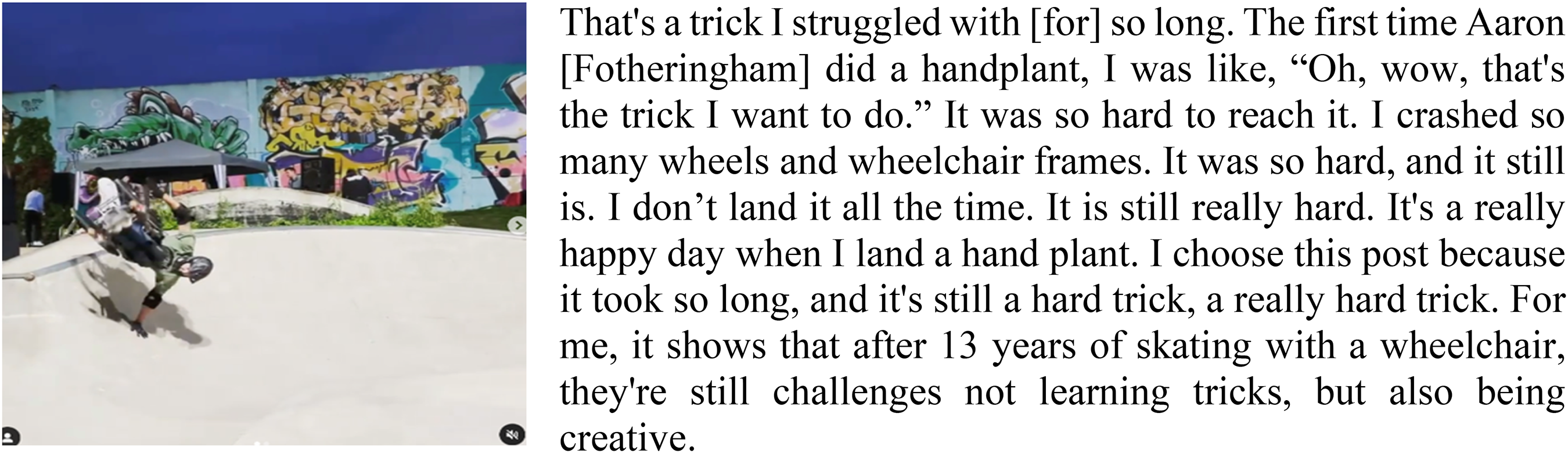
Handplant.
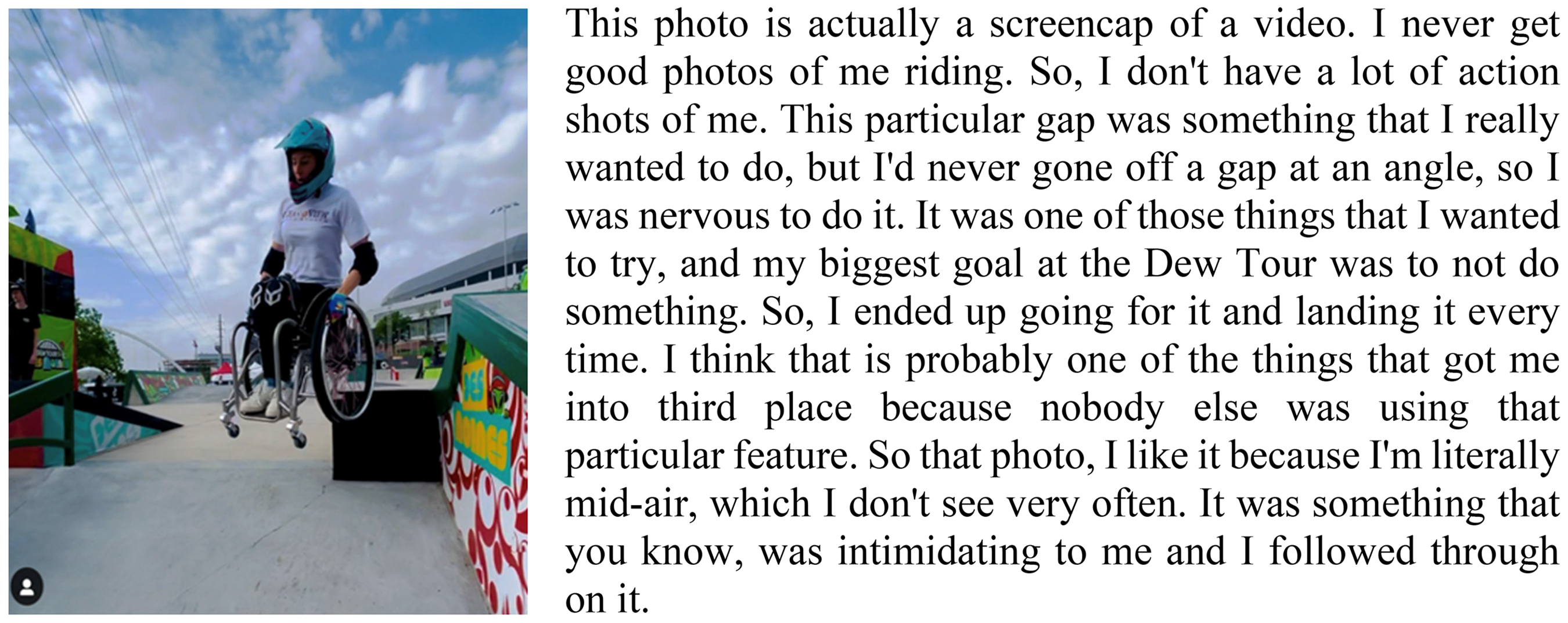
Dew tour gap.
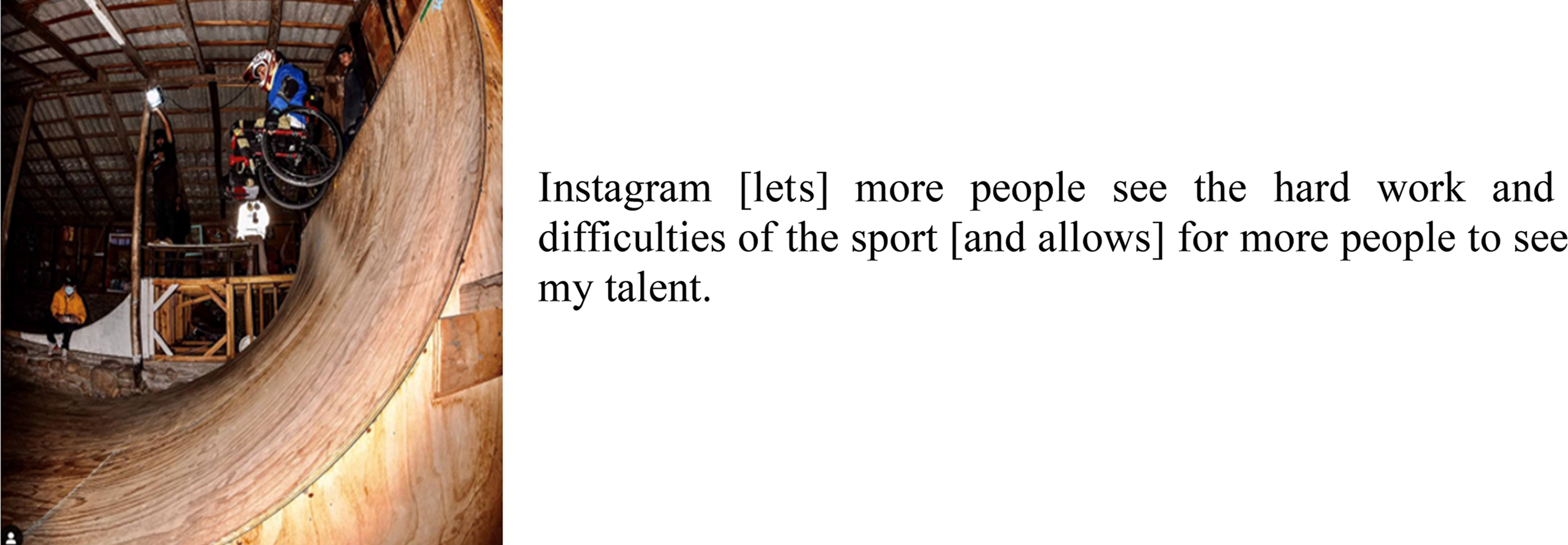
WCMX drop in.
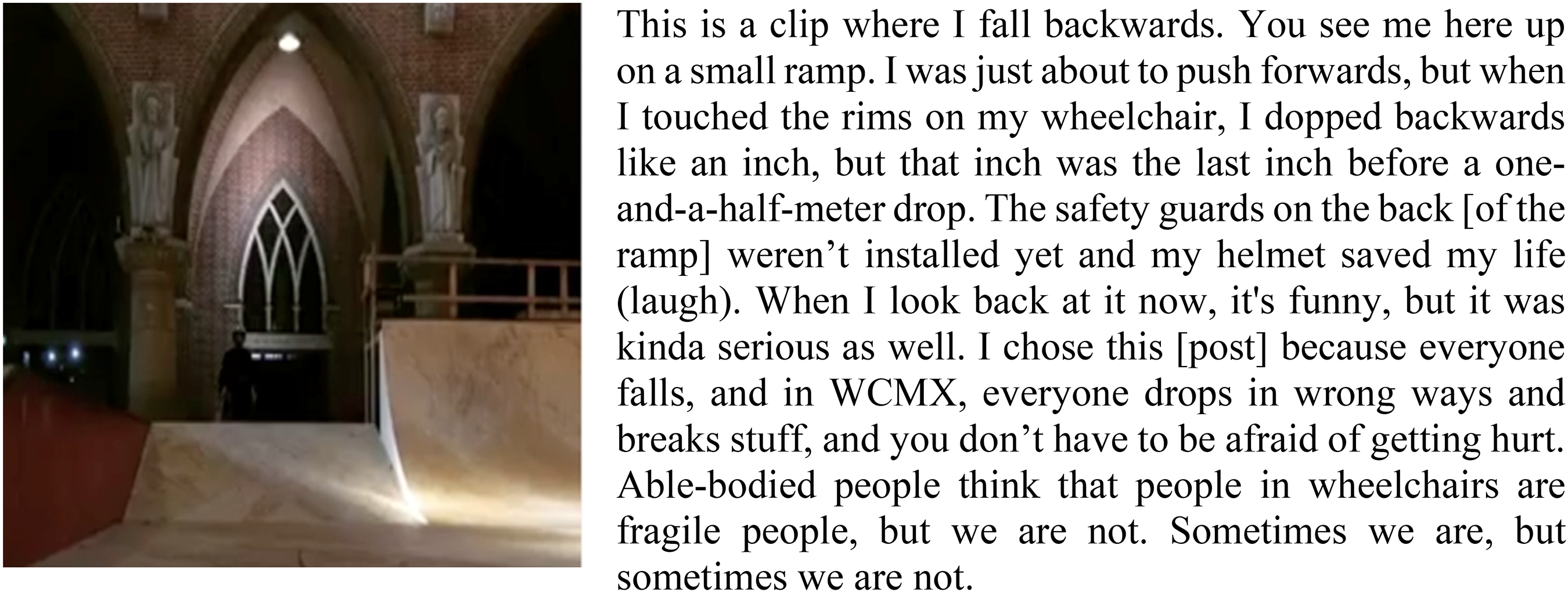
WCMX fall.
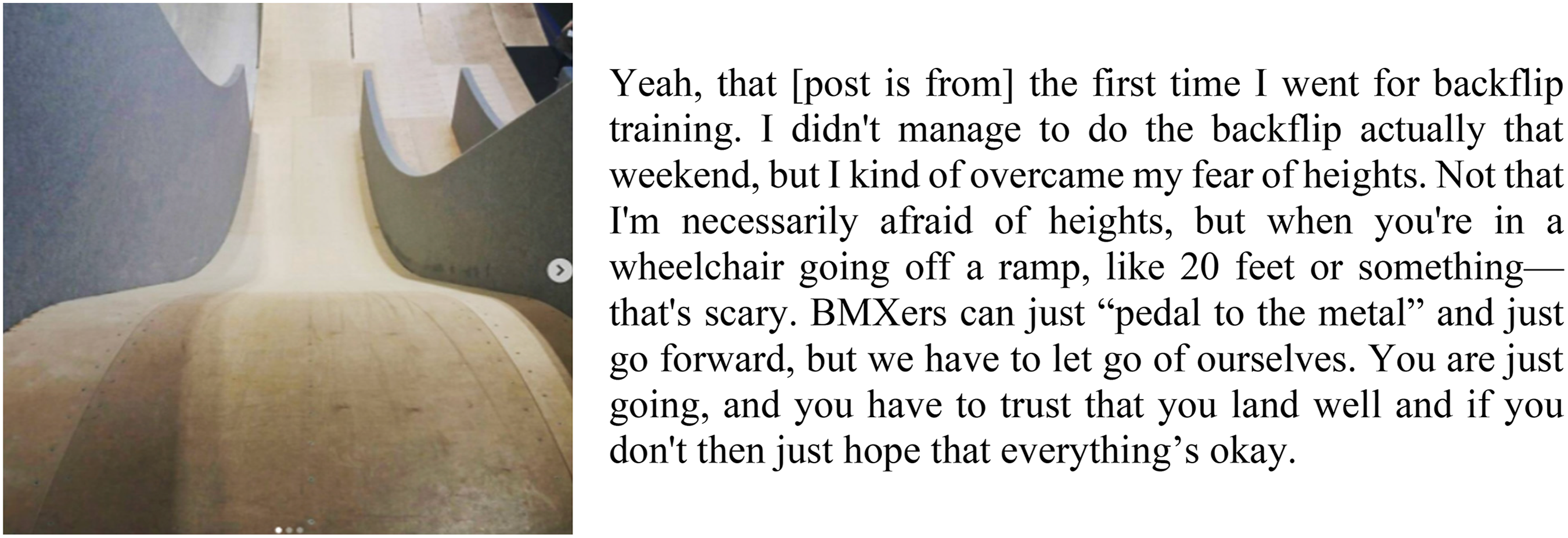
Vert ramp view.
Participant demographic data.
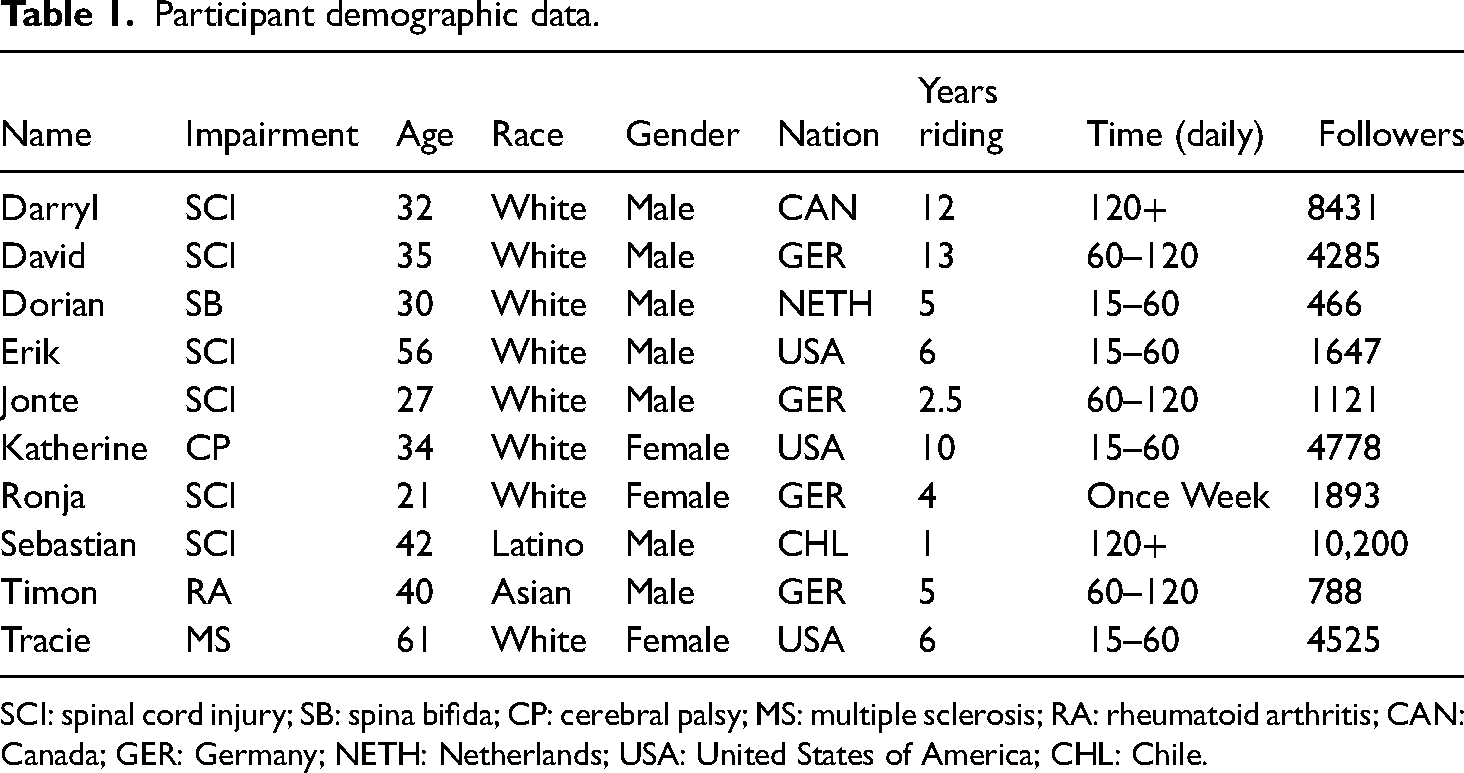
SCI: spinal cord injury; SB: spina bifida; CP: cerebral palsy; MS: multiple sclerosis; RA: rheumatoid arthritis; CAN: Canada; GER: Germany; NETH: Netherlands; USA: United States of America; CHL: Chile.
Footnotes
Declaration of conflicting interests
The author declared no potential conflicts of interest with respect to the research, authorship, and/or publication of this article.
Funding
The author disclosed receipt of the following financial support for the research, authorship, and/or publication of this article: This work was supported by the Social Sciences and Humanities Research Council.
