



Abstract
Drawing on theories from the sociology of work and organizations, such as Leiter and Maslach's concept of burnout and Siegrist's model of effort–reward imbalance, this paper argues that burnout symptoms in elite sport are related to a mismatch of investment and gratification. Building on data from a sample of German elite athletes (N = 312), findings show that high time investments for training and competitions, the experience of time and role conflicts and negative emotions related to daily training are associated with more burnout symptoms, while sporting success, social support and training-related positive emotions are associated with lower burnout scores. Vulnerability to burnout is increased in situations that qualify as gratification crises, in which athletes perceive that high time commitment does not pay off in terms of sporting success.
Introduction
The mental health of athletes has recently received considerable scholarly attention. This results from the observation that a substantial share of elite athletes are experiencing mental health problems, from sleep concerns to anxiety to depressive disorders. Although research on mental health in elite sport is limited and previous findings have been mixed, recent evidence has suggested that athletes are at comparable or even higher risk of mental health problems than the general population (Frank et al., 2013; Gouttebarge et al., 2019; Reardon et al., 2019; Rice et al., 2016; Wolanin et al., 2015). Consistent with this, a meta-analysis shows that the prevalence of burnout symptoms among athletes increased significantly from 1997 to 2019, which may be due to more frequent competitions, increased rivalry or greater external pressures (Madigan et al., 2022). While burnout is primarily recognized as a serious mental health problem, it also reduces an athlete's capability to train and compete at the highest levels. Therefore, a thorough understanding of burnout dynamics in elite sports is essential from both a health and a performance perspective.
The most prominent burnout conceptualization among athletes is based on three key symptoms (Raedeke, 1997; Raedeke and Smith, 2001): (1) Exhaustion relates to the depletion of physical, emotional and mental capabilities due to involvement in situations that are permanently too demanding. (2) Devaluation describes the gradual loss of interest in sport accompanied by a cynical and negative attitude towards sport. (3) A reduced sense of accomplishment and a loss of motivation to perform finally result from negative evaluations of one's own athletic abilities and achievements. In addition, burnout theories from work settings (e.g., Lauderdale, 1982) also include typical emotional dynamics, such as a loss of joy and an increase in negative affective states (e.g., frustration, anger, anxiety). With regard to burnout, González-García et al. (2020) recently showed that unpleasant feelings related to competition are associated with significantly higher levels of burnout symptoms in athletes. Likewise, emotional responses in relation to daily training, i.e., if training is permanently experienced as unjoyful and frustrating, would also be considered an indication of burnout risk.
Since the beginning of empirical research on athlete burnout in the 1980s, numerous psychological antecedents of this phenomenon have been identified. Accordingly, findings support the role of personality, motivation and emotion that may predict athlete burnout (e.g., athletic identity, perfectionistic concerns, negative affect, trait anxiety, ego goal involvement) or protect from burnout (e.g., intrinsic motivation, perceived control, optimism, mindfulness) (Eklund and DeFreese, 2020; Goodger et al., 2007; Gustafsson et al., 2018a, 2018b). Moreover, chronic stress and maladaptive coping strategies have been found to be central antecedents of burnout in athletes (Eklund and DeFreese, 2020; Lin et al., 2022). In this respect, psychological burnout research has often focused on the individual. A limited number of studies employed group-specific approaches or looked at person–environment interactions such as peculiarities of sporting disciplines, coaching styles or parents' success expectation to identify risk profiles for athlete burnout symptoms (Granz et al., 2019; Sorkkila et al., 2017).
Only few papers have provided a sociological perspective on athlete burnout (e.g., Coakley, 1992, 2009). Coakley (1992) conceives burnout explicitly as a ‘social problem’ and argues that the elite sport system promotes the development of one-dimensional identities, which also means that self-worth, but also loss of self-worth, corresponds directly with sporting success. In addition, athletes are exposed to combinations of stressors typical to the elite sport system, such as excessive training, lack of recovery and controlling coaching behaviours, which research has identified as potential antecedents of the athlete burnout process (Gustafsson et al., 2011; Woods et al., 2022). Athletes also must deal with various performance-related challenges throughout their career (e.g., failure, non-selection for competitions). Hence, even when investments are high and personal sacrifices are made, there is no guarantee of success. As a reaction, vulnerable athletes may tend to increase their efforts to avoid further setbacks and associated feelings of shame, which can potentially mark the beginning of a burnout spiral.
The present paper conceives elite sport as a specific work environment and – applying Siegrist's (1996) concept of a ‘gratification crisis’ – develops a conceptualization according to which burnout results from a systematic imbalance of personal investments and rewards within an organization. Based on this theoretical framework and using a sample of German elite athletes (N = 312), this paper analyses factors that potentially play a central role for perceived effort and reward and, in turn, in the process of ‘burning out’. Our findings add to existing research by showing that gratification crisis, i.e., a perceived mismatch between effort and reward, is key for understanding burnout dynamics. These findings also raise awareness for systemic conditions in elite sports that either enforce or help to prevent a gratification crisis.
Theoretical framework
A sociological perspective on athlete burnout
Whereas burnout was originally conceptualized and studied in the setting of human service occupations (Freudenberger, 1980), a number of theories emerged over time that focus on the phenomenon from a broader perspective (Ehrenberg, 2010; Lauderdale, 1982; Leiter and Maslach, 1999; Schaufeli and Buunk, 2003). We build on Leiter and Maslach's (1999) concept of occupational burnout, which highlights the interaction between the individual and the organization and relates burnout to social and environmental factors that are of relevance in the ‘elite sport workplace’. In addition, Siegrist's (1996) effort–reward imbalance (ERI) model is used to further elaborate how the elite sport system facilitates the development of burnout.
Leiter and Maslach (1999) provide an evidence-based approach that recognizes the working relationship between the individual and the organization as essential to the burnout process. Burnout is conceived as grounded in a chronic mismatch, understood as a persistent discrepancy between the individual's expectations and his or her actual work experiences. More precisely, they identified six elements of work that relate to burnout dynamics: workload, control, reward, community, fairness and values. Burnout processes are characterized by the increase of time and energy investments into work, accompanied by chronic exhaustion (workload). Conflicting demands and role conflicts within organizations prevent workers from effectively controlling their work, which can further aggravate an already exhausted state (control). Although support from the social environment can potentially help to deal with high demands, the absence of such support represents another catalyst of the burnout process (community). Further mismatches between individual and organization may relate to perceptions of fair decision-making (fairness) as well as ideals, motivations and shared values (values). In addition to these aspects, financial or symbolic gratifications are of central importance (reward). Leiter and Maslach (1999: 479) argue that ‘people use feelings of exhaustion as signals of excessive inputs’ and then expect greater rewards the more exhausted they feel. If these rewards fail to arrive, then work is perceived highly unsatisfactory and thus increases the vulnerability to burnout.
The mismatch between personal investments and the gratification provided by the organization is also at the core of the ERI model (Siegrist, 1996). The ERI model emphasizes that negative individual reactions in the form of stress or depression are likely in situations characterized by continued high levels of effort and exhaustion that are not matched by adequate rewards. These situations are conceived as occupational gratification crises. Normally, employees would try to avoid work situations that lack reciprocity between effort and reward. However, there may be conditions in which the dissolution of such unsatisfactory work relationships is not easily possible, for example, when no adequate job alternatives exist or, in highly competitive occupations, employees hope that the desired reward can be obtained later. Based on several studies with >30,000 employees, Siegrist (2011) concludes that a gratification crisis can approximately double the risk for depression.
The elite sport environment
As argued above and to understand the complexity of burnout dynamics specifically in the context of sports, there is a need for an approach that takes systemic conditions into account. As a starting point, we build on the concept of ‘greedy institutions’ (Coser, 1974). Greedy institutions expect from their members an undivided, 100% commitment and loyalty, literally with heart and soul, for which other social roles and commitments outside the organization must be severely curtailed or abandoned. Ultimately, this leads to a complete appropriation of the individual, his or her personality and identity. However, people voluntarily submit to the rule of greedy institutions because these institutions have something attractive to offer, such as money, power or reputation. Although not mentioned in Coser's work, the elite sport system may be regarded as a textbook example of a contemporary greedy institution.
Regarding athletes, their environment differs from the world ‘outside’ of professional sport, and this environment also brings with it a certain greediness insofar as competitive sport encroaches on the person's entire life – in terms of training, nutrition, sleep, health, career and relationships – which is essentially geared towards performance and success (Hatteberg, 2018). Bette and Schimank (2006) conceived this as ‘biographical fixations’. Fixations of the biography occur in athletes in (a) temporal, (b) factual and (c) social terms and thereby reciprocally reinforce each other: With regard to temporality, elite sport with all its components (e.g., training, competitions, sports medical treatment) takes up a substantial proportion of the time budget of an athlete (Burlot et al., 2018; Donnelly and Petherick, 2004). On average, German athletes invest more than 30 hours per week into training and competition preparation, even at a young age (Breuer et al., 2018; Nixdorf, 2018). This leads to a scarcity of time and accelerates the pace of daily life, in which literally every minute is already scheduled (Burlot et al., 2018). As a result, there is limited time left for pursuing non-athletic career goals related to school, college, work or other areas of (leisure) life (Bette and Schimank, 2006). For instance, Breuer et al. (2018) report that the average German athlete in so-called Olympic squads uses only 7.5 hours per week for education and learning and less than 4 hours for hobbies. This also indicates that sport is given the priority. Moreover, the biography of an athlete is also factually fixed in that prioritization which subordinates all other areas of life to sport, since otherwise the way to the top of the sporting world seems impossible. This does not mean, however, that success is a given, since uncertainty about the duration of a successful sporting career increases due to the constant risk of injury and the pressure of national and international rivalry. The associated fixation in social terms occurs in a quantitative reduction as well as in a qualitative transformation of the athlete's environment. There is often a closure of social contacts and social relations to such persons who not only support the athlete in his or her sporting activity but constantly confirm the prioritization of sporting demands over demands of life domains outside of sport. This focus on social contacts, who advocate for elite sport, in turn gives the athlete no reason to question competitive sport as the centre of his or her own life.
Consequently, taking on the role of an elite athlete not only brings the desired reputation but also requires total commitment in terms of time investment, self-sacrifice, psychophysical exhaustion or deprivation in non-sporting areas of life (Hughes and Coakley, 1991). This in turn leads athletes to identify solely with the role of the athlete, whereas other facets of identity fade into the background. Such a one-dimensional identity is susceptible to disappointment and therefore fragile (Coakley, 1992). This is a particular problem in sports, where competition itself produces not only a winner but also several disappointed ‘losers’ who are remembered by the public and the mass media at best as contenders (Bette and Schimank, 2006). Competitive sport thus produces constant pressure to deliver at the maximum level of performance, which can trigger stress and anxiety and even lead to sport-related use of painkillers or the willingness to compete hurt (Hanton et al., 2008; Mayer and Thiel, 2016; Neil et al., 2011; Overbye, 2021). In addition to defeats, aspects such as (repeated) non-nominations, fluctuations in performance, cuts in sports funding in the absence of success or pressure from the environment are key stressors from the athlete's perspective, which are closely linked to the experience of negative emotions and personal disappointment (Fletcher et al., 2012; Fletcher and Hanton, 2003; Mellalieu et al., 2009). Such experiences not only collide with an athlete's identity but may also call into question the whole sports career with all its prior investments. It is very likely that such phases are then experienced as a lack of reciprocity between investment and reward, corresponding to the ERI model (Siegrist, 1996). Thus, elite sport represents a peculiar type of organization that has institutionalized greediness (on the side of necessary investments) and brings risks of gratification crises (on the side of rewards). Of course, a gratification crisis does not necessarily occur, and some athletes can achieve outstanding success in their careers, but the logic of competition also regularly produces disappointments, and no athlete is immune to such setbacks (Bette and Schimank, 2006).
Hypotheses
In view of these theoretical considerations, elite athletes may be prone to burnout under certain conditions: Firstly, models of work-related burnout postulate that high investments of time and energy into the career are crucial ingredients for burnout processes (Leiter and Maslach, 1999). On the one hand, this investment can be understood simply as hours of time spent on the career – in the case of top athletes, mainly hours that go into training and competitions. On the other hand, investment can also be understood as the experience of personal role and time conflicts, i.e., when leisure time, family and friends take a back seat to a sports career. Hence, we assume that burnout symptoms increase with the time per week invested into the sporting career (Hypothesis 1a) and with the experience of personal role conflicts (Hypothesis 1b).
Secondly, the reward side of work is also considered important (Leiter and Maslach, 1999). In the elite sport context, the reward of an athletic career is most likely represented by sporting success. However, as the elite sports system has numerous competitions at different national, continental and international levels, success cannot simply be measured in terms of medals or rankings. Rather, success and disappointment are linked to individual expectations. Thus, for an Olympic champion, a second place in a national championship may be disappointing, while for a young up-and-coming athlete, the same result could mean a great triumph. Hence, success and failure, i.e., the reward function in the ERI model, are highly subjective. We can thus hypothesize that burnout symptoms in athletes increase with perceived sporting disappointments (Hypothesis 2a) and decrease with perceived successes (Hypothesis 2b).
The ERI model (Siegrist, 1996) does not simply assume effort and reward to be factors that influence mental health issues independently, but in their interaction. Precisely, the postulated effect on burnout is only expected if high effort and low rewards coincide. Hence, if invested time and energy pays off in terms of sporting success, no gratification crisis is experienced that would fuel the burnout process. Likewise, burnout would not occur if failure is experienced but not preceded by strong effort. In interviews with former athletes who experienced burnout, the lack of sporting success was named by all interviewees as an essential part of the burnout process, but some also explicitly described this experience in relation to the effort invested (Gustafsson et al., 2008). Similarly, recent findings of Eliasson and Johansson (2021) have suggested that weighing effort against reward seems to play an important role in the process of withdrawal from sport, which can also be an essential part of the burnout experience. Hence, we assume an interaction effect: Burnout symptoms in athletes increase when extensive time investments and sporting disappointments are experienced at the same time (Hypothesis 3).
Furthermore, the role of social communities and their social support for work-related burnout has been also discussed by Leiter and Maslach (1999). In the context of elite sport, support of the social network is important to optimally develop athletically and, at the same time, cope with challenges throughout the athletic career without questioning elite sport as a meaningful purpose in life. Therefore, we hypothesize that burnout symptoms decrease in athletes with a high level of perceived sport-related support of their social environment (Hypothesis 4).
According to the widely accepted understanding of work-related burnout, a further warning signal is the gradual increase of negative emotions (Lauderdale, 1982). Similarly, Leiter and Maslach (1999) suggest that burnout has an emotional component which may affect one's relationship with his or her workplace. A review shows that negative effect is associated with all dimensions of burnout, but most closely with exhaustion (Thoresen et al., 2003). Applied to elite sports, the emotions experienced in the context of daily training sessions could possibly contribute to the prediction of burnout symptoms. Based on this consideration, we assume that burnout symptoms increase with the experience of negative emotions during training sessions (Hypothesis 5a) and decrease with the experience of positive emotions (Hypothesis 5b).
Methods
Design and context of the study
This study uses cross-sectional quantitative survey data from the collaborative research project ‘Individualized performance development in elite sports through holistic and transdisciplinary process optimization’ (in:prove), conducted by three German universities and representing five scientific disciplines (physiology, psychology, movement science, information technology and sociology). The aim of this project is to identify and analyse individual performance reserves of German elite athletes from eight Olympic sports disciplines (3 × 3 basketball, artistic gymnastics, ice hockey, modern pentathlon, rhythmic gymnastics, table tennis, trampoline, volleyball). The project adopts a holistic, data-supported and transdisciplinary approach. Located at the intersection of sociology and psychology, one perspective within in:prove investigates the relation between performance and psychosocial health. It is precisely this perspective that the present paper takes up.
In the German elite sport system, a distinction is made between different squad levels with the aim of concentrating support on the athletes with the highest actual performance and highest potential for future performance at each stage of their development (German Olympic Sports Confederation, 2017). The study includes athletes from the three highest German squad levels: The ‘Olympic squad’ (OK) consists of athletes with a proven medal or final place record with a view to the next Olympic Games. Athletes with medal and final prospects for the Olympic Games after the following one form the ‘perspective squad’ (PK). Younger athletes with medium- to long-term prospects for integration into the men's and women's national teams are nominated for the ‘junior squad’ (NK). The goal is to build performance from the junior squad through the perspective squad to the Olympic squad. Most athletes train in one of 17 Olympic training centres (OTCs), where they are provided with comprehensive and professional training conditions for performance development (German Olympic Sports Confederation, 2022). The OTCs provide a network of services in order to optimally support top-level athletes, including training science, sports medicine, physiotherapy, sports psychology, nutritional advice and career-related advice. In addition, 43 so-called elite sports schools (Eliteschulen des Sports) are linked to the OTCs and are intended to make it easier for school-aged athletes to combine their sporting careers with their school education by offering more flexible school programmes. Petry et al. (2008) give a more detailed description of key aspects of the German elite sport system. Notwithstanding that differences between sports disciplines exist, these general conditions apply to almost all athletes in the sample who train within the OTC structures.
Data collection
The analysis primarily builds on survey data collected with standardized paper-and-pencil questionnaires. The present study is using a cross-sectional data set from the first year of the project (April 2022 up to May 2023) that includes 312 athletes from the highest German national squad levels. Data collection took place for each squad and each discipline separately, usually at training camps for competition preparation. Thus, athletes were selected based on their current squad status or nomination for a training camp by the national coach.
The questionnaire consisted of several thematic sections addressing, among others, sports biography, perceived support, mental health and team relationships. Within these questionnaire sections, all indicators theoretically relevant for the present study, such as investment, gratification, support and emotions (see measures), were queried. The survey was scheduled for 30 minutes, and the vast majority of athletes completed it in the allotted time. The questionnaire itself was filled out in a separate room where the athletes were undisturbed and in the absence of coaches. Subsequently, each questionnaire was received directly by a project staff member. In exceptional cases and due to time constraints, some athletes were offered the opportunity to return the completed questionnaire in a sealed envelope by mail. Before or after filling out the questionnaire, a variety of motor and cognitive tests and other diagnostics were also conducted.
All respondents gave their written informed consent to take part in this study and participated voluntarily. For athletes under the age of 18, parents filled out the consent form. The study procedures were approved by the Ethics Committee of the Faculty of Medicine of Justus-Liebig-University Giessen (AZ 55/22). From 333 athletes who were contacted and participated in the in:prove study until May 2023 (gross sample), a total of 312 athletes returned a completed questionnaire (net sample), representing a response rate of 94%. The most common reasons for non-participation were missing consent forms of underage athletes or not returning a questionnaire that had been handed out.
Sample
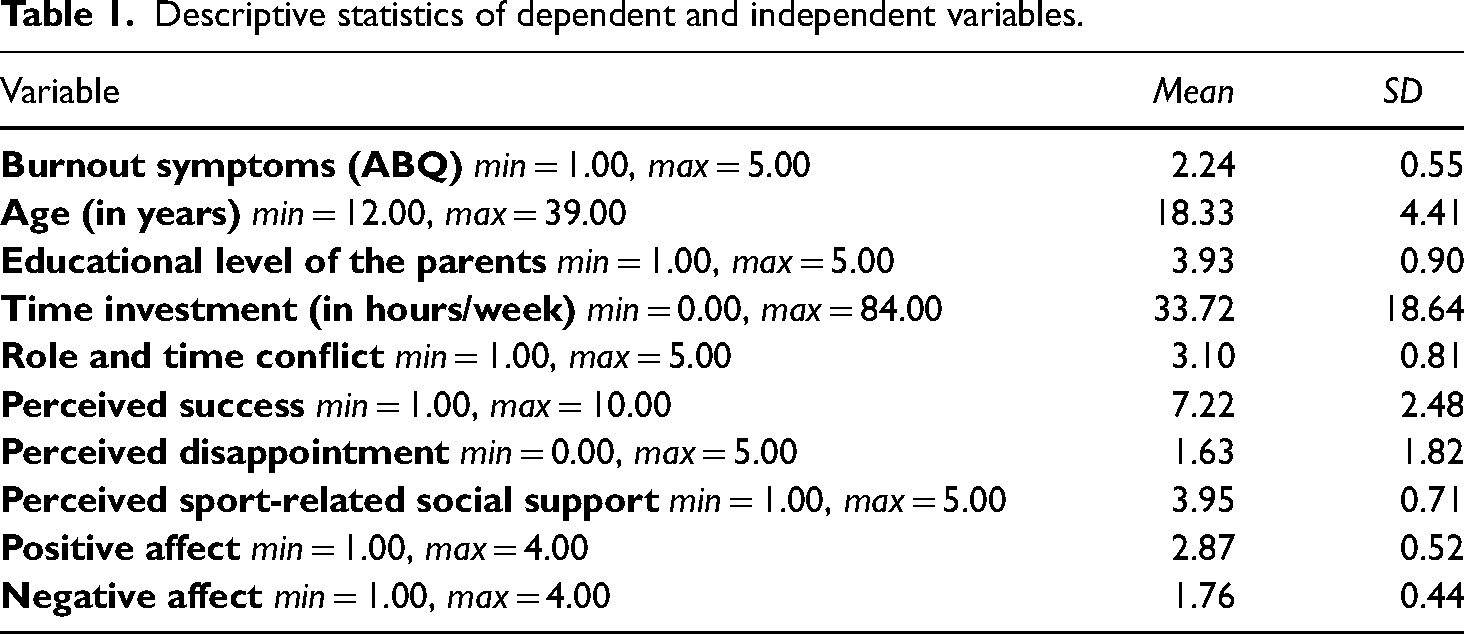
The sample includes N = 312 German elite athletes representing three different national performance levels, namely, Olympic, perspective and junior squad. The mean age of participants is 18.3 years (SD = 4.4, min = 12, max = 39). The sample includes 56.3% male and 43.7% female athletes. Regarding athletic disciplines, the sample consists of athletes from 3 × 3 basketball (13%), artistic gymnastics (7%), ice hockey (24%), modern pentathlon (7%), rhythmic gymnastics (7%), table tennis (5%), trampoline (11%) and volleyball (26%). On average, athletes have accomplished 11.4 years of training since they began practicing their sport (SD = 5.0, min = 2, max = 34). A detailed description of the sample can be found in Table 1.
Descriptive statistics of dependent and independent variables.
Measures
Athlete burnout symptoms. The extent to which athletes experienced burnout symptoms was assessed using the Athlete Burnout Questionnaire (ABQ, Raedeke and Smith, 2001) in its German version (Ziemainz et al., 2004). The scale consists of 15 items. Respondents could select their answer (‘How often do you feel this way…?’) on a Likert scale from 1, ‘almost never’, to 5, ‘almost always’. The ABQ scale does not allow for clinically validated diagnoses of burnout, but is the most widely used measure to assess burnout symptoms in the elite sport context (Gerber et al., 2018). We calculated the mean value for the total scale (Cronbach's α = 0.86). Higher scores represent a higher level of the athlete's overall burnout experience.
Time investment. Respondents were asked to indicate the time they invest in activities closely related to participation in elite sports in hours per week (‘Please think about the last month: How many hours per week on average did you invest in…?’), namely, for (a) training, (b) competitions, (c) travel time related to training and competition and (d) physiotherapy or medical care. Few individual athletes did not provide information on some of these sport-related areas, thus we subsequently replaced the missing values with ‘0’, assuming that these athletes temporarily (e.g., due to injury) did not spend any time in training, competition, travel time and/or medical care. We calculated the sum of all four responses, so that values represent overall hours per week invested into competitive sports.
Role and time conflict. Athletes often report personal sacrifices in non-sporting areas of life. As a reflection of this, we measured the extent of perceived role and time conflict by using a German translation of the Overload between Roles subscale of the Role Strain Questionnaire for Junior Athletes (RSQ-JA, Van Rens et al., 2016). This subscale includes four different statements (e.g., ‘Sport takes up too much of my time’), to which respondents indicated their agreement on a 5-point Likert scale (from 1, ‘strongly disagree’, to 5, ‘strongly agree’). The mean score of the four items was calculated so that higher ratings of agreement represent greater role and time conflict (Cronbach's α = 0.58).
Perceived sporting success. Subjective experience of sporting success was surveyed by the question: ‘How satisfied are you with your sporting successes in the last year’. Participants could select their answer on a 10-point Likert scale ranging from 1, ‘not at all satisfied’, to 10, ‘completely satisfied’. Here, higher values of this variable express greater satisfaction with one's own sporting successes in the past year.
Sporting disappointment. To assess the experience of sporting disappointment, we first asked respondents with reference to the last year: ‘Was there an important sporting event for you of which the outcome was very disappointing for you?’ Those who indicated that they had experienced such an event were further asked to assess how much of a burden this had been for them. Responses were rated on a 5-point scale (from 1, ‘very low’, to 5, ‘very high’). For unaffected athletes, this answer was subsequently set to ‘0’, assuming that no burden was experienced in this case. Higher values represent a stronger perceived burden due to the experience of sporting disappointment in the past year.
Social support. The perceived sport-related social support was measured using the Perceived Available Support in Sport Questionnaire (PASS-Q, Freeman et al., 2011). This 16-item scale captures four different areas of sport-related support with respect to emotion, esteem, information and practical support. Participants could choose one of the five response options ranging from 1, ‘strongly disagree’, to 5, ‘strongly agree’. For our analyses, we used the mean of the total scale (Cronbach's α = 0.93), with higher scores indicating higher perceived social support in sports. The PASS-Q does not assess who in the sport system provides emotional, motivational or practical support, but rather the athlete's perception that sufficient support is available. Support from people outside of sport is not captured with the scale.
Positive and negative affect. To assess the frequency of positive and negative emotions of athletes related to daily training sessions, we adapted a measure from the European Social Survey's Wellbeing Module (Huppert et al., 2009). Athletes were asked to indicate the frequency of positive emotional states (e.g., ‘I was happy’, ‘I was proud of myself’, ‘I felt valued by others’) and negative emotional states (e.g., ‘I was angry’, ‘I felt lonely’, ‘I was afraid’) before, during or after training sessions. Respondents used a 4-point Likert scale to indicate the frequency of these feelings over the last month (from 1, ‘not at all’, to 4, ‘almost every day’). We calculated the mean value for positive affect (Cronbach's α = 0.75) and negative affect (Cronbach's α = 0.64). Higher values indicate more frequent positive or negative emotions.
Socio-demographic variables. As potential confounding variables, we included age (in years) and gender (female vs male) into the analyses. In addition, the athletes were asked to indicate the highest educational degree achieved by both mother and father (from 1, ‘no degree’, to 5, ‘academic degree’). We used the mean score of both parents as an additional control.
Analytical approach
We first present a description and illustration of burnout symptoms in athletes with means, standard deviations and frequency distribution. Secondly, we conducted multiple linear regression analyses with the ABQ scale as the dependent variable. Linear regression is a simple, robust and easy to interpret method for detecting linear relationships between multiple predictor variables and a continuous outcome measure. Our first model specification includes the aforementioned variables as predictors, namely, investment into sporting career, (lack of) sporting reward, perceived social support and emotions related to daily training. To investigate the potential role of gratification crises in predicting burnout symptoms in professional sport, we additionally included an interaction variable in our second model. Here, the interaction of time investment and perceived sporting disappointment serves as an indicator of a gratification crisis and tests the ERI model, which postulates that high effort and a lack of rewards have to appear in combination. Moreover, socio-demographic variables are controlled as covariates in both models. In the regression models, we present unstandardized regression coefficients (b) and their standard errors (SE), standardized regression coefficients (β) and p-values. Before carrying out these regression analyses, we identified 55 cases in the data set with at least one variable missing and then estimated plausible values for these missing data using multiple imputation methods. Furthermore, we tested all model assumptions of linear regression models. A number of additional and preliminary analyses, none of which yielded significant results, are documented in a Supplement that can be downloaded from the last author’s website (Supplemental material). All analyses were conducted using IBM SPSS 28.
Results
Frequency distribution of burnout symptoms in elite athletes
In the present sample, athletes report a mean ABQ score of 2.24 (SD = 0.55). This score is close to the average burnout level of 2.29 (SD = 0.40) reported by Madigan et al. (2022) in a recent meta-analysis based on 91 journal articles. Figure 1 illustrates the frequency distribution of the ABQ scale in the present sample. Considering the subscales, the average exhaustion level is 2.78 (SD = 0.77), the average devaluation level is 1.64 (SD = 0.68) and the average level of the reduced sense of accomplishment subscale is 2.30 (SD = 0.66). In the present sample, exhaustion is somewhat more prevalent compared to the findings of Madigan et al. (2022), while devaluation and reduced sense of accomplishment are slightly less pronounced.
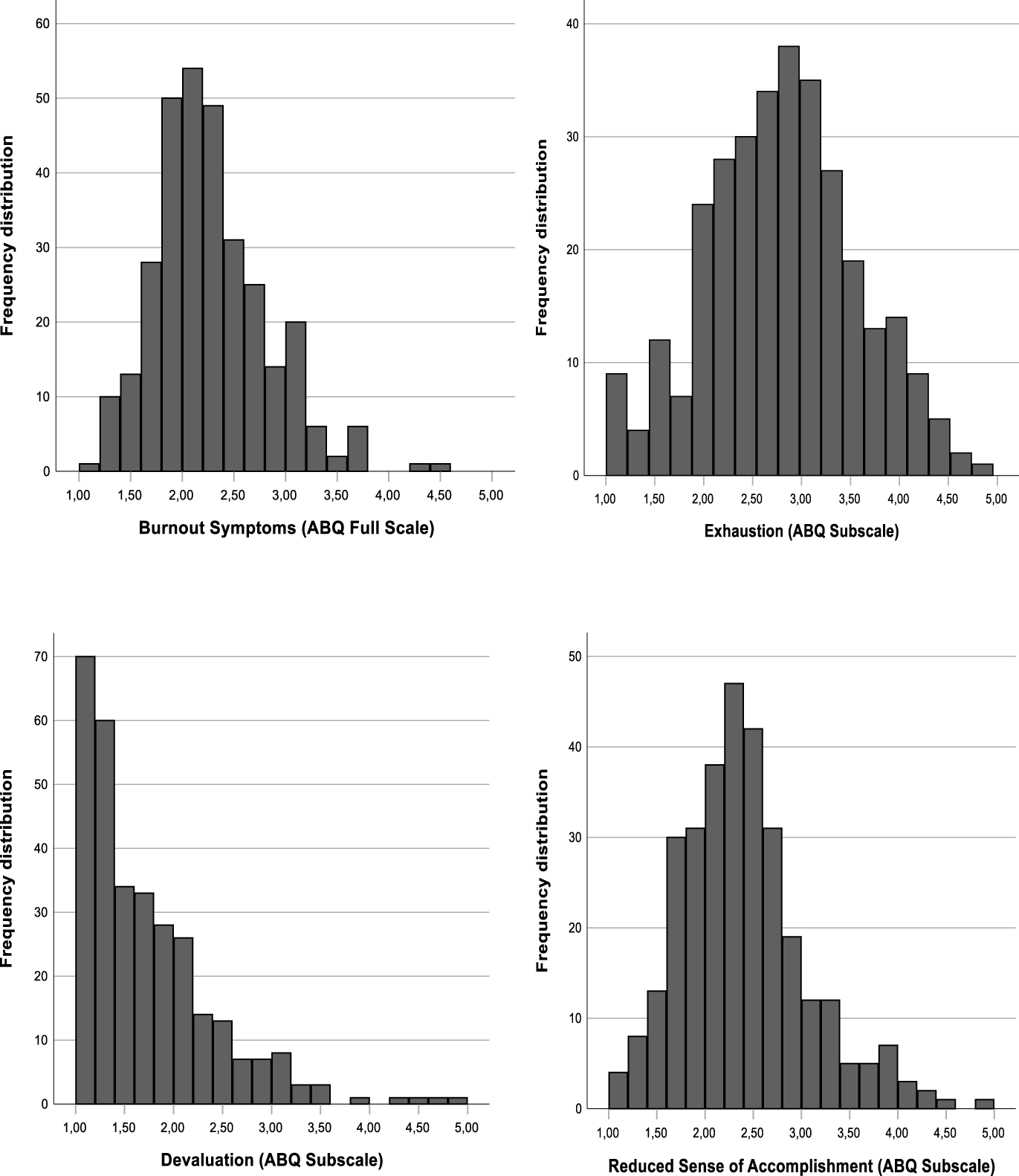
Frequency distribution for ABQ scores for subscales and full scale.
Prediction of burnout symptoms in elite athletes
Multiple linear regression models point to significant relationships between some characteristic factors of the elite sport system and burnout symptoms of athletes (Table 2, model I): With regard to investment into one's own sporting career, a higher time commitment (e.g., to daily training, competitions, travel time, medical care) is associated with significantly higher levels of burnout symptoms among athletes (ß = 0.11; p = 0.012) (Hypothesis 1a). The first model suggests that each additional hour per week invested into sports would lead to a rather small 0.003 unit increase on the ABQ scale. Moreover, the perception of personal role and time conflicts seems to be a more decisive risk factor for burnout symptoms (ß = 0.24; p < 0.001) (Hypothesis 1b). Looking at the outcome of athletic competition itself, we found no association between perceived sporting disappointment and the experience of burnout symptoms (ß = 0.05; p = 0.212) (Hypothesis 2a). In contrast, athletes who were more satisfied with their own sporting success in the past year reported significantly lower levels of burnout (ß = −0.14; p = 0.003) (Hypothesis 2b). With respect to athletes’ social environment, our results suggest that burnout symptoms are significantly lower in athletes who perceive more sport-related social support (ß = −0.13; p = 0.006) (Hypothesis 4). Furthermore, these findings also provide evidence for the potential role of emotions in predicting burnout symptoms: Training-related positive emotions are associated with significantly lower ABQ scores (ß = −0.28; p < 0.001) and therefore seem to represent an important protective factor in this context (Hypothesis 5b). The experience of negative emotions, on the other hand, is associated with higher ABQ scores (ß = 0.16; p < 0.001) (Hypothesis 5a). Moreover, we found no systematic relationships between socio-demographic variables and burnout symptoms among athletes in our sample.
Linear regression model for the level of burnout symptoms in athletes.
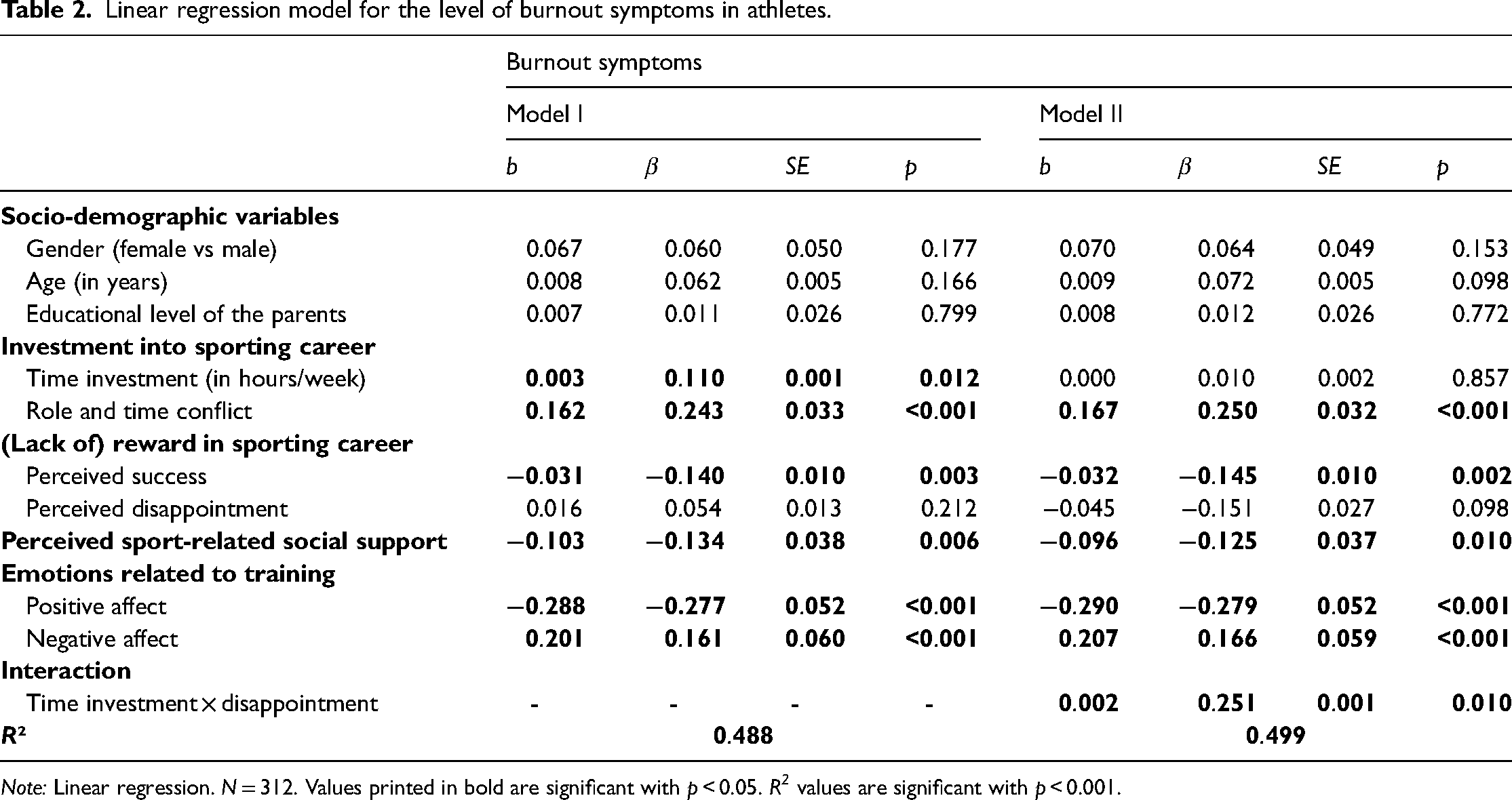
Note: Linear regression. N = 312. Values printed in bold are significant with p < 0.05. R2 values are significant with p < 0.001.
Burnout symptoms as a function of gratification crises
In a second model specification (Table 2, model II), we additionally included the interaction effect of time investment and perceived sporting disappointment as an indicator of the assumed mismatch between effort and reward (Hypothesis 3). While the main effect of sporting disappointment on the level of burnout symptoms remains insignificant (ß = −0.15; p = 0.098), the combination of such disappointing experiences and high time commitment is associated with significantly higher ABQ scores (ß = 0.25; p = 0.010). The main effect for time investment is insignificant in this model (ß = 0.01; p = 0.857), suggesting that high time investments are not per se associated with burnout symptoms. Rather, only under the condition of disappointing outcomes in sporting competitions, a high amount of invested time becomes a risk factor for burning out. The interaction effect represents the second strongest effect in model II. Figure 2 shows a visual representation of this effect. The figure indicates the estimate for burnout symptoms as a function of time invested for athletes with no disappointing experiences versus severe and highly straining disappointing experiences within the last 12 months of the sporting career.
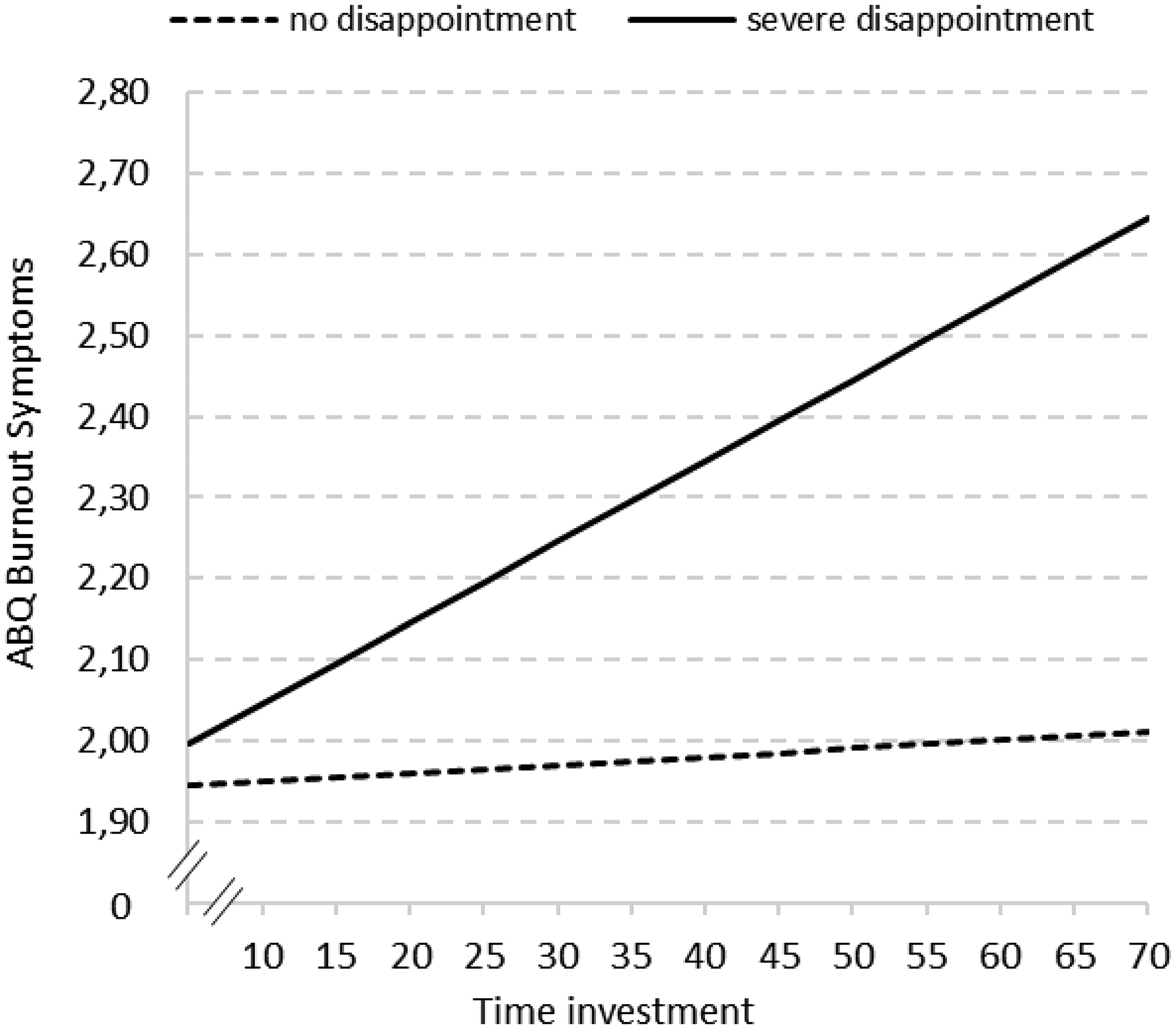
Estimated ABQ scores for athletes experiencing no and severe sporting disappointment as a function of invested time (in hours per week).
Discussion
Using a sample of German elite athletes that represents eight Olympic disciplines and the three highest German squad levels, the present analysis showed that burnout symptoms are common and pointed to several risk and protective factors that go beyond the level of personality factors already studied in the past (Woods et al., 2022). Risk factors associated with higher burnout symptoms are high time investments for training and competitions and the experience of time and role conflicts (Hypothesis 1a, 1b). Protective factors associated with lower burnout symptoms are the experience of sporting success as well as the perceived available support in the elite sport environment (Hypothesis 2b, 4). In addition, findings support the notion that training-related positive and negative emotions both matter for the prediction of burnout symptoms (Hypothesis 5a, 5b). Most importantly, the results indicate that feelings of disappointment cannot be considered in isolation (Hypothesis 2a), but rather in combination with the individual effort expended (Hypothesis 3). Precisely, vulnerability to burnout is particularly increased in situations that qualify as gratification crises, in which athletes perceive that high time commitment does not pay off in terms of sporting success.
In line with previous research (Goodger et al., 2007; Gustafsson et al., 2017; Rice et al., 2016; Röthlin et al., 2023; Woods et al., 2022), our findings add to the literature on the protective nature of social support, suggesting that the perceived emotional, motivational and practical support from the athlete's sporting environment contributes to overcoming stressful challenges. Furthermore, a novel insight of the present study is the presumed two-sided role of training-related emotions regarding the process of ‘burning out’: Our findings support the previously limited evidence not only for the association between positive affect and lower burnout symptoms (Gustafsson et al., 2013; Woods et al., 2022) but also for the association between negative affect and higher athlete burnout symptoms (Moen et al., 2019; Woods et al., 2022). Rather, this paper extends the base of knowledge by highlighting the predictive value of training-related emotions, i.e., affective states that are more closely related to the sporting context itself. In a previous account, Lemyre et al. (2006) were able to show that changes in negative affect related to daily training sessions predict the end-of-season burnout level in elite swimmers. Our findings suggest that this relationship might be generalizable to other sports beyond swimming as well. Moreover, our results also provide quantitative evidence for findings from a previous qualitative study, according to which aversive feelings towards training were mentioned by burned-out athletes as a central feature of their personal burnout experience and as an expression of sport devaluation (Gustafsson et al., 2008). As an affective component, negative feelings towards daily training sessions seem to fuel doubts regarding the meaningfulness of competitive sport and thus potentially accelerate the cognitive part of the burnout process in particular (Kleinert et al., 2021). Hence, we propose to consider negative training-related emotions over longer periods as an ‘early warning sign’ for burnout.
Drawing on Siegrist's (1996) ERI model, we characterize a mismatch of invested time and sporting success as a ‘gratification crisis’ in competitive sports. Theoretically, we conceived the elite sport environment as a highly competitive ‘workplace’ that demands from athletes enormous investments of time and energy as well as personal sacrifices to be able to continuously perform and to improve. We conceive this investment as a systemic imperative, i.e., a precondition for starting and continuing an athletic career. However, most athletes usually experience not only success but also failures, losses and disappointments. In periods where athletes suffer from sporting disappointments despite having invested much time into training and preparation, they are more prone to burnout. Although the ‘gratification crisis’ model has been supported by studies from various work environments (Van Vegchel et al., 2005), the present study is the first quantitative data-supported demonstration that ‘gratification crises’ are associated with burnout in the elite sport workplace as well, thereby contributing to the sociology of health and work. Our results also provide further evidence for initial conclusions on this topic drawn by Gustafsson et al. (2008) based on qualitative interviews.
Practical implications
Given that changing the essential systemic conditions of high-performance sports seems almost impossible (Coakley, 1992), athletes should at least be supported whenever they face a gratification crisis. From a practical point of view, this means that athletes should have easier access to various support services, especially when they are facing challenges (e.g., sports psychological counselling during performance slumps or injury). This is also important because the existence of a supportive social network cannot be taken for granted. Furthermore, it seems necessary to raise awareness of burnout, especially in the sporting environment itself. As athletes spend most of their time in this setting, at-risk athletes could thus be identified and supported at an earlier stage, even before severe symptoms manifest. In addition to raising awareness (e.g., among coaches), this could be facilitated by implementing screening tools. Our findings thus support Lemyre et al.’s (2006) call for regular monitoring tools of athletes’ emotional states specifically in relation to training to identify athletes at risk early on.
Limitations and future research
This study has strengths and limitations. Despite being based on cornerstone theorizing from the sociology of work and health, the assumed causality, i.e., that a gratification crisis is a cause for burnout risks, cannot be tested directly. The cross-sectional design of the study does not allow for any causal conclusions. We believe that it seems more convincing to understand burnout in athletes as a reaction to environmental and situational factors in elite sport; it cannot be ruled out yet that almost burned-out athletes are less successful or associate training with negative feelings due to their exhausted state. Moreover, our sample represents athletes from eight different sports. It is therefore not clear to what extent the results can be generalized to other sporting disciplines. Although we tried to use established measurement tools for data collection wherever possible, scales used to measure role and time conflict had a low internal consistency. However, since this scale is based on only four items and Cronbach's alpha is influenced by the number of items, we find it acceptable to use the scale. It also must be kept in mind that the Athlete Burnout Questionnaire (Raedeke and Smith, 2001), although widely used in research, represents a non-clinical measurement without validated cut-offs for a clinically reliable burnout diagnosis. Finally, it should be noted that there may be a number of other potential person-environment interaction effects that we have not examined here. For example, Leiter and Maslach's (1999) concept of burnout distinguishes between fairness norms or the degree of control over employees at the organizational level. Accordingly, future studies could apply these conditions to elite sport and examine other relevant interactions that might deepen the understanding of a ‘mismatch’ between person and organization.
We believe that future research is needed not only to replicate the current findings with a sample that covers more sporting disciplines and might thus be more representative of the >4000 German elite athletes (www.sporthilfe.de). Rather, operationalizing sporting success and disappointment by using objective performance data could help in understanding the subjective component that constitutes a gratification crisis. While the present analysis did not aim to identify risk profiles for specific groups of athletes, studies using classification approaches (Granz et al., 2019; Sorkkila et al., 2017) point the way to more precise profiles for subgroups more prone to burnout. Furthermore, longitudinal studies with person-centred research designs could be informative to better understand the interplay between ERI and athletes’ burnout risk over the course of time, for example, how long athletes endure gratification crises or when the negative health effects we describe begin to occur. Such a longitudinal perspective could also shed light on the extent to which negative emotions related to training could be a potential early warning sign for initial burnout symptoms. In addition, future studies could try to include ‘dual careers’ into the effort and reward perspective. Dual careers usually mean additional workload and increased role and time conflicts, implying a further acceleration of life and higher demands for the management of time, but athletes also report multiple benefits from these non-sporting careers, such as a sense of security and the transfer of learned skills to other areas of life (Aquilina, 2013; Burlot et al., 2018, 2021; Macquet, 2010; Schmid et al., 2022). Hence, a non-sporting ‘dual career’ includes effort and reward evaluations of its own, therefore potentially contributing to or protecting from burnout symptoms.
Conclusion
The increase in symptoms among athletes over the past two decades (Madigan et al., 2022) should be reason enough to consider burnout as a systemic or as a social problem in elite sports rather than merely an individual problem (Bette and Schimank, 2006; Coakley, 1992). The results of our study have shown that the elite sport system may contain not only protective elements but also important risk factors for burnout in athletes. In particular, we show that the concept of gratification crisis with its links between personality and organizational context helps in predicting burnout symptoms among athletes and thus should be considered as a useful framework for future research on athlete burnout.
Supplemental Material
sj-docx-1-irs-10.1177_10126902241248767 - Supplemental material for Burnout symptoms in elite athletes: Assessing the role of effort–reward imbalance, support and emotions
Supplemental material, sj-docx-1-irs-10.1177_10126902241248767 for Burnout symptoms in elite athletes: Assessing the role of effort–reward imbalance, support and emotions by Celine Hilpisch, Karsten Krüger, Markus Raab, Lena Wiese, Karen Zentgraf and Michael Mutz in International Review for the Sociology of Sport
Footnotes
Acknowledgements
The authors would like to thank the two anonymous reviewers as well as the IRSS editorial team for their conscientious and constructive feedback.
Declaration of conflicting interests
The authors declared no potential conflicts of interest with respect to the research, authorship, and/or publication of this article.
Funding
The authors disclosed receipt of the following financial support for the research, authorship, and/or publication of this article: This project was funded by the Federal Institute of Sports Science on the basis of a decision by the German Bundestag (ZMI4-081901-21-25).

Supplemental material
Supplemental material for this article is available online.
References
Supplementary Material
Please find the following supplemental material available below.
For Open Access articles published under a Creative Commons License, all supplemental material carries the same license as the article it is associated with.
For non-Open Access articles published, all supplemental material carries a non-exclusive license, and permission requests for re-use of supplemental material or any part of supplemental material shall be sent directly to the copyright owner as specified in the copyright notice associated with the article.
