




Abstract
In this article we provide a sociological analysis of parental choice in pre-school sports and physical activity, as a form of concerted cultivation, to understand the uptake of sports-based physical activity (PA) enrichment activities in England. Despite a growth in the under-five pre-school enrichment market, little is known about why parents pay for their under-five child(ren) to participate in sport and/or PA enrichment or how this relates to wider patterns seen in contemporary parenting. 24 semi-structured interviews with parents of early years children from across England were conducted. Findings suggest the reasons why parents enrol their child(ren) in sports-based enrichment activities can be considered a form of concerted cultivation. In particular, parents value routine and socialisation for themselves and their children. Parents look for paid-for activities that enhance their child's social and academic skills but do not emphasise the health benefits of being physically active as important in their decision making. Instead, they prioritise opportunities to enhance their child's social and cultural skills in ways that enable the child(ren) to be accepted and interact positively with adults and other children in key institutional settings. Parents also valued spaces where their young child(ren) could expend energy, although the importance of this was distinctly gendered. We conclude by outlining that paying for under-fives sport-based enrichment is linked to wider social and cultural expectations on parenting, and highlighting that more needs to be understood about the gendered, racialised and ableist spaces of commercial pre-school sport and PA.
In this article we conceptualise parental choice in preschool sport and physical activity as a form of concerted cultivation (Lareau, 2003), providing a sociological analysis of the growth of sports-based physical activity enrichment activities in England since 2000. In doing so we provide an understanding of how contemporary parenting influences the decisions parents make about early years children (i.e., 0–5 years old) and paying for sports-based physical activity (PA), contributing to the research in this area (Harlow et al., 2020; Vincent and Maxwell, 2016)
While paid-for, extra-curricular activities (e.g., sport, drama, and music) have been a long-established history of older children's leisure (Trussell and Shaw, 2012; Wheeler and Green, 2019), they now form an ever-increasing part of weekly routines for under-fives and their parents. Sports-based activities have become one of the most popular forms of paid-for pre-school activity (Allen and Velija, 2022). Established in 1979, Tumble Tots was one of the first companies delivering enrichment for the under-fives, focusing on physical movement. Since then, there has been a rise in the number of commercially available enrichment activities, often through a franchise model (Vincent and Ball, 2007). The demand for such activities can be seen in those taking part. For example, Baby Ballet has 25,000 participants a week and Rugby Tots state 80,000 children take part each week internationally, with some activities costing up to £20 per class (for more information see Table 1).
Franchise information and attendance rates.
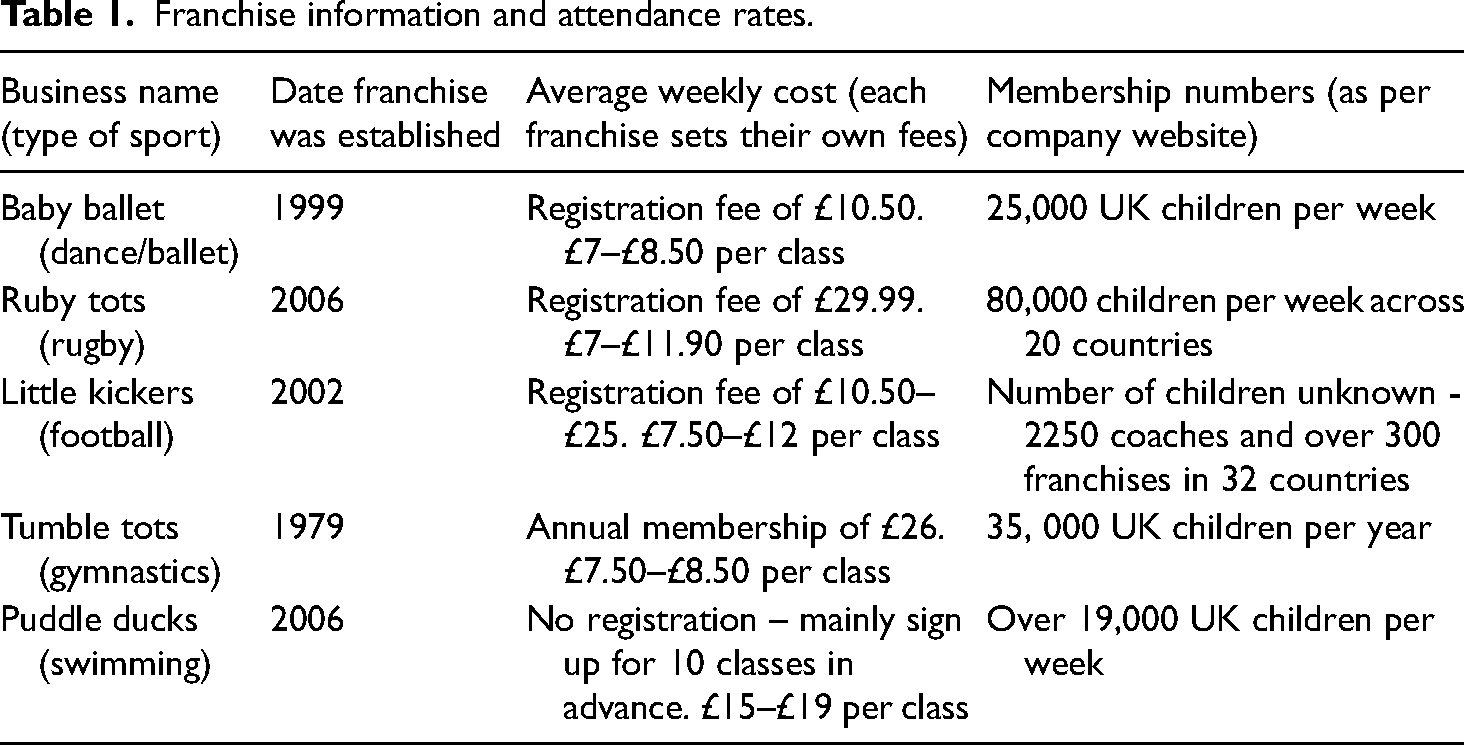
Throughout the article we draw upon Lareau's (2003) concept of concerted cultivation as a framework to understand how paid-for enrichment activities form a part of (largely) middle-class children's weekly routine at an increasingly early age (Allen and Velija, 2022, 2023), focusing on how parents talk about their decisions to attend and commit to paid-for sport and PA enrichment with their preschool child(ren).
Conceptual framework: Concerted cultivation and enrichment
Lareau's (2003) Unequal Childhoods provides an empirical analysis of how social class and class cultures impact parenting style and family life (in older children than our study). Through a longitudinal ethnographic study in America, she compared family life and parenting in middle-class families (employed in management positions) and poorer parents (e.g., those not regularly in work). Focusing on families and their routines over a period of time, Lareau (2003, 2011) was able to demonstrate the ways in which middle-class parents invest in their child(ren) in a concerted (and useful) manner, supporting them to navigate systems such as school and other institutions to their benefit.
The term concerted cultivation describes a pattern or type of parenting that seeks advantage for children through paid-for activities which dominate children's time outside of school (Lareau, 2003). Her study identified patterns in how families spend their time, and how engagement with paid-for enrichment activities is more extensive in middle-class parents who often schedule multiple activities for their children. These activities often dominate family life and give children confidence and an ability to engage with adults (and those in authority) (Lareau, 2003, 2011). In contrast, she describes a different pattern in working-class and poor families where parents are just as committed to their children, but they often lack the economic capital for paid-for leisure activities. Instead, the children from working-class and poor families had more free time to play with neighbours. These families also tended to have extended family nearby and had less structured and scheduled activities. This pattern of parenting was described by Lareau (2011) as the accomplishment of natural growth.
Lareau (2003) describes the research as an empirical application of Bourdieu's theoretical model, by detailing the way children develop habitus through leisure activities, their language use at home and the interventions of adults in useful ways. Her research captures moments of cultural and social reproduction but goes beyond this to show empirically how people draw on class-based resources to facilitate children's progress in social settings. This shows how access to economic capital enabled parents to enrol children in activities that are perceived to develop life skills that give children a cultural advantage, outlining ‘the largely invisible but powerful ways that parent's social class impacts children's life experiences’ (Lareau, 2011: 3). Concerted cultivation describes a cultural logic of child-rearing where parents support opportunities for children that give them an advantage in other institutions. Her research is an empirical analysis of how some parents can facilitate their children's development through key social settings and selection of activities. The long-term impact of advantage identified how family practices give children a cultural advantage, outlining systematic and cultural practices of parenting that impact social mobility and opportunity.
Parenting and sport and physical activity with under-fives
Contemporary pressures on parents have highlighted the performative nature of parenting and the ways being actively involved and investing in children's activities can be seen as a way of performing good parenting (Trussell and Shaw, 2012). Parents are under pressure to ensure children get ahead in education and other social situations, and while success cannot be guaranteed, the desire to try and cultivate success is created through reminders that securing places at good schools, universities, and jobs are limited (Lareau, 2003; Stirrup et al., 2015; Vincent and Maxwell, 2016; Wheeler and Green, 2014).
The growth of commercial activities for under-fives can be understood as part of the expected contemporary components of (largely middle-class) parenting practice (Gabriel, 2017). The demand for these activities and the cost associated means they are not available to all (Vincent et al., 2010). Across two different locations in London (England), Vincent and Ball (2006) identified a similar pattern to Lareau (2003), whereby working-class families were less likely to involve children in enrichment activities, highlighting a class-based element to enrichment. In the North-West of England, Wheeler (2018) compared the routines in poor-working class and middle-class families in her study on patterns of concerted cultivation (with children of primary school age). She found that some parents in lower middle-class families sacrificed other activities so their children could be involved in organised (predominantly) sport-related activities because they were perceived to be activities that could aid their child(ren) to get an advantage.
While enrichment activities are available across a wide range of interests (e.g., art, music, and education), sports-based classes (e.g., football, swimming, ballet) are a particularly popular choice in the commercial pre-school market (Harlow et al., 2020) as indicated in the number of children participating in such classes on a weekly basis. Early years enrichment shows a downward trend where activities that were once more associated with older children have become part of the routine and activities of many under-five children (Stirrup et al., 2015). It is not clear whether paying for involvement in enrichment activities impacts or contributes to the ‘socio-economic achievement gap in educational outcomes’ (Smyth, 2016: 724) or whether these activities are enriching or suitable for younger children (Harlow et al., 2020), but the way these activities are marketed encourages parents to engage in forms of concerted cultivation at a much earlier age, and the reasons for paying for these activities are worth sociological consideration.
The marketing of early-year enrichment activities seems to speak to parents who are seeking forms of concerted cultivation. Smyth's (2016) analysis of the marketing of enrichment to the parents of under-fives in Sydney (Australia) illustrates the ways in which political and media discourses about the early years has increased parental concerns about child development. Growth of pre-school enrichment is promoted as a way for parents to buy cultural capital to safeguard privilege (Smyth, 2016). Her analysis found activities for the under-five's seemed to draw on this and marketed in ways which imply that they give children a social, physical and/or skill advantage. Her research provides empirical examples of how enrichment activities are marketed in ways that enable parents to perform concerted cultivation through investing in their children's future successes. In England, Vincent and Maxwell (2016) analysed the marketing of Tumble Tots (a physical play programme developing physical skills), Perform (a drama, dance and singing class), and Kumon (a pre-school maths and English study programme). They emphasise the way these activities market the benefits of attending as well as promoting the development of a wide range of personal characteristics. Their research highlights how language appeals to parents with the economic capital to purchase perceived advantages for their under-fives to help children get ahead as part of performing as a good parent.
The relevance of pre-school activities for parents is discussed by Mysko et al. (2023) who interviewed 16 parents, with children aged 3–5 years, who paid for organised sport participation in Australia. They found parents saw the opportunity to future-proof children through early sport activity. This was particularly important for parents who had a desire for their child(ren) to develop a sporting habitus which reflected the family's status as a sporting family, an ideology of happiness and health through early involvement in sport and leisure. This alongside a long-standing cultural belief that sport is good forms part of parental decisions to invest in their children's sporting capital in the 3–5 age range (Mysko et al., 2023). Therefore, exploring family routines and leisure habits to understand the role of sports-based enrichment activities for the under-fives is of sociological significance.
Focusing on one specific activity in England, Gridley's (2022) study is one of the few that highlights the parental perceived benefits of a bouldering programme for children under six years old. Benefits include climbing-specific skills, intrapersonal skills (e.g., confidence and self-awareness) and interpersonal skills (e.g., learning from others and peer interaction). Parents considered the benefits of acquiring knowledge to support learning, varying activities, and changing parenting approaches, such as lowering expectations and being more patient around their child. The parents valued how the skills being taught through bouldering would benefit family related leisure activities when the child(ren) was older, indicating a form of habitus necessary for family leisure activities associated with middle-class family routines (Gridley, 2022).
In this article, we develop the work on pre-school enrichment by drawing on the conceptual framework of concerted cultivation to provide a critical understanding of parents’ decisions and motivations for making paid-for activities part of their routine with their under 5 children in England. The aim of this paper is to provide a sociological analysis for the growth of preschool sport and PA and was guided by the following research questions:
Why do parents pay for pre-school sport and PA enrichment? How do parents conceptualise the benefits of their own and their child's attendance at pre-school sport and PA enrichment? How are these benefits linked to wider trends that influence parents to enrol children in pre-school sport and PA?
Method
Procedures
Institutional ethical approval was granted from the first author's previous institution (approval number: 19177) and all ethical procedures were followed (e.g., informed consent, anonymity and right to withdraw). This paper only focuses on the qualitative data collected through semi-structured interviews; however, we recruited interview participants through an online survey that we had disseminated first. While disseminating the survey our only selection criteria was participants had to be over 18 years old and have parental responsibility for at least one child aged 5 years or under. 925 parents/carers voluntarily completed our survey looking at sport-based enrichment, and physical activity more generally with early years children. This approach allowed us to cover a greater geographical spread and postcode data shows completed survey responses from England, Wales, and Scotland. At the end of the online survey, we asked participants to leave an email address if they were happy to be contacted about participating in a follow up interview. Of the 80 participants who left details and were contacted, this paper discusses the interviews conducted with the 24 participants who replied and engaged in an interview (see Table 2 for demographic details). Whilst the survey gained responses from England, Scotland and Wales, the participants involved in the interviews were all from England.
Interview demographic data
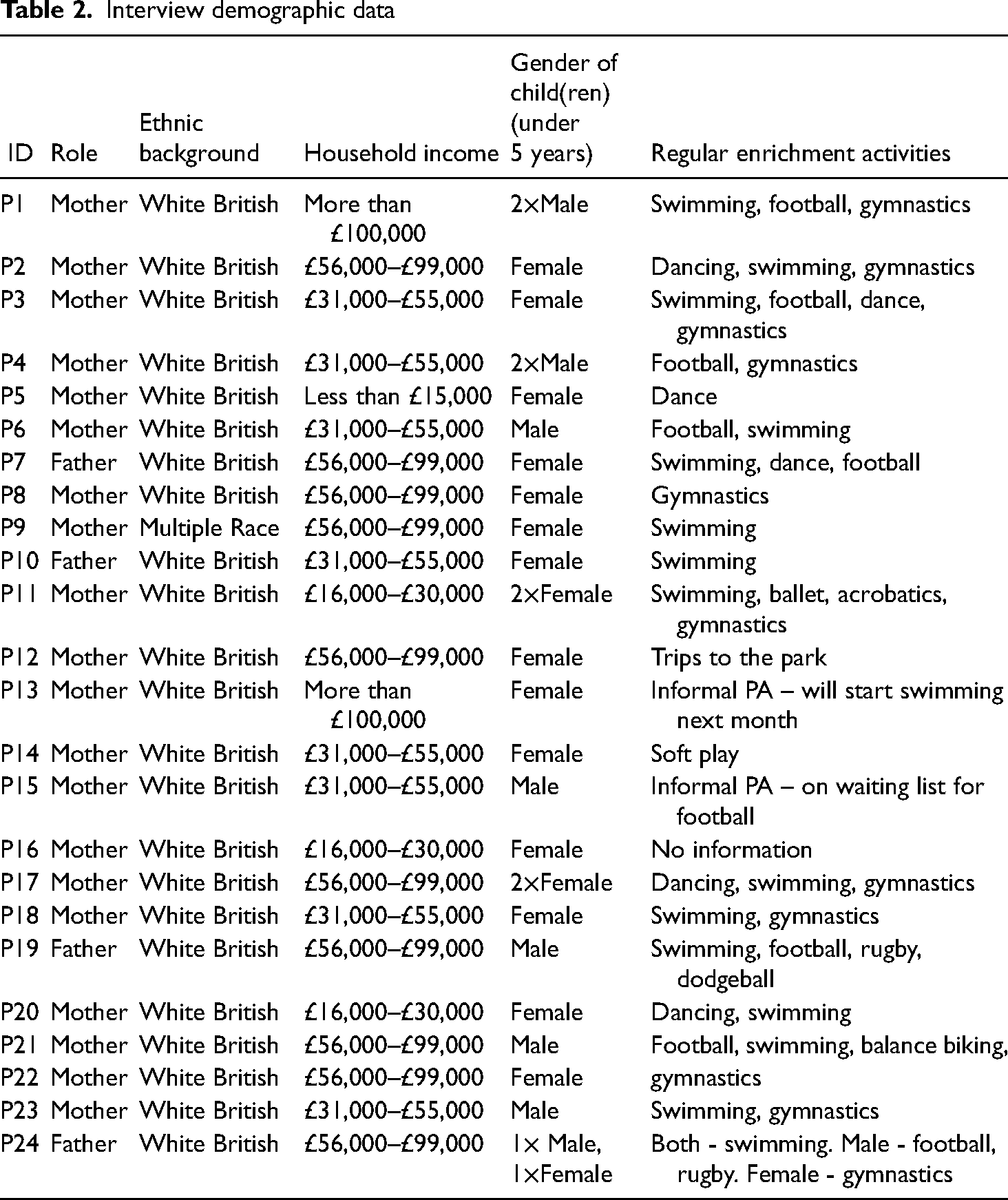
When recruiting, the language we used was parents, however, it was often mothers who organised enrichment activities and largely mothers who engaged with our study (n = 20). Other demographic data, that was not a direct focus or a specific criterion for recruitment but does require acknowledging, is the ethnic background and income of our participants. Such data was collected to aid the potential identification of any particular patterns and highlights the vast majority of participants in this study reported being from a White British background (both the survey (n = 846) and interviews (n = 23). We also asked for income to understand more about the economic resource's families had to support pre-school enrichment.
Interviews were semi-structured allowing us to gain detailed accounts of participants’ experiences. Eight interviews were conducted in person due to geographical proximity to the researcher and participant preference. Sixteen interviews were recorded in Microsoft Teams™ allowing us to cover a wider geographical area across England. Using an online platform to connect with participants also allowed data collection to continue during various Covid-19 restrictions. Online interviewees were informed that they were not required to switch on their cameras although all did. The increased use of online communication during the pandemic allowed us as researchers to gain a wider audience but also meant interviewees were more comfortable using this method of communication. Interviews ranged from 32 min - 71 min and were transcribed verbatim. To ensure participant confidentiality and anonymity, participant numbers were used (e.g., P1, P2 and so on). Pseudonyms were also used when participants referred to family members by name.
Qualitative data analysis
The interview transcripts were analysed using a thematic analysis approach (Braun and Clarke, 2022) allowing us to identify patterns of meaning across the interview data set (Braun et al., 2016: 191). Once familiar with the transcripts, codes were identified through labelling (or tagging) relevant text was completed by the second author. Semantic themes were generated and then themes were developed and reviewed. This process was not undertaken linearly and once the initial analysis was complete, time was spent reordering, reorganising, and renaming those initial themes as an interpretation of the data progressed. Using a theoretical framework resulted in some elements of analysis being deductive (theory-driven sub-themes such as ‘concerted cultivation or natural growth’), whilst the uniqueness of the data and the unprecedented situation in which the data was collected resulted in a largely inductive analysis (themes developed from the data itself, e.g., ‘gendered energy expenditure’).
In the interest of reflexivity, we were mindful of our positionality throughout the study as we are both middle-class women who at the time of designing this study had children under the age of 13. As we gained insight into each family's context, routine, and experiences of sports-based PA enrichment classes we would regularly discuss our own experiences, particularly Georgia who (at the time of data collection and writing) was a parent with two children accessing pre-school sport. We reflected on how our experiences had shaped our interest in the topic as we navigated mothering and noticed the ways in which pre-school enrichment was present and advertised.
Findings
The cultivation of organised and structured sport and PA in family routines
Our data highlighted the importance of routine for parents and children through structured paid-for weekly activities. The activities that they invested in were discussed as a significant part of their weekly lives, and were about an arranged activity that formed part of the day: Everyday we’d have an arranged activity, so she’d have football, swimming, dance, gymnastics, and then there’d be soft play centres. (P3, Mother) I think a lot of it for me is getting out of the house. I think she's much more focused … she gets way more out of it if she's actually in person with the actual props, seeing other children do the same things that she's doing. (P2, Mother) That the activity was already structured, planned, somebody had already sorted out what they were going to do that day. That even though I may be joining in, I didn’t have to think of how that was going to benefit my child, what areas to work on. (P3)
The importance of routine was also related to structure and having structured activities to support their child's social development: He's more of a wild child and independent child. So, I hope and think he's benefited from the structure of it as much as anything which I know is not the physical activity, but he listens more to instructions. (P6, Mother)
The wider pattern of parents who adopt a form of concerted cultivation relates to a desire to ensure children are doing activities that have benefit to them, and thus the need to have something planned that would have a purpose relates to the pressure on parents to cultivate their children's time on developmental and useful activities through play (Stirrup et al., 2017). However, this form of concerted cultivation is also related to increasing expectations on parents to stimulate or play with children and/or arrange activities (Allen and Velija, 2023). Some parents can pay for this providing them with a break from finding ways to entertain or plan activities. However, the data we collected on income showed that for some, lower-income families they were less likely to enrol in numerous activities and were more selective in their choices, thus suggesting that pre-school enrichment is not open to all.
However, routine and structure were not solely about something to do, but rather like the parents in Vincent and Maxwell's (2016) study, our parents wanted to do something to support the development of the child: It's a fun way of getting them to learn other things. Like my son is learning colours through playing football and running to the blue corner as opposed to running into the red corner. It's just a fun way of learning things. (P6, Mother)
The reasons why parents paid and enrolled their under-five(s) in structured sports-based sessions, were rarely associated with being physically active. Rather, parents drew on wider beliefs about children learning social skills (Harlow et al., 2020), and opportunities to socialise with other children. The social aspect of the class was specifically mentioned by several parents who discussed how important socialisation was in their decision-making to attend sport-based classes: ‘I wanted her to go to the classes for the social aspect’ (P9, Mother). Although the opportunities to socialise with other children are often minimal in certain classes (e.g., in this instance toddler swimming), being with others in the class seemed to be important for the parents as well the children: ‘I’d say I’m not into mummy friends or things like that, so I’ve made friends in the group, don’t socialise with them outside of the group’ (P11, Mother). Here the distinction between mummy friends and the group is clear. The group provides some form of socialisation in a structured time and space, but without the need to socialise outside of the activity. Parents discussed how they benefited from social interaction and that pre-school enrichment was a way to find parents to interact with others, for example: The dance … we’ve got a WhatsApp group, so there was lots of social interaction between the mums and dads. There's a television programme after Christmas, it was mask singer and people were guessing, you know, just sort of that, so we've benefited in that way, in a social way. (P6, Mother)
Parent four (mother) notes how her husband has benefitted from attending these activities with their child: ‘He's the one that did Tumble Tots and in a weird way he's benefited from finding friends and more social groups.’ As parenting can be isolating, making friends is important, and while some research has explored mothers and friendships (Andrews et al., 2019), there remains little research examining parental benefits of under-five enrichment, particularly for fathers. The socialisation element of the activities may also reflect a form of social reproduction as parents are likely to find parents at these activities who are like them (Allen and Velija, 2023), who also value parenting as a form of concerted cultivation.
Other skills developed through engagement in sport-based activities were deemed important for promoting social and physical capital by many parents. For example, this parent highlights the benefits of learning various life skills: All those skills that they are learning like appropriate behaviour of being in a small group, waiting your turn, the patience needed, listening, and following instructions are needed for starting school and are really important. (P5, Mother)
While paid-for activities are only one part of the child's week, it was clear that parents felt that paying for these activities could enhance their development in ways that will be valued when their children enter formal settings. As one parent discussed the importance of sport-based sessions for her only child was mainly related to it being able to do activities with other children: [It's] good for their coordination, it's really good for their stimulation, and I think it's good for their confidence. If it's a group physical activity, then they’ve got to learn to share and take turns which I think is a really important skill to learn. My daughter is an only child, so she doesn’t necessarily get that at home. It's really good to try and get her out with other children and learn those social skills as well as the physical activity. (P2, Mother) I think she's quite advanced for her age when I take it to a park or a class or something like that, she's much stronger than other children. Again, it might be sort of natural genetics. She's very, very slim, very light, and very fast and she sort of shoots over play equipment and seems to be miles ahead of her friends and much, much faster than them. I think she's quite confident … even dresses herself up in something and we'll put on a little show for people. So, I think it's really good for her confidence and I would hope her overall fitness. She seems to be able to eat whatever she wants, and I don't worry so much about how much she eats because I know she's very physically active and she is still very, very slim. But again, that could be natural genetics. (P8, Mother)
Cultivating physical development and energy expenditure
While many parents expressed multifaceted reasons for sending children to these activities, physical development, as opposed to physical activity, was the phrase most often used. One mother expressed a desire for their child to become more physically coordinated: Tumble Tots was amazing, not only for physical activity but for coordination. I think basically both my boys learnt to climb through Tumble Tots because it gives them that safe environment to do so but also risk take. (P4, Mother) She's so full of energy that at one point she was just running up and down the living room, you know, up down up down up down. So, we’ve got to get out and use some of this energy up somehow. And physical activity I’ve found is the best way. (P8, Mother) Boys have a lot more energy than girls do. And girls are a little bit more, I don't like putting labels on girls and boys if I'm completely honest, but I do find that my little girl is little bit more laid back - I'm going to use my friends’ boys as examples, boys are a little bit wilder in nature. (P9, Mother) Having two boys, I think boys learn through physical activity. Stereotypical, but it [PA] appears to be more essential in boys. Their emotions are more physical, whereas girls that I know of similar ages are more verbal in their emotions. Does that make sense? I think emotionally, physical activities are more important for boys. (P4, Mother) The sign that my child has had enough physical activity for the day is when they’re purely exhausted and can't keep their eyes open when we get to bedtime because they're just so worn out. (P6, Mother) I don’t like to make assumptions about things like that. I have heard girls are slower to develop gross motor skills, but I have no evidence base for saying that, it's just something I’ve heard. My attitude has always been that boys and girls should be raised the same way and I don’t think I would have done anything differently with my daughter if she’d been a boy. (Parent 7, Father)
Swimming lessons and cultivation of a life-saving skill
The reasons for why a particular sport was selected by parents for pre-school enrichment varied but swimming was viewed differently by parents as swimming was seen as a life skill. While doing more than one sport-based activity was important for parents to ensure the development of a range of life skills, these skills were often ranked in perceived importance. For example: I think at this point, swimming is more important. So, if we go on family holiday, the skills he's learning in swimming are more important than the sport skills he's learning in football which is primarily around ball control. (P23, Mother) We both think it's [swimming] an important life skill – to be able to swim … I registered when I was pregnant … I’d seen adverts on Facebook and in the mother-to-be packs that you get. Things like that were advertised quite heavily. (P18) We were aware of a family friend whose son had passed away due to lack of, not even lack of swimming lessons, I think he had gone for a swimming lesson and got himself in danger and obviously had passed away, so we were keen not to repeat that. (P22)
Cultivation for school preparation and readiness
Many of the parents had considered the wider benefits for their under-five(s) and were thinking longer term about how activities could support the development of their child: It's [PA] important to go alongside their education. I think it's really important to have that physical side as well. It helps them learn new skills that they wouldn’t get from just sitting in the classroom. They learn a lot from physical activity. (P17, Mother) I’d love to take her on junior park run… it would set her up for life, it really would. If you can start running at a young age and get good at it, then all of a sudden, you’re good at PE and if you’re good at running and PE at school, that tends to mean you’re probably in the popular crowd. Because the popular kids are the ones who are good at sports. (P14, Mother) We’re from Liverpool, so football is a favourite pastime, so it was just about giving Oscar that head start because when he starts school football is going to be the main thing that a boy would be expected to know about and to be able to do. (P19, Father) We wanted to start as early as possible then by the time he goes swimming with school, he’ll be a confident swimmer. I really don’t want it to be that they go swimming with school, and they can’t swim, and their friends see that. (P21, Mother)
For the following parent, this was particularly important because of their child's learning disability and the need to have a wide set of skills, but there was a recognition that this could be achieved through their own cultivation and not through paying for these activities: It's something to fall back on, if it does turn out that she's got learning difficulties then she can rely on her physical prowess rather than her mental prowess. … She could be an instructor in a sport… My experience of organised sport has always been a negative experience. I’ve met people who run these sorts of things are very often underqualified and charge way too much money. I’m a trained lifeguard so I know how to swim, and I saw the amount of money that was being charged for swimming lessons and I just thought, you know what, I can teach her. (14, Mother)
Conclusion
In this article, we provide a sociological understanding for the expansion of paid-for, pre-school sport and PA as a form of enrichment by identifying it as part of wider patterns of parental pressure for children to develop in specific ways. Whilst using sport in various settings to develop life skills in youth sport is not new (see Allen and Rhind, 2019; Camiré et al., 2022), our article highlights how sports and PA is valued by parents at an increasingly earlier age. Despite the popularity of sport and PA enrichment, a unique finding is that parents in this study very rarely chose sport classes or physical activity-based enrichment for health reasons. Health was often not a consideration at all. Rather, parents spoke more about the perceived skills that being involved in sports-based activities might bring and this was valued by parents who wanted children to learn skills along with expending energy. The discussion of energy and tiredness often reflected gender norms about perceived physical activity needs for young children and drew on traditional ideas about the physicality of boys and girls. We suggest that greater consideration needs to be given to how these activities reinforce inequality seen in later patterns of youth sports involvement and exclusion. For example, the whiteness of our sample suggests we need to understand more how ethnicity shapes the decisions of parents seeking enrichment and their experiences of the classes they attend. Furthermore, little is understood about enrichment and inclusion for children with disabilities.
Through the conceptual framework of concerted cultivation, we can provide insight into how parents seek forms of concerted cultivation through paying for enrichment activities with their under-five child(ren). The way parents talk about why they pay for pre-school enrichment can be understood as a form of concerted cultivation. This reflects the socially constructed pressure on (mainly) middle-class parents to provide children with experiences that aid their development, both physically and socially. As Lareau observes middle-class parents ‘engage in a pattern of concerted cultivation to stimulate their child's development and foster their cognitive and social skills’ (Lareau, 2011: 5). One way that these forms of social competence are being fostered at an early age is by parents who choose forms of enrichment often emphasising a desire for their children to learn through such activities. While there are elements of concerted cultivation in the parent decision-making, our data also highlights that there are benefits to parents when their child(ren) attends enrichment activities. There is a likelihood that concerted cultivation is broader than networks and skills for children, but also has parental benefits and thus supporting a wider understanding of how the pre-school space is stratified.
These networks are important as mothers, in particular, talked about the activities giving them a routine in an era where parenting can be isolating. In these examples weekly classes are a space where parents meet, providing a routine that gets them out of the house, and offers a structured way of meeting other parents who wish to invest in their children's development through paid-for enrichment. It is also a relatively risk-free space to meet other parents as the focus is on the child and the child-related activity. The benefits of parent socialisation and how new parents utilise such classes to form parenting networks is something that could aid a wider understanding of the demand for commercial pre-school enrichment.
Finally, it is worth noting that in this study, most respondents to the survey and interviews were mothers, highlighting how mothers, despite the increasing involvement of fathers, are still more likely to organise and facilitate young children's routine and time. This highlights the continued nature of gendered parenting and expectations when it comes to caring and developing young children.
In summary, who attends and who does not attend early years sport and PA enrichment is of significance for sociologists to further understand unequal cultural practices in parenting which may give children a set of skills which are valued in other middle-class settings. Our research highlights there are different class and cultural-based approaches that may need further consideration, both in how the commercialisation of pre-school sport is sold to (middle-class) parents, and how buying enrichment activities as a form of concerted cultivation may increase existing social divisions.
Footnotes
Declaration of Conflicting Interests
The authors declared no potential conflicts of interest with respect to the research, authorship, and/or publication of this article.
Funding
The authors received no financial support for the research, authorship, and/or publication of this article.
