




Abstract
Despite recognition that the early years are foundational for child development and that parents are significant influencers on a child’s spiritual development, little research has considered parental approaches to passing on faith to young children. Guided by frameworks of sociocultural theory and viewing parents as funds of knowledge, this exploratory, qualitative study involved an online survey of 71 self-identified Christian parents in the UK with children under 5 years. The results were analysed using thematic analysis to identify themes in the data. The findings indicate that Christian parents want to support their child’s spiritual development and that they find rhythms, routines, and sharing faith in everyday moments of life helpful for doing so. The project found support for parents to be varied and suggests that churches and the wider Christian community ought to intentionally evaluate the support they provide for parents and the approaches they have for doing so.
Introduction
Is it possible for Christian parents to share their faith with their young child? Or is this an impossible expectation? Do parents feel supported in this venture? How can support be improved?
These are some of the questions prompting this paper, as we explored the lived experiences of Christian parents with young children in the UK; viewing them as funds of knowledge (Moll et al., 1992) with the hope of sparking innovation in the provision for them in the UK church, faith communities and beyond. This has become an increased priority and focus as awareness of the importance of a child’s early years has been illuminated. However, as yet there is little research available about what is beneficial for families with young children who seek to pass on their faith to their children, even though it has been found that faith can be a support for many parents (Zhang and Li, 2021).
This paper is part of a broader project exploring the place of children in the UK church in the wake of the COVID-19 pandemic as this marked a distinct shift in the patterns of families engaging with churches worldwide (Casson, Holmes, Logan, 2023). As a result of pandemic restrictions and experiences, parents and families have adjusted priorities and behaviours, and the impact of this is noted in the education, health and social care sectors. Family life is now different to pre-pandemic times and agencies such as the British Academy have called for policy makers at local, regional and national levels to address this and respond by changing frameworks, policies and practices where required. It is therefore timely to explore the lived experiences of parents of young children, to reveal their needs and requirements as they seek to nurture their children’s faith development. While recognising that this topic is likely relevant across all religions, this study used Christian parents in the UK as a case study to gain particular insights into their approaches. As a result, the conclusions drawn are particularly relevant to this specific community and can inform revised strategies of the UK church in supporting young families, but are likely also applicable and informative for other faith communities.
Background
Parenting in the Early Years
A range of biological and environmental influences combine and interact during the early years to shape individual developmental trajectories (Bronfenbrenner, 1977). This project focuses on a child’s social experiences, particularly with their parents or immediate carers. Britto et al. (2017) found that the most powerful context for nurturing care is the home, usually provided by parents, family members, or the care system. This is supported by the Institute of Medicine and National Research Council (2000), who report that even for children who spend most of their waking hours in child-care, parents (or alternative primary care givers) remain the most influential adults in their lives. Thompson (2016) revealed how crucial interactions with these caregivers in the early years have been found to influence a range of developmental outcomes, such as vocabulary size and number knowledge, and are foundational for much of later development. This is surely an outworking of attachment theory (Bowlby, 1956), whereby secure attachment has been found to support self-regulation, buffer stress, facilitate learning and language development (Arnold, Lonigan, Whitehurst, & Epstein, 1994; Thompson, 2013; Whitehurst et al., 1998; Vally et al., 2015). In a family who observe religious faith, it therefore follows that parents practicing faith in the home might be the most significant factor influencing the child’s faith trajectory, particularly during early childhood.
The associations between attachment and faith development underpin Folwer’s stages of faith development theory (Folwer, 1981) which suggests that like cognition or social behaviour, spirituality is a basic aspect of human existence which matures in parallel to other aspects of development. He argued that in the first two years of life a child learns to trust the goodness (or not) of the world through the interactions they have with their parents and that these experiences of trust and security influence later feelings towards the divine. Numerous studies guided by this framework such as Tenelshof and Furrow (2000), Joung (2006) and Hart et al. (2010) have identified associations between early attachment and later faith development, highlighting the influence of parents in the early years on faith development in children.
Sociocultural theory, heavily influenced by Vygotsky (1978), suggests parents also influence child development by being ‘more knowledgeable others’ shaping the process through which children acquire their beliefs, values and problem-solving strategies. Longitudinal studies such as Lau et al. (1990) and Lazarou et al. (2008) have identified parents’ beliefs and behaviours concerning drinking, diet, exercise, and safety to be significantly associated with child and adolescent beliefs and behaviours on the same subjects. Lau et al. (1990) identified the effect of parents to be greater than that of peers, notably reporting that direct modelling of behaviour appeared to be the most important avenue of influence. In line with social learning theory (Bandura, 1977), this emphasises the importance of children observing, modelling and imitating the behaviour, attitudes and actions of those around them. This idea is mirrored in some contemporary Christian literature, for example, (Turner, 2018) encourages parents to create ‘windows’ into what it looks like to live as a Christian for their children to see, explore, and potentially imitate.
Rogoff (1990) suggests that a further way that parents shape their child’s beliefs and behaviours is by introducing them to routines and institutions which reinforce their values and goals. In the same way that variations in sleep, mealtime, and reading routines have all been found to correlate with language development, academic ability, and social skills (Spagnola & Fiese, 2007), it could be anticipated that rituals and routines such as attendance at collective worship, prayer, or reading a holy book may be associated with faith development. The routines instigated by parents in the early years can differ significantly between cultural groups, reflecting differences in societal beliefs and expectations (Gannotti & Handwerker, 2002). Resonating with the theories of Bronfenbrenner (1977), this suggests that routines and rituals provide avenues for passing on the values and beliefs of a particular culture or group to children. From this we might expect the beliefs and values expressed by the wider Christian community to influence the practices parents use to share faith with their children. Indeed, a report by Care for the Family (2020) acknowledged that the activities parents report doing to nurture their child’s faith at home differed between church denominations. It is therefore interesting to explore parental use of habits, rituals, and routines to foster their child’s faith development.
Christian Parenting
There is a wealth of literature supporting the notion that religious affiliation and associated beliefs have significant influence over family values and parenting behaviours which in turn impact on a child’s development. Ellison and Xu (2014) highlight how religion, particularly that of evangelical Christianity in the United States, has been found to significantly influences beliefs around family matters such as premarital interactions, cohabitation, marriage, childbearing and child-rearing. Furthermore, Bartkowski and Ellison (2009) note that evangelical beliefs appear to significantly impact a parent’s approach to child discipline. Religion has been shown to enhance the bond between both mothers and fathers with their children (Bartkowski & Xu, 2000; Pearce & Axin, 1998) as well as decreasing involvement in risk-taking activities and fostering pro-social behaviours during adolescence (Pearce et al., 2003; Pearce & Haynie, 2004; Smith & Faris, 2002).
The relationship between religious beliefs and parenting behaviours is far from straightforward, with research identifying paradoxical findings within some evangelical Christian families (Ellison & Bartkowski, 2009; Bartkowski, 2007). The relationship is deeply complex with some aspects of religion such as conversation and discussion yielding positive effects on child development while also recognising that at times conflict and disagreement associated with religious beliefs can in fact hinder a child’s development (Bartkowski et al., 2008).
An individual’s early life experiences, shaped as highlighted above by parental beliefs, heavily influences religious, with positive correlations having been found between parent religious beliefs and their child’s later beliefs (Gunnoe & Moore, 2002; King et al., 2002; Myers, 1996; Sherkat, 2003). Smith et al. (2020) emphasised that while parents do not fully control or determine the beliefs or practices of children and young people, studies typically find their religiosity to be the most significant influence on the religiosity and spirituality of their children, often for the rest of their lives. Lifecourse approach studies support this view; for example, Petts (2009) found that young adults frequently attending religious services in early adulthood were more likely to have been raised in religious families than those whose participation changed in adolescence. These results concur with those of Bengsten et al. (2013) whose data from longitudinal surveys found that parental influences on religiosity remained strong across four generations. Bader and Desmond (2006) also found positive correlations between parents’ religiosity and reported religious importance, church attendance, and frequency of prayer in adolescence. Interestingly they found that high attendance coupled with lower importance attributed to religion was not significantly associated with later measures of religion, whereas children whose parents had low church attendance but placed high importance on religion showed more religiosity later in life. These results indicate that parental faith activities outside of church attendance are important in a child’s faith development, implying that faith transmission activity in the home has an important role.
This is supported by weighted data reported by Jordan-Wolf (2022) which showed that when asked what age they came to faith, 76% of Christians claimed they made their own commitment to faith under the age of 18, with 38% selecting ‘from birth’ or ‘0–4years’. Alongside this, 34% of the practising Christians claimed growing up in a Christian family was the most significant factor in helping them develop their own faith (Jordan-Wolf, 2022). Similar findings were reported in a study by the Church of England (2015) which found that 41% of Christians attributed their faith to growing up in a Christian home, and a further study by Hope Together (2017) where 40% of Christian participants said they came to faith between the ages of 0–4 years. These results suggest that akin to other aspects of child development, parental choices in the early years of a child’s life are hugely significant for their spiritual development.
Methodology
This exploratory study adopted the notion of parents of young children as funds of knowledge. Moll et al. (1992) sought to develop innovations in teaching which drew upon the knowledge and skills found in households. In the same way, this project sought to draw upon the lived experiences, knowledge, and skills of parents with young children regarding their faith activity in the family context. The aim was that highlighting this acquired knowledge would bring about innovation in terms of provision and support from churches and the wider Christian community for this sector. Data was collected from parents using an online survey chosen for its inexpensive ability to collect a large amount of data with a broad geographic reach in a short space of time (Ritter & Sue, 2007; Braun et al., 2001). This was created using the software ‘Typeform’ and distributed via the existing mailing lists and social media of the seven partner organisations. The survey was open for two weeks during spring 2022, and included 7 open and 13 closed questions to further investigate the findings of previous research (Holmes, 2022; Holmes et al., 2021). In line with its aims, this study focused on 8 of the questions, half of these were open and half closed. The closed questions asked parents about their church attendance and the sort of faith practices their family had engaged in through multiple choice selections as well exploring their perceptions around the support they receive and their role in their child’s faith development. The open questions asked families to describe their experiences of faith practices at home, what they had found beneficial during the pandemic and what they would like the Christian community to do more of in the future to support them as parents. Care was taken to ensure that the language used was understandable and relatable for families from a range of geographic, demographic and denominational backgrounds. The study sample included 71 parents with children aged 0–5 years and came from a broader sample of 209 parents of children ages 0–16 years and 175 church leaders. Of the smaller study sample, 41% of the participants had only children under 5 years, compared to 59% who also had older children. While the data was not collected to be fully representative, the participants came from a range of geographic regions, church denominations and church sizes.
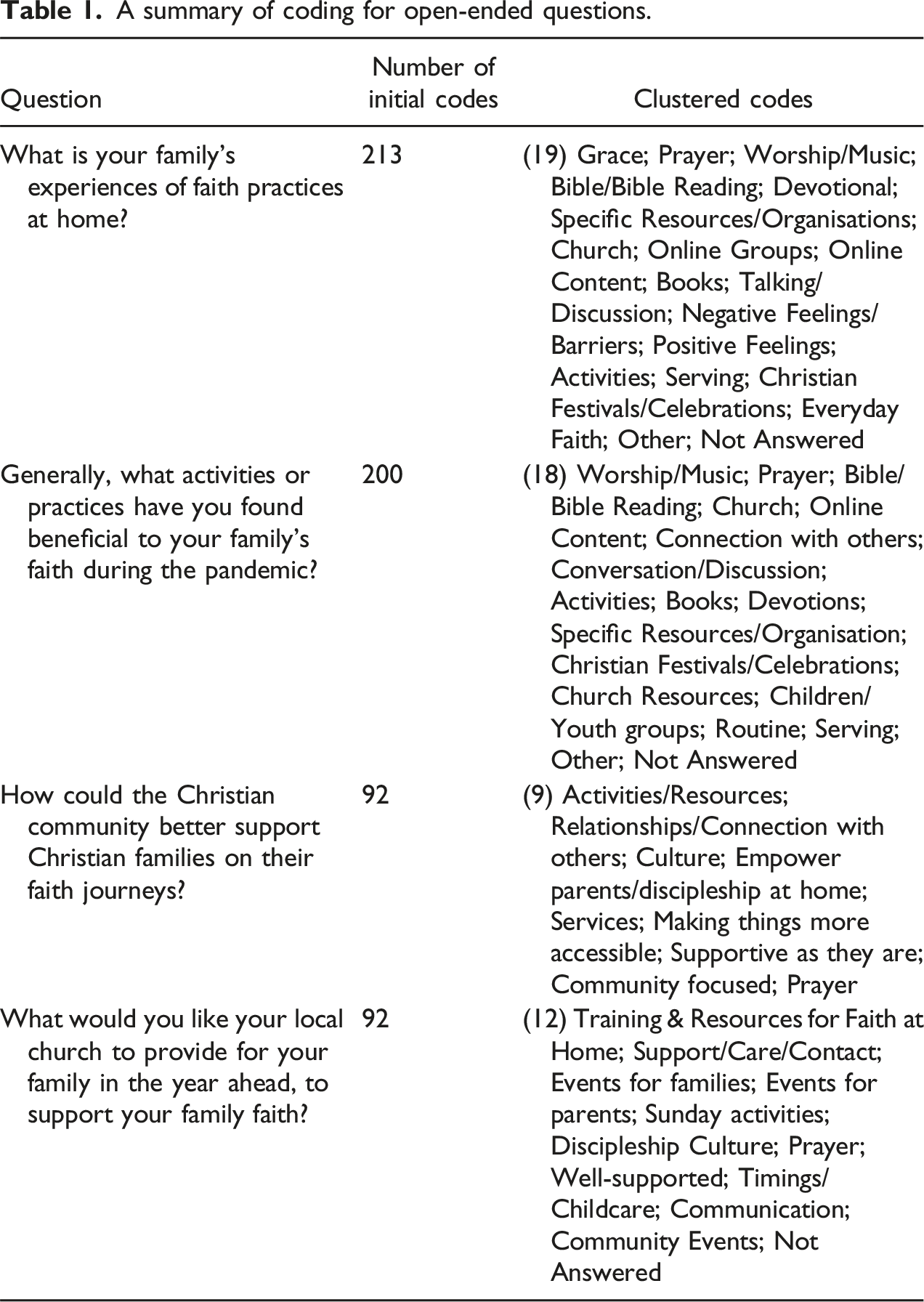
A summary of coding for open-ended questions.
Findings
Lived Experiences of Christian Parents with Young Children
When asked about their experience of faith activity at home, 76% of parent participants reported negative feelings or barriers, compared to only 24% expressing positive emotions. A range of difficulties were reported including: struggles engaging children, finding it hard to fit in, difficult to maintain, and requiring significant time and energy. Many of the negative responses appeared to centre around the impact of the pandemic, in particular the changes that it required of church. Nearly a third (31%) of the negative responses referred to difficulties accessing church services online, such as: “We found it very difficult to engage under 5s with online church” “We needed … relationship with other people” (054).
Conversely, several participants mentioned positive experiences of supporting their child’s faith at home, for example: “they help us see spiritual side of children” (009) “we enjoy it a lot” (041) “These have helped us through the darkest days of the pandemic to give us hope” (038)
78% of parents said they knew where to find resources to help develop their child’s faith, while 12% did not and 10% were unsure.
When asked about their experiences of faith activity at home, several parents made references to their role in sharing faith with their children, such as: it is “a must - pandemic or no pandemic - it's our responsibility to disciple our children. We invest time and energy in this” (049).
Another highlighted the importance of their child learning from them in the home environment explaining that they were: “trying to build a Christ-centered home where my boys learn about Christ through me” (070).
Respondents were asked to select from a list of Christian faith practices those which they had engaged in during the pandemic. The most common responses were: online church attendance (87%), in-person attendance (85%), Bible reading (76%) and using Christian books and resources (69%). These were followed by watching online Christian content (61%), spending time with other Christians (59%), singing (59%), faith discussions (55%) and serving others (44%). Some of the less frequently chosen activities were helping others in the community (35%), outdoor activities with a faith element (32%) and reflective/quiet time (28%). Participants explained their selections, with the open-ended responses producing 213 codes which were grouped into 18 clusters. Of these, the most frequently reported habits and practices were prayer (18.3%), Bible reading (12.2%), worship/music (5.6%) and attending church (5.6%). Other less commonly mentioned practices included reading books (3.8%), faith discussion (3.8%), watching online content (3.3%), grace (2.3%) and devotionals (2.3%). Feelings and emotions towards faith practices at home made up 16% of the coded responses, making them the second most reported theme. Within the participants answers the idea of ‘everyday faith’ was mentioned multiple times making up 3.3% of the overall responses. Interestingly, several individuals made specific reference to routine as beneficial with 10% of total responses inferring use of routine by mentioning time or place specific elements such as: at night, in the car, or at mealtimes.
The below comments exhibit this sense of everyday faith activity within the family: “We believe in the importance of discipling our children, in faith being a part of everything we do - not just on a Sunday” (001) “We make faith part of our everyday in whatever activities/parts of the day we can get it in to. Faith should be a ‘normal’ aspect of our life.” (018) “We try to make our Christianity part of our everyday. We incorporate prayer and talk about God when it comes up.” (021) “It got a lot easier when we learnt to weave faith practices into everyday life rather trying to do something extra (like a chore)” (056) We enjoy it a lot but, especially with the kids, have to add it on to current routines to make it happen (ie. breakfast)” (041) “Routine every night to have a Bible story with questions to discuss afterwards/ natural conversation, then prayer time together. Plus try to share our faith in everyday conversations as it arises” (019) “We talk about God being in the room with us, invite him to play games with us, chat and catch with him about decisions we have had to make” (037)
Perceptions of Parental Roles and Responsibilities
Participants were asked about their role in faith transmission, and more than half (68%) disagreed that they should leave their children to decide for themselves about faith, and the overwhelming majority (97%) agreed that it was their role as parents to instil Christian beliefs, habits and practices in their child. Furthermore, 97% of the parents believed that they should regularly discuss faith with their children and try to encourage them in their faith. This all shows that the participants felt a significant responsibility for nurturing their child’s faith. Alongside this, parents highlighted the need for other influences to support their child’s spiritual development with 90.2% of the parents agreeing that it was important to take their child to church so their faith could be nurtured there.
The Role of the Church and Christian Community
Of the participants, 89% of the families had attended church, either in person or online, once a month or more. Of these, more than three-quarters (76%) attended weekly. Marginally more than half of the parent respondents (56%) reported that they felt supported by their local church to nurture their child’s faith at home, while 34% did not and 10% did not know. Half of the parents stated that relationships with people at church had supported their child’s faith during the pandemic, 37% said they had not and 13% said they did not know. Slightly over half of parents (57%) reported that their church provided resources to use at home to help support their child’s faith, while 37% said they did not, and 6% said they did not know.
Participants were asked to reflect on things that had been beneficial to their child’s faith over the last few years and this generated 200 initial codes. The most frequently reported were traditional faith practices of worship & music, prayer, reading the Bible and attending Church. Alongside these, six percent of responses mentioned connecting with other people as being helpful for supporting family faith, with eight references to children’s groups and adult bible study or prayer groups as important for facilitating support and connection.
When asked what support they would appreciate from their local church, the responses generated 92 codes. Requests for training and resources for faith activity at home were the most frequently reported (17%). Other themes were for the church to provide support, care, and contact for families (14%), run family events (14%), and hold events for parents (13%). Less frequent responses were running Sunday activities (6%), having a discipleship culture (6%), praying for families (6%), the church considering timings of events and childcare needs for events (4%), clear communication (3%) and community events (2%). Five individuals mentioned feeling well supported and thirteen participants did not answer this question.
When asked about the role of the wider Christian community, 24% of responses had encountered provision of activities or resources from the wider community, whilst 23% highlighted the role of the wider community in supporting families in developing relationships and connections with others. Twenty percent of the responses discussed the culture of Christian communities mentioning things such as honesty and conversation about struggles in life, as well listening to parents about what they need. Other responses focused on aspects of services (8%), making things more accessible to families (8%), empowering parents for discipleship at home (7%), being community focused (3%) and offering prayer support (2%). Three of the responses stated these communities were supportive as they are, and 14 individuals did not answer the question.
Discussion
Is it possible for Christian parents to share their faith with their young child? Or is this an impossible expectation?
None of the participants conveyed any sense of this being ‘impossible’ or an unachievable expectation. Indeed, there seemed to be tacit acceptance of their role and responsibility in this regard. The respondents conveyed strong convictions about faith sharing being primarily their responsibility as a Christian parent. Expressions from parents of investing and inputting spiritually into their young child indicate an understanding that firstly this requires intentional and rich sowing type activity, and secondly a sense of reaping longer-term results, concurring with Okholm (2018). Participants cited discussing faith aspects with their child regularly, alongside traditional rituals and practices such as prayer, Bible reading and attending church. Many viewed themselves as a model of faith for their child, concurring with social learning theory (Bandura, 1977). This is also in line with family sanctification theory proposed by Mahoney et al. (2003) who suggest that through participation in family relationships, such as those between a parent and child, individuals can experience God or nurture their spirituality and that religious rationales often deem it a parent’s duty to model and instil particular values in their children. Bartkowski et al. (2019) have critiqued sanctification theory and noted it’s limitations, finding that some aspects of spiritual parenting such as religious attendance can have both salutary and adverse effects on children. Almost all our participants agreed that whilst sharing their faith with their child was important, this needed to also permit respect of their child’s independence in choosing their own religion. This fits with the cultural narrative in the UK that faith and religion, although significantly influenced by the family context, is considered by many to be an individual’s personal choice, as discussed by Mark (2016).
Within the responses, a theme of transmitting faith in the everyday moments of life emerged, such as the use of everyday activities such as bedtimes, mealtimes, journeys and playtime as mechanisms for nurturing faith in the ordinary moments of life. This concept seemed to be a more relaxed way of viewing the parental role, and did not seem to convey any sense of needing to meet set agendas or targets which would lead to increased pressure. Indeed, one respondent stated that it feels less like a ‘chore’ if an approach of everyday faith is fostered.
Another common theme was of instilling habits and religious practices into their family ethos and daily life, echoing studies, such as Smith et al. (2020), that have found significant associations between practices such as Bible reading, attending church, and prayer, and self-defined Christian faith later in life. Often referred to as spiritual disciplines, these habits are Biblical ideas practiced by Christians throughout the ages, to ‘bring the abundance of God into our lives’ (Foster, 2008, p. 10). Coupled with the fact that repetition facilitates learning in the early years (Horst et al., 2011), it is not unexpected that parents sought to help their children engage in these practices on a regular basis. However, it is interesting that parents who did not have additional children over the age of 5 placed such an importance on these practices, indicating that in contrast with the views of scholars like (Goldman, 1964) they did not see their young children’s limited mental capacity as inhibiting faith, and indeed viewed repetition as beneficial in middle and later childhood also. Rather, the parents highlighted a range of specific resources that they found useful in helping their children to engage with these practices such as: naming specific children’s storybook Bibles, referencing accessible language for praying with young children, and listing a plethora of online videos including worship songs and Bible stories created for young children. In this way, the parents in our study appear to seek out resources to help implement spiritual disciplines in ways that are age-appropriate for their family. While many of them felt confident in finding these, there were individuals who voiced a need for more help from their local churches in accessing these kinds of resources. This resonates with the ideas of Turner (2018) who encourages churches to act like a help desk for parents; listening to them, providing them with choices, and helping them solve problems for themselves.
The sense of rhythm and routine incorporated by many participants, such as mealtimes, bedtimes, and journeys to and from nursery seemed to be effective and beneficial opportunities to Christian beliefs with their child. This is interesting because it sits in line with findings considering other aspects of development such as those of Spagnola & Fiese (2007) who reported how variations in behaviours at mealtimes and bedtimes are significantly associated with developmental trajectories. It may be that there is something specific about these times that make them good learning opportunities for children. Indeed, journeys, mealtimes and bedtime-routines all offer opportunities for connection between parents and their children. Keeping children and adults together in a fixed place for a moment of time, these opportunities provide space for conversation and reflection, which appear to be avenues for sharing faith with one another. Not only this, but many significant conversations between adults occur around a dinner table, late at night, or when travelling from place to place, and thus it seems logical that parents might use these places to spark significant conversations with their children. This idea underpins ‘The Kitchen Table Project’ run by Care for the Family which encourages parents to share faith with their children through everyday experiences including conversations around the dinner table. Despite the limited conversational ability of children under 5, having family discussions about faith was mentioned by several parents in the study as beneficial. This further confirms the value parents placed on faith conversation as well as that they did not discount their child’s ability to contribute to and learn from spiritual conversations and wondering together – in line with the views of Berryman (2013). The importance of conversations for sharing faith was also identified by Care for the Family (2020), with 88% of their parent participants saying they talk about faith with their child. Alternatively, it may be that these rhythms and routines are helpful not because of the activity itself, but because they enable parents to fit sharing faith into the busyness of everyday life – an idea articulated by Turner (2018). Indeed, several parents reflected on how integrating faith into the everyday aspects of life made it easier to remember and repeat.
The focus on sharing faith through everyday moments and activities found in the study is in-keeping with much of the existing literature on child development and spirituality, such as the work of Coles (1991) and Goodliff (2013). Parent focus on sharing faith through craft activities, games and experiences in nature, fits with the historic inclusion of encouraging spirituality through wonder, creativity and play in the EYFS curriculum (Ministry of Education, 1996; DCELLS, 2008; CCEA, 2007; Department of Education, 2009; DfE, 2012). Similarly, the understanding that children might mediate their learning of the Christian faith through activities and storytelling which encourage play and imagination, is in line with the traditional ideas of sociocultural theory initiated by Vygotsky and Cole (1978).
Whilst the majority firmly believed that their role was fundamental to their child’s faith nurture, many also stated that they recognised the need for other influences on their child, namely, role models and others as part of their church community. Such an understanding reflects the interactions between the microsystem and mesosystem influences on the child (Bronfenbrenner, 1977). The responses intimated that the local church has the capacity to be a ‘safety net’ type surrounding support for families, although only half said that they felt supported in this way. This needs further investigating as to any mismatch or disconnections between the support desired of the local church and that which is provided. It resonates with Powell (2011) who identified that a web of intergenerational relationships between children and adults was associated with children maintaining Christian faith into adulthood. Parents mentioned these connections with the Christian community as helpful for both them and their children, highlighting that they were particularly important during the difficult season of the pandemic. This is in line with other studies which have found religion to be a source of social support (Bennet et al., 1995; Green & Rodgers, 2001). A range of Christian individuals were highlighted by parents as influencing their child’s growing faith, including Sunday school and youth group leaders, peers and other families. This aligns with the conclusions of (Fisher, 2006) who emphasised the importance of the local church and community relationships in an individual’s spiritual well-being, and Bengtsten (2013) who found that receiving positive multigenerational input from the wider family and church increased a child’s likelihood to follow their parents faith. It seems that parents view their role in sharing faith with their children in three main ways: as a role model, a facilitator of Christian experiences and a networker introducing them to other Christian individuals.
Since this paper is viewing these parent participants as funds of knowledge to inform future strategy and approaches of churches, it is key that the UK and wider church notes the above revelations from families with young children. The findings show that these participants do not find this to be an impossible task, instead considering it to be very much part of their role as a Christian parent. The patterns and approaches emerging are revealing a sense of demonstrating their faith as part of their everyday family life, and also involving their children (from very early ages) in faith activities and discussion at home. Whilst this is perhaps in line with traditional expectations within the Christian community, it does not seem to be what is being conveyed in UK churches (Holmes, 2021), who seem to convey messages that the church is the main place of spiritual input for their child and parents should therefore bring their children to attend these activities. Also, it is very clear from these parents that these activities they are involving their children with do not have an immediate outcome or target in mind, which may be counter to those who desire to see children growing and maturing in their faith. Therefore, the Christian church must learn from these funds of knowledge (Christian parents) to simply involve young children as active and fully participating agents and not seek to measure or pressurise for any particular goal. Equally, the experience and knowledge of these participant parents is revealing that they do see their young children as being capable and active in terms of faith, which is perhaps counter to some of the messages conveyed by the contemporary church who may perceive cognitive competencies and requirement to preclude young children from being active agents in the faith community.
The sense of reliance and desire for connection with the wider Christian community is another point for the Christian church to be attentive to. It may appear that families with young children are somewhat disconnected with church during these early years but this is not at all due to desire, but merely pressures of life for these young families. Hence, the calls from these parents for the church to be more flexible and aware of their needs must be heeded. Indeed, listening to their needs and forming church approaches and activity accordingly will be key to ensuring that the broader Christian community genuinely and meaningfully supports these families in ways that they desire and need.
Do Parents Feel Supported in this Venture?
The pervading feelings of parents in this study were negative relating to their experiences of faith activity at home, citing challenges and pressures such as time, energy and engaging their children accordingly, although there were some strongly positive counter experiences and feelings reported. This indicates that they are not receiving the support they require in this quest. Indeed, only half of the parents said that they felt supported by their local church. Questions around the ways in which parents felt others could support them in future once again highlight the importance of relationships with other Christians, and the crucial influence of churches, their services, resources, and activities. It seems that whilst the participants acknowledged their responsibility and influence in sharing their faith with their child, they recognised that they did not do this in a vacuum and that they and their child are influenced by their surrounding community, echoing Bronfenbrenner’s ecological model of child development (Bronfenbrenner, 1974) highlighting the complex interactions between children, parents, and other individuals at home, school, church and in society. Once again this is in line with the findings of much existing literature including Fisher (2006), Bengtson et al. (2013) and Powell (2011). It is therefore key that this knowledge about Christian families with young children is heeded by local churches and the wider Christian community to intentionally evaluate the support provided to this sector and attend to the issue so that appropriate support will be provided.
It was very striking to read in the responses that the support provided by church or wider Christian community was very activity-driven or carried a service-provider mentality, such as children’s clubs and activities. Many commented that these services and provisions were often challenging or inaccessible to parents with young children due to the timing, which they described as creating barriers. Conversely, the participant responses clearly show that what these parents of young children deeply valued was much more relational care and support, particularly in the sense of an open and honest ethos whereby parents could share their struggles authentically with one another. Further to this, many expressed that they would appreciate more support in their role and quest as a Christian parent, through training courses, peer support sessions or parent prayer groups. Once again, these revelations must be incorporated into the ongoing approaches of the UK church to exhibit enhanced and necessary support.
How can Support be Improved?
The above reveals that there is great value in the church viewing parents of young children as funds of knowledge in order that church strategies may informed by knowledge and skills of families including young children, but also so that revised approaches may be co-constructed and hence more appropriate in meeting the needs of young families (Chesworth, 2016). Adopting a funds of knowledge approach to enable churches to better develop their services and activities would be highly advantageous at aiding listening to children’s and parents’ perspectives.
Whilst literature shows that there has been a recent shift amongst the wider Christian community away from viewing the church as the primary centre of discipleship, voiced by authors such as Joiner (Joiner, 2009) and Turner (2018a, 2018b), the findings of this paper do not portray a sense of the church supporting and equipping the families in intentional and beneficial ways. Participant families expressed that they took seriously their role as having primary responsibility for their young child’s faith journey but they often did not feel appropriately equipped in this role. Therefore, churches providing training, peer support and targeted resources to empower parents in this way would be highly pertinent and effective.
The participants also called for greater focus on relational support than service provision. Whilst some did express feeling supported, many stated that greater openness and awareness of the needs of young families would foster more authentic and effective peer support to occur within the Christian community. This dovetailed with a desire for more development of faith role modelling to occur within the Christian community, both in the parents’ sector and children. Careful thought needs to be given to the nature of this and how it occurs in practice since it transpires from our data that the biggest challenge in accessing such support is the timing of events and activities to accommodate families with young children and hence they become inaccessible for families with young children. This again emphasises the need for the church to view parents of young children as funds of knowledge and to take note of their experience as approaches are refined and developed.
Limitations and Areas for Future Research
Naturally, this study has areas of limitations, and its findings could be strengthened by additional research. The conclusions drawn could be strengthened by taking a longitudinal approach, exploring parents’ experiences and how their perceptions change as their child grows. Future studies should consider using interview data alongside survey results to strengthen its findings, particularly since conversation after rapport development often leads to richer discussion. Research of this type would likely provide opportunity for more in-depth consideration of the topic and enable more nuanced conclusions, particularly regarding the role parents believe they play and their experiences of sharing faith in the early years. Such study would also remove any potential bias of internet-gathered data, and with considered recruitment could enable a greater representation of socio-demographic factors within the participants. As mentioned previously it would be interesting to repeat the study further away from the COVID-19 pandemic to see if the experiences of parents were reported differently. Nevertheless, despite these limitations, the study revealed some insightful findings with important implications for those wanting to better support parents in sharing faith with their children.
Conclusion
This paper hopes to begin robust conversation around faith in young families; both the nature of it and how faith communities such as the UK church can better support and enable it. Viewing young families as funds of knowledge will be a highly beneficial way to improve and enhance activity and approaches surrounding this sector. It is evident that significant evaluation of current approaches is required and that listening to Christian parents with young children could enable the pervading ethos and frameworks of contemporary church structures are more fit for purpose when it comes to nurturing the faith development of children. While taking care not to extrapolate these findings beyond the context in which they were retrieved, it could be expected that similar approaches which prioritise learning from the voices of parents, could be beneficial for professionals, educators, and faith leaders wanting to effectively support faith development in children and young people.
Footnotes
Declaration of Conflicting Interests
The author(s) declared no potential conflicts of interest with respect to the research, authorship, and/or publication of this article.
Funding
The author(s) received no financial support for the research, authorship, and/or publication of this article.
