




Abstract
This paper draws on original research from a larger study of racism and Islamophobia online around football, particularly a set of interviews with staff at English football clubs whose responsibility is to manage social media. We use that information alongside our reflections on “platformed racism” to appraise how expressions of racism on social media differ from those in and around the grounds, and how clubs and others in football contest them. This involves a consideration of three themes commonly identified by those speaking on behalf of the clubs: The triggers that ignite racist posts; the partnerships necessary to counter them; and their proposed solutions. Hence this is not just a cue for a collective wringing of hands, but an effort to point the way forward.
Keywords
Introduction
The title of this paper refers to the start of an open letter to the British government and the heads of X (formerly Twitter)
1
and Meta/Facebook, written by Kick it Out (KIO) an organisation known for promoting equality in football. The letter was co-signed by Brentford Football Club, with senior English professional leagues, associations and club representatives, and retitled for publication on their own website to coincide with KIO's press release (Brentford Football Club, 2022). Their collective concern was for the urgent need to put pressure on those with direct and indirect influence on social media platforms to be proactive in the wake of their experiences of online abuse that included racism, homophobia, misogyny, and other forms of discriminatory abuse (FIFA, 2022). In their open letter in support of the then Online Safety Bill, Kick it Out (2022) stated, A culture of impunity has developed on social media. The government, and the social media companies, have the power to create meaningful consequences. We are calling on them to do so.
Social media and offline worlds effortlessly fuel each other (Williams et al., 2019) and the challenges they bring to football's stakeholders are complex. Further, a basic tension of the internet is that at the same time as it enables the best and most productive of humanity it can also facilitate the worst. It is, A powerful force for good, spreads ideas and enhances freedom and opportunity [it] facilitate(s) the exchange of information, goods and services [it matches] supply and demand with great efficiency, increases consumer choice and lowers distance between participants’ (DCMS and Home Office, 2019: 11).
In this paper, we draw on empirical material focused on racism online in football taken from a larger study of racism and Islamophobia, particularly a set of interviews with staff at English football clubs whose responsibility it is to manage social media. We begin by considering the scoping review of Kearns et al. (2022) to contextualise social media abuse in sport, and the factors believed to exacerbate social media abuse. Bennett and Jönsson (2017) and Kilvington et al.'s (2023) critique of counter measures designed to curb online hate in football contribute to our understanding of the scale and nature of the effort required to challenge online abuse in football. We use these insights alongside “platformed racism" (Matamoros-Fernandez, 2017) to explore how expressions of racism on social media differ from those in and around the grounds, and why clubs and others in football struggle to contest them. This involves a consideration of three themes commonly identified by those speaking on behalf of the clubs: The triggers that ignite racist posts; the partnerships necessary to counter them; and their proposed solutions. Hence this is not just a cue for a collective wringing of hands, but an effort to point the way forward.
Football, racism and social media
It is no surprise that there has been a recent rise in research focusing on online hate in sport, especially in the aftermath of the men's European Championship Final in 2021 where three of England's Black footballers, who missed their penalties in the shootout, were subject to racist abuse online. Kearns et al. (2022), who undertook a scoping review on online hate in sport, found that 41 articles meeting their sample criteria were published between 2005 and 2022, 35 of which were published after 2015. They note that Twitter was the most commonly examined platform, football (soccer) was the focus of over a quarter of all publications, while racism was the most explored category of hate, being the focus of 19 out of the 41 published papers. They add that while quantitative methods dominate the literature in this space, more qualitative work needs to be undertaken, especially around the impact online hate and wider forms of abuse have on the recipients and targets. This point speaks to the importance of our paper as we aim to critically understand how stakeholders and clubs can best support, protect and empower their players and wider sporting workforce against online racism. We expect research into online hate in football, and sport in general, to continue burgeoning, especially when we consider that nearly 90% of adults in the United Kingdom are online, spending approximately a day per week on the Internet for work and/or pleasure (DCMS and Home Office, 2019). For young people, the statistics are higher. Notwithstanding the analysis of the Institute for Development Studies that digital poverty remains for a few communities (Faith et al., 2022), cyberspace is within reach for most people in the United Kingdom.
For contemporary football fans, spectatorship and social media go hand-in-hand (McGillivray and McLaughlin, 2019). In turn, traditional in-stadium fan performances of hooliganism, violence and abuse are now mirrored across social media platforms. As Garland and Rowe (2001: 98) hailed the benefits of technology in stadium design and surveillance reducing the likelihood for hooliganism and overt displays of antisocial behaviours at live games, there have been increases in online abuse in English football that reflect social developments in wider society (Bennett and Jonsson, 2017). There has been an inexorable rise in documented hate crime in the United Kingdom and in 2019/2020 hate crimes rose by 8% on the previous year as the figure reached 105, 090 (Home Office, 2020). Analogous to this, in football, the PFA commissioned research for the 2020/21 season by the ethical data company, Signify. Signify found an increase of 48% unmoderated racist abuse in the EPL, EFL, Women's Super League and former elite players with half coming from the United Kingdom (PFA, 2021). Further, KIO recorded a 50% rise in grassroots complaints of discrimination in the first three months of the 2022–2023 season, following a rise of 40% in 2021–2022. These dynamics have been reflected in abuse on social media such that the Chair of KIO, alarmingly predicted that the World Cup in Qatar might not be able to handle the amount of hate and abuse on its platform (Milmo and Mcinnes, 2022). FIFA, the world governing body for football, has reported that over 55% of players in the Euro 2020 and AFCON 2022 finals received some form of discriminatory abuse (FIFA, 2022). The rising concerns with online abuse and extremism led to FARE, the transnational inequality in football organisation and one of FIFA's partners, appointing a European network of experts to tackle hate speech (FARE, 2021).
Historically football's stakeholders have struggled to keep pace with the nature of racism, from the early work that linked racism to individual behaviours (Back et al., 1999) to less colour coded, systemic and intersecting processes off and online (Back et al., 1999; Bradbury et al., 2015; Evans et al., 2020; Evans et al., 2021; Hylton and Lawrence, 2016; Kilvington et al., 2022; Long and Hylton, 2014; Ratna, 2014; Regan and Feagin, 2017). Yet, it is clear even within the football establishment that there is a crisis that has led to the English Premier League (EPL) initiating a No Room for Racism – Action Plan to safeguard against online and offline racial discrimination, enhancing coaching and player pathways to make them more inclusive, improving workforce diversity, promoting the EPL Equality Standard, and supporting an antiracism education programme. These initiatives sit alongside the English Football Association's (FA) Football Leadership Diversity Code to promote race and gender diversity to make inclusivity, diversity and anti-discrimination work more transparent and accountable off the pitch in senior leadership and coaching. Further, it is well established that racism is entrenched in English football (Burdsey, 2011a; Cleland and Cashmore, 2016; FA, 2015; Hylton, 2017b; van Sterkenburg, 2020). Cleland and Cashmore (2016) reported that 83% of their 2500 football fans surveyed agreed that racism was engrained in the sport. Liew (2021) considers a “well-worn” pattern of reporting on racism in football in The Guardian newspaper that goes back four decades. Statements are issued. Governing bodies, broadcasters and public figures clamber over each other to offer their condemnation, often by way of a fancy social media graphic. And then, like any wave, the anger subsides. The news cycle gets bored. Racism carries on, and so does everyone else. Until the next wave, at least.
In April 2021, the EPL, EFL and other key stakeholders agreed a boycott of social media. This boycott came two years after the first one organised by the Professional Footballers Association (PFA) in 2019 when they were agitating for the national and European governing bodies, the FA and UEFA, to take decisive action in response to offline and online racism. Facebook, Twitter and Instagram were all targets of this boycott and cause for concern for the abuse felt across the game (English Premier League, 2021). Although the boycott illustrated a galvanisation of key stakeholders, which is a positive step forward, Kilvington et al. (2023: 94) remain critical of this “social media detox” adding that it was a missed opportunity “to work collectively to develop educational outputs, ways to support and protect victims and ways to identify, prevent and challenge future perpetrators”.
For Kilvington et al. (2023), the United Kingdom Football Policing Unit (UKFPU) is a more welcome addition to the fight against social media and racism in football as the unit works closely with social media organisations to access relevant data to help progress reports of online hate. This addition now means that online users posting hate messages in the context of football, whether anonymous or not, have an increased chance of facing legal sanctions. Barker and Jurasz (2018: 5) note, however, “although legislation cannot change attitudes, it can increase awareness and give victims more confidence and, combined with other measures outside of the law, can contribute to gradual, attitudinal change”. Problematically though, there has been limited response from clubs as Chief Constable Mark Roberts, Head of the UKFPU, revealed that only three Premier League clubs accepted the UKFPU's invitation to work together after writing to all 92 professional clubs 2 offering their support.
Football's governance around tackling online hate is worthy of scrutiny, especially as online hate crime in football continues to rise (Hawkins, 2023). Therefore, echoing Kilvington and Price's (2019) view that it is crucial for stakeholders including governing bodies, the police, clubs and social media platforms to work together in unison to challenge online hate, going beyond piecemeal and performative counter measures such as boycotts of social media. It is paramount that counter measures must be research-informed. We must understand the exacerbating factors or “triggers” (Awan and Zempi, 2015; Kilvington, 2021), how and why online hate circulates, how to identify and challenge perpetrators, and how best to support/protect recipients and targets of abuse.
Platformed racism
Social media and sport debates about “race” and racism have emerged out of concerns about legacy and new media (Farred, 2000; McCarthy et al., 2003; van Sterkenburg et al., 2010; van Sterkenburg, 2020). The dialectic of race and racial ideologies constructing lived realities, race-reinforcing identities, and the media perpetuating racism and intersecting differences all remain ongoing issues (Billings and Hardin, 2014). More specifically where social media in football are concerned there is a burgeoning interest in the role of football fandom (Bowman and Cranmer, 2014; Cleland, 2014) and social media and discrimination more broadly (Kearns et al., 2022; Kilvington and Price, 2017, 2019). Early work on online abuse relating to racism and xenophobia can be seen in the report by the European Monitoring Centre on Racism and Xenophobia (2002). The EUMC as with the early work on racism in football started with a concerted focus on Internet sites where neo-Nazis and right-wing extremists thrive and share toxic views. Even at that stage, the EUMC informed policymakers that racism in the stadium was “the tip of the iceberg”, that there was a “lack of clear rules on the Internet preventing the spread of racism” (European Monitoring Centre on Racism and Xenophobia, 2002: 7).
Those posting can do so seemingly without consequence for themselves in what Matamoros-Fernandez (2017) describes as “platformed racism”. By this, she means both a platform that manufactures and amplifies racist discourse, and also the mechanisms of platform governance that tend to reproduce, but could also challenge, social inequalities. For the most part, while professing to remain neutral, social media companies provide an efficient platform for disseminating racist views and assaulting racialised others. Social media firms adhere to economic models that tend to perpetuate racist dynamics by allowing forms of nefarious speech and user interests to go unremarked, adapting algorithms to bring together like-minded antisocial entities while perpetuating racist, Islamophobic and misogynistic discourses. So even though Facebook argues it is “a technology”, Twitter “a service” and YouTube “a distribution platform” (Matamoros-Fernandez, 2017: 933–4) they remain human constructions where claims of “freedom of speech” and expression encourage the propagation of racially underpinned narratives much to the chagrin of football's authorities.
Platformed racism is exacerbated by what Leung (2005) describes as the perceptual distance between offline and virtual worlds (because of avatars, IDs, usernames and anonymity, people see them as independent), which can partly explain why some say embodiments of “race” do not exist in many online domains, thus denying the potential for racism. Leung counters with the observation that freedom of speech, anonymity, speed of communication, and self-interest groups make up the very conditions for racism to flourish. Cyberspace as a so-called neutral domain brings with it these tensions and dilemmas which Kilvington (2021) argues disinhibit trolls in sport. However, we agree with Brentford FC and KIO that “online is not a parallel universe” (Brentford Football Club, 2022; Kick it Out, 2022) and that the worst excesses offline are reproduced in an offline-online dialectic. But, should this be the case? Our contention is that it is a naïve proposition that offline-online conversations and behaviours are a neat binary that should somehow be treated separately and siloed. Leung (2005: 13) proposes that as the world is a site of struggle and resistance cyberspace must be a point of negotiation between resistance and power.
Platformed racism is also inadvertently bolstered by what Bowman and Cranmer (2014) argue are opportunities presented by social media for fans to “create and collaborate” to the point where the physical and semantic divides between them and their sport seemingly disappear. This has been famously demonstrated by Donald Trump and Elon Musk in politics and business where they actively court an instant wave of support on issues while communicating significant policy information in ways unheard of a few years ago. In sport, fans actively and immediately support the transfer of players, canvass for the sacking of managers, and respond to social causes and live football punditry (Krasovic, 2016; Times Editorial Board, 2020). Bowman and Cranmer (2014) describe this dynamic as the minimal distance between online users and their potential to influence the direction of conversations in football. The potential for immediate action also emerges in what Awan (2016); and Awan and Zempi (2017) describe as “trigger events”. They illustrate how the proliferation of racist imagery and narratives escalate after terrorism-related acts or events, and were able to establish strong links between online hate speech and such trigger events.
In this paper, we share experiences and consequences at this nexus between real and virtual worlds by speaking to clubs resisting online abuse in professional football. We agree that online spaces are neither neutral nor “race” free zones, especially as many who believe they are “backstage” do the strangest of things that bring them frontstage when they feel inconspicuous (Hylton and Lawrence, 2016; Picca and Feagin, 2007). However, this paper goes beyond exploring why those backstage “keyboard warriors” do what they do when emboldened by their relative anonymity. It also shifts away from what Liew and Cleland in The Guardian describe as a “casualisation” of language, “hardening of minds” and a “coarsening of conversation” online (Liew, 2021).
We are specifically interested in examining how professional football clubs respond to such issues and what their dispositions to racialised abuse online looks like and their preparedness for responding. On this note, KIO's CEO argues that as numbers of abusive posts increase there needs to be better coordination of the response to online abuse across professional clubs: If you look at the stats that we have around discrimination – and bear in mind that we’re only one source of reporting because 92 clubs have their own sources, which all need to come together – we see a significant increase in the year to date when it comes to incidents of discrimination. (P.A. Media, 2022)
Methodology
This paper draws on semi-structured interviews from representatives of four EPL clubs and six English Football League clubs over the 2019/2020 season. The interviews contributed to a larger study that included content analyses of online fan forums (Kilvington et al., 2022) and a social network analysis of Twitter [Authors, under review] that had a broader focus on racism and Islamophobia. Both of those made use of data in the public domain thus enabling an efficient and effective data-gathering exercise with few constraints. Though the larger study that this paper is taken from focused on racism and Islamophobia, due to the lack of information provided by the clubs on tackling Islamophobia online or offline this paper concentrates on their experiences of, and systems related to, antiracism in clubs that encapsulate related forms of discrimination.
In an early phase of the project a scoping exercise was conducted using Qualtrics, an electronic data collection tool, in an approach to all 92 clubs to share preliminary information on any roles, responsibilities and activities regarding tackling online racism [and Islamophobia] 3 . This preliminary approach generated 12 responses on what clubs do to protect, support and train players and staff, and share the issues and challenges faced in engaging with racism [and Islamophobia] online. There were few signs of agreement among EFL/EPL clubs on institutional responsibilities to online anti-discrimination work. In just the clubs that responded, representative “leads” held a wide range of positions: Club Secretary; Media Team; Safeguarding Lead; Communications; Legal and Compliance; Equality Diversity and Inclusion (EDI) Officer; Community Trusts; Operations 4 . These initial contacts facilitated a link with the most appropriate person or department with the closest responsibility for policy and programme development regarding online and anti-discrimination work.
As even the United Kingdom Football Policing Unit (2023) discovered, access to professional football clubs is difficult and severely restricted. The response rate for the initial approach to clubs is in line with the experience of other researchers and may have been aggravated by clubs grappling with the impact of coronavirus disease 2019 (COVID-19). Nonetheless, that exploratory piece of research not only identified a set of contacts within clubs who were appropriate to our purpose but also a set of issues to examine in greater depth.
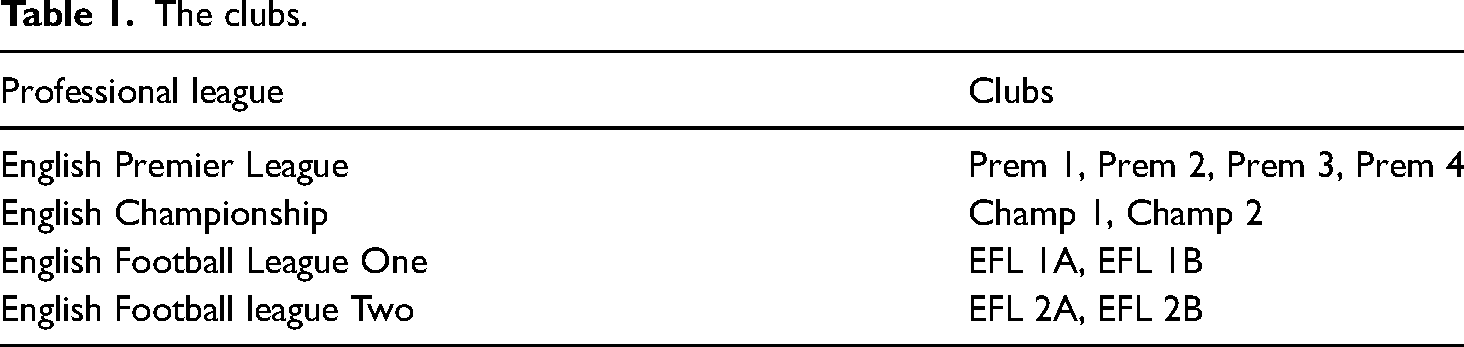
Representatives from ten professional clubs agreed to be interviewed. We used critical case sampling (Patton, 1990) with a stratified component, selecting participants we calculated would provide the most informed view of the issues identified in the scoping study. Nine of the ten clubs came from those responding to the scoping questionnaire and a tenth was added for balance across the four professional leagues. For anonymity and confidentiality, Table 1 includes only the leagues in which the clubs were playing at the time of interview.
The clubs.
It seemed to us likely that it was these clubs that would provide the richest, most informed insights to the issues we were investigating and these most likely to be trying to formulate positive responses to racism and Islamophobia. In that regard, it is worth noting Emmel's (2013) observation that in the context of qualitative research it is not the number of cases that matters, it is what you do with them that counts (Emmel, 2013: 154). The purpose of qualitative research is to explicate data at depth – in all its quirks and nuances – in order to develop a greater understanding of a particular phenomenon, rather than being zealously concerned with the amount of data and number of cases that have been generated. While not purporting to generalise with this sample, our pragmatic approach to the interviews satisfied our desire to understand processes rather than representing a population (Mason, 1996: 97).
The questions for the interviews stemmed from the initial responses to the Qualtrics questionnaire. Following agreement and consent, semi-structured interviews were arranged, conducted and captured on Zoom/Teams because of constraints imposed by the COVID-19 pandemic. After transcription, NVivo was used to sort, code, and support researchers to establish the patterns across clubs that led to three key themes. The key themes that emerged from the NVivo analysis followed a process of researcher critique and team moderation ( Flick, 2010 ). The moderated themes were established as the foundation for our eventual consideration of (a) triggers, (b) partnerships, and (ci) solutions.
Findings
Further inquiry we knew about the historical difficulties of accessing and researching professional football clubs we accepted the influence of the COVID pandemic limiting the ability of sports clubs to respond in a timely fashion to the Qualtrics invitation. There may have been other reasons for the reticence among clubs to join the second round of interviews possibly due to a number of interrelated matters of confidence, competence, ambivalence, priorities. Aversive behaviours can offer insights into how stakeholders in sport organisations think by how they behave (see Hylton, 2009). For example, the consequence of aversive behaviours led to the criticism of the five UK Sports Councils in their Tackling Racism and Racial Inequality in Sport (TRARIIS) report update ( UK Sport, 2021 ). We saw some evidence of risk aversion in the findings below as clubs demonstrated how they limited their response to racialised issues to avoid the ire of intolerant online fans. These experiences and potentialities may reveal tensions between whether our difficulties gaining access to professional football clubs is evidence of the low priority of tackling online racism in football or some other combination of pressures that require further inquiry. Nonetheless, the clubs who participated in the interviews generated issues that resonated inside and outside the world of football and thus raise further concerns about the dynamics of racism in everyday society, namely (a) triggers for online racial abuse; (b) key partnerships and expertise; and (c) club recommendations to manage and tackle online abuse.
Triggers for online racial abuse
Ten out of the 12 clubs in this study that responded to the exploratory Qualtrics question, “Have you noticed if there has been an increase in the volume of racist online abuse?” said “No” or “I don’t know”. Given the evidence available to the contrary, this is surprising given the data available from KIO, the DCMS and the EUMC, though may be indicative of low levels of organisation in the monitoring of online anti-discrimination work in football clubs. Faced with often inadequate procedures in place, participants were still able to draw on anecdote to support their observations of online racism. The reasons offered for why these abuses continue include “losing matches”, “the transfer of a Black player to a rival”, “key match incidents involving players from ethnic minorities”, and “cultural events” such as Eid, Black History Month, Ramadan. The most prevalent form of abuse was racism, while none of those who responded to this initial inquiry said they had to respond to any Islamophobia. The following quote is indicative of the bigotry in football and how some fans go to worrying extremes to steal an advantage, poke fun or make their point. One club representative stated: It's really peaks and troughs, I mean for us the two areas that we have the most reports are racism and homophobia […] the homophobic abuse is always aimed at 3 of our white players, it's never aimed at anybody else. And it's almost like if we lose and they perceive it to be someone's fault who isn’t white British they will use racism as a form of abuse, and when we lose and they deem it to be the fault of one of our white players it's homophobic. (Prem 1) No confidence in the management type social media messages over 24 hours it just exploded! (EFL 2A).
EFL 2A outlined how easily fans draw on a racist lexicon to make their point with each other, in this case after a tense play-off game: Sometimes the racism might occur between fans, as in one instance after a play-off game, two fans sparred online talking about a Black player rather than directly toward the player. However, racist language was used in reference to the player (EFL 2A).
The ease in which racial ideologies appear in virtual spaces gives insight into the symbiotic relationship between the online and physical world, emphasising how engrained racism is in society. The very design of social media platforms is such that racist discourses are likely to mushroom. This “platforming” contributes to the reticence of some clubs to respond to abusive behaviours for fear of their impotence to influence social media companies, and not wanting to perpetuate inflammatory and “no-win situations”. A barrage of bad behaviour can emerge from the posts of one or two people which can then snowball. One club representative described such social media dynamics by saying: Whenever we have received or dealt with a case of discrimination or racism … it very rarely seems to be out of the blue, it kind of always seems to be a barrage of discrimination but it all seems to come at once. There always seems to be that kind of person who goes too far or messages a player or something like that … and everything just kind of goes into a big fireball and it explodes (EFL 1A).
Black players involved in trigger events are often racialised and abused, as in this case when a popular racist chant progressed rapidly from the stadium into cyberspace. The shift from one space to the other was organic and effortless, further reinforced by this example: It was a bit of a song that was used across the board at a lot of football stadiums, and I think a lot of fans were singing it, it was in regard to one of the player's genitalia being massive (EFL 1A).
The prevalence of racism across English stadia is illustrated in this quote, while alternatively some of the clubs explained that their proximity to inner urban areas or towns with significant ethnically diverse communities presents opposing fans with additional material for abuse and slurs (sometimes passed off as “banter”) in stadiums and online. Dart and Long (2021) argue that racist tropes originally promulgated by fans attending football grounds are now disseminated more widely via social media, making it even harder for clubs to escape them. For instance the high-profile case of the racialisation of Tottenham Hotspur FC, based in north London where it has drawn support from the local Jewish community and had a number of Jewish board members. This is reason enough for opposing fans to taunt the club's supporters using the offensive word for Jewish people, “Yids”, or hissing as a signifier of holocaust gas chambers. The representative for one of the four EPL clubs, Prem 2, spoke in a matter-of-fact way about this shared knowledge of “Spurs” as they outlined their work with a key partner: … if anything happens inside the stadium or online, particularly around [you know], Tottenham with the anti-Jewish sentiment and any kind of racism, homophobia, we’d always involve the police on that side of things as well … (Prem 2)
The collective consciousness or “shared knowledge” of football fans has a tendency to draw on the worst excesses of the human condition. Fans “borrow” abusive sentiments and chants offline that they may hear in stadia, public parks, and other social settings which is why online abuse remains a serious concern for all involved in the sport. Currently, the EPL, the EFL and the PFA are consulting the Crown Prosecution Service about “tragedy chanting” in the game (Aarons, 2023). The problem over many years has been that fans from different clubs have used the same chants or events to taunt each other. Clubs targeted include Liverpool FC over the Hillsborough disaster, Manchester United over the Munich plane crash, others have sung songs about the two Leeds United fans killed in Turkey, in addition to Tottenham Hotspur, Bradford City and many more. In this study, despite the identification of significant triggers, their absence was not enough to prevent players racialised as Black from being constant targets for attack. In some cases, it takes no more than a dubious belief of “otherness” to act as the starting point for abuse, as pointed out by this club: If we’ve had a game where it's been particularly intense, then there's been someone from a different background, not sort of as the protagonist, but involved in an incident, say a 50/50 tackle, it's something like that that sparks the racist remarks. (EFL 1B)
The notion of “otherness” relates to ideas of contingent identities that are dependent on the perceived proximity or relationship to the “other” (Hylton and Lawrence, 2015). According to Hylton and Lawrence (2015) ethnicity is not only a point of difference in a binary Black-White sense but White-White binaries can also be strategically used as a point of ethnic and nationalistic difference in a racialised and xenophobic fashion. The same club went on to say: … it tends to sort of then escalate from there, so it might be that they’ve done that in the ground but because social media is so reactive to games and stuff, you’ll see it come up in conversation after the game and then that’ll be where someone jumps on and posts something (EFL 1B).
Football is a global phenomenon, so notions of online abuse purely being the preserve of those inside the stadium in question must be contested. The consumption of football is universal and therefore public discourses on football reflect that universality.
Due to a fear of backlash, clubs shared how certain types of cultural events or campaigns could also act as inadvertent triggers for racism and racially underpinned Islamophobia (see Hylton, 2009). These experiences are echoed by Tell MAMA (2019) which has demonstrated how hate crimes rise and fall depending on the time of year and when certain events occur. Clubs have become attuned to the fact that posting on social media in support of equalities campaigns and cultural events will lead to unwarranted attention online. One of the Championship clubs talked about a form of self-censorship to avoid controversy on their site: When we wish Eid Mubarak and different things, I have to confess, there's a nervousness when you post that because you think, “Oh my God, what is somebody going to respond to this”. We put “Happy Christmas” and everybody goes, “Happy Christmas everyone”; you put Eid Mubarak and you’re worried that somebody’ll say something discriminatory (Champ 1).
Similarly, a Premier League club stated that: If we put out about Eid for example, which we did, you get a backlash for a good 2 or 3 days (Prem 1).
Another Premier League club listed triggers they experienced as problematic, that include results; the social context of a post/image which infuriates fans; and the launch or endorsement of anti-discriminatory campaigns (Prem 2). For example, another club was able to identify the trigger for abuse on their social media as fans responded negatively to support for Black Lives Matter with discussions such as, Why are the club getting involved in this? or All lives matter! (Champ 1).
Prem 1's representative stated that in addition to supporting certain faith or political events, triggers can occur when playing against “certain teams”. In the Premier League there are far more Muslim players than ever before. Three of the highest profile players who may play for these “certain teams” include Mo Salah (Liverpool and Egypt), Riyad Mahrez (formerly Manchester City and Algeria), and Granit Xhaka (formerly Arsenal and Switzerland). Similar findings were shared by FIFA (2022: 6) that resonated with this study in that: Player or club identity is a trigger for abuse. One Egyptian player received over 50% of all Islamophobic comments during the study. The majority of these are from accounts based in the UK and seem to have been triggered by domestic football rivalries from fans watching the tournament.
Key partnerships and expertise
It was generally agreed at each of the clubs that they do not have the systems and resources to tackle online racism. In interviews it emerged that there was no established road map to become a lead on EDI and social media. Thus, they generally have no established stocks of knowledge to avail themselves of good practice frameworks and approaches to deal with online abuse. The dearth of expertise across the clubs was evident in the range of professionals with unrelated specialist backgrounds not directly related to the roles occupied. Few had a background in equalities work and/or technology; instead, public relations, marketing, human resources, media, communications, safeguarding, legal and compliance is where the work in this area fell for policy development and implementation. In one case, incidents were escalated to a managing director to have the final say. Learning on the job is a necessity encapsulated in this interview: I’ve had to learn a lot of stuff going along, it wasn’t something I studied as part of my course […] Obviously you were aware of stories from perhaps a [course] perspective over my time at university relating to racism in sport, but it wasn’t something I was trained in, and to be fair we leaned heavily on the support of Kick it Out, the Premier League to get that guidance and to get that framework to help us to move in the right direction (Champ 1).
There was general agreement in the clubs that a coherent, coordinated leadership is lacking around the work on online racism in professional football. This contributes to a sense of confusion about what should happen in the event of online racist abuse. This tentativeness emerges in how clubs see their own practice as well as that of antiracist organisations and other key partners. What we saw was a range of disconnected local responses of varying rigour and substance. In each club there was frustration at the lack of control, or inability to intercede with social media companies and their policies. Reacting to individual incidents, clubs and their partners often lacked the time and resources to monitor and follow through with each one. EFL 1 shared their frustration when they said: Twitter [is the problem] for us, Twitter for me. I joked with our [title] the other day that I wanted to delete our account […] the world of social media is great for getting the messages out and quick fire things, however I find it can be just as damaging … (EFL 1) I think the purpose of it [comments on social media] is a stance of togetherness […] allowing people the platform to air them views is dangerous because the more people that see it, the more people will perhaps form incorrect views on why we’re doing that [antidiscrimination work] (Champ 1).
Sometimes the reporting tools of clubs or KIO notified the clubs of incidents and often it is at this point that the anguish builds in terms of trying to coordinate a timely response between them and their partners. Each club had internal approaches to effect change regarding racism offline, particularly in the stadium, but struggled to achieve surety regarding tackling these abuses online. Without the support of social media companies, taking direct action against the perpetrators was generally beyond their control.
Though Twitter was the most consistent offender, anonymity across platforms and ease of entry to (and exit from) them by trolls meant that clubs were spending an inordinate amount of time trying to understand and track through the architecture and dynamics of social media sites to identify them. One club noted, Yeah. I think, we don’t have a tool, like some clubs will have a tool that monitors all
their social media for different traffic and language. We are very manual …
(Champ 1).
A manual approach to disabling specific accounts, or comments to posts or tracking fake accounts is laborious and time consuming. Thus, all the clubs valued the support of their external partner networks which generally involved a configuration of the police, FA, KIO, EPL, EFL, Show Racism the Red Card and in some cases the local council. EFL 2B described a range of partners in their response to real-world and online abuse: We work with the police, the fire service, the council, we work obviously with Kick it Out and the EFL if it came down to something specific to racism[…] and the PFA obviously.
The Premier League have this vast resource through a lot of campaigns around education, around anti-discrimination […]. The EFL do the same as well […] Kick it Out are doing some research at the moment […] the problem is, is there's that many messages that they all become a little bit watered down (Champ 1)
Yeah, so certainly with the F.A. and the EFL […] they have some really good support networks that we can go to for advice, we also have the Football Supporters' Association, the F.S.A. as well […]. We tend to go directly really with our police, I mean the E.F.L. are there for advice if we need it and so are the F.A (Champ 2).
Most of the clubs did their social media training in conjunction with the external expertise of the EFL, PFA and KIO. These networks were also being used to put pressure on social media platforms to make it harder for abuse to occur online, for perpetrators to be identified more easily and for sanctions to be more punitive. Yet some clubs expressed confusion about who they should approach for support and why,
It's very hard outlining each specific situation and saying hold up if that happens … we are as a club going to act in this specific way and that is where we may seek advice whether it is from […] I don’t know the EFL, whether it is from Kick it Out, whether it is from somebody, like the football ombudsman (EFL 1A).
Significantly, a Premier League representative described how the vagaries and frustration of working effectively with external partners has led them to collaborate with other clubs to make a direct appeal to social media bosses. They stated: We tend to work with Kick it Out we tend to work with the Premier League, I find social media bosses are very hard to contact, there doesn’t ever seem to be accountability when it comes to abuse, we as a group of equality leaders at clubs had a meeting towards the end of last season, where we said right, maybe we all have to go as a group … and literally go for it, but even then we got nowhere … (Prem 1)
Club recommendations
Clubs recognised that they could do more to challenge racism online. EFL 2A stated that football's leaders need to move beyond the superficial practices that sometimes typify antiracism campaigns in football: It's a lot more than the E.F.L. saying, hi guys, here's our latest racism campaign, please Tweet this at 1 o’clock on Friday the 12th of June, which is currently what we get, okay? And it's just nonsense, I almost sometimes think, you know what? Let's not bother Tweeting it …… and if someone asks us why, I’ll tell them, it's just a throw away graphic that no-one actually has given any real thought to.
I think that we should be able to guide people properly. I think that we should have support from not only the F.A., but government on what is acceptable in sport, in arenas, environments, online, assistance with banning processes.
At the heart is the need for clubs to adopt zero-tolerance policies and ensure they share values on anti-discrimination. This then has to be communicated to supporters and allied with that some were providing more opportunities to communicate reporting procedures and help lines, for instance on the back of season/match day tickets. In addition they saw a need to promote diversity and community foundation work to demonstrate a club ethos. A consistent factor across the clubs was the organisation of equity training at the start of a season or in the induction period of a new job. However, this was often in conjunction with other issues and not a specific focus on online abuse. Indeed, it often included other topics such as gambling, doping and match fixing. Some of the training for players and other staff is currently very short, one-off sessions that as a result were viewed as lacking substance. In some cases, the information is sent as a pack, without checks to see if staff actually read the material. Club representatives were persuaded by the need for specific social media training for players, and staff charged with managing this area of work. Some clubs also discussed the need for educating fans about the dangers of online abuse as part of a restorative justice approach. This was uncommon practice, though where it had been witnessed as re-education action planning for fans it was viewed as an attractive proposition.
Clubs were concerned about their need for further training as practitioners to help them identify behaviours that might be deemed to be racist or Islamophobic. This relates to them not fully understanding the subtleties of some of these behaviours beyond more obvious overt incidents. They made some recommendations about what they would like to see changed or put in place to tackle racism in the game. The representative from EFL 2B encapsulated this by saying: In this current climate, I think they do need to look more at racism and Islamophobia, and the triggers on social media. So out of this study, if that can be a recommendation back to the FA, EFL etc., the Premier League, in terms of what are those triggers, and what does it look like on social media and what should our [role] be looking for, in particular certain messages and undertones, that would really help, because, to be fair to [name] and myself, might only be looking on social media for something that really looks to us … Islamophobic … or calls out someone who is a Muslim or something like that, we don’t know what else to look for …
The idea that one organisation should lead the social media work across football was in order to reduce confusion around what constitutes good practice. To make this effective it needs A collaborative approach … there's got to be consultation (Prem 4). The representative for Prem 1 went on to state: … as clubs there is no central forum where we get together, share best practice and discuss what we are doing in different areas, because the Premier League don’t host that platform. I think when you are working in equality and inclusion it's quite lonely sometimes when you are constantly facing battles.
It is long hours because you are expected to do a lot, and there are a lot of battles you have to face that you probably aren’t paid to face […] the majority of issues at the moment are diversity and equality related. Why aren’t we getting together as leads, and talking about key topics, why isn’t that an area? (Prem 1).
As with the current call from KIO and Brentford football club to the British Government for support with the Online Safety Act 2023, the clubs in this study were adamant that pressure needs to be brought to bear on social media companies to challenge their apparent denial of responsibility and get them to accept their role as publishers by being more accountable for what is published on their platforms. This should include improving facilities to identify racist and abusive users. Part of this process may involve educating users on use of systems, risky behaviours and how to manage and report abuse.
Discussion and conclusion
Cyberspace has been vaunted as a space where race and racism are insignificant due to what Jordan (1999) concludes is a result of the revolving axes of power formed by identity fluidity, renovated anti-hierarchical structures, and informational space. In this seemingly uncurated and unfettered space, authority is decentred while individuals are empowered to communicate speedily and in ways and styles that suit them. The Online Safety Act 2023, KIO and others like Malone (2018) argue that the online world is where such behaviours hide in plain sight and should be the new frontier for policing and antiracism. Our primary concern in this paper is to explore how the recipients and targets of online abuse can be at the centre of clubs’ efforts to deal with the consequences of racism. Participants in this study felt somewhat adrift, especially in having to deal with social media platforms that have a very different agenda.
One of the hopes for social media is for them to wrestle agenda-setting and shaping of values from the few to empower the many. Twitter (now “X”) in particular chooses to interpret this in terms of guaranteeing “freedom of speech”, but the freedom they offer some provides trolls with a platform to abuse others. Different platforms have different rules, and it was Twitter that was most cited as causing the greatest problems for the ten clubs. This echoes the conclusion of Kearns et al. (2022) whose claims of Twitter's significance in sport research is maintained in part because of its protection of anonymity, making it especially difficult to trace perpetrators of racist posts. Reinforcing Matamoros-Fernandez (2017) view that while a veil of neutrality hangs over such platforms, they exacerbate the construction and proliferation of racist discourse. Notwithstanding differences between platforms, they typically protect “humour” often referred to as “banter” in football which Burdsey (2011b) and Hylton (2017a) argue allow for the circulation of racist messages. Platformed racism helps us to illustrate that there is no place for neutrality regarding “race” and racism, therefore this message should be shared by governing organisations and leaders in football and more broadly amongst scholars to underpin a more practical inclusive social justice approach to their investigations.
The triggers for racist posts identified by respondents demonstrate that we are not dealing with mutually exclusive online and offline worlds. Many racial incidents are triggered by sometimes benign incidents at a stadium, but once the subject of a social media post they become fanned by the architecture of a platform. The fans' ability to write, collaborate and echo racist views before, during and after games, in the stadium and otherwise reduce what Bowman and Cranmer (2014) describe as the distance between worlds. Far from being separate parallel worlds, offline and online spaces have significant impacts on each other (Williams et al., 2019) and therefore make the challenges for football's key stakeholders even more complex. Abusive chants reverberate around stadia and are amplified on social media which inflicts further pain on the recipients and targets offline. Moreover, in-stadium anti-discriminatory campaigns or protests in football are often met with a backlash which increases the likelihood of further hate speech (Williams et al., 2019). Consequently, some clubs self-censor their positive cultural messages due to the way they attract or aggravate bigoted trolls. This fear of “fanning the flames” means that the facility to challenge/resist racism on social media is compromised and requiring of not only the new Online Safety Act to curb the platforming and protections against antisocial behaviour, but also accessible expertise, interventions and coordination.
We noted that only a few clubs reported any increase in online abuse over recent years despite recorded statistics to the contrary (Bennett and Jonsson, 2017; FIFA, 2022). This may be because most of those responsible for such issues in the professional clubs do not have a formal background or training in this area prior to being appointed (see Kilvington and Price, 2019). In acknowledging their own limitations, clubs were keen for a more interventionist approach to raise awareness of racialised abuse. We recognise that new racism masquerading as protection of “White” or “British” culture is hard even for politically savvy platforms to deal with. However, when posts are viewed alongside each other their intent becomes clear. The educational challenge here is one for owners, managers and producers of social media.
The first challenge for the clubs is to make sure players, staff, fans and even themselves do not contribute, inadvertently or otherwise, to the racism that appears in social media. The race talk experienced online is akin to what Guinier and Torres (2003) would describe as “the miner's canary” which alerts miner's of more toxic concerns elsewhere. In this case, online activity signals real-world dispositions flagged in the growth of racism, hate speech and other forms of abuse in football and wider society (see Bennett and Jonsson, 2017; European Monitoring Centre on Racism and Xenophobia, 2002; FIFA, 2022). Although few seemed to have considered it, they also need to have procedures in place to make sure consistent and comprehensive support is provided to anyone at the club subject to racist or any other form of abuse. This echoes Kearns et al.'s (2022) recommendation for more qualitative work to better understand the lived experiences of recipients and targets of online hate, with research-informed guidance around how to effectively protect and support them. Beyond that, although it is not something clubs are accustomed to doing, clubs collectively need to work together in more than an ad hoc fashion to challenge both those writing racist posts and those providing a platform for them while also understanding the best ways to protect and support their workforce.
Clubs showed considerable frustration at the lack of co-operation they feel they get from the social media companies providing a platform for racism through their practices and algorithms. Clubs have a responsibility for safeguarding the wellbeing of their players and are held to account for the behaviour of club supporters, yet they have limited power to be proactive with social media platforms. This goes some way to explain why, in the interviews, those speaking on behalf of the clubs commonly returned to what happens in the stadiums and what they do about that. It is something they can influence directly.
The early study and recommendations from the European Monitoring Centre on Racism and Xenophobia (2002: 10) remain all too relevant as a starting point for tackling online racism in football. They call for consistency in the way clubs and governing authorities approach online abuse. Our research supports two of their proposed strategies to address platformed racism: (a) a legislative one, and (b) a social one. A legislative approach would incorporate the football stakeholders’ contribution to and use of the Online Safety Act with its implications for social platforms and those who fall foul of the related restrictions. In addition, a coordinated set of punitive regulations and measures within football from the grassroots to FIFA would be positive additions to the efforts to generate a more welcoming environment by eradicating online abuse and harassment. A social approach refers to comprehensive project of education for players, practitioners and fans to improve the culture of inclusion and respect across the sport. This educational approach should not only be about raising awareness, which by itself has been criticised as tokenistic but would also consider technical as well as critical insights into managing online abuse. There should also be a programme of training and development for those with responsibility for managing and governing the game so that racism and xenophobia are continually challenged on and offline. Through her research, Matamoros-Fernandez (2017: 940) demonstrates that platforms act as “a form of governance that reproduces inequalities”. If this is to be addressed, it will need both legislation and education.
This paper echoes concerns not only from the call to the Prime Minister, Mr Musk and Mr Zuckerberg, but also from the club representatives in this study that urges key stakeholders in professional football to rethink what they are doing inside the game to support them to tackle abuse online. The findings here suggest the necessity for football's key stakeholders to shift from,
Triggers – Reacting to online controversies, to being more proactive individually and collectively. Key Partnerships – Ad hoc organisations tackling issues, to shared established support networks and strategies.
Expertise – A paucity of expertise, to a sustainable expert critical mass, resources, education and planning. Recommendations – Identify a well-resourced lead organisation to ensure,
Diligent governance, and strategic leadership tackling online abuse. Influential expert liaison with social media organisations. Lead legislative and social initiatives in football.
The act of ignoring issues online can entrench it according to the Centre for Countering Digital Hate (CCDH). It is our contention that high on the agenda of footballing bodies and social researchers should be giving guidance on how to undermine and countermand such hatred. The CCDH adopts an approach to online hate that suggests that trolls are generally organised, though for many in football it is much more ad hoc. However, as this paper demonstrates, these ad hoc trolls are likely to be adopted by more organised propogandists to promote their own interests. Amongst their findings, Kilvington and Price (2019) outlined a number of failings in professional football's broad approach to managing social media that emerged in conversation with clubs. Based on our evidence, stakeholders that influence football governance need to address poor coordination across the sector and clarity about the responsibilities of institutions, organisations and clubs, as well as a lack of clear guidelines, policies and resources for clubs to follow as urgent concerns. Though in addition, as we focus on online racism in professional football, it should be noted that there remains an equivocal leadership domain concerning the management of online abuse continuing years after Bennett and Jonsson (2017) of KIO and P.A. Media (2022) argued for a more concerted approach to leadership. The clubs’ recommendation for a singular leader did not reach consensus even though many of the key stakeholders in football's equality space were recommended. Consequently, there is a general view among the professional clubs in this study that the plethora of, support, expertise, resources, training, good practice, campaigns and leadership is inconsistent, neither coordinated nor substantive. However, the “to do list” is substantial and this state of affairs requires major efforts to amend it. While it might represent a useful start, we conclude that legislation like the Online Safety Act 2023, and also for that matter the UKFPU (Kilvington et al., 2023), cannot be expected to challenge online racism in football without the coordinated efforts of football's professional clubs, key national/international stakeholders, and social media companies.
Footnotes
Acknowledgements
The authors would like to thank the reviewers and the IRSS editorial team for their diligent feedback and insights.
Declaration of conflicting interests
The authors declared no potential conflicts of interest with respect to the research, authorship, and/or publication of this article.
Funding
The authors disclosed receipt of the following financial support for the research and/or authorship of this article: This research was funded through a British Academy/Leverhulme Small Research Grant: SRG1819\190980.
