



Abstract
When students are confronted with the knowledge that racism exists and detrimentally impacts the lives of others, there can be a sharp pushback experienced by anti-racist educators. However, not providing anti-racist education can lead to radicalization which causes further harm. However, by analyzing common “pushback” responses, educators can enter these spaces with knowledge to help strategize ways to guide people away from defensiveness, fear, and other strategies of resistance. Thus, our article aims to address the question: “What are common push-back maneuvers encountered in response to anti-racist education on social media?” This article draws on social media comments listed in response to four anti-racism educational films developed by the authors, which encompass both the racism expressed in response, and the ways that some commenters dealt with this pushback. The films were viewed nearly half a million times, and inspired many comments, both positive and negative. We analyzed these comments and noted a strong theme of push-back to anti-racism work, which we broke into specific categories. This article details the categories of this push-back, along with ways to move against its flow. We would like to remind readers that the content in this article involves direct quotations from public comments which include racism and hate and can be difficult or triggering to read.
Introduction
Despite abundant literature that demonstrates the proliferation and impact of pushback against anti-racism education (e.g., Sensoy and DiAngelo, 2017; DiAngelo, 2018) there is not much known about what kinds of pushback exist to anti-racism education using social media in online spaces. This article seeks to fill that gap. Specifically, we answer the question: “What are common push-back maneuvers encountered in response to anti-racist educational films on social media?” Based on data resulting from four anti-racism films launched on five different social media platforms, we found that although engagement varied on different platforms, there were common types of negative responses. By grouping similar responses together, we detail the commonalities in push-back maneuvers for anti-racist educators occupying online spaces. This knowledge can support educators in their efforts to proactively counter those maneuvers with further education, resources, and relationships.
Literature review
Many scholars have advocated for education as an avenue for furthering equity in society. For example, Denis (2007) calls for building alliances for furthering anti-racist education. Wagner (2005) offers insight into the process of learning anti-racism within the academy. Casey and McManimon (2020) offer a model for supporting anti-racist learning and development in schools, including following up with teachers 1 year after the project had ended. Dei (2001) points out the potential for education to address problems of racism. These scholars, and many others, point out the need for anti-racism within education.
Despite this advocacy, many scholars have explored the pushback they encounter as anti-racist educators (i.e., Evans-Winters and Hines, 2020; Hassouneh, 2006; Sensoy and DiAngelo, 2017). Drawing on Evans-Winters and Hines (2020), we define pushback as the psychological and sociological resistance to anti-racist and non-hegemonic praxis. This resistance has a detrimental impact for both the students’ learning and for educators who are on the receiving end of racism (Evans-Winters and Hines, 2020; Hassouneh, 2006), although there are also barriers for white educators who adopt anti-racist pedagogy (Phillips et al., 2019). This pushback can arise from students’ feelings of discomfort and a sense of threat to identity, particularly for white students (Aveling, 2002; DiAngelo, 2018; Schick, 2000), although not exclusively (Alemán and Gaytán, 2017).
Learning about racism and privilege can result in shame and guilt for those who benefit from these systems, which is often then resisted (Pon, 2007; Tatum, 2010). When facing uncomfortable feelings such as guilt, white people tend to lash out (Parasram, 2019), or claim “anti-white racism” due to feelings of being under threat (Liou and Alvara, 2021; Sharples and Blair, 2021). Students may then double down on harmful beliefs, holding fast to ideological assumptions that reinforce the status quo (Denis and Schick, 2003). Efforts to counteract this increasing tide of hate are often undertaken by those who are already overburdened, marginalized, experiencing racism themselves, or insecurely employed (Parasram, 2019).
To counteract this wave of hate, Parasram suggests (among others), “intervening directly in popular culture and opinion by producing short and accessible videos” (2019: 204). The internet allows for sharing such videos easily, lending itself to be a potentially strong force in anti-racist work. However, with hate crime in Canada rising, and the growth of far-right nationalism (Hager, 2020), online spaces are increasingly becoming sites for discussions of white supremacy. For example, Wong et al. (2015) found that the Internet was being used by White supremacists as an optimal medium for recruitment and networking. Thus, understanding the public response towards anti-racist work in social media spaces is important. Critical Race Theory provides an avenue to interrogate and examine the public responses we received from the online spaces.
Critical race theory
Critical Race Theory (Crenshaw, 1989; Carbado et al., 2013) posits that racial inequity is not an aberrant surprise, but the logical conclusion of an unjust system. This project was built on the stories of 500 Manitobans who shared their experiences of racism, providing stories and imagining counterstories (Solorzano and Yosso, 2001; Solórzano and Yosso, 2002). Thus, the project design did not seek to examine whether racism exists. Instead, it took that as a starting point, and sought to imagine how films could be used to provide research-based stories that could educate and inspire change.
However, although these films met their goals in both online and in-person facilitated spaces, we also saw a wave of pushback through online video comments on our social media feeds. Critical Race Theory thus became useful not only for the project design, but for examining how these comments demonstrated the very tenets of the theory—that racism exists, baked in to the system and thus seeing it in comments and resistance was not surprising. Our goal in this article is not to show that racist comments exist in online spaces. Instead, our goal is to examine the ways in which this racism moves in response to the real-life stories of Manitobans, and to illustrate that the patterns in this pushback can be used to counteract and educate.
Methods
This study has focused on the comments shared in response to four anti-racism films produced through a research project entitled Viral Vitriol: Using Online Platforms to Promote Peace. The films were created through a multi-stage project which included a survey which asked participants to share stories of a time in the past 12 months where they had witnessed or experienced racism. From the common elements on those stories, four film scripts were written which focused on anti-Indigenous racism, anti-Black racism, Islamophobia, and racism towards immigrants. These film scripts were then read in focus groups for further refinement and editing, and then four filmmakers with lived experiences in each of the topics covered in the script were hired. The films were then created and launched on social media alongside toolkits of accompanying resources and a facilitation guide for using the films in classrooms or for professional development.
The films were promoted on YouTube and TikTok, and then shared through Facebook, Twitter, Instagram, and LinkedIn. On YouTube and TikTok, the videos were viewed 491,156 times (as of February, 2023). Although on YouTube and TikTok we can count how many times our videos were viewed and we can read the comments and discussion ensuing, when other users shared our films on their own social media accounts, it was not always possible to track this engagement. We saw most engagement on YouTube and TikTok, which is likely because these are primarily video-sharing platforms. We documented the resulting comments and discussion, with the aim of parsing out the types of pushback encountered in popular online spaces after being confronted with difficult knowledge. By exploring the common responses to anti-racist educational videos, this article can support educators in their efforts to proactively counter those maneuvers.
For this research, we analyzed 723 comments from YouTube and TikTok. After downloading all the comments, we analyzed each one separately, although we kept “nested” comments together (comments generated in response to other comments). In our first level of analysis, three members of the research team met together and sorted comments into similar themes while the other two conducted the analysis individually. Although we were seated at a shared conference table, we did this individually, discussing any difficulties we encountered, or data which left us unsure of how to categorize it. Then we met as an entire research team, and discussed overarching schemas that could summarize the major themes.
The films were situated within the Canadian context, based on Canadian data that we collected. However, once the films were launched on social media, they were viewed in 50 different countries. Thus, participants in the social media comments data were situated globally.
Participants
This project compiled the responses of social media users who encountered four anti-racist videos through social media. In some cases, the videos were shared with comments by participants. Although it would have been possible to find more information about participants when they had publicly available profiles, we did not include that information for our study.
When promoting the videos, most platforms allow the user to select particular demographics to be targeted with the videos. These were often very detailed, and could provide different segments of the population with different experiences. For example, on YouTube we could target an audience by language, geographic location, gender, age, parental status, or interests (e.g., we could target avid news readers and auto enthusiasts). On Facebook, there were even more options. We could select an audience by location, age, gender, education level, income, home location (i.e., people living away from their hometown), parental status, relationship status, work industries, and by specific interests and behaviors. Despite these options, for the purposes of this project, we did not tailor our audiences in any way, but kept the videos for a general English-speaking audience within Manitoba.
On TikTok, we could see that there was a strong gender skew (76% female) in our audience. 1 However, this was not an intentional choice on our end. It is not clear whether the algorithm assumed that our videos would be most engaging to female viewers and targeted them, or whether that was user-directed. Given that our earlier survey which inspired these films showed a statistically significant gender difference in the views held by people in our province, this would be a fascinating study for further research.
Analysis
In order to analyze the data collected, we created a summary document containing all the comments compiled, across all five platforms. We then conducted two separate stages of analysis. First, we individually coded and sorted into themes, occasionally referencing with others on an as-needed basis. Next, met as a whole group of co-researchers to collaborate in creating an organizational schema. We generated four different ways of organizing the data before arriving at the schema described below. In this process, we also attended to the emotional needs of our group, recognizing that many of the comments were harmful and difficult to read.
Of the comments listed above, over half of the comments (66%) received for each video could be considered neutral or negative, although we found that the YouTube comments were much more harmful than the TikTok comments, with 83% of YouTube comments falling into the negative-neutral categories, contrasted with 88% of comments on TikTok being positive interactions.
Findings
The comments were varied, with both positive and negative comments. There were general comments, such as “this is excellent” or “this is terrible” or comments with single emojis, such as a thumbs-up. These comments did not contain much information and we simply sorted them into two categories of general positive and general negative feedback.
Positive comments
We saw many examples of people sharing their own personal experiences with racism. In particular, one TikTok user “stitched” (merged) one of our films together with herself on her channel, asking her 16.3K followers the question: “Have you or your family member experienced this?” This resulted in many users sharing their own experiences with racism, prompted by our film. Thus, many of our comments were people sharing their own experiences, or expressing solidarity and resilience. Many commenters also pointed out the racism in the comments from other viewers, drawing examples from both the film and from the comments they had read. Many of the comments also took an educational tone, explaining to others about things they hadn’t understood, or creating awareness about racism.
Although these positive findings were encouraging, the bulk of this article focuses on the negative responses, or those which demonstrate pushback or resistance. At this point, we would like to remind our readers that the data we are referencing in this paper can be difficult to read, and contains racist and hateful content.
The negative comments can be thought of as fitting within guiding questions developed from Parasram (2019) and Sharples and Blair (2021) such as: (1) Does this comment have a hostile tenor? (2) Is this comment re-centering the commentor as a victim, someone under threat, someone experiencing loss of “their space,” or a claim of reverse discrimination/anti-white racism? (3) Is this comment expressing shock or disbelief that such racism could happen? and (4) Does this comment frame commentary around a white national identity?
We identified narratives of colorblindness, saviourism, fear-mongering, defensiveness, claims of reverse racism, white supremacy, personal insults, and unsolicited advice, including explanations of scientific understandings of race and religion. We also identified shifting blame and reinforcing stereotypes. And finally, we saw the claim that projects like this further create racism. We will describe each of these narratives in turn, woven together with relevant literature. Our hope is that by understanding the discursive maneuvers of each of these narratives, we can become more adept in recognizing them and dismantling them. In the sections that follow, all content in quotation marks is taken directly from the public comments.
“Not all white people”: Defensiveness, shifting blame, reverse racism, and white supremacy
We saw many examples of defensiveness, shifting blame, claims of reverse racism, centreing white suffering, and outright white supremacy. One commenter wrote, “we are tired of being called racists,” and another wrote “I am garbage because I am a straight white male,” and another wrote, “It’s only ‘racist’ when white people do it.” Claims of reverse racism, or anti-white bias have been linked to the idea that racism is a “zero sum game” (Norton and Sommers, 2011: 215) where white people feel they suffer more than others. This phenomenon is not limited to extremists and the sense of widespread victimhood has been useful for political maneuvering (Bartlett, 2016; Juan and Pease, 2002). In describing how she wrote an article about her stage IV cancer in the New York Times and then received numerous letters where people diminished her pain, Kate Bowler writes, “A seventy-three-year-old woman named Trudy writes me to say that cancer can’t be nearly as terrible as learning she was adopted. Um, okay, can’t they both be bad? The pain of the world is being calculated, and according to some, compassion can be doled out only by the teaspoon.” (Bowler, 2019: 109). In reading many of the comments, this was often a response. Much of the work of anti-racist educators is helping people see that their own suffering is not negated by recognizing the suffering of others, and can, in fact, be a powerful source of solidarity.
Although the films did not only feature racism from white actors, there was still a plethora of comments focused on how racism does not only come from white people. For example, comments like, “the people aren’t blameless themselves,” or “I guess we are all pretending there are no Native [sic] racists,” or “You see this happens with Pakistani Muslims backed by Indian Muslims.” While these discursive maneuvers attempted to remove white racism as the topic of discussion, other maneuvers re-centered the focus on the perceived goodness of the poster. These comments signaled towards the virtue or benevolence of the poster, such as, “I’ve gotten in trouble several times because I stood up to people,” or “There are those of us with compassion.” These moves reassert the commenter as “one of the good ones,” constructing themselves as not-racist (Rabii, 2022: 1275; see also: Schick, 2000).
On the more extreme end of these claims of reverse racism, we could see explicit support of white supremacist ideals. One wrote, “segregation works and is better for everyone,” and another wrote “immigrants should become slaves of the state.” These comments were full of name-calling, racial slurs, stereotypes, and expletives, driven home with all capital letters. I (first author) have written elsewhere about the ethical and relational considerations within this project (Lam, 2023), but the harm of these comments cannot be understated.
“They’re taking over”: Fear-mongering and doubling down on stereotypes
These comments held a strong “us-vs.-them” dynamic, believing that those who experience racism will “enslave” others if not subjugated, that white people will be replaced, killed, treated as “second citizens,” or that sharia law will be instituted and Christians will be persecuted. These fear-based emotions are political in nature (Ahmed, 2013), and their narratives are deeply harmful (Kayaalp, 2021). Over time they can become normalized if not counteracted (Krzyżanowski, 2020).
The films showed the common ways that people experience racism in the province. However, many of the comments responding to these real-life stories only affirmed the racist behavior or the stereotypes being counteracted by the films. These comments focused on violence, theft, taxation, drugs and alcohol, corruption, Black men and white women, and [lack of] cleanliness. It was as though these comments were justifying the painful actions portrayed by the films, and a mocking tone was often present in these comments.
Harmful advice
Giving advice was a common component of the comments we received. This advice was sometimes directed to the characters in the film, such as “you should of [sic] calmly called her on it [her racist behaviour].” Other advice at first glance, seemed unrelated to the topic of the films. However, engaging in scientific explanations or religious theological debates is not always far removed from espousing racism. The research team also found ourselves on the receiving end of insults and unsolicited advice about this project, particularly centered around the idea that projects that highlight racism end up producing racism. Other advice was not directed to the researchers personally, but was rooted in racist or ignorant views, such as directions to assimilate, show more gratitude, work harder, and cease any complaints.
Scientific explanations
One commenter began a thread by explaining the view that an increase in solar radiation due to ozone depletion will benefit some humans more than others due to the amounts of melanin in their skin. This prompted a multiple-page thread full of cancer, sunscreen, climate change, and name-calling. Science has a long history of racist ideas, including intelligence testing, brain size, criminality, sexuality, and other claims that promoted racial harm (Fairchild, 1991; Winston, 2020). Ideas such as the ones espoused by these commenters are not neutral.
Religious explanations
It seems likely that the focus on religion was in response to our film about Islamophobia and the experiences of Muslim women. For example, we saw claims such as “criticism against religion isn’t racism,” following discussions about Islam. Indeed, although there are differences between the legal rights to freedom of expression and the protections against hate speech directed towards religious groups, it can be difficult to know where to draw these lines (Barendt, 2011).
We also had many comments from a single person who used the thread to post multiple Bible verses about sin and salvation, along with links to videos with Christian testimonies. The thread was multiple pages long, broken by occasional posters who attempted to debunk claims or fellow Christians attempting to correct the original poster’s theological stances. In a 2010 meta-analysis, reviewers found that a strong religious in-group identity was correlated with racism (Hall et al., 2010). More recently, white Americans who adhere to Christian nationalism were found to hold tolerant views towards overt racists (Davis and Perry, 2019). Thus, perhaps the comments inspired by our film were not an outlier.
Woke snowflakes: Projects like this create racism
Calling attention to the racism experienced by people in the province opened us up to name-calling and insults. In addition to mean-spirited general comments, such as “your entire page sucks,” there were also many more specific comments about the “wokeness” of this project, calling us snowflakes, race-baiters, enablers, “or professional victims.” Online hate speech is an area of growing research, particularly as social media platforms grapple with the removal of hate speech in their spaces (Berglind et al., 2020; Maiti et al., 2020). These personal insults followed many of the patterns explored above through the claims of reverse racism.
The idea that calling attention to racism is producing racism was a common theme in the comments we received. This was not always coupled with insults or name-calling. Sometimes, the tenor was well-intentioned, such as one commenter who wrote, “why do we focus on what divides us rather than what brings us together?” This theme was common in our data and is also a common form of pushback to anti-racist initiatives (Apfelbaum et al., 2008). For example, after efforts to respond to racial incidents on a campus, calls for more diversity and intersectionality were used to reposition white victimhood (Rodriguez and Freeman, 2016), and a friendly atmosphere with diverse students where “we all get along” (Modica, 2015: 415) can cause race to become a taboo subject, leaving racialized tensions, resentment and anxiety unresolved.
Meet my bootstraps: Just be nice, hard-working, grateful, stop whining, and be like “us”
In 2003, Verna St Denis and Carol Schick summarized three ideological assumptions that make anti-racist pedagogy difficult. The first of the three was that race does not matter. The second was of equal opportunity, and the third was that good intentions and individual actions are enough for securing both innocence and superiority. We saw all of these on full display throughout the comments in this project, along with demands for gratitude and assimilation.
When thinking about solutions to racism, colorblindness often arises as a point of discussion. We could see these in comments such as, “People should just care about people, not what nationality they are.” While the idea that all people are deserving of respect and dignity is an honorable one, the effects of treating everyone equally within an unjust system are not felt equally, as St Denis and Schick pointed out.
There were many comments which focused on a demand for gratitude. Sometimes this was explicit, such as “please be grateful to Canada and stop throwing daggers at the country who is so open to all religions” and other times this was more subtle, comparing Canada favorably to other countries. Assimilation was often woven into these comments, including many comments about leaving or going back to (Africa/China/Afghanistan/Muslim countries/where you came from), along with the demand to “stop whining,” or “stop playing the victim.”
Kyriakides et al. (2018) wrote against the narrative of gratitude in refugee media discourses, pointing out the resilience and strength that people displayed in order to rescue themselves from untenable situations. However, the comments do not display this narrative. Rather, they demand both gratitude and assimilation. These comments were also sometimes tied to good intentions. For example, one commenter wrote, “There’s a lot of good people out there,” and another wrote, “I’m so tired [of] our government trying to frame us as evil racists when we put so much efforts [sic] to be welcoming to immigrants.” Saviourism, or re-centering benevolent actions or intentions, such as “my family always does the right thing,” is an impediment to deep anti-racist engagement as it prevents further education or discussion. However, good intentions do not ameliorate racist behavior (Denis and Schick, 2003; Gorski, 2008).
Discussion
As these comments and discursive maneuvers have demonstrated, racism proliferates in online spaces. The flow of racism has been compared to a moving walkway, against which anti-racist educators must exert effort: “I sometimes visualize the ongoing cycle of racism as a moving walkway at the airport. Active racist behavior is equivalent to walking fast on the conveyor belt… Passive racist behavior is equivalent to standing still on the walkway. No overt effort is being made, but the conveyor belt moves the bystanders along to the same destination as those who are actively walking. Some of the bystanders may feel the motion of the conveyor belt, see the active racists ahead of them, and choose to turn around… But unless they are walking actively in the opposite direction at a speed faster than the conveyor belt, unless they are actively anti racist, they will find themselves carried along with the others.” (Tatum, 2017).
Based on this metaphor, our research team compiled our thematic data into the “flow” of a moving walkway, as illustrated by Figures 1 and 2. Moving against the barrage of defensiveness, blame, fear, and harmful advice can be emotionally taxing and difficult, but, as the commenters on these films also showed, they can open up spaces for education, sharing experiences, interrupting hate, and creating awareness. The conveyor belt of racism in online spaces. Actions against the flow of the conveyor belt of racism in online spaces.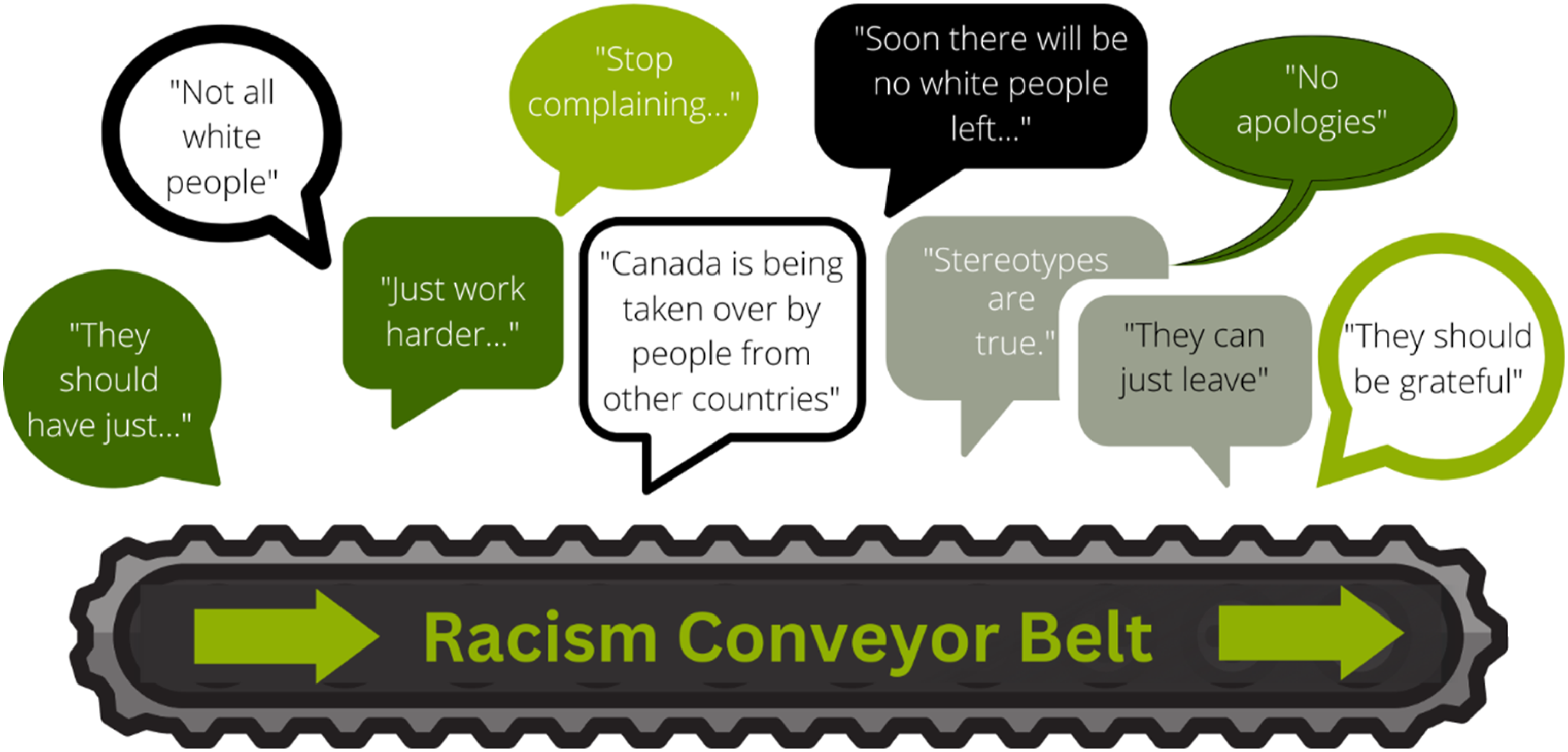
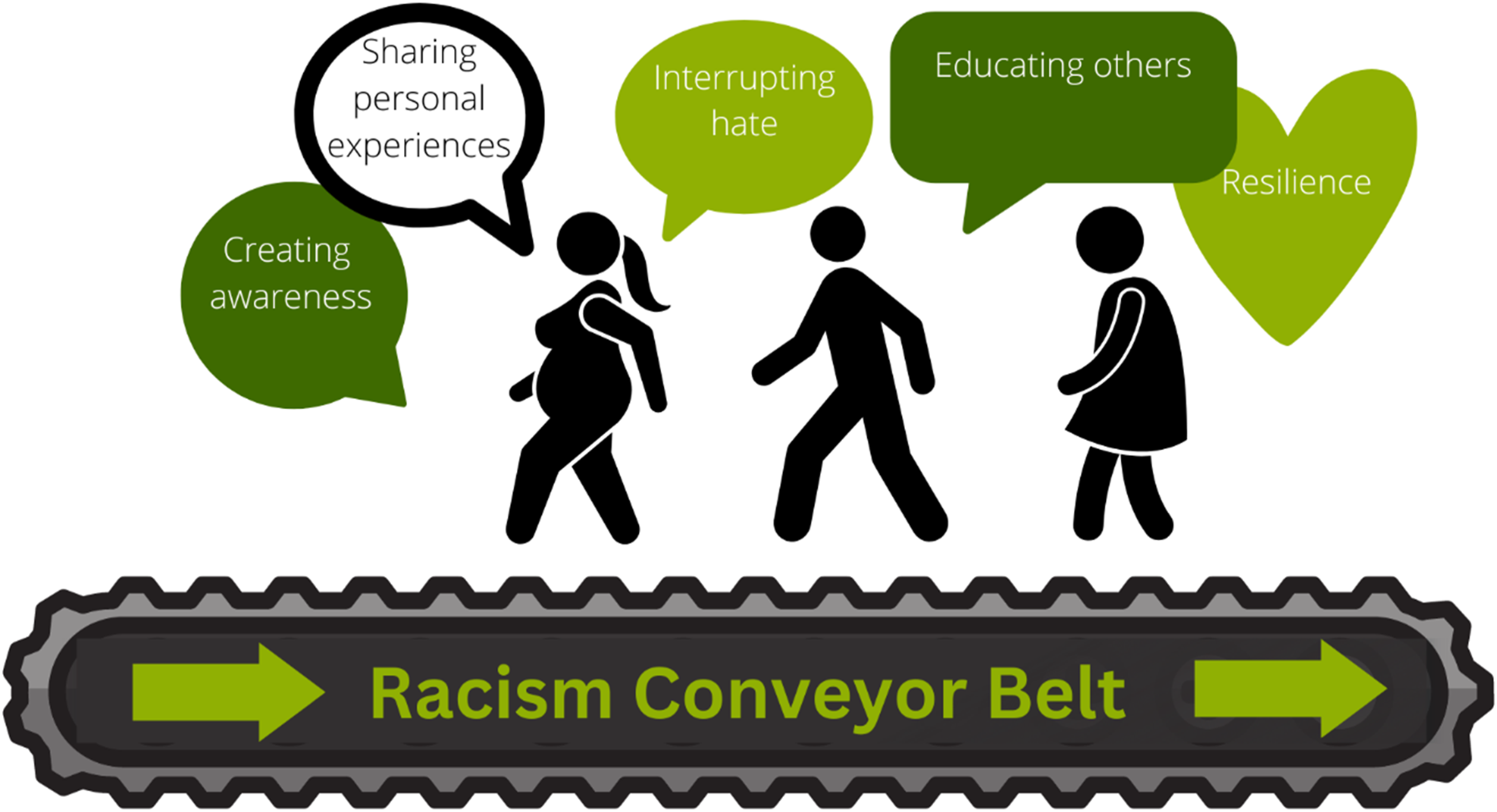
As illustrated by Figure 1, the comments created an ethos of racism, and if a reader simply scrolled through, they would encounter a barrage of hatred, defensiveness, stereotyping, fear-mongering, unsolicited explanations and advice, insults, and diminishment of suffering. However, there were significant comments which interrupted the above, educating, sharing strategies for resilience, raising awareness, educating others, and sharing personal experiences. These actions form the work of anti-racism.
Understanding these two “flows” can help illustrate both what we saw happening in the comments of the anti-racism education films, and also help educators and activists build their own understanding when they find themselves in such discussions.
Conclusion
In this article, we have explained typical forms that pushback or resistance to anti-racism efforts in online spaces takes. By analyzing public comments in response to four films created around real-life experiences of racism in our province, we have shown that in addition to the positive comments which educated others and shared personal experiences, many comments resisted these films, and this resistance took particular forms, including harmful advice, fear-mongering, and white posturing.
This project had several limitations. First, because the data used was online comments, it does not capture the many forms of pushback received by individual educators or groups. It only captures those who have access to YouTube or TikTok platforms, and although the films were shared on other social media platforms, those did not generate enough comments for analysis. In future research, it would be interesting to compare how the pushback generated in online social media spaces is similar to or different from other spaces. Second, because the social media comments cannot be tied to specific locations without violating confidentiality, it was not possible to situate the comments within specific places. In future research, it would be useful to note how regional differences may influence the types of pushback received.
In moving against this flow of racism and vitriol, educators can continue to take actions such as interrupting hate, creating awareness, demonstrating resilience, sharing personal experiences, and educating others. This work is difficult and demanding and care must be taken for those intentionally moving against the flow of racism, particularly in online spaces. Understanding the power of these actions in the face of the types of pushback and resistance that anti-racist educators receive cannot be understated.
Footnotes
Acknowledgments
This project has been made possible in part by the Government of Canada. Ce projet a été rendu possible en partie grâce au gouvernement du Canada.
Declaration of conflicting interests
The author(s) declared no potential conflicts of interest with respect to the research, authorship, and/or publication of this article.
Funding
The author(s) disclosed receipt of the following financial support for the research, authorship, and/or publication of this article: This work was supported by the Government of Canada.
