




Abstract
Despite numerous international and national policy documents promoting girls’ and women's empowerment and participation in community sports, the actual access to sport for women and girls is still restricted in several countries. This paper explores the situation in Ghana. Through the analytical lens of Cooky and Messner’s theory of ‘the unevenness of social change’, we analyse the cultural and structural barriers that prevent girls and women from participating in sport in Ghanaian communities. The data material is document analysis, focus groups and semi-structured interviews with male and female officials representing state-funded regional and district sports organisations as well as non-state sports organisations in Ghana. The findings reveal that cultural barriers, rooted in deep-seated cultural norms and structural hindrances that undermine gender-inclusive policies, contribute to the limited participation of girls and women in community sport. Furthermore, the interplay between these cultural and structural factors leads to gender-specific practices and fewer women in leadership positions. Based on our analyses, we suggest that structural changes (enforcing and implementing gender policies) can result in cultural changes (positive gender equality outcomes) over time.
Keywords
Introduction
Sport is popular in Ghana and the commitment to gender equality in sport is underlined in several policy documents such as the Sports Act 934 of 2016. Achieving Sustainable Development Goal 5 (gender equality) is outlined in the Ministry of Youth and Sports’ Medium-Term Expenditure Framework (MTEF) from 2016 to 2021, which details the promotion, empowerment, and enhancement of the participation of girls and women in community sport. The sparsely available research on the topic (Adam, 2014; Sarpong et al., 2022) indicates that participation in community sport is nevertheless higher among boys and men than among girls and women. The purpose of this article is to analyse the cultural and structural factors that account for the low participation of girls and women in Ghanaian community sport through focus group discussions and interviews with leaders and administrators at the district and regional level. Theoretically, we are inspired by Cooky and Messner's (2018) suggestion of analysing barriers and changes in girls’ and women's access to sport at various analytical levels. We will address the cultural and structural levels since these have been insufficiently captured in earlier studies from Ghana, despite the importance of addressing these levels to improve access to sport for girls and women. The interviews with leaders and administrators are especially suited to develop knowledge of structural and cultural barriers. The article is structured as follows: first we describe the empirical context and then present our theoretical perspective, research design and methods, followed by the findings and the discussion and conclusion.
Empirical context: Community sport in Ghana
In Ghana, community sport is funded through the District Assemblies Common Fund (DACF) and coordinated by the District Sport Units (DSUs) of the various district assemblies. Policies, especially those outlined in the Local Governance Act 936 of 2016 (which discourages gender-based discrimination – subsection a – and promotes equal treatment in sports – subsection c); the Sports Act 934 of 2016 (ensuring equitable treatment in community sports – section 3(m)); and the sport ministry's commitment to SDG 5, serve as directives for the DSUs to prioritise the empowerment and participation of girls and women in community sport. As described in the Sports Act 934 of 2016, community sport at the DSUs includes recreational activities, play, games or any form of physical activity that promotes inclusivity and community health and well-being. The DSUs are composed of district assembly representatives (under the Ministry of Local Government and Rural Development), district physical education (PE) teachers (from the Ministry of Education) and district sport development officers (from the Ministry of Youth and Sports). DSUs work closely with the regional sport offices to implement the sport ministry's policies on gender empowerment, gender equality in sport, and increased participation of girls and women in communities (Republic of Ghana, 2016). In this regard, the DSUs are strategically positioned to partner or collaborate with relevant NGOs or community-based organisations, particularly those organisations with experience in empowering girls and women to participate in community sport. Moreover, the DSUs provide resources and support to schools within the community during district school sport games. Among these are the provision of district playfields and courts, as well as the provision of game officials. Ghana does not have a district sport club system that emphasises sport-for-all or sport-for-development initiatives. Although there are sports clubs affiliated with national sports associations/federations, their programmes do not align with the DSUs as these clubs seek to promote the development of a particular sport and provide opportunities for young people to pursue professional careers as athletes. It is imperative to emphasise that these sports clubs are primarily football clubs, as football is the most popular sport in Ghana due to its historical and cultural significance to Ghanaians (Charway and Houlihan, 2020; Darby, 2013).
As far as the ratio of female to male participation in community sport in Ghana is concerned, there are no statistics available to estimate how many girls and women participate (Charway and Houlihan, 2020). However, the sparsely existing studies on gender participation in sport indicate low participation among girls and women in community sport. Adam (2014) studied the leisure patterns of various communities throughout Ghana and found that 61% of female respondents had never participated in physical activity or sports compared to 8% of male respondents. A survey conducted by Sarpong et al. (2022) among 180 female respondents from various communities in the western part of Ghana revealed a lower participation rate for women in college sports. Low female participation in Ghana's community sport activities has been attributed to the misconception that sport and physical activity are reserved for men and the constraints associated with the social roles of women and girls (Nkrumah and Domfeh, 2015; Ofei-Aboagye, 2004). Yussif (2021) found that socio-cultural, economic, political and religious barriers affected female participation in the programmes of community-based organisations (including sport organisations) in a district in northern Ghana. Adam (2014) attributed the low rate of female participation mainly to cultural norms and the patriarchal nature of the Ghanaian society.
The aforementioned studies are descriptive and focus primarily on personal or cultural barriers. Our study complements their findings by analysing the cultural and structural factors that may explain the low participation of girls and women in community sport from the viewpoint of gender-implementing actors. Knowledge about structural and cultural barriers is especially relevant to consider to be able to improve girls’ and women's access to sport.
Theoretical framework – cultural and structural factors influencing girls’ and women's participation
As described for several countries, sport has historically been dominated by men when it comes to opportunities to participate, access resources and positions and gain public attention and recognition (Theberge, 2003). Over the last 40 to 50 years, there has been an increasing recognition of the rights of girls and women to have access to sport as a public good, and this is also the case in Ghana. Despite these public goals, girls’ and women's participation in sport entails several barriers. Some of these barriers are rooted in assumptions that sport is not suitable for women based on the ideology of natural biological differences between men and women – what Messner (2018) refers to as hard essentialism. According to Messner, sport has been a key site for the naturalisation of this ideology. Another argument has been that sport is culturally inappropriate for girls, without reference to biological differences. Taking inspiration from Messner (2018), but not strictly following his definition, we refer to this as soft essentialism. 1
We are interested in the barriers to and the opportunities for promoting girls’ and women's access to community sport and follow Cooky and Messner's (2018) suggestion of analysing the changes in girls’ and women's access to sport at three levels. An argument for this division is that changes at one level do not automatically follow changes at another level – what Cooky and Messner refer to as ‘the unevenness of social change’. Even though the levels are in some cases closely connected, they can be analysed separately.
The personal and interpersonal level includes the everyday practices on the field: Who is actually taking part in sport? What are their motives for playing sport and what does sport mean for them? This level is addressed by studies on motivation for sports participation (Saavedra, 2009) as well as studies on gendered practices in grassroot sports (Persson, 2023).
The cultural level refers to beliefs or cultural values. This level includes the norms that designate gendered roles and indicate girls’ and women's place within the social structure. The cultural factors include gender ideologies and stereotypes (Messner, 2018), religious beliefs (Walseth, 2016), household chores (Kay, 2006) and conceptions of girls and women in sports (Hargreaves, 2002).
The structural level refers to the institutional context, meaning the priorities and actual offers of sport for women, as well as the structures of organisations, the gender composition and leadership and the allocation financial and human resources of organisations (Evans and Pfister, 2021).
The notions of hard and soft essentialism (Messner, 2018) combined with Cooky and Messner's (2018) suggestion of an analytical distinction between the personal, the cultural and the structural levels is our theoretical lens to understand the context and situation regarding girls’ and women's access to sport. The existing studies on gender from Ghana and sport have primarily addressed the personal and interpersonal levels (Adam, 2014; Sarpong et al., 2022). Thus, placing the individual at the centre of analysis, our study contributes by examining the cultural and structural factors that account for the low participation rate of girls and women in community sports. As we see it, our interviews with officials from DSUs, Regional Sport Offices and NGOs are particularly relevant for gaining knowledge of the cultural and structural levels.
Research design and methods
This study is a part of an ongoing research project which began in 2019. The purpose of this research is to analyse the cultural and structural barriers to girls’ and women's participation in Ghanaian community sport at the district level. As we see it, the complementary backgrounds and experiences of the two researchers were useful in the research design and process. The first author, who conducted the interviews, is a man from Ghana who has experience in sport administration in Ghana. The second author, who is a woman, has experience in gender studies and has never been to Ghana. We had thorough discussions from the outset about the research context, theoretical framework and the interview guide as well as how to prepare for unexpected responses.
The first author's position as a Ghanaian offered both opportunities and challenges for the data collection and research as a whole. In terms of opportunities, the researcher's familiarity with the context gave him an ‘easier entrée, a head start’ (Berger, 2015: 223), and probably also gained him trust. Challenges such as the tendency to take for granted and overlook certain issues (Patton, 2014; Yin, 2009) were discussed by the two authors both before the data collection and during the analyses. Challenges for male interviewers interviewing women about gender inequality were also discussed and prepared for as recommended by Styhre and Tienari (2013).
Data collection
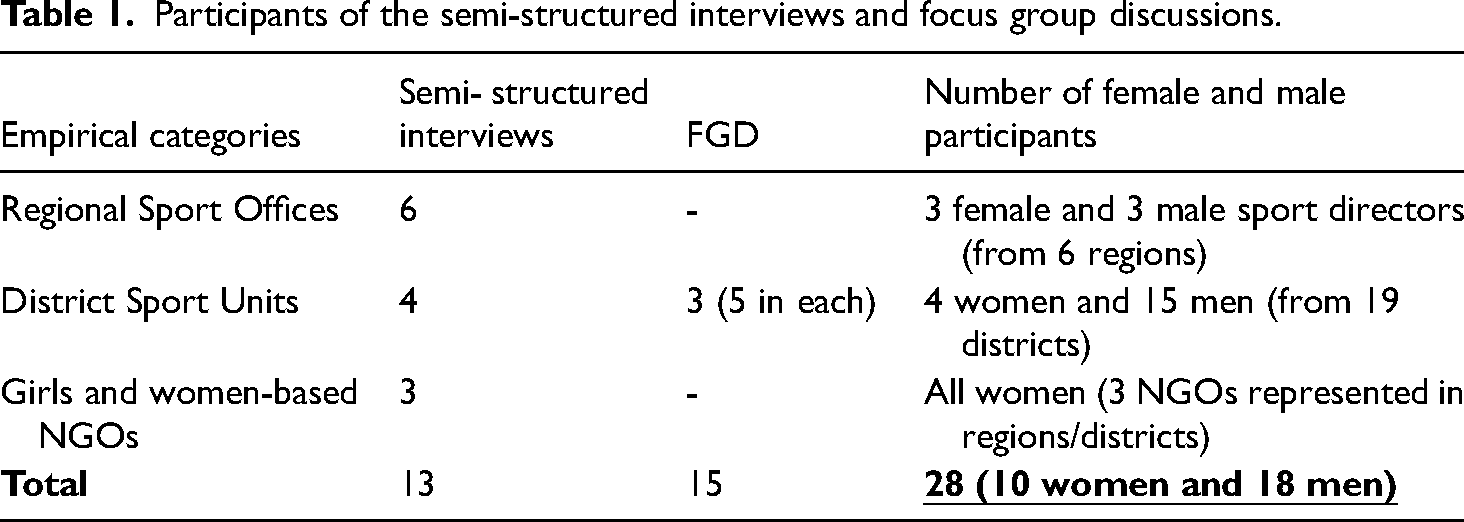
The data were collected through three focus group discussions (n = 15), semi-structured interviews (n = 13) and document analysis (n = 10). Overall, 28 participants (10 women and 18 men) were interviewed. Tables 1 and 2 provide details. The participants for this study had a minimum of 5 and a maximum of 20 years of experience in community sport. The interview guide for the semi-structured interviews and focus group discussions addresses the research question about the barriers contributing to girls’ and women's low participation in community sport and how the low participation rate can be increased. The focus group discussions and semi-structured interviews were conducted face to face in accordance with the Government of Ghana (2020) COVID-19 guidelines.
Participants of the semi-structured interviews and focus group discussions.
Sourced documents.
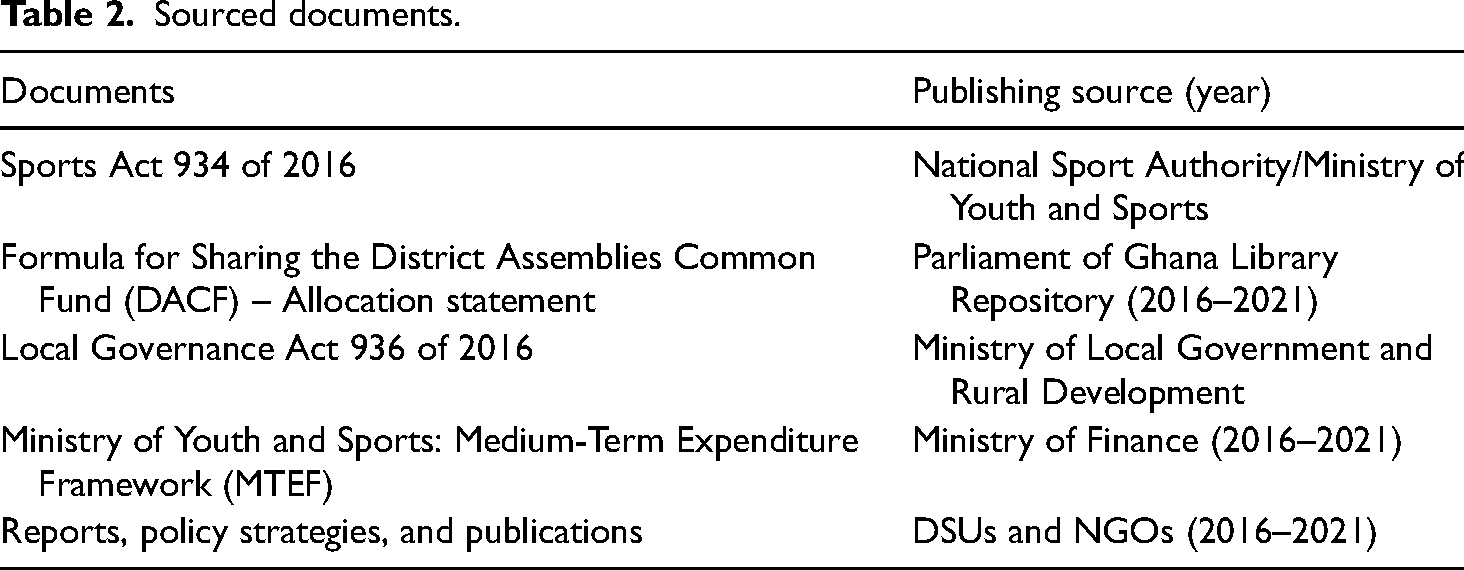
Document analysis included key documents requested from DSUs, regional offices and non-governmental organisations. These documents include policy documents, reports and publications. Additionally, we obtained accessible documents online (see Table 2).
We conducted semi-structured interviews with both women and men serving in various positions in different organisations. Unlike focus group discussions, semi-structured interviews allowed the participants to provide more in-depth communication and confidently share personal information and experiences that may not have been possible in a group setting (Frisina, 2018). Interviews were conducted with three men and three women from the regional sport offices, four women from the DSUs, and three NGOs. Three of the six regional directors were interviewed during the initial collection of data in 2020, while the remainder (including DSUs and NGOs) were interviewed during the second round of data collection in 2022. Although the focus group discussions and semi-structured interviews followed the interview guide, their emphasis differed slightly. Interviews with regional directors focused on gendered labour, organisational policies and practices and resource allocation; interviews with females from DSUs focused on social barriers, gendered labour, organisational policies and practices that restricted participation; and interviews with NGO participants emphasised collaboration and social barriers. The semi-structured interviews lasted between 40 and 60 min.
The focus group discussion with the participants from the DSUs during the initial data collection provided insight into the DSUs and the community in which they work. We tried to stimulate open discussions among the participants, allowing them to share their experiences from the various districts. This enabled us to collect and analyse a variety of narratives and perspectives simultaneously (Frisina, 2018; Krueger, 2014). The focus group discussions lasted between 70 and 90 min.
Ethical considerations
After gaining approval from the Norwegian Centre for Research Data (NSD), we established initial contacts and constant communication with the participants via multiple mediators. Each participant gave their informed consent before participating in the research. As part of the informed consent, the research participants were assured that their identities, sensitive information and personal statements would be kept anonymous and securely stored (Kaiser, 2009). It is worth noting that due to the fear of job loss for the participants (particularly from the DSUs) as well as the culturally sensitive nature of this research, we assigned pseudonyms to the participants (Chambers, 2022). In light of this, sites for data collection were established away from the workplaces of the participants from the DSUs (Elwood and Martin, 2000).
Data processing and analysis
First, documents from relevant government policies and reports obtained before, during and after the interviews were analysed in accordance with the four quality control principles of Scott (1990), which are data authenticity, credibility, representativeness and meaningfulness. Each document was printed and read carefully and thoroughly. In essence, document analysis is of importance to the structural analysis of the DSUs and NGOs. We transcribed the recorded interviews manually and analysed them digitally with MAXQDA Plus 2022. An open coding method supported by the theoretical framework of this study was used to generate 36 initial codes. Among the initial codes generated were family/parental roles, conceptions about girl's and women's participation in sport, religion, patriarchy, collaboration, policy guidelines, implementation of community sport, funding and leadership. The initial codes were then arranged into categories. We performed a collective analysis where the categories were discussed between the two authors and adjusted. Through the use of the theoretical lens for this study (Cooky and Messner, 2018), common themes that influence the low participation of girls and women were extracted (from the categories) under cultural and structural constraints. Cultural barriers include themes such as house chores and gender stereotypes, as well as religion and early child marriages. Structural barriers were grouped into institutional barriers and organisational practices. Gender policies and recruitment were considered institutional barriers, whereas under-representation of women within an organisation and partnerships were considered organisational practices.
Findings
The participants referred to both cultural and structural barriers to explain the low participation of girls and women in community sport.
Cultural barriers
The participants stated from the outset that girls and women do not have equal access to community sport due to the patriarchal nature of the Ghanaian society. Moreover, they recounted specific cultural barriers, including cultural beliefs and practices related to household chores, gender stereotypes, religion and early child marriages. These cultural constraints are discussed in greater detail below.
Gender stereotypes
The participants in this study recount how gender stereotypes and essentialist gender beliefs are barriers to the participation of girls and women in community sport. As a male DSU recounted: The misconception about sport being for boys is in both rural areas and the cities. Sometimes the girls tell us that their parents don’t want them to run or train for fear of developing men features or may not be able to give birth. (male DSU member)
The DSU and NGO participants also mentioned that they often encounter these stereotypes in the communities where they conduct routine activities. Here, both female coaches and girls are often subject to stereotypes about their appearance, womanhood and physical capabilities. As one female DSU mentioned: While training the youth in the community, some community members, especially the men, will refer to us as the weak species, and sometimes they will yell to me, ‘Go and marry and give birth’. (female DSU member)
The research participants described an endemic issue of female stereotypes in Ghanaian community sport, as suggested in previous studies (Adam, 2014; Nkrumah and Domfeh, 2015; Sarpong et al., 2022). To change such assumptions requires education and gender empowerment initiatives. According to the DSUs, they lack the resources to empower the entire community and are therefore only able to educate the parents and girls who participate in their programmes. As one NGO pointed out, ‘The best thing we can do is share our experiences as female coaches, mothers and former athletes who have achieved success’.
Household chores
According to the accounts of the research participants, household chores are a cultural practice reserved for girls and women, who are viewed as family caregivers. They mentioned that parents would allow the boys to participate in sports while the girls stayed at home to assist their mothers and take care of the family. Furthermore, it is evident from their assertions that parents play an active role in ensuring that girls stay at home to assist with housework. The participants from DSUs and NGOs that have programmes in rural and urban areas shared these challenges. According to them, household chores for girls are time-consuming and, as a result, leave the girls with insufficient time to participate in community sport programmes. As described in studies from Ghana (Nkrumah and Domfeh, 2015) and other countries (Kay and Spaaij, 2012), girls’ responsibility for household chores is taken for granted. Women/girls have house chore routines, and so how do you expect a girl to frequently come to our programmes? In the morning, they sweep the compound, do some laundry, cook for the family at night and shop or sell with their mothers in the market at the weekend. Some even have to hawk on the streets for the family. These prevent them from joining our programmes. (male DSU member)
The research participants mentioned that sometimes they succeed in persuading parents about the importance of community sport and physical activity, and as a result, the parents release their daughters, albeit reluctantly. Nevertheless, the girls often leave early during their programmes to attend to house chores.
…the [girls] will be like, ‘I will have to go home early to help my parents at home; when I don’t go home early my mum will beat me’. (male DSU member)
Girls who sell with their mums at the market will let us know that they have to leave early to help their mum sell at the market. (female DSU member)
Girls’ opportunity to participate in community sport is restricted by house chores as shown by Kay and Spaaij's (2012) studies of young people's participation in sport programmes from India, Zambia and Brazil. As underlined by Kay and Spaaij (2012), the family culture needs to be taken into account to foster participation and social change.
Early child marriages and pregnancies
The DSU and NGO participants identified child marriage as a fixed cultural issue in Ghana. A DSU participant from the northern regions of Ghana stated: There is family pressure and so the moment they finish basic school (at 13 or 14 years of age), they get married, and their husbands will not allow them to come and participate… it's difficult to get them when they finish school. (male DSU member)
An annual report we examined from one of the NGOs that has engaged 2000 girls (mainly from coastal areas of Ghana) indicated that child or teenage pregnancy is one of the major barriers to girls participating in their community empowerment and sport programmes. As one NGO member recounted: What we encountered was that the [girls] have this mindset from the community that by 13 or the latest 15 years a girl should have a child. When I told them that I didn’t have a child, they were surprised and they said that I would be ridiculed and insulted if I were to be in their community. (female NGO member)
Both the 1992 Constitution and the Children's Act (560) of 1998 of Ghana set the marriage age at 18 for both boys and girls and repudiate all forms of forced marriages. Nonetheless, child marriage has been prevalent in some areas and is primarily driven by socio-cultural barriers such as ‘poverty, teenage pregnancy and cultural norms such as betrothal marriages, exchanges of girls for marriage and pressure from significant others’ (Ahonsi et al., 2019: 13). Sub-Sahara Africa, particularly West and Central Africa, has the world's highest rates of child marriage (UNICEF, 2018). According to Koski et al. (2017: 13), ‘more than half of women born in the most recent cohort were married before age 18’ in West Africa. Whereas child marriage rates have plummeted below 20% in Ghana and Togo among West African countries, the number of cases of child marriage is higher in northern and rural areas of Ghana (de Groot et al., 2018). The DSU participants commented that these are sensitive cultural issues and given their limited resources, they can engage only those girls who are available and are taking part in the activities. On the other hand, NGOs engage some parents and girls through community forums.
Religion
Religion is a core part of the Ghanaian society and comprises 73% Christian denominations, 20% Islamic, 3% traditional religion and 1% no religion (Ghana Statistical Service, 2021). The DSU participants revealed that some religious sects in Ghana prohibit girls from participating in sport. Provision 9 of the Children's Act (560) of 1998 states that all children (18 years and below) have the right to social activity, and it further stipulates that no group or person ‘shall deprive a child the right to participate in sports… or other leisure activities’. The DSU participants retorted that this is far from what happens on the ground. The religious aspect is very key, especially from the Muslims and some of Christian sects like Jehovah Witness and Seventh Day Adventist. They will discourage the girls and tell them not to go and do sports. (male DSU member)
A DSU participant from mid-Ghana who was attacked while training young girls and boys in a field expressed shock to learn that his district assembly director acquiesced in a directive from the head of the Muslim sect that attacked him. He recounts: One time I was attacked by a Muslim group while on the field after I insisted that Muslim girls in my district schools participate in community sport. I was just following the right-to-play-law of the state. (male DSU member)
According to DSUs from the northern part of Ghana, religious-based rules are non-negotiable, particularly for Muslims. However, girls who wish to participate in community sports but are concerned about their appearance are educated about alternative ways to dress that cover their bodies. … if a girl wants to join our programmes, we recommend tracksuits that cover their entire body in order to be in tune with their parents and religious demands. (male DSU member)
In this way, they are able to avoid untoward reactions from their community, which is predominantly Islamic. Restrictions on Muslims girls’ participation in sport have been revealed in several other studies (Kay, 2006; Strandbu, 2005; Strandbu et al., 2019; Walseth and Fasting, 2003), whereas there are, according to Walseth (2016), surprisingly few studies on how Christianity influences women's participation in sport. The main message from studies on Muslim girls and sport is that religion is interwoven with culture (Walseth, 2016). Even though religions such as Islam could be described as encouraging physical activity and health improvement (Walseth, 2016), religion is also used to restrict women's access to sports.
Summing up cultural barriers
The cultural barriers referred to in the study are ingrained in deep cultural norms and stereotypes. The assumptions that participation in sport will contribute to developing masculine features and restrict the ability to give birth can be seen as examples of hard essentialism (Messner 2018), while girls’ responsibility for household chores and religious concerns can be seen as examples of soft essentialist views. As suggested in earlier research, the underlying cultural barriers to girls’ and women's participation in community sports in Ghana are not new (Adam, 2014; Nkrumah and Domfeh, 2015; Sarpong et al., 2022). While the DSU participants, regardless of gender, make efforts to encourage girls to participate in community sport, they are met with stiff opposition from key social actors such as parents, religious sects and community members who adhere to obsolete gender stereotypes and long-held cultural practices such as early child marriage and house chores. This is consistent with the research of de Groot et al. (2018) about child marriages in Northern Ghana, where social norms and beliefs as well as parents play a significant role in the marriage process and the maintaining of tradition. It is evident from the findings that negotiating and challenging these beliefs is difficult without a conscious and pragmatic effort to engage the aforementioned social actors in gender education programmes.
Structural barriers
The participants’ descriptions of the structural barriers can be grouped into two categories, namely institutional barriers and organisational practices. The institutional barriers include policies and resource allocation for gender empowerment and recruitment, while the organisational practices comprise gendered practices, cultural beliefs, policies, leadership and partnerships embedded in and often taken for granted in organisations (Schein, 2004).
Institutional barriers
Under the empirical context, we noted that there are policy provisions in Ghana that support girls’ and women's empowerment and participation in community sport. Although these policy statements may be well-intended, interviews with the DSU participants and regional sport directors (RSDs) revealed institutional barriers in implementing a gender-balanced community sport programme. Among the main challenges they cited were a lack of funding, implementation strategies and gender-based recruitment polices.
Lack of funds
During the interviews, DSU members and RSDs lamented a lack of sufficient funds to provide gender empowerment programmes and activities. As one male DSU member put it, ‘How do we educate parents and communities about the importance of girls and women participating in community sport when the assembly does not provide any assistance?’ According to the analysis of Charway et al. (2022) on sport policy implementation at the district assemblies in Ghana, directors (politically appointed) allocate the sport component of the DACF to DSUs at their discretion. Their analysis further revealed that since the sport component of the DACF is not backed by a legal instrument or a legally enforceable act, district assembly directors often use it for canvassing purposes.
The participants from the DSUs expressed an awareness of the sport ministry's policy commitment to gender equality and equal access to community sport. Nevertheless, they all agreed on the following statement: DSUs do not have any policy guidelines for addressing or improving the low participation of girls and women. (male DSU member)
It is not clear from the interviews whether the main problem is a lack of funds or a limited allocation of resources to women's sports.
Lack of implementation strategies
Furthermore, the participants pointed out that despite attending several district assembly meetings, no real commitment from the district assembly authorities had been made to mitigate the low participation rate of girls and women in community sport. As one female DSU member stated, ‘At meetings, the authorities act as if they care about the issues, but they really don’t, and at times I feel that my input is taken for granted’. According to one female regional sport director, the sport ministry is in the process of drafting a national sport policy guide (which includes provisions on gender empowerment and equal access to sport). The committee is composed of four males and three females and has no representation from DSUs or regional sport offices. A female regional sport director, who was critical of the committee's provision regarding girls’ empowerment and participation in sport, asked the following: How do you even come up with a strategic plan when those who are supposed to implement in the districts are predominantly men? (female RSD)
Despite women being included in the committee, the lack of women in sports leadership at the local level, as seen in several other countries (Evans and Pfister, 2021; Fasting et al., 2014), is viewed as an obstacle to implementing the policy.
Lack of gender-based recruitment policies
A further obstacle to the achievement of SDG 5 that emerged from our interviews and is supported by the document analysis is the absence of recruitment strategies or policy guides that can lead to an increase in female leadership in the DSUs and regional sport offices. Involving DSUs, regional sport offices and relevant NGOs in policy development can provide practical cultural and structural insights that are crucial to the development of effective policy. As one female NGO participant put it, ‘Gender equality shouldn’t just be a talk because there are deeper cultural issues to consider’. In her opinion, gender stereotypes such as ‘men head the family’ and ‘women are submissive’ prevent women from getting leading positions and thus make them play second fiddle to men. This situation makes gendered recruitment policies necessary. The impression from our study aligns with the conclusion in a recent review (Evans and Pfister, 2021), which found that even if a gender equality policy statement exists, the actual actions for pursuing gender equality are less elaborated.
Organisational practices
The participants interviewed described organisational practices related to women's leadership, gendered practices and partnerships as contributing factors to the low participation rate.
Under-representation of women in leadership
We began by first and foremost asking about gender representation in the DSUs and regional sport offices. From the outset, it was clear that women were far less or not represented in both organisations. As one male DSU member mentioned, ‘We have just one woman in about 26 districts of our region’. A female DSU from a different region also stated, ‘I am the only person in my DSU. All the rest are men’. According to male and female DSU participants, there are enough qualified women available, but they are not being employed. As one female participant mentioned, ‘Year in and year out, we have women graduating as coaches and PE (physical education) teachers from our universities and training colleges’. As another participant concurred, ‘There are many former sportswomen that I know who are interested if given a chance’. A female senior executive of an NGO that advocates for women in sport in Ghana and works closely with the ministry of sports and national sport associations and is present in almost every region of the country, reluctantly summed up the situation: There are many delicate cultural issues and lack of organisational support involved in this matter, and although we are doing our best, we admit that women in sport are underrepresented, particularly at the district levels. (female NGO member)
In addition, our audit of the Sports Act 934 of 2016 revealed that the membership of the DSUs does not include any representation from the Gender, Children and Social Protection Ministry. This is despite representation from the Ministry of Youth and Sports, Ministry of Education and Ministry of Local Government and Rural Development. Like the other ministries with representation in the DSU, the Ministry of Gender, Children and Social Protection has regional offices (called the Department of Gender) that work closely with district assemblies to implement and empower gender policies. Having a representative of the Department of Gender in the DSU could be a valuable resource and might help enhance the way in which gender issues are handled within the DSU. The under-representation of women in leadership was described as a crucial factor that accounts for the low participation of girls and women in community sport.
Gendered practices
When we probed the reason for the lack of female representation in leadership, the responses from male and female RSDs who have an influence on employment at and staffing of DSUs differed starkly. The statement below exemplifies the position of the male RSDs: It is about choice and willingness to enter the sport sector. Not every woman would like to be in sport. The sport space in Ghana is rough and lacks resources, and this is something women can’t handle. Giving birth is also a problem for women. Also, women are not good at accountability. (male RSD)
The above view is shared by the several male RSDs who were interviewed. The view that women lack accountability and are incapable of handling tough situations is a quintessential example of ‘hard essentialist’ gender stereotypes. Contrary to the male directors, the women we interviewed expressed discontent with the lack of respect for women in leadership positions: Our voices are not respected. It was very difficult to get to my current position due to opposition from the [National Sports Authority and the sport ministry] (who are primarily men). When I finally became the director, a group of men from the community came to my office to question my appointment. (female RSD)
In 2021, the National Sports Authority (NSA) took steps to employ and place women in the DSUs following the 2019 national regional reorganisation, which saw the creation of 6 additional regions (to the 10 already existing regions) with their districts. According to some of the newly employed women, district assemblies were surprised to learn that they were women when they arrived for work. As one of them stated, ‘They thought it was a man coming’. The other stated, ‘They said I am the first woman to serve as a district sport development officer since the district assembly was established’. The gendered practices described above are neither accidental nor isolated, they align with studies revealing how hard essentialist beliefs about ‘masculinity and femininity are reinforced [through] socialization’ in Ghanaian traditional communities (Gyan et al., 2020: 2). Therefore, it is not surprising that male RSDs interviewed hold ‘unconscious, taken-for-granted beliefs, perceptions, thoughts, and feelings’ about women in leadership positions and gendered practice as a whole (Schein, 2004: 26). The result shows how sport, in many ways reinforces ‘actively traditional notions of masculinity’ (Anderson, 2009: 4) and creates an environment that places women in a subordinate position (Cornell, 1995).
Partnerships
In addition to the DSUs, many NGOs arrange grassroot sport for women. Under provision 25 of the Sports Act 934 2016, one of the key responsibilities of the DSU's mandate is to engage in collaborative or strategic partnerships with NGOs in order to implement the sport ministry's policy on SDG 5 – gender equality and empowering women and girls – in Ghanaian communities. The NGOs included in this research are community-based organisations primarily concerned with empowerment, fostering partnerships and providing a safe environment for girls and women to participate in sport. Along with early child marriages and teenage pregnancy, which were discussed previously, the NGOs indicated that they constantly deal with harassment and violence against girls and women who participate in their community sport programmes. Therefore, joint action and collaborative partnerships are necessary to make a broader impact. From the interviews, it was evident that efforts to collaborate with the DSUs had been unsuccessful. We collaborate with NGOs alike and government agencies like CHRAJ (Commission on Human Rights and Administrative Justice) on issues like harassment and abuse, but when it comes to the DSUs, they are not available. If you write to them, they will not respond. (female NGO member) Many NGOs and government agencies can complement what we do in the communities, but there is little we can do when the district assembly is not interested. They do not even fund our programmes. (female DSU member)
This statement supports Charway et al.'s (2022) analysis of sport policy implementation in Ghana, which indicated that the contributions of NGOs that address social issues through sport at the grassroot level have been overlooked in the sport policy implementation. The lack of collaboration between NGOs and DSUs is seen as a major structural barrier to increasing girls’ and women's participation in sport.
Summing up the structural barriers
Analysis of the sport ministry policies (among other policies) and interviews with DSU and regional sport office participants revealed that there were no official implementation guides or involvement of DSUs and regional sport offices in planning programmes aimed at increasing the participation of girls and women in community sport. There is also a lack of or misappropriation of funds by district authorities to support the activities of the DSUs. Consequently, partnerships and collaborations with NGOs and other agencies that could enhance girls’ and women's participation in sport, as well as address other issues in the community such as gender-based violence, have not been established. Despite the institution's challenges, it was a surprise to see the sport ministry's MTEF showing continued achievements and support for sustainable development programmes promoting gender equality. These structural challenges of lack of funding, implementation guidance and involvement illustrate the policy-implementation gap in Ghanaian communities that Charway et al. (2022) identify as undermining sustainable development. Our findings provide evidence that well-intended/instituted policies in the absence of a real commitment to implementation may result in poor community development outcomes.
Discussion and conclusion
We have revealed both the cultural and structural barriers to girls and women participating in sports. Unlike the earlier studies from Ghana (Adam, 2014; Gyan and Mfoafo-M’Carthy, 2022; Sarpong et al., 2022) that primarily addressed the personal or cultural level, we have observed that cultural factors also influence or interact with organisational practices or policy implementation, resulting in gendered practices and fewer women in leadership positions at DSUs and regional sport offices. The female RSDs recounted the obstacles they faced in obtaining their positions in a sector dominated by men and operating in a patriarchal society. As with the female RSDs, and in line with the research of Sarpong et al. (2022), the male directors were of the opinion that the presence of more women in the DSUs could enhance the participation of girls and women in community sports. However, the male RSDs were adamant in their assertion that the lack of women in leadership might be due to a variety of factors. These factors include gendered preferences, childbirth, women not being accountable and the rough terrain of Ghanaian sports. Their statements exemplify both hard and soft essentialist views and provide evidence that reflects the patriarchal Ghanaian culture and traditions (Schein, 2004). As a result, most DSUs lack or do not have female representation, as can be seen from our findings. According to Gyan and Mfoafo-M’Carthy (2022), such gendered practices undermine the objectives of well-intended public policies.
Although studies have indicated that ingrained socio-cultural practices in institutions and organisations are hard to change (Kassinis and Stavrou, 2013), there is evidence that deliberate and concerted efforts to establish, enforce and implement gender policies (structural changes) can result in positive gender equality outcomes over time (cultural changes) (Ollier-Malaterre and Foucreault, 2017; Skirstad, 2009). A typical example is gender quota policies in sports organisations that have proved to increase women's participation and leadership in sport (Ottesen et al., 2010). This suggests that enforcing and legitimising sport-related gender policies, such as increasing women in leadership positions in communities, might lead to organisational change and, in turn, to a shift in work culture in due course.
This study could potentially contribute to feedback loops crucial for the ongoing development of the national sports policy guide mentioned in the findings (Gain et al., 2020), particularly concerning gender mainstreaming, stakeholder cooperation, institutional change for gender equality and women's rights and sustainable development. Feedback loops are essential for the development of effective interventions and can help identify potential areas for improvement to create more effective policies. In addition to the feedback loops for policy outcomes, organisational learning could be enhanced at DSUs, regional sport offices and NGOs. In the first place, these organisations can learn how to work in context by responding better to the socio-cultural demands of their local communities. In this regard, DSUs have the potential to exchange best practices and learn from one another. An illustrative example comes from DSUs in Muslim communities, where valuable insights can be gained. These DSUs permit girls to wear tracksuits, enabling them to cover their bodies and train without compromising Islamic principles. Another socio-cultural consideration is the context specificity of barriers, such as early child marriage and religious practices, which vary across different communities. In line with studies on girls’ and women's engagement in community sports, making broad gender equality policies without accounting for the diverse cultural and ethnic backgrounds could potentially be incongruent (Brady and Arjmand, 2002; Spaaij, 2013). A valuable model for guidance can be drawn from the Berhane Hewan project in Ethiopia, which operates under the auspices of the Ethiopian Ministry of Youth and Sports. Through collaborative partnerships with both governmental and non-governmental entities, the project established a community dialogue and mentorship programme focused on addressing the detrimental consequences of child marriage (Muthengi and Erulkar, 2010). The mentorship initiative involved families, community leaders, and local women who worked together to reintegrate married young girls into social club activities, including sport and physical pursuits.
Some limitations of this study need to be discussed. A first possible limitation is the familiarity of the first author with the context or field of study, which could have led to biases such as taking for granted and overlooking interesting findings, or overstatements or negative interpretations of research findings. We did, however, attempt to address these limitations through our discussion and analysis by taking advantage of one of the authors being an insider to the field and familiar with the context, the other author not. A second limitation is that since the study focused on social and structural barriers, personal or interpersonal factors that could contribute to the low participation rate of girls and women in community sport were not analysed. Interviews with women and girls or detailed ethnographical studies can elicit more data about girls’ and women's own experiences. Talking with girls and women who wish to participate but are not doing so could have provided insight into other perspectives.
Although some of the participants in this study mentioned the safety concern issues as barriers to participation in community sport, these issues were not presented as significant barriers. It might be the case, as indicated in interviews with sports leaders in Zambia, that gender-based violence and harassment are perceived as broad societal issues (not specific to sports) and, therefore, they were not deemed crucial to underscore in the interviews about sports participation. Safe sport issues that affect girls and women as revealed in other African countries (Erulkar and Muthengi, 2009; Fasting et al., 2014; Shehu, 2010; Solstad and Rhind, 2018; Solstad and Strandbu, 2019) could have been addressed in this study. These issues included child marriages and gender-based violence and harassment and are important because in a recent report, the Institute of Statistical, Social and Economic Research (ISSER) at the University of Ghana described women in contemporary Ghanaian society as ‘overwhelmingly’ subjected to objectification and stereotyping and regarded as a marital or sexual commodity (Anyidoho et al., 2016: 37).
In conclusion, this research underscores the significance of gender equality in the effective execution of sustainable development initiatives at the local level. The study revealed various cultural and structural barriers that offer the potential for in-depth exploration in future research. The insights drawn from local perspectives and contextual factors examined in this study contribute to the imperative for incorporating global south viewpoints into the discourse on gender, sport for development and policy implementation.
Footnotes
Declaration of Conflicting Interests
The authors declared no potential conflicts of interest with respect to the research, authorship, and/or publication of this article.
Funding
The authors received no financial support for the research, authorship, and/or publication of this article.
