



Abstract
Outdoor winter sports sit on the frontlines of climate change, with athletes subject to increasingly unsafe, unfair and non-ideal competition and training conditions as a result. With athletes’ livelihoods and the future of winter sports on the line, this research investigates if and how winter athletes use their position as public figures, celebrities and role models to challenge the hegemonic structures in sports and society driving climate change. Framed through the broad athlete-activism literature, this study used a qualitative survey of 390 elite winter-sport athletes and coaches combined with eight key stakeholder interviews to understand athlete climate activism. Results demonstrate that winter athletes’ climate action is generally low risk constituting advocacy rather than activism. Athletes express fear of being called out as hypocritical for their high-carbon sport and lifestyle, insecurity over their level of climate education and frustration with the lack of climate action from international- and national-level winter-sport organizations. Scholarly, grassroots and sport-based activism may help athletes engage more effectively in climate activism within and beyond sport.
Introduction
As the world watched tennis legend Roger Federer's final match in 2022, an activist took to the court, setting himself on fire in public protest against climate change. This event followed the French Open's semi-final match being similarly disrupted by an activist tying herself to the net wearing a t-shirt reading, “have 1028 days left” referring to the Intergovernmental Panel on Climate Change (IPCC) (2023) report's timeline to curtail greenhouse gas emissions to limit global warming to 1.5°C above 2005 levels. Thirty-nine days later, a climate activist group blocked the Tour de France's stage 10 wearing shirts reading ‘we have 989 days left’. With reports emphasizing the world is not on track to 1.5°C targets, the IPCC calls for resolute and urgent collective action (IPCC, 2023), examples of disruptive activism demonstrate opportunities for sports to grab the global audience’s attention and challenge systems contributing to the climate emergency. While climate activists have used sport, it remains unclear the role of athletes as climate activists.
The urgency of climate change extends across all sports (Edgar, 2021; UNCCC, 2018) yet climate activism may resonate with winter athletes’ direct reliance on cold climates, snow and ice (Knowles et al., 2020). Both media (Knowles and Scott, 2020) and recent research on the future of winter sports (Scott et al., 2022) highlight increasing impacts from record warm temperatures, extreme weather and unseasonal rain. Following the 2022/2023 season wherein seven of the first eight scheduled races were cancelled due to marginal climatic conditions, Austrian downhill skier Julian Schutter cited Scott et al.'s (2022) research in an open letter penned to the International Ski Federation (FIS) demanding the organization take action to reduce their impact (POW, 2023). The open letter now has over 450 active FIS athletes’ signatures. Signatory American Olympic gold medal nordic skier Jessie Diggins, who has long spoken publicly about climate change, stated ‘as skiers we're kind of the canaries in the coal-mine because we're seeing climate change first. Winning a gold medal for me was the catalyst for becoming an advocate. I have this platform. What can I do that's actually meaningful and important? And what could be more meaningful and important than trying my very best to help protect this planet’ (Antonucci, 2022). Both Diggins and Schutter are Protect Our Winters members, an environmental non-governmental organization started in 2007 by professional snowboarder Jeremy Jones to mobilize the snowsport industry for climate action (POW, 2023). These examples demonstrate interest and engagement in climate action, yet athlete activism remains an important and poorly understood component of sport sustainability.
While a growing body of research investigates athlete activism (Coombs and Cassilo, 2017; Cooper et al., 2019; Jolly et al., 2021; Williams, 2021), celebrity activism (Hopkins and Louw, 2016; Olmedo et al., 2020) and athletes as role models (De Rycke et al., 2018; Edgar, 2021; Leng and Phua, 2022), no research to date examines athlete environmentalists or climate activists. As the climate conversation increasingly incorporates social justice and takes place in highly politicized spaces, this paper uses themes and theories developed in the broader athlete-activist literature to examine the interplay between winter athletes, sport organizations and climate change, specifically investigating 1) what are winter-sport athletes’ self-perceived roles and responsibilities in addressing climate change? 2) what are the potential outcomes of athlete-climate activism? and 3) how do winter-sport institutions, policies and culture produce or constrain athlete-climate activism?
Literature review
Athlete activism, defined by both Cooper et al. (2019) and Jolly et al. (2021) as sport participants intentionally challenging hegemonic structures or oppressive systems, has a long and diverse history across social movements from racial, gender, ability and sexual equality; to unionization, labour and worker rights; to war, peace and social justice; to religious freedom and free speech. Interpretations of activism have long been debated and depend on what extent actions disrupt hegemonic structures, norms and mental processes (Cooper et al., 2019). While advocacy works within the system to publicly support or promote particular causes through insider actions including petitions, education and public meetings (Saunders 2013), activism operates outside the system to create change (Fuller and McCauley, 2016; Gardner et al., 2021). Taking many forms including boycotts, demonstrations and media stunts (Saunders, 2013), Cooper et al. (2019) determine activism must include a clear opposition, intentional counter-hegemonic action within sports or beyond to society, specific goals and a connection to broader social justice movements.
Role models and responsibility: on which courts should athletes wreak havoc?
Athletes are often considered role models by themselves and their fans (De Rycke et al., 2018; Leng and Phua, 2022; Kaufman, 2008). Role-model status, combined with frequent media presence, means professional athletes hold celebrity power potentially acting as agents of social change (Leng and Phua, 2022) especially as celebrities increasingly engage in global causes and the public interprets their experiences through fame (Hopkins and Louw, 2016). While no research exists on athlete-climate activism, research on celebrity participation in environmental activism ranging from intellectuals including David Suzuki, Jane Goodall, David Attenborough and Naomi Klein, to ambassadors like Leonardo DiCaprio or Harrison Ford, to philanthropists and entrepreneurs such as Bill Gates to activists like actress Shailene Woodley to ordinary people like Greta Thunberg suggests celebrities have brought climate change emotionally into the popular cultural sphere (Abidin et al., 2020). Boxer Muhammad Ali's activism beginning in the 1960s brought civil rights issues to the public domain until his death in 2016 which coincided with resurgent civil rights activism led by US National Football League (NFL) quarterback Colin Kaepernick. After kneeling during the American anthem to protest police brutality and racial inequality, Kaepernick stated in interview ‘to me, this is bigger than football and it would be selfish on my part to look the other way’. Athletes like Diggins, Ali and Kaepernick embody this ‘more than sport’ perspective whereby athletes can transcend sport, bringing attention to and challenging, social attitudes and injustices (Edgar, 2021).
Other athletes refute this responsibility. NBA star Charles Barkley stated famously in a Nike advertisement ‘I am not a role model. I am not paid to be a role model. I am paid to wreak havoc on the basketball court. Parents should be role models. Just because I dunk a basketball doesn't mean I should raise your kids’. Barkley's comments reflect common 1980–90s sentiments as athletes shifted away from political activism and a neutral vision of sport existing separate from society's social, political and economic realms emerged (Kaufman, 2008, Coombs and Cassilo, 2017). Fears public involvement in controversial topics could have negative repercussions on personal careers (Kaufman and Wolff, 2010), including dropped endorsement (Cunningham and Regan, 2011) and fans resistant to athlete engagement in political or social issues (Schmittel and Sanderson, 2015) was also evident (Kaufman, 2008). This ‘shut up and play’ response is prevalently used against celebrity political engagement (Agyemang et al., 2020) and leans towards Leng and Phua's (2022) perspective on confirmation bias wherein fans align with voices who share and reinforce existing beliefs, values and behaviours thus potentially resulting in preaching to the choir rather than changing perceptions.
In a 1993 Newsweek interview responding to Barkley, fellow NBA player Karl Malone brought to light an important third perspective: ‘We don’t choose to be role models, we are chosen. Our only choice is whether to be a good role model or a bad one’. Athletic achievement often thrusts athletes into an activist role by merely existing in the public eye (Leng and Phua, 2022). Studying athlete role-models during the COVID-19 pandemic, Leng and Phua (2022) found some athletes were held to higher standards than average people. Other athletes are identified and asked to speak on behalf of minority groups. For example, disabled athletes were uncomfortable with the assumptions they must be disability activists. One participant in Haslett and Smith's (2021:65) study was quoted saying, ‘there is no reason someone should have to advocate just because they are disabled. Like just because you're in the LGBT community doesn't mean you have to advocate for those rights’. Artist Senga Nengudi flips that sentiment around regarding race stating, ‘being born Black in America is a political act’ (Souter, 2018), suggesting that athletes may be forced into socio-political conversations whether or not they choose to actively engage, while staying quiet on a subject can be perceived as a political statement itself.
Risk and reward: what are the impacts and outcomes of athlete activism?
Shifting institutional powers can be a high-risk, high-reward endeavour. As athletes bring complex social, political or environmental issues onto the playing field, the impacts and outcomes can conversely extend beyond athletics. Kaepernick's activism, including symbolic action challenging a clearly defined opposition and $1 million donation supporting grassroots organizations in oppressed communities led to widespread multi-sport engagement in the Black Lives Matter movement, yet might have cost him his NFL career (Coombs and Castillo, 2017; Cooper et al., 2019; Towler et al., 2019; Williams, 2021). Tommie Smith and John Carlos’ famous civil rights podium demonstration at the Mexico Olympics led to medals being stripped, banishment from the Olympic village, sponsorship loss, media harassment and difficulty finding work, and Smith even relates his wife's eventual suicide to the 1968 protest backlash (Kaufman, 2008; Jolly et al., 2021). Zimbabwean cricket player Henry Olonga played the 2003 World Cup wearing black armbands against the Mugabe government revoking democratic rights (Edgar, 2021) and Iranian rock climber Elnaz Rekabi who competed in 2022 without her mandatory hijab, apparently in solidarity with human rights political protests against the Islamic regime (Weis, 2022). Despite stating after that this action was unintentional, Rekabi reportedly remains under house arrest (Weis, 2022), while Olonga, charged with treason and sentenced to death, remains in exile (Edgar, 2021). Conversely, Muhammad Ali's boycott against the Vietnam War (Coombs and Cassilo, 2017), taking action potentially saved his life (by not participating in combat) thus sports and social risks likely seemed insignificant.
Advocacy actions, such as celebrity endorsements and sharing petitions on social media have lower risks but also lower effectiveness at enacting meaningful change (Saunders, 2013; Olmedo et al., 2020). Still, contemporary social movements exist within the information era with widespread awareness of global issues. Social media, internet and other technologies are highlighted as low-cost ways to reach large audiences and potentially enhance free speech (McLean and Fuller, 2016). Social media advocacy favours quick emotive responses and confirmation bias, with more attention given to negative controversial posts (Leng and Phua, 2022). Engagement is not shown to affect fan perceptions of athlete brand images; however, fans did perceive athletes who engage in risky activism to be less attractive (Brown et al., 2022), which within contemporary call-out and cancel culture, may make even advocacy actions riskier.
Conversely, many athletes receive support from teammates, coaches and fans for activism (Kaufman, 2008). Increasingly accessible through social media, athletes’ ‘personal brand’, associated with earnings, endorsements and engagement, is reliant upon self-presentation – selectively emphasizing characteristics they would like to be known or associated with (Brown et al., 2022). With social and environmental justice increasingly important in social and mainstream media spheres, engaging on these issues may be an avenue to strategically manage personal brands, align with fans – particularly younger audiences – and partner with like-minded sponsors or endorsements. With sponsors also engaging in social and environmental action, for example, Patagonia's environmentalism work or Nike's diversity campaigns, athlete activists have an opportunity to align on shared missions, but simultaneously open their personal brand up to criticism if those companies face controversy for ‘sports-washing’ (Abrahamsson et al., 2023 Vrendenburg et al., 2020). Despite facing personal repercussions, many athlete activists are internationally recognized as sporting heroes and have left behind long-standing legacies of drawing global attention to injustice and inspiring positive change.
Rules and rebellion: how is activism produced and constrained within sports?
Female tennis great Billie Jean King was and continues to be an early role model for athlete activists in gender equality and LGBTQ + rights, literally winning the ‘Battle of the Sexes’ (Hardwicke et al., 2021). Gender equity, LGBTQ + rights and #MeToo social movements provide sport-based activism examples wherein athletes challenge oppressive hegemonic practices embedded in sport (Cooper et al., 2019). Venus Williams continued King's legacy, pushing for gender pay equality in tennis. Professional female soccer players in the United States and Spain used confrontational and non-confrontational tactics to demand better conditions and pay (Valiente, 2021), while Afghan and Pakistani soccer captains Khalida Popal and Hajra Khan and Moldovan Boxer Stela Savin push for gender equality in sport and beyond (UN, 2018). Basketball players Brittney Griner and Layshia Clarendon, diver Tom Daley, skier Gus Kenworthy and soccer players Abby Wambach and Megan Rapinoe are contemporary activists for LGBTQ + rights (Hardwicke et al., 2021). Olympic medalist and World Champion sailor Sofia Bekatorou brought the #MeToo movement about sexual assault to Greece through her personal testimony against a Hellenic Sailing Federation executive while American gymnasts and Canadian ski team members went public with their experiences, ultimately convicting former US team doctor Larry Nassar and ski coach Bertrand Charest of multiple sex crimes (Chroni and Kavoura, 2023).
As sport becomes increasingly globalized, commodified and monopolized by multi-national corporations, sponsors and sporting organizations (Boykoff, 2017), the $512 billion global sport industry (RM, 2023) emitting 300–500 million tonnes CO2e annually (equivalent to a top 25 emitting country) (Goldblatt, 2020) increasingly reflects extant patterns of production, consumption and economic growth driving carbon emissions and climate change. A recent report identified high carbon companies including major fossil fuel producers, automobile and airlines sponsor over 100 winter-sport events, organizations, teams and individual athletes such as the Canadian National Ski Team major sponsor mining giant Teck Resources (Abrahamsson et al., 2023). This is considered ‘sports-washing’, using sports for ‘green-washing’ or ‘woke-washing’ (Abrahamsson et al., 2023 Vrendenburg et al., 2020). While the sporting landscape provides space for sport-based climate activism to change hegemonic sports-based climate change drivers, celebrity embodiment of neoliberal climate drivers (e.g. consumerism, private jets, etc.) has led to questions on celebrity-driven environmental and climate activism effectiveness (Abidin et al., 2020; Agyemang et al., 2020).
Kaufman (2008:234) warns ‘those who brandished institutional power had the loudest and overtly negative reaction to athlete activism’. The International Olympic Committee (IOC) has long suppressed athletes’ ability to use the world's largest and longest-standing sporting event as a stage for protest. Rule 50 states, ‘no kind of demonstration or political, religious or racial propaganda is permitted in any Olympic site’ (IOC, 2021). Despite, or perhaps because of this, many athletes continue to use the Olympics as a platform to express social and political discontent; from Peter O'Connor climbing the flagpole and unfurling the Irish flag in 1906 (Boykoff, 2017), to reciprocal 1980s boycotts by the United States and Russia over the Afghanistan War, to Smith and Carlos’ historic podium salute (Jolly et al., 2021). In 2021, the IOC surveyed 3500 athletes representing 185 nations and all 41 Olympic sports, finding that 70% of athletes felt it was not appropriate to demonstrate or express their views on the playing field, at official ceremonies (70%) or on the podium (67%) (IOC, 2021). It should be noted over 30% of athletes (1155 athletes) feel the Olympics is an appropriate stage to demonstrate and express their views (IOC, 2021). Following this consultation, Rule 50 was upheld, although amended to create some space for sanctioned activism.
In part, the risks of rebelling against rules trigger interest and engagement from global audiences. Having a clearly defined opposition, be it social norms, laws, organizations, institutions or people, to challenge in alignment with broader social movements makes activism effective at building unity around an issue and shifting institutional powers until there is nothing to rebel against (Cooper et al., 2019). FIS President Gian-Franco Kasper spurred action by winter-sport athletes who sent an open letter calling for Kasper's resignation in 2019 after he spoke of ‘so-called climate change’ and suggested holding ski competitions in dictatorship countries was easier due to less environmentalist involvement (POW, 2023). Yet, as the IOC engages in climate action, including delaying 2030 Winter Olympic host decisions due to climate concerns (Scott et al., 2022), signing onto the UN's Sport for Climate Action Framework (2018), setting emission reduction targets and launching Climate Action Awards including an award for athlete climate advocacy, suggests potential shifts in opposition for sport-based climate activism.
While winter athlete's connection to the broader climate change movement is clear (Goldblatt, 2020; Knowles et al., 2020; Scott et al., 2022; Wicker, 2019), this study fills the gap between athlete activists and celebrity environmentalists by applying broader athlete activism definitions and theories, to investigate if and how winter sport athletes are taking intentional counter-hegemonic action, what the goals and outcomes are within sports or beyond to society and how the winter sport landscape may produce or constrain athlete engagement in climate activism (Cooper et al., 2019; Edgar, 2021; Jolly et al., 2021).
Methods
This research is part of a larger project exploring winter sport athlete and coach perspectives on climate change (e.g. Scott et al., 2022). This study used a quantitative and qualitative online survey of elite level (i.e. former or current participants at international competitions) winter athletes and coaches (n = 390), followed by in-depth semi-structured interviews with eight Winter Olympic athletes. Combining surveys and interviews allowed for a broad and deep understanding of athlete and coach's perspectives on winter sports, climate change and climate activism. The methods for both research phases are outlined below.
Participant selection and demographics
Elite-level athletes and coaches were initially recruited for the survey through personal networks, national sporting organizations (e.g. Canada Winter Games, German National Ski Team) and international non-profit organizations engaged in winter sports (e.g. Protect Our Winters). Links to the survey were initially sent to 200 individuals using email and social media and supporting a snowball technique, participants were asked to complete and share the survey with their teammates, coaches and competitors. To complete the survey, respondents self-selected as current or former elite-level athletes and coaches competing in international-level events including FIS world-ranked competitions, continental cups (e.g. Europa Cup, Nor-Am Cup), World Junior or U21/U23 Championships, X-Games, World Cup, World Championships, Olympic Winter Games, in racing (e.g. alpine skiing and snowboarding), endurance (e.g. nordic skiing, biathlon) or freestyle (e.g. slope-style, aerials, moguls) disciplines. In total, 390 elite-level winter snow sport athletes and coaches from 20 countries participated in the survey. Following the survey, participants were asked to provide contact information if they were interested in participating in follow-up interviews. Four interviewees were selected through this channel, while the remaining four were recruited based on their public engagement on climate change (e.g. speaking on climate change panels, partnership with climate organizations) and to represent demographics which mirror the survey sample (e.g. 50% womens).
Data collection and analysis
The survey, available in English, French and German (official FIS and IOC languages), included close-ended questions and open-ended responses regarding current and future climate change impacts on their sport and society more broadly, sport stakeholders’ roles and responsibilities for climate action, including the UN Sport For Climate Action Framework (Scott et al., 2022). Close-ended quantitative survey results were analysed using Qualtrics iQ statistical software. Open-ended qualitative responses were coded and analysed following Newing’s (2010) process of letting themes emerge through inductive reasoning. Survey results and emergent themes informed semi-structured interview protocol development wherein eight Winter Olympians were asked about their perspectives and experiences with climate change; goals, impacts and effectiveness to evoke change as an athlete; motivations, rewards, opportunities, barriers or repercussions to engage publicly on climate change; broader winter sport landscape, policy and culture's influence on climate action within and beyond sport; opportunities to enhance winter sport-based climate action, advocacy and activism. All stakeholder interviews were recorded, transcribed and thematically coded alongside survey results to identify shared stakeholder narratives. Collecting athlete and coach stakeholder narratives stresses climate change's social and institutional components recognizing individuals' nuanced, conflicting or contested interests, goals, experiences and values influence climate change perceptions and responses (Libarkin et al., 2018) and non-scientific or experience-based knowledge may result in pluralistic understanding of winter sport's relationship to climate change, identify relevant barriers and allow new approaches to climate action, advocacy or activism to emerge (Krauss, 2020).
Limitations
This study was inductive, allowing winter sport athletes and coaches to identify themes relevant to them, and therefore may not touch on aspects of climate change, winter sport or activism which did not emerge from participants. Furthermore, diversity within participants (Table 1) mean results reflect winter-sport-wide trends, perceptions, concerns and responses but may not always represent the reality of each individual. The snowball sampling approach likely garnered greater traction amongst particular demographics (e.g. alpine) and geographical regions (e.g. North America) thus results reflect these biases. Additional research could investigate climate activism themes not identified by participants, seek to fill and dissect demographical differences and add other sport stakeholder perspectives on climate activism.
Demographic breakdown of survey sample (interview demographics in brackets).
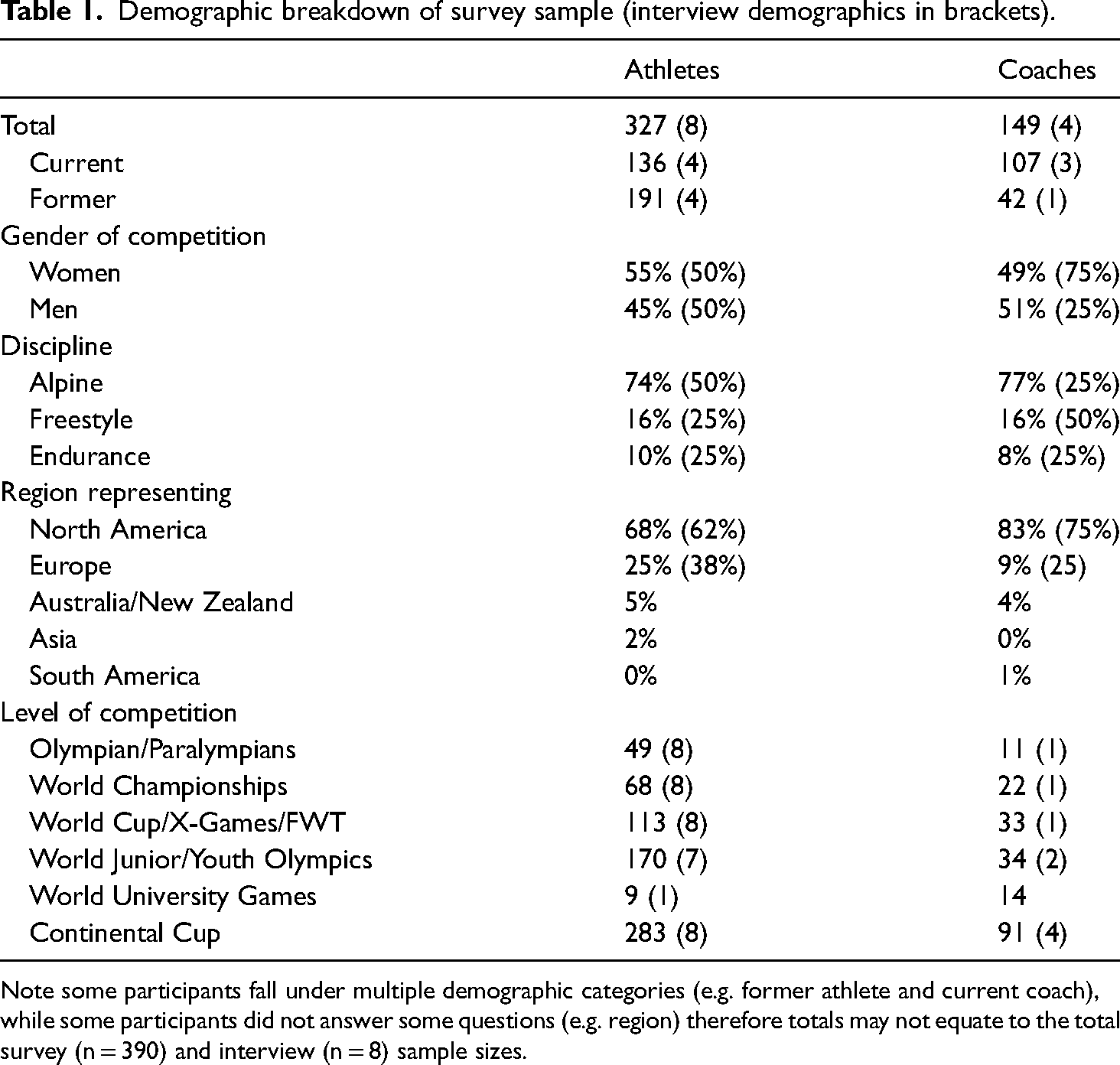
Note some participants fall under multiple demographic categories (e.g. former athlete and current coach), while some participants did not answer some questions (e.g. region) therefore totals may not equate to the total survey (n = 390) and interview (n = 8) sample sizes.
Results and discussion
Winter-sport athletes’ self-perceived roles and responsibilities for climate action
Results found that 94% of participants felt climate change already is or will negatively impact both their sport and the planet more broadly (Figure 1). An almost equal proportion (86%) also agreed sport holds responsibility to act in response to climate change suggesting a connection to the global climate change movement. Survey participants (97% of athletes and 93% of coaches) overwhelmingly felt they were personally responsible for engaging in some form of climate action. Themes emerged from qualitative survey responses and interviews in which participants felt their personal experiences with changing environments through their outdoor winter sport provided strong awareness and understanding of climate impacts and inspired commitment to take public or personal action. Participants also noted a growing interest in climate change by sport stakeholders (including athletes, international sporting organizations, sponsors, fans, and recreational participants) and the potential to share their winter sport experiences to draw attention to global climate change. Only four respondents (1%) strongly disagreed that sports industry stakeholders were responsible for addressing climate change. A survey participant expanded on this perspective explaining, ‘climate change is happening no matter what the sport does. There is not enough of an impact to the environment from alpine skiing that this sport should bear the responsibility’.

Respondent agreement with statements on winter sport, climate change and climate action.
Athletes and coaches tend to use activist and advocacy terms interchangeably, yet themes emerge with some athletes identifying as activists and intentional role models who can inspire social change (De Rycke et al., 2018; Leng and Phua, 2022). ‘Athletes are role models; inspirational, motivational and that's not going to change tomorrow, if anything that's why sport is so powerful, and [athletes can create] such a powerful movement [for climate change]’. Other participants described neutral visions of sport as separate from socio-political spheres (Kaufman, 2008), especially amidst challenges pursuing climate action while focusing on athletic success. Via interview former endurance athlete (interview #2) explains, ‘as an athlete you put all your effort into that pursuit and that leaves very little room for anything else, including advocacy’ while an alpine racer stated, ‘I don't want to do advocacy stuff, it's just not my personality and stuff. The way I [want to take climate action] is through my education and more behind the scenes type things I can do, so I think personally I don't want to really use my sport’. A freestyle coach and former athlete survey respondent confirmed this perspective stating, ‘it's tough because it takes numbers of athletes to really dive into [climate action] and make it their goal, which athletes don't tend to do much because they're very self-focused in general’. Only a small percentage of coaches (7%) and athletes (3%) felt they were not personally responsible for engaging in climate action or taking a public stance on climate change.
Participants across these three perspectives noted feeling thrust into the climate conversation and held to higher standards, particularly on their sport's climate relevance and lifestyle's carbon intensity (Haslett and Smith, 2021; Leng and Phua, 2022; Souter, 2018) and in response cited contradictory fears of hypocrisy for their large carbon footprint, and the insignificance of individual or sport-based emission relative to global carbon emissions. ‘I always felt bad about my carbon footprint. Lots of flights, lots of travel, lots of equipment. I see some are trying to at least do something, although their message seems very hypocritical’ stated one survey respondent, while another countered with, ‘conversations around sport and climate change are only relevant in terms of perception and setting an example. To set that example would be to be eliminate elite sport. So many things have much higher influence on climate change that I find the conversation around sports influence on [climate change] is pointless’. Both these concerns were shared by self-proclaimed climate activist: I started feeling horrible that I was travelling all over the place and flying. I wanted to be able to do something about it and I wasn't sure how. It felt like doing something about it meant stopping doing everything I like to do in my sport and meant stopping travelling for races and not flying anywhere and making a perfect carbon footprint. For several years I was just frozen because I couldn't do it perfectly. I wasn't doing a good job at being an advocate and a hypocrite and so it was too scary to do anything or do much at all, like I did small things in my day-to-day life, but it didn't seem like it was my place to be speaking or talking about this topic. I think my understanding has changed in the last few years is realizing I can be an imperfect advocate and still pursue what you love. (Endurance Athlete, Interview #5)
Athletes who perceived themselves as veteran, top-ranked and educated on climate felt more comfortable acting as role models or climate spokespeople due to both increased climate understanding and athletic standing. Former freestyle athlete and current coach felt their Olympic medal gave them more credibility and attention allowing them to have a louder voice.
Having that Olympic medal opens the doors to connect with kids and the next generation. Some people say they're not interested in what you're saying, the kids just want to see athletes and the medal. Even if 90% of the kids want to just see the medal, if we get even 10% that are really interested in what you're saying, and you get these hyper-motivated kids like I was, and you plant a seed in them and you can get the ripple effect started that one loud voice can just excite a small little army. (Freestyle Athlete and Coach, Interview #3)
Another stated (interview #1): ‘For me personally, with more experience and maturity where I had a bit more knowledge on climate change and I was ready to go about [advocacy] with dedication’. Conversely, self-perceived or relative lack of athletic success can create imposter syndrome on their status as an effective athlete-climate activist. Despite being an Olympian with an environmental degree, one alpine athlete (interview #6) stated: ‘I also feel like I'm not good enough to really use my voice to make changes. I don't get asked about climate change, maybe [current World Champion] does, but I'm not really the athlete that gets a ton of interviews’.
Fears of being called out for hypocrisy, imposter syndrome in terms of athlete voices and actions gaining large-scale attention or evoking change and uncertain climate education indicate a lack of what Cooper et al. (2019) define as scholarly activism, in which individuals or groups acquire and convey an understanding of oppressive systems they aim to challenge and dismantle. In this case, climate change education, in particular difficulties staying up to date amidst travelling for sport and fast-moving, widespread and highly polarized climate science and policy spaces, means that despite awareness of climate impacts on their winter sport and perceived responsibility to act, many athletes express confusion and uncertainty on the correct actions to take personally, and messaging to share with their audiences. This suggests lacking a clear opposition, intentional counter-hegemonic action within sports or beyond and specific goals, essential to activism (Cooper et al., 2019; Jolly et al., 2021) and leans towards public support for climate action which may be better defined as advocacy (Fuller and McCauley, 2016; Gardner et al., 2021).
Potential outcomes of athlete-climate action
Outcomes and interpretations of activism rest on to what extent actions disrupt hegemonic systems. Despite interest in climate change and public figure status, participants shared concerns over their ability to evoke change such that an alpine athlete (interview #8) stated ‘we realize as athletes we have that platform to be role models and that's a great way to use it for sure, but it only goes as far as people are willing to get behind your cause or not’. Survey participants ranked promoting sustainable and responsible consumption and advocating for climate action in communication channels as their primary way to engage in climate action (Figure 2). Qualitative responses found this was most commonly manifested through actions, such as social media posts on climate awareness and education, petitions and letter-writing campaigns (Brown et al., 2022; Leng and Phua, 2022) which constitute advocacy rather than activism. I'm definitely more on the soft side of activism and advocating. I try to be a bit more silent force where I don't go out in public much and try to be extremely vocal but I do have a lot of chats in meetings and stuff like that so my work and where I put a lot of energy is who I talk to and when I talk to them and hopefully this will have this domino effect but I'm not someone who's really going to stand up at the public stage area and go in the media and I try to protect a little bit this and I don't want to gamble too much to really lose my credibility.
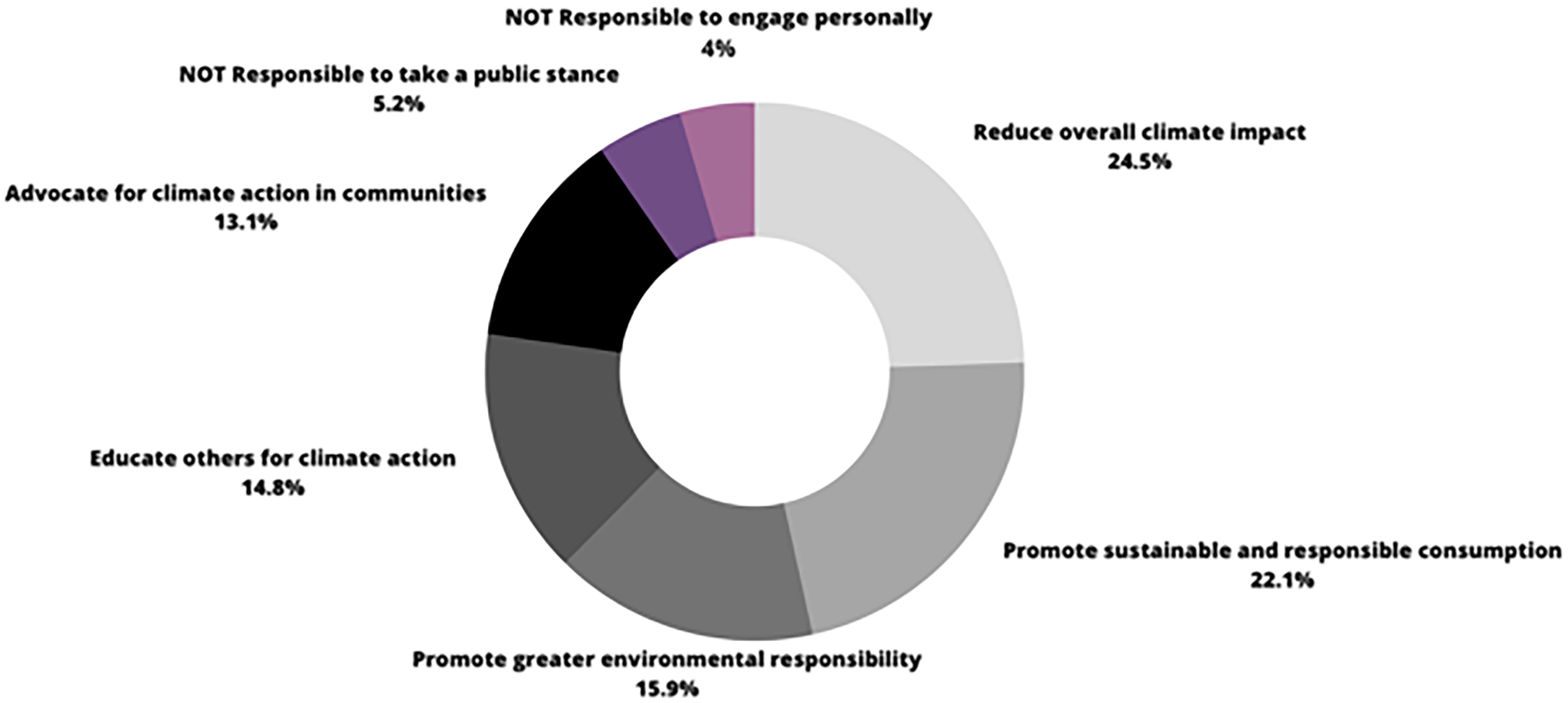
Athlete and coach perspectives on how best to engage in climate action to support the UN Sport for Climate Action Framework objectives.
To date, no participating winter sport athletes have engaged in symbolic climate activism (Cooper et al., 2019) or large-scale outsider actions (Saunders, 2013) such as public demonstrative activist actions, protests, boycotts or other tactics which disrupt normal sporting or societal operations. Athletes feel uncomfortable taking risks, especially at important events and question the effectiveness of these types of actions or their individual voices to evoke change. ‘Who's going to qualify for the games and then sit it out?’ stated one survey participant while former freestyle athlete and current coach (interview #3) stated: I'm sorry when you're twenty and thirty something and you've been working at this dream since you were five or six and you've worked all your life and finally you reach it, then people give you shit for rules and politics you have absolutely no control over. You've already put all your work and sweat and tears and money to go to an event, where it's the only event in the world where they don't pay their athletes and they're making billions off of you. You're pretty much nothing and you're there for the pride of competing for sport and now you're going to give me shit for doing it because these people are making all the money and all the bad decisions so this is where I find it's not fair and I hope athletes’ voices would be more heard.
Interview participants who self-describe as climate activists or advocates identify the support of other athletes, coaches and sport stakeholders who are engaged in climate action as helpful for sharing educational resources, up-to-date climate news and networks. In particular, athletes mentioned environmental organizations uniting athletes for positive environmental change, including Protect Our Winters, Killian Jornet Foundation (winter sport specific) and Runners for Public Lands, Surfrider Foundation, Players for the Planet and Global Athlete, as providing organization, education, power in numbers and ability to reach wider audiences including fans and recreational sport participants as well as politicians, decision-makers and climate scientists who athletes would not otherwise connect with. ‘[Climate change] seems like a big thing thats too overwhelming to do anything on my own but now that I'm with [Protect Our Winters] I can engage on projects and reach more people’, stated one survey participant. Participation in these organization may constitute grassroots activism (Cooper et al., 2019). Saunders (2013) warns as organizations become at least partially institutionalized and are consulted in decision-making processes, they may lose their ability to act more radically as outsiders. This may be a fruitful line of future inquiry as one interviewee mentioned non-profit environmental messaging can be influenced by funding sources, while another expressed frustration on non-profit organizations not supporting some contentious or intersectional climate issues.
Survey and interview participants emphasized changes need to happen within their sport and sporting organizations first, to be effective activists and use winter sports as a vector of societal change (Edgar, 2021; De Rycke et al., 2018; Leng and Phua, 2022), suggesting opportunities for athletes to engage in sport-based activism (Cooper et al., 2019). ‘Changing my habits is not going to do a whole lot but if I can convince the IBU or the IOC and put the pressure on them it changes our sport quite a bit’. While athletes were uncertain of societal climate actions, participants provided a wide range of institutional changes within sport needed to address hegemonic drivers of climate change including reducing travel-based emissions by adjusting schedules and minimizing distances between events, prioritizing local training and competitions, especially for youth, requiring low or zero emission events and venues and choosing climate resilient dates and locations for events to reduce climate impacted competition conditions and reliance on snowmaking. Many participants noted climate change impacting off-season training venues, and two athletes even suggested mandatory no-training windows during the off-season to reduce travel emissions, costs and ensure fair accessibility. Shutter's open letter to FIS (POW, 2023) reiterating some of these ideas indicates winter athletes are in the initial stages of sport-based climate activism. Beyond altering hegemonic structures and practices of winter sports to align with climate action, effective sport-based activism reducing winter sport's contribution to climate change may also help dispel athlete concerns of being called out as a hypocritical and allow further athlete-climate activism within and beyond sport.
Winter-sport institutions, policies and culture influence on athlete-climate activism
While sport-based activism was identified as foundational for athletes and sport more broadly to be effective climate role models and activists in society, participants highlight the winter-sport industry as difficult to influence and winter-sport landscape as constraining to climate activism. Athletes and coaches stress International Sporting Organizations themselves (e.g. IOC, FIS) are the most responsible for taking leadership on climate change (Figure 3). National Sporting Organization and sporting equipment brands were ranked second and third, while athletes ranked themselves fourth ahead of competition venues, sponsors, coaches, training facilities and sporting event host destinations as having the responsibility to engage in climate action. Two survey respondents articulate a common theme on why participants felt action needs to be taken at organizational scales to be effective: I believe bigger organization such as FIS, Olympic committee, ski brands can have faster and greater impact to the world. Their awareness will bring more attention than just athletes and coaches. Their voice is louder, and they should be leaders. (Survey response) Institutions and corporations that lead and control the snow sports industry should be making every effort to attain net-zero carbon emissions status immediately to serve as an example for other companies/industries to follow suit whilst further diminishing demand or reliance on any non-renewable energy source. (Survey response) Using [athlete's] own social media platform and the media which is one side of the whole equation for sure it's one angle, but I think at the end of the day the real change happens when you can be at the table with the decision-makers. (Freestyle Coach, Former Athlete, Interview #1) So, it's tough, and then obviously to have impact at that level you need the network and the confidence and the platform to talk with the decision-makers and sit at the table. Again, those are spaces are highly restrictive and it's really hard for athletes to get in a position in which you can be at the round table so there's always this kind of resistance. (Alpine Athlete, Interview #4) I think this goes back to the days when they had the Olympics back in Hitler's days in Germany. It just kind of shows politics have been there forever through sports, and it takes away some of the power sports has to transport messages to unite everyone. Going forward, having an organization with integrity is so important and having athlete representation is clutch for any organization at any level. Not just a puppet spokesperson or talking head but actual channels where athletes can voice concerns. IBU has that now. The athletes organized for the first time in 2016 ahead of the Paris Agreement. It was grassroots, there were a few of us wanted to get a bunch of athletes together, made a Facebook group so we could all communicate and get a picture showing we care about winter. It was a very small thing that allowed us to just have good channels of communication and organizing. We had athlete reps that hadn't done a lot before, but we started getting them to be a little more vocal and they started pushing and now they got a seat on the executive board for an athlete and it's just kind of each year taken a step forward. They have gotten some new leadership recently; created athlete ambassadors in three realms – gender equity, climate change, integrity; and put forward some initiatives like 2030 look ahead, target goals, trying to make their events carbon neutral and find ways to offset the transport of spectators, fans and the energy that goes into the races themselves, which is cool. I've got to say as an athlete it's really hopeful when you see the organization that guides your sport at the international level taking a stand on this stuff and doing something. It's just really more hopeful whereas with the IOC I see as so regressive right now. I think having more transparency in sport would help and to have the leaders that are at the top of these organizations actually care about environmental issues and see their product or whatever won't be viable in the long run if they're not protecting the environment, but granted these men are all like 70 + year-old men they're going to have a hard time seeing down the future of it all because they won't be there for it. (Survey respondent) I don't know if I'm pessimistic because more aware of where the events are happening and what's going on, but it just made me feel more powerless and the changes are going to be fricken tough. If it's just if someone from wherever in the world can come up with so much money then he can sway a lot of people, it's sad and horrible to say but this is what's happening. (Survey respondent) So that's the importance of getting some strong community and membership and good people unifying their voices and going at the corporate-level, government-level to really have some strong impacts on our legislation and our decision-making and where we put our money as a community as citizens. (Survey respondent) Making sure your voice can add up with other people's voice and have the compounding effect and together we can potentially have a bit more of an impact within people that are decision-makers, leaders and have money. Where the money is at that's where we gotta go because that's how the world works. (Survey respondent)
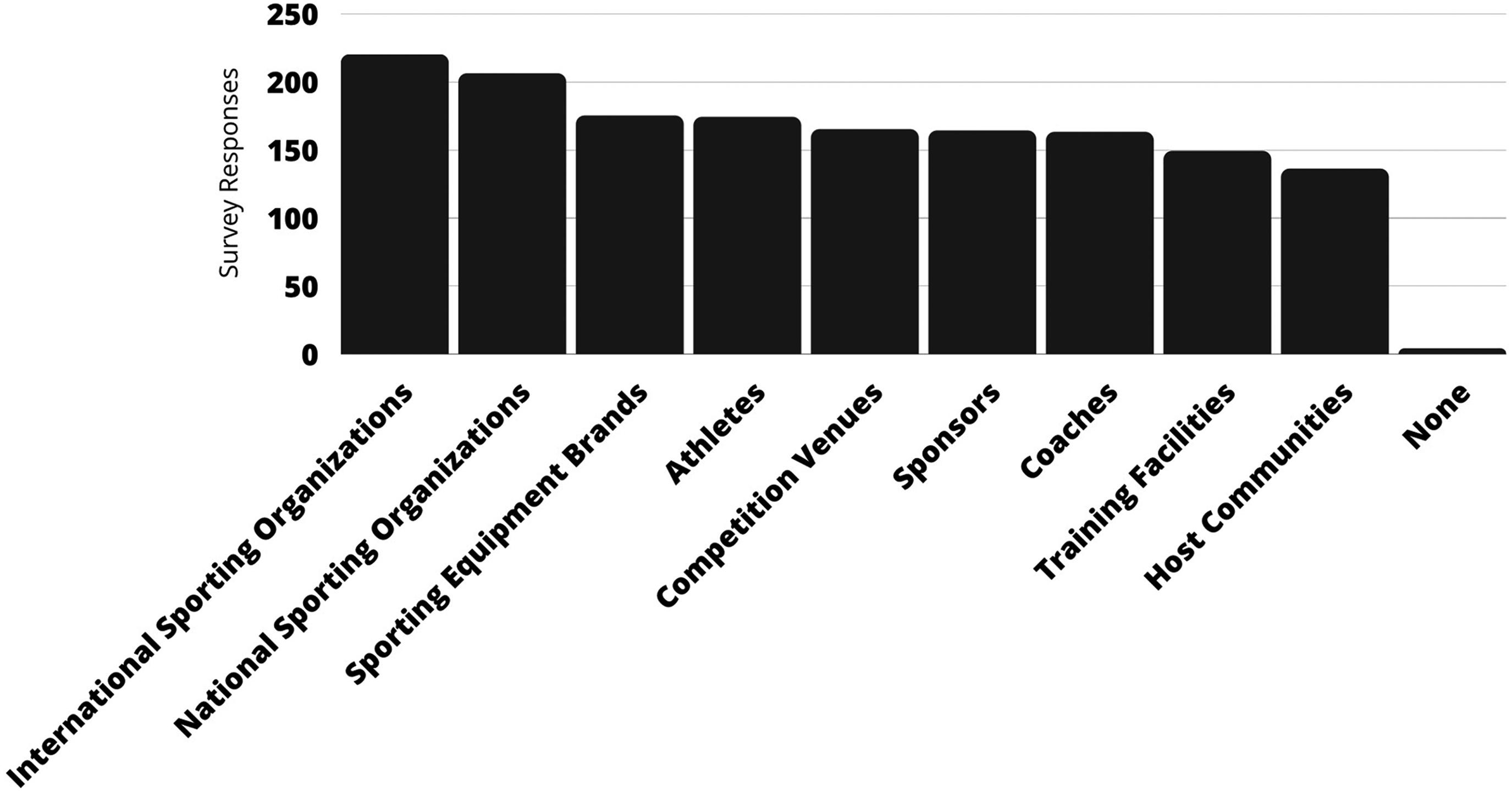
Athlete and coach ranking of winter sport stakeholders’ responsibility to engage in climate action.
A good example can be seen through carbon-intensive sponsors of winter-sport athletes, teams, organizations and events (Abrahamsson et al., 2023). While athlete see sports’ massive platform to create change, such an alpine athlete (interview #7) says ‘the world is way more tuned into sports than it is to climate change or science. The sheer billions of people that like to watch sports there's power in that attention and we can capitalize on the fact that people are tuning in to watch sport and use sport as a venue for advocacy and for getting some of these messages out’, sponsors also see the massive audience available through sports as potential consumers and profits. Abrahamsson et al.'s (2023) report makes a case for ending high-carbon winter-sport sponsors terming ‘sports-washing’ as a form of ‘green-washing’ or ‘woke-washing’ (Vrendenburg et al., 2020). Allowing sponsorship and advertising through the clean healthy outdoor winter-sports image increases demand for products and services such as automobiles and airlines, produces scope 3 emissions for winter-sports and ultimately contributes to climate change and winter-sport's declining conditions, safety, fairness and future viability (Scott et al., 2022). Frustrated with this dichotomy, an alpine athlete (interview #7) stated, ‘they say everything has a price, but do we have to put a price to everything, and can't we say no to things like oil companies sponsoring national ski teams?’. Abrahamsson et al. (2023) agree stating sports organizations, event organizers, teams and athletes need to screen corporate sponsors and turn down companies promoting high-carbon lifestyles, products and services that undermine the sports.
On an individual level, money and power relations exist between athletes and sponsors influencing how climate activism is produced and constrained. For example, some athletes feel they can enforce their environmental values, former freestyle athlete (interview #3) explained ‘if I go to a sponsor and they say no we don't want to sponsor you because you're advocating for the planet, to me that would be the biggest red flag that I don't need this sponsor’. Others suggest potential for internal action such as pressuring existing sponsors, particularly equipment brands, to address their product materials, energy sources and lifecycle. Conversely, many participants express how athletes do not always have the power to negotiate with sponsors, especially big corporations and in winter sports with less financial support than traditional professional sports. Aligning sponsorships with personal values is, one surveyed athlete states, ‘not an easy thing to navigate. At some point I'm a broke skier and [sponsors] know that, so they know people are going to say yes’. Furthermore, sponsorship decisions are often made by leadership at national and international federations, leading back to participants ranking these organizations as more responsible and able to create hegemonic change.
Conclusion
Despite clear indications that climate change is negatively impacting outdoor winter sports (Knowles et al., 2020; Scott et al., 2022), winter sport athlete engagement in climate action may best be classified as advocacy (Cooper et al., 2019; Fuller and McCauley, 2016; Gardner et al., 2021). Themes emerging through quantitative and qualitative analysis of winter athlete stakeholder narratives demonstrate athletes and sports more broadly, feel responsible for addressing their carbon-heavy sports industry and lifestyles, promote climate action publicly and have the potential to influence their audience. However, athletes are risk averse, preferring to act within rather than outside hegemonic systems. No examples of outsider actions (Saunders, 2013) or symbolic activism (Cooper et al., 2019) such as boycotts, disruption of events or protests were provided.
Athlete's low-risk climate action approach has thus far achieved little. Many athletes feel that they are held to higher standards due to their public role-model status (Leng and Phua, 2022) and want to separate sports from activism. Demanding athletic schedules, imposter syndrome, self-perceived lack of climate knowledge and concerns related to hypocrisy and public perception exacerbate climate inaction. Scholarly activism, including the acquisition and transmission of climate change knowledge (Cooper et al., 2019), may help athletes feel more comfortable using their platform to speak publicly and take more intentional action against hegemonic climate change drivers. Non-profit environmental organizations providing athletes with support, guidance and sense-of-community may enhance athlete grassroots activism. Sport-based activism reducing winter sport's carbon emissions may dispel athletes' fears, insecurities and hypocrisies, allowing stronger platforms to push for wider societal change.
Athletes feel frustrated by current winter sporting landscapes and culture where activism is produced, or more often constrained. Beyond producing considerable emissions (Goldblatt, 2020), sport's commodification entrenchment in global hegemonic economic systems exacerbating climate change, including sponsorship funding sources constituting ‘green-washing’, ‘woke-washing’ or ‘sports-washing’ (Abrahamsson et al., 2023; Vrendenburg et al., 2020), prioritize viewership, advertising and profits over climate change, winter-sport conditions and sustainability (Scott et al. 2022). Athletes expressed low trust or sincerity with sporting organizations’ climate leadership and identified power dynamics which leave athletes without agency to influence sports decision-makers. Conversely, this landscape may provide a strong stage from which activism could disrupt hegemonic structures, spark uncomfortable conversations and accelerate systemic changes fundamental to addressing climate change (e.g. actualizing the UN Sports for Climate Action Framework) (Boykoff, 2017; Edgar, 2021). Future research may investigate the effectiveness of different athlete climate advocacy and activism approaches, and how other stakeholders (e.g. media, non-profits) may help athletes affect change. While climate action seems like an uphill battle, one participant (interview #5) eloquently reminds us that adversity is something athletes are predisposed to seek and thrive under: Sport is a place where you see a lot of underdogs come through and we feel inspired to support the underdogs even if their chances are next to nil. I think one of the biggest issues holding us back in the whole climate issue is the fact we feel hopeless, so we've basically got to rally the masses to get behind a cause that seems hopeless and that's something sports do all the time.
Footnotes
Acknowledgements
The authors would like to thank all athletes and coaches who provided their time, thoughts, experiences, insights and perspectives to inform this research.
Declaration of conflicting interests
The authors declared no potential conflicts of interest with respect to the research, authorship and/or publication of this article.
Funding
The authors received no financial support for the research, authorship and/or publication of this article.
