



Abstract
This study examined the underexplored relationship between winter sport, newcomer participation, integration, and national identity. Winter sports hold a prominent place within Canadian culture and identity; newcomers recognize this and express a willingness to try winter sports to feel ‘more Canadian’. Using a qualitative intrinsic case study design, I interrogated how newcomers to Canada experienced the significance of participating in one introductory winter sport programme – the WinSport Newcomers Programme – for their integration into Canadian society. Study methods included qualitative in-depth interviews and a photo elicitation focus group with WinSport Newcomers Programme participants, as well as participant observations of the programmes. This research was theoretically informed by social constructionist perspectives on race and ethnicity, as well as critical insights on sport-related integration. Using reflexive thematic analysis, I developed two themes focusing on the relationship between winter sport participation and newcomer integration, and considerations about future winter sport participation. Results illustrate that study participants experienced diverse programme outcomes and drew varied meanings from learning prominent Canadian winter sports. Various program shortcomings were also identified, which weakened the WinSport Newcomers Programme's integrative potential. Acknowledging the programme shortcomings, I argue that the role of introductory winter sport programmes for newcomer integration is worthy of future inquiry.
Background
Managing immigration and the integration of newcomers into their host societies is a pressing global concern. Amid increases in global migration patterns (IOM, 2019), sport participation represents a prominent focus for policy makers and practitioners in supporting newcomer integration (Agergaard, 2018). Researchers have studied the relationship between sport and immigration across global contexts with particular emphasis on Western Europe (Flensner et al., 2021; Stura, 2019), Australia, (Block and Gibbs, 2017; McDonald et al., 2019), and, most pertinent to this study, North America (Robinson et al., 2019; Wong and Dennie, 2021b). Varied sport contexts are explored in the relevant literature, though sports generally played outdoors in warm temperatures – herein referred to as ‘summer sports’ – predominate.
More specifically, soccer 1 represents the sport of focus across much of the relevant literature. This is perhaps unsurprising given the globalizing force of soccer and the sport's resonance in the lives of people worldwide, migrants included (Woodhouse and Conricode, 2017). Nunn et al. (2022) drew on three distinct ethnographic and participatory studies of soccer in three different countries concluding that soccer can be conceptualized ‘as a mobile, transnational sphere of belonging’ (p. 43).
In comparison, sports involving ice and snow – herein referred to as ‘winter sports’ – have received scant attention in newcomer sport research (Barrick et al., 2021). Three possible reasons may help explain this dearth of research: (1) geographic and climactic factors: outdoor winter sports generally require cold temperatures, ice, and snow that is restricted to certain geographies (Orr, 2020), (2) migrant demographic trends: large proportions of migrants come from nations where winter sports are not common (e.g. India, Mexico; UNHCR, n.d.) and (3) participation barriers: the existence of well-known participation barriers in winter sports (e.g. cost, lack of access, racism; Szto, 2021). Despite these realities, winter sports hold a major place in Global North nations, of which Canada is a prime example (Allain, 2019).
This study was guided by a social constructionist perspective. An exploratory, interpretive qualitative case study of a community partnership – the WinSport Newcomers Programme (WNP) – was employed to interrogate how the newcomer participants experienced the significance of participating in the WNP – and winter sports more broadly – for their integration into Canadian society. Throughout this paper, I use the term newcomer for individuals who self-identify as an immigrant and have recently migrated to a new country. This term is inclusive of various immigration categories (e.g. asylum seeker, economic immigrant) and is a commonly used designation in Canada (Kramers et al., 2021).
Newcomer sport research in Canada
Canada is a nation long reliant on immigration, having implemented various immigration (e.g. the points system), settlement (network of settlement services providers) and cultural diversity policies (e.g. Multiculturalism policy) aimed at fostering a diverse ethnoracial population (Leung, 2015). In 2021, Canada admitted 401,000 permanent residents, the largest annual cohort in Canadian history (IRCC, 2021). Sport participation has long been a focus of policy makers and practitioners for integrating newcomers into Canadian society (Robinson et al., 2019), with research exploring newcomer sport participation in Canada representing a burgeoning area of study (Barrick et al., 2021). For example, researchers have investigated social inclusion and exclusion within sport and leisure opportunities for newcomers (e.g. Frisby, 2011; Rich et al., 2015; Tirone et al., 2010) focusing on where these processes occur. Notable examples include home, family, and traditional communities (Stack and Iwasaki, 2009); mainstream cultural spaces, such as sport and leisure facilities (Frisby, 2011); and ethnocultural spaces, such as ethnic sport clubs (Tirone et al., 2010). Frisby (2011) and Rich et al. (2015) argued that mainstream sport and leisure spaces – including municipal leisure departments and community sport tournaments – can help promote social inclusion and a sense of belonging to newcomers’ local community when the opportunities are community based and their voices are directly involved from the outset.
Understanding and navigating participation barriers are another focus in newcomer sport research. In the Canadian context, researchers have explored how participation barriers influence newcomer sport participation, most notably: limited financial resources (Campbell et al., 2016; Taylor and Doherty, 2005), limited available time (Curtin et al., 2018; Tirone et al., 2010), family and ethnoracial group influences (Curtin et al., 2018), difficulty navigating Canada's bureaucratic sport system (Frisby, 2011; Tirone et al., 2010), language and cultural considerations (Campbell et al., 2016; Curtin et al., 2018), and limited social networks (Stack and Iwasaki, 2009). In sum, various interconnected participation barriers obstruct newcomers to Canada from engaging in mainstream sport opportunities.
How sport programmes in Canada are designed for newcomers is another focus of research (Barrick et al., 2021; Kramers et al., 2021; Rich et al., 2015). Newcomers’ voices, however, have been largely absent from the planning, implementation, and evaluation of newcomer sport programmes (Barrick et al., 2021). One notable exception is Rich et al.’s (2015) analysis of the Community Cup soccer tournament. The authors found the participatory design of the tournament was positively received by newcomer study participants (e.g. offering opportunities to network and gain ‘Canadian’ experiences). Thus, the authors concluded that sport programmes or events on their own will not create extensive social change, calling on researchers to shift focus ‘to the broader organizational and engagement practices that may allow many events to produce tangible and important social outcomes’ (p. 139). Kramers et al. (2021), in their case study involving one founder/leader of a newcomer youth sport programme, reasoned that a complex set of factors (e.g. programme philosophy, internal/external challenges, the need to collaborate) were being continually (re)considered to intentionally promote physical activity and well-being in an inclusive, culturally safe environment. Lastly, Barrick et al. (2021) summarized various strategies introductory sport programme administrators adopted to promote newcomer inclusion and programme sustainability. Thus, structuring effective newcomer sport programmes requires organizers to (re)negotiate complex, inter-related considerations.
Newcomers and winter sports in Canada
Winter sport holds a prominent position in Canadian identity, with ice hockey occupying central importance (Allain, 2019). Canada's geographic and climactic positionality as a northern nation helps explain this prominence; yet, scholars also point to the nation's long-standing preoccupation with conquering the northern environment – informed by Canada's existence as a white, settler colonial nation – to explain why winter sports maintain strong cultural significance (Gruneau and Whitson, 1993; Szto, 2021). Research has shown how newcomers are drawn to winter sports (e.g. ice hockey, ice skating, downhill skiing) because they strongly associate winter sports with ‘being Canadian’ (ICC, 2014; Jedwab and Holley, 2021).
It is at this intersection that Canadian Ethnic Studies recently published a special issue entitled: ‘Hockey in Canada: Indigeneity, ethnic/racialized minorities and the nation’. Contributors illustrated how racialized communities – most notably Indigenous Peoples, racialized persons, and newcomers to Canada – have, and are making, important contributions to ice hockey despite being largely silenced by various cultural and institutional forces (Wong and Dennie, 2021a). Relevant special issue contributions (Jedwab and Holley, 2021; Wong and Dennie, 2021b) demonstrate how the place of newcomers in ice hockey, and winter sport more broadly, is receiving greater scholarly attention. Beyond the special issue, Gulamhusein (2021) offers an autoethnographic account of her lived experiences as a young Muslim female playing ringette 2 in Canada arguing that such participation ‘iterate[s] the complexities and relevance of leisure access and participation for (forced) migrants, immigrants, and children of immigrants’ (p. 201). Szto (2021) contends that South Asian hockey fandom and community hockey participation represent contested terrain for this ethnoracial group with relevant members striving to belong in hockey through building cultural citizenship. However, newcomers’ lived experiences in introductory winter sport programmes have yet to be investigated, thereby representing a notable research gap.
Theoretical underpinnings
Social constructionist perspectives of race and ethnicity (Gunaratnam, 2003) and sport-related integration (Agergaard, 2018) served as overarching theoretical groundings for this study. These perspectives helped orient this study within social and relational understandings of newcomer sport participation, thereby fostering critical examinations of the links between race, ethnicity, immigration, integration, and sport.
I view racial and ethnic identities as fluid, dynamic, and socially constructed (Omi and Winant, 2018). That said, ‘essentialist categories of “race” and ethnicity do have some level of resonance with lived experiences and this is something that we need to both address and interrogate rigorously’ (Gunaratnam, 2003: 33). Shifting demographic patterns since the 1970s have resulted in greater proportions of newcomers to Canada identifying as Black or persons of colour (Statistics Canada, 2017), arguably marking a departure from the nation's long history as a predominantly white immigrant nation (Leung, 2015). Given this reality – and considering Canada's contested identity as a welcoming nation to immigrants (Leung, 2015) – the complexity through which newcomers to Canada construct and negotiate their identity(ies) (ethnoracial and otherwise) while participating in winter sport was a central consideration for this study.
Integration represents a prominent political discourse for managing the settlement of newcomers into their host societies (Grzymala-Kazlowska and Phillimore, 2018). Informed by transnational perspectives on migration, Agergaard (2018) reconceptualizes sport-related integration as a series of ‘… multidimensional social relational processes that are bound up in power asymmetries, and evolve as changing trajectories’ (p. 25) bringing together people from diverse backgrounds (newcomers and members of host societies) to create something new. Agergaard's reconceptualization represents an appropriate theoretical framework for contextualizing and challenging prevailing political discourses in which integration becomes synonymous with one-way settlement processes such as assimilation – making newcomers and descendants of newcomers like the host population – and segregation – separating newcomers from the host society. Furthermore, Agergaard's articulation of integration as both an umbrella concept (encompassing assimilation and segregation) and specific policy strategy offered appropriate theoretical grounding to examine study participants’ experiences in the WNP in relation to their integration into Canadian society.
Additional scholars have critiqued integration's prominence as a policy tool and ideology through examining its assimilationist, unidirectional view of newcomer settlement (Dowling, 2020); problematizing deficit-based understandings of newcomers as passive programme recipients (Spaaij et al., 2019); challenging the norm of integration as an individual newcomer responsibility (Schinkel, 2018); and ignoring the complexity of newcomers’ transnational lives, especially before arriving in their new home (Nunn et al., 2022). Kataria and De Martini Ugolotti (2022) argued how newcomer sport programmes reproduce and challenge prevailing assumptions, narratives, and practices about newcomer lives and trajectories, thereby illustrating the complexity of studying sport-related integration. I put these critical discussions of sport-related integration into dialogue with Agergaard's (2018) reconceptualization to sharpen my focus on how integration was operationalized and experienced within the WNP, and examined extant programme tensions and dilemmas. For instance, the abovementioned studies all call to move beyond naïve, individualistic understandings of integration, which Agergaard also places at the centre of her reconceptualization.
Moreover, such critiques of integration have been underutilized in Canadian newcomer sport contexts – most notably in winter sport settings – thereby affording the potential for deep analysis. Szto’s (2021) and Gulamhusein's (2021) work is relevant here. Both authors share the complexity that comes with participating in winter sports as South Asian Canadians and Shia Muslim Canadians respectively, which is simultaneously marked by navigating racism and systemic discrimination, while forging cultural citizenship within such spaces. This work offers further theoretical grounding to contextualize and (re)imagine sport-related integration for newcomers in Canadian winter sport settings.
Study design
Introducing the case
The WNP is a community partnership involving representatives from the following organizations: WinSport, Centre for Newcomers (CFN), and Calgary Immigrant Women's Association (CIWA). The purpose of the WNP was to introduce newcomer preschoolers, youths, teens, and adults to the Canadian winter sports of ice skating, downhill skiing, and snowboarding while supporting their integration into Canadian society. Newcomer participants were recruited by CFN and CIWA settlement councillors and enrolled in existing WinSport introductory winter sport programmes alongside programme patrons from the general public. As an academic collaborator, I shared insights from the relevant research during collaboration meetings and evaluated year one of the WNP.
The WNP adopted several programme designs including two-day intensive lessons, weekly lessons, and a multi-sport March Break Winter Olympic/Paralympic camp. WinSport programmes are organized into age categories: preschool (aged 3–5), youth (aged 6–13), teen (aged 13–18) and adult (aged 19 years and older). To promote wide access, WNP organizers enrolled newcomer participants in programmes across the age categories. I adopted these same divisions throughout this article for consistency.
The WNP commenced in February 2017 with a meeting involving myself and several WinSport administrators to discuss newcomer sport programming options. Following several conversations, the concept for the WNP was developed. The original WNP organizers – consisting of myself and two WinSport senior administrators – recruited additional representatives from WinSport with expertise in introductory sport programming, as well as CFN and CIWA – two settlement services organizations with access to local newcomer communities. Year one of the WNP ran from January to April 2018 with over 200 newcomers being introduced to ice skating, skiing, and snowboarding.
Methodology
The WNP newcomer participants marked the phenomenon of interest in this qualitative intrinsic case study. The object – or analytical frame – involved the relationship between sport participation and the lived experiences and integration of newcomers to Canada (Thomas, 2011). Multiple research methods were utilized between September 2017 and August 2018 to explore the nuance and complexity within the WNP (Schwandt and Gates, 2018). Methods included: qualitative in-depth interviews with WNP participants and parents, a photo-elicitation focus group (herein referred to as focus group) with WNP youth and teen participants, and participant observation of the WNP.
Methods
Qualitative interviews
Qualitative in-depth interviews were conducted with nine WNP participants. Interview participants included youth, teen and adult WNP participants, as well as parents of youth and teen participants. Participants ranged in age from 8 to 48 with their families experiencing diverse immigration journeys before settling in Canada. I held two individual interviews with adult participants and three group interviews each consisting of several family members. Participants from the same families were invited to be interviewed individually or together. In all three instances, one parent and their one or two children chose to be interviewed together. I alternated asking questions from separate youth/teen participant and parent interview guides, which were curated by age level and context (e.g. asking parents why they registered their child(ren) in the WNP). I paid particular attention to extant power dynamics between family members (e.g. whether a parent's presence may have influenced a child's answer), writing reflexive notes where applicable. Please see Table 1 for additional interview participant demographic information.
Interview participant demographics.
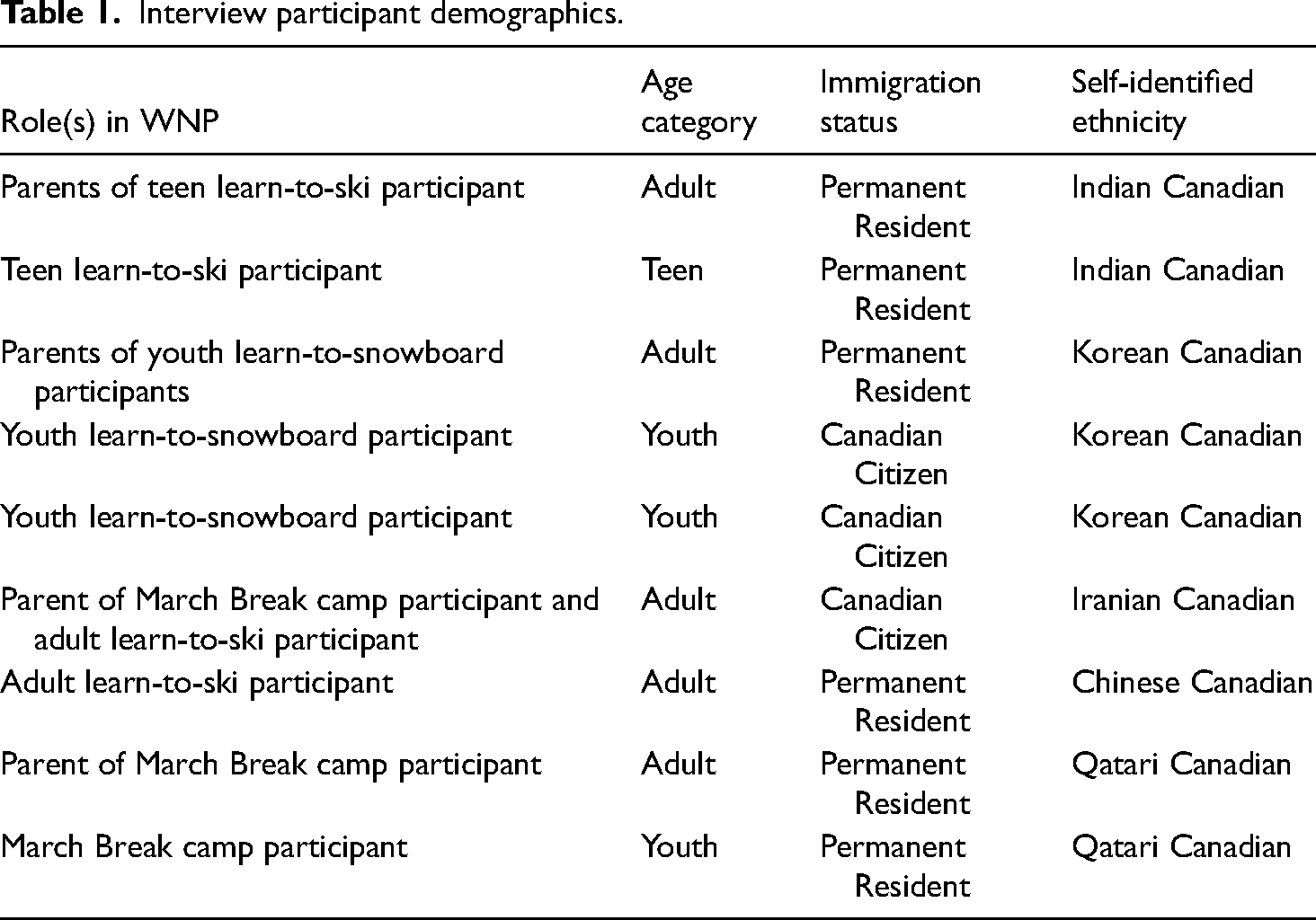
WNP participants were introduced to the study at the outset of each programme and interested interview participants were invited to arrange an interview with me in person, by phone or by email. The interviews were held at a public location chosen by each participant and lasted from 33 to 50 min (42-min average). With participants’ permission, interviews were audio recorded and verbatim transcribed. Using separate youth/teen, parent, and adult participant semi-structured interview guides, I asked each participant about their general and sports background, perceived strengths and weaknesses of the WNP, the relationship between winter sport and Canadian identity, and future sport participation intentions.
Photo elicitation focus group
Six WNP participants from the March Break Olympic/Paralympic camp took part in the focus group. See Table 2 for details about each participant. I adopted a focus group in an effort to democratize the research process (enabling participants to direct the conversation through selecting and discussing photographs that were meaningful to them), build trust and rapport with participants, challenge participants to think about the study context in different ways, trigger participants’ memories, evoke more emotional and multi-layered responses from participants, and provide an additional data source (the photographs; Croghan et al., 2008; Epstein et al., 2006). Such focus groups are also used in research with children to promote dialogue and break down the rigid nature of traditional qualitative interviews that may intimidate younger participants (Cook and Hess, 2007; Croghan et al., 2008; Epstein et al., 2006).
Photo elicitation focus group participant demographics.
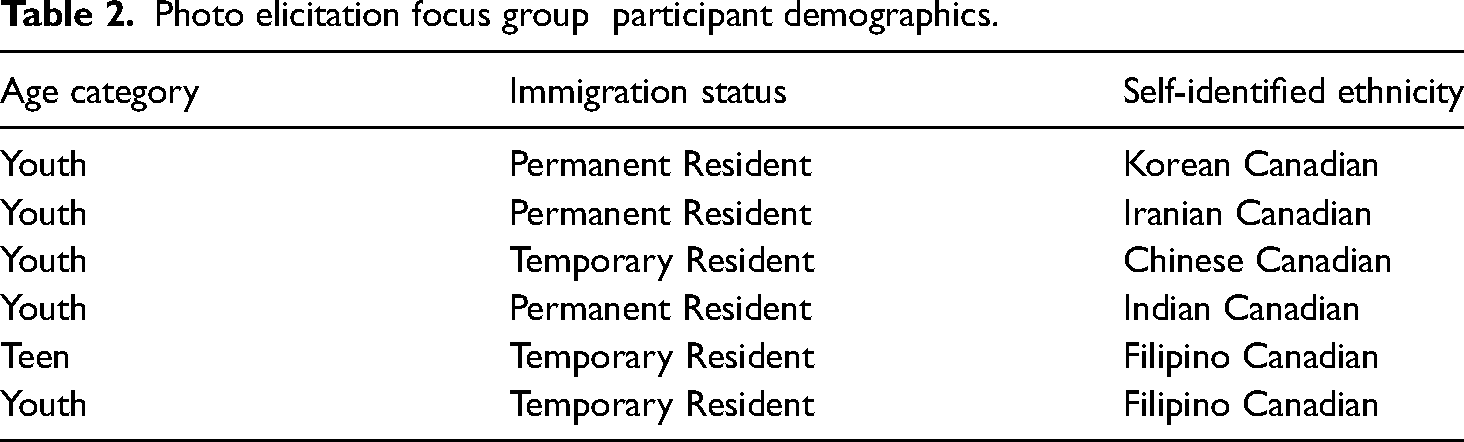
During camp registration, information letters were provided to newcomers and their parents outlining the focus group aims and procedures. Then, on the second day of camp, newcomers and their parents were invited to participate in an optional information session where the study purpose, informed consent and assent procedures, and a camera orientation were conducted. For the next three days of the week-long camp, the six focus group participants were given digital cameras and instructed to photograph aspects of the camp that were personally meaningful. Focus group participants were prohibited from using their cameras during structured camp activities to protect participant safety, and could take photographs before and after structured activities and during the unstructured camp time (e.g. mealtimes). The cameras were collected on the final day to develop the photographs. Later that day, the six participants joined me for the focus group lasting 48 min at the camp location. Each participant received physical copies of their photographs and were asked to select and describe their favourite photographs to the group. As participants described their photographs, I interspersed questions about the strengths and weaknesses of the camp, participants’ perceptions about trying winter sports, and their future participation intentions. Participants were given copies of their photographs as a token of appreciation.
Participant observation
I conducted participant observations across all WNPs to gain a rich understanding of the programme context and to augment the interview and focus group data. I adopted an observer-as-participant approach through watching the programmes from the perimeter to minimize disruptions and enable movement between simultaneous programmes across the WinSport campus. I completed approximately 140 hours of observations during the WNP in which I focused on interactions between stakeholders, peoples’ reactions during programmes (e.g. body language), and the organization of WinSport programmes. I recorded field notes in my research journal after each observation session.
Rigour and ethical considerations
How a researcher articulates their positionality and reflexivity in relation to the research setting is an important consideration in assessing the rigour of qualitative scholarship (Barrick, 2016). As a white, Canadian citizen by birth, I occupied a clear outsider position (Gunaratnam, 2003) and maintained a reflexive journal to work through this and other considerations. I reflected on my thoughts and feelings during fieldwork, the assumptions I found myself making, and how my various identities shaped what I experienced and how I interpreted these experiences.
I also navigated several ethical considerations surrounding my interviews and focus group involving youth and teen participants. First, I prioritized building relationships with programme participants throughout the programmes. I did this to get to know the participants and build trust in hopes they would feel comfortable participating in an interview or focus group.
Second, inviting focus group participants to select photographs that were personally meaningful to them fostered sustained participant engagement and enthusiasm throughout the focus group. Involving participants in the research process using photographic methods can help democratize aspects of the research process, though limitations exist as the researcher(s) generally retains authority over study design (e.g. selecting study purpose and methods; Croghan et al., 2008). Community-based participatory action research approaches hold potential here for more equitably democratizing the research process. Third, I worked to make participants feel safe and comfortable during the focus group and interviews by paying attention to non-verbal cues (e.g. body language) and consistently checking in with participants.
I believe how participants viewed me as an instructor and appeared comfortable during the focus group and interviews aligned with my relational priorities. Despite these efforts, my overlapping positionings in this study likely shaped what participants felt comfortable sharing, in part, given my affiliation with the WNP. While I made efforts to create a space where programme critique was welcomed, my overlapping positionings must be considered when interpreting study results.
Beyond continually (re)examining my positionality, I adopted several additional measures to build trustworthiness. I wrote memos throughout the data collection, analysis, and representation stages to investigate emergent considerations across the data and explore connections to relevant research. Feedback was also solicited from WNP collaborators as well as interview and focus group participants through providing summaries of study findings for review.
Data analysis
All study materials were analysed thematically (Braun and Clarke, 2019) using NVivo 11 qualitative data analysis software. Several rounds of initial and axial coding were completed to deconstruct and reconstruct the data into meaningful units of analysis (Saldana, 2016). Examples of initial and axial coding included ‘Canadian’ and ‘importance of family’. Preliminary thematic categories were compiled through an iterative process of reviewing codes, writing analytical memos, and reflecting on relevant research. I then refined the categories into the themes and sub-themes presented next.
Results
After analysing all study materials, I developed two themes: (1) contextualizing winter sport participation and newcomer integration and (2) what comes next? concerns about future winter sport participation. Sub-themes were incorporated in each theme to represent the complexity of how participants experienced the significance of participating in the WNP for their integration into Canadian society. I present the themes and sub-themes in heuristic categories to promote clarity; yet, various intersections exist across the data, which I will interrogate where applicable in the results and discussion. In line with my onto-epistemological and theoretical orientations, participants’ voices were given primacy in developing and representing the results through incorporating verbatim quotations and photographs to respect and preserve the authenticity of participants’ voices. Participant observation fieldnotes, reflexive entries and analytical memos provided a valuable interpretive context in developing and refining the results.
Contextualizing winter sport participation and newcomer integration
Study participants discussed the value of learning to do winter sports commonly associated with Canadian identity for their integration into the Canadian society and, where applicable, for their families. Agergaard's (2018) framing of integration as multidimensional social relational processes is instructive here in examining how participants articulated the significance of participating in the WNP for their integration. To unpack the various ways study participants talked about integration and the WNP, three sub-themes are presented: (1) winter sport, Canadian identity, and integration; (2) fostering social connections; and (3) centring family participation.
Winter sport, Canadian identity and integration
Study participants drew clear connections between winter sports, Canadian identity, and their own integration. A common connection involved recognizing how Canada's lengthy winter season facilitates a link between Canadian identity and winter sports, making learning winter sports enticing for newcomers: I think in Canada, skiing, snowboarding, and winter sports are very important to learn because of the culture and because of the weather. So, I think it was necessary to do [winter sports]. (Adult participant and parent)
Beyond simply identifying this relationship, participants recognized the value of becoming involved in Canada's winter sport culture, most notably ice hockey. In one case, a parent noted: At the same time, as I told you, because the hockey here is most popular sport in Calgary or Canada. And there is a [NHL] team and wherever, I would love [my son] to be involved so he have more friends, more things to be interested in with his friends. (Parent)
The lived experiences of study participants prior to immigrating to Canada also shaped their view of winter sports. Study participants were eager to enrol in introductory winter sport programmes, in part, because the majority had emigrated to Canada from regions that do not experience a winter season like in Canada: First and foremost, we don’t have this type of environment and facilities in our native country. We are from India, so we don’t have skiing there and skating and some of the programmes. (Parent)
How strongly participants associated winter sports with Canadian identity aligns with previous research (ICC, 2014; Jedwab and Holley, 2021), thereby demonstrating the entrenched nature of this narrative (Gulamhusein, 2021). Yet, participants offered nuanced, pragmatic explanations for why newcomers to Canada are drawn to winter sports. The last quotation illustrates the need to consider newcomers’ transnational lived experiences, something that is receiving greater attention in newcomer integration literature (Agergaard, 2018; Nunn et al., 2022). Moreover, the quotations presented thus far position winter sports as assimilative and unidirectional with interested newcomers bearing responsibility for fitting into dominant Euro-Canadian activities. Szto’s (2021) and Gulamhusein's (2021) research is helpful here in contextualizing the contested terrain individuals and groups who are racialized as Black or persons of colour face in fostering welcoming winter sport spaces for themselves and others. Relatedly, the argument from sport-related integration scholars that integration needs to prioritize structural, systemic changes, not individual newcomer responsibility, is instructive here (Agergaard, 2018; Schinkel, 2018).
Fostering social connections
Study participants valued opportunities presented through the WNP to develop social connections during the programmes, as well as skills and knowledge to apply in additional settings. Participants discussed fostering social connections within the WNP with fellow programme participants and instructors. In several cases, socializing with (presumably white) Canadian citizens was emphasized.
A teen learn-to-ski participant noted how partaking in the WNP enabled them to make new friends during the programme and generally expand their social network: I got to know people who I didn’t know before. I got a broader network and then, I could get some help from them. They could get some help from me. So, it's a stronger community. A greater bond. (Teen participant)
This quotation is one of the few instances where a participant noted how their interactions with established Canadians may benefit everyone involved. The multidirectional nature offered here challenges the prevailing assimilationist dynamic outlined in the previous sub-theme. It also offers an alternative to the common deficit-based framing of newcomers in sport programmes (Spaaij et al., 2019). However, the absence of similar examples across the data demonstrates how this version of integration likely was an exception, not the norm throughout the WNP. Furthermore, intentionally designing integrative opportunities (e.g. cross-cultural sharing) into the WNP could have enriched the possibility for relational, multidirectional integration, building on the potential shared in the teen participant's quotation.
During the focus group, youth and teen March Break Olympic/Paralympic camp participants also discussed the sense of community they cultivated with their fellow campers. This sentiment is reflected in Figure 1. Despite their faces being obscured to protect anonymity, this photo represents the friendship forged between two newcomer participants and one Canadian citizen. The bonds struck between participants – including between newcomers and Canadian citizens – further displays the integrative potential of introductory winter sport programmes. In both the above quotation and Figure 1, intentionally designing integrative opportunities (e.g. cross-cultural sharing) into the WNP may have enriched the possibility for relational, multidirectional integration, building on the potential shared in the teen participant's quotation. In the absence of intentional programme design efforts, multidirectional conceptualizations of integration (Agergaard, 2018) will remain underdeveloped and primarily the responsibility of individual participants to facilitate (Dowling, 2020; Spaaij et al., 2019).
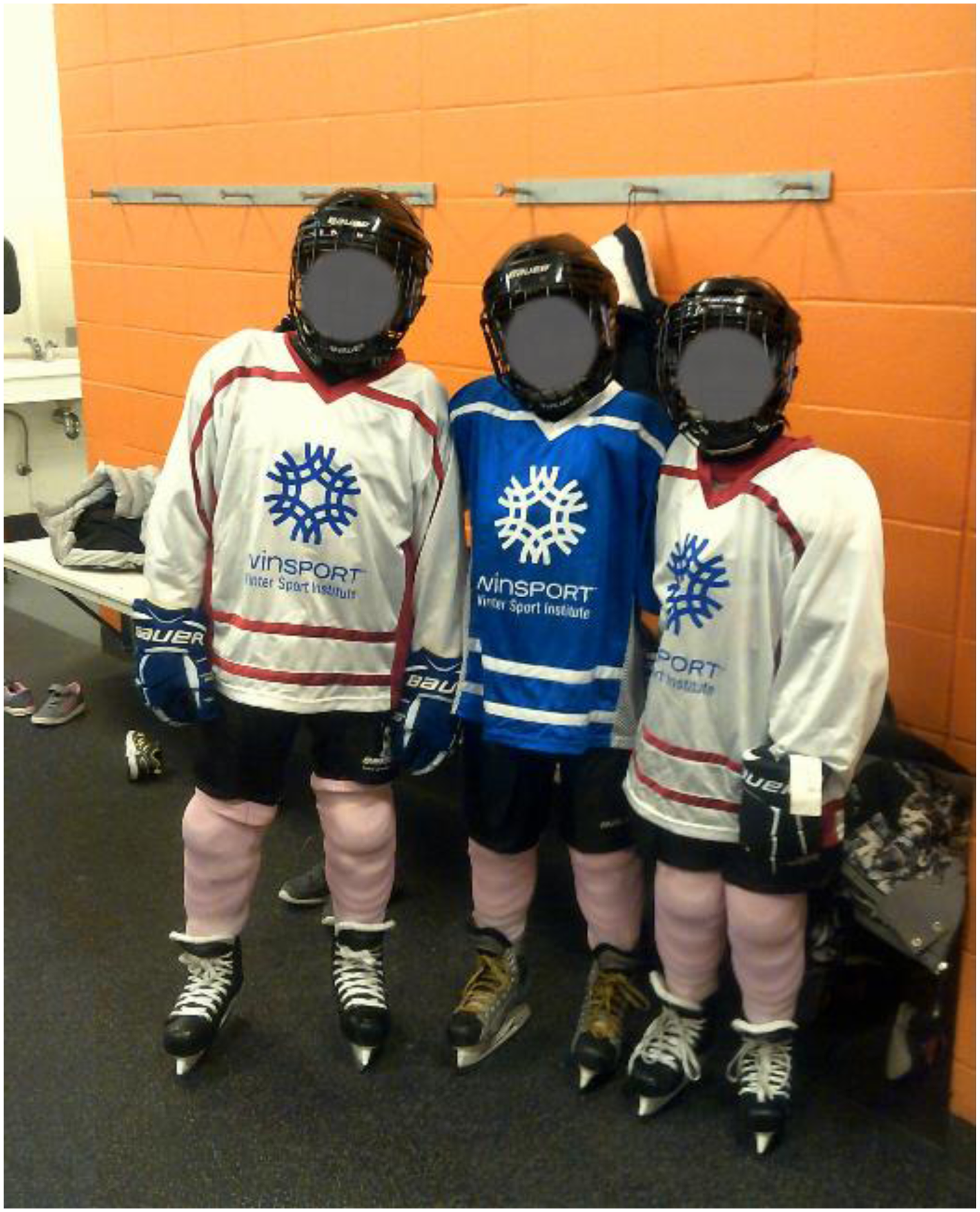
Three friends in (ice hockey) uniform.
Newcomer parents also valued the social connections their children developed, with particular interest on cross-cultural interactions. For example, a parent of two siblings participating in a youth learn-to-snowboard programme described the value of their children interacting with an assumed Canadian-born instructor: I always sense that when [my children] have a lesson, the instructor is Canadian born. And then, [the instructor]'s very nice. And then, our kids are very happy to listen instructors. And [my children are] learning English and also skills. And then, they are enjoying communicate with instructors, the Canadians. (Parent)
Figure 2 provides a visual representation of what the parent described above: a (presumably) Canadian coach (in the blue jacket) interacting with programme participants, many identifying as newcomers. The quotation and photograph further reinforce the relationship between Canadian identity, winter sport, race, and integration, and how newcomer participants view participating – or having their children participate – in winter sport as an opportunity to engage in (primarily white) Canadian society. Participants did not explicitly discuss or problematize the relationship(s) between race (particularly whiteness), speaking English, and winter sports in Canada. However, such intersections are explored in existing research involving persons who are racialized as Black or persons of colour across winter sports (Gulamhusein, 2021; Szto, 2021; Wong and Dennie, 2021b). I argue that the limited ways participants framed their WNP engagement around racial identity further illustrates the assimilative nature of how winter sport programming for newcomers generally operates in Canada; that is, favouring individual newcomer responsibility over their own integration instead of addressing long-standing structural and systemic discrimination that fosters racial indifference. Sport-related integration scholars exploring different sport and geographic contexts have made similar points in terms of how newcomer sport programmes can reproduce flawed, problematic assumptions of newcomers (Kataria and De Martini Ugolotti, 2022; Spaaij et al., 2019).
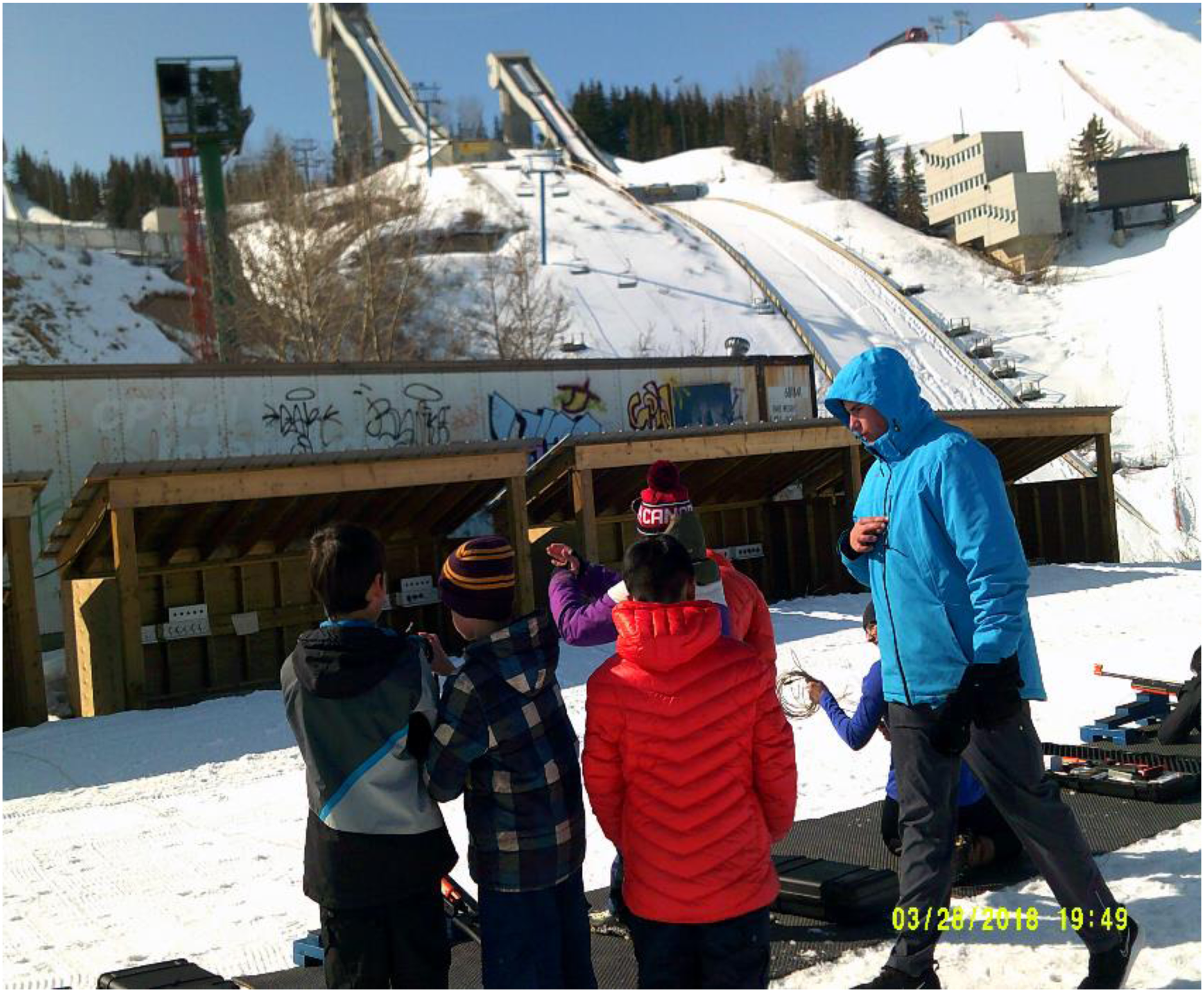
Coach-participant interaction.
Adult participants also built social relationships during the WNP. For instance, an adult learn-to-ski participant shared their experience socializing with two fellow newcomer programme participants: I think both of them [fellow participants] very friendly. We did talk a little bit about our background, where do you come from and do you have kids and where do you work … and things like that. And we encouraged each other when somebody fell, [we] will wait for her and say, ‘Okay, you can do it’. Ya, is pretty friendly communication. (Adult participant)
Across participant backgrounds (youth, teen, adult/parent), social connections were forged and prioritized, a trend which aligns with relevant Canadian newcomer sports research (Frisby, 2011; Rich et al., 2015; Tirone et al., 2010).
Extending beyond the WNP, participants recognized how fostering social connections enriched many aspects of their daily lives, whether that be in school, work, leisure time, or socializing with neighbours. For example, a youth learn-to-snowboard participant described how their newfound snowboarding knowledge and skills helped with making friends at school: … I was in [school] and there's a twin that likes hockey, so we talked about hockey and then this year, there's another guy in my class and he does snowboarding, like we talk about snowboarding and stuff. (Youth participant)
The way this youth used mutual interests in winter sports to make friends in school resembles how Gulamhusein (2021), through playing ringette, ‘learn[ed] to respond to and transition between various social contexts …’ (p. 201).
Establishing and maintaining social connections was likewise an important consideration for adult participants. An adult learn-to-ski participant discussed how learning the sport helped strengthen their relationships with fellow parents: I’m more confident and later I can also talk about skiing with my kid's friends’ parents now. Previously I don’t know much skiing, so we have nothing to talk. We just drop off the kids and say ‘hi.’ I left. (Adult participant and parent)
This study participant also shared how their family had a long-standing invitation from established Canadian neighbours to join a weekend ski trip to a nearby mountain resort. Before enrolling in the learn-to-ski programme, the study participant would respond, ‘no, I cannot. I simply cannot’ to their neighbour's request. Following the programme, the participant reported: And after [the learn-to-ski programme], I went to my neighbours – so, we three families went to the mountains. Though I’m shaking all over and cannot ski that much. Now I’m confident enough to join them. (Adult participant and parent)
A common thread across this sub-theme is how winter sport participation extended opportunities for participants, regardless of age, to meaningfully connect with individuals they might not have otherwise connected with. Like Gulamhusein (2021), engaging in the WNP offered participants space to connect with others and gain skills and experiences useful in participants’ ongoing settlement journeys. In sum, participants prioritized using winter sport participation for ‘fitting in’ to existing social networks whether that be with classmates, fellow parents or neighbours. While these interactions may represent a starting point for the rich, multidirectional integration processes Agergaard (2018) conceptualized, this study's cross-sectional design leaves this inquiry requiring future examination.
Centring family participation
In general, newcomer parents in this study ensured their children got the first opportunity to enrol in WNPs. Yet, many of these same parents also recognized the value of entire newcomer families learning Canadian winter sports. A common belief held by newcomer parents was that Canadians tend to do winter sports as a family: After I came to Canada, I found here in Canada people like to do – go out as a family. I hope that we could go out skiing as a family, not only the kids. So, as parents, we would like to also join. So yes, that's great! (Adult participant and parent)
Newcomer parents also expressed concern about being unfamiliar with what their children were learning in introductory winter sport programmes. Since newcomer parents in this study lack familiarity with winter sports – including being unable to physically participate in them – they were unable to assist their children when programmes ended and missed out on valuable family recreational sport opportunities, points which are emphasized in the following quotation: You know, Canadian families, they are very good at stopping … they can teach their own kids … that's different than my family or immigrants. The parents cannot skate and then, I don’t know, [my children] will never get better. I would definitely enrolled and then participate. (Parent)
Failing to introduce newcomer parents to the winter sports their children are learning thereby reduces the likelihood that newcomers – either individuals or families – will participate in winter sports beyond their introduction. Newcomer parents believed that this is not the case for Canadian families who are likely more familiar with Canadian winter sports. In reality, sport in Canada is quite individualistic with few participation opportunities available to families (Misener, 2020). Furthermore, winter sport participation rates are stagnating while more accessible summer sports like soccer, basketball and cricket are rising. This trend is fuelled by growing immigration rates (Jedwab and Holley, 2021). The belief in widespread family winter sport participation is a myth that is perpetuated by nostalgic idealizations of Canada as a winter sport country where such participation (and viewing) brings all Canadians together as an imagined community (Allain, 2019; Anderson, 2016). The pervasiveness of the myth in this study exemplifies the need to restructure winter sport delivery in a manner that promotes widespread access to culturally significant winter sports like ice hockey and ice skating (Szto, 2021), while also fostering integrative opportunities where newcomers can actively contribute to building more welcoming, inclusive futures.
Newcomer parents also described feeling isolated through having less access to introductory winter sport programmes than their children: Previously, my son and his friends, they would like to go ski, so I drive for him there. I drop him, I went shopping, and I came back. I can never go together with him. (Adult participant and parent)
As it turned out, this parent eventually enrolled in an adult learn-to-ski lesson, which they shared with me in passing one day at WinSport. They reported no longer feeling as isolated now that they were learning to ski like their son.
In another instance, a parent questioned why they were unable to learn a winter sport given that they were already at WinSport watching their children participate in the WNP: My son is going there and my daughter also going there, so just to participate with them and stop shooting videos of the kids. Why can’t we also join? And it's good for health and it's spending time with the kids and with the sports is awesome activity, so it's better for me also to come far and participate in this programme. (Parent)
These newcomer parent perspectives typify an issue across sports in Canada: the dearth of sport programming options for adults (Barrick and Mair, 2020), including in winter sports (Danford et al., 2021). Moreover, the challenges facing newcomer families to participate in winter sports demonstrate a need for sport administrators to consider the newcomers’ diverse transnational and sociocultural identities (Nunn et al., 2022) – through centring newcomer participant voices – in programme design. Such efforts may strengthen the integrative potential of newcomer introductory winter sport programmes.
What comes next? Concerns about future winter sport participation
Study participants expressed a desire to continue doing winter sports after their initial WNP experiences, along with concerns about several participation barriers. What follows is informed by the participants’ positive WNP experiences as well as their recognition of the programme and structural concerns inhibiting future participation opportunities. This theme is divided into (1) future participation within WNP and (2) future participation beyond WNP.
Future participation within WNP
Study participants generally enjoyed their experiences in the WNP and as such, they were interested in either progressing through subsequent levels in the sport they had been introduced to (i.e. levels two through four) or trying additional programmes offered at WinSport. These perspectives are illustrated in the following quotation: I’m already concerned because [my children are] enrolled in level one and then this coming Sunday, [my settlement services councillor] asked me, ‘There is more courses. But that is a level-one ski, level-one snowboarding’. So, I said, ‘We already snowboarded level one, so we’re going to try ski one’ … So, for us, it was good enough. But we think it would be not level two and three and four for newcomers. (Parent)
Across the interviews and focus group, participants discussed a longing for future participation opportunities in the WNP, either within the same sport or trying different winter sports. Yet, this parent's confusion demonstrated how it was rarely made clear to newcomer families what future participation options were available. In the absence of direct, accurate communication about future WNP participation options, any possibility for fostering sustained multidirectional, social-relational integration became reduced (Agergaard, 2018). Participants thus must look beyond the WNP – and the corresponding programme supports – to remain involved in winter sports.
Future participation beyond WNP
Study participants also shared how they were turning their attention to future winter sport opportunities beyond the WNP. This included searching for second-hand ski equipment and mapping out future participation opportunities: Ya, I want to [continue skiing]. I’m starting to ask people how to buy some second-hand ski equipment, so next year maybe we can go skiing. But we’re renting. Renting's also expensive I found. (Adult participant and parent)
While participants were exploring winter sport opportunities beyond the WNP, they were also aware that several participation barriers complicated these opportunities. Programme and equipment costs represented a prominent barrier limiting many newcomers from enrolling in winter sport programmes of their own volition prior to the WNP. Participants also understood that these same financial barriers would remain in existence once their involvement in the WNP ended, thereby hindering future participation opportunities. While additional participation barriers were raised (e.g. time pressures and transportation), participants tended to focus on the financial realities of doing winter sports as the primary consideration influencing their decision-making process. The emphasis here on participation barriers connects to existing newcomer sport and leisure literature (e.g. Barrick et al., 2021; Campbell et al., 2016), and reflects how managing interconnected participation barriers must remain an ongoing priority for sport administrators in striving for social and integration outcomes. This example represents a further example where the absence of structural supports resulted in integration becoming the responsibility of individual newcomers.
A conundrum was thus noted surrounding how participants, parents more specifically, balanced their tenuous fiscal realities with wanting to provide their children with additional opportunities to experience winter sport beyond the WNP: It would be [difficult to enroll my children in future winter sport programmes] if we don’t have a fund and then we cannot get free lesson [and] still have to try [to offer my children more opportunities] because I saw how much [my children] enjoyed it. (Parent)
Participants generally reported positive experiences in the WNP. Yet, without continued financial support beyond their initial WNP involvement, many participants recognized that it would be difficult to continue their winter sport journeys. For parents, the reality of letting down their children – who in many cases fell in love with winter sport – resulted in apprehension. This example illustrates the challenge of moving integration from an individual newcomer responsibility to a collective concern (Schinkel, 2018). Efforts by WNP administrators to support newcomers in addressing various participation barriers (e.g. cost, equipment, streamlining sport bureaucracy) impacted newcomer participants in positive ways. Yet, these impacts become compromised if structural supports are unavailable as newcomers progress through and beyond the WNP. Coordination is thus required across the sport system – involving relevant partners (e.g. settlement services organizations, provincial/territorial and national policy makers) – to address this gap.
Discussion and conclusion
The study results illuminate several prominent ways that participants experienced the significance of participating in the WNP – and winter sport more broadly – for their integration into Canadian society. Agergaard's (2018) reconceptualization of sport-related integration offered appropriate theoretical grounding to interrogate the participants’ WNP experiences from social relational and multidimensional perspectives. Moreover, extant newcomer sport-related integration scholarship (Dowling, 2020; Kataria and De Martini Ugolotti, 2022; Nunn et al., 2022; Schinkel, 2018; Spaaij et al., 2019) was put into conversation with Agergaard's (2018) reconceptualization to investigate the tensions and dilemmas throughout the WNP.
Participants clearly saw the connection between winter sport and Canadian identity, though such connections were overwhelmingly assimilative in nature (e.g. learning to ice skate to be more like white Canadians). Yet, how participants valued building social connections, both within and beyond the WNP, and vocalized the need for family centred introductory winter sport opportunities to support their positionalities as recent immigrants to Canada, demonstrates that integration was also present in the study context. As with previous research (Gulamhusein, 2021; Szto, 2021; Wong and Dennie, 2021b), participants navigated ‘fitting in’ to the assimilative status quo of winter sports in the Canadian context while simultaneously carving out space to refine their identities within their new homes.
Study findings thus point to a conundrum surrounding whether winter sports, which are entrenched within assimilative and Eurocentric settler colonial ideologies (Szto, 2021), can ever be commensurable with multidirectional and social relational reconceptualizations of integration. Evidence from this study shows that while the groundwork for such integration was present in parts of the WNP (e.g. organizers placing newcomers into programmes with established Canadians), it was not a central feature of the programming. Rather, participants raised isolated or abstract examples about the integrative potential of the WNP and winter sport participation more generally instead of specific programme examples (e.g. instructors explicitly facilitating cross-cultural sharing during lessons). Despite this extant tension, as long as newcomers are drawn to winter sports because of their link to Canadian identity (Jedwab and Holley, 2021), an opportunity exists to use popular Canadian winter sports to bring people together from diverse backgrounds (newcomers and members of the host society) to intentionally co-create spaces for rich, deep inclusion and belonging.
While participants were generally appreciative of their WNP experiences, several concerns were raised about the lack of adult programming options and clear information about future winter sport participation opportunities. These programme shortcomings created worry among participants – especially parents – and risk compromising future integration opportunities through winter sport participation. Study findings illustrated how and why these shortcomings are problematic within newcomer sport contexts and their impacts on newcomer families. Various critical perspectives on sport-related integration are useful here. Concentrating on newcomers’ transnational and socioculturally diverse identities (Nunn et al., 2022); conceptualizing integration as a collective, not an individual concern (Schinkel, 2018); and recognizing and studying the existence of power asymmetries (Agergaard, 2018) will help sport administrators refine sport programmes and researchers deepen their analyses. Such concerns may also be addressed through engaging in participatory programme and research designs, which are becoming increasingly common in newcomer sport settings (e.g. Smith et al., 2022).
The qualitative, in-depth nature of this single case study means that the findings are not representative of all WNP participants, and study insights may be considered across diverse settings, though local and contextual factors need to be considered. I hope this study offers insights for future researchers interested in the relationships between newcomer sport participation, winter sport, sport-related integration, and national identity. I encourage researchers to consider several future research directions. First, conduct longitudinal analyses of newcomer introductory winter sport programmes assessing how integration and the nature of participation change over time. Second, design case studies exploring the meanings newcomers ascribe to winter sports in varied locations where such sports hold national significance (e.g. Nordic skiing in Norway). Third, explore the differences in how newcomers and sport stakeholders (e.g. instructors, administrators, policy makers, funders) conceptualize integration. Studying the lived experiences of newcomers in Canadian winter sports offer important insights for how newcomers to Global North countries settle and integrate into their new homes – information that academics, policy makers and administrators should carefully consider moving forward.
Footnotes
Declaration of conflicting interests
The authors declared no potential conflicts of interest with respect to the research, authorship, and/or publication of this article.
Funding
The authors received no financial support for the research, authorship, and/or publication of this article.
