




Abstract
This study investigates the experiences of Norwegian coaches involved in a winter sports collaboration between Norway and China leading up to the 2022 Winter Olympic Games. Our analysis delves into the complexities of coach–athlete relationships in collaborations between nations with vastly different sports systems and cultures. Methodologically, the study is based on qualitative interviews with Norwegian coaches involved in the collaboration. Emphasizing the concept of “care,” we examine how Norwegian coaches navigated the cultural, bureaucratic, and political tensions that encompassed their relations with the Chinese winter sports athletes. The findings reveal that prioritizing care and athlete welfare serves not only as a coaching philosophy for the Norwegian coaches, but also as both a shield and a justification for their involvement, effectively sidelining broader ethical, and political considerations in the Norway–China winter sports collaboration. This research contributes to understanding the dynamics of international sports collaborations and coaches’ strategies for maintaining integrity while engaging in international partnerships marked by different values and traditions.
Keywords
Introduction
By securing the right to host the 2022 Winter Olympics, Beijing became the first city ever to host both the Summer and Winter Games. When the International Olympic Committee (IOC) granted the city the right to host the games in 2015, China began constructing new winter sports infrastructure and popularizing winter sports as promised in the bid documents. China also dedicated substantial resources to training winter sports athletes to make the Games successful in the eyes of the domestic audience. China's early achievements in global sports competitions played a pivotal role in amplifying nationalism from the 1980s onwards (Brownell, 1995: 100). In the 2008 Beijing Olympic Summer Games, China won more gold medals than any other nation, and the Olympics provided a stage for China to present itself as a developed and powerful country about to restore the glory of past empires (Haugen, 2008). To excel in the 2022 Winter Olympics, China invited foreign coaches to train Chinese athletes.
This article examines the experiences of the Norwegian coaches who worked with Chinese athletes for a nationally endorsed sports collaboration between Norway and China before the 2022 Winter Olympic Games. China commissioned Norwegian sports coaches and supporting staff to improve performance in several winter sports during the run-up to the Games. The coaches became part of an international sports collaboration with considerable cultural and bureaucratic differences. The article shows how the Norwegian coaches managed the tensions that arose when intimate coach–athlete rapports were placed within fraught relations by focusing on their contributions to the athletes’ wellbeing. We use the concept of care to elucidate how the coaches navigate expectations from two vastly different sports systems and legitimize their participation in an international collaboration shaped by controversy and tensions.
Understanding how coaches navigate the challenges of international collaborations and manage tensions arising from external and internal factors within these collaborations will become increasingly important for two reasons. Firstly, collaboration and knowledge transfer across national borders are well-known strategies to enhance the chances of success in international elite sports. Therefore, sports migration and international collaborations involving athletes, coaches, and sports leaders are common (Maguire and Falcous, 2011). While international sports collaborations provide valuable opportunities to develop athletic skills, coaching practices, and high-performance cultures, the collaborations can make for challenging environments for coaches and athletes alike. This is especially relevant when collaborations are initiated to further national interests beyond sports and bureaucratic structures compound cultural differences. Coaches, recruited mainly for their ability to produce athletic results, have steep learning curves when they straddle different social worlds and manage disagreements and frustrations between administrative leaders, within coaching teams, and between coaches and athletes. Secondly, such tensions will likely be amplified as the Olympics and other mega-events face integrity issues related to corruption in bidding processes and host nations with a history of human rights violations.
Below, we offer a contextual framework for our empirical data by delineating how winter sports are deemed socially and politically valuable for different reasons in China and Norway. We also situate our research within the field of international sociology of sport by drawing on previous research on two topics: (1) foreigners coaching Chinese athletes and (2) international sports collaborations. Furthermore, we draw on theoretical conceptualizations of care in sports coaching to examine how coaches legitimize their participation in sports collaboration marked by controversy while navigating expectations from different sports systems.
The value of a sports collaboration
The stakes in the winter sports coaching collaboration were high both in Norway and China. The two countries were driven by different incentives to initiate the agreement, and as we will see, these differences continued to influence relationships between coaches and athletes.
Blurring the distinction between sports and politics?
Bottom-up consultations and democratic leadership at all levels are central values in the Norwegian sports movement and civil society in general. Sports organizations in Norway emphasize their separation from the state and democratic leadership at all levels. However, there had been no formal consultations with the Norwegian governance institutions of the implicated sports when then-prime minister Erna Solberg signed a memorandum of understanding (MoU) with the General Administration of Sport of China during her visit to Beijing in April 2017 (NTB, 2020). The agreement committed the two countries’ athletes to attend international competitions held in both countries, and Norway pledged to organize training camps for Chinese athletes and dispatch skiing experts to China to coach contestants and promote the development of winter sports. The national coaching agreement came in addition to existing decentralized initiatives in China to hire Norwegian skiing coaches (NIF, 2022: 8). The national sports collaboration involved the engagement of Norwegian coaches and sports leaders in training Chinese athletes in cross-country skiing, Nordic combined, biathlon, and ski jumping. In addition, Norwegian coaches were to assist in the professional development of Chinese coaches within the field of winter sports (NIF, 2022: 6). About 100 Norwegian coaches and sports leaders helped train approximately 200 Chinese athletes from 2017 to 2020 (NIF, 2020).
In Norway, the public response to the agreement was initially positive. The prospects of popularizing niche winter sports globally appealed to Norwegian journalists and sports audiences. China was regarded as a new and potentially important winter sports market. The sports communities also saw the benefits of attracting money from abroad to promote sports infrastructure and give aspiring Norwegian elite coaches employment opportunities. However, concerns arose about how the agreement impacted Norwegian sports culture. Critics from Norwegian sports associations complained that the agreement erased the boundaries between the state and the volunteer-focused Norwegian sports movement, placing the sports at the service of the state.
The sports agreement was essential in improving the political and diplomatic relationship between Norway and China (NTB, 2020). Trade relations with China improved significantly after the collaboration was initiated, and of particular importance was the lifting of import restrictions China had placed on Norwegian salmon (Garcia and Nguyen, 2023). This led to a general perception that sports were being used in a political game to create trade agreements, which does not align with the Norwegian Olympic and Paralympic Committee and Confederation of Sports (NIF) position as a volunteer and politically independent organization. Another controversy is related to the fact that some of the project’s costs were covered by Norwegian public funds designated for improving Norwegian sports (Ekeland, 2022; NIF, 2020). While supporters of the coaching agreement pointed out that Norway's net gain was substantial, critics claimed that gains could not justify the loss of transparency in sports politics and allocation of funds.
Foreigners coaching China's athletes
China entered the sports agreement driven by ambitions to win Olympic glory. The Norwegian ski coaches who trained Chinese athletes under the MoU followed in the footsteps of other foreigners who have coached Chinese teams in programs that often have been specifically targeted at improving performance in the Olympic Games. After China failed to win any gold medal in swimming, rowing, sailing, or canoeing in the 2000 Sidney Olympics, the country committed public funds to recruit world-leading swimming coaches and training overseas for Chinese athletes (Zheng, 2017). The General Administration of Sports of China launched two major projects to prepare China for sporting success in the 2008 Beijing Olympics: the 119 Project 1 and the Invite In and Go Out Initiative. The two projects were complementary: The former established securing more Olympic medals as a national priority, while the latter signalled a determination to invite foreign expertise to enhance China's elite sports performance (Zheng et al., 2019: 53).
China experienced notable progress by hiring foreign coaches and encouraging Chinese teams to train overseas. For example, world-leading coaches helped the Chinese cycling team win three medals in the 2012 London Olympics (Zheng, 2016). Ahead of the Rio 2016 Summer Olympics, 29 foreign coaches were hired by the Chinese delegation to guide its athletes in 17 sports, including fencing, basketball, and track and field (Sun, 2016). To avoid the uneven power relations implied in receiving training resources from abroad, reciprocal arrangements were made with Chinese coaches training some foreign teams. Most notably, Australia recruited diving coaches from China to try to replicate some of the remarkable international diving success China has enjoyed since the 1984 Los Angeles Olympic Games (Tao et al., 2019). By incorporating Chinese coaches to instruct Norwegian table tennis players, the China–Norway cooperation also achieved a reciprocal exchange.
The Winter Olympics are held in lower international esteem than the Summer Games, and training for most winter sports is resource-intensive with low return on investments. Winter sports have not been a priority in China's sports system, except for speed skating, where China had decided to develop a niche advantage. Speed skating met the scientific criteria proposed by sports theorist Tian Maijiu, who had the ear of the General Administration of Sports of China (GAS) leadership. Tian maintained that China's best chances of success were in skill-based sports characterized by at least one of the five terms “small, fast, women, water, and agile” (Zheng et al., 2019: 53–54). Speed skating was “fast,” and the female athletes on China's team performed exceptionally well. In the Winter Olympics before the 2022 Games in Beijing, China won 11 of its 13 gold medals in speed skating, and 10.5 of the gold medals were won by female athletes (Zheng et al., 2019: 64–65).
China's resolve to improve its winter sports prowess before the 2022 Beijing Games was tested with the 2018 Pyeongchang Winter Olympics. The Chinese teams performed disappointingly poorly, securing only one gold medal and placing 13th in the total medal count (IOC, 2022). The gold medal count in the 2016 Rio Summer Games had also dropped from 51 gold medals in the 2008 Beijing Games to 26 in Rio. The strategy of relying on a limited number of strategically selected disciplines left China vulnerable. Reforms were needed for the country to excel—or even perform respectably—in the 2022 Winter Games, which placed an even greater imperative on improving Chinese performance in ski-based sports. Even during China's early battle with the corona virus epidemic, President Xi Jinping stressed the importance of preparing for the Beijing Winter Olympics “to realize the goal of hosting a wonderful event managing and participate with outstanding results in the competitions” (Ministry of Education, 2020). The political resolve to do well in the 2022 Winter Games fortified China's commitment to the coaching agreements with Norway.
Values in sport: practicing ethical coach–athlete relations
Building relationships between coaches and athletes poses greater challenges in international sports collaboration than in monocultural settings, even without the added political stakes described above. Below, we review the literature on international and cross-cultural relationships and outline theoretical conceptualizations of care as sustainable practice and performance assets in sports coaching.
International sport collaborations
The global mobility of people has increased. In sports, this means that many coaches and athletes relocate to places with new cultures, religions, and languages and must figure out how to work together in new contexts. There is now a sizable body of research on sport migration and coach–athlete relationships in international sports collaborations (see e.g. Agergaard et al., 2023; Botelho and Agergaard, 2011; Elliott, 2012; Marques et al., 2022; Velema, 2021).
Cultural backgrounds impact coaching and leadership styles (Hassanin and Light, 2014; Leduc et al., 2012; Orlowski et al., 2018). A study by Stodter and Cushion (2014: 76–77) of how coach education influences coaches’ leadership styles finds that coach education has minimal impact on coaches’ practices, while the organizational culture they are part of has the most significant influence on leadership styles. Other studies support this. For example, Borges et al. (2015) interviewed coaches about their experiences working in countries with different cultures than their home country, finding that coaches’ experience with working abroad depends on the local sports culture in the country where they work (Borges et al., 2015). According to this study, alignment between one’s own sports culture and the sports culture in the country of work is more important for wellbeing than factors such as a common language, salary, and working conditions. Coaches who migrate to a new continent with a different sports culture face more significant challenges than coaches who move to neighboring countries. Culture, not language, is key to these experiences. The findings applied to coaches who moved cross-culturally to contexts with a common language to that of their home country (Borges et al., 2015: 600). The findings of Borges et al. (2015) suggest that for Norway, sports cooperation between Scandinavian and European countries could be easier and more successful compared to sports cooperation across continents where cultural divides are more significant.
Cross-cultural collaborations are often subjected to greater public scrutiny and criticism, leaving little room for setbacks and mistakes in the coaching. Examining how foreign coaches are portrayed in local media, Borges et al. (2022) found that nationalist narratives often describe foreign coaches as incompetent and disloyal, especially when their athletic results do not meet the expectations of the local population. The study’s premise is that coaches and sports leaders working with athletes from other countries are seen as talented and resourceful, leading to high expectations of quickly achieving athletic success (Borges et al., 2015) while navigating the coaching role in a new organizational and cultural context. A key point in Borges et al.'s (2022: 16) analysis is that coaches and sports leaders working with athletes from other cultures need support in understanding their conditions, thus necessitating cultural training before working with athletes from other countries.
Studies of cross-cultural coaching collaborations involving Chinese coaches have shown that cultural differences impact coach–athlete relationships. Lenartowicz’ (2022) interviews with Chinese athletes in Poland and their Polish coaches revealed that the athletes from China were accustomed to a highly disciplined sports environment and an authoritarian, formal coach–athlete relationship. An important observation was a substantial difference in the approach to training and coaching practices between Poland and China. Statements from athletes and coaches on these topics revolved around two aspects: (1) the quantity and intensity of training and (2) the coaches’ position, authority, and relationship with athletes. Chinese athletes were surprised by what they described as a more relaxed relationship between Polish coaches and athletes, and the nonauthoritarian coaching style of Polish coaches. Lenartowicz (2022) describes the interaction between Chinese athletes and Polish coaches as a clash of cultures characterized by frustration, misunderstandings, and conflicts. These findings are supported by Tao et al.'s (2019) analysis of Chinese coaches’ experiences working with Australian athletes. The findings here show that coaches in Chinese sports cultures have significant authority and power over athletes, with a clear hierarchical structure between coach and athlete.
The effects of cultural differences on international coaching collaboration are not pregiven and may be reduced through efforts to identify and mitigate potential issues. Wang and Calloway (2011) assert that the reason foreign coaches often fail in China is a lack of understanding of Chinese cultural traditions, the political system, sports organizations, and communication barriers. After accounting for the challenges that foreign coaches working with Chinese athletes may experience, they assert that sports-specific expertise alone is insufficient to succeed as a coach in China. The foreign coaches in their study particularly underestimated the importance of building personal relationships with the Chinese coaching team and administrative staff. The coaching collaboration can be improved by putting more effort into the relationships with the professionals who surround the athletes.
The organizational culture in Norwegian sports is process-oriented, athlete-centered, and based on democratic values. These values are also central in approaches to elite-level coaching in Norway (Skille and Chroni, 2018). The process-oriented approach involves reflecting, learning, and working on aspects that athletes and coaches can develop together (Skille et al., 2020). Viewing competition results as incidental, this approach elevates development as the primary objective, implying that performance enhancements are a direct consequence of a developmental focus in sports coaching. The athlete-centered approach also places the responsibility for development on the athlete, with the coach as a facilitator that influences athletes’ reflection on improving training quality. Skille et al. (2020) describe how athletes are encouraged to take responsibility for their performance and careers in the Norwegian sports system. This contrasts greatly with the Chinese sports system, which research has identified to be characterized by bureaucratic and hierarchical organizational cultures and authoritarian coaching styles (Lenartowicz, 2022; Tao et al., 2019).
Care as sustainable practice and performance asset in sports coaching
Coaching high-level athletes requires understanding the sport's technical, tactical, and physical requirements. However, decades of research show that coaching styles that solely focus on the technical, tactical, and physical aspects of sports performance are related to a higher prevalence of health issues in athletes (Kim and Cruz, 2016). Athletes depend on and cherish their relationship with a coach; they often claim to have a special bond and perceive the coach as more than an instructor (Kuhlin et al., 2020). Because of this, coaches fundamentally impact athletes’ health, development, and wellbeing over time. This is complicated by the uneven power dynamics of coach–athlete relationships, which makes athletes vulnerable to different types of abuse. Considering this, care becomes an integral part of sports coaching to ensure balance between the athletes’ performance enhancement and physical and mental wellbeing (Dohlsten et al., 2020a, 2020b).
Care implies taking the time to interact and use dialogue to build and maintain an ethical and confidence-inspiring athlete–coach relationships. In other words, in sports coaching, the concept of care concerns optimizing top-level athletic performance through an ethical, understanding, and confidence-inspiring coaching style (Augestad and Hemmestad, 2023). Dohlsten et al. (2020a, 2020b) have introduced the terms sustainable coaching (Dohlsten et al., 2020a) and sustainable athlete development (Dohlsten et al., 2020b) to describe a holistic coaching philosophy that centers around care and works to maintain athletes’ physical and mental health. This is done by emphasizing social, mental, personal, and health-related development equally to that of sporting performances. Sustainable coaching implies that coaches are crucial in caring for athletes’ wellbeing and overall health. Coaches’ caring practices and involvement in athletes’ life outside of sports exemplify how sustainable coaching may look in practice (Dohlsten et al., 2020b). Dohlsten et al. (2020a) further explain that this is similar to Wals and Jickling’s (2002) conceptualization of sustainability, which involves democratic and participatory processes over time. A challenge for this coaching philosophy is that both athletes and coaches are conditioned to be driven by short-term goals and results, which can compromise care as a sustainable practice for long-term performance enhancement. This may include, for example, losing weight to improve sporting performance or competing while injured.
According to Dohlsten et al. (2020b: 52), coaches’ decisions and attitudes, like those of athletes, are shaped by the social and cultural environment, as well as their personal intellectual, emotional, and physical characteristics. Cohesion and collaboration between the different levels within the sports organization, is therefore essential for athletes’ sustainable long-term performance development.
In their study, Augestad and Hemmestad (2023) found that elite coaches in Norway tended to view care as crucial for the athletes’ wellbeing and their ability to perform well at a high level over time. Their participants understood “a good coach” to be someone who excels in relational and communicational skills, and not only in being experts on techniques and training programs. In other words, care is a “necessary skill that makes every coach better” (Augestad and Hemmestad, 2023: 1373). Augestad and Hemmestad (2023) add to the studies of Dohlsten et al. (2020a, 2020b) by arguing that care in sports coaching may only be achieved in a coach–athlete relationship where the athletes are given the status of full-fledged subjects. Thus, care in sports coaching requires the coach to violate the power asymmetry between the coach and the athletes.
Methods
This article is based on interviews with winter sports coaches involved in the sports collaboration between Norway and China leading up to the 2022 Beijing Olympic Games. This section elaborates on our sample, the interview protocol, and our analytical approach. The analysis relies entirely on accounts by the Norwegian coaches, and elaborates on their understandings and strategies. Data from athletes would undoubtedly have shed light on other issues and yielded different understandings of situations and intents. The findings do not provide a comprehensive overview of the relationships under study, but recount how these are experiences from the coaches’ perspective. At the time of the data collection, China was still closed for international travel due to the COVID pandemic, making it difficult to access Chinese athletes through institutional visits. In the close and hierarchical relationships between coaches and athletes, we considered it unwise to interview Chinese athletes recruited for online interviews through the Norwegian coaches, as we feared that the athletes’ capacity to freely consent to participation would be compromised and anonymization made difficult.
Participants and procedures
The participants recruited for this study were Norwegian coaches and leaders who worked with Chinese athletes, coaches, and leaders during the Norway–China winter sports collaboration. We selected participants who: (1) represent different leadership positions in the collaboration (coaches, administrative leaders/directors); (2) represent subprojects of the collaboration with different geographical locations in Norway; (3) include both young, inexperienced coaches, and middle-aged/older coaches with many years of experience; and (4) include both men and women coaches. We recruited informants based on a publicly available list of coaches and leaders involved with the collaboration (Næss and Botnen, 2020). Potential informants were approached via email, using publicly available contact information. We interviewed ten men and four women from four different subprojects in the collaboration. An overview of the participants is given in Table 1.
Participant characteristics.
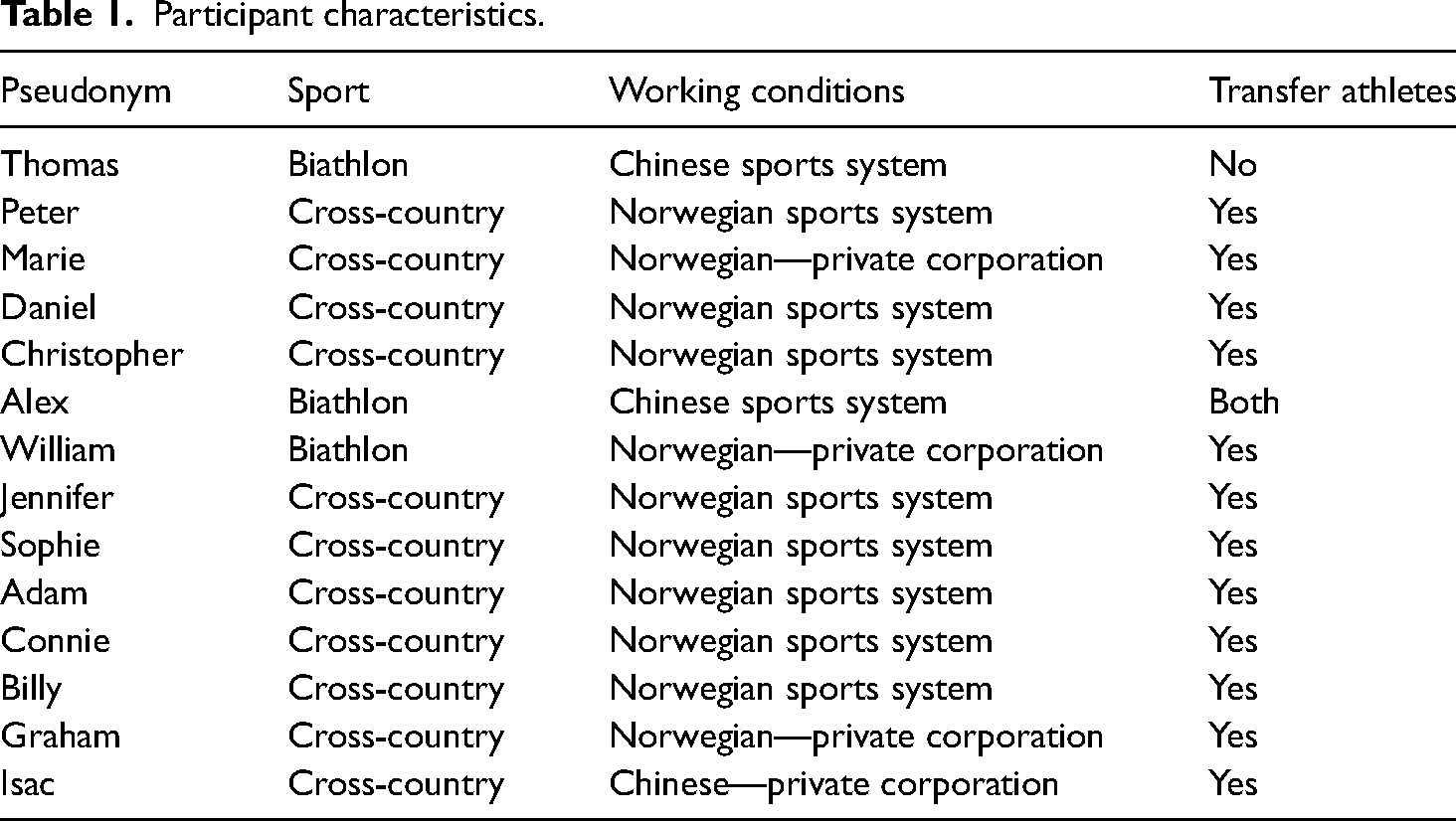
The Norway–China winter sports collaboration was organized in subprojects at various locations in Norway. In some cases, Norwegian coaches were also sent to China to work there. We aimed to recruit a sample of individuals from a variety of the collaboration's locations in order to obtain insights into a diversity of coaching experiences and working conditions with the Norway–China winter sports collaboration (Table 1). In Table 1, the section transfer athletes indicates whether or not the interviewees were responsible for training Chinese athletes who were forced to transfer from other sports (e.g. from rowing to cross-country skiing) or if they worked with athletes who were already a part of the Chinese national winter sports teams. For Alex, this column reads “both” because he had experiences with both athlete groups during the collaboration (see Table 1).
We conducted semistructured interviews and developed the interview guide around five key topics related to their experiences with being part of a sports collaboration characterized by political and cultural tensions: (1) the interviewees’ way into the project, (2) philosophies and pedagogies of sports coaching, (3) athlete–coach relationships, (4) ethical and political issues, and (5) reactions from others to the Norway–China sports collaboration and their participation. The informants have busy travel schedules and are geographically dispersed. All but one interview was conducted digitally on the video call service Zoom, with the researchers and research participants interacting in a conversation guided by prepared open-ended questions. As argued by Salmons (2021), this approach allows digital interview situations to become as close as possible to physical face-to-face interaction with participants. Both authors participated in the interviews.
The interviews lasted between 1 and 2 hours and were conducted in Norwegian. They were recorded and transcribed in full, and all quotes presented in the article have been translated into English by the authors. The interviews were conducted during the fall of 2022 and winter of 2023. Participants provided active consent upon being informed of the study's purpose and their right to withdraw in writing and orally.
Analytical approach
Inductive and reflexive thematic analysis (Braun et al., 2012) was used as an analytic approach by (nonlinearly) following six phases: (1) familiarizing with data, (2) initial coding, (3) searching for themes, (4) reviewing potential themes, (5) defining and naming themes, and (6) writing the report. We drew on this analytical framework to allow a “reflective and thoughtful engagement” (Braun and Clarke, 2019: 594) with the data in understanding the coaches and leaders’ experiences navigating coach–athlete rapports within tense political relations. Both authors were involved in the analytic process, allowing a collaborative, thoughtful, and reflexive approach that developed a richer and more nuanced data reading (Braun and Clarke, 2019). This was particularly central given the differences in the two authors’ research profiles. Tjønndal's research profile is within sociology of sport, while Haugen's research profile is situated in China studies.
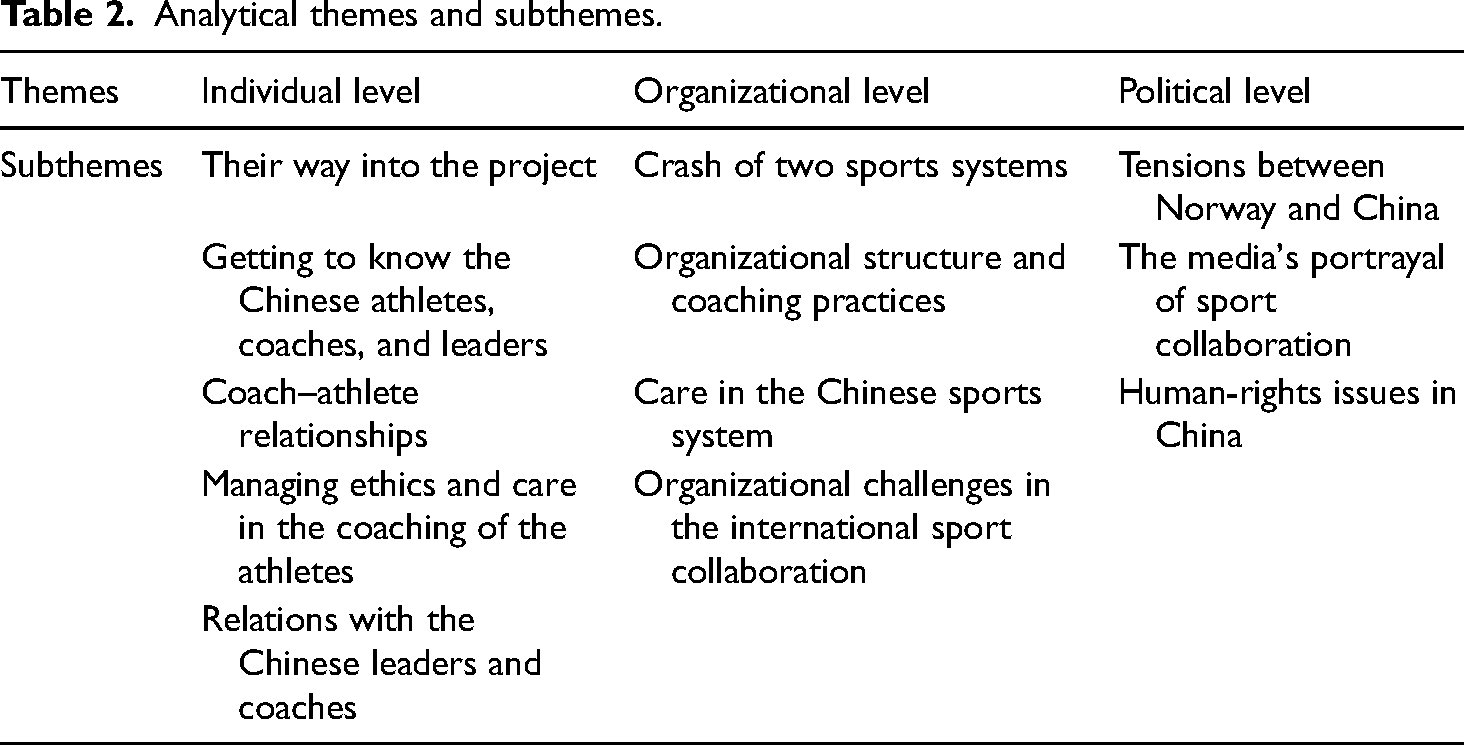
The participants discussed their experiences at three levels: the individual, the organizational, and the political. These levels, therefore, became our initial themes. These are presented below in Table 2.
Analytical themes and subthemes.
Findings
To examine how the coaches navigated being part of an international sports collaboration characterized by political and cultural tensions, we start by presenting the coaches’ first meeting and impression of the Chinese athletes and their initial work to establish and build coach–athlete relationships. The second part of the analysis focuses on the structural differences in the organization of elite sports in China and Norway. The third and fourth parts are centered around the topic of care as a strategy and resource in the coaches’ work as part of a sports collaboration characterized by tensions.
Developing coach–athlete relationships
The coaches described how most of the Chinese athletes who were sent to Norway during the collaboration were transfer athletes with backgrounds in other sports and with little or no knowledge of biathlon and cross-country skiing: They were part of transfer teams. So they had backgrounds from other sports, some from running, some from football, and some rowers and kayak paddlers, and even a javelin thrower who was with us. There were many different backgrounds involved here. (William) I heard that they had never seen snow before and had never been skiing, (Marie) Many of them had never seen cross-country skiing on TV. They didn't know what cross-country skiing was. (Peter)
While many coaches thought it was “impossible” for the Chinese transfer athletes to become Olympic winter sports medalists during the collaboration, the participants also expressed curiosity about what the project could achieve. The coaches wanted to “find out just how good the athletes would become.” Starting from scratch by explaining the basic principles of cross-country and biathlon represents a unique starting point for developing the coach–athlete relationships between Norwegian coaches and Chinese athletes. Furthermore, we found that participants’ experiences of developing relationships with Chinese athletes were strongly influenced by cultural barriers and by the differences between the Norwegian and Chinese sports systems. A dominant theme from the data was issues with communication and the insecurities of not knowing if the athletes felt free to express what they wanted to: You can't sit down and have a one-on-one conversation with the athlete when there's an interpreter there translating everything. Also, I don't really know if the athlete is saying what they mean or if they're afraid of saying something wrong. (Jennifer)
While previous studies of coach and athlete migration and international collaborations do highlight the lack of common language as a barrier to cross-cultural coach–athlete relationships (Botelho and Agergaard, 2011; Elliott, 2012), Borges et al. (2015) argue that commonality in sports culture is more critical for successful international collaboration than a common mother-tongue.
In the early stages of the collaboration, the lack of agency among the Chinese athletes, as Jennifer points out, became clear to the Norwegian coaches, leading to some of the participants feeling unease with their collaboration with the Chinese sports system: These athletes, they were just selected, they were supposed to come here and ski. (Christopher) So, we did what we could for their sake. I worked for the benefit of the athletes, not the Chinese system or the Chinese leaders. (Connie) We did the only thing we could do for them: we treated them well. (Billy)
Connie and Billy's emphasis on working for the athletes and their focus on treating them well represents the turmoil many Norwegian coaches navigated during the collaboration with China. Such turmoil developed due to the political tensions that had motivated Norway's coaching collaboration with China and the cultural and organizational differences between the two sports systems.
Organizational and cultural crash of sports systems
Cultural background and organizational culture greatly influence coaches’ leadership (Borges et al., 2015; Stodter and Cushion, 2014). Relatedly, organizational structure influenced the extent to which the Norwegian coaches felt they had agency to employ their personal leadership styles and coaching strategies. For many of them, the Chinese sports leaders’ skepticism of Norwegian approaches to organizing sports and coaching was frustrating: The Chinese system is different, you cannot depend on a trust-based training regime, like we do in Norway, in a country without trust. The biggest challenge was the Chinese leaders’ constant skepticism of everything we did. There were so many struggles with them during the project. There was a lot of frustration along the way. (Graham)
This “constant skepticism,” as Graham describes it, is likely due to the many cultural and practical differences between the Norwegian and the Chinese sports systems, as outlined by the participants. William, Adam, and Daniel explain that these differences are related to the intensity of training regimes, the pedagogical approach to sports coaching, and the role of science in sports coaching: Ninety percent low intensity and 10 percent high intensity, that's sort of the standard in Norwegian sports. In Chinese sports, it seems to be the higher intensity, the better. (William) The Chinese coaches approach coaching as some kind of witchcraft. They do not believe that sports performance is a science. (Daniel) A Chinese athlete is trained, while a Norwegian athlete is taught to train themselves. The coach contributes to the athlete's development. Whereas it's almost the opposite in China, the athlete exists for the benefit of the coach. (Adam)
The Chinese coaches’ and leaders’ skepticism of the Norwegian approach to coaching resonates with the findings of Borges et al. (2022), who describe that foreign coaches are often viewed as disloyal while facing higher expectations than local coaches.
Regarding the hierarchy between coach and athlete, a dominant theme in the interviews was the different approaches to individualism, care, and a holistic view of athletes’ wellbeing in Norwegian and Chinese sports: For me, it has been very important to be a person who cares and thinks about more than just training and results. I think equally as much about the fact that the athletes, they are people; they should be well and enjoy what they do. (Peter) They objectify the athlete. I don't have another word for it. When the athlete wins, it's the Chinese system that wins; it's not the individual. (Alex)
Similar findings have been made in a study of a Polish–Chinese table tennis collaboration (Lenartowicz, 2022), where Chinese athletes coached by Polish coaches were surprised by what they described as a more relaxed coaching style. In Lenartowicz's (2022) study, there were also reported differences in the Chinese and Polish approaches to the quantity and intensity of training, as William describes above.
Thomas and Isac both had experiences working within the Chinese sports system, and their interviews described how they felt that the Norwegian approach to sports coaching was not transferable to China because of the cultural differences: I think one of the reasons many failed in China was that they chose a Norwegian model, a kind of naive idea that we are all the same. (Thomas) I don't believe the Norwegian sports model works in large parts of the world. You must be open to adaptation and understand that a Chinese or anyone else has a different view of the world and a different mindset. To succeed, the Norwegian model must be adapted. If you don't do that, it's kind of arrogant, and we tend to be a bit morally arrogant around the world, thinking that everyone thinks like us. (Isac)
All the coaches we interviewed described the Chinese sports system as significantly more hierarchical than the Norwegian system. In this sense, our findings support those of Borges et al. (2022) in pointing to a need for cultural training for coaches who work in international collaborations such as this one.
Many participants questioned the competence and suitability of the political leaders of Chinese sports organizations, especially given that these leaders had the power to influence day-to-day coaching practices. The coaches described this as the drawback of a system that does not value bottom-up consultations and democratic leadership but allows leaders who are removed from the sports to make decisions. Several times, there was a new leader—and it might as well be a career politician as someone with knowledge about sports—who had an idea about what training is smart, and then you get told that ‘this is what you have to do because this is what the boss believes in’. (Graham)
The Chinese system contains leaders upon leaders upon leaders, and the coaches who came along at our trainings had no knowledge. So they just told us that ‘we’ll do what you say’ […] They received directives all the time from China, and we could only despair when these didn’t fit our plan. So, in a way, I had a very good relationship with the leaders sent to us. (Christopher)
Others viewed the Chinese sports bureaucracy as a hindrance: If we could work with the athletes alone without any influence from Chinese leaders, things would have gone much better. (Jennifer)
While cultural differences were described as significant in the Norway–China cooperation, they were far from insurmountable. Once the athletes got used to them, the collaboration was good; it was the system around that was the problem. As Christopher and Jennifer highlight, it was not the Chinese athletes or the coaches working with them that created tensions, but the directives from China, the “career politicians,” and “leaders higher up” in the system. In this way, our study modifies conclusions from other literature (Lenartowicz, 2022), indicating that the sports systems and organizational cultures may pose greater obstacles than the coaching styles.
Previously, Wang and Calloway (2011) have described how foreign coaches working with Chinese athletes need to understand and acknowledge the Chinese way of organizing sports to succeed. In particular, they highlight the need to understand the political system in China and find that foreign coaches often underestimate the importance of building relationships with Chinese administrative staff. Graham's description of the Chinese sports politicians as overly meddling and Thomas' statement that “the reasons many failed in China was that they chose a Norwegian model” can be interpreted in support of Wang and Calloway's (2011) findings. However, some participants felt that the Norwegian sports system was marked by similar camaraderie in positions of importance: We know that if you move up in the Norwegian system a bit, it's all about brown-nosing to get the right positions. It's camaraderie; it has always been like that. In this sense, the Chinese system is not worse than the Norwegian sports system; it's just different. (Alex)
Care as strategy and resource
In the Norwegian–Chinese winter sports collaboration, a caring approach to coaching became important for the Norwegian coaches as they were familiarized with the darker sides of the Chinese sports system's treatment of athletes. During the interviews, Peter and Marie described some of the harsher realities of the life of the Chinese transfer athletes: They live in boarding schools and spend all their time at training camps. They don't see family and friends. Just taking them away from their families and relocating them to the other side of the world, without them knowing when they get to go back home. It's a kind of psychological terror. A lot of the young ones they had homesickness and were sad, they were not doing well mentally. (Peter) Some of the athletes had not been in school since they were 12 years old. (Marie)
Alex adds to this in his interview by describing the Chinese sports system as a “use and discard kind of mentality”: Chinese athletes are treated as things, objects. It's a use-and-discard kind of mentality. If the athlete is not good enough, you throw them out. (Alex)
The treatment of the Chinese athletes, as described by Peter, Marie, and Alex, may be understood as an expression of traditional perspectives on sports coaching and coach–athlete relationships, where sporting performances are prioritized at the cost of health and wellbeing (Augestad and Hemmestad, 2023; Kuhlin et al., 2020). Within such sports coaching perspectives, pedagogical approaches to coaching are often authoritarian, and power structures between coach and athlete are hierarchical (Hovden and Tjønndal, 2019).
Faced with what many Norwegian coaches felt was unethical treatment of athletes, employing care for the Chinese athletes’ wellbeing became important to the participants. Focusing on care in their coaching approaches was expressed in many ways. Jennifer and Connie explain their approaches to care: I spent my weekends knitting headbands for them so that they would have something to wear when they got cold. I wanted to do what I could for them, I felt empathy and responsibility for them. (Jennifer) We focused on being positive, smiling, showing that we cared about them, asking how they were. The Chinese athletes thought this was strange at first. (Connie)
The actions of Jennifer and Connie signify a focus on sustainable coaching and sustainable athlete development, as described by Dohlsten et al. (2020a, 2020b). By asking the Chinese athletes how they feel and by spending time crafting warm clothes for them, Jennifer and Connie enact a holistic coaching philosophy that centers around care and works to maintain athletes’ physical and mental health. However, in the interviews, it was also clear that women coaches articulated enacting care in their interactions with the Chinese athletes more frequently than men. This may point to a gendered division of labor between the Norwegian coaches, where women are expected to provide care in addition to sound coaching. Such gender dynamics have been documented in previous studies of sports coaching in Norway (Augestad and Hemmestad, 2023; Hovden and Tjønndal, 2019). Hence, a critical interpretation of Jennifer and Connie's quotes could be that it is not coincidental that it is the women in our sample who bring up the most straightforward examples of enacting care in sports coaching.
From our data, it is apparent that the Norwegian coaches did not only employ care as a resource in their approach to coaching the Chinese athletes. Care also became a strategy in managing expectations from the Chinese sports system that the Norwegian coaches felt were wrong, counter-productive, or unethical. William describes two situations like this: Out of nowhere, we were demanded to increase the number of daily training sessions. It didn't matter much what the content was. So, for example, we tricked the system by adding 15–20 minutes of yoga in the morning as a ‘session’. Then we had the first session as usual after breakfast. We also had something we called ‘improve your weakness’. If someone, for instance, had poor coordination, they did coordination exercises. If someone needed to stretch, they stretched. But we had to somehow sneak in two extra “sessions” that were essentially just fillers, without any significant benefit. (William) One time, we were told that the athletes needed to run an eight-kilometer test race in Norway. It didn't matter how, but we were going to run an eight-kilometer test race. It didn’t fit with our plans and seemed stupid, so we just had the race in a stadium, so the athletes ran in laps there, as fast as possible, with the best conditions possible. (William)
William's approach to managing expectations from the Chinese sports system showcases an approach to sports coaching that emphasizes personal and health-related development equally to that of sporting performances (Dohlsten et al., 2020b). William's actions may also express a coaching practice where care is considered crucial for the athletes’ ability to perform (Augestad and Hemmestad, 2023). As William puts it, the extra sessions were “without any significant benefit.”
As time progressed in the collaboration, the participants also realized that the Chinese coaches and leaders had similar care strategies to manage the expectations of the Chinese sports system. For instance, Billy described how Chinese coaches would conceal under-performance among older athletes if they were close to fulfilling the requirements for receiving a state pension as retired athletes in China: It was important for the Chinese coaches to keep them in the program until they reached a certain age because they would receive a state pension for the rest of their lives. The Chinese coaches had consideration for the older athletes, asking us to keep them in the program a little bit longer. They saw that they wouldn't become good skiers, but they really wanted them to somehow receive their pension. (Billy)
Augestad and Hemmestad (2023) argue that care in sports coaching requires the coach to violate the inherent asymmetry between the coach and the athletes in coach–athlete relationships. However, that may not be possible in a system such as the Chinese sports model. Therefore, the care that Billy describes that Chinese leaders employ by keeping aging athletes in the project, illustrates how care is expressed in a system characterized by strict power hierarchies and authoritative sports coaching pedagogies. More broadly, the sports system provides institutionalized care by providing the athletes with some financial security. The coaches recognized that many Chinese elite athletes came from underprivileged rural backgrounds, where food, shelter, and a basic income went a long way in meeting their expectations. They had good living conditions here in Norway. There are probably many who have never lived as well as they did while they were part of the collaboration. They got food, they got clothes, they were really taken care of. (Connie)
The system allowed them to transfer into clerical or coaching positions after their careers as athletes ended. Several coaches contrasted this with the Norwegian system, where athletes who got injured, pregnant, or aged out of sports were abandoned by the system. In Norway, they pointed out that young talents without financial and practical assistance from their parents dropped out easily. At the same time, the Chinese system that provided comprehensive care for school-aged athletes allowed them to reach their potential. Institutionalized care was necessary, but not sufficient for the Chinese athletes to thrive. As we will see next, the Norwegian coaches regarded the athletes as dependent on their personally engaged care to succeed. For some, this became a justification for them to continue the coaching.
Bracketing the sport-politics discussion with “care”
In our material, we noticed how the participants often used care to legitimize their involvement in the collaboration. During the interviews, this happened in two ways: (1) as a reaction to being faced with the darker sides of the Chinese sports system and (2) the realization that the winter sports collaboration played a vital role in softening the political tensions between Norway and China.
The collaboration with China and the Norwegian government's use of sports to soften political tensions received much media attention in Norway. Some participants expressed that they had received backlash from other Norwegians for their involvement in the collaboration. In these cases, the coaches would also use care for the Chinese athletes to legitimize their involvement: I received some Amnesty-type questions, about helping China in terms of human rights and ‘does it feel right’ and such things, but I might actually turn that around, I might be able to make a difference for those athletes. (Marie) If I personally had declined to be a part of this project, I don't think it would have positively impacted human rights in China. I believe the opposite, that instead of excluding them, it's better to invite them here so they can see Norwegian culture, Norwegian values, and what we stand for and represent. (Adam) I can't save the world, but I can contribute to influencing each individual athlete and person I meet. (Alex)
Previous studies on China's engagement in sports collaborations with other nations have not examined how political tension in bilateral relations impact coach–athlete relations in these collaborations. While we have limited literature to contrast our data on this topic, we believe that external tensions, as Marie and Adam described, are likely to occur in other international sports collaborations, given the plethora of national interests and geopolitical tensions impacting sports today. Furthermore, our data shows how the coaches respond differently to these external tensions. Some coaches did not feel the need to legitimize their involvement in the collaboration. Instead, they expressed resistance to the notion that Norwegian sports are independent and apolitical, like Daniel: To say that sports aren't political and not propaganda here in Norway, that's just nonsense (Daniel)
Or, they saw the collaboration in a more pragmatic view, like Peter or Sophie. I thought it seemed like, at least initially, a bit of a win-win situation. We were allowed to sell more fish, export Norwegian culture, bring in a lot of money into our sport that kind of needs some growth internationally. Maybe it's a bit cowardly of us not to take a clearer stance on all the issues that are being unraveled in China, but at the same time, we don't unravel everything that happens in other countries with which we have a sports collaboration. (Peter) I did not have enough information before I jumped into this. I was probably a bit naive in that sense. (Sophie)
Overall, this part of our data shows how the coaches respond differently to the political tensions surrounding the collaboration. Still, most of the coaches we interviewed bracket the sports-politics discussion through the idea of care (Augestad and Hemmestad, 2023; Dohlsten et al., 2020a). Focusing on the individual athletes in their care, questions concerning human-rights issues in China, the use of Norwegian sports organizations as political pawns and other contentious political issues become irrelevant. We interpret this as a rhetoric of legitimization, where “doing what's right” becomes synonymous with “taking care of the Chinese athletes.” In turn, this implies continued participation in the collaboration on the coaches’ part, which requires overlooking external criticisms and political tensions that characterize the sports collaboration. Therefore, this study reveals a nuanced dynamic where prioritizing athlete welfare is not only a coaching philosophy (Dohlsten et al., 2020a; Skille et al., 2020), but also serves as both a shield and a justification for the coaches, effectively sidelining broader ethical and political considerations in the Norway–China winter sports collaboration.
Conclusion
This article has explored the complex interplay of care, politics, and coaching in the Norway–China winter sports collaboration. Central to our findings is the notion of care as a multifaceted concept in sports coaching. Norwegian coaches, navigating cultural, ethical, and political tensions, predominantly anchored their coaching philosophy in care for their athletes. This approach served as a strategy for athlete welfare and a shield against politically motivated critique and ethical dilemmas.
Our research highlights the intricacies of international sports collaborations, particularly within politically charged environments. The commitment of Norwegian coaches to prioritize athlete welfare, while commendable, also enabled them to sideline broader political and ethical considerations. This finding underscores the complexity of international sports collaborations, where coaches must balance athlete care with the realities of political and organizational dynamics. Furthermore, our study sheds light on the contrast between Norwegian and Chinese sports systems, illustrating how cultural understandings of coaching and athlete management can vary significantly. The Norwegian coaches’ focus on individual athlete development and wellbeing, often at odds with the more results-focused Chinese approach, necessitated a flexible and adaptive coaching style.
We hope that this study furthers scholarly interest in the experiences with transnational and transcultural coaching relationships from the perspective of participating athletes, in China and elsewhere. Studies that combine the perspectives of coaches and athletes within the context of specific collaborations enable comparisons that the current study does not provide. Studies of actors in different positions and from different backgrounds lend themselves particularly well to international research collaboration. This can present exciting opportunities for theoretical as well as empirical comparisons in sociology of sport and sport management.
Experiences from Norway–China winter sports collaboration underscores the need for a nuanced understanding of the role of care in sports coaching, especially within international collaborations that intertwine with broader cultural, political, and ethical narratives. The implications of this research extend beyond the specifics of our case study. It prompts a broader consideration of how nations engaging in international sports collaborations might better navigate the complex interplay of politics, ethics, and coaching philosophies. Future research could explore similar collaborations in different political and bureaucratic contexts, furthering our understanding of the role of politics in shaping the global sports landscape.
Footnotes
Declaration of conflicting interests
The authors declared no potential conflicts of interest with respect to the research, authorship, and/or publication of this article.
Funding
The authors disclosed receipt of the following financial support for the research, authorship, and/or publication of this article: This project has received funding from the European Research Council (ERC) under the European Union’s Horizon 2020 research and innovation programme (grant agreement No 802070).
