



Abstract
Within this article, we draw upon Kezar and Lester's three components of positionality theory to explore how multiple and overlapping aspects of esports leaders’ identities influence their experiences and perceptions of working within esports organisations. We present findings collected through interviews with 11 leaders from nine Scandinavian esports organisations. Our findings show that the experiences of the esports leaders are strongly gendered. For example, all four women informants reported experiences of discrimination and marginalisation, whilst none of the men informants described incidents of this nature. The positionality of the women influenced the varied nature and extent to which they experienced discrimination and marginalisation, as well as their experiences of agency to resist and transform these practices. Meanwhile, the positionalities of both women and men influenced their recognition of privilege and the value they placed on inclusion and diversity. Furthermore, the gendered experiences of individual leaders were influenced by the specific esports context within which they work, including wider issues of discrimination and marginalisation across the esports community. Overall, our findings demonstrate that future strategies to make esports more gender inclusive need to appreciate how positionality influences the power that individuals have to access and influence esports organisations.
The emergence of esports has resulted in the creation of new sport organisations at the local, national, and international levels. While extensive research and knowledge exists on gender inclusion in the leadership of traditional sport organisations (Adriaanse and Claringbould, 2016; Hovden, 2000; Piggott and Pike, 2020; Theberge, 1984), little is known about gender and leadership in esports organisations. From decades of research in sociology of sport, it is evident that the leadership and governance of traditional sport organisations are gender-imbalanced and gender-inequitable at all levels across the world (Elling et al., 2019; Evans and Pfister, 2021). An increasing body of research is also exploring the intersectional experiences of women sport leaders and has found that women experience unique challenges based on their intersecting identities (Hanlon and Taylor, 2022; McDowell and Carter-Francique, 2017; Palmer and Masters, 2010; Robertson et al., 2019; Simpkins et al., 2022; Walker and Melton, 2015). Within this article, we draw on positionality theory to understand how gender intersects and overlaps with other aspects of esports leaders’ identities to impact their privileged and/or marginalised perceptions and experiences of working in the sector.
Esports organisations make an interesting case for the expansion of research on gender inclusion in sport organisations. These organisations are, in most cases, novel and formed of a young demographic of employees and volunteers. It could be assumed that such youthfulness, in terms of organisations, their members, and employees, should have a positive impact on gender equity and inclusion within esports organisations compared to traditional sport organisations. Additionally, esports performances depend less on physical abilities related to strength and endurance, and more on skills related to reaction speed, dexterity, strategic thinking, and the ability to focus on the task at hand over long periods of time. This has led many practitioners to argue that esports holds great potential to provide gender-inclusive sporting spaces for athletes and coaches (Piggott et al., 2022). However, game studies have shown how both the technology industry behind gaming (Bailey et al., 2021; Robnett and John, 2020) and the virtual spaces of online gaming themselves (Choi et al., 2020; Darvin et al., 2021) are plagued by harassment and marginalisation of women. Recent studies of women in esports also indicate that these sporting spaces often include condescending and sexist behaviour towards women athletes (Rogstad, 2022; Ruvalcaba et al., 2018).
In both game studies and esports research, most scholarly work has focused on gender inequality and the harassment of women players, while few studies have examined gender inclusion in the leadership of esports organisations. By focusing on gender, positionality, and inclusion in esports leadership, this article expands sociological research on gender equity in sport organisations by investigating a new context and novel type of sport organisation. The article also contributes to the advancement of research on gender in esports by focusing on managers and leaders rather than players/athletes. Against this backdrop, the following research question is examined: How does the positionality of esports leaders influence their experiences and perceptions of working within esports organisations? To explore this, we analyse qualitative interviews with employed and elected men and women leaders in esports organisations in Scandinavia. Theoretically, we draw on Kezar and Lester's (2010) three components of positionality theory. This offers a new theoretical contribution to existing literature in the field by (1) considering not only social characteristics (e.g. gender, race, social class, sexual orientation) but also professional status and role, (2) exploring the experiences and perceptions of those with both marginalised and/or privileged positionalities, and (3) understanding how these positionalities not only influence experiences of discrimination and marginalisation, but also agency. This differs to existing intersectional research that has tended to focus solely on the perspectives of people or groups with multiple marginalised social identities (e.g. Hanlon and Taylor, 2022; McDowell and Carter-Francique, 2017; Palmer and Masters, 2010; Simpkins et al., 2022). The article continues with an outlining of previous research on the experiences of women in esports, as well as gender and esports leadership.
Previous research
Esports research is multidisciplinary and encompasses topics related to sport psychology, sport management, law, technology, and sociology (McLeod et al., 2022; Tjønndal, 2022). Research on the topic of gender and esports is the most relevant literature to explore in line with the research question posed in this article. Within gender and esports research, we highlight findings that focus on two themes: (a) the experiences of women in esports, and (b) gender inclusion and esports leadership.
Experiences of women in esports
Esports is male-dominated and the participation of women in professional competitions is scarce. This is related to the cultures of many popular, longstanding games, which are heavily masculinised (Witkowski, 2018). For instance, Taylor et al. (2009) show how the roles made available for women participating in esports traditionally have been limited, with mothers of gamers being depicted as “cheerleaders”, women esports players labelled as “halo hoes”, and promotional models for games being known as “booth babes”. The marginalisation of women in esports is also linked to longstanding gender disparities in ICT professions (Sigurðardóttir, 2020), which have contributed to social perceptions that computing related activities, such as gaming, are masculine practices that are most suitable for men.
The number of women participating in esports is slowly rising, with more women proving themselves to be highly capable athletes (Cullen, 2018). Still, many gendered issues remain. For instance, it has been found that women face different expectations and feedback from competitors and audiences compared with male gamers (Kuznekoff and Rose, 2013). This includes the use of sexist language and general hostility towards women. Previous studies indicate that the combination of anonymity, lack of direct repercussions, high frequency of banter, and a competitive gaming culture bolsters hostile and violent behaviour (Rogstad, 2022; Ruvalcaba et al., 2018). For example, Ruvalcaba et al. (2018) found that women players were 1.82 times more likely to receive sexual remarks compared to men players. Examining audience reactions to men's and women's voices in esports, Kuznekoff and Rose (2013) found that women's voices received three times more negative comments than a man's voice. It has been suggested that discriminatory behaviour is enhanced by the application of gender normative roles of playable characters in many games (Lynch et al., 2016).
Women players have utilised various strategies in response to the hostile environment of competitive gaming. A common strategy is known to be hiding their gender from other players, including choosing gender-neutral gamertags and not using microphone features, or using a voice changer for conversation (Arneberg and Hegna, 2018). However, revealing one's gender is unavoidable at a professional level, which might be an explanatory factor for the low participation of women in professional esports competitions. Women are also often marginalised in terms of their access to communities through which they might develop esports skills and networks, such as gaming, coding, and computer science (Voorhees and Orlando, 2018).
Gender inclusion and esports leadership
Women are, with increasing frequency, participating in esports as team managers, event and community organisers, and other leadership roles. With most current research on gender and esports focusing on esports athletes, research on gender inclusion in esports leadership is limited. There are only a few empirical investigations on this topic, including the works of Piggott et al. (2022), Darvin et al. (2021), and Taylor and Stout (2020).
Darvin et al. (2021) interviewed women players and managers from the USA, Canada, and England. The sample included women working in the esports industry as professional esports players, executives, and content creators. Their study examined the career experiences of women players and leaders in esports and the general underrepresentation of women in the esports industry. Based on their analysis, they highlight three findings: that the esports industry was hostile towards women and plagued by blatant sexism, that women employed in the esports industry faced numerous barriers and obstacles, and finally, that women experienced toxic masculinity and adopted survival skills (e.g. grit and resilience) to promote gender equity in the esports industry. The findings of Darvin et al. (2021: 484) illustrate that women who make it into leadership positions in esports organisations have broken through a “seemingly impenetrable barrier sustained through normalised male-dominance”. Therefore, this research showed how women esports leaders can experience the same types of sexist harassment as women esports players.
Similarly, Taylor and Stout (2020) conducted a study in which they interviewed collegiate esports leaders from the USA and Canada. Their study showed that there was greater gender inclusion in leadership in student-run esports clubs, while well-funded varsity programmes remained male-dominated. Specifically, Taylor and Stout (2020) reported few indications of attempts to proactively promote gender inclusion in participation and management, both in student-run clubs and in varsity programs. Yet, the informal nature of student-run clubs appeared to have a more gender-inclusive atmosphere than among varsity programs, even when no explicit efforts at inclusivity were in place among club leadership. Taylor and Stout (2020) demonstrate that this is likely due to the efforts of women esports players recruiting their women friends into the student-run clubs. Recruitment in varsity programmes on the other hand is much more formalised, and therefore more dependent on active efforts to ensure gender inclusion. Furthermore, a main finding from Taylor and Stout's (2020) study is that efforts to improve conditions for the recruitment and retention of women in esports (both as players and in managerial roles) were few and far between.
In this article, we build on Piggott et al.'s (2022) study exploring how organisational structures, processes, and practices influence the gendering of power in leadership and governance positions across nine Norwegian esports organisations. Through qualitative interviews, Piggott et al. (2022) found that there was a minimal representation of women across all roles and levels within the organisations, but particularly within roles that hold the highest prestige such as managers and coaches. Additionally, they identified how informal recruitment processes dominate Norwegian esports organisations and favour the advancement of men. Furthermore, they observed a lack of visibility and legitimacy of gender inequality as an issue that needs to be addressed within esports organisations. In this study, we expand on this work by analysing how the intersectional identities of individual esports leaders impact their experiences and perceptions of working in the esports sector.
Positionality theory
Existing research on gender inclusion in sport leadership and governance is predominantly characterised by one-dimensional perspectives that position gender as the single most significant form of social inequality. Such perspectives are essentialist through their privileging of certain aspects of identity and failure to explore the different conditions (e.g. race/ethnicity, social class, role within the organisation, and level of decision-making power/influence) that affect leaders’ gendered perceptions, experiences, and beliefs. There are some notable exceptions, with a small number of researchers exploring how various identities and conditions work together to produce unique inequalities for some women sport leaders (e.g. Hanlon and Taylor, 2022; Melton and Bryant, 2017; Palmer and Masters, 2010; Robertson et al., 2019; Simpkins et al., 2022; Walker and Melton, 2015).
We apply positionality theory to examine how multiple and overlapping aspects of esports leaders’ identities impact their perceptions and experiences of working within esports organisations. It is important to note that we distinguish positionality theory from intersectionality theory due to the former's focus not only on how individual identities are constructed and can lead to oppression, but also how these identities shape the way we see and construct the social world, including opportunities for agency (Kezar and Lester, 2010). Positionality theory was first developed during the late 1980s and early 1990s as an advancement of Sandra Harding's (1991) standpoint theory, yet does not privilege any particular standpoint. Instead, the identification of multiple perspectives is seen as significant to developing a more complete understanding of social phenomena (Kezar and Lester, 2010). Kezar and Lester (2010) highlight three main components of positionality theory: (1) intersecting identities, (2) power relations, and (3) context. We will discuss each of these components in turn and highlight how they are applied in our analysis.
Intersecting identities refer to postmodernist challenges to traditional notions of identity being static and singular. Within positionality theory, it is assumed that people have multiple, overlapping identities and construct meaning from various aspects of their identity (Kezar and Lester, 2010). Notably, such aspects of identity are not limited to gender, social class, race, or sexuality, as has often been the focus of intersectional theorists, but also other features such as professional status or role (Longino, 1993). Within the context of our study, our sample is formed of individuals occupying multiple and varied social identities (e.g. social class, gender, ethnicity, sexual orientation) but also different roles and positions (e.g. co-owner, co-founder, CEO, Board Member, coaching manager). We aim to understand how the different identities of our participants influenced their perceptions, experiences, and actions within their organisation and the broader esports sector.
Within positionality theory, power relations are characterised as pervading all contexts, historical situations, and interpersonal relationships. Power is central to the way people make meaning and shape perceptions of the social world and is socially constructed between people (Kezar and Lester, 2010). This means that “the positionality of the individual is also laden with power, and all people in all positions can access some form of power” (Kezar and Lester, 2010: 167). Importantly, positionality theory assumes that power relations can be altered when socially constructed norms and ideologies are examined (Kezar and Lester, 2010). This means that “the positionality model incorporates agency, and that people are not merely responding to context and power, but that they actively shape the conditions within which they work, think, and live” (Kezar and Lester, 2010: 168). Within this article, we examine how the positionality of leaders within esports organisations influences the extent to which they experience power and subordination in different forms and contexts. In doing so, we explore the agency of different individuals in their responses to discrimination, subordination, or challenges.
Context is an important element of positionality theory to understand individuals’ perspectives within particular social settings. The positionality of an individual in one context may be different or valued differently to another context. For example, a CEO of an esports organisation might hold authority and power at work, but experience subordination within their family setting. Context, then, is defined as “the circumstances and conditions in which an individual exists” (Kezar and Lester, 2010: 168). Within our study, the context is Scandinavian esports organisations and their location within the broader esports community. We are, therefore, examining the unique experiences of esports leaders within the context of the shared value systems, rituals, and norms that form esports culture and influence working conditions in esports organisations.
Methods
This research is situated within the constructivist philosophical paradigm and is based on qualitative interviews with esports leaders. In this section, we outline the sample and methodological approach to the research.
Participants
To understand the different ways in which esports leaders experience events, realities, and meanings, we conducted qualitative interviews with 11 leaders (seven men and four women) from nine different Scandinavian esports organisations between October and December 2021. We selected participants based on the criteria that the sample should: (1) represent esports organisations located at different levels (regional/local, national, and professional), (2) represent esports organisations engaged in different game genres (sports video games (SVGs), multiplayer online battle arenas (MOBAs), strategy games, and shooters), and (3) include both men and women leaders. We recruited participants by contacting 10 of the top esports organisations in Scandinavia, of which elected and employed leaders from nine organisations agreed to be interviewed. One organisation never replied to our invitation to participate in the study. To gain access we emailed the participants directly, through the contact information provided on the organisations’ websites. Over the course of our interviews, we identified one additional key informant (Eva) with diverse leadership experience from multiple organisations. We contacted her through social media, and she agreed to participate in the study.
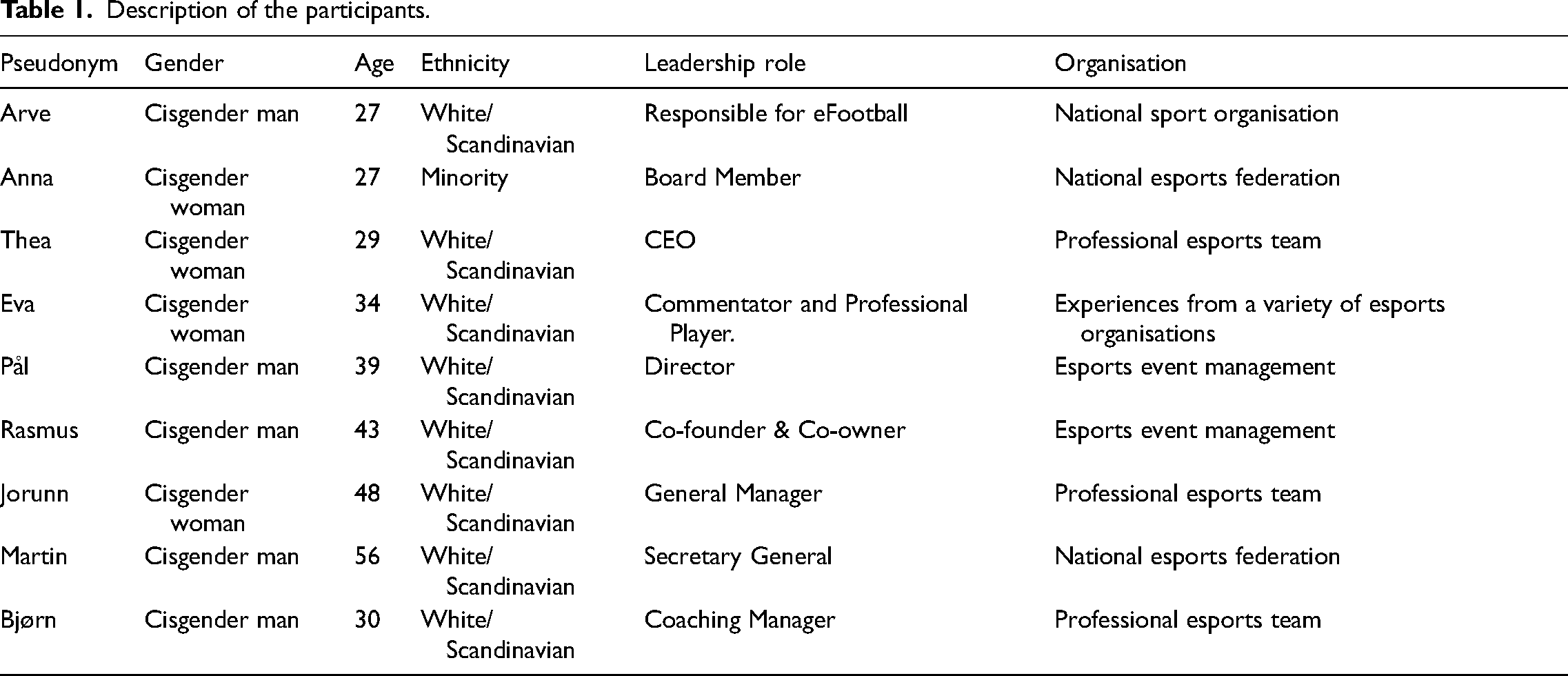
The characteristics of the participants are summarised below in Table 1. All the participants have been given pseudonyms to protect their identities and the specific national locations of the participants have been removed to further maintain anonymity.
Description of the participants.
The study was approved by the Norwegian Centre for Research Data. All participants provided active consent and were informed of their right to withdraw from the study at any time.
The interviews
We conducted semi-structured interviews and developed the interview guide around four key topics related to gender inclusion in esports leadership: (1) the interviewees’ background and experiences with esports, (2) the recruitment and selection processes for their current leadership positions, (3) daily tasks, responsibilities, and experiences in their current leadership positions, and (4) the aspirations and ambitions of the interviewees and their organisations. Due to strict COVID-19 rules and travel restrictions at the time of research, all the interviews were conducted digitally. We conducted our interviews synchronously (researcher and interviewee online simultaneously) to create a face-to-face interview situation, using the video call service Zoom. As argued by Salmons (2021), this approach allows digital interview situations to become as close as possible to physical face-to-face conversations with participants. The interviews lasted between one and two hours and were conducted in Scandinavian languages. They were recorded and transcribed in full before being translated into English.
Analysis
Inductive thematic analysis was conducted using the qualitative data analysis software Nvivo. Reflexive thematic analysis (Braun et al., 2012) was used as an analytic approach by (non-linearly) following six phases: (1) familiarising yourself with the data, (2) generating initial codes, (3) searching for themes, (4) reviewing potential themes, (5) defining and naming themes, and (6) writing the report. We drew on this analytical framework to allow a ‘reflective and thoughtful engagement’ with the data in understanding how the positionalities of esports leaders intersect with socio-cultural contexts and structural conditions to influence their individual accounts (Braun and Clarke, 2019: 594). Our own positionalities influenced the analysis process. The first author is a white, non-disabled, queer British woman from a lower middle-class background who is working and living in Norway. The first author's interpretation of the data was influenced by her understanding and experience of both privileged and marginalised perspectives, as well as her combined experience and inexperience within the subject area. The second author is a white, non-disabled, straight Norwegian woman from a working-class background. The authors have no previous applied or research experience of esports, but both have substantial experience of researching gender inclusion within sport organisations. Both authors were involved in the analytic process, which allowed a collaborative, thoughtful, and reflexive approach that developed a richer and more nuanced reading of the data (Braun and Clarke, 2019). This was particularly so given the variances in the positionality and research profiles of the two authors.
When becoming familiar with the data, it was clear that interviewees were discussing experiences and perceptions at three different levels: individual, organisational, and sectoral (esports). These levels therefore became our initial ‘top-level’ themes. We then developed sub-themes to further distinguish different shared meanings and experiences at each level. Sub-themes at the individual level included ‘background’, ‘introduction to esports’, ‘election/recruitment into esports’, ‘individual challenges that influence their work’, and ‘individual resistance/coping strategies’. Sub-themes at the organisational level included ‘organisational structure, strategy, processes and practices’, ‘organisational development’, ‘organisational culture’, and ‘organisational challenges’. Finally, sub-themes at the sectoral level included ‘organisation, structure, and governance of esports in Scandinavia’, ‘esports culture’, and ‘strategies to make esports more gender inclusive’. In some instances, a further one or two levels of sub-themes were developed to add further depth to our analysis.
When reviewing and finalising our themes, it became apparent that there were gender differences related to some sub-themes. For instance, women leaders discussed issues related to ‘discrimination, exclusion or marginalisation’, while men rarely talked about these topics. Furthermore, we identified patterns in which women were represented across some of the sub-themes. For example, Anna, a queer woman with a minority ethnic background, was the only woman represented in the sub-theme ‘lacking power, respect or influence’. This combination of gender and intersectional differences in the data led us to draw on positionality theory to explore the phenomenon in more depth. Subsequently, the combination of gendered/intersectional patterns in the data and use of positionality theory informed the three sub-headings that we will present in our analysis: (1) intersecting identities, discrimination, and marginalisation, (2) positionality, power, and coping strategies, and (3) the context of esports organisations. Due to women informants discussing topics or issues related to these themes more frequently and in more depth, we draw more heavily on quotes from women leaders in our analysis.
Findings
Intersecting identities, discrimination, and marginalisation
We found that participants’ perceptions and experiences of being leaders of esports organisations were strongly influenced by their intersecting identities. A dominant theme from the data was discrimination and marginalisation. All four of the women participants experienced sexism whilst working in esports, but this played out in different ways and to different levels of severity, seemingly based on other aspects of their identity. This reflects Kezar and Lester's (2010) assertion that, whilst women have multiple identities and occupy multiple positionalities that result in unique experiences and identities, they also share certain experiences and parts of their identities.
Anna (Board Member) has a minority ethnic background, identifies as queer, and is under the age of 35. She was, by far, the participant who most discussed being a victim of discrimination. She expressed how her intersecting identities led to experiences of marginalisation and exclusion within her organisation: Things are taken negatively when I say it, because I'm younger than everyone else, I'm a woman and I'm a minority. … It becomes a fight against who I am, rather than what I say. In addition, I'm gay, so … it makes it harder for people to listen to me when I share insight that might have actually saved the organisation from a lot of … unpleasant situations.
Anna's experiences of marginalisation appear to be rooted in her position as someone who originates from multiple marginalised groups but operates in an organisation dominated by privileged identities (i.e. white, heterosexual men). This is a position that Puwar (2004) conceptualises as a ‘space invader’ because the entrance of minority women into such spaces disrupts the status quo. This means that ‘outsider’ women such as Anna must navigate their complex identities to develop a ‘feel for the game’ and negotiate insider status. This can become problematic when the rules of the game conflict with the individual's value systems.
The unpleasant situations that Anna refers to include her organisation forming a partnership with a religious organisation that publicly opposed the legalisation of same-sex marriage. She argued that this goes against inclusive values that esports organisations should prioritise. She also explained that she was called ‘hysterical’ for being critical of a press release defending this partnership and said “no one calls women hysterical anymore, who does that?! It's so stupidly backwards”. ‘Hysterical’ is a term that was historically used to describe women who suffered from mental illness, but subsequently became a gendered word to irrationalise the beliefs and behaviours of women (Garg et al., 2018). In Anna's case, the word was used to delegitimise her resistance to the actions of the organisation.
As a queer woman, Anna spoke of the negative emotions and experiences that resulted from the alignment of her organisation with this religious organisation: It doesn't feel very good to sit and listen to these things. It feels very, very painful to be a representative of that organisation … when they go out and support an organisation that is against gay marriage when I, myself, sit here … with a sexuality other than straight.
Anna's experience of peripheralisation was further demonstrated by an example where she and two other Board Members were pigeon-holed into forming a ‘committee for social relations’, which was established because of backlash following the church partnership: The two of us [women] and the guy who stated at the meeting that he has a gay son were put in the committee for social relations. So I feel we who … fit into the stereotype that we care very much about others have ended up there together.
Such a distribution of tasks and roles becomes problematic if those with personal experiences of marginalisation are deemed to be the only ones to bring about change in areas related to social relations. This is particularly so when these individuals are, by their very marginalised nature, typically the individuals that are most deprived of having a voice within (esports) organisations.
In contrast to Anna's encounters, the other three women participants (all white Scandinavians) expressed more positive experiences of working in esports: I think it's just fine [to be a woman in esports], I like to be a unicorn, to be unique. I just think it's fun. (Thea, CEO)
I don't feel any difference, I don't think it would be, depending on whether I was male or female. (Eva, Commentator and Professional Player)
It's a really dynamic, positive, developing environment. It's always nice to come to work. … I feel I'm appreciated and seen as equal. (Jorunn, General Manager)
Yet, despite all three of these women discussing positive experiences, they also all discussed experiences of discrimination and marginalisation that are linked to their positionality. For example, Thea (CEO) explained that her biggest challenge working in esports leadership is the combination of her being a woman and lacking an esports or gaming background: The biggest problem is getting recognition because I'm not from the gaming community. … Mostly boys have been sceptical … and have said to me: “what are you doing here, we've been doing this for ten years, who're you to tell us how this works? You know nothing.”
Despite a lack of gaming background being perceived as her biggest problem in gaining recognition, Thea also spoke of this empowering her to challenge “unbelievably many truths … pertaining to the esports environment”. She saw this as “an opportunity to develop [the organisation] in a slightly different way, because [outsiders to the gaming industry] are not so accepting [of] … ‘that's just the way it is done’. We think about it a little differently.” This demonstrates how “individual leader beliefs and behaviours are affected by overlapping aspects of identity…, power dynamics, and context elements that shape which identity aspect takes prominence at a certain point in time” (Kezar and Lester, 2010: 171). For Thea, her lack of gaming background created issues in her perceived legitimacy and authority as a leader, yet also shaped her leadership beliefs in initiating new ways of working that sit outside of the norms and traditions of esports organisations. This demonstrates how diverse positionalities across esports leadership positions can develop more innovative ways of working as individuals outside of typical esports or gaming communities can be more aware and critical of traditional/dominant practices and ways of working.
Only one other participant, Martin (Secretary General), had no experience of gaming or the esports community prior to joining his organisation. Martin discussed how he was asked to take on the role of President (before becoming Secretary General) based on his previous experience of leadership in business and politics. Unlike Thea, he did not discuss any leadership authority issues or challenges relating to his lack of gaming background. Thea is educated to a higher level than Martin and has a background in sport and business that similarly qualifies her for the position of CEO. Yet, her positionality as a woman with no gaming background results in her having different experiences to Martin. This aligns with existing literature in sport leadership that has found that women “have to work harder than men to have power in the field, to be accepted, and to prove themselves” (Karacam and Koca, 2015: 219–220).
Contrary to Thea, Eva's (Commentator and Professional Player) experience of discrimination seemed to be most related to being a woman within her roles rather than other elements of her identity or background. Out of the four women interviewees, Eva had the most experience and knowledge of esports, which is an essential requirement for both of her current roles as a commentator and professional player. She has played esports games since she was a young child and has been competing as a professional on the world stage since 2006. Despite this, she still spoke of some examples where her competence had been questioned or undermined: I've seen, from time to time, that people are like, she only talks bullshit … I have also experienced that I am talked over, or that I am not allowed to share what I wanted to say, because there was someone else who took up a lot of space.
Whilst Eva discussed these as being rare occurrences, they align with existing research that has found that women television journalists are subjected to gendered expectations where they must simultaneously prove their competence whilst maintaining an acceptable feminine image (Finneman and Jenkins, 2018). It has also previously been reported that commentators tend to shrug off the abuse they received as just being part of the job, or what they signed up for (Finneman and Jenkins, 2018). The public nature of Eva's job as a commentator, in combination with her identity as a woman, is a key contributor in the heightened scrutiny, criticism, and marginalisation she has, on occasion, received in relation to her competence.
Finally, Jorunn (General Manager) discussed similar issues to Thea and Eva in being undermined and judged because of her gender: We were dealing with some foreign investors who had an opinion about my appearance and addressed my male colleague instead of me whom they should've addressed. … It was more important for him to talk about my smile and my eyes and what type of shoes I wore instead of professional aspects.
Unlike the other three women informants, Jorunn's experience of being undermined was not clearly linked to elements of her identity, background, or position other than her gender. This aligns with Ross-Smith and Huppatz's (2010) assertion that women leaders embodying a feminine appearance are universally often still equated to traditional female roles that are devalued.
Our findings show how Thea, Eva, and Jorunn's accounts of working in esports organisations were somewhat contradictory. They initially provided positive accounts of being leaders in esports, but subsequently discussed examples of discrimination or marginalisation. This demonstrates a lack of reflexivity on their own positionality-influenced experiences. Notably, it was also seen that this lack of reflexivity extended to the experiences of women leaders in esports more broadly. For example, Jorunn remarked that “I don't see being a woman as a big problem [in esports]” and claimed that “there are no barriers in esports; they want to include more ladies”. Additionally, Thea and Eva did not discuss the conditions for women in esports organisations outside of their own experiences. This not only demonstrates an overall lack of reflexivity on gendered practices, but also a lack of appreciation for the heterogenous experiences of different women within the sector.
None of the men spoke of any experiences of discrimination or marginalisation within their esports organisations or the wider esports community. On the contrary, Rasmus (co-founder and co-owner) found sanctuary in the esports community after being bullied as a child: I was to some extent a victim of bullying … because I was a bit skinny and shy … but I had a fantastic Internet community. … The bottom line here is that I found, as many others, that the Web and gaming and all the social stuff around it was very good for me.
Rasmus’ quote demonstrates the important potential of gaming and esports as a safe space to build networks and communities for those experiencing marginalisation within other areas of society. However, as our findings have shown, this safe space is largely preserved for white, heterosexual men who continue to be positioned as normal or neutral within the field.
Similar to the Thea, Eva, and Jorunn, the majority of the men also failed to reflect on either their privileged positionalities or the marginalised experiences of others: When it comes to the administration, there are no obstacles to that a new person can be a woman if that person has the right prerequisites and qualifications. (Arve, Responsible for eFootball)
There's not a hint of discrimination or anything else. (Martin, General Secretary)
We in the administration are very open to bringing in women. … We have several female employees. So we're good at that. (Bjørn, Coaching Manager)
These quotes contradict the individual accounts of the women esports leaders and show how the men's (invisible) privileged positionalities influenced positive perceptions of their organisations as inclusive spaces, and an ignorance of the different challenges that women leaders experience in these spaces.
One man did provide an exception to this by discussing gendered issues that women face in esports, which included discussions on the impact of a male-dominated culture, competitive environments, online environments, and gendered language. In particular, Pål's reflections on gendered language, which can often be invisible to dominant men, showed a deeper level of reflection than his male counterparts: There are more words for a bad female gamer, or concepts that include woman and bad, or woman and weakness, or women are only here for something else, in and around gaming.
Pål's employment background is in public administration and his educational background includes a bachelor's programme focused on democracy and rights. It is likely that his background in sectors that centralise issues of inclusion and diversity is highly influential in his reflections, perceptions, and beliefs regarding gender inclusion in esports leadership. All the other men had backgrounds in the traditionally male-dominated sectors of sport, business, and gaming/esports. This likely influenced the lack of awareness amongst some of them that gender inequity even exists within esports organisations. This highlights the importance of diversity of thought and experience within esports organisations as well as diversity of social background. That is, whilst Pål is a white, Scandinavian, heterosexual man, his educational and employment background and experiences have shaped his belief and value systems to legitimise the need for a more inclusive and diverse esports sector. This is important when ‘power relations can be altered when people come together to examine norms or ideologies that are socially constructed and infused with power’ (Kezar and Lester, 2010: 167).
Positionality, power, and coping strategies
As discussed by Kezar and Lester (2010), the positionality of an individual is laden with power. Relatedly, the positionality of the women in our study influenced the extent to which they felt they had agency to resist the challenges they faced, and in turn which coping strategies they adopted. For three out of the four women, bravery, toughness, and adopting a ‘thick skin’ were the overriding coping strategies: You have to get a little tougher. Get a little more thick-skinned. Things don't just fall in your lap, no matter how you twist and turn things. (Thea, CEO)
When you've grown up online and have had a fairly public profile, then it's clear that it takes a little more than some random nobody saying that ‘she has no clue’. I don't get annoyed by it, I just smile. (Eva, Commentator and Professional Player)
I think that if we dare to engage a bit ourselves, then we are very welcome. (Jorunn, General Manager)
These quotes align with the findings of Darvin et al. (2021) that women needed to have strong resilience and coping strategies to sustain esports management positions. The resilience of these women is likely linked to their positionality. For example, none of these three women vocalised being from marginalised groups in terms of their ethnicity, sexuality, or disability status. Additionally, both Thea and Jorunn hold the most senior paid leadership position within their respective organisations, and so have power to influence the culture of their organisations and the people within them. Furthermore, Eva has significant esports competence and experience through her background of competing at an elite level, which has led to her ability to shrug off criticism and prove people wrong when they doubt her ability or knowledge. These findings are positive in the individual agency of these women to cope and thrive in their roles, but also raise the important questions of why women should have to be more resilient than men to succeed, and what happens to women who face more extreme challenges or do not have the will or ability to develop such ‘thick skin’.
As presented in the last section, Anna had experienced the most significant challenges regarding discrimination and marginalisation out of all the participants in our study, which she largely contributed to her identity as a queer, young, ethnic minority woman. As a result, Anna felt that her only coping strategy was to resign from her position: I'm actually going to withdraw. I don't bother to sit on the board anymore, because I think that, if I cannot help here, then I have to find another way to fix this. … I don't want to burn myself out and start blaming myself for things going to hell, because this is not my fault.
This is an example of an individual from multiple marginalised social groups feeling so undervalued and powerless that she must remove herself from the organisation to attempt to create change. For Anna, this wasn’t a case of giving up, but trying to continue to influence esports through setting up a new organisation: This is my plan: a separate esports association without these dimwits. … The way I handle it is that I try for a very long time, and if that doesn't work, I will make something on my own with someone else who has the same values.
As Anna discussed, she felt like she did not have the agency to positively influence the sector when working with individuals who have such different values and practices to her. This is different to the strategies of the other three women who, despite experiencing challenges related to their positionalities, felt that the best way to maintain positions of influence or decision-making power within esports organisations was to be brave, tough, and resilient within the existing structures. The experiences and perceptions of these different women align with longstanding feminist debates around the implementation of liberal versus radical feminist approaches. That is, should the focus be on the recruitment or election of (resilient) women within existing esports organisational structures (i.e. ‘fix the women’ or ‘add women and stir’ approaches), as is the case with Thea, Eva, and Jorunn? Or should the focus be on restructuring existing organisations or establishing new organisations to be more inclusive to all women, as Anna is attempting? A further question raised from our findings is whether all women are able, or willing, to be added and stirred into existing esports structures in line with the continued dominance of liberal approaches within the (e)sports sector (Evans and Pfister, 2021). From our findings, it seems that this is mostly a possibility for women with privileged positionalities in terms of social characteristics and/or professional role or status. Resultantly, even if liberal approaches improve gender representation within esports organisations, little is achieved in developing genuinely inclusive organisational structures and cultures. As none of the men discussed experiences of discrimination or marginalisation, they did not discuss personal experiences of resistance or coping strategies.
The context of esports organisations
Context is an important factor to analyse when exploring the influence of positionality on the perspectives and experiences of individual leaders (Kezar and Lester, 2010). Within the esports context, two themes emerged that help to explain women's varying experiences of discrimination and marginalisation: (1) the ways in which the workforces of esports organisations are established and developed, and (2) wider issues of discrimination and marginalisation across the esports community.
In many cases, esports organisations are established as entrepreneurial ventures between groups of mostly male friends who want to turn their passion for gaming into a profession (Piggott et al., 2022). This leads to many of these organisations developing into small, private organisations with just a few paid employees. As we have discussed elsewhere (Piggott et al., 2022), the esports organisations included in our study have also tended to recruit via informal recruitment processes, mostly through existing esports networks. According to several of our participants, the small and informal nature of esports organisations results in a close-knit organisational community that requires new employees to conform to the existing culture: For us it is important that those who come in fit in here. … We cannot afford, nor have the capacity, for two people who hate each other. … You have to fit well together and be very much on the same wavelength. (Thea, CEO)
We've hired three new people, but everyone who was hired before that has been part of a bunch of friends. (Pål, CEO)
Whilst close-knit and informal working environments can be positive for those who conform to the existing culture, they can be problematic in terms of inclusion and diversity. As highlighted by Franks (1999: 52), “the clubbier the culture, the less likely women are to make it to the top”. If the ‘club’ is mostly formed of dominant men, the same principle also applies for minority groups. This is because homologous reproduction results in a lack of women or minorities due to individuals in powerful positions recruiting those with similar characteristics as them (Piggott, 2022). This means that when women or minority individuals are recruited to esports organisations, they can feel like outsiders or space invaders due to their identity, perceptions, and experiences sitting outside of that what is normalised and naturalised within the organisation (Puwar, 2004).
The wider esports culture is also influential in the experiences and perceptions of our informants. As discussed earlier, trends of gender discrimination and sexual harassment of women players are well-documented (Rogstad, 2022). Many of our participants reported similar perceptions: I think e-sports’ biggest weakness is that it lacks a safe environment for women … and then it's reflected further to people who're in vulnerable groups, such as … minorities, gays, people with disabilities. … They are the laughingstock of the gaming environment, so then they can also be the laughingstock in board positions. (Anna, Board Member)
There are many girls who have quit specific computer games because it's been a bad environment for them. (Eva, Commentator and Professional Player)
There's a lot of racism. There's a lot of homophobia. … What's often the problem is that this is an attempt at extremely bad humour. (Rasmus, Co-Founder and Co-Owner)
As organisational scholars have argued, organisational culture tends to be influenced by institutional or sectoral-level pressures and meanings (DiMaggio and Powell, 1983). When women and minority groups do not feel safe or welcome within the wider esports sector, it is unlikely that esports players will become more diverse. With a continued tendency for informal recruitment processes based on existing esports networks, this means that it is also unlikely for esports organisations to become more inclusive and diverse until the wider system and culture is transformed.
Conclusion
The aim of this paper was to understand how the positionality of women and men esports leaders influence their perceptions and experiences of working within esports organisations. In addressing this aim, we drew on Kezar and Lester's (2010) three components of positionality theory to demonstrate how: (1) esports leaders’ perceptions and experiences are influenced by their intersecting identities, (2) the positionality of informants influenced their agency and, in turn, coping/resistance strategies, and (3) the specific context of esports organisations influenced the informants’ experiences and beliefs.
We found that the experiences of the esports leaders were strongly gendered. All four women informants discussed experiences of discrimination and marginalisation compared to none of the men. However, the nature and severity of women's experiences of marginalisation and discrimination were heavily influenced by their positionality in terms of their ethnicity, sexual orientation, age, esports background, and professional role. Furthermore, the positionality of both women and men influenced the extent to which they were critically reflexive of their own and/or others’ (marginalised) experiences of esports leadership. This was seen with Anna being the only woman to demonstrate a depth of critical reflexivity on exclusionary practices in esports organisations, whilst the three women with more privileged positionalities failed to see beyond their own experiences or recognise the heterogeneity of women's experiences. Additionally, the only man to reflect on gender issues was influenced by his educational and professional background within public administration that sits outside of the male-dominated sectors that characterised the professional backgrounds of the other men.
The positionality of the women esports leaders not only influenced their experiences or reflections of discrimination and marginalisation, but also their perceptions and experiences of agency to resist these challenges that they faced. For the three white Scandinavian women, resilience was their primary coping strategy. Having the confidence and competence to foster such resilience within the existing organisational structure was seemingly linked to their positionality as ethnic majority women and having agency through either a strong esports background or holding the most powerful leadership position in their organisation. For the queer, ethnic minority woman, the challenges she faced within her organisation were deemed to be too much to resist, and so resigning from her position and co-founding a new organisation was seen to be her only option to create change. This demonstrates how positionality is laden with power in terms of the agency afforded to different individuals to resist or transform challenging organisational environments.
The perceptions and experiences of the esports leaders were situated within the specific esports context which ‘contain[s] cultures that represent a shared system of rituals and significance that give meaning and power to an individual's role’ (Kezar and Lester, 2010: 168). It became apparent that the informal, tight-knit nature of esports organisations combined with trends of gender discrimination in the wider esports sector influence organisational norms and culture as well as the pipeline for esports leadership.
In drawing on positionality theory, we believe that our article furthers theoretical insights within the field. Firstly, our article responds to Evans and Pfister's (2021) call for more intersectional research, avoiding essentialist scholarship that privileges certain aspects of identity or focuses exclusively on a particular aspect of identity (e.g. gender). Secondly, our paper builds on existing intersectional scholarship on sport organisations by extending our analysis beyond a sole focus on marginalised identities to also examine how those with privileged positionalities experience and/or perceive inclusion within esports leadership. Positionality theory's focus on (current or previous) professional roles or status, as well as social identities, enabled a nuanced understanding of this. Finally, our analysis does not just focus on how positionality influences experiences of discrimination and marginalisation, but also agency to cope with, resist, or transform exclusionary organisational cultures.
Overall, our findings demonstrate that future strategies to make esports more gender inclusive need to appreciate power differences in the ability of individuals to access esports organisations and “actively shape the conditions within which they work, think, and live” (Kezar and Lester, 2010: 168). Otherwise, esports organisations will continue to be clubby clubs that privilege the interests of men and open the door only for the most privileged women.
Footnotes
Declaration of conflicting interests
The authors declared no potential conflicts of interest with respect to the research, authorship, and/or publication of this article.
Funding
The authors disclose receipt of the following financial support for the research featured in this article: This work was supported by the strategic research funds for small research within the Department of Sociology and Political Science at the Norwegian University of Science and Technology.
