



Abstract
In this article, we frame men’s club football as an “extremely gendered” organization to explain the underrepresentation of women leaders within the industry. By analyzing women’s leadership work over a 30-year period, we find that women’s inclusion has been confined to a limited number of occupational areas. These areas are removed, in terms of influence and proximity, from the male players and the playing of football. These findings reveal a gendered substructure within club football that maintains masculine dominance in core football leadership roles and relegates women to a position of peripheral inclusion in leadership roles. Through a discourse analysis of gender pay gap reports, we show that men’s football clubs legitimize women’s peripheral inclusion by naturalizing male dominance at the organizational core. These findings are significant because they demonstrate that men’s football clubs, as masculinity-conferring organizations, have excluded women from core roles to maintain their masculine character while superficially accepting women into roles that do not challenge the association of football with hegemonic masculinity. Therefore, organizational change may be possible only if women are granted greater access to core organizational roles. Here, we offer a new theoretical framework for “extremely gendered” organizations that can be applied to other sporting and male-dominated contexts to analyze women’s access to core leadership roles.
Keywords
Despite decades of advancement in women’s labor market participation in male-dominated industries in Western societies (Blau and Kahn 2017; Teow et al. 2019), women remain proportionally underrepresented in positions of leadership within these industries (Blau and Kahn 2017; FTSE Women Leaders 2018; WISE 2018). A small but compelling body of literature has suggested that “extremely gendered” organizations such as the military (Sasson-Levy 2011) and the fire service (Tyler, Carson, and Reynolds 2019) have resisted gender equality in leadership positions because they represent extreme cases of gender-segregated organizations. Such organizations are not only “closely bound up with essentialist and hierarchical conceptions of gender” (Sasson-Levy 2011, 392), but they also have a strong cultural association with men and masculinity, which plays a central role in reproducing ideas of masculine superiority in society. However, in the face of mounting political and social pressures for organizations to actively reduce gender inequalities, such as the introduction of gender pay gap (GPG) reporting in the United Kingdom (Government Equalities Office 2020), “extremely gendered” organizations face a “patriarchal challenge” (Enloe 2007, 97): how to admit women without sacrificing their masculine character (Sasson-Levy 2011). Therefore, organizations that can be defined as “extremely gendered” warrant greater theoretical attention to understand how they function to exclude or accept women into leadership roles within this political and social climate.
In this article, we make a significant contribution to this growing area of scholarship as the first to examine the conditions of women’s inclusion in leadership roles within men’s club football (soccer) in England. We aim to understand why—despite women’s growing participation in English football and mounting external calls for gender equality within the industry—men’s club football continues to be characterized by stark gender inequalities in leadership (Gill 2019). Central to this examination is the framing of men’s club football as an “extremely gendered” organization. That is, men’s club football is not an ordinary industry; it is an industry closely associated, both culturally and symbolically, with notions of idealized masculinity and manhood in English society (Magrath 2018). Therefore, efforts to understand and tackle gender inequalities must be accompanied by a “recognition of the foundational nature of male dominance and hegemonic masculinity” within the industry (Tyler, Carson, and Reynolds 2019, 1319).
Following this introduction, we provide an overview of literature on gender inequality in male-dominated organizations in Western societies. We then present our case for framing men’s club football in England as an “extremely gendered” organization before detailing our methodology. To understand the implications of an “extremely gendered” regime on women’s patterns of inclusion in leadership roles in men’s club football, we first analyze the proportion and type of leadership roles women have held in men’s club football over the past 30 years. This analysis reveals that most women’s leadership roles have been peripheral to core football-related roles. We then turn to a discourse analysis of clubs’ GPG reports to explore the ways clubs make sense of and rationalize gender inequalities. We find evidence of an “extremely gendered” organizational logic that naturalizes men’s dominance in core football-related roles and legitimizes ongoing gender inequalities. Crucially, by framing men’s club football as an “extremely gendered” organization, we can understand this legitimacy as culturally ratified and this has implications for producing and implementing gender equality policies (Tyler, Carson, and Reynolds 2019).
Gender Inequalities in Male-Dominated Industries
Despite their notable advancement into male-dominated industries (Blau and Kahn 2017; Teow et al. 2019), women continue to occupy lower status and lower paid roles than men (Blau and Kahn 2017; FTSE Women Leaders 2018; WISE 2018). Thus, the economic advantage of accessing male-dominated industries, which tend to pay higher wages (Levanon, England, and Allison 2009), has not necessarily benefited women in the same ways that it has men. Indeed, one of the driving forces of the persistent GPG, which stands at 17 percent in favor of men in the United Kingdom (Office for National Statistics 2019b), is occupational gender segregation (Blau and Kahn 2017; Olsen et al. 2018; Torre 2017). Occupational segregation is also driving stark racial and ethnic pay gaps (Office for National Statistics 2019a). In the United Kingdom, women who are Black British, African, Caribbean, Pakistani, or Bangladeshi earn on average less per hour (Office for National Statistics 2019a) and are critically underrepresented in senior roles compared with white British women (Vinnicombe, Atewologun, and Battista 2019).
Human capital explanations locate the problem of segregation in the workplace with individuals by citing lack of self-confidence (Babcock and Laschever 2003), self-limiting behaviors (Sartore and Cunningham 2007), or an unwillingness to opt into certain careers (Born, Ranehill, and Sandberg 2018) as reasons for women’s relative absence in the most senior and highest paid roles. These explanations ignore the structural processes that hinder most women’s progression, and thrust (white) men, and some white women, into positions of power (Acker 2006; Eagly and Carli 2007). Indeed, the proliferation of metaphors such as the glass ceiling (Hymowitz and Schellhardt 1986), glass elevator (C. L. Williams 1992), labyrinths (Eagly and Carli 2007), and the concrete ceiling (Catalyst 1999) to describe different women’s, and some men’s, leadership journeys are testament to the ongoing informal organizational processes, such as homosocial reproduction (Aicher and Sagas 2009), discrimination (Bradbury 2013; Powell and Sang 2015), and stereotyping (Bobbitt-Zeher 2011), that differentially benefit and impede certain groups of women and men.
These processes tend to be more severe and uncompromising within highly masculinized and male-dominated industries (Claringbould and Knoppers 2007; Powell and Sang 2015; Torre 2014). In the masculinized world of sport, where women are critically underrepresented in positions of power and leadership (Burton 2015; Sartore and Cunningham 2007; Women in Sport 2017), gendered social processes, such as networking, dress codes, and humor (Shaw 2006); pervasive sexist stereotypes (Aicher and Sagas 2009; Fielding-Lloyd and Meân 2011; Sartore and Cunningham 2007); and the preservation of hegemonic masculinity (Anderson 2009; Whisenant, Pederson, and Obenour 2002) all function to exclude women from the most prestigious and powerful roles within the industry. There is also a critical underrepresentation of Black 1 leaders and coaches in the world of sport (Bradbury, Van Sterkenburg, and Mignon 2014; Rankin-Wright, Hylton, and Norman 2019). Furthermore, sport spaces marginalize subordinate masculinities (Anderson 2009; Connell 2005), in that certain groups of men, such as homosexual men, do not benefit in the same ways as heterosexual men from gender segregation. Because the world of sport leadership privileges white heterosexual men, women’s, particularly Black women’s, access to leadership roles is severely limited (McDowell and Carter-Francique 2017; Walker and Melton 2015).
Given that access to male-dominated fields and positions of power is crucial for women’s economic and social advancement (Torre 2017), mechanisms of acceptance and resistance to women leaders within masculinized and male-dominated industries, such as sport, warrant closer attention. In a recent study on the underrepresentation of women leaders in the International Olympic Committee (IOC), Pape (2020) found that the gender-segregated nature of Olympic sport, and the resulting presentation of men as athletically superior to women, underpinned an organizational logic of male superiority that functioned to informally exclude women from leadership roles. If hierarchical conceptions of gender play a central role in women’s exclusion from leadership in Olympic sports—where women and men largely compete on the same terms, albeit separately—then the organizational logic of male team sports may be even more uncompromising when it comes to admitting women into leadership roles. Despite it being one of the most notable examples of a masculinized industry (Harris 2007; Pfister et al. 2002), no studies to date have looked at the patterns of women’s inclusion and exclusion in leadership in men’s club football. In this article, we address this gap by examining women’s participation in men’s club football leadership and the organizational logic that functions to admit or exclude them from leadership roles. We draw on Sasson-Levy’s (2011) concept of “extremely gendered” organizations to explore how the construction of men’s club football as a masculine conferring institution structures women’s access to leadership roles.
“Extremely Gendered” Organizations and the Case for Including Men’s Football
The concept of “extremely gendered” organizations was developed by Sasson-Levy (2011) as a way to understand the rigid gender regime of the Israeli Military. Drawing on Acker’s (1990) theory of gendered organizations, Sasson-Levy argues that the gender regime of the military in Western societies is so deeply entrenched that it constitutes an “extreme case” of gendering. That is, the organization is so inextricably tied to idealized notions of men, masculinity, and the state that efforts to admit women, especially in the most senior roles, have been met with greater resistance than in other, even highly gendered, organizations. Furthermore, Sasson-Levy (2003) demonstrates that efforts to increase the proportion of women in the military have only resulted in their further marginalization by limiting their inclusion to “feminized” and lower ranking roles and by excluding them from frontline combat. This, she argues, has been necessary to protect the organization’s sense of self from the threat of women. In other words, the military is not masculinized by chance; it exists because it is masculinized and this characterization is important for constructing and maintaining hegemonic definitions of masculinity within society (Connell 2005). Thus, women pose a “multi-level threat” to the military and the wider patriarchal order of society (Sasson-Levy 2011, 407).
Sasson-Levy establishes a set of criteria for defining the military as an “extremely gendered” organization: the exclusion of women through formal policies; a highly gender-segregated workplace; a high level of top-down control; and, crucially, a high degree of legitimacy for gender inequality. This latter point is perhaps the most crucial in Sasson-Levy’s theorizing. Drawing on Acker’s (2006) later work on inequality regimes, in which Acker explains the conditions under which organizations are willing or able to change, Sasson-Levy suggests that “extremely gendered” organizations have resisted change because gender inequalities are perceived as highly legitimate. As Sasson-Levy (2011, 406) elaborates, “not only is the military highly masculinist but its masculinism enjoys strong cultural legitimacy.” According to Acker (2006), organizations are able to change only if there is a high degree of visibility of inequalities and low legitimacy for those inequalities. In the case of the military, inequalities are highly visible but highly legitimate. That is, the military is so “closely bound up with essentialist and hierarchical conceptions of gender” (Sasson-Levy 2011, 392) that it faces very few challenges to its organizational gender regime. To this end, Sasson-Levy questions whether change is possible or even desirable if the military continues to be constructed as legitimately masculine. That is, if women pose such a threat to the masculine character of an organization, their inclusion not only puts women at risk of harm but may also help the organization to legitimize its problematic practices and processes. These risks may be especially high when women are included in masculinity-conferring roles—roles that bestow an idealized image of masculinity upon those who hold such positions, such as frontline combat roles.
Although Sasson-Levy (2011) considers the military to be a “unique” example of an “extremely gendered” organization, Tyler, Carson, and Reynolds (2019) have recently argued that the concept can be extended to other highly militarized or masculinized organizations, such as the fire service. Their research opens up avenues for considering whether there are other organizations “that also have to be constructed as male institutions in order to exist” (Tyler, Carson, and Reynolds 2019, 1306). If so, this has consequences for how we approach and implement gender equality efforts within certain organizations. As Tyler, Carson, and Reynolds (2019, 1306) suggest, standard ways of approaching organizational change in relation gender equality . . . will be even more likely to fail, in part, because the importance of the social value and/or functioning of the organization relies so heavily on being gendered . . . as well as culturally masculinized.
Thus, they recommend that the concept of “extremely gendered” organizations be tested in other contexts. We further develop the application of this theoretical work by considering men’s club football in England as an example of an “extremely gendered” organization. In doing so, we open new theoretical avenues for considering how women are included and excluded, not just in the “extremely gendered” organization of men’s football but also in other sporting and male-dominated contexts.
The economic and social impact of men’s professional club football in England—local men’s football teams competing in the top four national football leagues—is vast. In the 2018/2019 season, a cumulative 3.2 billion people globally watched a Premier League (England’s top men’s football league) match on TV, making it the most watched sports league in the world (Premier League 2019). Men’s professional football clubs in England also have combined annual revenues of £5.5 billion (Deloitte 2018), and the Premier League alone employs more than 100,000 staff (The Premier League 2018). Given the cultural, social, and economic impact of men’s club football in England, it is important to critically examine the role of women within the industry and what this might mean for wider social understandings of gender. As Hoffmann et al. (2006) argue, the position of women in football is often a marker of gender equality in wider society.
Football in England has traditionally been considered a “male preserve” (Dunning 1986) and has a long history of formal, cultural, and symbolic exclusion of women from playing football (J. Williams 2003). However, the “new” era of English football, which emerged after the Hillsborough Stadium disaster of 1989, marked the end of the hooliganism and football disaster years and led to the commercialization of football and the modernization of football stadia (J. Williams 2006). These changes arguably opened up more opportunities for women and girls to become fans, with major improvements to professional sports venues creating a safer and more welcoming stadium environment for women. In addition, increased media and social media coverage of men’s elite-level football and its celebrity players opened the sport up to some new women fans (Pope 2017). Although there has also been a growth in women’s participation in football in recent decades as players and spectators (Pope 2017; UEFA 2017), there is evidence to suggest that (white) men still dominate the highest levels of football governance (Bradbury, Van Sterkenburg, and Mignon 2014; Women in Sport 2017). For example, before the introduction of mandatory 30 percent gender diversity targets for boards of national governing bodies of sport in 2017 by Sport England and UK Sport (2016), only one woman had held a board position at the Football Association (FA) (Women in Sport 2017)—the national governing body of football in England.
Although gender targets have changed the gender makeup of the FA’s board membership, these external governance reforms and monitoring do not apply at the club level. Thus, the gender makeup of, and patterns of women’s inclusion or exclusion within leadership in men’s club football in England remain largely invisible. That said, recent mandatory reporting of GPGs for organizations in the United Kingdom with 250 or more employees revealed a significant gap in pay between women and men in men’s club football (BBC Sport 2018). This suggests that men’s club football in England has resisted gender equality in the most senior and highest paid roles, and further warrants investigation as an “extremely gendered” organization.
Like other “extremely gendered” organizations, men’s club football is considered an important site for the maintenance and reproduction of hegemonic forms of masculinity (Fielding-Lloyd and Meân 2011; Harris 2007; Magrath 2018). That is, sport is the “leading definer” of masculinity in society (Connell 2005, 54), and football in the United Kingdom is particularly associated with masculinity due to its association with physical strength, skill, and power (Magrath 2018). In “extremely gendered” sites, men’s bodies are centralized, and men’s sexuality is prevalent and encouraged (Sasson-Levy 2011). This is a central feature of Sasson-Levy’s concept of “extremely gendered” organizations because it helps us to understand how and why women’s inclusion, especially in positions of power, can be viewed as a threat to masculinity both within and beyond the organization. That is, as an ideologically white, heterosexual masculine industry (Bradbury 2013; Clayton and Harris 2004), men’s club football serves an important role in protecting and producing white, heterosexual, male dominance in society. However, as we have seen in the case of the military (Sasson-Levy 2011) and the fire service (Tyler, Carson, and Reynolds 2019), football is not unique in this function. It is part of a broader category of atypical organizations that maintain strong (hetero)masculinist and (white) male-dominated cultures in the face of wider social shifts toward equality. These “extremely gendered” organizations not only drive the persistent GPG and ethnic pay gap; they help to maintain patriarchal notions of gender in society.
By framing men’s club football as an “extremely gendered” organization in this study, we examine how the construction of men’s club football as a masculinity-conferring industry functions to control women’s access to leadership roles. To do this, we analyze the patterns of women’s leadership participation in men’s club football over the past 30 years. We then turn to an analysis of club GPG reports to, first, reveal how clubs justify gender inequalities and, second, explore what this means for gender equality efforts. We discuss the significance of our findings through the lens of “extremely gendered” organizations and consider the implications of an “extremely gendered” regime on women’s access to leadership roles within and beyond football.
Methodology
We draw on three approaches to data collection and analysis for this original article. First, to examine the extent of gender inequality in leadership roles within men’s club football in England, we analyzed descriptive statistics on the type and proportion of leadership roles women have held between 1988 and 2018—spanning the “new” era of commercial English football (J. Williams 2006). These data are based on a sample of 698 women who have held leadership roles in men’s club football in England between 1988 and 2018. The sample was compiled using data from archival documents at the National Football Museum and Companies House listings and included the type of leadership role held, when and where the position was held, and the length of tenure. To ensure consistency and rigor in our approach, we define leadership roles as those with management responsibilities (Klenke 2018), for example, roles with “director,” “manager,” “chief,” “head,” or “chair” in the job title. We also include club secretaries because this is an instrumental and senior role in club football. We delimit “men’s club football” as men’s professional clubs that have played in the top four English football leagues between 1988 and 2018. This includes the Premier League, the Championship, League 1, and League 2. Because some women held more than one role or worked for more than one club in this time, our sample represents more leadership roles (756 in total) than women.
We further analyzed the GPGs of 48 2 men’s football clubs in England using GPG reports published in 2018 (snapshot date: April 5, 2017). This was the first time that organizations in the United Kingdom with 250 or more employers were legally required to report their GPG—defined as the difference between the average earnings of men and women, expressed relative to men’s earnings (Government Equalities Office 2020). A limitation of GPG reporting is that gender is addressed as a stand-alone category. These one-dimensional approaches fail to account for intersecting identity constructs (Rankin-Wright, Hylton, and Norman 2019). As a result, any analysis of gender inequalities that accounts for multiple, or combinations of, oppressions in men’s club football is limited. However, we draw on existing research in football and leadership throughout our discussion to highlight intersectional oppressions within club football.
The third approach to data collection is a discourse analysis (DA) of GPG supporting statements. Although these statements provide illuminating organizational explanations and rationales for the GPG within a given organization, this is the first study to examine the narrative content of these statements, demonstrating the originality of this research. DA views language as constitutive of social practice (Jørgensen and Phillips 2002) and provides an insight into the discursive meaning of social practice within a specific context. Specifically, Fairclough (1985, 751) argues that social institutions contain “ideological-discursive formations” that help to construct the norms of any given institution. We employed DA to examine the ideological-discursive formations within men’s club football to reveal the organizational construction of gender inequalities. We paid particular attention to discourses that “naturalized” or presented as commonsense organizational norms. The process of revealing these discourses “denaturalizes” them by “showing how social structures determine properties of discourse, and how discourse in turn determines social structures” (Fairclough 1985, 739).
GPG reports were initially coded by the first author to describe the discursive strategies employed by football clubs. The second and third authors analyzed a selection of GPG reports separately to enable an ongoing process of critical dialogue within the research team to enhance analytical rigor and to encourage reflexivity, and multiple or alternative interpretations (Smith and McGannon 2018). Further readings of GPG reports and ongoing critical dialogue allowed us to refine and focus these initial codes into the most salient categories and develop concepts to explain discursive strategies.
Next, we present our findings based on descriptive statistics of women’s leadership work to show how women’s presence in football leadership is one of peripheral inclusion. We then present our findings from the discourse analysis of GPG reports, which reveal an organizational logic based on a strategy of naturalizing male dominance at the organizational core. We discuss the implications of these findings for gender equality efforts in football and other “extremely gendered” organizations.
Peripheral Inclusion
Our data show that men continue to dominate the highest ranking roles in men’s club football, despite women’s significant presence in football as workers. Figure 1 shows that women account for more than one quarter of all workers in men’s club football, but the proportion of women decreases as they move up in the organizational hierarchy. In the 2017/2018 football season, women made up 14 percent of workers in the top pay quartile, 8 percent of board members, and just 6 percent of chief executive officers (CEOs)—the most senior managerial role within an organization. Historical data also show that progress on gender equality in the boardroom—the highest decision-making body within an organization—has been very slow within men’s club football. Figure 2 shows steady progress between the 1987/1988 and 2006/2007 seasons, but that progress appears to have stalled in the last decade. Although data on the racial and ethnic makeup of men’s club football leadership were not available for this study, research by Bradbury, Van Sterkenburg, and Mignon (2014) revealed that less than 1 percent of leaders in European football are visible minority women. 3 This suggests that Black women are not just underrepresented in football leadership but are almost entirely excluded from it.
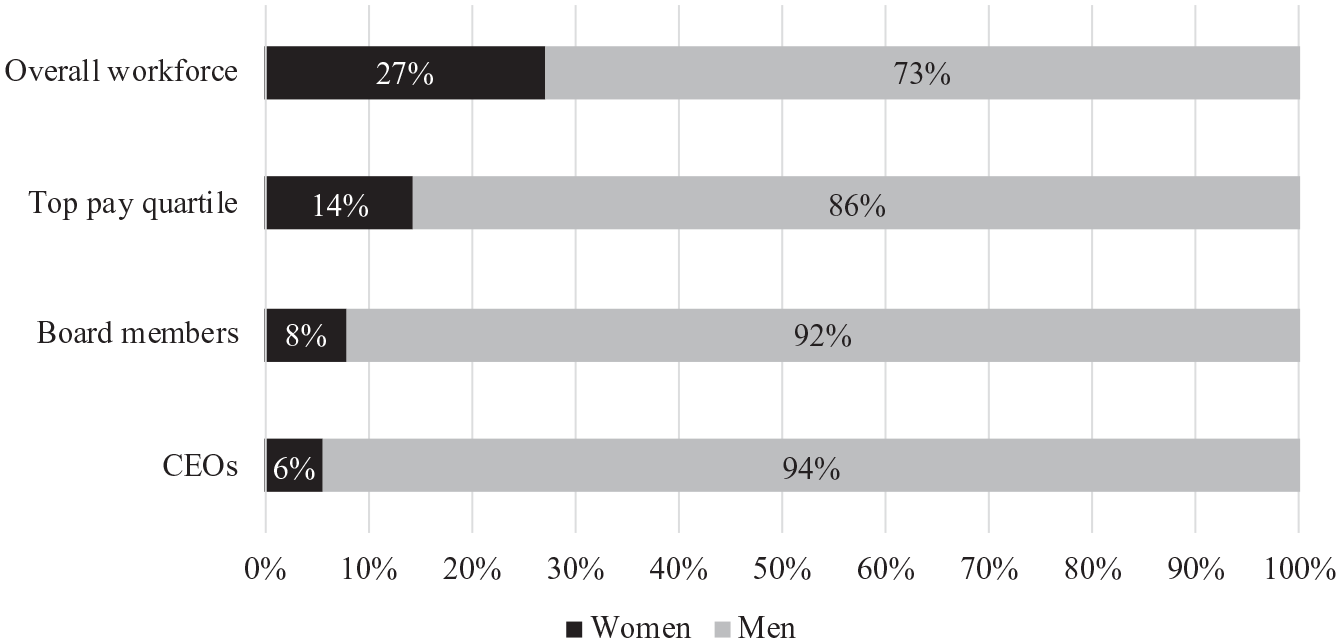
Gender Makeup of Men’s Club Football in the 2017/2018 Season
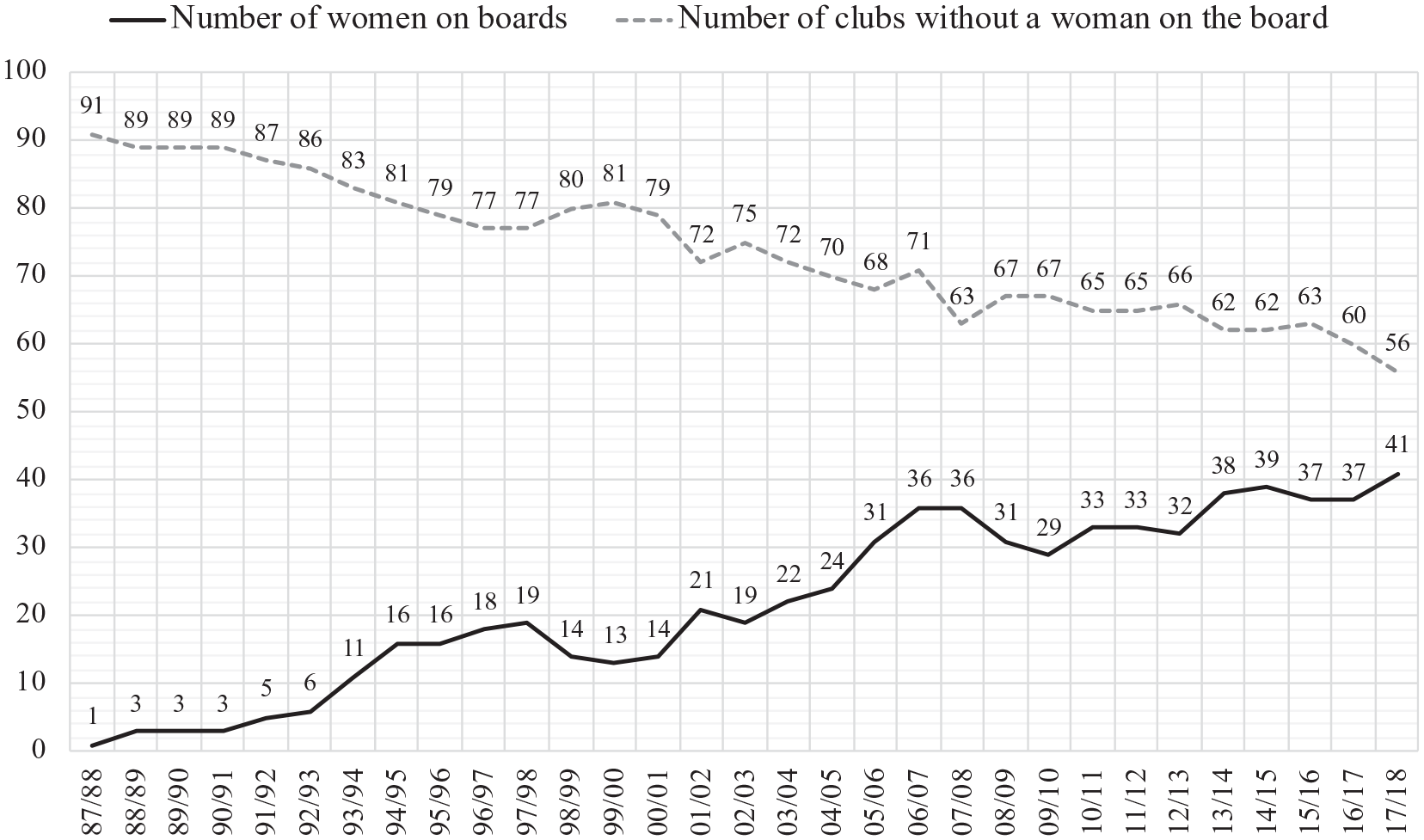
Number of Women Board Members and Number of Clubs Without a Woman on Their Board per Season in Men’s Club Football 1987/1988 to 2017/2018
We also find that women’s leadership roles in men’s club football over the past 30 years have been confined to a limited number of occupational areas. For example, Figure 3 shows that over 50 percent of women’s leadership work has been concentrated in just four occupational areas: commercial & sales (n = 129), club secretary (n = 103), ticketing (n = 96), and finance and accounts (n = 71). Notably, these occupations are detached from the male players or the field of play. Indeed, our data show that just 4 percent of women’s leadership work has involved direct contact with the male players, in such areas as football development (n = 6), sport science (n = 4), club doctor and physio (n = 4), director of football (n = 2), and academy, youth, and education (n = 4). To date, no woman has held the role of first team manager or head coach in men’s professional football in England, arguably the highest ranked and most visible leadership role in the sport.
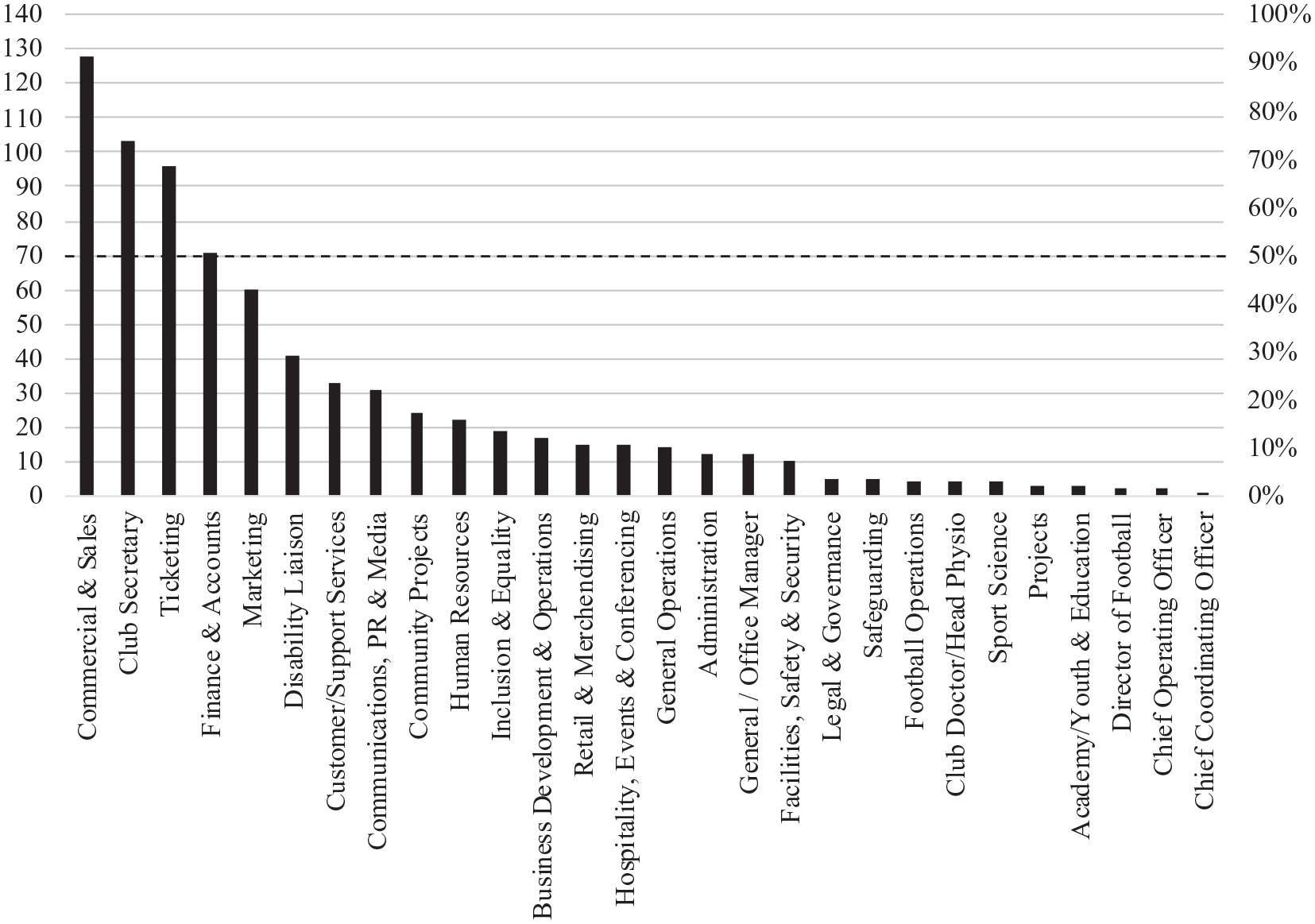
Number and Percentage of Leadership Roles Women Have Held in Men’s Club Football Between 1988 (88) and 2018 (18)
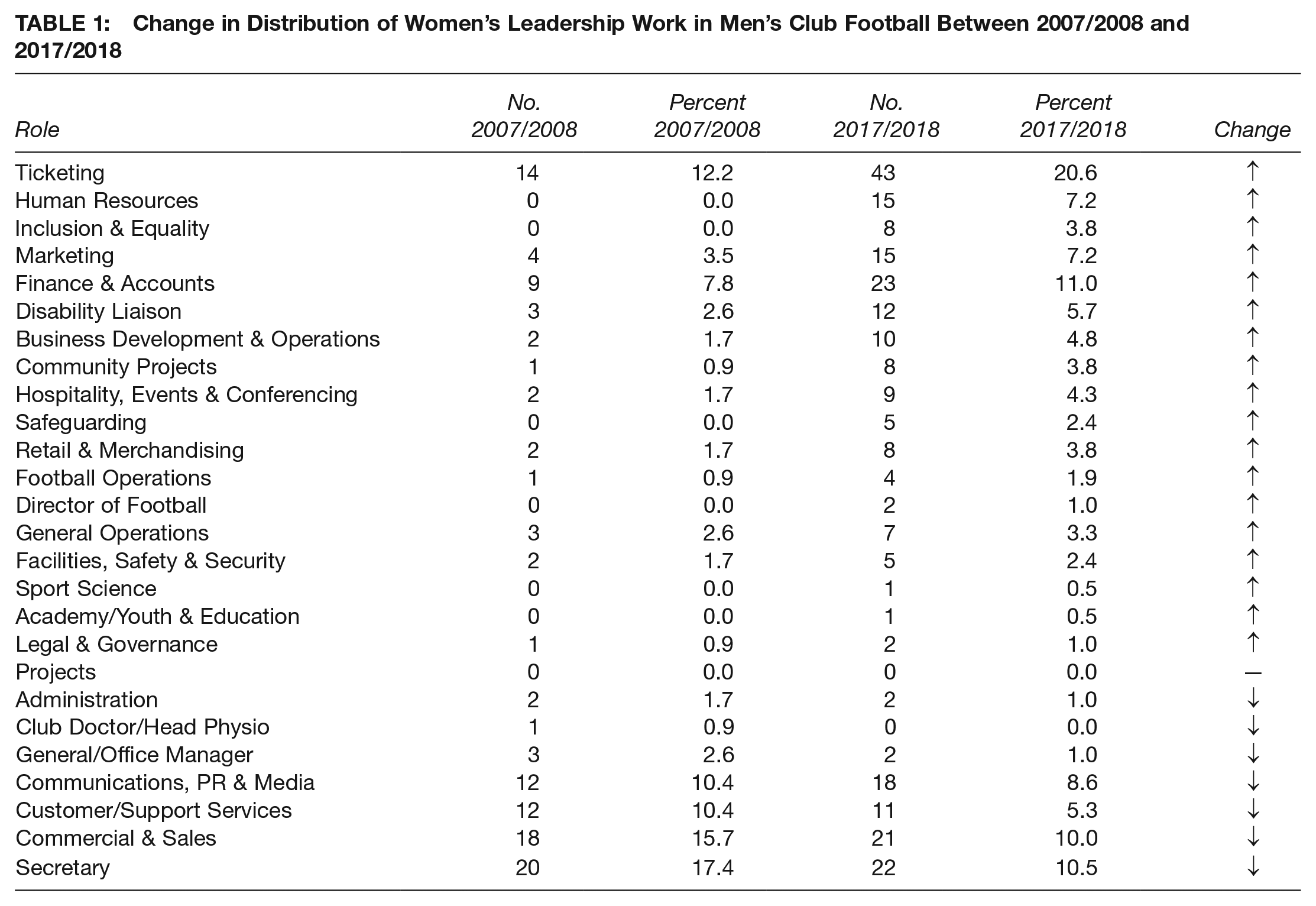
Although there have been changes over time in the distribution of women leaders into different occupational areas (see Table 1), the proportion of women’s organizational leadership work in football-related roles has scarcely changed over time. As Table 1 shows, although there has been a notable reduction in the proportion of women’s organizational leadership work in club/company secretary roles (17 to 10 percent) and a reduction in the proportion of women’s organizational leadership work in commercial and sales roles (16 to 10 percent) and customer service roles (10 to 5 percent) between 2007/2008 and 2017/2018, 4 women’s organizational leadership work has been redistributed into newly created and arguably feminized leadership roles rather than football-related leadership roles. For example, in contrast to 0 percent in 2007/2008, 7 percent of women’s organizational leadership work in 2017/2018 was in human resources—a notably female-dominated occupation (Chartered Institute of Personnel and Development 2018). Women’s organizational leadership work in inclusion and equality—work that often rests on the shoulders of those already marginalized (Ahmed and Swan 2006)—also increased from 0 to 4 percent during the same time. These roles along with safeguarding and disability liaison were newly created during this time, which means the movement of women leaders into these occupations has not disrupted the masculine core of the organization.
Change in Distribution of Women’s Leadership Work in Men’s Club Football Between 2007/2008 and 2017/2018
These findings show that most of women’s leadership work has been peripheral to the core function of men’s club football in England. That is, most women’s leadership roles have been removed, in terms of influence and proximity, from the male players and the playing of football matches. In contrast, leadership roles at the footballing core of the organization have remained the near-exclusive domain of (predominantly white) men (Bradbury, Van Sterkenburg, and Mignon 2014; Norman, Rankin-Wright, and Allison 2018). This is especially true for head coach and first team management roles—roles that no women, and very few Black men (Bradbury 2013), have ever held in men’s club football in England. Our findings on women’s exclusion from football-related roles are supported by the work of Fielding-Lloyd and Meân (2011, 24), who argue that women are positioned at the “peripheries” of the “central membership of the football category,” by which they mean the playing and coaching of football. However, our findings are the first to show that women’s exclusion extends beyond just player and coaching roles into leadership roles that are proximate to the players and the field of play. The closer the leadership role is to the playing of football, in terms of proximity and influence, the fewer women there are. These findings reveal a gendered substructure of core and peripheral leadership roles within men’s club football that preserves (white) male dominance at the core of the organization while accommodating (white) women at the periphery. As we show in the following section, this substructure is reinforced by an “organizational logic” (Acker 1990) that naturalizes men’s presence in footballing roles.
Naturalizing Male Dominance at the Organizational Core
A discourse analysis of football club GPG reports reveals striking evidence of a “naturalization discourse” (Fairclough 1985), whereby inequalities between women and men are legitimized as being “natural” or “normal” in the context of football. Indeed, references to the “nature” of football dominated narratives on the GPG: [the club] is committed to reducing its gender pay gap, but also recognises the unique nature of the football sector. (Everton Football Club 2018) The Club is committed to the EFL [English Football League] Equality Code of Practice but the nature of the business . . . inevitably results in male-dominated high-earners and a large gender pay gap can be expected. (Walsall Football Club 2018)
By presenting football organizations as unequal by nature, most men’s football clubs had resigned themselves to the idea that gender inequalities were “inevitable,” with little to no interrogation of the underlying mechanisms that produce inequalities in nonplaying roles. Even clubs that acknowledged inequalities in nonplaying roles, such as the lack of women in leadership, tended to justify these inequalities as being the result of men’s natural “attraction” to football: Within the football industry, the historical nature of the sport means that jobs are, arguably, traditionally more attractive to males. (Southampton Football Club 2018) The football industry traditionaly [sic] attracts male employees which is why our mean gender pay gap seems high at 75% when compared to the national average rate of 18.4%. (Cardiff City Football Club 2018)
Several clubs also made specific reference to football-related roles as “typically” or “traditionally” attracting men without offering an explanation or further critique. Although some clubs stated that they would review their recruitment policies to “attract more women” to football-related roles, generally the male-dominated core of football was presented as a natural state of affairs that required no further explanation: . . . the large majority of non-playing match day roles are stewarding and security —and are currently mostly male, reflecting the traditional, predominantly male match day attendance . . . senior football administration roles typically attract more male applicants. (Crystal Palace Football Club 2018) Most coaching and football support staff are primarily male and this has been the normal tendency in most professional football clubs. (Queens Park Rangers Football Club 2018)
Statements about football roles being more attractive to men serve to “naturalize the inequality” (Acker 2006, 453) in core roles and essentializes differences between men and women by claiming that it is men rather than women who are by “nature” attracted to working in football-related roles. Such statements help to perpetuate myths that football is “naturally” a male-only space. Claims that male-dominated roles reflect the typical male match day attendance are at odds with the recent “feminization” of football fandom, whereby women fans now form a substantial component of the crowd (Pope 2017). These statements reveal a prevailing organizational logic—“the underlying assumptions and practices that construct most contemporary organizations” (Acker 1990, 147)—that naturalizes men’s dominance in core football-related roles. What is interesting about these statements is that contrary to Acker’s (1990) concept of organizational logic they make no attempt to present core roles as gender neutral. Rather, the extreme gendered character of these roles is revealed and reified through these statements by essentializing men’s claim to football. This is significant because organizations that maintain a high degree of essentialist beliefs are more likely to have a severely gender-segregated workplace (Levanon and Grusky 2016) and, therefore, a higher GPG (Blau and Kahn 2017).
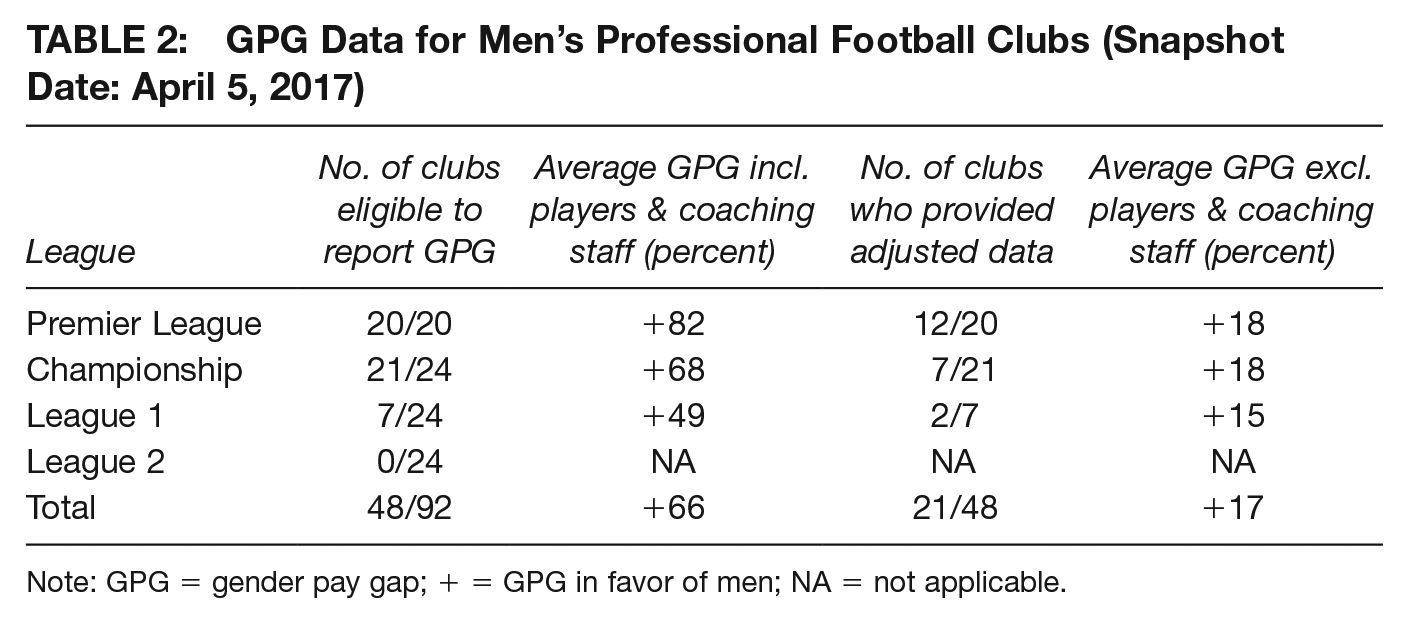
Another common naturalizing strategy was to use high wages for male players to present the GPG as a natural state of affairs in men’s club football. Given that players at a men’s football club must be male, 5 and male professional footballers can earn extremely high wages—£57,000 per week on average in the Premier League (SportingIntelligence 2018)—the inclusion of player wages in GPG reports skews the data considerably in favor of men. However, less than half of the clubs provided voluntary data excluding player wages for reasons of transparency (see Table 2).
GPG Data for Men’s Professional Football Clubs (Snapshot Date: April 5, 2017)
Note: GPG = gender pay gap; + = GPG in favor of men; NA = not applicable.
While the inclusion of player wages resulted in vast GPGs in favor of men, several clubs sought to use this to their advantage by justifying the organizational GPG based on high male-player wages. These extracts show how some clubs used male-player wages to explain their GPG: It comes as no surprise that, as with the majority of other professional teams competing in the English Football League, there is a significant pay gap due to the disproportionate salaries and bonuses paid to the playing and coaching staff. (Leeds United Football Club 2018) [T]he market wage rate for players and football management staff is inherently high. This, combined with the fact that the regulations of the league we compete in stipulate that our professional players are male, the pay gap in the company is also inherently high. (Preston North End Football Club 2018)
Rather than acknowledging inequalities in nonplaying roles, these extracts present gender inequality as natural or “inherent” because of male-player wages. Not only does this obscure the true extent of the GPG in nonplaying roles, it normalizes unregulated and exceptionally high male-player wages within the industry and thus undermines efforts to reduce pay inequality. Parallels can be drawn here with the banking sector and the normalization of bonuses for (predominantly male) executives. As Healy and Ahamed (2019) argue, although a bonus culture fuels a considerable GPG in the sector, bonuses remain discretionary and, consequently, non-negotiable when considering pay equality. These findings are significant because wages “are a powerful form of control” (Acker 2006, 454) and compliance with that control—for example, by accepting that the highest earners are male footballers—legitimizes power differences between women and men within the organization.
Even when clubs acknowledged high male-player wages and their influence on the GPG, there was a tendency for clubs to conflate the wages of male players and first team coaching staff. This is notable because while players at men’s football clubs must be male, there is no requirement for first team coaching staff to be male. However, we find that clubs largely ignored this distinction and presented players and coaches in the same category. For example, of the 21 clubs that provided voluntary data excluding male players on the basis that players must be male, 11 also excluded first team manager and coaching staff wages on the same basis (see Table 2). Indeed, the absence of women in these roles was not addressed by any of the clubs. Instead, the presence of all-male coaching teams was discursively presented as common sense, with no room for interrogation: Football is a sport in which the highest earning player and management roles are almost exclusively held by men and this has a significant impact on our results. (Ipswich Town Football Club 2018) This gap arises because of the inclusion of the First Team Manager, the Coaching Staff and the Players in the calculations. (Nottingham Forest Football Club 2018)
These statements again served to naturalize male dominance in core roles by failing to reveal the operational differences between male players and the hypothetically gender-neutral role of football coaching. Instead, the rationalization of inequality in one area of work—the gender-segregated playing field—is used to justify inequalities in areas with less legitimacy for disparity, such as coaching roles. This supports Pape’s (2020) findings that women’s underrepresentation in leadership roles within the IOC was highly influenced by the gender-segregated nature of sports participation. That is, that the “gendered logic” of the IOC was underpinned by the construction of women as athletically inferior to men. Interestingly, although men’s club football has not had to accommodate women as athletes in the same ways as the IOC—women footballers play in separate leagues, competitions, and even stadia, from those of men—the same gendered logic appears to have excluded women from leadership roles in men’s club football, especially in core roles. As demonstrated in the following extracts, this prevailing organizational logic within football that naturalizes male dominance in core roles renders questions of organizational change redundant: . . . we cannot employ female playing staff, therefore the Gender Pay Gap for players is 100 per cent [sic]. Consequently, opportunities open to the business to reduce the overall gender pay gap are very limited. (Portsmouth Football Club 2018) We cannot eliminate the gender pay gap completely due to our Football Management, Coaching and Playing jobs being filled by men. (Nottingham Forest Football Club 2018)
These extracts demonstrate how a gendered organizational logic is used to abandon notions of equality within the organization. Although a minority of clubs acknowledged gendered barriers to nonplaying roles, such as inflexible working hours and gendered language in recruitment packs, most showed an unwillingness to expose and address underlying gender inequalities in nonplaying roles, including the intersection of gender with other inequalities. For example, the severe lack of Black women and men in football leadership and core roles, such as first team manager and coaching roles (Rankin-Wright, Hylton, and Norman 2019), was not addressed by any of the clubs. These findings bring into question the ability of GPG reports to expose and address inequalities.
Discussion
The persistent underrepresentation of women in leadership roles within sport organizations is well documented (Burton 2015; Pape 2020; Sartore and Cunningham 2007; Women in Sport 2017), and there exists a proliferation of policies and programs that aim to address this phenomenon from individual-level approaches, such as leadership courses for women (FIFA 2016; the FA in Association with the Institute of Directors 2017), to macro-level policies such as gender targets (Sport England and UK Sport 2016). Despite this, the problem has remained stubbornly consistent, particularly within highly masculinized and male-dominated sports such as football (Bradbury, Van Sterkenburg, and Mignon 2014; Fielding-Lloyd and Meân 2011; Gill 2019). Sasson-Levy’s (2011) concept of “extremely gendered” organizations allows us to consider the possibility that certain sport organizations have resisted women’s inclusion in positions of power because they are masculinity-conferring organizations and as such must be constructed as masculine to exist. This possibility casts doubt on the ability of existing gender equality policies and initiatives to change gender inequalities in a meaningful way (Tyler, Carson, and Reynolds 2019). By considering the organization of men’s club football in England as “extremely gendered,” we can make sense of stark and persistent gender inequalities in football leadership and explore the possibility for change.
Our findings present the first analysis of women’s leadership work in football over the past 30 years and an examination of clubs’ GPG reports. We develop an empirically based set of new theoretical ideas to explain ongoing gender inequalities at a time when there is mounting pressure for organizations to reduce these. We find that women’s patterns of participation in football leadership have been characterized by peripheral inclusion. That is, women’s leadership work has been limited to occupations that are operationally separate from the footballing core of the organization. In her writings on women in the military, Sasson-Levy (2003, 459) argues that women’s involvement has followed a pattern of “limited inclusion,” meaning that their involvement has been “partial and curtailed” (Sasson-Levy 2011, 400) to maintain the masculinist cultures of the military. Women’s inclusion in football can be similarly understood as limited and restricted to preserve male dominance. However, our findings offer new insights by suggesting that women’s inclusion has been limited in a very specific way. Specifically, proximity to the male athletes and the field of play underpins a gendered substructure that distances women from core leadership roles by limiting their inclusion to roles that are peripheral to the organizational core.
By framing men’s club football as an “extremely gendered” organization, we can usefully understand core roles as being the most symbolically important to the preservation of the organization’s masculine character. That is, “extremely gendered” organizations help to define hegemonic masculinity through their core function—football playing, frontline combat, firefighting. Even if men are not enactors of these activities, association with those who are still yields benefits for men. As Connell (2005, 77) argues, it is the “successful claim to authority, more than direct violence, that is the mark of hegemony.” In the case of football, it is proximity to footballers that is the mark of masculinity and, as such, power. Therefore, preserving the masculine core of football by relegating women to the peripheries upholds men’s successful claim to football leadership. Parallels can be drawn here with Pape’s (2020) research on gender segregation in leadership roles in the IOC, in which she shows that women’s accommodation as athletes has done little to transform the gendered organizational logic that preserves male-dominated leadership. That is, female athletes are constructed as athletically able but inferior to men and this underpins a gendered logic that prevents women from accessing leadership roles. Similarly, accommodating women in peripheral leadership roles has done little to transform or disrupt the extremely masculine character of football.
Preserving this masculine character is not only beneficial for men inside of football; football’s masculine character also serves an important function in the wider patriarchal order of society from which all men benefit (Connell 2005). This is a key function of “extremely gendered” organizations. For example, playing football is a rite of passage for many boys in English society—especially working-class boys (Dunning 1999)—whereas this continues to raise questions for girls participating in a traditionally “male” sport (Pope 2017). American football serves a similar function in U.S. society as football (soccer) does in the United Kingdom (Messner 1992). While “extremely gendered” organizations will vary across cultures and nations, they will still function to reproduce and maintain idealized notions of masculinity and manhood in their most core roles. For example, we might conceive of frontline combat in the military or frontline firefighting in the fire service as core organizational roles. How organizations justify their “extremely gendered” regimes may also vary, but maintaining masculine dominance in core roles must be the prevailing logic upon which these organizations are based.
In the face of external pressures to actively reveal and reduce gender inequalities, for example, the introduction of GPG reporting, “extremely gendered” organizations face a challenge to their organizational logic. However, we find that men’s football clubs have used GPG reporting as an opportunity, consciously or unconsciously, to reinforce men’s dominance in football. This is made possible because of the “extremely gendered” character of men’s club football. That is, organizations that enjoy strong cultural legitimacy for masculine dominance can largely escape reproach for gender inequalities. Although the purpose of GPG reporting is to reveal and problematize gender inequalities within organizations, this is possible only if organizations accept that inequalities are illegitimate. If workers and the public accept male dominance in football, clubs can continue to function unhindered by external political or social pressures to transform. Furthermore, the treatment of gender as a stand-alone category within GPG reporting, without considering intersectional oppressions, allows organizations to overlook the importance of thinking intersectionally. Indeed, the lack of acknowledgment for severe racial inequalities in football leadership, despite the notable presence of Black male players, is a significant omission. Future research in this area would help to uncover the organizational logic that not only functions to exclude Black women and men from football leadership, but functions to admit and reproduce hegemonic ideals of femininity and masculinity from which white women and men collectively benefit (Hamilton et al. 2019).
This research shows that men’s football, certainly at its core, has remained almost impermeable to women. The presence of women leaders in men’s football, even in the boardroom, might look like progress, but if women leaders are removed from the players and major footballing decisions, the world of football will remain characteristically masculine. Research on gender segregation in the gendered organization of legislative committees also shows that women, who make up a growing number of political leaders, are still clustered in roles that deal with internal affairs or “soft” issues, in contrast to men who dominate instrumental policy-making leadership roles (Bolzendahl 2014). External efforts to increase women leaders in male-dominated organizations, such as gender targets for boardroom roles, will fail without a closer examination of the types of leadership roles women are appointed to. Indeed, the introduction of gender targets at the national level of football governance may have resulted in more women on the board, but most women have been appointed to nonexecutive leadership roles, meaning they are not involved in the day-to-day running of the Football Association. Crucially, our findings also show that even women involved at the highest levels of football leadership are not necessarily involved in decisions about the players and field of play.
Until women are involved, in equal proportion to men, in footballing decisions, equality will never be achieved; men will continue to be the holders of footballing power and women will only ever be accommodated at the margins. As Pape (2020) argues, we must look to make changes in roles where women’s inclusion will transform the gendered organizational logic of sport. However, in the case of “extremely gendered” organizations, possibilities for transformation may be limited. Indeed, Sasson-Levy (2011) questions whether gender equality is even possible in extremely “gendered organizations.” That is, if the primary function of an organization is to reproduce and sustain idealized notions of masculinity, how can that organization continue to exist in its current form if women are permitted significant entry into masculine confirming roles? Furthermore, if women continue to face severe sanctions, including sexism and harassment, for entering masculinity-conferring roles, then it might not be possible or even desirable to rely on women to transform organizational logic from within. Instead, it might be more fruitful to imagine a different way of organizing football and indeed other sports that fundamentally disrupts the assumption of male athletic superiority that underpins the organizational logic of masculine dominance in core roles. This might include, for example, mandating sports clubs to provide equal resources for female and male athletes (Travers 2008), something nonleague club Lewes FC voluntarily introduced in 2017 (Foster 2019). It might also include gender-collaborative training sessions (Ogilvie and McCormack 2020) or the inclusion of mixed-gender teams and competitions 6 (Channon 2014).
This study should initiate future research to examine women’s experiences of working within the “extremely gendered” industry of men’s club football to understand how women challenge, resist, or maintain ongoing inequality regimes. We also call for greater intersectional monitoring and reporting of the GPG within organizations. Finally, further research is needed to fully examine the complex, multiple, and interrelated patterns of inequality, including how gender intersects with other bases of inequality such as race and sexuality, both in men’s club football and in other “extremely gendered” organizations.
Footnotes
Authors’ Note:
We thank the reviewers and editorial team for their generous and insightful feedback on this article. This work was supported by the Arts and Humanities Research Council (Grant Nos. AH/P004083/1 and AH/N004841/1) and the National Football Museum.

Notes
Amée Bryan is a PhD candidate in the Department of Sport and Exercise Sciences at Durham University. Her research interests are in gender and the feminist sociology of work. Her doctoral research examines women’s access to and experiences of leadership in men’s professional football. Her doctoral research is funded by the Arts and Humanities Research Council (AHRC) in collaboration with Sporting Heritage and the National Football Museum.
Stacey Pope is an associate professor in the Department of Sport and Exercise Sciences at Durham University. She is especially interested in issues of gender and sport. She is author of The Feminization of Sports Fandom: A Sociological Study (Routledge) and co-editor (with Gertrud Pfister) of Female Football Players and Fans: Intruding into a Man’s World (Palgrave). She is currently working on a large AHRC project examining women and football fandom in the North East of England and international women’s football.
Alexandra J. Rankin-Wright is an assistant professor in the Department of Sport and Exercise Sciences at Durham University. Her research interests reside within the sociocultural study of sport and in particular equality and issues of diversity and inclusion. Her research addresses and challenges social (in)equalities, inclusive practice, and diversity related to participation, coaching, leadership, and organizational cultures in sport, with a specific focus on gender and race equality.