




Abstract
The purpose of this article is to introduce a holistic framework of power that can serve to examine constraining and enabling manifestations of power within international Sport for Development and Peace (SDP) partnerships. The article is grounded in the recognition that the international SDP sector is wrapped up in ‘post-colonial residue’ and brings to the fore issues and power and inequality based on the construction and maintenance of hegemonic power relations. The article calls for SDP scholars to challenge the nature of partnerships and practices within the sector between international partners from the global north and global south. To develop and advance the case for this novel theoretical framework for studying power in SDP, the article is organized into three parts. The first part highlights the critical literature from the SDP and international development sectors concerning the nature of power relations with a specific focus on critical debates concerning social hierarchies. The second part offers a theoretical proposition and a three-phase theoretical model drawing on the work of Giulianotti, Lukes and Coleman to argue that power within international SDP partnerships is not static but needs to be recognized as a complex interplay of actions and outcomes. Finally, the article highlights how and why the holistic theoretical framework may be useful for SDP scholars in analysing and challenging power relations in future empirical-based research.
Introduction
The Sport for Development and Peace (SDP) landscape is a global sector of ever-increasing partnerships, activities, opportunities and challenges (Collison et al., 2018). In practice, the SDP field is largely shaped by the interface of corporate, governmental and non-governmental organizations and is characterized by the implementation of ‘on the ground’ projects in developing nations (Giulianotti et al., 2016). In recent years, there has been a significant rise in the number of International Non-Governmental Organisations (INGOs) from the global north utilising sport as a tool to tackle broader societal and health issues in low- and middle-income countries (LMICs) in the global south (Collison et al., 2018; Lindsey et al., 2017). Despite such growth, and the widespread positive intentions of INGOs, a prominent criticism has emerged which posits that SDP practices may exacerbate unequal power relations between organisations in the global north and the global south 1 , typically in the post-colonial context (Collison et al., 2018; Darnell et al., 2018; Darnell and Hayhurst, 2012; Giulianotti et al., 2016). The article highlights key challenges associated with SDP, in particular partnerships and practices concerning the nature of hierarchical power relations, and proposes a theoretical framework through which scholars might analyse and challenge issues of power through future empirical research.
The 2030 Agenda for Sustainable Development was adopted in 2015 by all United Nations (UN) Member States. The UN's 17 Sustainable Development Goals (SDGs) and associated 169 targets build on the Millennium Development Goals (MDGs). SDG 17 focuses specifically on strengthening the implementation of the SDGs, including through north–south, south–south multi-stakeholder partnerships. Over recent years, the importance of partnerships has been increasingly recognized by UN Member States and leading international development institutions (DSDG, 2018). While partnerships may not be a panacea for global inequalities, they offer opportunities for people and institutions from different contexts to negotiate social relations and power that can lead to more respectful, equal implementation of programmes (Zingerli, 2010). Stafford-Smith et al. (2017) specifically suggested that global northern nations should co-produce knowledge, technologies, and processes for sustainability with nations from the global south to support the development of their capacities. The equitable involvement of southern partners in such co-production is important to ensure that resultant knowledge systems are credible, salient, and legitimate (Cash et al., 2003). Adopting a co-production approach helps to remove historical hierarchies associated with knowledge production and takes a proactive approach to valuing all knowledge systems as legitimate and recognizing the importance of equal partnerships and collaborations to reframe how knowledge is produced.
Within the SDP field, the importance of partnerships and collaborations among organizations in an international context has been noted (Lindsey and Bello Bitugo, 2018). Existing SDP research has helped to shape inquiries into various SDP partnership contexts including research partnerships (Peachey and Cohen, 2016), programme delivery involving global northern SDP partners (MacIntosh et al., 2016; Hartmann and Kwauk, 2011; Adams et al., 2017) and programme delivery involving global north and global south SDP partners (Nicholls et al., 2011; Sherry and Schulenkorf, 2016; Hayhurst and Frisby, 2010; Banda and Holmes, 2017).
This article contributes to the critical sociological analysis of SDP, analysing how power operates in SDP. Behind the self-promoting rhetoric of SDP that sport has the power to change the world, there are critical questions of power at play that apply to power dynamics both within the SDP sector and between organizations based in the global north and south (Giulianotti et al., 2016). As such, it is important to understand the nature of and debates associated with power within the international development and SDP sector.
Previous SDP work has examined how knowledge and power in SDP and international development create and maintain preferred subjects (Darnell and Hayhurst, 2014), often in terms that are gendered (Hayhurst et al., 2016) or grounded in neo-liberal strategies (Craig and Porter, 2006; Darnell, 2010; Forde and Frisby, 2015). Within the neo-liberal discourse, it is widely argued that activities and partnerships associated with SDP take place within power relations that are neither flat, but perpetuate power relations that legitimize inequality and social hierarchies inherent in market capitalism (Darnell, 2010, 2012; Darnell and Hayhurst, 2012).
Set against this backdrop, scholars have examined how SDP confirms, reproduces, and/or reifies colonial histories and social hierarchies (Darnell and Hayhurst, 2011; Essa et al., 2022). This includes ways in which knowledge production (including monitoring and evaluation) in SDP is produced in post-colonial contexts between actors and organisations from the global north and global south to enhance decolonization practices in SDP (Darnell, 2010; Nicholls et al., 2011; Whitley et al., 2023).
The article aims to introduce a new theoretical framework to assist SDP scholars in studying power relations between international SDP organisations from the global north and global south in a holistic way, which integrates differing theoretical perspectives of power. The theoretical framework presented enables SDP scholars to be sensitive and open to all aspects of power including both positive and negative outcomes when conducting empirical research on SDP partnerships. Such an approach seeks to heed the warning of international development scholars Hardy and Phillips (1998: 288) when researching partnerships not to simply (a) accept the stated goals and definitions of the most powerful partner in judging the ‘success’ of the partnership or (b) to mistake the ‘surface dynamics’ for ‘what is going on beneath’.
This article is grounded in the recognition that the study of power within international partnerships is increasingly part of the SDP lexicon, including questions about how to understand power (e.g. power as a positive enabling force or as a negative constraining force), examinations of how power works in SDP practice and critical inquiries into how power relationships in SDP are challenged and transformed. Rather than ‘choosing sides’ within these power debates or attempting to ‘solve’ them, this article acknowledges the different dimensions of these power contentions as many scholars argue, that power is also a fluid, ever-changing and even hybrid force (Darnell, 2012; Hayhurst et al., 2016). From this perspective, it is important to recognize that power is the capacity to cause effects, to have an impact on or change things in the physical or social world (Foucault, 2002; Gaventa, 2003). This approach supports the notion that power within SDP partnerships is not static. As Hayhurst et al. (2016) note, SDP practices operate in socio-political sites that are (re)constructed, implemented and negotiated within a networked set of dynamic relationships and connections.
Power in SDP and international development: Critique and analysis
As the early growth and wholesale support for SDP activities begin to slowly settle down, SDP scholarship is seeing more critical studies tackle issues concerned with hierarchies of power. The theorization of power in SDP has been conceived of in a variety of ways. Some pursue concerns regarding colonialism which focus on a ‘power over’ relationship dynamic (Forde and Frisby, 2015; Nicholls et al., 2011; Darnell, 2010, 2012; Mwaanga and Banda, 2014; Saavedra, 2019; Banda and Holmes, 2017). Others advocate for the use of Lukes’ (2005) radical power theory to highlight the less visible dimensions of power (Houlihan and Green, 2011) or the subaltern view of Freire (2000) to explain the convergence and divergence of various forms of alternatives to power of any given time (Forde and Kota, 2018). Some scholars focus on the ‘power to’ enabling power of sport to develop social capital gains (Adams et al., 2017; Peachey et al., 2015; Giulianotti et al., 2019; Hartmann and Kwauk, 2011), while others explore power relations focused on the personal development of individuals, e.g. Ubuntu philosophy (Mwaanga and Adeosun, 2020), and capability approach (Darnell and Dao, 2017). These varying theoretical and philosophical perspectives have led to the use of concepts such as structure, agency, and social capital within understandings of power in SDP, which have been associated with the influence of Bourdieu (1986), through his consideration of the relationship between agents and their social worlds (Bourdieu and Wacquant, 1992).
There is a scholarly consensus that hierarchical issues of power underpin SDP international partnerships (Hayhurst and Frisby, 2010; Lindsey and Bello Bitugu, 2018; Lindsey et al., 2017). Related SDP studies have reviewed inequalities of power specifically about colonialism, illustrating the asymmetric power relations that underpin the global SDP sector. In particular, Darnell and Hayhurst (2012: 113) have pointed to northern hegemony (as well as neo-liberal ideologies) as key influencing discourses of the SDP sector, discourses which they argue are connected to the (lack of) agency afforded to local people who ‘do not necessarily possess the capacity to uniformly challenge dominant ideologies (e.g. market-oriented or neo-liberal development); in fact, they may even reproduce such practices and relations or exacerbate pre-existing social hierarchies in a top–down form’. Similarly, Mwaanga and Banda (2014) have argued that global north knowledge and ideologies remain privileged and intact and that SDP practices are exported from privileged givers to the receiving end of SDP through travelling western academics, sports students on placement, knowledge transfer, and ideologies of western values and practice. Some studies have critiqued specific sports volunteering practices in Africa where UK (Banda and Holmes, 2017) and Canadian (Darnell, 2007) volunteers go to visit local NGOs and deliver SDP programmes in the global south. Another concern of this approach is the lack of role modelling and limited similarity between the teacher and the taught (see Bandura's work on social learning and self-efficacy theory), which raises significant issues about using any non-peer volunteers (Coalter, 2007).
Of course, this argument is not exclusive to SDP partnerships and practice but reflective of many international development-orientated programmes and partnerships. This article supports the view from Contu and Girei (2014) that a hiatus exists between the rhetoric and reality of such partnerships based on issues of equality, decision-making and power relations between international and national NGOs. Without understanding the nature and workings of partnerships on the ground, Contu and Girei (2014) argue that partnerships may in fact be reproducing relations of inequality characterized by subordination and oppression. Baaz (2005) concurs that north–south development-orientated partnerships should not be viewed as equal or based on mutual interests and goals but as battlefields of knowledge informed by differing goals and interests.
While the objectives of SDP INGOs are admirable and always well-intentioned, SDP programmes unfortunately could re-affirm colonial tendencies through preconceived notions of the need to ‘develop’ others (Darnell, 2007; Gartner-Manzon and Giles, 2016; Giulianotti et al., 2016). From this perspective, it is argued that the SDP sector has followed the same trajectory as the international development sector, which sees the hegemonic exchange of ideologies and resources from global north donors to communities in the global south. Critical development studies draw attention to the importance and significance of these global power relations, including issues of colonial residue within international development practice broadly (Groves and Hinton, 2013; Kothari, 2001). Critical scholars have argued that international aid provided by global northern nations creates a deep system of aid dependency and hegemonic practices (Parashar and Schulz, 2021). This results in uneven patterns of influence, ideology and wealth between regions, which emphasizes the continued relevance of post-colonial residue and understandings of geopolitical power relations and persisting inequalities of power (Wasserman, 2018). In the SDP sector, Mwaanga and Banda (2014) argue that global northern knowledge and ideologies remain privileged and intact and offer examples that such practices are exported to the receiving end of SDP through travelling western academics, sports students on placement, knowledge transfer and ideologies of western values and practice. Additionally, empirical research illuminating the ‘white saviour complex’ has been researched within the SDP context (Forde, 2015) and broader leisure context (Anderson, Knee and Mowatt, 2021). Indeed, Mwaanga and Adeosun (2017) question whether SDP initiatives delivered by global northern agencies, which tend to be finite and short-term, are in fact the right vehicles to deliver longitudinal processes such as decolonization and deliver authentic development. Mwaanga and Adeosun's (2017) perspective is centred on a neo-colonialism critique of the power and privilege of actors from the global north and south in SDP. They argue that colonial impressions are being replicated in many (not all) current global south SDP practices and advocate that the research knowledge production process shifts to challenge the current status quo, which is to privilege global northern voices at the expense of localised voices. They advocate that researchers and practitioners from the global to north consider and reflect upon their background (and privilege) in the knowledge production process.
Darnell and Hayhurst (2011) also draw attention to the importance and significance of post-colonial residue and challenge SDP scholars and practitioners to buy into a decolonizing mandate. Without it, they argue sport as a means of social change is susceptible to the notion that development proceeds as global northern charity or aid to help those unable to ‘help themselves’ (2011: 190). Within the SDP setting, critical analysis of global north and global south partnerships by Arellano and Downey (2019: 457) illuminates colonizing tendencies and tensions, arguing that ‘sport-for-development programmes have unwittingly embraced “shape-shifting” forms of settler colonialism while continuing to reinforce existing structure’. Giulianotti (2011: 51) asserts that the responsibility lies with global northern SDP organisations to thoughtfully reflect on the historical and ideological underpinnings of its origins, as, without such reflections, SDP organisations may run the risk of re-inscribing ‘imperialistic and neo-colonial (indeed, NGO-colonial) relationships between global north and global south’. As a result, it is reasonable to argue that SDP researchers are now confronted with the colonial, development critique and that it is necessary to embrace new ways to analyse and challenge post-colonial residue in SDP partnerships.
The justification for the theoretical framework presented centres on the argument that theories of power used to study partnerships in SDP to date have primarily been either ‘power as restrictive’ or ‘power as productive’. As such, the central focus of this article argues for a more nuanced and dynamic understanding of power in SDP. For example, much of the SDP literature which calls for decolonization approaches to research in the SDP sector is itself constructed along the binary lines of restrictive/productive and is therefore limited. As such, we need a more nuanced framing of power for decolonized approaches to take place and succeed. The framework has been developed by combining the work of three influential scholars to try to understand the nature of power within SDP partnerships. The next section highlights the importance and significance of developing a new framework to consider a nuanced, more holistic framing of power which remains open to the possibilities that both positive and negative displays of power can occur within SDP partnerships.
A holistic framework to understand power relations in international sport for development and peace partnerships
In laying out the framework, the article discusses three dimensions to consider when documenting how power manifests and operates in SDP, particularly around partnerships: (a) understand how and why the SDP partnership was established, (b) explore any evidence of restrictive manifestations and outcomes of power, and (c) explore any evidence of enabling and productive manifestations and outcomes of power (see Figure 1). Each of these dimensions interacts with the others and needs to be considered in total to capture a holistic understanding of power, one which is open to power as both a productive (enabling) and repressive (restrictive) force as expressed through the action and interaction between SDP actors/organisations.
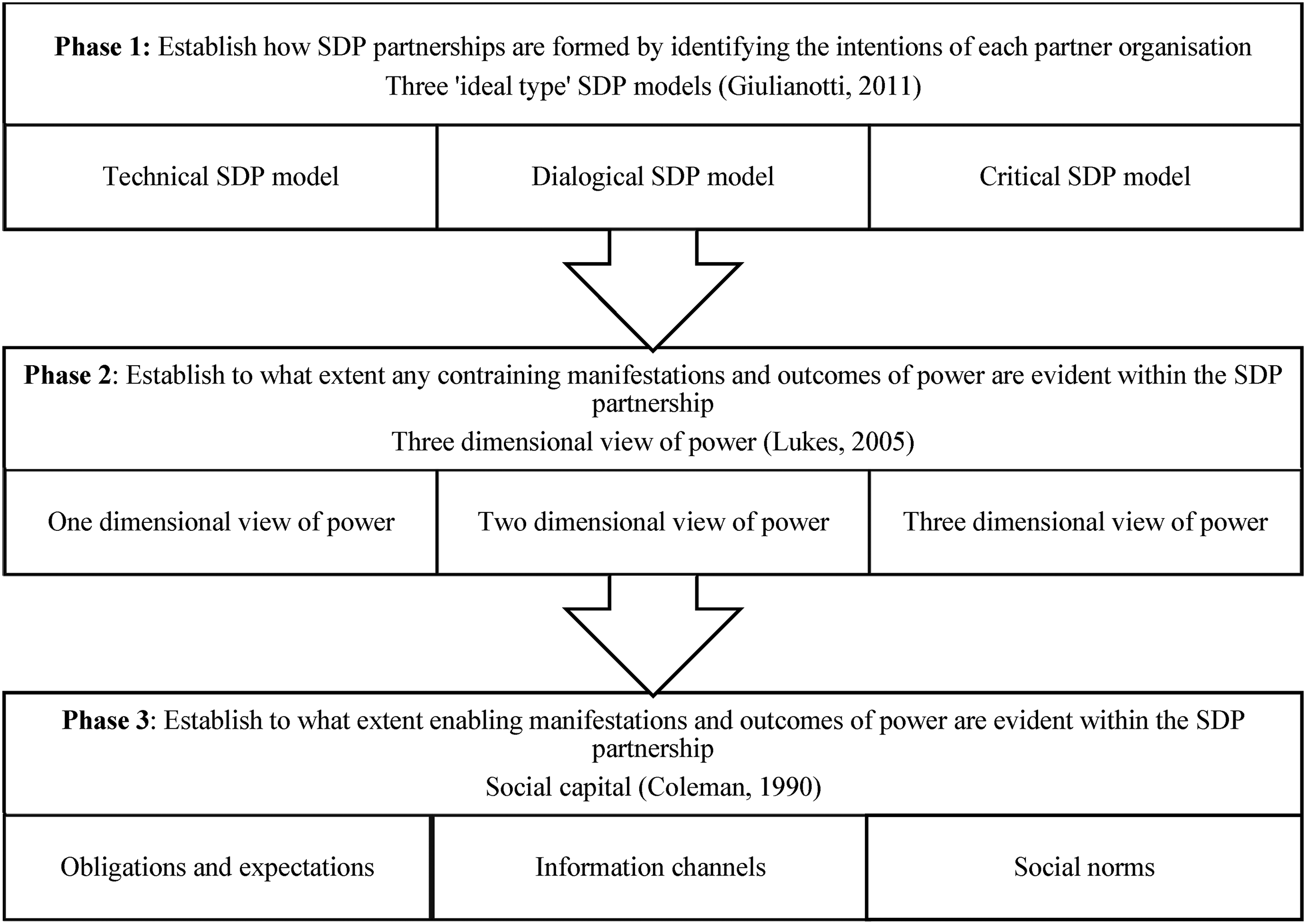
A holistic framework for understanding power in Sport for Development and Peace international partnerships.
Drawing on three influential scholars, the theoretical framework offers SDP scholars a way to theorize and critically reflect on issues of power in a more holistic way than currently deployed. Giulianotti's (2011) work is an important starting point as his three ideal type models encapsulate the advice from international development scholars who focus on NGO partnerships and advise the importance of scratching behind the surface of partnerships to examine the consequences of organisational interactions from the global north and global south (e.g. Contu and Girei, 2014) and examine the hiatus between ‘the promise and practice of partnership’ (Brinkerhoff, 2002: 1). Since Giulianotti's models (2011) were developed, the SDP sector has evolved somewhat, responding to a new global policy direction (e.g. the United Nations SDGs) and a global pandemic (e.g. COVID-19). LeCrom and Martin (2022) highlight that global southern SDP organisations have responded to the COVID-19 pandemic by placing an emphasized value on partnership-building and partnership management as an important strategy, which serves as a cue to shine a spotlight on such power relations in future research.
The work of Lukes (2005) is important in his understanding of power as a restrictive force and does so by offering a clearly defined and concise way to analyse issues of social structures, hierarchies and power struggles. To date, Lukes’ work has not been well utilised in SDP studies; however, the potential of Lukes’ (2005) radical theory of power to highlight the less visible dimensions and manifestations of power within SDP has been acknowledged (Houlihan and White, 2013). Lukes’ three-dimensional view of power offers a clear account of power as domination and conceives power as a process, which allows it to be effectively applied in an SDP partnership context.
The work of Coleman (1990) views power as an enabling, productive force has significant differences in his use of the term social capital, which is related to his assumptions about the nature of society and social relationships. It is important to note that Coleman differs in his interpretation of social capital from other leading social capital theorists, Bourdieu and Putnam. Collectively, Coleman, Bourdieu and Putnam agree that networks are important for the generation of social capital and its deployment, but they have significant differences in their use of the term social capital (related to their assumptions about the nature of society and social relationships). Coalter (2007) highlights that Coleman's main concerns relate to his interest in the processes surrounding the development of human capital at an individual level (e.g. education, employment skills and/or expertise). For Coleman, social capital exists in the structure of relations between individuals and denotes the influence of structures in facilitating certain actions of individuals within the structure. This perspective helps to understand power manifestations between individuals and SDP organisations from the global north and south, by exploring the capacity (just like physical and human capital) of social capital by individuals to facilitate productive activity to benefit themselves. For example, the rational choice of working (often as a volunteer) for a SDP organisation is based on the principle of investing human capital as a trade-off for future economic or human capital where social capital relates to opportunities for access to a structured programme that may legitimize the claim of personal and social empowerment (Field, 2003).
This narrative is frequently emphasized by sports organisations and centres on the potential role of sport as a social inclusion strategy that can be valuable and obtainable for all, including the powerless and marginalized. This framing of social capital is useful for this framework which considers the outcomes of partnership working from those who have been traditionally marginalized (e.g. global southern partner). SDP literature highlights that the southern agency is constrained by current SDP practices (Nicholls et al., 2011; Banda and Holmes, 2017). As such, SDP research must attempt to evolve to enhance southern agency and actively involve the role of subalterns (local actors) and demonstrate rejection or redressing of the universal and top–down nature of experiences captured in contemporary scholarship. Coleman's rationale choice theory (1990) helps to understand an individual's choice to involve themselves in activities for self-interest from an individualist perspective. Social capital theory, according to Coleman (1990), is an individual(istic) concept which posits that each person can gain stocks of social capital; this is represented by their set of interpersonal relationships and voluntary participation in life. Coleman's individual-orientated approach to social capital provides a platform to understand power manifestations from a localised perspective which aims to prioritise localised voices, an intention which has been suggested may promote those in the global north to ‘listen’ (Mawdsley et al., 2002).
The framework is presented in Figure 1.
Overall, the framework presented suggests that power can be both an enabling and restrictive force, exists in the form of both structure and agency, and is not static but is negotiated through ongoing dynamic relationships between various SDP actors. This approach takes inspiration from Go (2013), Estrada (2017) and Rosa (2015) who sought to develop multi-theoretical dialogues to prioritise localised understandings of networks and relationships. Estrada (2017) has argued for a more flexible holistic understanding of power rather than purely focusing on one theory, which in her view can limit the researcher to a narrow understanding.
Before examining each phase in more detail, it is important to note that in building the framework, the three phases were not considered to be independent of each other. Instead, the intention is that they provide scholars with three stages through which to identify and examine the manifestations of power within SDP spaces, and partnerships specifically, and to challenge unequal manifestation of power within partnership working while being open to possibilities of enabling or positive outcomes of power (such as social capital gain). Each of the phases is outlined here, as well as indicators to assess each phase.
Phase 1: Giulianotti's three ‘ideal type’ SDP models
To understand and conceptualise what power is, how it is presented and how it is responded to within SDP partnerships, it is necessary to have a clear understanding of the intentions and working practices of each organisation. Phase 1 draws on Giulianotti's (2011) three ideal type SDP models and helps scholars consider the structure and intentions of SDP organisations. The three models technical, dialogical and critical can be used as an analytical framework to help to map out the structure, intended outcomes and approaches of SDP partners. These models emphasize the institutional features of the organisation's projects, the properties of the work, and the types of social relations within the partnership.
The technical model is a hierarchical and directive one in which externally imposed agendas and programme content are determined and controlled by northern-based organisations with no evidence of co-creation of programme aims. Furthermore, in-country global south SDP agencies and organisations operating within this model tend to accept regulation by donors who seek to influence programme objectives and methods of evaluation (Giulianotti, 2011). Hierarchical approaches to relationships are also evident within this model, which is typically characterised by INGOs directing local and national agencies and through INGOs dispatching volunteer practitioners from the global north to teach from their manuals in global south communities.
The ‘dialogical’ model, according to Giulianotti (2011), seeks more of a participatory approach than the ‘technical’ model. The dialogical model is rooted in ‘an interpretative, communicative philosophy in which external agencies work to facilitate meaningful, sustainable contact between divided peoples and act as independent mediators’ (Giulianotti, 2011: 218).
Finally, the ‘critical’ model is a highly reflexive and transformative approach towards SDP practice. The critical model adopts a facilitating, bottom–up, local ownership, community-wide approach that seeks inter-communal transformation via self-directed experiential learning. It also recognizes that such work is complementary to wider social processes. Overall, the ‘critical’ approach is viewed as being the most progressive of the three models outlined, but Giulianotti (2011) notes that in the main, SDP programmes tend to feature a mix of attributes from either ‘technical’ and or ‘dialogical’ models, with the ‘critical’ model being far less apparent.
In terms of applying the multi-phase framework in practice, the intention is that phase one of the multi-stage framework of power enables researchers to understand and evaluate the intentions of the partnership by gaining insight from both partner organisations. By utilising the descriptors of Giulianotti's (2011) ‘technical’, ‘dialogical’ and ‘critical’ models, researchers are provided with a concise and detailed analytical ‘checklist’. The research design of phase one lends itself to a qualitative co-production research approach which offers an approach to help decolonize knowledge and rethink what we value as knowledge and more critically, whose knowledge is valued in a bid to enhance decolonization practices in SDP. Examples may include the review of organisational key documents, e.g. website, strategy and interviews with staff at each partner organisation to understand the structure, intentions and operational approaches within the partnership. Once this first phase is complete, researchers will have gained evidence concerning the intention of each partner and can next evaluate the nature of power between the SDP partners in phases 2 and 3 of the multi-stage framework of power, by drawing on the work of Lukes (2005) and Coleman (1990).
Phase 2: Lukes’ radical view of power
Lukes (2005) argues that power is complex and is exercised in three dimensions: (a) overt decision-making; (b) agenda-setting and (c) shaping the meaning and attitudes of others. Lukes’ first dimension of power claims that ‘A’ has power over ‘B’, if ‘A’ gets ‘B’ to do something that they would not otherwise do. For example, a one-dimensional view would locate the INGO (A) as possessing the funding, setting the programme aims (with no evidence of co-creation) and therefore holding the power, with the global south organisation (B) effectively holding no power as a result. In developing his second dimension of power, Lukes (2005) suggests that power is also evident when ‘A’ makes it impossible for ‘B’ to engage in decision-making processes, which are manifested in social and political values and practices. Under this understanding, it is not purely conflict that illustrates power but also more subtle forces of coercion, agenda-setting and manipulation, which are still visible. Lukes (2005) went on to develop a third, more radical dimension of power – power through domination. In a three-dimensional view, the properties of power are not exhausted by agenda and decision-making processes, but importantly, power can be found at a deeper, more invisible level. This invisible level of power is hard to evidence but heavily draws on Gramsci's notion of hegemony, which assumes that power is deeply rooted in forms of political and cultural socialization where actors unknowingly follow others against their best interests. Influenced by these views, Lukes’ (2005) third-dimensional view of power argues that organisations (e.g. national/global policies and politics) could shape people's perceptions and interests through the operation of ideological hegemony.
In applying the multi-phase model of power to evaluate international SDP partnerships, it is proposed that the second and third phases centre on exploring the extent to which ‘power over’ (Lukes’ three-dimensional view of power) and ‘power to’ (Coleman's understanding of social capital, see below) is evident by both partner organisations. As with phase one, careful consideration is needed here by researchers in the research design. Adopting a co-production approach to enhance decolonization practices in SDP is recommended as it may help to remove hierarchies in knowledge production, valuing all knowledge systems as legitimate and recognizing the importance of equal partnerships and collaborations to reframe how knowledge is produced. The recognition of traditional knowledge systems as valuable is not new and is strongly advocated for in SDP literature (Nicholls et al., 2011; Lindsey et al., 2017). It is suggested that an equitable and experientially informed research approach may be most suitable (Smith et al., 2022) which is a collaborative process in which people with lived experiences are essential partners in the research process from start to the end of the work.
Within the SDP context, Lukes’ third dimension of power allows scholars to challenge issues based on the one-directional donor–recipient relationship as the normative ideal that reinforces global north hegemony and global south dependence (Darnell 2007). Furthermore, as Forde (2015) notes, it is important to challenge invisible discourses, e.g. programme curriculum rhetoric, manuals and practices and manuals distributed by INGOs that are implemented in the global south.
Phase 3: Coleman and social capital theory
The final phase of the framework relates to the nature and process to obtain and utilise power, in an enabling manner to achieve social leverage for personal gain. The concept of social capital has gained salience as a means of understanding how agency can be exercised positively by forged networks in society. Coleman's (1990) concept of social capital supports the idea that social capital is individually driven (rather than driven by communities). Coleman claims that social capital can be embodied in personal relationships and social connectivity and social capital holds value for all kinds of communities, including the powerless and marginalized. This links to Lukes’ conceptualisation of power in terms of those who have access (or proximity) to donors and policymakers as capable of restricting agenda items. Coleman takes a positive stance concerning the access to and use of social capital by all individuals, including those who are traditionally deemed to be powerless and marginalized. This view necessitates that researchers (especially from the global north) should have an awareness of realities that certain individuals may face within NGO organisational structures, in that some individuals may have better chances of developing types of social capital than others. It is the responsibility of the researcher to be mindful of those who may be marginalized from certain corridors of power. For example, individuals from the global south may have differential access to SDP organisations, donors and policymakers in the global north SDP movement or indeed feel unable to challenge global northern knowledge and ideologies (Mwaanga and Banda, 2014; Baaz, 2005).
Drawing on rational choice theory, Coleman (1990) understands social capital as part of a wider exploration of the nature of social structures and defines social capital by its function (e.g. what it does). In turn, this connectivity may translate into different acts such as reciprocity, the building of relationships and the development of social and emotional skills which can bring about individual benefits. The use of Coleman's (1990) interpretation of social capital helps to explore individual behaviour in organisational settings and offers a nuanced analysis which does not dismiss individual behaviour via a wholly structural analysis. For Coleman (1990), social connections are maintained through (a) establishing obligations, expectations and trustworthiness; (b) creating channels for information and (c) setting norms.
An example of Coleman's obligations, expectations and trustworthiness is when a person or organisation ‘A’ does something for a person or organisation ‘B’ and trusts ‘B’ to reciprocate in the future; this establishes an expectation in A and an obligation on the part of B (Coleman, 1990). Creating information channels is understood as the sharing and exchange of information between members that facilitate action. Within an SDP context, identifying information channels offers a way to explore the extent to which social networks and connections are used as recognized outlets for transferring information which may lead to an elevated social status of one or more actors. Finally for Coleman (1990), to develop stocks of social capital, social norms are upheld, and effective sanctions are set (e.g. for ‘freeloaders’ who do not fulfil their obligations). In doing so, this helps facilitate or constrain certain actions which are reinforced by ‘social support, status, honour, and other rewards’ (Coleman, 1990: 311). In the SDP context, social norms and post-colonial residue in the form of hierarchical donor–recipient power relationships tend to privilege and benefit organisations and actors from the global north (e.g. academics and practitioners) which may prevent organisations and actors from the global south given meaningful opportunity and voice on policy and practice.
Similarities and differences between Lukes’ and Coleman's interpretation of power
The similarity between Lukes’ (2005) and Coleman's (1990) understanding of power is the consensus that hierarchies exist. As such, their respective perspectives of power provide useful tools to explore the idea that unequal relationships exist. For Lukes (2005) and Coleman (1990), there is an assumption that unequal hierarchies tend to be found within pre-existing structures which form the context to examine struggles for agency. The differences between the perspectives lie in the analysis of power and the emphasis placed on structure and agency. For example, Coleman's (1990) understanding of social capital proposes that power relations should be analysed on an individual basis via the production of social capital and suggests that structures both explain and shape power relations. In contrast, Lukes (2005) contests that power should be analysed through questions related to authority, be it in a political, cultural, economic and/or social context.
However, attitudes concerning structure and agency are the main point of difference. Lukes (2005) gives little emphasis towards opportunities for agency because his understanding of power tends to neglect the capacity to resist. In contrast, Coleman (1990) contests that power is a force which is never in possession of a particular actor, but more as a flexible movement of connections between actors, whereby negotiations are continual and multiple perspectives from various actors are prioritised.
Reflecting on the application of Lukes’ (2005) and Coleman's (1990) perspectives within this framework, there are fundamental tensions about their contrasting approach towards the source of and access to power within society. Lukes’ (2005) work is grounded in an ideological understanding of power which is founded on the notion that power is embedded within structures and institutions. In this understanding of power, ‘power over’ can be enforced using knowledge as an overt decision-making resource (first dimension). It can also occur indirectly through the control of an agenda, in that some information and interests are excluded in the production of knowledge (second dimension). Finally, for Lukes (2005), power can occur through control of the consciousness of the powerless and the powerful creation of ideologies and knowledge (third dimension); this aligns with the idea of hegemony which is linked to cultural and ideological control.
Conversely, Coleman (1990) argues that social processes within society are created by the free will of individuals (and not purely driven by structures as Lukes argues) who can build stocks of social capital. As they attempt to maximize their opportunities, individuals freely choose to build networks to further their self-interest. As such, Coleman's (1990) perspective would suggest that members of networks are more powerful than those without membership of networks because those who are part of a network can use their contacts/networks to make possible personal aspirations/goals. By acknowledging the similarities and tensions between the work of Lukes (2005) and Coleman (1990), it is possible to capture some of the complexities of the interplay between the two dimensions of structure and agency in the context of this article.
Discussion and practical implications
At the core of this framework is the idea that power within partnerships is not static or fixed but is nuanced. The application of the framework by researchers in the SDP field allows a more holistic understanding of power dynamics at the micro- and macro-level which may improve strategic planning around SDP regarding partnerships, decision-making, and opportunities for agency. When considering the research design, it is suggested that researchers prioritise views from the decision-makers from all partner organisations. The framework of power supports the viewpoint that all manifestations of power can be important indicators within SDP partnerships. Some questions to consider when using the framework of power include the following: ‘Power over’:
Is one partner visibility or invisibly exercising power over the other?
How are the structures of domination/dependence (re)produced?
How and to what extent do organisational actors aim to overcome/resolve/improve existing structures of domination?
How and to what extent are existing power dependencies challenged and ‘independencies’ created? ‘Power over’:
How and why does power as a productive force (social capital) manifest within the partnership?
How do organisational actors exercise power to enable positive personal change/gain?
To what extent and how does the change contribute to capacity-building within the organisation?
The key building blocks of successful, equal partnerships relate to a host of qualitative attributes, namely:
Evidence of listening to and responding to the voices of local organisations in the partnership Mutual trust, complementary strengths, reciprocal accountability, joint decision-making and transparent two-way exchange of information Strong personal relationships developed over time Clearly articulated and documented shared goals, equitable distribution of costs and benefits, performance indicators and mechanisms to measure and monitor performance and clear delineation of responsibilities
The ambition is that the framework is a useful tool to question how, to what extent and under which conditions power relations play out within SDP partnerships. As with any study, or development of a theoretical model, it is important to acknowledge its limitations. The first limitation of this framework is that like any theoretical model, they are artificial and oversimplified – and intentionally so. Limitations of this model echo the limitations of any theoretical model, in that such models do not have the scope nor capability to take account of unique historical and/or cultural. But of course, the devil is in the detail. It is important to acknowledge that in developing this framework, not all SDP partnerships are the same, nor do they fit into neat categories, nor are all actors/organisations who work in SDP the same. The social realities of SDP defy our efforts to sort it into neat little packages. It is messy and complex; filled with historical, political, and social baggage; and rarely cooperates with our efforts to label and theoretically contain it. As such, the next step would be to apply this framework to empirical case studies of SDP partnerships. The notion of co-producing future research with SDP actors and organisations would be particularly advantageous to support the decolonizing of knowledge (Narayanaswamy, 2016). Co-production is vital in efforts to decolonize research through problematising how knowledge is produced and valued – and by whom.
A second limitation is the focus on micro–macro-level analysis of SDP partnerships. By examining partner relations at this level, the application of the framework is likely to shed some light on issues of power at the macro-level, which by its nature is beyond the scope of the framework to explore and explain. What the theoretical framework does offer though is a systematic tool from which scholars can begin to explore micro- and macro-level interactions and relationships between SDP partners in a more holistic manner.
Additionally, there are some practical implications arising from the study. Firstly, an evaluation can be made as to whether the interaction between two organisations is a collaboration or a partnership. While both partnerships and collaborations involve organisations working together to achieve a common goal, partnerships involve more structure, often legal obligations, and typically follow a formal agreement, whereas collaborations are less formal and more fluid. In addition, collaborations tend to prioritise other interests and agendas (for instance, SDGs or funders) that may override real (local) interests in improving the lives of programme participants based on local needs or circumstances. As several scholars have asserted partnerships take years to develop and do not function by themselves, they are defined and agreed upon based on shared interests and mutuality (Farrington et al., 1993; Fowler, 2013). Many SDP scholars have emphasized power imbalances in SDP partnerships which tend to be a consequence of funding and resources being held by international donors (Lindsey and Bello Bitugu, 2018; Straume and Hasselgård, 2014). It is important to be aware of lip service of the term partnership which may be used to disguise or downplay power imbalances that can often subjugate those in the global south. If partnerships (structural or operational) are to be truly effective, the mechanisms underpinning them must be carefully managed, and shared decisions must be central between the global north and south partner.
These features are deemed central to counter global northern donor-driven development initiatives which it argued have proved neither effective nor efficient: Stakeholder participation in the design and implementation of the programs and projects is an important feature of ownership and, as such, an additional key to increasing development effectiveness. Those affected by the provision of aid need to be consulted.
This framework intends to move towards a cultural shift within the practices of SDP towards decolonizing knowledge. It has been argued that partnerships on the ground can be full of inequalities whereby a clear gap exists between the promise and practice of partnership. Adopting a holistic framework to evaluate power may help SDP organisations to review and reflect on current practices and consider any power imbalance, taking account of localised insight and data collection, ideally following a co-production approach (Smith et al., 2022). The goal of decolonizing knowledge is to end the static global north–global south knowledge binaries that trap southern actors and organisations into being represented as either empowered or repressed in a one-dimensional assessment. A decolonization standpoint favours local participation in knowledge production, in which the SDP agendas and focus are derived from both local interests. In doing so, SDP researchers should consider the broader top–down historical context (e.g. colonization and associated post-colonial residue) through which SDP programmes operate, particularly assumptions about knowledge, and be sensitive and supportive of practices that may destabilise and decolonize the structures of hegemony that are evident in these SDP partnerships.
This article has illustrated the extent to which the SDP sector is wrapped up in post-colonial politics and practices and makes a call to action by summarizing some of the critiques of SDP scholars. The article poses critical questions concerning power manifestations within the SDP sector and between organizations based in the global north and south. In doing so, a theoretical proposition highlights the need for a more holistic framework of power that effectively enables SDP scholars to identify both restrictive and enabling manifestations of power to examine dominant social structures, alongside opportunities for agency. The holistic framework of power allows scholars to move beyond linear examinations of power in the SDP sector and seeks to support scholars to address concerns in the SDP sector related to post-colonial residue and top–down approaches to SDP practices, while also exploring positive manifestations of power, such as opportunities for individual social capital gains.
The framework concurs with the view that it is necessary for more critical reflection on partnership working within SDP (Lindsey and Bello Bitugu, 2018: 88), as power is an ever-present theme within partnerships, and that ‘any suggestion that partnerships may have, share or develop “equal power” or be based on a level playing field may be more of an idealised wish than a reality’. The holistic framework of power gives due attention to exploring the intentions of both SDP partner organisations as well as examining the day-to-day practices to avoid, as Hardy and Phillips (1998) have warned, shortcomings when exploring manifestations of power and that it is not acceptable to just accept the stated goals and definitions of the most powerful in their account of the partnership and these ‘surface dynamics’ for actually ‘what is going on beneath’ (1998: 217) within the partnerships.
The article has argued that power is not a static force, but instead, it is in flux and something that is socially negotiated. The article has argued that, by linking the work of Giulianotti (2011), Lukes (2005) and Coleman (1990) who all explore issues related to power, a more holistic understanding of power can be achieved, an approach that is open to the idea that power can be both an enabling and (simultaneously) constraining process which is expressed through the constant action and interaction. For example, the framework has shown that power should be viewed as a relational force, a force which is central to human agency and involves relationships based on dependence and/or autonomy. By doing so, the article aims to establish a foundation upon which SDP scholars might theorize and critically reflect on constraining issues of power (e.g. neo-colonial, asymmetrical power relations) as well as enabling manifestations of power (e.g. social capital) and deliberately unpack a holistic understanding power in future research.
Footnotes
Declaration of conflicting interests
The author declared no potential conflicts of interest with respect to the research, authorship, and/or publication of this article.
Funding
The author received no financial support for the research, authorship, and/or publication of this article.
