




Abstract
The power literature’s focus on criticizing power relations comes at the cost of deliberate attempts to improve organizational practices. How can critical performativity and other scholars address power as an enabling force, thereby also allowing for more engagement with practitioners? We integrate the literature on power in and around organizations with studies of organizational change and behavior. By focusing on enabling instead of restrictive power, we draw attention to the potentially pivotal role of key actors—managers, other practitioners, and scholars—in fostering empowerment and emancipation within organizations. Our review points at four social mechanisms that drive enabling power: formal authority, language-shaping-action, community formation, and the dynamics of safety and trust. Furthermore, we identify various types of actions that can trigger these mechanisms that, in turn, may give rise to outcomes such as empowerment and emancipation. The main contribution of this article involves an integrated framework of power as an enabling force. By synthesizing various separate discourses, this framework extends prior reviews focusing on power-over, resulting in a systemic understanding of enabling power and thereby creating novel avenues for research on power. The integrative framework also provides a foundation for an intervention-oriented body of knowledge on enabling power.
Keywords
Introduction
The vast majority of studies on power in organizations focuses exclusively on criticizing power relations established and sustained by management (e.g. Barker, 1993; Clegg et al, 2006; Fleming and Spicer, 2014). This has hindered developing knowledge on power as an enabling force for organizational change, more humane managerial practices, and scholars’ engagement with practitioners (e.g. Fournier and Grey, 2000; Spicer et al., 2009; Wickert and Schaefer, 2015). For instance, power in organizational settings is typically conceptualized and studied as ‘power over others’ (Clegg et al., 2006; Göhler, 2009), that is, a restrictive dominating force—a commodity that may be seized, possessed, and manipulated (Pfeffer and Salanick, 1974). A key assumption in these studies is that a dominant position inhibits empowerment and emancipation in organizational settings, by restricting the ‘power to act’ of others.
Alternatively, authors studying power in and around organizations (PO) do not exclusively focus on how power operates in restrictive ways, but also how it can be conceived as a necessary and constructive organizational force (Carlsen et al., 2020; Foucault, 1979; Wartenberg, 1990). This alternative perspective on power refers to the ability of a key actor to increase the ‘power to act’ of others, by enabling them to bring about outcomes rather autonomously (i.e. empowerment) (Hosking, 2011; Pansardi and Bindi, 2021; Wartenberg, 1990). In this article, we refer to this perspective in terms of enabling power to emphasize that power-over can also be used to enhance empowerment and emancipation. By arguing that ‘genuine power is not coercive control but coactive control,’ Follett (1951 [1924]: xii–xiii) already emphasized that power is a constructive asset being co-developed among actors, rather than some ‘thing’ held by a few people who impose their will on others. This suggests enabling power can operate as a force that helps transform intra-organizational relations by fostering empowerment and emancipation (Huault et al., 2014; King and Land, 2018).
Unfortunately, the few studies that have addressed the enabling side of power are predominantly conceptual in nature (Carlsen et al., 2020; Haugaard, 2020; Hosking, 2011; Huault et al., 2014; Pansardi and Bindi, 2021; Wartenberg, 1990). Whereas several scholars have called for revitalizing the field of organizational power by adopting a practice-oriented mindset and approach (Alvesson and Spicer, 2012; King and Land, 2018; Spicer et al., 2009), the literature on PO provides little guidance on how to accomplish this (Learmonth et al., 2016; Leca and Barin Cruz, 2021). Interestingly, a large body of intervention-oriented research on organizational change (OC) and organizational behavior (OB) focuses on how to foster and apply enabling power within organizations (e.g. Bartunek et al., 2011; Löhr et al., 2020). However, these two streams of research are rather disconnected. As a result, we lack an integrated conceptualization and understanding of how enabling power may foster desirable organizational outcomes. To fill this void and stimulate more engagement with managers and other practitioners, we integrate the more practical (intervention-oriented) discourses in this area with the literature on PO. More specifically, the key question addressed is: how can we dissect the construct of enabling power in terms of the social mechanisms driving it as well as the actions and outcomes associated with these mechanisms?
In the remainder of this review, we first conceptualize power as an enabling force. Subsequently, we set out to identify actions that constitute enabling power. Drawing on mechanism-based explanations (e.g. Hedström and Swedberg, 1998; Pajunen, 2008), our synthesis of the various pieces of literature then serves to identify four key mechanisms—formal authority, language-shaping-action, community formation, and interpersonal dynamics of safety and trust. These mechanisms provide an ‘intermediary level of analysis between pure description and storytelling on the one hand, and universal social laws on the other’ (Coleman, 1964: 516; see also Davis and Marquis, 2005). Adopting a mechanism-based perspective serves to better understand how specific outcomes of enabling power are achieved, that is, what type of actions activate the various mechanisms that serve to constructively develop and use power.
This article thus reshapes and contributes to the literature by developing an integrated framework of enabling power across relatively separate discourses. The resulting research agenda may provide an antidote to the mainstream discourse on power as a (primarily) restrictive force. By identifying four social mechanisms of enabling power, we extend prior reviews that focused primarily on the power-over dimension (e.g. Clegg et al., 2006; Fleming and Spicer, 2014). As such, this framework creates a foundation for future work on enabling power, one that may also help in moderating overly negative critiques of management (Fournier and Grey, 2000) and enhancing the impact of researchers on what managers actually do (Wickert and Schaefer, 2015; Spicer et al., 2016), while avoiding ‘a heroic conception of human agency’ (Parker and Parker, 2017: 1369).
Theoretical background: Enabling power
In this section, we first position the notion of enabling power in the literature on power-over and power-to. We subsequently argue it is important to integrate the literature on PO with the OC and OB literature.
Connecting power-over-others and power-to-act
Power is typically conceptualized and studied as power-over-others (Clegg et al., 2006; Göhler, 2009), that is, as a restrictive force that may be seized, possessed, and manipulated (Pfeffer and Salanick, 1974). Especially, Dahl’s (1957: 80) definition has been very influential: ‘A has power over B to the extent that he can get B to do something that B would not otherwise do.’ This conceptualization introduces the interplay between an active powerful actor and a less powerful, rather passive recipient (Göhler, 2009; Hosking, 2011). In addition to these episodic interactions between actors, involving the direct exercise of power (Fleming and Spicer, 2014), power-over can also be instantiated in less visible, systemic ways. For example, ‘an actor’s very sense of self, including their emotions and identity’ can be subjectified and determined (Fleming and Spicer, 2014: 244) or power is congealed into institutional arrangements (Clegg, 1989). A key assumption in these studies is that a single actor (or group of actors) with substantial power over others can control and steer (key parts) of the organization (Clegg et al., 2006; Pansardi and Bindi, 2021).
By contrast, the power-to-act refers to the ability of an actor, or group of actors, to bring about outcomes rather autonomously, which resonates well with the notions of empowerment and self-determination (Fleming and Spicer, 2014; Göhler, 2009; Romme, 1999). Key assumptions here are that actors construct their own unique realities and organizational practices arise from negotiations and other interactions between actors (Hosking, 2011).
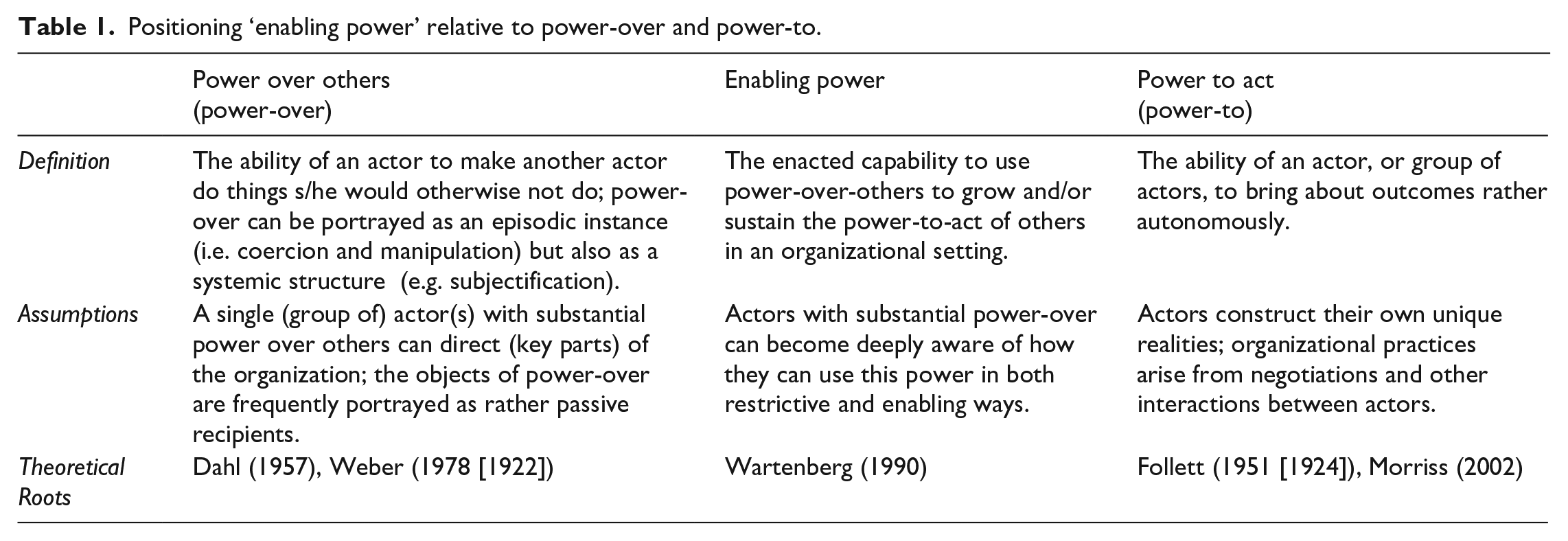
Whereas the vast majority of scholars exclusively draws on power-over (e.g. Dahl, 1957; Lukes, 2005; Weber, 1978 [1922]) and/or power-to notions (e.g. Arendt, 1958; Searle, 2007), an alternative perspective has been emerging. This alternative discourse explores how actors with power-over can increase the power-to-act of others, by enabling them to bring about outcomes rather autonomously (Hosking, 2011; Morriss, 2002; Pansardi and Bindi, 2021; Wartenberg, 1990). As such, this discourse deliberately seeks to connect the power-over and power-to perspectives (Clegg, 1989; Giddens, 1984; Haugaard, 2012, 2020; Morriss, 2002) by conceptualizing power as a force that is (potentially) enabling in nature. Power is then conceived as a constructive force that does not (overly) restrict others, but instead enables actors to take action and bring about outcomes. We define enabling power therefore as the enacted capability to use power-over-others to grow and/or sustain the power-to-act of others in an organizational setting. A key assumption made in the discourse on enabling power is that actors with substantial power-over can become deeply aware of how they can use their power in both restrictive and enabling ways (Haugaard, 2020; Van Baarle et al., 2021; Wartenberg, 1990). Table 1 outlines how the construct of enabling power is positioned in the broader literature.
Positioning ‘enabling power’ relative to power-over and power-to.
Enabling power: Toward an integration of various discourses
The PO literature has identified several key properties of enabling power. For instance, Morriss (2002) refers to an actor’s generative ability to bring about outcomes rather autonomously. Others highlight its relational and processual nature (e.g. Clegg, 1989; Follett, 1951 [1924]; Foucault, 1998; Hosking, 2011). Some authors have also highlighted the key transformative role of powerful actors, because asymmetrical power relations do not necessarily equal domination (e.g. Arendt, 1958; Haugaard, 2020); these actors can thus use their position in an empowering and transformative manner (Morriss, 2002; Wartenberg, 1990). The intertwined nature of enabling power, power-to and power-over implies they are often hard to disentangle, and all have constraining as well as emancipating properties (see Clegg, 1989; Haugaard, 2020). Power in organizational settings is therefore best conceived as multi-dimensional, that is, the enabling and restrictive dimension are likely to be distinctive aspects of a unified concept of power (e.g. Clegg, 1989; Foucault, 1998; Giddens, 1984). Table 1 decomposed the generic concept of power into its restrictive (i.e. power-over), self-determined (i.e. power-to) and enabling dimensions, with enabling power explicitly intertwining the two others. However, the existing body of literature on power is rather fragmented and not instrumental in guiding powerful actors in how they can apply their authority, status, and other sources of power in enabling ways; in other words, the wheelwork by which key actors produce effects such as empowerment or emancipation is not known.
In this respect, the PO literature has focused on identifying the disempowering consequences of power (e.g. Barker, 1993; Costas and Fleming, 2009; Ezzamel and Willmott, 1998), but several authors have advocated the need to move beyond mere intellectualism, calling for more engagement with managers instead of merely criticizing them, in order to promote a more equal distribution of power (Cabantous et al., 2016; Spicer et al., 2009). This point is especially articulated by scholars in the ‘critical performativity’ stream in the PO literature (Spicer et al., 2016). Accordingly, PO scholars increasingly acknowledge the importance of developing interventions for OC (King and Land, 2018), but this discourse has thus far remained rather theoretical (Leca and Barin Cruz, 2021). It includes extensive conceptual discussions on, for instance, the assumptions behind performativity (e.g. Learmonth et al., 2016; Spicer et al., 2016) defined as doing things with words (Austin, 1975), how this concept could be relevant for leadership (Alvesson and Spicer, 2012), and corporate social responsibility (Wickert and Schaefer, 2015). In other words, an overview of what types of actions and mechanisms foster enabling power and its intended outcomes (see Huault et al., 2017; Learmonth et al., 2016) is missing in the discourse on critical performativity and the PO literature more broadly.
As our review thus far shows, the PO literature is not intervention-oriented, yet emphasizes the importance of engaging with practitioners and fostering outcomes of enabling power (e.g. Morriss, 2002; Spicer et al., 2016). To fill this gap, it makes sense to integrate the PO literature with studies in OC and OB that focus on interventions and outcomes of enabling power. Interestingly, the OC literature provides many examples of interventions aiming to increase the power-to of others (e.g. Bartunek et al., 2011; Hosking, 2011; Schein, 1987). Additionally, the OB literature addresses relevant topics such as empowering leadership, (structural) empowerment, and voice (e.g. Maynard et al., 2012; Mills and Ungson, 2003; Morrison, 2014). Moreover, the OC and OB literature may be more appealing to actors in power-over positions (e.g. executives and consultants), because the jargon prevailing in this literature is more familiar to them.
In the remainder of this article, we therefore seek to integrate the PO, OC, and OB literatures to dissect the construct of enabling power in the underlying social mechanisms as well as the actions and outcomes associated with these mechanisms.
Method
We adopted an integrative review approach (Cronin and George, 2020) to assess and synthesize a set of publications distributed across various literatures and thereby create a deeper understanding of enabling power. The integrative review approach involved three steps; a more comprehensive description is included in the supplemental material. Step 1 involved a preliminary search, informed by the question as to what we can learn from the extant literature about practices involving both power-over and power-to. We discovered that few studies in this area have been conducted.
In step 2, we therefore redirected the review process toward enabling power as an emerging construct (Clegg et al., 2006; Haugaard, 2020; Morriss, 2002; Pansardi and Bindi, 2021). We thus extended the first step with snowballing techniques. Various sources identified were found to be part of a larger set of publications, implying we also reviewed several related publications connected to these initial sources. Eventually, this resulted in a total selection of 188 publications. The supplemental material includes a detailed overview of the distribution of these publications across the PO, OC, and OB literatures.
To synthesize these publications into a coherent framework, we adopted a mechanism-based perspective (Van Burg and Romme, 2014) in step 3. This perspective is instrumental in distinguishing the social mechanisms that drive enabling power from the actions that trigger these mechanisms as well as the outcomes arising from them (Denyer et al., 2008; Tanskanen et al., 2017). Actions (incl. ‘interventions’) refer to the practices that powerful actors have at their disposal to attempt to activate enabling power (e.g. OC practices). Mechanisms involve the wheelwork by which actors produce an effect, that is ‘a set of interacting parts—an assembly of elements producing an effect not inherent in any one of them’ (Hernes, 1998: 74). Thematic analysis was used to cluster the various actions and mechanisms into meaningful categories. Two researchers independently coded 40 of the 188 articles for themes, qualified as either actions or mechanisms, starting with first-order constructs and subsequently also resulting in higher order themes. Any disagreements were discussed, leading to a coding scheme (included in the supplemental material) that served as the basis for coding and categorizing the remaining studies. The supplemental material includes a detailed table that outlines the coding results for all publications reviewed.
Findings
Actions associated with enabling power
To develop an understanding of how enabling power fosters specific organizational outcomes, studies of OC were reviewed to uncover what type of actions give rise to organizational outcomes such as employee empowerment and voice. Additionally, PO studies provide an understanding of actions contributing to emancipation. To distill relevant actions from the literature, we draw on the key properties of enabling power outlined earlier. We thus identify four clusters of actions: participatory processes, empowering organizational structures, autonomous action, and transformative power practices. Each of these clusters involves actions that key actors can draw on to alter existing organizational practices.
Participatory processes
More power-to may be accomplished by initiating participatory processes. The literature on planned OC suggests that the active engagement of actors in dialogue is instrumental in tapping into their generative (power-to) potential (Bushe and Marshak, 2009; Löhr et al., 2020). OC interventions such as Large-Scale Interventions (Bartunek et al., 2011) and Dialogic Organizational Development (Bushe and Marshak, 2009) deliberately seek to empower a diverse set of organizational actors by engaging them in change processes. Many OC approaches are future oriented, based on the assumption that a focus on future possibilities generates more energy than a focus on solving problems (Bunker and Alban, 2006; Bushe and Paranjpey, 2015; Weisbord and Janoff, 2010). However, participatory change interventions are not restricted to imagining the best possible futures but can also be used to address more immediate challenges (Bartunek et al., 2011); examples are Open Space (Owen, 2008) and World Café (Löhr et al., 2020).
Although change interventions are more likely to be initiated by practitioners, scholars can facilitate them. In this respect, three types of participatory research appear to be relevant. First, action research is generally viewed as a democratic and participative approach that aims at creating knowledge with, rather than about, actors (Johansson and Lindhult, 2008). This approach focuses on developing a change capability within the organization. It seeks to empower a broad set of actors by collaborating on an issue that is of general concern to them, as opposed to managerial agenda-setting (e.g. Coghlan and Shani, 2015; Johansson and Lindhult, 2008). Examples of action research are Lüscher and Lewis (2008) who set out to both enable and study actors’ sensemaking, and Pradies et al. (2021) who engaged in an action research cycle that empowers actors to deal with various competing demands.
A second form of participatory research is intervention research, which draws on the assumption that in-depth knowledge of human systems can only be advanced by trying to change these systems (Schein, 1987; Starbuck, 2003). This type of research implies experimentation and intervention in real-life organizations (Starbuck, 2003) and aims to empower actors to overcome the complexities they face and simultaneously develop knowledge on these complexities. In these studies, an intervention research strategy (e.g. Lee et al., 2020; Oliva, 2019) is adopted to produce knowledge in the service of action (Simon, 1996 [1969]). Intervention research facilitates people in acquiring skills that enable them to improve their working conditions (e.g. Lee et al., 2020). Whereas this approach primarily involves intangible knowledge creation, it may also include efforts co-create and evaluate artifacts such as software (Sein et al., 2011).
Third, responsive evaluation is a participatory approach to evaluate organizational policies, programs, or practices (Abma, 2006). Various actors with different and/or competing interests are invited to contribute to all phases of the evaluation process, that is, formulating questions, selecting participants, and interpreting the findings (Abma, 2006). This approach deliberately seeks to equalize power differences between actors (Lincoln, 1993).
Empowering structures
Another way to increase the power-to in organizations is adopting empowering structures. In extreme cases, organizations are designed as co-operatives collectively owned and controlled by the workers (Kociatkiewicz et al., 2021). More common designs incorporate a formal decentralization of power, such that decisional power is systemically granted to employees (Mills and Ungson, 2003). In this respect, circular organization designs—also known as sociocracy and holacracy—are increasingly adopted (Robertson, 2015; Romme and Endenburg, 2006). Case studies of organizations adopting this type of design suggest that major forms of empowerment can be achieved (e.g. Romme and Endenburg, 2006). For example, these designs appear to enable employees in voicing their concerns and ideas directly to the CEO and non-executive directors, but only when these top managers together with the company’s shareholders adopts a power structure in which (representatives of) employees and managers, in so-called circles, together decide on the boundaries within which managers operate. Here, circularity refers to the process of continually switching between the (power-over) practice of managing operations and the (power-to) practice of team decision-making (Romme and Endenburg, 2006).
Transformative power acts
The behavior of powerful actors is a critical factor in empowerment and emancipation. For instance, whether employees speak up or remain silent depends on, among others, the voice climate (Frazier and Bowler, 2015) and employees’ expectations of whether speaking up is likely to bring about change (e.g. Morrison, 2014). However, Wartenberg’s (1990) notion of transformative power (1990), referring to how powerful actors can increase the power-to (e.g. speak up) of others, has hardly been used explicitly (an exception is Van Baarle et al., 2021). Nonetheless, certain types of leadership can be associated with this notion: examples include relational and reflexive leadership (Cunliffe and Eriksen, 2011; Eriksen, 2012), shared leadership (Wang et al., 2014), empowering leadership (Cheong et al., 2016), and servant leadership (Van Dierendonck, 2011).
Influencing others is a core activity of powerful actors, one that contributes to their effectiveness as leaders (e.g. Pfeffer et al., 1998). The traditional definition of (managerial) influence activity involves the attempt by actors to get things done their way (Lueger et al., 2005). However, one can also influence others by means of nudging, that is, altering ‘people’s behavior in a predictable way without forbidding any options or significantly changing their economic incentives’ (Thaler and Sunstein, 2009: 6). Nudges have been used to facilitate actors’ communication with governmental agencies (Sunstein, 2014), but can also be observed in managerial and organizational settings, in the form of interventions that facilitate (voluntary) participation. Participation in this type of intervention is not formally rewarded or monitored (Boiral and Paillé, 2012). Yet, several studies suggest that one can deliberately create a climate that nudges (at least some) actors to participate and speak their minds (e.g. Detert and Treviño, 2010; Frazier and Bowler, 2015).
Autonomous action
Restrictive power-over can never be completely secured, because of the agency dimension (Clegg, 1989; Reed, 2006). Self-determination theory posits that some types of behavior might be driven primarily by ‘controlled’ motivation, activated by contingencies external to the individual, while others are stimulated by ‘autonomous’ motivation (Vough et al., 2017). The latter implies a sense of choice and volition (Gagné and Deci, 2005). Consequently, controlled motivation is mainly associated with power-over, while autonomous motivation enhances empowerment and emancipation. In this respect, many studies draw on the idea that actors driven by autonomous motivation contribute positively to outcomes such as mutual learning and help among employees (Edmondson, 2003b), organizational development efforts (Bushe and Marshak, 2009), and speaking up about major issues (Morrison, 2014). Other work emphasizes the ability of actors to act and decide rather autonomously—also without being invited to so—regardless of any change initiatives or other forms of external motivation (Gagné and Deci, 2005). For example, autonomous action can enhance and sustain the ability to improvise (Cunha et al., 1999).
Autonomous action may also present itself as resistance, that is, the act of refusing power-over (Fleming and Spicer, 2003). Resistance can arise in the form of actors struggling to maximize or safeguard their power-to (Courpasson, 2000), protect their identity (Harding et al., 2017), and/or escape from other forms of managerial control (Alvesson and Willmott, 2002). An important stream of literature seeks to uncover alternative practices for self-creation, other than those in which actors’ identities are subjectified by systemic power-over (Munro, 2014: 1129). Foucault (1997: 292) argues that power relations are always present in producing or shaping subjects, yet he also suggests ‘these power relations only seem possible insofar as the subjects are free’ that, in turn, implies the possibility of ethical organizational practices. These ethical practices arise from becoming aware of, fostering, and increasing this (relative) freedom; they involve creating spaces and providing techniques to reflect upon oneself, the power relations one is involved in, and attempts to intervene in these complex phenomena (Iedema and Rhodes, 2010; Munro, 2014; Van Baarle et al., 2018).
These actions all qualify as enabling power practices, because they increase the generative (power-to) capabilities of the actors involved. Many participatory changes and/or autonomous actions initially emerge (partly) below the radar of the top echelon (Courpasson, 2000; Courpasson et al., 2016; Ford et al., 2008) but at some point in time, these initiatives need (full) ratification from the top level; that is, some form of enabling power is necessary to sustain these actions. The other two actions, empowering organizational designs and transformative power acts, arise by definition from the purposive acts of those in charge—and can thus be conceived as more explicit instantiations of enabling power.
Social mechanisms of enabling power
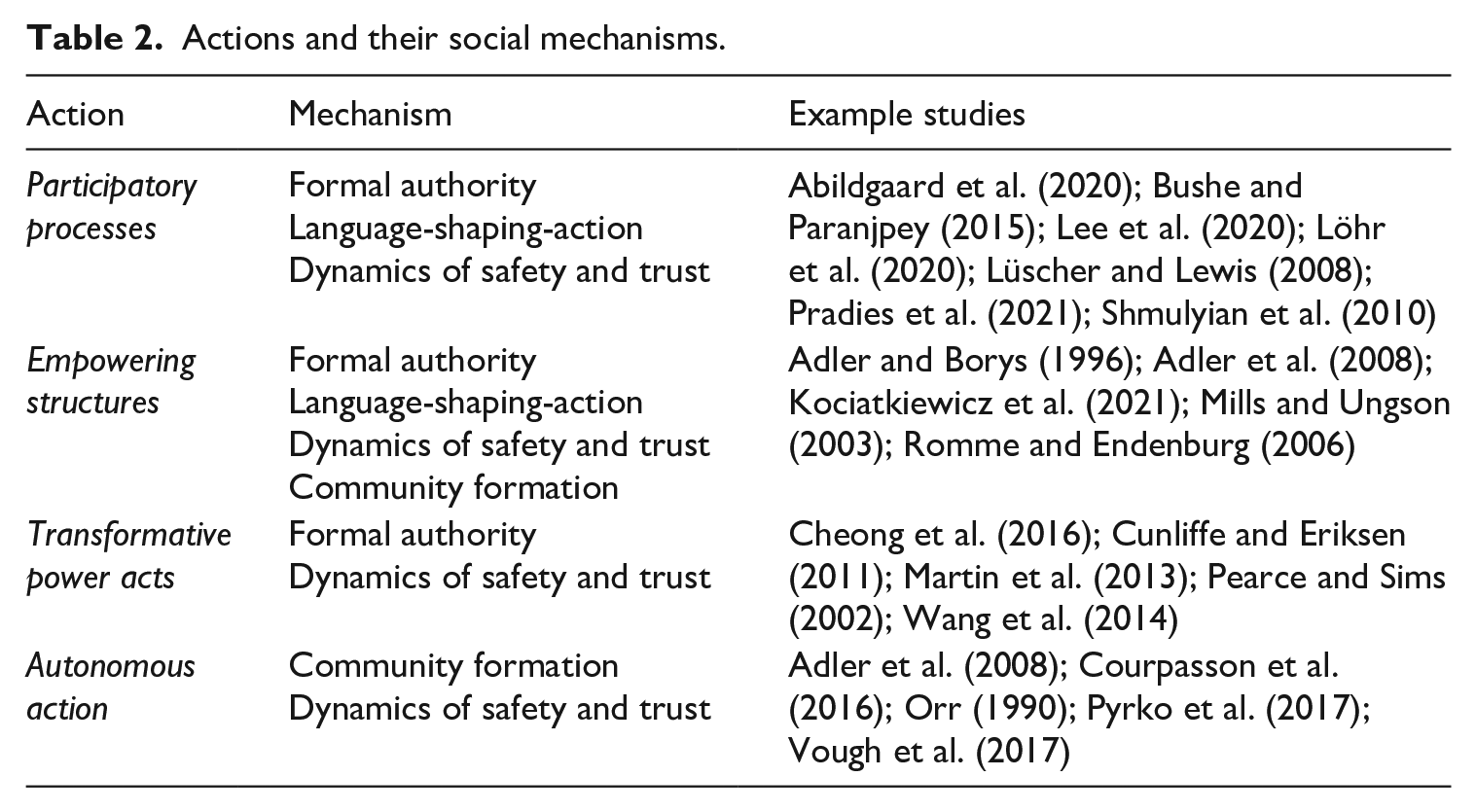
The various actions associated with (elements of) enabling power, described thus far, apparently draw on a small number of social mechanisms. More specifically, our review suggests that formal authority, language-shaping-action, community formation, and dynamics of safety and trust operate as the key mechanisms. Table 2 provides an overview of the mechanisms underlying each of the four action types reviewed. In the remainder of this section, each mechanism is explored more extensively.
Actions and their social mechanisms.
Formal authority
Formal authority, predominantly conceptualized as legitimate power-over, is a prevailing mechanism within many organizational hierarchies (Bourgoin et al., 2020; Clegg, 1989). Interestingly, the mechanism of formal authority has restrictive as well as emancipatory effects (Haugaard, 2020). A chain of formal authority levels serves to create and coordinate a horizontal as well as vertical division of activities (Adler, 2001; Simon, 1996 [1969]). As such, each agent in this chain is restricted to act and decide within the boundaries set, and agents with higher-level authority can impose sanctions on subordinate agents that act outside the domain of authority delegated to them (Bencherki et al., 2019; Simon, 1996 [1969]). The work of Arendt, Follett, Haugaard and Wartenberg (discussed earlier) suggests that differences in formal authority do not necessarily imply domination or restrictive power-over. Several empirical examples demonstrate that the formal authority mechanism can also reflect an enabling perspective on power. First, various studies show how formal authority can be delegated and cascaded through the organizational hierarchy, to empower lower-level employees in making decisions and solving problems (e.g. Levinthal and Workiewicz, 2018; Mills and Ungson, 2003). Accordingly, organizational chains of formal authority are not necessarily coercive or restrictive, but can also be enabling toward employees (Adler and Borys, 1996; Romme, 2019). In sum, the mechanism of formal authority can operate in restrictive as well as enabling ways.
Language-shaping-action
Broadly defined, language-shaping-action refers to the generative potential of interaction via spoken and/or written words (Taylor and Van Every, 2000). This implies that, words can actually do things—that is, they constitute organizational realities (e.g. Cooren, 2004; Ford and Ford, 1995). In this respect, Weick et al. (2005: 409) argue organizations are literally ‘talked into existence.’ For instance, actors engage in ongoing interactive processes to make sense of novel, unexpected or confusing events (Maitlis, 2005; Weick, 1995). Planned OC initiatives also trigger this type of interaction (Balogun and Johnson, 2005; Bartunek et al., 2006). For instance, Lüscher and Lewis (2008) demonstrated that their participatory research approach enables sensemaking (see also Pradies et al., 2021). Participatory interventions and research approaches create organizational settings that foster different narratives and increase (generative) ambiguity (Maitlis, 2005; Weick, 1995). In this respect, language appears to be the mechanism driving intentional change (Ford and Ford, 1995), whereas the performative power of sensemaking ‘comes both from a process of textualization by which organizations are stabilized as recognizable actors, and a process of conversation by which organizations are accomplished in situ’ (Gond and Cabantous, 2015: 512; see also Cooren, 2004).
Community formation
Unlike the formal authority mechanism, a community arises from informal ties between organizational actors (Adler, 2001; Wenger, 1999), involving spontaneous processes of people getting together, based on a mutual interest in specific challenges or topics (e.g. Pyrko et al., 2017; Wenger, 1999). Community formation especially generates desirable outcomes when voices are sufficiently diverse. Accordingly, the diversity of voices and sources of knowledge appears to be a key driver of new action patterns, creativity, and actionable knowledge (Anderson, 1999; Ripamonti et al., 2016). Consequently, when the diversity of voices and/or sources of knowledge is too low, or there is not enough interaction among them, new patterns of action are not likely to emerge (Anderson, 1999; Weick, 1995).
Interpersonal dynamics of safety and trust
Table 2 implies that all actions have one mechanism in common: the interpersonal dynamics of safety and trust. This mechanism appears to enhance the generativity of the three other mechanisms. The literature here assumes that organizational settings contain spaces with properties that (fail to) facilitate new behavior and/or emergence of ideas (e.g. Bushe and Marshak, 2009; Löhr et al., 2020). Organizational spaces characterized by high levels of trust and psychological safety can be deliberately created (e.g. Lee et al., 2020; Smith et al., 2003) or emerge as a result of, for example, adjacent value systems (e.g. Courpasson et al., 2016). In this respect, spaces characterized by a high level of interpersonal trust (McEvily et al., 2003) and psychological safety (Edmondson, 1999) positively affect organizational performance and other organizational outcomes (e.g. Detert and Burris, 2007; Kramer, 1999). While psychological safety and trust are conceptually distinct constructs, as social mechanisms they both refer to interpersonal perceptions of risk and vulnerability as well as expectations regarding the consequences of specific types of (e.g. speaking up) behavior (Edmondson, 2003a; McEvily et al., 2003). The individual intention to accept vulnerability can be based on more general expectations in dyadic relationships between actors (Rousseau et al., 1998) or specific group-level expectations that it is safe to make mistakes or hold deviant opinions (Edmondson, 1999). The interpersonal dynamics of safety and trust do not imply that organizational spaces should ideally be free from tensions, pressures, or problems. Rather, these spaces enable the ‘early prevention of problems and accomplishment of shared goals, because people are less likely to focus on self-protection’ (Edmondson, 2003a: 244). A virtuous dynamic pattern of trust and safety makes people feel empowered to speak up (Frazier and Bowler, 2015) rather than being silenced (Morrison and Milliken, 2000).
Potential outcomes of enabling power
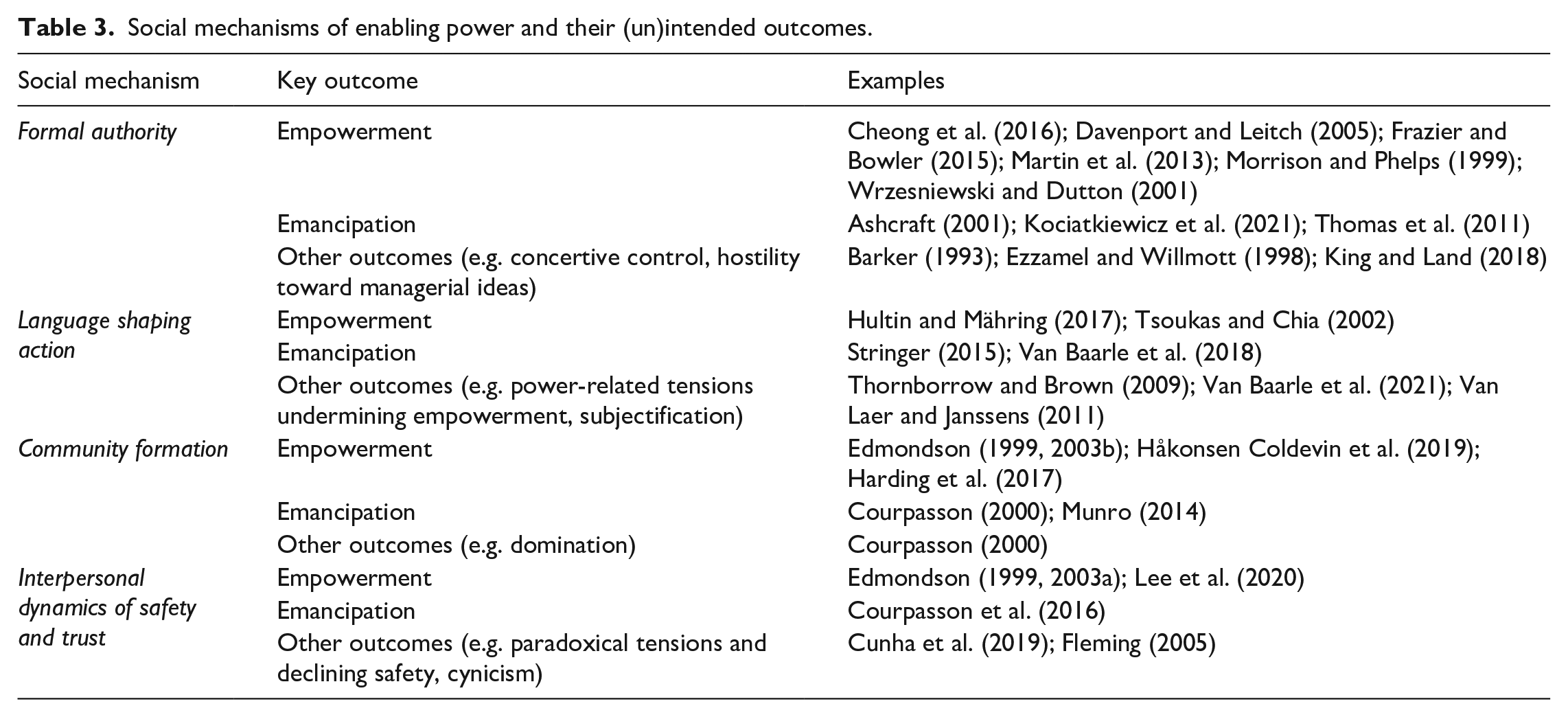
The various actions associated with enabling power may have different outcomes. To better understand how enabling power fosters desirable outcomes (or fails to do so), we now discuss some of the outcomes relevant to the current discourse on empowerment (Maynard et al., 2012; Sharma and Kirkman, 2015) and emancipation (Alvesson and Spicer, 2012; Spicer et al., 2016). Table 3 provides an overview. Notably, the four mechanisms outlined earlier can also generate other outcomes, which are beyond the scope of this review; for example, enabling power very likely also impacts innovation (Christensen, 2013), creativity (Carlsen et al., 2020), and resilience (Stoverink et al., 2020).
Social mechanisms of enabling power and their (un)intended outcomes.
Empowerment
Empowered actors have been observed to display increased levels of self-determination (Maynard et al., 2012; Romme, 1999). Empowerment is frequently described as an umbrella concept that can refer to a motivational construct (Clegg et al., 2006), aspects of personal growth or professional development, and driving authority down the administrative hierarchy (Maynard et al., 2012; Mills and Ungson, 2003).
The mechanism of formal authority appears to foster desirable outcomes for subordinate actors. For instance, participatory changes and shop floor initiatives deliberately supported by the top level may grow employees’ self-confidence about their ability to get things done (Latham et al., 1994) and increase employees’ power-to-act by stimulating proactive behavior (Morrison and Phelps, 1999; Wrzesniewski and Dutton, 2001). Other studies observed how the mechanisms of community formation and interpersonal dynamics of safety and trust increase a team’s power-to, learning and performance (Detert and Burris, 2007; Edmondson, 1999; Edmondson et al., 2001). Actions triggering the mechanism of language-shaping-action appear to invite the less powerful to engage in conversations about change (Ford and Ford, 1995; Thomas et al., 2011). A common factor in various participatory approaches is that less powerful actors become deliberately engaged in collective sensemaking. By doing so, their ideas and experiences become part of the change narratives about desirable organizational futures (Balogun and Johnson, 2005; Morrison and Milliken, 2000). As such, the organizational changes resulting from these sensemaking processes are ‘multi-authored’ (Buchanan and Dawson, 2007: 69) and hence likely differ from the initial intentions of those in charge (Weick, 1995). However, the robustness of the existing body of evidence on change interventions has been severely questioned (Barends et al., 2014; Bartunek et al., 2011), so one needs to be very careful in making any definite claims.
Emancipation
Scholars in PO tend to be skeptical about top-down change and empowerment (Alvesson and Willmott, 1992; Barker, 1993; Willmott, 1993). Whereas many scholars mentioned previously under ‘Empowerment’ are highly motivated to study it because of its potential benefits for organizational performance (e.g. Maynard et al., 2012), the PO literature instead focuses on improving the human condition (e.g. Parker and Parker, 2017): Emancipation describes the process through which individuals and groups become freed from repressive social and ideological conditions, in particular those that place socially unnecessary restrictions upon the development and articulation of human consciousness. (Alvesson and Willmott, 1992: 432)
Accordingly, PO scholars focus on values and outcomes such as democracy, autonomy, participation, equality, and solidarity (Huault et al., 2014; King and Land, 2018). Moreover, the means to realize these values are distinct as well. Whereas empowerment researchers tend to adopt a practical approach toward experimentation and learning-by-doing, PO studies primarily focus on emancipation by raising consciousness and reflexivity (Johansson and Lindhult, 2008).
Here, a distinction between micro-emancipation and macro-emancipation can be made (e.g. Huault et al., 2014). Macro-emancipation seeks to radically transform not only the workplace, but also society more broadly. For example, Munro (2014: 1127) investigates how social movement organizations act as emancipatory sites where ‘novel organizational subjectivities and ethical practices’ are being created. Some argue this approach has fallen out of favor because it is a too grand intellectual endeavor, among other reasons (e.g. Alvesson and Willmott, 1992; Spicer et al., 2009; Wickert and Schaefer, 2015).
In contrast, micro-emancipation involves a more selective search for specific ‘loopholes’ in managerial control that may allow local and temporary forms of emancipation (Huault et al., 2014). Exemplary work in this area explores how professionals form a community (as mechanism) and develop strategies to obtain autonomy from managerial control (Courpasson, 2000). Other studies have identified resistance to change as a positive phenomenon facilitating OC (Courpasson et al., 2016; Ford et al., 2008; Thomas et al., 2011). Accordingly, resistance can be conceived as a resource that keeps a proposed change alive, with ‘resisters’ being strongly engaged and stimulating a generative dialogue (Ford et al., 2008; Thomas et al., 2011). Moreover, in a recent study of two co-operatives, empowering organizational designs appeared to make workers feel less estranged (Kociatkiewicz et al., 2021). A different stream of literature reports emancipatory outcomes from ethical practices in organizations (strongly resembling participatory interventions) that, in turn, appear to increase workers’ awareness about moral dimensions at work, their own judgements in these matters, and their attempts to act upon their own values; these three outcomes together contribute to achieving more equity in the workplace (e.g. Stringer, 2015; Van Baarle et al., 2018). In these various micro-emancipation studies, language-shaping-action operates as a key mechanism, in addition to community formation and interpersonal dynamics of safety and trust.
Unintended outcomes of enabling power
Notably, the synthesis of the literature thus far may underestimate various unintended and hidden outcomes. Table 3 therefore also refers to these outcomes. For example, when managers create a highly unsafe and distrustful setting, employees will fear and avoid speaking up and feel largely disempowered (e.g., Detert and Treviño, 2010; Edmondson, 1999). Other studies demonstrate how the same mechanism can simultaneously enable and restrict, that is, produce intended as well as unintended outcomes (e.g. Thornborrow and Brown, 2009). For instance, Courpasson (2000) shows how the mechanism of community formation contributes to professional autonomy; this study also demonstrates the pivotal role of community formation in managerial strategies that serve to dominate these professionals.
Furthermore, the pervasive ‘subjectification’ effect of systemic structures shaped and sustained by multiple actors at key positions (Munro, 2014) may inhibit any well-intended ‘enabling power’ efforts by a single actor. An example is Thornborrow and Brown’s (2009: 355) study of paratroopers in a military organization, which shows how these paratroopers are ‘manufactured’ in the context of a tight web of discursive constraints. Additionally, Van Laer and Janssens (2011: 1203) show how language shapes workplace discrimination in a subtle manner, involving ‘disempowerment through apparent empowering behavior’ (see also, Barker, 1993). Other studies have documented the substantial level of estrangement felt by workers in post-industrial workplaces, which arises despite managerial attempts to produce affective attachment through ideas such as teamwork, community, and empowerment (Costas and Fleming, 2009; Ezzamel and Willmott, 1998). In addition to these systemic forms of power-over estranging workers, (episodic) enabling power interventions may generate similar outcomes. For instance, interventions inviting employees and other less powerful actors to participate can trigger major tensions that negatively impact trust and psychological safety, give rise to high levels of cynicism, and thereby make these interventions fail (Cunha et al., 2019; Fleming, 2005; Van Baarle et al., 2021). These examples suggest that episodic instantiations of enabling power often run into insurmountable barriers in the form of systemic forms of power-over, despite the good intentions of the top managers involved.
Enabling power: An integrative framework and research agenda
An integrative framework of enabling power
The PO, OC, and OB literature together paint a fragmented picture of enabling power. Our review findings, synthesized in an integrative framework presented in Figure 1, serve to synthesize these fragmented elements of enabling power. More specifically, the interplay between actions, mechanisms, and outcomes in Figure 1 draws on the findings outlined in Tables 2 and 3. The action-mechanism-outcome lens, described earlier in this article, assumes that key actors with substantial power-over in the incumbent organization have some discretion to activate and leverage various mechanisms by means of specific actions. Consequently, this part of Figure 1 largely focuses on the episodic instances of enabling power, in terms of actions, mechanisms, and outcomes.
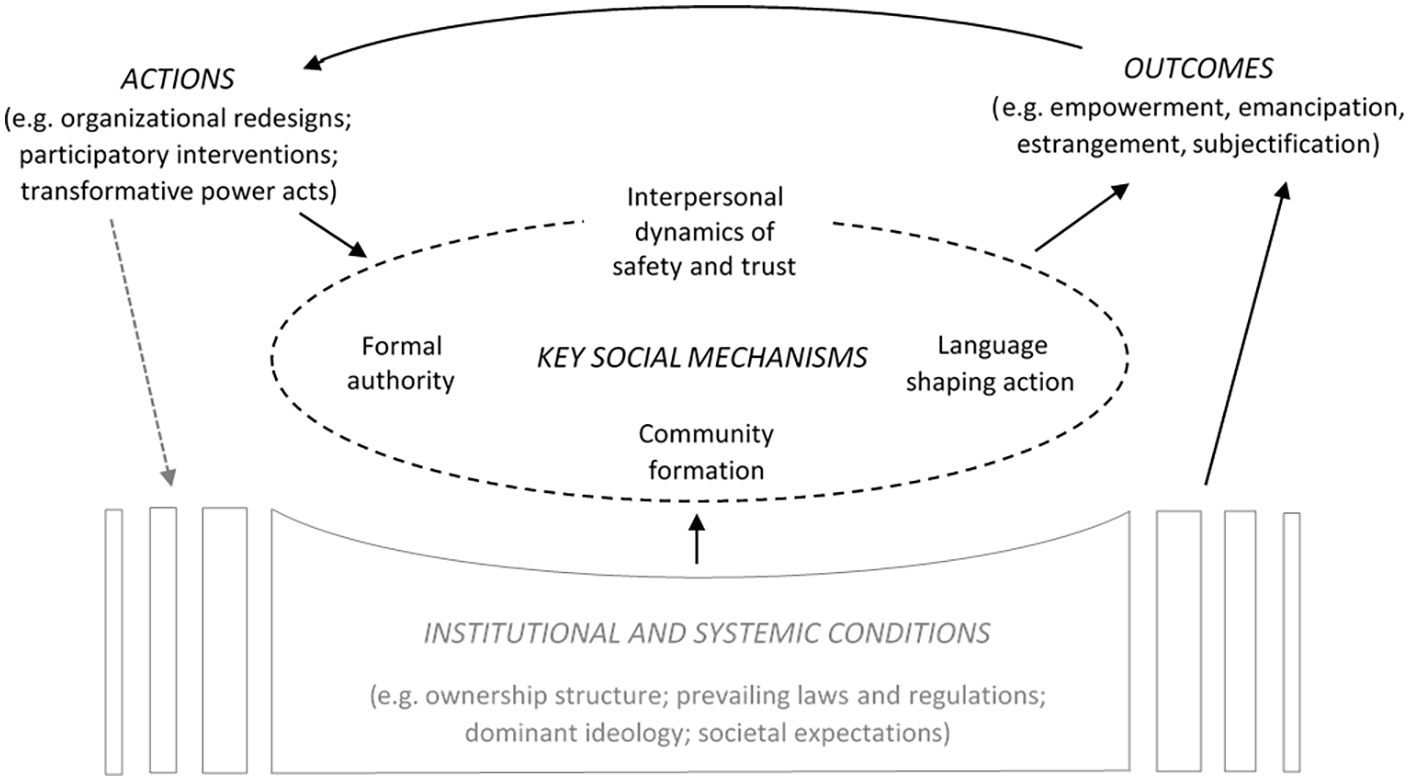
Integrative framework for studying the conditions, actions, mechanisms, and outcomes of (attempts to activate) enabling power.
At the heart of the figure are the four mechanisms inferred from the literature. Here, a core hypothesis arising from the previous section is that the interpersonal dynamics of safety and trust operates as the overarching mechanism, as it appears to reinforce formal authority (e.g. Edmondson, 1999), language shaping action (e.g. Frazier and Bowler, 2015) as well as community formation (e.g. Courpasson et al., 2016). Figure 1 also acknowledges that systemic conditions may have a potentially pervasive impact on the various mechanisms and outcomes. We have not focused on these conditions in our review, as signaled by the grey segment of Figure 1. The research agenda presented later in this section serves to flesh out the various opportunities for future work in this area.
Overall, the integrative framework outlined in Figure 1 connects various aspects of enabling power across different research domains and traditions. As such, this framework may constitute an essential steppingstone toward developing a more coherent body of knowledge on power as an enabling force. Moreover, it points at specific mechanisms and actions that can be used to encourage the development of enabling power practices. This integrative framework may also inspire (e.g. ‘critical performativity’) scholars that engage with practitioners to consider actions, mechanisms, and (un)intended outcomes beyond those typically addressed in their domain.
Research agenda arising from the integrative framework
Based on the framework outlined in Figure 1, a research agenda can be developed. We start by discussing the research opportunities arising from the key mechanisms identified. Next, we discuss several research challenges regarding the actions as well as the outcomes of efforts to activate enabling power. Furthermore, various research questions regarding the role and impact of systemic conditions are raised. Finally, we explore avenues for future research arising from the relationships between the components of the framework.
Mechanisms
The four mechanisms are at the center of Figure 1. These social mechanisms can be conceived as the ‘cogs and wheels’ (Hernes, 1998) of enabling power, through which both desirable and less desirable outcomes arise. Our synthesis of the literature, outlined in Table 2, suggests that the interpersonal dynamics of safety and trust operates as (a) the necessary mechanism for accomplishing any desired outcome (e.g. a substantial level of empowerment among employees) of enabling power interventions and (b) a pivotal mechanism that reinforces each of the other mechanisms. This central role of safety and trust dynamics needs to be further explored in empirical work. Interestingly, our review in the previous section is less clear on which combinations of mechanisms would constitute sufficient conditions for producing empowerment and/or emancipation. Accordingly, the conceptual framework in Figure 1 calls for empirical studies that help establish whether substantial outcomes can be realized by combining the interpersonal dynamics of safety and trust with only one, two, or all of the other mechanisms—community formation (e.g. Courpasson et al., 2016), formal authority (e.g. Edmondson, 1999) and language-shaping-action (e.g. Frazier and Bowler, 2015). This type of future work is especially promising if it develops an in-depth understanding of how these mechanisms interact over time.
Actions
The central role of power in OC is widely acknowledged, yet many questions and challenges remain (Bradshaw and Boonstra, 2004). For example, there is relatively little (deliberate) engagement with the notion of power in studies of empowerment (Maynard et al., 2012), participative change (Löhr et al., 2020), appreciative inquiry (Bushe and Paranjpey, 2015), and shared leadership (Wang et al., 2014). This raises questions about what exactly the kind of power is that these enabling power initiatives (seek to) capitalize on (Morriss, 2002). Figure 1 provides a conceptual framework of how various change interventions may lead to empowerment and emancipation, by activating (up to four) social mechanisms. As such, this mechanism-based perspective underlines the complexity and non-linear nature of OC. In addition, it raises questions as to when and how empowerment and other change initiatives will increase the power-to-act throughout an organization. Our synthesis of the literature in Figure 1 provides a framework that may guide future research in this area, by dissecting this challenge into more specific questions and empirical studies regarding the nature of actions and interventions, the (combination of) mechanisms activated, and intended versus realized outcomes.
Furthermore, to facilitate OC by means of enabling forms of power, one can add power-to practices (e.g., a participatory change intervention) to existing power-over practices in organizations (Hosking, 2011). However, the co-existence of these two practices may be rather complex. Powerful actors may feel they are giving up control and may not be willing to do so (Yukl and Fu, 1999) because they believe the actual power dynamics involve a zero-sum game. Here, more research is needed to understand how powerful actors can be motivated to conceive of (enabling) power as a non-zero-sum game. Moreover, actors willing to constructively use their formal authority may experience difficulties in switching between different power stances (Van Baarle et al., 2021). Consequently, future work can create a deeper understanding of how various actions and interventions drawing upon formal authority interact with (each of) the other three mechanisms.
Our review also suggests that power-over has constraining as well as emancipating properties (Haugaard, 2020; Wartenberg, 1990). Yet, most prior work on the interplay between enabling and restrictive power is conceptual in nature (Hosking, 2011; Pansardi, 2012; Parker and Parker, 2017; Spicer et al., 2009; Wickert and Schaefer, 2015). As such, a promising research avenue is to study the interactions between power-over and power-to in ‘well-balanced’ organizational systems (Haugaard, 2020: 20): can they be deliberately designed (Robertson, 2015); under what conditions can participatory interventions or new organizational forms give rise to a well-balanced system (Romme and Endenburg, 2006); and do these systems really enhance employees’ power-to? Additionally, when scholars emphasize the importance of speaking up in the context of safety and trust dynamics (Frazier and Bowler, 2015; Morrison and Milliken, 2000), they often fail to mention that speaking up takes place in highly constrained settings. This creates an interesting avenue for researching how and under what circumstances the dynamic interaction between various power practices within highly constrained settings becomes virtuous or vicious; in the former case, employees feel increasingly empowered to speak up (Frazier and Bowler, 2015), whereas in the latter setting they feel increasingly silenced and disempowered (Morrison and Milliken, 2000).
Outcomes
Regarding outcomes, the conceptual framework outlined earlier suggests two sets of research questions for future work. First, our review implies there is a disconnect between the discourse on voice and psychological safety as manifestations of empowerment (e.g. Detert and Treviño, 2010; Edmondson, 1999) and the discourse on disempowerment and estrangement (e.g. Barker, 1993; Cunha et al., 2019; Kociatkiewicz et al., 2021). Evidently, this disconnect is not helpful in creating a coherent body of knowledge in this area. Therefore, the framework outlined in Figure 1 may provide common ground for scholars with different backgrounds in developing a body of knowledge about the (often highly antagonistic) outcomes arising from attempts to activate enabling power.
This especially calls for more process-oriented studies of enabling power. Empirical investigations drawing on a processual perspective are rather challenging because power dynamics are often subtle and implicit in nature (Foucault, 1979), but longitudinal process studies may help (further) identify the various instantiations of enabling power by uncovering the dynamic nature of ongoing negotiations, dialogues, and other power-related phenomena. Process-oriented research designs are also well-suited to capture the non-linear nature of interventions arising from the feed-back and feed-forward loops displayed in Figure 1. Process studies will also be instrumental in exploring the inseparable nature of restricting and enabling forms of power. A particularly promising approach here would be intervention-based research, as in-depth knowledge of organizational systems can often be better obtained if one deliberately tries to change them (Grant and Wall, 2009; Schein, 1987).
Second, outcomes of attempts to enable and enhance the power-to-act throughout organizations are likely to raise intended as well as unintended outcomes. However, (initially) unintended outcomes are not necessarily problematic. In this respect, complex phenomena such as ‘resistance’ to enabling power interventions may ultimately enhance employees’ power-to-act (Ford et al., 2008), because accomplishing empowerment and emancipation requires fundamental alterations in the discourse between the powerful and the less powerful (Ford and Ford, 1995; Weick, 1995). That is, there is a ‘creative potential to power-resistance relations as meanings are reordered’ (Thomas et al., 2011: 24; see also Mumby, 2005; Thomas et al., 2011), which opens up another promising research avenue.
Systemic conditions
The destructive or ‘dark’ side of power has received abundant attention in PO (Learmonth, 2005; Parker and Parker, 2017; Spicer et al., 2009). Each of the four types of actions identified in our review can have major unintended consequences (e.g. silenced employees, lack of psychological safety, destructive leadership) in Figure 1. Especially systemic forms of power-over may inhibit any well-intended attempt by central actors to enable and increase the power-to-act of others, as many studies have documented (e.g., Barker, 1993; Van Laer and Janssens, 2011). Future work should address these challenges by means of, for example, (micro-level) ethnographic studies that allow comparative analysis of the (systemic) conditions, actions, and outcomes of less successful versus more successful attempts to enable and enhance the power-to throughout organizations. This type of empirical work can zoom into the broader systemic settings in which managers and other change agents can effectively activate various mechanisms (e.g. safety/trust and community formation), but without simultaneously activating mechanisms (such as centralizing formal authority) that would undermine the intended outcomes. In this respect, the framework in Figure 1 suggests that a single change effort can have multiple effects and can thus be both empowering and disempowering, with virtuous as well as vicious effects arising over time. Other types of future work might therefore draw on multiple longitudinal case studies, to more deeply understand the dynamic complexity of change efforts informed by enabling power.
Relationships between mechanisms, actions, and outcomes
Some of the cause-effect relationships outlined in Figure 1 draw on a strong body of evidence, while others are backed up to a lesser extent by empirical data. For example, the relationship between participatory change interventions and the language-shaping-action mechanism is well established (Bushe and Marshak, 2009; Bushe and Paranjpey, 2015; Hosking, 2011). However, the ways in which participatory change interventions and similar approaches activate the formal authority mechanism are less well understood (Grant et al., 2008), providing a promising avenue for future research. Similarly, the extant literature underpins the relationship between autonomous action and community formation (Adler et al., 2008; Courpasson et al., 2016), but little is yet known about what kind of transformative power acts and empowering organizational designs may activate the mechanism of community formation (Edmondson et al., 2001).
We have also observed that systemic conditions may have a structural impact on the various mechanisms and outcomes (e.g. Munro, 2014). Systemic conditions such as ownership structure and prevailing ideology can be conceived as mechanisms themselves; but in Figure 1 we assume these external conditions are relatively stable over time, if not completely inert, at the level of a single organization or a relatively small group of organizations. Prior work suggests that some organizations may in fact be able to initiate major structural changes in the ethical and regulatory conditions they are facing (Munro, 2014; Romme, 1999), but these changes take a long time (e.g. decades) to accomplish and are thus rather exceptional. Figure 1 acknowledges these transformational opportunities via the dashed arrow from actions to (possible changes in) systemic conditions. The arrow running from these conditions to outcomes represents the (potentially) pervasive impact of the conditions, in the sense that empowerment and other intended effects of enabling power acts are reinforced (Romme, 1999) or, alternatively, completely undermined and flipped toward estrangement and similar outcomes (Barker, 1993; Cunha et al., 2019). Future research may uncover and/or develop systemic conditions fostering empowerment and emancipation.
Lastly, the impact that the outcomes of enabling power have on actions also provides several opportunities for future work. For instance, various studies study the outcomes of a single enabling power initiative or change project (e.g. Barker, 1993; King and Land, 2018). However, it is likely that the outcomes of these initiatives in organizational settings trigger new actions, either to reinforce intended outcomes or overcome unintended effects—which would be worthwhile studying. Moreover, complex changes such as empowerment or emancipation tend to be incompatible with large-scale change (Termeer et al., 2017; Weick and Quinn, 1999). Yet, large-scale changes that address complex social problems can be facilitated by accumulating ‘small wins’ (Termeer et al., 2017; Vermaak, 2013; Weick, 1984), which entails recasting ‘larger problems into smaller, less arousing problems, [so] people can identify a series of controllable opportunities of modest size that produce visible results and that can be gathered into synoptic solutions’ (Weick, 1984: 40). These ideas have thus far remained rather conceptual and future research may seek to uncover what actions are necessary to scale-up small (e.g. emancipatory) wins to large-scale OC.
Fostering engagement and social change as a key attributes of the framework
The framework summarized in Figure 1 also provides a foundation for developing intervention-oriented knowledge to foster social change and more humane managerial practices. Our integrative review extends a long-standing debate on how to increase the PO literature’s impact in promoting and developing more humane managerial practices (Fournier and Grey, 2000; Leca and Barin Cruz, 2021; Spicer et al., 2009; Wickert and Schaefer, 2015). In doing so, we deliberately stayed away from theoretical discussions about concepts and assumptions behind, for example, ‘critical performativity’ (e.g. Learmonth et al., 2016; Spicer et al., 2016) or the discourse on ‘influencing’ managers via management education (Fournier and Grey, 2000: 23). Instead, by focusing on actions, mechanisms, and outcomes, we seek to meet managers and other practitioners in their own arena. This type of scholarly engagement is highly complementary to educational efforts and is likely to give researchers direct access to practical settings where they can study the outcomes of participatory practices created to develop more humane organizations.
Conclusion
By reviewing and synthesizing a fragmented and diverse body of knowledge in the PO, OB, and OC literatures, this article develops an in-depth understanding of enabling power. The mechanism-based integrative framework constitutes the core contribution of this article and serves to guide both scholars and practitioners in better understanding enabling power, in terms of actions, mechanisms, conditions, and outcomes. It complements extant research that tends to mainly focus on the restrictive nature of power-over. In this respect, the framework presented in this article may serve as an antidote to mainstream conceptualizations of power in organizational settings. Moreover, this framework informs a research agenda for future work on the actions, mechanisms, and outcomes of enabling power. We hope this framework will help promote both cross-disciplinary and academia-practice collaborations and thereby create new avenues for research on power.
Supplemental Material
sj-pdf-1-hum-10.1177_00187267221128561 – Supplemental material for Power as an enabling force: An integrative review
Supplemental material, sj-pdf-1-hum-10.1177_00187267221128561 for Power as an enabling force: An integrative review by Steven van Baarle, Annelies SA Bobelyn, Sharon AM Dolmans and A Georges L Romme in Human Relations
Footnotes
Acknowledgements
We would like to acknowledge the editor and reviewers for their time and effort in reviewing our work. The reviews we received greatly helped us develop our paper. We would also like to thank Daniëlle Zandee, Pascale Le Blanc, and Daniel King for their feedback on an earlier version of this paper.
Funding
The author(s) received no financial support for the research, authorship, and/or publication of this article.

Supplemental material
Supplemental material for this article is available online.
References
Supplementary Material
Please find the following supplemental material available below.
For Open Access articles published under a Creative Commons License, all supplemental material carries the same license as the article it is associated with.
For non-Open Access articles published, all supplemental material carries a non-exclusive license, and permission requests for re-use of supplemental material or any part of supplemental material shall be sent directly to the copyright owner as specified in the copyright notice associated with the article.
