




Abstract
In this study, we explore how empowerment initiatives can be understood by drawing on key notions from the power literature. By conceptualizing empowerment as the transformation toward ‘power to’ by actively using ‘power over’, we uncover power-related dynamics and tensions arising from empowerment initiatives in ways that go beyond prior work. Our in-depth case study of an empowerment initiative in a military organization highlights the complex challenges that powerful actors face when attempting to enhance the power to act elsewhere in the organization. Our findings demonstrate how power-related tensions arise between and within actors, as actors combine and shift between different power practices. We find that power tensions are not merely relational in nature (i.e. between actors), but also arise when individual cognition differs from action. By showing how the interplay of different power practices may result in major tensions, our findings provide a new perspective on why organizational empowerment initiatives may produce unintended outcomes or even completely fail. Moreover, while power-over, power-to and transformative power practices are typically explored separately, this study is one of the first to shed light on the complex relation between these power practices, thereby examining them together. Finally, this study demonstrates how cross-fertilization between the empowerment and power discourses may advance both fields.
Keywords
Introduction
Many organizations have been adopting some form of empowerment, for example in employee participation programmes (Maynard, Gilson, & Mathieu, 2012), dialogic approaches to organizational development (Bushe & Marshak, 2009) and organizational changes that promote less hierarchy and more self-management (Lee & Edmondson, 2017). All these forms of empowerment are essentially about increasing the power to act throughout the organization. However, empowerment initiatives often fail to reach their intended outcomes (e.g. Lorinkova, Pearsall, & Sims, 2013; Sharma & Kirkman, 2015). In this respect, empowerment initiatives may give rise to cynicism (Brown & Cregan, 2008) and increase job-related tensions (Lee, Cheong, Kim, & Yun, 2017). Empowerment is also likely to generate tensions because key actors do not give up power, control and autonomy that easily (Yukl & Fu, 1999). These unintended outcomes may even reinforce the existing power balance, instead of transforming it (e.g. Bunderson & Boumgarden, 2009; Mulder, 1971).
In this study, we aim to explore these unintended outcomes of empowerment initiatives, by drawing on key notions from the power literature (see Boje & Rosile, 2001; Hardy & Leiba-O’Sullivan, 1998). We conceptualize empowerment as the transformation from ‘power over’ to ‘power to’, which serves to uncover power dynamics and tensions arising from empowerment initiatives in ways that go beyond prior work. In essence, empowerment initiatives can be conceived as efforts to strike a new functional balance between ‘power over’ and ‘power to’ (Clegg, Courpasson, & Phillips, 2006). Whereas power over others typically involves domination, coercion and/or manipulation, the power to act draws on the idea of self-determination (Göhler, 2009; Haugaard, 2012).
We therefore explore what kind of power-related tensions arise from empowerment initiatives by powerful actors, and how these tensions affect the empowerment efforts. To this end, we draw on an in-depth case study of a large military organization, in which senior executives try to introduce and enhance empowerment throughout the organization. Our findings illustrate how powerful actors actively (try to) transform their power practices, as they attempt to empower others. We show that individual actors’ preferences for a power practice (e.g. a preference for ‘power over’ practices), as reflected in their power stance, influence how these actors interpret and respond to empowerment initiatives. In this respect, power-related tensions emerge at two levels: between actors and within an actor. Between-actor tensions arise when some of the powerful actors attempt to transform power practices, while others adhere to more traditional and rigid ways of working. This finding extends insights obtained in previous studies of empowerment (e.g. Cheong, Spain, Yammarino, & Yun, 2016; Lee et al., 2017). Additionally, we identify within-actor tensions between an actor’s cognitive disposition and public behaviour, which have not previously been theorized in the empowerment or organizational power literatures. Cognitive disposition refers to what actors think they do or believe to be important, while their public behaviour refers to what they actually do and what others see them do. Notably, within-actor tensions may further fuel between-actor tensions, as they undermine efforts to transform power practices and enhance empowerment throughout the organization.
By showing how the interplay of power practices may result in major tensions, our findings provide a new perspective on why organizational empowerment initiatives produce unintended outcomes and may even completely fail (see Barker, 1993; Humborstad & Kuvaas, 2013; Lorinkova et al., 2013). This responds to recent calls to deepen our knowledge on the processes and complexities generating these outcomes (Cheong et al., 2016; Lee et al., 2017; Sharma & Kirkman, 2015). Moreover, power-over, power-to and transformative power practices have mostly been explored separately, and our study is one of the first to shed light on the complex relation between these three power practices in organizational life, by examining them together. Many authors have been recommending this inclusive approach (e.g. Haugaard, 2012; Pansardi, 2012). Lastly, this study contributes to research on empowerment and power by demonstrating how the cross-fertilization between these two (largely separate) literatures may advance both fields (see Boje & Rosile, 2001).
Theoretical Background
Empowerment in organizations
Empowerment can be seen as the process of driving authority and responsibility down the ladders of the organizational hierarchy (Maynard et al., 2012). The notion of empowerment in organizations can be traced back to the beginning of the twentieth century, when Follett (1918) raised the idea to develop organizations democratically, as places where powerful and less powerful actors learn together. Later work focused on, for instance, engaging less powerful actors such as employees (Lewin, 1947) and developing the quality of work life in organizations (Kanter, 1977). While empowerment may have had its ‘heyday’ in the 1990s (Hardy & Leiba-O’Sullivan, 1998), it is coming back into vogue, albeit in slightly different shapes and terminology: for instance, in terms of eroding hierarchies and the simultaneous rise of network-like ways of organizing (Cunha, Rego, & Clegg, 2011; Lee & Edmondson, 2017) and efforts to increase voice, engagement and participation of those with less power (Bartunek, Balogun, & Do, 2011; Bushe & Marshak, 2009). Yet, the core idea in all these approaches has remained the same over the years: empowerment is assumed to enhance performance, work attitudes and well-being of organizational actors (Hempel, Zhang, & Han, 2012; Wagner, 1994), by distributing the power to act within the organization. Accordingly, empowerment appears to positively influence various work-related outcomes such as task performance, job attitudes, citizenship behaviours, and creativity (Maynard et al., 2012; Sharma & Kirkman, 2015).
However, empowerment initiatives have also been associated with unintended outcomes (e.g. Cheong et al., 2016; Lee et al., 2017; Lorinkova et al., 2013). For example, the introduction of empowerment initiatives is often met with cynicism (Brown & Cregan, 2008; Labianca, Gray, & Brass, 2000), which may even reinforce the existing power balance rather than shift power toward those with less (Barker, 1993; Mulder, 1971). To better understand why organizational empowerment initiatives often produce unintended outcomes or even completely fail, we will conceptualize empowerment in terms of key notions and insights from the power literature (as advocated by Boje & Rosile, 2001).
Driving authority and responsibility down the ladders of the organizational hierarchy inherently involves some form of (re)distribution of power in organizations (Kanter, 1977; Maynard et al., 2012). The dominant conception of power in organizational life is ‘power over another’ (Clegg et al., 2006); this power-over is commonly conceptualized as a restrictive force, and often a synonym for domination (Göhler, 2009; Pansardi, 2012). In contrast, power can be conceptualized as a facilitative force, as power-to, which reflects the ability of an actor to bring about outcomes (Clegg et al., 2006; Morriss, 2002). As an alternative to using power to impose their will or ideas on others, powerful actors can also use power in a transformative manner, such that it increases the power-to of other actors, as can be the case in teaching or parenting (Allen, 1998; Wartenberg, 1990).
In this study, we therefore conceptualize empowerment as the transformation toward ‘power-to’ facilitated by ‘power-over’, which includes the practices that powerful actors use to increase the power to act by others in their organization. To better understand any tensions arising from empowerment, we thus need to explore how power-over, power-to and transformative power interact. The overarching research question in this paper, therefore, is: Which power-related tensions arise from an empowerment initiative by powerful actors, and how do these tensions affect the empowerment initiative?
In the remainder of this section, we first review the literature on previous conceptualizations and definitions of power-over and power-to. We then turn to various attempts to bridge these two concepts, especially focusing on (notions related to) transformative power, and conclude by revisiting our research question.
Power over others
Dahl’s (1957) definition of ‘power over’ has been very influential: ‘A has power over B to the extent that he can get B to do something that B would not otherwise do’ (Dahl, 1957, pp. 202–3). As of the 1960s and 1970s, several scholars set out to conduct empirical research on different facets of ‘power over’, which served to identify its various dimensions (Göhler, 2009; Lukes, 1974). In organizational settings, coercion and manipulation are frequently identified as two key (episodic) dimensions of power-over. Coercion refers to actors directly exercising power to achieve certain ends (Fleming & Spicer, 2014). Manipulation refers to power being exercised in order to limit what is discussed, that is, power as a force that shapes and restricts agendas (Clegg et al., 2006; Hardy & Leiba-O’Sullivan, 1998). A third, more systemic, dimension of power-over is domination, that is, any process in which actors influence others by constructing ideological values that become hegemonic (Fleming & Spicer, 2014). These three dimensions share Dahl’s underlying notion of A’s power to get B to do something that B would otherwise not do (Clegg et al., 2006).
Inspired by Foucault’s (1977, 1980) work, several scholars have been arguing that subjectification is another systemic dimension of power. Subjectification goes beyond domination, by shaping the subjectivities of subjects (Clegg et al., 2006; Hardy & Leiba-O’Sullivan, 1998) and determining ‘an actor’s very sense of self, including their emotions and identity’ (Fleming & Spicer, 2014, p. 244). Foucault’s work has inspired critical management scholars to study how, for example, a particular discourse serves to discipline the ways in which actors construct reality and engage in particular behaviours (Grant, Hardy, Oswick & Putnam, 2004) or how they are produced by a discourse (Huber & Brown, 2017; Thornborrow & Brown, 2009).
In sum, the various notions of power-over appear to assume that ‘having power’ is about prevailing over others (Göhler, 2009). Thus, the vast majority of the literature conceives of power-over as a relational concept that refers to the coercion, domination, manipulation and/or subjectification of others, rather than individual dispositions (Fleming & Spicer, 2014). As a consequence, the notion of power-over is relational and asymmetrical in nature, where one of the actors is able to execute more power than others (Göhler, 2009; Hosking, 2011; Morriss, 2012).
Power to act
The power to act involves the ability of an individual or group to act or decide rather autonomously (Hosking & Pluut, 2010). Similarly, Morriss (2002) defines power-to more concisely as the ability to bring about outcomes. The concept of power-to is embedded in a long research tradition (e.g. Arendt, 1958; Mary Parker Follett, 1918). One of the first authors with a strong interest in power-to was Follett (1918), who explored ways to democratize organizations in order to enhance learning and cooperation. She believed that people had to be able to execute power at the grassroots level and that society would flourish from doing so.
The power-to-act can be conceived as an individual concept, referring to the ability to act or decide autonomously (Göhler, 2009). More recently, the individual nature of power-to has been contested by those who believe it is a relational concept (e.g. Hosking, 2011; Pansardi, 2012). In this respect, all organizational members are considered to be key subjects in the power-to discourse. This serves to acknowledge multiple local realities of actors as well as to value the differences between these realities in non-hierarchical ways (Gergen, 1995; Hosking, 2011). Power-to can thus be conceptualized as the ability of an individual or group to act or decide rather autonomously, giving rise to practices that allow the construction of different local worlds (Hosking, 2011). These ideas strongly resonate with Follett’s work on empowerment.
Some scholars consider power-to and empowerment to be equivalent concepts (Clegg et al., 2006; Pansardi, 2012), even though most of the empowerment literature does not directly address any power issues (Boje & Rosile, 2001; Hardy & Leiba-O’Sullivan, 1998). Furthermore, a large part of the empowerment literature stems from psychology, drawing on motivational theories regarding job characteristics and self-efficacy (Maynard et al., 2012). Empowerment is thus conceived as a psychological phenomenon that involves individual-level effects of various types and facets of autonomy, but does not take into account any structural or relational dimensions (Stokes & Clegg, 2002). In this study, we intend to move beyond individual facets of autonomy, and focus on the tensions and potential complementarities between fundamentally different ways of engaging with power.
‘Power over’ and ‘power to’: toward transformative power
As our review thus far shows, power-to and power-over are generally regarded as two major but largely separate approaches to power in organizational settings (see Clegg et al., 2006). Despite various attempts to reconcile the two approaches conceptually (e.g. Allen, 1998; Haugaard, 2012; Pansardi, 2012), scholars have typically focused on either power-over (e.g. Fleming & Spicer, 2014; Thornborrow & Brown, 2009) or power-to (Labianca et al., 2000; Maynard et al., 2012). Some have explicitly acknowledged the need for organizational practices that involve both power-over and power-to (Hosking, 2011; Romme, 1999), yet more insight is needed to understand how these practices coexist and reinforce each other.
Interestingly, Wartenberg (1990) has argued that power-over can, besides being used to coerce, dominate or manipulate, also be used in other ways. For example, power-over can be used in a rather paternalistic manner, for example, when the subordinate actor is (perceived as) not able to judge his own interests rationally. Moreover, power-over can be used in an empowering and transformative manner (see also Allen, 1998; Morriss, 2002). In the latter case, the dominant agent ‘attempts to exercise his power in such a way that the subordinate agent learns certain skills that undercut the power differential between her and the dominant agent’ (Wartenberg, 1990, p. 184). As such, we consider transformative power as a distinct notion, on par with power-over and power-to. Interestingly, the introduction of transformative power as a separate construct serves to open up the dualism between power-to and power-over. These three notions may together help to make better sense of how powerful actors engage with various tensions and challenges in a given organizational system. Table 1 provides an overview of the empowerment phenomenon as well as the three core notions of power, in terms of their key definitions, assumptions and historical roots.
Definitions and assumptions regarding empowerment, power over others, power to act, and transformative power.
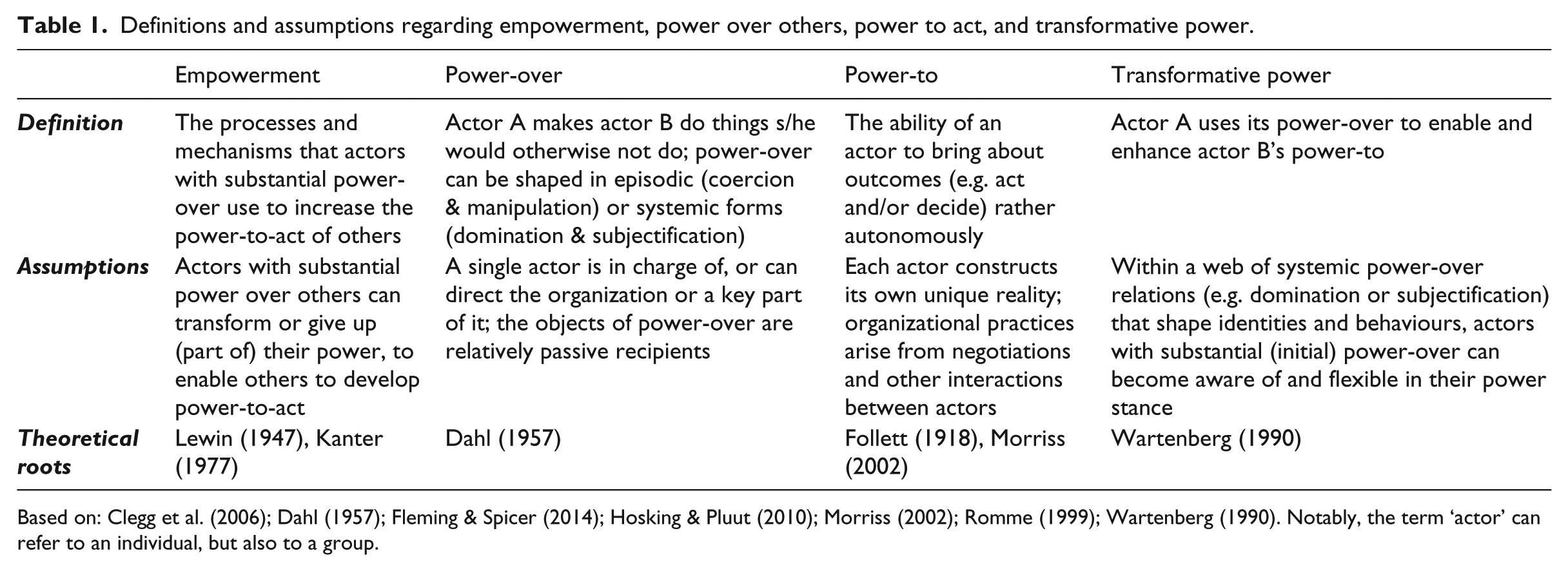
Based on: Clegg et al. (2006); Dahl (1957); Fleming & Spicer (2014); Hosking & Pluut (2010); Morriss (2002); Romme (1999); Wartenberg (1990). Notably, the term ‘actor’ can refer to an individual, but also to a group.
Notably, the various notions outlined in Table 1 are not mutually exclusive. For example, people with substantial power over others also tend to have a significant amount of power to act (while power-to does often not imply power-over), so power-over can be conceived as a subset of power-to. Moreover, the notions of empowerment and transformative power assume that someone is in charge, that is, has sufficient power-over that can be used to transform and enhance the power to act of others in the organization. Table 1 also demonstrates that empowerment and transformative power are highly similar constructs, with the former emphasizing the processes and mechanisms of enhancing power-to and the latter emphasizing the intentions of those in charge.
While many empowerment initiatives are taken to ‘open up power-to’ (Hosking, 2011, p. 60), in practice these initiatives are often closed down by way of power-over acts (e.g. Barker, 1993; Romme, 2015). In this respect, the notion of transformative power assumes that powerful actors can deliberately seek to enhance the power-to of others, whereas the power-over literature signals that any such transformation attempt is likely to run into many (covert) barriers and forces working against it. Such tensions have remained largely unaddressed in empirical work (Göhler, 2009; Haugaard, 2012; Hosking, 2011; Pansardi, 2012). Therefore, in the remainder of this study, we draw on the above notions from the power literature to explore what power-related tensions result from an empowerment initiative by powerful actors, and how such tensions may affect the empowerment initiative.
Method
Case selection and data
To answer the research question previously introduced, we draw on an in-depth case study in a large military organization. In this empirical setting, power practices can be studied in a rather straightforward manner due to the organization’s long tradition in command-and-control. The large military organization is part of the Dutch Armed Forces and employs over 5,000 people. Since 2011 the highest ranking actors in this organization have stressed the need for empowering military personnel in order to engage the complex challenges the organization is facing. To address these challenges, the generals leading this military organization tasked the leaders of key projects to empower and engage many employees in their projects.
We selected two specific projects, taking place in the same period, to collect narrative and other data. The first project, Newops, aims at developing and implementing a more advanced operational concept. The second project, Connect, aims at improving the agility of the organization, making better use of the potential of its personnel, and improving the connectivity between people in the organization as well as between the organization and its surroundings.
We collected three main types of data for both projects, covering a four-year period, supplemented with archival documents such as project papers, speeches and presentations for triangulation purposes.
Participatory observation
A primary source of data involves an extensive period of participatory observation (41 months in total), to gain insight into the dynamics and power practices within and around the two projects. One of the authors contributed as an insider-researcher as he has been employed in the organization for a long time and was thus able to work closely with the informants, resulting in many open talks and discussions. Being an internal advisor, he was asked to participate with an explicit focus on the organizational development aspects of the projects. He participated for 22 months in the Newops project, and subsequently in the Connect project for 19 months. He kept field notes (12 notebooks) and developed thick descriptions (33 pages) to describe and interpret critical incidents in and around these projects.
Semi-structured interviews
We also draw on the detailed accounts of key actors, obtained from 15 in-depth interviews with 11 informants. Three informants are senior executives: the highest ranked officers including a lieutenant-general and two major-generals, holding final responsibility for the entire organization and acting as either sponsor or principal of (one of) the projects. Five other informants were high ranking officers, from major-general to major, who served in one of the project teams. The three remaining informants, project team members, are civilian employees acting as specialist internal consultants responsible for the development and execution of the project. All informants have substantial power-over based on their position in the organization and their assignment to increase the power-to of others. Through participatory observation, we were able to identify different and sometimes opposing voices within each team regarding key decisions and challenges.
Focus group meetings and attendance in periodical meetings
The insider-researcher frequently attended meetings of a network of (team) coaches and change professionals in the organization. Additionally, two focus group meetings were organized to validate the themes, dynamics and patterns emerging from our initial analysis, from the perspective of practitioners that were (or had been) involved in a large number of other projects in the same organization.
Data analysis
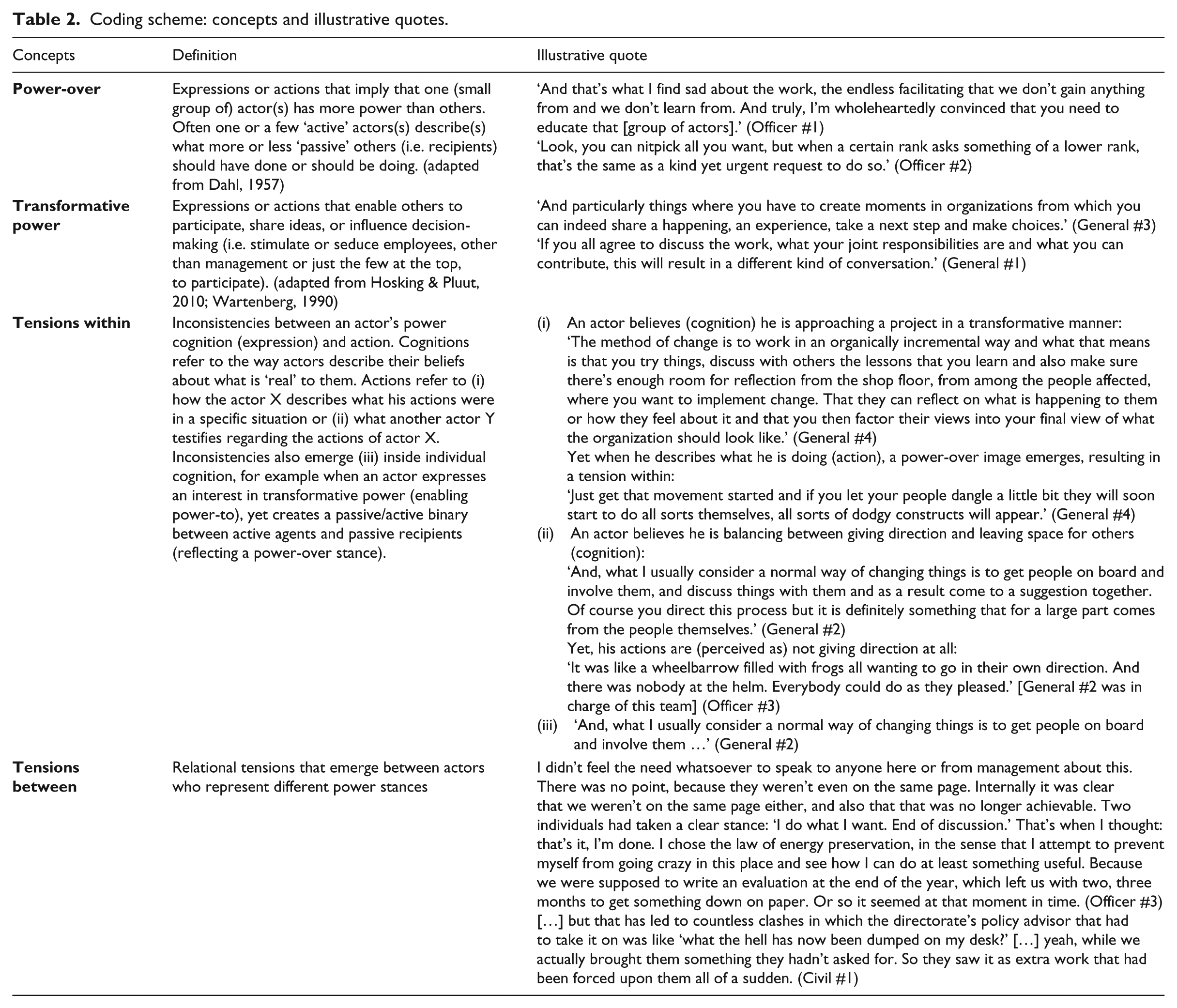
The data analysis consists of several steps, drawing on coding procedures developed by Miles and Huberman (1994). First, we analysed the field notes, thick descriptions and interview transcripts, using (first-level) open coding to explore power practices and dynamics in the two projects. Second, we used second-level codes to label power-over and transformative power acts and practices. The resulting patterns suggest that organizational actors typically have an individual power stance, representing their inclination (i.e. relative position) toward power-over or transformative power, as displayed in how they typically act or how they talk about what type of power they deem appropriate. Further analysis revealed that specific tensions emerge from the coexistence of, or shifting between, both power practices. Such tensions manifest themselves between and within actors, and were coded accordingly. The two focus group meetings served to further refine the coding scheme. Table 2 provides the final coding scheme, including definitions and representative quotes. A more comprehensive explanation of the methods used is available upon request from the authors.
Coding scheme: concepts and illustrative quotes.
Findings
This section describes the key findings. First, we portray the initial setting of the case organization, by describing the traditional use of power in this military organization and exploring what the empowerment initiative entails for this organization. Second, we show how each actor has an individual preference for a certain type of power practice, reflected by his/her power stance. Third, we identify two types of power tensions arising from the empowerment initiative. In particular, our data shows that tensions between actors emerge when both power-over and transformative power practices coexist. Subsequently, we demonstrate that the coexistence of, and shifting between, such power practices also leads to tensions within actors. Finally, we show how tensions within-actors fuel tensions between actors and ultimately undermine the empowerment initiative.
Traditional use of power and the empowerment ambition
Military organizations are traditionally characterized as authoritarian and control-oriented systems that leave little room for other organizational members to take decisions or provide input, as one of the generals in our study also observed: Defence is not an organization that has a change culture that really tries to involve people. Changes are often more or less imposed from above or, at least, really tightly controlled from above. (General #2)
In this organizational setting, power is traditionally considered to be something that only few actors have. Power can therefore be characterized as mono-vocal: only the voice of management counts, implying a strong power-over orientation. With regard to the Connect and Newops projects, senior executives had long been aiming for a different approach, by considering and embracing other voices than those of the executives themselves and the project leaders. Senior executives thus sought to enrich the repertoire with transformative practices that would enable power-to. This implied a more dynamic use of power practices in the organization combining both power-over and transformative power practices, in order to engage other organizational members in accomplishing the intended outcomes of the projects: I want to do the same as we’ve done in the past [embark in change efforts], but not in terms of power. Not in terms of structure. Not in terms of hierarchy. But in terms of work, because I think that we can be smarter in how we do it together. So, I think we should approach change differently in this organization. (General #1)
This is not to say that power-over practices would disappear; rather, they would get a different shape, implying that one proceeds: …. not in a forward march kind of way, but to discover the changes that others are going through. Discover the possibilities and lead people toward them. (General #3)
As such, the changes intended in this military organization were not about senior executives withdrawing from efforts to control the organization, delegating all responsibility, or transforming completely toward self-steering units. The intended shift toward empowerment was more subtle, involving both leading and directing (acts of power-over) as well as discovery and giving voice to others (acts of transformative power). Similar patterns can be inferred from data collected by the participant-observer: As long as I have been working here, more than ten years now, managers have asked me to act in ways to improve collaboration, develop processes so that people in other parts of the country can take part in the production of products and services that are normally only initiated by the senior executive office. Common phrases are ‘we need to engage with the people in the rest of the country’ or, when they refer to lack of collaboration within headquarters ‘we need to work in integral teams’. (Insider-researcher)
The intended transformation toward empowerment entails involving more people in key processes and policymaking. These ideas of empowerment had been discussed in the organization for quite some time, and were not limited to the two projects studied here. Senior executives strongly felt that with the prevailing power-over practices, and employees passively waiting for orders, the organization would no longer be able to face the complex challenges it was confronted with. This military organization is expected to respond adequately to, for example, terrorism, migration and natural disasters. As a result, it needs to be able to respond to continuous reprioritizing by the Dutch government and international (e.g. UN) bodies as well as collaborate in highly different and dynamic settings, both internally and externally. These challenges thus require different ways of engaging in decision-making and getting things done: It requires an organization in which as many employees as possible can think for the organization as a whole, see and understand what is going on, what needs to be done, and jump into action. So, self-managing teams are really key. Team members need to take responsibility and proactively negotiate about obtaining the right resources to get the job done. To me, this is not some sort of trick, it is a key enabler, and essential for us to continue fulfilling our duties in the future. (General #1)
The intended transformation was also observed at higher policy levels; for example, an internal memo about the desired leadership style within the Dutch Armed Forces states: Leading is strengthening the capability of a community to shape their own future.…Increasingly we choose inspiring over supervising, listening over sending, and connecting over convincing.
Hence, senior executives’ empowerment ambition implied a dynamic use of a broader set of power practices, including both power-to and transformative power. Yet, the data show considerable variation in terms of the type of power that senior executives deem right.
Actors’ relative power stances
A first key finding centres around the observation that each of the senior executives and project members has an individual preference for certain power practices: their power stance. An actor’s power stance may range from a strong preference for exercising power-over to a clear preference for enabling power-to (transformative power). It reflects how actors act (as observed by others) as well as how they think they act (as reflected by how they talk about their power actions). Figure 1 serves to map the relative power stances of actors along this power continuum. 1 Interestingly, when mapping the power stances of individual actors, it became apparent that how someone acted was often different from what this person believed and said about his or her actions, implying we needed to differentiate between action and cognition. Moreover, Figure 1 also serves to depict the differences between the actors’ power stances. In particular, potential tensions between (the power stance of) actors are likely to arise from the distance between the actors’ power stances; a relatively large distance reflects major differences in perspective. Tensions within actors are made visible in Figure 1 by mapping two individual power stance dimensions for each participant, cognition (C) and action (A), each involving a distinct miniature power continuum. If the two × marks for C and A are not aligned, this signals tensions within the actor.
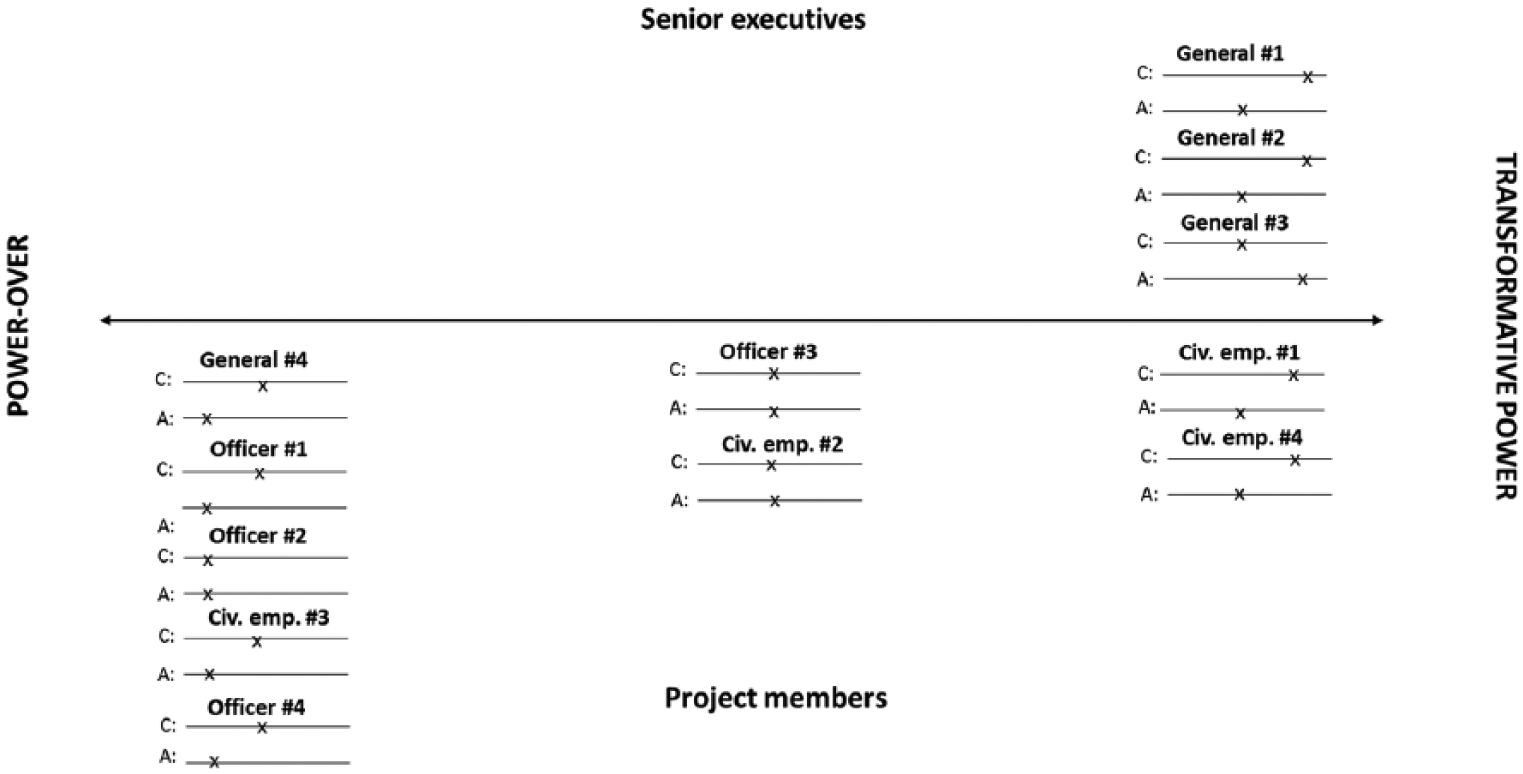
Positioning the informants’ cognitions and actions on the continuum between power-over and transformative power.
In the remainder of this section, we will elaborate the tensions between and within actors in more detail, including how they affect each other.
Tensions between actors
Here, we turn to how (relational) tensions between actors emerge at various levels in the organization. These tensions especially arise when some actors adopt a more transformative power approach toward the empowerment initiative, while others continue to draw on the power-over approach. One of the generals explained how Connect project members tried to sabotage his effort to use a more transformative approach (i.e. open dialogue) with his staff members: Well, I think the best example is when I wanted to go out and about to tell people where we are now, what’s happening, and not like ‘we’re going to do it like this’, but just where are we in the process and [ask others] ‘what do you think about what’s going on?’, and ‘have you got any questions?’, and stuff like that. People [members of the Connect project] tried to cancel that a few times when I wasn’t there, because I had a day off or something. Yeah, going out and about, that’s pretty scary, and what was I going to say, it wasn’t clear at all, and you could only tell people something once you knew exactly what was going to happen. (General #2)
An officer also recalled tensions in introducing more power-to practices, as these conflicted with the expectations of other organizational members acting on a power-over stance: The Director of Plans and so on, the financial people. Of course, they’re used to approaching a process like this differently.…But even outside the organization it didn’t match. I mean incremental growth, they are not familiar with that. No, you have reorganizations, you have a plan, you think about what the new formation will look like. Then you extrapolate that and recalculate, and it’s case closed. Whereas here [with this project] there were all sorts of open ends.…That drove them crazy, the fact that we were saying ‘we’ll have to see’. (Officer #4)
Whereas various project members found it hard to part with the power stance of command and control, they simultaneously felt the need to comply with senior executives striving for a more dynamic power stance in view of the empowerment initiative. During efforts to empower employees, who were used to taking orders, the more transformative power stance made some people feel rather uncomfortable: And I’ve also noticed a strong ‘wait-and-see’ approach within the organization. That people are looking at the situation in the sense of ‘ok, [senior executives and project members] tell me what we’re going to do’. Whereas the idea is actually to stimulate people to make their own contributions, so that’s interesting. Probably a bit of a culture thing too, though. (Civilian employee #2)
In addition, many actors appeared to struggle with a more dynamic power stance, when it comes to finding a good balance between power-over and transformative power practices. This also resulted in tensions between actors responsible for, or contributing to, the projects. The insider-researcher reflected on the first few months in the Connect project, characterized by a transformative power approach: …at this time we were working with a group of people from different parts of the organization. Only the project manager was officially appointed to run this project, the rest of us just felt we could contribute from all of our different backgrounds. The energy was high and the group of people willing to collaborate appeared to be growing with each month. (Insider-researcher)
After a few months, the senior executives holding final responsibility for the project decided to change the project’s approach. A new manager was appointed and the project was relabelled as ‘highly critical’ to the future of the organization. Within a few months, the new manager reinstated the traditional power-over approach. This change led to serious tensions between members of the team, ultimately undermining the empowerment initiative: …within six months, the team that was working together spontaneously fell apart. The new project manager characterized the old way of working as ‘letting a thousand flowers bloom’, an approach he didn’t appreciate at all. He knew what had to be done, he was calling the shots and it was ‘love it or leave it’. Those who were not officially appointed to the programme left, one by one. There was conflict and tension between the five formal project members and within six months only the project manager and an external consultant were working closely together. (Insider-researcher)
Tensions within actors: cognition versus action/expression
We now turn to the individual level of analysis. Our data shows that, at times, actors’ power stances involved significant differences between their cognition and action, that is, what they think they do or believe to be important versus what they have actually done as well as what others saw them do. Nine out of the twelve actors showed a substantial misalignment between their conceived power stance and their actual power practice. For example, one general espoused his power stance (cognition) as one that empowers others: The method of change is to work in an organically incremental way, and what that means is that you try things, discuss the lessons that you’ve learned with others and also make sure there’s enough room for reflection from the shop floor, from the people affected, where you want to implement change. That they can reflect on what is happening to them or how they feel about it and that you then factor their views into your final view of what the organization should look like. (General #4)
Yet, the same general addressed 400 people in the organization, from a power-over stance (action), as follows: We’ll explain it, then we’ll help you, give you the tools, and if it still doesn’t work…if you fight it, if I get any resistance in the form of sabotage, then I promise you as sure as I’m standing here, I’ll grab you by the scruff of your neck and sling you over the fence. (General #4)
Our data thus show that many actors cognitively struggle with adopting a more dynamic power stance, involving a balance between power-over and transformative power.
Balancing the use of coercive and transformative power appears to be highly challenging, which in turn may trigger major tensions within actors. This balancing act might require the actor to engage in ongoing reflection, or internal dialogue, about the nature of his or her involvement. For example, one of the generals wondered about whether he should step forward to actively engage in the conversation, or should merely be listening: Whenever we are working together, they turn to me or others in charge: [asking for] ‘come on, tell me what to do’. I then wonder: ‘is this an old reflex – the need to be guided by a commanding officer, both commanders and subordinates have been trained this way – or is this a natural moment in the conversation where I need to engage in the conversation in order to give some direction about the way ahead, in order to facilitate this group in their development?’ (General #1)
When we asked this general what would happen to his power and authority when he takes a step back, he reflected: I do not feel that I lose power at all, it is just that I enjoy our work so much that I want to engage in the conversation. I need to learn that I do not just speak as any other team member, I am speaking as the commander as well and that has serious impact. I sometimes feel that my rank gets in the way of me engaging in conversations about work and how we could do better. So, I really do not feel stepping back as having less power, yet this can be different for others. I am, of course, in a position not to worry about my power because it is so heavily confirmed over and over again. (General #1)
Moreover, while actors themselves may think they are balancing power-over and transformative power, others are likely to judge these actors’ actions in a more ‘black or white’ manner. That is, others tend to experience the actions of a powerful actor that is trying to balance between power-over and transformation in terms of either ‘leaving too much room’ or ‘acting too dominantly’. For example: If you have blind faith in the fact that people will do everything of their own accord, then you won’t really want to hear that, as a leader, you also now have to tell somebody to just do something now and then. (Officer #4) Newops only sees us as an extra pair of hands, switch on switch off, ‘Do as I say now, I’ll have a job for you.’ (Insider-researcher)
The insider-researcher was clearly also part of an organizational system in which power-over, for a very long time, had been the dominant power stance. Even though his espoused stance was more transformative in nature, at times he showed a power-over stance without being aware of it; for example, in discussing difficulties in the collaboration with one of the project members: …almost two years later I realized that even though our styles, background and the content of our messages were completely different, in terms of power we did exactly the same. I was, just as he was, absolutely convinced that it had to go more or less on my terms, or not at all. (Insider-researcher)
More elusive tensions within actors become apparent when their cognition differs from their actions in terms of the language used to communicate with others. These subtle inconsistencies appeared to be part of the prevailing discourse in the organization. For example, one of the generals expressed his concern about the involvement of lower ranked brigade commanders in the Newops project: I’m concerned about whether the brigade commanders have been sufficiently engaged.…To what extent did we get the Brigade Commanders and team leaders on board, for we have examples that they aren’t fully committed.…So if we don’t get the Brigades on board, we will not accomplish what we all intend. (General #2)
The quote demonstrates how this general creates a power-over relation between himself and the brigade commanders and team leaders, because he expects them to join a project initiated at the top level. This contrasts with the general’s main power stance, which is in line with a more intersubjective transformative perspective. As such, this example reflects a subtle, yet fundamental tension. These tensions appeared frequently, for example in expressions like ‘create a support base’, ‘manage resistance or change’ or ‘we need to enthuse personnel and take them on board in this development’, which implicitly assume that one (group of) actor(s) has more power-over than others. Such expressions display how power-over practices have become deeply ingrained in the organization, which in turn inhibits a more transformative approach. Several actors thus expected that the traditional power-over mentality would be very difficult to transform, for example: That’s not just General #2, it’s actually all of them. But, the interesting thing is that the people who have been put in a certain position [in the project], most of them have been brought up in this organization, so they’re used to working within a hierarchy. That’s how they’ve been trained, so it’s just second nature. (Civil employee #2)
This inertia of the traditional power-over mentality was further substantiated by focus group members: …to change an organization that has always been top-down and to expect to transform in just a few years to ‘no, now it may be bottom-up as well’. That is so much the opposite of how people have been conditioned for years on end. You expect people that have hardly reached M1 phase to move straight to M4 [addition by authors: M1, M4 refers to team development phases] and address them like ‘come on, take part, fulfil your role and contribute’. There is something between those phases, that’s called a transition. We seem to miss that completely. (Focus group #1)
Tensions within actors trigger tensions between actors
Our findings also suggest that within-actor tensions can, in turn, give rise to between-actor tensions. This effect occurs when actors try to comply with the espoused approach of transformative power, even if it collides with their own main power stance. One of the officers, whose main stance can be characterized as power-over, reflected on his efforts to comply with senior executives’ aims: The setup was splendid, the result was pathetic. Our idea was, we wanted more involvement from the organization in the whole philosophy.…I think each group was made up of at least 10 people. There were also points of contact who talked to their own people, so things were discussed within the organization and that was the idea. Only nothing came of it, because people had their own hobby horses and everything was mixed up.…I’m thinking: what are you supposed to do with all those opinions?…In the end, I just let it wash over me. And I’m thinking: this is hopelessly lost. (Officer #1)
This demonstrates that the tension within officer #1 gave rise to relational tensions between himself and other organizational members who were invited to co-create a solution for a particular problem. The solutions created did not appear to fit his ideas and preferences, so he ignored them; the ability to do this reflects some discretion in terms of the power-over exercised by officer #1. Focus group members confirmed that actors are inclined to fall back to power-over, when they do not see any value in transformative power practices: I acknowledge that there are, and have been, individuals that are very fond of these ideas.…You use the term power, but what I have experienced with these dynamics, is a great deal of powerlessness. So I have seen that there is a wish to establish something bottom-up, to have people participating, but just nothing seems to come from it. And then I see just powerlessness. For example, I have seen and heard people participating as intended, but at the end of the day, they [senior executives/project members] say ‘but not that!’ (Focus group #1)
Power-related tensions undermine empowerment
In sum, the powerful actors in this organization deliberately intended to move beyond command and control and increase the power-to-act throughout the organization. Our findings demonstrate that their attempts to switch between power-over and transformative power, depending on the situation at hand, gave rise to a broad spectrum of tensions that tend to reinforce each other. In turn, these tensions fuelled unintended outcomes of the empowerment initiative, such as sabotage, disbelief and cynical responses: There now is this inclination and ambition toward participation, but still power is ‘up there’ so to say. That is exactly what I mean, so people may speak up, there is talking along, and ideas being put forward, but there is judgement if the outcome is not what is expected, and people are not being coached. As far as I am concerned, the power about whether or not something will be done, is still ‘up there’.…I seriously question whether these people are willing to share power. (Focus group #1)
The insider-researcher reflected as follows: You see and hear many cynical responses to this empowerment ambition. When meeting a colleague in the parking lot who just returned from an away-day on team strategy: ‘I lost count on the number of flip-overs I have filled the last couple of years, I don’t bother anymore, nothing ever comes from it.’ Or, when a manager, with a track record in organizational development, and huge potential to contribute to the empowerment ambition of the generals tells me: ‘there’s a few of them, happy clueless followers of these empowerment ideas, the rest keep their mouths wisely shut. It really makes me not want to participate, I just focus on my own team, at least that’s where I feel I can make a bit of a difference.’ Let me give you one more example. At one point, there was this story going around. A powerful actor was moving elsewhere, and he had been pushing through an empowerment initiative involving many employees. There was a lot of gossip around that her successor would kill this initiative, it was completely against his style, or power stance if you will. When this gossip reached the upper echelon, the successor apparently felt or was pressured to make public statements about that he was a huge sponsor of the initiative, and that it would definitely go through. These tensions between powerful actors with different power preferences, the gossip, formal responses to gossip, I can imagine this would feed one’s inner cynic. (Insider-researcher)
Both senior executives and focus group participants acknowledged that a lot of work needs to be done to make the empowerment initiative succeed. When powerful actors themselves reflected on the change trajectory of the past four years, they observed that – despite their intentions to do otherwise – the power-over approach still prevailed and thus undermined the empowerment efforts: We need to go back to the ideas behind this new structure and Newops, and develop a storyline that people can engage with. (General #1)
Ironically, one participant in a focus group disagreed with senior executives, by claiming that one of the two projects failed to achieve any empowerment because of too little power-over, highlighting the complexity of any empowerment initiative in this organization: [to empower others] first and foremost, you need a common goal. And, if that is lacking, perhaps at least a supervisor. Yet, both of these conditions were not there, so that project [Connect] went everywhere, except for where it was supposed to be heading. (Focus group #1)
Discussion
The purpose of this study is to explore the unintended tensions arising from empowerment initiatives (e.g. Cheong et al., 2016; Lee et al., 2017; Sharma & Kirkman, 2015), by drawing on the notions of power-over, power-to and transformative power developed in the power literature (see Boje & Rosile, 2001; Hardy & Leiba-O’Sullivan, 1998). An in-depth case study of an empowerment initiative within a military organization served to identify and understand power tensions resulting from such initiatives, where actors with power-over seek to enhance the power-to of others. Our findings shed light on the complex challenges that powerful actors face when initiating empowerment throughout the organization. More specifically, our findings show how empowerment initiatives may give rise to tensions within actors and tensions between actors. These two types of tensions manifest themselves simultaneously and tend to reinforce each other – ultimately undermining the empowerment effort. These findings have important implications for both the empowerment and power literature, and demonstrate that cross-fertilization between these two discourses can advance both. In the remainder of this section, we will detail the main theoretical implications by drawing on both bodies of literature.
The overarching contribution of this study arises from the opportunity to develop a detailed and differentiated understanding of power-related tensions, which provides a new perspective on why organizational empowerment initiatives produce unintended outcomes and may even completely fail (Barker, 1993; Humborstad & Kuvaas, 2013; Labianca et al., 2000; Lorinkova et al., 2013). As such, our study responds to recent calls to develop deep knowledge of the processes and complexities generating these outcomes (Cheong et al., 2016; Lee et al., 2017; Maynard et al., 2012; Sharma & Kirkman, 2015). Several related arguments serve to further substantiate this primary contribution; the following five arguments illustrate the complexity and richness of power-related tensions, as well as how these tensions jointly shape the outcomes of empowerment initiatives.
First, our findings illustrate the existence of within-actor tensions and how they can undermine empowerment initiatives. Within-actor tensions emerge from differences between an actor’s cognitive disposition and public actions (e.g. in meetings and speeches). These within-actor tensions between cognition and action have not yet been theorized and studied in the empowerment and organizational power literatures. However, the observed differences between cognition and action resonate well with pioneering work by Argyris and Schön (1974) and Argyris (2004), who differentiate between the values and meanings that individuals espouse (their ‘espoused theory’) and the values and meanings expressed in their actual behaviour (their ‘theory-in-use’). In our study, ‘cognitions’ reflect what Argyris (2004) called espoused meanings. Similar to previous work in this stream of literature regarding how the misalignment between the theories espoused and those in use can negatively impact organizational change (Obloj & Davis, 1991) or employee productivity (Cording, Harrison, Hoskisson, & Jonsen, 2014), our results demonstrate how within-actor tensions may undercut empowerment efforts.
Second, our findings illustrate how within-actor tensions fuel between-actor tensions to further undermine the empowerment initiative. While some actors adopt a transformative approach regarding empowerment, others continue to draw on power-over practices, resulting in tensions between the key actors involved in the empowerment initiative. Moreover, previous work suggests that managerial actions in the context of organizational transformation tend to be closely monitored and scrutinized by subordinates, and any major inconsistencies between managerial actions and espoused values fuel scepticism and resistance (Brown & Cregan, 2008). When powerful actors embrace empowerment, yet simultaneously portray other actors as rather passive recipients (‘we need to engage you in this process’), the within-actor tensions may invoke widespread scepticism among employees (see Labianca et al., 2000). As a consequence, the deeper power structures are likely to remain untouched, and power-over practices may even be reinforced (see Barker, 1993; Mulder, 1971). As such, our findings suggest that powerful actors engaging in empowerment initiatives need to address the multiple and unpredictable power acts and responses (see Fleming & Spicer, 2008) that give rise to individual-level tensions as well as tensions between actors. Evidently, this is a major challenge for top managers, also because (conditions for) cynicism and ambivalence toward empowerment are easily created but rather difficult to change.
Third, our findings suggest that powerful actors can be highly different in terms of their individual power stance (e.g. a preference for ‘power over’). This helps to explain why some senior executives are more interested (in investing) in empowerment initiatives than others (Leana, 1986; Yukl & Fu, 1999) and why some of these executives may be more capable of empowerment than others (Offermann & Hellmann, 1997). Our findings suggest that any major empowerment initiative requires powerful actors to dynamically balance between power-over and transformative power practices, instead of a structural choice between the two. In turn, this induces uncertainty for powerful actors about what type of behaviour would empower other actors, or when power-over would be more effective. Consequently, powerful actors also experience major tensions when effectuating empowerment intentions, while previous research has predominantly focused on how empowerment initiatives increase tensions for less powerful actors, that is, the recipients of empowerment initiatives (Cheong et al., 2016). As such, our findings demonstrate how the power stance of top-level actors may impair their ability to act in empowering ways.
Fourth, this study contributes to the literature on power in and around organizations. Most studies of the relationship between power-over and power-to have remained conceptual in nature (Gergen, 1995; Haugaard, 2012; Pansardi, 2012). Moreover, Wartenberg’s (1990) notion of transformative power has been widely used by social scientists (e.g. Allen, 1998; Morriss, 2002) but not yet in organizational theory. In this respect, this study is one of the first to shed light on the relation between power-over, transformative power and power-to in organizational life (see Clegg et al., 2006; Morriss, 2012). Most power-over practices identified in our case study appear to be ‘identifiable acts’ shaping the behaviour of others (Fleming & Spicer, 2014, p. 240). However, the more elusive tensions within an actor – when cognition is inconsistent with the language used to describe relations with others – can be understood as systemic forms of power-over. Any intention toward transformative power may thus be problematic, because the prevailing organizational discourse (i.e. language and metaphors used by senior executives) is an integral part of established power-over practices (Fairclough, 1989). The within-actor tensions, identified in our study, point in that direction. This raises the question whether it is possible at all to shift between different power stances, from the point of view of the senior executives in the type of organization we have studied, and whether one can realistically expect that the power-to-act of subordinates can be substantially increased. Foucault (1984a) discussed the example of the soldier to illustrate the implicit power relations this type of subject is embedded in: systematic surveillance, classification, hierarchy, and military drill are all aimed at the formation of a trained docile body. Interestingly, Foucault (1984b) explicitly argued that these power relations always remain mobile, that is, actors can free themselves from the overarching power regime and realize their own preferences and objectives in a self-disciplinary framework of their own making (see also Starkey & McKinlay, 1998). Within the discursive bounds imposed by their membership of the armed forces, soldiers remain individuals who can construct their own self (see Thornborrow & Brown, 2009), that is, even highly constraining power-over practices will provide some space for power-to at the individual level.
Finally, by conceptualizing empowerment as the transformation toward power-to enabled by power-over, this study has opened up new ways for scholars to integrate the empowerment and power literatures. The discourse on empowerment has developed rather separately from the discourse on power. Various literature reviews of power (Clegg & Haugaard, 2009; Fleming & Spicer, 2014) and empowerment (Maynard et al., 2012; Spreitzer, 2008) reflect this separation. Consequently, Boje and Rosile’s (2001, p. 90) question ‘Where’s the power in empowerment?’ has remained largely unanswered. And it is precisely the latter question that we have addressed in this paper, which combines and integrates the power and empowerment literatures to advance both fields.
Directions for future research
Our study draws on an in-depth case study of one military organization, which may limit the generalizability of the main findings. Our findings can be readily generalized to other military organizations, but perhaps less so to non-military organizations. Future work will have to explore to what extent these findings also apply to companies and other (non-military) organizations, involving both mature organizations with an established power-over practice and young organizations without such a history.
The cognitive and action dimensions of (em)power(ment) practices might well vary situationally (Mills, 1940). In this respect, systematically observing informants in different situations may help to better understand the tensions identified in our study. Future research should also shed light on how the initial organizational setting, for example in terms of support for changing the ways in which power is practised, affects the tensions and dynamics of power. Some previous work in this area suggests that implementing power-to practices may have a counterintuitive effect, by reinforcing rather than decreasing power-over practices (Barker, 1993; Mulder, 1971). Therefore, future studies need to further explore the organizational conditions in which attempts to transform toward power-to reinforces, weakens or sustains the power-over regime.
Our study unveils some of the most fundamental challenges arising from empowerment, in terms of the dynamic balance between exercising power-over and enabling power-to (i.e. transformative power). Several scholars have argued that these organizational practices coexist and complement each other (Gergen, 1995; Romme, 1999). However, most work pursuing this idea has remained conceptual (Hosking, 2011; Pansardi, 2012) or descriptive in nature (Courpasson, 2000). Here, future research can serve to develop more knowledge on how managers and other powerful actors can actually switch between power-over and transformative modes of organizing, especially by acknowledging the systemic nature of the implicit power structures at play (see Lawrence, 2008).
Concluding Remarks
Our findings show how power tensions between and within actors may undermine an established organization to move beyond command and control. To effectively introduce empowerment in an organizational context that has long thrived on command and control, one has to develop a deep sense of awareness and knowledge of power-related tensions. Whereas tensions between people can be traced rather easily, a misalignment between cognition and action is likely to remain hidden. Nevertheless, both kinds of tensions need to be addressed in any effort to accomplish a substantial level of empowerment in organizational settings that have long relied on power-over practices.
Our study contributes to the literature on organizational power and empowerment by exploring the interactions and tensions between power-over and transformative power. The extant literature does acknowledge various power tensions, but there is hardly any understanding of the ways in which power-over and transformative power practices can coexist, and how these practices can be shaped and developed in ways that reinforce the power to act throughout the organization. As such, our study sheds new light on the various tensions arising from empowerment initiatives in organizational settings.
Footnotes
Funding
This research received no specific grant from any funding agency in the public, commercial, or not-for-profit sectors.
