



Abstract
This study set within the superdiverse city of Auckland, Aotearoa/New Zealand examined how mainland Chinese first-generation immigrants and Pākehā (white New Zealanders) discursively understood each other in the context of sport and physical activity. Existing policy within Aotearoa/New Zealand is underpinned by the simplistic notion that social cohesion will be organically improved for culturally and linguistically diverse migrants if sport participation rates are increased for these people. This study contributes to the discussion of whether sporting involvement improves cultural understandings and enhances social integration. Data was collected via interviews with Chinese immigrants and New Zealanders (predominately Pākehā) and analysed through a theoretical framework, incorporating the ideas of Foucault and Derrida. First, from a western-centric perspective, we suggested that the workings of discourse construct Chinese first-generation immigrants and other Asian ethnic groups into ethnic ‘others’ that were subject to various forms of prejudice. Second, Chinese participants were often aware of how they were positioned via the workings of discourse but in response, at times, were ‘wilful’ to reject participation in sports that they thought were overly aggressive. The results illustrated that sport participation does not simplistically enhance ethnic and cultural understandings or produce acceptance of cultural diversity as policymakers hope to achieve. We argue that without specific policy strategies to help migrants participate in sport that affords them recognised benefits (i.e., cultural capital) in the dominant culture, the simplistic strategy of encouraging sport participation can be read as a technology of assimilation.
Keywords
Introduction
With respect to the increased flow of people across borders and the growing rates of cultural diversity, many governments have developed policies to enhance intercultural relationships and the integration of culturally and linguistically diverse (CALD) migrants (Smith, Spaaij and McDonald, 2019). One prominent policy, adopted by many western countries, is underpinned by the quixotic belief that sport participation can enhance social cohesion and can assist the lives of migrants to feel more connected (Doherty and Taylor, 2007). Sport New Zealand (a crown agency vested to foster sport participation) (2017) adopts this belief and promotes various strategies to make sporting spaces more inclusive, such as the support of ActivAsian initiative in the Auckland Region to engage the growing Asian community to be more active in sport and active recreation. Their focus on inclusivity strategies has, however, tended to ignore CALD migrants (except for Pasifika people) and concentrate on Māori, the aged, people with disabilities and females (Ahmad, Thorpe, Richards and Marfell, 2020). By default, Sport New Zealand's prime strategy to better integrate CALD migrants relies on the simplistic notion that social cohesion will be ‘organically’ improved if sporting participation rates are increased for these people. The assumption that change will happen organically or indirectly, allows policy makers ability to be vague in predicting the impact of policy initiatives and the potential to absolve themselves of responsibility if intended outcomes towards social integration are not met.
Although understanding of how sport can improve social cohesion is somewhat limited (Agergaard, 2018), existing evidence suggests that sport policies that ‘focus exclusively on increasing participation amongst diverse and underrepresented groups will rarely lead sports organizations to embrace diversity and alter discriminatory practice’ (Spaaij, Knoppers and Jeanes, 2019: 10). Thomas and Dyall (1999) have long recognised the need for sporting managers to enhance their understandings of cultural and ethnic differences as a strategy to foster greater participation rates amongst CALD people. Yet despite clarion calls to improve cultural understandings of diverse ethnic groups and implement related strategies to foster inclusive sport participation (Thomas and Dyall, 1999), to date there has been minimal focus on new migrants within Aotearoa/New Zealand (c.f., Ahmad et al., 2020 study of Muslim women).
Our recognition that research into the lived sporting experiences of Chinese first-generation adult immigrants (now referred to as Chinese) has not been undertaken in Aotearoa/New Zealand was the prime impetus for this study. Our focus on Chinese was also underpinned by the fact that they are the largest and fastest-growing non-European and non-Māori ethnic group within Aotearoa/New Zealand (Spoonley, 2015; Stats NZ, 2019a). More broadly, we understand that the integration of a migrant group into a foreign culture is also dependent on how members of the majority culture, in our case white New Zealanders (we now use the term ‘Pākehā’ to denote white New Zealanders), understand and interact with the migrant groups. In this study we, accordingly, explored how Chinese and Pākehā interacted with and understood each other in relation to sporting participation. In further recognition that Auckland is a superdiverse city – given its complex migration-related social transformations and demographic diversity (Vertovec, 2007, 2019) – we aimed to understand the role of sport in shaping beliefs about Chinese and Pākehā and how these beliefs shape broader sets of power relations, hierarchical social positions, and new patterns of social segregation and interaction.
In what follows, we provide a brief history of Chinese in Aotearoa/New Zealand to illustrate a history of prejudice, then present a review of Chinese sport participation in western countries, and then introduce our theoretical framework, research methods and results.
Chinese history and contemporary place in Aotearoa/New Zealand
To understand the place of Chinese within the complex identity politics of contemporary Aotearoa/New Zealand, it is important to recognise the historical role of white settler colonialism (Veracini, 2010) and the associated colonisation of Māori, the dispossession of their lands, forced assimilation strategies and white immigration policies that existed until the 1970s (Spoonley, 2015). In the face of this British hegemony, respectful attempts to forge a bicultural society – with preservation of te reo (Māori language), tikanga (Māori practices and values) and tino rangatiratanga (Māori self-determination) – were undertaken but with limited success (Poata-Smith, 2013). In this context, a bi-cultural framework between Māori and Pākehā has historically been privileged over multiculturalism (Spoonley, 2015). Yet Spoonley (2015) questions, given the increasingly diverse and significant immigration flows since the 1970s, that the future challenge is what form of multiculturalism will be embraced in response to superdiversity?
Chinese within Aotearoa/New Zealand have endured sustained racism and legal marginalization (Lee, 2007). In the mid-nineteenth century, when the first group of Chinese came to work in Otago's goldfields (Walrond, 2006), anti-Chinese discrimination had travelled across the Pacific Rim goldfields to New Zealand (Ip and Murphy, 2005). The reason for these anti-Chinese sentiments related to the prejudiced belief that the Chinese and their culture were too different to integrate with the white, Anglo-Saxon colonisers (Fairburn, 2004; Ip and Murphy, 2005), such as related to their appearance, language, opium smoking and gambling proclivities (Ip, 2015; Walrond, 2006). Local media reported these early Chinese workers as unhygienic, immoral and as ‘greedy aliens’, which estranged them further from Europeans (Lee, 2007). This white supremacist perspective overlooked that European miners had equally dubious reputations as associated with drunkenness, gambling, hygiene and fighting (Phillips, 1987). To prohibit ‘any such evil’ (i.e., Chinese immigrants) from entering ‘white New Zealand’ as ‘a country of goodness’ (Elers, 2018: 90, 91), the New Zealand government enacted the Chinese Immigrants Act 1881 (and the 1907 and 1920 Amendment Acts) (Beaglehole, 2015), the Aliens Act 1891 and Asiatic Immigration Restriction Act 1899 (Spoonley, 1988). Despite the prejudice against Chinese migrants, Ballantyne and Moloughney (2006: 92) argued that the interaction between Māori, Pākehā and Asian migrants formed ‘a dense and complex series of webs of exchange’ for goods and services and that Asian migrants should, accordingly, be recognised as having played an important role in the historical development of Aotearoa/New Zealand.
The long-term legalised discrimination against Asian immigrants only changed in the 1980s, when the point-based immigration system was adopted (Beaglehole, 2015; Spoonley, 2018). Since the 1990s, Asian people have entered the country in greater numbers and a significant demographic change has occurred (Beaglehole, 2015). From the mid-1990s, mainland Chinese began to immigrate to New Zealand, and most of them were well-educated, came from middle-class backgrounds, and obtained visas for skilled work, business and education (Wang, 2018; Wang and Collins, 2016).
In the face of these demographic changes, backlash towards Asian migrants of the 1990s developed (Simon-Kumar, 2019). In the mid-1990s, MP Winston Peters, a populist politician used anti-immigration and anti-Asian sentiments to promote the ‘New Zealand First’ political party (Spoonley, 2018). Worrying about the economy, many New Zealanders viewed Chinese as competitors for jobs and housing (Ip, 2003). Prominent Māori scholar, Ranginui Walker (1995) argued that Māori should have been consulted more with respect to the Asian immigration policies as the changes in demographics have significant impact on Māori. Nevertheless, as greater connections with Asia have increased, many New Zealanders have become tolerant of the changing ethnic makeup of their population (Spoonley, 2018). Formal efforts have also been made by the New Zealand government to improve relationships with CALD migrants. In 2002, the government officially apologised for the injustice of the poll tax on Chinese migrants between 1881 and 1944 (Beaglehole, 2015) and has ‘made cultural diversity a key policy goal’ for the twenty-first century (Simon-Kumar, 2019: para 11).
Auckland city, where data was collected, is Aotearoa/New Zealand's largest city and is a city of superdiversity. The concept of superdiversity has gained popularity in recognition of the increased mobility of people, complex migration patterns and the associated challenges of immigration management and identity politics (Vertovec et al., 2018). Auckland's superdiversity relates to the fact that over 40% of its population (1.72 million in 2021) was born overseas, Māori and Pasifika peoples constitute 27%, various Asian communities represent 28% (with specifically 11% of Aucklanders identifying as Chinese, 171,309 in 2018), and Pākehā and other ethnicities forming the remainder of the population (Stats NZ, 2019b). Chinese sport participation contributes to the superdiversification of Auckland, as sport is recognised as an important site where cultural capital is negotiated and identity politics are at play (Smith et al., 2019).
Literature review: Chinese immigrants’ sports participation and experiences
Smith et al.'s (2019: 851) systematic review of new immigrants’ sport experiences revealed that sport is an important social context for the negotiation of cultural capital and that ‘migrants’ cultural capital can be both an asset to, and a source of exclusion from, sport participation’. Indeed, research has revealed that in western countries, migrant participation in hegemonic sports, such ice hockey in Canada (Bains and Szto, 2020), and soccer and cricket in England (Burdsey, 2007), can both strengthen and challenge racial stereotypes. Szto (2018: 27) argued that ‘white’ has been a default race among ice hockey participation, ‘whereas the “belonging” of racialized Canadians remains a constant negotiation, both inside and outside the rink’. In the U.S., ethnic Chinese athletes’ achievements, such as Lin's and Yao's success within the NBA, were celebrated within the storyline of Asians being a ‘model minority’ lest their racial difference ‘threaten to disturb dominant notions of race, opportunity, the NBA, and American society’ (Wang, 2016: 77).
Other scholars have interpreted Chinese and South Asians’ experiences within white-dominant sporting cultures, as a form of resistance to racial barriers and constrained subjectivities. For example, Burdsey (2006: 17) revealed young British South Asians tend to support their respective home countries in international cricket games, to distance themselves from those ‘elements of “Englishness” with which they feel uncomfortable’. In the U.S., Yep (2002) similarly uncovered a history of Chinese immigrants’ participation in basketball and argued that basketball, rather than a symbol of assimilation, was a means to articulate self-respect as Chinese American, create a sense of community, and temporarily overcome racial barriers and travel around the country. In the Canadian context, Bains and Szto (2020: 181) further argued that the existence of South Asian ice hockey participants ‘unsettle(s)’ the whiteness of Canada's ice hockey culture by claiming and creating their own space.
Within Aotearoa/New Zealand, the government's survey results illustrate that ‘Asian’ people are less physically active in comparison to Māori, Pasifika and Pākehā (Sport New Zealand, 2020). This low sport participation rate has also been found in Canada (Frisby, 2011) and Australia (Sawrikar and Kristy 2010), which share similarities with Aotearoa/New Zealand in terms of being home to indigenous minority and many immigrants with diverse characteristics (Spoonley, 2015). These types of findings may reflect the exclusionary and Eurocentric nature of sport. Yet the differing values that migrants hold towards sport, family and work may also explain the lower participation rates. Further, the marginality of new immigrants in the labour market and their employment in low-paid occupations mitigate against sport participation (Friesen, 2019; Lovelock et al., 2011). Studies further suggest that the priorities of Chinese immigrants in Aotearoa/New Zealand revolve around work and family-related commitments which often leave them with little time to engage in sporting activities (Kolt, 2008; Lovelock et al., 2011). Nevertheless, Roh and Chang's (2020) examination of South Korean's identity negotiations in Aotearoa/New Zealand found that participation in sporting clubs could increase friendships and enhance feelings of belonging.
Given the limited knowledge surrounding Chinese sporting experiences within Aotearoa/New Zealand, our aim in this exploratory study was to critically examine the place of sport in shaping beliefs about Chinese and Pākehā and how these beliefs shape broader sets of power relations.
Theorising ethnic identities: ideas from Foucault and Derrida
Our theorising drew from the intersections between Foucault's (1972, 1978) concepts of discourse/power and Derrida's (2004) notions of deconstruction to gain understanding of how ethnic identities were constituted, negotiated and differentiated through sport. We drew on Foucault's (1972: 80) notion that discourse can be understood as a ‘regulating practice that accounts for a certain number of statements’. Discourse, therefore, refers to the unwritten rules that produce and regulate what can be known, acted upon and understood. In this manner, we were interested to understand how the circulation of discourse within sporting contexts, as regulating practices, helped shape how Chinese immigrants were understood by Pākehā and how ‘New Zealanders’ were understood by Chinese. More specifically, we recognised that the workings of these discourses helped produce each ethnic identity as different to each other. To understand how the workings of discourse produced the Chinese as different to New Zealanders, and vice versa, we drew from Derrida.
Derrida's (2004) work on différance was based on the notion that people understand differing ideas or objects (i.e., people) through an ongoing process of comparison concerning a chain of assumed differences that are nevertheless interdependent. Thus, the meanings of ‘Chinese’ or ‘Pākehā’ are theorised to be derived via an unstable process of comparing differences. The Pākehā, for example, is identified via a process of comparing with differing ‘types’ of people: the Pākehā, via oppositional thinking, is recognised as not Māori, Polynesian, Asian or African. The Pākehā might be identified as being of ‘European descent’ but then identified further as not French, German, British, or Australian. Although there may well be more similarities than actual differences between Pākehā and Asian people, the process of comparing differences – such as by comparing differences in physical features, values, or social performances – is a process that leads to the identification of Chinese and New Zealanders as different. This identification process is political and hierarchical, as one of the subjectivities is deemed to be of more value. Derrida suggested that the first task of deconstruction is to devise ways to confront these hierarchies.
Lastly, we found Ahmed's (2014) conceptualisation of ‘wilfulness’ helpful to question the default existence and practice of whiteness in sport. Ahmed argued that within settler countries, whiteness functions as the general will, or as ‘institutional habits’ (Ahmed, 2007: 149), as well as the ‘somatic norm' (Ahmed, 2012: 3). Drawing from Ahmed we suggest that a governing strategy to use British sports to assimilate immigrants somehow discloses the expectations for the immigrants to be willing subjects and to internalise (or assimilate to) the general will, rather than accepting or allowing their particular will. In this respect, we were interested to understand the Chinese immigrants’ willingness and wilfulness to participate in culturally different sports.
Our research approach
In this study, we used convenience sampling to gain an understanding of an under-researched topic. Our sampling did not aim to be representative of Chinese or Pākehā. Our study also does not reflect the diversity of Aotearoa/New Zealand demographics, nor does it intend to. Ethnic relations in superdiverse Aotearoa/New Zealand (Ward & Liu, 2012; Spoonley, 2018) are more complicated than the Chinese-Pākehā relations outlined in this study. We also recognise that the identity categories we use (i.e., ‘Chinese’, ‘Pākehā’, ‘Māori’ or ‘Pasifika’) are power-laden and can be problematic to work with given the evermore complex ethnic genealogies of individuals and the associated fallibility of these existing terms. In contrast, we wanted to gain an understanding of the discourses that circulated within sporting contexts that worked to identify, and potentially differentiate, Chinese and Pākehā. Through understanding what discourses of ethnicity were circulating, we aimed to gain potential insights into the broader workings of ethnic power relationships. Ellis and Bochner (2000: 751) first argued that the generalisability of qualitative research is ‘constantly being tested by readers as they determine if it speaks to them about their experiences or about the lives of others they know’. In a similar manner, we hoped to provide sufficient contextual information or thick description within our results so that readers could judge or resonate with the veracity of our interpretations (see Smith et al., 2014).
All participants, named with pseudonyms, were invited via the authors’ personal networks and with knowledge of their diverse backgrounds: 14 Chinese and 7 predominantly Pākehā participants were recruited. Interview data was collected via focus group and individual interviews with Chinese and Pakeha participants.
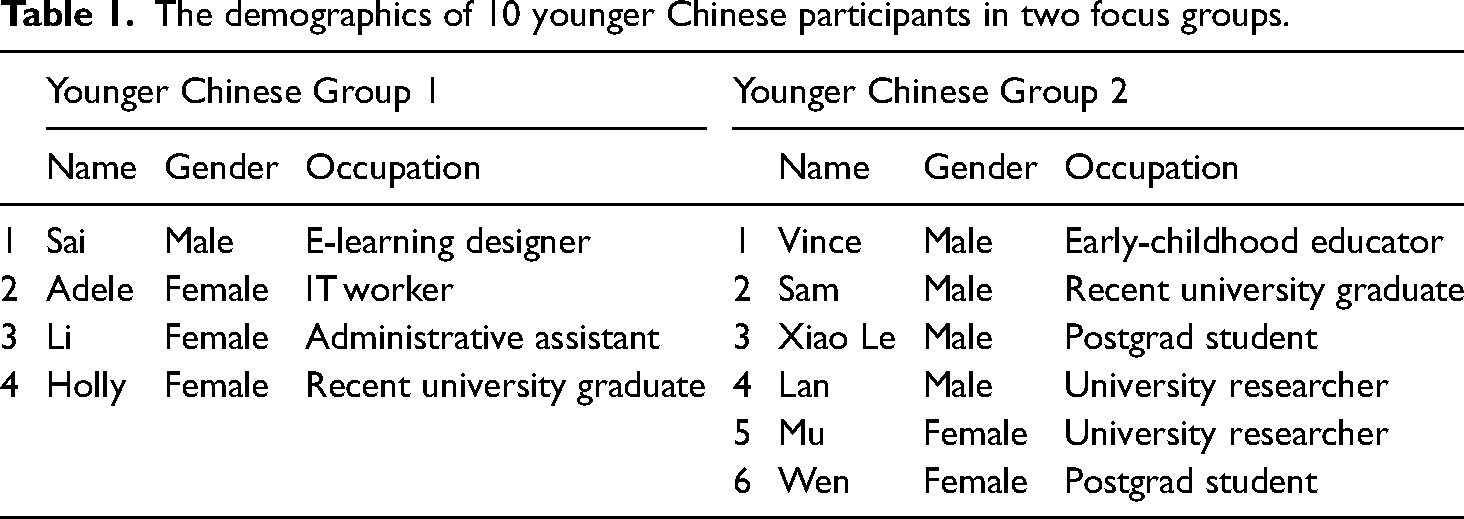
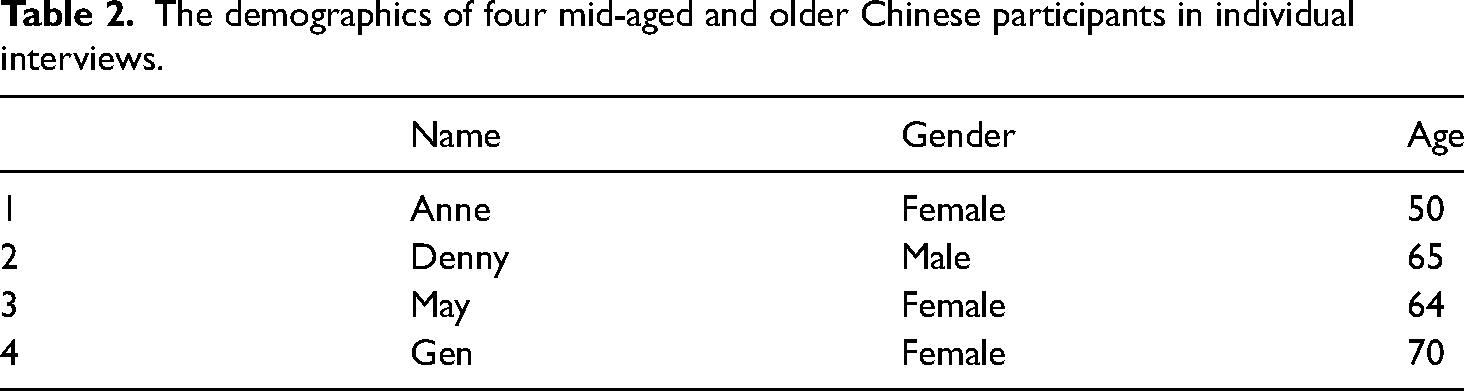
Our Chinese participants were all China-born, Han Chinese, mainly in two age groups: late 20s to mid 30s, and 50 to 70. The younger group (5 females and 5 males) had lived in Auckland for 4 to 7 years and were educated at the postgraduate level (Tables 1 and 2). They had experienced a range of sport and recreational pursuits in New Zealand. The older group (3 females and 1 male) had lived in Auckland for 10 to 30 years, either self-employed or retired, and actively participated in and helped to organise group dancing and table tennis in the Chinese community clubs. Accommodating their work and study schedules, the younger Chinese participants were interviewed via online focus groups chaired by the second author in Mandarin Chinese. Then, she met mid-aged and older Chinese participants in their community clubs and conducted interviews after their club activities.
The demographics of 10 younger Chinese participants in two focus groups.
The demographics of four mid-aged and older Chinese participants in individual interviews.
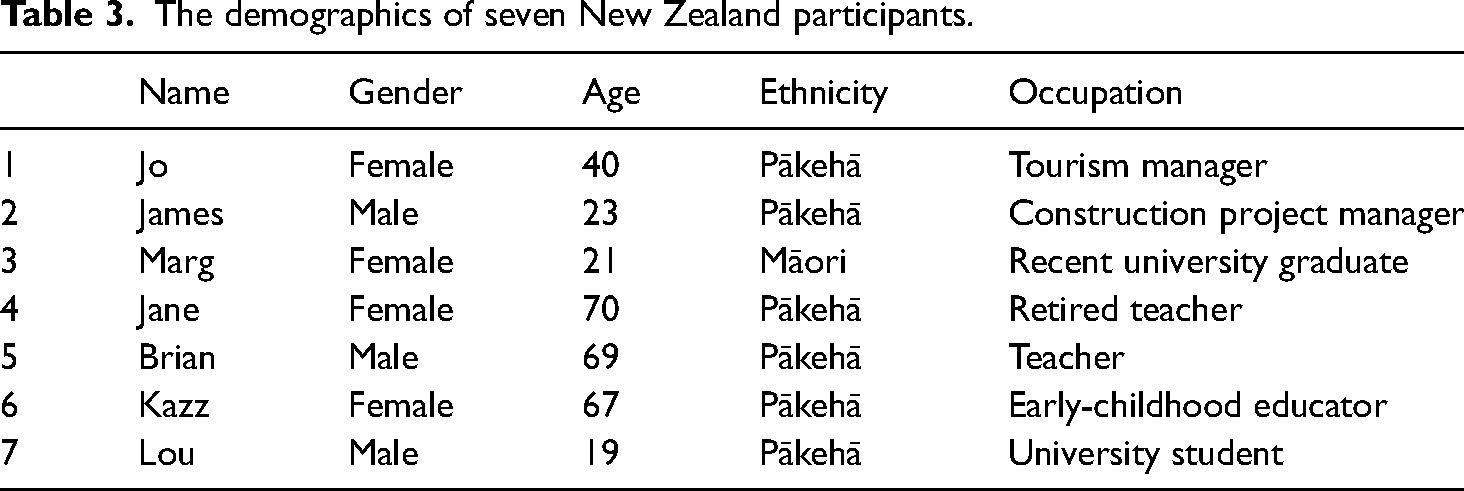
With our Aotearoa/New Zealand participants, the first author completed interviews in English. The 4 female and 3 male interviewees were predominantly Pākehā although one identified as Māori/Pākehā. They varied in age (21 to 71), education level (3 had undergraduate degrees) and occupation (Table 3).
The demographics of seven New Zealand participants.
With the ethics approval and participants’ permission, each interview was audio recorded. Focus groups lasted 90 to 120 min, and individual interviews lasted 40 to 90 min, during which participants identified their ethnic groups and talked about their cultural and sporting backgrounds. In particular, Chinese participants talked about their experiences of relocating to and living in Aotearoa/New Zealand, experiences of discrimination, sporting participation, and their understandings of Kiwi culture. Aotearoa/New Zealand interviewees reported their interactions with Chinese people, their understandings about race relations and Chinese sport participation. Though we focused on Chinese, our Pākehā interviewees often blurred the notion of Asian and Chinese people: a blurring that is consistent within existing research findings. For example, in public debates on new immigrants in both Australia and Aotearoa/New Zealand, Ip (2013:168) reflects that the term ‘Asian immigrants’ has become ‘an interchangeable term for “Chinese immigrants”’. The interviews were accordingly wide-ranging and were able to connect the unique stories of our participants with wider socio-political issues associated with sport, race, bodies and power relations.
Data was analysed following a process of theory-driven thematic analysis (Clarke and Braun, 2018). First, we familiarised ourselves with the textual data. Second, we applied a data-driven coding to the texts. Third, in relation to these initial codes we drew from Foucault's (1978) strategies for undertaking analysis of discourse to understand what discourse(s) underpinned various statements and how these discourses informed our participants’ views and values. We then employed Derrida's (2004) ideas to understand how ‘differing’ identities were formed. Next we discuss our results in relation to our prime research aims.
The characteristics of Chinese sport participation: being ‘different’
Our Aotearoa/New Zealand interviewees identified ‘differences’ between Chinese and Pākehā via their observations of differing sport participation practices. These differences were based on what Chinese participated in and what they did not. For example, our Pākehā interviewees indicated a belief that Chinese were not into outdoor adventures, not broadly sporty, not connected to ‘mainstream’ sport cultures (rugby, netball, cricket), and not involved in sports with close physical contact or risk of injury.
Jane: Well, I don’t think of them as – I don’t see them doing sport.
James: I think potentially in New Zealand they’re not as outdoorsy. It's very rare that you see a 16-year-old Asian kid out going for a run or something.
Lou: There was an Asian guy in the school rugby team that I know of, but I don’t know who else was in the rugby team.
In addition, Pākehā interviewees pointed out the non-mainstream sport and physical activities that Chinese like to do: Kazz: Obviously table tennis, obviously. Bill: Table tennis, yeah. James: They’re famously good at ping pong. They’re fairly good at basketball and tennis. Lou: At my high school a lot of Asian kids played soccer and tennis and badminton. Marg: Ping pong. And you always see older Chinese or Asian couples doing Tai Chi Jane: I mean when you think of them (Chinese) playing sport, you’d mostly think of ping pong.
As similar to how Derrida (2004) suggested that meanings were derived via deferral and a process of comparisons, our interviewees identified Chinese as different from Pākehā by what they did not do (e.g., outdoor sports or rugby) and what they did do (e.g., table tennis and badminton). These identifications of differences worked to position the Chinese immigrant as seemingly different from Pākehā, who have long identified themselves, perhaps stereotypically, in connection to an outdoors lifestyle, toughness, risk-taking pursuits and their love of sports, such as rugby, netball and cricket (Bannister, 2005; Pringle, 2017). Yet Chinese immigrants do not appear to share these same passions. Relatedly, via processes of default, ‘Chinese’ were not connected to the same moral narratives that are linked to particular sporting pursuits. For example, rugby union is regarded as the country's national sport and as a producer of moral and masculine character: a sexist discourse, relatedly, informs that rugby participation turns ‘boys into men’, that is, men of good character. Given that Asian and Chinese immigrants were not viewed as connected to the sporting and recreational cultures that New Zealanders valued and identified with (Thomson and Sim, 2007), they were not viewed as embodying some of the prime attributes that sporting involvement can convey.
Our Chinese participants similarly reflected that they were unfamiliar with the outdoors and reported that it was unusual to see Chinese in outdoor sports and especially, outdoor water sports. They acknowledged that unfamiliarity with differing activities and associated cultural/language differences dissuaded their desire to participate in some ‘Pākehā’ activities. Mu explained that: ‘I’m not familiar with the outdoor people, their jargons or their culture. All of these make it feel difficult to participate in outdoor sports.’ Adele explained that ‘we had no experiences of water sports from our schooling in China. We came here and (it) felt strange to do it. I tried kayaking, but I didn’t like it very much. I also certainly won’t go diving or scuba diving’. Li said: ‘Yachting and sailing are not like the land sports that we can understand and often play’. Wen also identified the language made it difficult to join hiking and jogging groups. She said: I did not know what to say to others. I couldn’t fit in. They spoke fast and I was unfamiliar with those topics, so I couldn’t join their conversation. Then, I stopped going. There were very few Eastern Asians in those groups. Now I wonder whether they were like me, tried once and found it very difficult to fit in, so never came back again?
Older female Chinese participants, May and Gen, actively participated in indoor group dancing. May pointed out that ‘almost every local board area and community centre has Chinese dancing groups and we go dancing every week’. Gen said: ‘we dance twice a week in the community centre’. Denny, a Chinese community club leader, said: In our club, most of us are older Chinese (65 + ) and you see those grandmas and grandpas. They like group dancing, Tai Chi and table tennis. They did those things back in China. They don’t like to go outdoors. Locals do many outdoor sports that are very dangerous and adventurous, and we are afraid of doing those, like rock climbing, downhill biking and going into the ocean.
Similar concerns with respect to cultural differences peppered our Chinese interviewees’ thoughts regarding participation in mainstream sports in Aotearoa/New Zealand, such as rugby and netball. Wen recalled that: ‘The first time I saw a netball court. I thought what's that?’ Sam expressed his feelings towards rugby: ‘As a new immigrant, I may have seen it on TV, at bars and barbershops, but I don’t understand what they were doing. I just see guys running after a ball.’ Sai remembered that his local PhD supervisor, an avid rugby fan, had always urged him to watch and play rugby, but he never did. Like Sai, Adele referred to watching rugby with her Kiwi friends as an act of embracing a cultural difference, something that she needed to try hard to pursue.
When Chinese participants talked about how Chinese prefer and are good at table tennis and badminton, Li and Denny sounded almost as if it was an inherent trait. Li said: When my twin boys were 6, we moved to New Zealand, and I sent them to try all the different sports, football, rugby, cricket and outdoors. For two years, they couldn’t find the thing they love to do, so we kept changing and trying. Finally, they chose one and stuck to it. It was badminton! I was so confused and surprised and now, I take them to play badminton four times a week.
Denny (aged 65) reported a similar experience: We made efforts to let our children experience the ocean, like we took our children to the local marine museum and went on a sailboat, and we sent our younger son to learn sailing. Sailing is a particular local culture, isn’t it? That's why Auckland City is called the City of Sails. How come you live in the City of Sails and play table tennis every day?! I’m quite open-minded. I want him to experience local culture, mainstream culture. But now, our younger son is playing table tennis every day. I think it's because I, my wife, two grandparents who’re over 80 years old all play table tennis, and there are many old Chinese playing table tennis in our club. We naturally have the habit of playing table tennis.
Our Chinese participants also stressed that they carefully avoided heavy-contact sports, such as rugby: Mu (CHN): I can’t do sports involving physical confrontation and I don’t understand those types of sport. They are not parts of my world and I’m not interested.
Vince (CHN): There is no physical confrontation in badminton and it's gentler. That's why I like it.
Lan (CHN): Personally, I dislike any form of confrontation, including badminton … If I can choose what to do, I will jog.
Most Han Chinese have been significantly influenced by Confucian principles of self-cultivation and social harmony (Chaibong, 2001) and, relatedly, our Chinese interviewees, Wen and Holly, provided cultural reasoning to explain why they typically did not participate in the sporting or recreational activities that many New Zealanders valued. Wen (CHN): Subconsciously, I don’t want to make physical contact against others. I don’t like to fight or confront. When I was playing basketball, I can defend, but I won’t grab the ball from the opponent. I just don’t want to bump into other bodies. Chinese are deeply influenced by Confucian culture. Hence, Chinese people will treat each other with politeness and courtesy. It affected the popularity of the bodily contact sports among Chinese.
Holly (CHN): We don’t like violent sports, due to our culture and our conservative and modest characteristics. Our ancestors preferred those seemingly more peaceful and calm activities, such as Tai Chi.
The broader Confucianist goal of social harmony made it difficult for Wen and Holly to participate or support sport that involved physical confrontation and acts of aggression. Other Chinese participants were also critical of rugby's ‘confrontation’ (Vince, Lan and Mu). By rejecting rugby participation, our Chinese interviewees inadvertently reinforced their differences from local New Zealanders.
Brian (NZ) was concerned, for example, that Chinese immigrants not only lacked involvement in rugby but that this also changed the sporting culture at local schools. Brian had taught at McCormack's College (a pseudonym), a school whose demographics had morphed greatly over two decades so that European/Pākehā students now constituted less 33% of the roll and ‘Asian’ and international students accounted for 60%. Brian reflected with a degree of regret: We used to have a number of rugby teams … but the rugby is dismal now and they used to be quite strong. And that's because they don’t have the European players and a lot of the Asian students are not playing, you know, the guys are not playing rugby, you see. So, that's changed. There is a good percentage of Asian students at McCormack's College …. McCormack's College was very good at rugby. As one of our sports. Well, you know, it's part of our culture, isn’t it, in New Zealand. It's sad to see that they don’t have the players that they would have once played, and it has changed.
Brian's lament about the loss of rugby reflected a concern with how the change in demographics – specifically the growth of the Asian population – was negatively impacting an aspect ‘New Zealand’ culture he loved.
Some of our Chinese interviewees were aware that they could gain cultural capital through participating in mainstream Aotearoa/New Zealand sports. Speaking from a Chinese parent's perspective, Anne wanted her children to be part of the dominant sport practices and said: We’re the ethnic minority and I honestly hope my children could do more local sports. Trying everything. But their endurance is bad and they’re not strong enough, except that my youngest son, he looks big and has strength. Rugby needs strength and power, isn’t it?
Immigrant parents (Denny and Anne) support their children to do local mainstream sports, to help them gain cultural values and the potential for associated capital. In contrast, when immigrant parents and grandparents talked about themselves, they unquestionably preferred to undertake Chinese ethno-specific sports, such as within Chinese community organisations and clubs, and to do the activities that they were familiar with. As Agergaard (2018: 22) notes, for migrants, ‘integration processes may be directed not only towards becoming part of (adapting to) local and national communities but also towards developing belongings and networks in transnational communities that link between societies of origin and societies of destination’.
Sport, Chinese males’ bodies and the construction of a feminised ethnicity?
Our interviewees revealed important intersections between ethnicities, sports, sexualities and genders. Halberstam (2016: vii) similarly noted that sport provides a ‘fertile ground for the crafting and sustaining of racial and gendered stereotypes’. Prior studies have also revealed that, under Western colonial racial discourses, discourses of the body operate differently around different ethnicities. Indigenous Māori and Pacific peoples have been associated with being ‘physical people’ (Grainger, 2009; Hokowhitu, 2003), while Chinese as physically weak (Chong, 2013). The body, as Foucault (1978) argued, is a site of power struggles and allows possibilities for the creation of hierarchies. These hierarchies were evident in how our interviewees talked of differences between Chinese and Pākehā male sporting bodies.
Our interviewees (both Pākehā and Chinese) revealed discursive connections between Aotearoa/New Zealand sportsmen, muscularity, big bodies, hegemonic-heterosexual masculinity and contact sports: all of which intersected to shape and, at times, romanticise understandings of New Zealand masculinities and forge a positive national identity. The successful performance of a hegemonic form of masculinity relies, in part, on an ability of Kiwi men to distance themselves from actions deemed feminine. Conversely, there is tendency to devalue and police overt displays of femininity within performances of masculinity within Aotearoa/New Zealand (Pringle, 2017). Moreover, sports and physical activities such as rugby, mountaineering and hunting, provide opportunities for Aoatearoa/New Zealand males to reaffirm a dominant form of masculinity.
In contrast, our Chinese and Pākehā interviewees revealed that Chinese men were often perceived as small, weak, non-sexy and, relatedly, somewhat effeminate as they did not participate in mainstream sports and recreational pursuits. Thus, via Derridean processes of comparison, the Chinese male was positioned as less masculine, as the following quotes reveal: Jo (NZ): Western woman typically don’t go for the Asian man … I don’t find them very sexy. Samoan and Tongan, some of the Island people, some of those men I find more attractive. They’re sort of big, strapping, masculine men, whereas some of the Asian men are quite slight and their physiques aren’t as attractive really.
Jane (NZ): They just don’t look attractive to me, but on the whole, they need to be a little bigger for a start. … maybe they look a bit soft as well.
Marg (NZ)
Sai (CHN): About the physique, we may pump up to be strong, but (we) have to put in a lot more time and energy. But I think for some reasons Māori and black people can get stronger within a shorter time.
Holly (CHN): I’ve chatted with Kiwi guys and they thought Chinese men are smaller and thinner and not as tough as they were.
Vince (CHN): A local co-worker of mine thinks Chinese men are gentler than Kiwis, and definitely not the Western kind of masculine men. Our bodies are thin and weak.
Xiao Le (CHN): The entire Western world, including New Zealand, sees Asian men as failing in their standard of masculinity. They would think white and black people have masculine physiques, robust bodies, while Asian men are not manly enough.
This ‘feminised’ subject position of Chinese males was connected to the workings of discourse associated with sport participation. Relatedly, both of our Pākehā and Chinese participants relied on the physical body to explain why few Asian and Chinese men play rugby: James (NZ): I think physically they’re not built for rugby. They could definitely play at primary school but once they start getting towards intermediate, college, University, professional, physically they’re not 100kg six-foot muscly people. They’re usually quite lean, quite tall or quite short. They don’t tend to have the stocky build that you need for rugby.
Jane (NZ): Too small (to play rugby). Lou (NZ): On average Asian guys are shorter. … In rugby, a huge part of it is size and strength.
Adele (CHN): I don’t think Chinese can withstand that level of crash (in rugby).
Li (CHN): I can’t imagine sending my boys into the rugby field. Their physique is not, not the New Zealand type of body.
Wen (CHN) acknowledged that: ‘A lot of Chinese play soccer and basketball and those involve full-on contacts’. Yet, James, from a New Zealander's perspective, regarded soccer as a ‘non-contact sport’ and, relatedly, as less physical and less rugged. This gendered difference explains, in his view, why ‘there's a decent amount of Asian kids who play soccer at high school’. These differing attitudes towards contact sporting contributed to the construction of the Chinese male as less masculine.
Studies of the relation between body image and Asian men conducted in the United States and Canada have suggested that Asian men have lower satisfaction with their bodies than Whites and Blacks and think that their body size is significantly smaller than the ‘ideal body’ (Barnett et al., 2001; Grammas and Schwartz, 2009). The ‘minority masculinity stress theory’ has even been developed to discuss Asian American men's stressful experiences of living up to the Western masculine ideal (Lu and Wong, 2013). Scholars conclude that ‘perpetual foreigner racism and acculturation’ drive Asian American men's concerns about muscularity, which is conversely admired within the hegemonic (i.e., ‘white’) culture (Cheng et al., 2016: 221).
Yet our interviewees also revealed a range of ideas that worked to counter the discursive positioning of Chinese men as feminine and to critique notions underlying hegemonic masculinity. Firstly, not all agreed that Chinese men were small, weak and not suited for rugby: Brian (NZ), for example, reflected on some of the Chinese rugby players he had coached: The ones I have seen at the school fitted their position well. They were a flanker or on the wing, and they were quite strong, you know. They’ve got strong bodies, even though they’re quite slight, some of them. But the particular forwards that we had, they were good. And we had one, I just remembered, we had another one who was a (prop). He was good.
Secondly, Lan (CHN) questioned whether New Zealanders were truly interested in playing rugby: I doubt the ratio between the number of people who are interested in rugby and the number who actually played it. I’ve heard many colleagues discussing whether to send their children to play it at a young age. Locals have been critically reflecting on it too.
In this manner, Lan (CHN) was questioning whether there was a romanticised version of Aotearoa/New Zealand masculinity and rugby interconnections and whether this was lived into existence. Thirdly, some of our Chinese male participants criticised the dominant ideas associated with New Zealand masculinities as western-centric and problematically rooted in one's body and physicality. Sam (CHN) argued, for example, that masculinities are not necessarily physical and can be judged based on one's ability to resist cultural norms: In our view, it's not manly to split the bill or go Dutch. But then, can we say a Western guy is not manly, because he didn’t follow the Chinese way to pay for the entire table … I also wonder why partying, binge drinking, using drugs and sleeping around makes one more masculine?
Xiao Le further questioned the relationship between men, masculinities and ball games: The idea that men must be doing some sort of sport makes me feel very uncomfortable. I was often asked: “which kind of ball games do you play?” Like, being a man, you must play ball games. Why?
Both Sam and Xiao Le, actively questioned the intersecting Western discourses around the body, masculinities and sport, as a way to renegotiate ethnic relations of power and to present themselves as ‘wilful’, in the manner that Ahmed (2014) uses the term, in their rejection of rugby culture and dominant masculinities. As such, they were proud to be gentle, respectful and non-violent men as they were critical of the so-called virtues of hegemonic masculinity. Despite changes in contemporary Chinese masculinities – with influences from the western world (Louie, 2014) and the increased visibility of sex- and body-based masculinities (Song, 2010)––Sam and Xiao Le's views on masculinities reflect similarities with what is known as the Confucian gentry-class masculinity. Confucian gentry-class masculinity, an influential traditional form of masculinity, emphasises the use of the mind, cultural attainment and literary knowledge over the focus on the body, physical strength and martial prowess (Louie, 2002, 2014; Yu and Bairner, 2011). Of interest, the Confucian gentry-class masculinity, is not constructed in opposition to women or feminine values, as are Western binary notions of masculinity, but are constructed in the politics of a homosocial context, based on knowledge of the Confucian canon, political position and ruling power (Louie, 2014). We suggest that some of these related Confucian ‘qualities’ would not be admired under a dominant Western guise of masculinity. More specifically, under a Confucian guise, self-cultivation and self-control were regarded as ‘the primary criteria for genuine manhood’ (Song, 2004: 5). In contrast to Western forms of idealised masculinities, the influential Confucian form of masculinity in the Chinese tradition, in part, is valued for thoughtfulness, reflexivity, scholarliness, elegance, and physically restrained self-expression (Louie, 2014; Song, 2004).
In this light, our results suggest that the lack of Chinese participation in rugby can be understood as ‘wilfully’ related to the immigrants’ attitudes towards rugby and its connections to a brutish and seemingly unreflexive form of masculinity, rather than the simplistic claim of weak Chinese bodies. Moreover, we can view that our Chinese male participants refused to let go of their cultural values or comply with the general will of Western society. ‘To be willful is here to be willing to announce your disagreement, and to put yourself behind it’ (Ahmed, 2014: 134). Yet within the context of rugby's cultural dominance in Aotearoa/New Zealand, this willful announcement is not publicly circulated by Chinese migrant males. Indeed, if one desires to integrate smoothly into a foreign culture, it is self-defeating to publicly critique sports that are central to mainstream culture. Hence, rather than seeing themselves as ‘feminine ethnic’ bodies, as a Pākehā optic might be inclined, some Chinese migrant males position themselves as masculine bodies of willfulness.
We emphasise that there are multiple ways of looking at Chinese masculinities and reflect that the influence of Confucian gentry-class masculinity allows for a more supportive and positive perspective. Relatedly, we suggest that Chinese discourses of masculinity are worthy of further exploration to increase the visibility of non-Western conceptualisations of the body (Pang, 2022).
Conclusion
Our exploratory study revealed that sport was an important space within which Chinese and Pākehā created understandings of each other's subjectivities. Although sport can challenge and reinforce stereotypes (Szto, 2018), our results suggested that sport participation tended to reinforce rather than challenge existing ethnic identities. Results further suggested that the Chinese migrants preferred to participate in sports that they were culturally familiar with such as table tennis, badminton, indoor group dance and Tai Chi. They enjoyed participating in these activities as they felt comfortable and safe, and it afforded them opportunities to connect with other Chinese. Sport participation, in this sense, plays a role in helping migrants adjust to life in a foreign country through creating valued networks and a sense of belonging (see Agergaard, 2018). Yet this participation does not necessarily build bridges between Chinese and Pākehā communities or Māori or Pasifika people, as government and policymakers might hope for. Moreover, these activities in our Pākehā interviewees’ views, positioned them as different and, for some, as signs of lacking desire to integrate as they did not participate in the mainstream (i.e., white) sports or physical activities.
Through processes of deferral and comparison, the Chinese male body was positioned as weaker, smaller, less robust, and was, thus, primarily essentialised as feminine: a derogatory subject position. The Pākehā and Pacific male sporting body, in contrast, was positioned as a respected form of masculinity: big-sized, tough, strong, hard-working, risk-taking, physical and rugged. Although this traditional understanding of masculinity is under threat in the face of increased urbanisation, changing demographics and increased support for feminism and gay rights, this form of masculinity still holds social influence and pays dividends.
Derrida (2004) would suggest that the first task in having identified this hierarchy would be to confront it. We agree that there is value in challenging this power imbalance. Yet through interviewing Chinese and Pākehā, we are also aware that this reading of Chinese/ Pākehā sporting bodies is somewhat western-centric. Our Chinese interviewees, for example, were aware that their sports participation reinforced the gendered and ethnic othering of them; but through processes of reflection, some wilfully chose not to comply with the discursive practices of dominant sport and white masculinities, specifically in relation to heavy-contact sport participation. Their willfulness demonstrated the agency of first-generation adult immigrants that operate in Aotearoa/New Zealand. Although our Chinese interviewees acknowledged their desire to integrate into Aotearoa/New Zealand culture and feel a sense of belonging, they did not desire to do so through participation in sporting activities, such as rugby or blue space activities (e.g., yachting, surfing, scuba diving, ocean swimming) that they felt unsafe in. Moreover, the Chinese participants’ wilfulness reflected that they are bearers of differing cultural values, such as self-cultivation, social harmony and the gentry-class masculinity, as related to Confucian cultural discourses.
We conclude that sport participation should not be understood as simplistically enhancing ethnic/cultural understandings or as producing acceptance of cultural diversity. These findings suggest that government policies that simplistically aim to promote sport participation, with the related belief that sport participation enhances social cohesion and improves cultural understandings, are likely ill-conceived (Ahmad et al., 2020; Smith et al., 2019).
Without specific strategies for CALD migrants to participate in sport in a manner that affords them recognised benefits (i.e., cultural capital) in the dominant culture, the strategy of simply promoting sporting activity can be read as a technology of assimilation. As this policy encourages CALD migrants to participate and value the sporting cultural traditions and practices that align with, and prop up, the host nation's identity and culture. Yet if CALD migrants participate in their preferred cultural activities (such as table tennis and Tai Chi) this can, as evidenced in this study, act to reinforce hierarchical differences between ethnic groups which can be perceived as symbolising segregation (Smith et al., 2019). We support the view that ‘CALD migrants cannot simply be expected to ‘fit in’ with current practices, especially where this implies that they leave their ethnic or cultural identity at the door (e.g., not practising certain religious or cultural beliefs or customs …)’ (Smith et al., 2019: 865).
Sport policymakers within Aotearoa/New Zealand with its legacy of a strong bicultural framework yet now facing the challenges of superdiversity, needs to specifically acknowledge the diverse needs, beliefs and values of CALD migrants and enable genuine partnerships between sporting organisations and community groups and mutual benefit.
Footnotes
Declaration of conflicting interests
The author(s) declared no potential conflicts of interest with respect to the research, authorship and/or publication of this article.
Funding
The author(s) received no financial support for the research, authorship and/or publication of this article.
