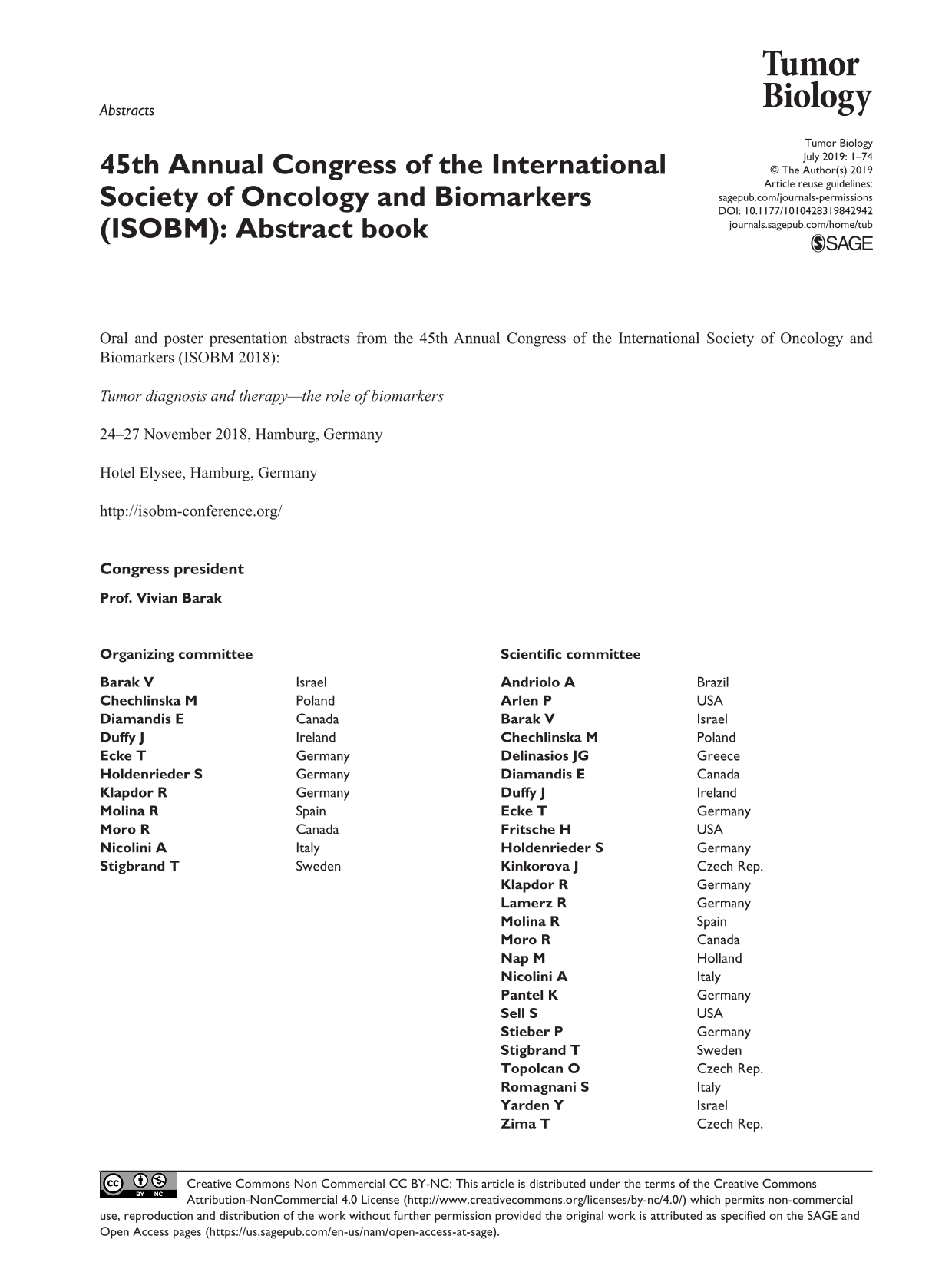
Oral and poster presentation abstracts from the 45th Annual Congress of the International Society of Oncology and Biomarkers (ISOBM 2018):
Czech Rep.
Czech Rep.
Czech Rep.
Lectures
Cancer screening: does it always reduce cancer mortality?
MJ Duffy
Clinical Research Centre, St. Vincent’s University Hospital and University College, Dublin, Ireland
Screening for premalignant lesions or early invasive disease has the potential to reduce mortality from cancer. Because of their ease of measurement, several biomarkers have been evaluated or are currently undergoing evaluation as screening tests for early malignancy. These include the use of alpha-fetoprotein (AFP) in screening for hepatocellular cancer in high-risk subjects, CA 125 in combination with transvaginal ultrasound (TVU) in screening for epithelial ovarian cancer, prostate-specific antigen (PSA) in screening for prostate cancer, fecal occult blood testing (FOBT) in screening for colorectal cancer (CRC), and vanillylmandelic acid and homovanillic acid in screening for neuroblastoma in newborn infants. Of these biomarkers, only the use of FOBT in screening for CRC has unequivocally been shown to reduce mortality from cancer and universally recommended for population-based screening. Three large randomized trials have evaluated the potential benefit of PSA screening for prostate cancer, that is, the Prostate, Lung, Colorectal and Ovarian (PLCO) trial which was carried out in the United States, the European Randomized Study for Screening of Prostate Cancer (ERSPC) trial which was performed in seven European countries, and the Cluster Randomized Trial of PSA Testing for Prostate Cancer (CAP) which was carried out in the United Kingdom. Two of these trials, that is, PLCO and CAP, found no impact of screening on reducing mortality from prostate cancer. In contrast, after 13 years of follow-up, the ERSPC trial found that screening decreased death rates from prostate cancer by 21% in men aged 55–69 years. Following adjustment for non-participation and contamination in the trial, the decrease in mortality was 31%. Although biomarkers have many attractive features as cancer screening tests, lack of sensitivity and specificity, when combined with the low prevalence of specific cancer types in asymptomatic subjects, limit their application for the early detection of malignancy.
Standards for pathologists: the World Health Organization classification of tumors
Ian A Cree
WHO Classification of Tumours Group, International Agency for Research on Cancer (IARC), World Health Organization, Lyon, France
The definitive diagnosis and classification of individual cancers underpins the care of individual cancer patients, as well as research into cancer causation, prevention, diagnosis, and treatment. Cancer classification has previously been based on consensus histopathological opinion with limited molecular input. However, pathology is undergoing a rapid transformation due to the introduction of new technologies to practice. The understanding of cancer at a molecular level is now at a point where it needs to be integrated into its diagnosis. Digital pathology and image analysis are now also producing new insights, and providing quantitative justification of many existing diagnostic criteria, while challenging others. Clinical practice is also changing. In certain patients, it is possible to arrive at a reliable diagnosis by radiology alone, combined with liquid biopsy—usually a blood sample—from which tumor markers, cfDNA, and circulating tumor cells can all be measured. The WHO Classification of Tumours, now in its 5th Edition, provides the definitions of individual cancers, including data on their ethology, histogenesis, and epidemiology. It is published as a series of site-specific books, which provide diagnostic criteria based on scientific evidence, interpreted by experts. Recent developments include a new classification of melanoma (1) and a proposed classification of neuroendocrine neoplasms (2). The classification increasingly incorporates molecular data required or desirable for diagnosis, including circulating tumor markers.
Meta-analysis on the relevance of CYFRA 21-1 and CEA for the assessment of therapy response in non-small cell lung cancer
Stefan Holdenrieder1, Birgit Wehnl2, Karina Hettwer3, Kirsten Simon3, Steffen Uhlig3 and Farshid Dayyani4
1Munich Biomarker Research Center, Institute of Laboratory Medicine, German Heart Centre Munich, Technical University Munich, Munich, Germany
2Roche Diagnostics GmbH, Penzberg, Germany
3QuoData GmbH, Dresden, Germany
4University of California Irvine, Orange, CA, USA
Background: Carcino-embryonic antigen (CEA) and cytokeratin-19 fragments (CYFRA 21-1) are well established biomarkers for monitoring of non-small cell lung cancer (NSCLC). However, interpretation of results and kinetics in a single patient remains still challenging due to method dependency, use of different cutoffs, lack of knowledge of influencing factors, and unclear definition of time points and individual changes required for risk assessment.
Study Aims: This meta-analysis evaluated whether pre-therapy serum levels of CEA and CYFRA 21-1 are predictive of response to therapy in NSCLC, and whether changes in these markers during versus pre-therapy are indicative of response.
Materials and Methods: Original peer-reviewed studies enrolling adults with untreated advanced NSCLC were identified using PubMed. Two reviewers independently extracted data from eligible studies and assessed study heterogeneity and the risk of study bias.
Results: Fourteen studies were eligible; 11 had objective response as an endpoint and 3 evaluated clinical benefit (i.e. response and stable disease). Study bias was relatively low. Both markers showed comparable modest predictive value across studies, with baseline CYFRA 21-1 numerically better in predicting treatment benefit. A good performance in identifying objective response during treatment was seen (area under the curve (AUC), 0.724 (95% confidence interval (CI), 0.667–0.785)) for CYFRA 21-1 and 0.728 (95% CI, 0.599–0.871) for CEA. A decline in CYFRA 21-1 levels during treatment was highly indicative for objective response (sensitivity, 79.1% (95% CI, 71.5–85.1)) (Br J Cancer 2017; 116: 1037–1045).
Conclusion: Comprehensive analysis of study heterogeneity and bias provides a high level of evidence for the clinical utility of CEA and CYFRA 21-1 for the prediction and monitoring of response in NSCLC.
State of the art and trends in the clinical use of cancer biomarkers
Massimo Gion1, Chiara Trevisiol2 and Aline SC Fabricio1
1Department of Clinical Pathology, LHA AULSS3, Veneto Region, Regional Center for Cancer Biomarkers, Rome, Italy.
2Scientific Direction, Istituto Oncologico Veneto IOV—IRCCS, Padova, Italy
Background: The appropriate use of available resources is crucial to preserve health care sustainability while facilitating a timely translation of innovation to clinical practice. Traditional circulating tumor markers (TMs) are well-established laboratory tests currently used in the management of cancer patients. If appropriately used, they would be an example of effective translational research and could represent the ground to design research projects aimed at translating in the practice the clinically useful tests among the sharply increasing number of candidate biomarkers.
Study aims: We investigated the rate of appropriateness of the utilization of TMs in the clinical practice in Italy in comparison with the position of available clinical practice guidelines (CPGs) to identify possible weakness and margins for improvement in the use of TMs.
Materials and Methods: All relevant information has been acquired from electronic health records and Cancer Registries. Over 25 million TM requests were examined. The rate of TM ordering has been evaluated in relation to (1) epidemiological data on cancer prevalence and (2) demographic and administrative information. All available CPGs have been systematically searched and selected, and recommendations on TMs from 238 CPGs have been appraised and compared.
Results: A high TM ordering rate was found, with over 260 requests per 1000 individuals. A high percentage of TMs orders occurred in subjects without cancer, thus demonstrating a meaningful utilization of TMs for diagnostic purposes. We further explored ordering pattern of TMs recommended for specific cancer types only (CA15.3, CA125, and CA19.9), showing comparable number of requests in contrast with the large differences among prevalence of their target malignancies. Ordering pattern does not seem to adhere to CPGs recommendations. Possible causes of the poor compliance of clinicians to CPGs have been investigated and a weak consistency of recommendation on some TMs was speculated to have a role.
Conclusion: (1) The poor consistency of recommendation provided by CPGs on traditional TM in several clinical scenarios suggests the need for additional research to elucidate their actual clinical usefulness. (2) The evidence of a high TMs over-ordering suggests that translation research on novel biomarkers should be planned taking into consideration drawbacks and pitfalls of research performed on traditional TMs.
Biomarkers—best assays to assess response to new therapies and provide prognosis in melanoma patients
V Barak1, V Leibovici2, T Peretz1, I Kalichman1, M Lotem1 and S Merims1
1Department of Oncology, Hadassah-Hebrew University Medical Center, Jerusalem, Israel
2Department of Dermatology, Hadassah-Hebrew University Medical Center, Jerusalem, Israel
Background: Malignant melanoma’s incidence is increasing during last years, while mortality is strongly decreasing due to improved early detection, close monitoring of patients including biomarkers, and introduction of new therapies.
Study Aims: The aim of this study was to evaluate a panel of biomarkers (S-100b, OPN, MIA, sIL-2R, TK) in melanoma patients, as to their ability to assess treatment response, especially to new immunotherapies (Anti BRAF, IPI, Anti PD-1) and provide prognosis of those patients.
Patients and Methods: We evaluated both retrospectively and prospectively 238 malignant melanoma patients. Blood biomarker levels were evaluated by conventional enzyme-linked immunosorbent assays. Correlations of marker levels to disease stage, metastases, response to new immunotherapies, and survival were performed.
Results: Serum levels of biomarkers were significantly higher in all patients before various therapies were applied, n = 89 (5.35 + 0.7) and decreased thereafter, n = 76 (1.4 + 0.3). Significantly higher levels of S-100β were demonstrated in advanced disease including metastases (8.97 + 0.52) as opposed to early disease (0.32 + 0.07) and NED patients (0.16 + 0.04). When comparing melanoma deceased patients who had extremely high levels of S-100β (6.2 + 0.35), we showed significantly lower levels in alive patients (0.26 + 0.02) and certainly in normal controls (0.08 + 0.02). In individual patients, kinetic evaluations showed earlier the response to therapy, or recurrence and non-response, as shown only after a few months later, by CT evaluations.
Conclusion: S-100β and most of the other tested biomarkers can serve as the most useful biomarker for assessment of treatment response and prognosis, especially after using new immunological treatments as anti-BRAF, IPI, or anti-PD1 in malignant melanoma patients. Additional biomarkers such as LDH, b2M, sIL-2R, and TK may also serve as part of a biomarkers panel, for improved detection of recurrence and metastasis or treatment changes, affecting survival.
Prostate cancer detection: biomarkers, imaging, and clinical data, the combination is a key
MJ Roobol
Department of Urology, Erasmus University Medical Center, Rotterdam, The Netherlands
Background: Prostate-specific antigen (PSA)-based prostate cancer early diagnosis has shown to reduce disease-specific mortality but coincides with unnecessary, potentially harmful interventions (PSA testing and/or prostate biopsy) and over diagnosis with subsequent overtreatment.
Study Aims: To review the performance characteristics of currently available biomarkers, including multiparametric (mp) magnetic resonance imaging (MRI) and to describe their role in a risk-based screening algorithm.
Materials and Methods: Reviewing published data on PSA-based screening, reflex tests, and mpMRI.
Results: The serum PSA test is a useful test for initial risk stratification. Men with elevated PSA levels (i.e. >3.0 ng/mL) can be further risk stratified with various so-called reflex tests. All have their pros and cons, unfortunately head-to-head comparisons are extremely scarce. Availability and costs are important factors when deciding which one to use. The mpMRI is here to stay and should be incorporated within a risk stratification algorithm and not serve as first-line screening tool.
Conclusion: The combination of PSA, reflex tests, and mpMRI is key in achieving keeping benefits and avoiding harms in prostate cancer early detection.
Pancreatic cancer—40 years clinical experience
R Klapdor
Clinical Unit, University Hospital Hamburg, Hamburg, Germany
During this period, there was a slow, but continuous and impressive change—from manual palpation of abdominal masses through the abdominal wall and definitive diagnosis only by surgery and/or postmortem pathology, from favoring palliative surgery (too late diagnosis and high postoperative mortality rate (about 30%) after resective surgery), from only limited palliative treatment possibilities (no cytostatics, no stents, no TNM staging or grading proposals, no relevant tumor markers (TM), no immunohistochemistry or modern molecular diagnosis and therapy)—that means from a situation with an overall survival of less than 1 year in more than 95% of patients to the modern and actual preoperative definitive diagnosis and staging, to postoperative mortality <5%, to concepts of effective adjuvant and palliative chemotherapy as well as of actually promising neoadjuvant trials for increase of the resection rate, relevant prolongation of survival, and/or at least relevant amelioration of symptoms and life quality by effective symptomatic treatment including parenteral nutrition. These actual possibilities resulted in an increase of 5 years’ survival after resection to about 40% and increase of the 1-year survival of metastasized diseases up to more than 50%—in the case of interdisciplinary treatment concepts following sequential treatment strategies and narrow follow-up. In addition, since some years it is recommended to handle PaCa patients in so-called certified pancreatic cancer centers and to follow the recommendations of so-called S3-guidelines. Till today, however, these guidelines are mainly based on prospective randomized clinical trials (expensive, requiring interested sponsors, etc.) and they do not include CA 19-9/CEA in an appropriate way. Consequently, on one hand, the guidelines recommended a more or less restrictive use of the cytostatics available, resulting for more than 10 years in an unneccessary low overall survival. And on the other hand, the neglection of these tumor markers for follow-up and for recommendations for clinical practice resulted in a non-optimal individualization of antitumoral therapy for patients involved in studies as well as in the general oncological practice. It has to be discussed that the organizers of the clinical studies fear that the adequate inclusion of tumor markers with all its advantages into the control of tumor disease will make the performance and interpretation of the prospective trials too complicated. That would mean, however, that the responsive persons would prefer an easier performance of studies to the detriment of an optimal individualized therapy of PaCa patients. This would mean that we would have today two general ways to improve the fate of these patients: by the detection of new treatment strategies and antitumoral drugs, and by efforts to make better use of the presently available possibilities.
Interplay of four genetic high-risk variants for urinary bladder cancer
Silvia Selinski1, Thomas Otto2, Nathaniel Rothman3, Lambertus A Kiemeney4, Jan G Hengstler1 and Klaus Golka1
1Systems Toxicology, Leibniz Research Centre for Working Environment and Human Factors at TU Dortmund (IfADo), Dortmund, Germany
2Department of Urology, Lukaskrankenhaus Neuss, Neuss, Germany
3Division of Cancer Epidemiology and Genetics, National Cancer Institute (NCI), Rockville, MD, USA
4Radboud Institute for Health Sciences, Radboud University Medical Center, Nijmegen, The Netherlands
Background: Little is known whether genetic variants identified in genome-wide association studies interact to increase bladder cancer risk. Recently, we identified two- and three-variant combinations associated with a particular increase of bladder cancer risk in a urinary bladder cancer case-control series (IfADo, 1501 cases, 1565 controls).
Study Aims: The study aims to investigate the best two- to four-variant combinations conferring bladder cancer risk to bladder cancer patients and to subgroups differing by their smoking behavior like current smokers or never smokers.
Materials and Methods: In an independent case-control series (Nijmegen Bladder Cancer Study, NBCS, 1468 cases, 1720 controls), we confirmed these two- and three-variant combinations. Pooled analysis of the two studies as discovery group (IfADo-NBCS) resulted in sufficient statistical power to test up to four-variant combinations by a logistic regression approach. The New England and Spanish Bladder Cancer Studies (2080 cases and 2167 controls) were used as a replication series.
Results: Twelve previously identified risk variants were considered. The strongest four-variant combination was obtained in never smokers. The combination of rs1014971[AA] near APOBEC3A and CBX6, SLC14A1 exon SNP rs1058396[AG, GG], UGT1A intron SNP rs11892031[AA], and rs8102137[CC, CT] near CCNE resulted in an odds ratio of 2.59 (95% confidence interval (CI) = 1.93–3.47; p = 1.87 × 10⁻¹⁰), while the individual variant odds ratios ranged only between 1.11 and 1.30. The combination replicated in the New England and Spanish Bladder Cancer Studies (OR = 1.60, 95% CI = 1.10–2.33; p = 0.013). The four-variant combination is relatively frequent, with 25% in never smoking cases and 11% in never smoking controls (total study group: 19% cases, 14% controls).
Conclusion: We show that four high-risk variants can statistically interact to confer increased bladder cancer risk particularly in never smokers.
Molecular response mechanisms to CDK4/6 inhibitors in bladder cancer involve Skp/Cullin/F-box (SCF) complexes that regulate MDM2 and Rb
Roman Nawroth, Pan Qi, Hui Wang, Zhichao Tong, Per Sonne Holm and Jürgen E Gschwend
Urology Department, Technical University of Munich, Munich, Germany
Background: Although CDK4/6 inhibitors are widely used in the therapy of breast cancer, molecular response mechanisms are still not completely understood.
Study Aims: In this project, we used a genome-wide CRISPR-dCas9 screen in order to identify mechanisms of resistance that might reveal novel combination therapies in bladder cancer.
Material and Methods: SAM transduced T24 and RT112 cells were used to study functional and molecular effects in cell viability (SRB), cell cycle progression (EdU incorporation), apoptosis (Caspase 3/7 activity, pBAD immunoblotting), and growth of tumor xenografts (chicken chorioallantoic membrane model). Lentiviral gRNA transduction, siRNA, or shRNA-mediated silencing of gene expression and small molecules against SCF complex modification and activity (MLN4924, SKP2-C25, PS-341) or proteasome inhibitors (epoxomicin) or CDK4/6 inhibitor (palbociclib) were used. Protein expression and transcription of genes were analyzed using immunoblotting and quantitative polymerase chain reaction (PCR).
Results: CDK4/6 inhibitors result in downregulation of Rb in both protein and mRNA levels. This regulation is essential for therapy response and can be reversed using proteasome inhibitors. We identified 21 f-Box proteins that confer resistance according to the biostatistical analysis of the used CRISPR-dCas9 screen. Inhibition of SCF protein complexes either by manipulation of gain and loss of function of various F-box proteins revealed a strong involvement of the SCF complex in cell cycle progression and cell proliferation. Inactivation of this complex using inhibitors against the E3 ligase, neddylation of Cullin or also SKP2 (expression and phosphorylation) results in antagonistic effects when combined with palbociclib. Activity of SCF complexes regulate MDM2 activation that at the early therapy response is involved in regulating Rb stability and also therapy response. Knockdown or mutations in critical binding sites of MDM2 and Rb also reverse the degradation of Rb and therapy response.
Conclusion: Therapy response to CDK4/6 inhibitors can be divided in early and late effects. In the early response, expression of Rb and regulation of SCF complexes that in turn activate MDM2-mediated Rb degradation are essential components in the molecular mechanism.
CCDC88A mRNA localizing in circulating tumor-derived exosomes as a novel serological marker for pancreatic cancer
Keisuke Taniuchi, Makiko Tsuboi, Takuhiro Kohsaki, Shinji Iwasaki and Toshiji Saibara
Department of Gastroenterology and Hepatology, Kochi Medical School, Kochi University, Kochi, Japan
Background: Pancreatic ductal adenocarcinoma (PDAC) is the fourth most common cause of cancer death in the Western world. Early diagnosis of PDAC is difficult, and no biomarkers in blood can identify patients with pancreatic cancer at an early stage. Serum cancer antigen 19-9 (CA19-9) remains the gold standard serum marker for patients with PDAC; however, inadequate sensitivity and specificity limit the use of CA19-9 in the early diagnosis of PDAC. Therefore, the discovery of biomarkers derived from blood that facilitate the distinction of PDAC would greatly affect patient management. Exosomes are extracellular lipid microvesicles, secreted by nearly all cells in body fluids such as peripheral blood. The exosome-associated RNA is called exosomal shuttle RNA that includes microRNAs and messenger RNAs (mRNAs).
Study Aims: To assess if CCDC88A mRNA that we found in the intracellular exosomes of PDAC cells is secreted from PDAC cells.
Methods: This is useful as a serum diagnostic marker for differentiating PDAC from individuals without pancreatic disorders compared with CA19-9. Twenty PDAC patients (stage IIA: n = 2, stage IIB: n = 4, stage III: n = 6, and stage IV: n = 8 according to the UICC TNM classification) and 30 control individuals without pancreatic diseases were analyzed in a case-control study. Circulating exosomes were isolated from serum, and then CCDC88A mRNA localizing in exosomes was measured by real-time quantitative reverse transcriptase polymerase chain reaction (qRT-PCR).
Results: We confirmed that CCDC88A mRNA was localized in secreted exosomes from cultured PDAC cells: a moderately differentiated PDAC cell line (S2-013) by the use of condition media real-time qRT-PCR. Furthermore, the case-control clinical study showed that the area under the curve (AUC) of receiver operating characteristic curves (ROC curves) was 0.805 (95% confidence interval (CI), 0.691–0.9199) for CCDC88A mRNA and 0.8 (95% CI, 0.675–0.926) for CA19-9. If CCDC88A mRNA was combined with serum CA19-9, the AUC increased (0.921 (95% CI, 0.851–0.991)).
Conclusion: Our data suggest that measuring the level of this exosome-localized CCDC88A mRNA has the potential to improve detection of PDAC. Further research is necessary to understand whether these have clinical implications for early detection of PDAC and how much this information adds to serum CA19-9.
Drosha and the Argonautes 1 and 2 as potential biomarkers for urothelial bladder carcinoma: an immunohistochemical study
Anja Rabien1,2, Nadine Ratert1,2, Anica Högner3, Andreas Erbersdobler4, Klaus Jung1,2, Thorsten Ecke5 and Ergin Kilic3,6
1Department of Urology, Charité—Universitätsmedizin Berlin, Berlin, Germany
2Berlin Institute for Urologic Research (BFIU), Berlin, Germany
3Institute of Pathology, Charité—Universitätsmedizin Berlin, Berlin, Germany
4Institute of Pathology, University Medicine Rostock, Rostock, Germany
5Department of Urology, HELIOS Hospital Bad Saarow, Bad Saarow, Germany
6Institute of Pathology, Hospital Leverkusen, Leverkusen, Germany
Background: Diagnosis, as well as prognosis, for urothelial bladder carcinoma has to be improved so that biomarker research in this field is still ongoing. Changes in the microRNA profiles let assume that also the microRNA machinery behind could be affected in bladder cancer.1
Study Aims: The potential of the microRNA maturation regulators Drosha, Argonaute 1 (AGO1), and Argonaute 2 (AGO2) as biomarkers for bladder cancer should be determined using immunohistochemistry.
Material and Methods: Drosha, AGO1, and AGO2 were immunostained on a tissue microarray composed of 112 urothelial carcinomas of the bladder from therapy-naive patients after radical cystectomy or transurethral resection. The expression levels were assessed and associated with patient parameters and overall survival.
Results: The expressions of all three, Drosha, AGO1, and AGO2, were increased in non-muscle-invasive bladder carcinomas (NMIBC) compared to normal bladder tissue, while in muscle-invasive bladder carcinomas (MIBC) only AGO2 was increased. AGO1 and Drosha could distinguish NMIBC from MIBC. In Kaplan–Meier analysis, Drosha expression was able to discriminate according to the probability of overall survival, whereas the independence of clinicopathological parameters in Cox regression was given for AGO1.
Conclusion: The three players of the microRNA machinery seem to hold the potential as diagnostic and in part prognostic biomarkers for bladder cancer so that further extended studies should define their values.
Reference
1. Rabien A, Ratert N, Högner A, et al. Diagnostic and prognostic potential of MicroRNA maturation regulators drosha, AGO1 and AGO2 in urothelial carcinomas of the bladder. Int J Mol Sci 2018; 19: E1622.
Prostate health index density in prostate cancer detection
Xavier Filella1, Laura Foj2, Josep Maria Augé1 and Rafael Molina1
1Biochemistry and Molecular Genetics, Hospital Clínic—IDIBAPS, Barcelona, Spain
2Labco Diagnostics, Synlab Group, Barcelona, Spain
Background: Prostate health index (PHI) is a valuable test for the detection of prostate cancer (PCa), related to the aggressiveness of the tumor. Furthermore, previous results underlined that PHI levels are influenced by prostate volume, showing a higher accuracy in patients with small prostate volume.
Study Aims: The goal of this study was to evaluate the value of PHI density (PHID) in PCa detection.
Material and Methods: We measured PSA, free PSA (fPSA), and p2PSA in 276 patients selected for biopsy because of an elevated PSA serum level and/or abnormal digital rectal examination. Biopsy was negative in 126 subjects and PCa was detected in 150 subjects. PCa patients were classified according to D’Amico criteria, including 77 patients with low-risk (clinical stage T1–T2a, Gleason score 7, and PSA ⩽10 µg/L), 48 patients with intermediate risk (clinical stage T2b or Gleason score 7 or PSA 10–20 µg/L), and 25 patients with high-risk (clinical stage T2c or PSA 20 µg/L or Gleason score 7). PSA, fPSA, and p2PSA serum levels were measured on Access2 analyzer (Beckman Coulter). WHO standards were used in the measurement of PSA and fPSA. PHI was calculated using the formula [(p2PSA pg/mL)/(fPSA μg/L)] × √PSA (μg/L). Prostate volume was calculated by ultrasound measurement, using the ellipsoid formula.
Results: The higher accuracy was found for PHID, obtaining an AUC of 0.785 for the detection of PCa. The AUCs for the other tests were 0.736 for PHI, 0.737 for %p2PSA, 0.691 for %fPSA, 0.720 for PSA density, and 0.508 for PSA. Similarly, we calculated the AUCs for the detection of intermediate/high-risk PCa, obtaining the following results: 0.781 for PHID, 0.781 for PHI, 0.757 for %p2PSA, 0.658 for %fPSA, 0.742 for PSA density, and 0.596 for PSA. We found that PHID was significantly higher (1.79; 0.25–11.90) (median; range) in patients with intermediate/high-risk PCa than in patients with low-risk PCa (0.99; 0.15–4.02) or negative biopsy (0.61; 0.17–2.41) (p = 0.0001, Kruskal–Wallis test).
Conclusion: Our results showed the usefulness of PHID in PCa detection, strongly discriminating between patients with negative biopsy and patients with PCa diagnosis. Furthermore, we found that PHID is related to the aggressiveness of the tumor.
Portal vein embolization versus portal vein embolization and hematopoietic stem cell application in patients with primarily non-resectable colorectal liver metastases
Vladislav Treska, Ondrej Topolcan, Vaclav Liska, Jan Bruha and Jakub Fichtl
Surgery, Immunohistochemistry, University Hospital, Pilsen, Czech Republic
Background: Portal vein embolization (PVE) and PVE with autologous mesenchymal stem cell application (PVE + MSC) increase future liver remnant volume (FLRV). The aim of this study was to compare both methods from the aspect of FLRV growth, colorectal liver metastases (CLM) progression, CLM resectability, and long-term results.
Methods: Fifty-five patients with CLM and insufficient FLRV were included in the study. FLVR growth and CLM volume were evaluated using computed tomography. Liver resection was performed in patients with FLVR 30% of total liver volume.
Results: In the PVE (N = 27) group, FLRV growth was observed in 23 patients (85.2%), in the PVE + MSC (N = 28) group in 100% of patients (p = 0.05). The rapidity of FLRV and CLM growth did not differ in both groups. R0 resection was performed in 14 (51.8%) and 24 (85.7%) patients from the PVE and PVE + MSC (p = 0.02) groups, respectively. The 3-year overall survival and progression-free survival was 85.75% and 9.3%, respectively, in the PVE group and 68.7% and 17.1%, respectively, in the PVE + MSC group (NS).
Conclusion: PVE + MSC allows for more effective growth of FLRV and CLM resectability compared to PVE. Both methods do not differ in the long-term results.
Design of biomarker response–based medical test for early prediction of nivolumab non-responsiveness in metastatic non-small cell lung cancer patients
Huub van Rossum1, Mirte Muller2, Ruben Moritz1, Tiny Korse1, Daan van den Broek1, Paul Baas2, Jelle ten Hoeve3, Vincent van den Noort4 and Michel van den Heuvel2,5
1Department of Laboratory medicine, The Netherlands Cancer Institute, Amsterdam, The Netherlands
2Department of Thoracic Oncology, Radboud Medical Center, Nijmegen, The Netherlands
3Division of Molecular Carcinogenesis, Radboud Medical Center, Nijmegen, The Netherlands
4Department of Biometrics, Radboud Medical Center, Nijmegen, The Netherlands
5Department of Respiratory Diseases, Radboud Medical Center, Nijmegen, The Netherlands
Background: Only a modest number of patients with non-small cell lung cancer (NSCLC) treated with immune checkpoint inhibitors will respond to this treatment. Serum-based tumor biomarkers may be of value to assess the response early and alert the clinician of possible treatment failure. Although evidence supports the clinical application of tumor biomarkers for monitoring lung cancer treatments, no clear guidance for practical use is available.
Study aims: We aimed to design directly applicable tumor biomarker response–based tests for accurate and early prediction of nivolumab non-responsiveness.
Materials and Methods: A total of 216 advanced NSCLC patients who received nivolumab immune checkpoint inhibitor therapy were monitored by radiology and the serum tumor biomarkers CA125, CEA, Cyfra 21.1, NSE, and SCC every 3 months and every other week, respectively. Next, biomarker response characteristic plots (BReC plots) were generated with a developed BReC-plot generator application for 2, 4, 6, 8, and 10 weeks of follow-up after start of treatment. Based on these plots, optimal biomarker response and tumor biomarker thresholds were determined that supported medical tests that met the pre-specified diagnostic performance criteria of a ⩾0.95 specificity for non-responsiveness with a ⩾0.20 sensitivity. Non-responsiveness was defined as death, clinical progressive disease, or progressive disease (RESIST) at 6 months after start of nivolumab treatment.
Results: For all individual tumor biomarkers, optimal biomarker response and concentration thresholds were obtained for all follow-up intervals using BReC plots. These optimal settings were simplified in a follow-up independent “rule of 5s and 50s” test configuration based on the CA125, CEA, Cyfra 21.1, and NSE tumor biomarker responses. Diagnostic performance of this test was determined for all follow-up intervals as well as tests lacking one, two, or three of these tumor biomarkers. The “rule of 5s and 50s” test demonstrated a 0.96–0.98 specificity for all follow-up intervals and a sensitivity for detecting non-responsiveness ranging from 0.24 at week 2 to 0.43 at week 4 and 8.
Conclusion: The “rule of 5s and 50s” test was designed that showed a high specificity and a 0.24–0.43 sensitivity for detecting non-responsiveness to nivolumab treatment. Future research should be aimed to reproduce these results in an independent validation cohort.
Vascularization of schwannomas with different genetic background
Reinhard E Friedrich1 and Christian Hagel2
1Department of Oral and Craniomaxillofacial Surgery, Eppendorf University Hospital, University of Hamburg, Hamburg, Germany
2Department of Neuropathology, Eppendorf University Hospital, University of Hamburg, Hamburg, Germany
Background: Schwannomas are benign peripheral nerve sheath tumors. A distinction is made between sporadic, neurofibromatosis-type-2 (NF2)-associated, and schwannomatosis-associated schwannomas. The therapy of schwannomas is surgical. Drug treatment of the schwannomas is currently focused on influencing tumorous vascularization. The efficacy of anti-angiogenic substances for the treatment of schwannomas is contradictory. Different success rates of this therapeutic approach may depend on differences in the vascularization of these solid tumors.
Study Aims: In this work, the hypothesis was examined whether the genetic background of the schwannomas has an influence on the vascularization.
Materials and methods: All syndromic patients included in this study had a confirmed diagnosis of schwannomatosis according to the consensus criteria (Plotkin et al., 2013) or the diagnosis of NF2 by the Manchester criteria (Baser et al., 2003). All patient samples were reviewed by a neuropathologist (C.H.). All sample data were anonymized by ID numbers. There were three different patient groups. Group 1 included sporadic schwannomas (n = 27, mean age: 46.6 years), group 2 NF2-associated schwannomas (n = 22, mean age: 27.5 years), and group 3 schwannomas of patients with schwannomatosis (n = 19, mean age: 38.3 years). The vascularization of the tumors was immunohistochemically identified with a panel of antibodies and analyzed morphometrically (target antigens: CD34, Ki67, VEGF1, VEGF2).
Results: The vascular density in sporadic schwannomas is higher than in the NF2-associated tumors. In addition, sporadic schwannomas showed broader vascular walls. In contrast, the syndrome-associated schwannomas as a group (NF2 and schwannomatosis) were characterized by higher vascular density. Furthermore, sporadic and schwannomatosis-associated tumors showed significantly higher proliferation than NF2-associated schwannomas, with highest levels observed in schwannomatosis-associated tumors. Therefore, a high proliferation rate in a schwannoma could indicate schwannomatosis and provide morphological difference to schwannoma in NF2. VEGFR-2 expression only correlates with proliferation in sporadic schwannomas, but not in syndrome-associated tumors. Proliferating endothelia were found especially in tumors with high proliferation indices.
Conclusion: Highly proliferative schwannomas of the schwannomatosis group may be particularly suitable for anti-angiogenic drug therapy.
Joint assessment of sensitivity/specificity curves (SS-ROC) and positive/negative predictive values curves (PV-ROC) interrelation with reference to clinical studies of bladder cancer and simulated pattern analysis
Peter Oehr1,2 and Thorsten Ecke3
1Medical Faculty, University of Bonn, Bonn, Germany
2Honsha, Yokohama, Japan
3Department of Urology, Helios Klinikum, Duisburg, Germany
Background: Threshold effects for biomarker test positivity on sensitivity and specificity are studied extensively in receiver operating characteristic (ROC) analysis. To our knowledge, there is no study on the effect of the positivity threshold on the predictive value of biomarkers in predictive ROC curves.
Study Aims: This study is a joint investigation of the positive predictive value (PPV) and negative predictive value (NPV) of diagnostic biomarker tests using predictive receiver operating characteristic (PV-ROC) curves for describing their relation to the according sensitivity specificity receiver operating characteristic (SS-ROC) curves.
Materials and Methods: Curves were created by plotting PV-ROC curves, consisting of all possible pairs of PPV and NPV as the threshold for test positivity varies, and SS-ROC curves consisting of all possible pairs of true positive rates (TPR) for sensitivity against the false positive rates (FPR) at various threshold settings for specificity. The curves were compared in SS-ROC/PV-ROC diagrams. Clinical data were evaluated with respect to UBC® Rapid (1532 samples) and Survivin (289 samples) tests from urinary bladder cancer patients and controls. Furthermore, simulated patterns were designed to study the properties of SS-ROC/PV-ROC curves including their relation to prevalence.
Results: Clinical evaluation showed that two distinct values of PPV can correspond to the same value of NPV and conversely, showing a complexity of PV-ROC curves which is not existing in SS-ROC curves. Simulation studies showed that in contrast to the SS-ROC curve the geometric characteristics of the PV-ROC curve are partially determined by prevalence. With an increasing prevalence, a point on a PV-ROC curve moves toward its upper-right direction. Given the condition that a test that does not discriminate between two groups, all the resultant SS-ROCs are a diagonal dividing the SS-ROC space; however, PV-ROC data are located within a single point on the same diagonal, moving toward its upper-right direction at increasing prevalence in the patient group.
Conclusion: Compared to patterns observed in SS-ROC curves, geometric patterns of PV-ROC curves are more complex than those observed in SS-ROC curves. It is therefore essential to study and attempt to characterize geometric properties of PV-ROC curves before undertaking an investigation of how the curves can be used to evaluate the performance of a diagnostic test.
How urinary-based tumor markers could be integrated into clinical routine: illumination of a vision
Thorsten Ecke
Department of Urology, Helios Klinikum, Duisburg, Germany
Background: Finding and development of new bladder cancer markers is still a very dynamic field. Because of the mass of all these markers, it is impossible to report all.
Study Aims: It seems that urinary-based assays could detect the presence of bladder cancer, because the malignancy is in direct contact with urine. Malignant cells are shed into the urine, and it is likely that urine will contain carcinogens producing the malignancy. But the illusion or vision that one single molecular marker can detect all kinds of bladder cancer accurately is probably not correct.
Materials and Methods: Not focus on one marker is the goal, we need to study a combination of several different tumor markers to guide the interval between cystoscopies and to direct biopsy of clinically meaningful “occult” disease that could not be detected by regular histopathological reports. New markers should be based on their characteristics as well as the particular risk profile of the studied patients. This could lead to greater sensitivity than either marker alone, but worsens overall specificity. Clinical needs in the uro-oncology is related to diagnosis, prognosis, and treatment. Uro-oncology is diverse since genitourinary tumors differ histologically in their origin and various clinical behaviors.
Results: Main players in urinary-based diagnostics for bladder cancer are UBC(R) Rapid, BTAstat(R), and NMP22. The use and clinical importance as diagnostic help are discussed.
Conclusion: It is important to integrate clinical prognostic factors into models including new tumor markers. It is necessary and important to integrate under the same objectives biological markers and clinical parameters to develop new risk scores.
Combination of photodiagnosis and photodynamic therapy in head and neck cancer patients
Jens Buentzel1, Soenke Baumann2 and Thomas Giesen3
1Department of Otolaryngology, Head Neck Surgery, Südharz-Krankenhaus Nordhausen gGmbH, Nordhausen, Germany
2Laserage GmbH, Omicron, Germany
3General Medicine, Private Practice, Germany
Background: Photodynamic therapy (PDT) is an established method in the treatment of recurrent head and neck cancer.
Study Aims: To test the potential of combining primary photodiagnosis (PD) and PDT for this cancer group in order to improve the outcome.
Materials and methods: Between October 2016 and April 2018, we have treated 20 patients with advanced head and neck cancer. We included 6 women and 14 men. The median age was 67 years (range, 41–99 years). Tumor localizations were mouth/tongue in six patients, pharynx in three patients, larynx in two patients, nose in four patients, salivary gland in two patients, and facial skin in three patients. We performed PD (405 nm) and PDT (670 nm) 3–4 h after infusion of 1 mg/kg chlorine E6.
Results: PD was performed as optical fluorescence or endoscopy in general before PDT. Interstitial PDT was used in nine patients, endoluminal PDT in eight cases, and frontal superficial PDT in further two patients. One patient received only PD and successive specified neck dissection plus lateral parotidectomy. The fiber position was improved according to PD spectroscopy in eight patients, for example, 40% of all patients benefit from site-specific PD. Combination with other treatment modalities—10× surgery, 8× systemic drugs, radiotherapy 5×, and PDT alone in four patients. Treatment results: 9 complete responses, 4 partial responses, 5 stable diseases, 2 progressive diseases. 5 patients died, and 15 are still alive.
Conclusion: Primary PD helps to improve site-specific PDT as well as the accuracy of further surgical procedures in the treatment of head and neck cancer.
Circulating matrix metalloproteinases as biomarkers in colorectal and breast cancers—a pilot study
Marie Karlikova1, Ondrej Topolcan1, Radek Kucera1, Vaclav Simanek1, Judita Kinkorova1, Vaclav Karnos2, Magda Curillova2 and Vaclav Karnos2
1Department of Immunochemistry, University Hospital in Pilsen, Pilsen, Czech Republic
2Department of Surgery, University Hospital in Pilsen, Pilsen, Czech Republic
Background: Matrix metalloproteinases (MMPs) are involved in cancer progression and metastasis through their ability to degrade the extracellular matrix. Significant increases particularly in MMP-2 and MMP-9 expression levels have been reported for many types of human cancer and cell culture and animal models of cancer. Serum or plasma levels of different MMPs, mainly MMP-2, MMP-7, and MMP-9, have been studied in relation to colorectal cancer (CRC) and breast cancer (BC); however, the studies have yielded conflicting results.
Study Aims: The aim of our research was to evaluate the potential of different MMPs as prognostic markers in colorectal cancer and breast cancer patients.
Materials and Methods: Preoperative plasma levels of 9 members of MMP family (MMP-1, MMP-2, MMP-3, MMP-7, MMP-8, MMP-9, MMP-10, MMP-12, MMP-13) in 80 colorectal cancer patients and 2 MMPs (MMP-2, MMP-9) in 70 breast cancer patients, and in 70 age-matched healthy subjects were assessed with multiplex immunoassay (xMAP technology).
Results: Regarding colorectal cancer patients, we found a significant increase in eight out of nine MMPs in CRC group, namely, MMP-1, MMP-2, MMP-3, MMP-7, MMP-8, MMP-9, MMP-10, and MMP-12. From receiver operating characteristic (ROC) curves, we calculated area under the curve (AUC) parameters; the best AUC was found for MMP-12 (0.7872), MMP-10 (0.7500), and MMP-9 (0.7260). The highest sensitivities (at 90% specificity) were found for MMP-10 (39.5%) and MMP-2 (30.9%). In breast cancer patients, we found statistically significant difference for MMP-2 and no difference for MMP-9.
Conclusion: Our results support the important role MMPs play in etiopathogenesis of cancers; however, they do not confirm the role of MMPs as prognostic markers in colorectal or breast carcinoma.
The prognostic relevance of urokinase-type plasminogen activator in the blood of patients with metastatic breast cancer
Malgorzata Banys-Paluchowski1, Tanja Fehm2, Isabell Witzel3, Bahriye Aktas4, Peter Fasching5, Andreas Hartkopf6, Wolfgang Janni7, Sabine Kasimir-Bauer8, Klaus Pantel9, Gerhard Schön10, Brigitte Rack7, Sabine Riethdorf9, Erich-Franz Solomayer11 and Volkmar Müller3
1Department of Gynecology, Marienkrankenhaus Hamburg, Hamburg, Germany
2Department of Obstetrics and Gynecology, Heinrich-Heine-University Düsseldorf, Düsseldorf, Germany
3Department of Gynecology, University Medical Center Hamburg-Eppendorf, Eppendorf, Germany
4Department of Obstetrics and Gynecology, University Hospital Leipzig, Leipzig, Germany
5Department of Gynecology and Obstetrics, University Hospital Erlangen, Comprehensive Cancer Center Erlangen-EMN, Friedrich-Alexander University Erlangen-Nuremberg, Erlangen, Germany
6Department of Obstetrics and Gynecology, University Hospital Tübingen, University of Tübingen, Tübingen, Germany
7Department of Gynecology and Obstetrics, University Hospital Ulm, Ulm, Germany
8Department of Obstetrics and Gynecology, University Hospital Essen, University of Duisburg-Essen, Essen, Germany
9Department of Tumour Biology, University Medical Center Hamburg-Eppendorf, Hamburg, Germany
10Department of Medical Biometry and Epidemiology, University Medical Center Hamburg-Eppendorf, Hamburg, Germany
11Department of Gynecology and Obstetrics, Saarland University Hospital, Homburg, Germany
Background: In breast cancer (BC), elevated levels of urokinase-type plasminogen activator (uPA) in tumor tissue have been confirmed as a strong prognostic factor in level-of-evidence-1 studies and the biomarker has been incorporated into national and international guidelines. So far, data on the biological significance of serum uPA in BC are scarce.
Study Aims: The aim of this study was to evaluate the clinical relevance of uPA levels in serum of metastatic BC patients and to compare uPA with other blood-based biomarkers, most importantly circulating tumor cells (CTCs).
Materials and Methods: A total of 252 patients with metastatic breast cancer were enrolled in this prospective, multicentre study. Blood samples were collected before start of first-line or later-line treatment. Serum uPA was quantified by a commercially available enzyme-linked immunosorbent assay (ELISA). CTCs were detected using CellSearch and other biomarkers (EGFR, VEGF, HER2, RAS p21, TIMP1, and CAIX) by ELISA.
Results: The optimal cut-off value for serum uPA (2.52 ng/mL) was determined using the receiver-operating characteristic (ROC) curve analysis and the Youden index. Using this value, 26% of patients had elevated uPA levels. Patients with visceral metastasis and more than one metastatic site were significantly more likely to present with elevated uPA (p = 0.036 and p = 0.016, respectively). CTC status (p = 0.008), serum HER2 (p = 0.001), RAS p21 (p = 0.003), CAIX (p = 0.001), TIMP1 (p = 0.001), and VEGF (p = 0.001) correlated significantly with uPA levels. Elevated uPA levels predicted shorter overall and progression-free survival in the univariate analysis (median OS: 7.5 months (95% confidence interval (CI), 4.5–10.5 months) vs not reached, p = 0.001; PFS: 4.8 (95% CI: 3.1–6.5) vs 9.1 (7.4–10.8) months, p = 0.001). In the multivariate analysis, elevated uPA, presence of ⩾5 CTCs, elevated RAS p21, higher grading, and higher line of therapy were independent predictors of shorter OS, while elevated CTC counts, higher line of therapy, and negative estrogen status were independent predictors of shorter PFS.
Conclusion: This is the first trial on the relevance of serum uPA in correlation to the CTC status in metastatic BC patients. Elevated uPA levels independently predicted reduced overall survival and improved prognostication in patients with known CTC status. Whether high serum uPA might identify patients most likely to benefit from therapies targeting uPA remains to be evaluated in future trials.
Molecular identification of telomerase reverse transcriptase promoter mutations in invasive and non-invasive urothelial bladder cancer
Jenny Roggisch1, Thorsten Ecke2 and Stefan Koch1,3
1Department of Pathology, Helios Hospital Bad Saarow, Bad Saarow, Germany
2Department of Urology, Helios Hospital Bad Saarow, Bad Saarow, Germany
3Brandenburg Medical School, Bad Saarow, Germany
Background: Recently, more and more tumor markers for bladder cancer were discovered. One novel tumor marker telomerase reverse transcriptase (TERT; promoter mutation) occurs in majority of cancers including glioblastoma, melanoma, urothelial, bladder, hepatocellular carcinoma, and thyroid cancer and is of particular importance for tumor research. In bladder cancer and other urothelial cancer, the TERT promoter mutations exist in all stages and grades and are more frequent than other earlier reported genetic alterations.
Study Aims: Furthermore, we want to figure out which role does TERT promoter mutations play in urothelial bladder cancer?
Materials and Methods: For this purpose, we detect TERT promoter mutation sequencing status in tumor tissues from 75 invasive and non-invasive urothelial bladder cancer patients.
Results: Overall, 84% (63/75) contained TERT promoter mutations. In addition, 80% (20/25) of invasive and 86% (43/50) of non-invasive tumors harbored TERT promoter mutations. The majority of these mutations were C228T (58.7%) and C250T (18.7%). We also identified rare promoter mutations (C228A (n = 1); C259T + C228T (n = 1); C231T + C228T (n = 1); CC228-229TT (n = 2)).
Conclusion: Our findings suggest TERT promoter mutations were frequent in invasive and non-invasive urothelial bladder cancer, making them potential therapeutic targets.
Prediction potential of selected microRNAs in glioblastoma patients
Pavel Fadrus1, Jiri Sana2, Radek Lakomy3, Vaclav Vybihal1, Leos Kren4, Ondrej Slaby2, Pavel Slampa5 and Martin Smrcka1
1Department of Neurosurgery, University Hospital Brno, Brno, Czech Republic
2Central European Institute of Technology (CEITEC), Masaryk University, Brno, Czech Republic
3Department of Oncology, Masaryk Memorial Cancer Institute, Brno, Czech Republic
4Department of Pathology, University Hospital Brno, Brno, Czech Republic
5Department of Radiotherapy, Masaryk Memorial Cancer Institute, Brno, Czech Republic
Background: MicroRNAs (miRNAs) are small, non-coding RNAs that function as post-transcriptional regulators of gene expression and play a key role in pathogenesis of a wide range of cancers, including glioblastoma (GBM).
Study Aims: To identify miRNA signature associated with the more aggressive phenotype of GBMs, which will enable sensitive prediction of clinical outcome in GBM patients.
Materials and Methods: We determined the expression profile of 667 miRNAs in tumor tissues of 92 patients with primary GBM with completed concomitant chemoradiotherapy with temozolomide according to standard Stupp protocol and 12 non-malignant brain tissues.
Results: We have identified specific signature of miRNAs differentially expressed between GBM tissue and non-tumoral brain tissues. We have confirmed some previous observations (e.g. up-regulation of miR-21, miR-155, down-regulation of miR-128a, miR-23a) and also identified miRNAs deregulated in GBM tissue which were observed for the first time (e.g. miR-220, miR-328, miR-888, miR-504). More importantly, we have found miRNA signature (miR-224, miR-31, miR-454, miR-672, miR-885-5p, miR-432) significantly associated short progression-free survival (p = 10–6) and overall survival (p = 10–6).
Conclusion: Our data confirmed that miR-21, miR-181c, miR-195, and miR-196b could be associated with survival of GBM patients. Above all, we suggest that the combination of miR-181c and miR-21 could be a very sensitive and specific test to identify patients at high risk of early progression after surgery.
Prostate health index predicts clinically significant prostate cancer in final pathology after surgical treatment
Stepan Vesely1, Vojtech Novak1, Joana Do Carmo1, Hana Luksanova2, Richard Prusa2, Otakar Capoun3, Vojtech Fiala3, Olga Dolejsova4, Jiri Stejskal5 and Miroslav Zalesky5
1Department of Urology, Charles University 2nd Faculty of Medicine University Hospital Motol, Prague, Czech Republic
2Department of Medical Chemistry and Clinical Biochemistry, Charles University 2nd Faculty of Medicine University Hospital Motol, Prague, Czech Republic
3Department of Urology, Charles University General University Hospital and 1st Faculty of Medicine, Prague, Czech Republic
4Department of Urology, University Hospital Pilsen, Pilsen, Czech Republic
5Department of Urology, Charles University, 1st and 3rd Medical Faculty Thomayer Hospital, Prague, Czech Republic
Background: Many studies have evaluated the predictive importance of preoperative parameters including serum level of conventional biomarkers like prostate specific antigen (PSA). Recently introduced PSA derivates and isoforms like (-2)proPSA and Prostate Health Index (PHI) seem to have potential to enhance the diagnostic accuracy of PSA with potential to predict disease aggressiveness.
Study aims: We aimed to evaluate in the multicenter study whether novel PSA-related biomarkers predict the presence of significant disease in the final specimen after radical prostatectomy and thus a need for more aggressive additional treatment.
Materials and methods: Baseline characteristics and outcomes on 472 patients after radical prostatectomy were collected from four urological centers. All the patients included in the study had preoperative assessment of serum PSA, fPSA, (-2)proPSA, and PHI. The ability of various preoperative parameters to predict cancer recurrence was assessed using nonparametric Wilcoxon test and area under the curve (AUC) calculation. Clinically significant PC was defined by the resulting histology Gleason score (GS) 6, pathological stage T3a or higher, or both factors combined. In addition, we studied the correlation of the previous markers with the positivity of the surgical margins of the specimen (R1) found in 133 patients.
Results: A stronger correlation of PHI with clinically significant prostate cancer over conventional PSA was found in all monitored outcomes. For GS 6 (PHI; p = 0.001, PSA; p = 0.662). For T3 (PHI; p = 0.002, PSA; p = 0.048). For both monitored parameters combined (GS 6 and pT3) (PHI; p = 0.001, PSA; p = 0.171). For positive margins (R1) (PHI; p = 0.003, PSA; p = 0.134). The accuracy of the prediction of the use of PHI expressed as AUC was for GS 6 = 58.5, for pT3 = 59.2, and for both parameters 70.8. For the parameter R1, the AUC obtained was 58.8.
Conclusion: Our results have shown that PHI correlates better with the findings of significant prostate cancer in the final histology after radical prostatectomy than conventional PSA. It could thus be used to more accurately identify patients at higher risk of disease progression and to tailor the treatment toward a more aggressive approach.
A new algorithm predicting imminent disease progression in advanced non-small cell lung cancer patients by applying machine-learning to multiple tumor markers
Yuri Kogan1, Marina Kleiman1, Shmuel Shannon1, Moran Elishmereni1, Larisa Aptekar1, Eldad Taub2, Vivian Barak3, Hovav Nechushtan4 and Zvia Agur1
1R&D, Optimata Ltd., Tel Aviv, Israel
2BD, Optimata Ltd., Tel Aviv, Israel
3Immunology Lab for Tumor Diagnosis, Department of Oncology, Hadassah Medical Center, Jerusalem, Israel
4Department of Oncology, Hadassah Medical Center, Jerusalem, Israel
Background: In advanced cancers, predicting disease progression just before its clinical manifestation enables an earlier switch to the next treatment line, thus preventing decline in the patient’s state and potentially improving response to therapy. Yet, given the prognostic ambiguity of current tumor markers (e.g. carcinoembryonic antigen; CEA), physicians are unable to forecast this key event during patient care.
Study Aims: For employing tumor markers to predict patient outcomes, we developed a diagnostic algorithm that processes continuous marker input and forewarns to approaching progression in advanced cancer patients.
Materials and Methods: Real-life data of late-stage non-small cell lung cancer (NSCLC) patients under first-line standard-of-care therapies, collected within a retrospective observational trial (NCT02577627), served for algorithm development by machine-learning. The algorithm was trained on selected features of five serum tumor markers (CEA, CA125, CA15.3, CA19.9, and NSE) via random forest classification, and its performance was cross-validated on a subgroup of pemetrexed-treated patients.
Results: Longitudinally measured markers and response evaluations of 314 NSCLC patients were processed by the algorithm, which predicted disease progression events with 61% sensitivity (accurate prediction of 69/113 progression events) and 91% specificity (10/113 false positives); positive and negative predictive values, accuracy and Cohen’s kappa were 72%, 86%, 83%, and 0.55, respectively. The algorithm’s predictive power was superior to that of standard statistical analyses of each of the markers separately (e.g. by receiver-operating characteristic analysis).
Conclusion: Our tool offers a new approach to using tumor markers as prognosticators in advanced cancers. The current algorithm-amplified ability to use a combination of five tumor markers to predict progression in this extended “real-life” NSCLC dataset is comparable to the earlier prediction capability of the algorithm (66% sensitivity) in the initial NSCLC subset (n = 167 patient files with higher quality and better documentation) [1], thereby further substantiating the algorithm. Clinical application of such a tool, merging and augmenting weak tumor marker signals to obtain a strong signal of imminent progression, can allow us to reliably harness tumor markers for improving treatment and potentially extend survival in cancer patients.
Brain-derived circulating DNA as a biomarker for radiotherapy-induced brain damage
Chen Makranz1, Aviad Zick2, Hai Zemmour3, Ruth Shemer3, Roni Lehmann-Werman3, Benjamin Glaser4, Miriam Maoz2, Eli Sapir2, Jonathan Cohen2 and Yuval Dor3
1Gaffin Center for Neurooncology, Hebrew-University Hadassah Medical Center, Jerusalem, Israel
2Sharett Institute of Oncology, Hebrew-University Hadassah Medical Center, Jerusalem, Israel
3Developmental Biology and Cancer Research Department, Hebrew-University Hadassah Medical Center, Jerusalem, Israel
4Endocrine Services, Hebrew-University Hadassah Medical Center, Jerusalem, Israel
Background: Radiotherapy is a common treatment for brain metastases. However, it is commonly associated with central nervous system (CNS) toxicity. There are no biomarkers for early detection of radiotoxicity. Here, we explore the utility of cell-free circulating DNA (cfDNA) for detection of brain cells death in the context of brain metastases. Using comparative methylome analysis, we have previously identified 12 genomic loci showing brain-specific DNA methylation patterns, including markers for neurons, oligodendrocytes, and astrocytes. These brain-specific methylation markers were identified in the plasma of patients suffering from multiple sclerosis, as well as traumatic and ischemic brain damage.
Study Aims: (1) Identify brain-derived cell-free DNA (bncfDNA) in patients suffering from brain metastases; (2) identify bncfDNA in patients receiving radiotherapy for brain metastases, which can potentially be used as a biomarker for radiotherapy-induced brain damage, to help guide treatment.
Materials and Methods: We recruit oncological patients treated by brain radiotherapy for brain metastases. We serially assess each patient before, during, and after treatment by neurological examination and MRI studies. In each study visit, a blood sample is collected for bncfDNA measurement. Pretreatment samples of patients suffering from brain metastases are compared to blood samples of healthy individuals.
Results: Preliminary results on samples from 22 patients show elevation of bncfDNA in patients suffering from brain metastases (average 8501 copies/mL; range 0–112,336 copies/mL) compared with an extremely low background in healthy individuals (average 6 copies/mL; range 0–33 copies/mL; p = 0.0001). We observed elevation of cfDNA derived from neurons, oligodendrocytes, and astrocytes. Next, we studied bncDNA levels following brain radiotherapy. Preliminary results from a patient suffering from an acute central facial paralysis during radiotherapy show clinical correlation of bncfDNA levels with neurological impairment related to acute radiotoxicity. Other patients are still followed up with bncfDNA measurement during and after radiotherapy.
Conclusion: BncfDNA reflects brain cell death incurred by metastases, as well as damage associated with radiotherapy, and may serve as circulating biomarker for neurotoxicity in patients suffering from brain metastases.
Mutant p53 in breast cancer: biology and potential as a biomarker and therapeutic target
MJ Duffy
Clinical Research Centre, St. Vincent’s University Hospital and University College Dublin, Dublin, Ireland
p53 is the most frequently mutated gene in invasive breast cancer. Although mutated in 30%–35% of all cases of breast cancer, p53 is mutated in approximately 80% of patients with triple-negative (TN) disease (i.e. tumors negative for ER, PR, and HER2). Because of this high prevalence, mutated p53 is both a potential biomarker and therapeutic target for patients with breast cancer, especially for those with TN disease. Although several retrospective studies have investigated a potential prognostic and therapy predictive role for mutant p53 in breast cancer, the results to date are mixed. Overall, however, most studies concluded that the presence of mutations or overexpression of p53 predicted adverse patient outcome. In contrast to the multiple reports on a potential biomarker role, few studies until recently had investigated mutant p53 as a potential target for breast cancer treatment. In the last decade however, several compounds have become available which can reactivate mutant p53 protein and convert it to a conformation with wild-type properties. Some of these compounds, especially PRIMA-1, APR-246, and COTI2 have been found to exhibit anti-cancer activity in preclinical models of breast cancer. Interestingly, in these models, response is correlated with the presence of high endogenous concentration of p53 and/or p53 mutational status. Two of these compounds, APR-246 and COTI-2, are currently undergoing clinical trials in patients with advanced ovarian cancer, a cancer where the prevalence of mutated p53 is almost 100%. Since p53 is mutated in the vast majority of TN breast cancers, drugs such as APR-246 and COTI-2 are potential treatments for patients with this subform of the disease.
Prospective evaluation of UBC® rapid and cytology in urine in patients for diagnosis of non-muscle invasive bladder cancer (NMIBC)—a preliminary analysis
Per-Uno Malmström1, Tammer Hemdan2, Christian Cantar2 and Roland Einarsson3
1Department of Urology, Uppsala University, Uppsala, Sweden
2Kirurgiska Kliniken, Enköpings Sjukhus, Enköping, Sweden
3IDL Biotech AB, Bromma, Sweden
Background: To date, numerous biomarkers for bladder cancer detection have been explored and investigated. Among them, cytokeratin (CK) 8 and 18 have been promising. They are intracellular proteins expressed in bladder epithelial cells. Soluble fragments of CK8 and CK 18 are released to urine from urothelial tumors due to apoptosis and necrosis. Increased soluble fragments of CK 8/18 is an indication of underlying bladder cancer activity. UBC®Rapid, a lateral flow immunochromatographic assay designed to detect soluble fragments of CK8/18 in urine, enables efficient detection of bladder cancer with sensitivity and specificity that are comparable to urine cytology.
Study Aims: Determine the sensitivity and specificity of UBC Rapid in diagnosis and follow-up of patients with non-muscle invasive bladder cancer and compare it with urine cytology in order to detect recurrent bladder cancer.
Materials and Methods: UBC® Rapid was evaluated in newly diagnosed bladder cancer patients and in patients at follow-up of non-muscle-invasive bladder carcinoma (NMIBC) from two Swedish hospitals. Urine samples were quantitatively analyzed by UBC® Rapid and cytology. The sensitivity and specificity of UBC Rapid and cytology were calculated and compared to the findings of the cystoscopic controls and biopsies.
Results: Among the first 111 patients included, 17 bladder tumors (16%) were verified. Cytology according to the Paris classification demonstrated malignancy in six of these (35%). UBC® Rapid with a predefined cut-point of 10 µg/L were positive in eight of these (47% sensitivity). Of those without tumor, 25 had a positive value and specificity 73%. Many of these had recently terminated BCG therapy and some had a recurrence at the next follow-up. The study is ongoing with more patients.
Conclusion: The UBC Rapid assay might be useful in the surveillance of bladder cancer after transurethral resection of bladder tumor (TURBT), by replacing urine cytology. However, the timing of the test in relation to previous instillation therapy has to be determined after further analyses.
The level of serum thymidine kinase 1 correlates with the presence of prostate cancer
Vojtech Novak1, Stepan Vesely1, Jakub Rezac1, Lenka Hanouskova2, Karel Kotaska2, Richard Prusa2 and Marko Babjuk1
1Department of Urology, Charles University 2nd Faculty of Medicine University Hospital Motol, Prague, Czech Republic
2Department of Medical Chemistry and Clinical Biochemistry, Charles University 2nd Faculty of Medicine University Hospital Motol, Prague, Czech Republic
Background: Thymidine kinase 1 (TK1) is a cellular enzyme involved in DNA precursor synthesis and reparation, and its activity has been used as a proliferation marker for monitoring several malignant diseases.
Study aims: The aim of this study was to evaluate the role of TK1 as a non-invasive diagnosis tool for prostate cancer.
Materials and Methods: Within the scope of the pilot study, we analyzed serum samples from 58 patients with histological confirmed prostate cancer. The results were compared with serum from 30 healthy male volunteers, without relevant urological or oncological medical history and with normal levels of prostate-specific antigen (PSA) and its isoforms (free PSA, (-2)proPSA, and prostate health index). For both groups, we established the TK1 marker level in the serum with the use of enzyme immunoassays method based on antibodies (ELISA). Predictive accuracy of TK1 was estimated using nonparametric Wilcoxon test and area under the curve (AUC) calculation.
Results: Median of the TK1 values detected in prostate cancer patients was 1.755 pmol/L (range, 0.34–10.2). Median of these values in the healthy control group was significantly lower (0.495 pmol/L; range, 0.04–1.58; p = 0.0001). Accuracy of prediction of prostate cancer, expressed as AUC, was 0.83 (p = 0.0001). Values of established prostate cancer markers (PSA, free PSA, (-2)proPSA, and prostate health index) did not correlate with the serum level of TK1.
Conclusion: The results of the pilot study imply that TK1 is detected in significantly higher values in prostate cancer patients than in healthy controls. Thus, TK1 appears to be a promising tumor marker of prostate cancer. However, a study with a higher number of participants is necessary to verify the results.
Fluctuation of carcinoembryonic antigen in the conventional normal range and the risk of relapse in resected colorectal cancer
Zsolt Fekete1,2, Alina Muntean2, Stefan Hica3, Gabriel Lazar3 and Dan Eniu1,3
1Department of Oncology, Iuliu Hatieganu University of Medicine and Pharmacy, Cluj-Napoca, Romania
2Department of Radiotherapy and Medical Oncology, Institute of Oncology Prof. Dr. Ion Chiricuta, Cluj-Napoca, Romania
3Department of Surgery, Institute of Oncology Prof. Dr. Ion Chiricuta, Cluj-Napoca, Romania
Background: Colorectal cancer is the third most common type of cancer in men and the second in women. Early diagnosis of relapse after curative surgery is mandatory for a salvage therapy. CEA (carcinoembryonic antigen) and optionally CA 19-9 are the two tumor markers used for post-therapeutic follow-up. At a cut-off value for CEA at 5 ng/mL, some patients have an advanced relapse, thus a more sensitive follow-up approach is needed.
Study aims: To analyze the fluctuation of CEA after curative treatment and to determine whether a certain increase in the normal range of values signifies recurrence (local recurrence, regional recurrence, or metastasis).
Materials and Methods: The study was conducted in the Oncology Institute “Prof. Dr. Ion Chiricuta” and included 78 patients who underwent curative surgical treatment and were diagnosed between January 2006 and December 2013. We have analyzed the significance of CEA for the diagnosis of a relapse.
Results: Twenty-two patients presented recurrence (28.2%), of which most had metastasis as the only type of relapse (12 patients), seven patients had both metastasis and local recurrence, and three patients had only local recurrence. Analyzing the fluctuations of CEA values in post-surgery follow-up, until relapse, it was observed that 90.9% (20/22) of patients that presented relapse had fluctuations that exceeded 1.1 ng/mL. No patients with fluctuations 1.1 ng/mL presented relapse (except the two patients with non-secreting tumors). Twenty-one patients presented an increase of the CEA ⩾1.1 ng/mL without a relapse: in eight subjects, the cause was adjuvant chemotherapy and in five benign pathology (cecum adenoma, cholecystitis, pseudopolyps ulcerative colitis, antral gastritis).
Conclusion: An increase during follow-up of CEA marker with ⩾1.1 ng/mL, but still within the normal range of values should raise the hypothesis of a relapse of colon cancer.
Molecular markers (FGFR3 mutation; p53 and Ki-67 expression) and clinical outcome of radical cystectomy for bladder cancer: a multi-center, multi-lab study
Bas van Rhijn
Department of Surgical Oncology (Urology), Netherlands Cancer Institute—Antoni van Leeuwenhoek Hospital, Amsterdam, The Netherlands
Background: Radical cystectomy (RC) is standard treatment for BCG-refractory non-muscle invasive bladder cancer (BC) and muscle invasive BC. Fibroblast Growth Factor Receptor 3 (FGFR3) mutations were found to be associated with favorable prognosis. Various immunohistochemical (IHC) markers have gained attention as predictors of worse outcome.
Study aims: To analyze the prognostic value of the FGFR3 mutation and IHC markers (p53, Ki-67) in a multi-center, multi-lab setting.
Materials and Methods: We included 1060 cN0M0, chemotherapy-naive patients who underwent RC with pelvic lymph-node dissection in nine hospitals. The RC specimens were reviewed by five uro-pathologists. The FGFR3 mutation status was examined using PCR-SNaPshot in six labs. p53 and Ki-67 expression were determined by standard IHC (7 labs). FGFR3 mutation status, p53 (cut-off 10%) and Ki-67 (cut-off 20%) expression levels were correlated to clinic-pathological parameters and disease-specific survival (DSS).
Results: pT-stage was FGFR3 mutation and was found in 109 RCs (10%), aberrant p53 in 720 (68%) RCs, and aberrant Ki-67 in 582 (55%) RCs. The FGFR3 mutation was associated with lower pT-stage (p = 0.001), G2 (p = 0.001), pN0 (p = 0.001), and prolonged DSS (p = 0.001). Aberrant Ki-67 and p53 were associated with higher pT-stage and G3 tumors but not with pN+ or worse DSS. Significant predictors in multivariable analysis were pT-stage (hazard ratio (HR) = 1.5, 95% confidence interval (CI): 1.3–1.6; p = 0.001), LVI (HR = 1.4, 95% CI: 1.2–1.7; p = 0.001), pN-stage (HR = 1.5, 95% CI: 1.3–1.6; p = 0.001), and FGFR3 mutation status (HR = 1.5, 95% CI: 1.1–2.2; p = 0.017).
Conclusion: The FGFR3 mutation selectively identified patients with favorable BC at RC while p53 and Ki-67 expression were only associated with adverse tumor characteristics. Tumor stage, LVI, and nodal status remained strong predictors of DSS in this multi-center, multi-lab setting.
Predictive biomarkers of radiotherapy response in bladder cancer
Anne Kiltie
CRUK/MRC Oxford Institute for Radiation Oncology, University of Oxford, Oxford, UK
Organ-confined muscle-invasive bladder cancer can be treated by surgical removal of the bladder by cystectomy or by a bladder preserving approach which usually involves maximal transurethral resection of the tumor, radiotherapy, and concurrent use of a radiosensitizing agent. There has never been a successful randomized trial of the two approaches, so which treatment the patient receives is based on advice from clinicians and patient preference. If biomarkers were available which could predict the more effective treatment approach for an individual patient, this would be highly beneficial. We have undertaken immunohistochemical studies (IHC) on the DNA damage response gene MRE11 in bladder cancer patients treated with radiotherapy or cystectomy and we found that high levels of MRE11 were associated with improved outcome following radiotherapy but not cystectomy. This was validated in an independent cohort by another group. We then attempted to develop the assay to the stage where it could be used in the clinic, by comparing its reproducibility among three centers. We also sought to define the assay’s relationship with clinical outcome in a prospective analysis of the BCON and BC2001 trial retrospective tissue collections. Our study demonstrated the challenges involved in developing a robust IHC-based biomarker and the results will be discussed. Another approach that we have taken is to study crowdsourcing as a method of analyzing biomarker expression by IHC in tissue microarrays (TMAs) from bladder cancer samples. We embedded the IHC analysis into a smart phone application called Reverse the Odds. IHC images were transformed to make them more attractive to score and segmented into 36 segments to make the individual cells more easily visible. Users had to score at least one IHC sample to be able to progress in the game. Users’ scores were compared to those of experts for 10%–15% of the data. Data were collected over a 2-year period and at least two markers (MRE11 and CK20) were associated with outcome and a further three markers were promising. Our study showed that this approach is feasible for accurate screening of IHC data which would speed up the discovery of biomarkers.
A performance evaluation of three currently used thymidine kinase 1 assays in sera from patients with hematological malignancies shows high concordance
Staffan Eriksson
Department of Anatomy, Physiology and Biochemistry, Swedish University of Agricultural Sciences, Uppsala, Sweden
Background: Thymidine kinase 1 (TK1) is an ATP-dependent cytosolic enzyme involved in DNA precursor synthesis. Serum TK1 activity is used as a biomarker for prognosis and monitoring of, mainly, hematological malignancies. Currently used methods, for example, LIAISON® TK and 3H-dThd phosphorylation assays, are based on the measurement of enzymatic activity. A commercial enzyme-linked immunosorbent assay (ELISA) has been developed by AroCell AB based on two monoclonal antibodies which recognize the C-terminal region of human TK1.
Study aims: Here, we evaluate the analytical performances of the TK 210™ ELISA, LIAISON TK and 3H-dThd assays on sera from subjects with hematological malignancies and from healthy blood donors.
Materials and Methods/Patients: Serum samples were from treatment-naive subjects with chronic lymphocytic leukemia (n = 22), acute myeloid leukemia (N = 9), myelomas (N = 7), chronic myeloid leukemia (N = 2), and lymphoma (N = 2), as well as from blood donors (n = 30). They were analyzed using the three different TK1 assays. Serum levels of the inflammation marker C-reactive protein (CRP) were also determined.
Results: Data from the TK1 activity-based assays and the TK 210 ELISA were able to differentiate subjects with hematological malignancies from healthy blood donors (p = 0.0001). A significant correlation was found between the assays (TK 210 ELISA vs LIAISON TK; rs = 0.96, p = 0.0001: TK 210 ELISA vs 3H-dThd assay; rs = 0.94, p = 0.0001 and LIAISON Thymidine Kinase vs 3H-dThd assay; rs = 0.93; p = 0.0001). Receiver operating characteristic (ROC) curve analysis demonstrated that all three assays gave similar diagnostic performance: TK 210 ELISA (AUC = 0.86, sensitivity = 0.57, and specificity = 0.94); LIAISON TK (AUC = 0.92, sensitivity = 0.64, and specificity = 0.96); and 3H-dThd assay (AUC = 0.79, sensitivity = 0.57, and specificity = 0.97). A previously seen correlation between serum CRP and TK1 was confirmed, based on data from the TK 210 ELISA and the 3H-dThd assays, rs = 0.37; p = 0.03, and rs = 0.40; p = 0.02, respectively, but not for the LIAISON results (N = 33).
Conclusion: These results demonstrate that TK210 ELISA from AroCell shows similar analytical and diagnostic performance compared to LIAISON TK and 3H-dThd phosphorylation assays when measuring TK1 in serum from subjects with hematological malignancies. Since TK 210 ELISA is a standard immunoassay, suitable for automated high-throughput platforms, it is suggested to be a valuable tool in the management of hematological malignancies, as already has been shown for subjects with breast cancer.
Role of STIL in colorectal cancer stem cells
Tapas Pradhan, Samu John, Anjana S and Asha S
Cancer Research Program 4, Rajiv Gandhi Centre for Biotechnology, Thiruvananthapuram, India
Background: Developmental signaling cascades are well studied for their role in cancer stem cell (CSC) maintenance and thus in cancer progression. Hedgehog signaling is well studied for its role in multiple cancer; however, its role in colorectal cancer (CRC) is still not well explored. STIL gene encodes for SCL-interrupting locus protein which has been reported to be important in cell division, survival, and early developmental process. STIL is known to be a positive regulator of sonic hedgehog pathway (SHH) by inhibiting the sufu protein, which acts a negative regulator of the SHH pathway. However, till date, there are hardly any studies on role of STIL in CRC.
Study Aims: In this study, we investigated the expression of STIL in CRC biopsies as well as explored its role in CRC stem cells regulation.
Materials and Methods: In this study, we used real-time q-PCR, IHC, Western blotting, lentiviral-mediated gene silencing, flow cytometry, cell proliferation, sphere formation, and migration assays.
Results: We found a significantly high expression of STIL gene in CRC biopsies at mRNA as well as protein level. To investigate its role in CRC, we silenced STIL gene in HT29 CRC cells using ShRNA. STIL silencing resulted in lower expression of CD133, CD44 CSC markers expression in HT29 cells. Furthermore, upon STIL silencing, we observed a significant reduction in side population cells in HT29 cells. ABCG2 drug efflux pumps expression was found significantly low upon STIL silencing, which shows STIL regulate side population via ABCG2 down-regulation. We also explored role of STIL in CRC cell migration and proliferation and found no significant effect on migration whereas it reduces cell proliferation significantly. Inhibiting HH signaling by SANT1 treatment reduced expression of CD133, CD44 along with GLI1, GLI2 and STIL expression. These results suggest an auto-regulatory mechanism of STIL by HH signaling along with CSC regulation.
Conclusion: Our study suggests a novel function of STIL gene in colorectal cancer. This study has revealed a new role of STIL in stem cell regulation in CRC via Hedgehog signaling. Further studies are going on to explore its role in CRC progression and its mechanism of regulation of various stem cell markers.
Clinical relevance of circulating tumor cells in ovarian, fallopian tube, and peritoneal cancer
Malgorzata Banys-Paluchowski1, Tanja Fehm2, Hans Neubauer2, Peter Paluchowski3, Natalia Krawczyk2, Franziska Meier-Stiegen2, Anna Kaczerowsky4 and Gerhard Gebauer1
1Department of Gynecology and Obstetrics, Asklepios Klinik Barmbek, Hamburg, Germany
2Department of Obstetrics and Gynecology, Heinrich-Heine-University Düsseldorf, Düsseldorf, Germany
3Department of Gynecology and Obstetrics, Regio Klinikum Pinneberg, Pinneberg, Germany
4Department of Obstetrics and Gynecology, Marienkrankenhaus Hamburg, Hamburg, Germany
Background: The presence of circulating tumor cells (CTCs) is associated with impaired clinical outcome in several solid cancers. Limited data are available on the significance of CTCs in gynecological malignancies.
Study aims: Aims of this study were (1) to evaluate the dynamics of CTCs in patients with ovarian, fallopian tube, and peritoneal cancer during chemotherapy and (2) to assess the clinical relevance of these changes.
Materials and Methods: A total of 43 patients with ovarian, fallopian tube, and peritoneal cancer were included in this prospective non-randomized study. Patients received chemotherapy chosen according to national and institutional guidelines in the first-line (n = 23) or later-line (n = 20) setting. CTC analysis was performed prior to chemotherapy, after three and six cycles. Blood samples were analyzed using the CellSearch system.
Results: Eleven out of 43 (26%) patients had at least one CTC/7.5 mL blood before start of chemotherapy (range, 1–76 CTCs). At baseline, 18% of patients with newly diagnosed cancer were CTC positive compared to 35% of patients with relapsed cancer (p = 0.216). The presence of CTCs was not correlated with other prognostic factors, such as the FIGO stage, nodal status, or grading. CTC positivity declined to 5% after three cycles of cytotoxic therapy and no patient was CTC positive after six cycles of chemotherapy. Eighteen patients died during follow-up. Patients with CTCs at baseline had significantly shorter overall survival compared with CTC negative patients (p = 0.029; median OS 6.5 vs 14.3 months). In the subgroup of patients with primary cancer, median OS of CTC positive patients was 3.6 months, compared to 13.1 months in CTC-negative patients (p = 0.225).
Conclusion: Hematogenous dissemination is a common phenomenon in ovarian, fallopian tube, and peritoneal cancer. CTC status assessed before start of systemic therapy predicts poor clinical outcome. Cytotoxic therapy leads to a rapid decline in CTC counts; further research is needed to evaluate the clinical value of CTC monitoring after completion systemic therapy.
Benefit of AV-R7 as treatment selection marker in patients with metastatic castration-resistant prostate cancer
Lubos Holubec1,2, Jiri Polivka2 and Martin Safanda1
1Department of Medical Oncology, Na Homolce Hospital, Prague, Czech Republic
2Biomedical Center, Faculty of Medicine in Plzen, Charles University, Plzen, Czech Republic
Background: Some significant changes appeared in the treatment of metastatic castration-resistant prostate cancer (mCRPC) within the last years. There are currently six treatment options available to mCRPC patients. In addition to the AR-targeting abiraterone and enzalutamide, docetaxel and cabazitaxel (two taxane-based chemotherapies), sipuleucel-T57 (immunotherapy), and radium-22358 (radio pharmaceutical) have all resulted in survival improvement for men with mCRPC. Although multiple prognostic markers have been identified, no biomarker is available for treatment selection, making it impossible to select for or against particular therapies.
Study Aims: Therefore, it is necessary to develop treatment selection markers to predict or indicate therapeutic benefit before mCRPC therapies are given.
Results: Recent studies focusing on the detection of androgen-receptor isoforms encoded by splice variant 7 (AR-V7) and its association with treatment outcome have generated promising data supporting further development of AR-V7 as a treatment selection marker in contemporary treatment settings for mCRPC patients. Detection of AR-V7 in circulating tumor cells (CTC) from patients with mCRPC may be associated with resistance to enzalutamide and abiraterone. Accumulating evidence suggests that CTC-based detection of AR-V7 may be associated with a lack of benefit of novel hormonal therapies (NHT) including abiraterone and enzalutamide. It therefore appears that the status of biomarkers may be crucial for choosing a patient’s treatment sequence in both first-line NHT and second-line NHT settings. Some clinical studies suggest a reduced efficacy of docetaxel in patients progressing on AR-targeted agents, which has been attributed to the effect of taxanes on AR pathway. However, the influence of AR targeted agents on the activity of cabazitaxel, a next-generation taxane, developed to overcome problems with docetaxel resistance, remain controversial.
Conclusion: Current clinical data suggest that cabazitaxel is an effective taxane in patients with mCRPC that are resistant to AR-targeted agents. The authors, through clinical case studies, demonstrate the benefits of cabazitaxel in the treatment of patients with mCRPC.
Ablation of malignant tumors by a novel alpha-particle-mediated radiotherapy and immunotherapy
Yona Keisari1, Aron Popovtzer2 and Itzhak Kelson3
1Sackler Faculty of Medicine, Tel Aviv University and Alpha Tau Medical Ltd., Tel Aviv, Israel
2Head and Neck Unit, Davidoff Cancer Centre and Tel Aviv University, Tel Aviv, Israel
3Sackler Faculty of Exact Sciences, Tel Aviv University and Alpha Tau Medical, Tel Aviv, Israel
Background: Alpha radiation is a lethal form of radiation whose short range limits its use for cancer treatment. A unique intra-tumoral alpha radiation-based tumor ablation treatment termed Diffusing Alpha emitters Radiation Therapy (DaRT) was developed in our laboratories. Radium-224 loaded sources (Alpha DaRT seeds) are inserted into the tumors and release by recoil short-lived alpha-emitting atoms. These atoms disperse in the tumor at least 5 mm from the source and spray it with highly destructive alpha radiation.
Results: Insertion of Ra-224-loaded seeds into experimental solid tumors significantly retarded tumor growth, extended survival, and reduced lung metastases in mice bearing murine squamous cell, lung, pancreatic, colon, prostate, or breast derived tumors, or human derived tumors. An augmented level of local and systemic tumor control was achieved when treatment with Ra-224 seeds was combined with chemotherapy. The radiosensitivity of tumors to alpha radiation was in correlation with their ability to avoid or repair double strand breaks. Tumor ablation resulted in the development of systemic anti-tumor immunity, which could be potentiated by immunotherapy. Treatment of cancer patients with skin squamous cell carcinoma resulted in total elimination of the tumor in 75% of the patients and partial response in 25%. No adverse effects were observed in the treated cancer patients. DaRT exhibits several major advantages: DaRT enables the delivery of lethal intratumoral radiation, while collateral damage to organs beyond tumor boundary is minimal; DaRT relies on alpha particles and can be effective against hypoxic tumors, which show great resistance to gamma and beta radiation; the DaRT source design is simple, offering flexibility in intensity, size, and shape and enabling high precision tumor damage; DaRT is characterized by negligible gamma radiation and is thus safer for physicians and patients compared with gamma radiation-based treatments; DaRT can be used in conjunction with surgery, external radiotherapy, chemotherapy, immunotherapy, and biological treatments.
Conclusion: DaRT provides, for the first time, an efficient method for treatment of the entire volume of solid tumors by alpha radiation. DaRT modality can be applied alone or in combination with other treatments and holds significant potential for the abolition of non-resectable human cancers.
Development and validation of novel enzyme-linked immunosorbent assays for the sensitive quantification of soluble PD-1, PD-L1, and PD-L2
Kimberly Krüger1, Miriam Gerckens2, Zsuzsanna Mayer1 and Stefan Holdenrieder1
1Munich Biomarker Research Center, German Heart Center Munich, Clinics at the Technical University Munich, Institute of Laboratory Medicine, Munich, Germany
2Department of Internal Medicine III, University Hospital Munich-Grosshadern, Munich, Germany
Background: Programmed death-1 receptor PD-1 (CD279) is a transmembrane receptor that is located on T-and Pro B-cells. PD-L1 (CD274, B7H1) and PD-L2 (CD273, B7-DC) are the corresponding ligands that are also found on the surface of cancer cells. Ligand binding causes a suppression of immune system activities which was shown to be an important immune escape mechanism in cancer.
Study Aims: To develop and validate a novel enzyme-linked immunosorbent assay (ELISA) to measure soluble PD-1, PD-L1, and PD-L2 in blood samples according to high-quality standards.
Materials and Methods: Antibody Duosets from R&D Systems were used to create sandwich ELISAs. The plates are analyzed using electrochemiluminescence detection on the Meso-Quickplex SQ120 from MSD Mesoscale. The establishing process included antibody titration, plate and buffer selection, and optimization of assay performance. Subsequently, standards, controls, and different clinical matrices were tested. Methodical validation comprised imprecision, limit of detection, dilution linearity, and selectivity testing.
Results: Optimal concentrations of antibodies were defined by chessboard titration experiments for the best signal-to-noise ratio (SNR). Calibration curves were established using regular dilutions of standard materials enabled a quantitative assessment of the results. The methods showed a broad dynamic range over 3 orders of magnitude and precise measurements down to the pg/mL area. The variation coefficient during the Imprecision measurements with three patient pools at low, medium, and high signal levels did not exceed 10.0% for all three assays (PD-1: 6.4%, 6.5%, 7.8%; PD-L1: 7.1%, 4.2%, 6.8%; PD-L2: 4.5%, 10.0%, 9.9%). Selectivity was shown to be good for each marker when cross-reactivity was tested against the respective other markers.
Conclusion: Soluble PD-1, PD-L1, and PD-L2 can be measured highly sensitively in blood of cancer patients. Its role for estimating prognosis and monitoring immune and cytotoxic therapies will be further assessed.
New biomarkers and multivariate analysis in gastric cancer diagnostics
Radek Kucera, David Smid, Ondrej Topolcan, Marie Karlikova, Ondrej Fiala, David Slouka, Tomas Skalicky, Vladislav Treska, Vlastimil Kulda, Vaclav Simanek and Martin Pesta
University Hospital in Pilsen and Faculty of Medicine in Pilsen, Pilsen, Czech Republic
Background: Gastric cancer is a malignant disease with a very poor prognosis. The number of newly diagnosed cases decreased in the last few years. Nevertheless, mortality rates remain constant and prognosis is still unfavorable, with a 5-year survival range between 5% and 20%. Early diagnosis increases the chance of successful treatment.
Study Aims: The first aim of our study was searching of new biomarkers for the gastric cancer diagnostics. The second aim was to verify the literature findings on the sample of local population and using a multivariant statistical analysis to investigate the risk of gastric cancer in the population.
Patients and Methods: We assessed groups of 53 gastric cancer patients and 68 healthy individuals. We determined CEA, CA 19-9, CA 72-4, MMP-1, MMP-2, MMP-7, MM-8, MMP-9, OPG, OPN, PIVKA II, pepsinogen I, pepsinogen II, gastrin, and Helicobacter pylori for each sample.
Results: The multivariate stepwise logistic regression (GCI = CEA × 0.7660 + CA72-4 × 1.1807 – pepsinogen I × 0.00622 + Helicobacter pylori × 0.0583 + MMP7 × 0.00177) identified following biomarkers as the best gastric cancer predictors: CEA (p = 0.0088), CA 72-4 (p = 0.0002), pepsinogen I (p = 0.0127), Helicobacter pylori (p = 0.0289), and MMP-7 (p = 0.0108).
Conclusion: CEA and CA 72-4 remain the best markers for gastric cancer diagnostics. We suggest a mathematical model for assessment of the risk of gastric cancer in the population.
Biobanks an important tool for cancer research, experience from biobank at University Hospital in Pilsen
Judita Kinkorova1,2, Vaclav Simanek1, Ondrej Topolcan1,2, Marie Karlikova1,2 and Radek Kucera1,2
1Department of Immunochemistry, University Hospital in Pilsen, Pilsen, Czech Republic
2Faculty of Medicine in Pilsen, Charles University, Prague, Czech Republic
Since 2000, the role of biobanks in biomedical research has grown very importantly. New biobanks appeared almost at every EU member state, and the complex process of defining of their role, their subjects of research, and a role in the whole system of health care and medical systems. Many aspects of biobanks showed their interdisciplinary character and a position as a pillar of personalized medicine. Biobanks are organized at national levels and international collaborations according to the standard procedures. Currently, the highest level of European collaboration is an infrastructure Biobank and BioMolecular Resource research Infrastructure (BBMRI), involving more than 500 European biobanks. Czech national node BBMRI-CZ is a founding member and consists of five biobanks; the Biobank at University Hospital Pilsen is a partner. Recently, the first project of international collaboration was started, the project Biobank Research on Telemedical approach for Human biobanks in a European Region (BRoTHER). In the nearest future, we want to concentrate on methodology mainly the preanalytic optimization—determination of stability of tumor markers according to International Society of Biobanks and Environmental Repositories (ISBER) protocol. Our next steps in clinics are to build continuously biobank of selected cancer diagnoses: breast, prostate, colorectal, liver, and lung cancers; to study optimal combination of predictive and prognostic biomarkers as well as diagnostic biomarkers, and treatment monitoring biomarkers for every diagnosis. In the field of information technologies (IT), the next step is to optimize connection between biobank samples, laboratory information system, hospital information system, and national information biobank system. At national level to harmonize biobanking activities as well as at international EU level. BRoTHER project is the first step to wider international collaboration. Nowadays, we consider broadening our international activities. European, Middle Eastern & African Society for Biopreservation and Biobanking (ESBB) and ISBER are the most important international societies with a wide range of biobanking activities and the biobank in Pilsen has the ambition to be more involved.
The association of baseline serum tumor markers with outcome of patients with wild-type RAS metastatic colorectal cancer treated with first-line anti-EGFR monoclonal antibodies
Ondrej Fiala1,2, Petr Hosek2, Ondrej Sorejs1, Vaclav Liska2,3, Tomas Buchler4, Alexandr Poprach5, Radek Kucera6, Ondrej Topolcan6, Monika Sedivcova7 and Jindrich Finek1
1Department of Oncology and Radiotherapy, Medical School and University Hospital in Pilsen, Charles University, Pilsen, Czech Republic
2Biomedical Center, Faculty of Medicine in Pilsen, Charles University, Pilsen, Czech Republic
3Department of Surgery, Medical School and University Hospital in Pilsen, Charles University, Pilsen, Czech Republic
4Department of Oncology, First Faculty of Medicine, Charles University and Thomayer Hospital, Prague, Czech Republic
5Department of Comprehensive Cancer Care, Faculty of Medicine, Masaryk Memorial Cancer Institute and Masaryk University, Brno, Czech Republic
6Department of Immunochemistry, Medical School and University Hospital in Pilsen, Charles University, Pilsen, Czech Republic
7Molecular Pathology Laboratory, Bioptic Laboratory Pilsen Ltd., Pilsen, Czech Republic
Background: The measurement of serum tumor markers is a simple and non-invasive method for estimation of prognosis of patients with colorectal cancer (CRC). However, their role in prediction of efficacy of targeted agents in patients with metastatic CRC (mCRC) is still poorly understood.
Study Aims: The aim of our retrospective study was to evaluate the association of baseline serum levels of carcinoembryonic antigen (CEA), carbohydrate antigen 19-9 (CA 19-9), thymidine kinase (TK), and tissue polypeptide specific antigen (TPS) with outcome of patients with wild-type RAS mCRC treated with combination of chemotherapy and monoclonal antibodies against epidermal growth factor receptor (anti-EGFR) in the first line.
Materials and Methods: The cohort included 102 patients treated with therapy based on anti-EGFR monoclonal antibodies between years 2011 and 2017 at Department of Oncology and Radiotherapy, University Hospital Pilsen, Czech Republic. Serum samples were collected within 1 month before the initiation of treatment.
Results: Cox multivariate analysis that included serum tumor markers and clinical baseline parameters show that high baseline serum CA 19-9 was significantly associated with worse progression-free survival (hazard ratio (HR) = 1.871, p = 0.0330) and also overall survival (HR = 3.903, p = 0.0006). We have not demonstrated association of baseline levels of CEA, TK, and TPS with patients’ outcome.
Conclusion: The results of our study suggest that baseline serum CA 19-9 was independently associated with worse progression-free and also overall survival in wild-type RAS mCRC patients treated with anti-EGFR monoclonal antibodies in the first line. CA 19-9 is commonly used serum tumor marker which is simple and readily available and its candidate prognostic importance in the setting of anti-EGFR therapy deserves to be studied in prospective trials.
Biomarkers and liver cancer process
Ondrej Topolcan1, Radek Kucera1, Marie Karlikova1, Sarka Svobodova1,2, Radka Fuchsova1, Vaclav Simanek1, Judita Kinkorova1, Ondrej Fiala3 and Vladislav Treska4
1Department of Immunochemistry, University Hospital and Faculty of Medicine in Pilsen, Pilsen, Czech Republic
2Third Internal Medicine Department and First Medical Faculty, Charles University, Prague, Czech Republic
3Department of Oncology, University Hospital and Faculty of Medicine in Pilsen, Pilsen, Czech Republic
4Department of Surgery, University Hospital and Faculty of Medicine in Pilsen, Pilsen, Czech Republic
Background: Prognosis and overall survival for primary liver cancer and metastatic liver cancer have improved recently. The early diagnostics and the aggressiveness estimation are essential for the successful surgical therapy. Regarding the primary liver cancer, it seems to be important to identify the risk group of patients to be involved in screening programs. Metastatic liver process will require the optimal follow-up proposal in order to make a good decision whether to perform the surgery resection instead of palliative therapy or chemotherapy. Serum biomarkers may help in early diagnostics of cancer, differential diagnosis between benign and malign processes, estimation of prognosis and optimal proposal for therapy procedure, and optimal follow-up.
Study Aims: We focused on the newly introduced and traditional biomarkers of liver cancer evaluation.
Results: Our research confirmed that, for primary hepatocellular carcinoma diagnosis, a combination of biomarkers alpha-fetoprotein (AFP), carbohydrate antigen (CA19-9), and protein induced by vitamin K absence (PIVKA) is appropriate. The highest sensitivity (at 95% specificity) was achieved for PIVKA (up to 92%) and AFP (around 70%). Very low sensitivity was found for CA 19-9. Moreover, we studied other promising biomarkers such as procollagen PIIINP and hyaluronic acid which showed high sensitivity for diagnostics of chronical benign diseases. In the case of metastatic disease, biomarkers seem to be beneficial for diagnostics and prognosis estimation. The highest sensitivity (at 95% specificity) was achieved for cytokeratins (up to 88%) and CEA (around 70%). AFP was not elevated in most cases and it seems to be useless as a biomarker.
Conclusion: Based on our pilot research, an optimal algorithm for diagnostics of liver cancer has been created which could be used also for therapy optimization and monitoring.
Biology and release of circulating nucleic acids into plasma and serum
Abel Bronkhorst
Institute for Laboratory Medicine, Munich Biomarker Research Center, German Heart Center Munich, Technical University Munich, Munich, Germany
Background: Harnessing the full potential of cell-free DNA (cfDNA) as a molecular marker for cancer management requires a firm understanding of its biological properties, but this is largely lacking.
Study Aims: To develop a better understanding of the molecular origin, physical properties, and dynamics of cfDNA in circulation.
Materials and Methods: An extensive review of the relevant literature was conducted.
Results: A commonly held assumption is that cfDNA is released into circulation primarily through apoptosis, but accumulating evidence indicates the involvement of multiple pathways, including necrosis, other cell death mechanisms, and active extrusion. It is becoming increasingly clear that these mechanisms are modulated by a wide range of biologic and physiologic factors, many of which are liable to intra- and interindividual variation. In addition, cfDNA does not originate only from tumor cells, but also from tumor microenvironment cells and healthy cells from various regions of the body. An important consideration in this regard is the phenomenon of genetic heterogeneity and the presence of cancer-associated genomic alterations in tissue biopsies from healthy individuals. Once present extracellularly, the characteristics of cfDNA are further affected by its rate of clearance/degradation. While these mechanisms remain poorly understood, it may be achieved by DNase I activity, renal excretion into urine, or uptake by the liver and spleen followed by macrophagic degradation. CfDNA can also be recognized by various cell-surface DNA binding proteins and be internalized. Clearance by these mechanisms is further influenced by the association of cfDNA with protein complexes, extracellular vesicles, and several blood proteins. All of the aforementioned variables converge to produce a dynamically fluctuating cfDNA profile with diverse genetic and physical properties. This makes it very difficult to detect cancer-associated mutations in relatively small blood samples, and notably complicates comparative studies.
Conclusion: Further research into the fundamental biology of cfDNA, and an improved understanding of its baseline values, is needed to interpret the associations between changes in the characteristics of cfDNA and the clinical manifestations of cancer. Another important point is that cfDNA of varying physical properties are differently affected by various preanalytical steps, such as sample processing, storage conditions, and extraction methods. This underscores the importance of method optimization and standardization.
Standardized mRNA based MammaTyper® intrinsic subtyping reliably reproduces St Gallen luminal A and B breast cancer subtypes based on immunohistochemistry and mitotic activity index/h3
Kai Finsterbusch1, Paul van Diest2, Thomas Decker1 and Cornelia Focke1,2
1Department of Surgical Pathology, Dietrich Bonhoeffer Klinikum Neubrandenburg, Neubrandenburg, Germany
2Department of Pathology, University Medical Centre Utrecht, Utrecht, The Netherlands
Background: Proliferation assessment using Ki67 is the crucial component in intrinsic subtyping of luminal breast cancers (BC) as it is compromised by variability between labs, observers, and methods. MammaTyper® is a molecular tool that measures quantitative messenger RNA (mRNA) content of ERBB2, ESR1, PGR, and MKI67 genes in BC, interprets the results according to the St Gallen 2013 consensus recommendations, and has been shown to be highly reproducible between labs.
Materials and Methods: We analyzed concordance of subtypes between MammaTyper® and immunohistochemistry (IHC) in 101 unifocal luminal HER2 negative early BCs of no special type. Two Ki67 counting protocols (Ki67-G and Ki67H) recommended by the International Ki67 in BC Working Group and the mitotic activity index (MAI) were used for proliferation assessment.
Results: Proportion of BC identified as luminal A versus B was 55% versus 45% using MammaTyper®, 55% versus 45% using IHC + Ki67-G, 36% versus 64% using IHC + Ki67 H, and 56% versus 44% using IHC + MAI, respectively. Agreement between MammaTyper® and IHC-based subtyping was 84% (k = 0.679) for IHC + Ki67-G, 72% (k = 0.462) for IHC + Ki67 H, and 89% (k = 0.779) for IHC + MAI, respectively.
Conclusion: High agreement rates between mRNA and IHC-based intrinsic subtyping of luminal HER2 negative BC can be achieved. However, concordance of IHC with MammaTyper®-based luminal subtypes depends on proliferation assessment method and was highest using the mitotic activity index (89%, κ = 0.779).
Using omics to understand ovarian cancer pathogenesis
Vathany Kulasingam
1,2
1Department of Laboratory Medicine and Pathobiology, University of Toronto, Toronto, ON, Canada
2Department of Clinical Biochemistry, University Health Network, Toronto, ON, Canada
Background: Ovarian cancer (OvCa) is made up of several distinct subtypes, including serous, endometrioid cancer (EC), clear cell cancer (CCC), and mucinous cancer (MC). While serous OvCa mostly arises from the fallopian tube, the origins of the non-serous subtypes remain unclear.
Study Aims: In light of this, we have deciphered the proteomes of non-serous OvCa tissues along with their suspected precursors.
Materials and Methods: Fresh, frozen tissues from patients diagnosed with endometrioid, clear cell, and mucinous ovarian carcinoma, as well as endometriosis, healthy endometrium, and mucinous cystadenoma were subjected to an in-depth proteomic analysis using a label-free mass spectrometry method.
Results: Approximately 10,000 unique proteins were identified in this proteomic exercise across the 34 biological samples, with roughly 7000 unique proteins being identified within each patient cohort (endometrioid carcinoma, clear cell carcinoma, mucinous carcinoma, endometriosis, endometrium, and mucinous cystadenoma). Overall, the expression profiles of EC and CCC were associated with endometriosis while those of MC were associated with gastrointestinal cancers. In addition, a subgroup of EC correlated well with MC suggesting that the current subtype model based on histopathology may not be sufficient and that proteomic profiling may enhance accurate diagnoses.
Conclusion: This discovery-phase study has generated a large warehouse of proteomic data for tissues of non-serous ovarian carcinomas and their suspected precursor lesions. Overall, our dataset is not only robust and comprehensive but also reflective of the molecular profiles of the various diseases.
Predictors and mechanisms of immune checkpoint inhibitor therapy responses
Sok-Ja Janket1, Anna Makinen2, Jukka H Meurman2, Thomas E Van Dyke1 and David Wong3
1Translational Oral Medicine, Forsyth Institute, Cambridge, MA, USA
2Department of Oral and Maxillofacial Diseases, University of Helsinki and Helsinki University Hospital, Helsinki, Finland
3UCLA Center for Oral/Head & Neck Oncology Research, University of California at Los Angeles, Los Angeles, CA, USA
Background: Immune checkpoint inhibitor (ICI) therapies blocking PD-1 and CTLA-4 activation revolutionized cancer treatment. However, the response rate is not optimal ranging from only 15% to 43.7% as a monotherapy and 57.6% as a combined therapy with significantly higher adverse events.
Study Aims: To identify the factors modulating the ICI responses and evaluate their role in causal context.
Materials and Methods: PubMed was searched with the terms “Immune checkpoint blockade” or “Immune checkpoint inhibitor” or “monoclonal antibody to immune checkpoint” or “PD-1/PD-L1 blockade” “CTLA-4 inhibitor” and combined with “Immune checkpoint blockade predictor” or “Immune checkpoint response” or “immune checkpoint resistance.”
Results: The determinants for ICI responses can be classified into three categories:
ICI mechanism-related factors: Generation of sufficient tumor reactive T-cells which is determined by
Neo-antigen presentation by dendritic cells;
Processing of antigenic stimuli and translocating to the tumor site by T-cells;
Producing adequate Teffector cells leading to recognition and killing tumor cells.
Immunoregulatory factors linking tumor and the host:
Genetic, endocrine, and metabolic pathways (e.g. loss of PTEN expression, WNT-β-catenin signaling pathway, or PI3K-AKT-mTOR pathway);
MHC I and II dysfunction and disruption in IFN representation;
Glucose or amino acid deprivation or conversion of tryptophan to kynurenines by indoleamine 2,3-dioxygenase (IDO) leading to T-cell anergy.
Lifestyle factors: Age, obesity and diabetes, smoking, infections (e.g. chronic HCV infection), gut microbiome, vitamin deficiency, and diet.
Potential Solutions: Cancer is a genetic immunomodulatory disease. There are several ways to enhance neo-antigen presentation, processing, and infiltration of Teffector cells within the tumor micro-environment. Also, modulation of hypoxia-inducible factor 1-alpha or epigenetic silencing of myeloid-derived suppressor cells (MDSC) development, or preventing metabolic inflammation by lifestyle factors may be beneficial. Moreover, inhibition of CMTM6 might decrease cancer incidence by facilitating tumor cell clearance and enhanced T-cells’ cytotoxic functions via perforin, granzymes, granulysin, and IL-2.
Conclusion: Longitudinal assessment is required to determine whether a factor is causal or coincidental. Abundant publications suggested that IDO causes immune suppression leading to cancer progression. However, in longitudinal assessments, “No significant correlation was found between baseline kynurenines/tryptophan ratio and NSCLC” nor “with pancreatic cancer.”
Identification and application of (molecular) biomarkers in patients with human germ cell tumors
Leendert Looijenga
Pathology, Erasmus MC, Dordrecht, The Netherlands
Background: The common precursor of all (malignant) seminomas and nonseminomas is the germ cell neoplasia in situ (GCNIS), being a blocked embryonic germ cell in its maturation process. The mechanisms involved in progression are largely unknown.
Study Aims: Elucidation of the pathogenesis of human germ cell tumor.
Materials and Methods: Integrated omics approach.
Results: GCNIS is characterized by a fully demethylated DNA status combined with a totally erased status of genomic imprinting. This facilitates its totipotent developmental potential. GCNIS formation is accompanied by an initial step of polyploidization, followed by net loss of chromosomes, resulting in a defined pattern of relative gains and losses. Additional gain of 12p is related to development of invasive growth, that is, Sertoli cell independent survival. Somatic mutations seem to be associated with further progression of the cancer, resulting in potentially a highly heterogeneous constitution, not by definition related to histological composition. Moreover, major differences can be found between the primary cancer and metastases, possibly related to (systematic) treatment exposure and even resistance. This is beyond the known insensitivity of the teratoma elements for systemic therapy.
Conclusion: Novel insights are generated, demonstrating the developmental origin of this type of cancer, resulting in novel and highly informative biomarkers for diagnosis and follow-up.
Interleukin-6 and interleukin-8 predict overall survival in patients with metastatic pancreatic cancer
Miriam Gerckens1, Stephan Kruger1, Kimberly Krüger2, Zsuzsanna Mayer2, Alexander Rupp2, Stefan Boeck1 and Stefan Holdenrieder2
1Department of Internal Medicine III, University Hospital Munich-Grosshadern, Munich, Germany
2Institute of Laboratory Medicine, Munich Biomarker Research Center, German Heart Center Munich, Clinics at the Technical University Munich, Munich, Germany
Background: Pancreatic cancer represents a devastating disease with the worst survival rate of all cancers. Inflammatory processes have emerged as key mediator in development and progression of pancreatic cancer. Therefore, proinflammatory cytokines may serve as prognostic serum biomarkers for patient survival.
Study aims: The aim of this study was to assess the diagnostic and prognostic relevance of proinflammatory cytokines in patients with locally advanced and metastatic pancreatic tumors.
Materials and Methods: Patients with pancreatic cancer were consecutively included in a prospective biomarker study at the University Hospital Munich-Grosshadern. Blood samples were collected within 30 days before start of neoadjuvant or palliative chemotherapy or after tumor resection before starting an adjuvant chemotherapy and stored at −80°C. Serum concentrations of interferon-gamma, tumor necrosis factor-alpha, interleukin-1β (IL-1β), IL-2, IL-4, IL-6, IL-8, IL-10, IL-12p70, and IL-13 were measured by an electrochemiluminescent multiplex enzyme-linked immunosorbent assay using the MSD Meso-QuickPlex SQ120 platform.
Results: In total, 163 patients were enrolled in the study including a cohort of 20 patients with locally advanced cancer, 101 patients with metastatic cancer, and 42 patients after tumor resection. In metastatic tumor patients, IL-6 levels (median 2.46 pg/mL, quartiles 1.05–4.85) and IL-8 levels (32.6 pg/mL, 18.2–79.4) were significantly higher than in tumor-free patients after resection (IL-6: 1.05 pg/mL, 0.64–1.91; IL-8: 15.6 pg/mL, 11.8–26.2; p = 0.001, respectively). Furthermore, IL-8 was significantly higher in patients with metastatic disease compared to patients with localized disease (32.6 pg/mL, 18.2–79.4 vs 15.3 pg/mL, 10.3–19.5, p = 0.001). In metastatic tumor group, IL-6 and IL-8 correlated highly significantly (p = 0.001, respectively). Discrimination between metastatic tumor patients and tumor-free patients was achieved with AUCs of 0.82 for IL-8 and 0.78 for IL-6 in ROC curves and between metastatic and locally advanced cancer patients with 0.81 for IL-8 and 0.67 for IL-6. Other cytokines had no discriminative potential. Furthermore, both markers IL-6 and IL-8 showed strong prognostic power in the metastatic group for the prediction of overall survival when median or quartiles were used as decision criteria.
Conclusion: Proinflammatory markers IL-6 and IL-8 showed high potential for discrimination of metastatic pancreatic cancer from localized or tumor-free disease state and demonstrated utility as prognostic markers underlining the relevance of proinflammatory processes in metastatic pancreatic cancer disease.
Development of a triage test for improved selection to colonoscopy
Hans Jørgen Nielsen, Linnea Ferm, Eva Rømer, Mathias Mertz-Petersen and Ib Jarle Christensen
Surgical Gastroenterology, Hvidovre Hospital, University of Copenhagen, Copenhagen, Denmark
Implementation of population screening for colorectal cancer by direct colonoscopy or follow-up colonoscopy after a positive immunochemical fecal blood test (FIT) in addition to the increasing numbers of diagnostic colonoscopies has challenged the overall capacity of bowel endoscopy examinations. Certain countries are facing serious colonoscopy capacity constraints, which have led to waiting list and long-time latency of follow-up examinations. Various options for improvement are considered, including increased cut-off values of the FIT test. Results from major clinical studies of blood-based, cancer-associated biomarkers, including proteomics, genomics, epigenomics, and metabolomics, have led to focus, however, on a triage concept for improved selection to colonoscopy. The triage test may include subjects’ age plus concentration of hemoglobin in the FIT test plus a combination of certain blood-based, cancer-associated biomarkers. Recent results have indicated that triage may reduce the requirements for colonoscopy by around 25%–30%. Such results may be advantageous for the capacity, for the health budgets and indeed, for the subjects, who do not need an unnecessary, unpleasant, and risk-associated bowel examination by colonoscopy.
Verification of prostate cancer genomic biomarkers at the protein level
Jacob Kagan1, Yuqian Gao2, Hui Wang2, Denise Young3, Jennifer Cullen3, Yingjie Song3, Yongmei Chen3, Athena Schepmoes2, Gyorgy Petrovics3,4, Thomas Fillmore2, Tujin Shi2, Wei-Jun Qian2, Richard Smith2, Sudhir Srivastava1, Albert Dobi3,4, Inger Rosner3,4, Karin Rodland2, Isabell Sesterhenn5, Shiv Srivastava3,4 and Tao Liu2
1Division of Cancer Prevention, National Cancer Institute, Bethesda, MD, USA
2Biological Sciences Division, Pacific Northwest National Laboratory, Richland, WA, USA
3Center for Prostate Disease Research, Department of Surgery, Uniformed Services University of the Health Sciences and Walter Reed National Military Medical Center, Bethesda, MD, USA
4John P. Murtha Cancer Center, Walter Reed National Military Medical Center, Rockville, MD, USA
5Joint Pathology Center, Defense Health Agency National Capital Region Medical Directorate, Silver Spring, MD, USA
Introduction: Approximately 40% of the screen-detected prostate cancers (PCa) are benign (Gleason Score ⩽ 6) and pose low risk for progression. However, advanced stage prostate cancer is a lethal disease with 5-year survival rates ~29%. The challenge is to identify early aggressive disease, when the cancer is still organ confined. Biomarkers for such purpose could also be used to better select patients with indolent and low-risk cancers for active surveillance.
Material and Methods: Candidate markers were selected from existing prostate cancer genomics data sets and from well-documented PCa drivers. To quantitatively detect the protein biomarkers and assemble a panel that could predict PCa progression, we have developed and optimized an ultra-sensitive, high-pressure, high-resolution separations coupled with intelligent selection and multiplexing-selected reaction monitoring (PRISM-SRM) assays for 52 candidate markers. For quantitative measurements, the PRISM-SRM assays used heavy isotope-labeled synthetic peptides as internal standards. Three hundred and thirty-eight formalin-fixed paraffin embedded (FFPE) organ confined prostatectomy tissue samples, which were obtained from patients enrolled in clinical and biospecimen data repositories at the Walter Reed National Military Medical Center, with the following cancer outcomes: 53 (15.7%) patients with primary tumors progressed to metastatic disease; 124 (36.7%) patients developed biochemical recurrence (BCR); and 161 (47.6%) patients had no BCR or metastatic progression after more than 10 years of follow-up, after radical prostatectomy.
Results: PRISM-SRM analyses of the FFPE tissue samples enabled the detection of 42 (80.8%) out of 52 candidate biomarkers; in comparison regular LC-SRM without the front-end chromatographic enrichment could detect only 21 (40.4%) of these candidates. Kruskal–Wallis testing was used for statistical evaluation of the PRISM-SRM results and for comparison of relative protein levels between the “no progression,” BCR and “metastatic progression” groups. Several prostate differentiation/androgen receptor signaling-related proteins (FOLH1, PSA, and NCOA) and tumor progression-related proteins (TGFB1, CCND1, and SPRC) had significantly different expression levels between the three groups and showed initial promise in predicting progression to invasive cancer, BCR, and metastasis.
Conclusion: Ultra-sensitive targeted proteomics is an efficient tool for fast selection and performance verification of early prognostic markers; the top selected markers were able to predict progression from organ confided disease to invasive cancer, cancers with BC recurrence or metastasis.
Exploring the potential of Mucin 13 (MUC13) as a biomarker for carcinomas
V Barak1,2, PS Filippou1,2 and E Diamandis1,2
1Department of Oncology, Hadassah-Hebrew University Medical Center, Jerusalem, Israel
2Department of Laboratory Medicine, Clinical Biochemistry and Pathobiology, University of Toronto, Toronto, ON, Canada
Background: Mucin 13 (MUC13) is a cell surface glycoprotein aberrantly expressed in a variety of epithelial carcinomas. Thus far, the role of MUC13 in various diseases remains elusive. To the best of our knowledge, this is the first study to examine the potential of MUC13 as a serum biomarker in a variety of carcinomas.
Materials and Methods: We developed a recombinant MUC13 protein, mouse monoclonal antibodies, and enzyme immunoassay (ELISA) for MUC13. We used this assay to measure MUC13 levels in the supernatants of cancer cell lines and a large cohort of serum samples from healthy and cancer diseased individuals.
Results: MUC13 is secreted from cancer cell lines, with highest levels found in ovarian cancer cell lines. MUC13 levels in human sera were significantly increased in patients with renal failure and 20%–30% of patients with ovarian, liver, lung, and other cancers. MUC13 was also elevated in 70% of patients with active cutaneous melanoma, but not uveal melanoma. Furthermore, we identified significant MUC13 elevations in the serum of patients with vasculitis (ANCA-positive) autoantibodies, but not in those with inflammatory bowel disease.
Conclusion: Serum MUC13 is frequently elevated not only in a variety of malignant cases but also in some benign pathologies, thus appearing to be a non-specific disease biomarker. Nonetheless, serum MUC13 is clearly highly elevated in some carcinoma patients, and its relationship with tumor progression in this context warrant further research. Future studies that examine the correlation between serum MUC13 levels to stage of cancer and therapy effects could elucidate its prognostic potential.
Individualized biomarker-based therapy decisions in early breast cancer
Nadia Harbeck
Breast Center, University of Munich (LMU), Munich, Germany
Systemic therapy decisions in early breast cancer (EBC) are driven by biomarkers: In HER2-positive disease, anti-HER2 antibodies are used together with chemotherapy; in triple-negative disease (ER–, PR–, HER2–), chemotherapy is indicated. Luminal tumors (ER+, PR+, HER2–) constitute the majority of cases in EBC. Here, in patients with up to three involved lymph nodes, the indication of whether chemotherapy is needed in addition to endocrine therapy cannot be made based on conventional histopathological factors alone. Additional biomarkers have been validated for clinical decision making: Ki-67, an immunohistochemical proliferation marker, has become widely used for distinction between luminal-A- and luminal-B-like tumors. As a standardized methodology and a validated cut-off value are still lacking, this factor cannot be used as a sole criterion in luminal EBC. uPA/PAI-1 has been validated at the highest level of evidence as a prognostic and predictive factor by a meta-analysis in 8000 patients and a prospective trial (CHEMO N0). Patients with N0 EBC and low uPA/PAI-1 in their tumor have an excellent outcome even without any adjuvant systemic therapy and may thus be spared chemotherapy. Unfortunately, fresh-frozen tissue is needed for analysis which has become a logistical difficulty in clinical routine. Several gene expression assays (e.g. Endpredict, MammaPrint, Oncotype DX, Prosigna) have been validated retrospectively regarding their prognostic impact in luminal EBC and two of these even in a prospective clinical trial. In the MINDACT trial, patients (0-3 LN) with high clinical risk but low genomic risk (MammaPrint) had an excellent 5-year distant metastasis-free survival of 94.7% without chemotherapy. In the prospective TAILORx trial, N0 with low and intermediate Oncotype DX recurrence score (25) did not benefit from chemotherapy in addition to endocrine therapy.
Cell therapies: from regenerative medicine to cancer immunology
Avi Treves
Cancer Research Center, Sheba Medical Center, Tel Hashomer, Israel
Background: Adoptive cell therapy (ACT) has been developed and applied for multiple clinical indications and utilizing many types of cells and technologies. Bone marrow transplantation (BMT) is used for treating hematological malignancies. Further developments of BMT include elements of immune therapy to enhance the anti-leukemic effect. Genetically modified T cells have recently made a huge breakthrough in the treatment of certain types of leukemias. Stem cells from different sources are developed for treatment of numerous degenerative diseases. In parallel, T cells and other elements of the immune system are successfully utilized for treatment of metastatic melanoma and other solid malignancies.
Results: Tumor-infiltrating lymphocytes (TILs) induce durable complete responses that significantly extend the survival of melanoma patients. In a recent study of 80 metastatic melanoma patients, treatment with the TIL protocol resulted in 36% response rate (partial and complete responders). Mutation-derived neoantigens were recently identified as key targets for tumor recognition. The isolation of T-cell receptor (TCR) genes directed against neoantigens and their transduction into peripheral T cells is currently developed for treatment of various malignancies. Autologous CD19 chimeric-antigen receptor (CAR) T cells demonstrated high remission rates in relapsed and refractory acute lymphoblastic leukemia. In a recent report, the estimated 1-year event-free survival and overall survival are 73% and 90%, respectively.
Conclusion: Current ACT response rates are about 80% for certain hematological malignancies and 30% for metastatic melanoma refractory to several lines of therapy. Further developments in T-cells ACT are currently implicated for improving clinical outcome in solid tumors with high mutation load.
Exploring predictive biomarkers of BCG response in T1 high-grade bladder cancer
Marta Sanchez-Carbayo
College of Health Sciences, Universidad Pontificia de Salamanca, Salamanca, Spain
The Bacille of Calmette-Guerin (BCG) is a live attenuated strain of Mycobacterium that stimulates the immune system when applied intravesically in bladder cancer patients. BCG represents the standard therapy for intermediate- and high-risk non-muscle invasive bladder cancer. The subset of T1 high-grade non-muscle invasive bladder tumors represent a critical subgroup of patients because of its high risk to recur and progress into muscle invasive disease. BCG response is established based on different clinical endpoints including the absence of recurrence, progression, and disease-specific survival. Despite major advances with the advent of high-throughput technologies, to date, factors affecting or predicting BCG efficacy remain unknown as well as the precise molecular and immunologic mechanisms involved in BCG therapy. Thus, elucidating mechanisms related to BCG therapeutic response represents an interesting area of research in bladder cancer. We are applying several strategies to uncover the mechanisms related to BCG tumor cell and host interactions using in vitro models and omic profiling of human samples. These analyses are also revealing novel biomarker candidates to predict therapy response. The major results of this challenge of exploring predictive biomarkers of BCG response in T1G3 patients will be discussed in this talk.
Immunotherapy for breast cancer
Paola Ferrari and Andrea Nicolini
Department of Oncology, University Hospital of Pisa, Pisa, Italy
Background: Immunotherapy of cancer is an expanding field. This is a review focused on important achievements obtained through the new approaches.
Study Aims: These approaches are aimed at stimulating immune response and/or circumvent immune evasion.
Materials and Methods: The immune treatments in breast cancer include vaccines, checkpoint inhibitors, monoclonal antibodies, and the “unconventional” immune role of chemotherapy. The principal studies are described.
Results: Clinical trials are ongoing in both early stage and metastatic setting for triple negative, HER2+, and hormone-positive breast cancer patients. The main results are reported. Important challenges are (a) enhancing the immunogenicity of breast cancer subtypes, (b) defining biomarkers that predict response to immunotherapy, and (c) determining the optimal combination of immunotherapy with conventional treatment. Advanced breast cancer is a complex, entirely displayed pathological system. Recently, we have hypothesized a close relationship between tumor growth and immune evasion. This relationship can represent a general rule governing the pathological cancer system from the initial cancer cells to when the system is entirely displayed. Accordingly, we have proposed a novel therapeutic strategy based on therapeutically induced conditions, that is, undetectable tumor burden and/or a prolonged cancer cell “resting state,” which enable a more efficacious immune response compared to a detectable tumor burden and/or proliferating cancer cell.
Conclusion: There is a great expectation from these renewed efforts in the use of immune therapy for breast cancer.
Serum tumor markers in the surveillance of asymptomatic women following surgery for primary breast cancer: unsolved questions
Andrea Nicolini and Paola Ferrari
Department of Oncology, University of Pisa, Pisa, Italy
Background: A few relevant unsolved questions regarding the methodology for post-operative monitoring of disease-free breast cancer patients are faced and discussed.
Study Aims: To propose appropriate answers to the unsolved questions.
Materials and Methods: Data from a meta-analysis and a more recent study are shown. The last one evaluated the combined measurement of serum CEA TPA and CA15-3, using an individual reference limit (IRL), for predicting distant metastases in asymptomatic women following a diagnosis of primary breast cancer. Two hundred and thirty-one patients were followed up for a mean of 5.5 ± 1.6 years. An IRL for defining critical changes in marker levels was used as a warning signal of pending distant metastases.
Results: Findings from the meta-analysis showed the superiority of using a serum TM panel unlike a single marker and a dynamic evaluation unlike single positive/negative cut-off value. Moreover, they showed a high sensitivity and specificity of the serum CEA-TPA-CA15.3 association. In the study, sensitivity, specificity, and accuracy of the combined CEA-TPA-CA.15.3 marker panel for predicting patient outcome was 95.2%, 97.8%, and 97.9%, respectively. Nineteen (8.3%) patients relapsed with a mean lead time (LT) to radiological evidence of metastases of 11.7 ± 13.8 months.
Conclusion: We conclude that the combined measurement of CA 15-3, CEA, and TPA using an IRL for determining the critical change in markers levels is an accurate strategy for predicting outcome during post-operative monitoring of asymptomatic breast cancer patients. Whether the early prediction of metastasis and subsequent administration of therapy impact on patient outcome should now be the object of a prospective clinical trial. The marker panel described here could serve as the basis for such a trial.
Two multi-variate index assays used sequentially improve diagnostic performance for the early detection of ovarian cancer in women with adnexal mass
Herbert Fritsche
Laboratory Medicine, MD Anderson Cancer Center, The University of Texas, Houston, TX, USA
BACKGROUND: In the United States, the lifetime risk of a woman requiring surgery for an adnexal mass is about 10%. Approximately 10% of those women will have ovarian cancer. It is well established that surgical outcomes for cancer patients are improved when the patient is referred to a gynecologic oncologist for cancer surgery, as opposed to an obstetrical gynecologist. Pre-surgical cancer risk assessment, performed by physical examination with imaging (ultrasound or computed tomography (CT)) and serum CA125, is not adequate for identification of women who are at high risk for ovarian cancer. OVA1, a Food and Drug Administration (FDA)-cleared five-test serum test panel, gives high sensitivity for detection of cancer. The OVA 1 test was validated in a group of 494 women by Bristow et al. (Am J Obstet Gynecol, 2013). Cancer was diagnosed in 18.6% (92 of 494 cases) with a sensitivity of 92.4% and specificity of 53.5%. Recently, the Overa 5-panel test was developed to improve the specificity of OVA1 while keeping its high sensitivity. In the same group of 494 women, Overa gave a sensitivity of 91% and specificity of 69%.
STUDY AIMS: We have investigated the sequential use of the OVA1 and Overa multivariate index assays to take advantage of the high sensitivity of OVA1, and the high specificity of Overa. Patients with borderline OVA1 risk scores were reflexed to the Overa test to determine if the diagnostic performance could be improved.
RESULTS: In a study of 1076 women (272 with cancer), OVA1 gave a sensitivity of 92% and specificity of 49%. After reflexing the borderline OVA1 samples to Overa, the sensitivity and specificity were 88% and 69%, respectively. The reflex testing reduced the false-positive referrals from 51% to 31%.
Conclusion: The use of OVA1, with reflex to Overa for those patients who have a borderline OVA1 score, results in significantly improved diagnostic accuracy for the early detection of ovarian cancer.
(Epi) genetic heterogeneity of human germ cell cancers: clinical implications
Leendert Looijenga
Pathology, Erasmus MC, Dordrecht, The Netherlands
Background: Testicular germ cell cancer (TGCC), being the most frequent malignancy in young Caucasian males, is initiated from an embryonic germ cell.
Study Aims: This study determines intratumor heterogeneity to unravel tumor progression from initiation till metastasis.
Materials and Methods: In total, 42 purified samples of four treatment-resistant nonseminomatous TGCC (NS) were investigated, including the precursor germ cell neoplasia in situ (GCNIS) and metastatic specimens, using whole genome and targeted sequencing. Their evolution was reconstructed.
Results: Intratumor molecular heterogeneity did not correspond to the supposed primary tumor histological evolution. Metastases after systemic treatment could be derived from cancer stem cells not identified in the primary cancer. GCNIS mostly lacked the molecular markers of the primary NS and comprised dominant clones that failed to progress. A BRCA-like mutational signature was observed without evidence for direct involvement of BRCA1 and BRCA2 genes.
Conclusion: Our data strongly support the hypothesis that NS is initiated by whole genome duplication, followed by chromosome copy number alterations in the cancer stem cell population and accumulation of low numbers of somatic mutations. These observations of heterogeneity at all stages of tumorigenesis should be considered when treating patients with GCNIS-only disease, or with clinically overt NS.
Personalized tumor markers
Eleftherios Diamandis1,2,3 and Vathany Kulasingam4,5
1Department of Laboratory Medicine and Pathobiology, University of Toronto, Toronto, ON, Canada
2Department of Clinical Biochemistry, University Health Network, Toronto, ON, Canada
3Department of Pathology and Laboratory Medicine, Mount Sinai Hospital, Toronto, ON, Canada
4Department of Clinical Biochemistry, University Health Network, Toronto, ON, Canada
5Department of Laboratory Medicine and Pathobiology, University of Toronto, Toronto, ON, Canada
Background: The discovery of new cancer biomarkers is slow and the process has low yield. The difficulties of finding novel and effective biomarkers for diagnosis and management of cancer patients have been described in the literature by us and others.
Study Aims: We speculate that it is unlikely to discover new serological biomarkers that are characterized by high sensitivity and specificity. This prediction is supported by recent findings that cancers are genetically highly heterogeneous, even within the same patient. Here, we propose a new way of improving the yield of cancer biomarker research. There are currently hundreds, if not thousands, of published biomarkers which perform at high specificity (90%), but at relatively low sensitivity (30%). We call these “rare tumor markers.” Motivated by the principles of precision medicine, we speculate that among these low sensitivity markers, some may be useful to individual, or a few patients.
Materials and Methods. We suggest screening new patients for hundreds to thousands of cancer biomarkers to identify a few that are informative and then use them clinically.
Results and Conclusion: This is similar to what is currently done with genomic analyses, to identify personalized therapies. We further suggest that this approach may explain as to why some biomarkers are elevated in only a small group of patients. It is likely that these differences in expression are linked to specific genomic alterations which could then be found with genomic sequencing. We will describe protein, autoantibody, and circulating tumor DNA as personalized cancer biomarkers.
Immuno-mass spectrometric identification of serum biomarkers of response and toxicity to pembrolizumab
Eleftherios Diamandis1,2,3,4, Milena Music1, Marco Lafolla5, Antoninus Soosaipillai2, Ihor Batruch2, Ioannis Prassas2 and Lillian Siu5
1Department of Laboratory Medicine and Pathobiology, University of Toronto, Toronto, ON, Canada
2Department of Pathology and Laboratory Medicine, Mount Sinai Hospital, Toronto, ON, Canada
3Department of Clinical Biochemistry, University Health Network, Toronto, ON, Canada
4Lunenfeld-Tanenbaum Research Institute, Mount Sinai Hospital, Toronto, ON, Canada
5Division of Medical Oncology and Hematology, Princess Margaret Cancer Centre, University Health Network, Toronto, ON, Canada
Background: Immune checkpoint blockade (ICB) is a breakthrough form of cancer immunotherapy that employs antibody-targeting of specific inhibitory receptors and ligands, such as cytotoxic T-lymphocyte associated antigen 4 (CTLA-4), programmed cell death protein 1 (PD-1), and programmed cell death ligand 1 (PD-L1). The major limitations of ICB are high cost, limited success rate (10%–40%), and potential severe toxicity due to immune-related adverse effects (IRAEs), which resemble autoimmune disease. Predictive biomarkers of ICB are not currently widespread in clinical use, despite the growing need for a personalized approach to cancer treatment. Effective immunotherapy causes tumor cell death, which releases tumor-associated antigens (TAAs) into circulation. This results in abnormal presentation of these antigens to immune cells, which leads to B-cell autoantibody production against them. Autoantibodies are effective biomarkers of some autoimmune diseases and may be present before disease onset.
Study Aims: We hypothesized that patients who develop immune-related toxicity from immunotherapy will produce specific autoantibodies that are indicative of an autoimmune-like response. Furthermore, we hypothesized that responders to pembrolizumab will develop high titers of serum autoantibodies against TAAs, indicative of a strong humoral immune response to TAAs released during immunotherapy. Likewise, non-responders will have low levels of these autoantibodies, due to a weaker or non-existent anti-tumor and humoral immune response.
Materials and Methods: We used a novel immuno-mass spectrometry method to screen for autoantibodies in the sera of patients with various tumors treated with PD-1 inhibition in the clinical trial called INSPIRE (INvestigator-initiated Phase II Study of Pembrolizumab Immunological Response Evaluation; NCT02644369) at Princess Margaret Cancer Centre. Our methodology involves immunoprecipitation of proteome-wide target antigens of autoantibodies in patient sera with the use of protein G magnetic beads, followed by shotgun mass spectrometry analysis.
Results: We analyzed autoantibody responses in the sera before and after immunotherapy initiation in a total of 24 patients, subdivided into four patient groups based on their objective response and toxicity status. Candidate autoantibody target antigens, including thyroglobulin, thyroid peroxidase, and ficolin-2, were identified by our pilot study.
Conclusion: Predictive biomarkers of cancer immunotherapy will save significant resources, ensure proper patient selection for cancer treatment, and spare certain patients from the toxic effects of immunotherapy.
New combined treatments for lung cancer
Hovav Nechushtan
Department of Oncology, Hadassah Hebrew University Medical Center, Jerusalem, Israel
Background: Current lung cancer treatments especially in the metastatic settings have very limited chances of achieving long-term disease-free survival. Although first-line treatments have used platinum-based combination therapies generally, these have not been individualized. Specific anti-oncogene therapies such as anti-EGFR inhibitors have been used as single agents; however, the number of cured patients is very low. It is clear that new combined treatments are urgently needed. We also need to find better ways to define the population of patients for which a specific combination should be effective and safe.
Study Aims: Here, I will describe several combined treatments in lung cancer patients each originally devised for a specific patient. The critical aim in each patient was to try and prolong disease-free survival, but each case also serves as an example upon which larger studies could be devised.
Materials and Methods: In all patients, we obtained a genomic profile before choosing a specific therapy. All the patients were treated in advanced disease. For some of the patients, we also obtained information utilizing an organ culture in vitro sensitivity testing performed by an external company. Therapies were usually obtained by the patients either through private insurance or by private acquisition.
Results: Several cases will be discussed, including failures due to toxicity (addition of full dose trastuzumab to afatinib and combination of erlotinib and pembrolizumab). On a more optimistic note, we will describe the use of organ culture for choosing combined treatment which allowed nearly a year of PFS in a KRAS patient and the use of sequential circulating free DNA for treatment and follow-up of a patient with an osimertinib resistance and for the treatment of a patient with osimertinib-resistant squamous cell carcinoma.
Conclusion: Combined treatments are on the way even in oncogene addicted cancers. Performing umbrella studies which will include several of these approaches is critical. Choosing the right patient for a specific treatment is not obvious and will rely on a genomic testing and perhaps the new technologies of in vitro testing utilizing fresh organ culture specimens.
A biobanker’s view on protein analysis in clinical tissues
Karl-Friedrich Becker
Institute of Pathology, Technical University of Munich, Munich, Germany
Access to high-quality human tissue samples is one of the most important prerequisites for modern biomedical research, including the analysis of proteins and phosphoproteins. Collecting human tissue samples is a complex process that varies between hospitals or even within single institutions. The influences of sample processing, including sample collection, transport, stabilization, storage, and analyte (e.g. protein) extraction, on the final assay result are not very well recognized in pre-clinical and clinical research laboratories, the daily routine clinical processes, biobanks, and in physicians’ offices. In the current workflows, the laboratories performing the molecular assay usually are not aware of what happened to the sample before the analytical test is performed. Therefore, standardization of the entire workflow from test ordering to the report of the molecular assay, with special emphasis on the pre-analytical phase, is crucial for successful integration of proteomic studies in the clinic as protein and phosphoprotein profiles may change due to sample processing. The aim of this presentation is to highlight the progress of proteomic studies with human tissues and to provide an overview of current international activities to standardize the pre-analytical phase by drafting and implementing pre-analytical CEN/TS and ISO/IS documents, focusing on the European projects SPIDIA, SPIDIA4P, and BRoTHER.
Determination of a multivariable signature for prediction of survival of patients with colorectal cancer based on 14 protein biomarkers from three cohorts
Ib Jarle Christensen and Hans Jørgen Nielsen
Department of Surgical Gastroenterology, Hvidovre University Hospital, Copenhagen, Denmark
Background: Accurate prediction of survival of colorectal cancer (CRC) patients is important for clinical management.
Study aims: Multivariable signatures of blood-based biomarkers have been developed for the prediction of survival of CRC patients adjusted for clinical covariates including adjuvant therapy.
Material and Methods: Three mature CRC cohorts have been used for development of multivarable signatures; the cohorts include 298, 539, and 512 patients, respectively. The blood-based biomarkers included in this study are CEA, CA19-9, TIMP-1, suPAR(I-III), suPAR(I-III) + (II-III), uPAR (I), Type IV collagen, YKL-40, Ferritin, hs-CRP, AFP, Galectin 3, Cyfra 21-1, and Cathepsin X, not all biomarkers were available in all cohorts. Age, gender, cancer location, TNM stage, and adjuvant therapy have been included in the multivariable analysis. Univariable Cox regression analyses have been performed for all biomarkers and cohorts. Multivariable Cox regression analysis was then done selecting the optimal signature based on three biomarkers for each cohort. Each signature has been validated using 10-fold cross validation.
Results: Statistically significant signatures of biomarkers have been identified for each cohort (p = 0.05). In addition, significant interactions between biomarkers and adjuvant therapy suggesting that biomarkers have potential predictive value for response.
Conclusion: Combinations of biomarkers provide additional predictive value than single biomarkers as well as clinical variables.
The flexible and sustainable sample and data management system for biobanks
Katrin Hallensleben
Department of Medicine, Pharma, Chemistry, GEFAT-IT GmbH, Oldendorf, Germany
Background: Biobanks are promising tools and must be connected with powerful software systems that collect all data, interact with robots, and enable sample management. However, a large data collection is not also a large pool of knowledge. To generate knowledge from data, structured and planned data collection is the most important step. Nevertheless, how do you deal with it if for future research requirements you want to be prepared? At this point, we do not yet know which samples and data might needed, but often one has precious material already in their hands. The quality of the data for this sample is the determining fact whether the sample will be valuable in the future.
Study Aims: The nature of the samples and the associated data are as individual as any biobank itself. In addition, the processes of sample collection, the sample receipt, as well as their processing and publication often differ greatly. A software solution for Biobanks has to adapt to their requirements—not vice versa.
Materials and Methods: So, can Biobanks also build up for purely research purposes or as a supplement to patient samples required for diagnostics. This not only leads to different requirements for the supporting software systems but also to a different legal consideration of the materials. Full-filling legal requirements needs therefore highly data protection and secure data access. A generic and expandable SQL database is the backbone for a flexible Biobank software solution for different purposes.
Results: eBioContol® is a modular software, which fits for all needs of a Biobank and enables you to document patient information (readable or pseudonymous), cancer data, therapy data, lab result, as well as corresponding material like cells, tissue, etc.
Conclusion: Finding a supportive software solution that gives Biobanks a high level of flexibility to meet future needs while providing a cost framework that takes into account individual opportunities is the goal of many Biobanks. The basic prerequisite for this is often a modular structure that adapts exactly to the needs of the Biobank and grows with it. This is the only way to react to future questions whose requirements are not known today.
How “micro” is the tumor microenvironment?
Magdalena Chechlinska1, Mariusz Kulinczak1, Maria Sromek1, Grzegorz Panek2, Klara Zakrzewska3, Renata Łotocka3 and Jan Konrad Siwicki1
1Department of Immunology, Maria Skłodowska-Curie Institute - Oncology Center, Warsaw, Poland
21st Department of Obstetrics and Gynecology, Medical University of Warsaw, Warsaw, Poland
3Department of Pathology and Laboratory Diagnostics, Maria Skłodowska-Curie Institute - Oncology Center, Warsaw, Poland
Background: Tumor microenvironment is commonly regarded as a complex pathological entity, comprising cells, vessels, soluble factors, and extracellular matrix, where cancer cells exist. Abnormalities in tumor-surrounding tissues were first shown in 1953 by Slaughter et al. in oral squamous cell carcinoma. Since then, a “field effect” theory, also referred to as “field cancerization,” “field defect,” and “second field,” has been developed to explain multiple primary tumor sites and local recurrences. The concept refers to apparently normal tissues that present cellular and molecular alterations predisposing to cancer development/recurrence.
Study Aims: The aim of the lecture is to show the accumulating data considering cancer field effect, including our own data referring to endometrial cancer. The context of tumor microenvironment will also be addressed.
Materials and Methods: Literature analysis and reverse transcription quantitative polymerase chain reaction (RT-qPCR) expression studies on normal and pathological endometria were performed.
Results: Field effect has been shown in colorectal, lung, pancreatic, esophageal, breast, and ovarian cancers, among others. The observed changes included gene expression, DNA methylation, metabolites, mutations, and morphology. We showed significant abnormalities in the expression of genes associated with “stemness,” EMT, and metabolism in histologically normal endometrium proximal to endometrial cancer. Interestingly, the examined cancer-associated genes were often up-regulated in the histologically normal endometria of patients with endometrial cancer (for details refer to the poster abstract by Kulinczak et al.).
Conclusion: (1) Cancer-adjacent histologically normal tissue samples may not be representative of the molecularly normal tissue. (2) The field effect should be considered not only in research methodology but also while developing more efficient therapies. (3) Whether a cancerized field defined as cancer-preceding may also be tumor-induced and how far the tumor microenvironment reaches out remain open questions.
MammaTyper®—a new innovative molecular in vitro diagnostic tool in breast cancer subtyping
Michael Oed
R&D, BioNTech Diagnostics GmbH, Mainz, Germany
Background: During the diagnostic workup of breast carcinomas, immunohistochemistry is the currently used method for assessing the expression of estrogen- (ER) and progesterone-receptors (PR), human epidermal growth factor receptor 2 (HER2) as well as of Ki-67 as a marker of tumor cell proliferation. We have developed and validated CE-labeled an in vitro diagnostic kit (MammaTyper®) for the quantitative determination of these markers on mRNA levels.
Materials and Methods: Reproducibility of the MammaTyper® measurements was assessed in a multinational/multicenter trial in which a set of samples was measured repeatedly. Precision was assessed by variance component analysis, Kappa and ICC statistics. Agreement with best practice IHC was determined on 269 samples for which IHC was scored by three blinded pathologists. Agreements were analyzed by OPA, PPA, NPA, Kappa, and AUC. Prognostic and predictive power of mRNA-defined subtypes according to St Gallen surrogate definition was studied in a retrospective analysis of 769 samples from the FinHER trial as well in a second set of 322 samples from low-risk patients treated without chemotherapy. Furthermore, two prediction models were set up by algorithmic combination of the quantitative values. The first model was set up to identify luminal patients which do no benefit from chemotherapy by comparison with Oncotype DX®. The second model serves as a tool to predict pathological complete response (pCR) after neoadjuvant chemotherapy (NACT) based on the pre-treatment biopsy.
Results: Reproducibility of mRNA assessments was excellent especially when compared to IHC. Concordance of binary mRNA and IHC assessments are furthermore highly comparable while mRNA shows a much wider dynamic range. mRNA-defined subtypes are prognostic for DDFS and OS and could predict benefit of Taxan-based chemotherapy, while IHC-based subtyping did not. The model for prediction of RS ⩽25 had an AUC of 0.883 in the validation set. pCR could be predicted by the second algorithm in a validation cohort of 418 patients of all subtypes with an AUC of 0.771.
Conclusion: mRNA expression assays in conjunction with defined cut-offs and mathematical algorithms unleash the full power of these markers allowing to identify patients which have no benefit from additional chemotherapy if treated with adjuvant endocrine therapy and to predict the response to NACT.
Personalized molecular radiotherapy of prostate cancer: theranostics for precision oncology
Harshad Kulkarni, Aviral Singh, Jingjing Zhang, Christiane Schuchardt, Thomas Langbein, Coline Lehmann and Richard Baum
Theranostics Center for Molecular Radiotherapy and Precision Oncology, ENETS Center of Excellence, Zentralklinik Bad Berka, Bad Berka, Germany
Background: The overexpression of prostate-specific membrane antigen (PSMA), predominantly in advanced tumors and increasing with the grade or Gleason’s score, is a hallmark of prostate cancer. PSMA can be selectively targeted using radiolabeled PSMA ligands.
Study Aims: To present the theranostic role of PSMA ligands for targeted molecular radiotherapy.
Materials and Methods: PSMA radioligand therapy (PRLT) using Lu-177 PSMA-617 and Lu-177 DOTAGA PSMA I&T was performed in 330 patients with metastatic, castration-resistant prostate cancer (mCRPC) between April 2013 and June 2018. Since February 2018, 28 patients have been treated with Actinium-225 PSMA-617 or with a combination of Lu-177/Ac-225 PSMA (TANDEM Alpha-Beta PRLT).
Results: Of the 274 patients who received 1–11 PRLT cycles (total 824 courses) using 3.5–11.7 GBq (mean, 6.7 GBq) of Lu-177 PSMA-617, any PSA decline was observed in 72% and the best response was biochemical complete remission (PSA = 0.0 ng/mL). Reduction in PSA by 50% was seen in 53% of cases. Median progression-free survival (according to RECIST 1.1) was 9.8 months. Median overall survival (at 61 months follow-up) was 30.9 months (96 patients deceased). PRLT with Lu-177 DOTAGA PSMA I&T was performed in 56 mCRPC patients. Generally, the patients tolerated Lu-177 PRLT treatment very well with no severe acute or long-term side effects (observation period 64 months). G3-4 hematological toxicity was observed in 5% of patients and was more frequently associated with previous chemotherapy or Ra-223 treatment. No nephrotoxicity occurred despite single functioning kidney in 16 patients. Radiation effect on salivary gland function was assessed using dynamic salivary gland scintigraphy before and after PRLT. Using a standardized questionnaire, 5% of patients reported mild dryness of mouth, which was mostly reversible.
Conclusion: PSMA radioligand therapy with Lu-177-PSMA is feasible, safe, and effective in mCRPC with appropriate selection and follow-up of patients by Ga-68 PSMA PET/CT applying the concept of theranostics. Targeted alpha radioligand therapy using Ac-225 PSMA or TANDEM Alpha-Beta PRLT appears to be extremely promising in end-stage metastatic treatment-resistant prostate cancer, progressing after castration, newer hormonal agents, chemotherapy, as well as after Lu-177 PRLT. Randomized clinical trials are required to confirm the results of this extremely promising new concept of precision oncology.
Expression and function of prostaglandin receptors in gynecologic cancer
Udo Jeschke
Obstetrics and Gynecology, LMU Munich, University Hospital, Munich, Germany
The strong correlation of inflammation and cancer development exists in numerous cancers and chronic inflammation contributes to the development of over 15% of malignancies worldwide. High expression of cyclooxygenase 2 (COX-2) and prostaglandin E2 (PGE2) has been identified in endometrial cancer, cervical cancer, and ovarian cancer. However, the adverse effects of COX-2 inhibitors include myocardial infarction, hypertension, stroke, reduced glomerular filtration rate and renal plasma flow, acute renal failure, acute interstitial nephritis, inhibition of ulcer healing, hepatic complications, allergy, fatal skin reaction, depression, delayed follicular rupture, and so on. Therefore, it is urgent to search for a novel target and an effective inhibitor of COX-2-PGE2 signaling in inflammation and carcinogenesis. Recently, we have demonstrated that increased expression of prostaglandin receptor 3 (EP3) is correlated with impaired overall survival rate of ovarian cancer patients, endometrial cancer patients, and cervical cancer patients, and EP3 is an independent prognosticator for these carcinomas. EP3 signaling plays a vital role in the carcinogenesis of endometrium carcinoma and cervical carcinoma. Thereby, downregulation of EP3 expression might be the novel way of chemoprevention or therapy via inhibiting the upstream or downstream factors in PGE2-EP3 signaling pathway. Therefore, we investigated the effects of PGE2-EP3 inhibitors, EP3 silenced carcinoma cells, and EP3 ligands on the EP3 signaling, proliferation, and migration in endometrial cancer and cervical cancer cells in vitro.
Exosomal microRNA biomarker signatures in clinical diagnostics
Michael W Pfaffl
Animal Physiology & Immunology, TUM School of Life Science, Technische Universität München, Freising, Germany
Extracellular vesicles (EVs) are circulating in body liquids and are involved in the intercellular communication with various key functions in physiological and pathological processes. In recent time, especially the exosomes have gained huge interest because of their molecular diagnostic potentials based on the containing microRNA signature. The past decade has brought about the development and commercialization of a multitude of extraction methods to isolate EVs and/or exosomes, with major focus on blood compartments. The exosome purity and which subpopulations of EVs are purified strongly depend on the applied isolation method, which in turn determines how suitable resulting samples are for potential downstream applications and biomarker discovery. Herein, we compared the performance of various optimized isolation principles for serum EVs/exosomes in healthy individuals and critically ill patients. The isolation methods were benchmarked regarding their suitability for microRNA biomarker discovery as well as biological characteristics of captured vesicles. Isolated vesicles were deeply characterized by nano tracking analysis (amount, size, distribution), transmission electron microscopy (size, appearance), western blotting (positive and negative surface marker proteins, total protein), small-RNA next generation sequencing (focus on microRNA & isomiR), and RT-qPCR (validation of microRNA biomarker signature). To analyze the high complex small-RNA sequencing results, a self-established bioinformatics pipeline for microRNA (based on R) and a deeper analysis of their isoforms (isomiRs) was developed and successfully applied (isomiRROR). The results show a distinct “microRNA/isomiR biomarker signature” for the early diagnosis and valid classification of sepsis patients in various patient groups (mild and severe pneumonia, septic shock, ARDS, and healthy controls). Obtained biomarker signatures were additionally validated by complex pathway analysis and IPA for clinical relevance. Furthermore, the methodological results provide guidance for navigating the multitude of EV and exosome isolation methods available today. It helps researchers and clinicians in the field of molecular diagnostics to make the right choice about the EV and/or exosome isolation strategy in microRNA/isomiR biomarker signature development.
Prostate health index density further improves the diagnosis of prostate cancer
Carsten Stephan
Department of Urology, Charité Universitätsklinikum Berlin, Berlin, Germany
Background: For prostate cancer (PCa) detection, the prostate health index PHI ([−2]proPSA/fPSA × √PSA) has been established since 2010. A new term PHI density (PHID: PHI/prostate volume) has been proposed in 2017. Two studies with 118 and 112 patients found different results using receiver-operating characteristic (ROC) curve analysis and the area under the ROC curve (AUC) for PHI and PHID. Our aim was to evaluate the clinical value of PHID in a larger cohort of >1000 biopsied men.
Materials and Methods: Preoperative serum samples from two centers (Charité Berlin and Klinikum Offenbach) were collected and stored at −80°C. Between 2012 and 2017, 1057 men underwent prostate (systematic 10–12 fold or MRI/US-fusion) biopsy. The determination of serum PSA, fPSA, and [−2]proPSA was performed on the fully automated immunoassay device Access® (Beckman Coulter, Brea, CA).
Results: From the 1057 patients, 552 had PCa and 505 no evidence of malignancy (NEM). PSA (medians 6.68 (PCa) CI 6.33–6.98 and 6.02 (NEM) CI 5.6–6.58; p = 0.0006), PHI (65.3, 62.2–68.5 vs 40.4, 38.4–42.2; p < 0.0001) and PHID (1.73, CI 1.63–1.83 vs 0.66, CI 0.62–0.70; p < 0.0001) were all significantly higher in PCa patients. The AUCs were 0.561 for PSA, 0.753 for percent free PSA (%fPSA), 0.801 for PHI, and 0.835 for PHID. All AUCs were significantly different to each other with p < 0.0001, except PHI vs %fPSA (p = 0.002) and PHI vs PHID with p = 0.0013. The correlation of PHI (rs = 0.38) and PHID (rs = 0.30) with the Gleason score was similar. The 95%, 90%, and 85% sensitivity cutoffs for PHI (correspond to absolute values of 33.4, 37.8, and 40.2) and PHID (correspond to 0.53, 0.66, and 0.84) resulted in specificities of 37.1%, 47.4%, and 53.5% for PHI and 32.5%, 48%, and 65.2% for PHID, respectively. When taking together this current retrospective run (n = 1057) with three former measurements (published 2009, 2013, and 2016), the AUC in all 2503 men (1253 PCa, 1250 NEM) for PHI (0.762) and PHID (0.787) were similar but PHID outperformed PHI (p = 0.0005). When restricting this overall analysis to patients with (WHO calibrated) PSA < 8 ng/mL (corresponds to < 10 ng/mL with Hybritech calibration), the AUC difference remains in those 1951 patients (PCa = 969, NEM = 992) between PHI (0.75) and PHID (0.769; p = 0.023). In this 1951 patients, the 95%, 90%, and 85% sensitivity cutoffs for PHI (and PHID) resulted in 19.1% (22.5%), 34.7% (37.8%), and 45.2% (50.1%) specificities.
Conclusion: PHID further improves PHI alone regarding the AUCs and at certain sensitivity cutoffs. However, PHI correlates somewhat stronger with the Gleason score. Possible differences are depending on the respective population.
Tumor marker EQA trials: trends and considerations
Nathalie Wojtalewicz
INSTAND e.V., Düsseldorf, Germany
Background: Serial measurement of soluble tumor markers is used as a cost-effective and fast method to supervise the effect of anti-tumor therapy for many different tumors. Therefore, it is important to achieve stable and accurate results to ensure the best treatment option for the patient. External quality control programs (EQAs, also known as proficiency tests) are a useful tool for monitoring for the quality of tumor marker tests.
Study Aims: The aim of this study was to evaluate the current quality and comparability of the laboratory serum tumor marker measurements for carcinoembryonic antigen (CEA), prostate-specific antigen (PSA), human chorionic gonadotropin (HCG), alpha-fetoprotein (AFP), carbohydrate antigen (CA)19-9, and CA15-3.
Materials and Methods: Data from 18 EQAs, collected in the last 3 years by the Society of for Promoting Quality Assurance in Medical Laboratories (INSTAND e.V.), was pseudonymized and analyzed for general performance quality and possible manufacturer-dependent differences for the individual tumor markers.
Results: All tumor markers show manufacturer-dependent differences for equal EQA samples, which can be up to sevenfold in case of CA19-9. We observe a slight alignment of at least part of the results in case of PSA, but the general differences have not changed significantly in the observed time frame. However, the interlaboratory comparability of the participants within a manufacturer collective is mostly below 10%.
Conclusion: While the general measurement methods for tumor markers seem to appear quite robust, a lack of comparability between several manufacturers for the individual markers seems to be a problem. This could greatly affect patients, especially if they change their current physician. We want to draw general attention to this problem and create a basis for further discussions on improving this status quo.
New approaches for the isolation of extracellular vesicles and the free-circulating fraction to address the needs of comprehensive liquid biopsy
Irina Nazarenko
Institute for Infection Prevention and Hospital Epidemiology, Medical Center University of Freiburg, Freiburg, Germany
The need to introduce better diagnostic and monitoring tools supporting the primary demand of the modern medicine, the personalization of therapeutic approaches, has led to the development of the “Liquid Biopsy” concept, based on the application of body fluids as a biomarker source. In view on the complexity of blood and availability of components of different origins, including circulating tumor cells, free-circulating nucleic acids, and extracellular vesicles (EVs), a question of a specific impact of each of these different compartments on the outcome of liquid biopsy-based diagnostic may arise. Furthermore, having a high potential for application, the liquid biopsy can be applied for various clinical tasks, including (1) early diagnostic biomarkers, (2) predictive and monitoring biomarkers, (3) biomarkers for therapy resistance, and finally, (4) biomarkers for minimal residual disease. There is a high demand for the investigation of the potential of liquid biopsy, allowing its implementation in the clinics. Alongside with the need for extensive clinical studies for biomarker validation, the introduction of new physiological in vitro models may significantly facilitate the implementation of liquid biopsy approaches. We have developed and comprehensively characterized a new microwell-based three-dimensional (3D) cell culture model, adapted for isolation of EVs and free-circulating components produced from the cancer cells, cultured in a 3D environment. Our results showed that EVs produced under 3D conditions have a smaller size, contain more specific miRNAs, and lower amount of proteins, specifically assigned to the ARF6 signaling pathway. We also uncovered a co-regulation of miRNAs and their target proteins in cells and EVs. Applying this model to discover the release of mutated BRAF DNA, we developed a protocol allowing separation of vesicular and free-circulating fractions from the same sample. Applying the protocol, we have observed that although EVs contain significantly more double-stranded DNA, the majority of the BRAFV600E-containing DNA is released in a free-circulating form. Analysis of blood samples from patients with stage IV melanoma confirmed our finding and showed about 10-fold higher copy numbers of the wild-type and mutant BRAF in the free-circulating fraction than in EVs pointing to differences in their content. Remarkably, other cancer types showed varying distributions of oncogenic DNA and RNA in free-circulating fraction and EVs, pointing toward a necessity of comprehensive approaches including analysis of different components for the establishment of reliable biomarkers for specific clinical questions.
Multiparametric approaches for diagnosis and monitoring of lung cancer
Stefan Holdenrieder
Munich Biomarker Research Center, Institute of Laboratory Medicine, German Heart Center, Technical University Munich, Munich, Germany
Background: Tumor-associated biomarkers have shown high potential and are widely established in clinical routine for supporting diagnosis and monitoring of lung cancer. In non-small cell lung cancer (NSCLC), carcinoembryonic antigen (CEA), cytokeratin 19-fragments (CYFRA 21-1), and squamous cancer cell antigen (SCCA) are most relevant while progastrin-releasing peptide (ProGRP) and neuron-specific enolase (NSE) are highly valuable in small cell lung cancer (SCLC). Despite different applications in differential diagnosis, histological subtyping, prediction, prognosis, and monitoring the course of disease, single markers and diagnostic cutoffs defined by healthy control groups are often still used for all these indications in patient management.
Aim: Better understanding of the influence of method dependency, preanalytics, analytics, marker characteristics and kinetics, false-positive results by non-malignant clinical conditions, as well as development and validation of algorithms of multiple markers and kinetics of serial marker determinations are required.
Materials and Methods: Different algorithms of tumor-associated antigens have been suggested for differential diagnosis and histological subtyping as well as monitoring therapy response for both NSCLC and SCLC.
Results: Combination of multiple markers has shown superior performance than single markers for diagnosis, histological subtyping, and disease monitoring in both NSCLC and SCLC. However, different decision rules, method dependency, and differences in the clinical management of the patients often prevent validation in multicentric studies. For therapy monitoring, immanent difficulties such as (1) the questionable accuracy and clinical relevance of radiological staging as golden standard, (2) the type of slow or extended progression, and (3) the lead time of biomarkers are further challenges for biomarker interpretation to be overcome. Finally, various biostatistics approaches have to be compared and validated at real data sets.
Conclusion: Defined multicenter studies are needed to establish and validate algorithms for the use of multiparametric diagnostics and to define targeted and sensible future application of biomarkers in lung cancer.
Liquid biopsy and precision medicine—hype or hope?
Stefan Holdenrieder
Munich Biomarker Research Center, Institute of Laboratory Medicine, German Heart Center, Technical University Munich, Munich, Germany
Background: The concept of “precision medicine” in the treatment of cancer patients aims to specifically target deregulated molecular cancer pathways that are involved in cancer cell proliferation, angiogenesis, metastasis, and evasion of the immune control. Classical ways are extracellular blockage of membrane-bound growth receptors by specific antibodies or intracellular inhibition of cancer pathways by small molecules like tyrosine kinase inhibitors that have shown promising therapeutic results. New approaches aim to restore and reactivate immune cell functions to attack the tumor in a more sustainable way. Precondition for precisely acting drugs is the presence of the respective molecular changes that have to be detected in tumor tissue or in the blood plasma—also known as “liquid biopsy” or “liquid profiling”—prior to therapy.
Materials and Methods: Sensitive blood-based diagnostics are able to identify druggable mutations in cell-free plasma tumor DNA (ctDNA) and circulating tumor cells (CTC). Current diagnostic strategies include single-, multi-gene and whole exome/genome approaches that have recently become more sensitive and specific by the introduction of tumor-enrichment and error-reducing techniques. As liquid profiling is only minimally invasive, it can be used to complement tissue biopsy for patient stratification and for the serial monitoring of successfully treated and newly occurring resistant cell clones at an individual level.
Results: With only few exceptions, plasma ctDNA is measurable in patients with most tumor types, particularly at advanced stage of disease. Concordance with tumor tissue is around 90% if highly sensitive methods are used. ctDNA diagnostics support therapy stratification if tumor biopsy is not available or insufficient, has predictive and prognostic power and can be used as modern, quantifiable tumor marker for monitoring mutation-positive patients. Finally, multiplexing and sequencing enables the detection of new mutations. Preanalytics and rigorous quality control have turned out to be critical for reproducible results. Today, the use of blood conserving tubes, double centrifugation, standardized DNA extraction, enrichment, quantification, and sequencing techniques are basic requirements for ctDNA diagnostics.
Conclusion: Plasma-based ctDNA “companion diagnostics” has developed to a valuable new tool for precision medicine. First assays are available as IVD-CE labeled methods to be applied in routine diagnostics. High grades of technological and quality standards as well as future combination with protein and metabolome markers will help to improve the diagnostic accuracy and facilitate new applications in other fields of precision medicine such as in immune checkpoint therapies.
Molecular pathology as prerequisite for precision medicine
Manfred Dietel
Institute of Pathology, Charité, Humboldt University Berlin, Berlin, Germany
Background: Applications of new immunological and molecular techniques play an increasing role in the routine process of tissue-based diagnostics of infectious and neoplastic diseases as well as in translational cancer research.
Study Aims: The major up-coming challenges are as follows:
To directly detect a great spectrum of microorganisms in surgical specimens,
To define the individual prognosis of an actual cancer patient as precise as possible,
To reproducibly predict the biological behavior of malignant tumors by genetic profiling or immunoprofiling (e.g. PD1/PD-L1),
To assess the probability of metastases, for example, in case of clinical state M0 at the time of tumor diagnosis,
To predict response/resistance of each individual tumor against conventional or targeted anticancer drugs,
To define new biomarker as predictors of drug efficiency,
To establish internationally accepted therapeutic algorithms based on molecular assays.
Materials and Methods: Due to continuous technical developments in immunohistochemistry (IHC) and in situ hybridization (ISH) assisted by different molecular and computational techniques, the power of tissue-based diagnostic histopathology increased dramatically during the last decade. Among others, the most impressive new innovations are as follows:
Multicolor IHC/IHC-ISH for double and triple staining;
Tissue-adapted next-generation sequencing, that is, amplicon sequencing, whole exome and whole genome sequencing;
Bio-informatic approaches to understand diverse genetic alterations, for example, mutations, inversions, and amplification;
To allow prediction of drugs efficiency.
Results: These approaches all can be performed under standard operating procedures in order to guarantee reliable results for the patients.
Conclusion: Combined application of the different technologies will further improve the importance of histological diagnoses and their predictive accuracy and all further efforts should be directed to improve the tissue-based diagnosis and predictive relevance of surgical pathology and to provide the clinicians with all those information needed for optimal treatment.
Biomarkers in colorectal cancer for today and tomorrow
MJ Duffy
Clinical Research Centre, St. Vincent’s University Hospital and University College Dublin, Dublin, Ireland
Biomarkers currently play an essential role in the detection and management of patients with colorectal cancer (CRC).1,2 Thus, for screening asymptomatic subjects, either a guaiac-based or immunochemical-based fecal occult blood test (FIT) may be used. Following a diagnosis of CRC, microsatellite instability (MSI) status and/or detection of mismatch repair proteins may be used in screening for Lynch syndrome, determining prognosis, and predicting response to immunotherapy (e.g. immune checkpoint inhibitors). For patients diagnosed with stage II or III CRC who may be candidates for further intervention (e.g. liver resection or systemic treatment), in the event of recurrent disease, CEA should be measured at baseline and then every 3/4 months for at least 3 years after diagnosis. CEA should also be used in monitoring therapy in patients with advanced CRC receiving chemotherapy. Although no biomarkers currently exist for identifying patients likely to benefit from specific chemotherapeutic agents, the mutational status of KRAS and NRAS should be used to predict likely response to anti-EGFR antibodies (cetuximab and panitumumab). For upfront identification of patients at high risk of suffering from severe therapy-related toxicity, dihydropyrimidine dehydrogenase (DPD) may be measured for predicting toxicity from fluoropyrimidines and uridine diphosphate glucuronyltransferase 1A1*28 (UGT1A1*28) for predicting toxicity from irinotecan. Newly emerging biomarkers for CRC include fecal DNA panels and methylated SEPT9 DNA in screening for CRC, immunescore, and specific multigene signatures (OncotypeDX Colon Cancer Assay, GeneFx Colon, ColoPrint Colon Cancer Recurrence Assay) for predicting outcome in patients with stage II disease.
References
1. Duffy MJ. Personalized treatment for patients with colorectal cancer: role of biomarkers. Biomark Med 2015; 9: 337–347.
2. Duffy MJ, Lamerz R, Haglund C, et al. Tumor markers in colorectal cancer, gastric cancer and gastrointestinal stromal cancers: European group on tumor markers 2014 guidelines update. Int J Cancer 2014; 134: 2513–2522.
Colorectal cancer detection from blood: challenges for implementation
L Barault1,2, K Lloyd3, E Mozdiak4, F Di Nicolantonio1,2, J McKay3, R Arasaradnam4 and IA Cree3
1Candiolo Cancer Institute, FPO—IRCCS, Candiolo, Italy
2Department of Oncology, University of Turin, Candiolo, Italy
3International Agency for Research on Cancer (IARC), World Health Organization, Lyon, France
4Division of Surgery/Gastroenterology, University Hospitals Coventry and Warwickshire, Coventry, UK
Early diagnosis of colorectal cancer (CRC) is of importance to both patients and healthcare systems. However, current screening methods produce large number of false-positive results: only 5%–6% of screen positive or symptomatic patients have cancer. Around 50% of the remainder have some form of diseases requiring treatment, but this still means that 50% of the colonoscopies required to establish the diagnosis are unnecessary. A blood test would help greatly in deciding who needs this procedure, reducing risk to patients, and improving the affordability of screening. The Coventry INTERCEPT (Intestinal Tumour, Early Recognition Capacitating Early Preventive Treatment) study was designed to test the feasibility of early detection of colorectal cancers from routine samples, taken from patients undergoing diagnostic colonoscopy for lower gastrointestinal symptoms, or following a positive fecal occult blood test (FOBT) in a busy endoscopy unit. The aims of this part of the study were to validate a quantitative polymerase chain reaction (PCR) cfDNA and miRNA tests and to determine whether cfDNA and miRNA levels distinguish between cancer, adenoma, and non-cancer cases in symptomatic and screened patients. Plasma cfDNA was extracted from 1300 µL (370–1650 µL) of 121 plasma samples and genome equivalents per milliliter were measured by LINE1 PCR assay (Rago, Cancer Res, 2007). The miRNAs were extracted from 300 µL of plasma, and the study was performed using a Taqman array developed for early cancer detection based on a systematic review by the UK Early Cancer Detection Consortium. This contained 48 miRNA PCR assays (including controls) selected from plasma miRNA previously reported to be discriminatory for cancer, including CRC. The results showed no significant difference in cfDNA or miRNA levels between patients with CRC, adenoma, and control. There are many reasons why such studies fail. The numbers here were small, but previous studies of cfDNA levels have reported positive results. The major issues are likely to be pre-analytic: particularly the use of standard phlebotomy and EDTA tubes, with issues of cell lysis and storage prior to assay. Prospective studies are much more likely to be informative.
Vascularization of schwannomas with different genetic background
Reinhard E Friedrich1 and Christian Hagel2
1Department of Oral and Craniomaxillofacial Surgery, Eppendorf University Hospital, University of Hamburg, Hamburg, Germany
2Department of Neuropathology, Eppendorf University Hospital, University of Hamburg, Hamburg, Germany
Background: Schwannomas are benign peripheral nerve sheath tumors. A distinction is made between sporadic, neurofibromatosis-type-2 (NF2)-associated, and schwannomatosis-associated schwannomas. The therapy of schwannomas is surgical. Drug treatment of the schwannomas is currently focused on influencing tumorous vascularization. The efficacy of anti-angiogenic substances for the treatment of schwannomas is contradictory. Different success rates of this therapeutic approach may depend on differences in the vascularization of these solid tumors.
Study aims: In this work, the hypothesis was examined whether the genetic background of the schwannomas has an influence on the vascularization.
Materials and methods: All syndromic patients included in this study had a confirmed diagnosis of schwannomatosis according to the consensus criteria (Plotkin et al., 2013) or the diagnosis of NF2 by the Manchester criteria (Baser et al., 2003). All patient samples were reviewed by a neuropathologist (C.H.). All sample data were anonymized by ID numbers. There were three different patient groups. Group 1 included sporadic schwannomas (n = 27, mean age: 46.6 years), group 2 NF2-associated schwannomas (n = 22, mean age: 27.5 years), and group 3 schwannomas of patients with schwannomatosis (n = 19, mean age: 38.3 years). The vascularization of the tumors was immunohistochemically identified with a panel of antibodies and analyzed morphometrically (target antigens: CD34, Ki67, VEGF1, VEGF2).
Results: The vascular density in sporadic schwannomas is higher than in the NF2-associated tumors. In addition, sporadic schwannomas showed broader vascular walls. In contrast, the syndrome-associated schwannomas as a group (NF2 and schwannomatosis) were characterized by higher vascular density. Furthermore, sporadic and schwannomatosis-associated tumors showed significantly higher proliferation than NF2-associated schwannomas, with highest levels observed in schwannomatosis-associated tumors. Therefore, a high proliferation rate in a schwannoma could indicate schwannomatosis and a provide morphological difference to schwannoma in NF2. VEGFR-2 expression only correlates with proliferation in sporadic schwannomas, but not in syndrome-associated tumors. Proliferating endothelia were found especially in tumors with high proliferation indices.
Conclusion: Highly proliferative schwannomas of the schwannomatosis group may be particularly suitable for anti-angiogenic drug therapy.
BRoTHER: a Bavarian-Czech exchange program to introduce students in biobanking
Pöppl Arnold1, Bangerl Natascha1, Babel Maximilian1, Karlikova Marie2, Kucera Ragec2 Kinkorova Judita2, Topolcan Ondrej2 and Brochhausen Christoph1
1Institute of Pathology, University of Regensburg, Regensburg, Germany
2Department of Immunochemistry, University Clinic in Pilsen, Pilsen, Czech Republic
Background: Biobanking represents a crucial tool in personalized medicine, which combines different aspects from medicine, biology, cryotechnology, and engineering. Thus, biobanking is a real interdisciplinary field. Since the techniques and the aims in biobanking underlie tremendous dynamic processes, it is important to be aware of the latest developments within the different fields, especially in digitalization. BRoTHER represents a Bavarian-Czech network to facilitate the cooperation of biobanks via digitalization.
Study Aims: The aim of the student exchange program within the BRoTHER project is to introduce students of medicine but also from natural sciences into the infrastructure, the different techniques and the hardware systems used in modern biobanking.
Materials and Methods: During site visits at the partner biobanks and a summer school the students from the Bavarian and Czech project partners will learn about the handling of hard- and software systems for biobanking as well as the impact of pre-analytics for the quality of biobank specimens. Furthermore, introduction in histochemical and immunohistochemical methods will be performed. The site visits will be monitored by student evaluation and feed-back discussions within the whole consortium.
Results: During the first site visit in 2017, the students worked in the Institute of Immunochemistry at the University Hospital Pilsen to get an introduction and to work with radioimmunoassays. The second event of the exchange program was the first BRoTHER Summer school, where the students discussed with leading experts in the field the questions of specimen quality, IT-systems, hard- and software solutions, and the question of data safety in the light of the new European Data Regulation. In the evaluation the students highlighted the experience they did not only on the scientific level but also on the social level: they appreciated the experience they could make in a scientific research laboratory abroad in a different medical system. Furthermore, they highly appreciated the experience in a mixed group of students from medicine and natural sciences.
Conclusion: The BRoTHER Student Exchange program provides an excellent opportunity to learn about the various parameters of biobanking in different scientific cultures and medical systems.
Serum HER-2 as a sensitive tumor marker in breast cancer patients
V Barak, S Breuer, I Kalichman, T Peretz and B Uziely
Immunology Laboratory for Tumor Diagnosis, Oncology Department, Hadassah Medical School, Hebrew University Medical Center, Jerusalem, Israel
Background: The HER-2/neu oncogene is overexpressed in breast cancer (BC). The serum HER-2 assay was cleared by the FDA in 2000 for monitoring metastatic breast cancer (MBC) patients. Its levels were found elevated in about 25% of primary BC and in 25%–75% of MBC patients.
Study Aims: To evaluate the sensitivity of the serum HER-2 Tumor Marker in our BC patients, as to treatments response (hormonal or targeted therapy), prediction of recurrence, or metastases and prognosis.
Materials and Patients: A total of 328 BC patients and 100 normal controls were evaluated for serum HER-2, compared to established tumor markers CA 15-3, CA 125, CEA, TPS and their levels were correlated to disease activity, metastases, number and their location, response to treatment, prognosis, and survival.
Results: Significantly higher levels of sHER-2 (and also of the other tumor markers) were recorded in MBC patients 31.7 + 4.6 ng/mL, as opposed to No Evidence of Disease (NED) patients 12.4 + 0.46 ng/mL and normal controls 10.9 + 0.24 ng/mL, which were very similar. Increasing levels of sHER-2 recorded during patients monitoring (6.2 up to 48.15 ng/mL) were correlated to recurrence or metastasis formation, shown only later (3–8 m) by CTs. Decreases in HER-2 levels (39.56–11.68 ng/mL) were correlated to treatments – both hormonal and targeted therapies response and to a better clinical outcome.
Conclusion: Serum HER-2 is a sensitive tumor marker for BC patients, indicating response to treatments and detecting earlier recurrence or metastases formation than CTs—a lead time which could enable treatments initiation or changes and might predict which patients will benefit from new treatments.
Standardized analysis of extracellular vesicles in liquid biopsies
An Hendrix
1,2
1Laboratory of Experimental Cancer Research, Department of Radiation Oncology and Experimental Cancer Research, Ghent University, Ghent, Belgium
2Cancer Research Institute Ghent, Ghent, Belgium
Extracellular vesicles (EV) mediate communication among cells through local and distant transport of proteins, nucleic acids, and lipids. Liquid biopsies, such as blood, contain EV and emerge as potential indicators for human diseases including cancer. Techniques based on biophysical parameters, such as size and density, allow to isolate EV from blood samples of cancer patients. Unbiased small RNA sequencing and mass spectrometry-based proteomics identify consistent and biologically relevant EV-specific biomarkers with high repeatability. To facilitate the clinical implementation of EV, we developed a reference material to calibrate EV measurements and to evaluate isolation efficiency. To increase the transparent reporting of experimental methodology to aid interpretation and replication of experiments, we created EV-TRACK, a crowdsourcing knowledgebase (http://evtrack.org) that centralizes EV biology and methodology and stimulates the scientific community to put experimental guidelines into practice, a prerequisite to assure the clinical implementation of EV-related biomarkers.
Discovery of drug resistance mechanisms
Gerd Bendas
Department of Pharmacy, University of Bonn, Bonn, Germany
Background: The loss in sensitivity of tumor cells against antineoplastic pharmacological regimes, referred to as chemoresistance, appears as dominant obstacle in the clinical treatment of cancer patients. Tumor cells make use of versatile molecular mechanisms, often based on a genetic reprogramming to circumvent apoptosis. However, there is presently no therapeutic sensitization approach and, consequently, oncologists need to modify the treatment regime to tackle an existing or developing resistance of tumors in clinical practice. Impact from in vitro cancer cell research is needed to elucidate resistance mechanisms and markers for generalization as potential sensitization targets.
Study Aims: Two scenarios were followed to search for novel targets and markers: How is microenvironment binding of tumor cells a trigger for resistance and thus, is it a general target for tumor sensitization? Has heparin, commonly used in oncology, an impact on chemoresistance?
Materials and Methods: Human MCF-7 and MDA-MB-231 breast cancer cells were treated with cisplatin, mitoxantrone, and doxorubicin, and signaling pathways of resistance formation upon collagen binding were analyzed by, for example, proteome profiler arrays. Impact of pathway component inhibition or integrin knockdown on increased sensitivity was analyzed by MTT assays. Sensitization of cisplatin-resistant A2780 ovarian cancer cells by heparin was analyzed by a whole genome array and reflected by functional studies, such as TopFlash assay.
Results: MCF-7 and MDA-MB-231 cells display significantly lower response against the indicated cytostatics when cultivated on collagen, which is associated with upregulation of integrin signaling pathways, but antagonized by β1-integrin knockdown. Interference with signaling components resensitized the cells impressively, exposing adhesion mediated resistance as a key process for further consideration. Referring to the heparin approach, A2780cis cells were sensitized for cisplatin by a therapeutic relevant concentration of heparin (tinzaparin). Genome analysis referred to a cell reprogramming by tinzaparin, for example, antagonizing the Wnt-signaling pathway. This appeared as impressive example for novel activities of heparin in oncology worth for further investigations.
Conclusion: Matrix binding, simulating cell embedding into a protective microenvironment, appears as early on set to escape cytotoxic stress for further genetic modification in different tumors and thus represents an attractive target for sensitization, detectable by upregulated integrin signaling pathway components as markers for resistance.
The use of systems pharmacology approaches to identify drug resistance networks
Christoph A Ritter
Clinical Pharmacy, Institute of Pharmacy, University of Greifswald, Greifswald, Germany
Background: Drug resistance is a major drawback particularly when patients are treated with targeted therapies. Particularly for targeted treatment of the epidermal growth factor receptor (EGFR) in non-small cell lung cancer, several mechanisms have been identified that lead to treatment resistance. As EGFR signaling is acknowledged to be realized in signaling networks, disturbance of several nodes of this network may play together in the development of drug resistance in some tumors rather than a single additional genetic alteration. In order to discover the multitude of drug resistance development, global approaches are needed.
Study Aims: Therefore, systems pharmacology approaches were developed and applied to cell models of drug resistance against EGFR targeted small molecule drugs in non-small cell lung cancer.
Materials and Methods: EGFR interactome was isolated and identified by immunoaffinity purification and high-resolution mass spectrometry in the non-small cell lung cancer cell line HCC4006 harboring EGFR activating mutations and in HCC4006 cells that were adapted to grow in the presence of 0.5 µM erlotinib by stepwise increasing concentrations (HCC4006rErlo0.5). Bioinformatics analyses were applied to identify resistance-related changes in the EGFR signaling network which were validated using Western blotting analyses.
Results: An enrichment of proteins that bound differentially to the EGFR in HCC4006rErlo0.5 compared to HCC4006 when cells were incubated with erlotinib prior to EGF stimulation was found for the functional categories of growth receptor signaling, focal adhesion, regulation of actin cytoskeleton, and protein degradation by the proteasome. Western blot analyses confirmed residual signaling of the mitogen-activated protein kinase (MAPK) pathway and revealed constitutive activation of Akt in the HCC4006rErlo0.5 cells. Further network analyses suggest the cancerous inhibitor of protein phosphatase 2A (CIP2A)–protein phosphatase 2A (PP2A)–Akt signaling module to be involved in constitutive activation and subsequent drug resistance in this cell model.
Conclusion: The CIP2A-PP2A-Akt signaling module has been identified as potential drug resistance factor in non-small cell lung cancer. Further analyses will characterize this module for hallmark characteristics of cancer growth.
Repeated mutKRAS ctDNA measurements in patients with advanced pancreatic cancer patients: kinetics, response prediction, and therapy monitoring in comparison to protein-based tumor markers
Stephan Kruger1, Volker Heinemann1, Carina Ross2, Frank Diehl2, Steffen Ormanns3, Sibylle Liebmann3, Christoph Benedikt Westphalen1, Michael Haas1, Andreas Jung3, Thomas Kirchner3, Michael von Bergwelt-Baildon1, Stefan Holdenrieder4 and Stefan Boeck1
1Department of Internal Medicine III and Comprehensive Cancer Center, Klinikum Grosshadern, Ludwig-Maximilians-University of Munich, Munich, Germany
2Sysmex-Inostics, Hamburg, Germany
3Institute of Pathology, Ludwig-Maximilians-University of Munich, Munich, Germany
4Institute of Laboratory Medicine, German Heart Center, Technical University of Munich, Munich, Germany
Background: The presence of mutated KRAS circulating tumor DNA (mutKRAS ctDNA) in plasma samples has been consistently shown to be a negative prognostic indicator in pancreatic cancer (PC). Only small pilot studies have evaluated the value of serial mutKRAS ctDNA measurements in PC.
Materials and Methods: We used BEAMing technology to determine the levels of mutKRAS ctDNA, CA-19-9, CEA, and CYFRA 21-1 in 284 plasma samples of 54 patients with advanced PC receiving gemcitabine-based first-line chemotherapy. Absolute levels and kinetics of mutKRAS ctDNA, CA-19-9, CEA, and CYFRA 21-1 were correlated to radiological response, progression free-survival, and overall survival.
Results: mutKRAS ctDNA was present in a majority of advanced PC patients (n = 36/54, 67%) and indicated tissue KRAS mutation status with a high sensitivity (74%) and specificity (100%). Presence of mutKRAS ctDNA and higher levels of CA 19-9, CEA, and CYFRA 21-1 at treatment initiation were significantly correlated to an adverse overall survival. During therapy, changes in mutKRAS ctDNA levels were more rapid and pronounced than changes in protein-based tumor markers. Kinetics of mutKRAS ctDNA were an early indicator of response to therapy, while there was no significant correlation between kinetics of CA 19-9, CEA, or CYFRA 21-1 and response to chemotherapy during the first 4 weeks of treatment. Repeated mutKRAS ctDNA measurements during follow-up indicated progressive disease with high sensitivity (84%) and specificity (100%).
Conclusion: mutKRAS ctDNA kinetics appear to be a powerful and highly specific tool in early response prediction and therapy monitoring of advanced PC patients receiving chemotherapy.
Prognostic and predictive relevance of RNA profiles in prostate cancer
Anna Katharina Seitz1*, Silvia Thöne2,3,4*, Andreas Bietenbeck2, Roman Nawroth1, Robert Tauber1, Mark Thalgott1, Sebastian Schmid1, Ramona Secci2,3,4, Margitta Retz1, Jürgen E Gschwend1, Jürgen Ruland2,3,4, Christof Winter2,3,4# and Matthias M Heck1#
1Department of Urology, Klinikum rechts der Isar, Technical University of Munich, Munich, Germany
2Institute of Clinical Chemistry and Pathobiochemistry, Klinikum rechts der Isar, Technical University of Munich, Munich, Germany
3German Cancer Consortium (DKTK), Munich, Germany
4German Cancer Research Center (DKFZ), Heidelberg, Germany
*These authors contributed equally to this work.
#Shared senior authorship.
Background: Androgen receptor splice variant 7 (AR-V7) expression in circulating tumor cells (CTCs) is known to predict poor treatment response in metastatic castration-resistant prostate cancer (mCRPC) patients treated with abiraterone or enzalutamide.
Study Aims: To develop a practical and robust liquid profiling approach for direct quantification of AR-V7 mRNA in peripheral whole blood without the need of CTC capturing and to determine its potential to predict treatment response in mCRPC patients.
Materials And Methods: Whole blood samples of 85 mCRPC patients before treatment initiation with abiraterone (n = 56) or enzalutamide (n = 29) were analyzed with droplet digital PCR. The association of AR-V7 status with prostate-specific antigen (PSA) response (defined by PSA decline ⩾ 50%) as well as PSA-progression-free survival (PSA-PFS), clinical PFS, and overall survival (OS) was assessed.
Results: High AR-V7 expression levels in whole blood were detectable in 18% (15/85) of patients. No patient with high AR-V7 expression achieved PSA response, and AR-V7 status was an independent predictor of PSA response in multivariable logistic regression analysis (p = 0.03). High AR-V7 expression was associated with shorter PSA-PFS (median 2.4 vs 3.7 months, p < 0.001), shorter clinical PFS (median 2.7 vs 5.5 months, p < 0.001), and shorter OS (median 4.0 vs 13.9 months, p < 0.001). On multivariable Cox regression analysis, high AR-V7 expression remained an independent predictor of shorter PSA-PFS (hazard ratio (HR) = 7.0, 95% confidence interval (CI) = 2.3–20.7, p < 0.001), shorter clinical PFS (HR = 2.3, 95% CI = 1.1–4.9, p = 0.02), and shorter OS (HR = 3.0, 95% CI = 1.4–6.3, p = 0.005).
Conclusion: AR-V7 mRNA level testing in whole blood is a simple and promising approach to predict treatment response in mCRPC patients undergoing treatment with abiraterone or enzalutamide.
The LysRS pathway and possible role in cancer
H Nechushtan1, S Boulos1, MC Park2, M Zeibak1, SY Foo3, YK Jeon4, YT Kim5, A Motzik6, S Tshori6, T Hamburger1, S Kim2 and Ehud Razin6
1Oncology Department, Hadassah Medical School, Hebrew University Medical Center, Jerusalem, Israel
2Medicinal Bioconvergence Research Center, Seoul National University, Seoul, South Korea
3NUS-HUJ-CREATE Cellular & Molecular Mechanisms of Inflammation Program, National University of Singapore, Singapore
4Department of Pathology, Seoul National University Hospital, Seoul, South Korea
5Department of Thoracic and Cardiovascular Surgery, Seoul National University Hospital, Seoul, South Korea
6Department of Biochemistry and Molecular Biology, Institute for Medical Research Israel-Canada, Hadassah Medical School, Hebrew University Medical Center, Jerusalem, Israel
Background: Multiple non-canonical roles of Trna synthetases have been revealed in the recent years. We have described a transcriptional regulatory role for Lysy ltRNA synthetase (LysRS) discovered through our studies of transcriptional regulation in mast cells. Basically following mast cell activation, we noted that LysRS is phosphorylated at amino acid 207, undergoes a structural switch, can translocate to the nucleus where it can bind the transcription factor mitf and allows its activation through release of a transcriptional inhibitor HINT1. This release has been linked to the production of Ap4A, a dinucleotide which can then be degraded by its hydrolase nudt2. Our preliminary results demonstrate that EGF can induce LysRS phosphorylation and its nuclear translocation.
Study aims: We were thus interested to find out whether this pathway is also activated in cancer and more specifically in lung cancer. We also wanted to analyze the effect of modified LysRS on response to EGFR inhibitors in vitro.
Materials and Methods: We developed specific antiphospho 207 LysRS antibodies and used them to study pLysRS in lung cancer cell lines and tumors. We used constructs containing non phosphorylatable 207 LysRS and pseudo phosphorylated LysRS to study the effect of phospho LysRS on lung cancer cells.
Results: We demonstrated that nuclear phosphorylated LYSR could be found in cancer cells; furthermore, LysRS seemed to be released from the multisynthetase complex following activation by EGFR and conversely restricted more to the multisynthetase complex following inhibition of EGFR. In a large series from Korea nuclear phosphoLys, RS was correlated with improved survival in EGFR-mutated carriers but with negative prognosis in EGFR wild-type patients. In tissue culture cells, transfection of pseudo phosphorylated LysRS was associated with some resistance to EGFR inhibitors as measured by colony formation assay.
Conclusion: There are two important issues that were raised by the current investigation one—can pLysRS serve as a marker for prognosis of EGFR-mutated lung cancer patients and the second one what is the critical role of LysRS in cancer. We are now establishing a monoclonal anti-pLysRs and a mouse transgenic model in order to approach these questions.
Theranostic applications of Lutetium-177 in nuclear oncology
Hojjat Ahmadzadehfar
Department of Nuclear Medicine, University Hospital of Bonn, Bonn, Germany
The aim of theranostics is to provide the right therapy for the right patient at the right time. The visualization of potential targets can help predict if a patient will benefit from a particular treatment. Thanks to the quick development of radiopharmaceuticals and diagnostic techniques, the use of theranostics agents has been continually increasing. In this talk, important milestones of nuclear therapies using Lutetium-177 in the context of theranostics are highlighted. It begins with the utility of theranostics in neuroendocrine tumors by using Lutetium-177-DOTATATE and then progresses through various approaches for the treatment of advanced metastatic prostate cancer, especially using Lutetium-177-PSMA.
Evaluation of circulating exosomes as diagnostic marker in pancreatic cancer
Christoph Kahlert
Klinik für Viszeral-, Thorax- und Gefäßchirurgie, Universitätsklinikum Dresden, Dresden, Germany
Background: Exosomes are small microvesicles (50–150 nm) that can shuttle active microRNAs, messenger RNAs (mRNAs), DNA fragments, and proteins from a donor cell to recipient cells. By this mechanism, tumor cells can manipulate the local and systemic microenvironment to aid cancer growth and dissemination.
Study Aims: To investigate if cancer-derived exosomes in the blood may provide detailed information about the tumor biology of each individual patient.
Materials and Methods: Exosomes were isolated from pancreatic cancer cell cultures, human and murine serum samples. Subsequently, exosomes were analyzed for tumor-specific DNA and protein markers in large patient cohorts.
Results: Mutations in KRAS and p53 could be detected using genomic DNA from exosomes derived from pancreatic cancer cell lines and serum from patients with pancreatic cancer. Moreover, whole genome sequencing revealed that serum exosomes from patients with pancreatic cancer contain genomic DNA spanning all chromosomes. Furthermore, we have identified Glypican-1 (GPC1) as a tumor-specific exosomal marker for patients with pancreatic cancer. GPC1-positive exosomes detected pancreatic cancer with absolute specificity and sensitivity (100%, respectively, area under the curve (AUC): 1.0) and perfectly distinguished between healthy subjects, patients with a benign pancreatic disease, and patients with pancreas cancer. Moreover, we have shown in our study that GPC1-positive exosomes tracked disease burden in post-surgically resected patients and a strong decrease of GPC1-positive exosomes in a longitudinal cohort was associated with improved disease-specific and disease-free survival.
Conclusion: Our data suggest that circulating exosomes from patients with pancreatic cancer can provide relevant diagnostic and prognostic information about the tumor biology. As a non-invasive form of liquid biopsy, they can be used as a complementary screening test for the diagnosis of cancer, chemotherapy response prediction, therapy selection and disease recurrence monitoring.
New strategies for external quality assessment design and evaluation
Steffen Uhlig
QuoData Statistics GmbH, Dresden, Germany
An overview of innovative approaches for the design and evaluation of external quality assessment (EQA) schemes is presented. These approaches allow for more extensive and reliable data evaluation. In particular, one new approach makes it possible to assess and compare laboratory performance over time, that is, across proficiency testing (PT) rounds, as well as across matrices or measurands. Moreover, differences between analytical methods can be identified—primarily via the evaluation of method equivalence—and if method effects are present, these are taken into consideration in the assessment of laboratory performance. Furthermore, highly efficient methods for the estimation of the mean as well as of precision parameters such as repeatability and reproducibility are applied. Finally, highly efficient experimental designs—which are increasingly gaining recognition in the relevant international standards—are discussed.
Growing evidence in prostate cancer screening emphasizes the need for active surveillance
Axel Semjonow
Prostate Center, University Hospital Muenster, Muenster, Germany
The aim of early detection of prostate cancer (PCa) is to improve quality of life and decrease PCa-associated mortality. The use of prostate-specific antigen (PSA) in a population-based screening study resulted in an increased incidence of PCa, a shift toward earlier disease stages and a reduction of metastatic disease and deaths from PCa. However, this benefit is accompanied by considerable rates of overdiagnosis which also involves potential overtreatment. Published estimates of overdiagnosis range from 27% to 56% of all screen-detected cancers, depending on the screening protocol. Thus, population-wide PSA screening is presently not recommended by medical guidelines: instead, most professional organizations now emphasize a personalized individual decision-making process with the aim of informing men about the potential advantages and disadvantages of PSA screening. Current research is concerned with the question of differentiating between prostate cancer requiring treatment and “insignificant” prostate cancer, which can initially only be controlled by an active surveillance strategy. Since the 1990s, these studies have investigated which patients are suitable for active monitoring and which criteria make curative therapy advisable. The most common inclusion criteria used are tumor aggressiveness (Gleason Score ⩽ 6-7a), presumed tumor volume (number of biopsy cylinders with carcinoma detection), PSA level (⩽10–20 ng/mL) and in some studies the ratio of PSA to prostate volume (⩽0.1–0.2 ng/mL × cm³). Criteria for the switch to curative therapy are the detection of more aggressive carcinoma types in the repeated biopsies, an increase in tumor-affected biopsy cylinders, or short PSA doubling times. With active monitoring strategies, undesired side effects of the treatment can either be postponed or even completely avoided. The risk of missing the right time for curative therapy depends on the inclusion and follow-up criteria. In order to make active monitoring safer on one hand and to treat as few patients as possible too early or too late on the other, new parameters are necessary. Ideally, these should also be able to replace at least some of the previously necessary control biopsies under active monitoring. To achieve this, the role of multiparametric prostate magnetic resonance imaging and various tumor markers in urine and serum is currently being investigated.
Immunosuppression in breast cancer
Ian A Cree
International Agency for Research on Cancer (IARC), World Health Organization, Lyon, France
An immune response to breast cancer has long been associated with a good prognosis, but in most patients ineffective due to local immune suppression. Virtually all tumor types show profound local immune suppression capable of suppressing systemic immune responses to cancers. Immune suppression is generated by neoplastic cells via several pathways. Immune checkpoint inhibitors target the interaction between neoplastic cells, T-lymphocytes, and dendritic cells. Side effects are an issue and predictive biomarkers are needed—options include PDL1, IHC, TILs, cfDNA, and others. Combination of immunotherapy with chemotherapy and radiotherapy can have at least additive effects. Trials of immune checkpoint inhibitors in triple-negative breast cancer (TNBC) have reported response rates of 5%–23% for immune checkpoint inhibitor monotherapy in metastatic TNBC, increased in combination with chemotherapy (e.g. RR of 38%). While only a minority of tumors responds to therapy, those that do respond typically have a substantially improved prognosis.
European Society for Medical Oncology guidelines (ISOBM 2018)
Elżbieta Senkus
Department of Oncology and Radiotherapy, Medical University of Gdańsk, Gdańsk, Poland
European Society for Medical Oncology (ESMO), being the largest and most influential professional society of oncologists in Europe, is committed to promote high quality, rational, responsible, and affordable cancer care to all patients. One of the tools guiding clinicians and policy makers in selecting the most appropriate diagnostic and therapeutic approaches are Clinical Practice Guidelines (CPG). The use of guideline-guided patient management has long been demonstrated to improve patient outcomes, including disease control and quality of life. CPGs are documents prepared by groups of experts according to strict Standard Operating Procedures and updated every few years to keep them up-to-date. They cover a wide range of tumor types, as well as issues related to supportive and palliative care of cancer patients. Tumor-specific CPGs cover all aspects of diagnosis and treatment with special emphasis on personalized medicine and follow-up and survivorship issues. CPGs are supplemented by management algorithms, presenting recommended strategies in a clear, graphical format. Importantly, in an attempt to provide a tool allowing for maximally objective cross-trial comparison of results, ESMO has developed the Magnitude of Clinical Benefit Scale (MCBS), a scale allowing for quantification of the outcomes observed for all drugs approved by European Medicines Agency (EMA) for the treatment of solid tumors since 2016. Besides the CPGs, ESMO is also providing consensus conference-derived guidelines, pocket guidelines, mobile applications containing the guidelines, and patient guides, presenting information in more simple language, understandable for non-professionals. Patient guides are available in a wide range of languages.
Poster Abstracts
Prognosis of occupational bladder cancer and polymorphic xenobiotic metabolizing enzymes
Cordula Lukas1, Hans-Martin Prager1, Meinolf Blaszkewicz2, Thura Kadhum2, Jan G Hengstler2, Silvia Selinski2 and Klaus Golka2
1Medical Surveys, Institute for Occupational, Social and Environmental Medicine, Castrop-Rauxel, Germany
2Department of Systems Toxicology, Leibniz Research Centre for Working Environment and Human Factors at TU Dortmund (IfADo), Dortmund, Germany
Background: In recent years, approximately 150 bladder cancer patients per year were acknowledged as an occupational disease in Germany. The question arises whether in genome-wide association studies described bladder risk factors may modulate the prognosis of occupational bladder cancer.
Study Aims: The study aims to investigate a possible impact of selected polymorphic enzymes involved in metabolism of bladder carcinogens on the prognosis of bladder cancer in subjects occupationally exposed to bladder carcinogens.
Materials and Methods: One hundred and thirty-six cancer patients surveyed for an occupational disease of the bladder were investigated for the course of the disease. EDTA blood samples were drawn. Patients were genotyped for the following polymorphisms: N-acetyltransferase 2 (NAT2, substrate: aromatic amines), glutathione S-transferase M1 (GSTM1, substrate: reactive metabolites of PAH), glutathione S-transferase T1 (GSTT1, substrate: small molecules with one or two carbon atoms), UDP-glucuronyltransferase 1A2 rs11892031 (UGT1A2, substrate: aromatic amines), rs9642880 (close to c-Myc gene), and rs710521 (close to TP63). Frequencies of recurrences were analyzed by means of chi-square test, and relapse-free times were analyzed by unadjusted Cox regression. The combined effect of the polymorphisms was analyzed by means of the weighted polygenic risk score (PRS).
Results: In 38% of the patients, a recurrence was reported (median, 1.54 years). All investigated polymorphisms except for rs710521 showed a tendency to more frequent recurrences and shorter recurrence-free times, in particular NAT2 (slow vs fast: hazard ratio (HR) = 1.75, 95% confidence interval (CI) = 0.98–3.12, p = 0.0582), GSTM1 (positive vs negative: HR = 1.77, 95% CI = 0.70–4.48, p = 0.2222), and GSTM1 (negative vs positive: HR = 1.37, 95% CI = 0.76–2.45, p = 0.2972). The PRS was significantly associated with shorter recurrence-free times (PRS median vs PRS ⩽ median score: 18 vs 26 months, HR = 1.93, 95% CI = 1.06–3.53, p = 0.0327), and the risk of recurrence was also higher (47% vs 31%, OR = 1.94, 95% CI = 0.93–4.06, p = 0.0757).
Conclusion: Polymorphic xenobiotic metabolizing enzymes may modulate the prognosis of occupational bladder cancer.
Insulin-like growth factor–related components and the risk of malignant neoplasms in a nested case–control study
Yasushi Adachi1,2, Masanori Nojima3, Mitsuru Mori4, Hiro-o Yamano1, Hiroshi Nakase1, Takao Endo2, Yasuo Kato2, Kohzoh Imai3, Kenji Wakai5 and Akiko Tamakoshi6
1Department of Gastroenterology, Sapporo Medical University, Sapporo, Japan
2Division of Gastroenterology, Sapporo Shirakaba-dai Hospital, Sapporo, Japan
3The Institute of Medical Science, The University of Tokyo, Tokyo, Japan
4Hokkaido Chitose College of Rehabilitation, Chitose, Japan
5Department of Preventive Medicine, Nagoya University Graduate School of Medicine, Nagoya, Japan
6Department of Public Health, Hokkaido University, Sapporo, Japan
Background: Insulin-like growth factor (IGF) 1 is a potent mitogen. IGF-binding protein (BP)-3 binds IGF1 and inhibits its effects. Serum concentrations of IGF and BP reported to be related to risks of several carcinomas. However, association of those components with the risk of malignant neoplasms has not been studied well.
Aims: In order to elucidate the relationship of those components and the risk of carcinogenesis, we analyzed the relationship of serum levels of IGF1 and BP3 with incidence of all malignant neoplasms, including hematopoietic and solid tumors, in a prospective case–control study nested in the JACC Study.
Methods: A baseline survey was conducted from 1988 and 39,242 subjects (35%) donated blood samples. Those who had been diagnosed as malignant neoplasms by 1997 were regarded as cases. For each case, we randomly selected two to three controls, matching for age, gender, and residential area. A total of 1349 cases and 4012 controls are eligible for this study.
Results: After controlling for alcohol intake, smoking, body mass index (BMI), and diabetes mellitus, participants with high total-BP3 and free-BP3, represented by molar difference of (BP3–IGF1), had the risk of future neoplasms (p for trend = 0.004 and 0.007, respectively), and people in the highest quintile had lower risks (odds ratio (OR) = 0.721 and 0.737; 95% confidence interval (CI) = 0.577–0.899 and 0.592–0.918, respectively), but those with IGF1 not. Limiting subjects to those followed for 3 years weakened those negative associations of total-/free-BP3, whereas the positive relation of free-IGF1, estimated by molar ratio of IGF1/BP3, with the risk of malignant tumors was revealed (OR = 1.075; 95% CI = 1.004–1.151; p for trend = 0.038).
Conclusion: Our findings might indicate that both IGF1 and BP3 are related to future risk of malignant neoplasms.
In vivo evaluation of concurrent application of brachytherapy with photoferin II
Ali Moradi and Bijan Hashemi-Malayeri
Department of Medical Physics, Tarbiat Modares University, Tehran, Iran
Radiosensitizers have been developed to potentiate radiation-induced tumor cell damages. Photoferin II (PII) is a small molecule which has shown promising preclinical and clinical results in photodynamic therapy and has successfully been used in combination with ionizing irradiation. In this study, we applied brachytherapy in the presence of PII in murine model of breast adenocarcinoma of Balb/c mice. (Adenocarcinoma was used as transplanted tumors.) The source of brachytherapy was 192 with dose rate of 1 Gy/h in the vicinity of the tumor. The doses given to tumors were 5 and 10 Gy. Tumor volume as a parameter of tumor growth delay was measured in different days to determine the ability of PII in enhancing radiation effects. Our results indicated that brachytherapy at both given doses significantly decreases the tumor volume (p = 0.05) compared to the control and tumor shrinkage is markedly higher in 10 Gy compared to 5 Gy. PII itself did not show any changes in tumor growth and no toxicity was observed following PII treatment. Surprisingly, no further decrease in tumor volume was seen when PII applied together with brachytherapy at both given doses. Our further investigation which is ongoing in our laboratory suggests that this effect is most likely due to high dose of brachytherapy which is sufficient to kill tumor cells and cover PII effect. To test this hypothesis, we are now applying different radiation doses beginning from 0.5 Gy. In conclusion, PII does not have any desired effect on adenocarcinoma when applied with 5 and 10 Gy brachytherapy.
Levels of biomarkers, homocysteine metabolism, cell–cell adhesion molecules, and metalloproteinases (MMP-13) correlated with reactive oxygen species in patients with prostate cancer
Thais Gascon1, Flavia Gehrke1,2, Beatriz Alves1, Fernanda Schindler1, Ligia Azzalis3, Virginia Junqueira3, Alexandre Fonseca1,2 and Fernando Fonseca1,3
1Oncology/Hematology Discipline, FMABC, Santo André, Brazil
2Paulista University, São Paulo, Brazil
3Institute of Chemical and Pharmaceutical Sciences, Federal University of São Paulo (UNIFESP), São Paulo, Brazil
Introduction: Unbalances between reactive oxygen species and antioxidant mechanisms result in the susceptibility of altering cellular functionality due to increased molecular damage in cellular genetic material in DNA, proteins, and lipids. Free radicals contribute to multiple disorders in the modulation of androgen hormones, inflammatory proteins, vitamin D metabolism, tumor necrosis marker, and antioxidants. In prostatic neoplastic processes, changes in androgen hormone concentrations promote production and accumulation in PCa cells, a cyclic process due to the present oxidative dysregulation. Thiobarbituric acid (TBARS) oxidative stress marker reflects on the peroxidation products of lipid macromolecules, which can affect irregularity in the metabolism of homocysteine and its cofactors (folic acid and vitamin B12).
Methods: A total of 38 patients with prostate adenocarcinoma were included. Samples were collected at diagnosis and 6 months of the treatment. Homocysteine, vitamin B12, folic acid, total prostate-specific antigen (PSA), E-cadherin, matrix metalloproteinase (MMP)-13, and TBARS were evaluated following the good practice in clinical laboratory analysis.
Results: It was observed that the levels of TBARS at diagnosis (Time 1) and after 6 months (Time 2) showed equivalent median and 95% confidence interval (CI) of 0.02 (0.02–0.03), respectively. The median and the 95% CI of the other parameters were 11.4 (8.93–15.09) for homocysteine levels, 320.0 (216.09–533.38) for vitamin B12, 3.6 (2.20–4.20) for folic acid, 15.71 (9.19–42.89) for E-cadherin, 0.04 (0.03–0.07) for MMP-13, 0.12 (0.04–2.4) for PSA at diagnosis (Time 1), and 0.07 (0.04–0.2) for PSA (Time 2). Furthermore, there was a positive moderate and significance correlation between TBARS (Time 1) and homocysteine (Spearman’s rho = 0.501, p = 0.033).
Conclusion: There was correlation between TBARS and homocysteine concentrations in samples collected at diagnosis. It is suggested that dosage of TBARS can be a biomarker of unbalance in the carcinogenesis at diagnostic in prostate cancer patients.
Inflammatory profile of tumor and peripheral blood in women with breast cancer: a liquid biopsy possibility
Fernando Luiz Affonso Fonseca1,2, Harryson Godoi dos Santos1, Thais Moura Gáscon1, Beatriz Colosso Bramante1, Beatriz Alves1, Matheus Moreira Perez1, Glaucia Luciano da Veiga1 and Ligia Ajaime Azzalis2
1Laboratório de Análises Clínicas e Biologia Molecular, Faculdade de Medicina do ABC, Santo André, Brazil
2Ciencias Farmaceuticas, Universidade Federal de São Paulo, São Paulo, Brazil
Background: Among all types of cancer, breast cancer is the most common among women (after non-melanoma skin) in Brazil and the world and is the leading cause of cancer mortality in women. There are evidences that the inflammatory response plays an important role in the different stages of tumor development, and it is believed that the expression profile of cytokines and chemokines in the tumor microenvironment may be more relevant than the immune cells themselves.
Study Aims: To identify and quantify the expression of interleukin-2 (IL-2), interleukin-10 (IL-10), interleukin-6 (IL-6), and tumor necrosis factor alpha (TNF-α) in the peripheral blood of breast cancer patients and compare with their expression found in blood samples from healthy women. Besides, to evaluate the same profile of inflammatory genes in breast tumor materials.
Materials and Methods: Peripheral blood and tumor samples were collected from 95 patients attended at the oncology outpatient clinic of FMABC and 25 healthy donors. The gene expression of the cytokines mentioned above was evaluated by the reverse transcription quantitative polymerase chain reaction (RT-qPCR) method.
Results: The mean age of the 95 patients was 57.3 years. The highest expression observed was IL-2 in the tumor and TNF-α in blood. The comparison of the expressions for peripheral blood samples among women with breast cancer and healthy women shows that there was a significant difference of IL-6 and IL-10 expression.
Conclusion: This study showed differentiated expression of cytokines between tumor and peripheral blood. There was a significant augment of IL-6 and IL-10 expression and highest expression of IL-2 in the tumor and TNF-α in blood.
The search for new markers of breast cancer invasion
Evgeny Denisov1,2, Tatiana Gerashchenko1,2, Nikita Novikov1,3, Lubov Tashireva4, Nadezhda Krakhmal4, Marina Zavyalova2,4, Alexis Gautreau5, Nadezhda Cherdyntseva1,2 and Vladimir Perelmuter4
1Laboratory of Molecular Oncology and Immunology, Tomsk National Research Medical Center, Tomsk, Russia
2Laboratory for Translational Cellular and Molecular Biomedicine, Tomsk State University, Tomsk, Russia
3Department of Cytology and Genetics, Tomsk State University, Tomsk, Russia
4Department of General and Molecular Pathology, Tomsk National Research Medical Center, Tomsk, Russia
5Biology Department, École Polytechnique, Palaiseau, France
Background: Intratumor morphological heterogeneity in breast cancer (BC) is represented by different morphological structures: tubular, alveolar, solid, trabecular, and discrete. These structures show individual gene expression profiles and signaling pathways associated with epithelial-mesenchymal transition (EMT) and cancer invasion, modulate chemotherapy efficiency, and are involved in BC metastasis.
Study Aims: To identify markers associated with BC invasion based on the analysis of gene expression profiles of different morphological structures.
Materials and Methods: Laser microdissection-assisted gene expression microarray analysis of different morphological structures was performed. The genes associated with EMT, actin cytoskeleton remodeling, and cell adhesion were chosen from the list of differentially expressed genes (p = 0.05) according to the literature data. The expression of the proteins encoded by these genes was analyzed in BC using the Human Protein Atlas. Only proteins that showed heterogeneous expression were chosen for immunohistochemical (IHC) staining of breast tumors (n = 80). IHC scorings of the protein expression (20 parameters) were analyzed to find an association with BC metastasis. Laser microdissection guided under fluorescence and RNA-sequencing were applied to find genes and pathways that are enriched in BC cells with expression of the invasive markers.
Results: We identified 10 genes that are associated with cell migration and whose proteins showed expression or its loss at the tips/periphery of morphological (particularly solid and trabecular) structures in BC according to the Human Protein Atlas. The expression of six (WAVE, KIF14, EZR, etc.) of 10 genes in BC was associated with decreased recurrence- and distant metastasis-free survival according to Kaplan–Meier plot. High frequency of distant metastases and decreased metastasis-free survival were observed in cases with heterogeneous expression of WAVE, KIF14, EZR, and some other proteins in certain morphological structures (p = 0.05). Expression of these proteins was also significantly associated with tumor size and grade. RNA-sequencing is in progress and the results will be presented at the congress.
Conclusion: Taken together, we identified new markers of breast cancer invasion that are associated with metastasis.
The study was supported by the Russian Science Foundation (grant #14-15-00318).
Drug resistance gene expression profiles of different morphological structures in breast cancer
Tatiana Gerashchenko1, Evgeny Denisov1, Nikita Novikov2, Nadezhda Cherdyntseva1, Marina Zavyalova3 and Vladimir Perelmuter3
1Laboratory of Molecular Oncology and Immunology, Cancer Research Institute, Tomsk National Research Medical Center, Tomsk, Russia
2Department of Cytology and Genetics, Tomsk State University, Tomsk, Russia
3Department of General and Molecular Pathology, Cancer Research Institute, Tomsk National Research Medical Center, Tomsk, Russia
Background: Breast cancer shows significant morphological heterogeneity that has a clinical significance and influences the therapy response.
Study Aims: To identify gene expression profiles involved in drug resistance of different morphological structures (alveolar, tubular, solid, trabecular, and discrete) in breast cancer.
Materials and Methods: Ten patients with luminal breast cancer have been included. A laser microdissection-assisted microarrays and reverse transcription quantitative polymerase chain reaction (RT-qPCR) were used to perform whole-transcriptome profiling of different morphological structures, to select differentially expressed drug response genes, and to validate their expression.
Results: We found 27 drug resistance genes that were differentially expressed between morphologically distinct structures of breast tumors. These genes encode proteins that are targets (TOP2A, TYMS, and Tubb3) for anticancer drugs and involved in the regulation of drug uptake into cells (ABCC1, ABCG1, etc.) or drug efflux from cells (SLC23A2, SLC1A3, etc.), drug detoxification (NAT1, NAT2, and ALDH1B1), drug-induced apoptosis (CASP3, TXN2, etc.), DNA repair (BRCA1, USP11, etc.), and cell cycle (CCND1, AKT1, etc.). NAT1 expression (increased drug metabolism) and ABCA12 and ABCC11 activity (insensitivity to 5-fluorouracil and paclitaxel) were common for all structures. Nevertheless, different morphological structures were characterized by the individual drug resistance profile: for example, decrease of drug influx was more pronounced in trabecular, the escape from apoptosis—in alveolar and solid structures. Most of 27 drug resistance genes were expressed in alveolar structures. Functional enrichment analysis showed that the processes such as drug resistance of cells and chemotherapy resistance of carcinoma cell lines are significantly associated with alveolar structures. These observations are in agreement with the previous findings that show the significant contribution of alveolar structures to a poor response to neoadjuvant chemotherapy.
Conclusion: Different morphological structures of breast cancer demonstrate individual expression of drug resistance genes that may significantly affect the chemotherapy response as found previously.
Correlation between chemotherapy and new markers of renal injury in patients with breast cancer
Glaucia Veiga1, Carina Tamashiro1, Marina Sonnenfeld1, Beatriz Alves1, Marcelo Bacci1 and Fernando Fonseca1,2
1Laboratory of Clinical Analysis, Faculdade de Medicina do ABC, Santo André, Brazil
2School of Pharmaceutical Sciences, Universidade de São Paulo, São Paulo, Brazil
Background: Breast cancer is one of the most common malignancies and the major cause of mortality among women, characterizing itself as a global public health problem. Despite being considered a well-established and well-chosen treatment, chemotherapy targets not only tumor cells but also healthy cells. In this context, the kidney is one of the most organs vulnerable to injuries caused by chemotherapy toxicity, leading to renal failure. Therefore, the study of renal biomarkers that allow monitoring the development of renal disease in patients submitted to chemotherapy treatment becomes an instrument for the investigation of the patient’s prognosis.
Study Aims: The aim of this study was to evaluate if serum neutrophil gelatinase–associated lipocalin (NGAL) and Cystatin C could be considered reliable biomarkers to the presence of renal injury in patients with breast cancer who are undergoing chemotherapy.
Materials and Methods: A cross-sectional study with breast cancer patients attended at the oncology clinic of the Faculdade de Medicina ABC, and 34 patients were selected according to the pre-established inclusion criteria. Renal failure was confirmed in patients with serum creatinine values greater than 1.4 mg/dL. Cystatin C and NGAL (ELISA) renal injury markers, as well as urea and creatinine, were evaluated during the third, sixth, and twelfth months of chemotherapy.
Results: Mean age of patients was 53 years, and the serum NGAL was not altered between measurements. However, the Cystatin C values were correlated with kidney injury during chemotherapy (192.6 (174.4–212.8), p = 0.012).
Conclusion: Our results suggest that Cystatin C levels are directly correlated with renal disease progression during chemotherapy. And that level of NGAL apparently is not the best biomarker to identify the onset of kidney disease in patients undergoing treatment. Financial support: CAPES.
Transcriptome analysis reveals distinct gene expression profiles between breast cancer and mastitis
Jiarui Xu, Dongdong Liu, Wan Wang, Dan Liu, Youqiang Li, Huimin Wang, Wen Shi, Lin Chen, and Jianhua Xu
Department of Laboratory Science, The Second Affiliated Hospital of Guangzhou University of Chinese Medicine, Guangzhou, China
Background: Breast cancer has become one of the malignant tumors that seriously threaten the health of women. However, the pathogenesis of breast cancer remains unclear.
Materials and Methods: Here, we performed next-generation RNA sequencing and comprehensive bioinformatics analysis to characterize transcriptome features, including long non-coding RNAs (lncRNAs) and messenger RNAs (mRNAs) in patients with breast cancer, mastitis, and control group.
Results: A total of 260 lncRNAs and 110 mRNA transcripts were differently expressed between breast cancer and control group; a total of 1013 lncRNAs and 357 mRNAs were differently expressed between mastitis and control group; and a total of 563 lncRNAs and 274 mRNAs were differently expressed between breast cancer and mastitis.
Conclusion: We showed breast cancer and mastitis display distinct transcriptome profiles. We identified crucial pathways, including the MHC protein complex and drug metabolism—cytochrome P450, connected to the pathogenetic mechanism of the two breast diseases.
Study of the inflammatory profile and the expression of antioxidant regulators in children supplemented with selenium in oncological treatment
Pâmela Delgado1, Virginia Junqueira2, Ligia Azzalis2, Sarah Alves2 and Fernando Fonseca1,2
1Clinical Laboratory, Faculty of Medicine of ABC, Santo André, Brazil
2Institute of Environmental, Chemical and Pharmaceutical Sciences, Federal University of São Paulo (UNIFESP), São Paulo, Brazil
Background: Children with tumors present a series of metabolic changes such as increased lipid oxidation of free fatty acid and inhibition of lipoprotein lipase, in addition to an increased production of inflammatory cytokines such as tumor necrosis factor alpha (TNF-α) and interleukin 6 (IL-6), which may be present associated with the induction of cachexia. The selenium micronutrient with its antioxidant action seems to play an important role in the control of metabolic alterations.
Study Aims: To assess the impact of selenium supplementation in children with leukemia and solid tumors by analyzing anti-inflammatory markers and antioxidant regulators gene expression by real-time polymerase chain reaction (PCR).
Materials and Methods: Children with leukemias and lymphomas or solid tumors of the Pediatric Oncology Service of FMABC aged up to 18 years supplemented with selenium. Anti-inflammatory markers IL-6, TNF-α, C-reactive protein, retinol-binding protein (RBP-4), and thiobarbituric acid reactive substances (TBARS) were detected through serum evaluations. We also studied the antioxidant regulatory genes thyroxine, glutathione peroxidase, NFKβ, and selenoprotein by real-time PCR.
Results: There is a tendency for TNF-α variation (p = 0.073) with a decrease of −0.7 (95% CI, −4.3 to −0.1) in the selenium group in relation to the placebo group. Despite changes in the expression of antioxidative regulators, we did not find statistical significance between the groups studied.
Conclusion: With this study, it was possible to observe that the administration of selenium has been shown to decrease the concentration of the proinflammatory cytokine TNF-α and thus could prevent metabolic and clinical changes that are observed in cancer children. In addition, the selenium may act at IL-6 concentrations.
Tumoral hypoxia: energy metabolism genetic profile in liquid biopsy
Carlos Henrique Peiró, Matheus Perez, Glauco Aquino, Gláucia Veiga, Auro Giglio, Fernando Fonseca and Beatriz Alves
Laboratório de Análises Clínicas, Faculdade de Medicina do ABC, Santo André, Brazil
Background: Hypoxia is a common phenomenon observed in cancer. Tumor cells under hypoxia need a higher glucose uptake, which causes overexpression of the protein glucose transporter (GLUT1) and carbonic anhydrase (CAIX) genes. The expression of these two genes is influenced by factors induced by hypoxia (HIF (hypoxia-inducible factors)), a highly conserved family of transcription factors activated by hypoxia. Clinically, HIF-1α, CAIX, and GLUT1 overexpression are associated with increased distant metastases and poor prognosis in several tumors. In patients with breast cancer, the detection of circulating tumor cells (CTC—cells that spread from the primary tumor) in peripheral blood has been associated with reduced general and progression-free survival.
Study Aims: We propose to study the expression of energy metabolism markers in sequential samples of peripheral blood from 50 patients with breast cancer undergoing chemotherapy treatment to determine its prognostic potential in liquid biopsies.
Materials and Methods: Total RNA isolated from peripheral blood and tumor samples using the TRizol method was converted to complementary DNA (cDNA) using the QuantiTect Reverse Transcription kit. Quantitative polymerase chain reaction (qPCR) was performed in the Applied Biosystems 7500 Real Time PCR Systems. Gene expression was assessed by the 2^(–Cq) formula.
Results: Expression of all target genes is significantly higher (p = 0.0001) in patients’ blood samples than in healthy women, indicating that blood expression of these genes could be an additional tool for breast cancer diagnosis.
Conclusion: Energy metabolism–related genes could be used in liquid biopsies as putative diagnosis and/or prognostic markers.
Expression of hMSH2 and hMSH6 in patients with buccal cancer and its correlation with NFκB in tumor samples from histological slides
Alexandre Fonseca1, Fábio Prosdocimi2, Bianca Bianco1, Matheus Moreira Perez1, Glaucia Veiga1, Fernando Luiz Affonso Fonseca1,3 and Beatriz da Costa Aguiar Alves1
1Laboratory of Clinical Analysis, Faculdade de Medicina do ABC, Santo André, Brazil
2Dentistry Department, Universidade Paulista, São Paulo, Brazil
3Pharmaceutical Sciences Department, Universidade Federal de São Paulo, São Paulo, Brazil
Background: An increase in the number of cases of buccal cancer has been observed worldwide in the past years, and the most common is squamous cell carcinoma (SCC). The SCC may be present in the region of the lips and in the interior of oral cavity: cheeks, tongue and underneath it (floor), hard palate, and the tonsils.
Study Aims: This study aimed to evaluate the expression of the hMSH2 and hMSH6 genes, their correlation with the inflammatory factor NF-kB in patients with squamous cell carcinoma (SCC), and to associate their occurrence with exposure to risk factors for its development, progression, and location in the oral cavity.
Materials and Methods: We included 32 SCC tumor samples obtained through biopsies performed in patients with clinical suspicion of oral cancer and with risk factors associated with their occurrence, such as age, alcohol, and smoking. Tumor samples were fixed in formalin and embedded in paraffin. Subsequently, they were microtomized and distended in slides for histological studies. Total RNA were isolated from these histological slides.
Results: The mean age of the included patients was 51.4 years, with male prevalence (67.9%); in addition, 57.1% of the patients were alcoholic and 64.3% smokers. An increased expression of all target genes was observed in those patients who were smokers and alcoholics. In addition, there is an increased expression of hMSH2 when SCC was withdrawn from the base of the tongue. There is a median and strong correlation between NF-kB and hMSH2 (rho = 0.570) and hMSH6 (rho = 0.658), respectively. There is also a correlation between the expressions of the repair genes hMSH2 and hMSH6 (rho = 0.376). All these correlations are statistically significant.
Conclusion: There is an increased expression of the hMSH2 gene in smokers and elitist patients with SCC. Tobacco and alcohol can affect the DNA repair system, especially when the SCC occurs on the basis of the tongue, a local of known higher absorption surface and blood flow. In addition, the expression of the NF-kB gene correlated with the repair genes corroborates the fact that smoke and alcohol can activate the local inflammatory route.
Detection of MCT1 expression in peripheral blood samples: a potential tool for improving prostate cancer diagnosis
Matheus Perez, Gláucia Veiga, Auro del Giglio, Fernando Fonseca and Beatriz Alves
Laboratório de Análises Clínicas, Faculdade de Medicina do ABC, Santo André, Brazil
Background: The number of new cases of prostate cancer (PCa) is expected to rise by about 60% with the increase in global life expectancy. The diagnosis of PCa is mainly performed with biopsies. But other techniques assist in the early detection and follow-up of the disease, such as prostate-specific antigen (PSA) measures. However, PSA is incapable of differentiating benign prostatic hyperplasia and low-risk benign tumors from more aggressive malignancies. Thus, new biomarkers have been studied and established. Recently, the liquid biopsies have been attracting interest, since it is a noninvasive technique that evaluates biomarkers, helping to monitor diseases.
Study Aims: We aimed to evaluate diagnostic and/or prognostic value of monocarboxylate transporter genes MCT1, MCT4, and CD147 in peripheral blood samples from men with PCa.
Materials and Methods: Total RNA isolated from PCa patients as well as from healthy peripheral blood using the TRizol method was converted to complementary DNA (cDNA) using the QuantiTect Reverse Transcription kit. Quantitative polymerase chain reactions (qPCR) were performed in a Applied Biosystems 7500 Real Time PCR Systems. Gene expression was assessed by the 2^(–Cq) formula.
Results: MCT1 expression in peripheral blood obtained before the beginning of any PCa treatment is significantly higher (96-fold change) in patients than in healthy men. Moreover, its expression increases according to the Gleason risk. Area under the curve (AUC) was 0.9179 (p = 0.0001).
Conclusion: Assessment of peripheral blood expression of MCT1 could be a specific and sensible complementary tool in the PCa detection.
The biomarker response characteristics plot and IT infrastructure to facilitate the diagnostic validation of longitudinal (tumor) biomarkers
Ruben Moritz1, Mirte Muller2, Tiny Korse1, Daan van den Broek1, Paul Baas2, Vincent van den Noort3, Michel van den Heuvel2,4, Jelle ten Hoeve5 and Huub van Rossum1
1Department of Laboratory Medicine, The Netherlands Cancer Institute, Amsterdam, The Netherlands
2Department of Thoracic Oncology, Radboud University Medical Center, Nijmegen, The Netherlands
3Department of Biometrics, Radboud University Medical Center, Nijmegen, The Netherlands
4Department of Respiratory Diseases, Radboud University Medical Center, Nijmegen, The Netherlands
5Division of Molecular Carcinogenesis, Radboud University Medical Center, Nijmegen, The Netherlands
Background: Serum-based tumor biomarkers are used to monitor cancer treatment, while clear guidance on the clinical usage is often lacking.
Study aims: We describe a graphical presentation to support diagnostic accuracy studies and clinical interpretation of longitudinal biomarker data.
Materials and Methods: A biomarker response characteristic (BReC) plot was designed. To allow demonstration of the BReC plot application, software was developed that supported (1) dynamic generation of BReC plots and (2) diagnostic accuracy studies of biomarker response-based medical tests. The BReC plot application was demonstrated using serial carcinoembryonic antigen (CEA) and Cyfra 21.1 results from 216 patients with metastasized non-small cell lung cancer, treated with Nivolumab in routine clinical practice.
Results: The developed software supported the generation of BReC plots and diagnostic validation of biomarker response-based medical tests by generating the sensitivity, specificity, and predictive values. Obtained BReC plots showed a clear relationship between clinical outcome and CEA and Cyfra 21.1 responses. Furthermore, using BReC plots, CEA and Cyfra 21.1-based medical tests were designed with a sensitivity for detection of treatment failure of 0.34 and 0.35 and a specificity of 0.96.
Conclusion: The BReC plot appears to support diagnostic validation studies and the interpretation of longitudinal biomarkers though further validation is warranted.
Epha2 cleavage by MT1-MMP acts as a switch converting a tumor suppressor into an oncoprotein and could be a possible target for cancer diagnosis
Naohiko Koshikawa1 and Motoharu Seiki2
1Division of Cancer Cell Research, Kanagawa Cancer Center Research Institute, Yokohama, Japan
2Faculty of Medicine, Institute of Medical, Pharmaceutical and Health Sciences, Kanazawa University, Kanazawa, Japan
Background: The receptor tyrosine kinase EphA2 plays an important role in maintaining epithelial cell morphology by suppressing Ras/MAPK and PI3K/Akt pathways. During progression, ligand-mediated EphA2 activation can counteract EGF receptor (EGF-R) downstream signals, acting as a tumor suppressor. However, EphA2 overexpression in advanced carcinoma frequently correlates with tumor progression.
Study Aims: Recent studies suggest that ligand-independent EphA2 signal that activated by EGF-R downstream signals plays a key role in paradoxical pro-tumorigenic activity of EphA2 in the absence of its ligand. However, since EphA2 ligands are normally present in normal and carcinoma cells, it is unclear when and how ligand-independent activation of EphA2 occurs in vivo.
Materials and Methods: EphA2 cleavage and phosphorylation status were analyzed by immunohistochemistry using an N- and C-terminal EphA2 or its phospho-Tyr594 and phospho-Ser893 specific antibodies in normal and cancer tissues. To analyze the ligand-binding domain of EphA2 fragment (soluble EphA2 fragment) in cancer serum, we developed a quantitative ELISA with a specific antibody to soluble EphA2 fragment.
Results: The ligand-binding EphA2 domain is frequently cleaved by membrane protease, MT1-MMP. EphA2 immunostaining revealed a significant loss of the N-terminal portion of EphA2 in tumor tissue areas that stained positively for MT1-MMP. Furthermore, EphA2 phosphorylation pattern showed ligand-independent EphA2 Ser893 specifically in the cancer area. Mechanistic experiments revealed that processing of EphA2 by MT1-MMP promoted EGF-R downstream signals, cell growth, and migration. Conversely, expression of a proteolysis-resistant mutant of EphA2 prevented tumorigenesis and metastasis of tumor xenografts in mice. Moreover, we hypothesized that the ligand-binding EphA2 domain is produced, because both MT1-MMP and EphA2 are predominantly overexpressed in many cancers. Therefore, specific detection of soluble EphA2 fragment in serum might be an effective biomarker for cancer diagnosis. To evaluate the possibility, soluble EphA2 fragment was measured in commercially available sera from various carcinoma patients by a quantitative ELISA using the specific antibody. Our preliminary result shows that soluble EphA2 fragment in the serum from pancreatic carcinoma was significantly higher than that of health donor.
Conclusion: The proteolytic nature of EphA2 in tumors determines its effector function and influences its status as a candidate biomarker for targeted therapy.
Noninvasive detection of bladder cancer by the UBC rapid test, ultrasonography, and cytology
Vivian Barak1, Dror Itzkovitch1, Roland Einarsson2 and Dov Pode1
1Department of Oncology and Urology, Hadassah Medical Center, Jerusalem, Israel
2IDL Biotech, Bromma, Sweden
Background: At presentation, 75% of patients have superficial tumors confined to the mucosa (Ta) or the lamina propria (T1). After transurethral resection (TUR), 50% of patients will have recurrence within 2 years. Therefore, a close follow-up is mandatory. Cystoscopy is invasive, so there is need for non-invasive methods.
Study Aims: To assess sensitivity and specificity of three noninvasive methods to detect primary and recurrent bladder cancer—the UBC Rapid, ultrasonography (US), and cytology.
Materials and Methods: A total of 89 patients following resection of bladder tumors and patients evaluated for hematuria provided urine for the UBC Rapid and cytopathological examination. Each patient had US and cystoscopy and biopsies, if needed. The sensitivity and specificity of the three noninvasive methods were compared to cystoscopy.
Results: No tumor in 54 patients, and bladder tumor found in 35 patients. Overall sensitivity of the UBC Rapid test was 68.8% and specificity was 79.6%. Sensitivity of US was 68.8% and specificity was 98%. Sensitivity of cytology was 56.7% and specificity was 97.9%. The combination of all three methods had a sensitivity of 94.3 and a specificity of 71.1%. At least one of the tests was positive in 33/35 tumors. The combination of UBC Rapid and US had a sensitivity of 91.4% (95% confidence interval (CI) = 76.9%–98.2%) and a specificity of 76%. The combination of UBC Rapid and cytology had a sensitivity of 87.5% (95% CI = 71%–96.5%) and a specificity of 75%. The combination of US and cytology had a sensitivity of 82.4% (95% CI = 65.5%–93.2%) and a specificity of 95.5%.
Conclusion: The combination of UBC Rapid, US, and cytology has very high sensitivity and can decrease the frequency of cystoscopies and should be used as a routine noninvasive surveillance test.
Bioluminescence system based on luciferase NanoLuc and flavoprotein miniSOG for photodynamic therapy of deep tissues
Elena Shramova, Galina Proshkina and Sergey Deyev
Laboratory of Molecular Immunology, Shemyakin-Ovchinnikov Institute of Bioorganic Chemistry, Russian Academy of Sciences, Moscow, Russia
Background: Photodynamic therapy (PDT) is one of the most promising methods of efficient and precise eradication of tumors. PDT is a three-component system consisting of a photosensitizer, light, and molecular oxygen. One of the main problems of contemporary photodynamic therapy is delivery of exciting light to the deep-lying tumors and metastasis. So it is important to develop a technique allowing light delivery to tumors anywhere in the body. Internal light sources based on bioluminescence energy transfer (BRET) can be a solution of this problem.
Study Aims: The aim of the study was to investigate if the bioluminescence system based on NanoLuc luciferase and miniSOG phototoxic protein can be used in vivo for BRET-mediated PDT of tumors.
Materials and Methods: Human breast cancer cells BT-474 stably expressing NanoLuc-miniSOG or NanoLuc alone were used to generate tumors in 6-week-old female nude mice. 5 × 10⁶ cells in 0.1 mL of Corning Matrigel® matrix were injected subcutaneously into the flank of the mice. Treatment was initiated when the tumors reached a volume of about 100 mm3 (day 0). Mice were divided into three groups (n = 5 per group): animals with NanoLuc-miniSOG tumors treated with 0.1 mL of PBS (control), NanoLuc tumors treated with 20 μg of NanoLuc luciferase substrate furimazine, and NanoLuc-miniSOG tumors treated with 20 μg of furimazine plus 150 μg of flavin mononucleotide (FMN is a cofactor of miniSOG). The drugs were administered intravenously into retro-orbital sinus twice a day for 5 days. Tumor size was measured regularly with caliper.
Results: BRET-PDT group showed apparent tumor growth inhibition, while the tumors in the control groups displayed rapid growth. On day 25 after treatment, the tumor volumes in the control groups were increased by approximately sixfold, while the PDT group showed obvious growth inhibition with TGI (tumor growth inhibition coefficient) equal to 71%.
Conclusion: Our results suggest that bioluminescence system based on NanoLuc-furimazine and genetically encoded photosensitizer miniSOG is a promising system for PDT of deep tumors and can be considered as an alternative to external light sources for in vivo phototherapy.
This work was supported by the Russian Science Foundation (project no. 16-14-10321).
Characterization of sequence variants of HER2 and evaluation of the anti-tumor properties of tyrosine kinase inhibitors in feline mammary carcinoma
Andreia Gameiro, Filipe Almeida and Fernando Ferreira
CIISA, Faculty of Veterinary Medicine, University of Lisbon, Lisbon, Portugal
Background: Feline mammary carcinoma (FMC) is the third most common type of neoplasia in cats. HER2+ tumors represent 33%–60% of all FMC and present a poor prognostic, similar to human breast cancer. Beyond monoclonal antibodies, a good alternative for breast cancer treatment is the use of tyrosine kinase (TK) inhibitors, such as lapatinib, a reversible TK inhibitor, and neratinib, an irreversible TK inhibitor, and also a combined therapy, with drugs such as rapamycin, an mTOR pathway inhibitor.
Study aims: The TK domain of HER2 on three feline cell lines was sequenced to identify single variants (SV) that could be indicative of resistance to therapy. To evaluate TK inhibitors’ efficiency, three feline and one human tumor cell lines were stimulated with different concentrations of TK inhibitors and rapamycin.
Materials and Methods: Genomic DNA from three feline cell lines was used as template to amplify HER2 TK domain and submit to sequencing. HER2 expression in the feline cell lines and in human cell line SkBR-3 was evaluated by Western blot. The four tumor cell lines were incubated with increasing concentrations of lapatinib, neratinib, and rapamycin, and cytotoxicity was determined by measuring cell viability.
Results: The sequenced HER2 from the different cell lines showed SVs mostly in intron regions, being the HER2 from FMCp the one presenting the higher number of SVs, as well as insertions and deletions. Regarding the protein expression analysis, the feline cell lines showed a lower level of HER2 expression, in comparison with the SkBR-3 cell line. The cytotoxicity effect of lapatinib, neratinib, and rapamycin in the feline cell lines was similar to the one observed with human SkBR-3 cell line. Stimulation of the cell lines with combinations of the different compounds allowed a similar cytotoxicity result, but using smaller concentrations of each one.
Conclusion: We showed that the feline and human TK domains of HER2 are similar, with a low number of SVs detected. The anti-tumor properties of the drugs used are comparable among human and feline cell lines, demonstrating their possible use in cats with FMC.
Clinical significance of serum let7-a and miR-21 levels in cats with mammary carcinoma
Ana Santos, Cláudia Marques and Fernando Ferreira
CIISA, Faculty of Veterinary Medicine, University of Lisbon, Lisbon, Portugal
Background: Feline mammary carcinoma (FMC) is known to show very aggressive behavior and a dare prognosis, and thus, the identification of accurate biomarkers that have the ability to early detect the disease or to reveal the disease course would be of great value.
Study aims: Although in humans, several microRNAs (miRNAs) have been reported as biomarkers and molecular targets for new therapies in breast cancer (BC), no data are available in cats. Therefore, this study aimed to verify if two microRNAs consistently reported to be dysregulated in BC patients (let-7a and miR-21) can be used as diagnostic and/or prognostic markers of FMC.
Materials and Methods: The circulating miRNA levels in 45 female cats with mammary carcinoma and 5 healthy cats were analyzed by reverse transcription quantitative polymerase chain reaction (RT-qPCR; 2–ΔΔCT method), before their normalization with serum levels of two reference miRNAs (miR-191 and miR-484).
Results: Results revealed that serum let-7a levels are decreased in cats with mammary carcinoma (p = 0.04), being significantly associated with shorter overall survival (p = 0.04) and elevated serum levels of stromal derived factor-1 (p = 0.03). In parallel, elevated serum miR-21 levels in cats with mammary carcinoma were associated with shorter disease-free survival (DFS; p = 0.02) and a positive lymph node status (p = 0.01). Altogether, our results suggest that serum levels of let-7a can be used as diagnostic biomarkers of FMC, whereas let-7a and miR-21 serum levels showed prognostic value.
Conclusion: These findings are closely parallel to those of prior studies conducted in breast cancer patients, reinforcing the utility of FMC as a suitable model for comparative oncology.
Pre-treatment systemic inflammatory response markers as prognostic indicators in ovarian cancer
Urszula Rychlik1, Wiktor Szatkowski2, Ewa Wojcik1, Pawel Blecharz2, Zofia Stasik1, Jadwiga Tarapacz1 and Jan Kanty Kulpa1
1Department of Clinical Biochemistry, Maria Skłodowska-Curie Institute - Oncology Center, Cracow, Poland
2Department of Gynecologic Oncology, Maria Skłodowska-Curie Institute - Oncology Center, Cracow, Poland
Background: Inflammatory cells can both suppress and stimulate tumor growth, and their influence on clinical outcome in cancer patients has been studied in various cancer types.
Study Aims: The aim of this study was to evaluate the leukocyte levels and systemic inflammatory response (SIR) markers as potential prognostic factors for progression-free survival (PFS) in ovarian cancer.
Materials and Methods: The study included 156 patients with primary epithelial ovarian cancer (EOC) who did not have any inflammatory conditions in surgical specimen, except endometriosis, and the reference group of 33 healthy women (REF). Age, some clinical features, CA125 levels, white blood cell (WBC) and platelet (PLT) levels, leukocyte differential counts (neutrophil, lymphocyte, monocyte), SIR markers including neutrophil-to-lymphocyte ratio (NLR), monocyte-to-lymphocyte ratio (MLR), and platelet-to-lymphocyte ratio (PLR) were estimated to select potential markers for clinical outcomes. The prognostic significance was determined by univariate and multivariate Cox survival analysis.
Results: In the EOC group in comparison to REF, significantly higher CA125, PLT, NLR, and PLR values and significantly lower MLR value were found. Spearman’s correlation analysis demonstrated that FIGO stage was positively correlated with CA125 concentration (Rs = 0.4944; p = 0.0001) and PLR (Rs = 0.2345; p = 0.0032) only. When analyzing levels of the studied factors in respect to tumor stage (FIGO I + II vs III + IV), significantly higher CA125 and PLR values and significantly lower MLR values were observed in more advanced patients. Significantly lower CA125, NLR, and PLR values and significantly higher MLR values were observed in the group without progression during 24 months after the end of the first-line treatment. On multivariate analysis, a higher clinical stage (p = 0.0001, HR = 11.72), NLR value (p = 0.0037, HR = 2.06), and PLR value (p = 0.0105, HR = 1.76) were factors predictive of EOC recurrence.
Conclusion: The study demonstrated that high pretreatment NLR and PLR values were independent prognostic factors for poor progression-free survival rate in EOC patients.
Prognostic significance of serum PSA level and telomerase, VEGF, and GLUT-1 protein expression for the biochemical recurrence in prostate cancer patients after radical prostatectomy
Urszula Rychlik1, Anna Gasinska2, Janusz Jaszczynski3, Elzbieta Luczynska4, Marek Pogodzinski3 and Mikolaj Palczynski3
1Department of Clinical Biochemistry, Maria Skłodowska-Curie Institute - Oncology Center, Cracow, Poland
2Department of Tumor Pathology, Maria Skłodowska-Curie Institute - Oncology Center, Cracow, Poland
3Department of Surgical Oncology, Maria Skłodowska-Curie Institute - Oncology Center, Cracow, Poland
4Department of Radiology, Maria Skłodowska-Curie Institute - Oncology Center Cracow, Poland
Background: Prostate-specific antigen (PSA) has limited diagnostic and prognostic value, therefore search for better prognostic biomarkers is needed to help in assessment of risk for biochemical recurrence (BR) and precise indication for more aggressive post-operative treatment.
Study aims: To evaluate prognosis for BR and patients’ biochemical recurrence free-survival (BRFS) by analyzing the clinicopathological and biological characteristics of prostate cancer (PCa) after radical prostatectomy (RP).
Materials and Methods: There were 130 men with clinically localized PCa in whom pretreatment serum PSA level and Ki-67, prostate specific membrane antigen (PSMA), glucose transporter-1 (GLUT-1), vascular endothelial growth factor (VEGF), microvessel density (MVD), and human telomerase reverse transcriptase (hTERT) protein expression, based on the number of immunohistochemically positive cells (labeling index), were retrospectively studied. In order to assess the prognostic significance of analyzed variables in univariate and multivariate Cox analysis, patients were dichotomized based on cut-off points chosen by receiver operating characteristic (ROC) curves.
Results: In a cohort of 130 patients, there were 83 males (63.8%) at pT stage 1–2 and 47 (36.1%) at pT stage 3–4, respectively, with median (range) age of 62.8 years (49–77), and median follow-up of 78.5 months (12–148). In 42 (32.3%) men, BR was found. In univariate analysis, tumor biological features: PSA ⩽ 8 ng/mL (p = 0.006), Ki-67LI ⩽ 12.7% (0 = 0.015), VEGFLI 11.0% (p = 0.030), and hTERTLI 6.7% (p = 0.016), but not clinicopathological parameters appeared to be positive prognosticators for BRFS. In the Cox analysis, Ki-67 lost its significance, and clinicopathological parameters appeared to be nonsignificant. The independent negative prognostic factors for BRFS were PSA 8.0 ng/mL (HR = 2.75, p = 0.003), GLUT-1 19.1% (HR = 2.1, p = 0.032), VEGF ⩽ 11.0% (HR = 1, p = 0.024), and hTERT ⩽ 6.7% (HR = 1, p = 0.017). Lower VEGF expression may indicate lower angiogenesis and hence greater hypoxia. Lower nuclear hTERT localization suggests its extranuclear localization in the cytoplasm (nuclear-mitochondrial shuttling of TERT), where it may have protective role in antioxidative stress and better cell survival. All these indicate the great role of hypoxia in induction of BR in PCa.
Conclusion: Only biomarkers and not clinicopathological variables affected patients’ BRFS. The PSA level 8.0 ng/mL and higher fraction of hypoxic cells (GLUT-1, 19.1%) double the risk (HR = 2), while higher VEGF and hTERT expression reduced by half (HR = 0.5) the risk of biochemical recurrence in PCa patients after prostatectomy.
Detection of Cox 2 in peripheral blood in patients with breast cancer
Camila Paula De Souza1, Beatriz da Costa Aguiar Alves2, Jaques Waisberg1,2, Alípio Carmo3, Fernando Luiz Affonso Fonseca2,4 and Flavia Gehrke1,3
1Programa de Pós Graduação em Ciências da Saúde, Instituto de Assistência Médica ao Servidor Público Estadual—Instituto Estadual do Servidor Público, São Paulo, Brazil
2Departamento de Análises Clínicas, Faculdade de Medicina do ABC, Santo André, Brazil
3Departamento de Farmácia, Universidade Paulista, São Paulo, Brazil
4Ciências da Terra, Universidade Federal de São Paulo, São Paulo, Brazil
Background: Breast cancer is the most common cancer in women worldwide. In Brazil, it was estimated that in the year 2018, 58,700 new cases would occur. Most are related to environmental and lifestyle factors. In cancer types, an overexpression of cyclooxygenase 2 (COX 2) is found. COXs are responsible for synthesizing arachidonic acid in prostaglandins by promoting cell membranes and the major physiological and inflammatory processes by cytokines and growth factors. COX 2 is related to the parameters of cancer aggressiveness, tumor size, positive nodal state, and lower survival, as well as angiogenesis and resistance to apoptosis.
Study aims: To observe the expression profile of the COX 2 gene in patients with breast cancer in the FMABC outpatient clinic.
Materials and Methods: 15.0 mL of peripheral blood was obtained from 34 patients and 21 healthy women. The extracellular RNA of the QIAamp RNA was submitted to a RNA sequestration kit for RNA reverse transcriptase. Reverse transcription quantitative polymerase chain reaction (RT-qPCR) was the support of COX2-specific oligonucleotides and the endogenous glyceraldehyde-3-phosphate dehydrogenase (GAPDH) gene.
Results: The mean remission was 53 years (8.57%: stage I, 40%: stage II, and 51.43%: stage III). The mean time to progression was 33 months. Significance was found between the median COX 2 expression per patient and the comparison group (p = 0.001).
Conclusion: The group of patients with breast cancer has a higher mean COX2 expression at diagnosis than the control group in peripheral blood. This information could be important to diagnosis and prognosis of the disease, requiring further testing with a larger “n” sample.
Detection of Cox 2 in peripheral blood in patients with prostate cancer
Vanessa Silva Pereira1, Beatriz da Costa Aguiar Alves2, Jaques Waisberg1,2, Jorge Luís Pinto3, Fernando Luiz Affonso Fonseca2,4 and Flavia Gehrke1,3
1Programa de Pós Graduação em Ciências da Saúde, Instituto de Assistência Médica ao Servidor Público Estadual, São Paulo, Brazil
2Departamento de Análises Clínicas, Faculdade de Medicina do ABC, Santo André, Brazil
3Departamento de Farmácia, Universidade Paulista, São Paulo, Brazil
4Departamento de Farmácia, Universidade Federal de São Paulo, São Paulo, Brazil
Background: Prostate cancer is the second most common type of cancer in Brazil and the sixth most common in the world. In 2018, 68,220 new cases are expected in Brazil. Several studies have shown a strong correlation between an overexpression of cyclooxygenase (COX 2) and most solid tumors including prostate cancer. COXs are enzymes that catalyze the limiting step of prostaglandin biosynthesis (PG) from arachidonic acid. COX 2 is selectively expressed in some tissues by growth factors, oncogenes, and cytokines, and the PGs produced by this isoform contribute to cellular processes such as angiogenesis, invasion, and anti-apoptosis.
Study Aims: To observe the expression profile of the COX2 gene in patients with prostate cancer of the FMABC and to correlate with the results of the anatomopathological examination.
Materials and Methods: 15.0 mL of peripheral blood was collected from 24 patients and 25 healthy men. RNA extraction and cDNA synthesis were performed according to the recommendations of the respective kits: QIAamp RNA blood mini and Supers crypt II RNAse reverse transcriptase. The reverse transcription quantitative polymerase chain reaction (RT-qPCR) was performed with the aid of the specific COX2 oligonucleotides and the endogenous gene GAPDH.
Results: The mean age of the patients was 69 years (37.5% Gleason equals 6 indicating low risk, 45.8% Gleason equal to 7 that indicates intermediate risk, and 16.7% Gleason between 8 and 9 indicating a high risk). The study group had a median of 0.97, while the median of the control group was 0.11 (p = 0.045).
Conclusion: The group of patients with prostate cancer presented a median COX2 expression higher at diagnosis than the control group. This information may have significant significance in the diagnosis and prognosis of the disease, requiring further testing with a larger “n” sample.
Potential biomarker of circulating hsa-miR-1273g-3p level for detection of recurrent epithelial ovarian cancer
Tuba Gunel1, Ece Gumusoglu1, Berkcan Dogan1, Fatma Betul Ertem1, Mohammad Kazem Hosseini1, Nazife Cevik2, Taylan Senol3, Samet Topuz4 and Kilic Aydinli5
1Department of Molecular Biology and Genetics, Istanbul University, Istanbul, Turkey
2Computer Engineering Department, Istanbul Arel University, Istanbul, Turkey
3Department of Obstetrics and Gynecology, Sanliurfa Training and Research Hospital, Sanliurfa, Turkey
4Department of Obstetrics and Gynecology, Istanbul University, Istanbul, Turkey
5Obstetrics and Gynecology, Medicus Health Center, Antalya, Turkey
Background: Ovarian cancer (OC) is the first gynecological cancer that causes death in women and epithelial ovarian cancer (EOC) is the most lethal OC type. While treatment is commonly successful, some cases (10%–20%) show resistance to chemotherapy which is followed by recurrence. MicroRNA (miRNA)-based diagnosis methods are slightly important for recurrent OC diagnosis.
Study Aims: We aimed to detect novel circulating miRNAs to be used as an early diagnosis and prediction tool for recurrent EOC.
Materials and Methods: In this study, recurrent EOC serum samples and healthy control serum samples were compared for miRNA expression analysis by microarray. Microarray results were analyzed by bioinformatics tools and differentially expressed hsa-miR-1273g-3p was obtained. After microarray analysis, differentially expressed hsa-miR-1273g-3p was validated by real-time PCR (RT-qPCR). The relation between target genes of hsa-miR-1273g-3p and OC was examined by Pathway Studio® (v.11.4.0.8).
Results: The expression of hsa-miR-1273g-3p was found to be significantly down-regulated by t-test Bonferonni FWER-corrected p of 0.05 and fold change of 2, in recurrent EOC compared with healthy controls. The RT-qPCR results confirmed that relative expressions of the serum hsa-miR-1273g-3p were significantly down-regulated in patients with recurrent EOC (p = 0.0275). Serum hsa-miR-1273g-3p levels could discriminate patients with recurrent EOC from healthy controls, with a power area under the curve (AUC) of 0.7.
Conclusion: This study suggested that hsa-miR-1273g-3p plays a significant role in the regulation of related genes, which are TNF-alfa (tumor necrosis factor alpha), COL1A1 (alpha-1 type I collagen), MMP-2 (matrix metalloproteinase-2), and MMP-9 (matrix metalloproteinase-9), with recurrent EOC outcome. Hsa-miR-1273g-3p may be used as a prognostic marker for recurrent EOC after chemotherapy.
General toxicity of PE40 encapsulated in DARPin-functionalized liposomes
Darya Kiseleva1,2, Olga Shilova1, Galina Proshkina1, Alexander Kotlyar3 and Sergey Deyev1,4,5
1Laboratory of Molecular Immunology, Shemyakin-Ovchinnikov Institute of Bioorganic Chemistry, Russian Academy of Sciences, Moscow, Russia
2Department of Biological and Medical Physics, Moscow Institute of Physics and Technology, Dolgoprudny, Russia
3Department of Biochemistry and Molecular Biology, George S. Wise Faculty of Life Sciences and the Center of Nanoscience and Nanotechnology, Tel Aviv University, Tel Aviv, Israel
4Faculty of Biology, Lomonosov Moscow State University, Moscow, Russia
5Bio-Nanophotonic Laboratory, National Research Nuclear University (MEPhI), Institute of Engineering Physics for Biomedicine, Moscow, Russia
Background: Bacterial toxins and their derivatives are promising components for cancer therapy due to their high activity, reproducible production, and opportunity to couple with targeting and visualizing modules by conjugation, encapsulation into nanomaterial, or gene engineering. Still, these molecules often retain high immunogenicity and undesirable nonspecific toxicity. One of the possible ways to reduce side toxicity and increase circulation time of toxic molecules is the use of liposomes for its delivery.
Study aims: To test systemic toxicity of PE40 (a fragment of Pseudomonas aeruginosa exotoxin A) targeted to human epidermal growth factor receptor 2 (HER2) by means of the designed ankyrin repeat protein DARPin_9-29. In addition, to compare general toxicity of HER2-targeted PE40 in a form of recombinant protein DARPin-PE40 and in a form of DARPin-functionalized liposomes, containing PE40.
Materials and Methods: DARPin_9-29, PE40, and DARPin-PE40 were produced in the cytoplasm of Escherichia coli and further purified using metal-affine and ion-exchange chromatography. DARPin-PE40 was intravenously injected in BALB/c mice every other day. The mice received four injections 10 µg each. PE40 was encapsulated in phosphatidylcholine liposomes that were afterward covalently coupled to DARPin. The resulting liposomes were intravenously injected to BALB/c Nude mice every day and amount of PE40 was equal to 50 µg for injection, and each mouse received six injections. To estimate general toxicity of both agents, the body weight of the mice was measured every day during the course of injections and a month afterward.
Results: The mice receiving recombinant protein DARPin-PE40 demonstrated severe body weight loss (up to 16%) during the period of injections, but recovered within a month after the end of exposition. Injections of DARPin-functionalized liposomes loaded with PE40 did not cause body weight loss. Morphological analysis did not reveal any changes in mice organs in both groups.
Conclusion: Delivery of therapeutically efficient doses of PE40 in a form of targeted liposomes is a prospective method due to lower general toxicity compared to the effective doses of recombinant protein DARPin-PE40.
The work was supported by Russian Science Foundation, grant number 14-24-00106.
Circulating and tumor-specific miRNA expression analysis in epithelial ovarian cancer for candidate novel miRNA biomarkers identification
Ece Gumusoglu1, Tuba Gunel1, Mohammad Kazem Hosseini1, Berkcan Dogan1, Efnan Elif Tekarslan1, Nazife Cevik2, Taylan Senol3, Samet Topuz4 and Kilic Aydinli5
1Department of Molecular Biology and Genetics, Istanbul University, Istanbul, Turkey
2Computer Engineering Department, Istanbul Arel University, Istanbul, Turkey
3Department of Obstetrics and Gynecology, Sanliurfa Training and Research Hospital, Sanliurfa, Turkey
4Department of Obstetrics and Gynecology, Istanbul University, Istanbul, Turkey
5Obstetrics and Gynecology, Medicus Health Center, Antalya, Turkey
Background: Ovarian cancer (OC) is one of the most common gynecological malignancies among women. In ovarian malignancies, approximately 90% of cases are epithelial ovarian cancer (EOC), which is the most lethal ovarian cancer type because of lack of screening tests and it is usually asymptomatic. Since observation of cancer mass and biopsy are difficult in early stages, diagnosis by noninvasive methods is becoming more important. Therefore, the detection of tumor materials (in circulating tumor cells, free nucleic acids, and exosomes) passed to body fluids in the first stage of cancer can make possible the early diagnosis of cancer. MicroRNAs (miRNAs), which are the one type of specific biomarkers for the pathogenesis of cancer, are used for detection, prognosis, diagnosis, and therapy in several diseases.
Study Aims: The purpose of this study was to identify novel circulating miRNAs to be used as early diagnosis and prediction tools for epithelial ovarian cancer.
Materials and Methods: In this study, we studied four different samples: epithelial ovarian cancer patients’ serum, healthy control serum, epithelial ovarian cancer patients’ tissue, and simple ovarian cyst tissue samples, and they have been compared for miRNA expression analysis by microarray. Microarray data validated by TaqMan Real-Time PCR (RT-qPCR) and the relation between target genes of miRNAs and epithelial ovarian cancer were examined by bioinformatic tools (Pathway Studio and TargetScan).
Results: In all, 31 and 3 significantly dysregulated miRNAs were identified by microarray in serum and tissue, respectively. RT-qPCR results showed that serum hsa-miR-1909-5p (p = 0.02, AUC = 1), hsa-miR-548am-5p (p = 0.084, AUC = 0.65), hsa-miR-885-5p (p = 0.0195, AUC = 0.78), and hsa-let-7d-3p (p = 0.0484, AUC = 0.7) levels could discriminate epithelial ovarian cancer patients from healthy control. Also, we identified tissue miRNAs hsa-miR-200c-3p (p = 0.0273, AUC = 0.83), hsa-miR-4665-3p (p = 0.13, AUC = 0.72), and hsa-miR-6737-3p (p = 0.8457, AUC = 0.5).
Conclusion: Our findings indicated that serum miRNAs (hsa-miR-1909-5p, hsa-miR-885-5p, and hsa-let-7d-3p) and tissue hsa-miR-200c-3p can be added to early diagnosis panels and utilized as potential and diagnostic biomarkers.
CA 19-9, MMP-9, TIMP-1, and NLR in patients with colorectal cancer
Jadwiga Tarapacz1, Zofia Stasik1, Ewa Wojcik1, Wojciech Wysocki2, Urszula Rychlik1 and Jan Kanty Kulpa1
1Department of Clinical Biochemistry, Maria Skłodowska-Curie Institute - Oncology Center, Cracow, Poland
2Department of Surgical Oncology, Maria Skłodowska-Curie Institute - Oncology Center, Cracow, Poland
Background: The aim of our study was to evaluate the prognostic significance of preoperative carbohydrate antigen (CA19-9), matrix metalloproteinase (MMP)-9, tissue inhibitors of metalloproteinase (TIMP)-1 levels, and neutrophil-to-lymphocyte ratio (NLR) value in patients with colorectal cancer.
Materials and methods: Serum CA 19-9, MMP-9, and TIMP-1 concentrations and blood count were measured before treatment in 136 patients with colorectal cancer and in the reference group of 50 healthy people. Furthermore, for each person the NLR was calculated. Disease-free survival (DFS) was assessed using the Kaplan–Meier method. Independent prognostic significance was analyzed using the Cox proportional hazards model.
Results: When compared with the reference group, patients with colorectal cancer exhibited significantly higher serum level of CA 19-9 (p = 0.0285), MMP-9 (p = 0.000001), and TIMP-1 (p = 0.000001) and higher NLR value (p = 0.0005). There was significant correlation between NLR value and MMP-9 concentration (r = 0.1963; p = 0.032) only. The serum TIMP-1 (p = 0.007) concentration was significantly higher in the III + IV stage group than in those of I + II stage. There were no statistically significant differences in the remaining parameters between these groups. Univariate analyses showed that III + IV stage (p = 0.0038), high concentration of CA 19-9 (p = 0.0022), MMP-9 (p = 0.0119), TIMP-1 (p = 0.0409), and high NLR (p = 0.005) value were all individually associated with an unfavorable prognosis. However, multivariate analyses indicated that advanced stage of disease, elevated preoperative serum CA 19-9, and MMP-9 levels were independent factors for poor disease-free survival, with a hazard ratio of 2.58 (95% confidence interval (CI), 1.26–5.29; p = 0.009), 3.82 (95% CI, 1.68–8.67; p = 0.002), and 2.65 (95% CI, 1.29–5.39; p = 0.008), respectively.
Conclusion: In patients with colorectal cancer apart from stage of disease, the preoperative CA 19-9 and MMP-9 concentrations are independent unfavorable prognostic factors of tumor recurrence.
Malnutrition at the end of life—is it measurable?
Jens Buentzel1,2, Harpak Arki1, Adrien Davesac1, Soeren Klaus Buentzel1, Kathrin Kratzing1, Oliver Micke2, Klaus Kisters2 and Ralph Muecke2
1Palliative Care Unit, Südharz Klinikum Nordhausen gGmbH, Nordhausen, Germany
2Trace Elements and Electrolytes in Oncology, German Study Group, Germany
Study Aims: At the end of life, we know the problem of nutrition as clinical and social theme. Nevertheless, we have a lack of markers to indicate nutritional support for palliative patients until today.
Materials and Methods: Between March 2017 and April 2017, we have included all 51 patients (27 male, 24 female, median age, range, % cancer patients) of our palliative care unit to this retrospective data analysis, representing a small pilot study of a defined cohort. Following data were measured as standard routine: body mass index; bioimpedance analysis (BIACORPUS 400); serum proteins (total protein, C-reactive protein); serum levels of selenium, zinc, and iron as essential trace elements; serum concentrations of sodium, potassium, calcium, magnesium, and phosphate as electrolytes; and vitamin B12 as well as folic acid.
Results: Changed proteins were seen in 39/51 patients with low total protein, and 42/51 patients with high CrP. Body mass index was decreased in 14/51 patients. The BIA phase angle was too low in 32/51. Low serum concentrations of trace elements were seen for 40/51 with decreased selenium, 37/51 with decreased zinc, and 32/51 with decreased iron. Electrolytes were decreased in 32% for sodium, 48% for calcium, and 28% for magnesium. Clinically relevant increase was seen only in 4% hypercalcemia. Vitamins were low in 6% for vitamin B12 as well as 18% for folic acid. High serum levels of vitamins were seen in 22% of all patients. In general, as more malnourished a patient was, as more serum changes were observed.
Conclusion: Biophysical (BIA) or biochemical data (CrP, total protein) are able to dedicate malnutrition in palliative patients. Decreased trace elements and specific changes of serum electrolytes should be recognized as typical secondary effects.
The small molecular regulator, RhoGDI3, a key protein taking part in metastasis and tumor mass in pancreatic ductal adenocarcinoma
Mercedes Piedad De León Bautista1,2, María del Carmen Cárdenas-Aguayo3, Daniel Marrero4, Mauricio Salcedo4, Lorena Gorgonio-Eusebio2, Emma Vélez-Uriza2, Miguel Vargas2, Rocío Thompson-Bonilla5
1Salud humana, Central ADN, Morelia, Mexico
2Departamento de Biomedicina Molecular, CINVESTAV-IPN, Ciudad de México, Mexico
3Departamento de Fisiología, Facultad de Medicina, UNAM, Ciudad de México, Mexico
4Medicina Oncológica, Centro Médico Nacional Siglo XXI, Ciudad de México, Mexico
5Investigación Biomédica y Traslacional, Laboratorio de Medicina Genómica, ISSSTE Hospital Regional 1° de Octubre, Ciudad de México, Mexico
Background: Pancreatic ductal adenocarcinoma (PDAC) is a complex pathology with poor prognosis. Efforts have been focused on understanding the role of RhoGDIs in PDAC, in particular, RhoGDI1 and RhoGDI2. However, the role of RhoGDI3 has neither been studied in relation to cancer nor to PDAC.
Study Aims: Our group have characterized the expression and functionality of RhoGDI3 and its target GTPases, RhoG and RhoB, in pancreatic cell lines and compared it to human tissue.
Materials and Methods: Through immunofluorescence, pulldown assays, subcellular fractionation, and immunohistochemistry, we found a reduction in RhoGDI3 expression in PDAC late stages, and this reduction correlates with tumor progression and aggressiveness.
Results: Despite the reduction in the expression of RhoGDI3 in PDAC, we found that RhoB was under expressed while RhoG was overexpressed, suggesting that cancerous cells keep their capacity to activate this pathway, thus these cells may be eager to the stimuli needed to proliferate and become invasive. Surprisingly, we found nuclear localization of RhoGDI3 in non-cancerous pancreatic cell line and normal pancreatic tissue biopsies, which could open the possibility of novel nuclear functions for this protein, impacting gene expression regulation and cellular homeostasis. To elucidate the possible functions of RhoGDI3 in cancer maintenance, the overexpression assays have demonstrated that increased RhoGDI3 protein increases proliferation rate; besides, the xenograft tumor was smaller compared to the mock, suggesting and predicting that overexpression of RhoGDI3 is an important molecule to constrain the tumoral volume.
Conclusion: In conclusion, RhoGDI3 protein decreases the malignant behavior in PDAC.
DOT1L inhibition blocks multiple myeloma cell proliferation by suppressing IRF4-MYC signaling
Hiromu Suzuki1, Kazuya Ishiguro1, Hiroshi Kitajima1, Takeshi Niinuma1, Reo Maruyama2, Eiichiro Yamamoto1, Masahiro Kai1, Tadao Ishida3 and Kohzoh Imai4
1Department of Molecular Biology, Sapporo Medical University School of Medicine, Sapporo, Japan
2Project for Cancer Epigenomics, Cancer Institute, Japanese Foundation for Cancer Research, Tokyo, Japan
3Department of Hematology, Japanese Red Cross Medical Center, Tokyo, Japan
4The Institute of Medical Science, The University of Tokyo, Tokyo, Japan
Epigenetic alterations play an important role in the pathogenesis in multiple myeloma, but their biological and clinical relevance is not fully understood. Here, we show that DOT1L, which catalyzes methylation of histone H3 lysine 79, is required for myeloma cell survival. DOT1L expression levels were higher in monoclonal gammopathy of undetermined significance (MGUS) and smoldering multiple myeloma (SmMM) than in normal plasma cells. Treatment with a DOT1L inhibitor induced cell cycle arrest and apoptosis in myeloma cells and strongly suppressed cell proliferation in vitro. The anti-myeloma effect of DOT1L inhibition was confirmed in a mouse xenograft model. Chromatin immunoprecipitation sequencing and microarray analysis revealed that DOT1L inhibition downregulated H3K79 dimethylation and expression of IRF4-MYC signaling genes in myeloma cells. In addition, DOT1L inhibition upregulated genes associated with immune responses and interferon signaling. Myeloma cells with histone modifier mutations or lower IRF4/MYC expression were less sensitive to DOT1L inhibition, but with prolonged treatment, anti-proliferative effects were achieved in these cells. Our data suggest that DOT1L plays an essential role in the development of multiple myeloma and that DOT1L inhibition may provide new therapies for myeloma treatment.
Magnesium in head and neck cancer—a possible biomarker for tumor treatment?
Oliver Micke1, Klaus Kisters2, Ralph Mücke3, Robert Hunger4 and Jens Büntzel5
1Department of Radiotherapy and Radiation Oncology, Franziskus Hospital, Bielefeld, Germany
2Department of Internal Medicine, St. Anna Hospital, Herne, Germany
3Department of Radiotherapy, RheinMainNahe, Mainz, Germany
4Private Practice, Chur, Switzerland
5Department of Otolaryngology, Südharz Klinikum Nordhausen gGmbH, Nordhausen, Germany
Background: Several clinical studies suggested that patients with advanced head and neck cancer exhibit a decreased serum concentration of magnesium compared to the normal population, and it may be interesting because hypomagnesemia is discussed as an independent prognostic factor regarding the effectivity of antibody treatment with the epidermal growth factor receptor (EGFR) antibody cetuximab.
Study Aims: We investigated the hypothesis that patients with advanced head and neck cancer exhibit a decreased serum concentration of magnesium compared to the normal population and whether a lower magnesium is of prognostic impact.
Materials and Methods: We measured the magnesium serum concentration of 18 patients with squamous cell carcinoma of the head and neck region. The control group consisted of 17 patients received tonsillectomy during the same period. It is possible to compare both groups because the age is the only imbalance and has no relevant impact on the serum concentration. All patients of the control group were without any serious secondary diseases. They had tonsillitis as their main diagnosis. The patients of the tumor group were suffered from cancer since at least 4 months.
Results: Overall, 14/18 patients with cancer have had magnesium serum concentrations of 0.80 mmol/L (78%). The control group showed only two patients (12%) with serum levels below the cut off. The mean serum concentration was 0.78 mmol/L in the tumor group. The control group had a mean value of 0.86 mmol/L. The Student’s t-test documents a significant difference (p = 0.003, two-sided, different variance). Five of 18 patients have received a treatment with cetuximab.
Conclusion: This small controlled study supports the hypothesis that decreased magnesium serum concentrations are typical for patients with advanced head and neck cancer. We could not show that hypomagnesemia is a prognostic biomarker in head and neck cancer treatment. In the light of the recent study data, magnesium remains an ion of high interest for oncology, whose different facets should be more and more enlightened.
Method of optimization for identification of carbohydrate moieties on human chorionic gonadotropin glycoforms using matrix-assisted laser desorption ionization mass spectrometry
Marcela Gondek, Beata Burczynska and Frank Hills
Biomarker Research Group, Department of Natural Sciences, Faculty of Science and Technology, Middlesex University, London, UK
Background: Protein post-translation modifications such as glycosylation are increasingly recognized as common and important element of disease pathophysiology. For example, differential glycosylation of human chorionic gonadotropin (hCG) is commonly associated with a variety of inflammatory and degenerative diseases as well as common trophoblastic cancers such as choriocarcinoma and non-trophoblastic cancers including bladder, prostate, colon, and breast. However, precise identification is challenging because analytical methods investigating this have relied on antibody specificity to particular hCG glycoforms.
Study Aims: In this study we have developed a sensitive method to isolate and detect N-linked carbohydrates attached to glycoproteins using matrix-assisted laser desorption ionization (MALDI) ion trap time-of-flight mass spectrometry (MALDI IT-TOF MS).
Materials and Methods: N-linked glycans were isolated from glycoproteins initially by denaturation and reduction using dithiothreitol with iodoacetate and deglycosylation with PNGase. Glycans were then isolated using hypercarb solid phase extraction tips and separated using MALDI IT-TOF MS. The method was applied to the analysis of intact hCG and hCGb. Protein Scape software-search engine GlycoQuest (Bruker) was used to identify and characterize glycans obtained and to create a glycan database.
Results: Both the peak intensity and the number of glycans identified were affected by DTT concentration, denaturing conditions, deglycosylation temperature, and specific conditions used for solid phase extraction. Glycans were detected within the range of 800–6000 m/z. This included tetra-antennary glycans characteristic of hyperglycosylated hCG. Glycan expression was altered according to differences in hCG structure.
Conclusion: In summary, we have successfully developed a MALDI IT-TOF MS technique using GlycoQuest for detection of N-linked glycans from glycoproteins. We have successfully applied this to the analysis of N-linked glycans present on hCG purified from pregnancy urine. This approach may permit profiling of glycans from a mixture of glycoproteins present in biological samples as well as structural characterization of individual glycans isolated from specific glycoproteins.
Re-irradiation in cancer—can amifostine help?
Oliver Micke1, Jens Büntzel2 and Henno Welgemood3
1Department of Radiotherapy and Radiation Oncology, Franziskus Hospital, Bielefeld, Germany
2Department of Otolaryngology, Südharz Klinikum Nordhausen gGmbH, Nordhausen, Germany
3Medical Affairs, Clinigen Group, London, UK
Background: A second irradiation course has been established for the treatment of recurrent head and neck cancer since more than five decades. In the age of more advanced technical possibilities like intensity-modulated radiotherapy (IMRT) and volumetric arc therapy (VMAT), this approach has become more and more attractive. However, the 24-month survival rates are still limited to 30%–40%. Severe acute and late toxicities are observed in up to 50% of all treated patients.
Study Aims: Does selective cytoprotection with amifostine offer a way to reduce the high toxicity profile?
Materials and Methods: We re-analyzed the data of three earlier published mono-centric studies which had combined re-irradiation of a solid tumor with the application of 500 mg amifostine IV before daily radiotherapy. Forty-two of 53 patients received re-irradiation because of head and neck cancer disease. In total, 14 have had other solid tumors (rectal cancer 5, cervical cancer 2, endometrial cancer 2, uterus sarcoma 1, prostate cancer 1). All head and neck cancer patients received an additional chemotherapy regimen for radiosensitizing.
Results: Overall, the therapy was possible in all patients without serious adverse events due to amifostine. The combination of chemo- and radiotherapy was possible in all treated patients. The total irradiation doses were 110 Gy for both courses. Acute mucosal and skin toxicities (mucositis, stomatitis, diarrhea, dermatitis, cystitis, proctitis) were reduced to grade 1/2 level in 49/53 patients. Grade 3/4 toxicities were seen in only 10% (n = 4).
Conclusion: These data give us a promising view on the combination of re-irradiation. Therefore, we suggest to initiate new research on the combination of amifostine and re-irradiation of solid tumors. We await the reduction of acute toxicity and positive impact on late toxicity profile as well as effectivity of irradiation in this situation.
Global microRNA analysis in cerebrospinal fluid of glioblastoma patients
Pavel Fadrus1, Alena Kopkova2, Marek Vecera2, Jiri Sana2, Jan Oppelt2, Tana Machackova2, Vaclav Vybihal1, Martin Smrcka1 and Ondrej Slaby2
1Department of Neurosurgery, University Hospital Brno, Brno, Czech Republic
2Central European Institute of Technology (CEITEC), Masaryk University, Brno, Czech Republic
Background: Deregulated levels of microRNAs (miRNAs) and short noncoding RNAs associated with pathogenesis of many tumors of central nervous system (CNS) have been also observed in cerebrospinal fluid (CSF).
Study Aims: The main aims of this work were to optimize the extraction of RNA, to select suitable technologies for global high-throughput analysis and its validation, and finally to identify CSF miRNAs profile in glioblastoma (GBM) patients.
Materials and Methods: In the phase of optimization of RNA extraction from CSF, the Urine microRNA Purification Kit was evaluated as the most appropriate extraction kit. Next-generation sequencing (NGS) was selected for CSF miRNA profiling because of the deep analysis and easier way of normalization in comparison to techniques based on PCR. Subsequently NGS results were validated by detecting the levels of selected miRNAs using digital PCR and TaqMan qRT-PCR.
Results: Digital PCR showed higher correlation and sensitivity and thus appear to be more accurate for NGS data validation. Evaluation of primary NGS data showed 13 miRNAs with deregulated levels between 35 CSFs taken from patients with GBM and 19 non-tumor samples.
Conclusion: These miRNAs have been able to classify tumor samples with more than 90% sensitivity. Analysis of these miRNAs in CSF might be a useful diagnostic tool leading to a more accurate diagnosis of GBM.
Translational application of cancer-associated biomarkers: implication in hepatocellular carcinoma
Alexander Terentiev1, Innokenty Mokhosoev1 and Nurbubu Moldogazieva2
1Department of Biochemistry and Molecular Biology, N.I. Pirogov Russian National Research Medical University, Moscow, Russia
2Department of Biotechnology, I.M. Sechenov First Moscow State Medical University, Moscow, Russia
Background: Cancer biomarker development is aimed on early cancer diagnosis, prognosis, and evaluation of anti-cancer drug efficacy and patient’s care decision making. Presently, various genomic, epigenomic, and proteomic approaches are exploited to discover highly specific and sensitive biomarker candidates for cancer diagnosis and prognosis.
Study aims: To meet translational medicine requirements, it is necessary to discover predictive, prognostic, and pharmacodynamic biomarkers that give precise information about tumor stage and patient’s response to a given intervention and drug. Additional challenge is developing safety biomarkers that allow assessing drug toxicity in any tissue.
Materials and methods: Currently available proteomic tools typically include integrated usage of two-dimensional (2D) polyacrylamide gel electrophoresis, multi-dimensional liquid chromatography, liquid chromatography-selected reaction monitoring mass spectrometry, matrix-assisted laser desorption ionization (MALDI), surface-enhanced laser desorption/ionization (SELDI) or tandem mass spectrometry, and protein chip and microarray technologies. Capability of proteomic methods has been greatly enhanced by recent advances in quantitative proteomic analysis such as stable isotope labeling by amino acids in cell culture (SILAC), isotope coded affinity tag (ICAT), and isobaric tags for relative and absolute quantification (iTRAQ) technologies.
Results: Proteomic profiling gives additional information to assess a tumor stage. This is especially true for such heterogeneous tumor as hepatocellular carcinoma (HCC), whose early diagnosis, prognosis, and reliable tools in assessment of therapeutic strategies are very important to increase survival rate for patients. The currently recommended combined testing of patients for HCC includes alpha-fetoprotein (AFP), des-gamma-prothrombin (DCP), and Lens culinaris agglutinin-reactive fraction of AFP (AFP-L3); all these tumor markers are useful for monitoring treatment responsiveness and tumor recurrence. In addition, alpha-l-fucosidase, glypicane-3 (GPC3), squamous cell carcinoma antigen-1 (SCCA-1), osteopontin (OPN), Golgi protein-73 (GOLPH2), carcinoembryonic antigen (CEA), vascular endothelial growth factor (VEGF), and matrix metalloproteinases-2 and -9 (MMP-2 and MMP-9) along with microRNAs are presently extensively studied as novel molecular biomarkers for HCC.
Conclusion: Translation of novel biomarkers into clinical practice requires collaboration between research laboratories and bioindustry to drive further advancements in the field of biomarker discovery and applications.
Predictive value of growth factors for future liver remnant volume and colorectal liver metastasis volume growth following portal vein embolization and autologous stem cell application
Jakub Fichtl1, Vladislav Třeška1, Tomáš Skalický1, Václav Liška1, Ondřej Topolčan2 and Peter Duras3
1Surgical Clinic, University Hospital in Pilsen, Pilsen, Czech Republic
2Departments of Oncology and Radiotherapy and Immunoanalysis, University Hospital in Pilsen, Pilsen, Czech Republic
3Department of Radiology, University Hospital in Pilsen, Pilsen, Czech Republic
BACKGROUND: Liver metastases occur in 60%–80% of patients with colorectal carcinoma. The only potentially curative method is surgical resection, with an operability of 20%–25%. The main reason for such low resectability is insufficient future liver remnant volume (FLRV). Portal vein embolization (PVE) alone is associated with failure in up to 40% of patients. A new method that could lead to acceleration of FRLV growth appears to be combination of PVE and application of hematopoietic stem cells (HSCs).
STUDY AIMS: The aim of our study was to evaluate the importance of growth factors and interleukins for FLRV growth after PVE and HSC application and also their possible effect on growth of colorectal liver metastases.
PATIENTS AND METHODS: From June 2010 to December 2017, PVE was combined with application of adult HSCs in 27 primarily inoperable patients with colorectal liver metastases. We determined the serum levels of growth factors (hepatocyte growth factor (HGF), vascular endothelial growth factor (VEGF), insulin-like growth factor 1 (IGF-1), insulin-like growth factor binging protein 3 (IGF-BP3), epidermal growth factor (EGF), transforming growth factor (TGFα), tumor necrosis factor (TNF)) and interleukins (IL-2, IL-6, IL-8, and IL-10) at given time intervals by immunoanalytic methods. The growth of FLRV was evaluated by multidetector computed tomography at intervals of 1 week until sufficient growth of FLRV.
RESULTS: We were able to perform radical surgery in 27 primarily inoperable patients (85.1%). The average FLRV growth was 25% (range = 21.9%–38.6%), from an initial FLRV of 30.5% (range = 20.6%–39%) to 40.1% (range = 29%–48%) before resection.
Conclusion: The combination of levels of EGF, HGF, VEGF, IGF, TGFα, and IL-2, IL-6, and IL-8 appear to be crucial for predicting operability. IL-8 was statistically significant for the growth of colorectal liver metastases, and TGFα, IL-2, and IL-8 are important for a longer disease-free interval.
Molecular changes in histologically normal epithelium neighboring endometrial cancer
Mariusz Kulińczak1, Maria Sromek1, Grzegorz Panek2, Klara Zakrzewska3, Renata Łotocka3, Łukasz Michał Szafron1, Michalina Zajdel1, Magdalena Chechlińska1 and Jan Konrad Siwicki1
1Department of Immunology, Maria Skłodowska-Curie Institute - Oncology Center, Warsaw, Poland
2Obstetrics and Gynecology Clinics, Warsaw Medical University, Warsaw, Poland
3Department of Pathology and Laboratory Diagnostics, Maria Skłodowska-Curie Institute - Oncology Center, Warsaw, Poland
Background: Changes in expression of molecular markers related to tumor progression in histologically normal tissues neighboring tumor have recently been recognized. This phenomenon has not been studied in endometrial cancer.
Study Aims: We aimed to analyze gene and microRNA expression in primary endometrial cancer samples, in the matched, histologically normal endometria and in normal endometrial epithelia from cancer-free patients.
Materials and Methods: Paired snap-frozen samples of primary tumors and histologically normal endometria from patients with endometrial cancer (59 pairs), samples of normal endometrium from cancer-free patients (n = 25), and four endometrial cancer cell lines were examined by the reverse transcription quantitative polymerase chain reaction (RT-qPCR), for TWIST1, SNAI1, NR5A2, MYC, CXCR2, STK11, HMGA2, and miR-205-5p expression using 7500 Fast thermal cycler and specific primers and TaqMan probe kits (Applied Biosystems). Based on NormFinder_0953 algorithm results, PPIA and RPLP0 were selected as references for gene, while RNU44 and RNU48 for microRNAs expression assessment. The relative expression levels were calculated using the ΔCt method. In statistical analyses, the Wilcoxon signed rank test were used for paired samples and the Mann–Whitney rank-sum test for groups of samples from endometrial cancer patients and from cancer-free patients.
Results: The expression levels of TWIST1, SNAI1, NR5A2, MYC, CXCR2, and STK11 were significantly lower in tumors than in the matched, histologically normal endometrium from the tumor proximity. Moreover, histologically normal endometria from the tumor proximity expressed significantly higher levels of SNAI1, NR5A2, MYC, CXCR2, HMGA2, and miR-205-5p than normal endometria from cancer-free patients. Interestingly, MYC expression did not differ between tumor tissue and endometrial samples from cancer-free patients. Endometrial cancer cell lines presented alterations in expressions similar to that in tumor tissues.
Conclusion: (1) Histologically normal endometrium proximal to endometrial cancer presents significant disturbances in the expression of genes associated with “stemness” and/or EMT and metabolism; surprisingly, the examined genes associated with cancer progression mechanisms were often up-regulated in histologically normal cancer-adjacent tissues; (2) new anticancer therapies should take into account not only tumor characteristics but also the molecular alterations in tumor-adjacent tissues, so far considered to be normal; and (3) cancer-adjacent histologically normal tissue samples are not representative of molecularly normal tissues.
Quantitative imaging and deep-learning based feature-extraction for characterization of new tumor biomarkers and the microenvironment of the metastatic bone marrow niche in stage M neuroblastoma
Daria Lazic1, Florian Kromp1, Fikret Rifatbegovic1, Lukas Fischer2, Christian Ostalecki3, Inge M Ambros1, Peter F Ambros1,4 and Sabine Taschner-Mandl1
1Department of Tumor Biology, Children’s Cancer Research Institute, Vienna, Austria
2Knowledge-Based Vision Systems, Software Competence Center Hagenberg, Hagenberg, Austria
3Department of Dermatology, Universitätsklinikum Erlangen, Erlangen, Germany
4Department of Pediatrics, Medical University of Vienna, Vienna, Austria
Background: More than 95% of neuroblastoma patients with metastatic disease (stage M) present with disseminated tumor cells (DTC) in the bone marrow (BM). Currently, BM-DTC detection by automatic immunofluorescence (IF) imaging is state of the art to evaluate treatment response and BM minimal residual disease.
Study Aims: Novel imaging techniques will allow the simultaneous or sequential detection of multiple biomarkers, which could improve DTC and therapeutic target detection, and enable exploration of the BM metastatic niche. Based on transcriptomics and proteomics of primary tumors, DTCs as well as BM non-tumor cells isolated at diagnosis and relapse, we aim to identify and validate additional DTC biomarkers relevant for metastasis and relapse and evaluate potential therapeutic targets as well as the BM microenvironment by automated imaging approaches.
Materials and Methods: Based on data mining of RNA-seq data-sets of stage M neuroblastoma (tumors, DTCs, BM-derived non-tumor cells) and proteomics data (neuroblastoma tumors, cell lines, fibroblasts) and guided by public databases, tumor-specific biomarkers were prioritized. Sample preparation and IF-staining protocol were optimized to validate specificity of identified biomarkers and allow the assessment of protein expression profiles by multi-epitope ligand cartography (MELC).
Results: We prioritized 13 tumor-specific biomarkers by data mining. Automated IF imaging confirmed specific signals for 9/13 antibodies, that is, PROM1, B7H3, NCAM-L1, PRAME, DCLK1, FAIM2, TAG1, PD-L1, and VIM, on neuroblastoma cells spiked into BM samples. Building on a validated 20-antibody multi-epitope ligand cartography (MELC) panel, designed to characterize the tumor microenvironment, we added GD2 and 3/9 antibodies meeting MELC QC criteria. To automatically process images, extract fluorescence and morphological features, and analyze cellular subtypes, a deep learning-based framework has been developed and complemented by interactive visualization tools, so-called image scatter plots. In pilot assays, primary neuroblastoma cell lines were spiked into tumor-cell free BM; and MELC-analysis followed by our image processing pipeline demonstrated that detection of DTC heterogeneity and classification of tumor- and non-tumor cell populations, including hematopoietic subsets, in the BM is feasible.
Conclusion: We identified neuroblastoma/DTC-specific proteins, developed a 24-marker IF-panel, and established a new image processing and analysis pipeline. These developments build the basis to characterize DTCs as well as the BM microenvironment and potentially refine diagnostics of stage M neuroblastoma patients.
Screening marker for colorectal carcinoma: hemoglobin in stool and its external quality control in the Czech Republic
Drahomíra Springer1, Petr Kocna1, Marek Budina2 and Tomas Zima1
1Institute of Medical Biochemistry and Laboratory Diagnostics, General University Hospital and of The First Faculty of Medicine of Charles University, Prague, Czech Republic
2SEKK, EQA, Czech Republic
Background: Colorectal cancer (CRCA) poses a serious health risk to the European population, predominantly in the Central European region. CRCA is the second most common cancer, as well as the second most common cause of cancer death. In the Czech Republic, 46.8% of patients (about 8000 people) are diagnosed annually at Dukes III-IV stage, where there is a risk of high mortality. The screening of colorectal carcinoma in the Czech Republic is carried out from 2009 at the age of 50–54 years by detecting occult bleeding in stool at an annual interval. From the age of 55, primary screening colonoscopy or occult bleeding detection in stool is offered at a 2-year interval. Determination of hemoglobin (Hb) in stool by quantitative immunochemical technology is currently the most accurate method of determining occult bleeding, and according to European recommendations, external quality control is required to ensure the accuracy and reliability of the laboratory test. In the Czech Republic, this service is provided by SEKK (member of EQALM) accredited according to ISO/IEC 17043: 2010.
Method: Twice a year, two liquid samples with hemoglobin are sent to the participants. The final control cycle in April 2018 was attended by 89 participants detecting Hb in the stool using OC-Sensor—Eiken (n = 25), FOB Gold—Sentinel (n = 42), and QuikRead Orion POCT analyzers (n = 20).
Results: The Hb values determined by the FOB Gold Sentinel method are 1.6 times higher than the Hb determined by the OC-Sensor Eiken method. The values determined by the POCT analyzer QuikRead Orion differ only slightly from the OC-Sensor Eiken method. However, the POCT analysis shows a much higher coefficient of variation (CV). Laboratory analyzers have CVs comparable and lower (OC-Sensor 7.9%, FOB Gold 8.5%). While POCT analyzers have a CV around 25.5%.
Conclusion: The external quality assessment (EQA) of hemoglobin determination in the stool has been started in January 2012 as a part of the national EQA in the Czech Republic. The overall success rate of a large proportion of participants in the control cycle over the past 2 years is 75% or greater.
Clinical importance of FANCD2, BRIP1, BRCA1, BRCA2, and FANCF expression in ovarian tumors
Joanna Moes-Sosnowska1, Iwona Rzepecka2, Joanna Chodzynska3, Agnieszka Dansonka-Mieszkowska2, Lukasz Szafron1, Renata Lotocka2, Piotr Sobiczewski4 and Jolanta Kupryjanczyk2
1Department of Immunology, Maria Skłodowska-Curie Memorial Cancer Center and Institute of Oncology, Cracow, Poland
2Department of Pathology and Laboratory Diagnostics, Maria Skłodowska-Curie Memorial Cancer Center and Institute of Oncology, Cracow, Poland
3Laboratory of Bioinformatics and Biostatistics, Maria Skłodowska-Curie Memorial Cancer Center and Institute of Oncology, Cracow, Poland
4Department of Gynecologic Oncology, Maria Skłodowska-Curie Memorial Cancer Center and Institute of Oncology, Cracow, Poland
Background: Platinum-based treatment, currently taxane-platinum (TP) regimen, which replaced platinum-cyclophosphamide (PC) regimen, is the standard first-line treatment of ovarian cancer patients. The survival rates of advanced-stage patients are poor, and it is of utmost importance to identify biomarkers predicting prognosis and chemotherapy response. Platinum-induced DNA damages are repaired by different mechanisms, including homologous recombination (HR). Homologous DNA repair involves the FANCD2, BRIP1, BRCA1/2, and FANCF genes, which implicates their possible role in cell response to DNA-damaging agents.
Study Aims: We aimed to evaluate the prognostic and predictive significance of tumor FANCD2, BRIP1, BRCA1/2, and FANCF expression, in the TP- and PC-treated ovarian cancer patients.
Materials and Methods: FANCD2, BRIP1, BRCA1/2, and FANCF mRNA expression was determined by the real-time PCR in 99 primary, ovarian carcinomas at II–IV FIGO stage disease (median follow-up: 35 (3.5–125) months). Clinical significance of the expression changes was evaluated in the whole series of patients and depending on treatment (PC, n = 33 vs TP, n = 66). Statistical analyses were performed with the Kaplan–Meier method, univariate and multivariate Cox’s proportional hazards (overall and disease-free survival) and logistic regression models (probability of complete remission and platinum sensitivity). In the TP-treated group, additional analyses, considering TP53 accumulation status, were carried out.
Results: Increased FANCD2 expression was shown to be a negative prognostic factor in patients with advanced-stage ovarian carcinomas (PC + TP: HR 3.85, p = 0.0003 for the risk of recurrence; HR = 1.96, p = 0.02 for the risk of death), and this association was stronger in the TP-treated patients (HR = 6.7, p = 0.0002 and HR 2.33, p = 0.01, respectively). In the PC-treated patients, elevated BRIP1 expression was the only molecular factor of unfavorable prognosis (HR = 8.37, p = 0.02 for the risk of recurrence). In TP-treated patients, there was a complex relationship between increased FANCD2, BRCA1/2 expression levels and poor outcome in TP53-positive (n = 41) or TP53-negative (n = 25) cases. The predictive value was shown only for BRCA2 overexpression in TP53(–), TP-treated patients.
Conclusion: Our study is the first to show that FANCD2 overexpression is a strong negative prognostic factor in ovarian cancer, particularly in TP-treated patients. Increased BRIP1 expression is a negative prognostic factor in PC-treated patients.
Burkitt lymphoma and Burkitt-like lymphoma with 11q aberration show significant differences in transcriptome signatures at the microRNA and mRNA levels
Michalina Zajdel1, Grzegorz Rymkiewicz2, Agnieszka Paziewska3, Michalina Dąbrowska4, Zbigniew Bystydzieński2, Maria Kulecka3, Mariusz Kulińczak1, Maria Sromek1, Katarzyna Błachnio2, Beata Grygalewicz5, Anita Borysiuk2, Renata Woroniecka5, Jolanta Rygier5, Łukasz Michał Szafron1, Magdalena Chechlińska1 and Jan Konrad Siwicki1
1Department of Immunology, Maria Skłodowska-Curie Institute - Oncology Center, Warsaw, Poland
2Flow Cytometry Laboratory, Department of Pathology and Laboratory Diagnostics, Maria Skłodowska-Curie Institute - Oncology Center, Warsaw, Poland
3Department of Gastroenterology, Hepatology and Clinical Oncology, Centre of Postgraduate Medical Education, Warsaw, Poland
4Department of Genetics, Maria Skłodowska-Curie Institute - Oncology Center, Warsaw, Poland
5Cytogenetics Laboratory, Maria Skłodowska-Curie Institute - Oncology Center, Warsaw, Poland
Background: Burkitt lymphoma (BL) and Burkitt-like lymphoma with 11q aberration (BLL,11q) are highly aggressive B-cell lymphomas. BLL,11q, the new entity recognized by the 2017 World Health Organization (WHO) classification, is diagnosed with morphologic, immunophenotypic, and clinical features resembling BL, but with no MYC translocation, however with specific 11q aberrations. To date, few studies on BLL,11q are available. A better molecular characterization of BLL,11q is needed to develop more effective differential diagnosis and treatment of the disease.
Study Aims: The aim of the study was to compare transcriptome patterns between BLL,11q and BL.
Materials and Methods: The analysis included 17 clinical samples (10 BL and 7 BLL,11q), obtained by fine needle aspiration biopsy of tumors, from patients diagnosed and/or treated at the Department of Lymphoid Malignancies, Maria Skłodowska-Curie Institute—Oncology Center in Warsaw. The diagnoses were made according to the 2017 WHO classification, based on detailed histopathological criteria, immunohistochemical examination, cytological and cytogenetic analyses, flow cytometry immunophenotyping, along with clinical characteristics of the patients. The biopsies were subjected to erythrocyte lysis and kept frozen at −70°C until total RNA was isolated using TriReagent. Next-generation sequencing (NGS) was performed on ION Proton Sequencer (ThermoFisher) for microRNA and mRNA profiling of each sample.
Results: NGS indentified 945 microRNAs and revealed 49 microRNAs differentially expressed between BL and BLL,11q. High area under the curve (AUC = 0.8) for 25 microRNAs, including miR-21-5p, miR-1295a, miR-21-3p, miR-29b-2-5p, miR-4464, and miR-34a-3p, suggests their diagnostic potential. Transcriptome sequencing indicated significantly different expression of 2573 transcripts between BL and BLL,11q, including SIAH2, BEST3, AEBP1, CTTN, CRB2, CHN2, SPOCK1, ETV5, SERPINA11, and STAT3. NGS data need further verification by the reverse transcription quantitative polymerase chain reaction (RT-qPCR). The analysis revealed differences in 45 molecular pathways at a transcriptome level, for example, associated with hemostasis, signaling by interleukins, MAPK family signaling cascades, neutrophil degranulation, or immunoregulatory interactions between lymphoid and non-lymphoid cells.
Conclusion: Here, we showed for the first time, significant differences in mRNA and microRNA transcriptome signatures between BL and BLL,11q. A number of microRNAs and mRNAs show high diagnostic potential for the molecular differentiation between BLL,11q and BL. A better molecular characterization of the rare aggressive B-cell lymphomas will pave the way to improve diagnosis and treatment outcomes.
Development of a sandwich enzyme-linked immunosorbent assay for total soluble neuropilin-1—a decoy receptor for vascular endothelial growth factor
Manfred Tesarz1, Elisabeth Gadermaier1, Jacqueline Wallwitz1, Annegret Bitzer2, Gabriela Berg1,2 and Gottfried Himmler1
1Research and Development, The Antibody Lab GmbH, Vienna, Austria
2Scientific Communication, Biomedica Medizinprodukte GmbH & Co KG, Vienna, Austria
Background: Neuropilin-1 (NRP1) functions as co-receptor for several extracellular ligands (e.g. members of the semaphorin family and specific vascular endothelial growth factor (VEGF) isoforms). It exists as 103 kDa transmembrane NRP1 isoform 1 and as 72 and 68 kDa soluble NRP1 (sNRP1) isoforms 2 and 3, which are produced by alternative splicing. NRP1 is involved in multiple physiological processes. In its soluble form, it acts as an antagonist of VEGF-meditated angiogenesis. sNPR1 has further emerged as a potential diagnostic marker in cervical cancer and possibly other malignancies.
Study Aims: To investigate the potential of NPR1 as a biomarker in physiological and pathological conditions, there is a need for a highly specific and sensitive assay for the quantification of sNRP1 in peripheral blood.
Materials and Methods: We developed a sandwich enzyme-linked immunosorbent assay (ELISA) employing polyclonal and monoclonal anti-human NRP1 antibodies. Linear epitopes were mapped with microarray technology and further compared between the soluble NRP1 isoforms. Assay parameters like specificity, dilution linearity, and spike recovery were assessed.
Results: The monoclonal detection antibody binds to a linear epitope located in the N-terminal CUB 1 domain of human NRP1. The multiple linear epitopes recognized by the polyclonal coating antibody are distributed over the entire NRP1 sequence. All mapped linear epitopes are conserved between the human sNRP1 isoforms. The assay is calibrated with sNRP1 isoform 2, and it detects sNRP1 in human serum and plasma (heparin, EDTA, citrate) samples. All assay characteristics (specificity, dilution linearity, spike recovery) meet the standards of acceptance.
Conclusion: This novel ELISA provides a reliable and accurate tool for the quantitative determination of human soluble Neuropilin-1 in healthy and diseased samples.
Quantification of pro-angiogenic, soluble human semaphorin 4D by sandwich enzyme-linked immunosorbent assay
Anna Laber1, Elisabeth Gadermaier1, Jacqueline Wallwitz1, Annegret Bitzer2, Gabriela Berg1,2 and Gottfried Himmler1
1Research and Development, The Antibody Lab GmbH, Vienna, Austria
2Scientific Communication, Biomedica Medizinprodukte GmbH & Co KG, Vienna, Austria
Background: Semaphorin 4D (SEMA4D, CD100) is a type I integral membrane glycoprotein that regulates key cellular functions. It is overexpressed in a wide variety of cancers including malignancies of prostate, colon, breast, lung, and pancreas, as well as cervical and ovarian malignancies, head and neck squamous cell carcinoma, and osteosarcoma. The extracellular region of Sema4D can be proteolytically cleaved to generate a soluble molecule retaining its biological activity (sSema4D). The type 1 matrix metalloproteinases mediating this cleavage are upregulated in many malignant cells. Sema4D activates endothelial cells and promotes tumor angiogenesis and tumor progression. Apart from its pro-angiogenic properties, Sema4D acts on receptor-positive malignant cells where it promotes survival, proliferation, and migration.
Study Aim: To further investigate the potential role of Sema4D as a biomarker in physiological and pathological conditions, there is a need for a highly specific and sensitive assay for the quantification of Sema4D in peripheral blood.
Material and Methods: We developed a sandwich enzyme-linked immunosorbent assay (ELISA) that enables the accurate measurement of sSEMA4D in plasma samples. The assay utilizes two monoclonal anti-human Semaphorin 4D antibodies, both recognizing conformational epitopes. The epitopes have been mapped by overlapping constrained peptides and shown to involve amino acids AA30-AA34 and amino acids AA238-AA241, respectively.
Results: We demonstrate that sSEMA4D can reliably be measured in various plasma preparations (EDTA, citrate, heparin) with a mean coefficient of variation of 8% between these matrices. Serum measurement of sSEMA4D showed in average threefold higher concentration than plasma, indicating that the measurement of sSEAMA4D in blood samples may be interfered by the in vitro release from platelets. Hence, the assay was optimized for human plasma samples only. The assay covers a wide calibration range between 0 and 2000 pmol/L and sSEMA4D EDTA-plasma concentrations in apparently healthy individuals are 239 ± 59 pmol/L (n = 44). Assay characteristics, such as precision, dilution linearity, and spike/recovery, as well as sample stability, have been analyzed and meet the international standards of acceptance.
Conclusion: Our ELISA provides a reliable and accurate tool for the quantitative determination of soluble, biologically active Semaphorin4D in human samples and could help to gain further insight into the role of Sema4D in cancer progression, prognosis, and therapy.
Cancer biomarker profiling: integrative and systems biology approaches
Nurbubu Moldogazieva1, Innokenty Mokhosoev2 and Alexander Terentiev2
1Department of Biotechnology, I.M. Sechenov First Moscow State Medical University, Moscow, Russia
2Department of Biochemistry and Molecular Biology, N.I. Pirogov Russian National Research Medical University, Moscow, Russia
Background: Cancer is a multi-factorial and complex disorder and a process with non-linear dynamics to be studied with the use of systems biology approach. Cancer systems biology has arisen as a logical extension and application of systems biology to the field of biomedical sciences. As the EU-USA Workshop concluded, systems biology can advance cancer research and is likely to be superior to many other research strategies.
Study aims: The development of novel state-of-the-art technologies to integrate systems biology, structural biology, and computational biology for cancer biomarker profiling.
Materials and methods: Integrative usage of high-resolution structure determination technologies such as NMR and X-ray crystallography and structural biology approaches (electron microscopy, atomic force microscopy, mass spectrometry, and single molecule techniques) in combination with computational and bioinformatic tools, and experimental methods such as tandem mass-spectrometry, yeast two-hybrid assay and phage display, and microscopy techniques.
Results: The process of candidate biomarker identification typically involves analysis of tissue samples and a blood serum or plasma to reveal gene expression profile, alterations in protein amounts, and metabolite distribution in cancer as compared to healthy tissues. The integrative biomarker profiling technologies allow researchers from different scientific fields to be capable of studying details of protein structures and their complexes as well as dynamic changes in their behavior. This includes protein–protein, protein–DNA, and protein–ligand interactions involved in various cellular events. Moreover, such approaches trigger constructing molecular networks including genomic and protein interaction networks and analyzing interactomes of different tissues, both under normal and pathological conditions. Genome-wide association studies used for DNA methylation and non-coding RNA profiling have advanced discovery of epigenetic biomarkers for cancer diagnosis and prognosis along with revealing novel targets for anticancer therapeutics.
Conclusion: Study of dynamic processes that occur in living cells is no more possible with the use of a single method both in vitro and in vivo, even in combination with in silico approaches. Exploiting integration of various technologies is required to understand cancer complexity and novel biomarkers discovering for cancer diagnosis, prognosis, and evaluation of anticancer therapy.
Therapeutic switching of dimethyl fumarate: from anti-psoriasis to anti-cancer
Nathaniel EB Saidu1,2, Gaёlle Noé3, Olivier Cerles1, Niloufar Kavian4 and Jérôme Alexandre1,5
1Development, Reproduction and Cancer, Paris Descartes University, Sorbonne Paris Cité, INSERM U1016, Cochin Institute, CARPEM, Paris, France
2Division of Molecular Medicine, Institute Ruđer Bošković, Bijenička, Croatia
3Pharmacy, UMR8638 CNRS, Faculté de Pharmacie, Université Paris Descartes, PRES Sorbonne Paris Cité, Paris, France
4Immunology, Paris Descartes University, Sorbonne Paris Cité, INSERM U1016, Cochin Institute, Paris, France
5Medical Oncology, Service d’Oncologie Médicale, GH Cochin Port Royal, Paris, France
Background: RAS genes are among the most commonly mutated oncogenes in human cancers, where they have been shown to render resistance to chemotherapy. Hence, there is a current need for therapies targeting KRAS mutated tumors. The mutation of KRAS results in deregulated activation of signaling pathways involved in cell proliferation or survival. Thus, it was shown to induce the activation of nuclear factor erythroid 2 (NF-E2)-related factor 2 (NRF2), which itself controls the expression of a large number of antioxidant enzymes. Dimethyl fumarate (DMF) is a derivative of fumaric acid registered for the treatment of relapsing forms of multiple sclerosis and psoriasis. We previously described an antitumoral effect of DMF, which appeared dependent of the inhibition of the anti-oxidant program driven by NRF2 (Saidu et al., Mol Cancer Ther, 2017).
Materials and Methods: We combined in vitro and in vivo methods to examine the effect of DMF on cancer cell death and the activation of the NRF2 antioxidant pathway.
Results: We have shown the effect of DMF on cell death and the activation of the NRF2/DJ-1 antioxidant pathway according to KRAS status (Saidu et al., Oncotarget, 2017). Our data suggests the dependence on NRF2 observed in the mutated KRAS malignant cells makes them more sensitive to the cytotoxic effect of DMF. Moreover, in contrast to malignant cells, our data show that the same concentration of DMF has no significant cytotoxic effects on non-tumorigenic cells, but is rather associated with NRF2 activation, decreased reactive oxygen species (ROS), and increased glutathione (GSH) levels.
Conclusion: These results thus open up prospects for the therapeutic use of DMF. They, however, also open up questions such as: how does DMF affect (a) NRF2-KEAP1/NRF2-DJ-1 protein interactions? (b) other antioxidant proteins? and (c) are there other NRF2, KEAP1, and/or DJ-1 binding partners that are affected by DMF? To address these questions, we are currently employing tools/techniques such as kinomic analysis, MS, pull-down, and co-immunoprecipitation assays; results from which will broaden our understanding on how DMF modulates immune and antioxidant responses in different cancers.
Biomarkers of oxidative/nitrosative stress and cancer cell signaling
Innokenty Mokhosoev1, Nurbubu Moldogazieva2 and Alexander Terentiev1
1Department of Biochemistry and Molecular Biology, N.I. Pirogov Russian National Research Medical University, Moscow, Russia
2Department of Biotechnology, I.M. Sechenov First Moscow State Medical University, Moscow, Russia
Background: Cancer cells grow in the environment with low oxygen concentration denoted as hypoxia and adapt their metabolism to meet elevated requirements in energy and nutrients (such as glucose and amino acids) for survival and proliferation. In response to hypoxia, the elevated production of reactive oxygen and nitrogen species (RONS) has been observed in various cancer types. RONS accumulation leads to oxidative/nitrosative stress.
Study aims: To discover protein oxidative/nitrosative chemical modification-based alterations in ROS/RNS signaling, transcription factors activation, and cytoskeleton disruption during carcinogenesis.
Materials and methods: Novel integrated proteomic and systems biology approaches are presently being utilized for discovery of novel oxidatively modified amino acid residues in proteins and novel biomarkers of oxidatively damaged proteins as well as targets for therapeutic agents.
Results: Metabolic reprogramming is a hallmark of cancer cell phenotype that is characterized by increased anaerobic glycolysis and lactate production, deficiency in oxidative phosphorylation and ATP generation, and overall mitochondrial dysfunction. Oxidative/nitrosative stress-induced disturbances in complex networks of cellular protein quality control including UPS and lysosome/autophagy protein degradation pathways, and molecular chaperone machinery in cancer growth have been observed in many cancer types. Various growth factors, their receptors, and intracellular effectors of cell signaling pathways are up-regulated during carcinogenesis. Furthermore, growth factors (epidermal growth factor (EGF), transforming growth factor (TGF)-beta1, and hepatocyte growth factor (HGF)) and cytokines (interleukin (IL)-1, IL-6, tumor necrosis factor (TNF)-alpha, and interferon (INF)-gamma) stimulate production of RONS that cause alterations in signal transduction pathways during cancer initiation and progression. This is achieved through oxidative/nitrosative modifications in protein kinases and their negative regulators, protein phosphatases, involved in MAPK- and PI3K/Akt-mediated pathways and transcription factors.
Conclusion: Studying cancer cell signaling greatly influences cancer diagnosis, prognosis, and anticancer drug design. Redox-sensitive components of the pathways along with RONS-generating enzymes can serve as targets for discovery of relevant anticancer drugs. Furthermore, ionizing radiation and chemotherapeutic agents can exert their action via RONS generation and induction of cancer cell apoptosis; this can be exploited in developing selective anticancer strategies. This contributes to translation of novel anticancer drugs into clinical practices and personalized disease treatments.
The importance of investigation of epidermal growth factor receptor and epidermal growth factor receptor polymorphism in patients with lung cancer
Vladimir Jurisic
Faculty of Medical Sciences, University of Kragujevac, Kragujevac, Serbia
Background: Non-small cell lung cancer (NSCLC) is the leading cause of cancer death worldwide. Chemotherapy increases survival with progressive disease, but the overall prognosis remains low. Based on this, an attempt is made to create new and fundamental principles of drugs based on the blocking of key molecules that regulate intracellular processes in carcinogenesis.
Study Aims: Numerous molecules have been studied as a potential target therapy, but aims of this investigation are estimated significance of the mutation for the epidermal growth factor receptor (EGFR) and its promoter gene polymorphisms (single-nucleotide polymorphisms (SNPs)) −216G/T and −191C/A in NSCLC.
Materials and Methods: Detection of EGFR SNPs was performed using polymerase chain reaction (PCR)-restriction fragment length polymorphism (RFLP) methodology. PCR was performed on 2720 Thermal Cycler (Applied Biosystems, United States). PCR and RFLP products were detected by gel electrophoresis. SPSS-17 software (SPSS, Inc.) was used for statistical analyses.
Results: Data indicated that the frequency of EGFR mutations is higher in women, nonsmokers, and patients with adenocarcinoma in comparison to other types of lung cancer. Using dominant genetic model for −191C/A SNP, we observed statistically significant association of −191CC genotype and adenocarcinoma (p = 0.043) in the subgroup of patients younger than 64 years. Namely, patients younger than 64 years and carriers of −191CC genotype had higher risk (odds ratio (OR) = 9.6; 95% confidence interval (CI) = 0.8477–108.7214) for adenocarcinoma than the ones carrying −191CA or −191AA genotype. In addition, SNPs are also associated with some side effects of tyrosine kinase inhibitors (TKI) used for NSCLC and specific appearance metastasis in pleura.
Conclusion: According to these considerations, it can be noted that detailed study of mutations simultaneously with investigation of EGFR SNPs can be useful not only for predisposition to the onset of cancer but also for predicting the effects of therapy and evaluating the toxicity of therapy as new bioavailability-pharmacological markers, especially for personalized medicine.
Molecular forms of serum thymidine kinase 1 in hematological malignancies determined with the AroCell TK 210TM ELISA
Kiran Kumar Jagarlamudi1,2, Hamberg Levedahl Kerstin3, Martin Höglund3and Staffan Eriksson1,2
1Department of Anatomy, Physiology and Biochemistry, Swedish University of Agricultural Sciences, Uppsala, Sweden
2AroCell AB, Uppsala, Sweden
3Department of Medical Sciences, Uppsala University, Uppsala, Sweden
Background: Thymidine kinase 1 (TK1) is a pyrimidine salvage pathway enzyme that plays an important role in DNA precursor synthesis. Previous studies have shown that serum TK1 exists as a high molecular weight (MW) complex with a range of MWs from 50 to 720 kDa. Here, we characterized the molecular forms of serum TK1 in samples from subjects with hematological malignancies using size exclusion chromatography and the AroCell TK 210TM ELISA. The effects of the AroCell sample dilution buffer (SDB) were also studied.
Study aims: To determine the molecular forms of thymidine kinase 1 in sera from subjects with hematological malignancies and the effects of the SDB pre-incubation on the analytical performance of the TK 210 ELISA.
Materials and Methods/Patients: Sixteen serum samples from patients with acute (N = 2) and chronic lymphoid leukemia (N = 5), acute (N = 3) and chronic myeloid leukemia (N = 2), myelodysplastic syndrome (N = 2), myeloma (N = 2), and blood donors (N = 16) were pre-incubated with Tris buffer saline (TBS) or the AroCell’s SDB for 60 min at 25°C before analyzing the TK1 protein levels using the TK 210 ELISA. Sera from acute myeloid leukemia (N = 4) and B-cell lymphoma (N = 1) and acute leukemia (N = 1) were analyzed on a Superose 12 column (1.0 × 30 cm GE Health Care, Sweden) with and without SDB treatment.
Results: The TK1 protein concentrations in sera from subjects with hematological malignancies pre-incubated with SDB were significantly higher compared to blood donors (median = 0.95 vs 0.27 μg/L; p = 0.0002). This difference was not observed when the sera were pre-treated with TBS (median 0.94 vs 0.54 μg/L; p = 0.75). Size exclusion chromatography showed that the major part of serum TK1 eluted as a peak with MW of 60–200 kDa and a significant increase (15%–50%) in the total recovery of the TK1 protein peaks were found as a result of SDB pre-treatment.
Conclusion: The pre-incubation with SDB increased the recovery of the major molecular form of serum TK1 as well as the sensitivity and specificity of the TK 210 ELISA in subjects with hematological malignancies. Moreover, pre-treatment also reduced the non-specific binding in samples from blood donors.
SERPINA3 and VSIG1: unexplored players in early onset of colorectal cancer
Anjana Soman, Tapas Pradhan and S Asha Nair
Cancer Research Program-4, Rajiv Gandhi Centre for Biotechnology, Thiruvananthapuram, India
Background: Colorectal cancer (CRC) accounts for over 10% of all cancer incidences and the third most prevalent cancer worldwide. The median incidence age in men is 68 years and women is 72 years in colon cancer, whereas 63 years for both sexes in rectal cancer. Interestingly, several recent studies have reported an increase in the incidence of Early Onset of CRC (EOCRC) with age below 50, exhibiting more aggressive behavior and poor prognosis, suggesting them to be a unique molecular sub-group. However, the distinct molecular mechanism underlying prevalence of EOCRC has not been understood yet.
Study aims: To explore the molecular drivers and their functional relevance in EOCRC and its progression.
Materials and methods: CRC and adjacent normal biopsies were obtained from the Regional Cancer Centre (RCC), Trivandrum, after informed consent and ethical clearance. Whole mRNA sequencing, bioinformatics analysis and validation by quantitative polymerase chain reaction (qPCR) were carried out.
Results: mRNA sequencing of an EOCRC patient sample revealed 1581 differentially expressed genes (DEGs) (p-value ⩽ 0.05 and log2fold change ⩾ 2/–2), in tumor compared to its respective normal. Furthermore, gene ontology (GO) analysis showed an abundance of genes associated with immune response (IR). Alteration of the genes associated with maintenance of gastrointestinal epithelium (MGE) can commence inflammatory reactions and intestinal cancer development. From our DEGs list, we found five genes enriching MGE GO; comprising ATG13, NEUROD1 as down-regulated and SERPINA3, VSIG1, TFF1 as up-regulated; out of which SERPINA3 is the only gene sharing IR GO. Further validation using qPCR in CRC samples showed SERPINA3 as significantly up-regulated in EOCRC and a significantly higher expression of VSIG1 in the tumor, in spite of its known tumor suppressor role reported in other cancers. Furthermore, individual and combined expression of SERPINA3 and VSIG1 showed a significant decrease in survival rate with high hazard ratio in PROGgeneV2 database.
Conclusion: These observations suggest a possible role of SERPINA3 in EOCRC and VSIG1 in CRC, which demands further validation to understand their role in pathophysiology and prognostic application.
Envisioning primed NK (natural killer) cells activity-mediated Hsps-controlled anti-PD–1 checkpoint blockade activity-based immunotherapeutic approach to tumor death in the immuno-tumor habitat!
Jerry Moffatt
School of Management, Alliant International University, Los Angeles, CA, USA
Study Aims: The purpose of study looks at how primed NK cells’ (Natural Killer cells) activity is controlled in heat shock protein (Hsp)-constituted, anti-PD1-PD-L1-check-point blockade-based immunotherapy, significantly identifying the role of MHC-Class-1 peptide antigen receptor co-stimulatory and co-inhibitory roles, which spell out autoimmunity, and therefore all important immunotolerance.
Materials and Methods: Immunoreactivity to PD-1 and internalization and cellular priming of Hsp27/Hsp70/Hsp90, in situ during both competition and saturation binding studies, would as be observed through chemiluminescence protocols (such as Western immunoblotting) and by radioactive assay, for example, radio ionization of mAb to PD-1 ligands to confirm autoimmunity and immunotolerance plus changes in cell morphological changes—apoptotic/senescence cells response heat shock. Parallel assay studies performed with cells that respond to cytotoxic activity of natural killer cells against any class of MHC class-1 antigen peptide recycling or inhibition could be compared to mAB PD-1 uptake occurring in the immune-tumor environment.
Results: Immunoreactivity of mAB antibody PD-L-1, because of primed natural killer cells, when self MHC-Class-1-antigen inhibitory action on receptors become excessive, ebbs. As well, severity/degree of re-constitution or reconditioning of heat shock proteins could affect the chances that the inhibitory capacity of such checkpoint blockade paradigm of PD-1 PD-L-1 could either be elevated or attenuated! Statistical analysis: Statistical differences intrinsic to antigen effect on net cytotoxic/inhibitory role of MHC-Class 1-peptide antigens could be made to reveal any association or relationships therein.
Conclusion: To the extent that it is very critical that immunotherapy approach has a significant integral consideration as immunotolerance, which should precursor an escape mechanism, and therefore confer tumor cells survival, the heat shock proteins-PD-1, PD-L-1 checkpoint ligand interactions in the tumor environment elucidation is critical to underscoring the holistic integrity of effective immunotherapy.
The importance of oral trifluridine/tipiracil (TAS-102) chemotherapy for the treatment of patients with metastatic colorectal cancer
Lubos Holubec1,2, Jiri Polivka2, Martin Safanda1 and Vaclav Liska2
1Department of Clinical Oncology, Na Homolce Hospital, Prague, Czech Republic
2Biomedical Center, Faculty of Medicine in Plzen, Charles University, Plzen, Czech Republic
Background: Trifluridine/tipiracil (TAS-102) is an oral cytotoxic agent that consists of the nucleoside analog trifluridine (a cytotoxic antimetabolite that inhibits thymidilate synthetase and, after modification within tumor cells, is incorporated into DNA, causing strand breaks) and tipiracil, a potent thymidine phosphorylase inhibitor, which inhibits trifluridine metabolism and has antiangiogenic properties. Benefit in refractory metastatic colorectal cancer (mCRC) was shown in a phase III trial (RECOURSE) in which 800 patients who were refractory to or intolerant of fluoropyrimidines, irinotecan, oxaliplatin, bevacizumab, and anti-EGFR agents (wt KRAS) were randomly assigned to TAS-102 (35 mg/m2 orally twice daily on days 1 through 5 and 8 to 12 of each 28-day cycle) or placebo. TAS 102 was associated with significant prolongation in median overall survival, the primary endpoint (7.1 vs 5.3 months), and this benefit was irrespective of prior regorafenib use. Consistent benefits and safety with TAS-102 were also seen in a real-world treatment setting for patients with refractory mCRC, according to preliminary data from the phase IIIb open-label PRECONNECT trial. An expanding role in the treatment of CRC is expected for TAS-102 in the near future, as its favorable safety profile makes TAS-102 a suitable drug to be combined with other cytotoxic and targeted agents. The evaluation of TAS-102, in combination with other active drugs, such as irinotecan, oxaliplatine, antiangiogenics, and anti-EGFR antibodies, for mCRC may be promising. The combination of TAS-102 with immuno-oncology agents has been investigated. This combination may generate novel biological strategies for the treatment of mCRC. The authors, through clinical case studies, demonstrate the benefits of TAS-102 in the treatment of patients with mCRC in daily clinical practice.
Conclusion: TAS-102, with robust survival efficacy and feasible toxicity, is one of the standard salvage-line treatments for patients with mCRC. For patients who have been previously treated with all of the following: fluoropyrimide-, oxaliplatin-, and irinotecan-based chemotherapy, and anti-VEGF agent, and (if RAS and BRAF wild-type) anti-EGFR agent and who require additional therapy, we suggest single agent trifluridine/tipiracil as an optimal treatment strategy. Supported by the National Sustainability Program I (NPU I) Nr. LO1503 provided by the Ministry of Education Youth and Sports of the Czech Republic.
Influence of preanalytic conditions on newly developed enzyme-linked immunosorbent assays measuring soluble PD-1, PD-L1, and PD-L2 in serum
Kimberly Krüger1, Miriam Gerckens2, Zsuzsanna Mayer1 and Stefan Holdenrieder1
1Munich Biomarker Research Center, German Heart Centre Munich, Clinics at the Technical University Munich, Institute of Laboratory Medicine, Munich, Germany
2Department of Internal Medicine III, University Hospital Munich-Grosshadern, Munich, Germany
Background: Programmed death-1 receptor PD-1(CD279) is a transmembrane receptor that is located on T-and Pro B-cells. PD-L1 (CD274, B7H1) and PD-L2 (CD273, B7-DC) are the corresponding ligands that are also found on the surface of cancer cells. Ligand binding causes a suppression of immune system activities which was shown to be an important immune escape mechanism in cancer.
Study Aims: To assess the influence of different preanalytical conditions on the marker levels of soluble PD-1, PD-L1, and PD-L2 in serum and establish appropriate sample handling standard operating procedures (SOPs).
Materials and Methods: All three assays are self-developed sandwich enzyme-linked immunosorbent assays (ELISAs) based on antibodies from R&D Systems. The plates are analyzed using electrochemiluminescence detection on the Meso-Quickplex SQ120 from MSD Mesoscale. Following the methodical validation process, the robustness to preanalytical influences was assessed. First unfrozen and frozen samples were compared to detect whether the freezing process itself influences the marker values. Next, repeated freeze-thaw-cycles were investigated. Finally, different time intervals and storage temperatures before blood centrifugation (3 h/6 h/24 h/48 h/168 h at 4°C/25°C/37°C) and after blood centrifugation (3 h/6 h/24 h at 4°C/25°C) were examined.
Results: Soluble PD-1, PD-L1, and PD-L2 sample values were not affected by the freezing process. Three repeated freeze-thaw-cycles in serum showed the following recoveries: PD-1: 105.7% (CV: 9.1%), PD-L1: 105.9% (CV: 6.8%), and PD-L2: 103.4% (CV: 4.8%). Concerning short-term stability, PD-1 recoveries were shown to range between 80% and 120% until 24 h at 4°C and 25°C before and after blood centrifugation. The results for PD-L1 showed higher variations of ±40%, however at very low signal levels. The recoveries for PD-L2 ranged between 80% and 120% for 24 h at 4°C and 6 h at 25°C and 37°C before blood centrifugation and until 24 h at 4°C and 25°C after centrifugation.
Conclusion: All three markers PD-1, PD-L1, and PD-L2 showed to be stable regarding repeated freeze-thaw-cycles and different sample handling conditions in the laboratory.
PIVKA-II—a new promising biomarker of hepatocellular carcinoma
Sarka Svobodova1,2, Marie Karlikova1, Ondrej Topolcan1, Ladislav Pecen1, Martina Pestova1, Otto Kott3, Vladislav Treska4, David Slouka1 and Radek Kucera1
1Department of Immunochemistry, Faculty Hospital Pilsen, Pilsen, Czech Republic
2IIIrd Internal Medicine Clinic, General Faculty Hospital, Prague, Czech Republic
3Faculty of Health Care Studies, University of West Bohemia, Pilsen, Czech Republic
4Department of Surgery, Faculty Hospital in Pilsen, Pilsen, Czech Republic
Introduction: Hepatocellular carcinoma (HCC) is the fifth most common cancer worldwide. Serum alpha-fetoprotein (AFP) has been routinely used as a tumor biomarker for HCC detection and for monitoring the disease course. But it has not yet become an optimal biomarker for diagnostic purposes. A protein induced by vitamin K absence (PIVKA-II) has been described in relationship with HCC. It is released in association with vitamin K deficiency and in the presence of HCC.
Study Aims: The aim of this study was to evaluate the clinical contribution of PIVKA-II for HCC diagnostics and compare it with AFP.
Materials and Methods: A total of 332 participants were enrolled in this study: 64 with HCC, 48 with liver metastases of colorectal cancer origin, 42 with liver cirrhosis, and 178 healthy individuals. Serum levels of PIVKA-II were measured using the chemiluminescent assay of the Architect 1000i System (Abbott, USA) and AFP levels using the chemiluminescent assay by DxI 800 (Beckman Coulter, USA).
Results: Both biomarkers were found at the highest serum levels in the group of patients with HCC and the lowest levels were found in the control group. PIVKA-II achieved better sensitivity than AFP and the difference in this sensitivity was statistically significant. PIVKA-II achieved the best sensitivity (96.9%) in distinguishing between the HCC and control groups with the proposed cut-off value of 60 mAU/mL. The AFP sensitivity varied over the range 34.3%–50.0%. AFP achieved the best sensitivity (50.0%) in distinguishing between the HCC group and the group with metastatic colorectal cancer with the proposed cut-off value of 6 IU/mL.
Conclusion: PIVKA-II achieved better sensitivity in our study than AFP, traditionally used a marker of HCC. Our recommendation is to add PIVKA-II to the routine panel of HCC tumor markers. We can see further potential in the differential diagnostics between HCC and other benign liver diseases, as well as in the differential diagnostics between primary HCC and liver metastasis.
Stability of total and free prostate-specific antigen after 10 years storage
Radek Kucera, Vaclav Simanek, Ondrej Topolcan, Marie Karlikova, Olga Dolejsova, Radka Fuchsova, Judita Kinkorova and David Slouka
University Hospital and Faculty of Medicine in Pilsen, Pilsen, Czech Republic
Introduction: Prostate-specific antigen (PSA) is a serine protease composed of 240 amino acids in a single polypeptide chain and is a routine parameter in prostate cancer diagnostics. Retrospective research requires an accurate knowledge of the stability of the biomarker molecules. In current literature, the main part of the data is concerned with preanalytical conditions and short-term stability. Usually, data regarding long-term stability are rare or not available.
Study Aim: The aim of our study was to test the long-term stability of total prostate-specific antigen (tPSA) and free prostate-specific antigen (fPSA) after 10 years’ storage at −80°C.
Materials and Methods: We analyzed two aliquots from 50 serum samples. Serum was separated within 3 h of blood collection. Serum samples were immediately aliquoted and processed or frozen at −80°C. The first aliquot was assayed in routine testing in 2006. The second was thawed for further testing after 10 years’ storage at −80°C. We compared 50 results of tPSA, 20 results of fPSA, and 20 calculated results of the fPSA/tPSA ratio. Serum tPSA and fPSA levels were assayed using chemiluminescent kits Access Hybritech PSA and free PSA (Beckman Coulter, USA). All measurements were performed using the instrument UniCel® DxI 800 Immunoassay System (Beckman Coulter, USA).
Results: The median of change after 10 years’ stocking was tPSA = –6.62%, fPSA = 10.00%, fPSA/tPSA ratio = 13.13%. On clinical evaluation, three samples dropped to the lower category of malignancy.
Conclusion: tPSA reached its limit of usability after 10 years’ stocking at −80°C and its using have to be considered very carefully. fPSA is less stable and its using after 10 years is limited. The calculation of the fPSA/tPSA ratio is not recommended due to the change in false-negative results.
An assessment of novel biomarkers in bone metastatic disease using multivariate analysis
Hana Rezackova, Jindra Windrichova, Radek Kucera, Radka Fuchsova, Ondrej Topolcan, Ondrej Fiala, Jana Svobodova and Jindrich Finek
University Hospital and Faculty of Medicine in Pilsen, Pilsen, Czech Republic
Introduction: Current diagnostics of bone metastatic disease is not satisfactory for early detection or regular process monitoring. Bone metastatic disease is a complex process incorporating both genes that are only overexpressed if the cancer has a predilection to spread into bone and genes common to metastases at all locations. The combination of biomarkers and the multiparametric approach was described as effective in other oncology diagnoses.
Study Aims: The aim of the study was to improve the difference diagnostics between bone metastatic disease and solid tumors using multivariate logistic regression model.
Materials and Methods: In our study, 16 circulating biomarkers were measured, and their performance compared in the distinguishing of bone-metastatic disease occurrence in a cohort of 131 oncological patients with solid tumors who underwent whole-body skeletal scintigraphy using technetium (99mTc). According to the results of scintigraphy, the cohort was divided into two groups based on the occurrence of bone metastases. Group 0 was a control group of 75 patients with no signs of bone metastases and group 1 included 56 patients with bone metastases.
Results: We used stepwise selection multivariate logistic regression for choosing the multimarker formula for calculation of risk score for bone metastases diagnostics. For detection of bone metastasis, it was shown to be most effective measurement of three biomarkers: PINP, GDF15, and OSTEONECTIN and combining with calculation of risk score by designating measured concentrations in mathematical formula: BRS = PINP × 0.0500 + GDF15 × 1.4179 + OSTEONECTIN × 0.00555.
Conclusion: We identified GDF15 as the best individual marker for bone metastasis diagnostics. The best formula for risk score includes levels of three biomarkers—PINP, GDF15, and osteonectin. New score has better performance described by higher area under the curve (AUC) than individual biomarkers. A further study is necessary to confirm these findings incorporating a larger number of patients.
Fibrobolast growth factor 23—a biomarker for clinical use in oncology?
Martina Pestova1, Marie Karlikova1, Ondrej Topolcan1, Sarka Svobodova1,2, Ladislav Pecen1, Vladislav Treska3 and Radek Kucera1
1Department of Immunochemistry, University Hospital and Faculty of Medicine in Pilsen, Pilsen, Czech Republic
2Third Internal Medicine Department and First Medical Faculty, Charles University, Prague, Czech Republic
3Department of Surgery, University Hospital and Faculty of Medicine in Pilsen, Pilsen, Czech Republic
Introduction: This study was focused on the fibroblast growth factor 23 (FGF 23) and its possible application in the diagnosis of colorectal carcinoma and its liver metastases.
Study Aims: The main purpose of the FGF 23 introduction was to assess the level of FGF 23 in the normal population to obtain reference values and to assess level of FGF 23 in colorectal cancer patients and patients with the colorectal origin liver metastases.
Materials and Methods: The first group of the patients included 124 patients with colorectal cancer (clinical stage I and II). The second group of the patients included 95 patients with advanced colorectal cancer (clinical stage IV with liver metastases). Control group consisted of 365 healthy individuals. Blood samples were collected prior surgery and prior any therapy initialization. FGF 23 was assessed by continuous loading chemiluminescent immunoassay (CLIA) method using automated instrument LIAISON® XL (Diasorin, Saluggia, Italy).
Results: According to the results of the FGF 23 assay by the CLIA method, FGF 23 reference values for the healthy population were set up at 30–105 pg/mL. In patients with colorectal cancer, the level of FGF23 varies with the stage of the disease. In early stages the level is higher than in advanced stages with the liver metastases. The levels of FGF 23 in patients with the stage IV of colorectal cancer before surgery were statistically significantly higher than the levels after surgery. FGF 23 levels did not correlate with any other marker. The evaluation included the comparison of the levels in the individual groups and comparison with already established tumor markers carcinoembryonic antigen (CEA), carbohydrate antigen (CA) 19-9, tissue polypeptide antigen (TPA), and tissue polypeptide specific antigen (TPS) whose levels were determined in the same groups.
Conclusion: FGF 23 is not yet usable as a tumor marker in clinical practice, but it can be used for the study of tumor disease etiopathogenesis.
Nucleotide sequence analysis of the cell-free DNA isolated from the culture medium of human bone osteosarcoma (143B) cells
Vida Ungerer, Abel Bronkhorst, Zsuzsanna Mayer, Kimberly Krüger, Michaela Sander and Stefan Holdenrieder
Institute for Laboratory Medicine, Munich Biomarker Research Center, German Heart Centre Munich, Technical University Munich, Munich, Germany
Background: The development of comprehensive cancer screening tests utilizing cell-free DNA (cfDNA) requires a firm understanding of its biological properties, but this is largely lacking. In investigating the cfDNA present the growth medium of human bone osteosarcoma (143B) cells, we previously demonstrated a small amount of 166 bp DNA fragments after 4 h of incubation. However, after 24 h of incubation, the 166-bp cfDNA population declined significantly and was replaced by a high concentration of DNA fragments ranging between 2000 and 3000 bp. Typically, DNA with a size of 166 bp is a product of apoptotic fragmentation, while a size of 2000–3000 bp can be explained by neither apoptosis nor necrosis, suggesting the involvement of an active extrusion mechanism.
Study Aims: In order to develop a better understanding of the above-mentioned phenomenon, we sequenced the cfDNA present in the growth medium of cultured 143B cells after 24 h of incubation.
Materials and Methods: CfDNA was isolated directly from growth medium, followed by semiconductor sequencing on the Ion Torrent PGM platform. After re-assembly, sequences were screened for repetitive elements, followed by local alignment and chromosomal distribution analyses.
Results: CfDNA is comprised mainly of repetitive DNA (88%), including alpha-satellite DNA, mini-satellites, and transposons that currently exhibit the capacity for reactivation and mobilization. Furthermore, a large portion of the cfDNA fragments originates from the centromeric and pericentromeric regions of chromosomes 1 and 9.
Conclusion: In healthy somatic cells, the centromeric and pericentromeric regions of these chromosomes are normally densely methylated. However, in many cancer types, these regions are preferentially hypomethylated. This can lead to double-stranded DNA breaks or it can directly impair the formation of proper kinetochore structures. This type of chromosomal instability is a precursor to the formation of nuclear anomalies, including lagging chromosomes and anaphase bridges. DNA fragments derived from these structures can recruit their own nuclear envelope and form secondary nuclear structures known as micronuclei, which can localize to the nuclear periphery and bud out from the membrane. We postulate that the majority of cfDNA present in the growth medium of cultured 143B cells originates from these micronuclei.
Transcriptome analysis reveals distinct gene expression profiles between breast cancer and mastitis
Jiarui Xu, Dongdong Liu, Wan Wang, Dan Liu, Youqiang Li, Huimin Wang, Wen Shi, Lin Chen and Jianhua Xu
Department of Laboratory Science, The Second Affiliated Hospital of Guangzhou University of Chinese Medicine, Guangzhou, China
Background: Breast cancer has become one of the malignant tumors that seriously threaten the health of women. However, the pathogenesis of breast cancer remains unclear.
Study Aims: Our aim was to discover differential expression of long non-coding RNA (lncRNA) between breast cancer, mastitis, and normal individuals and then to study their mechanism of action.
Methods: Here, we performed next-generation RNA sequencing and comprehensive bioinformatics analysis to characterize transcriptome features, including lncRNAs and messenger RNAs (mRNAs) in patients with breast cancer, mastitis, and control group.
Results: A total of 260 lncRNAs and 110 mRNA transcripts were differently expressed between breast cancer and control group; a total of 1013 lncRNAs and 357 mRNAs were differently expressed between mastitis and control group; and a total of 563 lncRNAs and 274 mRNAs were differently expressed between breast cancer and mastitis.
Conclusion: We showed breast cancer and mastitis display distinct transcriptome profiles. We identified crucial pathways, including the MHC protein complex and drug metabolism—cytochrome P450, connected to the pathogenetic mechanism of the two breast diseases.
BRoTHER: whole slide imaging for an interactive digital pathology framework
Natascha Bangerl, Arnold Pöppl and Christoph Brochhausen
Institute of Pathology, University of Regensburg, Regensburg, Germany
Background: Whole slide imaging (WSI) is a powerful tool in modern pathology for both image analyzing and image sharing. In the BRoTHER network, digital pathology will give the virtual filament which builds the connection of the partner biobanks.
Study aims: The aim is to interconnect the partner biobanks via a digital pathology framework based on WSI. This will facilitate both the interactive and easy-to-handle exchange of imaging data and a tool for secondary consultations of histopathological features.
Materials and Methods: We used modern web-based technologies for WSI and virtual microscopy to create a prototype of a digital pathology framework to share histological image data and to enable interactive image evaluation. As a base, the Pate framework is used (http://pate.um-mainz.de/) which was awarded by the German Medical Faculty Day with the “Ars legendi Award” in 2015.
Results: We are modifying the Pate-tool to create a prototype of a digital pathology framework for interactive second opinion use. For this purpose, we will develop an interactive digital secondary consultation system for desktop and small screens. To provide access to this digital system for the project partners, we will use a special software which will be chosen after identifying the relevant prerequisites. The presentation will provide an overview of what is state of the art in this field and what is achieved within the project.
Conclusion: The Pate framework will enable the biobank partners to exchange histopathological data for the use in biomarker studies.
Early detection of chromosomal markers in retinoblastoma patients of southern India
Jayakumar Rajarajeswaran
Department of Molecular Medicine, University of Malaya, Kuala Lumpur, Malaysia
Cancer is a disease characterized by abnormal cell division, leading to an unbalanced distribution of cellular hereditary material among daughter cells. It is a disease of altered gene expression involving a complex array of epigenetic events, gene mutations, chromosome rearrangements, and altered chromosome number. Retinoblastoma (RB1; OMIM 180200) is a childhood tumor that originates in the retina of the eye with autosomal dominant pattern of inheritance. The earliest cytogenetic studies on retinoblastoma patients described the presence of partial deletion of a D group chromosome. Francke (1976) identified an interstitial deletion from the long arm of chromosome 13 and proposed that 13q14 is the site for the development of retina. Early analysis of chromosomal aberrations in the patients helps to predict the severity of the disease and selection of proper treatment protocols. This study aimed to analyze the chromosomal aberrations in patients aged between 1 and 8 years. Chromosomal aberration analysis of the peripheral blood cells showed that the chromosomes 1, 3, 5, 6, 8, 10, 13, and 17 carry aberrations. The more frequent aberrations were 13q–, 6p+, and 1q–. Deletion in the 13q is considered as a pre-requisite for tumorigenesis, whereas the 6p and 1q are involved mainly in tumor progression. In conclusion, this study identified the major chromosomal aberrations present in young retinoblastoma patients of southern India.