




Abstract
MicroRNAs are non-coding RNAs that regulate gene expression by targeting messenger RNA molecules in 3′ untranslated region. Mounting evidence indicates that microRNAs regulate several factors to influence various biological activities that are related to carcinogenesis, including signal transducer and activator of transcription 3, which is a transcription factor that also acts as an oncogene. MicroRNAs influence signal transducer and activator of transcription 3 either by directly targeting or via other pathway components upstream or downstream of signal transducer and activator of transcription 3 such as Janus kinases, members of the suppressor of cytokine signaling family, and other genes that regulate cell proliferation, apoptosis, migration, invasion, and epithelial–mesenchymal transition. However, signal transducer and activator of transcription 3 activation changes the pattern of expression of microRNAs and mediates tumorigenesis. Moreover, the relationship between signal transducer and activator of transcription 3 and microRNAs varies among different kinds of cancers. A specific microRNA may act as an oncogene or tumor suppressor in different cancers, and microRNAs also directly or indirectly regulate signal transducer and activator of transcription 3 via pathways in the same cancers. In this review, we focus on the reciprocal regulation and roles of microRNAs and signal transducer and activator of transcription 3 in cancer, as well as describe current research progress on this relationship. A better understanding of this relationship may facilitate in the identification of targets for clinical therapeutics.
Keywords
Introduction
MicroRNAs (miRNAs, miRs) were first described by Victor Ambros in a research investigation on Caenorhabditis elegans genes. 1 MiRs are endogenous non-coding RNAs of 21–23 nucleotides in length that are transcribed by RNA polymerase II into pri-pre-miRNA. After a series of enzyme digestions, miRs and RNA-induced silencing complex (RICS) are combined in the 3′ untranslated region (3′-UTR) of the target gene. MiRs then promote messenger RNA (mRNA) degradation and/or inhibit mRNA translation of proteins that are involved in various biological processes, which include cell proliferation, cell cycle, apoptosis, differentiation, invasion, and metastasis. 2 For example, miR-124 promotes cell apoptosis and inhibits cell proliferation, invasion in non–small cell lung cancer (NSCLC), colorectal cancer, and other kinds of cancers by targeting signal transducer and activator of transcription 3 (STAT3),3,4 MiR-203 directly targets suppressor of cytokine signaling 3 (SOCS3) and regulates cellular proliferation in breast cancer. 5 Therefore, microRNAs are considered as key regulators of gene expression. Recent studies have shown that miRs play an important role in the pathogenesis of cancer by acting as either tumor suppressors or oncogenes. Varol et al. have indicated that the relationship between miRs and cancers is complicated. Some transcription factors could lead to the activation of various miRs; furthermore, amplifications, deletions, and translocations may also alter miR expression patterns. Polymorphisms involving cancer-related genes may influence miR biogenesis, miR target sites, and mature miR sequences. 6 Thus, the mechanism of miRs in regulating target genes is crucial to understanding cancer progression.
STATs pertain to a family of transcription factors that were first observed in interferon (IFN) responses. 7 STAT3 is a crucial member of the STAT protein family (which include STAT1, STAT2, STAT3, STAT4, STAT5a, STAT5b, and STAT6) that is activated during inflammation and in cancer. 8 STAT3 is activated by phosphorylation and cytoplasmic-to-nuclear shuttling. 9 A previous report has shown that tyrosine phosphorylation of STAT3 contributes to oncogenesis by Src. 10 Subsequent cell and animal experiments have confirmed that constitutive STAT3 activation mediates malignant transformation of cancer.11,12 Janus kinase (JAK) is an upstream component that regulates the biological activity of STAT3. 8 Interleukin 6 (IL6) is an inflammatory cytokine that also has biological functions in cancers and binds to the IL6 receptor (IL6R). Members of the JAK family are phosphorylated after the IL6/IL6R complexes with gp130. 13 Members of the SOCS family (CIS, SOCS1-7) are key negative regulators of the JAK/STAT signaling pathway that acts by combining with JAK catalytic sites.14,15 The protein inhibitor of activated STAT3 (PIAS3) blocks the DNA-binding activity of STAT3, which in turn inhibits the activation of STAT3, thereby indicating that PIAS3 is a specific inhibitor of STAT3. 16
Recent studies have demonstrated that miRs and STAT3 regulate each other in various ways. In this review, we discuss the findings of recent studies on the relationship between miRs and STAT3 in cancer. We concentrate on the negative and positive regulation of miRs and STAT3 signaling pathway via direct and indirect regulatory mechanisms. Therefore, we will discuss how miRs participate in the STAT3 signaling pathway, which in turn may be potentially utilized as targets in cancer therapy.
MiRs and STAT3
MiRs directly target STAT3
Previous studies have established that miRs act as tumor suppressors by directly targeting and repressing STAT3 expression that in turn inhibits cell proliferation, invasion, migration, metastasis, epithelial–mesenchymal transition (EMT), and angiogenesis, as well as promotes cell apoptosis (Figure 1 and Table 1). MiR-148a, -9600, -124, and -320a are downregulated in lung cancer.3,17–19 MiR-17-5p, -29b, -106a/b, -15a, -16, -17, -221, -519d, -124, and -544 are downregulated in breast cancer.20–26 MiR-29b, -125a, and let-7a are downregulated in cervical cancer.27–30 MiR-125b is downregulated in metastatic melanoma. 31 MiR-519a and -124 are downregulated in glioma.32,33 MiR-874 and -124 are downregulated in colorectal and gastric cancers.4,34–36 MiR-143 and -124 are downregulated in esophageal carcinoma.37,38 Let-7a is downregulated in hepatocellular carcinoma (HCC). 39 MiR-1181 and -130b are downregulated in pancreatic cancer.40–42 MiR-129-5p is downregulated in laryngeal cancer. 43 MiR-1299 is downregulated in colon cancer. 44
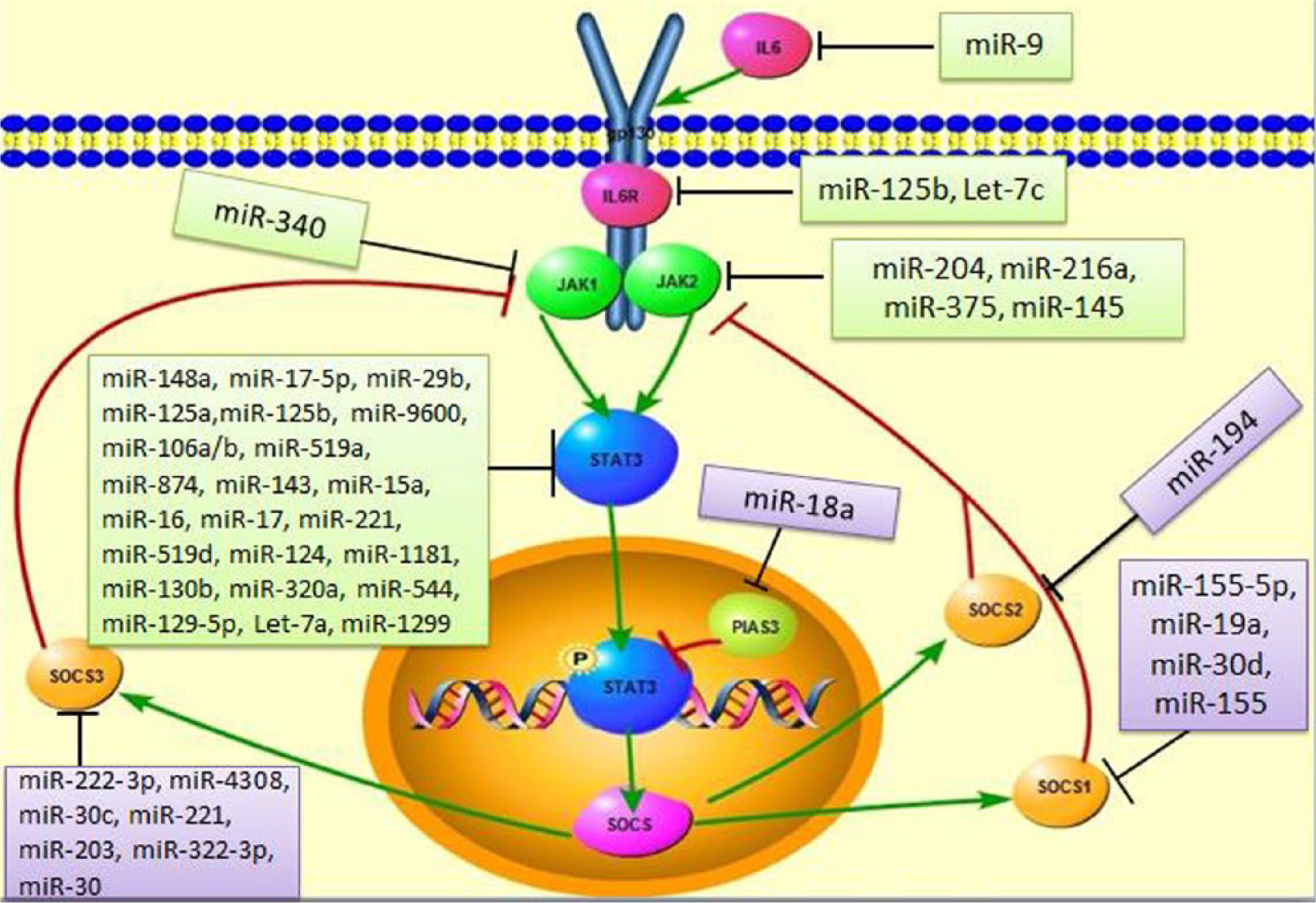
Regulation of miRs in the IL6/JAK/STAT3 signaling pathway. MiRs activate this signaling pathway at multiple levels by targeting SOCS and PIAS3. MiRs directly target STAT3 or indirectly target JAKs to repress the IL6/JAK/STAT3 signaling pathway.
MiRs that directly target STAT3.

MiR: microRNA; STAT: signal transducer and activator of transcription; NSCLC: non–small cell lung cancer; EMT: epithelial–mesenchymal transition; HCC: hepatocellular carcinoma.
Therefore, directly targeting STAT3 using miRs fundamentally influences various signal transduction pathways and biological activities, which in turn may be potentially utilized as therapeutic targets.
MiRs target other components of the JAK/STAT signaling pathway
In addition to directly targeting STAT3, miRs also target other components of the JAK/STAT signaling pathway by indirectly targeting IL6/6R, JAKs, SOCS, and PIAS3, which mediates STAT3 expression (Figure 1 and Table 2).
MiRs target other components in JAK/STAT signaling pathway.

MiR: microRNA; JAK: Janus kinase; STAT: signal transducer and activator of transcription; HCC: hepatocellular carcinoma; OSCC: oral squamous cell carcinoma; EMT: epithelial–mesenchymal transition; NSCLC: non–small cell lung cancer.
MiRs target members of the JAK family to suppress the phosphorylation of JAKs, which in turn, as a tumor suppressor, downregulates the expression of STAT3. MiR-340 suppresses cell proliferation and invasion by targeting JAK1 directly as a tumor suppressor in HCC. 45 MiR-204, -216a, and 375 suppress the JAK2/STAT3 signaling pathway by targeting JAK2 in breast, pancreatic, gastric cancer, and bladder cancer.46–49 MiR-125b and let-7c inhibit migration, invasion, proliferation, and apoptosis in cholangiocarcinoma (CCA) by targeting IL6R. 50 MiR-9 targets IL6 to indirectly suppress STAT3 in cervical cancer. 51
Conversely, JAK/STAT signaling is active when miRs target SOCS proteins, which in turn activates STAT3. MiR-155-5p, -19a, -30d, and -155 upregulate STAT3 by targeting SOCS1 in breast cancer, oral squamous cell carcinoma (OSCC), NSCLC, prostate, and pancreatic cancer.52–57 MiR-194 acts as an oncogene by targeting SOCS2 in prostate cancer. 58 MiR-222-3p, -4308, -221, -203, -322-3p, and -30 activate STAT3 by targeting SOCS3 in different cancers (Table 1).5,59–62 PIAS3, as a protein inhibitor of active STAT3, targets miR-18a to suppress STAT3 in gastric adenocarcinoma. 63
In summary, miRs regulate STAT3 by directly targeting its classic signaling pathway to inhibit or promote the expression of STAT3-interacting proteins, which reveals that the regulatory mechanism involves a complex network of interactions.
MiRs target other signaling pathway components
Other miRs indirectly regulate STAT3 by targeting components of other pathways (Figure 2 and Table 3). For example, reversion-inducing cysteine-rich protein with Kazal motifs (RECK) is a membrane-anchored glycoprotein that acts as a repressive factor of matrix metalloproteinase 9 (MMP-9) and MMP-2; miR-590-5p is upregulated in gastric cancer and contributes to cell growth and invasion. MiR-590-5p regulates STAT3 by binding to the 3′-UTR of RECK, as well as promotes cell invasion in gastric cancer. Therefore, as an oncogene, the miR-590-5p/RECK axis is an important pathway that regulates the expression of STAT3 in gastric cancer. 64 MiR-126 is downregulated in osteosarcoma, and the overexpression of miR-126 inhibits cell proliferation, migration, invasion, and EMT, thereby demonstrating that miR-126 functions as a tumor suppressor. Zinc finger E-box binding homeobox 1 (ZEB1) has been verified as a target gene of miR-126, and silencing ZEB1 results in the inactivation of the JAK1/STAT3 pathway. Thus, the miR-126/ZEB1 signaling pathway also influences STAT3 activation. 65 In conclusion, miR-590-5p, -424, and -221/222 indirectly activate STAT3 by targeting RECK, COP1, ADIPOR1, and PDLIM2 individually to promote cell proliferation, invasion, and EMT.64,66–68 MiR-24-3p, -1207-5p, -363, -203, -197, -199a-3p, -30c, -519d, -27b-3p, -99a, -101, -302b, -12b, and -34a have been reported to target FGF11, CSF1, S1PR1, LIFR, CKS1B, C-Met, TWF1, RhoC, ROR1 IGF1R, CXCR7, RUNX1, ZEB1, and INH3, respectively, as tumor suppressors in various cancers.28,50,69–79

STAT3 regulation by miRs via other signaling pathway components. Other pathways by which miRs directly or indirectly regulate STAT3 expression.
MiRs target the components of other signaling pathways.

MiR: microRNA; EMT: epithelial–mesenchymal transition; NSCLC: non–small cell lung cancer; HCC: hepatocellular carcinoma; RCC: renal cell carcinoma.
All the additional examples of miRs that regulate STAT3 via a non-classical pathway are listed in Table 3 and Figure 2. These non-classical pathways create numerous nodes in the cellular regulatory network; therefore, miRs regulate STAT3 by targeting proteins with different functions. These proteins, acting as either oncogenes or tumor suppressors, modulate STAT3 expression; however, details on the underlying regulatory mechanism remain unclear.
MiRs regulate STAT3 using an unidentified target locus
Previous reports have shown that MiRs regulate STAT3 expression; however, the underlying mechanism remains unclear. For example, STAT3 is an oncogene that promotes cell proliferation and migration. Yu et al. showed that miR-148a expression effectively downregulates STAT3 activation; however, its underlying mechanism remains unclear. STAT3 is a downstream factor of miR-148a and not a target locus. There is currently a need to identify the target locus of miR-148a and the relationship between 148a and STAT3 in gastric cancer. 80 All miRs that influence STAT3 expression in different kinds of cancers act as upstream factors (Figure 3 and Table 4). MiR-199a5p, -205, -373, and -139-5p act as oncogenes that upregulate STAT3 in osteosarcoma and colorectal carcinoma.81–83 On the contrary, miR-148a, -491-5p, -31, -146a, -375, -204, -197, -133b, and -135a inhibit STAT3 expression in gastric cancer, pancreatic cancer, cervical cancer, colorectal cancer, cutaneous squamous cell carcinoma, HCC, and renal carcinoma.80,84–90

STAT3 regulation by miRs with unidentified target loci. MiRs regulate STAT3 via an unknown mechanism and unidentified target loci.
MiRs that regulate STAT3 with unidentified target loci.

MiR: microRNA; STAT3: signal transducer and activator of transcription 3.
In summary, the regulatory function of miRs and STAT3 is unclear, and no target locus in specific signaling pathway has been identified. However, previous studies have shown that STAT3 is involved in the regulatory network of cancer progression.
STAT3 upregulate or downregulate MiRs
Previous studies have shown that miRs regulate STAT3 and STAT3-related signaling pathways. Similarly, STAT3 also modulates the expression of miRs, which in turn regulates cell proliferation, migration, apoptosis, invasion, and EMT in various cancers (Figure 3 and Table 5).
STAT3-mediated regulation of miRs.
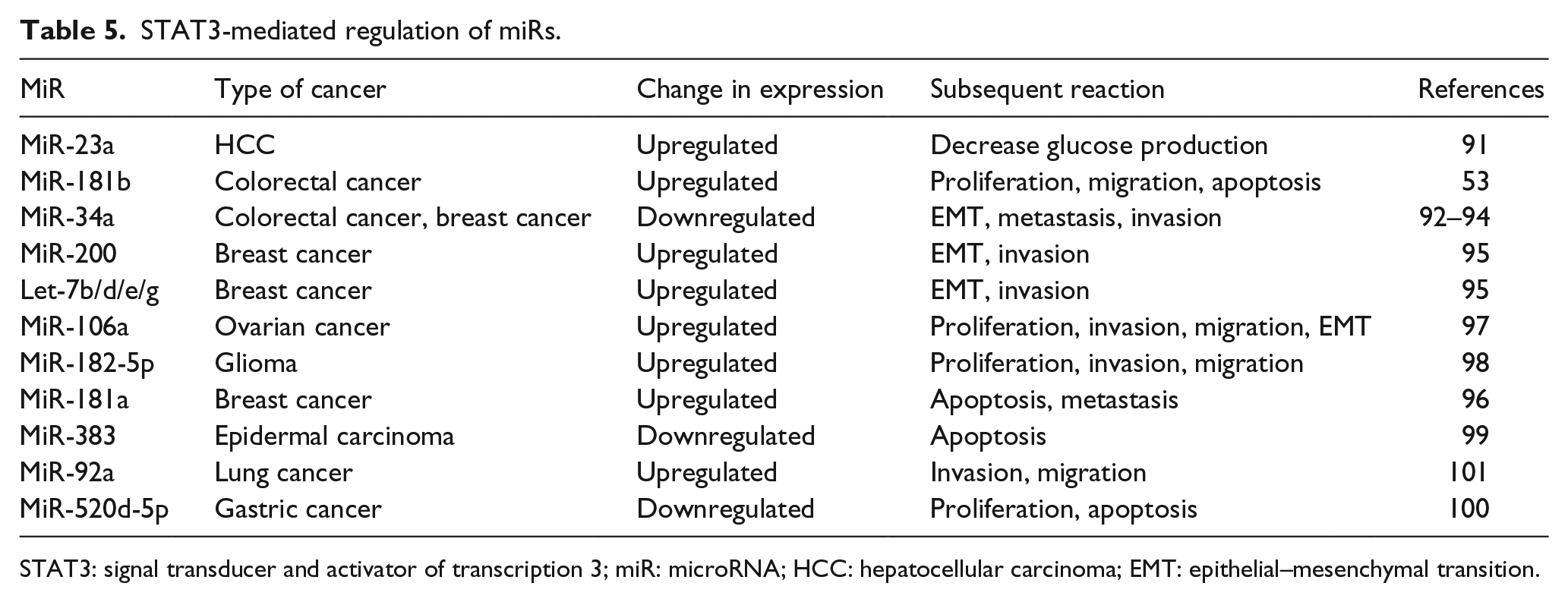
STAT3: signal transducer and activator of transcription 3; miR: microRNA; HCC: hepatocellular carcinoma; EMT: epithelial–mesenchymal transition.
Wang et al. used a mouse model and conducted cell experiments to prove that the expression of miR-23a is upregulated in HCC mice. Furthermore, they showed that STAT3 upregulates miR-23a, which targets G6PC, and thus the activation of the STAT3/miR-23a pathway could lead to a decrease in glucose production. 91 In colorectal cancer, STAT3 upregulates miR-181b, which in turn promotes cell proliferation and migration, as well as inhibits cell apoptosis. 53 Conversely, STAT3 downregulates miR-34a in colorectal92,93 and breast cancer. 94 Moreover, STAT3 also promotes the expression of other miRs such as miR-200 and -181a in breast cancer.95,96 Members of the Let-7 family such as let-7a and-7c play an important role in cancer.27,29,39,50 Furthermore, STAT3-coordinated let-7b/d/e/g induces invasion and EMT in breast cancer. 95 In ovarian cancer, the IL6-mediated activation of STAT3 upregulates miR-106a, which promotes invasion, migration, proliferation, and EMT via the IL6/STAT3 signaling pathway. 97 MiR-182-5p acts as an oncogene in glioma, targeting PCDH8, which is also activated by STAT3. 98 STAT3 is downregulated by miR-383 and -520d-5p in epidermal carcinoma and gastric cancer, respectively.99,100 In lung cancer, STAT3 upregulates miR-92a to target RECK and downregulates RECK, which in turn promote invasion and migration. 101
The cross talk between miRs in regulating STAT3 activity
Collectively, we have summarized the current reports on the relationship between miRs and STAT3 in various types of cancers. The role of miRs in tumorigenesis is supported by a variety of scientific findings. We have enumerated the interactions between miRs and the STAT3 signaling pathway below. In addition to directly targeting STAT3, miRs also interact with other genes in the IL6/JAK/STAT3 pathway and other components upstream of STAT3. Furthermore, by acting as STAT3 downstream effectors, miRs are also up/downregulated by STAT3 activation.
A specific miR may play the same function in different cancers. For example, miR-375, by acting as a tumor suppressor, targets JAK2 in gastric cancer. Gain- and loss-of-function experiments have determined that miR-375 mediates JAK2/STAT3 activation, which in turn could be potentially utilized as a novel clinical therapeutic target for gastric cancer. 48 However, another study showed that a JAK2/STAT3-related signaling pathway is downregulated in miR-375-overexpressing cells, and cell proliferation is inhibited in colorectal cancer, thereby indicating that miR-375 acts as a tumor suppressor, preventing the occurrence and development of colorectal cancer, although its target locus remains unclear. 86 Nevertheless, miR-375 targets JAK2 in cancer, thereby downregulating STAT3 and inhibiting tumorigenesis. MiR-148a, -204, and -197 play a similar function in cancer as that of miR-375.17,46,72,80,88,89 These studies indicate that miRs play a central role in various cancers, that is, as oncogene or tumor suppressor, although the interrelationship between these miR- and STAT3-related signaling pathways remains unclear.
Another phenomenon involving the relationship between miR family and STAT3 is that different miRs belonging to the same miR family also play the same function in cancers. For example, in the miR-125 family, whose members act as tumor suppressors, miR-125a directly targets STAT3 in cervical cancer, and its overexpression suppresses cell growth, invasion, and EMT, as well as regulates cell cycle by inhibiting G2/M checkpoint proteins, 30 focal adhesion kinase (FAK) is a protein tyrosine kinase that promotes cell migration, invasion, and adhesion via STAT3 activation. Quantitative reverse transcription polymerase chain reaction (qRT-PCR) analysis indicated that miR-125b is upregulated in siFAK cells compared to siNC cells, suggesting that miR-125b participates in the FAK/STAT3 signaling pathway and demonstrating that miR-125b directly targets the 3′-UTR of STAT3 in melanoma via the promotion of FAK. 31 MiR-125b indirectly inhibits STAT3 by targeting IL6R in CCA, thereby resulting in the inhibition of cell proliferation, migration, and invasion and promotion of cell apoptosis via the miR-125b/IL6R/STAT3 pathway. 50 Members of this miR family include miR-181, -17, -519, -155, and -30, which show a similar function as that of miR-125.20,23,24,32,52,53,55–57,62,75,76,96 Members of the same miR family regulate the expression of specific proteins that influence cancer progression, thereby suggesting that these may be potentially utilized as novel therapeutic targets in cancer treatment regimens.
SOCS3, which is the most common negative regulator of STAT3 in the SOCS family, indirectly downregulates STAT3 activity in breast cancer by targeting miR-203. MiR-203, which acts as an oncogene, inhibits the SOCS3/STAT3 pathway, thereby preventing breast carcinogenesis. 5 However, miR-203 also acts as a tumor suppressor that targets leukemia inhibitory factor receptor (LIFR) in rhabdomyosarcoma (RMS), thereby negatively regulating the STAT3 pathway, inhibiting myogenic differentiation and decreasing the proliferation and migration in RMS. 71 Therefore, these studies thus demonstrate that a specific miR may play opposite functions in different cancers, which in turn may be potentially utilized as a novel target in cancer therapeutics. Further investigations on the function of miRs may provide insights into the clinical targeted therapy in different cancers.
Comparison between miRs and pharmacological inhibitors in regulating STAT3 negatively
STAT3 has been localized to the cytoplasm, is activated by phosphorylation, and plays a role in tumorigenesis, thereby rendering itself an ideal target for cancer therapeutics. Recent reviews have described the use of pharmacological inhibitors in targeting STAT3 via five major routes, which include its DNA-binding domain, N-terminal domain, SH2 domain, its interaction with importin, and upstream kinase activity. 102 Clinical trials have investigated the use of pharmacological inhibitors such as butein, capsaicin, and other macromolecules of similar activity such as anti-cancer therapeutic agents.102,103
mRNA serves as the template in DNA transcription that results in the synthesis of proteins. MiRs and RICS have been utilized to target the 3′-UTR of mRNAs to inhibit protein translation. However, the main mechanism of pharmacological inhibitors involves blocking the DNA-binding domain of STAT3 or repressing other components of the STAT3 signaling pathway such as JAKs. Therefore, compared to pharmacological inhibitors, miRs negatively regulate STAT3 with a higher degree of specificity and may thus serve as a novel approach for targeted gene therapy.
Conclusion
Collectively, we have summarized the current reports on the relationship between miRs and the STAT3 signaling pathway in different kinds of cancers. This signaling pathway modulates cell proliferation, migration, metastasis, EMT, cell cycle, and apoptosis, and various miRs regulate STAT3 activity. This review provides insights into novel schemes for clinical therapeutics of cancer.
Footnotes
Acknowledgements
J.Z. contributed to the conception of the study. J.L., Q.W., G.M., X.L., H.Z., and W.L. contributed significantly to the analysis and manuscript preparation; L.Z. performed the data analyses and wrote the manuscript.
Declaration of conflicting interests
The author(s) declared no potential conflicts of interest with respect to the research, authorship, and/or publication of this article.
Funding
The author(s) received no financial support for the research, authorship, and/or publication of this article.