




Abstract
We aimed to demonstrate the differences in the expression of glucose metabolism–related proteins according to the thyroid cancer subtypes and investigate the implications of these differences. A total of 566 thyroid cancer patients, including 342 cases of papillary thyroid carcinoma, 112 cases of follicular carcinoma, 70 cases of medullary carcinoma, 23 cases of poorly differentiated carcinoma, 19 cases of anaplastic carcinoma, and 152 cases of follicular adenoma, were enrolled in the study. Immunohistochemical staining for glucose transporter 1, hexokinase II, carbonic anhydrase IX, and monocarbonylate transporter 4 was performed, and the relationship between immunoreactivity and clinicopathologic parameters was analyzed. Glucose transporter 1 and tumoral monocarbonylate transporter 4 expression levels were shown to be the highest in anaplastic carcinoma, and medullary carcinoma showed the highest carbonic anhydrase IX and lowest hexokinase II levels compared with other subtypes. Stromal expression of monocarbonylate transporter 4 was observed in papillary thyroid carcinoma and anaplastic carcinoma samples. Conventional papillary thyroid carcinoma tumors expressed higher levels of glucose transporter 1, and tumoral and stromal monocarbonylate transporter 4, than the follicular variant, which showed a higher expression of carbonic anhydrase IX. Papillary thyroid carcinoma samples with BRAF V600E mutation were shown to have higher glucose transporter 1, hexokinase II, carbonic anhydrase IX, and tumoral monocarbonylate transporter 4 expression levels. Univariate analysis showed that papillary thyroid carcinoma cases with glucose transporter 1 positivity had shorter overall survival, patients with medullary carcinoma and hexokinase II positivity were shown to have a shorter disease-free survival and overall survival, and tumoral monocarbonylate transporter 4 positivity was associated with shorter overall survival compared with papillary thyroid carcinoma patients with negativity for each marker. Disease-free survival and overall survival of patients with poorly differentiated carcinoma were shown to be significantly decreased when glucose transporter 1 and tumoral monocarbonylate transporter 4 are expressed. We demonstrated that the expression levels of glycolysis-related proteins differ between thyroid cancer subtypes and are correlated with poorer prognosis, depending on the subtype.
Introduction
Thyroid cancer is a relatively common malignant tumor affecting 1.5% of population worldwide, 1 and the most common subtype is papillary thyroid carcinoma (PTC), followed by follicular carcinoma (FC), medullary carcinoma (MC), poorly differentiated carcinoma (PDC), and anaplastic carcinoma (AC). Each subtype shows different cellular origin, clinical manifestations, metastatic pattern, and clinical prognosis. 2
The metabolism of malignant tumors can be explained with Warburg effect, a metabolic shift from oxidative phosphorylation (OXPHOS) to glycolysis in tumor cells.
3
The key molecules in glycolysis include glucose transporter 1 (GLUT-1), hexokinase II, carbonic anhydrase IX (CAIX), and monocarbonylate transporter 4 (MCT-4). GLUT-1 plays a role in the facilitation of glucose entering into the cytoplasm,
4
and hexokinase II is an enzyme responsible for the phosphorylation of glucose into glucose-6-phosphate.
5
CAIX neutralizes acidification, which occurs because of the increased production of lactate during glycolysis, by reversible hydration of carbon dioxide,
6
while MCT-4 is a transporter that removes lactate produced during glycolysis from the cytoplasm.
7
Recently, several studies suggested that the expression of these glycolysis-related proteins may be different depending on a cancer subtype.
Materials and methods
Patient selection
Patients who were diagnosed with PTC and underwent thyroidectomy from January 2012 to December 2013, and diagnosed with other thyroid cancer subtypes and had thyroidectomy from January 2001 to December 2014 at Severance Hospital of the Yonsei University, were included in this study. Patients who received preoperative chemotherapy were excluded from the study. This study and all experimental procedures were approved by the Institutional Review Board (IRB) of Yonsei University Severance Hospital. Informed consent was exempted by IRB. All cases were retrospectively reviewed by a thyroid pathologist (J.S.K.), using hematoxylin and eosin (H&E)-stained slides and light microscopy for the assessment of histologic features. Clinicopathologic data were obtained from the patients’ medical records, and included age at diagnosis, disease recurrence, metastatic status, current status, and the length of follow-up. The tumor size, location (right or left lobe), extent (confined to the thyroid parenchyma or with extrathyroidal involvement), and the number of metastatic lymph nodes were also obtained by the review of the slides and the surgical pathology reports.
Tissue microarray
Representative areas of H&E-stained slides were selected, and a corresponding spot was marked on the surface of the matching paraffin block. Core biopsies of 5 mm were taken from selected areas and placed into a 5 × 4 recipient block. More than two tissue cores were extracted from each sample, in order to minimize the extraction bias. Each tissue core was assigned a unique tissue microarray location number that was linked to a database containing other clinicopathologic data.
Immunohistochemistry
Antibodies used for immunohistochemistry are listed in Supplementary Table 4. All immunohistochemical analyses were performed using formalin-fixed paraffin-embedded tissue sections, with an automated immunohistochemistry staining device (BenchMark XT; Ventana Medical Systems, Tucson, AZ, USA). Briefly, 5-µm-thick formalin-fixed paraffin-embedded tissue sections were transferred onto adhesive slides and dried at 62°C for 30 min. Standard heat epitope retrieval was performed for 30 min in ethylenediaminetetraacetic acid, pH 8.0, using the autostainer. The samples were then incubated with primary antibodies, and afterward, they were incubated with biotinylated anti-mouse immunoglobulins, peroxidase-labeled streptavidin (LSAB kit; DakoCytomation, Glostrup, Denmark), and 3,30-diaminobenzidine. Negative control samples were processed without the primary antibody. Positive control tissue samples were used according to the manufacturer’s recommendation. Slides were counterstained with Harris hematoxylin. Optimal primary antibody incubation times and concentrations were determined by serial dilutions for each immunohistochemical assay, using a tissue block fixed and embedded in exactly the same manner as those used in further experiments.
Interpretation of immunohistochemical staining
Immunohistochemical markers were assessed using the light microscopy. The expression of each glycolysis-related molecule was evaluated in a semi-quantitative manner, using the previously established procedure. 13 Tumor cell staining was assessed as follows: 0, negative or weak immunostaining in <1% of the tumor cells; 1, focal expression in 1%–10% of tumor cells; 2, positive staining in 11%–50% of tumor cells; and 3, positive staining in 51%–100% of tumor cells. Whole tumor areas were evaluated, and scores 0–1 were defined as negative, score 2 was defined as positive, and score 3 was defined as highly positive. For stromal expression, positivity was defined as the staining of an expression area encompassing more than 10% of whole tumor stroma.
Statistical analysis
Data were analyzed using SPSS for Windows, Version 22.0 (SPSS Inc., Chicago, IL, USA). For the determination of statistical significance, Student’s t and Fisher’s exact tests were used for continuous and categorical variables, respectively. In the case of multiple comparisons, a corrected p value with the application of the Bonferroni multiple comparison procedure was used. Statistical significance was set to p < 0.05. Kaplan–Meier survival curves and log-rank statistics were employed to evaluate time to tumor recurrence and overall survival (OS). Multivariate regression analysis was performed using the Cox proportional hazards model.
Results
Characteristics of thyroid cancer samples
Here, we included 566 cases of thyroid cancer, including 342 cases of PTC, 112 cases of FC, 70 MC cases, 23 PDC cases, and 19 AC cases. The characteristics of PTC samples are presented in Supplementary Table 1, and PTC samples are divided into 302 cases of the conventional type and 40 follicular variant cases, and the latter were shown to have a larger expanding tumor margin, compared with that in conventional type samples (p = 0.002). PTC samples with BRAF V600E mutation included 236 (69.0%) cases, which showed larger infiltrative tumor margins (p = 0.004) and included a lower proportion of follicular variant cases (p < 0.001), in comparison with PTC samples without BRAF V600E mutation. FC included 99 cases of minimally invasive and 13 cases of widely invasive type, and the latter had significantly larger tumor sizes (p = 0.004), more vascular invasion (p = 0.028), extrathyroidal involvement (p < 0.001), and distant metastases (p = 0.003), compared with the former group (Supplementary Table 2). The characteristics of MC, PDC, and AC cases are presented in Supplementary Table 3.
Expression of glycolysis-related proteins in thyroid cancer
The expression of all glycolysis-related proteins was shown to be significantly different between different thyroid cancer subtypes (Figure 1). The expression of MCT-4 was observed in both tumor and stromal cells, with GLUT-1 and tumoral MCT-4 expression shown to be the highest in AC, CAIX in MC, while hexokinase II expression levels were lower in MC than in other subtypes (p < 0.001, all). MCT-4 was expressed in the stromal cells of PTC and AC, with AC showing higher MCT-4 expression levels than PTC (p < 0.001; Table 1).

Heat map of the glycolysis-related protein expression levels in thyroid cancer. (a) GLUT-1 and tumoral MCT-4 expression levels are the highest in AC, and MC shows the highest CAIX and lowest hexokinase II levels compared with other subtypes. Stromal expression of MCT-4 is observed in PTC and AC. (b) Conventional PTC tumors express higher levels of GLUT-1, and tumoral and stromal MCT-4, than the follicular variant, which show a higher expression of CAIX. PTC with BRAF V600E mutation is shown to have higher GLUT-1, hexokinase II, CAIX, and tumoral MCT-4 expression levels than PTC without BRAF V600E mutation.
Expression of metabolism-related proteins according to the histologic subtype of thyroid cancer.

PTC: papillary thyroid carcinoma; FC: follicular carcinoma; MC: medullary carcinoma; PDC: poorly differentiated carcinoma; AC: anaplastic carcinoma; GLUT-1: glucose transporter 1; CAIX: carbonic anhydrase IX; MCT-4: monocarbonylate transporter 4.
PTC variants showed differences in the expression of glucose metabolism-related proteins. Conventional-type samples were shown to have an increased expression of GLUT-1 (p = 0.011), tumoral MCT-4 (p < 0.001), and stromal MCT-4 (p = 0.013), compared with the follicular variant samples. Follicular variant cases expressed CAIX at a higher level compared with the conventional type (p = 0.015; Figure 2). PTC with BRAF V600E had higher expression rates of GLUT-1 (p < 0.001), hexokinase II (p < 0.001), CAIX (p = 0.001), and tumoral MCT-4 (p < 0.001) than PTC samples without this mutation (Figure 3, Table 2).

Representative images of glycolysis-related protein expression in thyroid cancer samples. The expression of MCT-4 is observed in both tumor and stromal cells, with GLUT-1 and tumoral MCT-4 expression shown to be the highest in AC, CAIX in MC, while hexokinase II expression levels are lower in MC than in other subtypes.
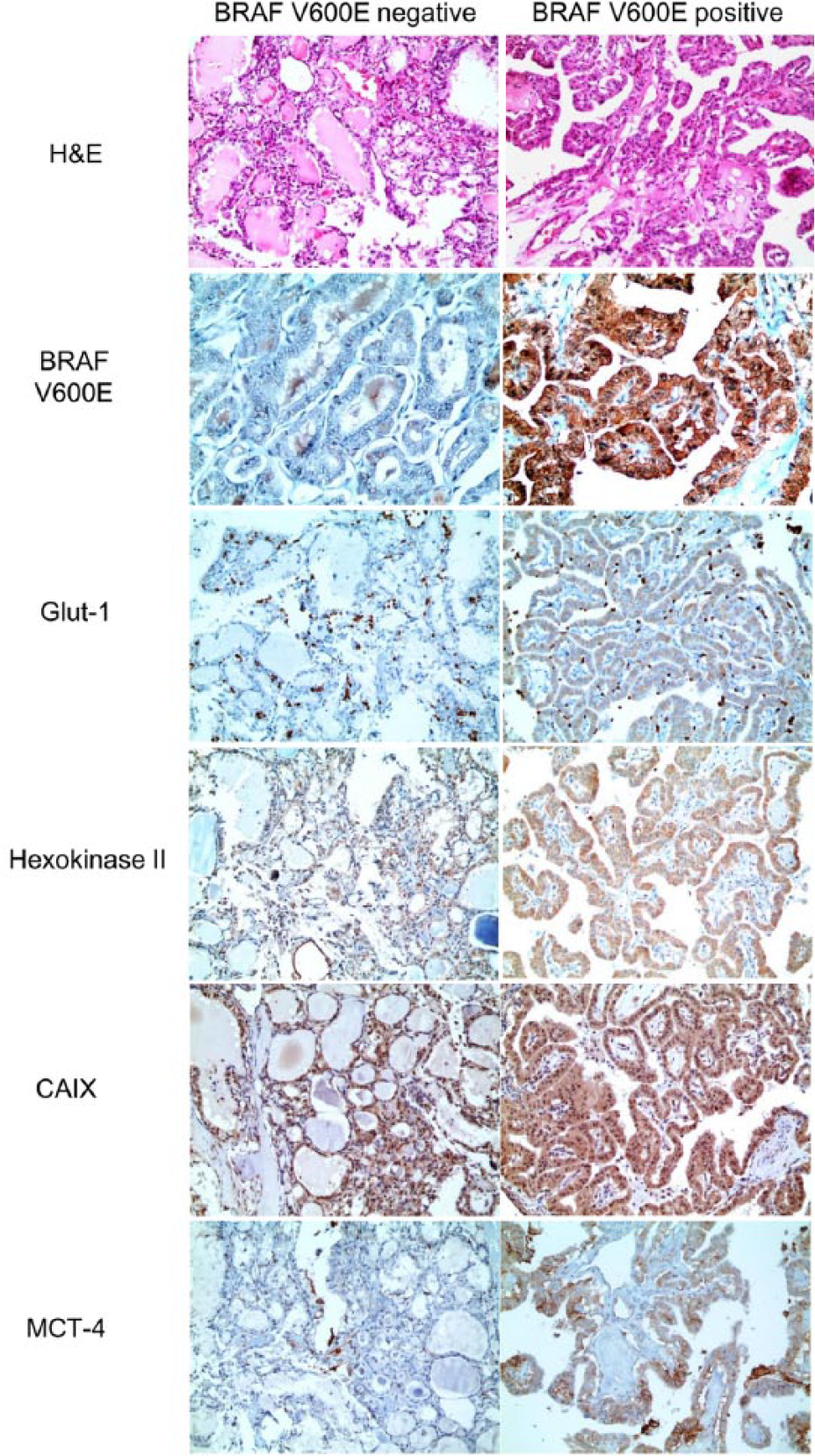
Expression of glycolysis-related proteins in PTC according to the BRAF V600E mutation status. PTC with BRAF V600E has higher expression rates of GLUT-1, hexokinase II, CAIX, and tumoral MCT-4 than PTC without BRAF V600E mutation.
Expression of glycolysis-related proteins according to the histologic variants of PTC.

PTC: papillary thyroid carcinoma; GLUT-1: glucose transporter 1; CAIX: carbonic anhydrase IX; MCT-4: monocarbonylate transporter 4.
Bold value represents p < 0.05.
In follicular neoplasms, the expression levels of GLUT-1, hexokinase II, and tumoral MCT-4 were higher in FC than in follicular adenoma (FA) samples (p = 0.001, p = 0.009, and p = 0.019, respectively; Table 3). However, there was no significant difference in the expression levels of glycolysis-related proteins between the minimally invasive and widely invasive types of FC (Table 4).
Expression of glycolysis-related proteins in follicular neoplasms.
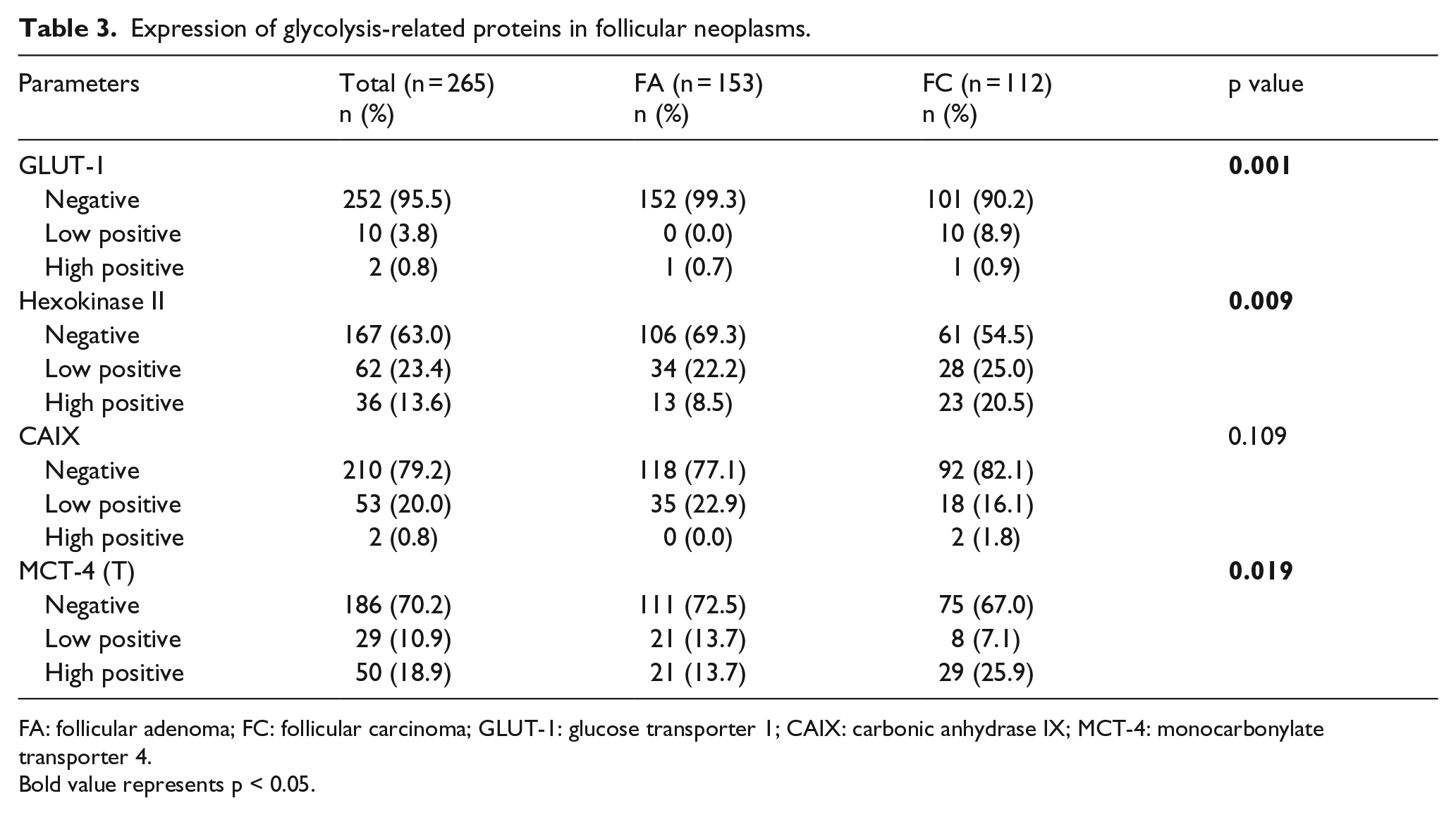
FA: follicular adenoma; FC: follicular carcinoma; GLUT-1: glucose transporter 1; CAIX: carbonic anhydrase IX; MCT-4: monocarbonylate transporter 4.
Bold value represents p < 0.05.
Expression of glycolysis-related proteins according to the histologic subtype of FC.

FC: follicular carcinoma; GLUT-1: glucose transporter 1; CAIX: carbonic anhydrase IX; MCT-4: monocarbonylate transporter 4.
Effect of glycolysis-related protein expression levels on prognosis
Univariate analysis was used to investigate the effect of glycolysis-related protein on thyroid cancer prognosis (Figure 4). The OS of PTC patients with high GLUT-1 expression was shown to be reduced (p = 0.001), compared with GLUT-1-negative PTC patients (Table 5), while the patients with MC had shorter disease-free survival (DFS) when the samples were positive for hexokinase II expression (p = 0.015), together with the shorter OS in case of hexokinase II positivity (p = 0.002) and tumoral MCT-4 positivity (p = 0.001) than MC patients with negativity for each marker. Shorter DFS and OS in patients with PDC were shown to be related with GLUT-1 expression (p = 0.005 and p < 0.001, respectively) and tumoral MCT-4 expression (p = 0.019 and p = 0.014, respectively) compared with PDC cases without the expression of each markers (Figure 4).
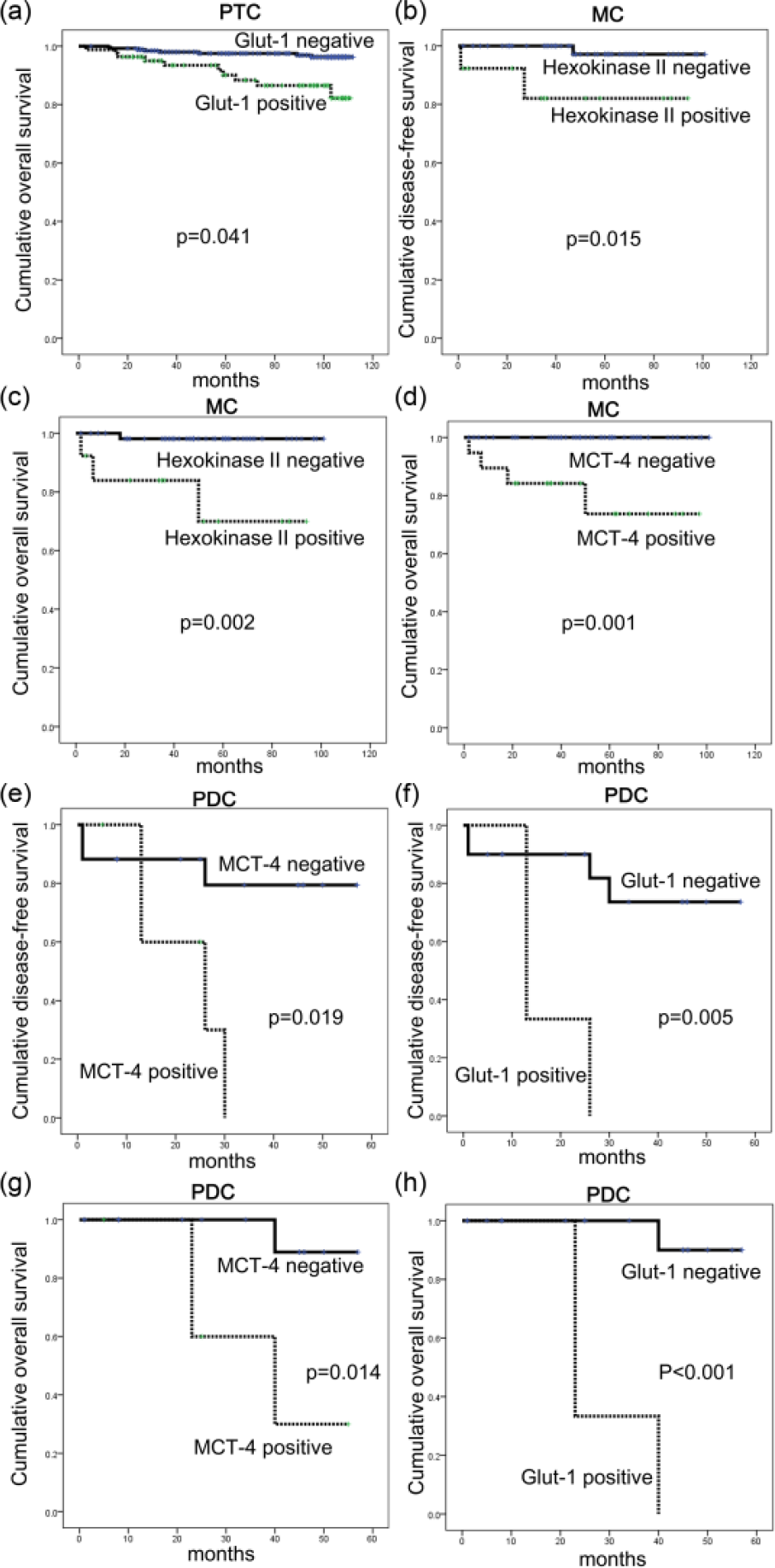
Impact of glycolysis-related protein expression on prognosis in patients with (a) PTC, (b)–(d) MC, and (e)–(h) PDC. (a) The overall survival (OS) of PTC patients with high GLUT-1 expression is shown to be reduced compared with GLUT-1-negative PTC patients, (b) while the patients with MC have shorter disease-free survival (DFS) when the samples were positive for hexokinase II expression, together with the shorter OS in case of (c) hexokinase II positivity and (d) tumoral MCT-4 positivity than MC patients with negativity for each markers. Shorter DFS and OS in patients with PDC are shown to be related with (e, g) tumoral MCT-4 expression and (f, h) GLUT-1 expression.
Univariate analysis of the influence of metabolism-related protein expression in PTC on DFS and OS.

PTC: papillary thyroid carcinoma; DFS: disease-free survival; OS: overall survival; CI: confidence interval; GLUT-1: glucose transporter 1; CAIX: carbonic anhydrase IX; MCT-4: monocarbonylate transporter 4.
Bold value represents p < 0.05.
Discussion
In this study, we investigated the expression of glycolysis-related proteins in thyroid cancer. We showed that the expression of GLUT-1 and MCT-4 was significantly higher in AC cases, compared with other thyroid cancer subtypes. GLUT-114–16 and MCT-417,18 expression levels have been reported to be correlated with the aggressiveness in several tumor types, and AC is one of the most aggressive thyroid cancer types, and therefore, our results agree with the results obtained in the previous studies. Main reason for high GLUT-1 and MCT-4 expression in AC may be caused by higher tumor proliferative activity and induced hypoxia, compared with other tumor types. The proliferative activity of AC, based on the measurements of Ki-67 labeling index, was shown to be more than three times higher than in other subtypes,
19
which suggests that AC cells have increased metabolic demands compared with other cancer cells. In addition, tumor hypoxia is caused by high proliferative activity, which may represent the reason for extensive tumor necrosis in AC.
20
Under the hypoxic conditions, the expression of hypoxia inducible factor 1 (HIF-1) is increased,
21
and the representative target molecule of HIF-1 is GLUT-1.
AC showed an increased expression of stromal MCT-4 compared with other subtypes, and stromal expression of MCT-4 was reported in several previous studies.34,35 This may be explained with the reverse Warburg effect, representing metabolic interactions between tumor and stromal cells. Tumor cells produce reactive oxygen species (ROS), such as nitric oxide (NO), which leads to the oxidative stress of stromal cells and induces glycolysis and mitochondrial dysfunction. Lactate and other glycolysis products of stromal cells enter the tumor cells, allowing the increased production of ATP through mitochondrial OXPHOS, and in this way, the survival and development of tumor cells is increased.36–39 Therefore, the differences in glycolytic properties between cancer and stromal cells in AC samples were investigated in this study, and the obtained results suggest that AC shows both Warburg and reverse Warburg effects. The reverse Warburg effect was first observed in breast cancers, since metabolic phenotypes were shown to differ between breast cancer subtypes. Triple-negative breast cancer (TNBC), the most aggressive subtype, was shown to have high rates of mixed-type (Warburg type and reverse Warburg type) tumor and stromal cells, 9 which agrees with the results of this study. MC samples were shown to have high CAIX expression levels, which can be explained by the study that CAIX activation was suggested to be related with rearranged during transfection (RET)-mediated activation of the HIF pathway. 40
The expression of glycolysis-related proteins was higher in PTC samples with BRAF V600E mutation, which agrees with the results obtained in a previous study. 41 The proposed underlying mechanism is the association of BRAF mutation with the activation of mitogen-activated protein kinase downstream targets such as c-MYC and HIF-1a, which increases glucose metabolism.42,43
GLUT-1, hexokinase II, and MCT-4 expressions, depending on the subtypes of thyroid cancer, were associated with poor prognosis in this study. This agrees with previous studies showing that the increased expression of GLUT-1,14,44,45 hexokinase II,46–48 and MCT-4 17 correlate with poor thyroid cancer prognosis. Therefore, glycolysis-related proteins seem to play the roles as tumor aggressiveness regulators.
The results of this study may provide the basis for the potential use of glycolysis-related proteins as therapeutic targets for the treatment of thyroid cancer. Since AC, the most aggressive type of thyroid cancer, samples were shown to have high expression levels of GLUT-1 and MCT-4, and MC cases high expression levels of CAIX, these proteins especially may be used as targets. In previous studies, it was shown that the progression of various tumors can be reduced by the inhibition of GLUT-1,49–51 MCT-4, 52 and CAIX.53,54 For this, further studies of aggressive subtypes of thyroid cancer, such as AC and MC, are required.
In conclusion, glycolysis-related proteins were shown to be differentially expressed between different subtypes of thyroid cancer. AC samples had the highest levels of GLUT-1 and MCT-4 expression, while MCs showed high CAIX expression. PTC samples with BRAF V600E mutation were shown to express high levels of glycolysis-related proteins.
Footnotes
Declaration of conflicting interests
The author(s) declared no potential conflicts of interest with respect to the research, authorship, and/or publication of this article.
Funding
This study was supported by a grant from the National R&D Program for Cancer Control, Ministry of Health & Welfare, Republic of Korea (1420080). In addition, it was supported by Basic Science Research Program through the National Research Foundation of Korea (NRF) funded by the Ministry of Science, ICT and Future Planning (2015R1A1A1A05001209).
References
Supplementary Material
Please find the following supplemental material available below.
For Open Access articles published under a Creative Commons License, all supplemental material carries the same license as the article it is associated with.
For non-Open Access articles published, all supplemental material carries a non-exclusive license, and permission requests for re-use of supplemental material or any part of supplemental material shall be sent directly to the copyright owner as specified in the copyright notice associated with the article.
