



Abstract
Introduction
Parkinson’s disease (PD) affects the central nervous system and is primarily characterized by the degeneration of dopamine-producing cells in the substantia nigra. Early signs include tremor, rigidity, bradykinesia, and postural instability, with later cognitive, sensory, sleep, and emotional issues. Ayurveda correlates these symptoms with Kampavata, primarily linked to Vata (bio-entities) imbalance. The prime aim of this paper is to study Panchakarma’s efficacy in managing Kampavata (PD).
Case Presentation
This is a case presentation of a 55-year-old male patient who has experienced tremors in the left upper and lower limbs, numbness in the left lower limb, loss of balance for 10 years, abnormal facial expression (masked face), difficulty in speech, and sleep disturbance for 5 years. The patient was treated with Panchakarma therapy for 30 days.
Results
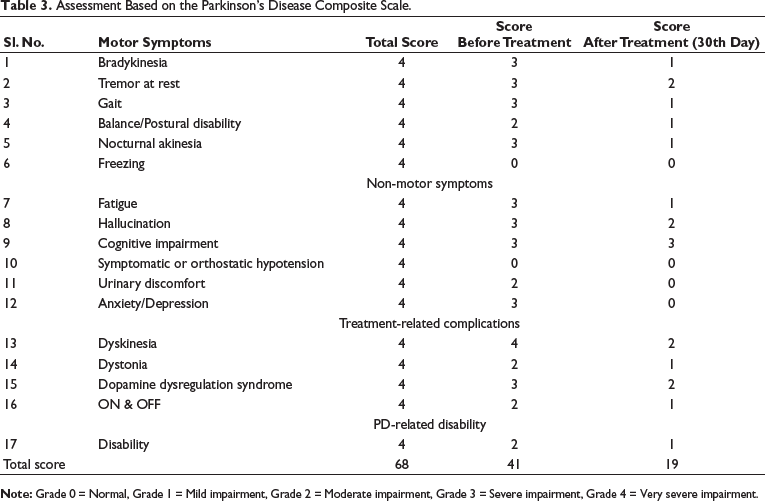
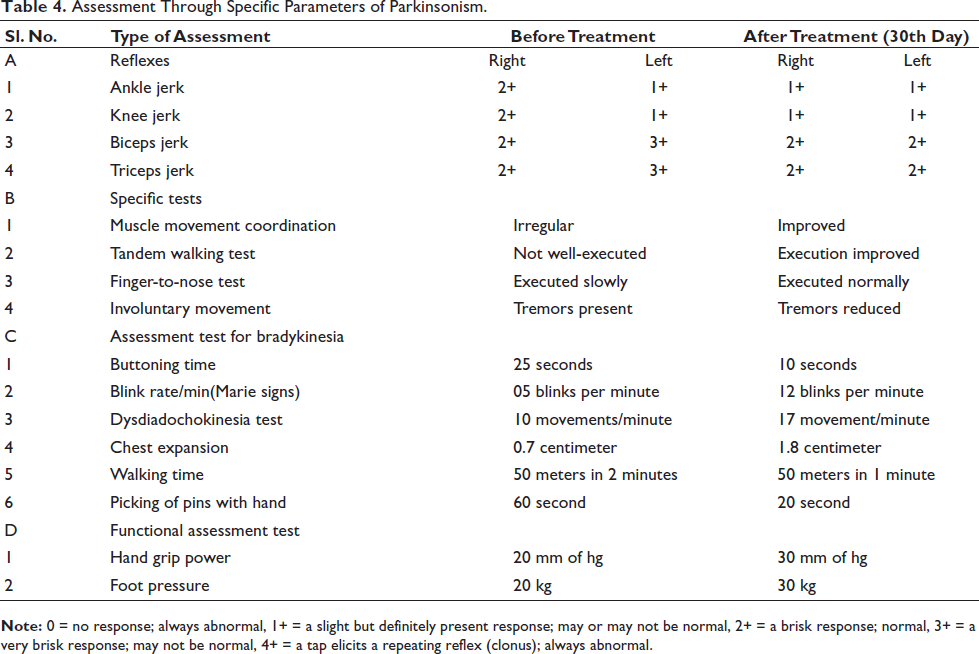
Following treatment, the patient exhibited significant improvement in symptoms, assessed using the PD composite scale, with the total score decreasing from 68 to 19, along with evaluated by specific examination, bradykinesia test, reflexes, functional activities, and clinical features also notably improved.
Discussion
Panchakarma therapy, rooted in Ayurvedic principles, shows promise in managing Kampavata, associated with PD. Conservative management focuses on Vata balance, which offers substantial comfort and enhances patient quality of life.
Conclusion
Panchakarma therapy presents a potential avenue for treating Kampavata, addressing symptoms associated with PD, and improving patient satisfaction and well-being. Further research is warranted to validate these findings and explore the broader applicability of Ayurvedic approaches in neurodegenerative conditions.
Keywords
Introduction
Parkinson’s disease (PD) is a progressive, degenerative neurological condition that primarily impacts the motor system over time. 1 Symptoms including hyposmia, constipation, and exhaustion are part of the clinical prodrome that can be present up to 20 years before the beginning of motor symptoms due to pathologic alterations. 2 The average age at which this disease shows itself is 50. 3 All ethnic groups are affected by the illness; in most populations, it affects men more frequently than women by a factor of two.4, 5 The worldwide incidence of PD is estimated to be around 7–10 million & more than 1 million cases are suffering from PD per year in India. However, the exact etiology of the disease is still unknown. The cardinal signs include bradykinesia, lateral instability, cogwheel rigidity, and resting tremors, but the more prevalent and apparent signs are resting tremors. 6 It is caused by the degeneration of neurons in the substantia nigra, a brain region associated with Lewy bodies.
It is a Vata Nanatmaja vikara and is comparable to Kampavata in Ayurveda. Almost all ailments appear due to Vata, which is also thought to be the motivator and controller of the other two bio-entities, that is, Pitta and Kapha. Vata regulates all motor and sensory systems. Vata Vyadhi is the category for severe neurological issues, which are the state of numerous degenerative nerve system disorders. One of these is Kampavata. The disease of deficient Vata, in which tremors are the primary clinical manifestation, is called Kampavata. The term Kampavata was explained for the first time in the text Basavarajiyam. 7 Clinical signs of Kampavata, such as kampa (tremor), sthamba (rigidity), Chestasanga (bradykinesia), and vakvikriti (speech disorder) were not discussed as a single disease during the time of Acharya Charaka 8 and Sushruta, but rather in multiple situations. Numerous names for tremors are given in Ayurvedic literature, including Kampavata, Vepathu, Shirokampa, Kampana, etc. 9
The treatment of the mentioned neuropathies in Ayurveda is unique and strongly emphasizes Panchkarma, which aims to eradicate its root cause. The procedures of Panchkarma are especially advocated in the treatment of neurological diseases. The prime aim of this paper is to focus on and illustrate the efficacy of Panchakarma and Ayurvedic medication in managing Kampavata (Parkinson) using Ayurvedic principles.
Patient Information
It is a single case of a married male patient aged about 55 years who was admitted to the In-patient Department of Panchakarma of Mahatma Gandhi Ayurvedic College Hospital & Research Center since he was suffering from clinical complaints, for example, gradual onset of tremors in both the left upper & lower limb, numbness in the left lower limb, difficulty while walking, loss of balance since 10 years & sleep disturbance, abnormal facial expression (masked face) & difficulty in speech since 5 years associated with gradually decreased in loss of appetite, unsatisfactory bowel, abdominal distension & hyperacidity in for 5 days.
History of Past and Present Illness
History.
Syndopa Plus 1 Tablet twice a day (A/F). Tablet Pacitane 2 mg twice a day (A/F).
Diet - Vegetarian, but recurrent intake of spicy food. Sleep - Disturbed. Habit - Addicted to tobacco and betel nut chewing for 8 years. Addiction - Alcoholic & Chronic tobacco chewer. Bowel - Constipated. Nature of Work - Worker.
Clinical Findings
Pulse - 68 beats per minute. Blood Pressure - 110/70 millimeters of mercury. Temperature - 98.2 Fahrenheit. Respiratory Rate - 16 beats/minutes. Weight - 55 kilograms. Body Mass Index - 22.7 kg/M.
Gastrointestinal system – Abdomen - Soft, no organomegaly present. Respiratory examination – Chest - Clear bilateral airflow is standard, with no abnormal sounds. Locomotor system. Body build - Thin. Gait - Shuffling with small steps. Walking - Difficulty with loss of balance. Posture - Mild stooped posture.
The patient was conscious and well-oriented to time, place, and person. Anxiety, depression, masked face, muffled speech. Motor function: Tremor at rest in the left upper and lower limb, moderate slowness (bradykinesia), difficulty in walking, shuffling with slight steps gait. Hyper reflex in biceps and triceps, diminished reflex in ankle and knee. Sensory system examination within normal limits.
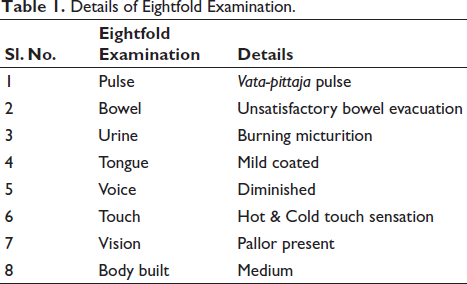
The findings of Eightfold are provided in Table 1.
Details of Eightfold Examination.
Based on the examination and clinical presentation of the disease, it was diagnosed as Kampavata (Parkinson).
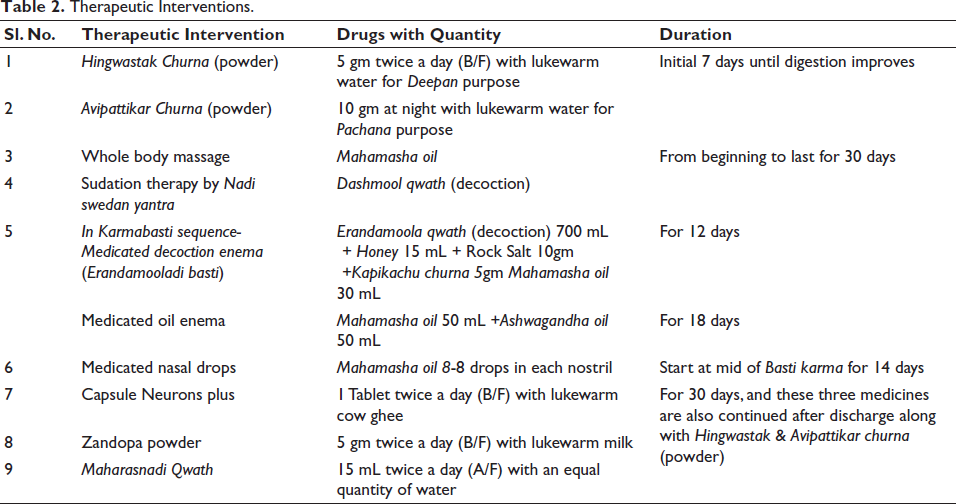
Therapeutic Interventions (See Table 2)
Therapeutic Interventions.
Follow-up and Outcomes
In this case, therapeutic outcomes were assessed before and after treatment based on the PD composite scale in Table 3, 10 assessment was done through specific parameters of Parkinson’s in Table 4, and improvement in clinical features was mentioned in Table 5.
Assessment Based on the Parkinson’s Disease Composite Scale.
Assessment Through Specific Parameters of Parkinsonism.
Assessment Based on Clinical Features.
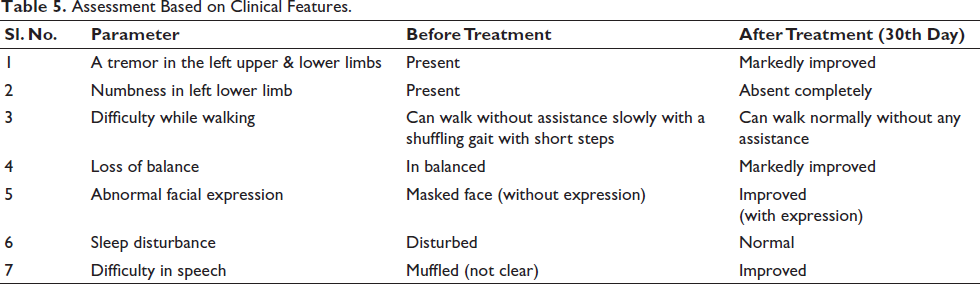
A daily assessment of the procedural effect was done for this patient, but the primary assessment of the disease was done before treatment. After treatment, that is, on the 30th day, to date, the patient has been in touch but has no complaints now, suggesting the sustained effect of our therapy.
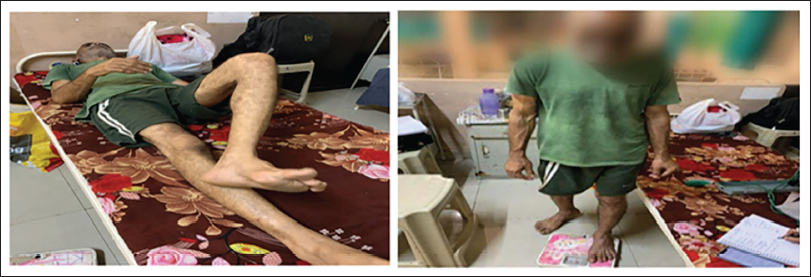
Some Specific Examination (See Figure 1)
(A and B) Showing Specific Examination. (A) Image Showing Measuring Foot Pressure by Weighing Machine. (B) Image of Heel Shin Test.
Discussion
In Ayurveda, PD is understood as Kampavata, primarily attributed to an imbalance of Vata dosha, which governs movement and coordination in the body. When Vata becomes aggravated, it can cause symptoms such as tremors (kampa), rigidity, and other motor disturbances characteristic of PD. The pathophysiology of Kampavata involves the depletion of Ojas (essential energies), Dhatus (tissues), 11 and the obstruction of Prana, Vyana, and Udana Vata (subtypes of Vata bio-entities), leading to impaired neural functions and nervous system degeneration. Therefore, controlling Vata is crucial in treating PD. Effective treatment involves removing strotodushti (blockages), performing Vata Shamana (pacifying Vata), Vatanulomana (correcting the flow of Vata), and administering Rasayana therapy (rejuvenation) through appropriate medications and treatments, which are essential for mitigating the clinical presentation of Apatarpana’s symptoms. The pharmacotherapies behind this case or probable mechanism of action of all procedures and medicine used for this patient can be justified as a follow-up.
Whole Body Massage
Massage with Mahamasha oil, an Ayurvedic composition, treats various neurological and Vataj disorders. It has homeostatic, neurotransmitter, antioxidant, and anti-inflammatory properties, aiding analgesia and reducing inflammation. 12 The massage involves the rhythmic and systematic application of warm oil, penetrating deep into the tissues to promote circulation and reduce stiffness and rigidity in muscles and joints. This therapy nourishes the Dhatus (body tissues) and Ojas (vital energy), which are depleted in Kampavata. 13
Sudation Therapy
Nadi Swedana with Dashmool Qwath is a steam therapy in Ayurveda. Dashmool Qwath, a blend of 10 potent herbs, possesses anti-inflammatory, analgesic, Vata-balancing, and antioxidant properties. 14 Steam from Dashmool Qwath targets specific body areas, penetrating deeply to enhance circulation, reduce muscle stiffness, and alleviate rigidity. 15 This therapy also mitigates neural inflammation and oxidative stress, critical factors in PD degeneration.
Medicated Enema
Medicated enemas, traditionally made with rock salt, honey, medicated oil, and herbal decoctions, reduce Vata bio-entities and nourish the nervous system. Rock salt’s properties aid in the passage of medication molecules and liquefying viscid matter, while honey is an effective vehicle for drug transportation. Mahamasha oil’s Sukshma property facilitates drug absorption at a microcellular level. L-dopa, found in Kapikaachu powder, increases dopamine levels and benefits Parkinson’s patients. Erandamool decoction is potent in treating various Vata disorders. Together, these components aid in nerve cell regeneration and hydroelectric energy production, which is crucial in addressing the neuronal loss characteristic of PD.16, 17
Mediational Nasal Drops
All ailments above the clavicular region, especially those related to the brain, respond best to Nasya as it allows direct administration of therapeutic compounds, bypassing the blood-brain barrier. Mahamasha oil, used in Nasya, has neuroprotective, anti-inflammatory, and antioxidant properties. Pacifying the aggravated Vata dosha, the primary cause of Kampavata reduces key symptoms such as rigidity, tremors, and bradykinesia. Additionally, it promotes nerve health by boosting blood circulation, fortifying nerves, and lessening numbness. 11
The Probable Mode of Action of Palliative Treatment is as Follows
Maharasnadi Qwath is an herbal remedy mainly used for musculoskeletal disorders. It primarily affects the muscles, joints, nerves, and bones. Maharasnadi Qwath cleanses the body of impurities and calms nerve irritability and inflammation. 18 Capsule Neuron Plus can cross the blood-brain barrier with the aid of cow ghee as a carrier and contains qualities such as anti-inflammatory, antioxidant, anti-analgesic, and antistress. It also raises dopamine levels. 19 Hingawastak Churna balances pacifying Vata Kapha entities because of kindling, digestion & increased metabolism properties due to its sweet, bitter, pungent taste, dry, hot quality & sweet taste conversion. 20 Zandopa Powder is used to treat neurological conditions, including PD. Mucuna pruriens, a natural source of L-DOPA, the precursor to dopamine, is found in Zandopa. One neurotransmitter essential for regulating movement, emotions, and pleasure is dopamine. In the brain, the L-DOPA in Zandopa is transformed into dopamine, restoring this crucial neurotransmitter’s levels. 21 Avipattikar churna drugs are sweet, bitter, astringent, pungent in taste & sweet taste conversion. It was administered to help people achieve the right direction of waste product metabolism and to correct their digestion since Avipattikar is a potent Ayurvedic churna made of herbs that helps to enhance Agni (digestive fire) without making pitta worse, according to Ayurveda. It is also suggested as a laxative and aids with appetite stimulation.22, 23
Conclusion
Ayurveda states that Kampavata is clinically similar to Parkinson’s illness. Several Panchkarma techniques, including Snehana (whole body massage), Swedana (sudation therapy), Nasya (medicated nasal drops), Asthapana, and Anuvasan basti (medicated enema), among many more Ayurvedic formulations, have demonstrated potential in the treatment of PD patients. Shamana aushadhi (palliative Medicine), which alleviates aggravated doshas without eliminating them from the body, and Shodhana Chikitsa (bio-purificatory therapy), which aims to eradicate aggravated doshas from the body, thereby restoring balance among Vata, Pitta, and Kapha, both play crucial roles in treating Vata disorder and improving daily activities of living for patients with PD.
Abbreviations
Footnotes
Acknowledgments
We appreciate the patient’s and his family’s permission to share the information.
Authors’ Contribution
Punam Sawarkar conceptualized the data and designed the study. Sonia Mandal and Varinder Singh wrote and drafted the manuscript. Punam Sawarkar also provided valuable input in preparing the manuscript. Finally, all authors read and approved the final version of the manuscript.
Declaration of Conflicting Interests
The authors declared no potential conflicts of interest with respect to the research, authorship and/or publication of this article.
Ethical approval
Not applicable
Funding
The authors received no financial support for the research, authorship and/or publication of this article.
Informed consent
Informed consent for publication of the data was taken from the patient.