



Abstract
Background
Low back pain is a pervasive and often debilitating musculoskeletal condition that affects millions of people worldwide. Low back pain affects 619 million globally (10%) and may rise to 843 million by 2050. It causes 8% years lived with disability and 4.6% disability-adjusted life years in India, with a 1.2%–2.3%. Ayurvedic interventions offer potential relief, specifically Panchaprasrutik Basti (bowel lavage/enema). This study investigates Basti’s therapeutic effects on low back pain.
Objectives
To assess Panchaprasrutik Basti’s efficacy in reducing Katishula (low back pain) using the visual analog scale (VAS). Also, the efficacy of Panchaprasrutik Basti in the restriction of movement and tenderness of Katishula will be assessed using the coin test.
Materials and Methods
This was an interventional, open-label, single-arm, single-center, prospective study of a sample size of 35 patients. Inclusion criteria encompassed patients having symptoms of Katishula (lumbar pain), Katigraha (restriction of movement), Sparshasahatva (tenderness), and ages between 18 and 70 years. Therapeutic intervention in the study compromised Panchaprasrutik Basti (enema) for 7 days. Outcome measures included the VAS for pain severity and the coin test for restriction of movement and tenderness, comparing baseline and post-treatment data.
Results
Thirty-five participants completed the study. Statistical analysis showed significant improvement (p < 0.05) in low back pain symptoms.
Conclusion
This study evaluated the effectiveness of Panchaprasrutik Basti (480 mL, 7 days) in managing low back pain. Results show significant symptom improvement and enhanced quality of life, validating Ayurvedic medicine as a safe and effective alternative therapy.
Introduction
Low back pain is a pervasive and often debilitating musculoskeletal condition that affects millions of people worldwide.1–3 Characterized by discomfort, aching, or tension in the lower portion of the spine, low back pain can range from a dull constant ache to a sudden, sharp sensation that leaves the person incapacitated. Its prevalence is staggering, with studies suggesting that up to 80% of adults experience low back pain at some point in their lives. The prevalence of low back pain is alarming, with 619 million people affected in 2020, which is 10% of the global population and is anticipated to surge to 843 million people by 2050. 4 In India, low back problems account for approximately 8% of years lived with disability (YLD) and 4.6% of disability-adjusted life years (DALYs) due to musculoskeletal disorders. Notably, DALYs related to low back issues increased from 1.2% to 2.3%. 5
The impact of low back pain extends far beyond individual discomfort. It is a leading cause of disability globally, contributing significantly to decreased quality of life, reduced work productivity, and increased healthcare utilization. Low back pain is the top reason for doctor visits and a major contributor to healthcare expenditure. 4
The current medical approach for this disease focuses on alleviating pain but lacks a curative treatment strategy. Moreover, extended use of pain medication such as non-steroidal anti-inflammatory drugs (NSAIDs) can have harmful consequences, including adverse effects on various organs. Empirical evidence supports the potential of Ayurveda and traditional medicine systems to relieve low back pain.6, 7
Based on clinical presentation, this condition is termed Katishula in Ayurveda classics. Katishula comes under Vata (body humor) disorders. 8 Due to improper diet and improper lifestyle, Vata dosha (body humor) increases and minimizes the lubricant at that site. Since Vata is the factor responsible for bodily motions, its vitiation leads to the manifestation of pain, restriction of motion, and tenderness.
In Ayurveda, Samhita mentions the importance of dosha Shodhana (body humor purificatory). Basti (enema/bowel lavage) is the best treatment to treat all Vata disorders 9 and is mentioned as Ardha Chikitsa (half treatment) in classical text. 10 Panchaprasrutik Basti, which contains Godugdha (cow’s milk), Madhu (honey), Tila taila (sesame seed oil), and Go Ghrit (cow’s clarified butter), has a Vata pacifying and nourishing effect. 11
In an effort to combat low back pain, this study explores the therapeutic potential of Basti. This treatment approach has demonstrated promising results in alleviating the symptoms of this condition.
Objectives
Primary Objective
To assess the efficacy of Panchaprasrutik Basti in pain reduction of Katishula (low back pain) using the VAS.
Secondary Objective
To assess the efficacy of Panchaprasrutik Basti in restricting movement and tenderness of Katishula using the coin test.
Materials and Methods
A clinical study was performed on the patients from OPD and IPD of the Panchakarma Department of Dr. D. Y. Patil Ayurveda Hospital and Research Centre, Pimpri, Pune, for 18 months. The Institutional Ethical Committee granted ethical clearance for the study on August 5, 2022, before starting the trial, with the reference number DYPCARC/IEC/510/2022. This trial adhered to Schedule Y of the Drugs and Cosmetics Act (1945, amended in 2005) of India, as well as the Indian Council of Medical Research ethical guidelines for biomedical research on human participants and the GCP guidelines adopted from the World Medical Association—Declaration of Helsinki. This clinical study was prospectively registered in the Clinical Trials Registry of India CTRI/2023/01/049143. The trial was done after obtaining a signed consent form from the participants.
Methodology
Trial Design
This was an interventional, open-label, single-arm, single-center, prospective study of a sample size of 35 patients.
Study Design
The patient was enrolled after CTRI registration. Patients were selected for Katishula after screening the subjects for inclusion criteria. Written consent was taken from patients for the trial. Panchaprasrutik Basti was given for 7 days. Assessment was done on the 1st and 7th day of the treatment.
Selection of Patients
Inclusion Criteria
Patients having symptoms Katishula (lumbar pain), Katigraha (restriction of movement), Sparshasahatva (tenderness), and aged between 18 and 70 years.
Exclusion Criteria
K/c/o Aamvata (rheumatoid arthritis), Vatrakta (gout), Garbhini (pregnant lady), and low back pain resulting from spinal fractures, infections, and neoplasm.
Intervention
The therapeutic intervention in the study was Panchaprasrutik Basti (enema). This intervention was administered for 7 days. To ensure quality, all drug authentication and standardization were done from Sudhatatva Pharmacy of Dr. D. Y. Patil Ayurveda Hospital and Research Centre, Pimpri, Pune, adhering to Good Manufacturing Practice (GMP) standards.
Preparation of Basti (Enema)
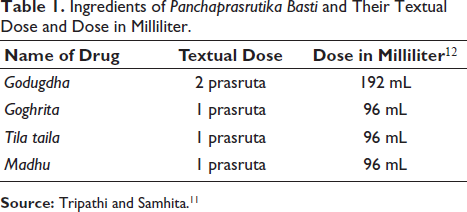
Basti dravya (enema) was prepared by mixing all the ingredients as mentioned in Table 1, that is, Godugdh (cow milk) two Prasruta (192 mL), Madhu (honey), Tila taila (sesame seed oil), and Go Ghrit (cow’s clarified butter) each 1 Prasruta (96 mL); this makes all total 480 mL. All these should be taken and churned well together. Before adding the clarified butter, sesame seed oil, and cow’s milk and to lukewarm overheat. The Basti dravya (enema) was prepared in the following manner: honey, sesame seed oil, clarified butter, and cow’s milk one after another. 11
Ingredients of Panchaprasrutika Basti and Their Textual Dose and Dose in Milli liter.
Method of Administration of Panchaprasrutik Basti
Localized massage was done with sesame seed oil, and localized steam was done to Kati and thigh regions. Then, the patient was asked to lie in the left lateral position with their left leg folded at the knee joint. The anus and nozzle (Basti Netra) are lubricated, and the Panchaprasrutik Basti of 480 mL was slowly injected into the rectum. The nozzle was withdrawn, and gentle strokes were applied to promote retention. The patient rests in a supine position, retaining the medication for maximum absorption, and then observes the retention time of the enema. This was repeated for 7 days.
Outcome Measures
To evaluate the effectiveness of the treatment, the baseline data (initial measurements) with the data collected before and after administering the medication, using both subjective (patient-reported) and objective (clinically measured) parameters.
Primary Outcome Measure
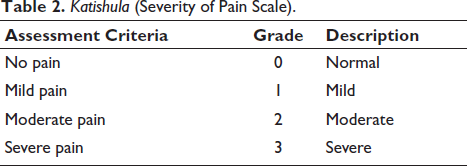
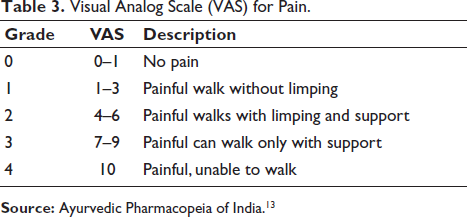
Assess the severity of pain in Table 2 with gradation and the VAS in Table 3 used to assess objective pain. 13
Katishula (Severity of Pain Scale).
Visual Analog Scale (VAS) for Pain.
Secondary Outcome Measures
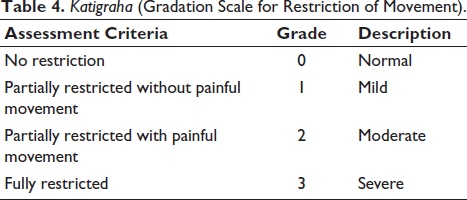
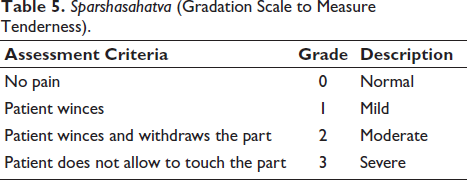
It included changes in the symptoms associated with low back pain. Assessing the restriction of movement (Table 4) and tenderness (Table 5) was done using the coin test (Table 6).
Katigraha (Gradation Scale for Restriction of Movement).
Sparshasahatva (Gradation Scale to Measure Tenderness).
Coin Test (Test to Measure Restriction of Movement and Tenderness).
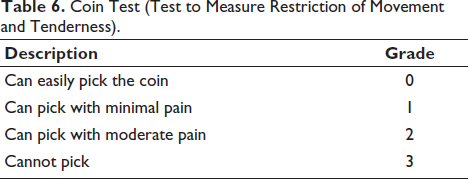
Patients were asked to pick up the coin from the ground, and gradations were done according to the severity of pain.
Results
Status of Enrolled Patient
Of a total of 36 enrolled participants, 35 completed the study, while 1 patient was withdrawn.
Statistical Analysis
The data were then entered into EPI-info version 3.5 (software) and exported to the Statistical Package for Social Science (SPSS) version 21 for analysis. The collected data were subjected to statistical analysis using descriptive and comparative methods aligned with the predefined primary and secondary outcomes. Quantitative variables were summarized using descriptive statistics, presented as mean ± standard deviation (SD) or median (range), depending on the variable’s distribution pattern. The Wilcoxon signed-rank test was used to evaluate observations on an ordinary scale. Statistical analysis of Panchaprasrutik Basti in subjective and objective parameters of LBP was found to be highly significant (p < 0.05), indicating that trial drugs were effective in relieving pain, restriction of movement, and tenderness. Following 7 days of therapy, a noteworthy reduction in the mean score was observed.
Demographic Profile
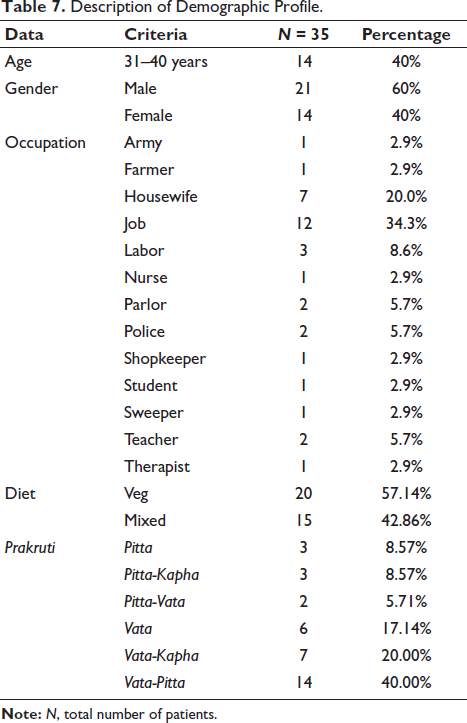
The majority of trial participants were within the age range of 31–40 years, with a higher proportion of male participants (60%) compared to female participants (40%). A significant proportion is jobs (34.3%), followed by housewives (20%). The data analysis revealed that 57.14% of participants were vegetarians. It was found that Vata-Pitta Prakriti (40%) had the highest proportion of subjects (Table 7).
Description of Demographic Profile.
Analysis of Disease-specific Clinical Parameters
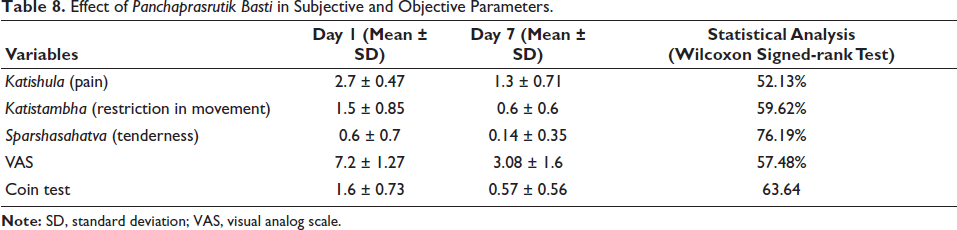
Statistical analysis shows the treatment had a substantial impact, with an impressive result. The Wilcoxon signed-rank test was used to evaluate observation measured on an ordinary scale with p value < 0.05. Seven days treatment result shows Katishula (pain) 52.13%, Katistambha (restriction in movement) 59.62%, and Sparshasahatva (tenderness) 76.19% improvement with objective parameter VAS 57.8% and coin test 63.64% improvement, indicating a marked positive effect. Here, the mean value suggests that grades decrease significantly after intervention in Table 8.
Effect of Panchaprasrutik Basti in Subjective and Objective Parameters.
Throughout the observation period, most of the participants got clear skin and improved in a complexion that shows Panchaprasrutik Basti also acts as Varnya (improved skin complexion) as stated by the authors in the text. 11
Discussion
Demographic factors did not significantly influence the prevalence of low back pain or its symptoms in this study (Table 7).
Panchaprasrutik Basti treatment significantly improved Katishula symptoms from day 1 to day 7. Subjective measures showed reductions in pain (52.13%), stiffness (59.62%), and tenderness (76.19%). Objective measures revealed improvements in pain intensity via VAS (57.48%) and functional ability via coin test (63.64%). Results were statistically significant (p < 0.05), with large effect sizes (52.13%–76.19%). Consistent improvements across measures provide strong evidence for Panchaprasrutik Basti’s efficacy in addressing lower back pain, particularly in reducing tenderness and enhancing functional capacity. These findings support the treatment’s potential as a comprehensive solution for Katishula management. Statistical significance and large effect sizes confirm clinical relevance.
The Action of Drug Used in Panchaprasrutik Basti
The Basti formulation, comprising Dugdh (milk), Ghrita (clarified butter), Madhu (honey), and Tila taila (sesame seed oil), works through a synergistic action of its ingredients. Milk provides nourishment to the tissues and soothes irritated nerves, while its Snigdha (unctuousness) quality helps counteract Vata aggravation. 14 Clarified butter, with its lipophilic nature, penetrates deep into the tissues, carrying other ingredients with it and promoting cellular rejuvenation. It also possesses anti-inflammatory properties and aids in Vata pacification. 15 Honey, with its Yogavahi property (capacity to carry some other thing to distant places and make it available at the place of its utilization), enhances the absorption and efficacy of other ingredients, while its Lekhana (scraping) action helps remove ama (toxins) from the tissues. 16 Sesame seed oil, rich in antioxidants and essential fatty acids, improves local circulation, reduces inflammation, and deeply pacifies Vata due to its Ushna (heat) and Snigdha (unctuousness) qualities. 17 Together, these ingredients balance the aggravated doshas (primarily Vata), improve tissue metabolism, enhance local circulation, reduce inflammation, and promote overall healing in the lower back region. This multifaceted action explains the observed improvements in pain (Katishula), restriction in movement (Katigraha), and tenderness (Sparshasahatva).
The Probable Mechanism of Basti (Enema)
Basti, an Ayurvedic treatment, operates through three mechanisms: local effects, systemic effects, and neural pathways. Locally, Basti stimulates bowel movements, cleansing the colon and activating the mucosal immune system. Systemically, it regulates fluid and electrolyte balance through the colonic mucosa, maintaining homeostasis. Neural pathways influence gut function and motility via the enteric nervous system (ENS), modulating local reflexes, hormones, and digestive tract motility.
In the colon, absorption occurs through various mechanisms: sodium is actively absorbed (95% efficiency), water passively follows sodium absorption, chloride is coupled with bicarbonate secretion and sodium transport, potassium is secreted or absorbed based on the luminal concentration, and bicarbonate is secreted against an electrochemical gradient.
Rectal absorption involves passive diffusion, influenced by fluid availability, rectal mucus properties, contents, and wall motility. Absorption enhancers, such as surfactants, are necessary for satisfactory administration, making rectal absorption suitable for peptide-like drugs and avoiding the first-pass effect.
Therapeutic Mechanism of Panchaprasutik Basti in Low Back Pain
Katishula (Lower Back Pain)
The anti-inflammatory properties of Ghrita (clarified butter) and Tila taila (sesame seed oil) could reduce inflammation in the lower back muscles and tissues. The Brihamana (nourishing) qualities of milk and clarified butter may support tissue repair. The overall combination helps balance Vata Dosha and the warm nature of the Basti, which could improve blood circulation in the lower back, potentially reducing pain. 18
Katigraha (Restriction in Movement)
The lubricating properties of Ghrita (clarified butter) and Tila taila (sesame seed oil) could help improve flexibility in the lower back joints and muscles. The muscle-relaxing effects of the warm Basti might help reduce muscle tension and stiffness. Improved circulation from the treatment could enhance the delivery of nutrients to the affected area, potentially improving mobility. The Vata-pacifying nature of the ingredients might address the root cause of stiffness according to Ayurvedic principles. 18
Spararshasahatva (Tenderness)
The soothing properties of the ingredients, particularly Madhu (honey) and Dugdha (milk), could help reduce skin and nerve sensitivity. The anti-inflammatory effects of the Basti might decrease overall sensitivity in the affected area. By potentially reducing underlying inflammation and improving tissue health, the treatment might make the area less reactive to touch. The balancing effect on Vata dosha could help normalize sensation in the area, as hypersensitivity is often associated with Vata imbalance in Ayurveda.
Conclusion
The comprehensive study evaluating the effect of Ayurvedic interventions, administration of Panchaprasrutik Basti in a dose of 480 mL for a period of 7 days in managing low back pain, including restriction in movement and tenderness as well as improvement in quality of life. The study demonstrates the potential of Ayurvedic medicine as a viable and safe alternative for managing low back pain.
Footnotes
Abbreviations
Acknowledgments
The authors give great gratitude to the institute Dr. D. Y. Patil College of Ayurveda and Research Centre, Pimpri Pune, for technical support and CCRAS for providing scholarships for the project.
Declaration of Conflicting Interests
The authors declared no potential conflicts of interest with respect to the research, authorship, and/or publication of this article.
Ethical Approval
The Institutional Ethical Committee granted ethical clearance for the study on August 5, 2022, before starting the trial, with the reference number DYPCARC/IEC/510/2022.
Funding
The authors disclosed receipt of the following financial support for the research, authorship, and/or publication of this article: Financial support was provided by CCRAS under the Programme of PG-STAR (Scheme for Training in Ayurveda Research for Post-graduate Scholars) for conducting this research for PG Scholars of MD/MS (Ayu) Admission Batch 2021–2022.
Informed Consent
Informed consent was obtained from all the participants in the study.
