



Abstract
Aim
This study aimed to determine the patterns of physical activity (PA) and its association with gender and academic year among undergraduate medical students of a tertiary care hospital in South India.
Materials and Methods
A cross-sectional study was conducted among undergraduate medical students from August to October 2022 at a tertiary care teaching hospital in South India. PA was determined using the self-administered long form of the International Physical Activity Questionnaire (IPAQ). Statistical analysis was performed using SPSS software.
Results
A total of 223 students aged 18 to 25 years completed the questionnaire, with the majority being females (59.2%). Their median total PA (metabolic equivalent [MET] minutes/week) was 1320, with 2073 and 771 MET minutes/week among male and female students, respectively. Fourth-year students were the most physically active, with higher energy expenditure per week, followed by second-year, third-year, and first-year students (p = 0.007). Out of the total 223 students, 141 (63.2%), 62 (27.8%), and 20 (9%) students belonged to low, moderate, and high PA levels, respectively. There was a greater proportion of students with low PA among females (70.5%) compared to male (52.7%) participants (p < 0.001).
Conclusion
Most undergraduate medical students had a low level of PA, especially females and students in the first academic year. To increase the PA levels among medical students, curricular reforms by incorporating sports/exercise training, and ensuring the availability of adequate facilities and trainers for sports in every college/university is warranted. Future research focusing on the exploration of barriers to PA and designing innovative strategies to promote PA among medical students is the need of the hour.
Introduction
Physical inactivity is becoming increasingly rampant and emerging as a serious public health issue. As per the WHO’s (World Health Organization) global status report on physical activity (PA) in 2022, 81% of adolescents and 27.5% of adults do not meet WHO’s recommended PA levels. 1 With the current rates of PA, around 500 million people worldwide will develop non-communicable diseases attributable to their sedentary lifestyle between 2020 and 2030. Their treatment would cost around US$ 27 billion yearly, imposing a significant economic burden. 1 The WHO’s Global Action Plan on Physical Activity 2018–2030 (GAPPA) targets a 15% relative reduction in the global prevalence of physical inactivity in adults and adolescents by 2030. 2
PA is “any bodily movement produced by skeletal muscles that results in energy expenditure.” 3 Regular PA is crucial for maintaining physical and mental well-being. The WHO has estimated that adults aged 18–64 years should do at least 150 minutes of moderate-intensity aerobic PA throughout the week or do at least 75 minutes of vigorous-intensity aerobic PA throughout the week or an equivalent combination of moderate- and vigorous-intensity activity, to be considered physically active. 4
Medical students being future physicians get innumerable opportunities for promoting PA among their patients. Evidence suggests that the personal PA practices of doctors and medical students strongly influence the frequency and quality of PA counseling for their patients.5, 6 Moreover, regular PA has several advantages for medical students. It helps in stress management, reduces the incidence of depression, promotes happiness, and even improves academic performance, apart from its health-promoting and non-communicable disease prevention potential.7, 8 Thus, we need to encourage medical students to be physically active and incorporate PA into their daily routines.
Literature indicates that medical students neglect regular PA due to their high academic burden and often lead a sedentary lifestyle.9–11 There is a dearth of studies on PA levels in South Indian medical students. A thorough understanding of the nature of PA patterns among medical students in this demographic is crucial in identifying the gravity of the problem in this area. It also aids in devising targeted interventions tailored to promote PA among this vital group, ultimately improving their health and that of their future patients. Thus, the present study was undertaken to determine the patterns of PA and its association with gender and academic year among undergraduate medical students of a tertiary care hospital in South India.
Materials and Methods
Study Design, Setting, and Participants
This prospective cross-sectional study was conducted from August to October 2022 at a tertiary care teaching hospital in South India. The study was conducted among undergraduate medical students in the first to the fourth academic year, either gender, aged ≥18 years. As per the new Competency-based medical education (CBME) curriculum in India, the first-year MBBS students attended their one-month foundation course, with a mandatory 4 hours/week of sports activities in the month of April 2022. 12 Since the study data were collected at least three months after their foundation course, the authors believe that there will capture their regular/routine practice of PA.
Sample Size Calculation
The sample size is calculated to be 223 for a prevalence of PA of 71.1% among MBBS students in South India, 13 absolute precision of 5%, and a confidence interval of 90%, using Open Epi, Version 3.
Study Tool
Data were collected using the self-administered official long-form English version of the International Physical Activity Questionnaire (IPAQ). The questionnaire is publicly available without requiring any permissions for use. 14 The tool is a reliable and validated measure of PA in people aged 15 to 69 years across developed and developing countries. Craig et al. 15 found that long IPAQ questionnaires have excellent repeatability with a test–retest reliability of approximately 0.8 (Spearman’s ρ). Also, the median ρ for criterion validity is about 0.30, comparable to other self-report questionnaires.
The questionnaire measures the amount of PA performed as a part of their everyday life, across the four domains like work, transport, domestic and garden, and leisure time; and the time spent sitting. It has 27 questions divided into 5 sections. The first section deals with job-related PA questions (seven questions); the second covers transportation PA questions (six questions); the third addresses housework, house maintenance, and caring for family questions (six questions); the fourth includes recreation, sport, and leisure-time (six questions), and finally, the fifth section has questions on time spent sitting (two questions). The questions recorded the PA and sitting time in the previous 7 days.
The frequency (no. of days/week), duration (minutes/day), and intensity (moderate or vigorous) of PA were captured in the questionnaire. The activity should have been performed for a minimum duration of 10 minutes for it to be taken into consideration. Moderate-intensity activities are those activities that take moderate physical effort and make breathing somewhat harder than normal. Vigorous activities are those that take hard physical effort and make breathing much harder than normal.
Basic demographic characteristics of the students (age, gender, year of study), height, and weight were also included in the IPAQ questionnaire. The body mass index of the students was calculated based on the formula weight (in kilogram)/height (meter 2 ). It takes no more than 10–15 minutes to complete the questionnaire.
Study Procedure
The study was conducted after obtaining approval from the Institutional Ethics Committee (IEC no. EC/38/2022). Data were collected by convenience sampling. After obtaining prior written informed consent, the questionnaires were distributed to the students, and they were requested to fill out the questionnaire during their free time and return it the next day. The data were collected anonymously and students’ names or roll numbers were not collected. The confidentiality of the participants’ data was ensured throughout the study.
Based on the IPAQ scoring protocol, 16 total PA scores as well as domain-specific PA sub-scores; and walking, moderate-intensity, and vigorous-intensity sub-scores, were estimated and expressed as energy expenditure in metabolic equivalent minutes per week (MET minutes/week). Further, based on the standard scoring criteria, 16 of the study participants were classified into the following three levels of PA: “high,” “moderate,” and “low.”
Statistical Analysis
Data were entered in Microsoft Excel, and SPSS software version 24 was used for statistical analysis. Normality was assessed by the Kolmogorov–Smirnov test. All the continuous variables were summarized as median (range) since they did not follow the normal distribution. The categorical variables were summarized as frequency (percentage).
Socio-demographic characteristics like age, height, weight, and BMI were compared across both genders by the Mann–Whitney U test. The median PA (in MET minutes/week) and the median total sitting time (in minutes/week) were compared across genders and academic years by the Mann–Whitney U test and Kruskal–Wallis test respectively. The chi-square test was used for comparing levels of PA (low, moderate, and high) across genders and academic years. A p-value of < 0.05 was considered statistically significant.
Results
A total of 223 students from the four academic years completed the questionnaire. They were in the age range of 18 to 25 years, with a median age of 21 years. The majority of the respondents (59.2%) were females. Males were taller, heavier, and had slightly higher BMI compared to females (Table 1).
Socio-demographic Characteristics of Undergraduate Medical Students (n = 223).
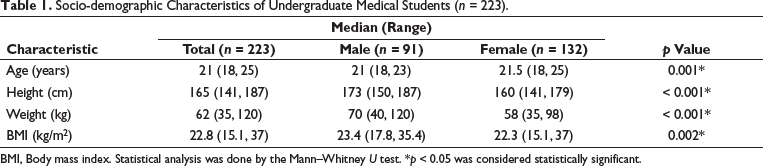
BMI, Body mass index. Statistical analysis was done by the Mann–Whitney U test. *p < 0.05 was considered statistically significant.
The median total PA in MET minutes/week among the participants is 1320. Domain-specific PA analysis shows that participants burnt more calories as a part of transportation and leisure-related activities. Also, the majority of the energy expenditure happened during walking, followed by moderate-intensity activity with nil median vigorous-intensity activity (Table 2).
Comparison of Physical Activity Across Genders Among Undergraduate Medical Students (n = 223).
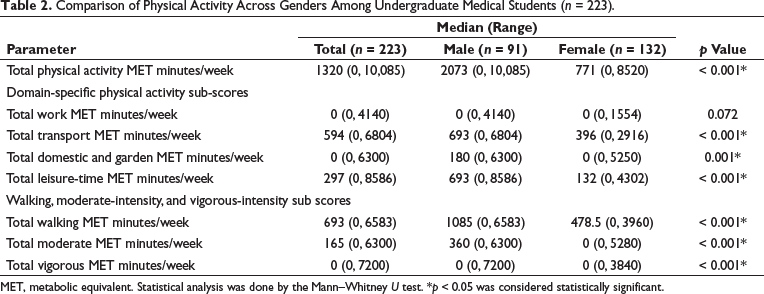
MET, metabolic equivalent. Statistical analysis was done by the Mann–Whitney U test. *p < 0.05 was considered statistically significant.
Male students were more physically active with a median energy expenditure of 2073 MET-minutes/week, compared to females who spent only 771 MET-minutes/week (p < 0.001). Also, a greater number of calories were burnt by males across the three domains: transport, domestic and garden, and leisure time activities, when compared to female students (p ≤ 0.001). Similarly, males spent more energy compared to females by walking (p < 0.001). Males engaged themselves more in moderate-intensity activities (median value of 360 MET-minutes/week) compared to females with a median value of zero MET-minutes/week (p < 0.001). Both males and females had nil median energy expenditure pertaining to vigorous activities (Table 2).
Fourth-year students were the most physically active with greater energy expenditure per week, followed by the second-year, third-year, and first-year students (p = 0.007). Compared to other academic years, second-year students spent more energy on transportation, and domestic and garden activities. Students of all four academic years spent more energy by walking compared to moderate-intensity activity, and all of them had nil median vigorous-intensity activity scores (Table 3).
Comparison of Physical Activity Across Various Academic Years Among Undergraduate Medical Students (n = 223).
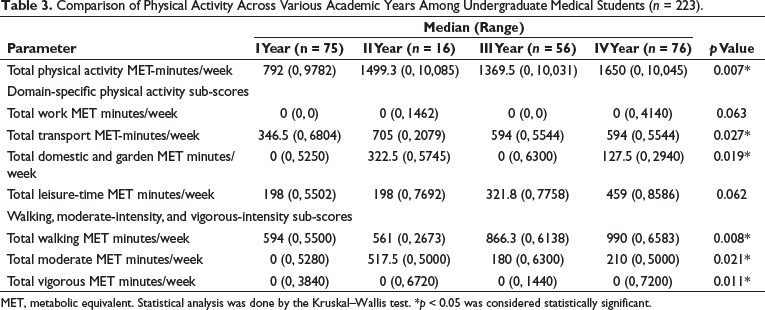
MET, metabolic equivalent. Statistical analysis was done by the Kruskal–Wallis test. *p < 0.05 was considered statistically significant.
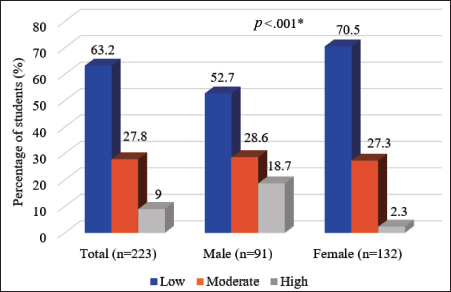
Out of the total 223 students, 141 (63.2%), 62 (27.8%), and 20 (9%) students belonged to low, moderate, and high PA levels, respectively. There was a greater proportion of students with low PA among females (70.5%) compared to male (52.7%) participants (p < 0.001). Also, there was a significantly lower proportion of students with high PA among females (2.3%) compared to male (18.7%) students (p < 0.001) (Figure 1).
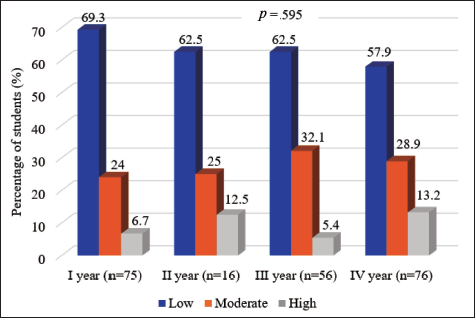
The majority of the participants were in the low PA category, followed by moderate and high PA levels across various academic years. There was no statistically significant difference in the proportion of students within each PA level across the academic years (Figure 2).
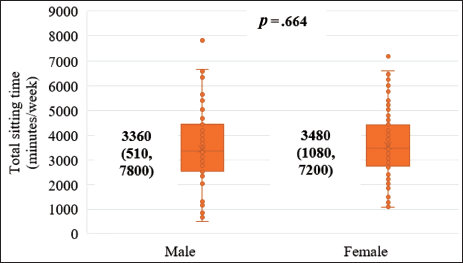
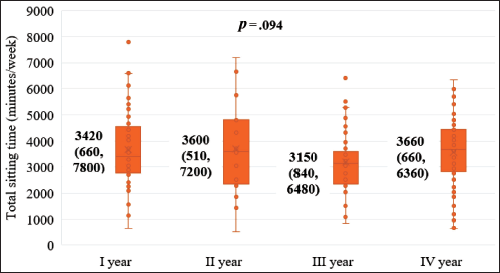
The median (range) total sitting time among the students was 3480 (510, 7800) minutes/week. There was no statistically significant difference in the total sitting time across gender and academic years (Figures 3 and 4).
Discussion
Our study shows that medical students, especially females and those belonging to the first academic year were physically inactive with lower levels of weekly energy expenditure. In the present study, the median total PA in MET minutes/week among the medical students was 1320; with 2073 and 771 MET minutes/week among male and female students, respectively. Specifically, the first-year medical students had a strikingly low median energy expenditure of 792 MET-minutes/week. The scenario is no different among medical students in other parts of India and globally. A study on PA among professional college students in North India revealed a very low value of 87.7 MET minutes/week among medical students, and they were physically inactive compared to students of other professional courses like physiotherapy, dental, nursing, lab technician, pharmacy, management, law, and engineering. 17 Similarly, a study on PA in students of a Medical University in Poland showed physical inactivity being highly prevalent among medical students compared to other specialities like physical therapy, nursing, midwifery, cosmetology, and pharmacy. 18 Moreover, medical students from Thailand also had a very low PA of 540 MET minutes/week. 10 On the contrary, similar studies on PA of medical students have demonstrated better median energy expenditure scores ranging from 2347.8 to 4354.62 MET minutes/week.19, 20
It was distressing to know that more than half of the respondents in our study (63.2%) were in the low PA category. Similar levels of physical inactivity were observed among medical students in India (66.8% in Karnataka) and abroad (60.1% in Saudi Arabia).11, 21 Contrastingly, some studies show low levels of physical inactivity among medical students in Karnataka (41.3%), Kerala (28.9%), Peru (25.3%), and Saudi Arabia (22%).9, 13, 19, 22
One of the significant findings of our study was that physical inactivity was more prevalent among female medical students. The results were in concordance with data obtained from other studies among female medical students.9, 13, 19, 20 It is of great concern that women did not indulge in PA to such an extent of reaping its health-promoting benefits.
Also, the first-year and fourth-year medical students were the least and the most physically active in our study. The first-year students, despite attending the foundation course with mandatory sports activities, at least three months before the data collection time period, had the lowest levels of PA, reflecting that they did not incorporate regular PA into their day-to-day life. The highest PA levels in fourth-year students could be possibly attributed to their greater awareness of regular PA. Similar higher levels of PA among fourth-year University of British Columbia medical students were seen by Holtz et al. 23 However, our findings were in contrast to a study on male medical students in Saudi Arabia, in which third-year medical students were the most physically active. 22
In the present study, students spent more energy as part of transportation-related activities. However, other Asian studies reveal leisure time PA to be the chief contributor to total PA.10, 13, 20 The jampacked curriculum of our medical students with less time for their recreational activities could be the possible reason for our divergent findings.
In our study, walking was the most frequent type of PA with negligible vigorous-intensity activity. The literature also supports our finding that vigorous-intensity activities are performed only by a minority of the students.19, 21
In our study, the median sitting time was 3480 minutes/week (or 8.29 hours/day), which was higher than that reported among medical students in Karnataka (2044 minutes/week) and Emergency medical service students in Saudi Arabia (3078.6 minutes/week).21, 24 However, medical students in North India have much higher values of 3696 minutes/week. 25 Excessive sitting time has been linked to a higher risk of all-cause mortality and major cardiovascular diseases (CVD) such as cardiovascular death, myocardial infarction, stroke, or heart failure.26, 27 Evidence suggests that after 6–8 hours of sitting per day, the risk of all-cause and CVD mortality increases. 28 In our study, the students had a median sitting time of 8.29 hours per day, which is slightly more than the upper limit of the threshold value. However, the good news is that research shows that reducing sedentary time among inactive people led to a greater improvement in cognitive function and favorable effects on cardiometabolic parameters such as apolipoprotein B/apolipoprotein A-1 ratio, total cholesterol, high-density lipoprotein (HDL) cholesterol, and total cholesterol/HDL ratio. 29 Therefore, it is important to reduce sitting time and increase PA among medical students. We need to come up with effective strategies to encourage students to move more and sit less throughout the day, which can help reduce the risk of premature deaths and CVD among this group.
The differences in the level of PA among medical students in different settings could be due to variations in their level of awareness and practice of being physically active, time constraints, availability of facilities for sports/extra-curricular activities in their institution, and differences in their sociocultural environment. Also, the timing of interviewing/administering the PA questionnaire can influence the study results; during exam time or study holidays, PA might be low, and it could be more during vacations. In addition, differences can creep in due to differences in the type of participant (undergraduate or postgraduate students), differences in the proportion of males and females (males being more physically active), and study instrument (since different types of questionnaires with different cutoffs are available to measure PA among students).
Low levels of PA among medical students worldwide stem from the fact that there is a lack of dedicated teaching and curriculum focused on exercise in medical education. In India, the new CBME curriculum has introduced sports training as a part of the foundation course of a one-month duration at the beginning of the MBBS course, mandating four hours of sports per week. 12 However, our study shows that sports training during their foundation course did not drive the students to imbibe the habit of leading a physically active lifestyle. Thus, colleges should allot protected hours for exercise throughout their medical education program. Furthermore, colleges should also ensure the availability of gyms and play areas for students and appoint trainers to facilitate these activities. These strategies will aid in promoting increased PA among medical students, which paves the way to improve the health of the medical students and the public.
Strengths of the study include the representation of medical students from the four academic years and the use of a globally validated questionnaire, which enables comparison of results with other populations. Also, the anonymous nature of data collection would have reduced the possibility of social desirability bias. The limitation of our study is that it is a cross-sectional self-reported single-center survey.
Conclusion
Most undergraduate medical students had a low level of PA, especially females and students in the first academic year. To increase the PA levels among medical students, curricular reforms by incorporating sports/exercise training, and ensuring the availability of adequate facilities and trainers for sports in every college/university is warranted. Future research focusing on the exploration of barriers to PA and designing innovative strategies to promote PA among medical students is the need of the hour.
Abbreviations
Footnotes
Acknowledgments
The authors express their gratitude to the management and administrators of Sri Manakula Vinayagar Medical College and Hospital for their support. The authors are also thankful to the MBBS students who participated in this study.
Declaration of Conflicting Interests
The authors declared no potential conflicts of interest with respect to the research, authorship, and/or publication of this article.
Ethical Approval
The study was conducted after obtaining approval from the Institutional Ethics Committee (IEC no. EC/38/2022) of Sri Manakula Vinayagar Medical College and Hospital, Puducherry.
Funding
The authors received no financial support for the research, authorship, and/or publication of this article.
Informed Consent
Written informed consent was obtained from all study participants.