



Abstract
In the era of advanced Open artificial intelligence (AI) technology, the large language model tool known as chat generative pre-training transformer (ChatGPT) is gaining an increasing number of users in various fields such as healthcare, medical education, agriculture, and customer support due to its features like information retrieval, generating human-like conversations, and natural language processing. The purpose of this narrative review is to present the perspectives of ChatGPT in Pharmacology and Medical Education. And highlight the limitations of ChatGPT in these areas and draw the attention of policymakers in healthcare to implement such technologies while taking into consideration ethical issues. To collect information regarding the perspectives of ChatGPT in pharmacology and medical education. And highlight the limitations of ChatGPT in these areas. In health care, it helps in the drug discovery and development process, diagnosis, treatment, counseling, assisting in surgical procedures, pharmacovigilance, pharmacy, and so on. In medical education, this tool plays a crucial role in online tutoring, personalized assistance, grading, improvement in grammar, and so on. Despite the limitations, ChatGPT is helpful in healthcare, medical education, and scientific writing. To overcome such limitations of ChatGPT, like ethical issues, emotionlessness, providing information before 2021, the risk of biases, uncontrollability, lack of transparency, academic dishonesty, and so on, alternatives have been developed, but they also fail to entirely resolve the associated limitations. Looking at the current scenarios, there is an urgent need for comprehensive guidelines to address these limitations and provide a framework for appropriately utilizing AI tools in healthcare domains. This framework should also focus on maintaining a balance between human involvement and technological advancements.
Introduction
Artificial intelligence (AI) is a methodology for imbuing computers, intelligent software, computer-controlled robots, and systems with the ability to analyze and mimic human intelligence. This is achieved through the study of human mental patterns and the analysis of cognitive processes. 1
Chatbots and virtual assistants developed by OpenAI have gained widespread popularity on a global scale. This is largely attributed to their capacity to engage with users, comprehend natural language queries, and furnish pertinent responses. These expansive language model tools possess the capability to produce conversations akin to human interactions, aiding users in tasks such as language translation, information retrieval, personalized guidance, task streamlining, e-commerce support, expediting decision-making, delivering customer assistance, and contributing to healthcare services.1, 2
The current era of AI is marked by its diverse applications, spanning every sector, including the healthcare system, astrophysics, robotic science, education, banking, cybersecurity, gaming, automation, agriculture, transportation, entertainment, and social media activities, among others. 3
Happify, Sense.Iy, WebMD, Babylon, Symptomate, Skinvision, chat generative pre-training transformer (ChatGPT), Hello Heart, Google Bard, docGPT, and others are AI tools routinely utilized for health information purposes.4, 5 AI is typically categorized as strong AI, which possesses the capability to comprehend and apply knowledge, generating human-level cognitive functions that are currently non-existent; this is an area under active research and development. Super AI, which would surpass human capabilities, also remains unrealized. On the other hand, weak AI is designed to proficiently execute specialized tasks, such as Alexa or Siri. AI can take various forms, ranging from purely reactive to self-aware, including a theory of mind or limited memory.1, 2 Among the myriad tools available today, the large language model tool ChatGPT particularly garners the attention of professionals due to its remarkable features.
History of ChatGPT
In 1950, Alan Turing was the first to raise the intriguing question of whether machines could replicate human thinking. Following that, numerous technologies embarked on a quest to achieve this goal. 6 OpenAI introduced the expansive language model, ChatGPT, in November 2022. This model serves as a conversational chatbot designed to comprehend and process natural language. It was developed based on a neural network architecture. By integrating AI and natural language processing (NLP) techniques, software programs such as chatbots simulate conversations with humans. Models like the generative pre-trained transformer (GPT) and GPT-2 made their debut in February 2019, marking a breakthrough by demonstrating the capability to generate coherent and contextually relevant text. OpenAI then unveiled the third iteration of its language model, GPT-3, in June 2020. This marked a significant advancement in NLP, boasting 175 billion parameters, which made it one of the largest language models of its time. GPT-3, capable of generating text across various genres, amassed 1 million users within its inaugural week of release. Its diverse capabilities span tasks including chatbots, text generation, language translation, question-answering, code generation, and more. Notably, a large multimodal model named GPT-4 has been developed, showcasing human-level performance in specific challenging educational and professional benchmarks.7, 8
ChatGPT in Healthcare
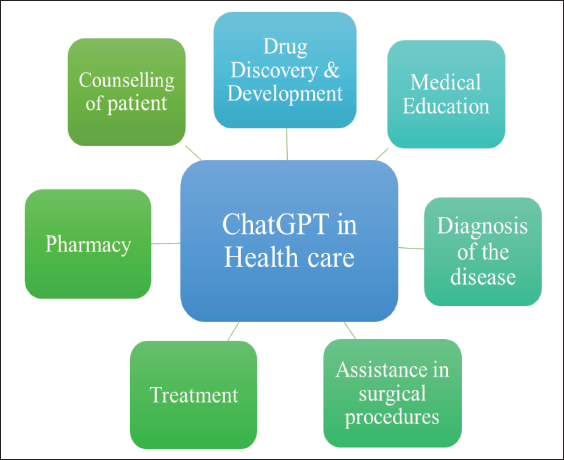
The AI-powered large language model tool, ChatGPT, offers comprehensive information across a wide array of healthcare tasks. 9 Applications of AI through large language model tools enable the identification of patterns within medical data. This, in turn, yields valuable insights for healthcare purposes, encompassing areas like drug discovery, disease diagnosis, radiological imaging analysis, personalized medicine, and patient monitoring. The integration of AI tools into domains such as surgical robotics and drug dispensing facilitates enhanced diagnostic accuracy and treatment efficacy through the potential role of ChatGPT in the translation, transcription, and summarization of feedback. 10
ChatGPT, along with other OpenAI tools, makes a notable contribution to enhancing healthcare facilities, particularly in resource-limited settings. When prompted with requests for information about ongoing medication, laboratory samples, arterial blood gas analysis, and hemodynamic and respiratory parameters in random sequence, ChatGPT generates medical notes for patients admitted to the intensive care unit (ICU). Furthermore, upon requesting a structured note, it readily provides one as well. 7 Utilizing patient data, ChatGPT assists neurosurgeons in clinical practice by aiding in decision-making, interpreting laboratory results and imaging studies, and offering guidance in the diagnosis, management, and prognosis of cases. 11 In the field of orthopedics, ChatGPT contributes valuable insights into the diagnosis as well as pre-operative and intra-operative procedures of joint arthroplasty. 12 However, it is noteworthy that a study highlighted the insufficiency and unreliability of ChatGPT’s current capabilities. This was demonstrated when findings related to shockwave therapy for erectile dysfunction diverged from those generated by human experts and trusted tools like DISCERN. 13
AI-based chatbots, including ChatGPT, are programmed and trained using data pertaining to psychiatric conditions. The convenience, ease, and simulation of human-like conversation render these applications as valuable tools for delivering therapy within the realm of psychiatry. However, it is important to acknowledge certain limitations, particularly in terms of diagnosing specific diseases and providing precise treatment information. 14
Amid the pandemic, ChatGPT has the potential to disseminate “Fake news,” thereby generating and endorsing erroneous and counterproductive hypotheses, which can pose a significant risk. However, it is worth noting that during the COVID-19 pandemic, ChatGPT has also made significant contributions to the scientific literature, leading to life-saving advancements at an unprecedented pace (Figure 1). 15
ChatGPT in Drug Discovery and Development
ChatGPT possesses the capability to analyze data sourced from clinical trials, research papers, and various other references, enabling the identification of patterns. This proficiency aids in pinpointing potential new drug targets and even designing these targets based on their chemical and physical attributes. Moreover, ChatGPT can forecast the pharmacokinetic, pharmacodynamic, and toxicity attributes of a molecule, providing critical insights for drug development. 16 In accordance with the amendment to the New Drug Development and Clinical Trial Rules (NDCT) of 2023, recently implemented by the Indian government, the use of animals in research, particularly for drug testing, has been restricted. Consequently, ChatGPT, functioning as an AI tool, along with various other modalities, can play a pivotal role in conducting toxicological assessments of new molecules and contributing to research endeavors. 17 Furthermore, ChatGPT excels at identifying similar molecules with a higher potential for success in preclinical and clinical studies. Through comprehensive database analysis, ChatGPT identifies disease-specific agents, genes, and related information. This functionality enhances the clinical trial design, aids in participant recruitment, and facilitates the execution of efficient and effective clinical trials by harnessing its pattern recognition and analytical capabilities.16, 18, 19 Moreover, ChatGPT contributes to protein drug design by providing insights into the structural domains, configurations, and specific functions of proteins. It even contributes to the evolution of new protein designs through the generation of novel protein structures and sequencing. 20
Drawing from data, ChatGPT can predict the safety and efficacy of potential drugs, thereby reducing the financial burden and duration associated with drug discovery and development—a process that is known for its significant costs and time requirements. However, a notable limitation arises from the necessity for accurate and dependable data in clinical trials, as language tools may not consistently offer precise information. 16 ChatGPT boasts predictive analysis capabilities and can process vast quantities of patient data to identify potential risks and forecast treatment outcomes. Through automation, clinical trial personnel, aided by ChatGPT, can expedite result generation, freeing up their time to focus on other crucial aspects of their responsibilities. Additionally, participants can receive tailored information, fostering heightened engagement in clinical trials. This detailed information and support contribute to the overall enhancement of trial quality. Within the realm of research, ChatGPT acts as a bridge, mitigating communication gaps among researchers across diverse medical fields. It serves to furnish pertinent information throughout the drug development process.18, 19 However, despite these capabilities, limitations persist concerning accuracy, transparency, predictive outcomes, and the requirement for reliable data within clinical trials. The chief executive officer (CEO) of OpenAI has noted that ChatGPT is not infallible and may not consistently deliver accurate information.18, 19, 21
ChatGPT in Pharmacovigilance
ChatGPT possesses the capability to furnish drug-adverse drug reaction (ADR) pairs, succinctly summarize ADRs, and offer guidance on their management, all derived from published data. It also facilitates information dissemination concerning ADR reporting and contributes to the enhancement of ADR reporting language. However, in comparison to its proficiency in English, there is a scarcity of data on pharmaceuticals in other languages. Notably, ChatGPT is hindered by certain limitations, such as a lack of real-time updates and the inability to provide evidence-based scientific information. Crucially, causality assessment, decision-making policies in pharmacovigilance, and ADR management invariably demand human intelligence. 22
ChatGPT furnishes information regarding drug-drug interactions (DDIs) to both healthcare providers and patients. This aids in determining the initiation and discontinuation of specific drug regimens. However, it is essential to underscore that any alterations necessitate consultation with a qualified healthcare professional. 23 As a valuable asset in pharmacy practice, ChatGPT contributes to the optimization of patient care while acknowledging the ethical considerations at play. ChatGPT can provide accurate and up-to-date information about medications, including their dosages, uses, ADRs, interactions, and cost information. This can help patients and pharmacists make informed decisions about treatment options. It can assist pharmacists in providing medication counseling to patients and offering reminders for patients to stay on track with their treatment plans. It can help pharmacists identify any dangerous combinations and suggest alternative medications if necessary. ChatGPT can alert pharmacists and patients to potential allergies or contraindications related to specific medications, ensuring patient safety. It can send medication reminders to patients through various communication channels, improving adherence to treatment plans and ultimately leading to better outcomes. It allows pharmacists more time to engage in high-quality patient care efforts. Despite its undeniable utility, it is important to emphasize that ChatGPT cannot supplant humans in the realm of pharmacy. 24
ChatGPT in Medical Education and Research
Evaluating and generating original research, along with soliciting feedback, is imperative in assessing the incorporation of technological tools within academic settings. This encompasses examining their impact on learning and teaching experiences as well as overall outcomes. Equally important is the implementation of guidelines to ensure prudent utilization of such tools, avoiding excessive reliance on language tools in academic contexts, given that students and faculty are already employing large language model tools. 23 An urgent requirement exists for research that delves into achieving equilibrium between vital human interaction and technology.25, 26
In the recent era, the revolutionary nature of ChatGPT has raised a significant question in the minds of professionals: “Can ChatGPT replace the human brain?” This concern, rather than evoking fears of unemployment, can be harnessed as an exceedingly useful tool. 25 ChatGPT is capable of furnishing comprehensive and pertinent information to students, effectively functioning as a virtual teaching assistant. Moreover, it possesses the potential to augment student engagement, facilitate improved learning, and ultimately facilitate interactive simulations. 27
AI has had a significant impact on academia, and it is not a threat to professionals but rather a means to deliver quality education. Its potential is promising for the future, particularly by implementing a hybrid approach that integrates AI into medical education. AI tools like generating language models (GLMs) for knowledge sharing and language translation are highly advantageous within the education system. These multilingual tools facilitate the exchange of knowledge, enabling easy access to real-time patient care information, aiding in lecture preparation, and enhancing engaging presentations during events like webinars and conferences. Moreover, AI tools have the capacity to actively involve students in academic activities. 21 Considering that manuscript writing is a time-intensive endeavor, ChatGPT proves to be beneficial for researchers engaged in scientific writing. Given the need for revisions and comprehensive research, ChatGPT offers pertinent information and references, assists in constructing sentences, correcting grammar, creating outlines, and streamlining the manuscript. 11
GLMs possess the capacity to create case scenarios or digital patients and provide feedback on students’ responses, thereby proving advantageous for simulation exercises and skill enhancement. Additionally, they encompass data concerning rare diseases, a valuable resource for practicing rare disease management, which can be challenging to come across during clinical placements. ChatGPT can contribute insights to both summative and formative assessments for medical students within competency-based curricula. Moreover, it has facilitated improved communication among researchers, educators, and students. 21
Presently, AI is being employed in various educational domains, encompassing exam integrity, enriched online discussions, educational research, analysis of student success metrics, campus connectivity, lecture transcription, and tailoring student experiences based on their strengths and weaknesses. It facilitates universal access for all students, plagiarism detection, and scientific writing, and provides prompt and prospective feedback to students. 28
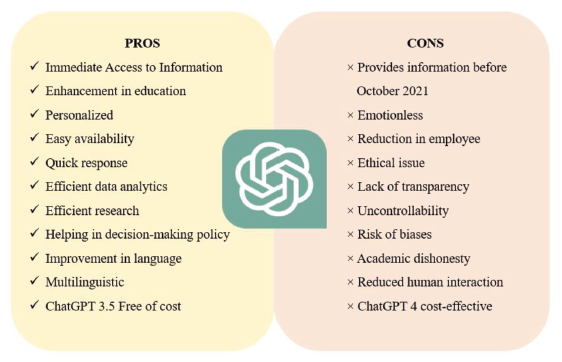
While ChatGPT offers several advantages in healthcare, it does exhibit limitations. Notably, it cannot generate real-time, up-to-date information due to its training being rooted in data available until 2021.15, 29 Although ChatGPT can generate references or citations for the details it provides, a study indicated that the generated reference list covers only the most recent ten years. Additionally, when regenerated, the reference list remains the same, albeit with differing years. This phenomenon extends to the PMID numbers, which correspond to distinct research papers. Based on these findings, the author concluded that ChatGPT’s output may lack comprehensiveness and accuracy and could be subject to bias. Consequently, the use of ChatGPT should be tempered by human oversight, involving careful review and editing of its results. 30
It lacks the capability to generate responses to voice commands and voice responses. Frequently, issues related to high traffic can result in errors, displaying a response such as “ChatGPT is down or at capacity.” Moreover, the integration of ChatGPT with platforms like Twitter, Instagram, Gmail, and so on, is not presently available. A range of ChatGPT alternatives exist, offering a plethora of readily accessible features that are more cost-effective than ChatGPT. Additionally, these alternatives boast functionalities for generating factual and accurate blogs or articles on contemporary subjects. 26
Following are the ChatGPT alternatives in 2023:
GPT-4: It is the most advanced system, producing safer and more useful responses. AutoGPT: Theoretically, it will start asking and answering relevant questions, prompting itself during the process until it finds the solution. Elicit: It is an AI-powered research assistant dedicated to automating specific research workflows. It can locate related papers without needing a perfect keyword match, generate summaries based on abstracts tailored to the question, and explore citation graphs to discover more related research papers. ChatPDF is a tool designed for reviewing PDF files. After uploading a PDF, it undergoes analysis and prepares answers to questions. Privacy features are also included. Perplexity.ai: Perplexity.ai shares similarities with ChatGPT but has the added capability to search the internet. It possesses the ability to generate presentations from mere topics and specified slide counts. Notably, it offers both Android and iOS apps, as well as a Chrome extension. Magicslides.app: It seeks to transform the text into visually captivating presentations. Scite.ai: Scite.ai offers a novel approach to research with its smart citations, facilitating an understanding of the data and results provided by cited articles. This has proven to be immensely beneficial for researchers. This includes tasks such as literature reviews, identifying relevant papers, summarizing content, and extracting crucial information. Chatsonic (Writesonic): It provides an image, real-time data, voice searches, and a plethora of content creation capabilities. Claude: It assists in various text-based and conversation-driven tasks. Jasper Chat: One of the best AI writing tools. It is a new chat interface that helps to create content in an efficient way. Bard AI: Google’s newest, revolutionary AI chatbot that can generate texts and answer questions. Bing AI: It is more powerful than ChatGPT and GPT-3.5. Bing AI has been tailored to maximize speed, efficiency, and accuracy. Otter: Virtual teaching and learning or in-person, both educators and scholars can stay abreast of lectures and confabs. Note-taking and real-time captioning are parts of the process. Bloom: Multilingual language model, which is widely regarded as one of the top alternatives to ChatGPT.5, 29
GeneGPT
A novel method for teaching large language model tools to use the National Center for Biotechnology Information web APIs to answer genomic questions. 31 ChatGPT and GPT-3 exhibit relatively satisfactory performance in providing information related to genetics as compared to other tasks. 32 However, when comparing the genetic knowledge of ChatGPT against human participants, the results indicate a 68% accuracy rate. This study revealed that the answers provided by ChatGPT were occasionally correct but also at times incorrect, particularly when the same questions were posed multiple times. Consequently, drawing definitive conclusions regarding ChatGPT’s capabilities and issues in the field of genetics from this study can be challenging. 31 In contrast to GeneGPT’s functional analysis (with an average score of 0.84), the new Bing search engine (with an average score of 0.91) demonstrates superior performance. This might be attributed to the greater number of web pages related to gene functions that can be accessed through the new Bing search engine. 32 Large language model tools have the potential to handle tasks such as RNA sequencing, protein folding processes, and grouping genomic data into categories. Notably, Google DeepMind researchers have introduced a novel approach called SynJax, which employs an entirely distinct algorithm. 33
Limitations
ChatGPT, or GPT-4, represents advanced technology that faces obstacles such as potentially hindering the doctor–patient relationship and undermining experience and judgment. Moreover, its reach is concentrated in prestigious and developed countries, leaving developing and underdeveloped nations underserved by this tool, thereby possibly exacerbating a “Digital divide.” The biases propagated by this tool could lead to disparate health outcomes for marginalized populations. Employing AI-generated figures, images, graphics, and text might be deemed a scientific violation and even tantamount to scientific misconduct. This is not dissimilar to utilizing altered images or committing plagiarism using existing data. 21
Addressing the ethical concerns encompassing transparency, biases, and plagiarism, H. Holden Thorp suggests that attributing authorship to ChatGPT is inappropriate, especially in journals that have adopted the International Committee of Medical Journal Editor criteria. Thorp recommends establishing a distinct section for “Non-Author Contributors,” clearly acknowledging the contribution of ChatGPT. This approach would enhance the transparency of scientific writing (Figure 2). 34
Conclusion
The perspectives of ChatGPT as a large language model tool in pharmacology and medical education encompass its role in assisting the drug discovery and development process, facilitating pharmacovigilance, aiding pharmacy-related tasks, enhancing scientific writing, and enriching teaching-learning activities. However, these applications come with distinct limitations. To mitigate these limitations, upcoming OpenAI tools will likely necessitate customization, whether as language model tools or in other applications. Adhering to guidelines concerning the integration of technology across diverse healthcare domains is crucial, ensuring a harmonious equilibrium between human involvement and technological advancement.
Footnotes
Declaration of Conflicting Interests
The authors declared no potential conflicts of interest with respect to the research, authorship, and/or publication of this article.
Funding
The author received no financial support for the research, authorship and/or publication of this article.
