




Abstract
Artificial sweeteners (AS) are compounds that offer sweetness with little or no calories, and are usually expected to do so without the metabolic effects of sugars. In individuals with particular health conditions (diabetes or obesity), quality of life may be improved by using AS since they may provide favourably modified foods to meet their special needs. However, AS are very diverse molecules with varied kinetics. In spite of the detailed safety assessments by regulatory bodies before the approval for use, AS have been reported to be connected with a range of unfavourable health consequences, mainly in the lay media. Major concerns include the probable role of AS regarding food intake, body weight, diabetes, dementia or dental caries. Existing evidence to date on those issues is not entirely consistent. Therefore, though AS have been endorsed as a possible way to decrease sugar and overall intake of energy, a debate continues around the real benefits of AS use for this purpose. Considering the extensive use and popularity of AS in contemporary nutrition practice, it is important for clinicians to become familiar with the benefits and provide individualised advice to patients on the selection of appropriate AS, depending on its proprieties and likely benefits. This article includes description of various types of AS and the advantages and possible side effects of the long-term consumption on health of the consumers. Additionally, conflicting evidence surrounding the adverse effects of AS on human health is explored.
Introduction
Non-nutritional sweeteners (NNSs), also known as artificial sweeteners (AS), are heterogeneous class of compounds with diverse chemical structures. AS are popularised as sugar substitutes in foods and beverages owing to their small caloric content and an intense sweet taste. The precise amount of AS consumption by the general population is difficult to assess and varies significantly based on dietary, education, economic and accessibility to healthcare factors.[1] Since the introduction in the 19th century into the market, NNSs have gained huge popularity as substitutes for simple sugars used for control of body weight and obesity management, particularly over the last few decades.[2] Besides the regular use of sweeteners for weight loss, prevention of dental caries and diabetes management, NNSs are used in pharmaceutical and different healthcare products as well. With the increase in consumption of AS sweetened foods and beverages, questions around their benefits and probable deleterious effects on health have escalated too.[3] Notwithstanding the comprehensive evaluations on safety by regulatory bodies before the approval for routine use, substantial debate surrounds long-term health implications of using NNS. An ongoing controversy is specifically evident concerning the chronic metabolic effects of AS, where findings from cohort and observational studies and those from randomised controlled trials (RCTs) are conflicting.[3,4] This review focuses on the various types of AS and the benefits and side effects of using NNS for long-term on health. Furthermore, basic mechanisms of the adverse effects of AS on health are discussed.
Types of Artificial Sweeteners
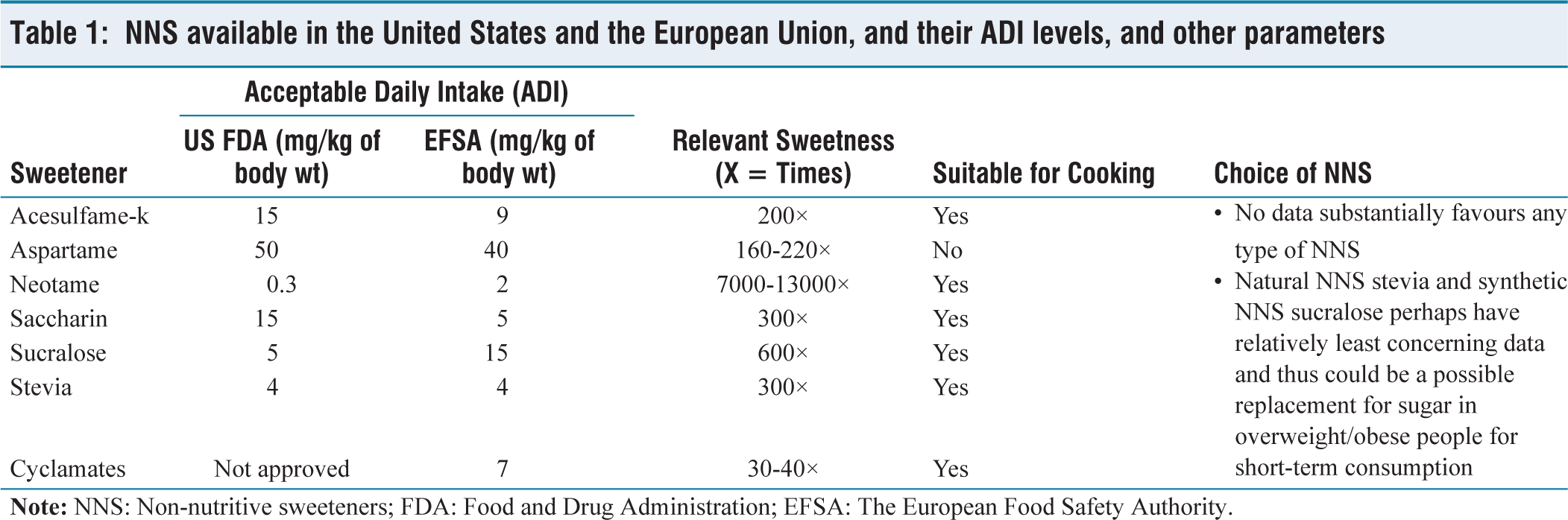
NNS can be divided into natural sweeteners (NS) and AS, when it is extracted directly from the plants or manufactured in the laboratory, respectively. Most of the NNS approved for human consumption are synthetic which comprise saccharin, sucralose, neotame, aspartame, acesulfame-k and Advantame. However, more and more NNS of natural origin are available on the market. Steviol glycosides extracted from the plant Stevia include stevioside and Rebaudioside A.[5] The most familiar NS are Stevia rebaudiana-based products. The acceptable daily intake (ADI) for different sweeteners has been established by the Food and Drug Administration (FDA) and the European Food Safety Authority (ESFA) [Table 1]. As per the FDA statement, ADI level for any AS is generally considered safe if any person consumes that amount daily for the person’s whole lifetime.
NNS available in the United States and the European Union, and their ADI levels, and other parameters
Major Effects on Metabolism
Effect on Glucose Homeostasis
AS cannot make the gastrointestinal (GI) tract ready for digestion and nutrient utilisation like the way sugars do. AS, contrary to natural sugars, have no direct effect on incretin secretion, which seems to be nutrient-dependent.[6] Both short- and long-term studies demonstrated that NNSs consumption, either artificial or natural, had no effect on insulin levels in healthy, overweight, obese or diabetic people.[7-9] Furthermore, the findings of studies on NNS effect on glycaemic control are indecisive. Chronic consumption of AS may be linked with the evolution of insulin resistance and type 2 diabetes (T2D) in normal individuals or the worsening of glucose control in individuals with diabetes, which raises specific concern as these are largely consumed by diabetic people.[10] Influence on glucose tolerance through alteration in the gut microbiota by certain AS,[11,12] alterations in secretion of gut hormones[13] or interfering with the neurological circuits related to food reward[14] have been proposed as possible mechanisms. However, interventional studies have mostly failed to establish the clinical significance of these suggested mechanisms in humans. Additionally, different metabolic effects were reported for various NNS, which may be mediated independently of the common activation of the sweet receptors.[11] The evidence surrounding the use of NNS and an increased risk for T2D is heterogeneous and conflicting.
Effects on Body Weight
The aim of NNSs use is basically to generate energy deficit by sugar replacement, however, without any compensatory consumption of calories in the form of snacks with extra calories and other sources. AS result in decreased secretion of intestinal peptides in comparison with simple sugars that apparently could decrease satiety and could enhance food intake. When the sensory signal by sweet taste to brain is disrupted, it may lead to alteration in energy balance and in that way it promotes overcompensation.[15] In an RCT, Stevia users were reported to maintain a stable body weight in comparison to the placebo arm which reported significant increase in body weight.[16] In a meta-analysis which included 20 studies, use of NNS was found to reduce body weight when compared with sucrose users but not in comparison with placebo or water.[17] In another meta-analysis by Movahedian et al., reduction in body weight and fat mass was reported in NNS users.[18] The effect of substituting sugar drinks with beverages sweetened with AS or water was found specifically beneficial in a group of adolescents with the highest body mass index (BMI).[19] On the contrary, other studies have shown no effect or even increase in weight or BMI with the use of AS among children and adolescents.[20,21] It has been suggested that the consumption of foods and beverages with AS could favour overweight and abdominal obesity.[22,23] Some of these effects have been linked to possible changes in the release of GI hormones, GI motility or modifications of the gut microbiota,[24] but the existing evidence in this respect is inconsistent. To summarise, the weight reducing effect of NNS is primarily seen in individuals with higher BMI and in those who are not on any calorie-restricted diet and it does not depend upon the NNS agent used.[17] Therefore, the possible role of AS on weight control and prevention of obesity for healthy people remains contentious. Concerning the NNS effect on adipogenesis, the results of available researches are also debated.
Effects on Gut Microbiota
The GI tract is populated by numerous species of micro-organisms, which may have impact on growth, metabolic and immunological status of the host.[25] NNSs are processed by the gut microbiota and have considerable consequences on biological processes. Increased consumption of NNSs may lead to alterations of gut microbiota and possibly gut microbiota are acted upon by NNSs directly, thereby influencing host defence mechanisms and triggering inflammatory responses, resulting in altered metabolic regulation.[2]
Benefits of Artificial Sweeteners
AS have several potential benefits which are as summarised as follows[1]:
AS have no significant effect in increasing appetite or energy intake. AS can reduce total energy intake in comparison with other energy dense foods. AS can cause significant weight loss as well as a decline in fat mass and central obesity (mainly in patients with higher BMI and not following calorie restricted diet) AS have beneficial effects on post meal glycaemic surge and insulin sensitivity in healthy individuals and as well as in patients with diabetes. AS can reduce tooth decay and dental caries.
Risks of Artificial Sweeteners
Cardiovascular and Cerebrovascular Risk
The cardiovascular (CV) and cerebrovascular risks associated with consumption of AS are controversial. In the landmark Women’s Health Initiative study, increased intake of artificially sweetened beverages (ASB) was associated with increased risk of all-cause mortality (hazard ratio [HR]: 1.16; 95% confidence interval [CI]: 1.07–1.26) and coronary heart disease (HR: 1.29; 95% CI: 1.11–1.51).[26] ASB intake was associated with increased risk of overall stroke (HR: 1.23; 95% CI: 1.02–1.47). On subgroup analysis, the risk of ischaemic stroke (HR: 1.31; 95% CI: 1.06–1.63) was found to be increased with ASB use. The risk of ischaemic stroke was specifically high for small artery occlusion type. In contrary, the risk of haemorrhagic stroke was not reported to be increased with ASB use. In another large population-based prospective cohort study (The NutriNet-Santé study), 103388 participants were included to evaluate the CV risk of AS uses.[27] The overall risk for CV diseases (CVDs) was increased (HR: 1.09, 95% CI: 1.01–1.18, P = .03) with AS use and more for cerebrovascular events (HR: 1.18, 95% CI: 1.06–1.31, P = .002). In the subgroup analysis by individual AS, intake of aspartame was associated with increased risk of cerebrovascular events (HR: 1.17, 95% CI: 1.03–1.33, P = .02) and intake of acesulfame potassium and sucralose were associated with increased risk of coronary heart disease (acesulfame potassium: HR: 1.40, 95% CI: 1.06–1.84, P = .02; sucralose: HR: 1.31, 95% CI: 1.00–1.71, P = .05). The differential risk for different AS should be evaluated in future in larger prospective studies. In a meta-analysis of prospective cohort studies, higher use of ASB as well as sugar-sweetened beverages (SSB) was associated with increased risk of CVDs and all-cause mortality.[28] With each additional serving of SSB and ASB per day, the authors reported an additional risk of 9 (relative risk [RR]: 1.09, 95% CI: 1.07–1.12) and 8% (RR: 1.08, 95% CI: 1.04–1.11) for CVDs, and 10 (RR: 1.10, 95% CI: 0.97–1.26) and 7% (RR: 1.07, 95% CI: 0.91–1.25) for all-cause mortality respectively. In another meta-analysis by Yin et al. higher intake (>2 servings/day) of low-calorie sweetened beverages (LCSBs) had been found to be associated with increased risk for CVDs (RR: 1.07; 95% CI: 1.05–1.10).[29] Use of AS had also been linked with atherogenic dyslipidaemia which may be responsible for the possible increase CV risk.[30]
Cancer Risk
The carcinogenic potential of AS had been under investigation for long and the results were mostly inconsistent. In the initial animal studies, use of high dose of saccharin and cyclamate was found to be associated with bladder cancer.[31] In a prospective cohort study, higher incidence of overall cancer had been reported with use of aspartame and acesulfame-k.[32] In the meta-analysis by Rios-Leyvraz et al., the authors reported possible higher risk with bladder (26 case–control studies) and larynx cancer (one case–control studies) without any significant increase in cancer-related mortality.[30] However, when only prospective cohort studies were included, there was no evidence of any increased risk of cancer. In another recent systematic review of 22 cohort and 46 case–control studies which evaluated acesulfame K, aspartame, saccharin, Steviol glycosides and sucralose, the authors did not find any significant association of these AS with cancer.[33] Although International Agency for Research on Cancer (IARC) classified aspartame as a possible human carcinogen (Group 2B), the Joint Food and Agriculture Organization/World Health Organization Expert Committee recently confirmed the ingestion of aspartame (within ADI level) was not associated with any significant cancer risk.[34,35] The possible risk of carcinogenesis reported with AS use is seen only in much higher exposure than the ADI level (20–40 times). The FDA also recently stated that they did not find any safety concern related to aspartame when it is used in approved conditions.[36]
Other Risks
AS commonly can cause flatulence as they are not absorbed completely from the GI tract. AS had been reported to cause hepatotoxicity. In animal studies, both aspartame and saccharin had been reported to be associated with hepatic injury.[37] Moreover, the possible association of AS with Metabolic Dysfunction-Associated Steatotic Liver Disease (MASLD) is also had been reported.[38] However, to explore the relationship of AS with MASLD, longer prospective studies are needed. AS also affects various other functions of GI tract including gut permeability, motility and gut microbiome. Among AS, aspartame had been reported to increase the incidence of headaches.[39] Taste alteration and very rarely allergic reactions were also reported with use of AS.[40,41]
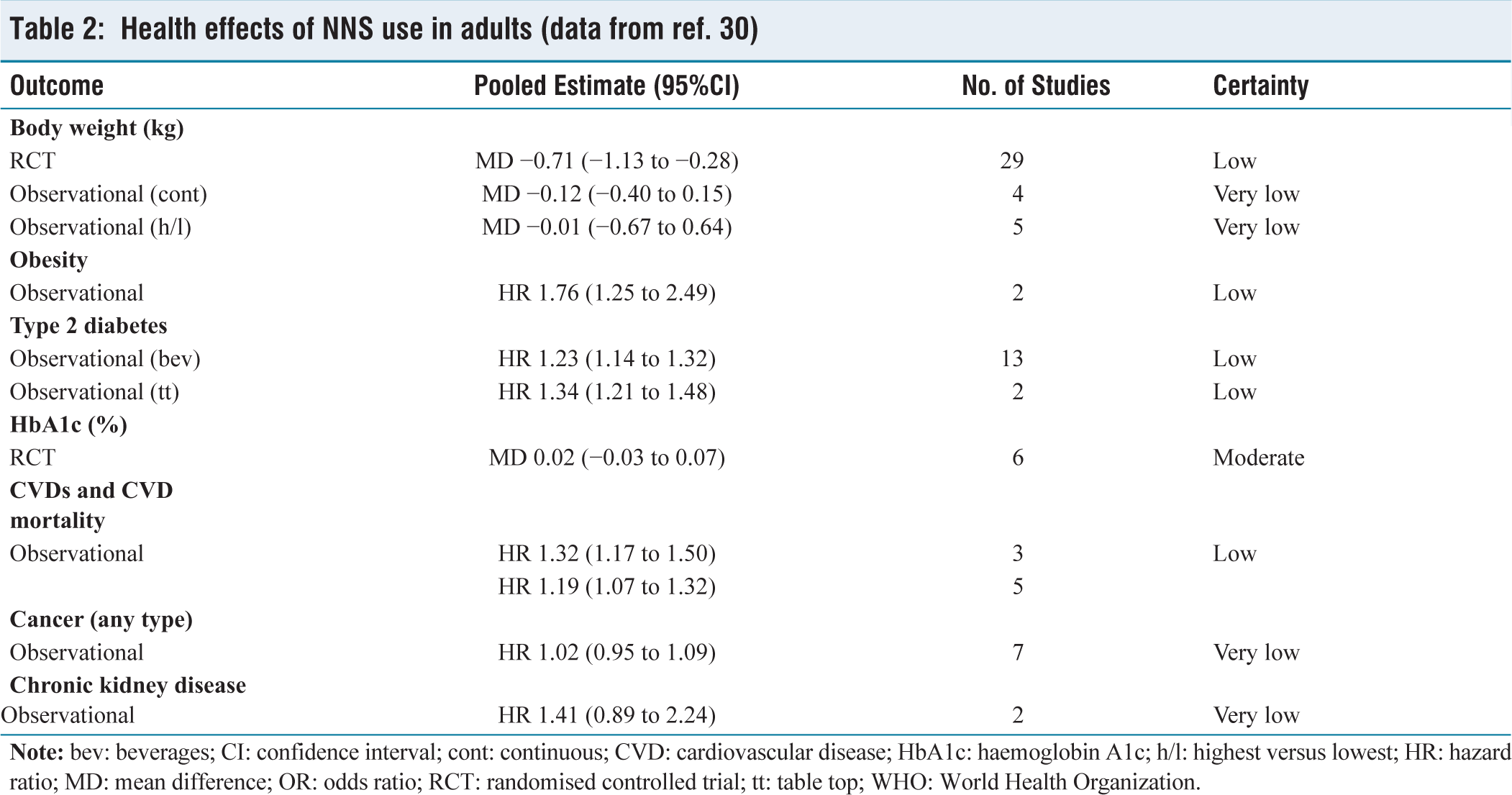
The systematic review and meta-analysis authorised by the World Health Organization (WHO) have evaluated the health-related outcomes of NNS consumption (including all AS and NS) in populations constituting adults (≥18 years of age), children and pregnant women (individuals with diabetes were excluded).[30] This WHO meta-analysis demonstrated that adults who used NNS within the ADI as per the established norms had a meaningfully lower body weight and a trend toward lesser energy intake and BMI in contrast to those who consumed sugars in short duration RCTs. Nevertheless, long-term prospective cohort studies in adults suggested possible harm associated with consumption of NNS. A notably elevated CVD risk (CV events, hypertension, stroke and CV death), all-cause death, in addition to an augmented risk of incident obesity, increased fasting glucose, and T2D were linked with NNS consumption when compared to sugar or water [Table 2]. Nevertheless, the certainty in evidence varied from ‘low’ to ‘very low’ in both prospective cohort studies and RCTs.
Health effects of NNS use in adults (data from ref. 30)
Use in Special Populations
With the widespread use of the ‘sugar free’ products, almost 30% of pregnant women now report intentional NNS consumption during pregnancy.[42] The AS had been found in amniotic fluid as well as in breast milk. Thus, it has the potential for transfer to foetus as well as breast-fed infants.[43,44] The use of AS in pregnancy can have detrimental effect. In a meta-analysis which evaluated data form three prospective cohort studies reported a 25% higher risk (HR: 1.25; 95% CI: 1.07–1.46) of preterm birth.[30] However, the risk was mainly limited for late pre-term delivery (34–37 weeks). The authors did not find any significant risk of low birth weight or large for gestational age babies. Prenatal exposure to NNS had been reported to increase BMI of infants.[45] Unfortunately, there is dearth of guideline regarding the safety of AS in pregnant as well as lactating mothers.[46] Moderation of NNS consumption is advisable in this sensitive population till further long-term studies are available.[42]
The safety of AS usage in paediatric population is controversial. This population can have greater exposure of AS due to potential longer duration of life-time use and relatively higher intake per kilogram of body weight.[47] As per the few available guidelines for paediatric population, AS should not be used in the children of less than two years and children with ketonuria should avoid aspartame or neotame.[48,49] The use of AS in children with diabetes or obesity should always be a part of moderate and balanced diet.[2]
Conclusion
With the widespread use of AS in today’s world, we can say that these molecules are now omnipresent in our daily foods. Like any other molecule, it also has some beneficial as well as harmful effects. On one side, AS can help to reduce body weight, management of diabetes, enhancement of food flavours and reduction in dental caries. While results of RCTs have largely suggested NNS may have insignificant impact on glucose metabolism and result in weight reduction when combined with energy restriction in the short-term, no clear consensus is available on whether NNS are efficacious for long-term weight reduction or maintenance or if they are associated with other chronic health effects when consumed within the ADI limit. On the other hand, there are possible risks related to dyslipidaemia, CV events, ischaemic stroke and cancer. Despite the absence of any robust conclusion that suggests consumption of NNS enhances the risk of cardiometabolic problems, no strong evidence also refutes this statement. Longer-term RCTs are necessary to confirm or refute benefits or harms associated with NNS use.[50] However, the daily permissible amount of AS which is considered safe as per ADI is much higher than the average daily consumption.[51] As per the last recommendations, the WHO suggested that NSS should not be used as a means for the prevention of non-communicable disease or controlling body weight.[35]
Footnotes
Declaration of conflicting interests
The authors declared no potential conflicts of interest with respect to the research, authorship and/or publication of this article.
Funding
The authors received no financial support for the research, authorship and/or publication of this article.
Institutional ethical committee approval number
As this is a review article, it does not require ethical clearance.
Informed consent
Not applicable as review article.
Credit author statement
Ray S conceptualised the work, performed a literature search, performed the writing, provided intellectual input and critically revised the manuscript.
Palui R supervised the literature search and performed writing, provided intellectual input and critically revised the manuscript; All authors have read and approved the final manuscript.
Data availability
Not applicable as narrative review.
Use of artificial intelligence
Not applicable as not used.