



Abstract
In this article, we examine the nexus between foreign development assistance and the attraction of foreign direct investment (FDI) through a de facto political power, as an aid-seeking and likely aid-dependent group. We apply structural equation modelling to investigate the direct and indirect effect of aid on FDI via economic institutions for a sample of 42 African countries from 2002 to 2016. Our results corroborate a direct positive effect of aid and institutions on FDI as a productive financial source. However, an aid-dependent de facto political power does not improve the economic institutions, and within a broad institutional context, it may even worsen them, evidencing the indirect effect of reducing a country’s attractiveness for FDI. This study offers robust evidence under different specifications and variables of institutions in addition to several controls for political and strategic interests and economic conditions. We ultimately develop a model explaining why aid barely makes any contribution to institutional reforms. In countries that are heavily dependent on aid, the beneficiary group is discouraged from improving institutional qualities as the source of benefits would be discontinued.
Introduction
It is an undeniable fact that African countries have advanced somewhat in social dimensions, such as basic health care and education. However, although this continent has been receiving Official Development Assistance for decades, we still cannot refer to these achievements as the result of a development process. The aid-development debate is controversial. Some studies find a positive effect of aid on growth while others find a negative effect or no impact. The nexus is not direct, according to Burnside and Dollar (2000), who suggest that aid can boost growth only in countries with a good political environment. Subsequently, the study of foreign aid widens its scope and incorporates its effect on different outcomes, with special attention to institutions.
The relationship between aid and institutions can be summarised in two approaches. Early studies suggest that aid has a capacity building effect on institutions. Given the successful experience of Europe, economists of this approach suggest that one role of aid is to improve the institutions of the recipient countries. However, in the case of Africa, some economists find that foreign aid has not produced the expected results. The governments in the recipient countries have been blamed for not having the capacity to absorb aid. The second approach proposed by economists is known as selectivity, which maintains that aid should be given to countries with a good government so that the effectiveness of aid can be ensured. However, it seems that neither of these approaches can provide a complete explanation as to why Africa has achieved little in development after receiving an unprecedented amount of aid for a long period.
Early studies treat foreign aid as a mere inflow of capital when assessing its effect on economic outcomes and ignore its institutional effect which might indirectly affect foreign direct investment (FDI). To fill this gap, this article adopts and extends the model proposed by Acemoglu et al. (2005) to contribute to the discussion on aid effectiveness. The model assumes that there are two political groups, the de jure and the de facto political group. The former has the de jure political power which originates in the political institutions. This group tends to shape the economic institutions to ensure the distribution of resources in their favour. Under these economic institutions, certain groups will become richer than others and this will increase its factual political power and form a de facto political group. Consequently, to maintain their benefits, they will use this de facto political power to influence the economic institutions. In this study, we specify that foreign aid and aid dependency are the resources to be distributed, and the de facto political group, respectively. Therefore, assessing the overall effect of foreign aid on FDI requires us to determine the indirect institutional effect.
Structural equation modelling (SEM) enables us to discover the indirect effect of aid on economic outcomes via institutions, also known as the transmission effect. Moreover, this technique provides us the ability to determine the mixed effects of aid and institutions on economic outcomes. Furthermore, we can also investigate the inverse effect.
Although our final goal is to discuss the role of aid in development, we have not attempted to explain development or economic growth. Rather, we have chosen FDI, another controversial variable given that, as a source of foreign capital, FDI to Africa has also been subject to much discussion. Some authors find that it can spur economic growth (Lumbila 2005) while others find that its effect is not significant or even harmful for growth (Alfaro 2003; Habiyaremye and Ziesemer 2006). Our results suggest that economic institutions and aid have a positive effect on FDI while aid dependency has a negative effect on it.
The rest of the article is structured as follows: In Section 2 we review the literature investigating the relationship between foreign aid, institutions and FDI. Section 3 provides a theoretical model to explain why we should consider the institutional aspects. In Section 4, we report the path diagram, empirical mode and data. Section 5 presents the empirical results and the last section the conclusions.
Literature Review on Aid, FDI and Institutions
Our structural model studies the effects that aid, and institutions have on each other and their mixed effects on FDI. To do this, our SEM estimation uses three endogenous variables, respectively, foreign aid, economic institutions and FDI. 1 In this section we sum up the literature on their interaction that underpins our analysis.
Before we study the relationship between the three variables, it is useful to review the long-discussed and controversial aid-growth issue, as it shows the necessity of applying a structural model study. In their survey study, Hansen and Tarp (2000) classify the aid-growth nexus into three generations. In the first generation, aid affects economic growth by reducing the gap between savings and investment. Some pro-aid economists such as Rosenstein-Rodan (1961) find that foreign resources lead to an increase in both savings and investment while others find a negative effect on the growth rate (Griffin and Enos 1970). The Solow growth model has been incorporated into second-generation studies, where economists suggest that aid affects growth via domestic investment. A large number of studies conclude that aid has no effect on growth. However, Hansen and Tarp (2000) find a consistent pattern in all these results: aid increases savings and domestic investment, so there is a positive relationship between aid and growth. In the third-generation studies, the interactive term of government and institutions with aid has been applied to capture the non-linear effect. Of these articles, the one by Burnside and Dollar (2000) is noteworthy for suggesting that aid spurs growth only in countries with a good policy environment, despite that their results are sensitive to sample selection and specifications.
Although a link between aid and domestic investment has been found, early studies assume that aid has no effect on private and foreign inflows. However, recent literature on aid effectiveness, such as the study by Dollar and Pritchett (1998), suggests that aid can attract FDI by providing a good policy environment. The Monterrey Consensus (UN 2002) and its subsequent conferences also inform that aid can serve as a catalyst in attracting FDI. For instance, the Conference in Doha in 2008 proposes that aid can be beneficial to developing countries in improving the social, institutional and fiscal infrastructure and fostering FDI. Since then, economists have been focusing on the relationship between aid and FDI which, within the framework of the Sustainable Development Goals would together represent an important mobilisation of financial flows.
Effects of Foreign Aid and Institutions on FDI
The aid-FDI nexus is no less controversial than the aid-growth debate. Economists propose different models to explain the relationship, yet the results remain inconclusive. Some of them find that aid has a crowding in effect on FDI (Opoku 2015; Thangamani 2014) while others find a negative effect (see for example Arellano et al. 2008). Moreover, Karakaplan et al. (2005) and Kosack and Tobin (2006) find that aid has no significant effect on FDI. The ambiguous results can be explained by the selection of sample (Opoku 2015) or the donors’ practices (Kimura and Todo 2010; Minasyan et al. 2017), while others find that the composition of aid matters for assessing its effects (Harms and Lutz 2006; Selaya and Sunesen 2012).
The extensive literature on institutions highlights both economic and political institutions due to their importance in attracting FDI (Karakaplan et al. 2005; Opoku 2015; Peres et al. 2018; Thangamani 2014; Walsh and Yu 2010). Asiedu (2006) and Radu (2015) confirm the positive effect of political stability on creating a favourable investment environment.
Effects of Foreign Aid on Institutions
Beyond the economic outcomes, economists have recognised that aid effectiveness is a complex issue which involves economic and non-economic variables. Therefore, they focus on the effect of aid on government, although this is a puzzle yet to be understood. 2 As Alonso and Garcimartín (2011) suggest, we can classify the aid-institutions literature into groups according to whether the studies find a positive or negative effect. As for the literature finding a positive effect of foreign aid on institutions, Goldsmith (2001) finds a small and positive effect of aid on democracy and economic freedom for African countries. Jones and Tarp (2016), using disaggregated aid data and different metrics of political institutions, find that aid has a small and positive impact on political institutions. They also suggest that the positive effect is mainly driven by stable flows of aid. Likewise, Alonso and Garcimartín (2011) find that, after considering the determinants of institutions, foreign aid tends to improve the institutional quality for the recipient countries. The return to scale is decreasing, indicating a non-linear relationship between foreign aid and institutions. This strand of literature suggests that aid has a capacity building effect on institutions, which is considered as an important role of foreign aid.
Nevertheless, other authors do not observe the expected outcomes. For instance, Knack (2004) uses a large sample of recipient countries for the period 1975–2000 and finds no evidence that aid encourages democracy. Likewise, Moss et al. (2006) and Kalyvitis and Vlachaki (2012) also confirm the negative democratic effect of aid. The former focus on Sub-Saharan African countries while the latter study its effect on a wider selection of recipients. Djankov et al. (2008) use panel data of 108 countries between 1960 and 1999, finding a negative institutional effect of aid. Jablonski (2014) also suggests that aid has been used by incumbents to maintain their power. Other economists find that aid has a negative effect on tax revenue (Brautigam and Knack 2004) and accountability (Moss et al. 2006). Svensson (2000a) finds that aid fuels corruption in recipient countries where powerful social groups tend to appropriate the foreign aid, which, therefore, does not usually reach the needy people. Even in the same strand of literature, there are still some inconclusive results. For instance, Asongu and Nwachukwu (2016) find that aid deteriorates economic institutions but has no effect on political institutions, while Young and Sheehan (2014) suggest that aid flows are detrimental to both economic and political institutions. Moreover, some studies suggest that the effect of aid is not simple and monotonic. Asongu and Jellal (2013) conclude that aid channelled through government expenditure increases corruption while aid channelled via private investment and tax effort decreases corruption. Dutta et al. (2013), whose study and results have inspired our work, suggest that aid has an amplification effect that strengthens democracy for countries which are already democratic and increases the dictatorship of countries which are already dictatorial. Rather than aid itself, some economists suggest that aid dependency produces negative outcomes. Remmer (2004) argues that aid dependency reduces tax revenue. Guyer (1992) finds a negative relationship between aid dependency and democracy in African countries.
Effects of Institutions on Foreign Aid
In the literature relating institutions to foreign aid, there is a strand which is contrary to the capacity building approach. Here, some economists suggest that aid should be given to countries with good governance or institutions to ensure its effectiveness (Burnside and Dollar 2000; World Bank 1998). 3 This approach is also known as selectivity. However, other economists suggest that selectivity does not produce the expected outcomes (Azam and Laffont 2003; Layton 2008).
FDI and Growth
Finally, we will review some outstanding literature addressing the effect of FDI on economic growth. Although this study seeks to reveal the effect of foreign aid on FDI, attracting FDI is not the ultimate goal of foreign aid, rather, improving development and the well-being of the people are the established objectives. The FDI-growth debate is also ambiguous. Lumbila (2005) finds that FDI can spur economic growth for African countries. However, Habiyaremye and Ziesemer (2006) find that investment has no significant effect in Sub-Saharan Africa because most of the capital is invested in the primary sector. Additionally, Alfaro (2003) finds that FDI in the primary sector tends to lower growth. Thus, we focus on the literature stressing the relevance of FDI besides the role of institutions. Amendolagine et al. (2013) suggest that FDI generates backward linkages with local firms in Sub-Saharan African countries, where good institutions, particularly a reliable legal system, are pre-conditions for boosting such linkages. Many economists highlight the spillover effect of FDI (De Mello 1997). FDI can increase the productivity in the host country through transfers of capital stock, technology, human resource and infrastructure and the existence of a domestic environment for investment boosts productivity (Fillat and Woerz 2011). Javorcik (2004) finds that the productivity spillover is associated with backward linkages. Specifically, one-standard-deviation increase in foreign presence produces a 15% increase in the output of host firms.
Theoretical Model
In this section, we present our theoretical model, which is developed from that of Acemoglu et al. (2005) explaining how aid has an influence on economic institutions and the subsequent effect on economic performance.
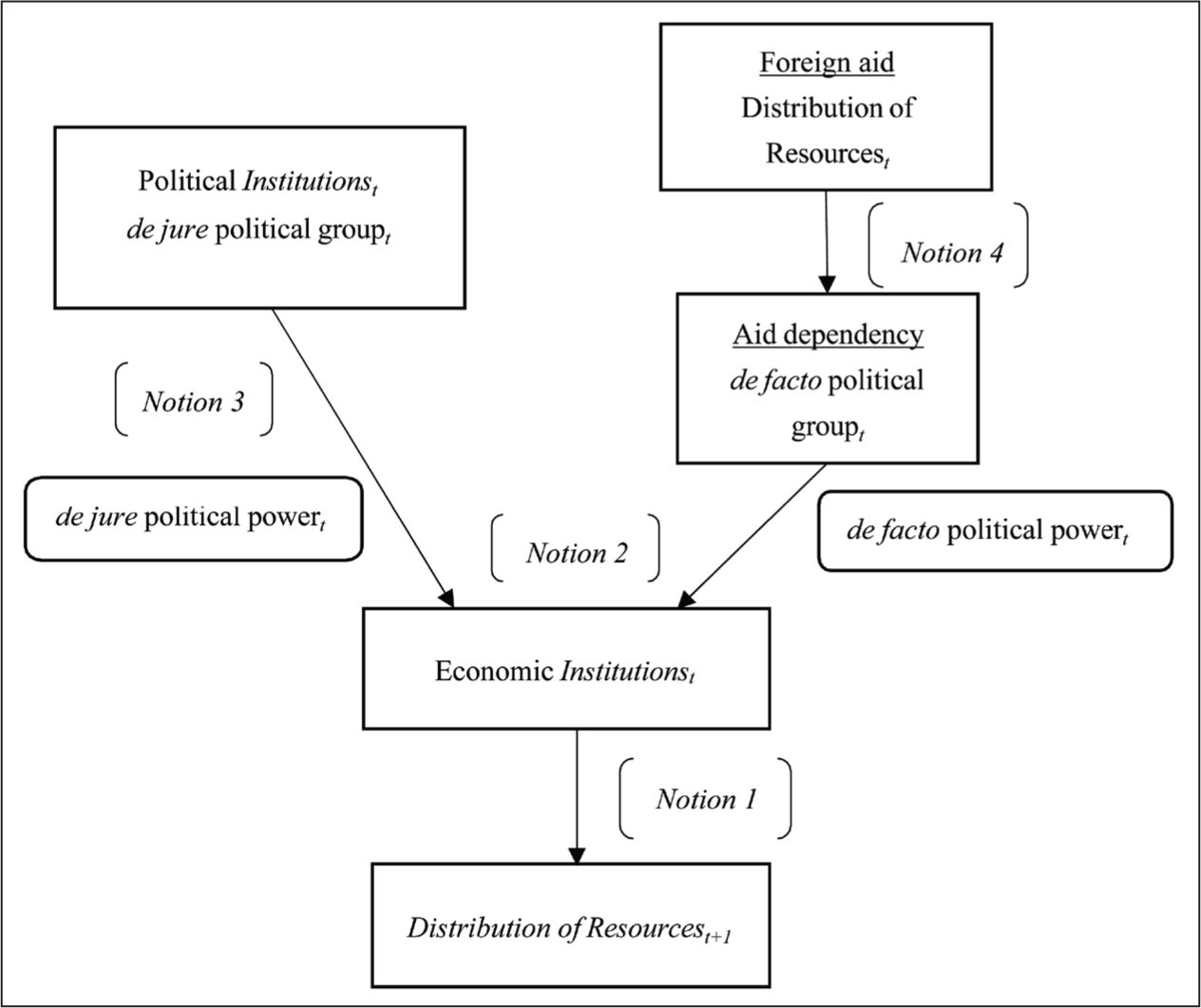
We start with economic institutions, as Acemoglu et al. (2005) suggest economic institutions determine the economic growth as well as the distribution of resources in the future. We denote it as:
Notion 1: Economic institutionst => Economic performancet and distribution of resourcest
+1
Notion 1 shows that economic institutions determine economic outcomes as well as the distribution of resources in the future (denoted by the subscript t + 1). In other words, under the determined economic institutions, certain individuals or groups will be richer than others.
Notion 2: Political powert => Economic institutionst
Economic institutions are determined as a collective choice, but we have no reason to believe that all individuals and groups will have the same preferences over the sets of economic institutions, as one implication of Notion 1 is that different economic institutions produce different economic outcomes as well as different distributional mechanisms.
Acemoglu et al. (2005) argue that it is the political powers that determine economic institutions. In the case of two groups with different preferences, the one with greater political power likely dominates the preferences.
Notion 3: Political institutionst => de jure political powert
It is essential to introduce two different types of political power, the de jure and de facto political power. Notion 3 shows that the de jure political power originates in the political institutions. We specify the group possessing the de jure political power as the de jure political group. Combining Notions 1 and 2, one implication of Notion 3 is that this de jure political group will shape economic institutions to ensure the distribution of resources in its favour.
Notion 4: Distribution of resourcest => de facto political groupt => de facto political powert
According to Acemoglu et al. (2005), the de facto power is determined by two resources. The first is the group’s ability to solve its collective action problem, while the second is the economic resources. Notion 4 shows that the distribution of resources enriches a certain group, giving it the de facto power to influence and determine economic institutions in order to maintain or improve the distributional mechanisms favouring itself.
Putting all of this together, Figure 1 illustrates the theoretical basis of our analysis. We specify that foreign aid denotes a resource to be distributed. And aid dependency is adopted to proxy the de facto political group which tends to determine the economic institutions so as to maintain the reception of foreign aid in the future.
By rethinking the source of the de facto political power, we find that the resources to be distributed come in varied forms, such as FDI in this study. A group of entrepreneurs or stakeholders will get richer than others which gives them the ability (de facto political power) to determine the economic institutions.
Empirical Strategy and Data
Figure 2 shows the simplified path diagram that illustrates the hypothesis. The overall effect of aid on FDI is made up of its direct effect (path c) and the indirect effect (path a*b).
Path Diagram: Hypothesis.
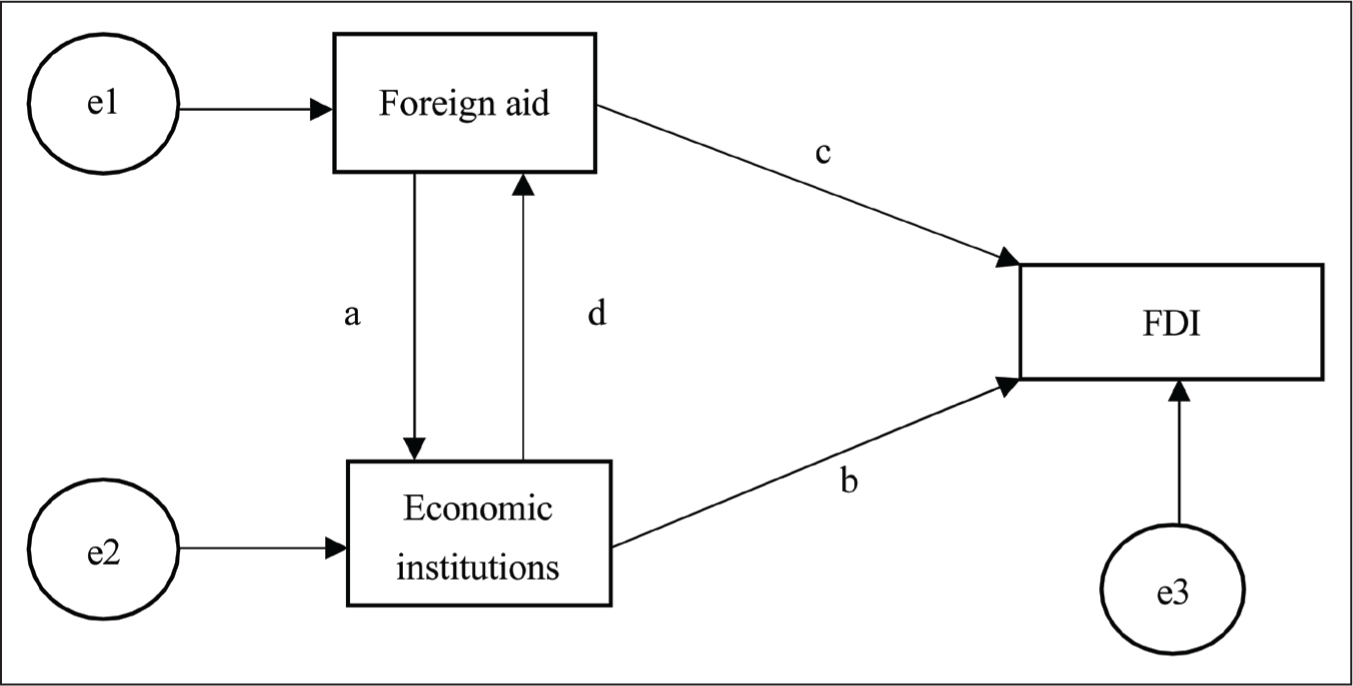
For simplicity, we have omitted the path representing the effect between foreign aid and dependency since they are assumed to be positively correlated. Also, in the regressions, aid dependency is treated as an exogenous variable.
We have applied SEM to capture the direct and indirect effects among our exogenous and endogenous variables. Although SEM with latent variables is known as the full model, we have only contemplated the observed variables. Our data fail to meet the assumption of multivariate normality. We have applied the quasi-maximum likelihood (QML) method. 4
The first equation in our specification establishes the determinants of foreign aid (aid). Many economists suggest that aid allocation is based on the donors’ interests, the recipients’ needs and government performance (for more discussion see Neumayer 2003a, 2003b). There is little doubt that the donors’ economic and political interests play an important role in the aid given. Issues such as tied aid have been repeatedly discussed. Following the work of Neumayer (2003b), we use data on arms imports (arms) and military expenditure (military) to represent the donors’ strategic interests. Neumayer finds evidence that countries with higher levels of military expenditure and arms imports do not receive more foreign aid. This evidence leads us to expect a negative relationship between aid and these strategic variables. More recently, Rahman and Giessen (2017) established the relevance of the donor’s political, economic and strategic interests in the allocation of aid, leading us to expect a positive relationship. 5
We also use fuel exports (fuel) to show the donors’ economic and strategic interests since they represent the repayment capacity and energy security of the donor countries (Couharde et al. 2020). 6 The variables that represent the recipients’ needs are their growth rate of GDP (gdp) and population (population) and their Human Development Index (HDI). 7 We consider the economic freedom (EF) index from the Fraser Institute to represent the economic institutions. 8 We add a score for the political regime authority spectrum, ranging from hereditary monarchy to consolidated democracy, the variable Polity2, from the Center for Systemic Peace, to represent the political institutions of the recipient country. If a positive effect of institutions on aid is observed, this may indicate that donors have applied the selectivity approach in giving aid; a negative effect may imply that donor countries believe that recipient countries need aid to improve institutions (capacity building). Aid dependency (dependency) is the ratio of foreign aid to government expenditure which we use to proxy the de facto political group. 9 It is expected to work in favour of aid as it is empowered by the recipient of foreign aid.

In the equations we include dummy variables Sub-Saharan Africa (SSA) and Least developed countries (LDC), controlling for the Sub-Saharan African and least developed countries. Some studies find that poorer countries receive more aid (Schraeder et al. 1998). Others find a contrary result (McGillivray 2011; Briggs 2017).
The second equation establishes the determinants of economic institutions (EF), based on the scarce existing literature studying their determinants. Integrating the works of Brown (2010) and Jones and Tarp (2016), the control variables are growth rate of GDP (gdp) and population (population), life expectancy at birth (life), urban population growth rate (urban), fuel exports (fuel), economic openness (openness), political institutions (Polity2). We have also included a one-year-lagged EF due to the persistency. The variable of interest in our model is the disbursement of aid (aid) and aid dependency (dependency). The inclusion of political institutions is to establish whether the de jure political power is greater than the de jure political power.

Finally, we establish the regression for FDI, as:
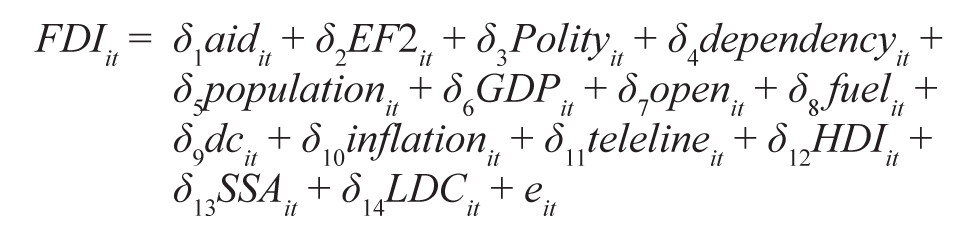
In order to explain FDI we have followed the work of Tampakoudis et al. (2017), using the economic and political institutions (EF and Polity2) and aid dependency (dependency), to which we have added foreign aid (aid). Parameters δ1 and δ2 report the direct effects of foreign aid and economic institutions on FDI. There is a controversy in the literature regarding the effect of aid since it could be positive, negative or not significant. dc is the domestic credit to the private sector that we have drawn from the World Bank. We have included it to represent domestic financial development since a high domestic financial level may influence foreign inflows (Dutta and Roy 2011). The variable teleline is the fixed telephone subscriptions per 100 people, representing the infrastructure of recipient countries. The HDI represents the recipient’s absorptive capacity.
Our data cover 42 African countries and the available data for aid disbursement have limited our sample to the period 2002–2016. Data on foreign aid are the bilateral aid from the Development Assistance Committee (DAC) countries to the recipient countries in the DAC recipients list. We have gathered the aid data from the Creditor Reporting System of the Organisation for Economic Co-operation and Development (OECD). Data on FDI and EF have been drawn from the World Development Indicators of the World Bank and the Fraser Institute, respectively. More details can be found in the descriptive statistics and countries in the sample in Tables A1 and A2. As for the robustness check, we have estimated our model with the modified EF without the sub-indicator Freedom to trade internationally since it could cause an endogeneity issue. Furthermore, keeping the modified economic institutions, we have transformed our data into five-year intervals. By doing so, we can minimise the external impacts to aid flows such as economic crises and development conferences. We are also able to capture the real variation of economic institutions since recipient countries would act deliberately well in certain years to ensure the donation of aid (Layton 2008). Moreover, we can reveal the long-term effect among variables. In addition, we have tested two alternative indicators of institutional performance, namely, the Government Effectiveness Index (GE) from the World Bank and the EF index from the Heritage Foundation (EFH). The GE index considers a wide variety of aspects capturing the quality of public and civil services, the degree of its independence from political pressure, policy formulation and implementation (Kaufmann et al. 2011). Given that it considers the basic education and health services in the same way as HDI does, we have respecified the model excluding HDI. With respect to Heritage’s EF, we find it is more closely correlated to Fraser’s index in measuring institutional qualities (Murphy 2016). We have also recalculated it dropping the government integrity and trade freedom due to their similarity with political institutions (Polity2) and trade openness (open), which are taken from the World Bank, as well as the control variables considered.
Empirical Results
The empirical findings are presented in three subsections. In the subsection of Baseline Results we first report the result of the baseline model in which only core variables are included. The results are interpreted based on the theoretical model. Then we include all controls. In the subsection of Robustness Checks, we have recalculated EF and transformed our dataset into five-year intervals and reported their results. Moreover, we also present the findings of the alternative indicators on institutional performance GE and EFH. Finally, in the subsection of Summary and Discussion, we have depicted the path diagrams with the estimated coefficients and provided some discussion on the empirical findings.
Baseline Results
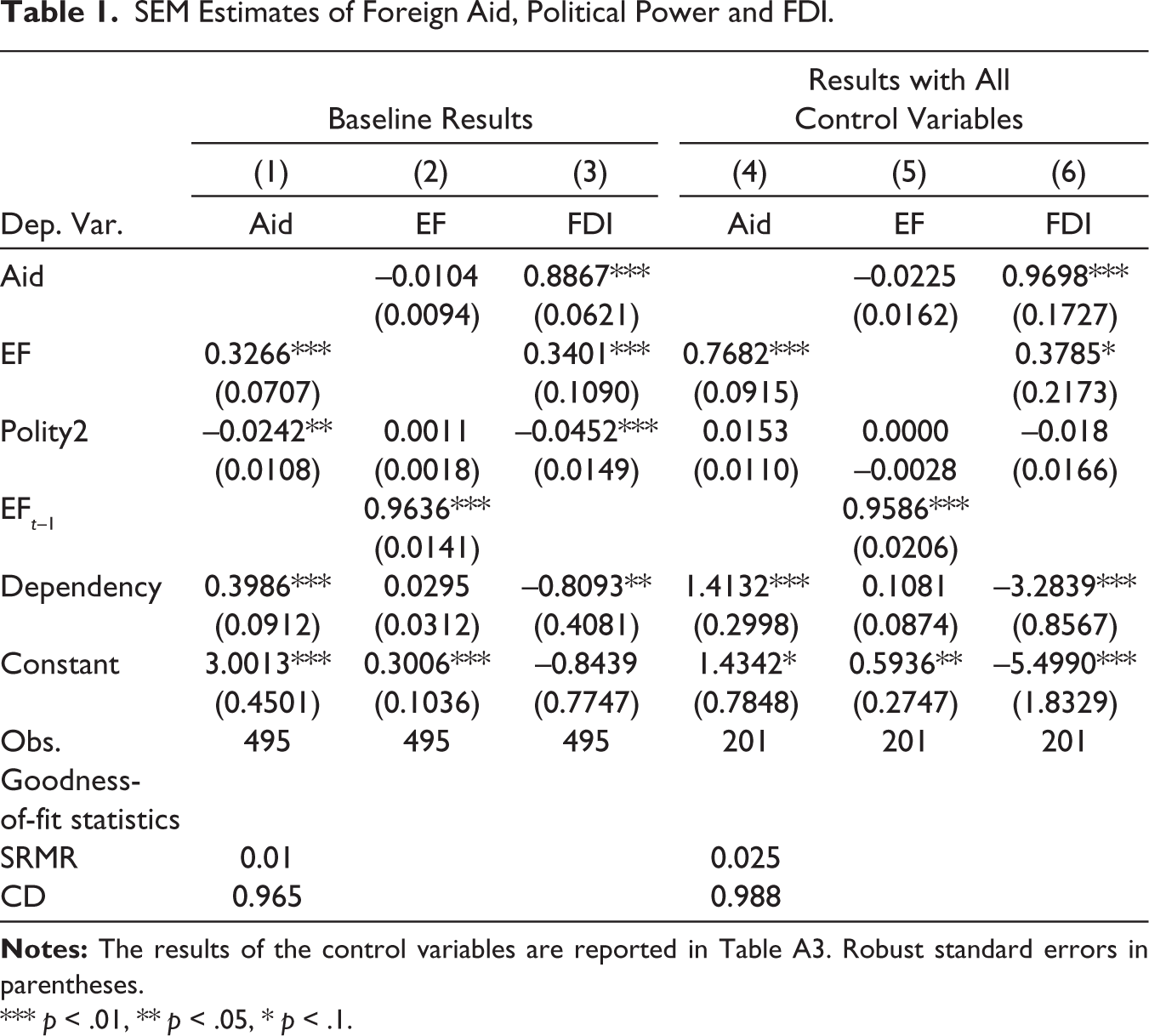
Table 1 reports the results of the baseline model (Columns 1–3), and the results with all control variables included (Columns 4–6). We first report the statistics of goodness-of-fit at the bottom of the table. Since QML is applied, only the standard root mean squared residual and the coefficient of determinants statistics have been reported. As the former approaches 0 while the latter approaches one, we can conclude that the model fits the data well. We can now move on to these coefficients.
SEM Estimates of Foreign Aid, Political Power and FDI.
*** p < .01, ** p < .05, * p < .1.
Column 1 reports the determinants of foreign aid. EF positively affects the donation of aid while political institutions (Polity2) have a negative effect. Aid dependency has a positive effect, indicating that a country that depends heavily on aid will receive more inflows of aid. As for the determinants of EF in Column 2, we find that only the lagged EF (EF t – 1) has a positive and statistically significant effect, suggesting the persistency of economic institutions. Column 3 reports the determinants of FDI. Foreign aid has a positive effect, and we can argue that this could be due to the enhanced absorptive capacity through the aid invested in education, training and physical infrastructure (Donaubauer et al. 2016; Selaya and Sunesen 2012). Another explanation could be that the accumulation of capital has not reached the threshold when one crowds out another. EF has an attraction effect on FDI while the effect of political institutions (Polity2) is negative. Aid dependency tends to crowd out FDI.
The baseline results show that economic institutions positively affect foreign aid and FDI. The theoretical model explains that under the current economic institutions, foreign aid and FDI, as two kinds of resources to be distributed, are attracted into this country. Moreover, the distributed resources would grant the de facto political power to the corresponding groups. Thus, the beneficiary groups will compete to determine the economic institutions in order to maintain the benefits. 10 Improving institutional qualities would not be preferred from the perspective of the group of aid, given the positive correlation between FDI and economic institutions. Once the need for capital is satisfied by FDI, donor communities might cease to donate. Meanwhile, worsening institutional qualities would lead to a decline in the inflows of aid which would not be the best choice for this group. This explains why we find a not significant effect of aid dependency on economic institutions in Column 2.
Then Columns 4–6 present the results after the inclusion of all control variables. We find that the variables of interest have not changed the sign and significance. Column 4 reports the determinants of foreign aid. Similarly, we find that economic institutions have a positive effect. Moreover, political institutions fail to show a statistically significant effect. Again, we find that aid dependency has a positive effect on foreign aid. As for the recipients’ needs, HDI has a negative impact on foreign aid which is consistent with our expectation that the needy countries usually have a lower level of HDI. Regarding the donors’ strategic interests, we find that only the imports of arms (arms) show a positive and statistically significant effect at the level of 1%. The dummy variables SSA and LDC have a negative effect on foreign aid, which confirms the findings of McGillivray (2011) and Briggs (2017). Kosack and Tobin (2006) also suggest that recipient countries with an extremely low level of human capital do not absorb aid and aid even works against development, which evidences the selectivity approach applied by donor countries.
Column 5 reports the determinants of EF. We find that the results are consistent with the baseline whereby only the lagged EF has a positive and statistically significant effect.
Robustness Checks
After including control variables, we find that the results remain unchanged. Although the variables of interest in the baseline are consistent with our model, there are some concerns that we need to address. First, we suspect that the variable openness might cause endogeneity problems with one indicator of EF which is the freedom to trade internationally. To solve this, we have recalculated the EF index by dropping the freedom to trade internationally and included it in the third equation while the rest of the equations remained the same. Second, we have transformed our data into five-year intervals. By doing so, we can mitigate the impact of external shocks on aid flows, such as economic crises or development aid conferences. By working with intervals, we can observe the real variation of economic institutions since we believe some recipient countries would purposely act in specific years in a way to ensure the donation of aid. Moreover, we can discover the relationship between variables from a long-term perspective. Third, we have applied alternative variables of institutions, GE and EFH, to investigate whether the results are robust to different variables of institutions. The former considers a wider coverage of government performance such as social issues and political credibility and the latter has a similar interpretation to that of the EF from the Fraser Institute.
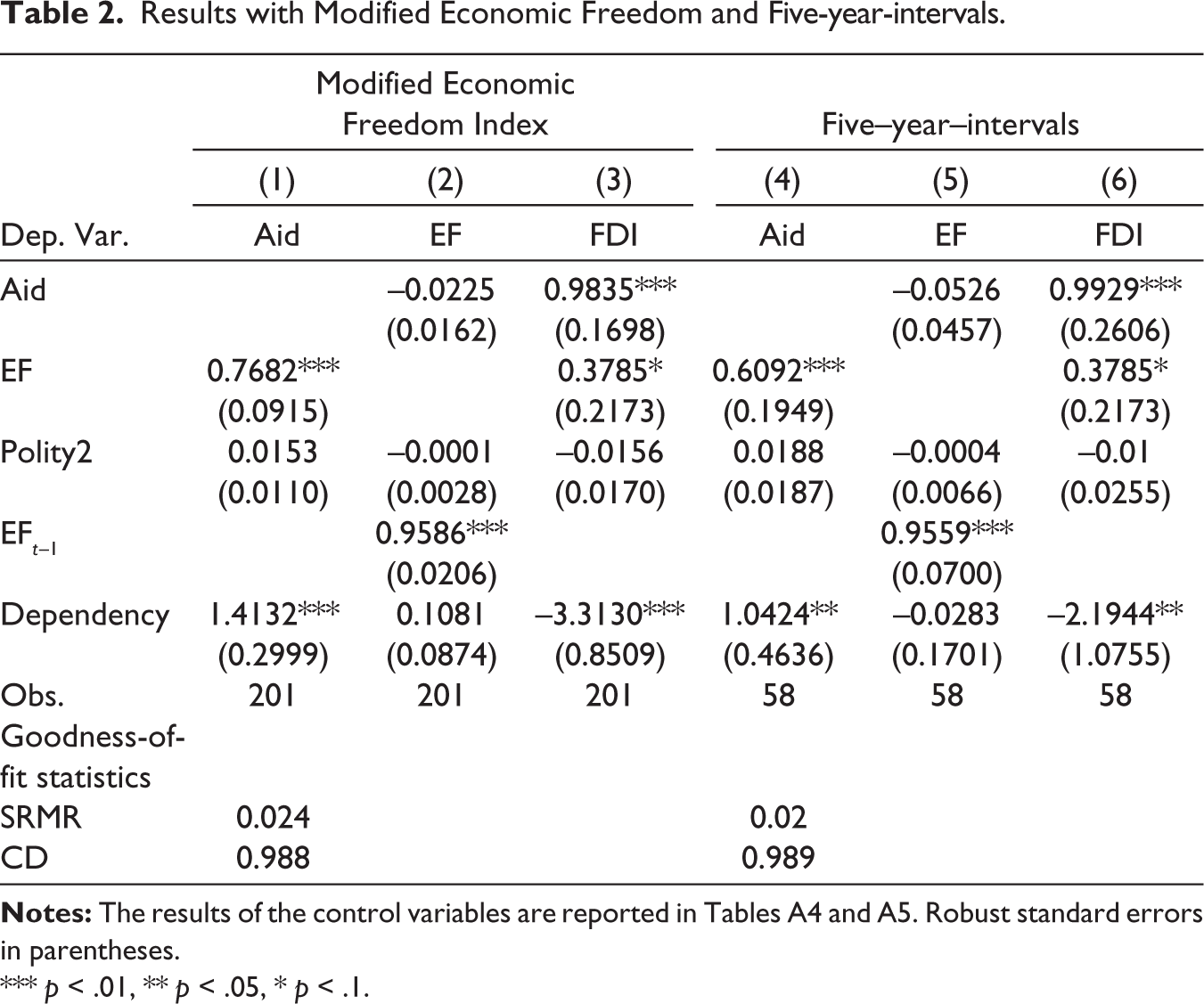
Table 2 reports the results for the first two alternatives. The results of the modified EF index are reported in Columns 1–3 and the results of five-year intervals are reported in Columns 4–6. Column 1 shows that economic institutions have a positive effect on aid as in the baseline. Population growth, HDI, aid dependency, arms imports, SSA and LDC show the same effects as in the baseline. In Column 2 we confirm again that foreign aid and aid dependency have no significant effect on EF while its past value does have an impact. Column 3 shows that after modification, economic institutions have a similar positive and statistically significant effect at 90% as in the baseline. Moreover, the effect of openness remains positive and significant. We find that the model is robust to the first alternative specification.
Results with Modified Economic Freedom and Five-year-intervals.
*** p < .01, ** p < .05, * p < .1.
The five-year intervals model has a goodness-of-fit, but the number of observations drops to 58 which might influence the estimates. Column 4 reports the determinants of aid. From a long-term perspective, the selectivity approach is again confirmed, given that EF has a positive effect on aid. The aid dependency of recipient countries continues to act as a driving factor of aid and the rest of the results remain the same. Column 5 shows that foreign aid and aid dependency have no significant effect on economic institutions. As for FDI, the results in Column 6 remain unchanged from a long-term perspective. Aid and economic institutions are positively associated with FDI while aid dependency still has a massive crowding out effect.
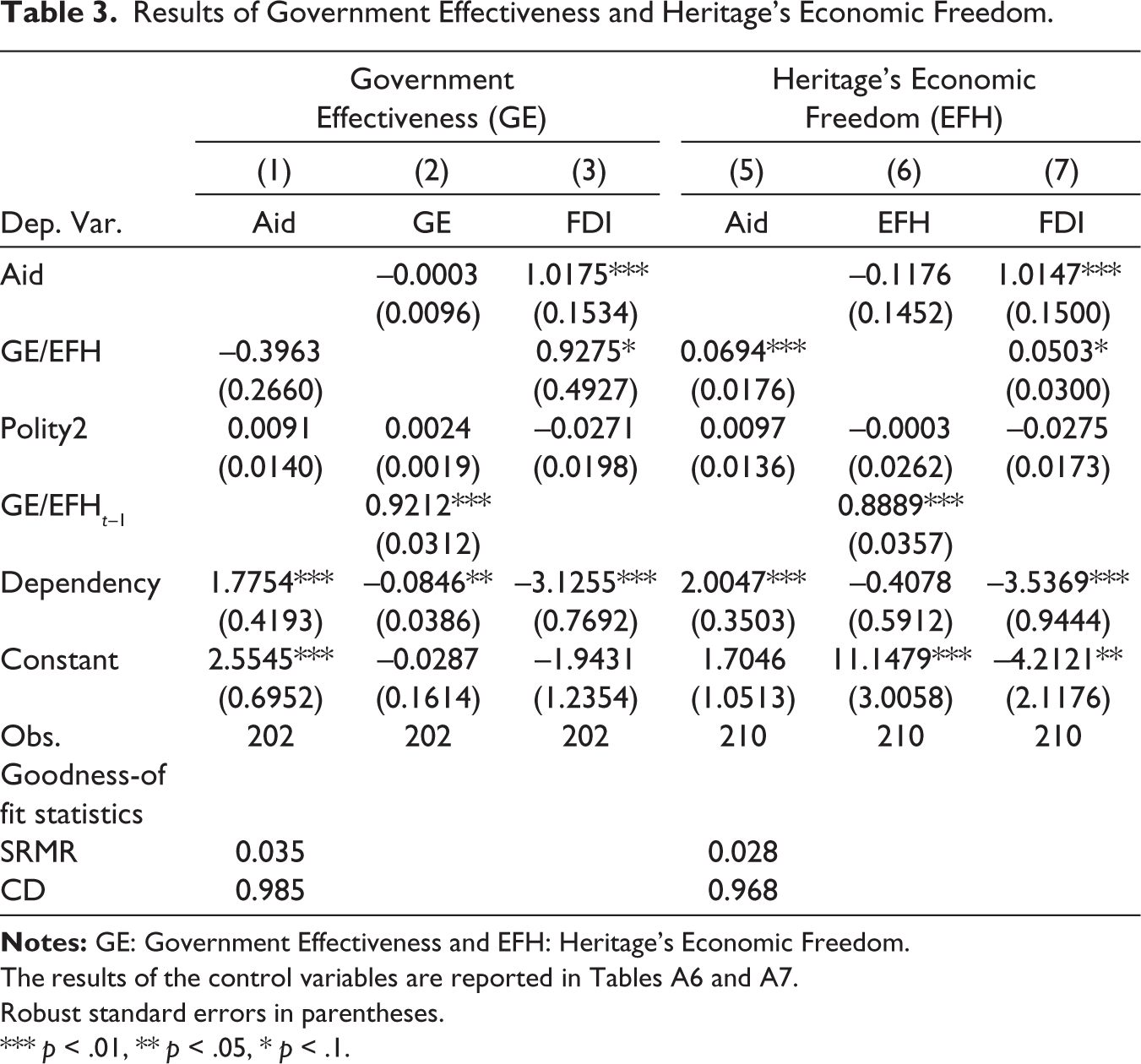
Table 3 presents the empirical findings of GE (Columns 1–3) and Heritage’s EF (Columns 4–6). Column 1 reports that GE has a negative but not significant effect on foreign aid. The wide coverage of this indicator might offset the effects on aid. For instance, according to the methodology, a higher score indicates a better basic education and financial development. The former represents the social needs and the relationship with aid is expected to be negative while the latter tends to attract more foreign aid. In Column 2, we can observe that aid dependency tends to worsen the institutional quality in a broader political scope, evidencing the indirect effect of reducing a country’s attractiveness for FDI, given that the results also confirm the theoretical model according to which better institutions attract more FDI (Column 3).
Results of Government Effectiveness and Heritage’s Economic Freedom.
The results of the control variables are reported in Tables A6 and A7.
Robust standard errors in parentheses.
*** p < .01, ** p < .05, * p < .1.
As to Heritage’s EF, we find the results remain unchanged in comparison to that of Fraser’s EF, evidencing that institutions attract both international flows and that the aid-dependent group seems to prefer to maintain the current status quo, that is dependency has no significant effect on the economic scope of institutions.
Summary and Discussion
The results are robust to alternative specifications and different variables of institutions. As for the determinants of aid, we find that aid dependency and EF have a positive effect on aid. The control variables representing the donors’ interests and the recipients’ needs demonstrate the corresponding effects. As for the determinants of EF, only the lagged value has a positive and significant effect indicating the persistency of economic institutions. Regarding the determinants of FDI, foreign aid and EF have a positive effect while aid dependency negatively affects FDI. Among other control variables, openness and fuel exports are positively associated with FDI.
A broader definition of government, as approximated by the GE index, contributes to the robust evidence of the indirect institutional mechanism whereby aid may hinder a country’s attractiveness for FDI. In addition, by extending the behaviour of institutions with their political performance, our results show that aid funding decisions are not influenced, although aid-dependency worsens government performance and slows down FDI.
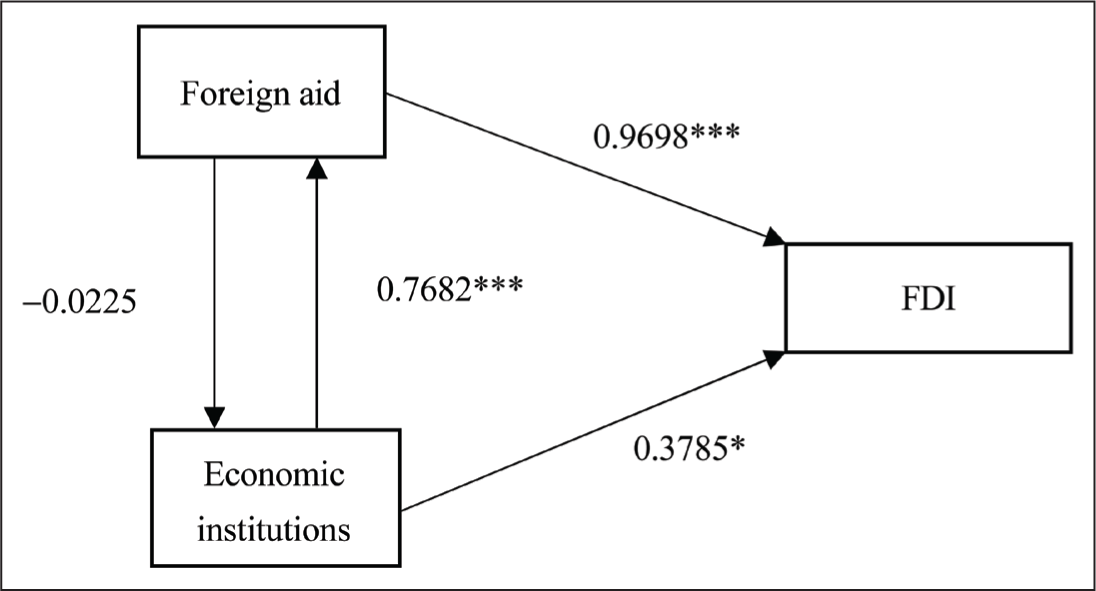
Figure 3 depicts the path diagram of Table 2 (Columns 1–3), showing the relationship between foreign aid, economic institutions and FDI which is the core element of this study. First, foreign aid has a positive direct effect on FDI. The mechanisms remain unknown, but it could be the aid invested in education, training and physical infrastructure which improves the absorptive capacity. Second, EF has a positive effect on foreign aid and FDI. The attraction for aid (0.7682) is larger than that for FDI (0.3785) suggesting that the current economic institutions prefer aid over FDI. This is particularly important to explain that aid has no significant effect on EF, that is its indirect institutional effect is not significant. 11 The theoretical explanation is that a better institution tends to attract more foreign aid as well as FDI. 12 The de facto political group (aid dependency) attempts to maintain the current status quo in which donor countries continue to donate while avoiding attracting more FDI since it would form another de facto political group and raise competition. The model can explain the controversial results that the government has no incentive to improve institutions after receiving extraordinary flows of aid (Azam and Laffont 2003; Bauer 1993; Brautigam and Knack 2004; Svensson 2000b).
Conclusions
The results of aid-growth and aid-institutions analysis remain controversial, especially for the continent of Africa. Economists have found positive, negative and null economic and institutional effects of foreign aid, with results varying across countries. The aid-institution discussion stresses the important role of aid in improving the institutional quality of recipient countries. However, the results in Africa are not as expected.
Most studies merely treat aid as a source of foreign flows and discuss its effect on economic outcomes, ignoring its indirect institutional effect. Hence, this article adopts and extends the theoretical model of Acemoglu et al. (2005), specifying that foreign aid has formed a de facto political group which is proxied in our analysis by aid dependency. The results suggest that foreign aid has a positive direct effect on FDI while the indirect institutional effect is not statistically significant. In turn, we find that economic institutions positively affect foreign aid and FDI. An explanation derived from the model is also provided, confirming the finding. The beneficiary groups of aid have no incentive to improve institutional qualities as donor countries might withdraw the donation when institutional qualities improve considerably and the attraction for other private international flows will increase which also makes the country less dependent on foreign aid. When a broader government performance is considered, it does not influence aid decisions and only attract FDI; in this case, the beneficiary group of aid tends to worsen institutional qualities and slows down FDI inflows.
Given the empirical findings, we suggest that rather than cease the donation, the way in which aid is given should be improved, and the content which aid embodies should be reconsidered. That is, in addition to the capital flows, foreign aid should contain more education, technical assistance and capacity building which helps recipient countries to identify and complete the institutional reforms.
Footnotes
Declaration of Competing Interest
The authors declare that they have no known competing financial interests or personal relationships that could have appeared to influence the work reported in this article.
Funding
This work was supported by the Government of Aragon for the Foreign Sector and Financial Integration Research Group (SEIM-S44-17R).