



Abstract
This article discusses the widespread distinction between instrumental and emancipatory approaches within ESD, also known as ESD 1 and ESD 2, which was highly influential in our field. Against the backdrop of current discourses in environmental and sustainability education as well as critical sustainability studies and transformation studies we suggest four perspectives to be reconsidered: (a) the processual nature of transformations, (b) the incorporation of non-dualistic epistemologies, (c) the challenge to evaluate what has to be handled controversial and what not and (d) the need to address the emotional dimension within ESD. We argue that the discussion on ESD 1 and ESD 2 has to be conceptually updated in light of ethical requests of current social-ecological crises and argue for ESD 3. Such a transformative approach within ESD describes ‘learning in relation with a changing world’. The article concludes by formulating implications for educational praxis and future research.
Keywords
Introduction
I believe that we have a very important opportunity at school to—influence is the wrong word—make young people aware of this. To show them things—in the end, they have to decide for themselves whether this is important to them or not. Educating
This passage from an interview conducted with a teacher as part of a study on Austrian teachers’ ESD practices illustrates the inherent tension in ESD between implementing a sustainability agenda on the one hand and nurturing a critical understanding and following aspirations for education on the other. The paradoxes and antinomies
In the Journal of Education for Sustainable Development, the paradoxes and antinomies of ESD (and how to deal with them) have also been intensely discussed (e.g., Hofman, 2015; Hopkins, 2012; Jickling & Wals, 2012; Obeng-Odoom, 2020; Schulte, 2022; Wals, 2011). The 2007 article Learning for a Change: Exploring the Relationship Between Education and Sustainable Development by Vare and Scott (2007) has proven to be decisive in this debate. It distinguishes between two approaches within ESD, instrumental ESD 1 and emancipatory ESD 2 (see also Wals et al., 2008), and it conceptualizes their interplay metaphorically as an interdependent yin–yang relationship (Vare & Scott, 2007, p. 196). The article can be regarded as one of the most widely considered works in the field, and yet, against the backdrop of more recent discussions, it calls for an update.
Indeed, current developments like the effects of the climate crisis are giving the debate new relevance and a sharper thematic focus. Although political documents on ESD have evolved since the first anchoring of sustainable development in international education policy agendas (United Nations, 1992), proposing a less admonitory and instrumental form of ESD, several studies at different points in time (Kranz et al., 2022; Boström et al., 2018; Huckle & Wals, 2015; Sauvé et al., 2007) have continued to uphold the early criticism that institutional implementation of ESD has an instrumental tendency. In a critical reading, ESD can thus be discussed as a post-political educational practice, that is, its affirmative character can be criticized as contributing to the perpetuation of current conditions instead of to their change (Sund & Öhman, 2013). In their literature review, Boström et al. (2018, p. 1) come to the sobering conclusion that
after thirty years with sustainable development as the dominant global discourse of ecological concern there is deep-felt disappointment with its ability to confront key sustainability problems. The problems of continued unsustainability and surpassed planetary boundaries, require not only scientific and technological advances but also deep and enduring social and cultural changes.
Against the backdrop of this disillusioning assessment, numerous questions arise that essentially address the debate about the objectives of ESD: How can ESD contribute to socio-cultural change without having an affirmative or instrumentalizing effect? What normative objectives can be legitimized in the name of education and in the context of sustainability, and how, and what orientation can teachers gain from this? How do individual and social change processes come into play in the definition of ESD objectives? What ontological assumptions about human–nature relationships lie behind the distinction between instrumental and emancipatory ESD? How can learners deal with specific emotions in the context of sustainability and receive pedagogical support? Overall, we are interested in what gaps and potentials for further development arise from the distinction between more instrumental and more emancipatory approaches in ESD.
In the past few years, the far-reaching changes have been increasingly discussed in the sustainability debate as a whole as well as in the ESD debate from the perspective of the concept of transformation. This concept refers both to a transformation towards a sustainable way of life and economy—in the sense of a social-ecological or great transformation (WBGU, 2011)—and to the transformation of patterns of thinking, feeling and acting, as well as of social models and guiding norms and values acquired through learning—in the sense of transformative learning processes. Some authors believe that this combination has the potential to contribute to the repoliticization of ESD (Boström et al., 2018; Lotz-Sisitka et al., 2015; Pettig & Lippe, 2024). Even if the core of all sustainability-oriented efforts is to find answers to the risk of reaching or overstepping planetary boundaries, the answers are sought in different discourses and at different levels. Adloff and Neckel (2019) distinguish between three futures of sustainability: transformation, modernization and control. In the critical transformation discourse, the orientation towards liveable futures, that is, social-ecologically sustainable and just futures for all, represents a directive, that is, central normative guiding value (Brand & Wissen, 2021; Lotz-Sisitka et al., 2015). This is radically different from ecological modernization discourses (Neckel, 2017), which see technological and market-based innovations, such as emissions trading, as central solutions. In control discourses, the focus is particularly on resilience in the face of the inevitable catastrophe, ‘which is to be countered with infrastructurally anchored technical, military and state means’ (Adloff & Neckel, 2019, p. 176).
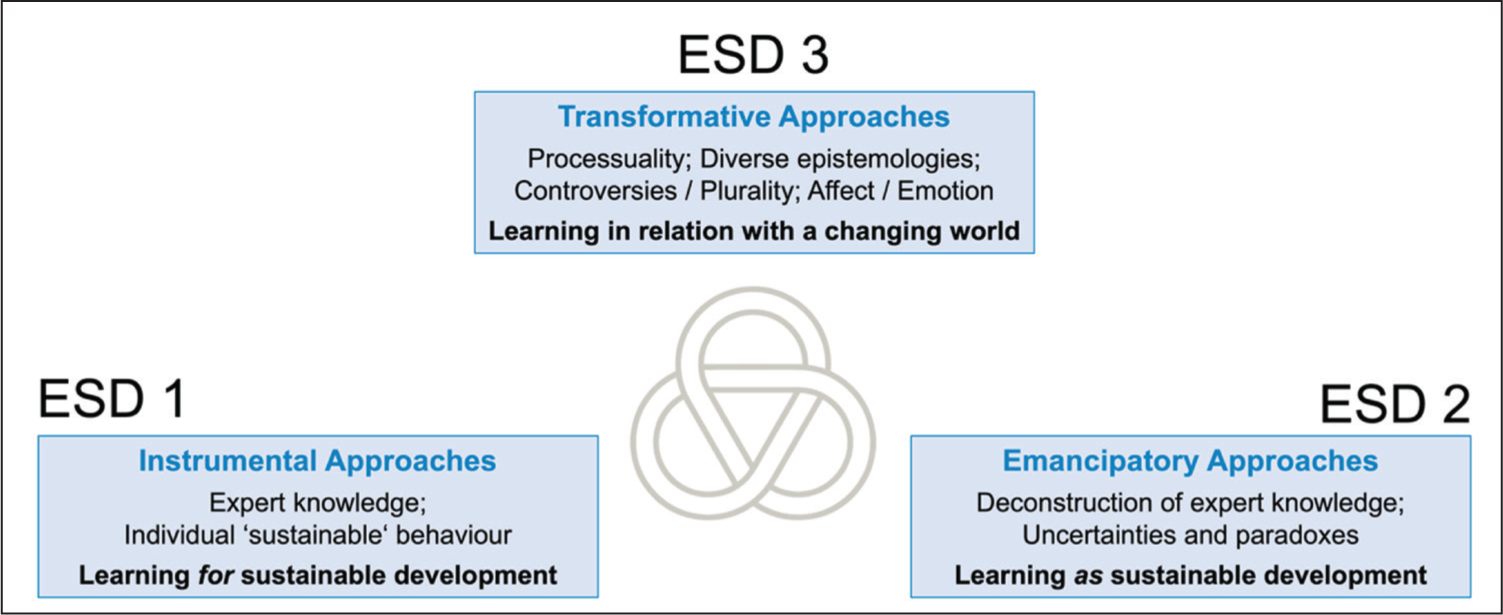
In view of these developments in the ESD debate, we propose further developing the analytical description of different approaches and differentiating a new, transformative ESD 3 heuristically from instrumental ESD 1 and emancipatory ESD 2. Vare (2014) formulated initial thoughts on a possible third approach, drawing on activity theory, but he did not pursue them further. In our view, the core of a transformative approach lies in seeking a productive way of dealing with the paradoxes and antinomies of sustainable development related to education, without getting lost in relativism in the face of the social-ecological crisis, and at the same time pursuing a holistic approach to learning: Based on the understanding that individual and societal transformation processes are closely intertwined, we posit that a transformative approach in ESD is oriented towards issues of social-ecological justice. Such an approach recognizes multiple uncertainties, follows a reflexive-decolonial approach to one’s own thinking and action patterns, differentiates between sustainability-related issues that should be discussed controversially (and those that should not), strives to comprehensively repoliticize all issues concerning the planet and includes the emotional dimension of learning. In a nutshell: Transformative ESD enables learning in relation with a changing world.
Our aim is to address blind spots in the heuristic of ESD 1 and ESD 2 by conceptually updating the discussion on ESD approaches, to take into account recent developments in the ESD debate, and to provide guidance for ESD practice. We agree with Lambrechts and Hindson (2016) that due to the complexity, controversy, uncertainty and unpredictability of questions, bodies of knowledge and solutions in the sustainability debate, ESD must continue to evolve.
Two interconnected questions guide our research: (a) What desiderata arise from the analytical distinction between ESD 1 and ESD 2? (b) What perspectives are suitable for dealing with the paradoxes and antinomies in the discussion to date? To approach these questions, we proceed in three steps: First, we trace the distinction between ESD 1 and ESD 2 and point out limitations and open ends of this distinction. We then explore the blind spots of the heuristic on the basis of four facets of the current ESD discourse and determine the contours of a transformative ESD 3, which we conceptualize in an extension of the heuristic. The article concludes with a critical reflection on the potential of the proposed updated heuristic for ESD practice.
Navigating The Instrumental and The Emancipatory Approach of ESD
The critical debate on ESD is characterized by contradictory viewpoints, conceptual and methodological breadth, and a wealth of pedagogical and didactic facets. One suggestion for structuring the discourse is to differentiate between instrumental ESD 1 and emancipatory ESD 2 (Vare & Scott, 2007; see also Wals et al., 2008).
ESD 1: Learning for Sustainable Development
According to Vare and Scott (2007, p. 193), this approach to ESD includes educational settings that aim to promote a certain behaviour declared by experts to be ‘sustainable’ or conducive to ‘sustainable development’. A systematic reappraisal of international studies shows that the mainstream of politically institutionalized ESD efforts corresponds to this trend, which resolves antinomies of ESD in a unilateral way and focuses solely on changing young people’s behaviours in favour of sustainable development (e.g., Huckle & Wals, 2015; Rousell & Cutter-Mackenzie-Knowles, 2020). The aim of such educational efforts is to achieve measurable learning outcomes, such as a reduced ecological footprint. The focus here is on direct communication of values (in the sense of sustainable development) and thus the equation of ESD and ‘educating [“erziehen” in the original German quote] children for sustainability’ (Nohl, 2024; Pusch, 2023). This also expresses an understanding of the future as calculable and controllable: If one drafts a clear future scenario and determines what a sustainable future looks like, the knowledge, skills and abilities required for its realization can be determined quite clearly and unambiguously, the necessary skills can be promoted accordingly, and the success of educational offers can be clearly measured (cf. Kopnina, 2014). Generally, such scenarios of sustainable development are thought to be achievable through (technological) innovations, increased efficiency and changed consumption patterns (Holfelder, 2019).
ESD 2: Learning as Sustainable Development
If, on the other hand, educational efforts are not based on a clear future scenario or if a sustainable future is itself understood as a social learning process, the skills and willingness to participate in this process today and in the future, to make decisions based on reflection and to act responsibly become decisive educational ambitions. For Vare and Scott (2007, p. 194), this includes educational settings that promote the ability to criticize and reflect on supposed expert knowledge and thus also address uncertainties, contradictions and gaps in discussions about sustainable development. Learning is then a collaborative and reflective process in which the teacher does not simply prescribe what is ‘right’ and ‘sustainable’. Instead, learning is an activity in which ways, possibilities and alternatives are sought, as well as discussed controversially and critically, weighed up and questioned. The success of ESD 2 can therefore not be measured directly in terms of ecological impact. ESD 2 approaches follow an open process logic in which learners are empowered to make decisions today and in future, to take responsibility and to develop expectations regarding their self-efficacy (Vare & Scott, 2007). To put it concisely, ESD 2 comprises processes where learning individuals go through open-ended self-transformation; and ultimately, this can also contribute to non-sustainability. At its core, ESD 2 aims to develop a consciousness of and ability to deal with controversial sustainability-related issues.
These approaches are often associated with pluralist traditions and at the same time problematized because of their sustainability-related paradoxes and antinomies: If all learning outcomes from pluralistic negotiations are seen as equally valid, this might lead to an ‘anything goes’ relativism (Wals, 2010, p. 145; see also Kopnina, 2014; van Poeck & Vandenabeele, 2014). Based on Stanley (1985), Fien (1997) already argued that the endeavour embedded in a liberal and pluralistically oriented environmental education to critically incorporate as many perspectives as possible into the debate can lead to a relativism of values in which all positions must be discussed as equally valid. To enable further differentiation, Wals (2010) uses an idea from Meggill (1995) and distinguishes between ‘anything goes relativism’ and ‘heuristic relativism’. The latter aims to enable the limits of one’s own perspective and one’s own positionality to become the subject of discussion and reflection in a dialogue with others and other perspectives on sustainability issues. Wals sees the cultivation of such pluralistic thinking—in relation to values, perspectives and ideas—as a prerequisite for a ‘transition towards a more sustainable world (e.g., at the level of school, neighbourhood, region, and so on)’ (Wals, 2010, p. 146). Ultimately, it remains unclear to what extent a reflection on positioning and pluralistic thinking is conducive to liveable futures.
These considerations, which are deeply rooted within the discussion of values education, are inspired by critical theory and by the question how a supposedly ‘neutral’ stance in educational endeavours can lead to injustice and violence because it conceals what power interests are maintained by the educational system. Instead of arguing for neutrality, Fien (1997), following Kelly (1986), argues for ‘committed impartiality’, the aim of which is to enable teachers to present their opinions and values for more justice without instrumentalizing their students.
The Yin and Yang of ESD
What becomes visible in the dichotomy of the two extremes of ESD 1 and ESD 2 can be described with van Poeck (2019, p. 473) as the incompatibility of an objectivist and a relativist approach to teaching and learning in the face of climate and environmental crises:
The former sees the factual account of the state of the planet as a non-negotiable basis for normative guidelines on how to think and act that should be transmitted through teaching and learning. The latter, on the other hand, is grounded in an understanding of pluralism as a sheer fact of plurality, resulting in an anything-goes spirit that grants every opinion equal value. (van Poeck, 2019, p. 473)
In this context, Vare and Scott (2007) argue that while both types of approaches are certainly needed in educational contexts, instrumental-objectivist ESD 1 only becomes meaningful in the context of emancipatory-relativistic ESD 2. In the long term, what is needed is less the ability to implement predetermined behaviours than the ability to take a critical and self-determined approach to the future:
ESD 2 not only complements ESD 1, it makes it meaningful, because our long-term future will depend less on our ability to do the ‘right’ thing now, and more on our capability to analyse, to question alternatives and negotiate our decisions. ESD 2 involves the development of learners’ abilities to make sound choices in the face of the inherent complexity and uncertainty of the future. (Vare & Scott, 2007, p. 194)
Furthermore, an overemphasis on ESD 1 aimed at individual behavioural change—if successful—would also weaken the ability to self-regulate, making learners less able to act and ultimately leading to less sustainability in the long term (Vare & Scott, 2007, p. 191f). The attempt to teach sustainable behaviour or specific attitudes is therefore neither effective nor purposeful; it also (re)produces power asymmetries in the classroom, as teachers determine what ‘sustainable knowledge’ is, pass it on to students unidirectionally and evaluate the ‘right’ attitudes. As a way of dealing with the pedagogical challenges inherent in both ESD 1 and ESD 2, the authors accordingly propose that both approaches should be understood as inseparably interwoven dimensions of ESD, which means that the two are understood as intertwined (see also van Poeck, 2019). This concept, described by the authors as ‘yes/and…’ (Vare & Scott, 2007, p. 198), corresponds to a synthesising way of thinking: both apply.
In a dialectical manner, we formulate another, in our view, highly productive conclusion for our contribution at this point: neither applies. And we explore what this starting point means for ESD practice. In his dissertation, Vare (2014) develops some initial thoughts on a further approach to the educational challenges described. What he describes as ‘the emergent, often transformative outcome of overcoming contradictions’ (Vare, 2014, p. 104) and what he identifies as the initial contours of an ESD 3 seems promising to us in view of the various further developments in the discussion about successful ESD; we will now take them up and explore them below.
Thinking Beyond ESD 1 and ESD 2
Here we address the heuristic tensions outlined above on the basis of current discussions about ESD. ESD is increasingly confronted with the fact that
children and young people are growing up in uncertain, precarious and potentially confusing times, as the social, cultural and environmental effects of global climate change begin to permeate their everyday lives and communities and they grapple with various futures presented to them and what might be done to achieve them. (Walshe & Sunde, 2021, p. 1)
Faced with the multiple uncertainties and contradictory discourses ensuing from these developments, educational contexts need to address the need for stronger orientation. Against this background, we focus first on the processuality of (learning) processes in the context of a social-ecological transformation; second, we take into account the more-than-human perspective in the multiple crises of unsustainability; third, we ask how a normative orientation in sustainability education is legitimized; and fourth, we outline the importance of considering an emotional dimension in educational contexts.
Engaging in the Processuality of Transformations
In the first step, we turn to a more recent line of discussion that allows us to question a central basic assumption of the thinking about ESD 1 and ESD 2 in the 2007 article: Neither do Vare and Scott question the programmatic-political goal of sustainable development in their reflections, nor do they question that this goal can be achieved through learning or education (cf. Nohl, 2024, p. 17). In contrast to this, current ESD debates open the space for different, even controversial ideas about how society can be transformed towards sustainability and what sustainable development actually means and for whom. They reflect more strongly on learning in the context of social-ecological transformations as a process on two levels. On the one hand, the processual nature of learning itself is reflected upon and a transformative understanding of education is sought from a psychological, pedagogical and philosophical thought tradition (Yacek et al., 2020). This understanding seeks to distinguish itself from a competence- and output-oriented perspective on education (Yacek, 2020). On the other hand, the processuality of a social-ecological transformation is taken into account, and its socio-political negotiation, which ranges from ecological modernization approaches to post-growth, is problematized (Neckel, 2023; Nightingale et al., 2022). This discussion distances itself from an understanding of ESD as goal-determined and turns to an understanding focusing on transformation processes; at the same time, some authors strive to combine a transformative perspective on learning and a transformative perspective on social-ecological crises (Sterling, 2011; Walshe & Sund, 2021), thus acknowledging transformative learning as societal learning in the light of current crises (Boström et al., 2024; Formenti & Hoggan-Kloubert, 2023).
For Erik Swyngedouw, really acknowledging that social and ecological issues are intertwined in the sustainability debate also means understanding the political ‘as the sphere of agonistic dispute and struggle over the environments we wish to inhabit and on how to produce them’ (2015, p. 90). Such an understanding can slow down ongoing processes of unsustainability and make political configurations of their reproduction fundamentally addressable (Swyngedouw, 2015). ‘Sustainability’ thus becomes an individual and social processual task and the object of transformative negotiation; and it is not simply the solution to current problems (Neckel, 2017): It is about the processuality of negotiating liveable futures and sparking transformation to achieve a yet unknown tomorrow rather than working towards achieving a predetermined future that we envision from today.
This echoes a fundamental paradox in educational contexts that, in our view, has only been implicitly addressed to date. The paradox is about the question how crises can be dealt with on an individual and societal level and how something new, unforeseen and emergent—in short: transformative—can emerge and spread within existing (non-)sustainable practices and routines (in relation to societies and educational contexts) and how individual and collective transformation processes are interwoven in this process. Sterling describes such an educational ambition as the ‘Sustainable Education Paradigm’ (Sterling, 2001) and argues: ‘It is therefore a transformative paradigm which values, sustains and realizes human potential in relation to the need to attain and sustain social, economic and ecological wellbeing, recognizing that they must be part of the same dynamic’ (Sterling, 2001, p. 22, italics in the original). After all, ‘[o]ur search for a more sustainable world […] requires cutting edge new thinking that can break the cycle of un-sustainable knowledge creation and transfer, un-sustainable technological development and unsustainable consumption patterns tied to un-sustainable economic principles’ (Wals, 2006, p. 56). This process also involves decolonizing one’s own thinking, that is, becoming aware of the historically conditioned positionality and context dependency of one’s own thinking and knowledge, asking how and what problems and solutions are determined and discussed by whom. In this context, the very premises of our discussions are themselves also called into question: What do we mean by sustainability, sustainable development, social-ecological transformation? How do these approaches relate to education? And even more fundamentally, what human-nature relationships do we base our thoughts and actions upon? In the context of ESD, however, this also means focusing on the situatedness of ESD practice itself, which, as an educational policy agenda, risks (re)producing primarily terms, approaches and concepts of the dominant Western society.
It is also worth broadening our view of the question of the orientation of transformation processes and recognizing that transformation as a process is always characterized by uncertainty, ambiguity and unpredictability (Nightingale et al., 2022), ‘both with respect to what is going on and with respect to what needs to be done’ (Lotz-Sisitka et al., 2015, p. 73). Indeed, on the one hand, the future scenarios produced by transformative practices are unpredictable and ‘[a]s a “product” of envisioning (…) marinated in uncertainty and complexity, and, indeed, in ambiguity, even controversy, as there will be disagreement about both knowledge and value claims with respect to what makes for a desirable future’ (Wals et al., 2017, p. 79). On the other hand, transformative learning and experiential processes cannot be deliberately triggered (Cranton, 2002), nor can we know before having a transformative experience how we will classify things after this experience and what courses of feeling, thinking and acting will result for us from it (Paul, 2014).
The processuality of learning in the context of the processuality of social-ecological transformation is therefore characterized by unpredictability at different levels. If this finding is taken seriously, the dichotomous structure of defining the objectives of educational programmes in terms of ESD 1 and ESD 2 is largely meaningless. Neither could transformation be taught, nor teleologically taught ‘towards it’ (=ESD 1), because we cannot yet know what the world will look like after the social-ecological transformation (and how we would then formulate our objectives); nor would it be seriously possible for a social-ecological transformation to provide a definitive evaluation and conclusive discussion of expert knowledge (=ESD 2): indeed, how can our observer position be legitimized if it necessarily always precedes both individual and societal transformation? Both aspects are reinforced by the fact that ESD practice is embedded in non-sustainable power relations and hegemonic discourses on (non-)sustainability that imply blind spots of observation and thematization (Selby & Kagawa, 2010). In addition to reflexively dealing with these issues, we need to have the will to recognize uncertainty as instructive and not to want to get ahead of it. In short, on the one hand, we need to have the will to embark on a search for futures worth living for all and, on the other hand, an openness to having transformative experiences in this quest.
Moving away from affirmative practices of sustainability education aimed at adaptation and resilience in the sense of sustainable development, the guiding value of social-ecological transformation in the context of sustainability education is thus more about enabling people to uncover and disrupt existing systems, practices and routines in order to uncover and change the causes of the unsustainable status quo:
In order to transform for the sustainability turn or transition, people everywhere will need to learn how to cross disciplinary boundaries, expand epistemological horizons, transgress stubborn research and education routines and hegemonic powers, and transcend mono-cultural practices in order to create new forms of human activity and new social systems that are more sustainable and socially just. (Lotz-Sisitka et al., 2015, p. 74)
Learning in the context of a social-ecological transformation is not only aimed at deconstructing the situatedness of our thinking and the power asymmetries rooted in it, but also explicitly at dismantling and changing the very conditions and relationships that (re)produce inequality on a global level in the first place (cf. Swyngedouw, 2015; Brand & Wissen, 2021). In this process, the embeddedness of learning individuals in unsustainable systems is not negated, but becomes the starting point for revealing tensions, dilemmas and contradictions.
Turning to Non-dualistic Epistemologies
A second, more recent field of discourse in the ESD debate considers epistemic departure points for our thinking about human-nature relationships that have not yet been fundamentally addressed and set up for discussion in the distinction between ESD 1 and ESD 2. The starting point for this debate is that the way in which we conceptualize the relationship and interdependencies between humans, society and the environment is shaped historically, culturally, politically and socially. In different contexts at different times in different places, a variety of understandings of human-nature relationships and the values ascribed to it or associated with it have emerged in this way (cf. Pascual et al., 2023). However, as a broadly based document analysis
More recent discussions about taking greater account of non-dualistic epistemologies are breaking up these approaches, which dominate sustainability education. The aim is to redefine the complex relationships between humans, society and nature. Thus, in the light of multiple, intertwined crisis phenomena across disciplinary boundaries, a turn towards the planetary in general and in the education debate in particular is recognizable (e.g., Engel & Terstegen, 2024). This perspective argues for a ‘non-human-centred’ thinking, ‘where the interests of the human species are entangled with those of other life forms to reimagine a different habitable planet earth’ (Petersmann, 2021, p. 4). In the climate change debate, Chakrabarty (2015) notes a ‘growing divergence in our consciousness of the global—a singularly human history—and the planetary, a perspective to which humans are incidental’ (Chakrabarty, 2015, p. 55). In the spirit of new materialism, this also emphasizes the importance and agency of the more-than-human and calls for the consideration of critical, feminist and post-humanist approaches:
A planetary reading then entails this important work on materiality, precisely because it shifts the focus towards the potency of matter to act in the human world, and because it evidences the harsh ecological, racial and species injustices of globalisation rhetoric that attempts to disaggregate the human and the nonhuman. A planetary thinking therefore recognises our material and psychological intimacy with the living atmo/bio/eco-sphere around us, and as Latour (2017, p. 223) has stressed, ‘rematerializes and reterrestrialises our belonging to the world’. (Mould, 2023, p. 6)
The ‘planetary’ thus calls for a way of thinking that distances itself from the hegemonic idea of viewing more-than-human entities as passive, lifeless and as resources, and instead conceptualizes the human and more-than-human in interdependencies through an expanded understanding of the subject (Haraway, 2016; Schroer, 2022). In this way, a non-dualistic way of thinking also counters the long-standing critique of the universalism inherent in many ESD approaches: First, this critique points out that ESD universalizes the claim to sustainability, assumes that human subjects have equal rights and ignores global inequalities regarding responsibility, agency and motivation. Second, the criticism is voiced that ‘sustainability or sustainable development is a demand from a particular, that is, specifically Western middle-class perspective that is universalized and becomes a global standard’; in the process, no attention is paid to the fact that the harmonization ideal of ecological modernization also legitimizes certain non-sustainable lifestyles, declaring them as the norm and thus consolidating them (Stimm & Müller, 2023, p. 24, translation by the authors).
The way in which we define the relationship between people, society and the environment has direct consequences for our idea of and concrete form of sustainability-related education. With regard to the distinction between ESD 1 and ESD 2, it is clear that the distinction only makes sense if we assume that the relationship between humans and the world is dualistic, thus conceiving of humans as having an impact on the environment, and climate change impacts and transformation processes as processes that are decoupled from humans. Or to put it another way: how would it be possible to instrumentalize a planetary perspective if we ourselves are part of the planetary? Conversely, the perspective of non-humans is rarely included in forms of ESD 2 for the simple reason that non-humans cannot participate in the debate on sustainable development in the same way as humans and thus cannot express their fundamental rights in the same linguistic and organizational way.
The perspective of non-dualistic epistemologies also points the way forward in the search for ethical reflection and normative objectives in the context of ESD 1 and 2, because if we as humans are deeply interwoven with the planet, the search for a normative perspective is not about preserving something that is ‘outside of us’ (and for which learners can be instrumentalized) but about the protection of fundamental living, with which both educators and learners are deeply interwoven. This objective could also prevail as an overarching argument in the sense of a normative-ethical foundation for educational efforts—especially in controversial debates about sustainability.
Navigating Controversies and Plurality
The third strand of discussion that we consider to be a key area for further development, relates to the justification of appropriate learning objectives from the perspective of teachers and the enabling of controversial discussions. Particularly in ESD 2, the pluralistic tradition strives to negotiate as many positions as possible in order to promote critical thinking. However, such a perspective lacks a normative foundation that provides teachers with orientation for the necessary social transformation, which is why Vare and Scott (2007) also use the yin and yang metaphor to argue that there needs to be a balanced relationship between ESD 1 and ESD 2.
The universal claim that EVERYTHING that is discussed controversially in science, politics and society must also be discussed controversially in the classroom (e.g., Christensen & Grammes, 2020) is increasingly being called into question. The argument is that one of the main challenges in dealing with controversies is not being able to distinguish between controversial and non-controversial content in a criteria-based manner (Pusch, 2023). However, these criteria would be necessary for teachers to be able to decide whether different positions in a debate are equally valued and can therefore be taught non-directively (balanced approach, Hess, 2005, p. 48) or whether one position can be advocated more strongly and can therefore be taught more directly. In essence, three criteria come into play (social, political and epistemological): A topic should be discussed controversially in class if it is discussed controversially in society (social criterion, Bailey, 1975; Hand, 2008). According to the political criterion, issues should be discussed controversially if they touch on different and ambiguous questions in the political public sphere (political criterion, Drerup, 2021; Hand, 2008). Finally, the epistemic criterion formulates the claim that debates are controversial when there are different rational and, if possible, empirically based perspectives on a topic (epistemic criterion, Dearden, 1981; Hand, 2008).
Non-fulfilment of the criteria is used in the ‘criterion debate’ to justify when a topic does not need to be discussed on an equal basis, and thus a prioritization of certain positions in the sense of a directive teaching style can be advocated (privileged approach, Hess, 2005). Such a topic could then also be treated more directive in the sense of ESD 1 and with the claim of (value) education. In ESD 2, a clear distinction must be made regarding what positions are presented by the teacher as having equal rights in the classroom and which ones can also be marked as not having equal rights (e.g., the denial of anthropogenic climate change due to the non-fulfilment of the epistemic criterion because of the scientific consensus of anthropogenic climate change). This can provide an initial orientation in ESD practice with regard to the treatment of controversial topics and the scientific-reflexive approach to the valuation of more or less controversial positions to be discussed can make an important contribution to professionalization in the context of pluralistic claims in ESD 2. At the same time, some authors argue that there can hardly be an ultimate justification for moral and ethical questions without considering the context (Drerup, 2021; Saetra, 2019). Therefore, the concrete handling of controversies in ESD (Bengtsson et al., 2024) is the subject of further discussion.
In addition, ESD 2 implicitly assumes that the normative guidelines of social debates are relatively stable and legally unambiguous. This position is not so easy to maintain, especially in view of rulings on climate protection (e.g., for Germany, the Federal Constitutional Court ruling on the need to improve CO2 reductions through climate protection measures in 2021, or the court rulings on the intrinsic value of ecosystems in New Zealand, Spain and Australia) and is changing with developments in ecological jurisprudence (Kersten, 2023). Internationally, the protection of (current and future) generations
In our view, the increasing threat to the foundations of survival of all beings on this planet, as well as the changes in jurisdiction, justify the need for an ethically guided repoliticization of ESD. That means not discussing every path to achieve ‘sustainability’ controversially and as equally valid, thus allowing teachers to select among possible transformation paths for putting up for debate in a non-directive manner and avoid risking relativism and standstill in the process. In practice, the opposite often happens anyway: ESD is often criticized for being placed in the service of an ecological modernization agenda (e.g., Bryan & Mochizuki, 2023; Huckle & Wals, 2015; Læssøe, 2010), thus depoliticizing and delegitimizing the vision of changing the (unsustainable) status quo in the sense of a comprehensive social-ecological transformation. We therefore combine the need for repoliticization with the perspective that environmental issues must always be addressed as justice issues, that is, the social dimension of the sustainability discourse must be recognized as inextricably linked to the ecological dimension (Latour, 2018; Leichenko & O’Brien, 2019). With Swyngedouw (2010, p. 382), we thus place the ‘politically explosive question of the kind of social-ecological arrangements we want to produce’ at the centre of transformative ESD.
While commitment to a political perspective leads to seeing a need for introducing the various transformation paths (e.g., social-ecological transformation, ecological modernization, control) controversially and in a pluralistic tradition in educational practice, it does not exclude the possibility of evaluating them differently, that is, not on an equal basis, against the background of ethical discussions and the recognition of non-dualistic epistemologies, or evaluating their meaningfulness based on professional and ethical criteria. In this way, the ideal of repoliticizing sustainability-related discourses can provide teachers and educators with orientation and encouragement for using privileging/more directive teaching styles in the treatment of controversial issues in the context of sustainability, because they make the limits of a purely pluralistic perspective visible without falling prey to instrumentalization or simplifications of complex transformation processes.
At the level of the learning objectives discussed in the debate on ESD 1 and ESD 2, feelings of insecurity due to the paradoxes and antinomies of ESD can therefore be addressed by clarifying when specific learning objects and debates on sustainability should be treated as controversial by teachers and when they should be dealt with in the sense of a privileging teaching style. Our educational practice needs ethical orientation, for example, based on the guiding value of a socio-ecologically just and sustainable future for all and, in addition, on the courage to face open outcomes of transformation, that is, to venture into the unknown, to communicate, to experiment and also potentially to fail. The aim of education is then to enable learners to imagine and shape liveable futures with an open outcome along the normative orientation of planetary justice. In this sense, a pluralistic ESD with the intention of social-ecological transformation is also normative, without anticipating or disambiguating the concrete design of concrete transformation processes in various policy fields (Tryggvason et al., 2023, p. 1478).
Taking the Emotions of Learners Seriously
Furthermore, both ESD 1 and ESD 2 can be accused of overemphasizing rationality and neglecting the emotional dimensions triggered by the subject of sustainability (e.g., Bonnett, 2002). While ESD 1 can give rise to emotions such as a feeling of reactance to the requests for action presented, ESD 2 is more likely to give rise to a feeling of uncertainty in the face of different positions. Both perspectives must deal with the question of when sustainability-relevant emotions are experienced by learners, how they develop in the process of discussing sustainability issues and how they can be accompanied pedagogically (Grund et al., 2023). In the course of the so-called ‘emotional turn’ or ‘affective turn’, that is, the rediscovery of the connections between learning, experience, education and emotions, in recent work from philosophy (e.g., Tappolet, 2023), neuroscience (e.g., Ali & Tan, 2022) and pedagogy (e.g., Huber & Krause, 2018), connections between emotion and cognition or processes of critical thinking are once again being intensely discussed. When discussing emotions in the context of ESD, it is important to understand that there is a potential (a) for emotional prerequisites with which learners approach the subject of sustainability and which they bring with them into educational settings and institutions to be ignored, (b) for emotions triggered by teachers’, fellow learners’ or the respective learning environments’ (controversial) discussion of specific questions and debates in the context of sustainability to be not (sufficiently) taken into account, and (c) for the power of emotions to be underestimated with regard to the intensity of learning processes as well as to the motivation of learners to act after the lesson.
The strong focus on cognition is considered a major problem of a narrow pedagogical perspective in the work on ESD in general and the work on Transformative Learning for Sustainability in particular (Boström et al., 2018). Reluctance to address emotions in ESD can be historically justified by a conscious turning away from a specific form of environmental education that aimed to get people to act by triggering specific emotions in the sense of an eleventh-hour disaster pedagogy. With the shift towards the concept of sustainability and the associated modernization scenario (Haan & Harenberg, 1998), the favouring of future-oriented options for shaping the future and the prioritization of political discourse instead of individual options for action, the relevance of emotions in ESD discourse has tended to decline (Overwien, 2019). Particularly with the more recent discourse on climate education, an increasing number of studies are demonstrating the relevance of emotions.
These recent studies (Hickman et al., 2021; Ojala, 2016; Verlie, 2019) show that negatively connoted emotions in the context of the climate crisis (fear, anger, sadness, etc.) dominate among young people. Learners bring these emotions into the classroom even before dealing with sustainability: they are triggered by the experience of extreme weather events, media coverage or exchanges with important persons on sustainability issues. To a certain extent, these sustainability-related emotions act as a background variable for engagement with the subject matter even before any educational intervention has taken place. Hickman et al. (2021), for example, showed in a large country comparison study with over 10,000 young people that climate-related emotions have a significant impact on the well-being and everyday life of the respondents.
Emotions also have implications for the specific pedagogical treatment of sustainability topics in the sense of ESD 1 or ESD 2. On the one hand, the demand for basic orientations or concrete instructions for action in the sense of ESD 1—regardless of their normative justification—can cause resistance and defensive reactions among learners (e.g., Singer-Brodowski, 2023; Spannring & Grušovnik, 2019). If learners get the impression that their political views are an important criterion for the teacher, this can lead to a variety of negative emotions (fear, anger), especially in the power-based system of schools, where grades are also used for selection. On the other hand, in the debate about teaching controversial topics in the sense of ESD 2, it has been argued that these controversial discussions can also evoke specific emotions. Yacek argues that ‘we must understand controversy as a psychological phenomenon consisting in an intellectual tension in the minds of students’ (Yacek, 2018). Because dealing with controversial positions can be associated with uncertainty and therefore stress for both teachers and students, this emotional dimension should also be covered in the further development of ESD 1/ESD 2. Last but not least, the supposed ignoring of emotions in educational institutions can also have serious consequences (Ojala, 2015): Ojala found in a study that students’ perceptions of how their teachers treated their climate-related emotions had an impact on the seriousness with which students viewed the issue. It is also crucial to clarify to what extent which emotions are marked as legitimate in the classroom (e.g., for anger: Zembylas, 2023), when they are evaluated as productive for learning processes, and how they influence fellow learners and the pedagogical setting in general. Against the background that rational processes and critical thinking are always associated with emotions, it is also important to understand how ‘safe enough spaces’ (Singer-Brodowski et al., 2022) can be designed when dealing with existential sustainability issues and thus to adequately take into account the affective turn in existential questions of value formation.
Ultimately, a crucial question is what sustainability-related emotions learners leave a learning setting with. Regardless of which theoretically based goals teachers pursue in terms of ESD 1 or ESD 2, it is the task of pedagogy to enable learners to deal with everyday challenges. However, studies show that young people with an affinity for sustainability are particularly prone to feeling a lack of hope that social-ecological transformations will take place quickly and deeply enough (Grund & Brock, 2019). This lack of hope paralyzes action with regard to concrete sustainability activities (Grund & Brock, 2019). Based on the work of Paulo Freire and bell hooks, Lopez (2022) argues that the task of sustainability-related educational programs must be to open up transformative spaces for hope in which a new world can be imagined. This is not about suppressing climate anxiety by promoting naïve confidence that everything will be fine, but about addressing climate anxiety by developing critical hope that we can find a way to avert the climate catastrophe and make a contribution along the way (Pelluchon, 2023). Educational work should accordingly promote critical-constructive forms of hope, for example, through action-oriented forms of learning in which students can get involved in ongoing transformation processes on site or in their own learning environment (Pettig & Ohl, 2023a). This can avoid that they get caught up in paralyzing contradictions.
Ultimately, the perspective on learners’ emotions is not caught in the fundamental contradictions in the goals of different ESD approaches, but rather focuses on the emotional tensions that learners (as well as teachers) are confronted with when dealing with sustainability challenges. Emotions shape learning processes comprehensively and play a decisive role before, during and after learning. Both the uncertainty and processuality of transformation processes at an individual and societal level, as well as the consequences of recognizing non-dualistic epistemologies and immersion in controversies, provoke emotions that should be taken seriously in both ESD 1 and ESD 2 and could become a central point of reference for further thinking about the approaches.
Contours of a Transformative Approach to ESD
We highlighted four facets of the more recent debate that expands the dialectic of ESD 1 and ESD 2; we now bring them together as a third approach in the ESD debate, a transformative ESD 3:
A transformative approach in ESD is characterized by the recognition of uncertainty with regard to the course of transformation processes, the crisis-like jolting of what is old and the emergent, unpredictable emergence of the new. This approach takes into account that individual and social transformation processes are closely interwoven, that is, individuals are embedded in hegemonic sustainability discourses and contradictory social debates about the design of liveable futures, and that their own value systems, thoughts and actions are embedded in these structures and processes, while at the same time reproducing them. The approach thus opposes the unquestioned telos of sustainable development and the possibility of concluding the forming of opinions and judgments on issues of sustainable development; and it understands the processuality of negotiating liveable futures oriented towards social-ecological justice as a goal of sustainability-related educational practice. A transformative approach in ESD is sensitive to the one-sidedness and shortcomings of a Western dualistic understanding of humans and nature. It reflects on the Eurocentric or Western perspective in large parts of the sustainability debate and in the core concepts of ESD educational practice, which contribute to creating and reproducing (epistemic) inequality and injustice. By recognizing the interconnectedness of human and more-than-human entities, our pedagogical practice gains access to fundamental planetary questions that could enable a deeper ethical foundation and orientation. The aim of this transformative approach in ESD is to learn in relatedness with the world. A transformative approach in ESD takes into account a criteria-based decision regarding what issues and questions should be discussed controversially in the sense of negotiating equally valid positions (balanced), and what issues should not. This approach is based on the viewpoint that a comprehensive transformation of our societies is needed in the face of multiple social-ecological crises, but that the question of how and by whom the transformation should be shaped in concrete terms must remain the subject of controversial negotiations. It is thus based on a comprehensive commitment to repoliticize all issues affecting the planet and a perspective on environmental issues as questions of justice. A transformative approach in ESD includes emotions at different levels in learning processes and educational programmes, and thus follows a holistic understanding of learning experiences. This does not mean inducing specific emotions, which is often used by populist movements, but allowing, processing and reflecting on negative emotions, such as fear and anger in the face of the climate crisis and the injustices that emerge from it, as well as feeling, creating and nurturing positive emotions, above all the hope of being able to find and pursue paths to a future worth living.
Transformative ESD 3 is characterized by the following: its learning processes and educational opportunities open up spaces for experimentation that create critical hope, in which liveable futures in the unsustainable today are imagined, negotiated micro-politically, collectively tested, and potentially become societal reality, while being sensitive to power asymmetries, responsibilization practices and structures, processes and mechanisms of inequality, and (planetary) exploitation that are deeply inscribed in the status quo. For us, transformative ESD 3 is not characterized by a specific teaching-and-learning strategy, but by the desire to offer learners opportunities to explore their own ways of thinking and acting as well as their situatedness, to explore alternatives and to find new (sometimes not yet known) paths to a future worth living (Pettig, 2021; Pettig & Ohl, 2023b; Singer-Brodowski, 2016; Singer-Brodowski, 2023). The main aim is therefore to find a productive way of dealing with the paralyzing paradoxes and antinomies of sustainable development (Vare, 2014, p. 104) and to set out together in search of pathways and options for a good life for all. The focus is on the concerns, questions and feelings of learners in the face of uncertain futures in an age of multiple crises (Figure 1). This also requires a changed learning culture in which a reflective approach to one’s own worldviews and feelings is just as natural as the commitment to enabling self-determined participation in the hopeful negotiation of a future worth living as a political process.
Three Approaches in ESD (adapted from Pettig & Ohl, 2023a, p. 12, based on Vare & Scott, 2007, Vare, 2014).
Limitations and Further Discussion
Our aim was to examine current issues of sustainability-related education in order to gain insights for updating the established distinction between the two complementary approaches in ESD and to use them to expand the heuristic. In our view, drawing the contours of a third, transformative approach offers the potential to describe the issues and concerns of ESD in a more differentiated way, to stimulate reflection on current ESD practice once again and to reorient it overall in view of recent issues of planetary overload in an age of multiple crises. We understand the relationship between the approaches as interrelated: It cannot be the goal of ESD to solely impart consumer-tips and change behaviour, nor is it plausible in the face of ongoing deconstruction not to take action at all; nor would it be pedagogically desirable or even legitimate to replace the emancipatory core of education (as Bildung) with (supposedly) transformative actionism. What is needed, instead, is a comprehensive consideration of new developments in the sustainability and educational discourse on ‘transformation’. To this end, we took up four strands of discourse in this article that we consider to be particularly relevant to our concerns. This necessarily means that other strands of discourse received less attention or were not taken into account.
In our experience as ESD researchers and ESD practitioners, the heuristic presented here can help us to develop an orientation for our own professional actions because it enables us to systematically reflect on assumptions, educational goals and teaching styles in a field characterized by paradoxes and antinomies. With the four focal points of processuality, epistemologies, controversies and emotions, we want to offer a discourse for differentiating and thinking further about different approaches in ESD. We do not see the four fields as a conclusive delineation of all questions in a transformative ESD 3, nor do we consider the perspectives developed here as themselves unworthy of further questioning. Rather, we want to encourage academic debate and the sharpening of positions as well as practical reflections on the frequently discussed limits of ESD 1 and ESD 2. In this sense, we see the current discussion about successful educational processes as a field in motion against the backdrop of the need to develop perspectives in the face of current challenges. In this context, we have a number of follow-up questions that we consider worthwhile and necessary for the development of ESD:
What possibilities of designing educational spaces for transformative learning processes and educational programs exist in the ‘age of measurement’ (Biesta, 2010)? How can diverse epistemologies and planetary thinking be comprehensively integrated into ESD, even if ESD itself is epistemically situated? What orientations legitimize a transformative ESD that is open to the future, while not all outcomes are equally viable? How can a productive approach to the emotional dimension of climate change, sustainability and transformation issues be stimulated?
We understand our contribution and the idea of a third approach in ESD, as well as the follow-up questions that emerged from our research, as an offer for discussion and as an impulse to constantly reinvent the debate on successful ESD.
Footnotes
Acknowledgements
We would like to thank the interdisciplinary ESD colloquium of emerging researchers for the valuable discussion of our research. Special thanks go to Paul Vare, with whom we had critical discussions on our conceptualization of ESD 3 as well as on an earlier version of this article. We thank Anne Zimmermann for the excellent proofreading. We acknowledge the financial support by University of Graz.
Author Contributions
This article is the result of a close exchange and ongoing dialogue in which both authors contributed equally and is thus the product of a shared first authorship.
Declaration of Conflicting Interests
The authors declared no potential conflicts of interest with respect to the research, authorship and/or publication of this article.
Funding
The introductory quote originates from the research project NormESD, which was supported by the Provincial Government of Styria under Grant ABT08-265055/2021-6.