




Abstract
The study aims to discuss the challenges of teachers and teacher educators in the context of Education for Sustainable Development (ESD) and how teacher education can support the implementation of the concept. Teacher education is a central part of higher education which plays a crucial role in supporting the sustainable future. The work is based on qualitative research with the help of group interviews during international online webinars. The findings point out challenges and needs at the stakeholders and policy levels. Educational stakeholders as well the policymakers need more knowledge and a better awareness of sustainable learning for the transformation in teacher education and to rethink educational programmes.
Keywords
Introduction
‘The world is in deep trouble’. With these words, UN Secretary-General António Guterres opened the Political Forum for Economic and Social Councils in July 2022 (UN, 2022). The twenty-first century is characterized by uncertainty and the world has to face different social, political and economic crises such as inequality, instability and climate change, as well as, diseases and pandemics (Worldwatch Institute, 2016). Humanity is increasingly facing new global challenges that significantly impact our development and existence.
With the world’s population set to rise to 9.7 billion by 2050 and natural resources under threat due to human activities, we need new values and behaviours, as well as, a turnaround in education, to address global issues (UNESCO, 2021). Agenda 2030, developed by UNESCO, serves as a guide to respond to global developments and leave no one behind. Within the framework of 17 Sustainable Development Goals (SDGs), they aspire to ensure prosperity and well-being for all women and men, strengthen peace and protect our planet (UNESCO, 2017). Education plays a dual role in this context: on the one hand, it is defined as an explicit goal (SDG4); on the other, education is seen as a key instrument and resource for a comprehensive implementation of Agenda 2030 (Ferrer-Estévez & Chalmeta, 2021; UNESCO, 2017). Education can be seen as a mediator of the past and future for transformation processes.
In this global context, Education for Sustainable Development (ESD) has been proposed as a key to achieving a sustainable future. Teacher education is a part of higher education that influences children’s acquisition of skills and attitudes in consequence. Both teacher educators and teachers can bring about a behaviour change towards sustainability, and they need to provide students with the tools and skills to achieve the transformation process (Anderson, 2017). Their knowledge and competences are crucial for sustainable teaching and learning, and influence the values of the individuals that they educate (Esa, 2010; Leicht et al., 2018; UNECE, 2005). The challenge is that future knowledge is still unknown and pupils at school need to be prepared for jobs that do not yet exist (OECD, 2022). Higher education plays a crucial role in educating future generations, which in turn has a huge impact on the emergence of leaders in the field of global sustainable development (Cortese, 2003). Addressing and confronting current and future challenges and implementing global sustainable development requires new structures and efforts in higher education (Leal Filho, 2011). In this context, Mokski et al. (2023) and Berchin et al. (2021) point out that the implementation of sustainable development has been slower than necessary and there is still a behavioural gap in the professional approach to the topic.
Based on these needs, this article discusses the challenges for teachers and teacher educators and how teacher education as a central part of higher education can support ESD. According to current data, only 7% of teacher education programmes worldwide cover ESD (Global Education Monitoring Report, 2017/8; Accountability in Education pp. xvii). Gomes et al. (2022) and Mirza (2020) point out that this topic has so far not been implemented satisfactorily and argue that insufficient teacher education and the lack of a basic understanding of the concept is the greatest problem. They underline an urgent need to rethink education programmes. Goller and Rieckmann (2022) reinforce this argumentation by describing anchoring ESD in teacher education as a milestone.
The study is part of the international project ‘Teaching the Global Goals: Exploring Synergies between Teacher Education Programmes and the Sustainable Development Goals’ (Teach4Reach) between South Africa and Austria. This project aims to expand the curricula on sustainable development and the global goals in teacher education programmes as a strategic initiative to impact and optimally support Agenda 2030. The findings are based on qualitative group interviews during international online webinars.
ESD in Teacher Education
Education for sustainable development empowers learners to take informed decisions and responsible actions for environmental integrity, economic viability and a just society, for present and future generations, while respecting cultural diversity. It is about lifelong learning and is an integral part of quality education. (UNESCO Institute for Statistics, 2021)
ESD is currently more omnipresent than ever (UNESCO, 2021). However, efforts to integrate the concept into teacher education have been made in the past. In 1971, the International Union for Conservation of Nature (IUCN) Conference on Environment and Conservation Education referred to environmental education in primary and secondary education and teacher education (International Union for Conservation of Nature and Natural Resources, 1972). This understanding has been reinforced with various international policy guidelines of UNESCO (United Nations Educational, Scientific and Cultural Organisation, 1977/1978/1988; UNECE, 2005), which also develop a specific focus on (teacher) ESD, such as the United Nations Decade of Education for Sustainable Development (UNESCO, 2014). In this context, the role of higher education, especially with a focus on teacher education, underpins the need and urgency of implementing ESD in curricula and training programmes. Each member state government has included ESD in its education agenda and needs to find its own way to mainstream this concept at different levels of teacher education. The implementation of Agenda 2030 is increasingly bringing ESD into focus and is making education a priority topic (UNESCO, 2017). In this context, SDG4, Quality Education, which aims to ‘Ensure Inclusive and Equitable Quality Education and Promote Lifelong Learning for All’, can be seen as a roadmap (United Nations General Assembly, 2015, p. 19). Here, seven specific areas have been developed that relate to various topics, such as equality for all women and men, eliminating gender disparities in education, ensuring access to all levels of education and ensuring the acquisition of the knowledge and skills needed to promote sustainable development and sustainable lifestyles (United Nations General Assembly, 2015). ESD is commonly understood as education that supports changes in knowledge, skills and values for greater sustainability. It can seen as a key instrument to empower and equip current and future generations to meet their needs and promote sustainable development (Leicht et al., 2018).
In the literature, the international discourse on ESD in teacher education has increased in recent years. Various studies include a discussion on improving the quality of ESD in teacher education worldwide (Gavinolla et al., 2022; Wang & Shih, 2022) and on the perception of different stakeholders such as teachers or teacher educators in higher education on sustainable development (Dlouhá et al., 2018; Durrani et al., 2021; Fehlner, 2019; Findler et al., 2019; Leal Filho et al., 2018; Zaleniene & Pereira, 2021). In respect of environmental teacher education in particular, the discussion is wide-ranging and focuses on international perspectives (Zaleniene & Pereira, 2021). Nevertheless, there is still little evidence and a lack of discussion on specific areas of ESD in relation to teachers’ or teacher educators’ professionalism, a lack of data on ESD processes and learning opportunities, as well as clarity of the study framework and curricula (Eloff et al., 2022; UN, 2011). The urgency for more research was also underlined by Natividad (2020), who points out that teacher education has become more demanding than ever before. Therefore, teacher education institutions need to rethink their structures to meet the challenges of the twenty-first century. The study by McGrath and Fischetti (2019) points out that examining what schools might look like if they were invented today can support the transformation process. It is about students’ perspectives and a new model that is not based on the ‘old school’. This requires a research-based understanding of the professionalism of key stakeholders in the formal system.
The quality and success of education is influenced by the quality of teachers (Darling-Hammond, 2006; Louis et al., 2010). The professional development of teachers is closely linked to teaching effectiveness and student learning outcomes; the training of high-quality teachers depends mainly on research-based teacher education that successfully conveys key and relevant contemporary issues (Darling-Hammond, 2006). Pre-service teacher education plays a crucial role in the development of the professional beliefs and skills of prospective teachers. Therefore, teacher education programmes need to be reoriented according to global trends and requirements (Evans et al., 2012; Kassymova & Ciftci, 2020). Teachers need to be educated in sustainability because, as Esa (2010) and Sadaf and Huma (2021) argue, teachers are the most influential source for achieving sustainability. They are social actors who can support a transformation process in society by positively affecting students’ behaviour and attitudes (Anderson, 2017). Ferriera et al. (2007) note that the success factors for implementing ESD in teacher education are that we have to consider the system as a whole, and not just focus separately on the teachers or teacher educators, the systems of schools, or teacher education institutions and policies. A holistic view of the different sectors is needed to successfully pursue the aim of a sustainable future and transformation (Gonzales-Gaudiano, 2005; Leicht et al., 2018). UN (2011, p. 25) gives a framework for educational change that can support this process:
From passing on knowledge to understanding and getting to the root of issues From teaching attitudes and values to encouraging clarification of values From seeing people as the problem to seeing people as facilitators of change From sending messages to dialogue, negotiation and action From behaving as formal and authoritative experts to acting as a partner—informal and egalitarian From raising awareness to changing the mental models that influence decisions and actions From changing behaviour to increased focus on structural and institutional change
The UN (2011) presents a systematic guide aimed at changing existing educational systems, structures and practices. This need is also recognized in ‘Decade of Education for Sustainable Development’ (UN, 2011), which makes seven suggestions for a transformation with lasting results:
The adoption of new ways of thinking about teaching and learning Active engagement of the learner in an exploratory learning process to build capacity as well as knowledge Changes to educational policy and curricula Changes to the professional development of facilitators and to teacher education Creation of a culture of organizational learning and change to support sustainable development Creation of a culture of social learning in informal contexts Opportunities to extend the understanding of and engagement with sustainable development.
These guidelines are intended to provide access to a different way of looking at education. Educational stakeholders as well as policy play a central role in sustainability and the implementation of the SDGs (Gatti et al., 2019; Mokski et al., 2023; Shields, 2019; Zsóka & Ásványi, 2023) and can change people’s mindset (Kalsoom & Khanam, 2017; Zaleniene & Pereira, 2021). The aim of ESD is not to change people’s lifestyles, but to enable and encourage them to help shape sustainable development, to critically reflect on their actions in this regard and to lead the transformation of society (UNESCO, 2007). For societal change to happen, Sterling (2001) argues the great influence of values, as well as the need for a change in values and knowledge among the actors for educational change. UNESCO (2007) underlines its own core meaning: ‘ESD is fundamentally about values, with respect at the centre: respect for others, including present and future generations, for difference and diversity, for the environment, for the resources of the planet we inhabit’. Education enables us to understand ourselves as well as others and to see the connections with the wider natural and social environment, and this understanding serves as a lasting foundation for building respect.
Today, ESD is the main aspect of Agenda 2030 and its 17 SDGs and should be more focused on transformation and perception change in education (Leicht et al., 2018). Therefore, the question of quality education in ESD is fundamental.
Quality Education and the Understanding of Learning in ESD
The question ‘What is quality education and how can it be provided?’ frequently recurs in the international education discourse. Agenda 2030 with Goal 4 (Quality Education) also reinforces the urgency of the question, which needs to be discussed at the international and also at the national level (UNESCO, 2021). In the literature, there is no common understanding or model for the quality of education in the global context. It is a dynamic concept that changes over time and is very fragile, depending on social, economic and environmental developments (Laurie et al., 2016; UNESCO, 2005). Education must be oriented towards social development but must be aware of its limited effectiveness (Steiner, 2011).
Nikel and Lowe (2010, p. 599) have developed a dynamic framework of seven dimensions of quality that are not specific to ESD but also demonstrate the need for sustainability and crucial competencies for educational quality: (a) Effectiveness—the extent to which stated educational aims are achieved; (b) Efficiency—economic considerations, such as the ratio of outputs to inputs to maximize the use of resources; (c) Equity—issues of access to education for all people regardless of gender, ethnicity, disability, sexual orientation; (d) Responsiveness—meeting the needs of the individual learners in classroom interactions by taking into account the uniqueness of learners’ abilities; (e) Relevance—the usefulness of education in the lives of learners; (f) Reflexivity—the ability to adapt to change, especially rapid change, which is essential for engaging with an uncertain future; and (g) Sustainability—focus on behaviour change and acceptance of responsibilities. Nikel and Lowe’s understanding of the seven criteria can support lasting transformation and increase understanding of how to teach to promote SDG4 and the overall Agenda 2030.
In the context of the ESD, UNESCO (2004, p. 17) has worked on two basic principles in particular, characterizing quality education as (a) identifying the cognitive development of learners as the most important explicit goal of all education systems and (b) emphasizing the role of education in promoting the values and attitudes of responsible citizenship and in promoting creative and emotional development. Only people with sufficient strength can confidently deal with complex situations based on their own reflective capacity (Heinrich et al., 2007). Henting (1996) previously pointed out that education means not only the self-realization of the individual person but also accepting responsibility in society.
The concrete design of high-quality ESD in the formal context also incorporates current insights from learning theory. UNESCO (2005) has developed a framework about what learning that incorporates ESD looks like: Interdisciplinary and holistic, values-driven, critical thinking and problem solving, multiple methods, participatory decision-making and locally relevant. Steiner (2011) expands this understanding with the understanding of constructive and situated learning, irritation, the missing relation between knowledge and action as well as interdisciplinarity.
In addition to acquiring knowledge, values and theories for sustainable development, the UN (2011) states that learners especially need more competencies like critical thinking, problem-solving skills, reflection on their own values, envisioning a more positive and sustainable future, systematic thinking, responding through applied learning and exploring the links between tradition and innovation. The framework of learning in ESD relates to the current discussion on competencies in education and the key competencies developed by the OECD (Learning Compass), which lists them as essential for a successful life and a high degree of well-being in society (OECD, 2022) and identify learners as active and self-determined. Barrat Hacking et al.’s (2010) research on sustainable schools also suggests that ESD has a critical impact on school improvement, raising standards and improving the well-being of those engaged in schools.
According to UNESCO, education not only refers to the formal education system but is also part of daily and professional life (UN, 2011). To achieve these learning goals, cooperation and dialogue are of central importance. In this context, the lifelong learning process of each individual is a base for a sustainable future (UN, 2011). ESD should be understood as an integral part of quality education and lifelong learning (Leicht et al., 2018).
Method
Context of the Study: Teach4Reach Project
The Teach4Reach project aims to reflect on various SDGs as part of a two-year webinar series on teacher education from the Global South and the Global North between Austria and South Africa, funded by OeAD from July 2020 until May 2023. The project views teacher education as a crucial pivot for achieving the SDGs of Agenda 2030. Though all 17 global goals are relevant to the field of education, this project focuses on four SDGs in particular: quality education (SDG 4), gender equality (SDG 5), reducing inequalities (SDG 10) and good health and well-being (SDG 3). The project aims to raise awareness in teacher education by constructing future-focused research agendas, strengthening international collaborative networks and promoting scientific knowledge (Eloff et al., 2022). It is implemented through a series of different webinars led by subject-matter experts. The international webinars for education stakeholders like pre- and in-service teachers, teacher educators and policymakers allow for an exchange of ideas on how teacher education curricula can be reformed or designed to contribute to the achievement of the identified SDGs. A focus is placed on various aspects, such as how the SDGs currently feature in teacher education programmes in the Global South and Global North, how they can be improved, and examples of good practices that support implementation.
Research Question
The article addresses the following research questions:
what are the challenges for teachers and teacher educators in the context of ESD? how can teacher education support the implementation of ESD?
Design and Procedure
With this study, the aim is to contribute to the research field of ESD and teacher education in the context of teachers’ and teacher educators’ challenges as well as how the implementation of ESD can be supported. To answer the research questions the study is based on qualitative data. In order to collect data regarding perceptions, constructs, beliefs and practices on and within the context of ESD, qualitative semi-structured interviews are used, which serve as a complementary way of collecting in-depth data. Integrating diverse perspectives such as those of teachers and teacher educators intends to triangulate the data within multiple perspectives. With the help of the interviews cognitive concepts can be reconstructed (Aschermann et al., 1991). Interviews give insights into their understanding of ESD, their values, attitudes and also their teaching practice (Byrne, 2001). The focus is on the thoughts and concepts of the individually interviewed participants and their awareness of the concept. A semi-structured interview guide with the concepts listed below (see Table 1) provides a framework, as well as, a clear set of instructions for interviewers.
During three webinars, the education stakeholders critically discussed various issues led by a semi-structured interview in different breakaway groups for about 45 minutes. The focus group discussions were recorded and transcribed professionally with the help of the platform Zoom. The interviews were conducted with the assistance of a facilitator. Prior to collecting the data, ethical approval was obtained from all participants. The participants agreed with the recording as well as the publication of the data. In each webinar, the same main questions were asked (see Table 1), taking into account the specific webinar theme.
Overview of the Topics and Research Questions During the Breakaway Groups.
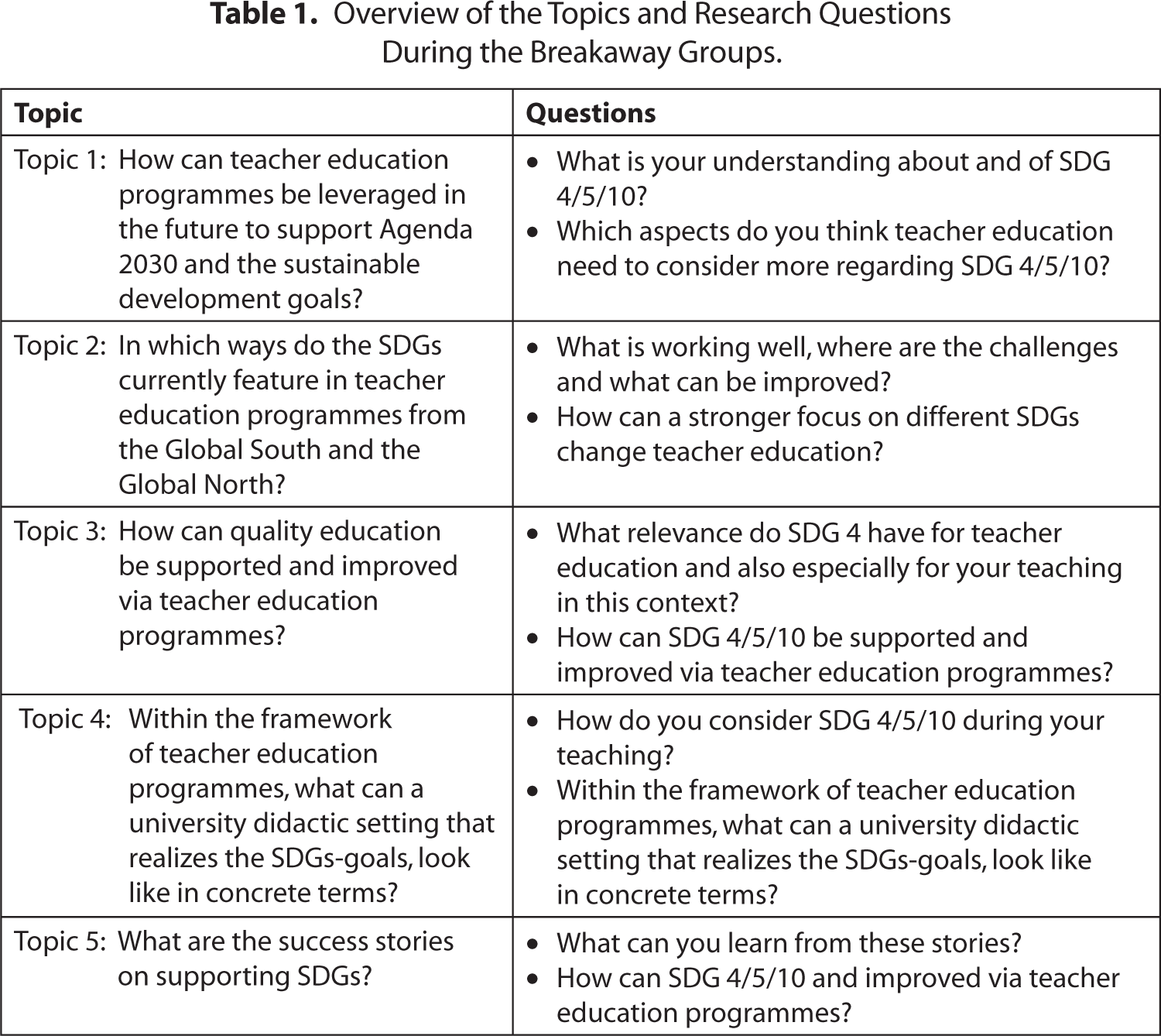
Important to emphasize in this context is that webinar 1 focused specifically on the topic of SDG4 ‘quality education’, so ESD was the main focus during the webinar. The two other webinars focused on SDG 5 ‘gender equality’ and SDG 10 ‘reduced inequality’. Nevertheless, the topic of ESD was also essential in these two webinars and was highlighted by the participants explicitly.
Participants
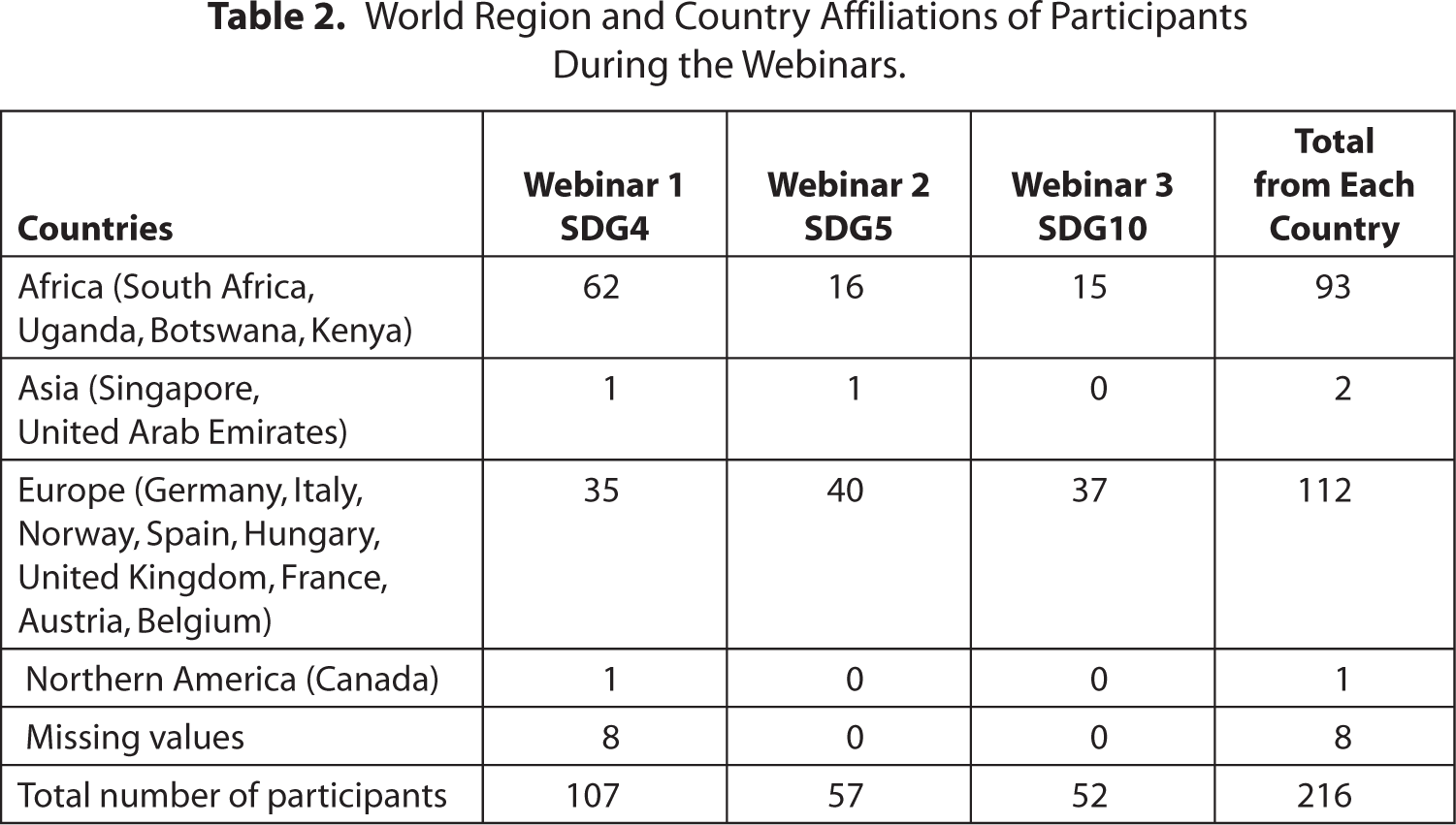
The sample of the study is teachers and teacher educators from different countries. In total 216 people participated during the webinars. In Table 2 the affiliation of the participants during the webinars is presented.
World Region and Country Affiliations of Participants During the Webinars.
Analysis
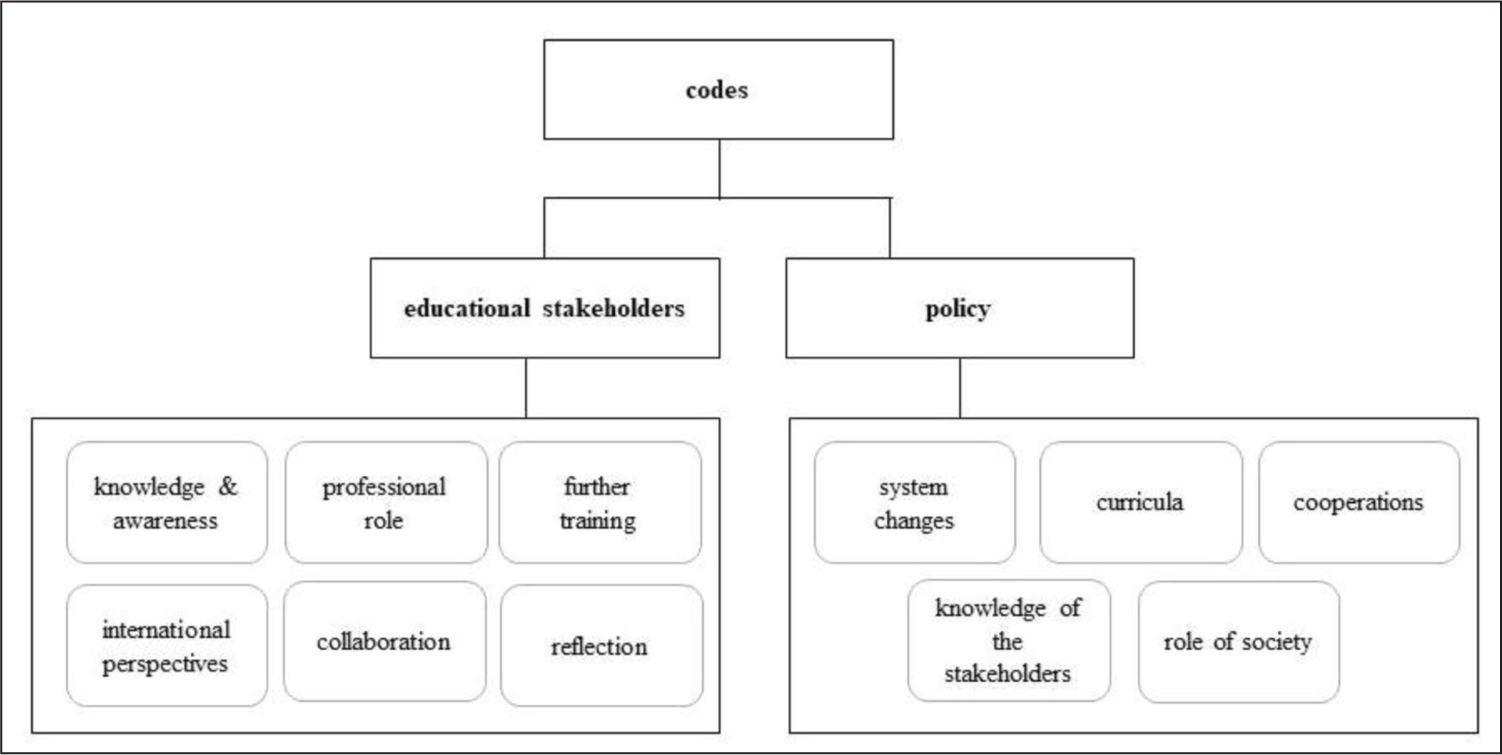
The interviews were transcribed from an independent professional transcription service and analysed using MAXQDA, a computer-assisted and category-driven data analysis programme. In order to ensure the dependability and confirmability of the analysis, the data collected from the qualitative reconstructive approach was evaluated using the grounded theory approach. With the help of this process, new insights and models can be generated (Glaser, 2007). The process involves a continuous cycle of data collection, coding and analysis. The aim is to develop categories and subcategories and, in the following, to generate theory and models (Strauss & Corbin, 1996). The first analysis approach referred to an open and axial procedure, whereas the selective procedure was applied only towards the end of the analysis. In coding, the underlying empirical data were broken up, interpreted and put together in a new way (Flick, 2022; Strauss & Corbin, 1996). According to Glaser and Strauss (1967), the evaluation process is completed when the data shows theoretical saturation in the development of new theories and no more new content can be generated. The data was developed in main categories, such as the policy and educational stakeholders in the context of the challenges and implementation of ESD in teacher education (see Figure 1).
Reconstructed Categories.
Findings and Discussion
The findings show the challenges and need for implementing ESD in teacher education at two levels: the stakeholder level and the policy level. The reconstructive levels support the understanding of Ferriera et al. (2007) or Gonzales-Gaudiano (2005) who point out that for the holistic implementation of ESD in teacher education it is necessary to consider the system as a whole which includes the stakeholders, the institutions and the policy.
Stakeholders
The stakeholders argued that there is no or very little knowledge and awareness of Agenda 2030 and the SDGs in general, and also of how to deal with the relevant framework in teaching:
“I didn’t know about SDGs and how they work, there is low awareness of SDGs.” (Webinar 3, Theme 1) “What we have seen so far is that teachers’ awareness of Agenda 2030 and the SDGs is very low.” (Webinar 2, Theme 1) “Teachers are aware of certain values of the SDGs, they might know about them, but they definitely don’t practice them.” (Webinar 1, Theme 2).
The data shows that there is a lot of interest in this topic. Sustainability is described as a central topic and the stakeholders agree that education is essential for a sustainable future (Ferrer-Estévez & Chalmeta, 2021; UNESCO, 2017). Teachers and teacher educators are curious about the topic of sustainability. However, they need more support and guidance to acquire the required knowledge and apply it professionally in their daily practice:
“At the same time, they are curious and very interested in current issues like gender discrimination and sustainable development, so I think they need concrete practical tools for teaching.” (Webinar 2, Theme 1) “I really hope that SDGs don’t stay theoretical, and I hope that they will be something really practical.” (Webinar 2, Theme 2)
On the one hand, this knowledge gap may be due to the fact that, as OECD (2022) states, future knowledge is not yet known and teacher educators prepare students for tasks that are unclear today. On the other hand, there needs to be more training and support opportunities for educators, which so far makes it difficult for them to acquire professional knowledge and tools for action in the context of ESD (Eloff et al., 2022; UN, 2011). The results support this finding, with stakeholders indicating that their individual role in the context of ESD is often unclear and that they lack the courage and motivation to change and develop further. They struggle with their own professionalization and their influence on students’ values is often not clear. They feel that more training and support are needed:
“They don’t want to change, if you look at the teacher educators, they don’t want to learn about multilingualism because then they would have to take courses in addition to what they are already doing.” (Webinar 1, Theme 1) “We need more in-service training that motivates teachers to develop and want to be part of the state.” (Webinar 3, Theme 1)
As Esa (2010) and Sadaf and Huma (2021) argue, teachers need to be educated for sustainability. They are the most influential source to achieve this. Their knowledge and competencies are crucial for the transformation process and value formation of students (Anderson, 2017; Darling-Hammond, 2006; Zaleniene & Pereira, 2021). They are often not aware of the role of values in sustainable development, as Sterling (2001) also underlines. Stakeholders need more knowledge and awareness about ESD and how it can be integrated into their own teaching practice and everyday school life. A significant challenge for the teaching profession is the ‘lone wolf’ approach. Teachers in schools and universities are often reluctant to exchange ideas and experiences. However, a participatory and collegial exchange would be very central with colleges (UN, 2011). Above all, a self-critical examination and reflection competence also helps to question one’s own actions and to develop personally as well as professionally (UN, 2011).
“Teacher educators and teachers need to reflect on themselves. What they know, what their experience is and what they need to develop further.”
(Webinar 3, Theme 3)
“We consider our teachers to be public intellectuals, and yes, we require them to reflect systematically on their practice and everything else. I have always been concerned, and I mean this is a much bigger picture than just our education curriculum, we need to be a reflective practitioner, to think deeply.”
(Webinar 1, Theme 1)
“We need some dialogue spaces where they can also talk about problems and find solutions together.”
(Webinar 3, Theme 4).
This requires extensive and new knowledge in different areas, for example, which competencies will be important in the future? How should learning take place and what kind of grading is still appropriate in view of these challenges? Compared to the UN (2011) frameworks on learning as understood by ESD and quality education (Nikel & Lowe, 2010; Steiner, 2011; UNESCO, 2004/2005), the respondents have less knowledge about how learning can take place and what change supports the transformation process. Some educators argue that it is important to look at educational systems in other countries to get a multi-perspective view:
“We need a new understanding of learning. Global learning, interdisciplinarity, life-oriented learning and so on.” (Webinar 1, Theme 1) “Travelling to other countries, to look at other education systems, to get a sense of one’s own background, so that one can take a much clearer position on where we are with our education system, and not to accept it uncritically and unquestioningly.” (Webinar 3, Theme 3) “I think formative assessment is becoming one of the most important pillars of learning and teaching.” (Webinar 1, Theme 1)
As we can see, many educators have no knowledge of how teaching and learning or the system itself works in other countries. More use should be made of the resource of shared knowledge to provide ideas and inputs on success factors and challenges. Interdisciplinary and holistic learning is a learning strategy for a sustainable future (UNESCO, 2005). Another need that was directly addressed was collaboration in the relationship with students. An appreciative connection, as well as mutual knowledge about the individual, helps to align lessons in a meaningful way:
“We need to connect with our students. Do we understand who they are? Do we understand their contextual realities? Then, based on that, we can design a responsive curriculum that’s going to help advance the sustainability agenda.” (Webinar 3, Theme 1) “We need to engage with our students, perhaps much more than we’ve done in the past, so that we really understand who they are, but this is not a one-way street; it’s a two-way street that we need to travel. We also need to be self-reflexive about who we are in this space of teacher education.” (Webinar 1, Theme 1)
Students’ perspectives are determinants of a transformation process that supports an understanding of constructive learning (McGrath & Fischetti, 2019; Steiner, 2011). The cognitive development of learners and a recognition of their knowledge and values is a crucial factor for ESD (UNESCO, 2021). Only people with a strong personality can act in complex situations, reflect on their own skills and accept responsibility in society (Heinrich et al., 2007). Cooperation at different levels (with students or colleges) is thought to be pivotal for the integration of ESD in teacher education. Nevertheless, the findings indicate that stakeholders need to gain more knowledge about what learning can look like in the context of ESD. The findings point out that the educational stakeholders lack instruments on how to achieve this goal. The focus should be not on teaching knowledge, but rather on understanding (UN, 2011). For this, teachers as well as teacher educators need tools about new ways of thinking about teaching and learning. As the UNESO (2011) states in its framework, participative, explorative and also organizational learning should take place, where local and global issues are central. Strategies like cooperative learning, participatory decision-making as well as the creation of irritation settings can change the way of learning (Steiner, 2011; UNESCO, 2005). In addition, the educational stakeholders should acquire new methods and knowledge in order to know how to educate the topics of sustainable development and competencies like critical and structural thinking or problem-solving skills (United Nations, 2011). It is of great significance to make the students clear that, as Henting (1996) argues, education is not only self-realization but also a responsibility in society. Teachers and teacher educators must create spaces for dialogue and reflection. A culture is needed in which values are explicitly addressed and discussed so that they can be debated, tested, and applied (Kalsoom & Khanam, 2017; Zaleniene & Pereira, 2021). The main issue of the educational stakeholders should be to change mental models and support cognitive development (UNESCO, 2004). Achieving these learning goals requires a lifelong learning process for education stakeholders that includes both a research-based understanding of ESD and new perspectives and knowledge to transform their teaching and the understanding of their own role (Darling-Hammond, 2006; Leicht et al., 2018).
Policy
The policy was also highlighted as an important factor influencing the implementation of sustainable education in teacher education:
“I think education needs to change, and here we need new and different perspectives at the policy level.” (Webinar 1, Theme 2)
UNESCO (2018) and UN (2011) underline this message and argue that a success factor for implementing ESD in teacher education is the policy level. Stakeholders emphasize the difficulty of implementing changes in the system itself and also at the policy level. Above all, they complain about the slowness of change processes and that the system cannot react professionally to social developments.
“Teacher education is much too slow, they just don’t pick up the pace of societal change, and societal change does mean more change in the students than in the older people; the older people don’t change as much in their composition as they do.”
(Webinar 1, Theme 4)
“I don’t want these SDG’s to stay just theoretical so it’s really important to communicate them, and for this reason I really think that the SDG’s in general should be really connected to education.”
(Webinar 2, Theme 5)
Special attention was also paid to the curricular embedding of the topic of sustainable development. It was emphasized that the SDGs, especially ESD, have so far hardly or not at all been anchored in teacher education. According to them, in schools, individual curricula are already oriented in the right direction, but at university, this is still a long way off. The Global Education Monitoring Report (2017/2018) and UNESCO (2018) also point out that it is insufficiently implemented in pre- and in-service teacher education. Currently, only 7% of teacher education programmes worldwide cover ESD. Nevertheless, teacher education needs to support the transformation process and respond to global trends and demands (Kassymova & Ciftci, 2020). The educators in the interviews call for the topics of ESD and the teaching of essential future-oriented competencies to be anchored and for implementation strategies to be defined in the curriculum. They point out that responsive curricula are necessary for a transformation process towards sustainability. To this end, policy must provide direct frameworks on how the educational shift can take place. There is too little knowledge about how this can work in practical terms, as called for by the UN (2011) and changes to curricula have to be made to implement the concept of ESD more sustainable. At the same time, the interviewees were also critical of new policies and guidelines such as the ESD. They argue that many guidelines and models come from the top, that these tend to be no longer relevant after a few months and that it is difficult to respond appropriately to everything:
“Teacher education should play also a role and school education should play a role in changing society, so not only responding to an existing society and its needs, but also, and I don’t really see at the moment because that takes a kind of courage, being brave, doing things, knowing that this might be not so easy.” (Webinar 1, Theme 3) “There is so much to do, I will say I don’t even know where to start.” (Webinar 3, Theme 6) “The main question should be how we are going to structure our curriculum to produce the teachers of tomorrow, so I would suggest that we give equal share or attention to content knowledge and pedagogy.” (Webinar 2, Theme 5)
Different areas were mentioned by the interviewees as promoting the integration of ESD into teacher education. The professional competencies especially also from policy makers were highlighted as important issues. Education policy must offer a path for how educational stakeholders like teachers or teacher educators acquire specific skills and values of sustainability. The policy has to give a framework for how teachers can be educated to be change agents and how to motivate them to train on a regular basis (Leicht et al., 2018; UNECE, 2005).
“When it comes to teacher education, I think there should be focus on supporting teachers to develop these kinds of skills to facilitate multi-cultural, multi-perspective discussion. I think that would be something, and they should be able to experience what it’s like to work with, or to lead such a group, so that would be something they need to actually put their knowledge into practice and work with different people.”
(Webinar 1, Theme 4)
“Education should be much more about the idea that the well-being of teachers is the most important thing in education. If the teacher is not feeling well the children cannot feel well.”
(Webinar 1, Theme 5)
As far as the policy level is concerned, the conscious handling of different issues such as diversity, gender or well-being was also mentioned. Those responsible for policy must model these issues and put them on the educational agenda so that they can be further addressed. Especially the well-being of education stakeholders was highlighted in the interviews. For school improvement, the well-being of teachers and students is described as indispensable for sustainable schools (Barrat Hacking et al., 2010). The demands require more discussion about what society needs and how education needs to be oriented. Networks and dialogue spaces with different stakeholders should promote exchange and make education more sustainable and efficient in classrooms. As Steiner (2011) and also UNESCO (2005) point out, cooperation and discussions are essential to achieve quality education. Participatory decision-making as well as interdisciplinary and critical thinking are required. Politicians and policymakers are urged by the participants in this study to become more actively involved and also to share more practices with other countries:
“We have curriculum policies, we’ve got health promotion policies that reflect these values but we don’t see it happening in the classroom, so there is definitely a gap between the policy and implementation in the classroom. The educator stands between policy and implementation in the classroom, and so it’s vital to strengthen the educator’s role, their understanding, their attitudes, their values.” (Webinar 2, Theme 1) “Collaboration is needed between all education stakeholders, parental involvement, teachers’ involvement, learners’ involvement, teachers’ involvement in every decision that we make on the change.” (Webinar 1, Theme 5)
Knowledge does not automatically lead to action or transformation (Steiner, 2011). Direct strategies are needed, such as a greater focus on structural and institutional change, a change in people’s mental models and values, and an understanding that people can promote change (UN, 2011) for making the school system effective. In order to achieve this, a continuous process of reflection on the educational aims of a qualitative education is necessary (Nikel & Lowe, 2010). How the United Nations (2011) states it is important to explore the link between tradition and innovation.
Conclusion
The aim of the study was to discuss what challenges teachers and teacher educators face in the context of ESD and how teacher education, as a central part of higher education, can support implementation. ESD is still an underrepresented topic in teacher education and needs more evidence and discussions in relation to teachers’ or teacher educators’ professionalism and policy (UN, 2011). This study brings further findings and identifies important suggestions which can support teacher education in the process toward ESD. Educational stakeholders and policymakers need to respond to global issues in order to achieve holistic change in education. For this, more discussions about what society needs and how education should be is needed at different levels like policy or the educational stakeholders for transformative education. There must be a structural change as well as a change in the professional development of the educational stakeholders for addressing current and future challenges, to lead the transformation of society.
During the interviews, stakeholders pointed out the importance of this issue and mentioned different strategies for how ESD can be implemented in teacher education. Cooperation, further training, reflection or a new understanding of learning and of the own professional role were described as key strategies. However, they mainly talked about challenges, needs and future perspectives in terms of structures and opportunities in teacher education for the implementation of ESD in teaching and presented very little knowledge on how to use it in practice.
Stakeholders need more knowledge, values and better awareness of the sustainable roadmap and how to deal with societal demands. Learning has to be redefined. Educational stakeholders need tools to teach key competencies and implement new ways of learning. For this, they themselves must know their role and exemplify a sustainable attitude. The central importance of developing one’s own profession against the background of societal developments is particularly evident here. Here is still more research needed to make a contribution to the behavioural gap in the professional approach and to get a better understanding for teaching ESD in practice.
Policymakers are seen as having an essential role in implementing ESD. Policymakers have to set standards, design curricula, put specific topics on the educational agenda and provide training for educators. For transformation, more knowledge and research on how to integrate ESD in curricula is needed at different levels. Especially education policymakers need specific knowledge and a reflexive attitude to rethink education programmes.
Based on these results, the question arises about the responsibilities for implementing ESD in teacher education. Here, further discourses have to take place. In the results, the role of teachers, teacher educators and policymakers were highlighted. School principals, for example, were not an issue at all, although they should also make a significant contribution.
The results of this article also have limitations. The data is based on a small representative sample of stakeholders in teacher education. During group interviews, individual concepts and knowledge cannot be presented as in an individual interview. Here additional data from each person and also from other countries would be interesting. The analysis was evaluated on a country-unspecific basis. Individual local patterns of ESD were not considered in the analysis.
Footnotes
Declaration of Conflicting Interests
The author declared no potential conflicts of interest with respect to the research, authorship and/or publication of this article.
Funding
The author received no financial support for the research, authorship and/or publication of this article.