




Abstract
This study examines responses from Facebook and X users regarding the burning of TVC headquarters by protesters in Lagos, Nigeria. Data for the study were from a mix of quantitative and qualitative content analysis of Facebook and X posts (N = 41,188) of netizens in Nigeria who responded to the burning of TVC headquarters in Lagos. The thematic content analysis categorised the responses into Validators, Defenders, Intimidators and Accusers. We show that greater percentage of Facebook and X users in Nigeria validated and encouraged violence against journalists in Nigeria. We highlight the seriousness of harassment of journalists and its impact to press freedom.
Introduction
There is growing evidence around the world that journalists experience harassment online and offline. The harassment of journalists includes diverse disparaging comments that accuse journalists of one form of transgression or the other. As increased distrust of journalism professionals and their products among many people drive a wedge between the press and the society they serve, studies (Orgeret and Tayeebwa, 2020; Waisbord, 2020; Hiltunen, 2019; Jamil, 2020; Mong, 2019) have started uncovering the patterns and effects of such cynicism and the results are concerning. The escalation has been growing from meanness online to online harassment and sometimes to physical assaults (Uwalaka & Amadi, 2023a).
On October 21, 2020, during the 2020 #EndSARS protests in Nigeria, the international headquarters of Television Continental (TVC) and Max FM radio station were burnt down by protesters (BBC, 2020). The stations which share the same compound are located in Ikosi Road, Lagos, Nigeria (Alabi, 2020). Beside the studios of the two stations that were burnt, several vehicles including cars belonging to staff of the two media organisations were destroyed (Alabi, 2020). According to reports (Alabi, 2020; BBC, 2020), the atmosphere around Nigeria was tense and uncertain after the shooting at the Lekki Tollgate on the night of October 19, 2020 (Uwalaka, 2024; Uwalaka & Nwala, 2023). It was within this period that protesters broke into the compound where the stations were located and set them on fire. There were journalists and other workers inside the building when the building was set on fire. A TVC live breakfast programme, Your View went off air abruptly as the protesters began to burn the building. The burning of TVC headquarter in Nigeria illustrates increasingly, the hostilities journalists and their organisation face not only in Nigeria but across the world.
In Nigeria, it is conventional for attacks against the press to come from the government. What is quite unusual is for the attack to be perpetrated by ordinary citizens. Even when citizens protest and attack press organisations, they usually target government-funded stations such as the Nigerian Television Authority (NTA). One of such attacks was the 2012 invasion of the NTA station in Lagos. In 2012, protesters invaded the premises of NTA in Lagos and forced the staff to report on the 2012 Occupy Nigeria. Thus, the concern here is the escalated attack on TVC and Max Radio, two private media organisations and the growing online harassment of journalists in Nigeria (Uwalaka & Amadi, 2023b).
One area which has seen little, or no inquiry is around attacks on journalists and media organisations by non-state actors. Fewer studies have examined public reactions to attacks against journalists by the people on social media platforms. That is, not much is known about responses from social media users on account of an attack on journalists by the people. Examining the responses of social media users around attacks of journalists will improve our understanding of the tolerance of such journalistic safety malaise in the society. The tolerance of harassment and violent attacks against journalists will show how commonplace harassment of journalists (online and offline) has become. This will hold a concerning implication for the journalism institution. However, a lack of tolerance for harassment of journalists will demonstrate that those who harass journalists are in the minority.
This study is designed to address this shortcoming in the literature. The study conducts an analysis of responses from social media users regarding the attack against journalists and media organisations in Nigeria. Consequently, this study examines the themes from social media posts from social media users in Nigeria regarding the burning of TVC headquarters in Lagos, Nigeria by the 2020 #EndSARS protesters. To achieve these objectives, the study sought to answer the following research questions:
What are the themes from online responses by social media users in Nigeria on the burning of TVC headquarters in Lagos, Nigeria during the 2020 #EndSARS protests?
How do these online responses from social media users about the incident demonstrate the significance of hostilities towards the press in Nigeria?
The Nigerian press and harassment experiences
The history of journalism in Nigeria can be divided into two eras, the colonial, which is the period marked by British imperialism and the post-independence. The former began around 1859 when the first newspaper Iwe Irohin was established and the latter began on October 1, 1960, the date Nigeria gained independence from the Britain. Ogbondah (1992) remarks that the colonial period witnessed the introduction of press laws by alien political authorities. In the post-independence era, press laws were enacted by indigenous political authorities. Some of the laws were enacted by democratically elected officials representing the various constituencies of the governed. Other media laws were made by military governments which came to power without the mandate of the governed. One of the most repressive press laws in Nigeria was Decree No. 4 of 1984 also known as the Protection Against False Accusations Decree (Ogbondah, 1989).
The first newspaper, Iwe Irohim, was a missionary creation. During the colonial period, there were some foreign-owned newspapers such as the Lagos Times, and the Lagos Weekly Record (Omu, 1974). Newspapers such as the Lagos Daily News, Pioneer, The Wasp, West African Pilot, Lagos Critic, and Lagos Observer were owned my indigenes (Kolade et al., 2012). These newspapers were established to serve specific purposes or meet special needs. It has been observed that ‘these newspapers . . . through their names left no one in doubt as to their self-assigned duties’ (Kolade et al., 2012, p. 4). Regardless of the era, there have always been divisions within the Nigerian press into pro- and anti-establishment. These positions influenced the perception and positions of the press and their coverage of events, particularly political activities. The positions and coverage of political events by the press generate a response from the people. Most times, pro-establishment and government positions and coverage tend to infuriate the people and can lead to harassment of journalists from that media organisation.
While the press in the anti-colonialist movement and repressive military era became known for critical, sometimes adversarial reporting, the ownership and control of major media organisations by prominent politicians appear to dilute the overall influence and significance of the media (Dare, 2011; Kperogi, 2022; Olaniyan and Akpojivi, 2021). Ownership, economic interest, and the concern for profit are arguably limiting the media’s ability to hold governments to account (Stiglitz, 2017). Ownership has been one of the major areas of contention. Coker (1968) argued that privately owned newspapers were sophisticated political weapon in the hands of their owners who had political ambitions (pp. 109–110). Coker (1968) notes that the direct and indirect contemporary involvement of rich politicians, mostly serving or former governors, retired military officers, and former editors in newspapers is an indication of the tremendous influence and patronage associated with media ownership in Nigeria. This is significant as it shows that ownership of a media organisation is impactful and a source of strength. This was why media licence is concentrated among politicians and their friends. This is also why the government started their own media organisations.
The recognition of the power of media ownership was visible that it led to changes in media policies and ownership structures in Nigeria. Apart from the colonial period when privately owned newspapers proliferated, the period towards the attainment of political independence and thereafter was characterised by government domination of the press. The involvement of politicians came with the liberalisation of the space with the return of civil rule. What government did thereafter was to put in place stringent measures perhaps to control the media.
While the harassment of journalists by state actors in Nigeria is well studied and recorded (see: Ogbondah, 1989, 1991, 1992, 1994, 1997, 2000), online and offline harassment of journalists in Nigeria are new phenomena. Uwalaka and Amadi (2023a) note that online harassment has become a part of life for journalists in Nigeria and that online harassment induces fatigue, anxiety, and self-censorship. One of their key findings is that acute forms of online harassments were misrecognised as ‘online notice-me’ or ‘online banter’ (Uwalaka & Amadi, 2023a: 1937). However, they argue that political and investigative reporting are triggering factors for online harassment of journalists in Nigeria. Overwhelmingly, studies relating to online harassment of journalists in Nigeria have looked at it from either discrimination (Aribisala, 2023) or press freedom (Onuche, 2021) perspectives. That is, how online and physical harassment of journalists shrinks press freedom in Nigeria. Some others inquired about the safety of journalists in Nigeria (Ibrahim et al., 2021; Ogwezzy-Ndisika and Shaibu, 2017).
Attempt has been made to understand audience motivation and suggested solution for online harassment of journalists in Nigeria. Uwalaka et al. (2023) uncovered that perceived reportorial malpractice and unethical behaviours as the key reasons that the audience harass journalists in Nigeria. Their participants accused Nigerian journalists of failing to do ‘the right thing’ (Uwalaka et al., 2023: 7). The participants who are members of media audience suggested improved transparency and ethical conduct among other points as ways to prevent online harassment of journalists. Understanding what journalists think indicates that the hostility that they face is significant. This is because it will provide a data point to compare what their audience claim leads them to harass journalists. This confluence of ideas and data points has the potential to help amend the issue. Therefore, our study examines responses from Facebook and X users regarding the burning of TVC headquarters by protesters in Lagos, Nigeria.
Online harassment of journalists and public responses
The type of responses that social media users from a particular country engage in after an attack on a journalist reflects how journalists are perceived in such climes. After an attack, if a journalist continues to receive threats and ‘e-bile’ (Jane, 2014a) that could indicate further safety threat while a more sympathetic response could illustrate that the attack and attackers are in the minority. An overwhelming positive response to the attackers and negative response to the journalist by the populace indicate both distrust of the press and a breakdown of relationship between the people and the press. Such a sour relationship pushes the people sometimes into providing their ‘street’ corrective and remedial measures. Such remedial measures could be in the form of mob censorship, that is, citizen vigilantism aimed at disciplining and suppressing journalists (Waisbord, 2020) and other forms of online harassment (Holton et al., 2023; Lewis et al., 2021; Marwick, 2021; Uwalaka & Amadi, 2023b).
The nature of the response to such attacks reveals how free the press is in such a place. The response usually exposes the motivation for the attack and the acceptance of such an attack further buttress the danger of working as a journalist in that place. An overwhelming response in support of the perpetrators usually leads to online harassment of the journalist. Extravagant invective, threats of further violence and recreational nastiness constitute a dominant tenor of such responses against the journalists (Jane, 2014a, 2014b). Such responses could simply be morally motivated networked harassment based on perceived journalistic failure or malpractice (Martin, 2018; Marwick, 2021; Uwalaka & Amadi, 2023a; Uwalaka et al., 2023).
Responses to attacks on journalists could fall into five categories: general commentary, critical commentary, humiliation and shaming, gender tropes and support and defence (Burch et al., 2023). In these categories, only the first and the last sympathises with the journalists or the victims. General commentary is unbiased comments around the underlying issue of the attack. Such response asks more questions, seeks further clarification, and supports the victim most of the time. Like general commentary, the support and defence responses are comments that sympathise with the journalists (Burch et al., 2023). These types of responses call out the abuses and discriminatory responses against the journalist. The responses usually acknowledge the abuses, call out the name-calling, and attack belittling and ridiculing comments. These types of responses see the journalist as the victim.
The reverse is the case for the other three response types: critical commentary, humiliation and shaming, and gender tropes. These responses are critical of the journalists and often cause psychological distress (Burch et al., 2023). Critical commentary against journalists include disagreements, criticism, disrespect, and challenges to gender equity, as well as ‘shift to negative sentiments to contents which contained forms of virtual maltreatment’ (Burch et al., 2023: 12). As the emotional elements within the content are heightened, ‘an abusive echo chamber and “waves” of online abuse emerge’ (Burch et al., 2023: 15). These types of responses are beyond flaming that is ‘the hostile expression of strong emotions and feelings’ (Lea et al., 1992: 90).
These forms of responses are like e-bile, in terms of their reliance on profanities, ad hominem invective, hyperbolic vulgarity, and extravagant imagery of graphic violence. Such responses show that those who attack journalists online gain some forms of pleasures from their activities online. Even when they do not explicitly accept that they cherish their e-bile status, the enthusiastic derision noticeable in their exchanges shows that they relish this stichomythic back and forth (Jane, 2014a).
Some of these responses that are critical of the journalists and support those that attack the journalists are mainly due to ideology. Some of these ideology-based groups include anti-COVID-19 vaccination movements, anti-lockdown movements, and conspiracy theory groups (e.g. QAnon) that perpetrate violence against the press (Alade and Sanusi, 2022; González de Bustamante and Relly, 2016; Papadopoulou and Maniou, 2021; Pedersen and Burnett, 2022; Robie, 2022). During COVID-19 lockdowns, journalists were harassed so much that some dubbed it ‘the militarisation of the streets’ (Ndlovu and Sibanda, 2022: 1073). The flamboyant demands for neutering journalists, the garishly punctuated threats to torture, rape and execute journalists (Jane, 2014a, 2014b) are ways perpetrators attempt to intimidate the press. Some of the hostilities towards journalists describe attacks by people who feel omitted from the news media sphere (Löfgren Nilsson and Örnebring, 2016; Nerone, 1994; von Krogh and Svensson, 2017).
In Nigeria, conspiratorial allegations about the quality of reportage and lack of independence of the press particularly, media ownership structures have led to the ‘erosion of trust’ in the press (Uwalaka, 2020; Uwalaka & Nwala, 2023: 187). Nigeria operates a plural media system in which both the public and privately owned media exist side by side (Gever et al., 2023; Popoola, 2012). Ogbondah (1992) argues that the colonial period witnessed the introduction of press laws by alien political authorities. In the post-independence era, press laws were enacted by indigenous political authorities (for a detailed discussion, see the ‘the Nigerian press and harassment experiences’ section above).
While the harassment of journalists by state actors in Nigeria is well studied and recorded, harassment of journalists by non-state actors in Nigeria is a new phenomenon. In 2022, 66 Nigerian journalists and 3 media organisations suffered diverse forms of attacks (Punch, 2023). This number is significantly higher than the 40 attacks that were recorded in 2021 (Punch, 2023). In a worrisome development, 45 journalists in Nigeria were attacked during the first quarter of 2023 (Premium Times, 2023). This trend calls for a robust examination of some of these attacks, their causes, and their implications. This study evaluates one of such attacks.
Methods
Data collection
This study employed a mix of quantitative and qualitative content analysis approach (Bryman, 2016). Using Netlytic (Malik et al., 2022; Meneses, 2019), we scraped 26,188 posts from X and manually scraped 15,000 Facebook posts relating to the burning of the private broadcast stations, TVC and Max Radio from October 20, 2020 to October 29, 2020. We used the hashtags, ‘#TVCisburning’, and ‘#BurningofTVC’. After scraping the data, we downloaded the responses from Netlytic as an excel document and added the responses from Facebook into the excel file and then moved the excel file into NVivo (Crowley et al., 2002; Hilal and Alabri, 2013; Phillips and Lu, 2018) for qualitative data analysis. The goal was to download responses (Facebook and X posts) relating to the burning of TVC and Max Radio in Lagos, Nigeria. We preferred this software because the aim was to develop common themes from the posts. The intent here, is to evaluate the themes that emerged from these posts, and comments (responses) about the burning of TVC’s headquarters in Nigeria.
Data analyses
The study analysed Facebook and X posts from the hashtags ‘#TVCisburning’ and ‘#BurningofTVC’ to determine the themes that emerged from these posts and comments about the burning of TVC headquarters during the 2020 #EndSARS protests in Lagos, Nigeria. This is important as it helps capture societal dispositions towards harassment and physical attacks of journalists in Nigeria. The study provides a glimpse of how citizens framed their reactions to such incendiary events. Also, Facebook and X are found to be two of the most promising sites for analysing global debates on key issues due to the open environment of their data.
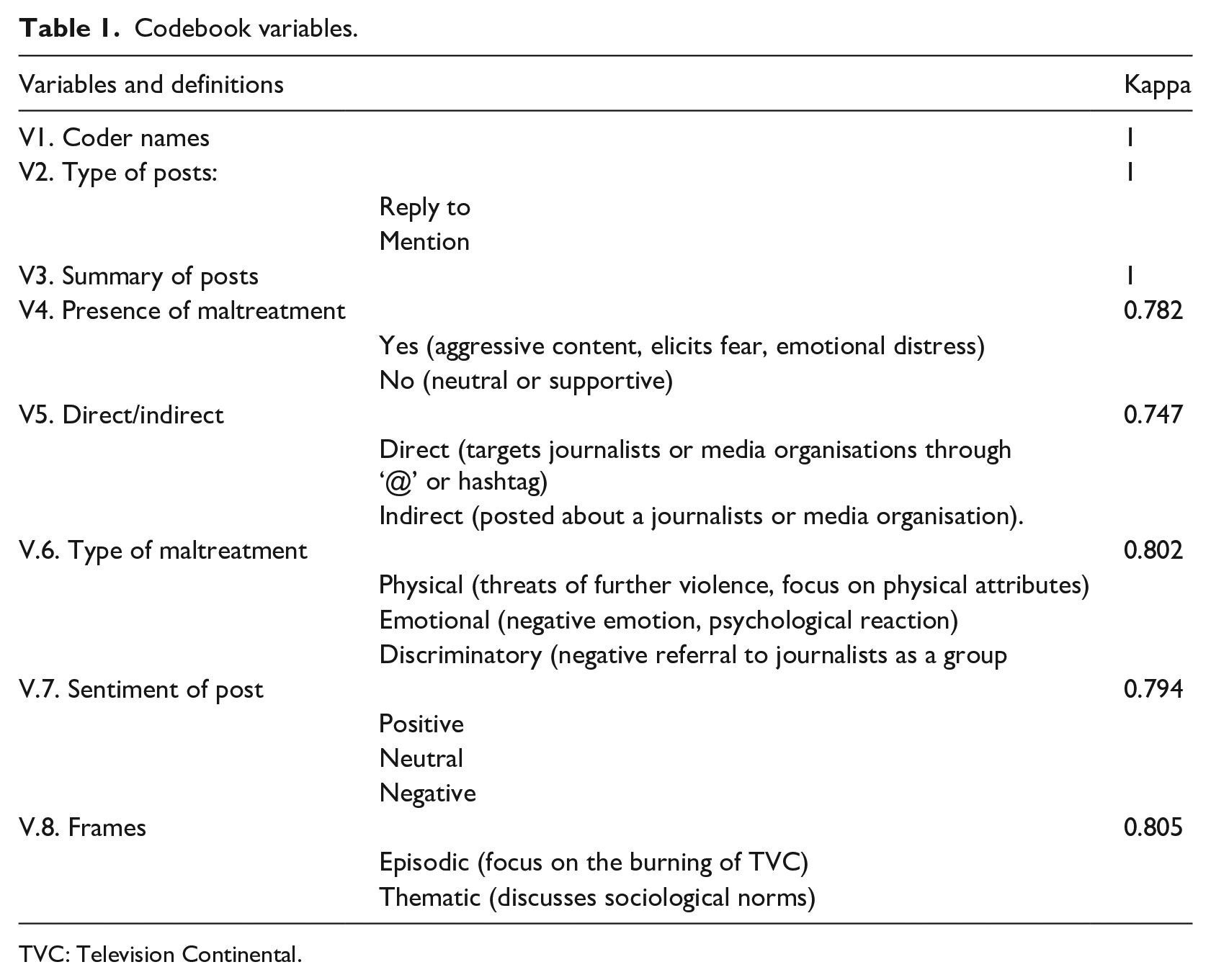
A thematic content analysis was conducted to examine the typologies of response and determine how themes and frames emerged during the burning of TVC station (trigger event). First, quantitative content analysis determined the typologies of response and was guided by Burch et al. (2023) typology of maltreatment. We utilised a coding protocol and codebook that employed virtual maltreatment variables as a response to attacks on journalists.
Coding was divided between two trained coders and intercoder reliability was performed on 2% of the dataset (n = 8238) to test for chance agreement between coders. The two coders reviewed the same dataset and independently coded the variables then Fleiss (1971) Kappa values for dual-rater agreement were calculated. All variables reached substantial agreement (i.e. 0.61–0.80). Table 1 below contains all coding variables and definitions based on Burch et al. (2023) framework as well as the individual kappa values.
Codebook variables.
TVC: Television Continental.
Following quantitative content analysis, a descriptive qualitative coding was performed to abridge social media posts into a phrase indicative of the topic of content (Burch et al., 2023; Saldaña, 2021). We did this by moving the data into qualitative software called NVivo. The software then helped us to retrieve code and build a conceptual framework that was handy at the theme development and meaning condensation stages. After the descriptive coding, we analysed the data further through indicative thematic qualitative coding. This allowed a narrative to emerge from the descriptive codes.
We submitted the codes to some form of analysis that would consolidate meaning. We adopted the meaning condensation approach to make sense of the data. This approach ‘entails an abridgement of the meanings expressed by the interviewees into shorter formulations’ (Kvale, 1996: 192). At its core, the approach rephrases what is posted on social media into just few words of a more succinct nature, but in which the meaning is not lost. It allowed us to add subjective interpretations based on what the meaning is perceived to be from the experience undergone during the coding of the data. Within the inductive coding process, each coder determined the themes and ensuing frames separately, then investigator triangulation was employed (Burch et al., 2023; Denzin, 1989).
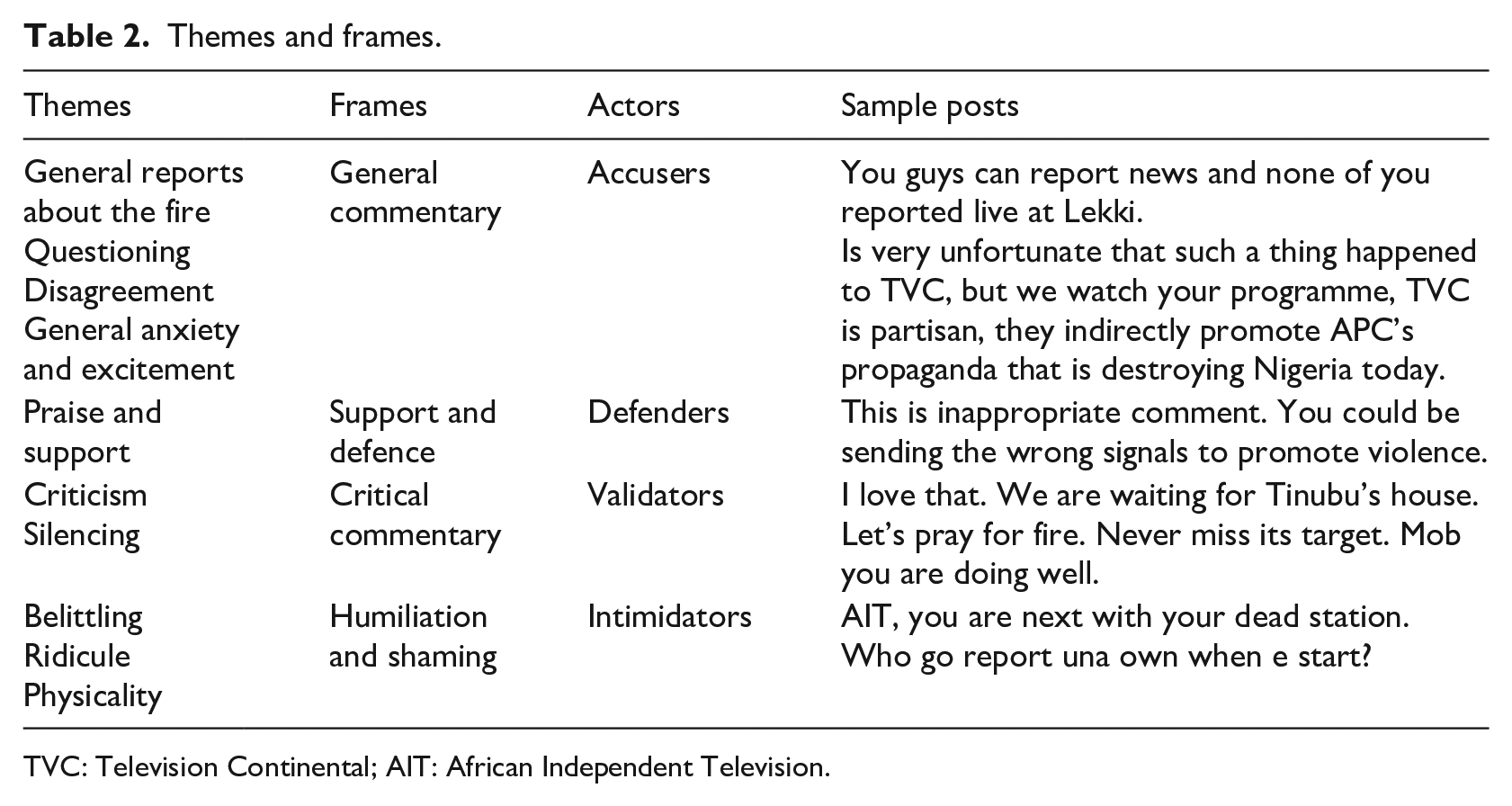
Themes included news report about the burning of TVC, questioning, criticism of the press in Nigeria, disagreement about whose fault it was, disrespect, belittling, ridicule, praise, and silencing. These themes resulted in four frames emerging. These frames were general commentary, critical commentary, humiliation, and shaming as well as support and defence. To enable us to gauge the responses better, through data reduction and constant comparison with axial coding, we were able to rename our frames into actors. Thus, four set of actors emerged from our frames. They are: (1) Validators – those supporting the perpetrators of the violence, (2) Defenders – those against the perpetrators and who supported the victims, (3) Intimidators – those who are still threatening violence, and (4) Accusers – those who blame journalists for the ills in the society.
Results and discussion
Social media contents from Facebook, and X, relating to the burning of TVC’s headquarters during the 2020 #EndSARS protests in Nigeria were analysed to understand how social media users framed their responses. The themes and frames that emerged deepen our understanding of the phenomenon and explicate the growing hostilities towards journalists around the world. Of the 41,188 posts, 15,000 are posts and comments from Facebook, while 26,188 were posts and replies by Nigerian X users regarding the burning of TVC’s headquarters in Lagos, Nigeria. In terms of the themes and frames, we grouped the responses of Facebook and X users in Nigeria into the following categories: Validators, Defenders, Intimidators and Accusers.
Validators: validating hostilities towards the press
Validators are X and Facebook users whose responses to the burning of TVC supported the arsonous act. By Validators, we mean social media users whose responses encouraged and praised the burning of TVC’s headquarters. They validated the attack and encouraged the perpetrators to even do more. According to Table 2 below, responses that were classified as Validators emerged from the critical commentary frame and themes such as, criticism and silencing.
Themes and frames.
TVC: Television Continental; AIT: African Independent Television.
About 6300 Facebook posts and 10,475 X posts validated hostilities towards the press in Nigeria. Forty two percent (6300) of posts and comments on Facebook and 40% (10,475) of posts and replies on X regarding the burning of TVC’s headquarters in Lagos, Nigeria validated and supported the burning of the TV station. The posts clearly supported and encouraged the actions of the protesters and hatred towards TVC and their journalists. In response to a news posts announcing the burning of TVC’s headquarters in Lagos, an X user posted, ‘one cold stout for you baby!!!’. This X user is offering a bottle of cold stout – a beer brand in Nigeria, to the protesters that burned the station signifies his tacit endorsement to what they have done. It is celebratory and illustrates the X user’s delight at the burning of the station. Such fist bumping shows that the X user aligns with the protesters and do not mind the attack on the press.
The posts and tweets showed an outpour of vile against journalists and their institution in Nigeria. Specifically, the posts mocked journalists and the ownership of TVC. These validating responses did not show any concern for the safety of the journalists that were working in the television station when the attack took place. For example, an X user posted, ‘live footage of TVC burning, our prayers remain with the fire’. Another commented, ‘the burning of TVC and BRT buses . . . Wasn’t that God sent? And a warning to these thieves?’ These posts show that these social media users are unconcerned about the danger that such violent actions portend to journalists in Nigeria. In contrast, these posts succinctly buttress that such social media users approved of the burning of the media houses in Nigeria.
Beyond validating the protesters and their actions, some social media users also started mocking the station. A Facebook user posted, ‘our best regards to those forces’. Another noted, ‘AIT and TVC are just bunch of odes!! Thunder fire these two stations for me. AIT, you are next’. Yet another posted, ‘hope the mobs are fine. Please help them with food. They need strength’. A Facebook user in responding to African Independent Television (AIT)’s Facebook newsflash about the burning of the station said, ‘angry fire from nowhere burns down TVC HQ. Fixed it’. Another Facebook user posted, ‘angry mob? TVC is burning due to wiring issue. Keep the same energy you all had last night, Eyinolofo’. These comments, posts, and replies used sarcasm in their support of the burning of TVC headquarters.
These posts by Facebook and X users show that they approve of the hostilities towards the press in Nigeria. The last Facebook post was sarcastic and a tongue in cheek commentary of the situation. It is obvious from the way that the Facebook user phrased the post that she was in support of not only the burning of TVC, Max FM, the Nation and even BRT buses in Lagos, but also wanted to further hurt journalists and their media organisations. This reflects the findings around safety challenges faced in reporting the 2020 #EndSARS protests and other risks associated with journalists in Nigeria (Gever et al., 2022, 2023). With comments such as ‘Yes oooonamelian dragon dey do am oooo’ and ‘Gbammmmm!!’, it is apparent that many Facebook and X users in Nigeria were in support of the attack of journalists and media organisations in Nigeria.
The two highlighted comments above, sarcastically implied that the dragon in the television drama, Merlin was the source of the fire that engulfed TVC headquarters. The social media users validated the attack on TVC. With such support and approval to burn TVC, these social media users are tacitly encouraging violence against journalists in Nigeria.
Defenders of journalists: invalidating the burning of TVC
Even though majority of the posts that we scraped cheered and encouraged the burning of the television station, there were other posts that defended the rights of the journalists and criticised the actions of the protesters. Although these posts were fewer than those that validated hostilities towards journalists, the latter posts showed contrition and discouraged the harassment of journalists. Defenders of journalists are Facebook and X users who criticised the violence against journalists and invalidated the burning of the headquarters of TVC in Lagos. These posts were clear and some of them were angry at the actions of their fellow citizens. Responses that were classified as Defenders emerged from the support and defence frame and themes such as, praise and support.
Twelve percent (1800) Facebook posts and comments as well as 10% (2619) posts and replies on X regarding the burning of the TVC station discouraged and invalidated the burning of TVC headquarters. The fact that quite few posts criticised the actions of the protesters is concerning. This entails that majority of those that responded to the burning of the television station supported the actions of the protesters. This is dangerous for journalists and journalism as a profession in Nigeria. It means that ordinary Nigerians, those online at least, are quite disenchanted with journalists to the extent of feeling no empathy for them even when they were attacked. Some of the posts that invalidated the actions of the protesters were quite strong. For example, a Facebook user in a reply noted, ‘this is a lie, we were watching when Tope herself said the mob were outside the gate and Morayo herself did a video showing that they were inside and could not come out’. This post shows that there were some Nigerians albeit small, who are against hostilities that the press is increasingly witnessing in Nigeria. These responses frowned at the destruction of the media houses and harassment of journalists.
Some of the contrite posts were outraged that protesters could go that far. Due to the shock, some of the posts were cursive in nature. For example, in supporting journalists and invalidating the actions of the protesters, an X user posted, ‘all hands involved in the burning down of TVC won’t prosper and use them to hold good things for the rest of their lives. Amen’. Another posted, ‘all those behind the burning of TVC will never know peace’. Other responses asked the correlation between police brutality protests and a television station and the rationale for burning the media house. One of such responses asked, ‘what is the nexus between police brutality and the burning down of TVC and the Nation newspapers offices?’ One other response questioned, ‘I’m still asking how EndSARS turned to burning of TVC and BRT buses?’ These social media users were appalled by the actions of some of the 2020 #EndSARS protesters. Some of those that posted and tweeted support for the journalists and invalidated the attack were themselves protesters as well. They were not in support of the harassment and assault on journalists and media organisations. They posted their dissatisfaction to such action. While the pushback from some of the social media users were encouraging, the sheer number of posts and tweets that were against journalists and the press is alarming. The graveness of the situation was captured by one of the posts, ‘the burning of TVC Lagos and the brief closure of Channels TV Lagos are all worrisome indicators of mob threat to the freedom of the press. No nation can grow when the citizens muzzle and intimidate its press’. This post shows the threat of such incidents and the chilling effect it may have on journalists and the journalism profession.
Intimidators and accusers: accusing the media of reportorial misconduct
Beyond those that validated and invalidated the burning of TVC’s Head Office in Lagos, some of the Facebook and X posts were categorised as either intimidating or threatening or accusative in nature. Intimidators were Facebook and X responses that threatened journalists and their media houses. These posts could easily be classified as an online harassment of journalists and media organisations. These posts are meant to intimidate journalists in Nigeria into submission. These threatening posts ranged from acute, to chronic and even to escalatory forms of online harassment (Holton et al., 2023). Here, threatening posts were targeted at the journalist as an individual or as a media organisation. The threat and intimidating category are a post that threatens other media houses and journalists beyond TVC. Furthermore, the response also applied to posts that further threaten TVC journalists and TVC as a media organisation. Responses that were classified as Intimidators emerged from the humiliation and shaming frame and themes such as, belittling, ridicule, and physicality.
About 20% (3000) of the Facebook posts and comments, and 17% (4452) of the posts on X and replies about the burning of TVC’s headquarters in Lagos was intimidating and threatening responses. Some posts and tweets threatened further attacks of journalists in TVC and other media organisations.
In replying to a post from AIT, a Facebook user threatened, ‘AIT finally reported something awonoloriburuku. May your station be next’. An X user also threatened AIT, ‘your headquarter is next’. This threat was in response to AIT’s report of the burning of the headquarters of TVC. A Facebook user posted, ‘this should be a warning to all journalists. Report the news as it is. Don’t disguise the news. You could be next’. It is obvious that some Facebook and X users in Nigeria distrust the mainstream media as they view their actions in a deeply negative light. Many of the posts threatened the mainstream media and journalists in Nigeria. These threats were aimed at individual journalists and journalism as a profession in Nigeria. These responses tried to intimidate Nigerian journalists and the media organisations to change from what the social media users perceived to be unfair news coverage about the protests. The posts threatened to burn the other media organisations and targeted journalists that they noted will ‘hear from them’.
The press is an important organ in the state in a democracy. The ability of journalists to carry out their roles without hiccup is essential to the smooth running of the society. However, these intimidating and threatening posts could muzzle journalists and bring about a chilling situation that will adversely impact the functioning of journalism in Nigeria. These threats could be seen as harassment of journalists. The threats relates to some of the definitions of harassment of journalists such as networked harassment, morally motivated networked harassment (Marwick, 2021, 2023; Marwick and Caplan, 2018), citizen vigilantism or mob censorship (Waisbord, 2020) or just plain unwanted abusive behaviour towards the press (Miller, 2021). Such actions have debilitating impact on both the safety and morale of journalists.
Accusers are Facebook and X users who posted critical messages about the journalists and media organisations in response to the burning of TVC headquarters in Lagos, Nigeria. These responses emerged from the general commentary frame and themes such as, general reports about the burning of TV, questioning, disagreement, general anxiety and excitement. The Accusers post derogatory and controversial remarks of the journalists. Their posts in some way validate the attack on TVC as well as justify the harassment of journalists in Nigeria. The posts of the Accusers allege that journalists and media organisations in Nigeria are on the side of their oppressors. This response refers to posts that accuse the media of partiality, lack of fairness in their reportage, stoking tension in the society and generally, bad, or inadequate due diligence in reporting. Some of the posts also accuse media organisations of elitist mentality.
About 25% (3750) of Facebook posts and comments, and 30% (7856) of posts relate to alleged media failure. Facebook and X users whose posts formed this response type, justified the hostilities and harassment that journalists in Nigeria are experiencing. These social media users believe that reportorial issues were reasons TVC was burnt. This theme is a collection of posts about social media users on X and Facebook who challenged and called out media organisations on their alleged reportorial misconducts. They accuse the press of being biased and unprofessional. Others argue that the press are part of their oppressors as the press shield those in power. A response notes, ‘you were quick to post this. But hold up, you went missing last night when innocent Nigerians were massacred’. A Facebook user posted, ‘so your network work really fast?’. Another user posted, ‘wow so AIT is alive. Last night they all pretended to be dead. Wow really wow!’.
Nigerians’ distrust of the media is a well-known fact. Nigerians have accused some journalists of reportorial malpractices. The press has been suspected of becoming elitist. Others have accused the press of allegedly nervous to critically report on those in power (Henshaw, 2024; Olayinka and Odunayo, 2024). One other issue that has exacerbated this suspicion is the outsized ownership of the press in Nigeria by politicians. Thus, hostilities towards journalists sometimes are derived from the hostility towards the owner(s) of such media establishments as well as the antecedents of such media organisations. In situations where the owner of the media organisation is a politician, the journalists are suspected (rightly or otherwise) reportorial bias and that lead to them being harassed. The accusatory comments and posts from Facebook and X above highlight the reservations that social media users in Nigeria have of some of these media organisations. Netizens in Nigeria do not have faith that some of these media organisations can be fair, balanced, and unbiased. The people do not have faith in some of these media organisations to perform their fourth estate role without compromise. Due to this suspicion, the people lash-out and harass the press.
Further discussion
We found that Validators, Intimidators and accusers hated journalists and media organisations and believed that they are contributing to societal disintegration. Intimidators or the posts that threatened journalists and media organisations have the hallmark of escalatory harassers of journalists. This study demonstrates that unlike Validators who simply praised protesters for burning TVC headquarters in Lagos, Intimidators displayed all the characteristics of harassment. Intimidators engaged in networked or online harassment (Holton et al., 2023; Marwick, 2021) of journalists in Nigeria. Crucially, the posts conjure the definitional principles of harassment of the press and mob censorship. For example, the manner with which Intimidators swarmed media organisations such as Channel TV and Arise TV, resemble ‘unwanted abusive behaviour towards the press’ (Miller, 2021: 3; Miller and Lewis, 2022).
The fact that those perpetrating this act are not state actors but ordinary people in Nigeria resonates with the argument that mob censorship is ‘a bottom-up, citizen vigilantism aimed at silencing journalists’ (Waisbord, 2020: 1031). Our findings show that this study not only add an example of an attack of the press through the burning of media organisations into the literature but also discusses the motivations for the attacks and the implications of online hostilities towards the press. This part of the findings adds to the online harassment literature and shows how one form of harassment could spin into other forms.
We also found contrite voices and those who defended the rights of journalists and the need for the type of role that the press plays in the society. Defenders of TVC and other journalists are Facebook and X users in Nigeria who invalidated the actions of the protesters that engaged in the burning of TVC. These Defenders criticised the actions of the perpetrators of the act. Their strong stance contrasts those of Validators, Intimidators and even Accusers. They disavowed the burning of the television station and called for the cessation of such acts. The Defenders used their posts to highlight the danger of attacking the press. Many of the defensive and supportive posts mentioned that they were also protesters but still condemned the act of their colleagues. This group of posts serve as an encouragement to those who may hitherto have lost hope.
Our data also demonstrate that Accusers validated the burning of TVC station. Accusers are Facebook and X users in Nigeria whose posts and comments allege reportorial misconduct. Some responses blamed and accused the press of reportorial malpractice and alleged that the press serves as shills for the leaders who the Accusers view as their oppressors. The accusation that the media is not doing enough and that the media act as a front for the political leaders is not new in Nigeria. For example, earlier studies on digital activism and social movements in Nigeria found similar angst among Nigerian activists towards the press, especially, the Nigerian press.
Uwalaka and Watkins (2018) highlighted that some of their participants joined the 2012 Occupy Nigeria protests because of dissatisfaction with mainstream media in Nigeria as the mainstream media were accused by their participants as displaying ‘ineptitude’ in their duties and harbouring ‘sympathies’ for those in power. They further reported that their participants alleged that the mainstream media ‘has failed in their role as the fourth estate of the realm’ (Uwalaka & Watkins, 2018: 30). Their study concluded that the Nigerian mainstream media acquiesced to the pressure from government officials by refusing to cover the 2012 Occupy Nigeria protests at its inception until the protesters allegedly broke into stations such as the NTA.
This is evocative to the posts, and tweets from X and Facebook users in Nigeria that informed this study. The tweets and posts show a significant disinterest to journalists and journalism in Nigeria. Social media users’ sheer dislike for journalists and their products in Nigeria is concerning as they validated hostilities towards the press but also threatening to harm journalists and burn other media houses especially the AIT and Channels Television – two additional television stations in Nigeria. See Figure 1 below for sample tweet and Facebook posts.
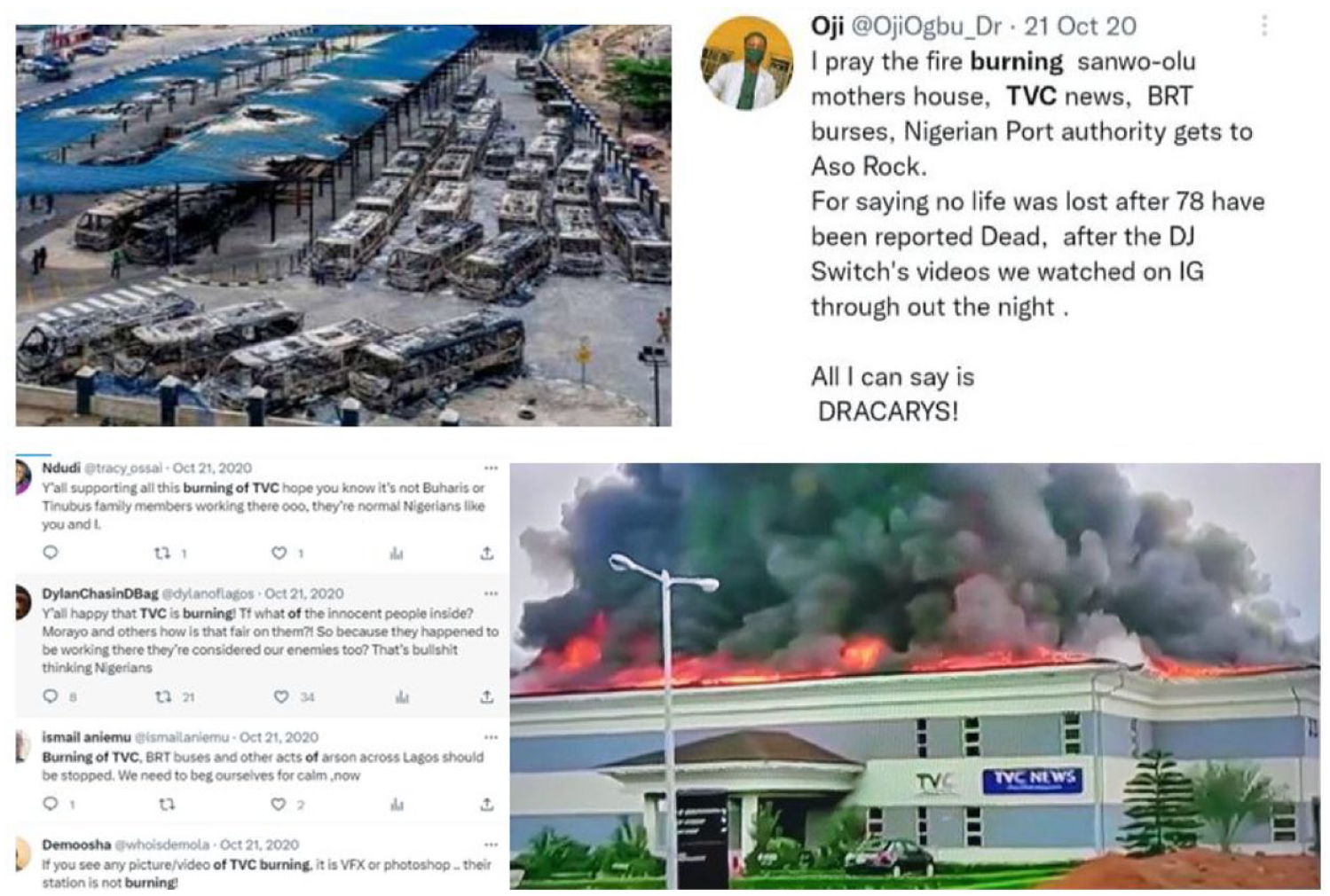
Sample tweets.
One key issue that resonated with majority of the responses was the alleged failure of the press. Via their posts, social media users in Nigeria accused the press of serving itself and not the people. This is what appears to motivate those that attacked TVC. The alleged inaction of the press serves as motivating factors in the harassment of journalists. Findings from this study appear to resonate with ‘accessibility to the press’ (Miller, 2021: 10) reason for hostility towards the press.
The response of Defenders resonates with the defence and support forms of responses when a journalists is attacked (Burch et al., 2023). The defence and support responses during an attack on a journalist are usually comments sympathetic to the journalist who was attacked. This study labels those that sympathised and defended the journalists and TVC during the arson attack as Defenders. This is because they called out the abuses and the prejudices that online attackers directed at the press. Defenders leaped to the defence and support of the journalists and their media houses. They acknowledged the abuses and rebuked the name-calling and ridiculing comments. These social media users saw TVC and their staff as victims.
In contrast, Validators, Intimidators and Accusers were responses that were critical, abusive, humiliating and derisive of the journalists and TVC during the burning of the station (Burch et al., 2023). Their responses to the attacked created an ‘abusive echo chamber’ (Burch et al., 2023: 15) where profanities, ad hominem invective, hyperbolic vulgarity and extravagant imagery of violence were present. Their responses were forms of ‘e-bile’ (Jane, 2014a, 2014b). Responses from Validators, Intimidators and Accusers show that these social media users enjoy their nasty online activities. The enthusiastic derision with which the Validators, Intimidators and Accusers responded to the attack on TVC reveals that they relish their stichomythic exchanges. Their garishly punctuated threats to TVC and other media organisations approach recreational nastiness (Jane, 2014a).
This study illuminates the seriousness of hostilities towards the press from social media users. It reveals that Nigerians accused the press as oppressive. From the posts on X and Facebook regarding the burning of TVC station, the study demonstrates that Nigerians embraced violence against the press. This has greater implication for the journalism profession. Findings from this study resonates with that of some other studies (Burch et al., 2023; Jane, 2014a, 2014b) where e-bile and critical commentaries are in the majority. These e-bile and critical commentaries are used to shame and humiliate the journalists who were attacked. This study shows that posts that supported and defended the journalist were in grave minority. This indicates that a greater number of Facebook and X users in Nigeria are against the press.
Our finding has great safety implication for journalists and journalism in Nigeria. With the sheer volume of posts that were critical and validated the attack, journalists in Nigeria are increasingly in great peril and targets of violence. Consequently, it is vital that journalists in Nigeria are supported and equipped with skills to manage harassment from the public. This study demonstrates that journalists are in greater level of risk in Nigeria.
Conclusion
This study analysed 41,188 posts, regarding the burning of TVC headquarters in Nigeria. The study found that greater percentage of Facebook and X users in Nigeria validated the burning of the television station as well as threaten violence against journalists in Nigeria. The study further uncovers that Nigerian social media users are distrustful of the media and see the media almost as an ‘enemy of the people’. What protesters in Nigeria failed to understand is that while the colonial media acted and reported in an activist manner (as many of them evolved with the nationalists’ movements) that the current media should not operate as activists’ media but should strive to maintain an objective mien. The point is that while one can genuinely critic the performance of journalists that it should be done in an ethical and objective manner rather than engage in harassment. This study argues that while criticism of the media is necessary and do have some praxeological benefits to the journalism profession, violence against journalists should not be misrecognised as an objective critique of journalists.
We classified the responses into four types. The Validators support the activities of the protesters including that burning of TVC station in Lagos. They posted laudatory messages to the alleged arsonists and berated journalists. We also found posts from those we labelled Defenders. These are those that were not in support of the burning of the station. These people invalidated the actions of the protesters who burnt the television station. Intimidators were labelled posts that threatened more violence on journalists and their institution. Then there were the Accusers. These people were from posts that accused journalists in Nigeria of reportorial mistakes. Our study demonstrates that journalists in Nigeria are enduring hostile environment and safety-based issues.
This study reported on social media content analysis. This has some drawbacks regarding the representativeness of the sample. However, enormous data set and the number of posts that we analysed and the fact that these were direct contents of the users, give this study further legitimacy and completeness. This means that the results stated in this study are not only important in digital journalism literature but should be part of theorising of hostilities towards the press.
Finally, the study reveals that while Nigerian social media users validated and threatened to further harass the press, a greater percentage of Facebook and X users in Nigeria validated and encouraged threats and violence against journalists. The study further shows that the accusation of the failure of the press was significant. This study illuminates the seriousness of hostilities towards the press and the level of threat against the press in Nigeria.
Footnotes
Acknowledgements
The authors thank the peer-reviewers of this manuscript for their constructive and comprehensive feedback to our manuscript. Their constructive comments and brilliant suggestions greatly improved our manuscript. We would also like to thank the editors for their professionalism and unalloyed support throughout this process.
Funding
The author(s) received no financial support for the research, authorship and/or publication of this article.
