




Abstract
This study investigates international users’ reception of a dark-humour meme tweeted by Ukraine’s governmental Twitter (X) account on 7 December 2021 as part of its exceptional cultural practice of posting humorous memes. Tweeters’ responses to the ‘headaches meme’ are examined through a discourse-analytic lens. An emphasis is placed on the appreciation of the humour (emanating from the meme or its contextual embedding) and other forms of humour support demonstrated by its online indicators. The overarching aim is to distil and compare user reactions to the meme in two sociopolitical contexts—before and after the invasion of Ukraine that Russia mounted on 24 February 2022—based on two equal quote tweet samples. While the findings reveal a relative decrease in humour appreciation after the invasion, the same diversified reactions encompassing humour support or its lack and politically polarised discourses making for participatory digital warfare are detected in both parts of the dataset.
Keywords
Introduction
On 24 February 2022, the government of Russia launched a military invasion of Ukraine under the pretext ‘to protect the people that are subjected to abuse, genocide from the Kiev regime’ and to ‘demilitarize’ and ‘de-nazify’ Ukraine. 1 This military attack is an escalation of the conflict going back to the annexation of Crimea by Russia from 18 to 23 February 2014. Initial reactions within news media tended to express shock and dismay at the outbreak of war alongside the borders of the European Union, and the daily news reports have since revealed the atrocities of the ongoing armed conflict. To this day (24 February 2024), Ukraine has managed to withstand the Russian attack, but the situation is grave, with some Ukrainian towns demolished, refugees fleeing the country, and both soldiers and civilians losing lives (not infrequently in massacres). None of this causes Ukrainians, proudly represented by their government, to lose their military ardour or sense of humour.
Humour seems to be a fixture in Ukrainian politics. Since 2019, the country has been led by President Volodymyr Zelenskyy, who earned his degree in law but chose to pursue a career as a comedian and comedy producer while simultaneously engaging in politics. He gained popularity thanks to a satirical comedy series, Servant of the People (2015–2019), which he created and produced and in which he portrayed a schoolteacher who becomes the Ukrainian President after delivering a viral anti-corruption diatribe. The series’ title became the name of the political party that Zelenskyy registered in March 2018. He duly ran for president and connected with the electorate mainly through social media (rather than mainstream media) and stand-up comedy routines instead of campaign rallies. He won with ease.
Humour is also one of the political tools characterising the official Twitter 2 account @Ukraine. Established in May 2016, the account lists its administrators as a Ukraine government organization. By November 2023, the account had earned 2.2 million followers. As if in anticipation of doubts, presumably provoked by the frequent use of humour, the account description says, ‘Yes, this is the official Twitter account of Ukraine’. As the Russian military invasion (officially commenced on 24 February 2022) ensues, tweets regularly sent from the account include humorous memes, which communicate ‘serious’ meanings about the current political situation.
Indeed, humorous memes are widely attested as vehicles for non-humorous political meanings communicated by citizens (e.g., Dynel & Poppi, 2022; Ross & Rivers, 2017; Shifman, 2014; Dynel & Poppi, 2022). Also, the Russian–Ukrainian conflict is not a new topic of memes and other forms of online humour shared by individual users (Dynel, 2024; Munk, 2023; Wiggins, 2016; Yehorova et al., 2023). However, what makes @Ukraine’s memes exceptional is that they are used as tools of the government’s official political rhetoric in strategic messaging to a populace, which is not a commonplace political practice and, therefore, deserves academic attention.
Contributing to previous scholarship on political memes, this article takes a new methodological tack by addressing users’ spontaneous reactions to a potentially controversial meme tweeted by the Ukrainian government. While studies on responses to (various forms of) conversational humour, especially in spoken interactions, abound (e.g., Alberts et al., 1996; Hay, 1995, 2001; Kotthoff, 1999; Lytra, 2007), the research that addresses reactions to digital humour, its epitome being memes, is quite scarce and is based primarily on questionnaires rather than natural user responses (Maíz-Arévalo, 2021; Schmid, 2023; but see Bi & Ren, 2023; Kramer, 2011). The topic of natural reactions to memes seems unexplored, and this research aims to address this gap by focusing on a timely political topic and capitalising on Twitter affordances, notably quote tweeting.
The central aim here is to examine diachronically a spectrum of international user responses (posted to Twitter before and after the Russian invasion of Ukraine launched on 24 February 2022) to a viral meme evincing dark humour tweeted from @Ukraine. The question underlying this study is whether the dramatic event inspired any evident change in users’ reactions to the meme, which as such constitutes a rather peculiar type of discourse and represents an unconventional communicative practice employed by a government.
The article is organised into six sections. The theoretical section directly following this introduction gives a brief overview of the existing research on humour support in online and offline contexts. The section ‘The Headaches Meme in View of Humour Theory’ depicts @Ukraine’s meme at hand, situating it within humour theory and presenting it against the relevant sociocultural backdrop. The section that follows details the methodology of the research, and its findings (primarily qualitative) are reported in the subsequent section by distilling the salient sentiments found in the dataset of quote tweets (N = 600). In the closing section, I offer empirically driven conclusions and their theoretical implications about the (lack of) humour support for dark humour in the grave sociopolitical context, as well as quote tweets’ role as a rhetorical weapon in participatory digital warfare.
Humour Support
In interactional pragmatics, positive responses to humour are conceptualised as humour support (Hay, 1995, 2001). It manifests itself in various reactions dependent on multiple factors, notably the type of humour and the context in which the humour occurs. In oral interactions, humour support shows, among other things, in laughter (e.g., Glenn, 2003), which is considered the prototypical reaction to humour and an indication of humour appreciation, that is amusement, even though it may perform other functions as well, such as marking the speaker’s humorous intention (e.g., Hay, 2001; Provine, 2000; Yus, 2023). Other indicators of positive humour reception encompass further humour construction (Hay, 2001; Kotthoff, 1999; Lytra, 2007), which consists in responding to humour with humour and joining in the humorous frame (for an overview, see Dynel, 2017a, 2018). Also, positive humour reception may be displayed in metapragmatic comments about humorous contributions, that is ‘situated comments about or evaluations of language use [or multimodal messages], which often involve the use of metalinguistic descriptors’ (Culpeper & Haugh, 2014, p. 241), containing such evaluative expressions as ‘funny’, ‘hilarious’ or ‘That’s a good one’ (see, for instance, Alberts et al., 1996; Bell, 2009; Drew, 1987).
In written online interactions, the same types of reactions occur, albeit in forms and through interactional patterns dictated by the affordances of the relevant platforms. Based on previous research, it can be concluded that laughter may take four forms (cf. McKay, 2020). These include laugh particles (Messerli & Locher, 2021; König, 2019), which are textual representations of laughter sounds (Taylor, 2009), such as ‘haha’ or ‘Muahaha’. In addition, laughter is also represented by emoji (e.g., face with tears of joy: 😂 or rolling on the floor laughing: 🤣) and emoticons, such as: -) (Dresner & Herring, 2010; König, 2019; Messerli & Locher, 2021; Sampietro, 2021;Taylor, 2009), the latter now obsolescent on social media. Finally, laughter may also show as acronyms (see Messerli & Locher, 2021), such as ‘LOL’, that is ‘laughing out loud’, or ‘LMAO’, that is ‘laughing my arse off’. It could be argued that all these laughter representations are reflexive metapragmatic cues indicative of users’ spontaneous amusement that they consciously recognise and report, whether or not spontaneously. In addition to these written indicators of laughter, positive reactions to humour online, as in oral interactions, may also involve metalinguistic comments, typically centred on humour-related expressions (Messerli & Locher, 2021; Taylor, 2009), as well as further humorous content.
It must be emphasised that humour appreciation, that is amusement manifested in laughter and relevant positively evaluative metacomments, comes only with full humour support, which—as Hay (2001, p. 55) emphasises—rests on the ‘recognition of a humorous frame, understanding the humour, appreciating the humour, and agreeing with any message associated with it’. These stages lie on a scale, and one is conditioned upon the previous one(s) but does not inherently entail the following one (Hay, 2001). A lack of humour appreciation, originating in any of the stages, is conducive to failed humour (Bell, 2009; Hay, 1995), which may be consequent upon multiple personal and contextual factors (see Dynel, 2017b). In the case of political humour, one such factor is a significant change in the political landscape.
The Headaches Meme in View of Humour Theory
The point of departure for this study is a humorous meme posted in English (to facilitate its international availability) from Ukraine’s official Twitter account on 7 December 2021. This viral has been generating a lot of interest globally, as evidenced by the user engagement numbers in the form of retweets, quote tweets, and likes (see Figure 1).
The Headaches Meme Tweeted by @Ukraine.
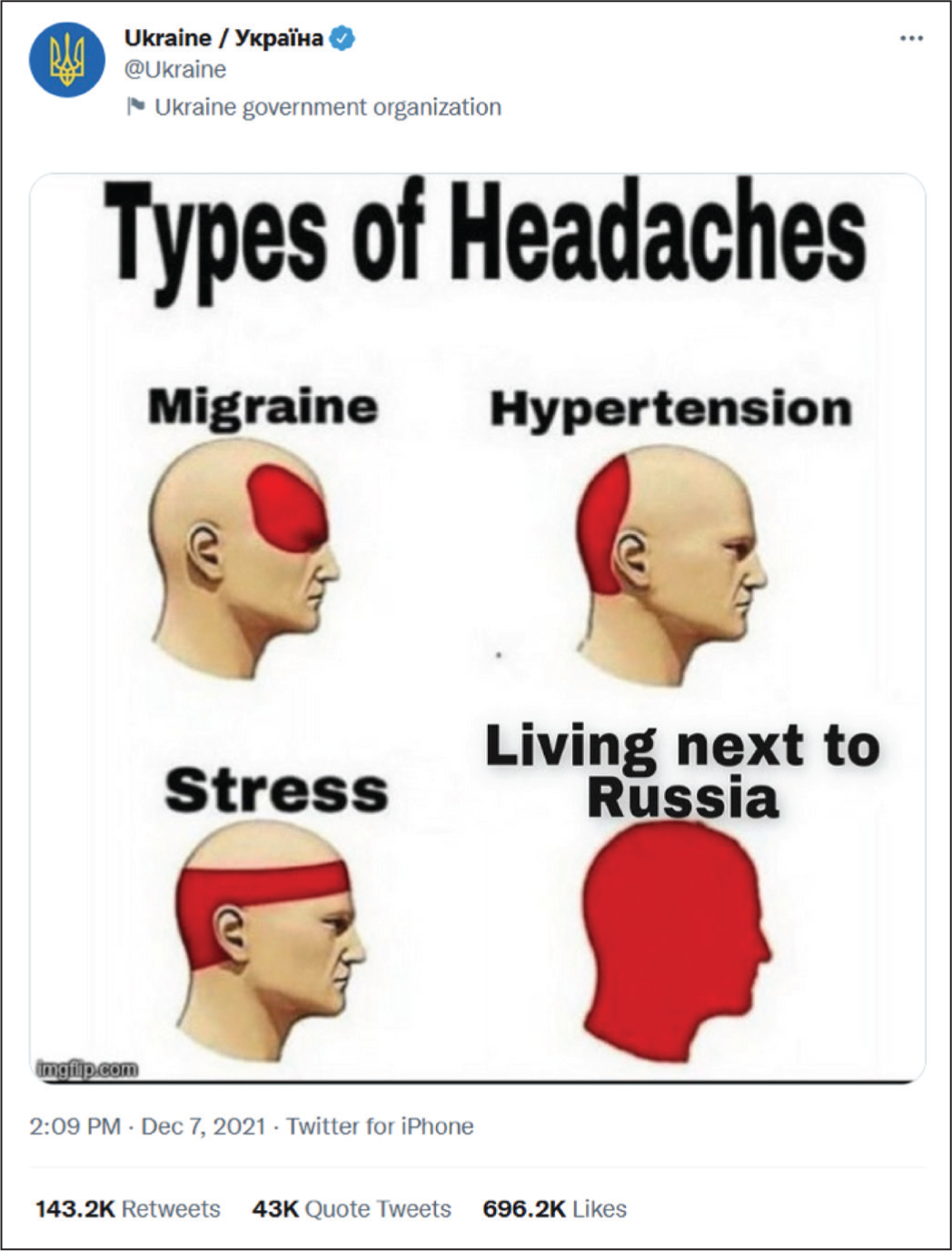
This meme constitutes a verbal–visual joke with a clear linear structure and is subject to incremental interpretation similar to four-part verbal jokes ending with a punchline (see Dynel, 2016). In line with the header, each of the first three images captures a medical condition tantamount to pain located in the head’s specified area. The fourth image, however, introduces humorous incongruity as it breaks the pattern. Rather than presenting another medical condition, it depicts the metaphorical pain washing over the entire head, face, and neck, with Russia as a neighbouring country. On another figurative level of interpretation, the red colour that is culturally associated with Russia (cf. a symbol of communism reflected by the national flag of the Soviet Union or names such as the Red Army or Moscow’s Red Square) filling the entire contour functions as a metaphtonymic (metonymic-metaphorical) representation of Russia’s expansion. By design, this is the non-humorous sense, the truthful meaning, communicated outside the humorous frame through the humorous form (see Dynel, 2017a, 2018 for relevant theoretical considerations). Since the meme was posted when the Ukrainian government and military forces must have had corroborated suspicions about a potential invasion, with Russian troops gathering close to the border, the meme may be conceptualised as a specimen of gallows humour, a category of dark humour.
Dark humour addresses, or arises in response to, death and other morbid topics, such as illness, pain, and suffering (Bucaria, 2008; Maxwell, 2003), which stem from various precarious and traumatic events (Dynel & Poppi, 2018). Importantly, however, dark humour does not need to involve making fun of, let alone ridiculing, tragedies or their gruesome consequences. Rather than being unequivocally offensive to the individuals affected, dark humour has often been described as a coping strategy to help people overcome hardships (see Bischetti et al., 2021; Maxwell, 2003). While elapsed time and physical distance may increase the perception of funniness emerging from tragedy-based humour (Bischetti et al., 2021), those directly experiencing hardships may also reap humorous rewards. This is essentially what the notion of ‘gallows humour’ captures; it is used in reference to the humour created by an oppressed social group or an individual in the context of an immediate life threat (e.g., Lewis, 1993; Maxwell, 2003; Obrdlik, 1942). Gallows humour may then be conceptualised as a category of dark humour that addresses one’s own plight, which is precisely what the headaches meme represents.
Ukraine’s Twitter account continues to publish witty and acerbic memes as a show of defiance and resilience. Tweeting humorous memes that communicate serious messages about Russia, the undisputed aggressor, testifies to the widely recognised function of humour deployed in crises, which is to give comfort to those affected, notably Ukrainians. This rhetoric is also indicative of Ukrainians’ moral victory in the teeth of Russia’s oppressive politics. Furthermore, it may be interpreted as part of Ukraine’s ‘informal defence tactic’ meant to sustain the flow of information (Munk, 2023) and to contribute to Ukraine’s digital warfare (cf. Peacock, 2020 for a similar argument about non-humorous memes and virals).
Overall, the Ukrainian government’s practice of tweeting humorous memes, epitomised by the headaches meme, is a neat representation of several approaches to humour that emphasise the importance of some kind of norm transgression lying at the heart of humour or contributing to the mirth humour elicits (for an overview, see Warren et al., 2021). Therefore, @Ukraine’s memes may provoke amusement specifically because they are sent from this account and/or at this particular time or because they openly and publicly communicate criticism of Russia, which the hegemon forbids, infamously penalising its people for any act of disobedience. Nonetheless, regardless of the complex authorial intent (involving humour and informative value), the headaches meme may be considered seriously inappropriate for several reasons, such as the topic being a no-joking matter and the official governmental Twitter account being a wrong venue for such a humorous post. This perceived inappropriateness may cause not only cringe reactions or outrage but also mixed reactions encompassing negative responses and amusement at the same time (see Aillaud & Piolat, 2012; Oring, 1987). Premised on this assumption, this study explores user reactions to the headaches meme before and after the 24 February 2022 invasion of Ukraine. The impetus of this study is to ascertain whether the internationally recognised tragedy would influence the (humorous or otherwise) perception of the meme, as reflected by users’ tweet quotes.
Methodology
The primary goal of this analysis is to determine the sentiments in users’ reactions shared on the international Twitter landscape (with English as its lingua franca) to the dark-humour meme posted by Ukraine’s official account on 7 December 2021. By focusing on quote tweets, I examine user responses to the original viral tweet rather than retweets, which are much more diversified, ranging from plain retweets to politically loaded comments other than direct reactions to the meme per se, which are the present focus of attention. Also, unlike many reply tweets, quote tweets constitute free-floating self-contained units that users wish to share outside of the original interaction on the Ukrainian government’s account. Thus, using quote tweets to gauge user responses to a meme comes across as a fruitful research strategy.
The study is premised on the assumption that the responses to the recontextualised headaches meme should be dynamic. The context in which it was posted originally changed drastically on the day of the Russian invasion. This recontextualisation enabled shifts in users’ reactions to the meme, most notably in terms of its perceived funniness. Therefore, with the day of the Russian invasion of Ukraine (24 February 2022) as the threshold to mark a liminal day between the periods before and after the Russian invasion, each subset consists of n = 300 quote tweets. In the light of a post-test conducted with another batch of tweets from each period, this number was retroactively proven sufficient for the manual qualitative analysis. This post-test revealed that the saturation point had been reached for both parts of the dataset concerning the categories distinguished therein.
The whole core dataset (N = 600) was collected manually from Twitter (in line with the permission previously received from Twitter for the author’s project ‘Fungression’) in a randomised manner, except that only ‘tweets with text in English (which did prevail anyway) or quote tweets amounting to emoji were included and a specific timeframe was selected. Quote tweets in the before-the-invasion subset come from December 2021 and January 2022. The rationale not to consider quote tweets from February before the invasion (that is, excluding 1–23 February 2022) stems from a pattern identified through observation concerning users’ awareness about, or expectation of, the invasion in some of those quote tweets, which could have jeopardised the reliability of findings about the tweets coming strictly from the ‘non-invasion’ phase. (Some users based in Eastern European countries must have anticipated’ and spread the news about’ the imminent invasion, given the reports about Russian troops approaching the Ukrainian border). In the after-the-invasion subset, tweets posted on 24 February 2022, and a week afterwards populated the sample undergoing the analysis.
A rigorous discourse analysis of the datasets was conducted to identify user reactions to the headaches meme. The tweets were addressed as anonymised specimens of natural discourse not associated with the users, compliant with guidelines for academic research on social media (franzke et al., 2020; Townsend & Wallace, 2016). It would have been impossible and unethical to vet the sociocultural provenance/background of the authors of the tweets. Nor would it have been relevant to this study of posts shared publicly on Twitter and meant for its broad international audience.
In line with the discourse analytic approach (see Coulhard, 2014; Taylor, 2013), the tweets (i.e., verbal content and emoji) were examined in the light of the relevant sociolinguistic context. The underlying premise was to distil the communicative thrust of each quote tweet, namely the sentiments in reference to the original memetic tweet, based on its discourse as the source of literal and implicated content. In the close reading of the tweets in both subsets, in addition to seeking humour appreciation indicators, a grounded-theory approach was applied (to allow the categories to emerge from the data) together with an iterative coding procedure (for the categories to be exhaustive and mutually exclusive). The data were double-coded, with the author and a co-researcher working independently, and the results were duly compared and fine-tuned to reach an agreement about the labelling to safeguard the reliability of the findings. Thereby, eight categories, falling into two major groups based on the presence/lack of humour support, were discerned, representing the dominating response types within both datasets.
Two disclaimers are in order. First, not all tweets could be unequivocally coded given their inherent epistemic ambiguity (e.g., a tweet ‘…’ could indicate that the tweeter was in awe, speechless, or simply decided to withhold judgement, with their underlying intention not being clear). On a related note, indicators of humour appreciation were vetted with the co-text in the quote tweets, which were labelled as humour appreciation only if they concerned the users’ appreciation of the meme [vis-à-vis cases such as ‘Everything is funny, as long as it’s happening to somebody else (Will Rogers)’, a meta-comment on humour perception in general]. Without sufficiently clarifying co-text, some indicators were considered inherently ambiguous and could not be coded in terms of humour appreciation due to their polysemy, which developed over time (Franco & Fugate, 2020). Such was the case with the frequently used loudly crying face (😭), which may stand for either inconsolable grief or uncontrollable laughter, according to recent user definitions (e.g.,
Second, the categories emerging from the analysis are mutually exclusive but may co-occur in one tweet. In other words, one tweet may qualify for more than one label, as is especially the case with tweets that disclose user amusement but may simultaneously contain some further discourse. This is consonant with the principles of discourse analysis designed for addressing complex examples that are not amenable to rigorous quantification.
The qualitative analysis aimed to establish the nature of reactions, whether or not indicative of the users’ humour appreciation, emerging from the dataset. The quantitative dimension was addressed only with regard to the positive reception of the meme’s humour (i.e., the perceived funniness caused by the original tweet, whether thanks to its content or otherwise), which was the original impetus for the study. In all other cases, it is the categories per se that are the focus and thrust of the study. In what follows, an emergent list of categories, divided into those that do and those that do not display humour support, is detailed with representative examples. These user comments are presented in their original form (including various infelicities) and marked as coming from either subset of quote tweets posted ‘before’ or ‘after’ the invasion.
Analysis
Humour Support
Humour Appreciation
Tweets that constitute positive reactions to the humour of the headaches meme form the most pronounced category. One type of user response is to express laughter through the metonymic visual representations of the emotional reaction, such as emoji (Example 1), which may accompany textual evaluations (Example 2), and laughter particles (Example 3). Other reactions feature reflexive metapragmatic comments, which report on user amusement (Example 4).
1. 😂(before)
2. This is fantastic 🤣🤣 (before)
3. Hahahaha (after)
4. Im really holding myself from laughing out loud at the library rn bc of this thread (after)
In quantitative terms, it is hardly surprising that the before-the-invasion subset contained more tweets, namely 93, that unequivocally recognised the humorous nature of the original meme in comparison to the after-the-invasion subset, which contained only 52 such items. This quantitative difference seems to demonstrate user awareness of the seriousness of the situation, which tends to prevent humour experience, as reported by psychological studies (see Martin & Ford, 2018). It should be noted, however, that the overall count of evident positive responses manifesting users’ amusement is not as high as may have been expected, which leads to a conclusion that humour appreciation is not the primary reaction that the meme invites in its receivers.
Interestingly, the reactions testifying to users’ amusement indicate a few sources of humour that the meme displays. The original source of humour intended by the meme’s creator(s) is the basic incongruity-related humorous mechanism (Suls, 1972), which brings about the surprise at the stage of the punchline (i.e., the final image) as the sequence of images is processed incrementally and the new idea is introduced. What contributes to the humorous effect is the wittiness of the meme and the apt political import that it communicates outside the humorous frame. While the ‘serious’ thrust of the meme is no joking matter per se, the fact that this kind of content is communicated through a humorous meme may be considered an additional incongruity. Furthermore, the observation that the meme comes from the Ukrainian government brings about yet another humorous-surprise effect. Such use of humour against the oppressor may be considered audacious, quite unusual, and as rhetorically inappropriate as to be amusing. These are the different layers of humour that the response tweets signpost.
5. Best meme 😂 (before)
6. That’s so funny from the Ukraine government. 😂 (after)
7. Wait. That’s a real tweet from an official account? 😅 (after)
Presumably, if no clarification is provided for the positive humorous reaction, the funniness is seen in the post’s content per se, as is the case of the ‘best’ evaluation followed by the laughter emoji (Example 5). However, explanations are provided to account for the humorousness arising from who the author of the meme is (Example 6), sometimes amounting to mild disbelief (Example 7).
An additional incongruity, and thus a layer of humorous potential, arises in the context of the invasion, especially after it formally commenced. Thus, users seem to recognise the greater power of the humorous meme despite the circumstances, which do not naturally promote humour production.
8. This tweet did not age well 😂(after)
9. Lmaaoooo so you started a war with a meme?! (after)
The user cited in Example 8 appears to be laughing at the meme as seen in the new political context, while the tweeter in Example 9 purports to suggest (but, presumably, does not actually believe) that the meme itself is the reason for the invasion, thus pointing to the source and timing of the meme, which is what they find amusing, as the emphatic acronym indicates. Interestingly, considering the whole co-text, some tweeters report their mixed ‘funny/not funny’ feelings.
10. PLS IM CRYING 😭😭😭 I SHOULDNT ME LAUGHUNF AT THIS BUT WHY IS UKRAINE MAKING MEMES (after)
11. I can’t tell if this has become more or less hilarious (after)
In Example 10, the self-reflexive user admits to crying, both verbally and visually (through the emoji), which seems to be the consequence of extreme amusement, as the unfolding post makes clear. At the same time, the user notes that the laughter is inappropriate given the circumstances but is somehow excused if Ukraine purposefully posts memes at which to laugh. Another user, appreciating the change in the political context, has problems determining whether the tragedy retroactively boosts or decreases the funniness of the meme (Example 11). This is presumably due to the greater seriousness of the situation, and hence the inappropriateness of the humour, which may simultaneously make for greater funniness of the meme’s dark humour, which is in keeping with the thesis that taboos promote humour experience (see Martin & Ford, 2018).
Praise of the Meme (Posting)
The category closely related to the tweets expressing user amusement encompasses users’ positive evaluations of the meme as a communicative strategy deployed by a governmental account. Even though such evaluations cannot be interpreted as the users’ humour appreciation, they do exhibit their humour support by recognising the humorous meme. Thus, this praise concerns the meme as such (14) or the act of meme posting (11). Through metonymic extension, the users also praise the whole Twitter account (13) or its admin (12) for the meme-based rhetoric or the meme-posting activity.
12. The fact that the official Ukraine twitter posted this is amazing. (before)
13. You guys ROCK!!! (before)
14. I love Ukraine’s Twitter (after)
15. Never forget this legendary tweet by Ukraine’s official Twitter account (after)
These tweets seem to be motivated by the users’ tacit acknowledgement that posting humorous memes like the one at hand is not a standard practice expected from a governmental Twitter account, which lies at the heart of a related category.
Rhetorical Weapon Recognition
This category, also indicative of humour support, may be seen as an offshoot of the previous one, with the praise, whether explicit or implicit, being directed at the meme-based rhetoric, regarded as an efficient weapon in a digital meme war running parallel to, or in lieu of, the physical combat. This praise is communicated explicitly (Example 16) or with varying degrees of implicitness, for instance, in the form of statements about Ukraine’s digital victory (Examples 18 and 19) or an invocation of digital action, which may be interpreted as an indirect call for peace (Example 17).
16. This was the reply to a war threat and I love it. (before)
17. Make memes, not war (before)
18. Just a reminder that not only can @Ukraine kick their ass on the battlefield, they also kick digital ass (after)
19. Damn ukraine already one the meme war (after)
Humorous Responses
Quote tweets grouped into this category display humour support through humour production. Thus, these verbal posts constitute the standard ‘respond to humour with humour’ interactional practice realised in the digital space of Twitter thanks to its affordances. Thus, one meme invites users’ humorous verbal reactions, which show recurrent patterning, in line with other practices on Twitter (see, for instance, Dynel, 2023). Specifically, the users purport to suggest that the meme is the prospective (before) or actual (after) trigger of the Russian invasion of Ukraine and even the reason for the Third World War, and/or that it has an immense historical impact.
20. World War I: Assassination of Archduke Franz Ferdinand
World War II: Facism/Holocaust/Pearl Harbor
World War III: Twitter Memes (before)
21. If Russia ends up invading Ukraine, this meme will likely end up in history books. (before)
22. the real reason Russia attacked Ukraine (after)
23. Cracking up thinking that this is 100% gonna be a DBQ my kids encounter in high #school history LOL (after)
In Example 20, the headaches meme is jocularly likened to the validated facts known to have led to the First and Second World Wars. The meme is also explicitly presented as the ‘real reason’, as opposed to genuine political factors, for the Russian invasion (Example 22). Other posts historicise the meme as a prospective topic covered in history (text) books (Example 21) or exams (Example 23) as if the memetic specimen of Twitter discourse is a historic fact worthy of study. Whether or not the humorous intent is explicitly signposted (cf. the laughter indicator ‘LOL’ in Example 23), the tweeters cannot possibly believe sincerely that a meme can ever precipitate a war or become a historical fact. The tweets are not to be taken at face value and, instead, ought to be interpreted as specimens of humour-oriented overt untruthfulness (Dynel, 2018), only speaking to the social media salience and relevance of the headaches meme, with which the users engage and interact through further humour production (cf. Dynel, 2024).
Reactions Beyond Humour Support
Shock or Disbelief
Quote tweets assigned to this category stand in contrast to the humour-support categories as they communicate negatively loaded disbelief and shock at the meme. The meme posting must have been considered inappropriate, uncanny, or shocking both after and before the military invasion and its grave repercussions. The expression of disbelief focuses on the act of posting the meme, given its content, and on the fact that the meme comes from Ukraine’s official Twitter account.
24. Saw this on tiktok thought ‘no way it’s real’. It’s real 😭😭 (before)
25. Still can’t believe Ukraine’s official account tweets memes like this. #NoChill (before)
26. 👀 (after)
27. IM SCREAMING LOOK WHO TWEETED THIS (after)
The sense of disbelief is expressed through conventional lexemes, such as ‘no way it’s real’ in Example 24, ‘can’t believe’ in Example 25, or the emoji representing shock of disparagement in Example 26. Some tweets document the users’ negative emotional reactions (cf. the use of capital letters and reflexive descriptions in Example 27) or the urge to debunk the meme (cf. the authenticity check reported in Example 24). These quote tweets thus suggest not only a lack of humour support, given the absence of its cues, but also disapproval of the meme posting by @Ukraine. However, it cannot be entirely ruled out that, in some of the tweets falling into this category, shock may potentially entail astonishment and a positive evaluation, amounting to a mixed reaction.
Legitimacy Queries
Quote tweets falling into this category also stem from the disbelief in Ukraine’s use of a Twitter meme regarding a serious, if not grave, subject matter but go one step further in that they pose legitimacy queries about it. The examples include sincere questions (albeit often without a question mark) about the rationale behind the meme given its impact on geopolitics (Example 28), about the meme’s authorship (Examples 30 and 31) or the Ukrainian admin’s appropriate use of the Twitter account (Example 29). Their specific foci notwithstanding, all these tweets seem to be motivated by the users’ doubts about the legitimacy of tweeting the meme based on dark humour.
28. why is ukraine live tweeting war (before)
29. who allowed ukraine to have twitter (before)
30. Who is in charge of Ukraine’s Twitter… this is unreal (after)
31. Who the fuck is shitposting on the Ukraine Twitter account (after)
Empathy and Support for Ukraine
Quote tweets classified under this category testify to the users’ empathy and support for Ukraine. Mostly disregarding the humour per se (but see Example 34), the users do refer to the meme in some way, whether its content or rhetoric, as they voice their political opinions. For instance, Example 32 plays off the headaches metaphor and supportively echoes the thrust of the meme, while Example 35 contextualises the metaphor to implicitly suggest that Ukraine requires help. On the other hand, Example 33 capitalises on the visual annexation metaphtonymy to express aggressive defiance against Russia and a bold sentiment of Ukraine’s territorial sovereignty.
32. A permanent headache living next to Russia (before)
33. Fuck off Russia, you aren’t getting an inch. (before)
34. I’m sorry but this shit ✋😂
Ukraine got my support [insrt flg imag] (after)
35. The headache is real when other countries are less willing to help @Ukraine (after)
Delegitimisation of Ukraine
In opposition to the previous category, quote tweets coded into this one exhibit a critical stance on Ukraine and its politics, sometimes going as far as to endorse Russia’s perspective and its military activities. These tweets counter the mainstream politically correct rhetoric, and thus they may be claimed to have been fabricated by Russian trolls or bots. However, the political arena in many countries (e.g., Poland or Italy) does feature voices critical of Ukraine, and this sentiment is reflected in both public media and social media discourses (see Dynel, 2022). Also, even if some of the tweets should indeed come from accounts set up specifically to promote pro-Russian ideology, they are woven into the fabric of Twitter discourse (that other users are exposed to) and deserve to be accounted for.
36. From the *official* account of the Ukraine… Wave goodbye to Kiev (before)
37. I never thought I’d live in a future where a sovereign government posts a meme to Twitter in order to cope with the threat of imminent invasion and possible annexation. (before)
38. The problem is not Russia…. Russia has the right to protect itself. The headache comes from these crooks ruling Ukraine (leak Ass of USA) and from that mafia organization called NATO (the liers) I also forgot to mention that momia called Joe Biden (the peace danger) (after)
39. That’s why y’all goin lose, y’all busy with memes instead of riding out for your fallen brethren. 🚮 (after)
Example 36 encompasses several indications of the tweeter’s lack of empathy for the Ukrainian people and agreement with Russia’s hostile actions. This shows in the asterisks around the word ‘official’ suggesting the opposite, the definite article in ‘the Ukraine’ alluding to the Soviet era (when Ukraine was not independent), and the preferred Russian transliteration ‘Kiev’. Also, the tweet communicates the inevitable destruction of Ukraine’s capital city. Example 38 is even more explicit in its support of Russia’s invasion, pointing to international involvement in the affairs of Ukraine, whose sovereignty is questioned. In the less bellicose Examples 37 and 39, the tweeters comment on Ukraine’s rhetorical defiance on Twitter being at cross purposes with actively securing its sovereignty. While Example 37 presents only implicit criticism of the Ukrainian defence strategy, the discourse of Example 39 is much less implicit, with the blunt message being followed by the ‘put litter in its place’ symbol. While these tweets may not present an evident anti-Ukraine stance (or pro-Russian bias) per se, they do delegitimise the position taken by Ukraine on Twitter, which is in marked contrast to all the categories of tweets that side with Ukraine or express a positive evaluation of its memetic practice.
Discussion and Conclusions
@Ukraine administrators’ exceptional tweeting practice of posting humorous memes that refer to an ongoing political conflict with Russia may be thought of as a localised norm. This meme sharing is the hallmark of the ‘new generation of tech-savvy politicians’ who become ‘digital influencers’ (Asmolov, 2022, p. 25). The posted memes perform an informative function (e.g., Dynel & Poppi, 2022; Ross & Rivers, 2017; Shifman, 2014) and showcase the need to communicate to the account’s international followers Ukraine’s political woes, such as Russia’s hegemony and the threat of invasion, and to do this in a potentially controversial but attention-grabbing manner. Therefore, it can be postulated that humorous memes are Ukraine’s digital warfare weapon, which aligns with the broader view that contemporary wars may be waged rhetorically in digital spaces (e.g., Boichak, 2021; Lu, 2022; Peacock, 2022). All this is the motivation behind the headaches meme posted six weeks prior to the Russian military invasion of Ukraine. This meme also perfectly illustrates the relief function of gallows/dark humour in times of political upheaval and crisis (e.g., Bischetti et al., 2021; Maxwell, 2003), speaking to the producers’ good sense of humour and resilience.
The categories of quote tweets in response to the dark-humour meme distilled in the comparative discourse-analytic study of the two manually compiled datasets and reported here testify to tweeters’ engagement with the meme in terms of its humorousness and/or political implications both before and after the Russian invasion. These diverse discourses indicate political polarisation and several user sentiments, both negative and positive, primarily with reference to the meme, the tweeting practices of @Ukraine, the account’s (governmental) administrators, and Ukraine taken as a whole. On the methodological plane, the focus on quote tweets is a new method submitted here for future research as a useful means of studying natural reactions to online humour, including memes.
In qualitative terms, the before-the-invasion and after-the-invasion subsets present the same eight categories of responses, co-occurring in some of the posts, divided into those that express humour support (Hay, 1995, 2001) and those that do not. Full humour support (Hay, 2001) is reflected by users’ amusement showing in written representations of laughter or relevant metapragmatic comments. This amusement stems from not only the incongruity underlying the meme structure per se but also contextual incongruities reliant on the act of posting (i.e., who the meme poster and its target are, as well as the non-humorous socio-political circumstances). In addition to humour appreciation, three other types of reactions indicative of partial humour support are prominent in both subsets. Users’ praise of the meme or its being posted and the recognition of the meme as an unconventional but appealing rhetorical weapon are also to be interpreted as positive evaluations of the humorous meme. Another form of humour support, much subtler than others, involves verbal humour production reliant on overt untruthfulness. Essentially, the tweeters do not genuinely subscribe to their statements but only overtly pretend to conceive of the meme as the Russian invasion/Third World War trigger or overestimate its historical impact. This verbal response to the meme bears out that, unlike in spoken interactions (cf. the practices of teasing or joint fantasising), the ‘respond-to-humour-with-humour’ tactic of humour support on social media does not need to rely on humour of the same kind (see also Dynel, 2024).
It should be noted that humour support may not be overt if the humour receiver withholds the relevant response, which is easy to do in written interactions on social media, such as Twitter. Thus, the lack of humorous reactions to the meme (signposted by humour support indicators) does not unequivocally indicate failed humour, namely that the humour has not been recognised, understood, and/or appreciated. The publicly available responses to the meme represent what users choose to share, which means that ‘written’ laughter may be suppressed if the users reflexively consider it inappropriate. The alternative forms of user humour support disclosure seem to be a compromise; through partial humour support, the users do indicate that the humour has been well received but not really appreciated (unless humour appreciation indicators are present). This is, presumably, because the grave political context blocks users’ amusement or at least induces them to conceal their uninhibited expression of amusement at the dark humour.
Indeed, the quantitative part of the study of quote tweets shows that humour appreciation does not dominate either subset. With less than one-third of the tweets in the before-the-invasion subset signalling user amusement, humour appreciation indicative of full humour support is not the prevailing response to the Twitter meme. Also, given that the meme at hand represents an ironic reversal of typical dark humour, which operates according to the principle that the passage of time turns tragedies into joking matter (Dynel & Poppi, 2018), it is unsurprising that the number of responses indicating user amusement should have decreased considerably (by about 44%) after the Russian invasion on 24 February 2022. This decrease is an evident indication of users’ recognition of the aggravated sociopolitical context, testifying to the fact that grave circumstances may block humour experience or, at least, prevent users from exposing it overtly in case this should be considered inappropriate (cf. Bischetti et al., 2021). Indeed, such reactions from English-speaking users unaffected by the tragic events might be regarded as being uncouth, or at least insensitive, by people directly affected or more empathetic. However, dark humour appreciation responses decreased but were not absent from the after-the-invasion subset, presumably facilitated by the persistence of the Ukrainian military defence.
Returning to the qualitative dimension, the reactions beyond humour support can be grouped into four types. One of them involves users’ manifestations of shock or disbelief caused by the humorous meme, which is considered inappropriate, echoing the perennial questions about the ethics and limits of humour (e.g., Lockyer & Pickering, 2005). Sometimes, this leads to users’ legitimacy queries, with doubt being cast on the meme as genuinely coming from Ukraine’s governmental account. These two categories stand in stark opposition to the humour-support responses, indicating that it is not only that the humour of the meme is lost on the tweeters but also that the meme and/or its humour (potentially recognised) must be considered improper and even illegitimate, whether before or after Russia’s attack. These reactions then point to failed humour, whose presence is recognised but which is not appreciated (Bell, 2009; Hay, 1995). While some tweeters repudiate the fact that a government can post dark-humour memes, others ignore the humour entirely (whether or not they acknowledge its existence) and embrace the seriousness of the situation, choosing to focus on the truthful message that it communicates outside the humorous frame. Users may take the quote tweet tool in reference to the meme as an opportunity to demonstrate their empathy and support for Ukraine. In contrast, other tweeters assume the opposite stance as they communicate negative sentiments about the invaded country, which is thus delegitimised.
Overall, user reactions to the controversial dark-humour meme posted by @Ukraine range from positive to negative responses to the humour and Ukraine’s rhetoric and politics. Similar to Kramer’s (2011) findings on the reception of rape jokes, the quote tweets examined here unveil diverse reactions to the headaches meme, ranging from amusement and partial humour support to a display of astonishment and refutation of the meme, which speaks to failed humour. Additionally, some of the quote tweets reveal ‘humour ideologies’ (Kramer, 2011), in this context pertaining to the users’ folk beliefs about the (in)appropriateness of the headaches meme.
Finally, the diverse politically polarised sentiments, ranging from sympathy and endorsement to criticism of Ukraine’s politics and memetic practice on Twitter, corroborate the inherent polyvocality of online discourse (Milner, 2016) co-constructed by users with divergent political viewpoints on the ongoing conflict. It can then be postulated that the digital war is fought by not only politicians but also users posting their reactions to Twitter in times of mediatisation. As Boichak (2021, p. 1) puts it, ‘Blurring the boundaries between military and civilian actors, physical and mediated battlefronts, weapons and witnesses, digital media afford unprecedented opportunities for remote participation in wars’. This remote participation through user comments may be considered part of digital participatory culture, which resides in creating and sharing content (Jenkins, 2009). Consequently, bringing together the concepts of digital war and digital participatory culture, it seems useful to coin the term ‘participatory digital warfare’ to capture user posts such as tweets that take either Ukraine’s or Russia’s side in the armed conflict persisting physically on the battlefield, as well as in the digital war held by politicians. Deciding to comment on memes, users self-select as recruits in the participatory digital war to help shape public political opinion (see also Peacock, 2022). Despite one tweeter’s encouragement for peace in ‘Make memes, not war’, the conclusion offered here is that both humorous memes and responses to them do contribute to warfare, albeit ‘only’ digital, with no lives being lost and many people getting a laugh against all odds.
Footnotes
Acknowledgements
I would like to thank Bradley E. Wiggins for his collaboration during the data annotation and early conceptualisation stage, as well as Tiffany Crawford for her assistance in the data collection procedure.
Declaration of Conflicting Interests
The author declared no potential conflicts of interest with respect to the research, authorship and/or publication of this article.
Funding
This work was supported by the National Science Centre, Poland (Project number 2018/30/E/HS2/00644).