



Abstract
Danmu-mediated communication reveals the intricate process of audience participation and preference. Such intricacy of communication includes danmu subtitling as a translation, danmu commentary as a multimodal text as opposed to the original, subtitled video clip, which consists of audiences’ insights into their heads-on experience, and familiarity with the audiovisual subject matter, all as a reception-side paratext (Freeth, 2021: 130–131). Reception-side paratexts provide an invaluable platform for capturing readers’ critical understandings of original texts (ibid.: 118). Among these paratexts, this article argues that danmu functions significantly and cumulatively to transform humour in the digital mediascape. The authors aim to measure participants’ reception of danmu-enabled humour in thematically heterogeneous films, fantastic animation and romcom-themed films. To gauge the impact of danmu-enabled humour on viewers, this paper conducted a survey and interview-based reception study with 30 participants who watched danmu and non-danmu-loaded videos from different film topics. The results suggest that, while danmu videos do not significantly differ from non-danmu videos in terms of evaluations of humour, participants prefer the animation themed without danmu and the romcom themed with danmu. This suggests that the consumption of danmu-loaded videos is film-topic specific and humour-feature diverse. This study points to insightful relations between audience reception and the production of digitally-born multimodal texts, which could provide evidence to improve online participatory and interactive experience, and build customizable and accompanying user experience.
1. Introduction
Humour happens in many ways and takes on many different shapes, among which is newly emerged danmu-enabled humour on social media platforms. Danmu, known originally as danmaku in Japanese, refers to live comments running across the screen, usually found on social media platforms such as Niconico, AcFun, Bilibili, iQIYI, etc. Danmu originated from the Japanese video platform Niconico in 2006 and was introduced to China by the ACG (i.e. animation, comic, game) websites AcFun and Bilibili in 2008. During the past decade, danmu subtitling has gained great success in online video platforms in many East Asian countries and has become a ‘distinct cultural phenomenon’ in China’s digital mediascape (Wang, 2022). It has now become a signature function on Bilibili (also known as B site), one of China’s most popular video-sharing platforms.
Provided by participatory viewers, danmu subtitling is a contemporary collaborative translation practice where online users leave discursive translations with their thoughts and explanations of foreign untranslated videos (Yang, 2020). Danmu subtitling refers to virtually real-time comments drawn on the concerned video, including ‘antecedent, concurrent, and delayed danmu translation’ (Chen, 2023: 598), which may facilitate learning and understanding in various ways, as Figure 1 illustrates. This screenshot is taken from B site regarding an adapted version 1 of Bridget Jones: The Edge of Reason (2004), in which the flying, virtually real-time comments in red, white and green across the screen are danmu subtitles. Taking this screenshot as an instance, Figure 1 explains the multimodality and humour of danmu. First, the multimodality of this example is clear because of the kinetic feature of the running danmu subtitles and the colourful presence of the danmu. Similarly, the humour embedded occurs instantly when the original Chinese subtitles ‘今天是她43岁生日’ (literally, today is her 43-year-old birthday) become the red danmu at the top of the screen: ‘有心栽花花不开, 无心插柳柳成荫(A watched flower never blooms, but an untended willow grows).’ This humorous transfer metaphorically implies the love betrayal between the couple of Bridget and Mark. ‘有心’ (the lovesick Bridget) refers to the innocent female character Bridget, who earnestly falls in love with her boyfriend Mark, while ‘无心’ (the heartless Mark) relates to the relentless male character Mark, who has sexual intercourse with her but ends up betraying her. With the assistance of danmu, the original subtitles with the lonely scene in which Bridget is celebrating her birthday alone become a carnival of criticizing her disloyal and ungrateful boyfriend, which is hilarious and playful. Such active viewing participation via danmu enables audiences to contribute humour, foster emotional bonds and enhance the sharing of information (Liang and Díaz-Cintas, 2025). Our article aims to compare the effectiveness of humour transfer with and without danmu subtitling in thematically different film topics, attempting to find audience-friendly ways to get humour across cultures.

The danmu subtitles in an adapted version of Bridget Jones: The Edge of Reason (2004) from Bilibili.com
Danmu users enjoy a high level of freedom as danmu is posted anonymously with customizable settings for font, size, colour, transparency and speed (Zhang and Cassany, 2019b: 3). Such customization enables danmu users to choose these settings flexibly and creatively to immerse themselves in the viewing experience while sharing thoughts with other co-viewers. As danmu users, they could play the dual role of danmu consumers/viewers and danmu producers/subtitlers at the same time, acting as prosumers in mediascape (Di Giovanni and Gambier, 2018). Unlike traditional comments, which are often strictly positioned at the bottom of the video, danmu subtitles are creatively displayed as live and moving comments, mainly scrolling horizontally on the screen. Since danmu subtitles are synchronized to the video timeline and are kept for archiving, they often create a scene of ‘bullet curtain’ (the literal translation of danmu in Chinese) when the comments reach a heavy density (Yang, 2022). Furthermore, the phenomenon of danmu blends real-time comments (Ding, 2015), social interaction (Chen and Ding, 2019) and participatory viewing (Liu et al., 2016).
However, although an increasing amount of danmu-related research has focused on textual analysis (Yang, 2020, 2022) and employed a multimodal approach (Zhang and Cassany, 2019a), insufficient attention has been paid to the reception of danmu from the viewer’s perspective. This study does not confine itself to a linguistic discussion of subtitling humour through the lens of danmu. Instead, it considers how viewers receive the subtitling of danmu-enabled humour in multimodal texts. To fill the research gap by analysing viewers’ reception of humour in different film topics, this article examines whether viewers immerse themselves in the humour devised in and out of the danmu context. Immersive tendency is ‘a disposition that determines whether someone is receptive to immersive experiences during media exposure’ (Weibel et al., 2010: 251). Such immersive tendency is likely to be measured by questionnaires based on self-reports with rating scales (Kim and Biocca, 1997; Witmer and Singer, 1998).
2. Literature Review
2.1. Danmu research
The last decade has witnessed the rapid growth of academic research on danmu, although strictly speaking, the analysis of danmu might not fall into the conventional audiovisual translation (AVT) norms, given they are not necessarily involved in translation activity directly and often indicate ‘a broader participation in discursive practices surrounding translation than translational practices’ (Yang, 2022: 18). However, the way danmu subtitles are produced and received by the online audience in emerging media practice makes it relevant to AVT. Existing literature on danmu subtitling focuses primarily on exploring its interface characteristics and the subculture phenomenon (e.g. participatory media, humour creation, grassroots translation, trust building and community identity) derived from the video platforms (Díaz-Cintas, 2018; Dwyer, 2017; Hsiao, 2015; Lu and Lu, 2022, 2024; Pérez-González, 2019; Qin, 2025; Wang, 2022; Yang, 2020, 2021, 2022; Zhang and Cassany, 2019a, 2020; Zhu, 2017). Empirical research on exploring the impact of this innovative subtitling practice on audiences’ perception and reception of online videos is still minimal.
Only a few reception studies have focused on danmu subtitling from the audience’s perspective. Most recently, Yin et al. (2025) explored how danmu is used as a social, cognitive and emotional engagement to empirically enhance audience reception through semi-structured interviews. Socially, as a form of fan translation, danmu subtitling showcases an active interaction in the mediascape between and beyond media prosumers and media texts that form participatory culture (Jenkins, 2006b). Emotionally, viewers’ positive emotional reactions and personal insights have been activated via the grassroots-made, carnivalesque danmu commentary (He and Muroi, 2020). Cognitively, danmu technology efficiently helps audiences to decrease cognitive load when specialized terms, unfamiliar language, hidden meanings, or symbolic implications of audiovisual contents have been clearly explained. In addition, Chen et al. (2017) conducted a group interview and a survey of 248 participants to explore audiences’ reasons for watching or not watching danmu videos and to identify users’ behaviour and attitudes towards danmu videos. The results suggest that the main motivations for young Chinese audiences (aged 15 to 35 years) watching danmu videos are to obtain information, seek entertainment and build a social connection with other users, while hindrances to danmu videos viewing include an aversion to visual clutter as a result of comment density. Through a controlled experiment, self-reported measures and a combination of unstructured and structured interviews, Djamasbi et al.’s (2016) study examined the factors that might influence younger American audiences’ viewing experience of danmu videos. The empirical data shows that although danmu videos tend to be more engaging than traditional videos, they do not influence viewers’ mood and their social presence. However, danmu videos can also be distracting to many participants, as evidenced by their results. Zhang and Cassany’s (2019a) content and discourse analysis of multimodal humour created through danmu is also relevant to the current study. Although their research does not involve experimental data, the danmu examples collected from some of China’s major video platforms (e.g. Bilibili, Souhu, Tudou, iQiyi, etc.) show how humour is created in danmu by making fun of the plot, characters and of other users, and how various multimodal resources (e.g. colours, layout and symbols) in the danmu interface are innovatively deployed to enhance the humorous effects.
As can be seen, insufficient experimental studies have been done so far on exploring the impact danmu might have on audiences’ evaluations of humour in the film topic diverse subtitled films from an audience reception perspective. Since danmu subtitles have ‘substantively changed the way internet users enjoy online videos’ (Wang, 2022: 54), it is crucial to understand audiences’ feedback on the satisfaction and perception of the use of danmu videos. Only in this way can our study better meet audiences’ needs and improve their satisfaction with multimodal products in the digital era.
2.2. Definitions and features of danmu-enabled humour
Danmu-enabled humour is defined as humour that is generated from danmu subtitling and danmu commentary in the digital era. In relation to the features of danmu-enabled humour, our article does not use ‘types of danmu-enabled humour’ because one specific type of joke may overlap with other categories (Zabalbeascoa, 2005: 198; Zabalbeascoa and Attardo, 2023: 25). Therefore, we prefer to use ‘features’ that are better suited to our danmu-loaded cases, which is also supported by Zabalbeascoa and Attardo’s (2023: 21) factors for joke translation. Since humour is highly contextualized, a multimodal approach is used to supplement ‘language-only’ mode in the process of perceiving humour. As humour comes in when interacting with the semiotic complexity of both verbal and non-verbal dimensions, humorous and comical texts can be viewed as intricate and multimodal texts, maintaining ‘verbal, pictorial, and typographic signs’ (Kaindl, 2004: 190). In this article, humorous texts refer to ‘a linguistic ambiguity to exploit a metaphor’ that can generate laughter, while comic texts mean ‘stylistic deviations, prosodic or mimetic cues’, adding another layer of meaning that can produce a humorous perspective on the ongoing activity (Kotthoff, 2006: 274).
Following Lu’s (2023) method of selecting swearword examples in the Chinese subtitling context, this article analysed the selected danmu-loaded video clips to identify and quantify the humour features embedded in these with-danmu versions. The Chinese transcripts were downloaded from Bilibili.com and then saved in Excel files. A total of 121 instances of humour were identified, and the most frequently shown features of danmu-enabled humour found in those clips are linguistically-based humour (20, 16.5%), Chinese cultural humour (17, 14.1%), non-verbal humour (27, 22.3%) and heterogeneous complex humour (57, 47.1%), as illustrated in Figure 2. The abovementioned four features of danmu-enabled humour also tap into the humour classifications drawn from Zabalbeascoa (2005), Martínez-Sierra (2006), Chiaro (2010), Peng (2020) and Zabalbeascoa and Attardo (2023).
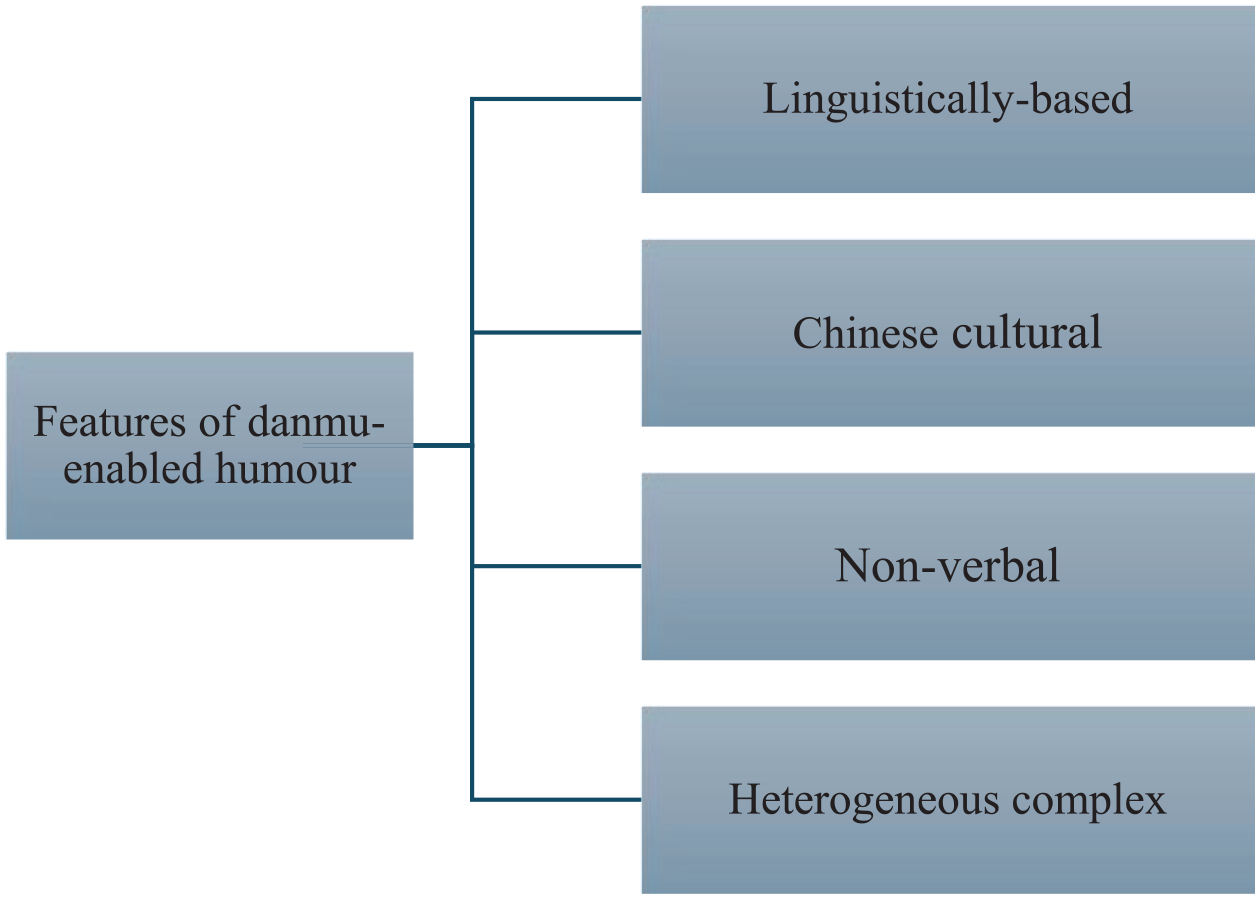
Features of danmu-enabled humour.
Linguistically-based humour refers to the type of humour dependent on the language-specific wordplay, such as puns created through polysemy, homophony and synonymy (Zabalbeascoa, 2003). Chinese cultural humour, as proposed by Peng (2020), includes those instances that are strongly rooted in Chinese cultures, such as places, customs, foods, songs, etc. Our study suggests the distinctiveness of Chinese characteristics in transferring humour (Yue, 2010) in the danmu context because Chinese viewers reinterpret the humorous elements with their own cultural background under the main category of verbal humour. The non-verbal humour, apart from its kinetic paralinguistic, acoustic and visual modes (Peng, 2020: 43), also refers to surreal humour that engenders visual humour from the incongruity between what is presented on the screen and what is pre-existent in audiences’ minds and in their cognitive processes (ibid.: 52). Audiences incorporate their prior knowledge and familiarity with the filmic texts into the Chinese participatory subtitling practice across video-sharing platforms via danmu (Pérez-González, 2019). Finally, building on Zabalbeascoa’s (1996: 251–254) broader category of the complex joke—which refers to a combination of international jokes, national-sense-of-humour jokes, language-dependent jokes, and visual jokes in dubbed television sitcoms—heterogeneous complex humour in the danmu context specifically refers to “the complexity of humour transfer in multimodal film texts” (Peng, 2020: 52), involving two or more of the above danmu-mediated humorous features.
3. Theoretical Frameworks Conceptualizing Danmu-Mediated Humour
3.1. Incongruity theories
To tap into the overarching aim of our study to see how viewers receive the danmu-mediated humour, the concept of incongruity is helpful because it is found to be prevalent in humorous and comical texts. It refers to an unexpected inconsistency with established norms of the communicative situation that elicits a comical response (Savina, 2023: 60). Based on the violation of expectation and making sense of nonsense, incongruity theory serves as one of the most influential frames in conceptualising humour studies (Attardo, 2020: 78). According to Vandaele (2002), incongruity is one of the parameters of humour, which can be defined as a contrast or conflict between what is expected and what actually happens in the humour. Vandaele (1999) identifies several types of incongruities, which include linguistic incongruities, pragmatic incongruities, narrative incongruities, natural incongruities, social incongruities and intertextual incongruities. Under this prism, our study uses incongruity theories to understand humour, which takes a cognitive approach and emphasizes contrast (Attardo, 1994). In an audiovisual text, incongruity can be constructed monomodally (e.g. within one single mode) and multimodally (e.g. a combination of different modes). According to Pascal (1933, cited in Morreall, 1987, 130), humour is no more than ‘a surprising disproportion between that which one expects and that which one sees’. These diverse incongruities help us understand the complexity of humour in our danmu-enabled and film-topic heterogeneous context. As our study will show shortly, comprehending humour is beyond static linguistic and semantic issues (Attardo, 1997); it extends to multimodal, dynamic and interactive issues (Attardo, 2023). Humour fulfils various functions in films, including characterisation, facilitating the development of the plot, indicating a certain relationship between characters, establishing a relaxed and playful atmosphere, and providing audiences with pleasure, entertainment and amusement (Kozloff, 2000).
3.2. Multimodality
There is a shifting focus from the traditional linguistic transfer of humour to the more recent multimodal humour (Kotthoff, 2006: 191) that lies at the heart of danmu-mediated humour. Multimodal humour has been proliferating in cyberspace, such as ‘memes, stickers, GIFSs, emojis, humorous comments on a social networking site entry’ (Yus, 2023: 3). Our study aims to explore this under-researched area by investigating viewers’ reception of the danmu-mediated humour emerging on key social media platforms across film topics. In this regard, previous research focuses on humour drawn from the social media platforms characterised by ‘multimodality and interactivity’ (Wu and Fitzgerald, 2023: 35), possibly building a sense of community and connectivity ‘with educational and pedagogical natures’ (Liang, 2023: 9). Our study also adopts a multimodal approach in order to analyse danmu-enabled humour, as it provides researchers with a holistic and comprehensive perspective that helps to analyse the mechanism of meaning-making in danmu subtitles via audiovisual texts.
As Pérez-González (2014) suggests, the successful application of multimodality to the analysis of subtitling can be explained by the nature and characteristics of subtitling. It is the only type of translation ‘using written language acting as an additive and synchronous semiotic channel as part of a transient and polysemiotic text’ (Gottlieb, 2000: 15). The subtitles, such as the bilingual subtitles and danmu subtitles in this study, are therefore not the only written mode in the contribution of meaning-making in audiovisual texts. Apart from texts, there are also many other modes, such as kinetic, paralinguistic, acoustic and visual modes, which play significant roles in the construction and reception of humour in subtitled films. Scholars suggest that subtitles function in combination with other modes, and meanings are often achieved through the interaction between different modes (Kaindl, 2013; Pérez-González, 2014). As shown in the previous section, our features of danmu-enabled humour follow a multimodal rather than a linguistic approach, since the key factors of humour – incongruity – can hardly be inferred from a purely linguistic perspective.
Previous studies have been conducted to explore the subtitling of humour in the Chinese context. Peng’s (2020) research, Translating Humour Using Subtitling (Chinese to English), is among the pioneering studies that discuss multiple types of humour across different genres, in which multimodality is used to analyse such ‘multiplicity and interconnections’ (p. 11). She argues that humour is multimodal, varying hugely according to ‘time, context, nation, medium and person’ (p. 14). Although Peng looks primarily at the officially released subtitles, Guo (2023: 17) investigates fan translation that provides ‘a more nuanced picture’ that helps people overcome linguistic or cultural barriers to connect groups and media texts in today’s mediascape. This relates to the aim of our study of how the fans-generated humorous danmu intends to build a sense of communication. To keep this shared, co-created and entertaining cycle of online communication going, users introduce more visual incongruity. This adds to multimodal humour, where playful linguistic transformations are combined with popular, adaptable and creative visual elements (Vasquez and Aslan, 2021: 16–25).
3.3. Cognitive load
Since this article aims to rectify the critical blind spot where the newly emerged type, danmu-driven humour, seems to have rarely been analysed from the viewers’ reception perspective, it is also necessary to resort to the key conceptual frame of cognitive load that facilitates the understanding of how film viewers process humorous images, sounds, subtitles, etc. In Szarkowska and Boczkowska’s (2022) research, the concept of cognitive load is applied to colour-coding subtitles in multilingual films, concluding that colour coding has no significant adverse effects on viewers’ film reception. The concept of cognitive load is relevant to our study in understanding how humour is perceived by audiences. It refers to ‘the total amount of mental activity imposed on working memory at an instance in time’ (Cooper, 1998: 358). This concept thus helps us to identify how viewers process the humorous elements in two different versions of the film, danmu and non-danmu versions. Not confined to textual analysis of humorous elements, humour in our study has multifaceted meanings thanks to the danmu because viewers are able to actively resort to their extraneous and intrinsic cognitive load to interpret humour embedded in the film. Extraneous cognitive load refers to the film settings consisting of ‘the sequences of images, sounds and subtitles, understanding the action, and construing the narrative’ (Szarkowska and Boczkowska, 2022: 5), while intrinsic cognitive load relates to audiences’ prior knowledge, head-on experience and familiarity with the overarching theme of the film (Wray, 2002).
4. Overview of the Experiment
4.1. Participants
A total of 30 first-year postgraduate students majoring in translation and interpreting were selected as research subjects due to their language competence in consuming bilingual (English and Chinese) subtitled films (Liang, 2022a). They are frequent video watchers and mixed general and frequent danmu users. According to our danmu pilot study, among these 30 participants, 14 of them often (two to three times a week) watch danmu-loaded videos, 8 of them always (four to five times a week) do so and 2 of them are daily users, indicating that most of them (24, 80.1%) are regular danmu users.
4.2. Material
Two filmic topics have been chosen for experiments. They are animation-themed for children and romcom-themed for adults. The former film topic selected is Shrek 2 (2004), while the latter includes Bridget Jones’s Diary (2001) and Bridget Jones: The Edge of Reason (2004). This article adopts ‘film topic’ instead of ‘genre’ because genres are inherently temporal, mutable and overlapped with different sub-genres, which are challenging to define once and for all (Matthews and Glitre, 2021: 1513). These two film topics contain distinct features that are recognisable and explicit for different target audiences, such as children and adults, respectively, which is useful for fulfilling the humourous functions of the foci of this article.
The film topic of romcom relates to the key themes associated with romantic comedy films, among which Bridget Jones’s Diary (2001) is a constant presence of its kind that not only provides a comic chorus of characters’ love lives as well as their lifelong pursuit (Mortimer, 2010: 8). The prominent features that characterised this film are the impulsive, independent and vulgar language and imagology, which demonstrates the freedom and independence depicted in the film (Liang, 2022b: 180). As for the fantastic animation Shrek 2 (2004), it is an unprecedented box office success for its unfailing verbal and visual humorous elements (Murugan, 2019: i). Multimodal genre films such as cartoons have sufficient grounds for irony factors and markers that may elicit humour (Burgers et al., 2012: 304), which is a good fit for this article’s danmu-mediated humour in the most recent mediascape.
The rationale for choosing these film topics is based on three key factors. First, they were very popular with young people compared to the other films in their respective series (as referenced by China’s well-known film ratings platform Douban). Second, they contain a relatively high and comparable density of danmu, which provides nuances and insights into whether humour reaches audiences in new and exciting ways. Third, the humour 2 embedded in these three specific film topics travels beyond the textual and engages highly in multimodality. That could empirically open research avenues to uncover humour across different film topics in the newly emerging media discourse (Burgers et al., 2012: 305).
The films analysed here were downloaded from Bilibili and iQIYI, two of China’s most popular danmu-loaded online video platforms. We chose one film clip for the pilot study and four clips for the parallel surveys. Each clip is about 5 minutes long and has two versions: danmu and non-danmu versions. As a pilot study, the first two with and without video clips are drawn from Harry Potter and the Sorcerer’s Stone (2001) because the popular film is loaded with humorous danmu that fits in the abovementioned danmu-enabled features. It enables more direct communication among viewers that creates a real-time sharing experience (He et al., 2017: 1) and enhances their viewing gratification to know that like-minded people share common views and build a collective identity (Lu and Chen, 2024: 233). This pilot study aims to examine whether the reception of danmu changes from the perspective of humour consumption compared to Fang’s (2016: 49) research. She argues that general viewers are more likely to get offended by aggressive, profane and distractive danmu comments than frequent users of danmu who are more comfortable and adapted to danmu interface. Moreover, the preliminary findings from this pilot study can further help us explore our research questions outlined at the end of this section. Subsequently, four separate film clips are used in the following reception studies from Shrek 2 (2004) (clips 1 and 2), Bridget Jones Diary (2001) and Bridget Jones: The Edge of Reason (2004) (clips 3 and 4), with each film clip in two danmu and non-danmu versions. Each set is picked primarily for humour featured with linguistic, Chinese cultural, non-verbal and a combination of these characteristics.
4.3. Procedure
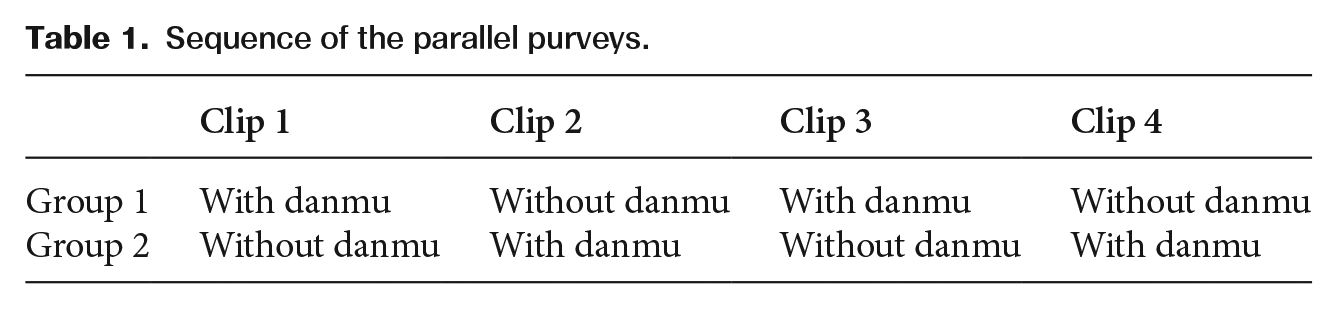
To explore how to better cater to audiences’ viewing experience thanks to danmu-enabled humour, our experiment was conducted in three steps: a pilot-study survey, parallel surveys and a post-experiment interview. To start with, for the pilot-study survey, the 30 participants were required to watch the clips taken from Harry Potter and the Sorcerer’s Stone (2001) in both non-danmu and danmu versions. Subsequently, for the parallel surveys, the 30 participants were randomly assigned into group 1 or group 2 to watch a mixture of the four videos of animation-themed Shrek 2 clip 1 and clip 2 and romcom-themed Bridget Jones’ Diary clip 3 and Bridget Jones: The Edge of Reason clip 4 as shown in Table 1. Each group had an even number of 15 participants who watched the four different with-and-without danmu video clips for a total of 60 times of ratings, ratings for their preference, self-assessed comprehension and evaluations of danmu. To distinguish audiences’ receptions of the humour for different film topics, participants were clearly informed that those who watched the video clips with danmu should rate the humorousness of the danmu only. On the other hand, participants who watched the video clips without danmu should merely focus on the humorousness of the films per se.
Sequence of the parallel purveys.
Participants were asked to fill out an online survey immediately after watching each clip. The survey consisted of more detailed questions about the preference, self-assessed comprehension and evaluations of the humour in the video. The online survey consisted of 5-point Likert scale questions ranging from 1 (e.g. not humorous at all or no comprehension at all) to 5 (e.g. extremely humorous or excellent comprehension). The post-experiment interview was conducted to gather participants’ nuanced feedback on the use of danmu in their film-watching experience and to further explore the details and specific aspects of danmu-enabled humour that were not fully addressed in the designed survey.
4.4. Research questions
It is expected that participants are likely to evaluate the danmu versions as more humorous than the non-danmu versions since various elements of humour are often embedded in danmu (Zhang and Cassany, 2019a), such as the content of danmu that often provides additional information or explanatory words related to the plot (Zhang and Cassany, 2019a, 2020). Therefore, our study aims to answer the following research questions:
(1) Do participants rate the danmu versions as more humorous than the non-danmu versions?
(2) Do participants find the danmu versions more humorous across both romcom and animated film topics?
5. Results and Discussion
To answer our two research questions, a statistical analysis, including average scores, i.e. mean, median and percentage of each value for each question, was then carried out. We first compared the overall result of the two versions (danmu and non-danmu) by calculating the data from the preliminary study and the follow-on parallel surveys. Then we compared the data from the two different film topics to see whether humour travels across film topics.
5.1 Results of the pilot study
To justify the significance of investigating danmu-loaded videos, this study conducted a pilot study to examine levels of humour, self-assessed comprehension and preferences for both the non-danmu and danmu versions of a clip extracted from Harry Potter and the Sorcerer’s Stone (2001). Among the 30 participants, one-third preferred to watch the danmu version based on its humorous nature. Although 12 out of 30 students (40%) reported understanding the humour in the danmu-loaded videos at a fairly high level, nearly half (46.7%) found the selected video clip very humorous. This suggests that danmu comments contribute to the overall humorous effect to some extent.
To further explore this relation, a majority of 23 out of 30 (76.7%) participants preferred the danmu version over the non-danmu one. One participant labelled as no. 19 explains that ‘The non-danmu one is funny because of the film itself, while the danmu one is much more funny for comments (whether relevant to the plot or not) rather than the film.’ It can be inferred that participants may have found the danmu-loaded clip humorous not only because they were entertained by the content itself but also because of the associated and creative ideas built from audiences’ familiarity, experience and reflection of the film.
As argued by Zheng et al. (2023), translation is no longer confined to interlinguistic transfer but is re-conceptualized as ‘an assemblage of multimodal resources that reconstitute and extend the original meanings of the source text’. The process of reconceptualisation also applies to humour reception in our study. Audiences can engage with humour in multiple ways, drawing on multimodal resources beyond the film’s dialogue. These resources include first-hand experiences, familiarity with the film and its context, reflections on the plot and characters, and the synchronicity of various film elements. Examples of such synchronicity include original sound effects, the alignment of text with visual movement and the interplay between non-verbal elements (Zabalbeascoa, 2008: 2–3). Therefore, the creation of new audiovisual text resonates with new audiences thanks to the coherent and relevant relationships with the pictures and sounds that mutually contribute to the new audiovisual texts (p. 10; Zabalbeascoa, 2001: 130).
5.2 Results of the main surveys
To explore how audiences perceive humour in danmu and non-danmu versions of two film topics –animation and romcom – the study first examines their understanding of the humour presented. Participants’ self-assessed comprehension results are presented in this section, followed by a post-experiment interview related to their comprehension of humour. This approach helps to provide an insight into the reliability of audience responses regarding their humour reception.
5.2.1. Participants self-assessed comprehension scores are slightly higher for the non-danmu versions than for the danmu ones
Table 2 shows that participants’ self-assessed comprehension scores of humour in the non-danmu versions are slightly higher than that in the danmu versions (mean = 3.28 and 3.03 respectively). For both the danmu and non-danmu versions, the most frequent rating was 3 (fair comprehension), with 21 out of 60 and 26 out of 60 times of ratings giving this score, respectively. However, for the danmu and non-danmu versions, 19 out of 60 times vs 24 out of 60 times of the ratings had a self-assessed comprehension score between 4 to 5, with these ratings underlining good or excellent self-assessed comprehension of the humour in the videos. This indicates that more participants had higher self-assessed comprehension scores for the non-danmu versions than for the danmu versions. Overall, participants’ self-assessed comprehension scores of humour in danmu and non-danmu versions are both between fair to good comprehension (closer to fair comprehension), with slightly higher self-assessed comprehension scores for the non-danmu versions.
Participants’ self-assessed comprehension scores of humour in danmu and non-danmu versions.
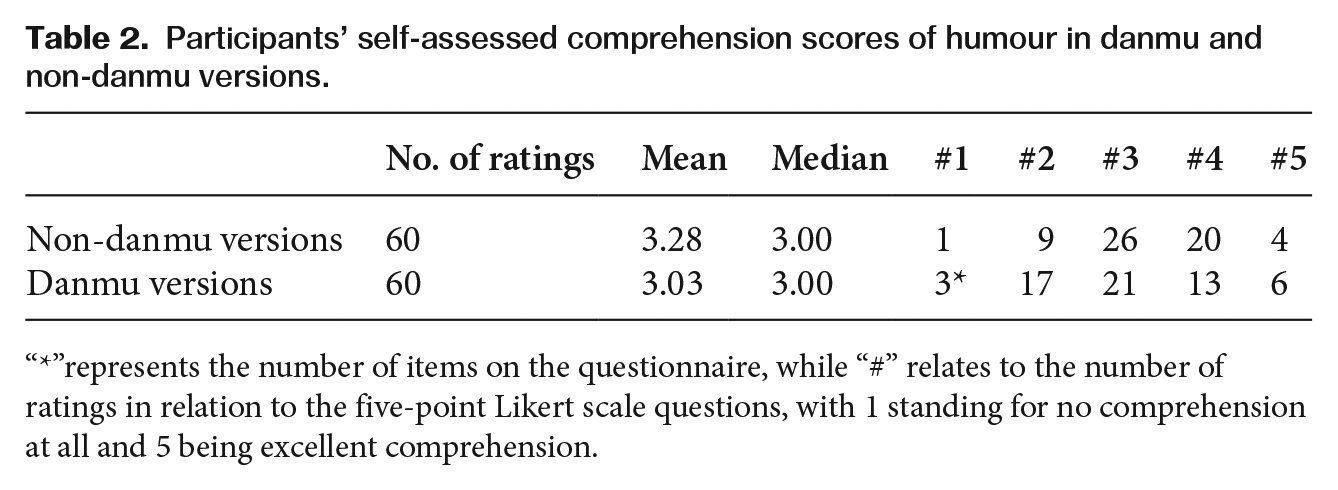
represents the number of items on the questionnaire, while “#” relates to the number of ratings in relation to the five-point Likert scale questions, with 1 standing for no comprehension at all and 5 being excellent comprehension.
One possible explanation for this result is that the appearance of danmu and its complex variants, such as ‘arrows, kaomoji, context-specific special characters and symbols and ASCIIart, 3 (Zhang and Cassany, 2023) may increase audiences’ cognitive load when they are watching the videos, which may further influence their self-assessed comprehension of humour. The larger amount of information accumulated in working memory may lead to a heavier cognitive load that affects effective performance (Mizuno, 2017). As Kruger et al. (2015) suggest, when watching subtitled videos, audiences need to process several sources of information (e.g. moving images, sounds and on-screen text) simultaneously. Danmu, which appears at the top of the screen, is an additional layer of subtitles added to the original video that attracts audiences’ attention and increases the semiotic complexity and information density of the multimodal texts. Compared with non-danmu versions, processing danmu versions could be more complicated and cognitively demanding as audiences not only need to pay attention to the original bilingual subtitles at the bottom of the screen but also danmu subtitles at the top of the screen, as Figure 3 4 shows. This is similar to Szarkowska and Gerber-Morón’s (2019) study, which found that three-line subtitles tend to be more cognitively demanding than two-line subtitles. In this study, the higher level of information density in the danmu versions means that audiences may have less time to process humour, which may affect their self-assessed comprehension of humour. This result shows that the way information is presented in multimodal texts, especially in an age when digital technology allows for much more complex integration of written text, images, videos and emojis in multimodal communication, influences audiences’ cognitive load and, therefore, their comprehension of the humorous text.
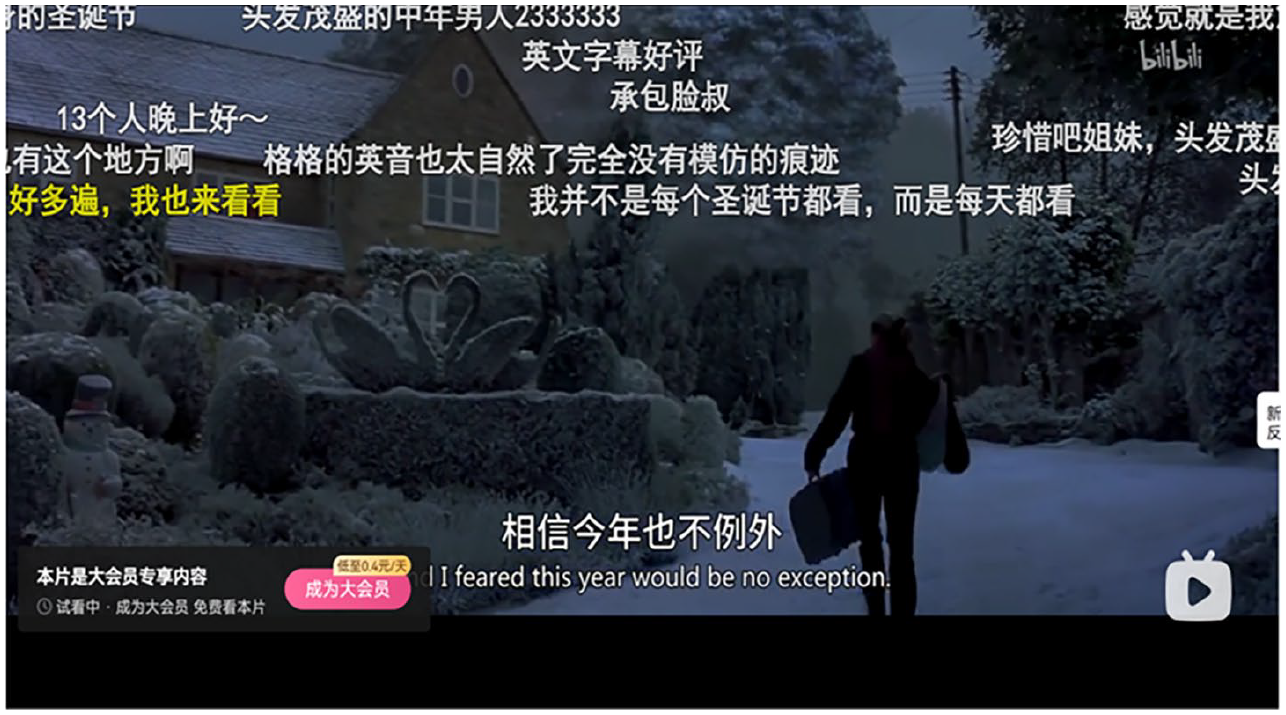
The bilingual subtitles and danmu subtitles in Bridget Jones’s Diary (2001) from Bilibili.com
5.2.2. Participants’ evaluations of humour are insignificantly higher in the danmu versions over the non-danmu ones
Contrary to the pilot study, which found that most participants (23 out of 30) preferred the danmu version for its new and exciting humorous effects, our survey suggests a key finding: participants rated the humour levels of the danmu and non-danmu versions similarly. As shown in Table 3, there is no significant difference between the mean of the two versions (mean = 2.98 and 2.75, respectively), indicating that, overall, participants rated both versions more or less the same – between slightly humorous and neutral, but closer to neutral. The danmu versions were generally perceived as being slightly more humorous than the non-danmu versions: for the danmu versions, the most frequent rating was 3, with 22 out of 60 times ratings giving this score; while, for the non-danmu versions, the most frequent rating was 2, with equally 22 ratings out of 60 giving this score. The mean and median of the two versions are very close to each other, indicating that there are no extreme values that significantly affect the central tendency of the data. Overall, although the data suggests that the participants rated the danmu versions as slightly more humorous than the non-danmu versions, the difference is minimal. Such slight differences and preference for danmu versions over non-danmu ones may be determined by audiences’ familiarity with the film and the density and insights of danmu. As argued in Zhang and Cassany’s (2023) visual analysis of danmu, the more viewers are familiar with the film, the more they tend to show curiosity about the danmu comments.
Participants’ evaluations of the level of humour in danmu and non-danmu versions.
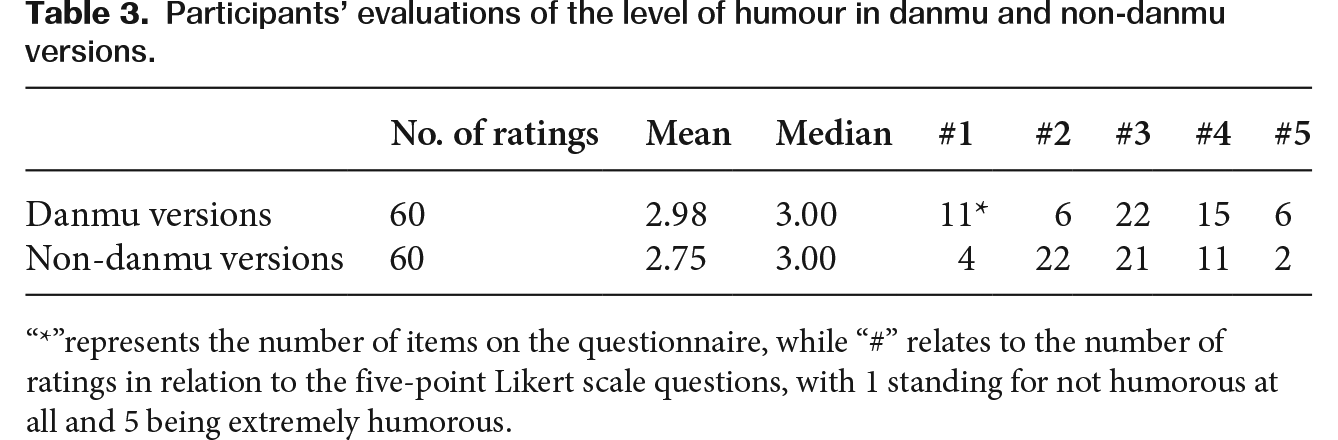
represents the number of items on the questionnaire, while “#” relates to the number of ratings in relation to the five-point Likert scale questions, with 1 standing for not humorous at all and 5 being extremely humorous.
5.2.3. Film topics as a key indicator influencing participants’ evaluations
Since our data covers two film topics – animated fantasy comedy and romcom – this article then compared whether film topics is a key factor influencing participants’ evaluations of humour. Again, to ensure the credibility of participants’ reception of danmu-mediated humour, their self-assessed comprehension is examined before their evaluations of humour. The results suggest that the presence of danmu can affect audiences’ self-assessed comprehension and evaluations of humour in different film topics.
Tables 4 and 5 show participants’ self-assessed comprehension of humour in the two film topics. Comparing the mean and median in the two tables, it can be seen that participants’ self-assessed comprehension scores of humour are prominently higher in the danmu versions for the film topic of romcom than that of animation, as illustrated by Table 4. This suggests that the appearance of danmu may positively affect participants’ self-assessed comprehension of humour in romcom-themed films. The narrative of romcom focuses primarily on people’s lives in real-world situations and humour usually comes from everyday life, which can better resonate with people, while humour in animation is often created through the incongruity between real-life and, unreal settings between reality and imagination, which resonates less with people’s daily lives. The quintessential features of romantic comedy are that humour, intimacy, sexuality, irony and metaphor all appear to be intertwined (Desilla, 2012: 40–47). Such complexities and richness may explain why Bridget Jones’s Diary (2001) and Bridget Jones: The Edge of Reason (2004) are more humorous, and their danmu-loaded versions are more appealing among viewers.
Participants’ self-assessed comprehension scores of humour in two film topics with danmu.
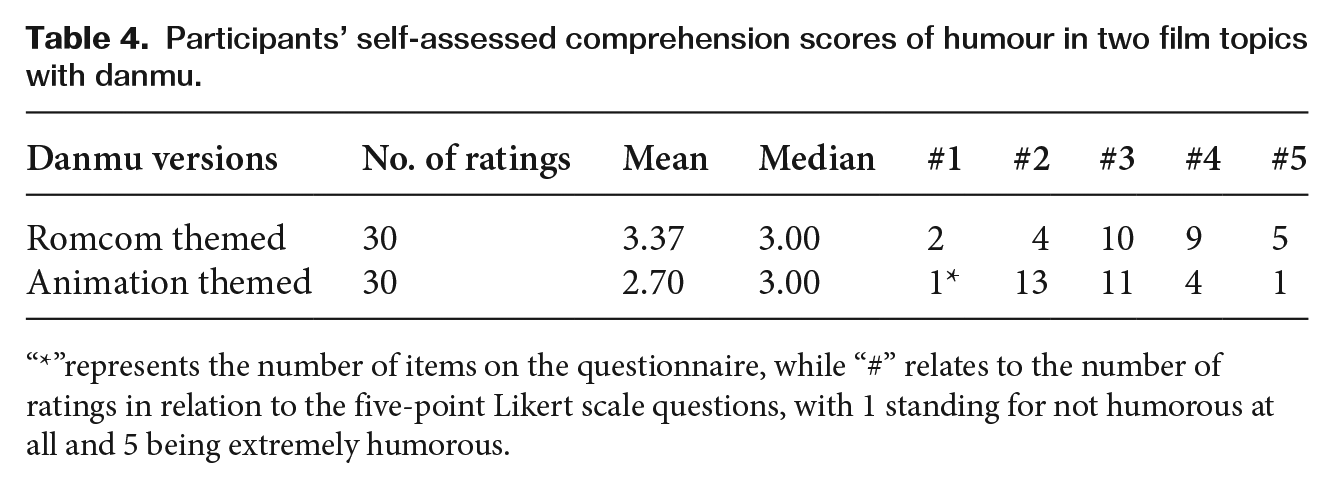
represents the number of items on the questionnaire, while “#” relates to the number of ratings in relation to the five-point Likert scale questions, with 1 standing for not humorous at all and 5 being extremely humorous.
Participants’ self-assessed comprehension scores of humour in two film topics without danmu.
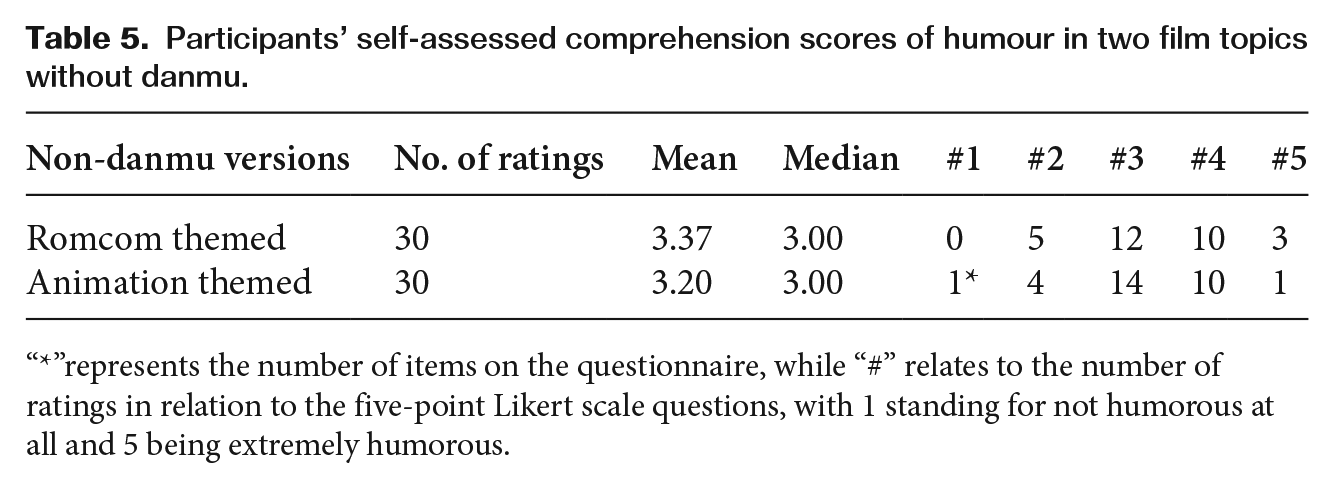
represents the number of items on the questionnaire, while “#” relates to the number of ratings in relation to the five-point Likert scale questions, with 1 standing for not humorous at all and 5 being extremely humorous.
If Table 4 highlights a significant difference in self-comprehension between the two film topics with danmu-enabled humour, Table 5 underscores that no such difference exists in self-comprehension of the non-danmu versions of these topics. The slightly lower self-assessed comprehension scores in animation than in romcom could be explained by the types of humour in the two film topics: most instances of humour in animation belong to the category of foreign cultural-specific humour and heterogeneous humour. In light of this, animation viewers would have to perceive and resolve humour made by the incongruity simultaneously, which takes time and adds difficulties for viewers to consume and comprehend the humorous content. Therefore, if the incongruity is not understood by audiences on the spot, they will experience confusion instead of humour (Robinson, 2022: 127–128). In the case of consuming animation, participants need to pay more attention and bear a heavier cognitive load to the video itself rather than danmu subtitles, while most humour in romcom belongs to a broad spectrum of all the humour categories discussed in our study, which are more likely to align with participants’ daily life and their approachable experiences.
Table 6 shows that for the danmu versions, the evaluations of humour for romcom (3.30) are much higher than that of animation (2.67). Similarly, the median rate for the romcom themed with danmu (4.00) is incredibly higher than the median rate for the animation themed (3.00). This suggests that participants found romcom with danmu much more humorous than that of animation-themed films. This is possible because there is more variety of humour features in the Bridget Jones clips than in the Shrek ones. The former host a wider range of humour types, including linguistically-based humour, Chinese cultural humour, non-verbal humour and heterogeneous humour that are readily accessible to Chinese viewers, while the latter covers culturally-specific humour and heterogeneous humour that are foreign to domestic viewers.
Participants’ evaluations of the level of humour in two film topics with danmu.
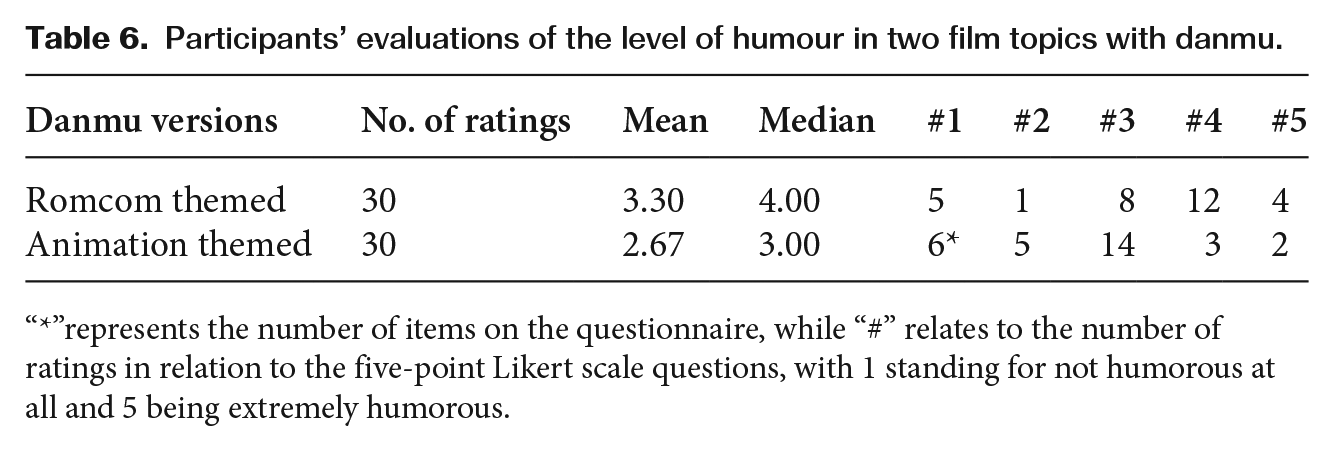
represents the number of items on the questionnaire, while “#” relates to the number of ratings in relation to the five-point Likert scale questions, with 1 standing for not humorous at all and 5 being extremely humorous.
In contrast, in terms of participants’ evaluations of humour in the non-danmu versions, less significant differences can be found across these two film topics. Table 7 reveals that the evaluation rate of humour for romcom without danmu (M = 2.77) is marginally higher than that of the animation (M = 2.73), with both mean deviations almost identical to each other. This suggests that the absence of danmu may have had a slightly positive impact on the perceived humour for romcom over animation. The above findings suggest that the filmic topics of multimodal texts can have an impact on study participants’ perception and consumption of technology-enabled, user-generated texts in the digital age. As can be seen from Tables 6 and 7, audiences tend to prefer films themed with fantastic animation without danmu while opting for a romcom with danmu. The perception of humour in multimodal texts is not only with-and-without-danmu-dependent but also film-topic-specific and humour features-diverse.
Participants’ evaluations of the level of humour in two film topics without danmu.
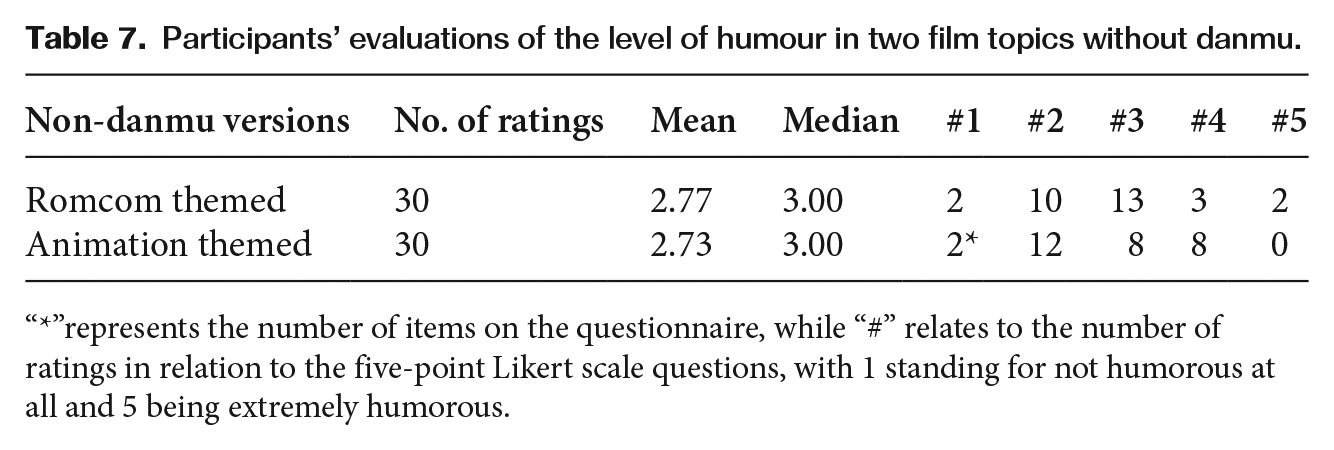
represents the number of items on the questionnaire, while “#” relates to the number of ratings in relation to the five-point Likert scale questions, with 1 standing for not humorous at all and 5 being extremely humorous.
5.3. Post interview
The subsequent post-interview aims to uncover nuanced and specific feedback from participants regarding their viewing experiences of danmu. This study classified participants’ acceptance of danmu, including advantages, disadvantages and neutrality. As Figure 4 illustrates, a higher proportion of them vote for danmu’s disadvantages (54%) over advantages (37%). Audiences’ dislike of danmu consists of three key components: distraction, spoilers and impoliteness. Distraction relates to the quantity and density of danmu that prevent audiences from smooth watching. Spoilers are defined as a retelling, in which ‘the content of already-aired episodes can now be a source of spoiler information for not-yet viewers’ (Perks and McElrath-Hart, 2016: 5528). In our interviews, some of the participants believed that danmu reveals the main plots and endings of the story based on the question that triggers frustration, tension and annoyance among viewers (Newman, 2012). However, Jenkins (2006a) argues that many spoilers function positively to improve viewers’ social, cognitive and emotional engagement. Lastly, impoliteness can be found in the negative comments on danmu, some of which contain offensive jokes and bitter quarrels during the viewing time. Offensive jokes refer to laughter in comedy when it is directed at misfortune rather than ‘outrage, tears or compassion’ (Bicknell, 2007: 458).
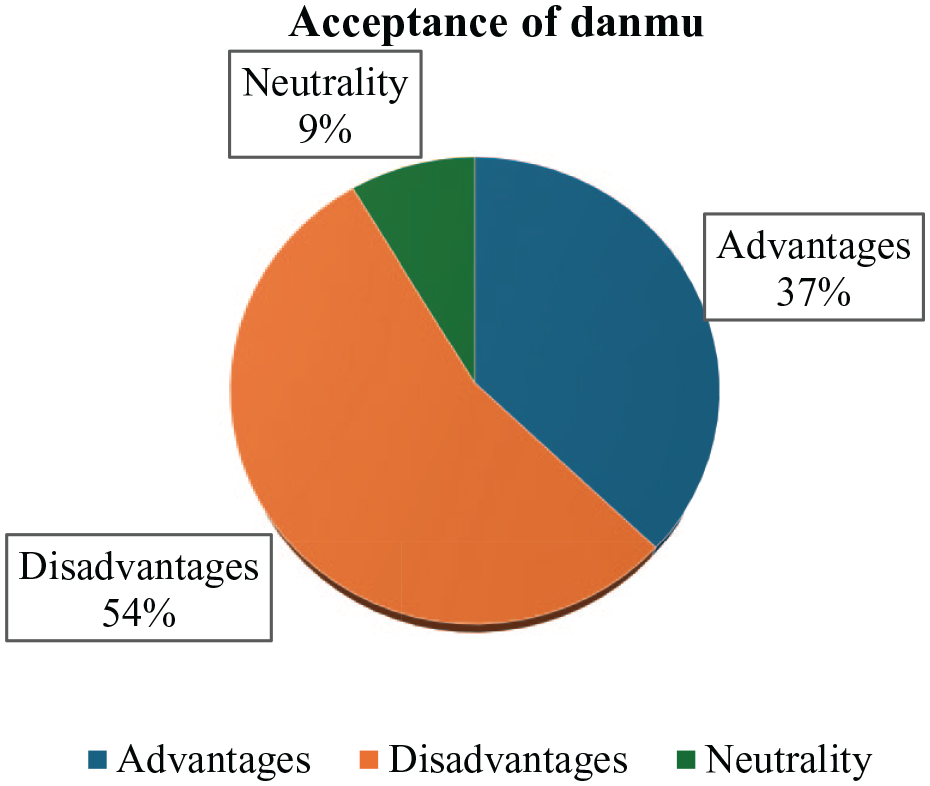
Participants’ acceptance of danmu.
Contrary to the relatively lower support rate for danmu’s advantages compared to its disadvantages, participants brought up more positive points than negative ones. For example, participants who supported danmu summarised that danmu versions are readily comprehensible, more entertaining, knowledge-loaded, highly interactive, multifunctional and customisable. Most importantly, watching videos with danmu is full of a sense of companionship that substantially decreases the feeling of loneliness.
To sum up, the post-interview shows that there is no clear-cut preference for the use of danmu. Participants are able to seek comfort and companionship while watching video clips with danmu and (un)expected humour. Those who dislike danmu because of its distraction, spoilers and impoliteness are still able to freely choose the customisable settings provided to reset danmu’s colour, speed and presentation. Overall, danmu provides audiences with a new and creative perspective for diversifying viewing experiences.
6. Conclusion
To sum up, our results suggest that participants’ evaluations of humour in the danmu versions does not show a significantly higher score than the non-danmu versions. This finding seems to contradict existing literature, which often adopts a discourse analysis approach and emphasizes the humorous and entertaining nature of danmu (Zhang and Cassany, 2019a, 2020). Similarly, our results also suggest that participants’ evaluations of humour vary across different film topics. For the romcom-themed film, participants evaluate danmu-mediated humour as more humorous than that of the fantastic, animated film. Conversely, participants prefer to watch the fantastic, animated-themed film without danmu than its danmu-loaded counterparts, whose viewing experience is almost identical, with the mean deviation between them being merely 0.06. This suggests that the reception of humour in multimodal film texts is danmu-and-non-danmu dependent, film-topic specific and that humour features are diverse. Specifically, humour is favourably received by audiences in relation to romcom-themed films with danmu as well as fantastic animation without danmu based on audiences’ familiarity with the subject matter of different film topics (Dynel, 2009: 1290) and the abundant humour features characterised with these films. Building on these initial findings, future research could test specific hypotheses (e.g. participants will assess the danmu versions as more humorous than the non-danmu versions across other different film topics) using inferential statistics as a follow-up to this study.
This study extended Yus’s (2023) study on investigating internet humour in advertisements and cartoons to exploring danmu-mediated humour via the under-researched film topics of animation and romcom. Our results suggest that danmu-mediated humour is received differently in different film topics. Differences can mainly be seen between the much-favoured film topic of romcom and the marginally received fantastic, animated film. This study also empirically broadened the danmu features of colour and layout as set forth by Zhang and Cassany (2019a) to uncover the diverse ways in which danmu-mediated humour is characterised by linguistically-based, Chinese culture-rooted, non-verbal and heterogeneous complex features. Moreover, our reception study suggests that, for multimodal texts, the desire to enhance entertainment through increasing semiotic complexity and information density (e.g. adding danmu) should not come at the cost of increasing the viewer’s cognitive load, which in turn affects the reception and experience of the original video content. It is suggested that a balance needs to be found between adding entertainment and compromising audience reception and perception of multimodal products in the digital age.
However, this study was limited to 30 participants and only examined three film topics. Future studies looking at more film clips with larger sample sizes are needed to extend our findings. It is also suggested that it would be preferable to extend the video clips to three kinds of video to ensure audiences’ (self-assessed) comprehension of humour: one without any subtitling, one with ‘ordinary’ subtitling and one with danmu. 5 In addition, since individual differences, including participants’ personalities (Chen et al., 2017), familiarity with danmu and acceptance of new things may also influence their reception and perception of humour, future researchers are advised to explore how these factors affect audiences’ evaluations and their actual comprehension (e.g. by conducting triangulation in assessments that combine self-reported comprehension measures, content test and free recall task) of humour in danmu videos. In addition, in this study, audiences’ reception of humour is rated based on the entire humorous effect in the with-and-without danmu video clips; results would have been more revealing if participants had been required to rate particular instances in future studies.
The results of this study point to insightful relations between audience reception and the production of digitally-born multimodal texts, which could provide evidence for improving online participatory and interactive experience, and building customisable user experience. This study thus contributes to opening new directions on this emerging informal participatory phenomenon that permeates numerous layers of the subtle and nuanced voices made by audiences, non-professional audiovisual translators, creative industries practitioners, etc. Such reflexive practice further facilitates complex power dynamics and cultural representations resulting from multimodal and multilingual streaming media, and audiovisual intercultural communications (Hu, 2023).
Supplemental Material
sj-docx-1-vcj-10.1177_14703572251331109 – Supplemental material for An audience reception study of danmu-enabled humour in multimodal texts
Supplemental material, sj-docx-1-vcj-10.1177_14703572251331109 for An audience reception study of danmu-enabled humour in multimodal texts by Lisi Liang and Siwen Lu in Visual Communication
Footnotes
Funding
This work was supported by Ministry of Education of the People’s Republic of China under Grant 21YJC740027, the Philosophy and Social Sciences Planning Projects of Guangdong Province [grant number GD24WZXC02-13] and Guangdong University Featured Innovation Program Project 2024 [2024WTSCX119].

Data Availability Statement
Data sharing is not applicable to this article as no datasets were generated or analysed during the current study.
Supplemental Material
Supplemental material for this article is available online.
Notes
Biographical Notes
LISI LIANG is a lecturer, Yunshan Young Scholar at the School of Translation and Interpreting Studies, and researcher at Centre of Translation Studies at Guangdong University of Foreign Studies. Her research interests revolve around audiovisual translation, with special references to the innovative forms of fan-generated subtitling and dubbing, and multimedia studies. She has published widely in journals such as Babel, Humanities & Social Sciences Communications, Translation and Translanguaging in Multilingual Contexts and New Voice of Translation Studies.
Address: 2 Baiyun Blvd N, Baiyun, Guangzhou, Guangdong Province, China, 510515. [email:
SIWEN LU is a Lecturer in Translation Studies and Modern Languages at University of Sheffield. Her research interests include audiovisual translation (e.g. fan-translation, subtitling), multimodality and informal media cultures. She has published articles in journals including Babel, New Media & Society, International Journal of Communication, Perspectives: Studies in Translation Theory and Practice, and Visual Communication.
Address: University of Sheffield, Jessop West 1 Upper Hanover Street, Sheffield S3 7RA, UK. [email:
References
Supplementary Material
Please find the following supplemental material available below.
For Open Access articles published under a Creative Commons License, all supplemental material carries the same license as the article it is associated with.
For non-Open Access articles published, all supplemental material carries a non-exclusive license, and permission requests for re-use of supplemental material or any part of supplemental material shall be sent directly to the copyright owner as specified in the copyright notice associated with the article.
