




Abstract
Much attention has been dedicated to how digital platforms change the nature of modern conflict. However, less has been paid to how the changes in the nature of warfare affect everyday lives. This article examines how digital mediation allows a convergence of the domestic environment and the battlefield by offering new ways for participation in warfare. It contributes to the discussion of how new participatory affordances change the nature of conflicts and whether they empower users or offer institutional actors more control over users. To this end, this research explores the transformation of domestic spaces, mediated via memes, as digital artefacts of participatory culture (see Confronting the Challenges of Participatory Culture: Media Education for the 21st Century, 2009, by Henry Jenkins). Building on the notion of domestication (see Domesticating the Revolution: Information and Communication Technologies and Everyday Life, 1993, by Roger Silverstone), the article conducts a discursive analysis of memes referring to the notion of ‘sofa warfare’ – an ironic description of internet users taking part in conflict without leaving their own sofas – in the context of the Russia–Ukraine conflict.
Keywords
Introduction: War and mediated participation
A renowned historian of war, Martin van Creveld (1991: 89), has described the paradox whereby war is ‘the most confused and confusing of all human activities’, which ‘at the same time is also one of the most organized’. The nature of war has been continuously changing. Nowadays, scholars describe the essence of the change in the nature of warfare through a variety of concepts, including those of hybrid warfare (Hoffman, 2007), proxy warfare (Maurer, 2015), asymmetric warfare, irregular warfare, and others. A distinct body of literature addresses information – and cyber warfare (Carr, 2011). Specific attention has been dedicated to the role of information technologies, including the case of network-centric warfare, which relates to the role of information systems in the management of warfare, and the case of remote warfare (Crawford, 2015), where digital technologies allow participation in a conflict from a distant location.
A number of scholars have highlighted how information technologies afford new forms of participation in warfare. Pötzsch (2015: 81) argues that ‘New media ecologies enable unprecedented forms of participation and dissemination that make the discursive function and political impact of information in war increasingly unpredictable.’ According to Patrikaros (2017: 182) ‘anyone with an Internet connection can become an actor in a war’. Merrin (2018: 214) argues that participative war leads to a reality where every war zone is transformed into a global battlefield. That said, the increasing opportunities for participation do not necessarily mean an increase in the agency of users with regard to their relations with conflict. New participatory affordance also enables new forms of governmentality of a subject’s everyday life (Grondin, 2011), as well as a ‘militarization of [a subject’s] inner space’ (Orr, 2004) directed by state actors.
In this light, this article is concerned with the question: ‘What is the major contribution of participatory technologies to the change in the nature of conflicts?’ The ongoing debates about the increase in forms of participation have been focused on the emergence of new actors and/or have highlighted how participative technologies are used by traditional actors to achieve their conflict-related goals. There is, however, an additional dimension of change. This relates to how conflict changes our everyday lives. It focuses attention on the question of whether participatory affordances empower users in a context of conflict, or whether they offer institutional actors more control over users in a situation of security-related crisis. To tackle this question, this article addresses the impact of conflict-related participatory affordances on the most private space of users – their homes.
Andrejevic (2007: 162) argues that internet users become citizen-soldiers when ‘we are invited to participate in the war on terrorism from the privacy of our homes’. As a consequence of digitally mediated remote participation, not only can military operation centres manage drones from thousands of kilometres away, but warfare can also be managed from bedrooms and mediated by personal digital tools. This type of warfare from private spaces has remained almost beyond the scope of discussion, perhaps because its potential impact on the actual battlefield is considered limited. In this light, the question that seems to be neglected is not how technologies change warfare, but how the changes in the nature of warfare transform the everyday lives of people far beyond the space of battle and what the consequences are of a situation where warfare becomes a part of daily routine practices?
To shift attention from the new forms of participation to warfare’s embeddedness in everyday life we need to focus on the spatial dimension of this digitally mediated expansion of war. This article explores how new forms of participation in conflict change the structure of users’ domesticity. For this purpose, the article examines the phenomenon of ‘sofa warfare’ (Shatilov, 2014). Sofa warfare and ‘sofa troops’ are ironic descriptions of internet users who take part in conflict without leaving their own sofas. The notion of ‘sofa troops’ is often linked to one of low-risk participation or of meaningless activity requiring minimal effort. At the same time, sofa warfare can be considered not as a participatory practice but as a discursive construct that highlights how warfare can take place in a private space. The household becomes a site of struggle between the privacy of everyday life and the external forces that change this space through relying on new forms of digital mediation.
Approaching sofa warfare as a discursive structure requires a theoretical and methodological framework enabling us to follow the transformation of domestic space in light of the new forms of digital mediation that allow participation in conflicts. The next sections develop this type of framework. First, a brief review of the literature concerning the role of conflict in everyday life establishes a context that allows us to examine the role of digital mediation in changing the nature of warfare. Second, the concept of domestication offers an opportunity to conceptualize how digitally mediated warfare changes the domain of our private lives. Thirdly, consideration of memes as a unit of analysis offers a methodological opportunity to explore the discourses of sofa warfare. An empirical section analyses the transformation of the domestic space in a context of conflict-related participatory practices.
Literature review: Everyday life and participation in conflict
Traditionally, ‘everyday life’ was not considered as a domain having value for the analysis of international politics. According to Guillaume and Huysmans (2019: 287), there is a need to shift attention from ‘moments of crisis’ to ‘how quotidian and ordinary temporalities are affected by or are affecting the international’. At the same time, everyday life appears in critical approaches to the study of the everyday domain (Sztompka, 2008) as an object of control. Totalitarian regimes seek to diminish the inviolability of private space, so that even ‘walls have ears’. The Foucauldian approach suggests that various forms of governance seek to structure everyday life that relies on ‘dispositifs’ as a ‘thoroughly heterogeneous ensemble consisting of discourses, institutions, architectural forms . . .’ (Foucault, 1980[1977]: 194). In this sense, both technologies and the discourses that address these technologies take part in the constitution of everyday life and can be considered as elements in networks of power.
According to Lefebvre (1987: 10), the everyday ‘is a product’ and a domain of ‘organized passivity’ in ‘work, family, private life, leisure’. Thus, everyday-related manipulation seeks to neutralize people’s agency. At the same time, Guillaume and Huysmans (2019: 291) highlight processes related to ‘mobilising private or personal lives as political’, as seen in feminist approaches. According to Wibben (2018: 142), critical feminist security scholars ‘reveal how militarism is reliant on gender hierarchies that also shape everyday lives’. In her analysis of a Heinz Tomato soup can, Enloe (2000) demonstrates how militarization may affect a variety of everyday objects from toys to condoms. She concludes that ‘Militarization is a specific sort of transforming process, but the list of what can be militarized is virtually endless’ (p. 4). That type of militarization often reinforces gender hierarchies and re-articulates ‘hegemonic masculinity’ (Enloe, 2015).
The diversity of approaches highlights how the everyday can be considered as a domain of the struggle between the agency of users seeking control over their own lives and the desire of hegemonic actors to have users under their control. In this spirit, Campbell (1996: 23–24) points out that everyday life is ‘a transversal site of contestations . . . because the conflicts manifested there not only transverse all boundaries; they are about those boundaries, their erasure or inscription, and the identity formations to which they give rise.’
Identifying the boundaries of the everyday becomes, however, more challenging in a crisis context. One the one hand, a crisis can be considered as a temporal retreat of everyday life (Barton, 1969). On the other hand, the everyday can be seen as an integral part of a crisis while ‘everyday life goes on, even in the midst of madness’ (Proctor, 2014). The distinctive nature of ‘the everyday’ in a context of conflict has been challenged in the case of civil wars. According to Beck (2013: 15), civil wars ‘show a tendency towards a three-dimensional decomposition of boundaries’, including the division between combatants and non-combatants, the spatial dimension that addresses the location of the battlefield and the temporal dimensions that addresses the distinction ‘between times of war and times of peace’. This decomposition means that ‘the theatre of war shifts from the front into everyday life.’ The expansion of wars into the domain of everyday life can also be linked to the change in the nature of modern conflicts, while in the most recent mode of war ‘civilians crowd the battlefield, both literally and – because of the media – figuratively’ (Smith, 2006: 17).
Critical military studies suggest focusing on the analysis of the constantly shifting boundaries ‘between what is “military” and what is “civilian”’ (Basham et al., 2015: 1). For instance, Ochs (2011) analyses the case of Israel in order to describe the process of proliferation of state security in daily life. According to Ochs (2011: 9), ‘The security that materialized in everyday habits and desires tended to extend, rather than oppose, sovereignty and violence.’ Kuntsman and Stein (2015: 12) also address the Israeli case, to explore the contribution of digital platforms to ‘the penetration of military mores into the most mundane and private civilian domains’. They offer a concept of ‘digital militarism’ for exploring how information technologies have enabled the ‘extension of militarized culture into social media domains’ (p. 6). Kuntsman and Stein describe various forms of citizen engagement during the conflict in Gaza in 2008–2009, including the employment of hashtags, likes, shares, memes and selfies for the purpose of collaboration between state and users online, and as a means of supporting state violence (p. 37).
Critical approaches highlight how participatory affordances empower state actors. For instance, Andrejevic (2007: 162) underlines how ‘in a disturbing twist to the interactive promise of the internet, once-passive spectators are urged to become active participants.’ At the same time, some authors (e.g. Patrikaros, 2017) argue that participatory affordances allow users to challenge hegemonic actors by offering alternative narratives. That said, the discussion of participation cannot be limited to the information domain that includes ‘sharing images, posts, video, memes and propaganda’, as described by Merrin (2018: 218). Various crowdsourcing practices expand the range of participation by users and allow various resources of the digital crowd to be mobilized in order to achieve different conflict-related goals (Asmolov, 2019). These include participation in ‘hacktivism’ (Lokot, 2017), the analysis of open source intelligence (OSINT), crowdfunding practices that support the purchasing of military ammunition, as well as the facilitation of conflict-related offline activities ranging from logistical assistance to actual participation in warfare (Boichak, 2017).
The increase in the diversity of forms of participation highlights how digital platforms mediate new forms of relationship between users and conflicts. Research on digitally mediated participation in conflict is focused more on the technologies of engagement, and less on how the offline space of everyday life is modified by new participatory opportunities. The latter requires a framework allowing us to follow how digital tools may change the private spaces of users. The next section suggests an analysis of the role of participatory technologies, relying on the concept of domestication.
Theoretical framework: Digital mediation in the private space and the domestication of warfare
Home is considered to be an ‘internal site of everyday life in which objects from the exterior pervade’ (Bakardjieva, 2005; Courtois et al., 2012: 423). It should be mentioned that ‘home’ as a private space is a relatively modern invention. According to Walter Benjamin (1999[1927–1939]), the division of life into private and public spheres started under the rule of Louis-Philippe (1830–1848) and resulted in the development of the concept of ‘the interior’. According to Abbas (1988), ‘corresponding to this spatial division is a psychic division’ between the office and the private space where ‘the private citizen takes refuge, suppressing both social and business preoccupations’ (p. 220). The interior is a space that has created ‘the padded case of the self’ of the private citizen (Jonsson, 2001: 559). However, the shelter of the interior is under constant pressure from external forces, while the ‘presumed autonomy [of the interior], continues to be mediated by the exteriority of modern society, against which it reacts and claims to protect’ (p. 560).
One of the factors allowing external forces to change the domestic space from within is the media. This includes the way in which wars and conflicts get into the private space. Hoskins and O’Loughlin (2015: 4) address this question by drawing on the notion of mediatization, which they define as ‘the process by which warfare is increasingly embedded in and penetrated by media’. The more the media become part of a war, the more the war becomes part of our everyday lives. The above discussion of the role of participatory technologies, however, highlights how the role of information is not limited to that of the media. Addressing the question of this study requires that we shift attention from the mediation of meanings to the mediation of the new forms of conflict-related activities by digital tools. To explore the role of technologies in changing the domestic space, I rely on the notion of domestication.
According to Silverstone (1993: 229), our domesticity is ‘constituted in a constant and dialectical interrelationship with that outside world. Media and information technologies are central to this dialectic.’ The concept of domestication addresses how technological artefacts have been appropriated as a part of everyday routine and ‘given a comfortable physical and discursive space within the home’ (Courtois et al., 2012: 423). Silverstone (1993: 229) defines the household as a ‘resource system, in which both symbolic and material resources are mobilized for the engagement with the outside world as well as internally’. The core aspects of domestication address the change in mobilization of these resources. Domestication does not necessary mean that technologies are ‘brought (or not) under control by domestic users’ (p. 227). In some cases, on the contrary, the technologies take over the life of their users. The domestic space becomes a site of struggle between internal and external forces ‘for the control and management of its space and times’ (Silverstone, 2005: 13).
The nature of struggle has been addressed as a shift in boundaries between the interior and external worlds: ‘technologies can be seen to be both boundary breaching and breaking as well as . . . boundary restoring and securing’ (p. 15). The role of digital platforms as ‘key mechanisms in the erosion of the boundary between public and private spaces’ offers new opportunities for external intrusions. Silverstone (1993: 231) considers ‘the arrival of teleworking’ as among the types of intrusions that lead to ‘the possibility of a significant restructuring of the relationship between home and work’.
The domestication of technologies is not limited to the appropriation of physical artefacts. The essence of domestication is the appropriation of various forms of activity afforded by an artefact within a private household space (Courtois et al., 2012). Domestication is related to what technology affords us the opportunity to do from home (Bucher and Helmond, 2018) and to how these affordances are realized through digitally mediated activity (Kaptelinin, 2014). In this sense, conflict-related participatory affordances can potentially contribute to breaching the boundaries between the external and the interior.
That potential restructuring of the relationship between home and war can also challenge the traditional role of the domestic space in a context of conflicts. A number of scholars point out the gendered binaries between men as protectors at the front lines and women as protected at the home front (Jarymowycz, 2020). However, that division may be reconsidered if home also becomes a space of war. That may also lead to the need to examine how conflict-related participatory affordances change the role of home as a space that is involved in a construction of gender identity (Rezeanu, 2015), new forms of gender asymmetries and a possible reproduction of masculine hegemony. Some researchers highlight the role of digital technologies in the change of the gender aspect of domestic space. For instance, the proliferation of computer gaming leads on the one hand to ‘Increasing encroachment of masculine leisure activities into . . . traditionally feminine and domestic leisure spaces’ (Bryce et al., 2006 : 194) but, on the other hand, offers new ‘sites for resistance to societal notions of the gender appropriateness’ (Bryce and Rutter, 2003 : 1).
To examine the phenomenon of sofa warfare, this article offers the notion of a ‘domestication of warfare’. Approaching sofa warfare in the context of domestication suggests that we should explore how digitally mediated practices that allow participation in warfare change the private space. Addressing the domestication of conflict in the context of breaches in the boundaries between private and public space highlights the need to explore whether we, as inhabitants of households, are domesticating conflicts or conflicts are ‘taming the users’. Domestication is a discursive process that suggests how various discourses shape the structure of domestic space. Following the notion of discursive domestication (Burgess, 2007; Hartmann, 2009), sofa warfare is examined here as a discursive structure presenting the location of warfare in the everyday life of users. The next section offers a framework for analysis of the discourses of domestication of warfare in the context of the Russia–Ukraine conflict.
Methodological framework
‘Sofa warfare’ as a meme and a discourse of space
The cultural origins of the notion of sofa warfare are linked to a broader phenomenon of ‘armchair experts’. Sofa warfare, however, became one of the major notions discussed in relation to the role of the internet during the Russia–Ukraine conflict. Shatilov (2014: 57) defines ‘sofa troops’ as ‘an active part of the users of social Internet networks, taking regular informal part in virtual information wars’. An online search for the notion of sofa warfare shows that it appears in a number of contexts. It is mentioned in media articles and by users in the context of discussion of the role of the internet in the conflict between Russia and Ukraine. It is also the subject of a number of dedicated chapters in Russian online encyclopedias of underground culture (Absurdopedia; Lurkmore; Wikireality). The most frequent references to sofa warfare can be found, however, in various types of images considered as memes. Our methodological framework suggests an approach to memes as a form of discursive construction that allows us to examine how the domestication of warfare changes the private space of users.
The notion of a meme was coined by Richard Dawkins (1976). Shifman (2013: 367) defines memes as ‘units of popular culture that are circulated, imitated, and transformed by individual Internet users, creating a shared cultural experience in the process’. According to Huntington (2013: 4), a meme is ‘a useful tool for Internet users to shape and declare their identity and to participate in discourse related to events in the media’. Following Jenkins (2009), Wiggins and Bowers (2014/2015: 7) argue that ‘Internet memes exist as artifacts of participatory digital culture’.
Memes have a particular importance in Russian internet culture, where they seek to avoid censorship by using satire (Denisova, 2019). Moreover, building on Bakhtin’s concept of the ‘carnivalesque’, memes can be approached as a form of counter-discourse that challenges hegemonic narratives of the state in a form of ‘E-carnival’ (Boje, 2001; Denisova, 2017). Milner (2016: 149) highlights the double nature of memes located at the centre of ‘ambivalent everyday antagonisms’. On the one hand, they can be ironic and subversive. For instance, memes can offer a critical account of participation in cases of low-risk protests and clicktivism, as in the case of the Occupy Wall Street protests (pp. 170–172). On the other hand, memes can ‘reinforce oppressive ideologies’ (p. 183) and be co-opted by hegemonic actors (Pearce and Hajizada, 2014). The case of Occupy Wall Street also illustrates an ambivalence related to ‘brand appropriation’, where the symbols created as part of participatory memetic production are transformed into a commercial brand (Milner, 2016: 162). According to Kuntsman and Stein (2015: 52), the production of memes can be seen in the context of digital militarism as a form of state-driven engagement.
This methodological framework allows us to highlight a link between participatory warfare and participatory culture. Sofa warfare exists both as a practice of digitally mediated participation in conflicts and as a discursive construct that shapes the identities and the communities of those who take part in conflicts. Here, I would argue that the object of discursive construction includes not only identities and virtual communities, but also an additional set of objects – the everyday life of users. In this light, memes both reflect and shape the role of digital tools in participation in warfare. Exploring the process of domestication of warfare therefore requires an analysis of memes as discourses that take a part in shaping private space.
Methods: Memes as a unit of analysis and data collection
Exploring how the digital affordances of participation in warfare change the domestic space relies on the discursive analysis of memes as digital artefacts ‘transmitted by consumers–producers for discursive purposes’ (Wiggins and Bowers, 2014/2015: 1892). Milner (2016: 223) suggests that the collection of a corpus of memes should be focused on discursive strands (Siegfried and Maier, 2016). The present study relies on the collection of a corpus of artefacts forming a discursive strand related to the phenomenon of sofa warfare in the context of the Russia–Ukraine conflict. Scholars differentiate between ‘individual meme instances, meme families, and the entire memetic network’ (Segev et al., 2015: 418). The memes concerned with sofa warfare are approached here as a meme family with a shared quiddity. In the case of sofa warfare, these shared quiddities are connected to the verbal notion of sofa warfare as well as to visual elements that link symbolic representations of military/warfare-related objects to a domestic space, specifically that of sofas and armchairs.
A number of scholars have developed strategies for a sampling of the most popular memes that relies on ranks in search engines (Shifman and Lemish, 2010) and a multi-platform search for memes (Knobel and Lankshear, 2007). The purpose in this study is rather different since it is focused on the analysis of a family of memes concerned with a specific topic. Alternative approaches to the sampling of memes rely on the notion of ‘thematic saturation’ (O’Reilly and Parker, 2012) that can be reached ‘when no new patterns emerged from the data’ (Literat and Van den Berg, 2019: 236). In this sense, the data collection of memes from a specific family sets out to find the maximum sample of memes related to specific quiddities, and to make sure that no new memes with principally different features are found. Finally, the sampling of memes is also driven by the fact that one of the attributes of memes is ‘their diffusion through competition and selection’ (Shifman, 2013: 365). In this sense, memes also compete for the attention of the researcher. The success of a meme in reaching the sample for this study is an outcome of the overall online performance of the meme (Knobel and Lankshear, 2007).
Data collection for this study relied on a multilayer approach. First, three search engines, Yandex, Google and Bing, were used to carry out a dedicated search for images. All the images related to the key words ‘sofa warfare’ and ‘sofa troops’ (‘divanniye voiska’ in Russian) were extracted from these search engines. Second, the search engines were used to identify websites and forums with discussions related to the notion of sofa warfare. Popular Russian websites dedicated to humour and memes (e.g. yaplakal.ru; fishki.net; pikabu.ru; demotivatorium.ru; reactor.cc; joyreactor.cc) were also searched for memes related to sofa warfare. The collection was divided into three types of meme-related images: the memes themselves, the badges related to memes and merchandising relying on memes and badges. A certain level of ‘thematic saturation’ was reached when the scale of repetition of more than 20 of the selected memes in the search results in each of the three groups was reached.
Data analysis
The population of memes under analysis included 212 images collected in 2018. ATLAS.ti was used to organize and tag the dataset. A thematic analysis was carried out to divide memes into a number of groups, addressing their discursive function in relation to the construction of domestic space. Thematic analysis (Braun and Clarke, 2006) allows the incorporation of several theoretical standpoints. On the one hand, the coding was informed by the frameworks for discursive analysis of the role of online memes for cultural production (Knobel and Lankshear, 2007). At the same time, the thematic analysis was focused on categories related to the quiddities of the family of sofa warfare memes, including ‘object, action, specific character, generic character and phrase’ (Segev et al., 2015: 424).
The sample of 32 images was reviewed first in order to acquire a high level of familiarity with the data. Some additional codes were generated that were related to specific quiddities identified in the sample. Then the images were analysed, relying on a coding scheme. The codebook included several variables: type of object subject to militarization (e.g. furniture or electronic devices); settings (room/ outside); type, location and role of furniture; nature of process related to militarization and type of activities in the image; properties related to a person (gender, age, location and activity); role of text (descriptive, patriotic or critical); and critical function of meme (whether it has any explicit message that criticizes the practice). In addition, the analysis examined whether the meme had a function in setting out a common identity for a group of users and whether the meme was used to create a physical object.
As pointed out by Highfield and Leaver (2016: 54), the analysis of memes raises questions ‘around copyright and authorship that become quite fuzzy’. Milner (2016: 231–232) suggests that the reproduction of memes for the purpose of research rely on the notion of fair use and that there is no obligation to seek permission for images reproduction. This study follows the guideline for reproduction of memes as set out by Milner and by MIT Press.
Analysis: The memetic discourses of sofa warfare
The concept of sofa troops is addressed by dedicated chapters in three wiki-based encyclopedias that focus on underground Russian internet culture: Lurkmore (see Figure 1), Absurdopedia and Wikireality.
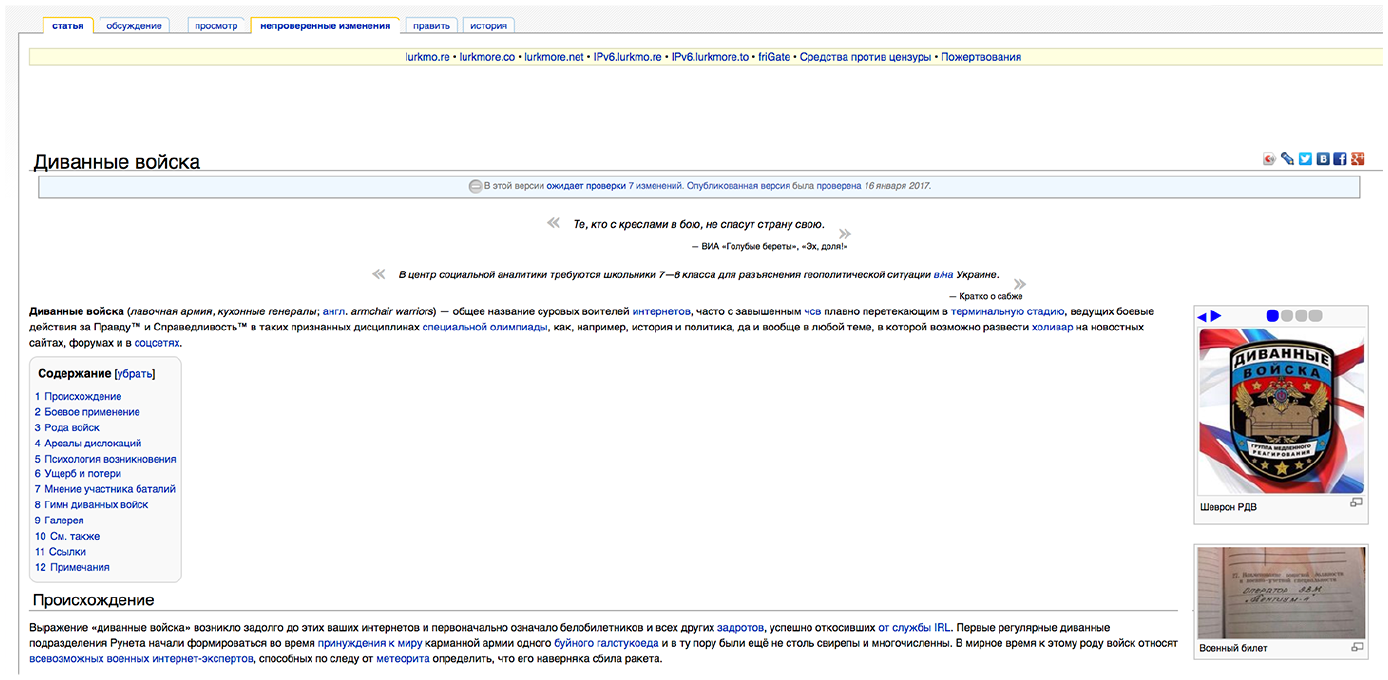
Chapter on sofa troops in Lurkmore.co.
All these chapters use the image of a badge with a sofa that is transformed into a double-headed eagle and title ‘sofa troops’ as a lead illustration. Searches for ‘sofa troops’ using image search engines including Yandex Pictures and Google Images were also dominated by badges (coats of arms) of sofa troops (see Figure 2).
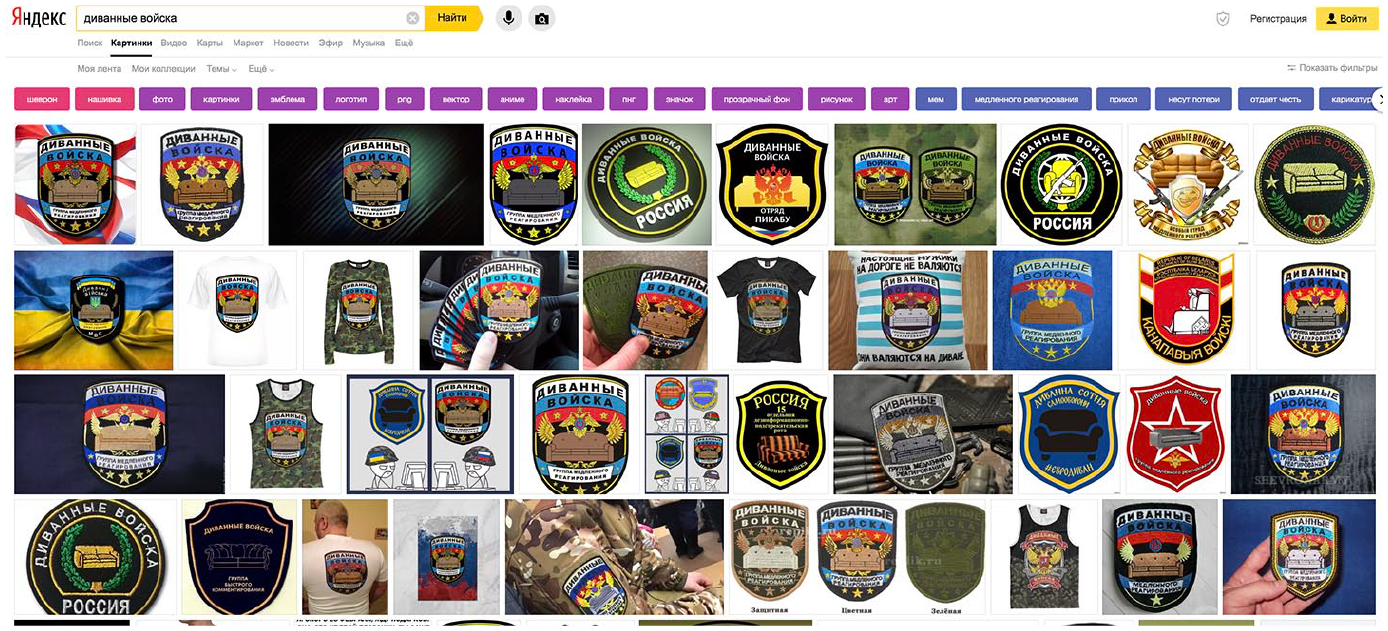
Results of search for key words ‘sofa troops’ with Yandex Pictures.
The case of badges therefore requires particular attention. The selected badges shown in Figure 3 allow a more detailed analysis. They have all been constructed around a sofa as a central element. The first four badges (from 1 to 4) are those of Russian sofa troops. Numbers 5 and 6 have been created for Ukrainian sofa troops. Number 7 is linked to Belarussian sofa troops and number 8 to sofa troops from Kazakhstan. Most of the badges include some type of state symbol such as the Russian eagle (1), Soviet stars (4, 8) or national flag colours (1, 5, 6, 7). The mottos read ‘the forces of slow response’ (1, 4, 7), ‘a rapid comment response group’ (2) and ‘we don’t respond at all’ (8). The badges can be considered as a form of symbolic production of common identity, which builds on the notion of sofa as a common denominator in a context of online participation in conflict-related activities.
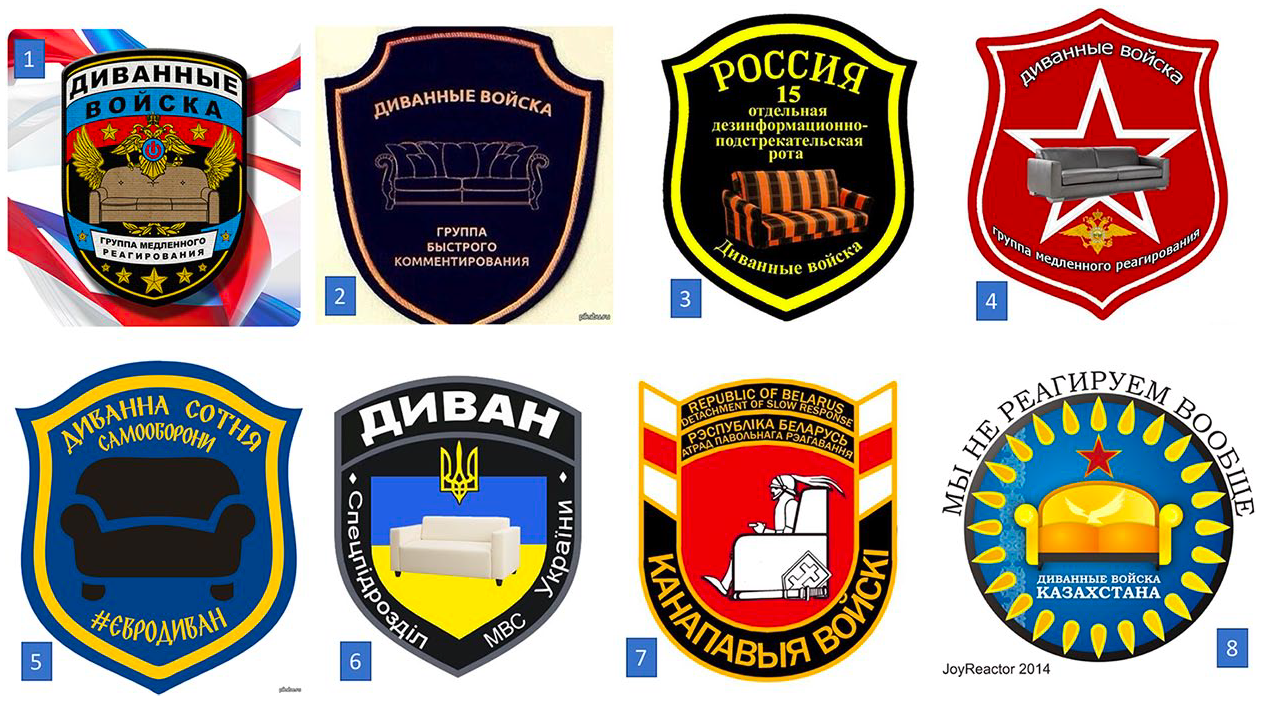
Badges of sofa troops.
The badges also became a major element in one of the common visual representations of sofa troops. The image in Figure 4 shows two internet users sitting in front of their computer screens. One wears a military helmet with a Ukrainian flag, the other a helmet with a Russian flag. Ukrainian and Russian badges are seen above both users. This image was transformed numerous times to include sofa troops from different national backgrounds including Kazakhstan, Armenia and Germany.
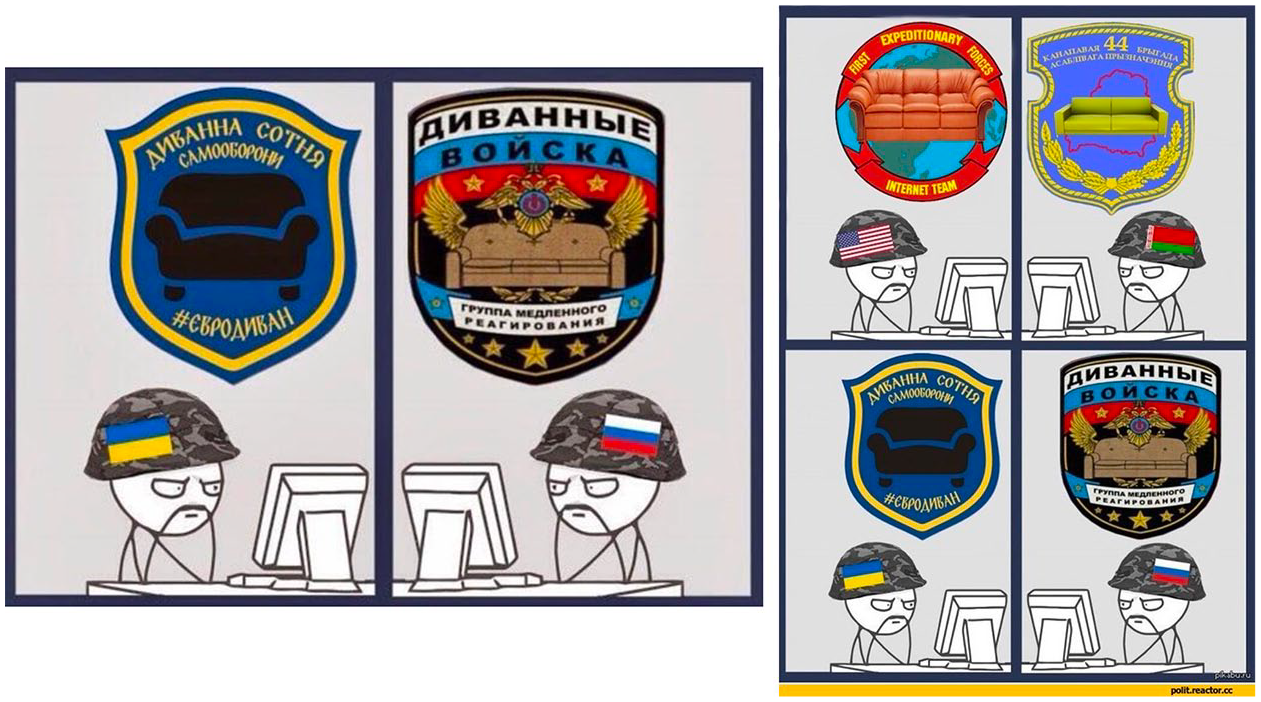
The ‘sofa warrior’ meme from March 2014.
There is a broad repertoire of other elements that form part of the construction of the identity of sofa troops. As seen in Figure 5, there are rank insignias for sofa troops, dedicated medals and diplomas for participation in online battles and even a special ‘death notification’ format announcing that a sofa warrior has been ‘killed’ by a unit of enemy trolls.
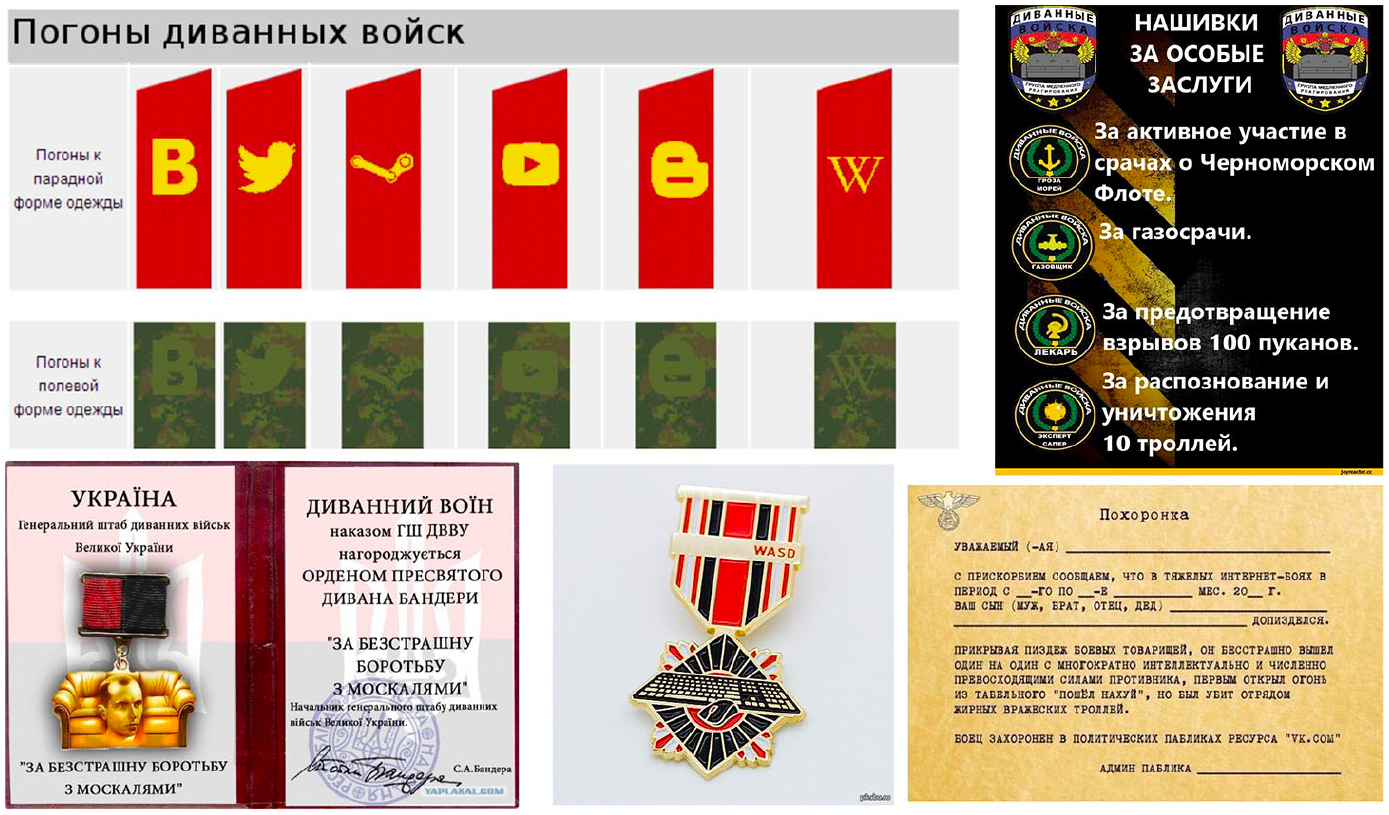
Rank insignias and medals for sofa troops.
In addition to the production of an identity, we can see how memes produce a symbolic representation of the physical private space of users, and particularly of the sofa.
The images in Figure 6 show the ‘armoured vehicles’ of sofa troops. An item of furniture usually used to watch TV is presented like a tank or a machine gun. Here we see a contradictory integration of cosiness with aggressive military equipment. Some of the memes offer an even greater level of detail, transforming a sofa from an item of everyday furniture into a military machine.
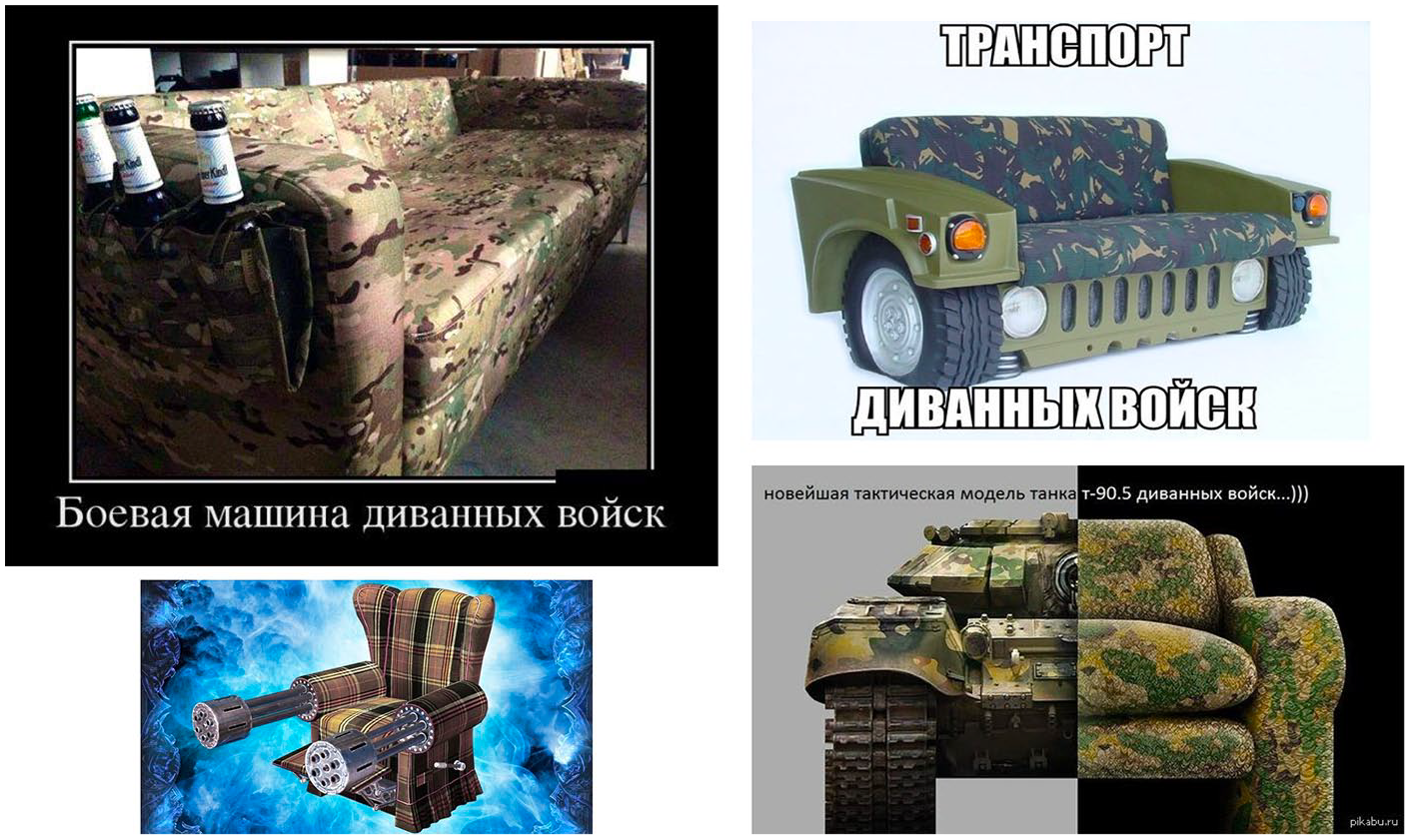
Memes of sofa militarization.
The images in Figure 7 present a ‘self-propelled multipurpose “expert” sofa’. The images suggest that the sofa has a fuel tank and a communication device, as well as ‘Sofa-Internet’ rockets that can be used against online opponents.
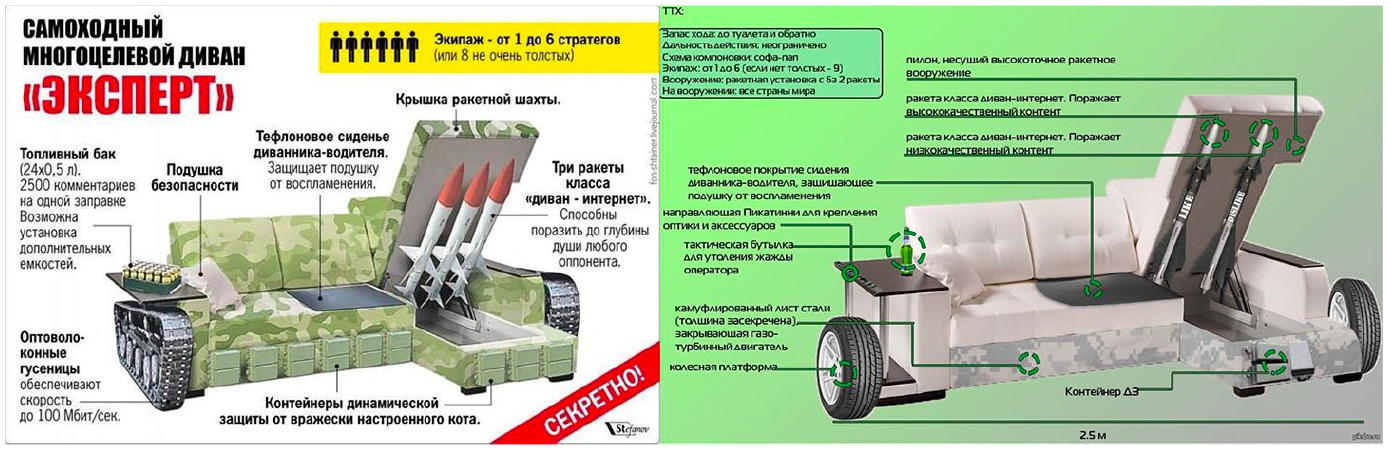
Self-propelled multipurpose ‘expert’ sofa.
An additional group of memes (Figure 8) deals with the transformation of the bedroom. Here, a private space is transformed into a military situation room. The image on the right demonstrates a sofa surrounded by computer screens with the title ‘position of the general of sofa troops’. Another image (bottom left) reads ‘a secret technology of sofa troops’. The image at top left presents a ‘sofa warrior’s helicopter’.
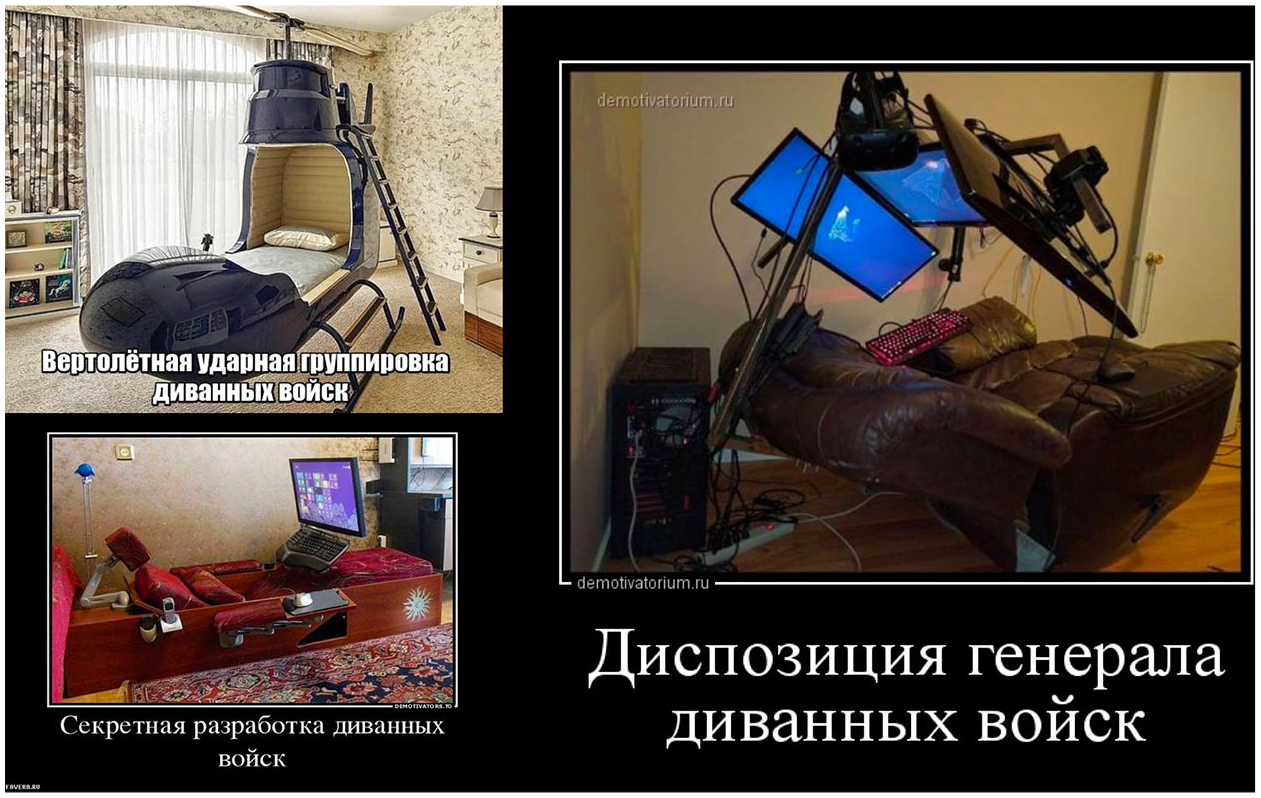
Memes and the transformation of bedrooms.
As highlighted by Enloe (2000), militarization may potentially involve endless lists of objects. The symbolic transformation of domestic objects is not limited to the furniture. One set of memes (Figure 9) offers a symbolic construction of the militarization of another type of domestic object. The image at top left presents the transformation of a keyboard into a machine gun (with the title ‘total mobilization’). The image at bottom left shows the ‘service pistol of an officer of sofa troops’. The meme at bottom left suggests a similar type of transformation of a TV remote control (with the title ‘sofa special forces’).
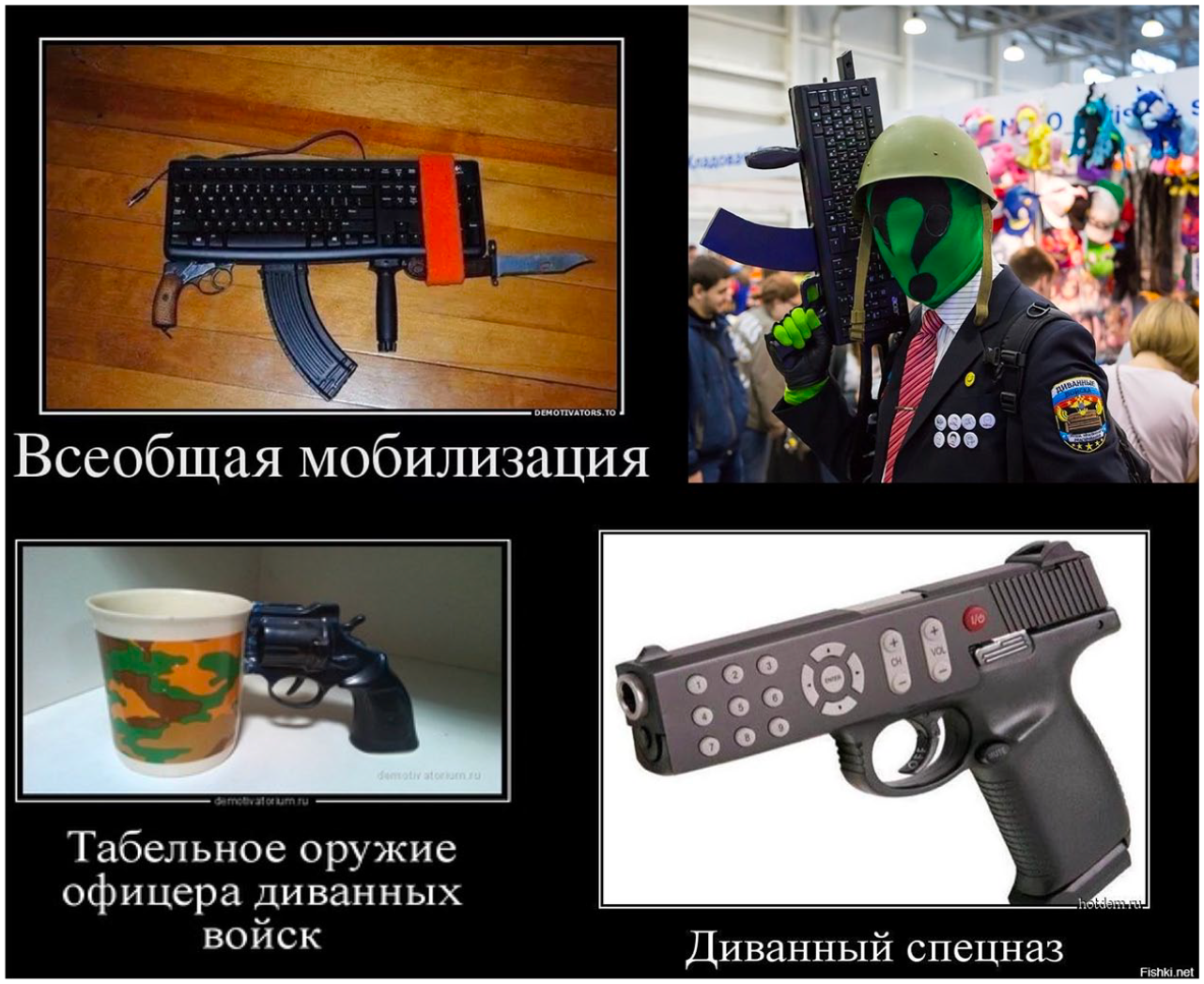
Militarization of domestic artefacts.
The next set of images (Figure 10) identified in our analysis presents the location of users in the context of a militarized private space.
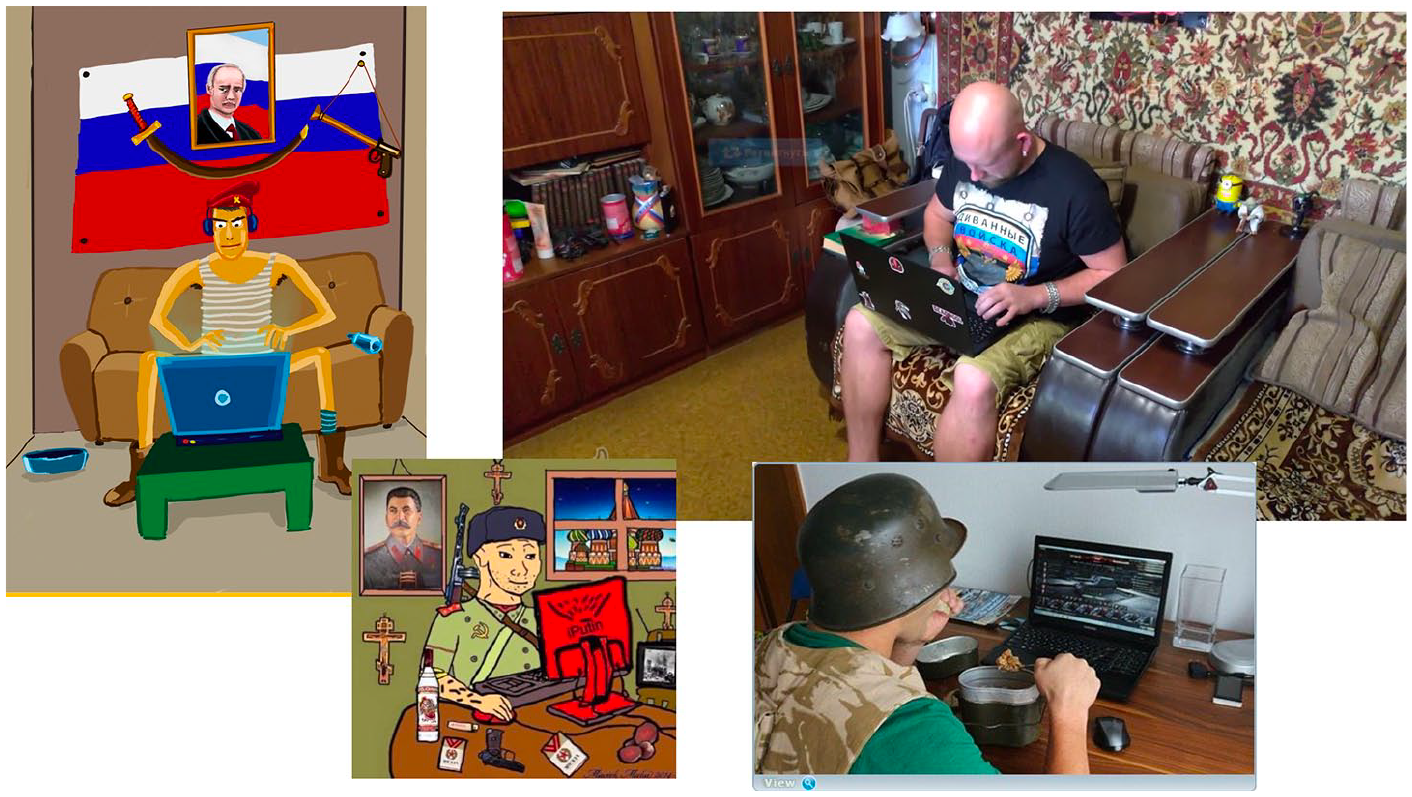
Users in a militarized private space.
The two images on the left present drawings of a domestic sofa warrior. Here we see several common elements: the leader’s portrait, some type of military uniform, a state symbol (a national flag or an image of the Kremlin), weapons and alcohol. The images on the right present photos of militarized spaces. At the top, a laptop user has a T-shirt with a sofa troops badge. The bottom image, which is often used in articles linked to the notion of sofa troops, demonstrates a gamer in a military uniform, eating military food in front of a laptop screen showing a tank. Here the militarization of the domestic space is achieved via the transformation of the user. Interestingly, in all cases, the user is a man. Women seem to be excluded from the visual representation of ‘sofa troops’.
The images in Figure 11 are titled ‘camouflage of sofa troops’. The images illustrate a new type of relationship between a person and his sofa in the context of the militarization of domestic space.
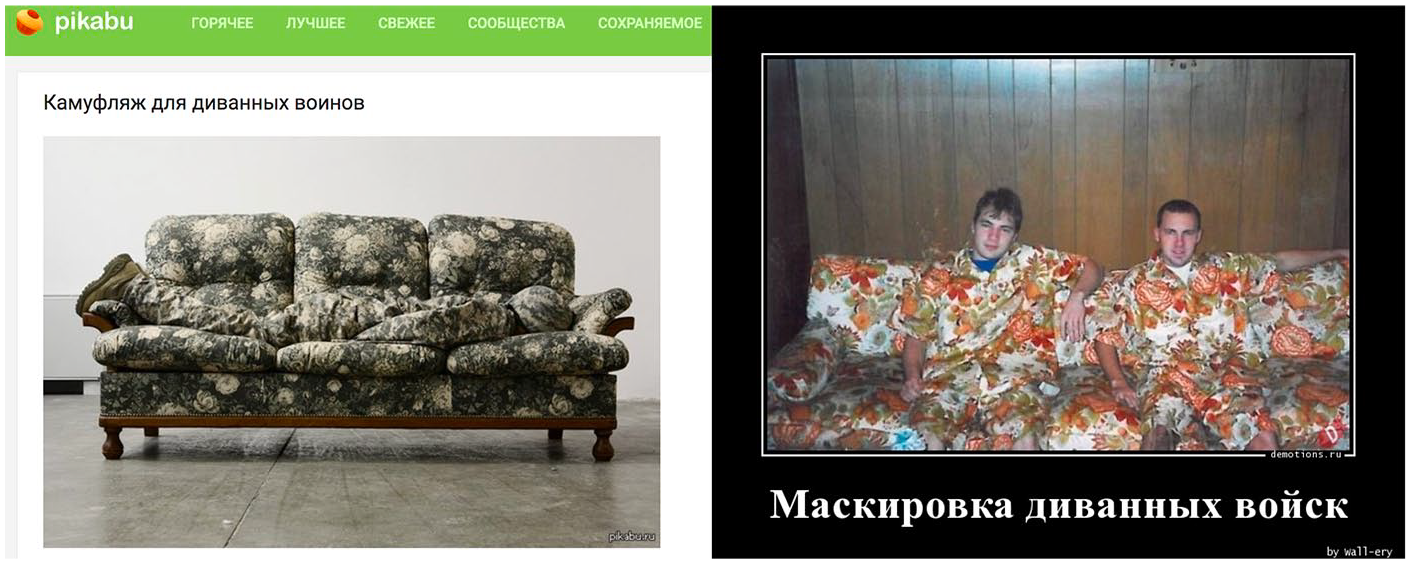
User–sofa relationships in militarized private space.
The representation of sofas is not limited, however, to passive militarized objects in a private space. As a military machine, the sofa takes on a new life that allows it to be an active agent of warfare and to leave the bedroom or living room. In the images in Figure 12 we can see the sofa meme as a vehicle in a shooter survival game, as an offline armoured vehicle or a jet fighter. One of the most popular memes of the sofa can be seen at top right above. The title of this image, showing sofas on a road, is ‘Russian forces move toward Kiev’.
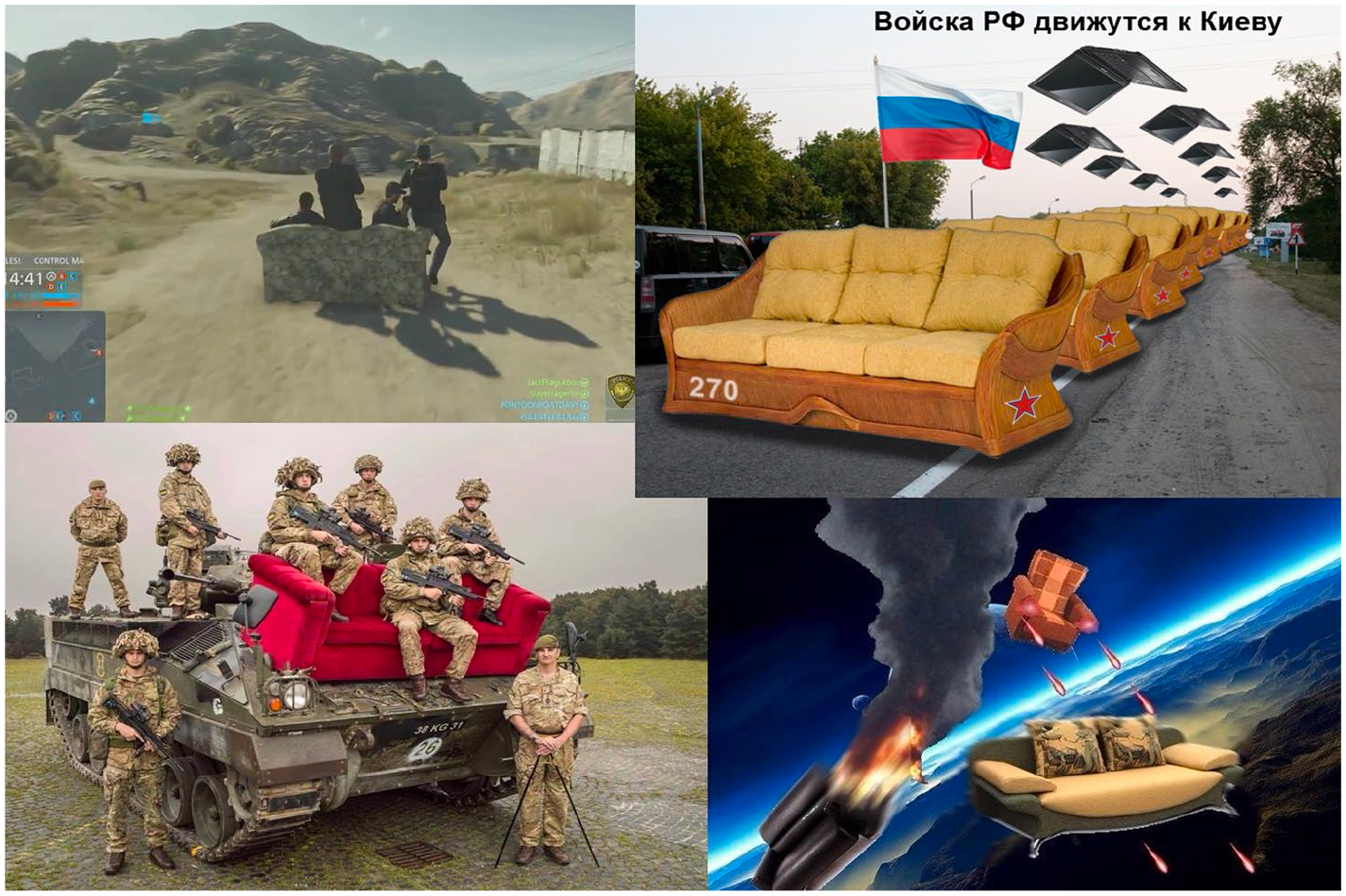
Military sofas beyond the private space.
A broad range of memes takes images of sofas in public space and puts them into the context of online warfare. For instance, the image in Figure 13 takes a common everyday situation and captions it ‘sofa troops on the march’. In this case, we can see that memes offer a framework for the reinterpretation of people and sofas in the offline space, where the meaning of the sofa is transformed by placing it in a context of digitally mediated warfare.
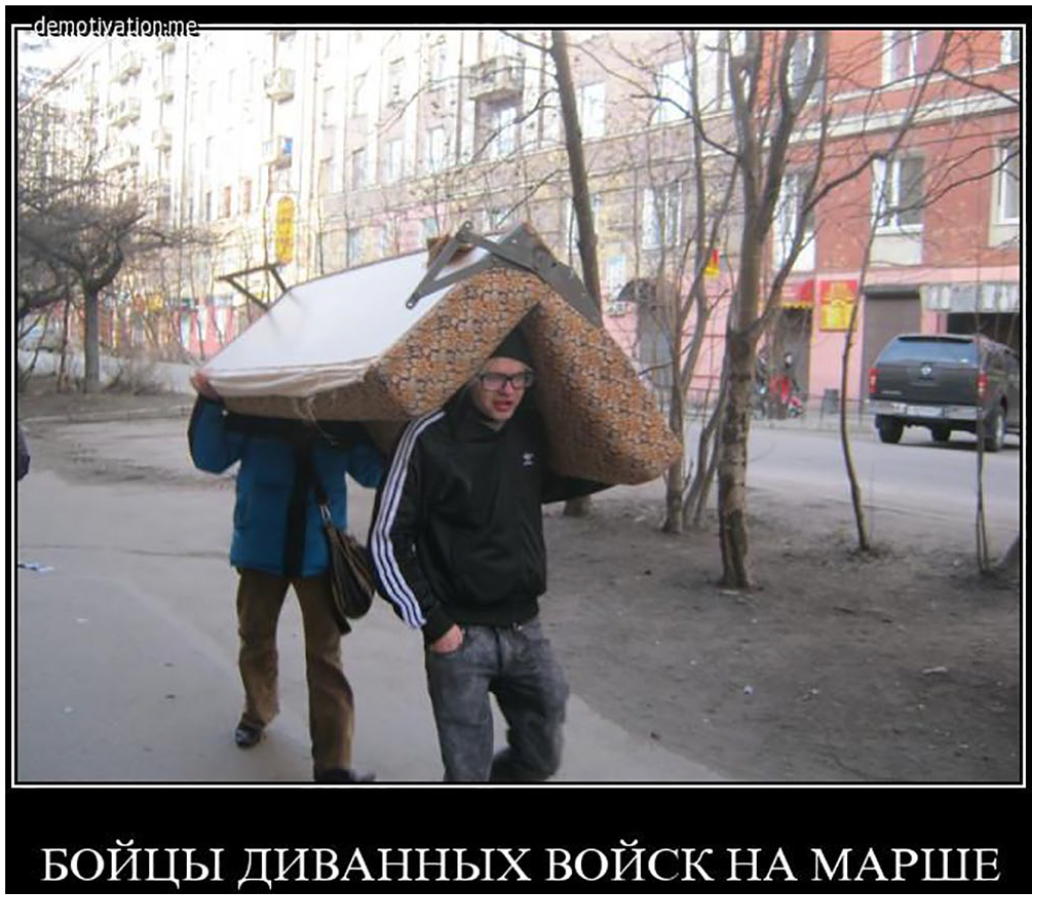
Reinterpretation of sofas in public space.
In some cases, an online meme acquires a second, offline life. In Figure 14 we see images of people in public spaces with the badges of sofa troops. The images show people on public transport as well as a backpack with badges. ‘They exist’ says a caption on the left, referring to sofa troops. This type of offline appearance of a meme can be addressed as memetic externalization. An additional mechanism of externalization is merchandising. The badges that we see on the images in Figure 14 also become part of the merchandise sold online.
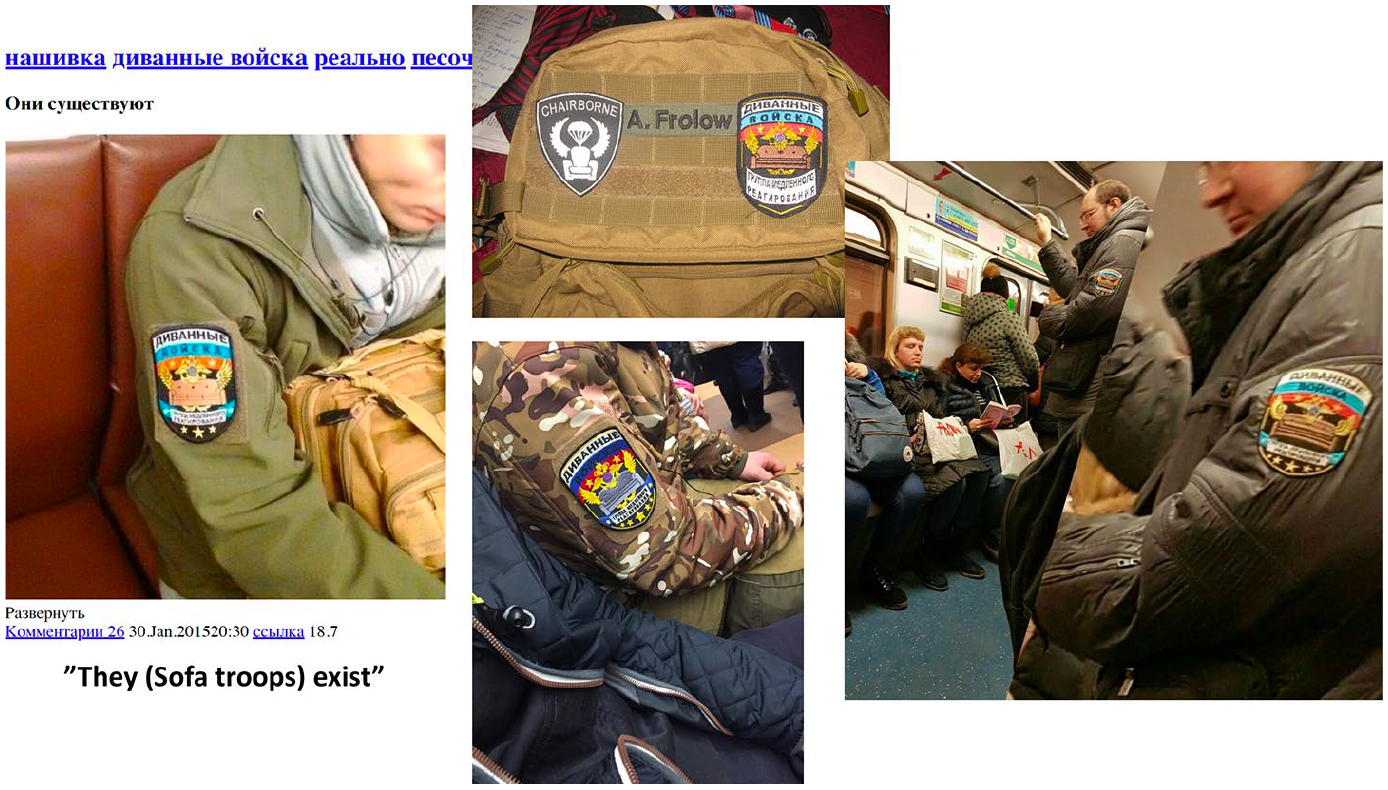
Memes in public space.
The image in Figure 15 presents a range of merchandising that uses the memes of sofa troops. This includes a medal for a ‘sofa troops veteran’, mugs with symbols of sofa troops, cushions and beach bags with badges of sofa troops. Interestingly, most of the merchandise is presented as gifts to be given on Russian Military Day, 23 February, which in Russia is considered to be the male alternative to 8 March (International Women’s Day). Using memes for merchandising recalls a form of ‘brand appropriation’, as illustrated by Milner (2016). The transformation of memes from online into offline artefacts is not limited, however, to traditional merchandising products.
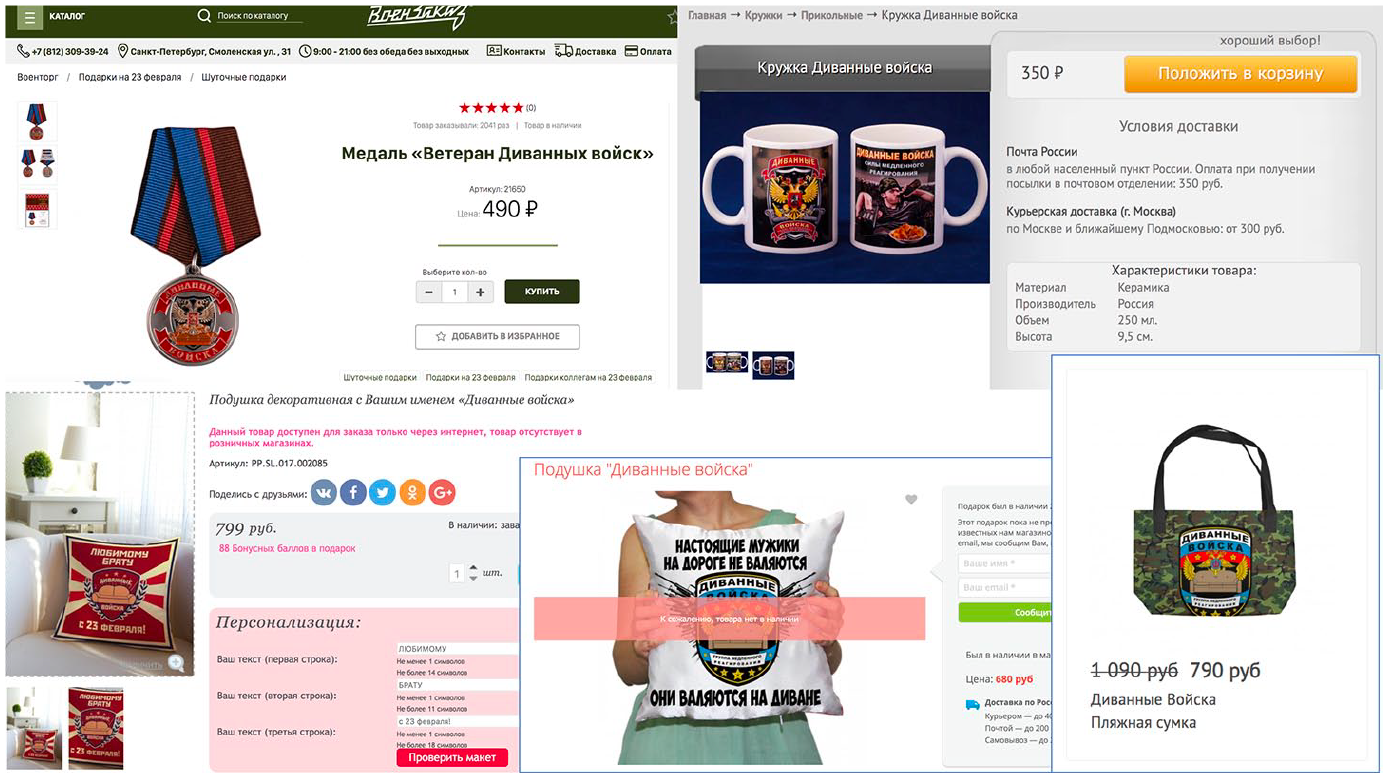
Merchandising of memetic production.
In November 2015, a furniture factory in Ekaterinburg offered a special model of sofa constructed as a modern Russian tank, the Armata (Figure 16). In another case, online sellers offered a sofa cover that gave it a military look. In this way, the militarization of the private space has been embedded in physical artefacts that construct the space of bedrooms and living rooms.
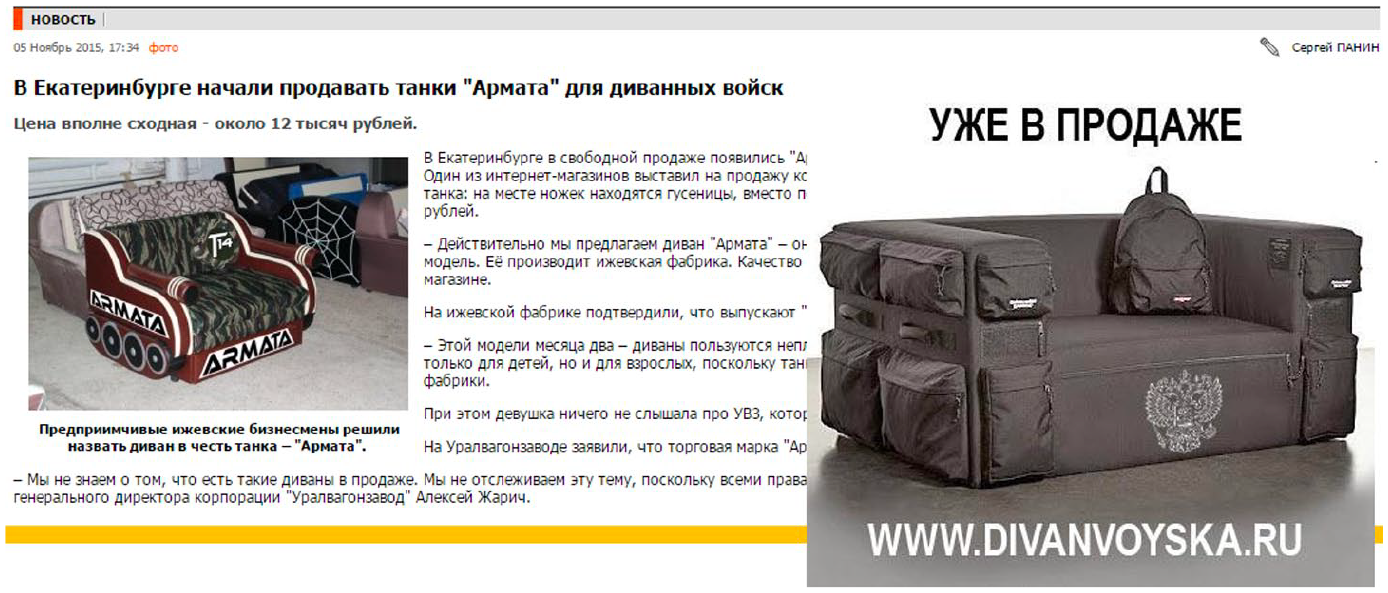
Memetic production and offline artefacts.
Analysis: Participatory warfare and the erosion of private space
New forms of digital mediation allow a broad range of opportunities for people to participate in conflicts without leaving their bedrooms. The question is, however: what is the meaning of this participation? Does it gives more agency to users or offer more opportunities to institutional actors for control and governance? The analysis of the discourses of sofa warfare as seen through memes suggests focusing on the role of participatory affordances in the erosion of private space and in a form of boundary-breaching that allows the conflict to feel ‘at home’ in the bedrooms and living rooms of users. It highlights how mediation functions in two directions: not only do participatory digital tools change a conflict, but participation relying on digital mediation also changes users and their environment.
The conflict that comes from inside the screen is contagious. It transforms furniture, cushions, keyboard, mugs and remote-control devices. The domestic space becomes infected by the conflict. This is the essence of the domestication of warfare. The memes in particular, however, as symbolic artefacts, allow us to follow how this ‘virus’ operates to change both symbolic and physical environments. Like the initial notion of a meme (Dawkins, 1976), the memes of sofa warfare struggle for successful replication and proliferation, not only online but also offline, by triggering mutations in a diversity of objects, subjects and domains.
As in the case of teleworking (Silverstone, 1993), the rise of a participatory warfare that relies on personal digital tools contributes to a shift in the boundaries between the interior and the external world. This analysis of memes offers evidence of the intrusion of a conflict into the domestic space. Following the participatory culture that grew up around the memetic development of sofa troops allows us to follow not only the process of militarization of domestic space, but also how the structure of everyday life has been continuously integrated into a conflict-related reality. It eliminates the distinction between everyday life and crisis (Barton, 1969).
Building on the recognition of the ambivalent nature of memes (Kuntsman and Stein, 2015; Milner, 2016; Pearce and Hajizada, 2014) analysis of this empirical data focuses on whether the sofa warfare memes support critical and ironic messages that challenge hegemonic actors or eventually support the goals of institutional actors. In fact, the memes of sofa warfare seem to have an ambivalent role. On the one hand, they offer an ironic and critical description of practices related to home-based user participation in conflicts, as seen in the context of the Russia–Ukraine conflict. On the other hand, they contribute to an increasing salience of the notion of sofa warfare as describing a digitally mediated form of relationship between users and conflicts, as well as to an identity formation related to conflict-related participatory practices.
The analysis above demonstrates that the central element of sofa warfare memes is the production of an identity of ‘sofa warrior’, as seen in the badges and rankings described. This identity has been appropriated as part of patriotic discourses. The critical function of memes is thus hijacked and becomes hegemonic. Moreover, this identity has been appropriated by opposing sides in the conflict, as well as by additional parties beyond Russia and Ukraine. The ‘hegemonic function’ of memes, however, is not limited to the production of identity, but is also seen in the transformation and militarization of users’ domestic space, which can be considered as a manifestation of ‘digital militarism’ (Kuntsman and Stein, 2015). Here, memes not only oppose the penetration of warfare into the interior, but also reinforce it. The tension between these ‘critical’ and ‘hegemonic’ functions of memes highlights how the interior is a site of struggle between the agency of the users over their private space and the external forces that seek to incorporate domesticity within a broader hegemonic system.
The reinvention of domestic space mediated via memes, as digital artefacts of participatory culture, includes not only the production of an identity of inhabitants of a domestic space as ‘sofa warriors’, but also the production of the space itself in a physical domain. The latter can be seen in the process of memetic externalization – another hegemonic function of memes identified in the data analysis. Conceptualization of memetic externalization offers a particular contribution to understanding how the critical function of memes as a manifestation of user agency has been appropriated and co-opted by economic and political institutions. It also allows us to identify a new mechanism of militarization (Enloe, 2000). Symbolic meanings created by memes have been transformed into physical artefacts, including not only real badges and merchandise, but also furniture that is intrinsic to the construction of the private physical environment. In this way, the emergence of a new type of identity and the transformation of private space are reinforced through brand appropriation of ‘sofa warfare’ by the producers of physical artefacts. When these symbols become a patriotic gift, we see how memetic subversion may be transformed, via externalization, into a hegemonic manifestation.
The manifestation of hegemonic hierarchies can also be seen from a gender perspective. The binary division between men as protectors at the front lines and women as protected at the home front requires reconsideration due to invasion of the warfare into domestic space. Notably, woman are completely missing from the memetic representation of sofa warfare. The geography of domestic militarization involves bedrooms and living rooms, while the only spaces that are missing in the discourses of domestic warfare are kitchens and bathrooms. The increased presence of masculinity in domestic space can be also linked to a shrinking of a feminized space and displacement of the woman. The bed in the bedroom and sofa, as the spaces related to safety, intimate relationship and leisure, are occupied by hegemonic masculinity. In that sense, digital affordances that allow participation in warfare are linked to further militarization of domestic space that reinforces gender asymmetries. That said, the memes also offer a counter-hegemonic reading that presents ironic depiction of masculinity and patriotism while joining the military is substituted by participating in warfare as a sofa warrior.
Conclusion: The sovereignty of domestic space
In 2018, a popular Russian band, Leningrad, released a song called ‘Garbage’. In the accompanying video, a singer with a guitar is seen sitting in front of his partner and his laptop in their kitchen. He tells her about his feats online as a sofa warrior while his wife criticizes him for not taking the garbage out. The kitchen here remains almost the only stronghold of femininity, while the boundary between the battlefield and home front are not somewhere far but within the domestic space. The tension between everyday life and the militarization of private space is set to increase with the further development of participatory practices. Following Silverstone’s (1993) approach to the household as a ‘resource system’, one may identify the essence of this tension. This means that more and more of digital users’ resources will be devoted to conflict, while fewer and fewer resources will be left for taking out the garbage. The perspective offered by critical military scholars also reveals how this tension is manifested through reconsideration of gender hierarchies. A major aspect of conflicts in new information environment is an outcome not of the struggle between adversaries, but of the location of the conflict in the everyday life of the societies involved in the conflict. To some extent, the real conflict is already taking place not on the battlefield – either offline or online – but in that kitchen, as well as in the living room and bedroom.
This article shows that everyday life, and specifically the domestic space, is increasingly becoming a site of struggle. New digital tools that enable a range of participatory practices make the interior particularly vulnerable in the face of external forces. These forces include not only the forces of militarization, but also a variety of external intrusions into domestic space as addressed by the scholars of digital labour who explore the new forms of algorithmic surveillance in the home environment (Wood et al., 2019) and the scholars of data colonialism who follow the extraction of the terrain of personal lives for the purpose of economic profit (Couldry and Mejias, 2018). The external pressure on the domesticity significantly increased in a context of the Covid-19 pandemic, when the need to stay home also lead to various forms of the transformation of home as a compensation to social isolation.
The key aspect of struggle here is the issue of sovereignty. Can the inhabitants of the domestic space still be sovereign in their own private environment, as in ‘the padded case of the self’ (Jonsson, 2001: 559)? How can the sovereignty of domestic space be protected in the face of the new forces that rely on digital mediation in order to breach the boundaries between the external and the interior? In this case, the true meaning of user agency lies not in using the new participatory opportunities, but in the preservation of the capacity for self-governance by controlling the impact of these opportunities on private life. The fragile balance between the critical and hegemonic functions of ‘sofa warfare’ memes highlights the continuation of this struggle; however, it becomes increasingly difficult to resist the forces coming from outside our homes.
Footnotes
Declaration of Conflicting Interests
The author(s) declared no potential conflicts of interest with respect to the research, authorship, and/or publication of this article.
Funding
The author(s) disclosed receipt of the following financial support for the research, authorship, and/or publication of this article: This research was supported by the Leverhulme Trust as a part of Early Career Fellowship.
