




Abstract
The public relations (PR) industry in India is a multi-billion industry, and various global and national players are part of it. This article, by analysing the existing literature in this field, aims to understand the current state of the profession in India and identify possible issues and challenges. Based on a systematic literature review, 95 published academic works were identified from academic databases. Of 95, 27 were selected for analysis to answer the research questions and identify research gaps in the field. The study finds that although PR practice had a firm footing in the pre-independence era, progress was seen after 1947, especially with initial support from the government and public sector organisations. The profession is still evolving and has much scope for development. Poor reputation of the profession, scarcity of talent, limited scope for professional education and training, lack of measurement methods to demonstrate its value and competing for public and private sector philosophies pose a serious challenge to its growth. The study offers valuable insights for the practitioners and researchers and suggests future research areas to improve the professional discipline.
Keywords
Introduction
With the liberalisation of Indian economy, public relations (PR) as a profession has witnessed rapid growth. Hundreds of small and large PR service agencies, including some global consultancies, are now offering their services, employing thousands of PR practitioners. As per the Public Relations Consultants Association of India (PRCAI) report, the Indian PR industry grossed 16 billion rupees in 2019. The report forecasted a 12.5% growth for the industry (PRCAI, 2019).
The growth of PR industry also resulted in the expansion of the scholarship and knowledge base of Indian PR. Although research on Indian PR has increased, it is still not adequate (Bardhan & Patwardhan, 2014). Although PR is a multi-billion industry offering strategic communications services in India (PRCAI, 2019), a comprehensive understanding of the current state of the profession and the challenges it faces is hardly present. The purpose of this article is to perform a comprehensive analysis of the Indian PR profession, its evolution and its growth and the challenges faced by PR professionals by exploring the existing research on PR in India.
This research article is structured as follows: the section, after introduction, provides a brief overview of Indian PR. It is followed by a description of the research methodology adopted for the study. Key findings of the study, including a descriptive analysis, are presented in the subsequent section. The article concludes with the implications of the study.
Research Methodology
Since the study aims to present a synthesis of the current state of knowledge in the field of PR research, the systematic literature review (SLR) method, consisting of a methodological approach to identify, evaluate and synthesise the available and relevant literature, is adopted. ‘A systematic review is literature review that is designed to locate, appraise and synthesise the best available evidence related to specific research question in order to provide informative and evidence based answers’ (Boland et al., 2017). This method follows a pre-determined plan with clearly stated criteria. Unlike traditional literature review, the protocols are specified before the study, and this method provides a comprehensive review of the literature (Dempster, 2011). This also helps in minimising bias and ‘providing more reliable findings from which conclusions can be drawn’ (Lasserson et al., 2019, p. 3). ‘Systematic literature reviews are an increasingly used review methodology to synthesize the existing body of literature in a field’ (Kraus et al., 2020, p. 1023).
Topic of Review and Research Questions
This SLR focuses on PR practice as a profession in India. Analysing the available literature on PR practice in the Indian context, it attempts to answer the following research questions:
What are the stages of development of the PR profession in India? What is the current state of the PR profession in India? What are the significant issues and challenges faced by the PR profession in India?
The Search Process and Literature Identification
Relevant articles on PR in India were considered for this study. To identify the same credible academic databases, Scopus was searched using the following keywords: ‘Public Relations in India’, ‘Indian Public Relations’, ‘Corporate Communication in India’ and ‘Indian Corporate Communication’. The search returned an initial list of 59 literature containing either of the keywords in any field. The search syntax was ALL (‘Public Relations in India’) OR ALL (‘Indian public relations’) OR ALL (‘Corporate Communication in India’) OR ALL (‘Indian Corporate Communication’) without any limitation.
Databases from EBSCO Business Source Complete (EBSCO BSC), Web of Science and Taylor & Francis were also searched using the same keywords. The search for EBSCO BSC was limited to scholarly (peer-reviewed) journals only, and it returned 14 records. The syntax for the EBSCO BSC search was TX ‘Public Relations in India’ OR TX ‘Indian Public Relations’ OR TX ‘Corporate Communication in India’ OR TX ‘Indian Corporate Communication’. Similarly, Taylor & Francis returned 18 records with the search for [All: ‘public relations in India’] OR [All: ‘Indian public relations’] OR [All: ‘corporate communication in India’] OR [All: ‘Indian corporate communication’]. Web of Science, which is also another widely referred database, generated only four records across all timespans. The search syntax for Web of Science was ALL = (‘Public Relations in India’ OR ‘Indian Public Relations’ OR ‘Corporate Communication in India’ OR ‘Indian Corporate Communication’). The search was conducted in the first week of July 2021.
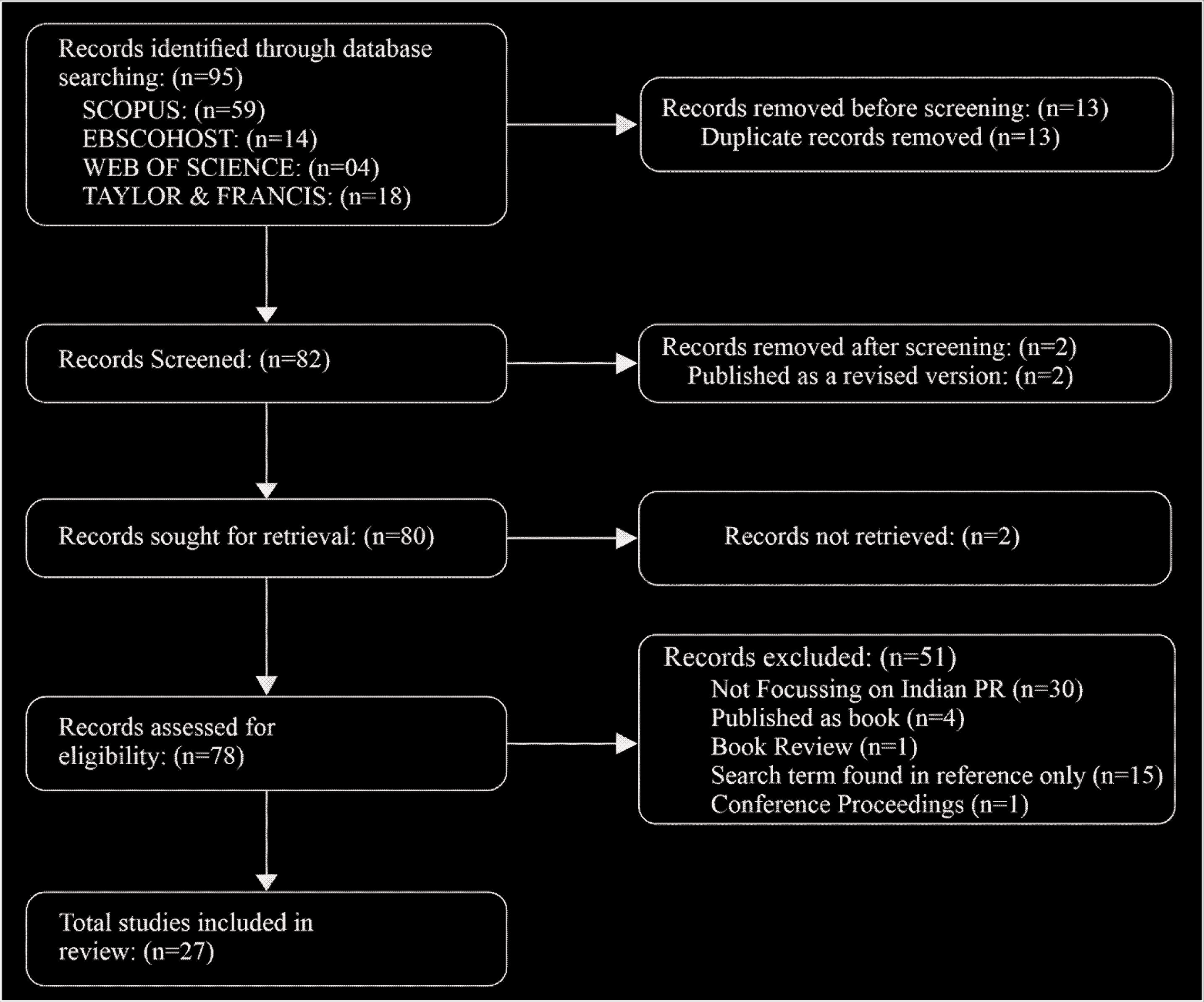
Thus, a list of totally 95 works was prepared in the process; of which, 13 were found to be duplicates. In addition, revised versions of two were also published; hence, the latest publication was included. Two publications, of which the full text could not be accessed, were excluded as well. Totally, 82 works were finally selected for further study.
Screening for Inclusion/Exclusion
All identified works were read and assessed for inclusion or exclusion. Some inclusion/exclusion criteria were set as well. One being in the PR profession in India should be the focus of the work. Similarly, works published only in research journals or as part of an edited book were included. Literature published as books, as book reviews and/or with the search term in the reference list only were excluded from the study. Both researchers of the present review independently assessed the identified works and selected them for inclusion in the study, and differences, if any, were discussed and resolved. Based on these criteria and agreed upon by both researchers, 51 works of 78 were further excluded, leaving a total of 27 for inclusion in the study. The flowchart of the literature identification, as per the PRISMA 2020 flow diagram (Page et al., 2021), is depicted in Figure 1.
Categorisation and Data Extraction
At the first level, the identified research publications were categorised as basic bibliographic information such as author, year of publication, type of study and the journal it was published in. The publications were then classified as per their structural dimensions after content analysis.
A thematic analysis of the selected publications was conducted to answer the research questions. After going through the selected works, various analytical themes were extracted from the selected works and grouped and synthesised. Thomas and Harden (2008) suggest that ‘analytical themes are more appropriate when a specific review question is being addressed (as often occurs when informing policy and practice)’. Xiao and Watson (2019) also find thematic analysis as a frequently used technique in SLR.
To address the research objectives and questions, three broad themes were identified, and both researchers categorised the information under these themes independently after which the resultant data were consolidated and discrepancies were discussed and resolved. Finally, after consensus on the categorisation, both researchers analysed the data in collaboration for synthesis and presentation.
Data Extraction and Descriptive Analysis
After applying the exclusion criteria, a total of 27 works—23 journal articles and four book articles—were selected for literature review. Details of the selected works are presented in Table 1.
Journal Name and Period of Publications
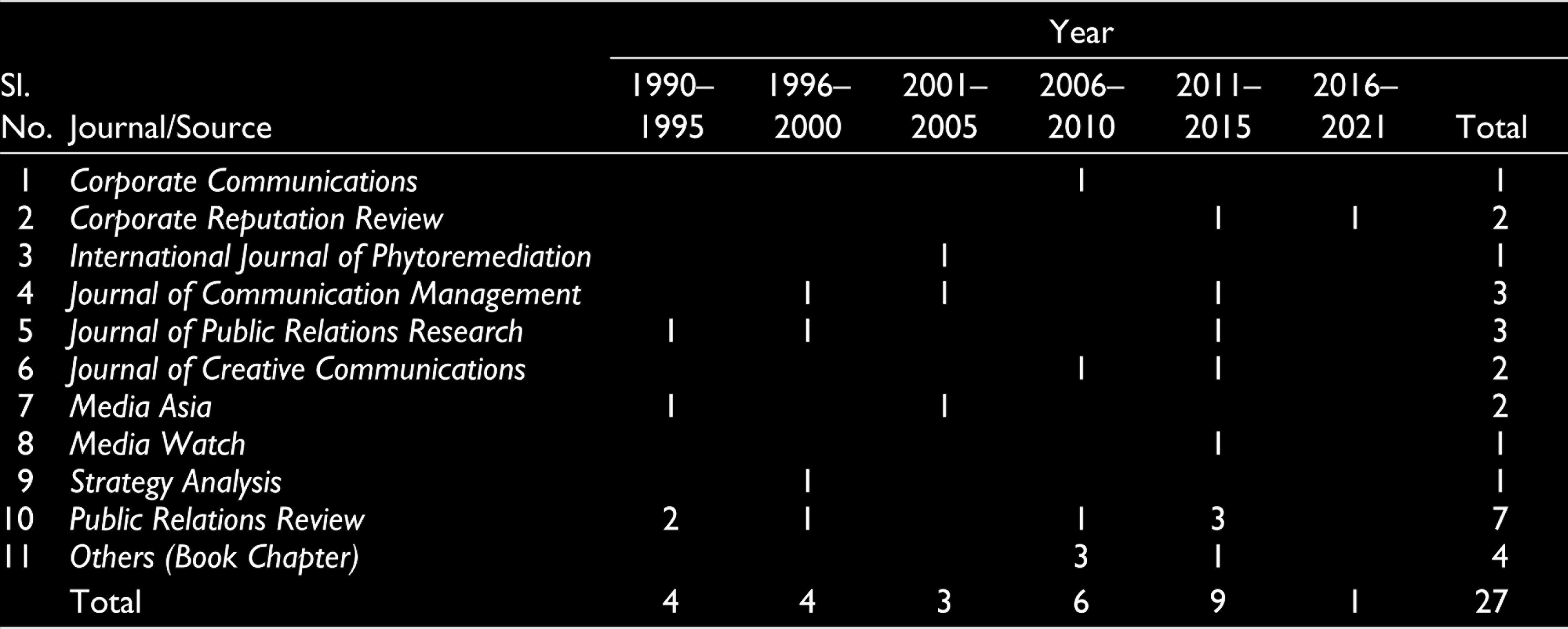
The result shows that research on PR in India started after 1990. Before 1990, there was hardly any systematic research on PR in the country. The number of studies has increased over the next three decades. However, considering the number of publications on Indian PR, as recorded in the databases searched, it can be concluded that PR in India is a less researched subject.
Major Contributors
As per the data extracted from the selected literature, Krishnamurthy Sriramesh is the highest contributor in the field of research on PR in India. Nilanjana R. Bardhan and Padmini Patwardhan are the other two significant contributors with five and four scholastic articles, respectively, on Indian PR (Table 2).
Major Contributors

Affiliation of the Authors
The study reveals that most of the authors who have contributed to research on PR in India are affiliated with organisations outside India (Table 3). On the one hand, totally, 44.44% are from the USA. On the other hand, authors affiliated with Indian organisations constitute only 22.22%. However, most of the authors, with affiliation even from the USA or other Asian countries, have a significant association with India in terms of work experience or origin.
Country of Affiliation (of authors)

Geographical Context
The selected works were grouped under their geographical context too. It is found that 71.43% of the studies are in the national context, exploring and/or discussing PR in India. One-fourth of the studies are in an international context but still cover Indian PR practice significantly. Only one study is found to have been conducted in the context of a specific state (Table 4).
Geographical Context of the Literature

Methodology Adopted
Most of the studies (39.29%) use no specific research methodology and are conceptual. Among the articles, the qualitative approach seems to have a marginally higher preference (25%) over the quantitative approach (21.43%). Only 14.29% have used a combination of both quantitative and qualitative methods (Table 5).
Methodology Adopted

Growth of Professional Public Relations in India
Most of the scholars are univocal about the early practice of ‘PR-like activities’ in India. From the Indus Valley Civilisation to the era of Ashoka the Great, one can find shreds of evidence of persuasive communication practice to propagate and promote various messages and precepts mostly related to governance and religion (Sriramesh, 2013). Similar practices continued in the times of the Muslim (Vil’Anilam, 2014) as well as the British rule. Various Indian rulers and preachers have used different communication activities to reach the mass (Kaul, 1992; Reddi, 2019; Sriramesh, 2013). These activities can be called rhetorical PR practices (Bardhan & Sriramesh, 2006).
Beginning of Public Relations in India
The foundation of PR as an organised and systematic practice was laid during the colonial rule, especially in the early 20th century. The struggle for Indian independence, under the leadership of Mahatma Gandhi, is considered the starting point of modern Indian PR (Bardhan & Sriramesh, 2006; Koul, 2009). Under the leadership of Gandhi, leaders of the freedom movement used various communication strategies to mobilise public support and boost the morale of the people. ‘This monumental political movement may be perceived as a massive public relations endeavour that ultimately resulted in the achievement of its main goal in 1947—Home Rule’ (Bardhan, 2003, p. 234). Various scholars have considered Mahatma Gandhi the Father of PR in India (Bardhan, 2003; Singh, 2000; Sriramesh et al., 1999).
The colonial government in India started making various efforts for publicity and public information during the late nineteenth century. In 1914, it established the Central Publicity Bureau to disseminate information related to World War I, starting the modern PR in India (Reddi, 1990). In 1923, the colonial government set up the Central Bureau of Public Information. Post-independence, the Bureau became a part of the Ministry of Information and Broadcasting and is now known as the Press Information Bureau (Bardhan, 2003; Bardhan & Sriramesh, 2006; Newsom & Carrell, 1994). The publicity campaign by the Great Indian Peninsular Railway to promote tourism in India is also considered one of the countries’ earliest organised PR activities (Newsom & Carrell, 1994; Patwardhan & Bardhan, 2014).
Besides PR practice by the government and society, corporate PR in India also has its roots in pre-independence times. Several leading corporate organisations use PR for their outreach activities (Bardhan & Sriramesh, 2006). The House of Tata, one of the oldest industrial houses in India, is credited with starting corporate PR in India. They established a PR office in 1943, the first time by any corporation in the country (Bardhan, 2003; Bardhan & Patwardhan, 2004; Bardhan & Sriramesh, 2006; Newsom & Carrell, 1994). In the 1940s, Tata and other multinational corporate organisations, like Dunlop and Unilever, used modern forms of PR (Bardhan & Patwardhan, 2014). During the colonial rule, Defence Forces also established a Directorate of Public Relations to facilitate information sharing with the media. The Directorate, under the Commander-in-Chief, ‘regulated the flow of the reports from the war fronts’ (Sachdev, 2000, p. 1800).
Professionalisation of the Practice
After independence, India expanded its infrastructure in various fields. With a socialist model for development, the country established various public sector organisations to build the nation (Sriramesh, 2013). The new government created a separate ministry called the Ministry of Information and Broadcasting. The colonial government’s institutional set-up for public information became a part of this ministry, which spearheaded publicity and public information activities to build the nation. The ministry became the pioneer of PR in India after its independence (Halff & Gregory, 2014).
During the first three decades after India’s independence, there has been a substantial increase in industrial activities, especially the establishment of various public sector industrial organisations. The media, especially print media, also prospered during this period. Public sector enterprises set up a separate unit for their PR activities. This gave rise to the public sector style of PR (Bardhan, 2003; Bardhan & Sriramesh, 2006). During this time, the public sector was the largest employer of PR personnel in India (Bardhan, 2003). The government was and still continues to be a significant player in the Indian PR industry (Sriramesh, 2009). Besides the public sector units (PSUs), companies such as Tata, Dunlop, Unilever and Philips set up full-fledged PR functions (Newsom & Carrell, 1994) during the early years of Indian independence.
Although PR was gaining its ground as a professional practice, dominated by the public sector enterprises, PR practitioners organised themselves in 1958 with the establishment of the Public Relations Society of India (PRSI) ‘to bring recognition to professional practices’ (Newsom & Carrell, 1994, p. 185). A decade later, the PRSI organised the first All India Public Relations Conference on 04/21/1968 in which PR practitioners of the country met on a single platform for the first time. The conference established a code of ethics for PR and attempted to set some parameters for the profession. This conference is hailed as the beginning of professional PR in India (Reddi, 1990; Sriramesh, 2000). The PRSI remains the most prominent national association of PR professionals, and April 21st is celebrated as the National Public Relations Day in India.
Beyond Public Sector Public Relations
In the 1980s, there was a change in India’s economic policies but to a limited extent. Although deregulation of the industry and trade began in the 1970s, the pace of reform paced up in 1985 (Panagariya, 2004). The introduction of limited reforms helped higher economic growth and expansion of the corporate sector. The economic environment also led to a substantial rise in the media and advertising industry in the country.
During the 1970s and 1980s, India’s number of advertising agencies witnessed substantial growth (Bardhan & Patwardhan, 2004). Several advertising agencies added PR services to their portfolio with increased demand for more PR activities. Several local PR firms established independent operations or formed alliances with multinational PR firms (Bardhan, 2003; Bardhan & Patwardhan, 2004). In the late 1980s, service sector organisations, such as universities, private hospitals and hotels, started PR activities (Reddi, 1990). A new model of PR beyond industries and the public sector was emerging.
The Age of Upswing
The reforms introduced in the 1980s played a critical role in reviving the economy throughout the decade. More systematic and systemic reforms were introduced in India in the 1980s and 1990s (Panagariya, 2004). With the new economic policy that paved the way for liberation, privatisation and disinvestment of various PSUs in 1991, India opened its market to the global economy (Sriramesh, 2013). This led to increased foreign investment in India and the entry of several multinational corporations into the Indian market. As a result, several new players emerged, creating a competitive environment.
On the other hand, the media industry, primarily broadcast media, expanded significantly during the 1990s. Satellites and cable televisions moved beyond government control, and various private television channels started (Bardhan & Sriramesh, 2006). Print media witnessed a boom, especially at the regional level.
In the new economy, because of the liberalisation, the changed business and social environment propelled the PR industry to the next level. Multinational organisations entering India engaged in PR to face resistance from various stakeholders in the new market. They also used PR services for understanding the market and building relationships with stakeholders. A ‘new school’ of PR began to gain traction in line with the Western paradigm (Bardhan, 2003).
The growing private sector and increasing demand for PR services also helped establish more PR agencies in India during the 1990s. Every 90 days, a new PR operator established a business in 1992 (Newsom & Carrell, 1994). In addition, several leading global PR agencies set up their footprint in India, either directly or through local affiliations. The most important consequence of this philosophical shift has been the increased acceptance of PR as an important management function. Senior management began to place a higher significance on PR’s capacity to contribute to the organisation’s reputation management (Bardhan & Sriramesh, 2006).
Communication infrastructure was further strengthened with the increasing use of the Internet and computer technology, which started in the latter part of the 1990s. It has also empowered and equipped PR professionals by providing them with various communication tools (Krishan, 2015). Communications in the government and corporate sector have become more critical to face global competitiveness on the one hand and reach consumers across the world on the other. As a result, PR communications have entered the ‘Age of Upswing’ (Reddi, 2004).
Current State of the Profession
The practice of PR in India has evolved and so has the concept. Publicity and press agentry was the central focus of initial PR practice for the colonial government (Reddi, 1990). This trend continued for a long time, presenting not so good image of the profession. After independence and until economic liberalisation in the 1990s, the government and government-controlled public sector units were the major players in PR in India. PR was centred on press relations (Bardhan, 2003) with the ultimate aim of getting good publicity in the media.
Most of the respondents of the ethnographic study by Sriramesh defined PR as publicity with image-building as its major purpose (as cited in Grunig et al., 1995). Sriramesh (1991) found that many PR professionals who participated in his study identified PR as a subsidiary of marketing. Good PR was all about getting positive publicity in the media (Bardhan, 2003).
In Search of Excellence
Sriramesh (2000) found that the press agentry model with a high focus on media relations was practised by most organisations. In contrast, government agencies were more into the public information model. Bardhan and Patwardhan (2004), in their study of PR practice in two MNC subsidiaries in India—Hindustan Lever and Maruti Udyog—found that both organisations practised two-way communications along with the one-way press agentry and public information approach. However, the perception of senior executives in organisations is that they know what is suitable for their audience, and lack of adequate resources to conduct research and gather feedback could be two reasons why the two-way communication approach is less frequently adopted in Indian organisations (Sriramesh, 2000).
Extending Grunig and Hunt’s four models of PR, Sriramesh (1992), through his ethnographic study of PR in organisations based in south India, developed the personal influence model of PR (Bardhan & Sriramesh, 2006; Grunig et al., 1995; Patwardhan & Bardhan, 2014). This model is characterised by the use of ‘interpersonal communication with strategic individuals to achieve public relations objectives’ (Sriramesh, 2000, p. 232). The prevalence of the personal influence model of PR in India is further substantiated by later research (Bardhan, 2003; Bardhan & Patwardhan, 2004; Patwardhan, 2015). The model is usually asymmetrical in approach, involving unethical practices (Grunig et al., 1995). It stresses interpersonal communication and the relationship between the PR practitioner and the influential persons/public.
Tactical Versus Strategic
PR practitioners have been stereotyped as ‘fixers’ with primary responsibilities of achieving objectives through wining and dining. Making arrangements (bandobast) and publicity in the media are perceived as their primary functions (Bardhan, 2003; Bardhan & Sriramesh, 2006). Sriramesh (1992) found that PR was not viewed as a critical function and hence has been given a tertiary publicity role in smaller organisations. Public sector organisations set up PR departments primarily for the publicity of their respective organisations. Changed market dynamics induced by economic liberation changed this perception. The profession got more management attention for its ability to manage an organisation’s reputation. The fixer stereotype receded but was still found in PSUs (Bardhan & Sriramesh, 2006). Koul (2009), in a study on public sector enterprises, also shares a similar view.
Gupta (2011) in her study also observes that while corporate communication (CC) ‘is considered to be an important function for organisation, there is still some skepticism about it in the minds of top management’ (Gupta, 2011, p. 123). Before the 1990s, the PR practitioner played the role of a technician with the emphasis on non-strategic publicity and public information models (Bardhan & Patwardhan, 2014).
Sriramesh (1992) also observes that senior executives considered image-building publicity activities the primary role of PR, and they hired PR personnel who can work with this limited perception. Gupta (2007) and Koul (2009) marked that PR was perceived as a more operational than strategic function in most organisations. PR professionals have more technical and functionary roles than strategic roles in managing media relations in India (Lee & Desai, 2014). Bardhan and Patwardhan (2014) observe that the strategic role is performed by top PR leaders, whereas the junior members performed technician roles.
The Public in the Indian Public Relations
Most of the PR activities in India are directed towards the media and employees although other groups of the public are focused on the organisation’s need. The public sector style PR, which dominated the industry during the first three decades after independence, focused on internal relations and external image management (Patwardhan & Bardhan, 2014). Publicising good images of the organisation in the media was considered PR’s major goal (Singh, 2000).
PR practitioners consider media relations the most important PR activity (Sriramesh, 1991 as cited in Grunig et al., 1995). Gupta (2011) and Lee and Desai (2014) also present a similar observation regarding the dominance of media relations in the Indian PR practice. Indian PR professionals develop cordial relationships with the media to disseminate positive information about their companies (Guerber et al., 2020). In line with the personal influence model, Indian PR professionals prefer to have open communication lines with important individuals in the industry and the government who may not own the media but exercise significant control over the media (Sriramesh & Verčič, 2009).
Building the corporate brand and managing the company’s reputation have also been the central purpose of function of PR practitioners (Gupta, 2011). Local communities, customers, associates like dealers and vendors, investors, government and various pressure groups in different fields also constitute an important audience for various organisations (Bardhan & Patwardhan, 2004).
Although organisations make an effort to build a relationship with various people, the level to which organisations use two-way PR tactics differs from people to people (Bardhan & Patwardhan, 2004). Presenting a similar view, Gupta (2011) observes that the focus on specific stakeholders or activities varies as per the organisational requirement. PR practitioners lead CSR in India in general. However, in companies with an extended CSR commitment, CSR activities are led by specialists and often by human resource professionals (Dhanesh, 2012).
Professional Ecosystem
PR as a profession is evolving in India, but the function’s name differs from organisation to organisation. PR professionals have various designations such as Publicity Officers, Information Officers, Public Affairs, Corporate Relations, Communications or PR Managers (Reddi, 1990). PR functions in public sector enterprises were called PR department, publicity group, PR group or government relations (Koul, 2009). Gupta (2011) posits that different names of the function add to the confusion. The PRSI is the largest professional organisation in the field of PR in India (Bardhan & Patwardhan, 2014). However, Reddi (2004) observes that the PRSI is weak without a permanent office address or permanent staff. The PRSI is highly influenced by the public sector style and philosophies of PR as most of its members are from PSUs (Bardhan, 2003; Bardhan & Patwardhan, 2014; Bardhan & Sriramesh, 2006). The PRSI frequently organises conferences, seminars and workshops, but these activities hardly focus on the important issues the PR professionals face (Bardhan & Patwardhan, 2014).
The dominance of public sector PR philosophies has been a significant challenge for the PRSI in attracting more new generation PR professionals who work in an open market using the consultancy approach (Bardhan & Sriramesh, 2006). As a result of the ideological gap, private sector-oriented associations of PR professionals, like the PRCAI, have emerged (Bardhan & Patwardhan, 2014). The PRCAI was formed primarily to represent the interest of PR consultancies and organises various activities similar to the PRSI (Bardhan & Sriramesh, 2006).
There exists an uneasy relationship between these two organisations based on two different philosophies (Patwardhan & Bardhan, 2014). Due to the absence of a unified professional industry structure, institutional mechanisms for training and professional growth at the industry level are minimal (Bardhan & Patwardhan, 2014).
Sriramesh (1992) observes negative stereotypes associated with women in the Indian PR profession. However, Gupta (2007) reports the absence of gender bias in the Indian PR profession. Patwardhan (2015) too finds that women in India are in various leadership positions such as leading PR consultancies, heading corporate organisations’ PR functions and running their PR agencies.
India also has a robust PR consultancy industry with various multinational organisations. Considering the complex business environment in India, multinational companies entering India prefer to first engage PR agencies, besides legal and accounting firms (Bardhan & Sriramesh, 2006). PR consultancies in India have a flatter organisation structure and are relatively smaller in size than corporations. Therefore, professionals working in PR firms have better direct access to the top management of the PR agencies (Gupta, 2007).
Issues and Challenges
Economic liberalisation in India provided a ‘new thrust’ for the professionalisation of PR in India (Bardhan, 2003). The pro-market PR practice enhanced the status and reputation of the profession. Still, the profession is evolving and occupies a lesser position in Indian organisations than other functions such as marketing, finance and strategy (Gupta, 2011). The literature reviewed for this article highlights various issues that affect the growth of the profession.
Image of the Image-building Profession
Different nomenclatures for the profession give Indian PR practice an identity crisis (Reddi, 2004). In addition, historically, PR practitioners in India have been seen as ‘fixers’ who could achieve things through ‘wining and dining’. PR activities are neither research-based nor strategically planned (Sriramesh, 1992).
Patwardhan and Bardhan (2014) remark that the Indian PR industry continues to fight some image problems. They found that improving the image of PR/communication management profession is the third most important issue in India. In contrast, it is the least important (among the top 10) issue globally.
The negative image of PR practice (Dhanesh, 2015) poses a serious challenge to the profession and practitioners’ growth. Entry of untrained PR practitioners and the use of unethical means to achieve the objects further dent the profession’s image. Patwardhan (2015) also reports image problems associated with the profession, arguing that the image of PR has been hit because of unqualified practitioners and ethical lapses in practice.
Due to the dominance of media relations activities, PR is often equated with media relations. Bardhan and Patwardhan (2014) also make similar observations about the profession. ‘Many clients see public relations as getting press coverage, with low recognition of its other functions’ (Bardhan & Patwardhan, 2014, p. 160). Scholars also find that the image of PR has been a major challenge for self-employed professionals.
Demand Still Outstrips Supply
As highlighted by various scholars, one of the most significant issues the Indian PR profession faces is the lack of skilled talent (Gupta, 2007; Newsom & Carrell, 1994; Patwardhan & Bardhan, 2014). Newsom and Carrell (1994) report the challenges of getting adequate skilled professionals to match the demand for PR services. After two decades, Bardhan and Patwardhan (2014) also report that ‘finding, developing and retaining highly talented communication professionals’ is the topmost PR issue in India. Patwardhan (2015) also reports ‘talent crunch’ as a dominant issue faced by Indian PR. Most PR practitioners do not have adequate training and hence can be called quacks in medical parlance (Reddi, 2004). ‘Public relations in India is now a mixed legacy comprising highly qualified PR professionals second to none in the world and the many non-professionals without any grounding in the discipline’ (Reddi, 2004, p. 28). For the smaller players in PR industries, like PR agencies and self-employed professionals, the challenge is even more acute (Bardhan & Patwardhan, 2014).
Industry Fails to Create Opportunities for Public Relations Education and Training
The talent crisis in Indian PR stems from the country’s poor PR education and training infrastructure (Bardhan & Sriramesh, 2006; Patwardhan, 2015). Presenting a similar view, Bardhan and Sriramesh (2006) posit that PR education in India still struggles for academic recognition. Few academic institutions and organisations offer PR programmes, but most of these are part of advertising and journalism courses (Bardhan & Sriramesh, 2006; Reddi, 1990; Singh, 2000).
Not only lack of university education but also opportunities for working professionals to continue their education in PR are also scarce (Bardhan & Sriramesh, 2006). Patwardhan (2015) also has a similar finding in her study in which none of the respondents believed that university education provided sufficient training. The quality of PR education and training is also a concern. Several unrecognised institutions without the required competency and resources add to the problem. There are very few industry-academia collaborations to offer quality PR education in India. Few programmes offer a full PR curriculum; instead, PR is taught as a subject within a journalism or communication course (Patwardhan, 2015).
Demonstrating Strategic Value
Measuring the effectiveness of PR and demonstrating its strategic value has been highlighted by various scholars as an important issue for professionals. Measuring the outcome of PR activities has been given a low priority, making it a drawback in the growth of the profession (Reddi, 1990). PR activities focused on media relations, and maintaining press clippings was ‘the only regular form of evaluative research conducted by the public relations units’ (Sriramesh, 1992, p. 203). Even after two decades, measuring the effectiveness of PR, like the issue of talent crunch, was an issue for the Indian PR profession (Bardhan & Patwardhan, 2014).
Gupta (2007) observes inadequate professional standards in the area of measurement of the effectiveness of the PR campaign (and also in other areas) among PR practitioners. Measurement of narrow functional activities like output in the form of press releases, newsletters or website management does not make the top management realise how communication management function can contribute to the organisation’s interest. The function should identify metrics in terms of efficiency, effectiveness and impact linked to the organisation’s performance (Gupta, 2011). Patwardhan (2015) also identifies ‘communication effectiveness measurement’ as one of the three primary challenges before the PR profession in India.
However, PR leaders are making efforts to address the issues. Several studies reveal the increasing importance of measuring and evaluating PR activities and its strategic contributions (Bardhan, 2003; Gupta, 2007; Patwardhan & Bardhan, 2014). Although not considered an accurate measure, advertising equivalency measure is a widely used method of measurement of PR effectiveness. Several professionals have developed qualitative and quantitative measurement methods, but there is no standardised method across the PR industry (Bardhan & Patwardhan, 2014).
Discussion
The literature review suggests that research on Indian PR is limited and led by a few scholars, mainly Krishnamurthy Sriramesh, followed by Nilanjana R. Bardhan and Padmini Patwardhan. Moreover, although they have a strong connection with India, most scholars are affiliated with organisations outside India. In addition, most studies reviewed here are done in the national context.
What Are the Stages of Development of Public Relations Profession in India?
The foundation of modern PR in India was laid during the pre-independence era by both the government and private organisations along with the leaders of the freedom movement. During the first three decades after independence, PR built a solid foundation with the support of the government and government-controlled public sector enterprises. PR was recognised as a separate function by various public and private organisations, and the number of professionals in the field also increased.
The 1980s witnessed a change in the economic and media environment with the growth of the private sector and an increasingly competitive environment, necessitating more strategic communication management. The PR profession moved beyond the ‘public sector style’, and a spurt of PR agencies, local and multinational, further enriched it. The professionalism and importance of PR as a management tool gained more acceptance by the Indian industry.
Liberalisation of the Indian economy and subsequent change in the socio-economic landscape resulted in the expansion of corporate sector with the influx of various multinational players and growth of media. The changed socio-economics and the growing importance attached to communication generated a significant demand for and progress of PR services in India. This resulted in the entry of more multinational and local PR players and improvement in the PR profession.
In other words, development of modern PR in India can be divided into four broad phases: pre-independence era (Before 1947), professionalisation era (1947–1980), pre-liberalisation era (1981–1990) and liberalisation era (after 1991). During these four phases, the profession continuously evolved with increasing demand.
What Is the Current State of Public Relations Profession in India?
Globalisation offered a stimulus to the Indian PR industry with a boom. With the entry of global corporations and multinational consultancies, professionalism and the importance of PR have improved. This has helped the profession to transit from a traditional approach to a more market-focused approach.
Indian PR uses all models of PR (Grunig & Hunt, 1984), but the public information model dominates the field. The personal influence model (Sriramesh, 1992) is also practised in the country to a large extent. As Grunig et al. (1995) suggest, a symmetrical personal influence model can be created for achieving excellent PR. The more the importance of PR grows within organisations and the more professionals join the field, professional PR will be closer to excellence. PR practice in multinational organisations and consultancies, globalisation, the rise of activism and public voice through digital media platforms have created the right opportunity for the transition.
The importance accorded to the PR function by the management also varies with organisations. To have a more strategic role for the function, PR professionals need to have expertise in both communication and general management (Gupta, 2011).
As the literature review shows, PR in India is more focused on media. Employees are also the next important public in Indian PR. This is because of the strong influence of public sector organisations on the profession. However, with the changing market environment and organisational requirements, other stakeholders are also getting attention. CSR is moving away from PR and getting its own professional footing. Panda et al. (2019) observe that although there is some scepticism among Indian PR professionals about use of the latest technology, like artificial intelligence, the industry is slowly taking steps towards the adoption of the latest technology, and the industry is gradually embracing the new technology.
What Are the Major Issues and Challenges Faced by the Public Relations Profession in India?
From the literature, it can be seen that although reputation management is one of the important functions of PR, the profession’s own image is certainly not very encouraging. It has grown rather rapidly, but it is still struggling to build its own image.
Lack of quality practitioners has been a persistent issue for PR in India. As a result, many unqualified practitioners without any training and education in PR have entered the profession to meet India’s increasing demand for PR services. Poor education and training facilities in the field of PR have failed and can hardly generate a good talent pool to meet the requirement, further affecting the quality of practitioners and limiting the entry of professionally trained persons into the field. Various scholars have highlighted the urgent need to address this issue for the benefit and growth of the profession in India. Measurement and evaluative research is another important area of concern in Indian PR profession. Addressing this issue can help in making PR more strategic and in accordance with the strategic role within organisations.
Indian PR profession needs to address these challenges to emerge stronger as a professional discipline. This will also help in attracting more talented professionals to the field and also to get a strategic position within the organisations.
Implication and Future Research
The study provided an overview of the growth of PR and the current state of the profession in India. It is expected that industry professionals understand some of the important issues confronted by the PR profession in India. At the same time, the study also identified several gaps in the research in this field. The following gaps may be of interest to the academicians for further study:
Although Indian freedom fighters used various PR tools to drive the independence movement in the country, none of the studies presents an in-depth analysis of this use of PR. Future studies can explore this topic in detail to develop an Indian model of PR and enhance the reputation of the profession. Most of the existing literature are based on a national perspective in which the regional contexts/issues are hardly covered. Considering India’s diversity, studies on the regional context can provide a micro perspective of Indian PR. PR education is a significant area of concern as discussed in the various studies reviewed here. Research on the quality of PR education also can throw more light on these issues and equip the industry and academia in taking further action. Smaller agencies and independent PR professionals who form a sizable part of the industry are not adequately represented in most of the studies. Future research can explore issues and challenges faced by these smaller players and throw more light on their practice. The Indian Government, especially after a few decades of independence, used PR to reach out to the masses and to drive various development campaigns. Research on the role of PR in nation-building may help in instilling pride of the profession and also enhancing its image. There is hardly any study on how PR is placed within the organisational system and its interaction with other departments. Research in these areas can be valuable for practitioners, contributing to the overall development of the profession.
Conclusion
The PR profession in India, although has a firm footing, is in a transitional phase. Industry bodies should work in synergy, leaving aside their philosophical differences, to strengthen the profession. Compared to the fast growth of the profession in the country, research on Indian PR and training has not maintained pace. Promoting PR as a separate academic discipline can reinforce the profession’s growth. More industry-academic partnerships to facilitate training and research can take the profession forward and to a desired level. The current SLR on PR in India presents a comprehensive overview of the development, status and issues of the profession in the country.
The present work also points out various areas such as role of PR during freedom struggle and nation-building, PR practice in the regional context, PR education, role of independent professionals and smaller agencies in the industry and PR in relation to other functions within organisations. Further studies in these areas will aid in building a more comprehensive body of knowledge for Indian PR theorists and practitioners.
Footnotes
Declaration of Conflicting Interests
The authors declared no potential conflicts of interest with respect to the research, authorship and/or publication of this article.
Funding
The authors received no financial support for the research, authorship and/or publication of this article.