




Abstract
Cousin marriage is an important social institution in many parts of Asia and Africa; yet few studies have looked beyond the health consequences to its role in shaping intrahousehold dynamics. We use a unique survey of households in Pakistan to examine the role of parental consanguinity on education, child work and vaccination, and how those effects differ by gender. We apply ordinary least squares, Tobit, inverse probability weighting with regression adjustment treatment effects and intent-to-treat estimation techniques to a dataset of 1,020 households from 9 districts and control for a rich set of covariates. We model selection into consanguineous marriage using the availability of opposite-gender marriageable cousins. Our results show that the adult children of parents who are first cousins completed fewer years of education and are less likely to have attended school. Educational attainment was curtailed equally for daughters of both marriage arrangements, but consanguineous daughters faced a double burden of consanguinity and gender discrimination. For school-aged children of consanguineous couples, the number of days of school missed is higher in some specifications, but enrolment and educational expenditures are roughly the same as children of parents who are not related or are related more distantly. In contrast, domestic work is somewhat reduced for the offspring of first-cousin parents. Daughters of consanguineous parents are less likely to have received vaccinations, although this effect is weaker in the sample of school-aged children than adult children.
Introduction
Understanding the full range of factors—economic, demographic and cultural—that determine human capital investments in children is key to achieving development goals and raising the rates of economic growth in developing countries. Existing studies on the cultural determinants of schooling and child labour have so far considered a number of factors, including the roles of attitudes, ethnicity and religious norms, as well as their intergenerational transmission in influencing human capital investments in children overall and gender gaps in particular. Yet no research has considered the role of consanguineous marriage, an important social institution in many developing countries, on the human capital development of children. 1 In this study, we will attempt to fill this gap in the literature by considering the impact of first-cousin marriage on the educational attainment, child labour and vaccination status of the offspring of these unions, and if these effects vary by gender, through a child-level empirical analysis of primary data collected from a survey carried out in Pakistan with around 1,000 households.
Consanguineous (or cousin) marriage is a common—and in some countries the predominant—pattern of marriage, especially in Asia and Africa (Bittles & Black, 2010). It is particularly widespread in Pakistan, which has one of the highest rates of such marriages in the world, with more than 50% of women married to a first or second cousin (National Institute of Population Studies & ICF International, 2019). Rates of cousin marriage are also near or exceeding 50% in many countries in the Middle East and especially in the Gulf states, including Oman (Islam, 2017), Saudi Arabia (el-Hazmi et al., 1995), United Arab Emirates (al-Gazali et al., 1997) and Qatar (Bener & Alali, 2006).
Much of the existing literature on cousin marriage and child outcomes focuses on its health effects, documenting higher rates of disease, intellectual disability or mortality when parents are blood relations, although recent reassessments have questioned the magnitude and precision of previous estimates (Bittles & Black, 2010; Mobarak et al., 2019). More recently, the role of consanguineous marriage in shaping decisions around marriage and marital relations is being considered by researchers. 2 This suggests that there are different family dynamics within families that are married consanguineously, and it is therefore reasonable to consider that they may extend to the children born of these unions, particularly in virilocal societies such as Pakistan where a bride is taken into her in-laws’ home and extended families comprising three generations living together is the norm.
It is difficult to predict a priori whether parental consanguinity should affect the human capital development of children positively or negatively, because the mechanisms through which consanguineous marriage is likely to affect child investment decisions—genetic endowments, altruism, intergenerational transmission of behaviours and norms, son preference and traditional gender attitudes—may have opposing effects. Consanguineous marriage may reduce investments in education through its correlation with genetic conditions and socially conservative attitudes, of which the latter mechanism we expect to operate primarily through girls. For this reason, daughters of consanguineous marriages may also do more domestic work at home. Consanguineous marriage may further reduce educational investments because education and the behavioural norms supporting academic achievement are transmitted intergenerationally, and consanguineous marriage is more common amongst the less educated. In contrast, greater altruism towards the children of cousin marriages would tend to result in more educational investments and less child labour. These will each be discussed in more detail in what follows and in the literature review.
Even though recent research has raised question about the negative health impact of consanguineous marriage, a weak genetic endowment (or perception of it) may reduce the effectiveness of educational investments, lowering academic achievement, investments or both in the offspring of consanguineous marriages. Through a weaker genetic endowment, consanguineous parents might therefore invest less in their children’s education.
Consanguineously married parents may be more socially conservative and invest less in their daughters’ education (Akyol & Mokan, 2020). This could happen if the daughters of cousin marriages will not be allowed to pursue careers or if parents have less precise priors about the returns to education because few women from their family have careers. Also, norms favouring women’s labour force participation have been found to be transmitted from parents to children (Farre’ & Vella, 2013; Fernandez et al., 2004). Consanguineously married parents, if they are also more conservative, may be more hesitant to allow their adolescent daughters to spend time at school or work outside the home, unsupervised by household members or harbour concern that their daughters should not be more educated than their future spouses.
More traditional households might also exhibit greater son preference, further exacerbating gender inequality in educational and health investments. Son preference may be higher in families favouring consanguineous marriage or matches within the family may be easier to find for women in families with a high degree of son preference. Daughters of consanguineous marriage might therefore do more domestic work, both because they spend more time at home and because of greater son bias.
On the other hand, the children of consanguineous parents may receive more educational and health investments (and work less) if, due to the stronger genetic tie to parents and grandparents, they benefit from greater altruism. According to Hamilton’s rule (1964) derived from work in evolutionary biology, altruism towards family members can be viewed as a device for ensuring the survival of one’s genes (Cox, 2007). For example, bequests are principally made to children and close relatives. Since first cousins share around 12.5% of genes, these motives may be stronger in consanguineous unions. A woman who marries her first cousin and joins her in-laws’ household (as is the common practice in Pakistan) will be both niece (and daughter-in-law) of her mother-in-law or father-in-law, making them doubly related to their grandchildren. An implication of Hamilton’s rule is that closer genetic ties should be correlated with greater altruism, including less child labour and more educational and health inputs. Conversely, the children of consanguineous marriages will have a smaller extended family, since they are doubly related to a number of relatives; this could limit the available sources of familial support.
Literature Review
In the literature review that follows, we discuss the three primary mechanisms through which we expect consanguineous marriage to impact children’s human capital development: (a) through preferences related to education and child labour that are transmitted intergenerationally, (b) through families’ gender traditional attitudes that negatively impact girls’ education and (c) through altruism via genetic proximity that increases investments in children.
Intergenerational transmission of both parental education (that is observed) and attitudes towards education and child labour (that are unobserved) may lead to an inverse relationship between parental consanguinity and children’s human capital. This is because consanguineously married men and women tend to have less education (Hussain & Bittles, 1998), and behaviours and preferences related to education are transmitted intergenerationally: these include unobserved characteristics like attitudes towards education (Agupusi, 2018), patience and ability (Black et al., 2005) and ambition and competitiveness (Khadjavi & Nicklisch, 2018). Child labour both reduces education and is intergenerationally transmitted, also perpetuating inequalities (Bau et al., 2020). Norms favouring women’s labour force participation have also been found to be transmitted from parents to children (Farre’ & Vella, 2013; Fernandez et al., 2004). While we can control empirically for parental education, we have no way to do so for unobservable traits that may be passed from parents to children, including ability, patience, competitiveness and other attitudes related to education.
Consanguineous marriage is also related to holding more traditional gender attitudes (Akyol & Mokan, 2020), and mothers holding traditional views of gender roles tend to limit the enrolment of daughters in secondary school (Smits & Hoşgör, 2006) and increase the childcare responsibilities assigned to them (Glick & Sahn, 2000; Lincove, 2009). Estriche et al. (2004) model the labour market implications resulting from the intergenerational transfer of ‘family priority’ preferences for female behaviour. The same beliefs that lead the parents of women to choose cousins as their daughters’ spouses may manifest as family norms that limit the education of daughters in the next generation. Relatedly, sons (especially eldest sons) in traditional societies are perceived as the source of old-age support for parents and play keys roles in inheritance and religious practices, contributing further to gender gaps in schooling (Hannum et al., 2009; Kaul, 2018). 3 Son bias in Pakistan increases fertility in families, since many couples continue having children until the desired number of sons is reached (Chaudhry et al., 2021; Hafeez & Quintana-Domeque, 2018). In this way, consanguineous marriage matches may be easier to find for women from families with a high degree of son preference. A negative empirical relationship between consanguineous marriage and girls’ education may therefore be related to son bias and conservative gender attitudes.
Altruistic parents may be more likely to marry their daughters to cousins, since it is believed that women married to cousins benefit from the ability to live near the natal home, an easier adjustment into the husband’s household and better relationships with her husband and in-laws (Mobarak et al., 2019). If there is intergenerational transmission of altruistic tendencies, their daughters will tend to treat their own children better as well, possibly extending to investment in their human capital.
From an evolutionary biology perspective, the offspring of consanguineous unions may be the beneficiaries of more human capital investments because first cousins share more genes in common (around 12.5% of their genes), and evolutionary biology hypothesizes that altruism towards family members can be viewed as a device for ensuring the survival and thriving of one’s genes (Cox, 2007). Empirical evidence confirms that investments in biological children exceed those made in step- or adopted children (Case et al., 2000). In fact, Cox (2007) notes that maternal grandmothers show greater altruism than other grandparents since the maternal grandmother is the only grandparent who can be 100% confident of her genetic tie to a grandchild. Along these lines, Duflo (2003) found that pensions benefitted the daughters of daughters, and Sear et al. (2002) showed empirically that child mortality is impacted by the presence of the maternal grandmother. The results regarding maternal grandparents demonstrate that greater assurance of a genetic tie (i.e., greater probability of genetic connection) increases investments in children.
Empirical Issues in Disentangling Impacts of Consanguinity
Consanguineous marriage does not occur by chance; it is the result of a decision-making process engaged in by the young people and their parents. Further, there are many common factors that impact both consanguinity and parental investment in children’s human capital. For example, the decision to marry consanguineously has been linked to a variety of factors such as education, literacy, wealth and fertility (Bittles, 2012; Hussain & Bittles, 1998); in turn, these same factors are also related to parental investments in children, including education, health inputs and child labour.
Given that consanguineous and non-consanguineous families differ in meaningful ways, this raises the possibility that regression analysis that treats ‘consanguineous marriage’ as an exogenous variable will be problematic unless we are able to control for selection into consanguineous marriage. This implies that simple ordinary least squares (OLS) or Tobit (in the case of censored dependent variables) will only measure the correlation between consanguineous marriage and child outcomes. But what we wish to measure is the causal impact on children of having parents who are married consanguineously (in comparison to having parents who are not); however, we only observe each family in one state (married consanguineously) or the other (not married consanguineously). If some factors that lead couples to marry consanguineously also impact child outcomes, self-selection becomes an issue because the non-first-cousin couples will not be an accurate comparison/control group.
In a clinical or randomized control trial setting, these selection issues are best solved by randomly assigning individuals to control or treatment groups, and the difference in average outcomes is the causal effect of the treatment. Since random assignment of couples to the ‘treatment’ of consanguineous marriage is not an available (or ethical!) option, we must rely on other methods to solve the selection issue.
If we have enough understanding of the factors that predict selection into treatment and have data on them, in other words ‘selection on observables’, the treatment is effectively made exogenous once we control for these factors in a regression. This assumption is known alternately as the conditional independence, unconfoundedness or ignorability assumption (Cameron & Trivedi, 2005). If this along with two other assumptions is satisfied, including overlap (so that there are treated and untreated cases for all covariate values) and conditional mean independence (so that outcomes do not determine treatment status), then we can implement ‘treatment effect’ methods to measure the causal impact of treatment, in our case consanguineous marriage, on child outcomes. The data from the control group, the non-first-cousin couples, are used to simulate the counterfactual or potential outcomes for the consanguineous couples, that is, the outcomes that would have resulted if the couple were not consanguineous.
Doubly-robust, inverse probability weighting with regression adjustment (IPWRA) treatment effects, following Wooldridge (2010), use generalized methods of moments to do two things simultaneously: regression adjustment (RA) and inverse probability weighting of observations (IPW). Regression adjustment uses the data from the non-consanguineous couples to predict child outcomes had their parents not been cousins; these are the potential outcomes or counterfactuals. Comparing actual to potential outcomes gives us a measure of the impact of consanguineous marriage. Inverse probability weighting first estimates the selection model, that is, the determinants of marrying consanguineously, and then uses the probability of marrying consanguineously (or not) as regression weights. The benefit of IPW is that it puts greater weight on the observations where the overlap between consanguineous and non-consanguineous covariate distributions is concentrated.
Since consanguineous and non-consanguineous families differ in important observable ways (as discussed earlier), they might also be different in unobserved ways as well such as in family-level altruism and traditional cultural attitudes. These omitted variables, when correlated with both investments in children and consanguineous marriage, have the potential to bias regression coefficients measuring the impact of consanguineous marriage on education, vaccination and child labour. 4
If unobserved factors (omitted variables) jointly determine selection into consanguineous marriage and child outcomes, the methods to measure the impact of consanguineous marriage include instrumental variables/two-stage least squares (IV/2SLS) and intent-to-treat (ITT) analysis if the researcher has at least one variable that impacts the decision to marry consanguineously that can be excluded from the child outcome regression. Our instruments for consanguineous marriage are the ratios of close-in-age, opposite-gender cousins relative to same-gender rivals for the husband and wife. The instrument measures the opportunity to marry a first cousin and is highly correlated with the decision to marry consanguineously.
Researchers have been re-evaluating the use of instrumental variables in understanding causal effects because the coefficient estimates on endogenous explanatory variables obtained through two-stage least squares (2SLS) have been found to be substantially biased in a number of contexts due to both well-known and newly identified problems. 5
On the other hand, ITT is the impact of being offered treatment and suffers from fewer of problems identified with IV/2SLS. It involves a simple regression of the child outcome on the instrument, that is, the availability of opposite-gender cousins for marriage, and can be considered a lower bound of the treatment effect.
In the analysis that follows, we will discuss results from three different techniques: (a) ordinary least squares or Tobit (OLS/Tobit) correlations of consanguinity with child outcomes, treatment effects (IPWRA) regression with availability of opposite-gender cousins for the selection model into consanguineous marriage and ITT effects on children of their parents having more opportunity to marry a cousin due to a larger number of available first-cousin partners.
Data
The analysis uses primary data collected in 2009 using a unique and highly detailed survey instrument covering 1,020 households across nine districts of Pakistan, including both urban and rural areas. The data were collected using a three-stage random cluster design. First, three districts were selected from each geographic area of the Punjab province: the northern, central and southern regions. 6 Next, from the 2007–2008 sample frame of UNICEF’s Multiple Indicator Cluster Survey (MICS), 45 rural and 25 urban clusters were selected in accordance with district population shares. In the last stage, 12 households were randomly chosen from each urban cluster and 16 households were randomly selected from each rural cluster, as is done in the MICS.
In addition to standard modules on educational investments and attainment, we collected detailed information from each parent about their blood relationship as well as the gender and ages of all first cousins on each side of the family. This allowed us to construct unique instruments for the availability of first cousins for marriage.
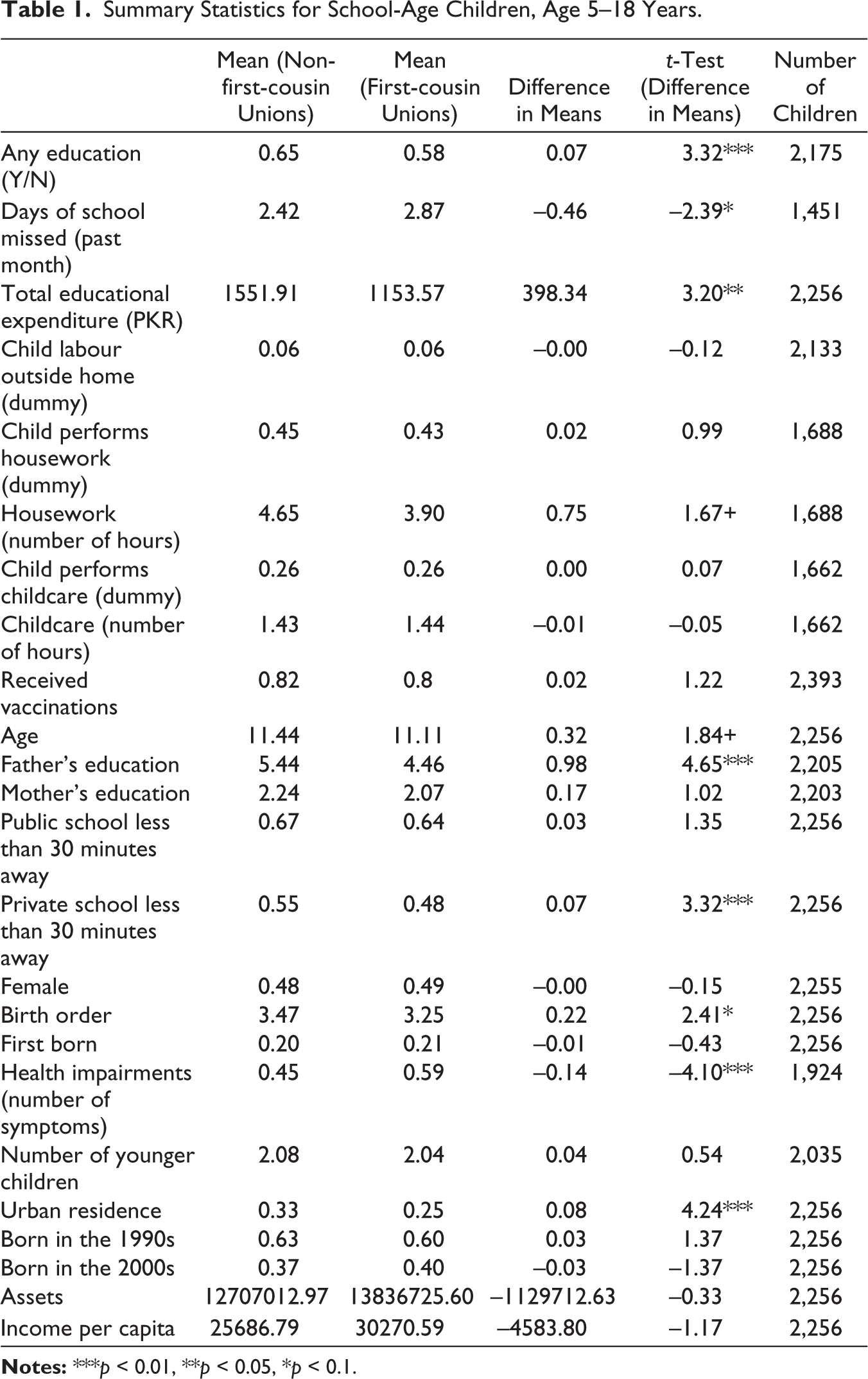
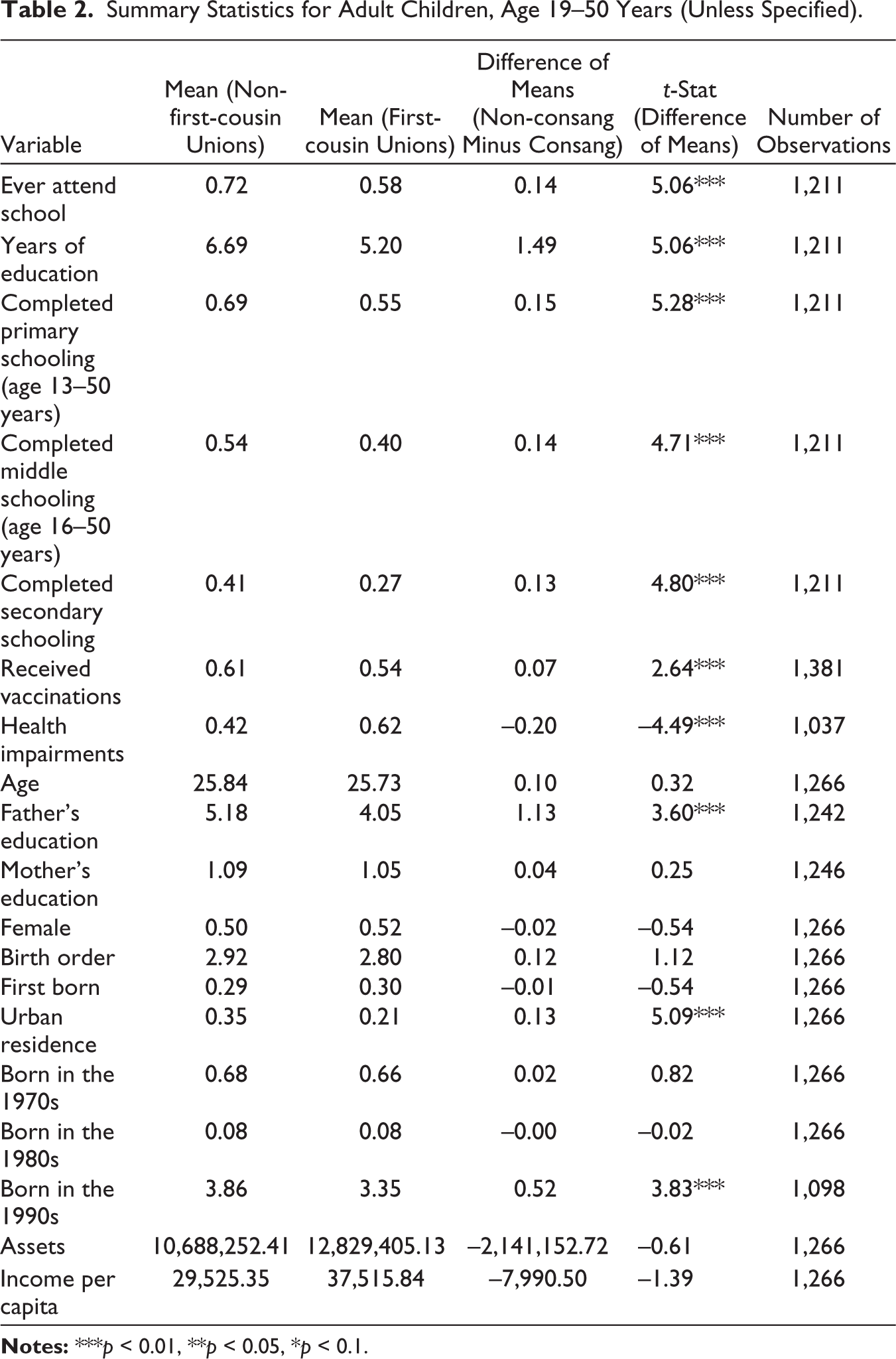
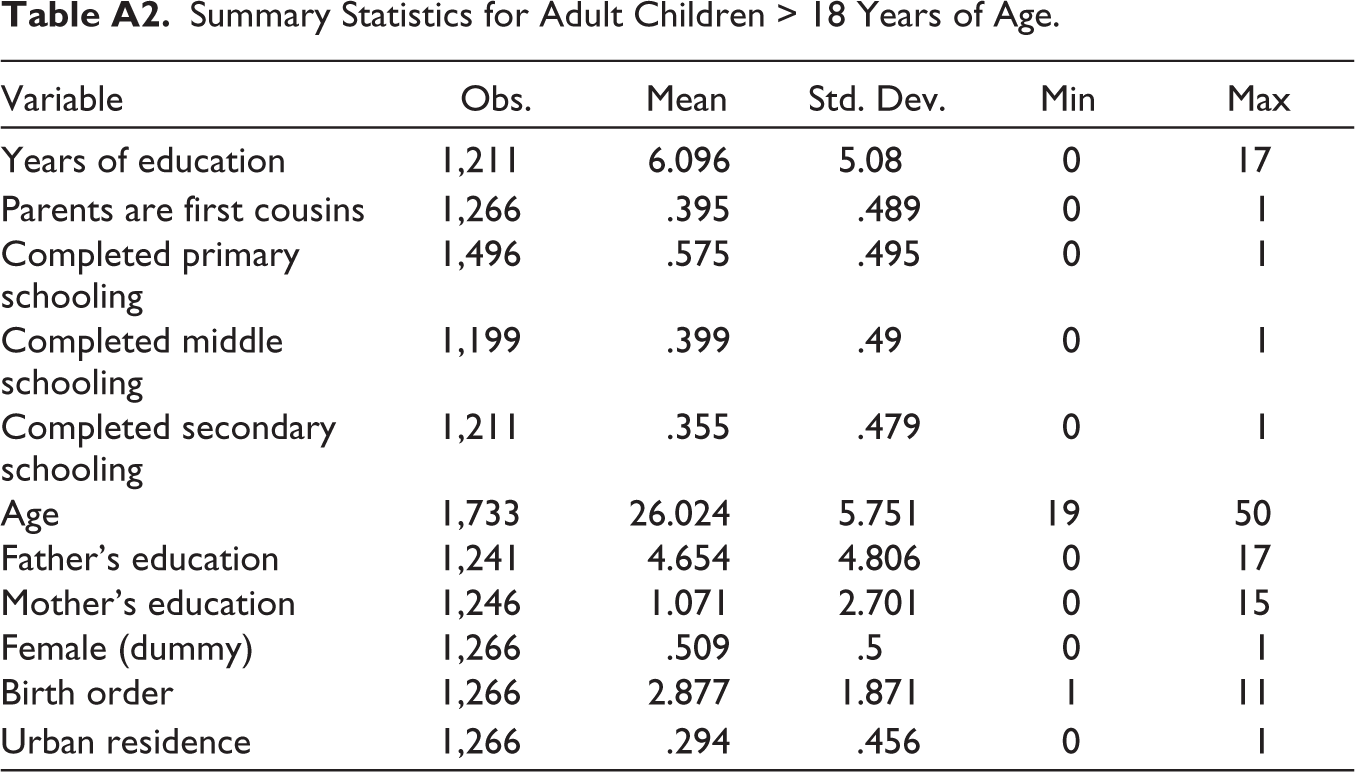
We divide our sample into two subsamples, adult children (age 19–50 years) and school-aged children (age 5–18 years), to study the impact of consanguineous marriage on completed education, vaccination, current educational investments and child labour. Summary statistics by parental consanguinity are provided in Tables 1 and 2, while detailed statistics for the samples as a whole can be found in Tables A1 and A2.
Summary Statistics for School-Age Children, Age 5–18 Years.
Summary Statistics for Adult Children, Age 19–50 Years (Unless Specified).
In our survey, we find that around two-thirds of women are blood relations of their spouses, with 39%–40% married to their first cousin and 24% married to a second cousin. 7 The rate of first-cousin marriage is nearly identical for the subsamples of adult and school-aged children (Tables A1 and A2). Through the remainder of the study, we will consider a couple to be consanguineously married if they are related as first cousins, as we only have data on the availability of first-cousin spouses.
When we look at the summary statistics for school-aged children broken down by parental consanguinity in Table 1, we see that the share of children who have ever gone to school is 7 percentage points lower for the children of parents related as first cousins, a difference which is statistically significant at the 1% level. Average expenditures on schooling are lower amongst the consanguineous group by nearly PKR 400.
Turning to the sample of adult children in Table 2, we see that the children whose parents are first cousins attain around 1.5 years fewer education on average. Next, we consider differences in the family backgrounds by consanguinity status of the parents. The fathers of children married consanguineously have completed around one year less education for both the samples of school-aged children (Table 1) and adult children (Table 2), while the mothers’ education levels are roughly the same. Assets and income per capita were not significantly lower for consanguineous couples; however, they were more likely to reside in rural areas. 8
Empirical Strategy
We begin the analysis of each outcome variable by assessing their correlation with the consanguinity status of parents. In the case of the continuous, left-censored variables, we apply a Tobit analysis to the years of completed education, number of days of missed school, hours of housework and childcare, and educational expenditures. In the case of dummy-dependent variables, we estimate a linear probability model using OLS for the child having any education, for completion of primary, middle and secondary schooling, for vaccination status and for child labour status.
The estimated equation when parental consanguinity is treated as an independent variable is

where Child_Outcome is Education
ij
, Vaccination
ij
or Child_labour
ij
. Education
i,j
is the educational outcome or investment being considered, which include years of education attained, days of school missed and educational expenditures in the case of a continuous variable or an indicator that takes a value of 1 if the child has completed each level of schooling—primary, middle or secondary. Vaccination
ij
is an indicator that takes a value of 1 if the child has received some or all of their recommended vaccinations. Child_labour
i,j
is either the measurement in hours that a child has worked or an indicator for the child labour variable considered, including work outside the home, housework and child care work. Consang
j
is the main explanatory variable of interest and takes a value of 1 if the parents of child i in household j are related as first cousins and 0 if they are unrelated or related more distantly. We interact Consang
j
with the indicator for female children to see if there is a differential effect for daughters.
In order to correct for the potential selection problems into consanguinity, we will apply IPWRA treatment effects regression and ITT analysis, using the instrument developed by Mobarak et al. (2019). For the instrument to be valid, it should be positively correlated with the incidence of consanguineous marriage but independent of other characteristics affecting educational investments in children. Given the strong preference for consanguineous marriage in Pakistan, a greater availability of marriage-eligible cousins should be positively related to the decision to marry consanguineously.
Specifically, the instruments utilized are the ratio of mother’s close-in-age male cousins to female rivals (for women) and the ratio of father’s close-in-age female cousins to male rivals (for men). If the gender of one’s cousins can reasonably be considered random, some people will have a larger number of available opposite gender cousins, while others will have fewer. In linear probability models, we find that an additional eligible cousin (relative to same-gender rivals) increased the probability of marrying a cousin by 7 percentage points on the woman’s side and 5–6 percentage points on the man’s side, both statistically significant at the 1% level. While the gender of individual children may be random, families with son preference may have additional children in order to achieve the desired number of sons. In this way, women whose extended families exhibit greater son preference will have more chances to marry a cousin. While we would have liked to control for it, son preference is unfortunately not easily captured in a way that is measurable in a survey.
For son preference to be problematic to our analysis, however, it would need to be prevalent amongst a woman’s aunts and uncles for it to affect her ability to marry a cousin, rather than in her own (nuclear) family. To the extent that son preference leads to larger families, we do control for the total number of cousins on both the father’s and mother’s sides of the family. And in unreported specifications, when we use only the husband’s opposite-gender cousins as the instrument, which should be less susceptible to son preference (as it is based on the number of female cousins available to the husband to marry), the results changed negligibly; so excess son preference within consanguineous families does not seem to be driving the results.
Details of the IPWRA treatment effects technique are described in Wooldridge (2010), while a useful non-technical introduction can be found in Huber and Drukker (2015). We offer a non-technical summary here. Our selection model for the IPWRA treatment effects technique is a logit model, with the following specification where the

where Consang
i,j
is a dummy variable indicating if the parents of child i in household j are first cousins, α is a constant term, EligCous_Mj is the ratio of the mother’s close-in-age opposite gender cousins to the same gender rivals, and EligCous_Fj is the ratio of the father’s close-in-age opposite gender cousins to the same gender rivals. TotCous_Mj is the mother’s total cousins and TotCous_Fj is the father’s total cousins to control for the possibility that larger, poorer families were more likely to engage in consanguineous marriage. Household controls in Vj include husband’s and wife’s education, income, assets and urban/rural location. The predicted propensity scores, pj, are used as weights in the linear child outcome regressions, where RA is also applied. Regression adjustment is a linear model for the child outcomes that:
First, estimates separate child outcome model coefficients for the consanguineous and non-consanguineous couples based on the household variables Vij and child characteristics Xij, including age, birth order, medical impairments, number of younger siblings, distance to school and gender. Since we are implementing IPWRA, this regression is weighted according to the inverse of the propensity scores. Second, applies the coefficients from the non-consanguineous families to the data of the consanguineous couples to predict child outcomes had their parents not been cousins; these are the potential outcomes or counterfactuals. Third, takes the difference between the actual outcome and the (estimated) potential outcome as the ‘treatment effect on the treated’, in other words the impact of consanguineous marriage on the children of first cousins.
For the ITT analysis, we create an Instrument = EligCous_Mj + EligCous_Fj to measure the effect of either the mother or father having an additional available opposite-gender cousin on child outcomes. We interact the instrument with the indicator for female children to see if there is a differential effect for daughters:

Results
We consider the impact of consanguineous marriage on the educational outcomes and vaccination of adult children (including years of education attained and completion of each level of education) separately from educational investments, child labour and vaccination of currently school-aged children. We will discuss each in turn.
Educational Attainment of Adult Children, Age 19–50 Years
We start by looking at educational outcomes of adult children of first-cousin spouses in comparison to those children whose parents are related more distantly or not at all.
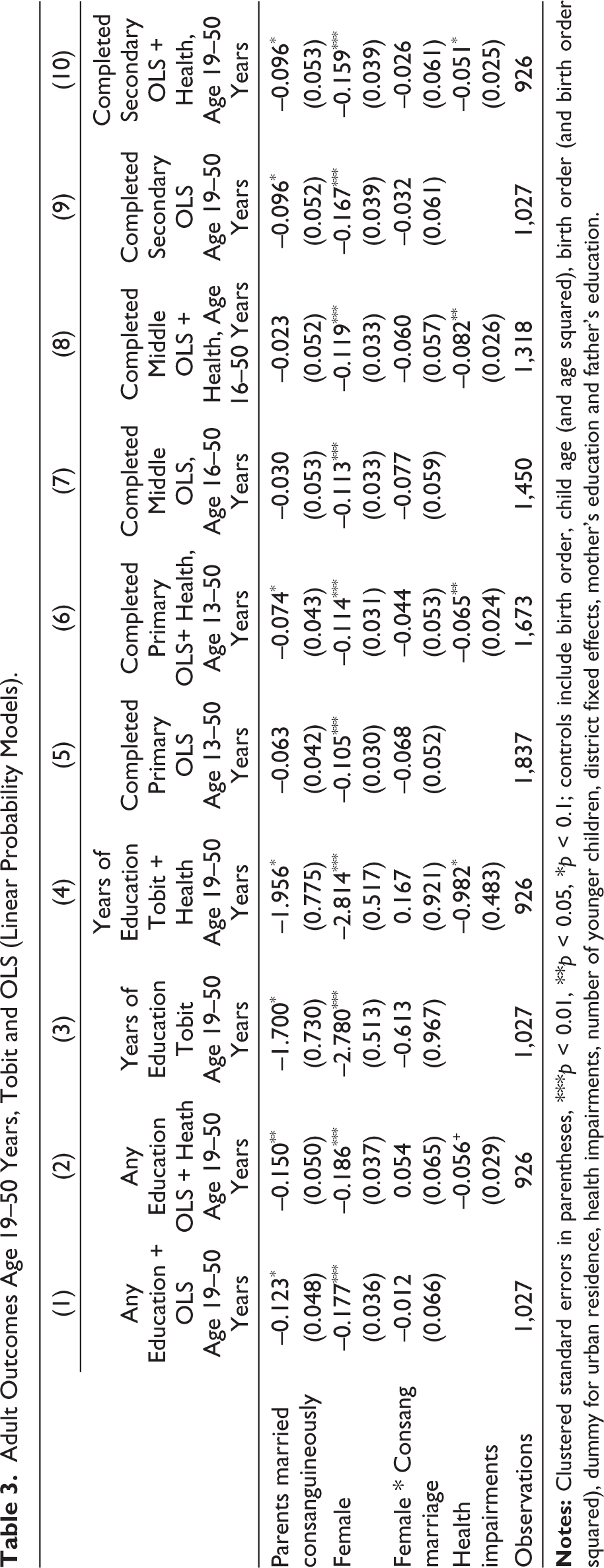
In the OLS and Tobit results, in Table 3, we see that adult children (age 19–50 years) of consanguineous parents are 12–15 percentage points less likely to have any education and complete 1.7–2 years less education. This effect is not lessened by the inclusion of controls for medical impairments; in other words, consanguinity’s negative effect on education cannot be accounted for through genetic effects. Further, daughters have fewer educational achievements across the board. The marginal impact of consanguinity is not greater for daughters since the interaction term was statistically insignificant. Nonetheless, daughters of consanguineous parents face a double burden of consanguinity and sex discrimination.
Adult Outcomes Age 19–50 Years, Tobit and OLS (Linear Probability Models).
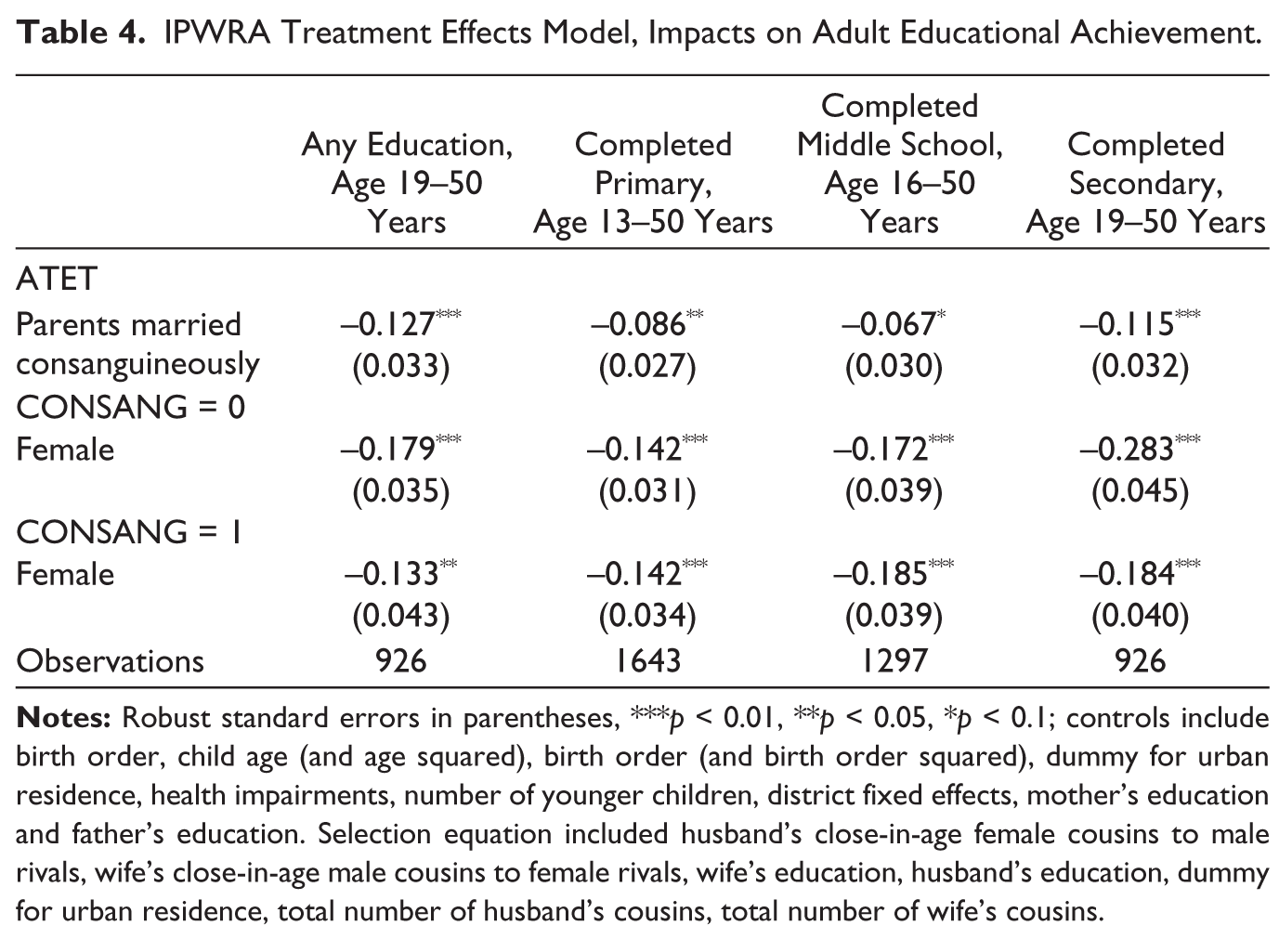
The IPWRA treatment effect specifications in Table 4 indicate that the adult children of consanguineous parents are less likely to have any education and are less likely to complete primary, middle and secondary school. Daughters of both consanguineous and non-consanguineous families are similarly (negatively) affected. Nonetheless, daughters of consanguineous marriage still encounter the negative effects of both consanguinity and sex discrimination.
IPWRA Treatment Effects Model, Impacts on Adult Educational Achievement.
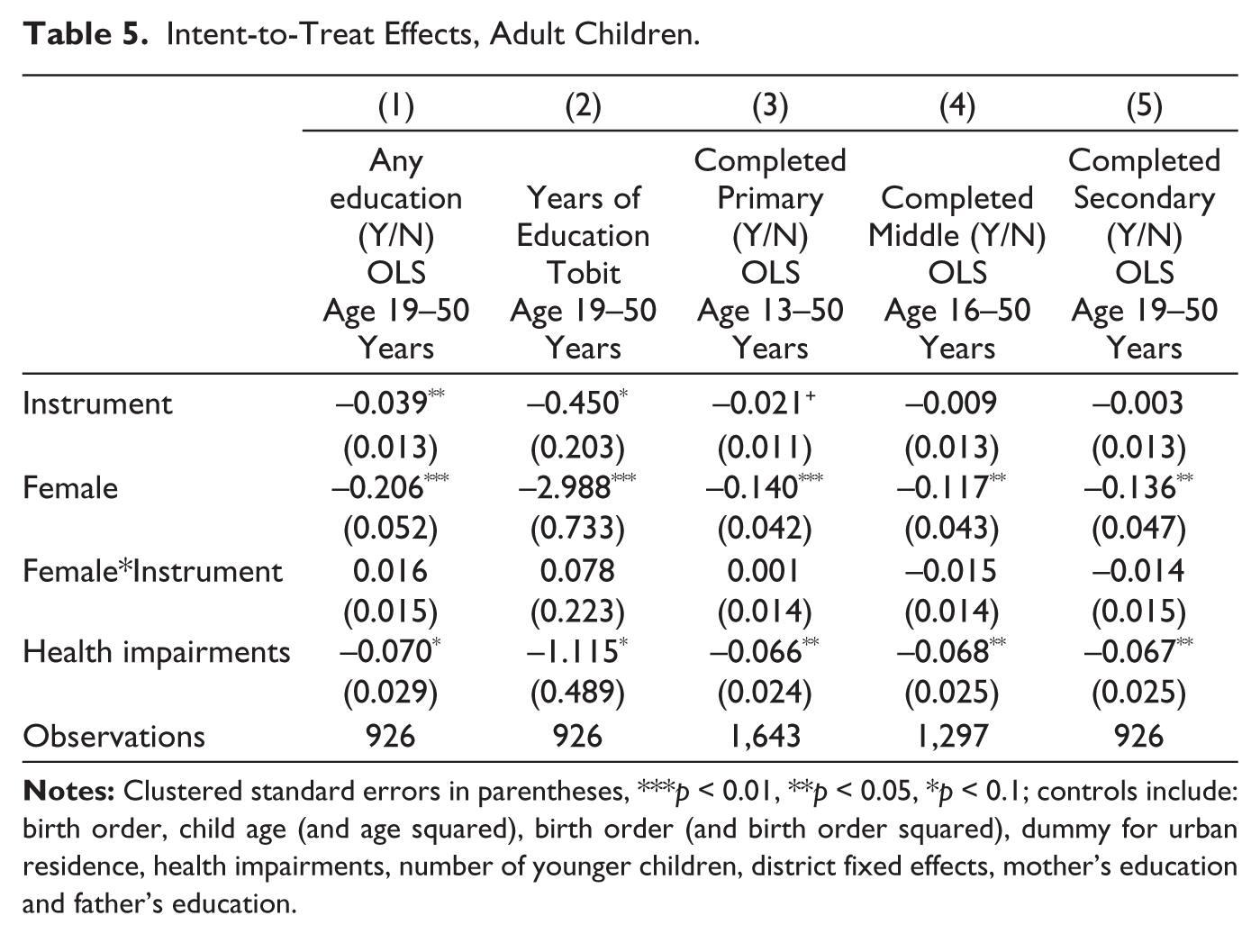
Like the OLS and Tobit results we saw earlier, the ITT results in Table 5 show that adult children (age 19–50 years) of consanguineous parents are less likely to have any education and complete fewer years of education. They are also less likely to complete primary school. While the marginal impact of consanguinity is not greater for daughters, daughters of consanguineous marriage achieve the least amount of education due to the combined negative effects of consanguinity and sex discrimination.
Intent-to-Treat Effects, Adult Children.
Educational Investments and Child Labour, School-Aged Children (Age 5–18 Years)
Next, we look at educational investments and outcomes for school-aged children of first-cousin spouses in comparison to those children whose parents are related more distantly or not at all. Overall, there seem to be fewer negative ramifications of consanguinity on the current generation of children, age 5–18 years, as compared with the adult children discussed above.
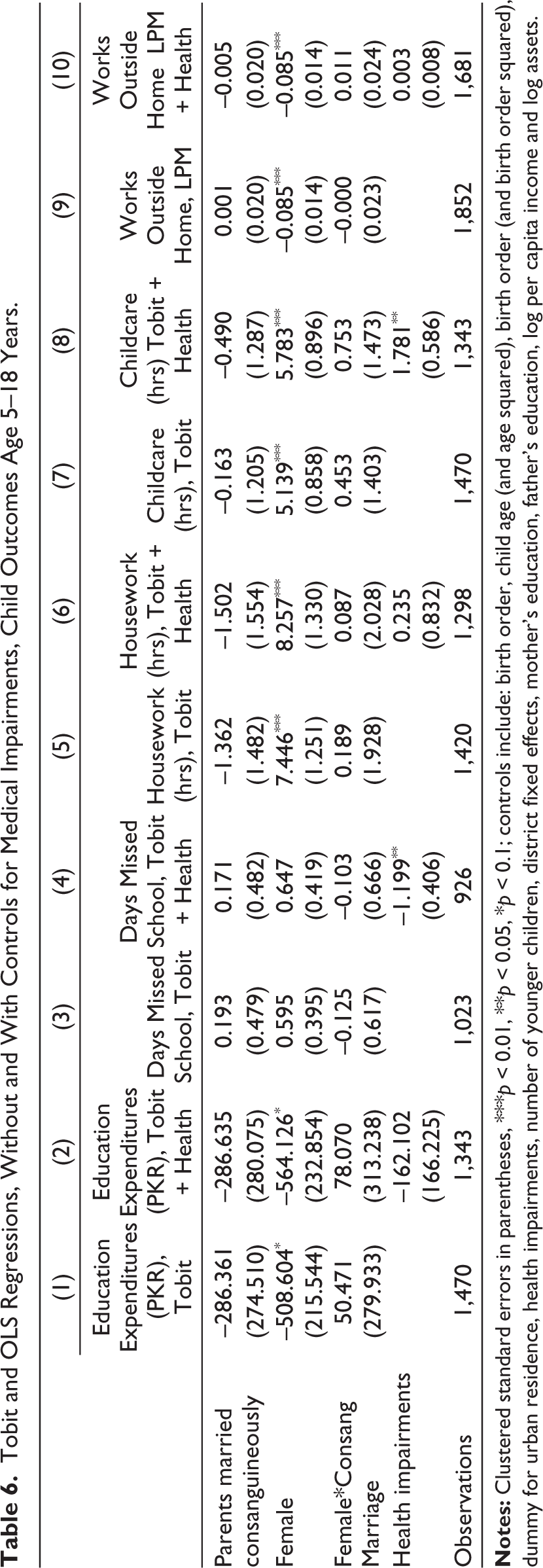
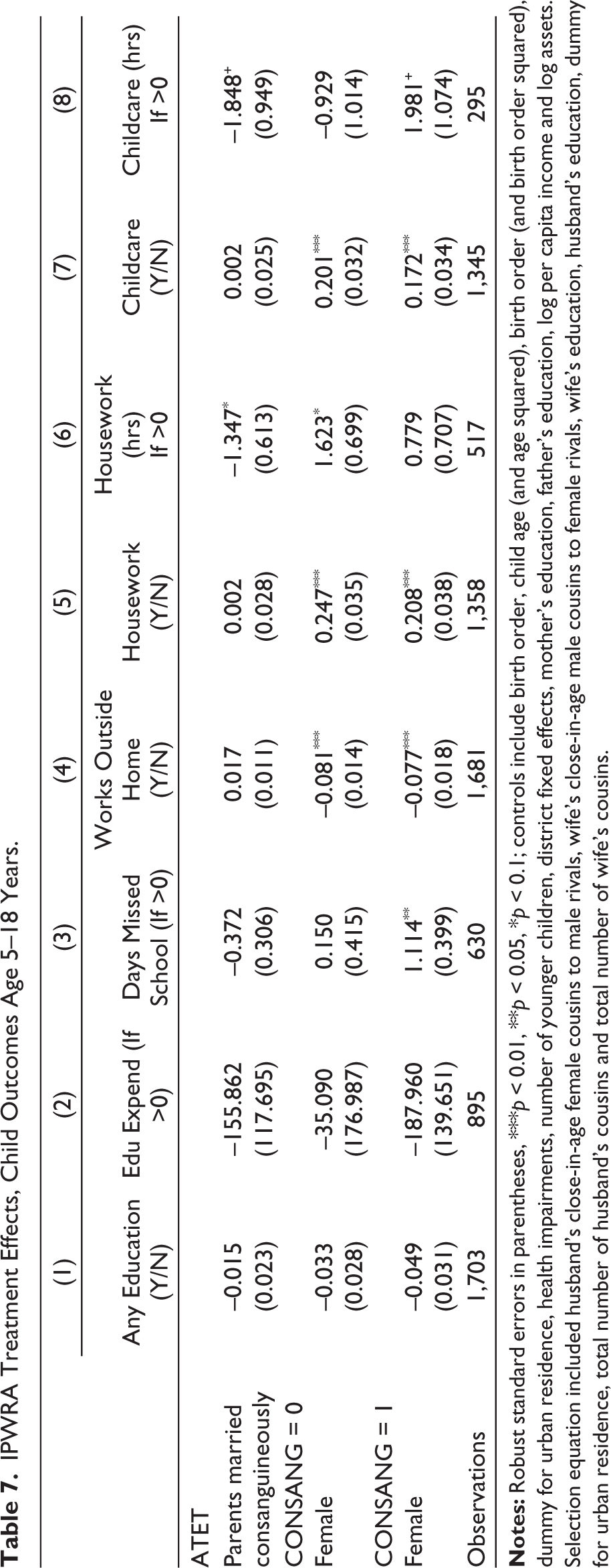
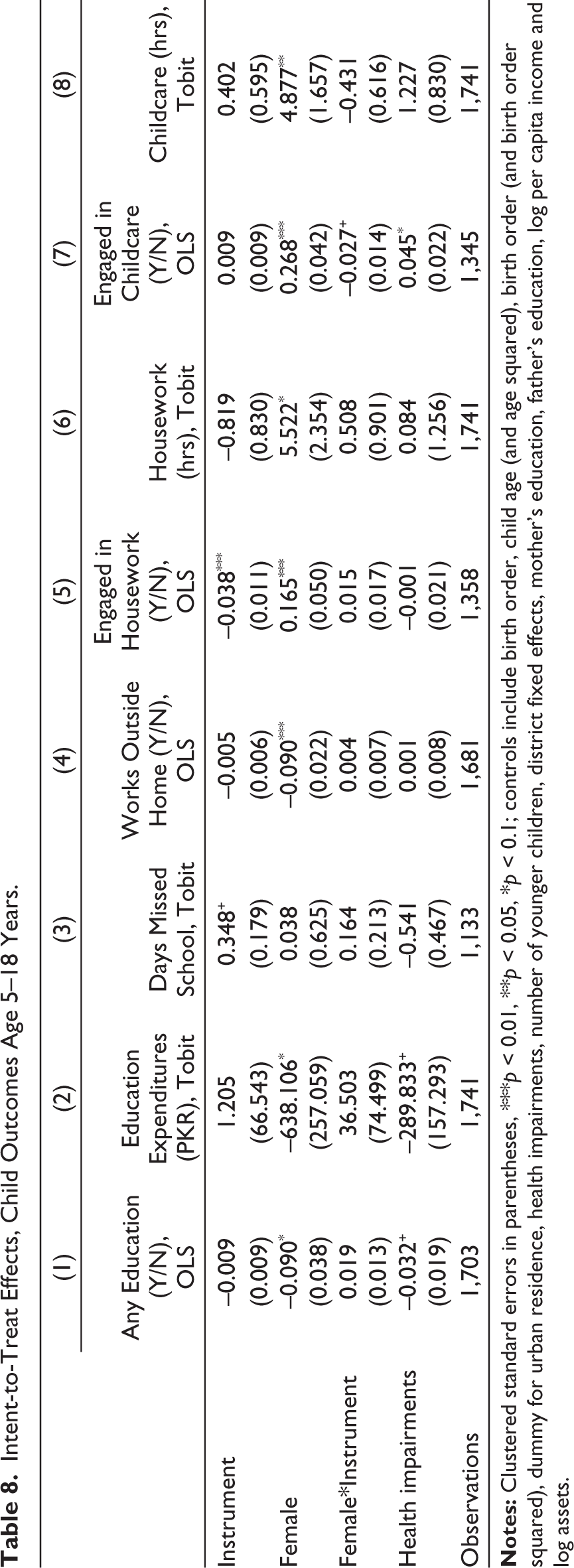
In the OLS/Tobit specifications in Table 6, we see little correlation of consanguinity with child labour and education outcomes for the school-aged subsample, regardless of the inclusion of controls for medical impairments. Daughters, regardless of consanguinity status, do more domestic chores (housework and childcare) but are less likely to work outside the home; less is spent on their education as well. Recent work highlights the importance of including domestic work to accurately measure child labour, especially for girls (Basu et al., 2010; Dziadula & Guzman, 2020). In our second set of results, the IPWRA treatment effects specifications, we still see little impact of consanguinity on child educational outcomes amongst the 5–18-years-old age group, and children of both types of marriage are equally likely to have ever attended school (Table 7). However, children of consanguineous marriage perform 1–2 fewer hours of housework and childcare. Finally, in the ITT specifications in Table 8, we still see no statistically significant impact of consanguineous marriage on child labour but there is a small impact on the number of school days missed per month.
Tobit and OLS Regressions, Without and With Controls for Medical Impairments, Child Outcomes Age 5–18 Years.
IPWRA Treatment Effects, Child Outcomes Age 5–18 Years.
Intent-to-Treat Effects, Child Outcomes Age 5–18 Years.
Child Vaccination
Our last set of results in Table 9 consider the impact of consanguinity on a child being at least partially vaccinated, split into samples of school-aged children (age 5–18 years) and adult children (age 19–50 years). We again apply the three techniques to the data: OLS, IPWRA treatment effects and ITT analysis. In this case, we also report the results by gender because, unlike for schooling and child labour, the results do, in fact, differ. In both age groups, for OLS and IPWRA treatment effects specifications, the impact of consanguinity on the vaccination status of daughters is negative. Again we find that the negative relationship between consanguinity and vaccination status, where it exists, is fortunately less severe in the current generation of children than in the sample of adult children.
At Least Partially Vaccinated, OLS, Treatment Effects and ITT.
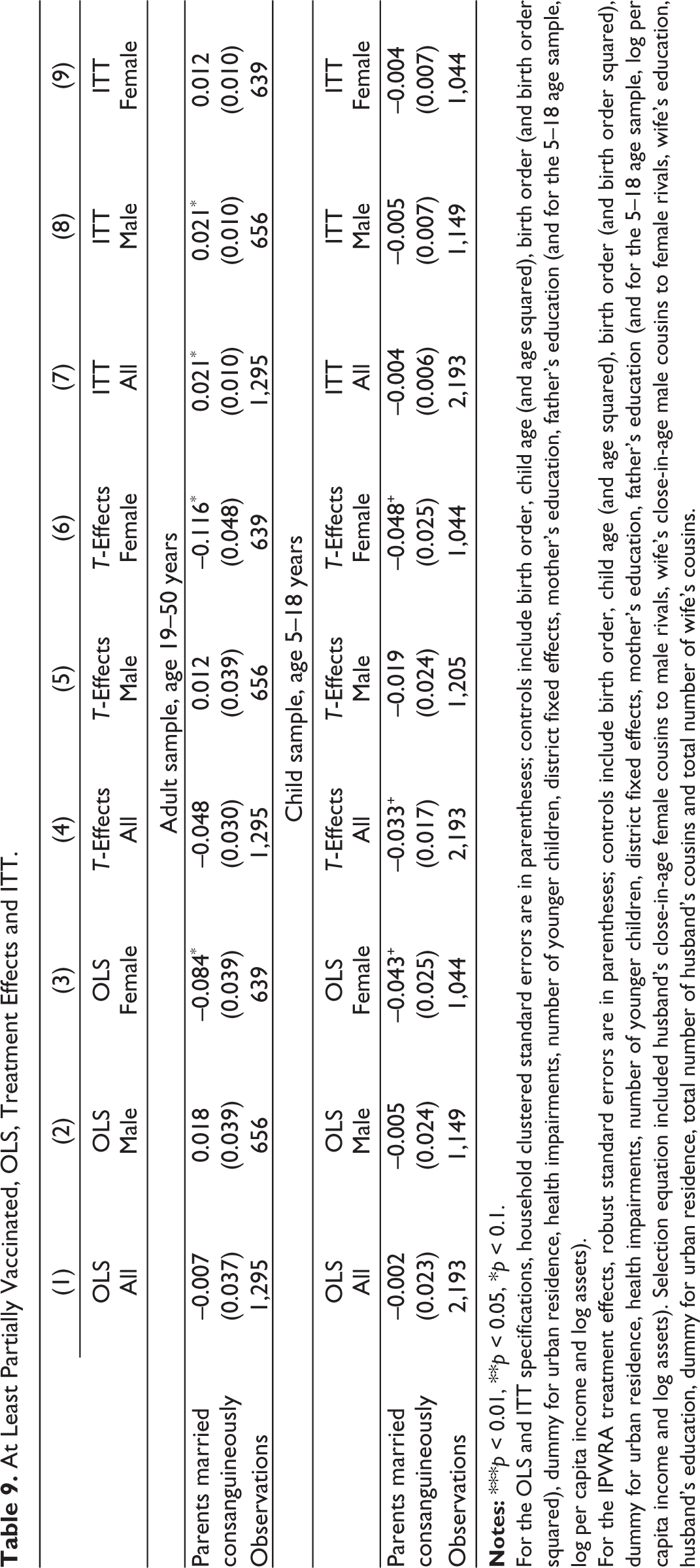
For the OLS and ITT specifications, household clustered standard errors are in parentheses; controls include birth order, child age (and age squared), birth order (and birth order squared), dummy for urban residence, health impairments, number of younger children, district fixed effects, mother’s education, father’s education (and for the 5–18 age sample, log per capita income and log assets).
For the IPWRA treatment effects, robust standard errors are in parentheses; controls include birth order, child age (and age squared), birth order (and birth order squared), dummy for urban residence, health impairments, number of younger children, district fixed effects, mother’s education, father’s education (and for the 5–18 age sample, log per capita income and log assets). Selection equation included husband’s close-in-age female cousins to male rivals, wife’s close-in-age male cousins to female rivals, wife’s education, husband’s education, dummy for urban residence, total number of husband’s cousins and total number of wife’s cousins.
Discussion of Mechanisms
In the literature review, we had discussed how consanguinity might impact children’s education positively due to greater altruism and negatively through inherited medical impairments and intergenerational persistence of education, and for consanguineously born daughters through socially conservative gender norms.
Greater altruism, even if it was to some extent operating, was not enough to reverse whatever caused the negative relationship of consanguinity with educational attainment in the generation of adult children and vaccination of daughters. Altruism may be reducing domestic duties in the form of housework and childcare among current school-aged children, however (Tables 7 and 8).
Given that controlling for medical impairments did not lessen the negative coefficient on consanguineous marriage in any of the OLS/Tobit regressions, a genetic cause for the negative correlation between parental consanguinity and education is also unlikely.
Socially conservative attitudes towards girls also do not seem to be a major mechanism through which consanguinity negatively impacted the education of adult daughters. While adult daughters did face a double burden of consanguinity and gender discrimination, there was no additional marginal burden of consanguinity for girls; the coefficient of the interaction on Female × Consanguinity was statistically insignificant in the OLS/Tobit and ITT regressions, and in the IPWRA treatment effect regressions, where the coefficients were estimated separately for the consanguineous and non-consanguineous subsamples, the coefficients on the female indicator variable were of similar size and significance. 9 In unreported specifications, when we use only the husband’s opposite-gender cousins as the instrument, which should be less susceptible to son preference (as it is based on the number of female cousins available to the husband to marry), the results changed negligibly; so excess son preference within consanguineous families does not seem to be driving the results either.
The only explanation that we cannot rule out for the negative relationship between educational achievement and consanguinity among adult children is intergenerational transmission of attitudes and norms towards education (Agupusi, 2018), patience and ability (Black et al., 2005) and ambition and competitiveness (Khadjavi & Nicklisch, 2018). This is partially supported where we see greater numbers of missed days of school for children aged 5–18 years in consanguineous families (Table 8).
Regardless of the causes, there seem to be fewer negative impacts of consanguinity on education and vaccination in the younger generation of children aged 5–18 years than in adult children aged 19–50 years once we control for sociodemographic characteristics. In the current generation, children of consanguineous families may do worse on average in educational investments using raw averages (Table 1), but it is likely more a result of poor opportunities and environment (less educated parents, less access to schools) than a direct impact of being born to consanguineous parents as we see in our regression analysis (Tables 6–8).
Conclusions
Our empirical results show that, using a variety of estimation techniques and controlling for child and household factors, the adult children of parents who are first cousins completed fewer years of education. Fortunately, there are few effects of consanguineous parentage on the current generation of school-aged children other than possibly missing more days of school. Also, the hours of household chores were lower for children of consanguineous parents, suggesting that these parents may either be more lenient with their children as a result of greater altruism or have fewer expectations of them. Raw differences between outcomes for school-aged children of consanguineous and non-consanguineous families remain, but they appear to be the result of the relative disadvantages faced by consanguineous families rather than some direct consequence of consanguinity itself.
Human capital investments are lower for daughters regardless of consanguinity status and for both the adult and school-aged samples. In this way, gender discrimination rather than consanguinity is driving the pattern of poor female outcomes. While an important development goal on its own, reducing gender gaps is important for raising income per capita (Baliamoune–Lutz & McGillivray, 2015). Further, raising the education level of women, regardless of their consanguinity status, is critical to achieving key development goals such as reducing fertility (Samarakoon & Parinduri, 2015), improving child nutritional status (Alderman & Headey, 2017) and increasing women’s empowerment (Mahmud et al., 2012) and labor force participation (Keats, 2018).
Footnotes
Acknowledgements
The authors gratefully acknowledge the help of Mehak Ejaz and Usman Sikander for their translation and pre-testing of the Urdu survey
Declaration of Conflicting Interests
The authors declared no potential conflicts of interest with respect to the research, authorship, and/or publication of this article.
Funding
The authors disclosed receipt of the following financial support for the research, authorship, and/or publication of this article: Funding for this study was provided by the National Science Foundation Human and Social Dynamics Grant No. SES-0527751 and the Lahore School of Economics.
Appendix
Summary Statistics for Adult Children > 18 Years of Age.
| Variable | Obs. | Mean | Std. Dev. | Min | Max |
| Years of education | 1,211 | 6.096 | 5.08 | 0 | 17 |
| Parents are first cousins | 1,266 | .395 | .489 | 0 | 1 |
| Completed primary schooling | 1,496 | .575 | .495 | 0 | 1 |
| Completed middle schooling | 1,199 | .399 | .49 | 0 | 1 |
| Completed secondary schooling | 1,211 | .355 | .479 | 0 | 1 |
| Age | 1,733 | 26.024 | 5.751 | 19 | 50 |
| Father’s education | 1,241 | 4.654 | 4.806 | 0 | 17 |
| Mother’s education | 1,246 | 1.071 | 2.701 | 0 | 15 |
| Female (dummy) | 1,266 | .509 | .5 | 0 | 1 |
| Birth order | 1,266 | 2.877 | 1.871 | 1 | 11 |
| Urban residence | 1,266 | .294 | .456 | 0 | 1 |