



Abstract
When children are able to progress beyond their parents’ education level, that is, when there is upward intergenerational education mobility—they are more likely to have better opportunities and access than their parents in terms of jobs and income. For any nation, it is important to understand the trajectory of intergenerational education mobility and ask: Has it been increasing? In the case of Bangladesh, our study is the first to use nationally representative household survey data to explore the trend of intergenerational education mobility. We compute intergenerational education mobility separately for three different years—2005, 2010 and 2016, and find that intergenerational education mobility has, from 2005 to 2016, significantly decreased in terms of fathers’ education. This is surprising given that the expansion of education has been a target both policy-wise and action-wise—for Bangladesh over the last few decades. The finding in terms of mothers’ education—that intergenerational education mobility has significantly increased from 2005 to 2016—makes more sense given the focus on female education expansion in Bangladesh over the years. Moreover, our results indicate that daughters, in general, have been progressing better compared to sons in terms of intergenerational (father–child) education mobility and that children of fathers with higher education levels progressed better than children of fathers with lower education levels. We suggest policies accordingly and emphasize the need to investigate the reasons behind the father–child education immobility over time in Bangladesh.
Introduction
This article aims to understand the trend in intergenerational education mobility in the context of Bangladesh, and as such, the intergenerational aspect is at the heart of its focus on education. The intergenerational aspect focuses on the advantages, disadvantages, barriers and progresses carried through generations and it is an important indicator of the educational development of a country (Schuller & Desjardins, 2007). If all our efforts and investments, as a nation, towards education and development are, in the end, unable to break the shackles of disadvantage in order to allow a child to make better progress than their parents, then are the efforts really working as expected? In actuality, the need and aspiration to break the shackles of disadvantage, and achieve equality of opportunity, act as the strongest motivation behind attempting to understand intergenerational mobility of education, occupation or earnings (Javed & Irfan, 2014). In this article, we focus particularly on intergenerational mobility in terms of education.
If a child is able to progress beyond their parents’ education level, it raises the probability of that child having a better opportunity and access than the parents in terms of jobs and income. This is referred to as intergenerational educational mobility (Torche, 2019). Unfortunately, it may often be the case that children are unable to progress beyond the education their parents attained. This may result in ‘intergenerational educational persistence’, which indicates the phenomenon of a child attaining the same level of education as his/her parents and not being able to progress beyond their parents’ education level (Azam, 2016; Checchi et al., 2013). In essence, the terms intergenerational mobility and intergenerational persistence imply opposite incidences.
It is important to assess and understand intergenerational education mobility because education may allow a child born into a poverty-stricken family to rise beyond the poverty to improve their own standard, and quality, of life (Black & Devereux, 2011; Cutler & Lleras-Muney, 2006; Gans, 1995; Holleb, 1972; Levine & Nidiffer, 1996; Lochner, 2011). Evidence suggests that countries that have higher inequality experience lower upward mobility which means that there is a lower opportunity for a child born into a low-income family to climb the economic ladder (Corak, 2013; Greenstone et al., 2013). Admittedly, income inequality is increasing in recent times, especially in developing countries such as Bangladesh, and perhaps the rising inequality is an indication of entrenched inequality of opportunities in the education system and labour market (Emran & Shilpi, 2017). In determining how to reduce the inequality of opportunities in any education system, and also in understanding the intergenerational transmission of economic status, the influence of parents’ education on their children’s educational attainment is a key factor (Lillard & Willis, 1994; Solon, 2004).
There are strong theoretical frameworks and models that argue in the favour of parents’ educational background affecting—through different mechanisms—children’s education. For example, Becker and Tomes (1979, 1986) suggest that parents’ abilities influence their own income and educational outcomes, which in turn determine the quality and quantity of their investment in children, thus affecting their children’s educational attainment. On the other hand, poorer parents may be unable to afford better quality education (Alderman et al., 2001; Härmä, 2011). According to Kivinen and Rinne (1996), when children go to school, they take along the assets and deficiencies of their home and family background; and this, in turn, may influence the extent of their learning and skill development. Indeed, education is the main vehicle both for economic persistence across generations and for intergenerational mobility (Hout & DiPrete, 2006).
Most of the research till date on intergenerational mobility in developing countries has used education as the main indicator of economic status (see e.g., Azam & Bhatt, 2015; Emran & Shilpi, 2015; Jalan & Murgai, 2008; Nimubona & Vencatachellum, 2007). There are at least two reasons—first mentioned and highlighted by Emran and Shilpi (2017)—that justify the focus on education as a measure of intergenerational mobility. The first reason is that in the absence of reliable data to estimate permanent income rigorously, educational attainment may be considered a suitable proxy for income in developing countries. The second reason is that education is accepted in large as being essential to social mobility, especially in skill-driven economies, by policy makers and economists alike (Beddoes, 2012; Rajan, 2016; Stiglitz, 2012). Stiglitz (2012) suggests that ‘education is viewed as the main shaper of all other adulthood opportunities’. Therefore, there is merit to focusing on intergenerational education mobility in order to understand the overall economic condition and developmental state of a nation, especially on the trend in the mobility over the years. This is the main, albeit modest, goal of this article.
Before proceeding, it is worth sharing some points about the context in focus. Bangladesh is a South Asian lower-middle income and developing nation. The education system of Bangladesh has, in general, the following four education levels: primary, secondary, higher secondary or college and tertiary. On the education front, Bangladesh has made significant progress in terms of increasing the ‘quantity’ of education, specifically in terms of near universal net primary enrolment (Haque, 2020), but the quality of education in Bangladesh remains low (Asadullah & Chaudhury, 2015). One of the developments that Bangladesh is praised for is the significant strides taken towards the education of girls (e.g., the ‘Female Secondary Stipend and Assistance Program’ [FSSAP]), and towards the empowerment of women, which is often attributed as a driver in Bangladesh’s economic transformation (Basu, 2018). With the multiple achievements that Bangladesh has accomplished on the education front, it remains equally important that we assess different aspects, such as intergenerational education mobility, to ascertain that the trajectory of development is on the right path and that we are progressing as intended.
In sum, the research questions of this article stand as follows:
How does intergenerational educational mobility change over the years 2005, 2010 and 2016 in Bangladesh? Does it increase or decrease? Is there a difference in the trend in intergenerational educational mobility across the different relationships of fathers and sons, fathers and daughters, mothers and sons, and mothers and daughters? Is there a difference in the trend in intergenerational educational mobility between higher-educated parents and comparatively lower educated parents?
In terms of data, we use the repeated cross-section household income and expenditure survey (HIES) data from the years 2005, 2010 and 2016. The reason behind is that we are interested to determine the trend in intergenerational education mobility over time—especially whether it has increased or not—and not whether there is intergenerational education mobility in a particular period of time. The HIES data—nationally representative of Bangladesh—allows us to investigate the trend in intergenerational education mobility. However, using such repeated cross-section household data is not without its limitations. For instance, one such limitation is that there may be truncation in our HIES data due to co-resident restrictions (Emran & Shilpi, 2017). Acknowledging this limitation, we use rank-based measures of intergenerational mobility for our analysis, as Emran and Shilpi (2017) suggest in the case of co-resident samples, to overcome some of these limitations.
In terms of the literature, there is limited evidence on the topic from countries of the global south, especially in the case of Bangladesh. The only other studies on intergenerational education mobility conducted in the context of Bangladesh are Asadullah (2012) and Emran and Shilpi (2017). The latter study is more aimed at making a methodological contribution and finds that rank-based measures are more robust than the widely used intergenerational regression coefficient (IGRC) and intergenerational correlation coefficient (IGC) in estimating intergenerational mobility with incomplete data (Emran & Shilpi, 2017)—we follow their recommendation in this article. On the other hand, Asadullah (2012) uses data from 141 villages in rural Bangladesh and finds that low wealth mobility, in their data, can be explained by intergenerational persistence in educational attainment.
The study at hand is different from the above studies on Bangladesh in both nature and scope. First, none of these studies explore the trend of intergenerational education mobility, which our study does. It is important to explore the trend of intergenerational education mobility to achieve a better and more comprehensive understanding of how the landscape of education, and consequently development, is changing in Bangladesh. It is difficult to understand the trajectory of development without considering the trend in aspects such as intergenerational education mobility. Second, unlike previous studies, this article uses nationally representative data and the advantage of this lies in the enabling of wider inferences, from the findings to the population.
In essence, we aim to take the research on intergenerational education mobility in Bangladesh a step further by exploring the trends in the indicator over time. The underlying premise behind exploring these trends is to ascertain how well we, as a nation, have been doing in terms of children progressing beyond their parents’ education. In summary, although we do not make any advancements on the methodological front on the topic of intergenerational education mobility, we believe the novelty of our study lies in using an established methodological approach to analyse the trends in intergenerational education mobility, which obtain results that stimulate further contemplation of the dynamics between mobility, education and development. To the best of our knowledge, ours is the first study in Bangladesh to use nationally representative data to assess the trends in intergenerational educational mobility over time (2005–2016) in Bangladesh.
Our study finds that intergenerational education mobility has, overall, from 2005 to 2016, decreased in terms of fathers’ education but increased in terms of mothers’ education. Both these estimates are statistically significant. The decrease, over time, in education mobility with respect to fathers’ education is a puzzle, especially considering the expansion of education over the same time-period and the gradually increasing focus on education over time. This indicates, in essence, a downward trend in intergenerational education mobility in terms of fathers’ education in Bangladesh. We shed light on why this might be in the later sections of this study.
In the following sections, we discuss our data and empirical approach to analysing the trend in intergenerational education mobility. We then present the results of our regression analysis and discuss the most salient findings. We end by discussing the policy implications of our findings and then underscore the contributions and future scope of research following our study.
Data and Methodology
Data and Variables
This study uses nationally representative ‘HIES’ data conducted, in 2005, 2010 and 2016, by the Bangladesh Bureau of Statistics (BBS, 2017). HIES followed a stratified two-stage cluster sampling design. In brief, the survey provides valuable household-level data on household income, expenditures, assets, housing conditions, as well as individual-level data on education, employment, health and disability (Bangladesh Bureau of Statistics, 2017). In the HIES 2005, a total of 10,080 households were randomly selected from 8 divisions and 64 districts; in HIES 2010, this number was 12,240 households and in HIES 2016, the number was 46,076 households. Each household may consist of multiple members including parents, children and extended family.
Since the main variables of interest are parents’ and children’s years of schooling, we use the HIES data to construct all possible parent–child relationships within the data. For example, in one relationship the household head is a parent and their son/daughter is the child, whereas in another relationship the household head is the child and their father/mother is the parent. As such, we obtain multiple parent–child relationships. Therefore, with an aim to examine intergenerational education mobility, the final number of observations (members) in this study are respectively 1,250, 2,727 and 3,068 for the years 2005, 2010 and 2016. These observations represent the number of children who have completed schooling (with age 22 years or above) and have parents who either attended different levels of schooling or had no formal schooling at all. As Wooldridge (2013, p. 315) suggests, this type of exogenous sample selection does not create any bias and provides consistent and unbiased results. In our models, we include several other covariates, for example, gender, stream of education, age, age squared, regional (divisions) categorical variables and households’ per capita expenditure.
We also aim to explore whether intergenerational education mobility changes differently across parents with different education levels. For this analysis, we construct two separate variables. Each of the variables have a threshold that categorizes parents into higher education levels and comparatively lower education levels. The threshold for the first variable is the secondary school certificate examination (SSC) in Bangladesh, and parents are categorized into the following two groups: (1) parents with education below the level of SSC completion and (2) parents with education up to SSC completion or beyond. Similarly, the threshold for the second variable is the higher secondary school certificate examination (HSC) in Bangladesh, and parents are categorized into the following two groups: (1) parents with education below the level of HSC completion and (2) parents with education up to HSC completion or beyond.
Empirical Approach
In this article, we aim to examine the association between parents’ educational attainment and their children’s educational attainment. There are generally two widely used methodologies—regression estimations—for the intergenerational mobility analysis, the estimation of (1) the IGRC; and (2) the IGC. On the other hand, rank-based correlation has recently arisen as a more appropriate approach in the case of co-resident samples in developing countries. Among these, the IGRC is the most widely used measure of intergenerational mobility in the development literature (Behrman & Wolfe, 1987; Emran & Sun, 2015; Hertz et al., 2007; Jalan & Murgai, 2008; Lam & Schoeni, 1993; Lillard & Willis, 1994; Nimubona & Vencatachellum, 2007).
The specification of the IGRC is as follows:

Here,
In the above IGRC equation, our parameter of interest is β1 and the estimate of β1 is the measure of intergenerational transmission of education after using an ordinary least square (OLS) estimator. The β1 would be written as follows:
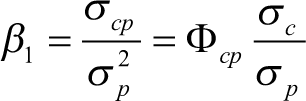
Here, Φcp is the correlation coefficient between parents’ years of schooling and their children’s years of schooling; σc and σp are the standard deviations of the children’s years of schooling and parents’ years of schooling, respectively. Therefore, our estimated β1 from IGRC might change solely due to the changes in the ratio of the standard deviations of the parents’ and children’s years of schooling

Here, σc and σp are standard deviations for children’s years of schooling and parent’s years of schooling, respectively, and α1 is the coefficient of intergenerational mobility. IGC is the normalized measure, as compared to IGRC, that adjusts for the changing variances among generations.
The measures of IGRC and IGC are closely related measures in estimating intergenerational mobility, whereby IGRC is the relative measure and IGC is the absolute measure. Both the measures estimate the intergenerational mobility of education. Additionally, IGC estimation can also capture the exogenous educational policy shocks such as compulsory education, secular increase in schooling, etc. (Checchi et al., 2008). In the case of developing countries such as Bangladesh, there may be truncation bias in surveys due to co-resident samples. This means that it may be the case that household members who are not residing in the same household are not considered as household members in the survey. In such a case, rank-based correlation would be a more appropriate and less biased measure of intergenerational mobility (Chetty et al., 2014; Dahl & DeLeire, 2008; Emran & Shilpi, 2017). Therefore, we have used rank correlation as our main estimation method in measuring the association between parents’ and children’s years of schooling over time. The specification of rank-based correlation is as follows:

Here, Ri is the percentile position/rank of child i in the distribution of years of schooling of all children,
At this point, some methodological issues are worth clarifying. First, since we have used multiple children from a single household and the data are clustered, robust standard errors have been used in all the regressions to minimize biases. Second, there may be some multi-collinearity between fathers’ and mothers’ years of education variables, in the case of which Holmlund et al. (2011) suggest using the summation of parents’ education as a solution. However, since one of the objectives of this study is to examine intergenerational mobility separately in terms of both fathers’ and mothers’ years of education, we do not use the summation of parents’ education but rather keep fathers’ and mothers’ education variables unique in our analysis. This decision was further justified when we conducted multi-collinearity tests (Table A1) and found that the magnitude of multi-collinearity between fathers’ and mothers’ years of education variables is not high as compared to the minimum thresholds of the Variance Inflation Factor (VIF).
Finally, in this article, our main outcome variable is the total years of schooling of the child or the rank of the child in the distribution of years of schooling of all children. In this case, we have the accumulated total years of formal schooling of a child from class one to masters level, where any higher studies beyond the masters level are also considered as masters level (HIES data does not have separate information of PhD or post-doctorate graduates). Therefore, the dependent variable is the total years of schooling of children and this varies between ‘0’ and ‘17’. Children below the age of 22 have been excluded from the study because it is highly likely that children below this age have not completed their formal education and may still be in school/college/university.
Findings
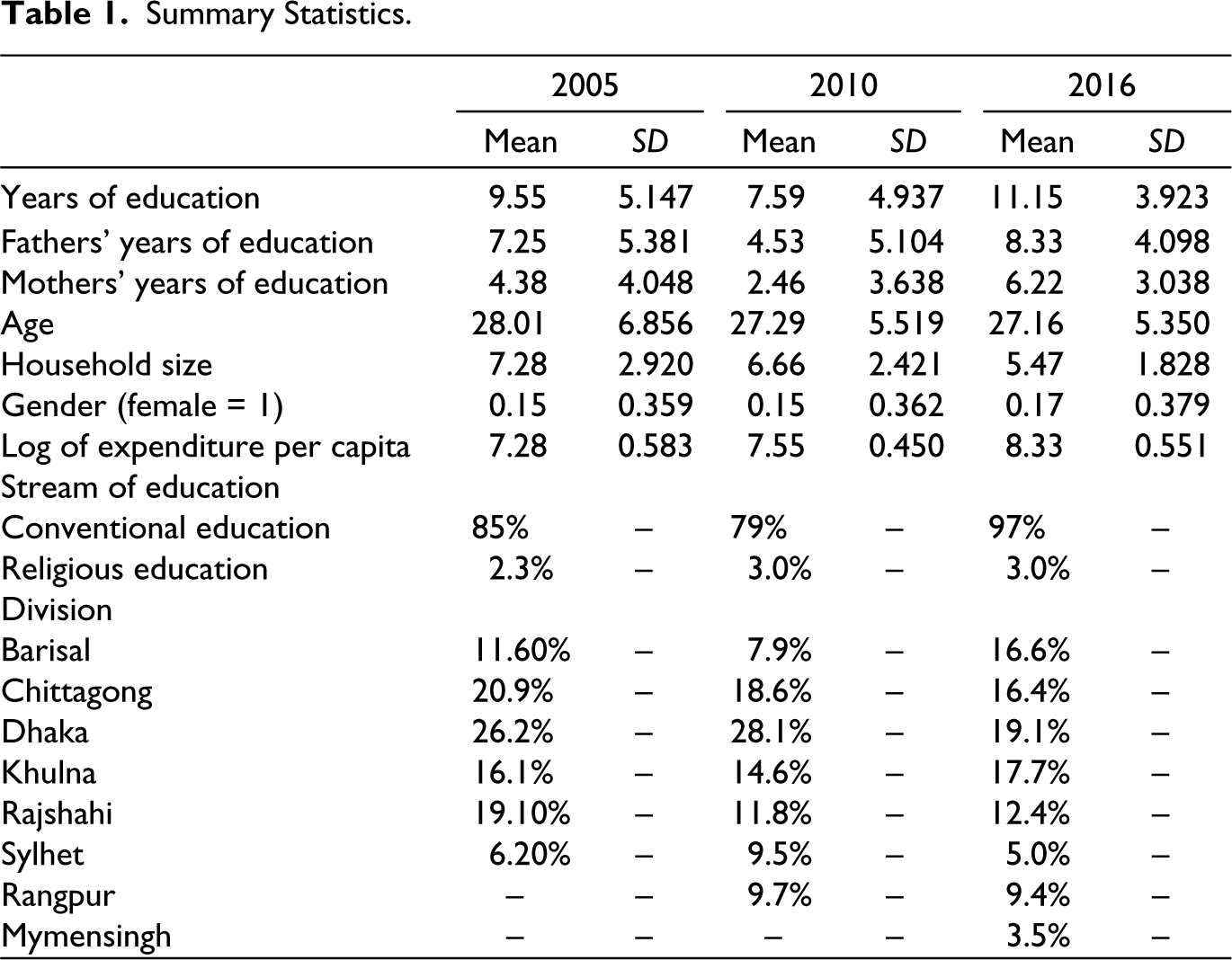
Tables 1–6 show the descriptive statistics, while Tables 7–11 show the results from the associational analysis. Table 1 reports the descriptive statistics of the variables used in our empirical analysis. Tables 2–6 report the rates of children’s completed education level conditional on respectively parents’ incomplete secondary education, parents’ SSC, incomplete higher secondary education and parents’ HSC. From Table 1, it is evident that the average years of education of both a child’s father and mother each decrease from 2005 to 2010 but increase from 2010 to 2016. Overall, there has been an increase in average years of education from 2005 to 2016. In actuality, the decrease in average years of education from 2005 to 2010 is evident across the sample regardless of whether an individual is a child or a parent.
Summary Statistics.
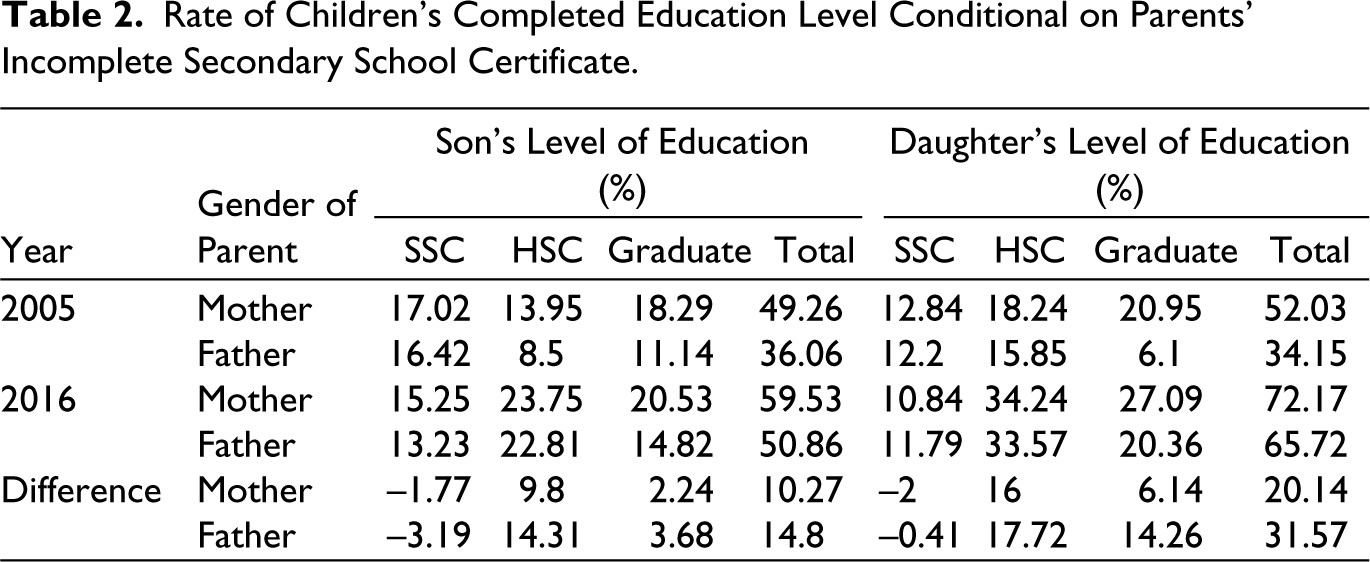
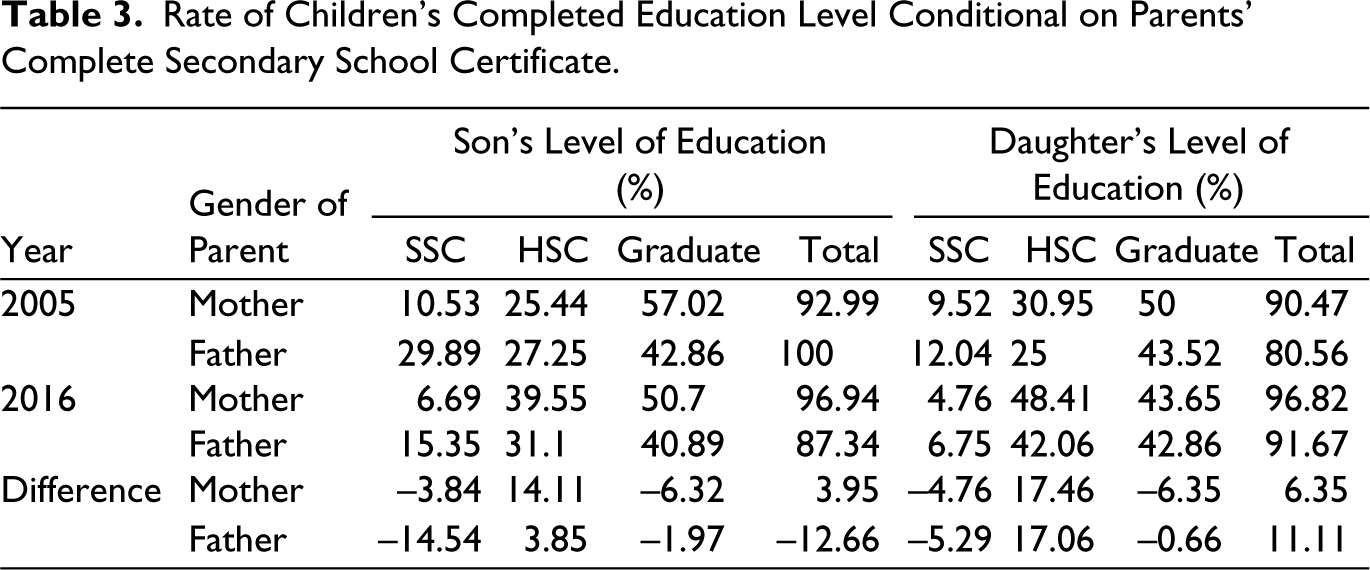
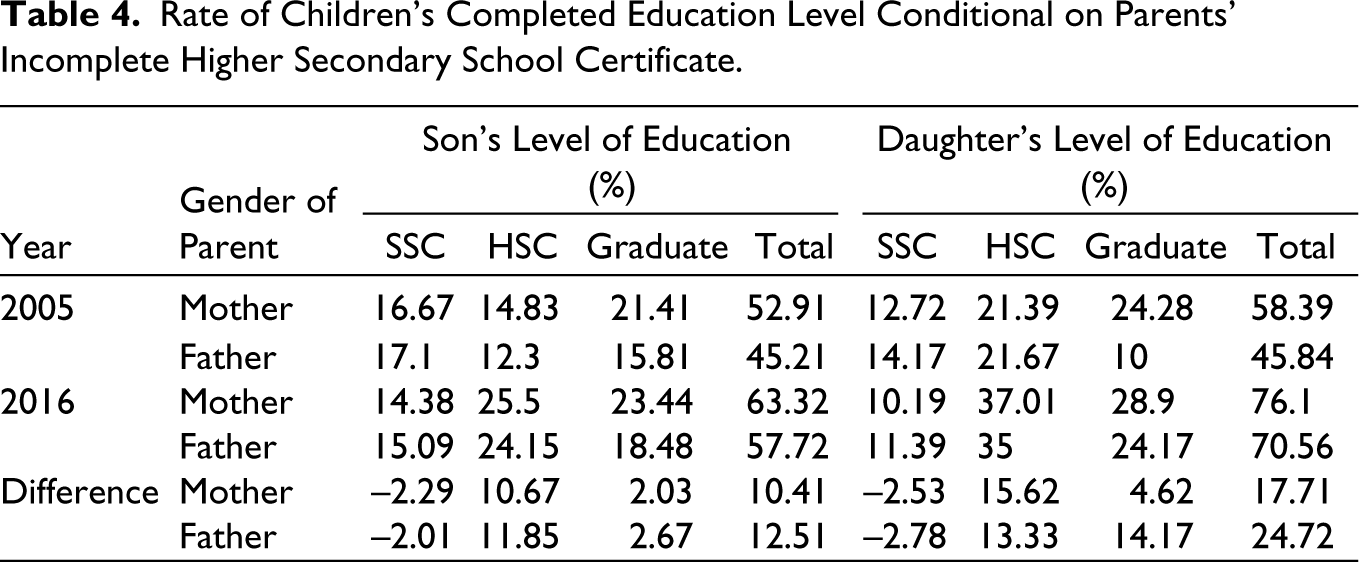
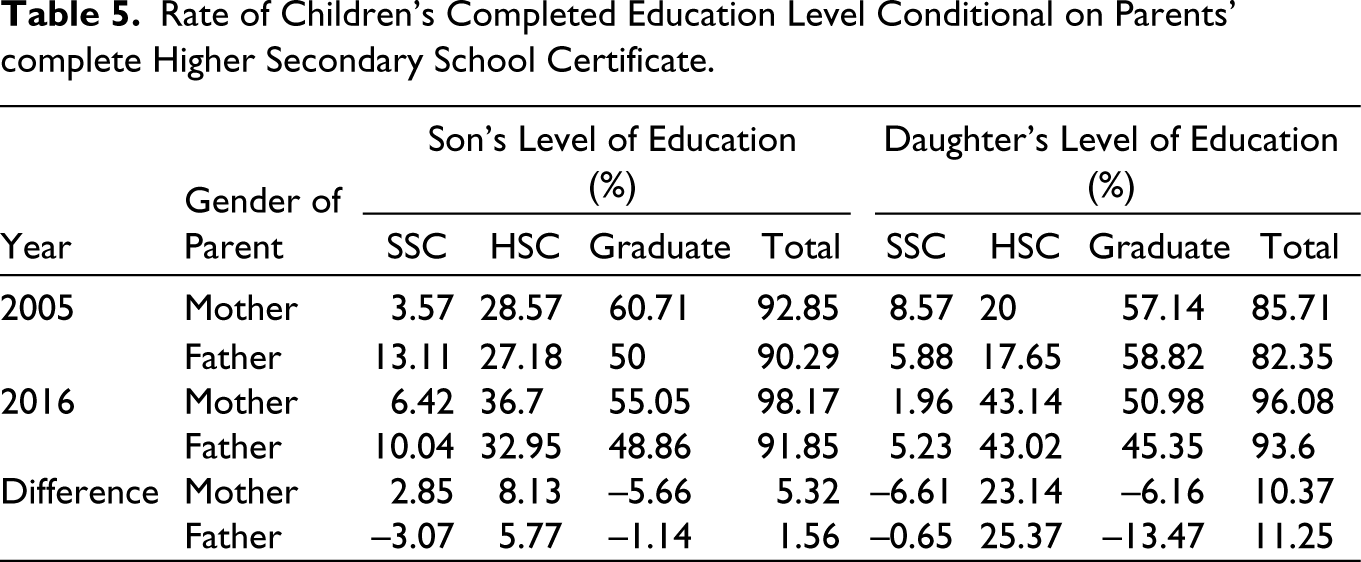
Tables 2–6, show the percentage distributions of the children’s highest education level conditional on parental education. In reviewing changes over the decade (2005–2016) in the completion rates of each level of education, we find that the rate may decrease among lower levels as more children achieve secondary education. Tables 2 and 3 highlight changes in the ‘at least secondary’ statistic over the decade among the following two subsets of parents: ‘incomplete secondary’ and ‘completed secondary level (SSC)’. Similarly, Tables 4 and 5 highlight changes in the ‘at least higher secondary’ statistic over the decade among the following two subsets of parents: ‘incomplete higher secondary’ and ‘completed higher secondary level (HSC)’. We have done these to compare low- and high-education levels among parents.
Rate of Children’s Completed Education Level Conditional on Parents’ Incomplete Secondary School Certificate.
Rate of Children’s Completed Education Level Conditional on Parents’ Complete Secondary School Certificate.
Rate of Children’s Completed Education Level Conditional on Parents’ Incomplete Higher Secondary School Certificate.
Rate of Children’s Completed Education Level Conditional on Parents’ complete Higher Secondary School Certificate.
Rate of Children’s Completed Education Level Conditional on Parents’ Incomplete Primary Education.
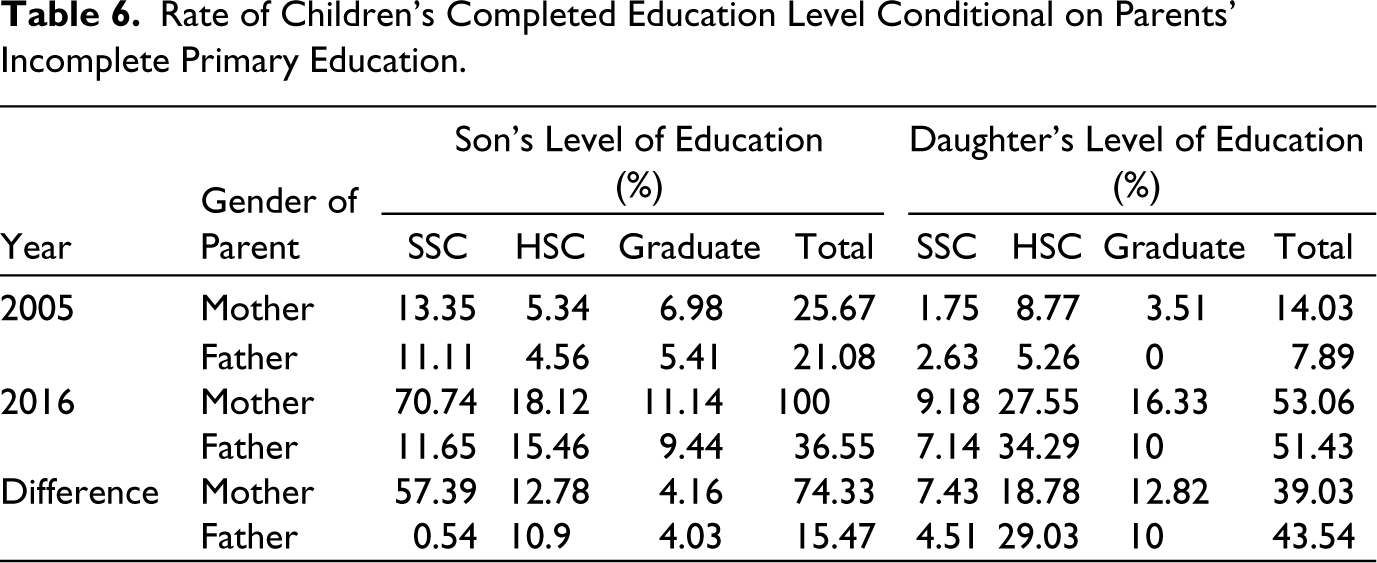
The most prominent feature from the descriptive statistics analysis is that in the case of both the parents’ education levels, the increase in levels of education among daughters is higher than among sons (except in the case of mothers’ incomplete primary education). The gender difference is more pronounced in the case of parents’ low-education levels than in high-education levels. Regardless of whether the ‘at least secondary’ statistic is conditional on mother or father’s education, or conditional on low versus high parental education, the increase over the decade among sons is small. Moreover, the increase in the ‘at least secondary’ statistic among both sons and daughters, and both high- and low-education parents, is higher when conditioned on fathers’ education. Overall, changes in the percentage of children who completed ‘at least secondary’ level from 2005 to 2016 is higher in the case of the children of lower-education parents. In addition, the increase in the ‘at least secondary’ statistic, among both sons and daughters, is higher when parents’ education is less than primary compared to when parents’ education level is secondary or higher secondary completed.
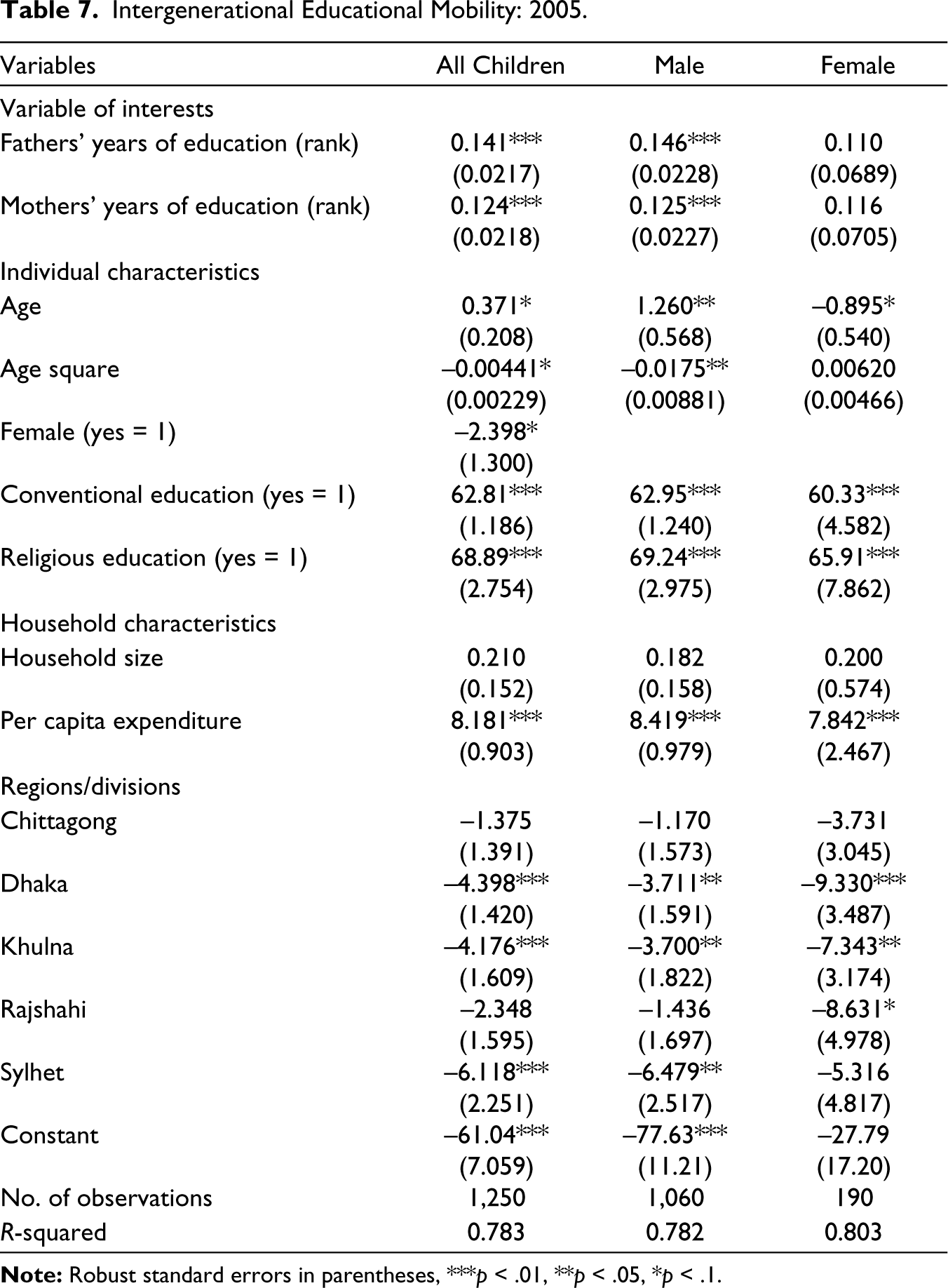
Intergenerational Educational Mobility: 2005.
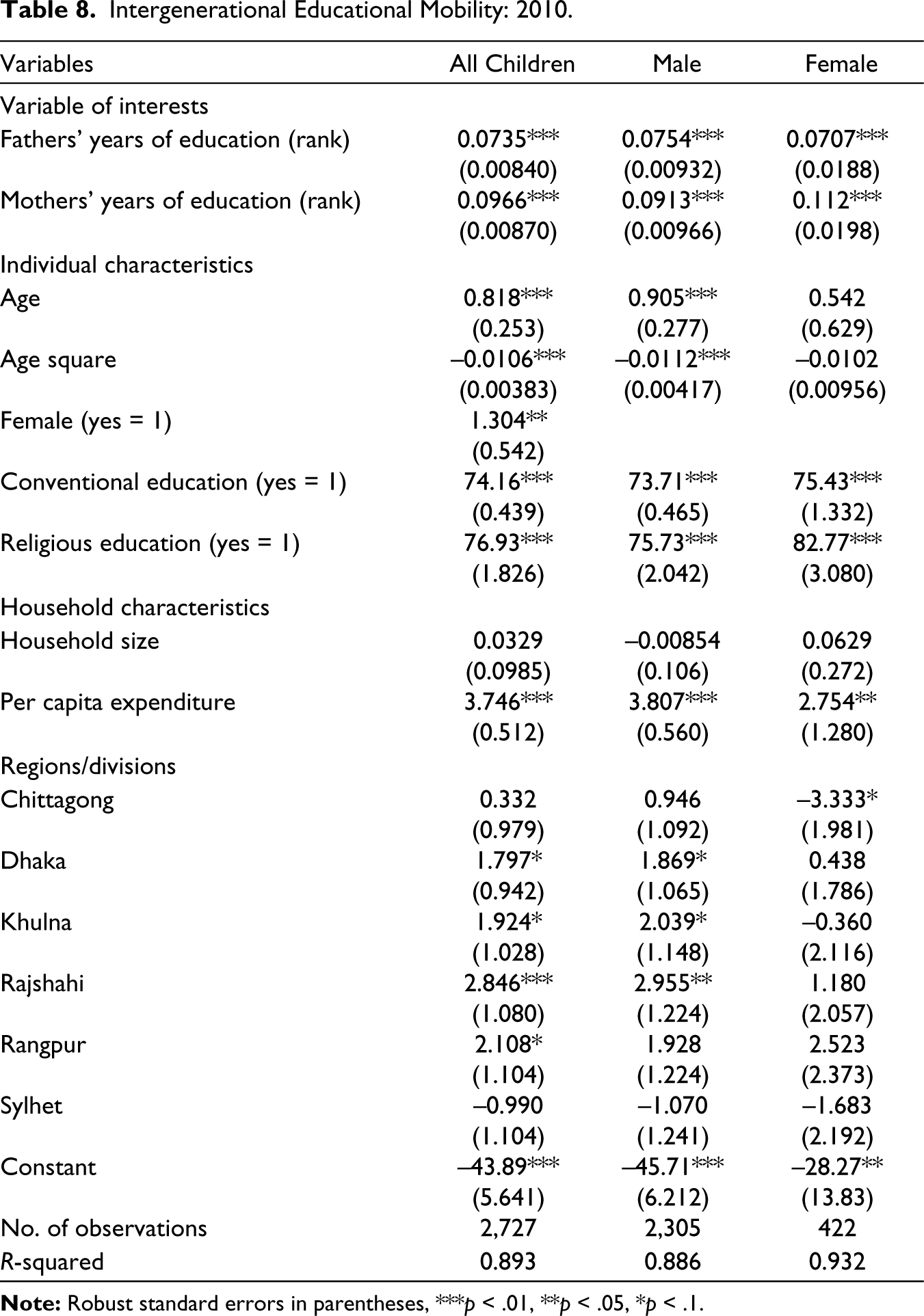
Intergenerational Educational Mobility: 2010.
Intergenerational Educational Mobility: 2016.
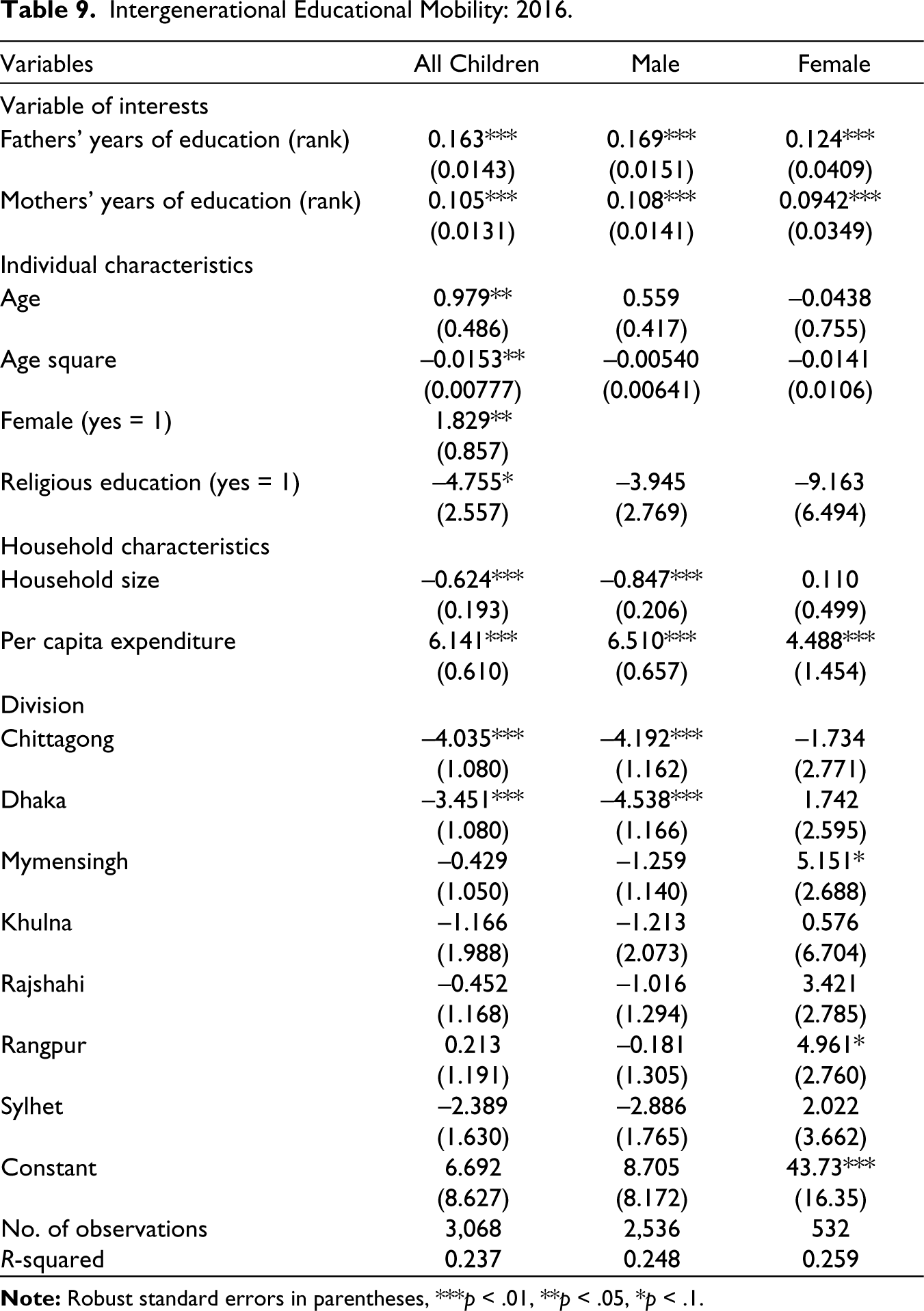
To explore the possibility of correlations existing between parents’ and children’s educational attainment, we develop and run three OLS regression models for three different years. Tables 7–9 show the regression results using rank correlation, respectively, for 2005, 2010 and 2016. The coefficients from the rank-based correlation analysis indicate how the trend in intergenerational educational mobility has changed over the years 2005, 2010 and 2016. The coefficients can be interpreted as such: An increase in a particular coefficient over the years indicates a decrease in intergenerational educational mobility, and vice versa. Evidently, the highest level of intergenerational educational mobility is evident in the case of father and daughter (0.07 in 2010). The lowest level of intergenerational educational mobility is observed in the case of father and son (0.17 in 2016). We unpack and discuss these results in detail below. Also, we test whether the differences of the coefficients between each of fathers’ and mothers’ education ranks and children’s/son’s/daughter’s education ranks are statistically significant between 2005 and 2010, 2010 and 2016, and between 2005 and 2016, and we report these results in Table A2.
According to the estimates in Tables 7–9 (first column), intergenerational mobility between fathers’ and children’s education has increased (not significantly) from 2005 to 2010, then significantly decreased from 2010 to 2016 and has overall significantly decreased from 2005 to 2016. On the other hand, intergenerational mobility between mother’s education and children’s education has increased (not significantly) from 2005 to 2010, then significantly decreased from 2010 to 2016 and has overall significantly increased from 2005 to 2016. In particular, a 10% increase in fathers’ rank in terms of years of schooling is associated with a 1.4%, 0.7% and 1.6% increase in children’s rank in terms of years of schooling, respectively, in 2005, 2010 and 2016. On the other hand, a 10% increase in the mothers’ rank in terms of years of schooling is associated with a 1.2%, 1% and 1.1% increase in the children’s rank in terms of years of schooling, respectively, in 2005, 2010 and 2016.
Tables 7–9 also show (second and third columns) the trends in intergenerational education mobility disaggregated across children’s gender. In terms of fathers’ education, mobility in the case of sons has significantly decreased, whereas in terms of mothers’ education, mobility in the case of sons has significantly increased. On the other hand, in terms of fathers’ education, mobility in the case of daughters has remained unchanged, while in terms of mothers’ education, mobility in the case of daughters has significantly increased. A 10% increase in the fathers’ and mothers’ rank in terms of years of schooling is associated with, respectively, a 1.5% and 1.3% in 2005, a 0.8% and 0.9% in 2010, and a 1.7% and 1.1% in 2016 increase in the ranks of education of the male children. On the other hand, a 10% increase in the fathers’ and mothers’ rank in terms of years of schooling is associated with, respectively, a 1.1% and 1.2% in 2005, a 0.7% and 1.1% in 2010, and a 1.2% and 0.9% in 2016 increase in the ranks of education of the female children.
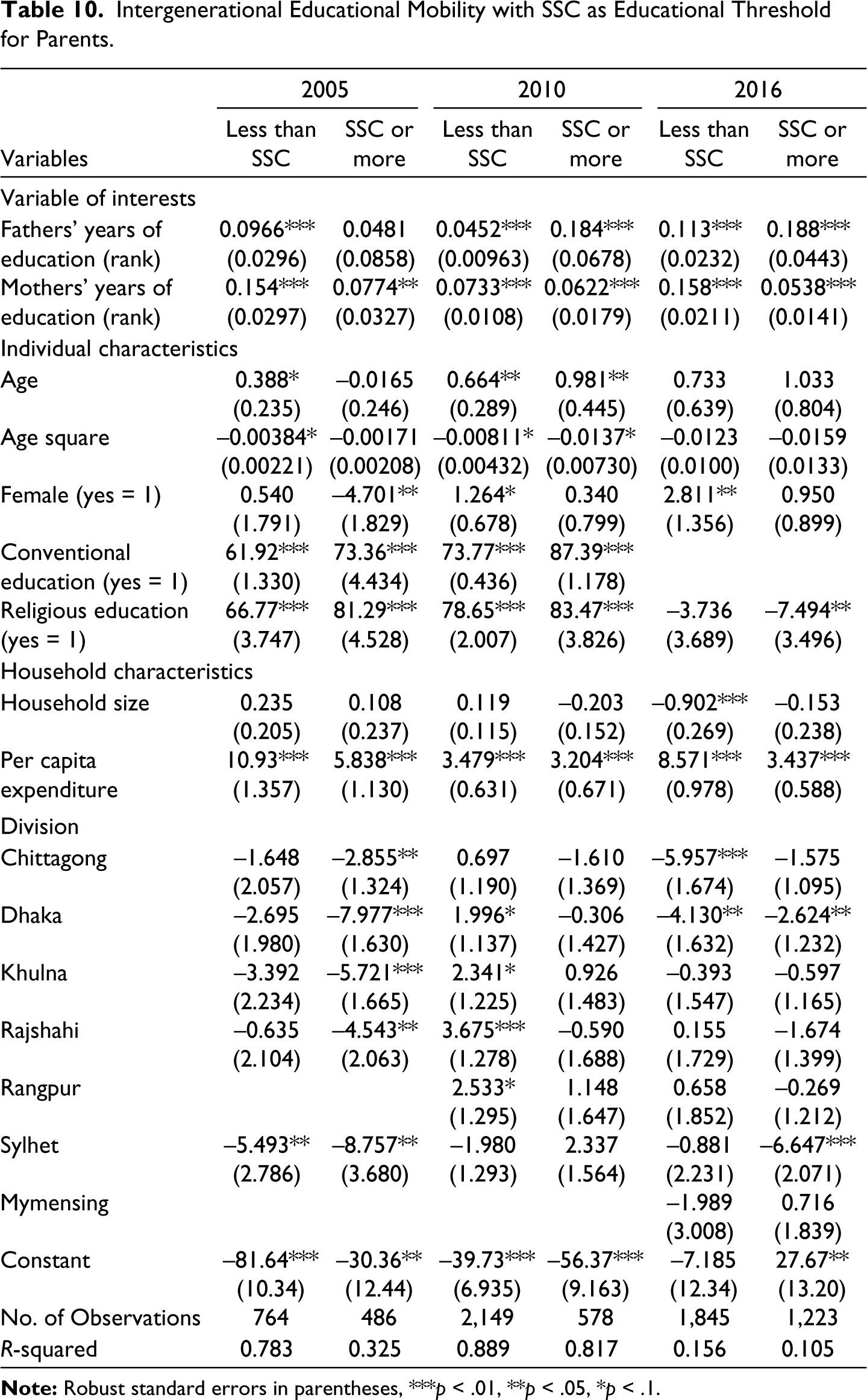
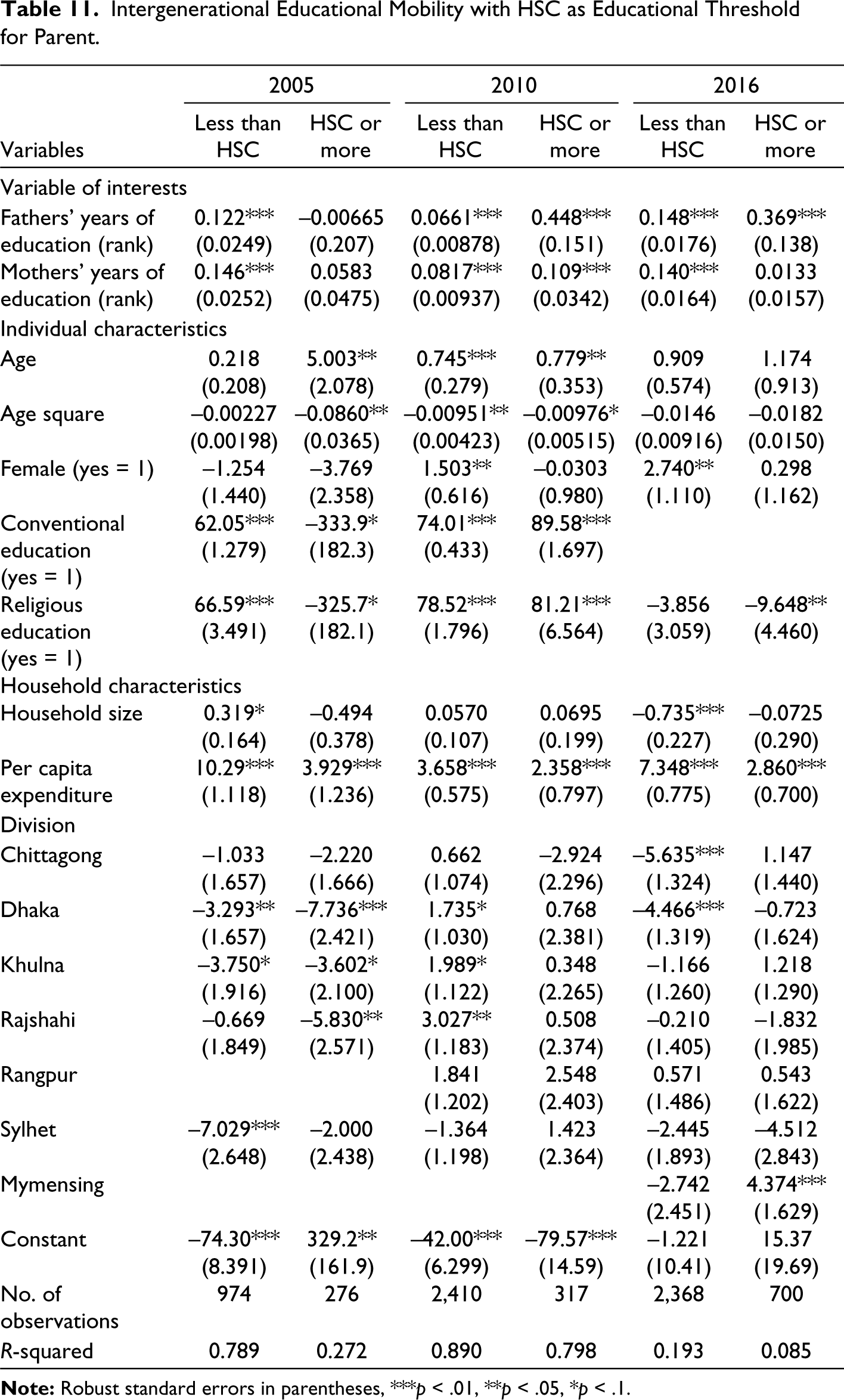
Lastly, to assess any potential correlations between children’s educational attainments across parents with different levels of education, we assess (Tables 10 and 11) the variation in intergenerational education mobility across parents with higher education levels (up to or above the SSC/HSC completion level) versus parents with lower education levels (below the SSC/HSC completion level). We also test whether the differences of the coefficients between ‘higher educated’ fathers/mothers and ‘lower educated’ fathers/mothers are statistically significant between 2005 and 2010, 2010 and 2016, and 2005 and 2016, and we report these results in Table A3. Our results reveal that in the case of father–child education mobility, there has been no significant change in education mobility in the case of fathers with education levels below the SSC completion level, and the same is evident in the case of fathers with education levels either up to or above the SSC completion level. However, when the threshold education level is HSC completion, there is a significant decrease in father–child education mobility in the case of fathers with education levels below the HSC completion level, whereas no significant change in father–child education mobility in the case of fathers with education levels either up to or above the HSC completion level. On the other hand, in the case of mother–child education mobility, there has been no significant change in education mobility in the case of mothers with education levels below the SSC completion level, and the same is evident in the case of mothers with education levels either up to or above the SSC completion level. The same stagnant mother–child education mobility is found, in both the cases of mothers with education levels below or above/equal to the HSC completion level, when the threshold education level is HSC completion.
Intergenerational Educational Mobility with SSC as Educational Threshold for Parents.
Intergenerational Educational Mobility with HSC as Educational Threshold for Parent.
In terms of other covariates we control for, our results reveal that household income has a positive association and household size has a negative association with years of schooling, implying that children from richer households are more likely and children from a larger family are less likely to have higher years of schooling. In terms of the main variable of interest, our results (rank correlation) show us that intergenerational educational mobility decreased in 2016 than in 2005 in terms of fathers’ education and increased in 2016 than in 2005 in terms of mothers’ education. Some particularly noteworthy and striking findings from our analysis are as follows:
A declining trend in father–child education mobility and an increasing trend in mother–child education mobility between 2005 and 2016. Better progress in terms of father–daughter education mobility compared to father–son education mobility. Better progress in terms of father–child mobility (when HSC completion is considered the threshold) in the case of fathers with higher education levels compared to fathers with lower education levels.
We discuss the possible reasons behind these findings in the next section. Before we proceed, it is important to acknowledge the limitations of our study. First, due to the unavailability of the information in the data, we are unable to account for, as covariates, factors such as children’s inherent ability or parents’ inherent ability, which each may respectively influence children’s schooling years and parents’ schooling years. This is indeed a limitation because it is an indication that there may be some omitted variables bias, and it may be the case that our associational results are capturing the influence of some of these unobservable factors. In such a case, a causational analysis would be plausible but this is beyond the scope of this article. As such, our estimates do not imply causality, and this must be taken into account when interpreting our results.
Salient and Noteworthy Findings: A Discussion
In this article, we ask: What is the trend in intergenerational educational mobility in Bangladesh over the years 2005, 2010 and 2016? In this section, we discuss the ‘why’ behind each of the results: One, the decline in intergenerational education mobility in terms of fathers’ education over time; two, the intergenerational education mobility of daughters being higher than sons in terms of fathers’ education; and finally, three, the education mobility of children with higher-educated fathers progressing better than that of children with lesser-educated fathers.
Why the Immobility in Father–Child Education Mobility?
Our results show that a child in 2016 is significantly less likely to progress beyond their father’s education level, and significantly more likely to progress beyond their mother’s education level, compared to a child in 2005. Thus, there is a downward trend in intergenerational education mobility in terms of fathers’ education. This is, in actuality, quite surprising given the progress in Bangladesh in terms of other indicators, for example, GDP, and the focus on development and education over the last few decades since the independence of Bangladesh in 1971. We must ask ourselves: Why is it that children have not been able to progress beyond their fathers’ education levels better in 2016 compared to 2005? Why has there been no significant improvement but rather a decline in the indicator over time in the case of father–child education mobility? Indeed, the diminishing trend in education mobility with respect to fathers’ education over time is surprising, especially considering the expansion of education over the same time-period and the gradually increasing focus on education over time. We posit that the quality education may be an important factor in this puzzle, which our study findings do not shed light on. If the quality of education is low and further perceived to have declined across generations, then this adds an important dimension to attempting to understand intergenerational education mobility and its decrease in terms of fathers’ education. For instance, Asadullah and Chaudhury (2015) established a weak association between education and cognitive skills, and this speaks to the quality—or lack of it—of education in Bangladesh. Our study finds that children, on average, are not able to progress beyond their fathers’ levels of education, and while we cannot comment on the quality of education from our results, we acknowledge that it is an important element of the story.
Another question arising from the results in this study is as follows: Why is it that children have been able to progress beyond their mothers’ education levels (we find evidence of an increase in intergenerational educational mobility in terms of mothers’ education from 2005 to 2016) but not beyond their fathers’ education levels? We infer that the reason behind this may be that mothers, to begin with, have lower education levels, in general, compared to fathers. We explore this across the HIES data for 2005, 2010 and 2016 and find that, across all the years, mothers, in majority of the cases, have lower education levels than the fathers in the household (Table A4). Therefore, a child being able to progress beyond their mothers’ education level may not be an indication of any progress, but merely a reflection of the poorer state of higher education of mothers compared to fathers.
Across Child’s Gender
In this study, when we disaggregate both children and parents across gender, we find differences in the trend of intergenerational educational mobility (IGC) among fathers and sons, fathers and daughters, mothers and sons, and mothers and daughters. For instance, intergenerational educational mobility between fathers and sons significantly decreases from 2005 to 2016, whereas intergenerational educational mobility between fathers and daughters remains stagnant between 2005 and 2016. In terms of mothers and sons, intergenerational educational mobility significantly increases from 2005 to 2016, and a significant increase in intergenerational education mobility is also evident in the case of mothers and daughters between 2005 and 2016. However, the magnitude of the increase is higher in the case of mothers–daughters compared to mothers–sons. Thus, we find that, in the case of disaggregation of intergenerational education mobility across children’s gender, daughters have seemingly progressed better than sons in terms of intergenerational education mobility. This is not surprising and may merely be a reflection of increased focus on girls’ education and empowerment in Bangladesh (Dahal et al., 2016). Consider, for example, how Bangladesh has made a notable stride in targeting policy towards increasing female enrolment and completion at both the levels of primary and secondary using initiatives such as the ‘FSSAP’. Additionally, the difference between sons’ and daughters’ educational mobility may also be a reflection of the fact that sons in Bangladesh, more than daughters, often have to focus on income-earning activities to support the family and have lesser opportunity to pursue education and thus dropout of schooling (Sarker et al., 2019).
Across Parents’ Education Levels
We investigate whether and how intergenerational education mobility varies across parents with different education levels—one, either below or above/equal to the SSC completion level, and two, either below or above/equal to the HSC completion level—and assess the changes in the correlations between parents’ education levels and their children’s years of education across the years 2005, 2010 and 2016. We find that father–child education mobility has a better trend in the case of fathers who completed education up to or above the HSC completion level compared to fathers who completed education to a level below the HSC completion level. This raises the question of whether there may be a possibility that children of fathers with comparatively higher education levels (up to or above the HSC completion level) are perhaps better equipped and facilitated to progress in education beyond their fathers, whereas children of fathers with comparatively lower education levels (below the HSC completion level) are at a somewhat disadvantage. The question, thus, then arises: Could there be a disadvantage trap in the case of children of fathers with lower education levels? If so, could it be that this disadvantage trap hinders children’s progress in education beyond their fathers’ education?
Policy Implications
Mobility, whether measured in terms of education or wealth, is an indicator of how a nation is faring in terms of providing better opportunities for its people. The trend in mobility may be an indication of how future policy should be steered to sustain or accelerate the rate and degree of mobility, and forces us to ask the important question: Is mobility translating into better well-being for our people? With increased welfare being the goal, we draw the following policy ramifications from our findings. We would like to clarify that since our study is based on correlational evidence, and not causal evidence, the policy recommendations we provide based on our analysis are suggestive at best.
Skill-Building and Income-Earning Facilitation from School Level
We find that educational mobility has decreased, over time, in terms of fathers’ education and this is especially true in the case of sons. We assume that sons having to share the burden of earning income may be playing a role in sons not being able to pursue their educations. We suggest that employment be included with education in the form of skill building and some technical and vocational training from the school level. We need schemes that allow the children to work in the setting of their educational institution instead of working outside school compromising their institutional schooling. It is equally important to mandate policies, alongside scholarship opportunities, that assure that children start acquiring skills, for example, computer and digital literacy, from school so that they are better equipped to turn their education into better opportunities for themselves and their families.
Increased Opportunities Up to the Level of Higher Education for Disadvantaged Children
Our results show that children of fathers with lower education levels have lower mobility. Thus, they are more at risk of falling into a trap of disadvantage. Employment and income earning are unavoidable circumstances for children of parents with lower levels of education. These children need extra attention, in the form of opportunities such as scholarships, to be able to overcome the barriers they face due to their parents’ lower levels or altogether lack of education. There is currently an access barrier to higher tertiary education for such children, which may be enlarging the divide between children of parents who are less educated and children of parents who are more educated. The access barrier is created when there is too much competition to gain admission into a public university and too much cost involved to get admission into a private university. Thus, a child from a disadvantaged family who is already behind in terms of the lack of privilege created by his/her parents’ lack of education falls further behind due to the barriers faced in accessing and pursuing tertiary education. This disadvantage of access to higher education for children from less advantaged backgrounds has become too important to ignore. Therefore, we suggest devising higher education policies that provide increased opportunities to children of parents with lower levels of education or no formal education. For instance, the government may subsidize, through providing scholarships and loans for example, private tertiary education for these underprivileged children who fail to attain admission in public universities.
Providing scholarships and loans to disadvantaged students to pursue private higher education are common forms of support in different countries around the world, especially in contexts from the global south that are more similar to Bangladesh, such as Kenya (loans provided by the Higher Education Loans Board), Ghana (Student Loan Trust Fund), Botswana (loans and scholarships to privately enrolled disadvantaged students), Nigeria (loans provided by the Nigerian Education Bank) and Mozambique (Provincial Scholarship Fund for poor students) (Tamrat, 2022). On the other hand, in Tanzania, although governments rarely provide direct subsidies, in the form of scholarships and loans perhaps, to poorer students in private higher education, they try to play a role in increasing university access for disadvantaged students by encouraging the private sector to invest in private universities (Tamrat, 2022). Relatedly, amidst running a good number of public universities, support via direct subsidization for disadvantaged students to access private universities may only be possible for the government of Bangladesh with help from the private sector, perhaps through CSR (corporate social responsibility) activities. Moreover, it may often be the case that there are differences in the quality of education provided across colleges, universities and other educational institutions. This may create further disparities by weakening opportunities for poorer parents to afford the comparatively better-quality education.
Conclusion
In essence, understanding intergenerational educational mobility, and the factors at play behind it, is not a simple process and the literature continues to grow. We contribute to the literature on the topic in the context of Bangladesh by investigating the trends in the indicator of intergenerational education mobility over time. Therefore, our article is a contribution to the existing literature in that, first, it explores the trend in intergenerational education mobility over time in Bangladesh that was previously unexplored, and second, it derives interesting results that will stimulate important contemplations regarding development in Bangladesh in terms of education mobility.
Our findings reveal that children are less likely to progress beyond their fathers’ levels of education in 2016 compared to 2005. We also observe differences in intergenerational education mobility in the case of daughters compared to sons, and in the case of children of more educated fathers compared to children of less educated fathers. Our findings compel us to contemplate and ask: What may be the reason behind the decrease in intergenerational mobility in terms of both their fathers’ education but the increase in terms of mothers’ education? As mentioned earlier, the quality of education may be playing a role in this case. It may also be that mothers have historically had lower levels of education compared to fathers to begin with. On the other hand, we contend that one of the reasons behind the comparatively better progress of daughters may be due to the increased focus on female education over time, especially considering the history of female education being lower to begin with in countries such as Bangladesh.
It is evident that much remains to be explored in understanding intergenerational educational mobility, especially in the context of Bangladesh. While we now, through this article, know the trend of intergenerational education mobility in Bangladesh, it remains to be seen whether the results are correlated with an improvement in the socio-economic conditions of the successive generations of the families. It would also be interesting to explore which policies and investment strategies regarding the education system over the past few decades have played a more significant role in children being able to attain intergenerational educational mobility. There is scope for future research to explore these dimensions.
Footnotes
Declaration of Conflicting Interests
The authors declared no potential conflicts of interest with respect to the research, authorship and/or publication of this article.
Funding
The authors received no financial support for the research, authorship and/or publication of this article.