



Abstract
Background:
Attention-deficit/hyperactivity disorder (ADHD) is a neurodevelopmental disorder characterized by inattention, hyperactivity, and/or impulsiveness. The studies on non-pharmacological treatment for ADHD are rather sparse. In India, usually, ADHD is assessed using rating scales, and not much importance is given on selective attention, that is, auditory and/or visual. Kofler1 hypothesized a functional relationship between working memory (WM) and inattention.
Aim:
The current research was planned to study the effect of Cogmed Working Memory Training (CWMT) program on various parameters of the auditory attention span of children and adolescents having ADHD.
Methods:
A total of 30 children were taken for the current study. Parental consent was taken. Auditory attention span of the sample was measured by the Continuous Auditory Test of Attention (CATA). After pre-assessment, the children underwent CWMT program for 5 weeks. Cogmed is a scientifically researched program, which has been recommended to be used for improvement of WM and attention. At the end of the training, the children were reassessed by the abovementioned tool, CATA. t-test was used to analyze the pre-intervention and post- intervention data for auditory inattentiveness, impulsivity, sustained attention, and two age groups. Mann-Whitney U-test was used to analyze the comparison between male and female gender groups.
Results:
Results indicate the effectiveness of Cogmed Working Training Program on auditory attention span of children with ADHD.
Conclusion:
The results need to be validated if the improvement is sustained over a period of time with follow up assessment.
Keywords
Introduction
Attention-deficit/hyperactivity disorder (ADHD) is a neurodevelopmental disorder characterized by inattention, hyperactivity, and/or impulsiveness. It is first diagnosed in childhood and can last into adulthood. Both sexes are affected. It often leads to decline in academic performance and poor social relationships and various behavior problems. A reliable link is reported between inattention and executive functions in children. There is an overlap of inattention and working memory (WM). It is necessary to remember what one has to focus on. To carry out any function it needs to be retained in mind. WM is the ability of a person to remember any information for a short time. It refers to the brain system that provides temporary storage and manipulation of the information which is required for solving problems logically. WM is used to keep information active for a short time. A person who gets easily distracted loses the sight of goal. WM is considered the best predictor of intelligence. Baddeley and Hitch, 2 who had used the term WM for the first time in 1974, mentioned that there are 3 components of WM. These include the visuospatial patch, which is responsible for storing visual information, phonological loop which is responsible for storing verbal information, and the third component central executive, which plays a central role in coordinating these two. WM is necessary to control attention and is necessary to remember the instructions. It helps an individual in solving complex problems. WM and attention are related. High inattention is related to poor verbal WM measures. Attention is characterized by a person’s ability to take the information in and WM makes sense of it.
ADHD as a disorder, is still a grey area in India. It is not considered a disability as per government rules. Various school boards do not give any accommodation to the children in the examinations solely for ADHD. Though many studies for the pharmacological treatment of ADHD have been reported from India, studies regarding non-pharmacological treatments are rather sparse. In routine tasks, as well as in school setting, selective attention is required for multiple tasks. If we look for school setting, a student has to look at the board as well as pay attention to auditory instructions from the teacher. Thus both visual as well as auditory attention are important. Conners CATA (Continuous Auditory Test of Attention) assesses auditory attention and provides scores which include signal detection statistics, error rates, and reaction time statistics. CATA assesses dimensions of attention, that is, inattentiveness, impulsivity, and sustained attention. Conners CATA also measures the respondent’s ability to shift attention from one ear to another.
Effectiveness of Cogmed Working Memory Training (CWMT) program for improvement in attention span of children with ADHD has been reported in many studies carried out abroad but information regarding this is lacking in India.
In a review article, Satapathy et al 3 suggest a huge gap between global and Indian research in the area of non-pharmacological interventions for children having ADHD. They emphasized the need for development and efficacy testing of non-pharmacological interventions such as psychosocial interventions, body-focused interventions, cognitive-behavioral interventions, and cognitive/neuro-CT interventions. The gap in global and Indian research could also be because the clinicians’ inability to give proper time to the ADHD patients during assessment.
Usually a child is a visual learner or an auditory learner, or some may be having both the characteristics. Visual or auditory attention is usually compromised in children with ADHD.
Many researchers have tried to assess the visual attention or auditory attention in children having ADHD. They reported deficits in the area of selective attention in children having ADHD. Jonkmann et al 4 had suggested that reduced selective attention may be due to problems in auditory selective filtering. According to Gomes et al, 5 because of the reduced selective attention, reduction in early perceptual processing in unilateral auditory stimuli occurs. According to Laffere et al, 6 other researchers debated that child with ADHD had only dysfunctional attentional engagement, rather than a deficiency in auditory selective attention. Therefore, it is still an open area, whether and how the impairment of auditory selective attention occurs in children with ADHD.
Attention is a complex cognitive function that is necessary for learning, for following social norms of behavior and for effective performance of responsibilities and duties. Attention is a cognitive process that is defined as the selective focus on one aspect of the environment while neglecting others. It is especially important in sensitive occupations requiring sustained attention.
Attention can be grouped into the following categories: (1) Focused attention, the ability to respond individually to visual, auditory or sensory stimulus. (2) Sustained attention, that is, ability to sustain a steady-state response. (3) Selective attention which includes ability to maintain a fixed set of responses in the face of distraction. (4) Alternating attention or ability of mental flexibility to shift attention and make a decision between different tasks. (5) Divided attention or the ability to respond to several tasks at the same time.
Kwasa et al 7 in their research concluded that listeners differ in their ability to modulate neural representations of sound based on task goals, while suggesting that adults with ADHD may have weaker volitional control of attentional processes than their neurotypical counterparts. The study carried by Kofler et al 1 had suggested that attention deficit in children with ADHD seems to be the result of placing demand on the central executive process, which seems to be due to exceeding the storage/rehearsal capacity. He proposed a model that hypothesized a relationship between WM and inattention. The study involved 15 children with ADHD and 14 typically developing children. Karbach et al 8 studied the benefits of WM training on academic abilities of children in elementary school. Aksayli 9 reported that WM training is related with attention control, which further is responsible for cognitive and academic tests. Al-Saad et al 10 suggest that strategies to improve WM may play an important role in the management of ADHD.
In a review article, Chacko et al 11 reported that Cogmed intervention resulted in improvement in certain aspects of WM of children with ADHD. Spencer-Smith and Klingberg 12 noted in a meta-analysis study that participation in Cogmed was associated with decrease in inattention as well as in symptoms of ADHD. Soveri et al 13 reported that Cogmed intervention produces small to moderate improvement in WM and attention. The effects were found to be larger for individuals with WM deficits than for healthy individuals. Marcelle et al 14 studied the effectiveness of Cogmed in adults with ADHD. They suggested that Cogmed intervention to be more suitable for children than for adults. They proposed that in future, for Cogmed to be more viable for adults, greater support may be needed to improve likeliness for adherence to the program. Studies by Sandberg et al 15 reported some improvement in adults with ADHD. They suggested that, though Cogmed intervention is not likely to be an effective treatment for core clinical features of ADHD, however, the youth felt more competent with better self-respect after the training. Qiu et al 16 reported Cogmed training to be beneficial in resulting moderate-to-large effect on WM and improving inhibitory control and cognitive flexibility in children with ADHD. Significant moderate to large effects were observed. Cognitive training was found to have large training effects on WM. They assessed executive functions in children and adolescents having age between 5 and 18 years.
Objectives
To study the effectiveness of CWMT on detectability, Omissions, Commissions, hit reaction time (HRT), hit reaction time standard deviation (HRT SD) as parameters of auditory attention.
To compare the effectiveness of Cogmed Working Training on auditory attention in male and female gender in the sample taken.
To compare the effectiveness of Cogmed Working Training on auditory attention in the 2 age groups, that is, 8 to 12 years with 13 to 18 years in the sample taken.
Methods
Sample
A sample of 30 children having ADHD was taken for study (N 30). The sample was collected from researcher’s clinical practice. There were 22 males and 8 females in the sample, while the number was 14 for the age group 8 to 12 years, and 16 for the age group 13 to 18 years.
Parents were explained the need and rationale of the study, issues of confidentiality, voluntary nature, and option to withdraw.
As per the latest ICMR guidelines (2017), for children 8 to 12 years, oral assent in the presence of parents was taken, and for older children (aged between 13 and 18 years), a written assent was taken.
The study was accorded approval vide Research Degree Committee, Devi Ahilya Vishwavidyalaya, School of Social Sciences vide No. Psychology/2021/1209 dated 30.03.2021.
The study was carried out in accordance with the principles as enunciated in the Declaration of Helsinki.
Tools
Conners Continuous Auditory Test of Attention (Conners CATAR)
Conners CATA assesses auditory processing and attention- related problems. It can be used for individuals aged 8 years and above. Response assessment is done in the areas of inattentiveness, impulsivity, and sustained attention. It also assesses the respondent’s auditory laterality, that is, relative effectiveness/efficiency on left or right ear targets and mobility (the ability to shift attention from one ear to another). The scores used to help assess 3 dimensions of attention (inattentiveness, impulsivity, and sustained attention) include d-prime (d’), Omissions, Commissions, HRT, hit reaction time standard time standard deviation (HRT SD).
d-prime (d’) is the measure how well nontargets are discriminated against target. It measures detectability. It measures difference between the signals (target) from the sound (nontarget) distributions. The detectability values are reverse scored.
Omissions refer to the missed targets. High Omissions scores indicated the respondent was not responding to the target stimuli, which is due to a specific reason, as indicator of inattentiveness.
Commissions scores refer to the incorrect responses to nontargets. High Commissions rate values generally indicate inattentiveness. However, high Commissions rate scores if coupled with high HRT scores, indicates impulsivity.
HRT refers to the mean response speed. It is measured in milliseconds. Slow HRT may indicate inattentiveness. A very high HRT when combined with high Commissions rates indicates impulsivity.
HRT SD is a measure of consistency of response speed during the administration of the entire test. A high HRT SD indicates greater inconsistency. Inconsistency in response speed is at times indicative of inattentiveness. It indicates that the respondent was inattentive during the administration of the test and processed stimuli less efficiently.
Cogmed
It is a computer software used to improve WM. The program is not just a computer game. It is designed to build the WM especially in persons who find it difficult to remember and retain the information. For each session, the person is logged in to complete a series of video game like exercises, which include remembering and repeating certain tasks. With correct choices used by the respondent difficulty level is triggered so as to push the limits of WM. On the contrary incorrect responses trigger difficulty levels to decrease so that the respondent does not get frustrated.
Procedure
Conners CATA assesses auditory processing and attention related problems in individuals aged 8 years and older. Responses from the 14-minute, 200 trial protocol are used to assess respondent’s performance. Before each administration respondents are given a 1-minute practice test so as to acclimatize them. It is ensured that the respondent understands the task instructions.
Auditory attention was assessed using CATA. Conners CATA is administered on individual basis in a formal testing/assessment environment. One-to-one attention is provided by the administrator to the respondent for entire duration of the test.
After the pre-assessment, the children underwent Cogmed Working Memory Training (CWMT) program for 5 days/week for 5 weeks (25 sessions). At the end of this training the children were reassessed by the abovementioned tool.
Data was analyzed using t-test for the pre-intervention and post-intervention data for auditory inattentiveness, impulsivity, sustained attention, auditory laterality, and auditory mobility. Mann-Whitney U-test was used to analyze the comparison between the gender and age groups.
Inclusion Criteria
Any child or adolescent with diagnosis of ADHD with or without any neurodevelopmental comorbidity like autism spectrum disorder & specific learning disorder. However, in the sample under study, there were no child with NDD comorbidity.
IQ above 70.
With or without concomitant pharmacological treatment for ADHD.
Children and adolescents aged between 8 and 18 years.
Both boys and girls.
Children and adolescents having the facility of computers to undertake CWMT on a regular basis.
Exclusion Criteria
Patient and/or parent unwilling to give informed consent.
IQ below 70.
Children and adolescents aged below 8 years and above 18.
Severe comorbid emotional disturbance like severe depression, severe anxiety or bipolar disorder.
Children and adolescents who are not able to complete the CWMT.
Children and adolescents with clinical evidence of psychosis.
Informed consent was obtained by explaining the general purpose of the assessment to the respondent. He/she is explained the reason why he/she is being asked to take the Conners CATA test.
Results
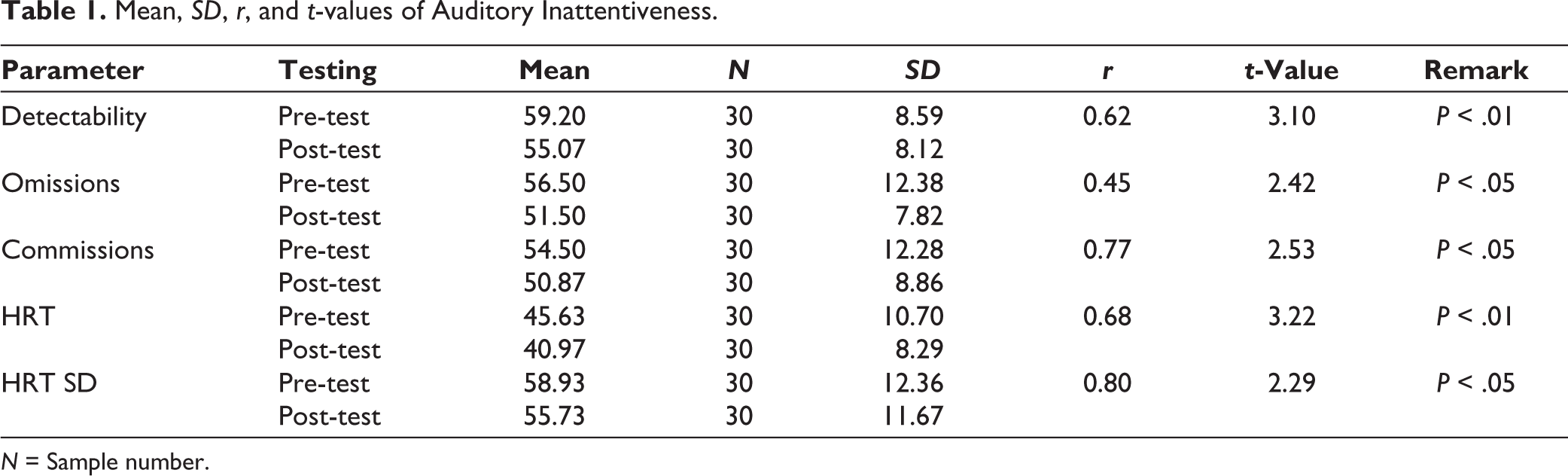
From Table 1, it is evident that t-values in respect of detectability and HRT are 3.10 and 3.22, respectively. Both these values are significant at .01 level with df = 29. It is also evident from Table 1 that t-values in respect of Omissions, Commissions, and HRT SD are 2.42, 2.53, and 2.29, respectively. It shows that mean post-test scores of detectability, Omissions, Commissions, HRT, and HRT SD are found to be significantly different from their corresponding mean pre-test scores. Further, the mean post-test scores of detectability, Omissions, Commissions, HRT, and HRT SD are found to be significantly lower than their corresponding pre-test mean scores.
Mean, SD, r, and t-values of Auditory Inattentiveness.
N = Sample number.
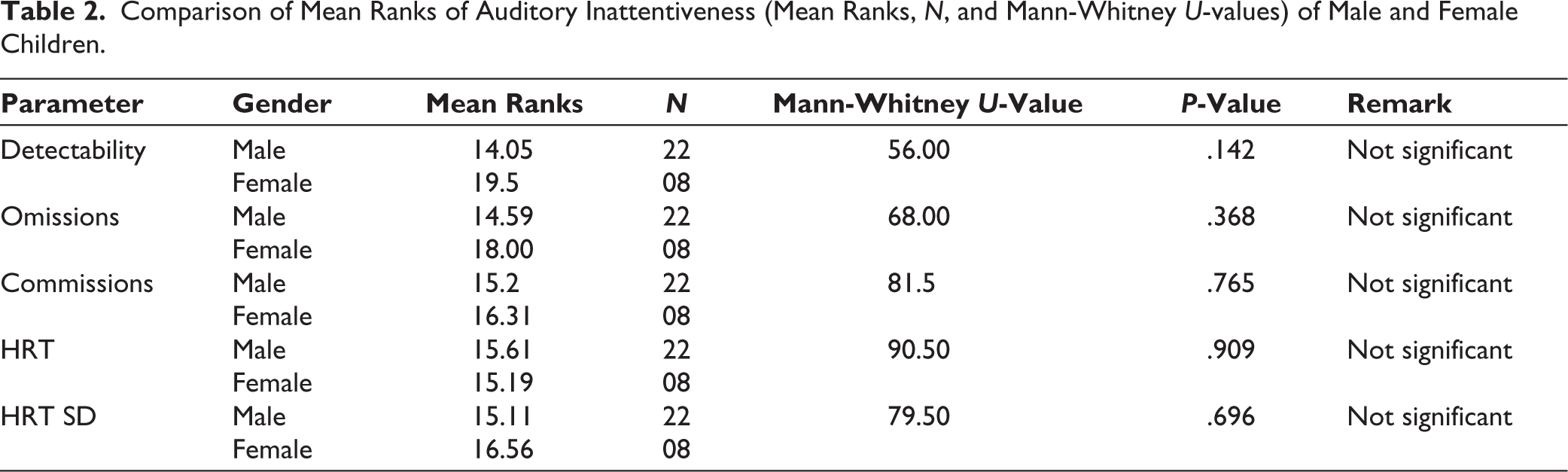
From Table 2, it is evident that Mann-Whitney U-value in respect of detectability, Omissions, Commissions, HRT, and HRT SD are 56.0, 68.0, 81.5, 90.5, and 79.5, respectively. All these values are not significant. It indicates that the mean ranks of detectability, Omissions, Commissions, HRT, and HRT SD of male and female children do not differ significantly. Thus, the null hypothesis that there is no significant difference in the mean ranks of separate parameters of detectability, Omissions, Commissions, HRT, and HRT SD of male and female children with ADHD treated through CWMT is not rejected. It may, therefore, be said that both male and female children with ADHD treated through Cogmed were found to have no significant difference in pre- and post-intervention scores of detectability, Omissions, Commissions, HRT, and HRT SD.
Comparison of Mean Ranks of Auditory Inattentiveness (Mean Ranks, N, and Mann-Whitney U-values) of Male and Female Children.
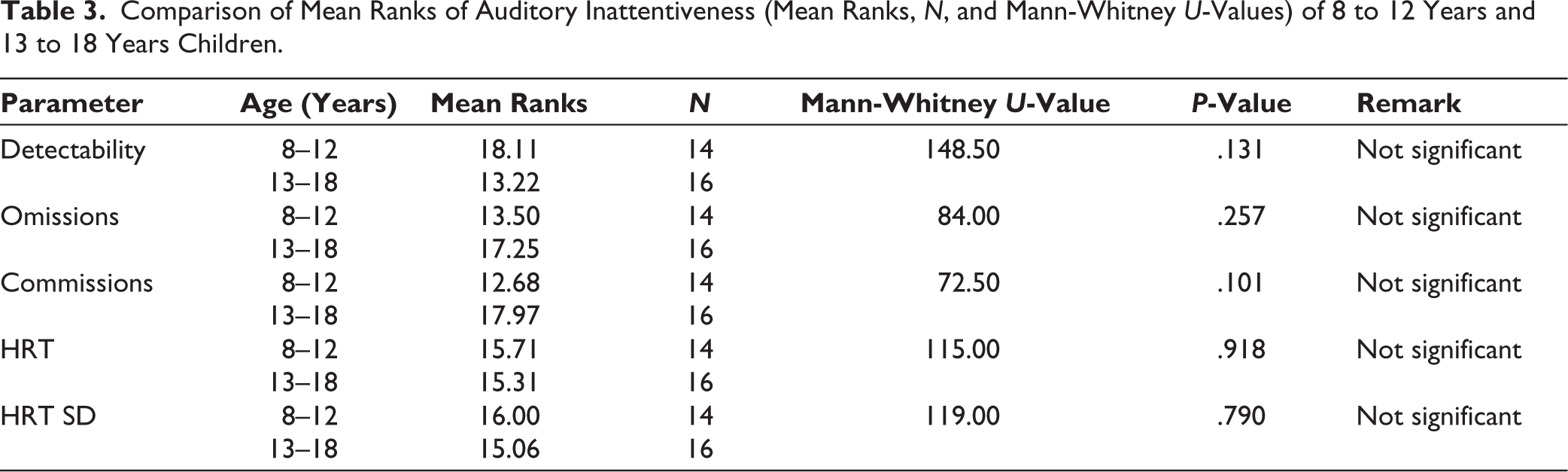
From Table 3, it is evident that Mann-Whitney U-values, in respect of detectability, Omissions, Commissions, HRT, and HRT SD with respect to the 2 groups of children taken for the study, are 148.50, 84.00, 72.50, 115.00, and 119.00, respectively. All these values are not significant. It indicates that the mean ranks of detectability, Omissions, Commissions, HRT, and HRT SD of 8 to 12 years and 13 to 18 years children do not differ significantly. Thus, the null hypothesis that there is no significant difference in the mean ranks of separate parameters of detectability, Omissions, Commissions, HRT, and HRT SD of 8 to 12 years and 13 to 18 years children with ADHD treated through Cogmed is not rejected. It may, therefore, be said there was no significant difference of that both groups of children (8 to 12 years and 13 to 18 years) with ADHD in their response to the intervention by Cogmed for detectability, Omissions, Commissions, HRT, and HRT SD to the same extent.
Comparison of Mean Ranks of Auditory Inattentiveness (Mean Ranks, N, and Mann-Whitney U-Values) of 8 to 12 Years and 13 to 18 Years Children.
Discussion
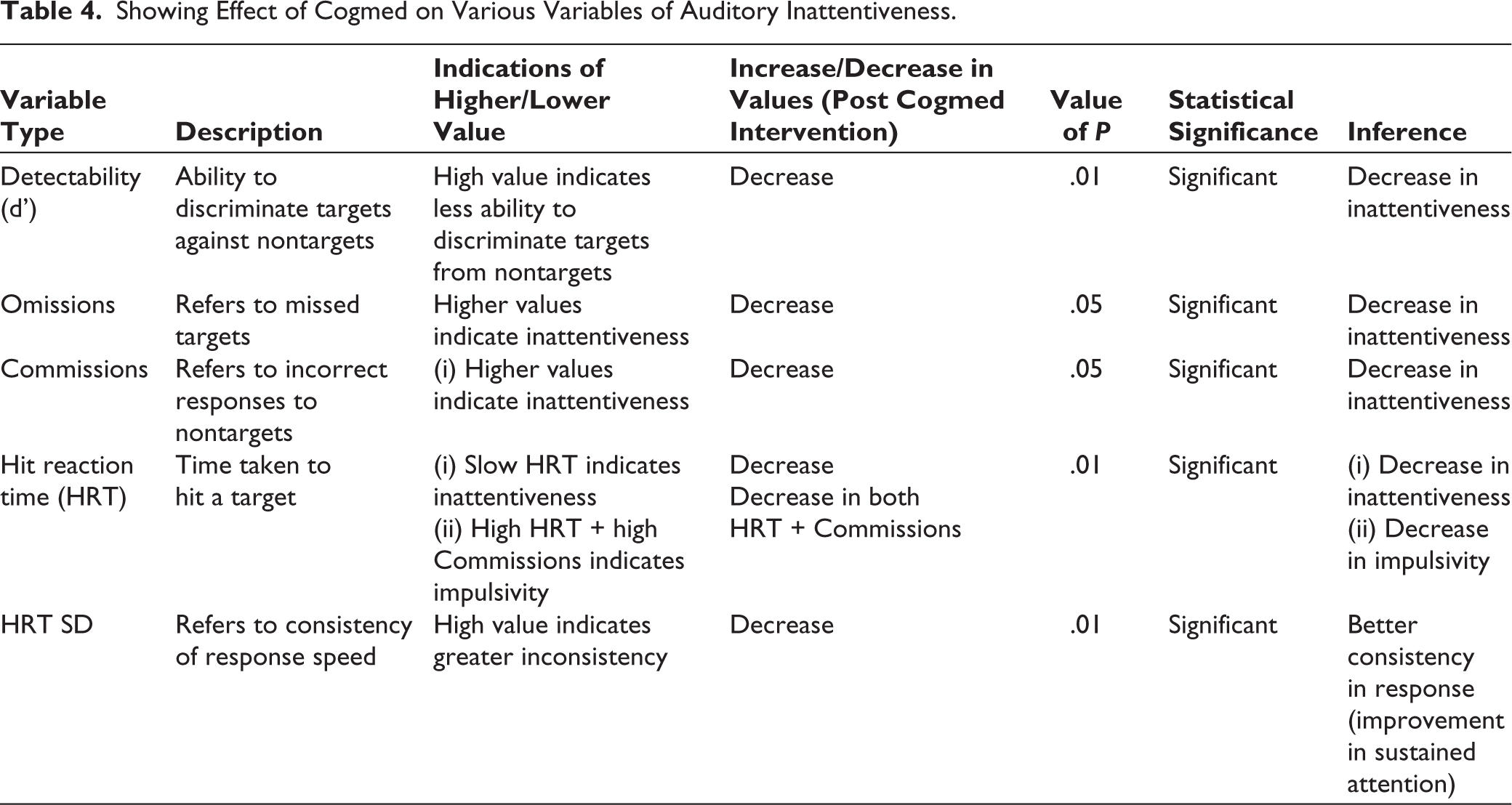
Significant improvement in inattention is observed in children with ADHD (8–12 years and 13–18 years of age) when there was intervention by Cogmed, a memory training program. The data observed with respect to Auditory inattentiveness is summarized in Table 4.
Showing Effect of Cogmed on Various Variables of Auditory Inattentiveness.
WM is correlated with inattention and disorganization in children with ADHD. WM training improved components of executive functioning. Executive functioning capacity is not static and has been reported to be associated with brain activity, which may be altered by task-repetition or training. Significant neural effects are reported in brain imaging studies of WM training in persons with ADHD. In neuroimaging studies of WM training, impulse control are seen. Karbach et al 8 studied the benefits of WM training on academic abilities of children in elementary school. Results clearly indicate that the CWMT program is an effective intervention for children having ADHD with auditory inattention. The results support the observations made by Kofler et al. 1 They studied visual and auditory components in students having ADHD as well as in normally growing children. Their study reported that normally growing children performed better in the visual memory test while the children with ADHD performed better in auditory tests. In our study also intervention with Cogmed has been found to make a significant improvement in auditory inattention, auditory impulsivity as well as in sustained attention. Washington 17 reported that ADHD and auditory processing disorder (APD) occur together. Persons with APD may not correctly interpret sound and may appear to be inattentive. In fact it is advised by him that ADHD patients can be screened for APD since ADHD person find it difficult to interpret the sound signals. Their sensory difficulties can also affect their behavior.
Sandberg et al 15 suggest that using Cogmed as an intervention for ADHD children requires regularity and sincerity. Wiest et al 18 have also recommended computerized cognitive training as an intervention tool in children with WM deficits. Performance improvement in reading and maths is reported in children who had completed the training. Their study was aimed at children with ADHD and SLD. Cognitive training might be related to cognitive structural changes, which are found in pre- to post-training among the variables being measured. Plasticity of the brain in children with neurological disorders has been suggested. Constant effort is needed which may be challenging for the children with ADHD. At times intervention for a month may not be sufficient. However, it is also suggested that the intervention may not be effective treatment for the core clinical features of ADHD, but the child may feel more competent and self-respect after the treatment. In the study carried out by Qiu et al, 16 besides physical exercise, Cogmed was found to be beneficial in improving WM and cognitive flexibility in children with ADHD. In certain studies in which fMRI was done, the training had increased the activity of frontal and parietal lobes of the brain. This indicated that the intensive long-term training on a cognitive task can alter brain activity in much the same way as the sensory and motor exercises have shown. The greatest changes were observed in the area of brain associated with the capacity limitations of WM. The results indicate that the WM can be trained. Area responsible for keeping the WM may be as plastic as the other parts of the brain.
Another objective was to study the comparison of effectiveness of Cogmed intervention between male and female children with ADHD. Cogmed intervention was not found to be significantly different with respect to gender.
Similarly, Cogmed intervention was not found to have significantly different effect in children with ADHD of the 2 age groups (8–12years and 13–18 years).
Conclusion
Though the current study is not a randomized control trial (RCT), the findings indicate that Cogmed could be an effective training program, especially in children with ADHD. CWMT program has been found to be an effective intervention for auditory inattention in children having ADHD. WM training may be effective in reducing attention and memory problems. The effects were monitored objectively using CATA. However, further studies with control groups and over an extended period of time with repeated evaluations are needed to establish the efficacy of this intervention.
Footnotes
Declaration of Conflicting Interests
The authors declared no potential conflicts of interest with respect to the research, authorship, and/or publication of this article.
Ethical Approval and Statement of Informed Consent
As per the latest ICMR guidelines (2017), for children 8 to 12 years, oral assent in the presence of parents was taken, and for older children (aged between 13 and 18 years), a written assent was taken. The study was accorded approval vide Research Degree Committee, Devi Ahilya Vishwavidyalaya, School of Social Sciences vide No. Psychology/2021/1209 dated 30.03.2021. The study was carried out in accordance with the principles as enunciated in the Declaration of Helsinki.
Funding
The authors received no financial support for the research, authorship, and/or publication of this article.