




Abstract
BACKGROUND:
Life skill education is critical for developing various competencies among the adolescent population, especially in India, given the recent shift in policy focus.
AIM:
To examine the reliability, factor structure, and the validity of scales measuring gender attitudes, perceived self-efficacy, resilience, and problem-solving in order to assess the effectiveness of a life skill program among Indian adolescents.
METHODS:
Baseline data, before a life skill intervention program by Magic Bus India Foundation, were collected from over 16000 Indian adolescents between 11 and 15 years on different measures. Results from principal component analyses with pro-max rotation indicated a one-factor solution for all the scales. Further, confirmatory factor analyses indicated an excellent model fit using the diagonally weighted least squares method of estimation for the above- mentioned scales.
RESULTS AND DISCUSSION:
The models for each scale were gender invariant, indicating that gender attitudes, perceived self-efficacy, resilience, and problem solving were assessed similarly between boys and girls. Additionally, correlation analysis indicated a positive relationship between gender attitudes and self-efficacy, a negative relation between gender attitudes and resilience, and a negative association between self-efficacy and resilience. Implications are discussed.
According to UNICEF, 1 (p.7) “life skills are a set of abilities, attitudes as well as socio-emotional skills that enable individuals to learn, make informed decisions, and exercise rights leading to a healthy and productive life.” Adolescence is a stage of identity formation, during which attitudes toward socialization, gender equality, and human rights consolidate; 1 thus, life skill education among adolescents is especially important in India as social and class structures can often limit their opportunities. 1
The National Education Policy (NEP), which aims for the holistic development of a child, has included critical life skills as one of the programs in the curriculum framework for adult education. 2 It also states the importance of life skills such as communication, cooperation, teamwork, and resilience in the Indian education system going forward. 2
Resilience and problem solving are a part of the 12 core life skills, according to the Life Skills and Citizenship Education framework (LSCE). 3 Additionally, individual agency, self-efficacy, and motivation to use life skills are important across all the 12 life skills. 4 In low-middle income countries, there is a big gender gap, where women and girls have fewer educational opportunities, less autonomy in terms of marriage and fertility, and restrictions in workforce participation. 5 A study by Dhar et al 6 found that an attitude-change intervention among schools in Haryana, India, was successful in making adolescent (average age, 12 years) attitudes and behavior more gender equal. Thus, including gender attitudes in life skill interventions is important in the context of the Indian population.
Life skill training is conducted depending on the demands of a particular setting. 7 In low-middle income countries (such as India, Sri Lanka, and Bangladesh), life skill education is conducted at different grade levels sequentially that include everyday skills (such as communication skills), health and social issues skills, and life skills in relation to risk behaviors (such as using drugs and smoking).7,8
Previous studies 9 show the effect of life skill education on problem solving, resilience, and self-efficacy of adolescents. It has been found that adolescents (11–19 years) who perceive themselves as highly efficient in displaying empathy and problem solving were also high on resilience. 9 In another study, 10 it was found that highly self-efficient early adolescents (14–18 years) in terms of problem solving, scholastic performance, and empathy were more resilient as compared to less-self-efficient adolescents. 10 Another study 11 found that adolescents (15–19 years) having a high positive affect reported having high perceived self-efficacy in life skills and reached a high level of resilience. Additionally, another study indicated that general self-efficacy predicted resilience among middle adolescents in the ninth and tenth grades. 12
Research has shown that life skill training helped reduce psychological distress among adolescent students 13 and improve mental well-being among adolescents with psychosocial problems. 14 Furthermore, a study 15 indicated a reduction in emotional distress and improvement in emotional health in adolescents due to life skill training. Life skill training also increases adaptability and psychological well-being of married female students. 16 Given the increased need and importance of life skill education for adolescents in India, measures to assess its effectiveness are essential.
Gender role attitudes can be understood as a point of view held by individuals regarding the roles of men and women in a society. 17 Perceived self-efficacy reflects an optimistic self-belief. 18 It can be understood as a belief that one can perform novel or difficult tasks or even cope with adversity in the various areas of functioning. According to the LSCE framework, resilience can be understood as the constructive and personal ability of an individual to navigate changing circumstances successfully. 3 Additionally, the LSCE framework defines problem solving as an ability to think through steps that lead to a desired outcome by identifying and understanding a problem and devising a solution for it. 3 These variables make up an important part of life skills. As most of the measures for life skills have been developed for the Organization for Economic Co-operation and Development (OECD) countries, cultural differences in life skills are under-researched. 4
A report by Evaldesign, India, 19 noted the landscape of life skill education for adolescents in India. Of the various organizations implementing life skill education for adolescents in India, the study also evaluated the Magic Bus India Foundation (MBIF) “Childhood to Livelihood program.” This life skill intervention involved an in-school program and community intervention with a specific focus on gender. The program involved a focus on problem solving, communication, learning to learn, teamwork, perceived self-efficacy, and resilience of adolescents. 19 Given the wide focus of the program, this article examines the reliability, factor structure, validity of the gender attitudes, perceived self-efficacy, resilience, and problem-solving scales developed to measure the effectiveness of the life skill program by MBIF among Indian adolescents. The current work is part of a broader research project that uses these scales to evaluate the impact of the MBIF program using a difference-in-difference approach. The focus of this study is on measurement validity, whereas other studies focus largely on impact evaluation. In recent years, life skill education has gained importance in the Indian context, and the current study will help to validate certain tools to measure different life skills among adolescents in India.
Method
Participants
Data were collected from Indian adolescents between the ages of 11 and 15 years before the life skill intervention, to evaluate the effectiveness of the life skill education program conducted by MBIF. This baseline data were collected from 12 distinct sites at which the NGO is active, across the states of Andhra Pradesh, Assam, Chhattisgarh, Karnataka, Maharashtra, Madhya Pradesh, New Delhi, Himachal Pradesh, Rajasthan, Tamil Nadu, and West Bengal between 2016 and 2019. Data were collected in local languages: Hindi, Assamese, Marathi, Tamil, Telugu, Kannada, and Bengali. About 86% of the sample was Hindu and 9.2% identified as Muslim; the remaining were a mix of Christian, Sikh, and Buddhist. A majority of the sample belonged to upper caste (33%), followed by 26.5% identifying as OBC (Other Backward Class), 21% identifying as SC (Scheduled Caste), and 10.5% belonging to ST (Scheduled Tribe). The scales were developed to measure the participants’ baseline scores on gender attitudes, self-efficacy, resilience, and problem solving before taking part in the life skill education program.
A total of 11536 Indian adolescents completed the survey for gender attitudes, general self-efficacy, and resilience scales, and 4677 adolescents completed the survey for the problem-solving scale. After cleaning the data for inconsistencies, a total of 10587 adolescents for gender attitudes, general self-efficacy, and resilience scales and a sample of 4652 adolescents for the problem-solving scale were included in the study. The sample decreased further due to missing values for a few variables.
Procedure
The constructs of gender attitudes, perceived self-efficacy, resilience, and problem solving were measured as part of the life skill education program conducted by MBIF. The survey including the above-mentioned scales was circulated among Indian adolescents who were a part of the life skill education program. All the scale items were developed in English and accompanied by their local language translations.
Measures
Gender Attitudes
The scale consists of seven items scored on a 4-point Likert scale (1 = fully agree to 4 = fully disagree). A sample item for the scale is “Teachers should encourage boys to take more classes in science and mathematics as compared to girls.” Higher aggregate scores on the gender attitude scale indicated more liberal gender attitudes and lower scores were associated with conservative gender attitudes. For this data sample, the gender attitude scale had a satisfactory internal consistency reliability (a = 0.75).
General Self-efficacy
This scale was developed by Schwarzer and Jerusalem. 18 It is a 10-item scale rated on a 4-point Likert scale (1 = strongly agree to 4 = strongly disagree). A sample item for the scale is “I can always manage to solve difficult problems if I try hard enough.” This index was reverse scored. High cumulative scores indicated higher perceived self-efficacy. For the current sample, the general self-efficacy scale had a good internal inconsistency reliability (a = 0.89).
Resilience
The scale comprises 12 items rated along a 3-point Likert scale (1 = no, 2 = sometimes, 3 = yes). A sample item for the scale is “I try to finish activities that I start.” Higher aggregate scores were associated with higher resilience among individuals. The resilience scale (a = 0.93) was found to have an excellent internal consistency reliability.
Problem Solving
The scale consists of eight items along a 4-point Likert scale (1 = strongly agree to 4 = strongly disagree). A sample item of the scale is “I easily identify my problems.” This index was reverse scored. Higher cumulative scores indicated better problem-solving ability. The data for this scale were available only for five studies, of which one study had data on only five items. Thus, its use was restricted in subsequent analyses. The problem-solving scale (a = 0.78) had a satisfactory internal consistency reliability.
Data Analysis
RStudio software was used for data analysis. 20 The data were initially cleaned for non-numeric and inconsistent values. Next, the dataset was divided into two parts; one part was used for exploratory factor analysis (EFA), while the other half was used for computing confirmatory factor analysis (CFA). 21 Next, the internal consistency reliability was measured for each scale for this sample. Later, one of the datasets was tested for the assumption of normal distribution.
Finally, EFA and CFA were computed for each scale. The factor loadings and scree plots were examined to evaluate the factor structure of the scales for the EFA. For the factor models, the fit was measured by evaluating the Comparative Fit Index (CFI), the Tucker–Lewis Index (TLI), the Root Mean Square Error of Approximation (RMSEA), and Standardized Root Mean Square Residual (SRMR), in order to determine the optimal fit. Additionally, measurement invariance for gender was also computed for all the models.
Results
Exploratory Factor Analyses
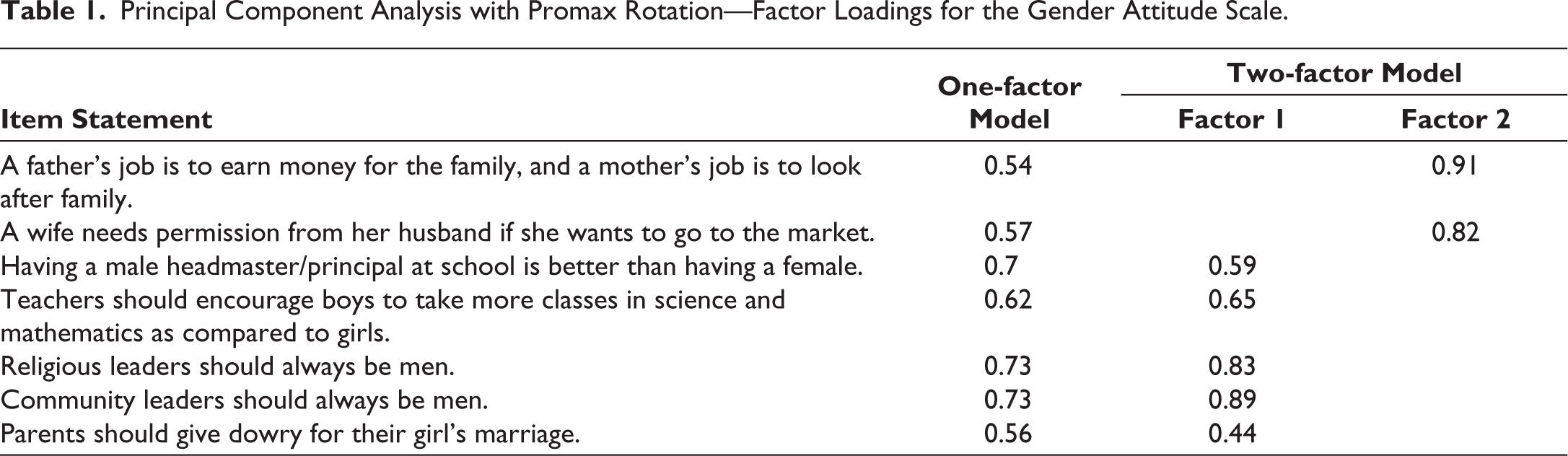
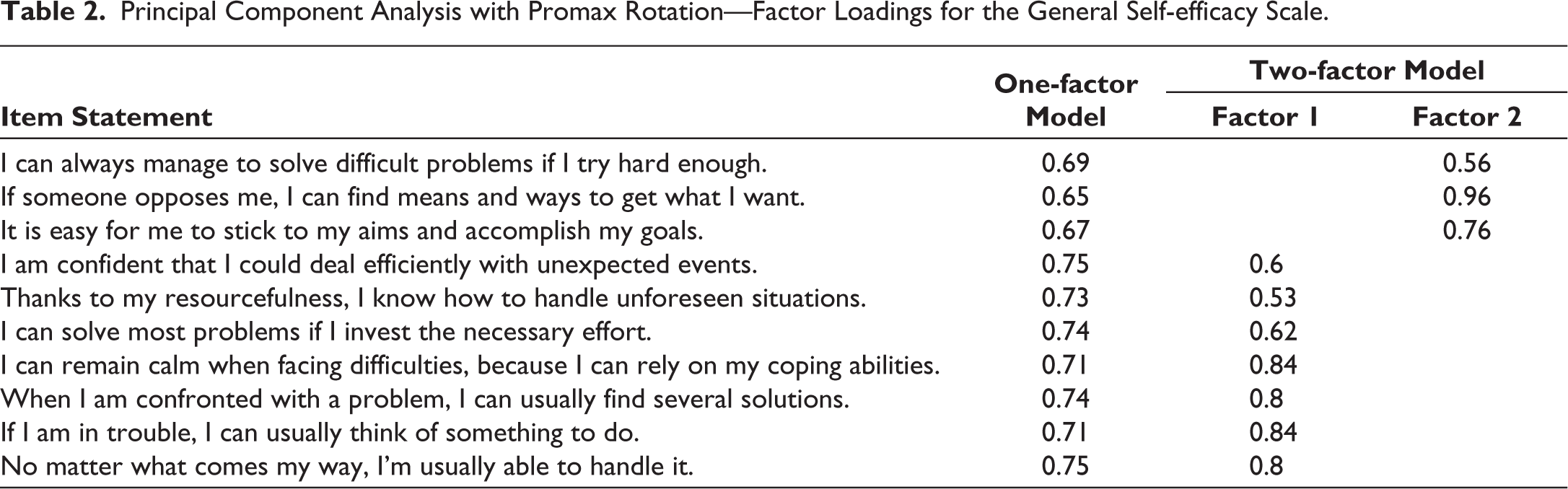
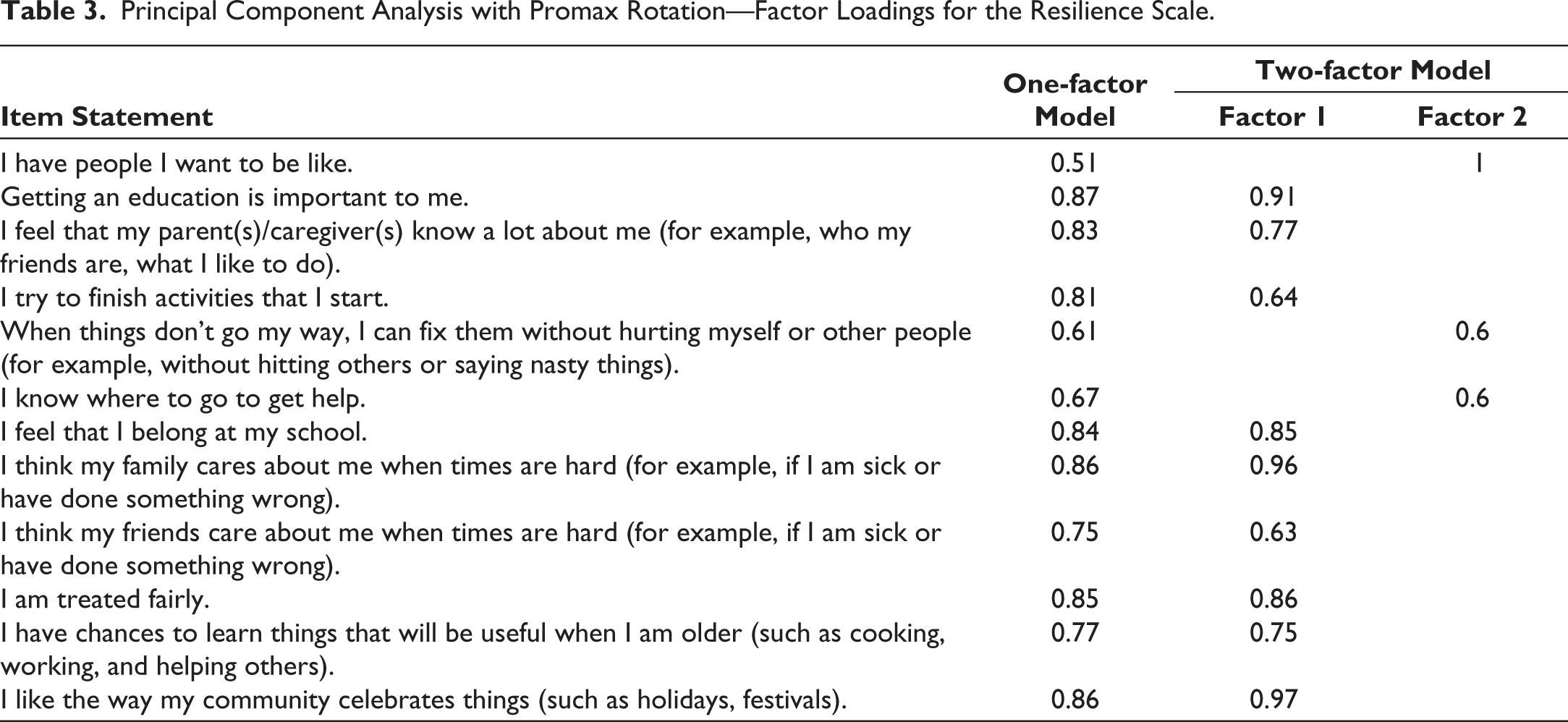
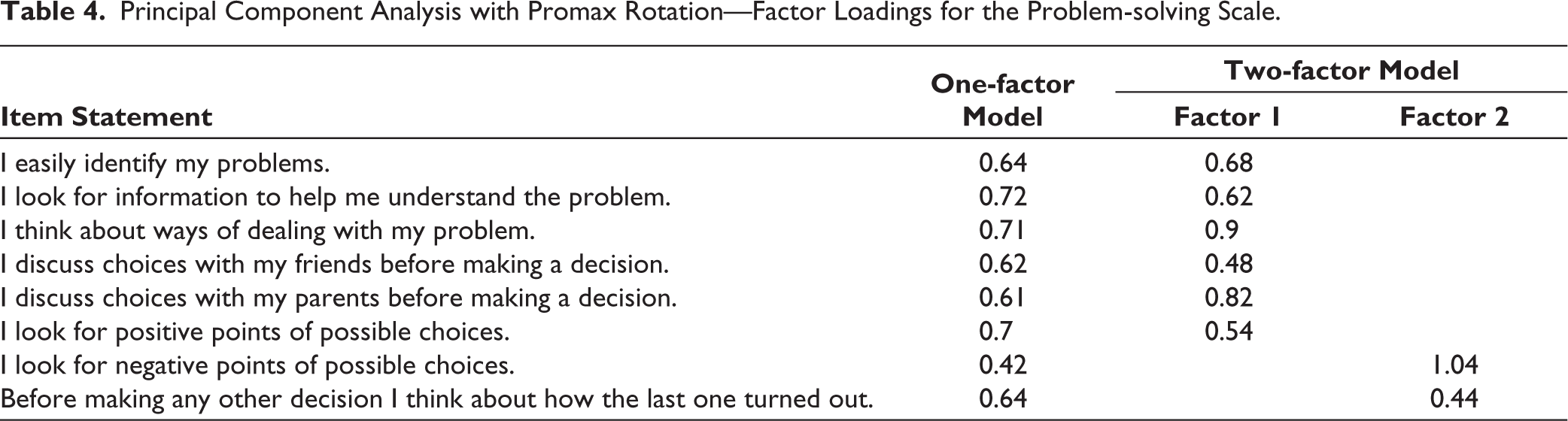
To explore the factor structure of the scales, principal component analysis (PCA) with promax rotation was computed. The data of 5713 participants were considered for the gender attitudes, general self-efficacy, and resilience scales and of 2328 participants for the problem-solving scale. The results revealed that most of the items in the scales, namely, gender attitudes (Table 1), general self-efficacy (Table 2), resilience (Table 3), and problem solving (Table 4), loaded onto one factor. Specifically, the one-factor solution of the gender attitude scale explained 41% of the variance (SS loadings = 2.88), general self-efficacy explained 51% of the variance (SS loadings = 5.1), resilience explained 60% of variance (SS loadings = 7.24), and problem solving explained 41% of variance (SS loadings = 3.28). The scree plots also indicated a one-factor structure for all scales (Supplementary Figures S1–S4). The aim of the PCA analysis was not to reduce the items in each scale, but to identify whether the items loaded on a single factor or on two factors. Based on these results, it was concluded that the scales are best represented by a single factor each, and therefore, the construct validity of the scales was determined.
Normality Analysis
The Shapiro–Wilk test of normality was computed on the dataset. Gender attitudes (W = 0.99, p = .00), general self-efficacy (W = 0.97, p = .00), resilience (W = 0.74, p = .00), and problem solving (W = 0.97, p = .00) were not normally distributed. The histogram plots show a skewed dataset for general self-efficacy, resilience, and problem-solving scales (Supplementary Figures S5–S8).
Confirmatory Factor Analysis
Subsequently, CFA was also computed on the above-mentioned scales (Table 5). The data of 5717 participants were considered for the gender attitudes, general self-efficacy, and resilience scales and of 2324 participants for the problem-solving scale. Using the maximum likelihood (ML) method of estimation, the gender attitude scale did not show a good fit. However, general self-efficacy, resilience, and problem solving had a good model fit. Because the data did not follow a normal distribution, the diagonally weighted least squares (DWLS) method of estimation was used in order to achieve the best overall fit indices. For gender attitudes, using DWLS led to an adequate model fit, while general self-efficacy, resilience, and problem solving had an excellent model fit.
Principal Component Analysis with Promax Rotation—Factor Loadings for the Gender Attitude Scale.
Principal Component Analysis with Promax Rotation—Factor Loadings for the General Self-efficacy Scale.
Principal Component Analysis with Promax Rotation—Factor Loadings for the Resilience Scale.
Principal Component Analysis with Promax Rotation—Factor Loadings for the Problem-solving Scale.
One-factor Confirmatory Factor Analysis Using Maximum Likelihood and Diagonally Weighted Least Squares Methods.
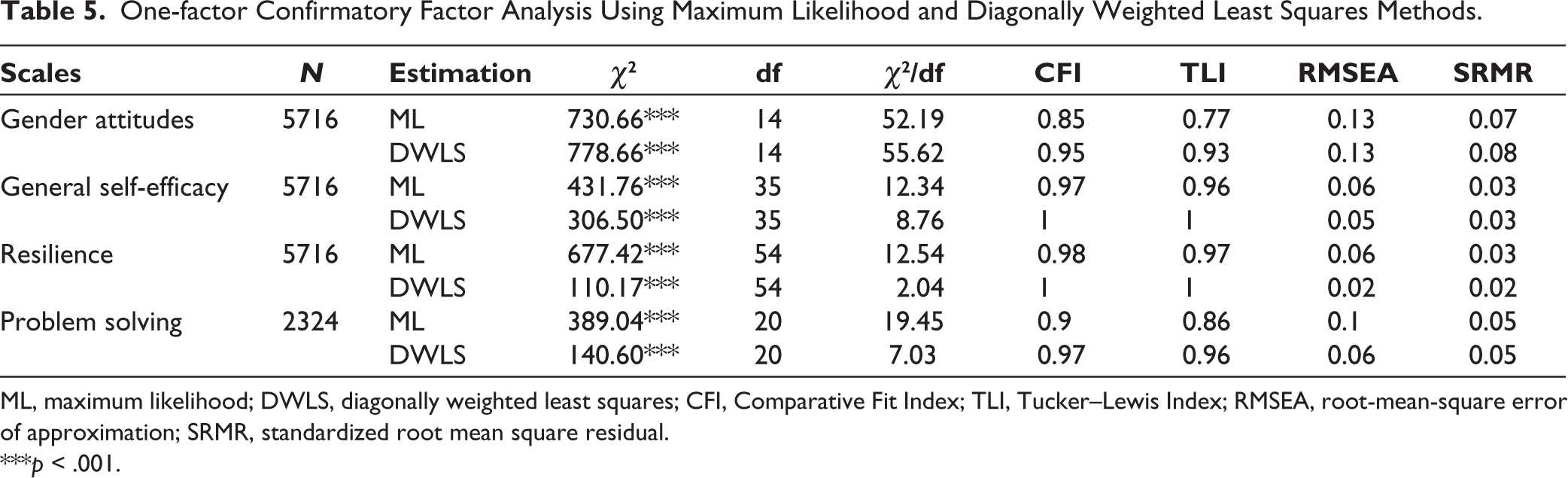
ML, maximum likelihood; DWLS, diagonally weighted least squares; CFI, Comparative Fit Index; TLI, Tucker–Lewis Index; RMSEA, root-mean-square error of approximation; SRMR, standardized root mean square residual.
***p < .001.
Measurement Invariance
In addition to the CFA, measurement invariance for all the scales was assessed across gender. Measurement invariance was computed to examine whether the scales had the same measurement properties across two or more groups. 22 Using the most robust statistics to measure between-group invariance, ∆CFI ≤ 0.01 23 will be considered instead of the ∆χ2 due to its sensitivity to sample size.23,24
Based on the results of the gender attitudes (Table S1), general self-efficacy (Table S2), resilience (Table S3), and problem-solving scales (Table S4), the change in CFI for Model 2 vs Model 1, Model 3 vs Model 2, and Model 4 vs Model 3 indicates invariance between boys and girls. This suggests that the association between items and the latent traits of individuals for all the scales did not depend on group membership (here, gender).
Descriptive Statistics and Correlations
The datasets for all the scales were merged to compute descriptive statistics and correlations. For the total sample, the descriptives for the scales were as follows: gender attitudes (M = 17.06, SD = 4.80); self-efficacy (M = 20.19, SD = 6.27); resilience (M = 30.63, SD = 6.71); problem solving (M = 14.81, SD = 4.88). Further, the correlations indicated that liberal gender attitudes were positively related to self-efficacy (r = 0.05, p < .01) and negatively related to resilience (r = −0.03, p < .05). Resilience was negatively related to self-efficacy (r = −0.14, p < .01). As data for the problem-solving scale was from a separate sample, it was not included in the correlation analysis.
A total of 5105 boys and 5477 girls responded to the items of the gender attitudes, resilience, and self-efficacy scales. As displayed in Table 6, there was a significant negative relationship between self-efficacy and resilience for boys. In contrast, among girls, liberal gender attitudes were positively related to self-efficacy and negatively related to resilience; resilience was negatively related to self-efficacy. It is important to interpret the correlation coefficients carefully, as large sample sizes can inflate significance of even small coefficients.
Descriptive Statistics and Correlations Between Variables for Boys and Girls.

** p < .01.
Discussion
In India, caste, gender, poverty, and location create barriers for many young individuals to realize their potential. A strong focus on developing life skills among adolescents in India can help empower adolescents and transform them into responsible citizens. Taking the complex and diverse contexts of India, life skills can be useful to elicit empowerment, active participation, recognize their power and potential, promote social inclusion, and equal opportunities for all. 1
This article assesses the reliability and validity of gender attitudes, general self-efficacy, resilience, and problem-solving scales developed to measure these variables among adolescents in India before the implementation of a life skill education program by the MBIF. The results indicated that all the scales had good reliability. Additionally, the findings from exploratory factor analyses indicated that all the scales had a one-factor solution. Further, CFA indicated a good model fit for the above-mentioned scales. Thus, the results indicated that the scales are reliable and valid measures of gender attitudes, general self-efficacy, resilience, and problem solving and were invariant measures between boys and girls. Furthermore, significant correlations between liberal gender attitudes, general self-efficacy, and resilience indicated that the scales taken together might be useful in assessing and imparting life skills among adolescents. These unidimensional scales are useful measures for the specified constructs among adolescents in India.
Past studies have shown that life skills have been helpful in improving adolescents’ mental health 14 and reducing psychological 13 and emotional distress. 15 Additionally, education based on life skills is also important in promoting the personal and social development of an individual. 25 Studies have shown that building life skills among adolescent girls fosters decision-making ability, mobility, sense of efficacy, and access to resources. 19 Furthermore, including gender attitudes as part of life skill education might help overcome the gender inequality in India. Given the effectiveness of life skill education and training among adolescents, validation of appropriate tools for measuring the efficacy of the life skill program in India has its implications for future use.
It has been noted that life skill programs in low-middle income countries lack effective planning and execution. 26 Furthermore, there is a dearth of research evaluating the effectiveness of these programs in these countries. It is crucial to assess the acquisition of knowledge, skills, and changes in attitudes resulting from life skill programs in order to determine the efficacy of program design. 27 Thus, this study evaluates the scales designed to assess the skills and change in attitude of adolescents undergoing life skill education. By measuring these variables before and after the program, we can monitor the program’s effectiveness and customize future programs to address the unique needs of adolescents in India.
The analysis also revealed a negative correlation between self-efficacy and resilience. This rather unlikely result might point to the impact of participants’ social environment (largely from a lower socioeconomic background) on building resilience. Research has noted a significant relationship between sociodemographics and resilience variables. 28 It also highlights the importance of imparting life skills among adolescents to increase knowledge and foster self-efficacy and resilience together, along with other skills. Gender attitudes, on the other hand, were positively related to self-efficacy, indicating the importance of having liberal gender attitudes, especially among girls. Further, gender attitudes were negatively associated with resilience, suggesting the need for life skill training for Indian adolescents.
Limitations and Future Directions
This study was not without its limitations. First, missing data on some scales reduced the final sample size for analyses. Further, other relevant life skill variables were not examined in the current study. Second, cross-sectional measurement invariance was conducted only for gender (across boys and girls) and not for other identities or socioeconomic factors. Third, it is important to consider how life skill interventions eventually translate into beneficial life outcomes; however, the scope of this study was limited in this regard. Future research in this domain can fill in these gaps as well as address these limitations, while using the scales validated in this research.
Self-efficacy, resilience, and problem solving are among the many basic life skills important among adolescents. Measuring certain life skill abilities gives policy makers as well as practitioners (such as social impact organizations, NGOs, and educationists) the ability to track the progress of programs as well as informs the scope of useful interventions. For example, it could broaden the policy targets under NEP to include more than just cognitive test or exam scores as outcomes for the education sector. Greater precision and validity in the measures used here can go a long way in knowing, for example, whether schools in states that have adopted the NEP are indeed making progress on goals related to social and emotional skills. Further, these tools also help researchers in identifying sub-groups who need more support and learning of these life skills. 4 Thus, the measures evaluated in this study, namely, gender attitudes, general self-efficacy, resilience, and problem solving, can be useful to measure the effectiveness of a life skill program among the adolescent population.
According to the LSCE framework, there are 12 core life skills, namely, creativity, critical thinking, problem solving, cooperation, negotiation, decision making, self-management, resilience, communication, respect for diversity, empathy, and participation. 3 Thus, future efforts can be made to develop tools that measure the various different important life skills specifically designed to assess the effectiveness of the life skill education programs among adolescents in India.
Supplemental Material
Supplemental material for this article is available online.
Supplemental Material
Supplemental material for this article is available online.
Footnotes
Declaration of Conflicting Interests
The authors declared no potential conflicts of interest with respect to the research, authorship, and/or publication of this article.
Funding
The authors received no financial support for the research, authorship, and/or publication of this article.
Statement of Informed Consent and Ethical Approval
The study was accorded Ethical Committee Approval vide the Institutional Review Board at Monk Prayogshala (#045-020) dated July 2, 2020. Verbal informed consent was taken from all the participants. The study was carried out in accordance with the principles as enunciated in the Declaration of Helsinki.