




Abstract
Aim:
This study aims to test the psychometric properties of Odia translated Child and Youth Resilience Measure (CYRM-R) scale
Method:
A total of 167 participants were recruited for this study. The English version of the CYRM-R scale was translated into Odia and back-translated into English. Following item analysis, exploratory factor analysis using Oblique rotation was used to confirm the factor structure and internal consistency of the scale was established.
Results:
The items on the scale had a good inter-item correlation. The contextual resilience scale was removed due to low internal consistency. The final scale had two subscales namely individual and relational resilience. Significant differences were found in resilience between the two genders and CNCP & CCL population.
Conclusion:
The translated CYRM-R seems to be a good scale with high reliability to measure resilience among youth. However further study has to be done cross-culturally to generalise the results.
Introduction
Resilience has been defined as the ability to maintain positive levels of functioning during difficult life circumstances and helps an individual to adapt to life circumstances and grow amidst difficulty. 1 There are psychological and behavioural components to resilience. The ability to maintain positive mental health during adversity is the psychological component and maintaining an adequate level of functioning in social situations and work environment is the behavioural component of resilience. 2 Resilience is associated with certain factors such as temperament, personality, the ability to form meaningful relationships with friends, family and availability of resources such as health services, education etc. Resilience has been considered both as a trait or an attribute of an individual and a continuous evolving process. 3
Resilience acts as a protective shield against stress, anxiety and other depressive disorders. Having more positive emotions and resilience helps in developing coping strategies to handle adverse events efficiently. 4 This in turn, helps improve individuals’ mental health in such difficult situations. Studies have found that better resilience is positively correlated with positive indicators of mental health such as positive affect, life satisfaction and negatively correlated with negative indicators of mental health such as anxiety and depression. 5 Resilience has also been shown to play an important role in preventing and faster recovery from mental illnesses associated with adverse events. 6
Children in India are given multiple legal protections under the Juvenile Justice Act of 2015. The law provides supervision and care for both children who have been victims of crimes or are part of families that are unable to care for them (Children in Need of Care and Protection—CNCP) and children allegedly in conflict with the law (Children in Conflict with the Law—CCL). These children who are unable to be cared for in the community are placed in Child Care Institutions (CCIs). These are a uniquely disadvantaged group of individuals who have faced multiple challenges in their lives at a very young age. This may have an impact on their mental health and wellbeing and building skills of resilience would be essential to mitigate the effects of these experiences. Even though the Child and Youth Resilience Measure (CYRM-R) has been used in different cultural contexts, the same has not been validated in Odia among adolescents.
Methodology
Procedure
This study is part of the Juvenile Assessing Mental Health Service (JAMS) project. The study protocol was reviewed and approved by the Independent Ethics committee at the primary research institution in March 2021. The ethics committee was formed and worked according to the ICH-GCP (International Conference on Harmonisation—Good Clinical Practice) and applicable local laws and regulations. Once appropriate permissions were obtained from the administration, including the administration of the individual CCIs and the district collector of Ganjam district in Odisha, the children from the various CCIs were approached for participant assent. No identifying information about the children was taken from the CCI and the children were allowed to withdraw from the study at any time and all ethical principles protecting the interests of the child were followed and ensured by the research team and the Ethics committee. The self-report questionnaires were administered after they were translated into Odia by the process mentioned below.
Translation Procedure
The original 17 item CYRM-R scale was read, understood and discussed by the translation team to ensure the questions’ accurate meaning and the intention was understood. The items were then translated into Odia by two translators who had Odia as their first language and were conversant in English. The measure was then back-translated into English by two independent translators who were proficient in both English and Odia and were unfamiliar with the scale. The various versions of the translated scales were reconciled at each step by the research team and the same was compared with the original version to check its accuracy. Following this, cognitive interviews were conducted with five children from a similar background and age range but, not from the CCIs for ensuring comprehension and the appropriateness of translation. The final changes were made to the scale and then administered in the target population.
Participants
A total of 167 children living in 4 CCIs in Odisha between the ages of 12 and 18 agreed to participate in the study. Their demographic characteristics are shown in Table 1.
Mean, Standard Deviation and Range of Ages for Each Gender Group.

Tool Description
The CYRM was a 58-item measure which was then reduced to 28 items. These 28 items were further validated and made more robust into a 17-item scale and found to have two factors of intra/inter-personal and relational/caregiver resilience. 7 The inter/intra personal resilience subscale has 10 items and the relational resilience has 7 items. All items were answered on a 5-point Likert scale ranging from 1 (not at all) to 5 (a lot). An overall score was generated for the full scale and the subscales by calculating the mean of the item responses. Higher total scores on the scales indicate greater levels of the constructs measured.
Statistical Analysis
Item analysis of the CYRM-R was initially conducted, investigating descriptive statistics for each item along with the mean inter-item correlation for the items within each subscale. Exploratory factor analysis was then conducted to confirm the factor structure of the questionnaire, before confirming the internal consistency of the final subscales using Cronbach’s Alpha.
Results
Item Analysis
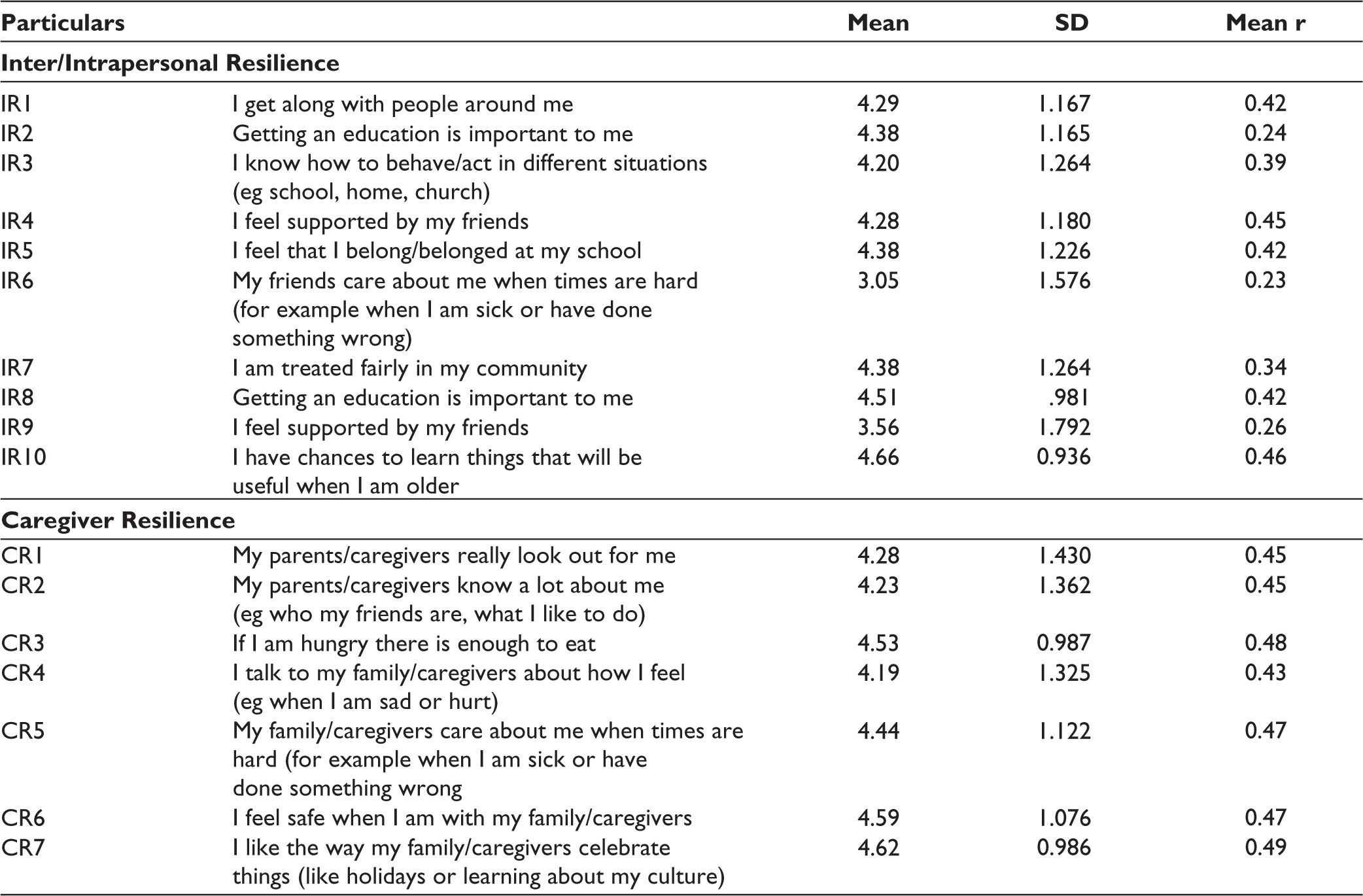
The descriptive statistics of the data were analysed and the same can be seen in Table 2. Inter-item correlations were calculated within each subscale (see Table 2), by taking a mean correlation of each item with all other items in the subscale. The recommended mean inter-item correlations are between 0.15 and 0.50 for psychological constructs. 8 Since all the items were within the above-mentioned range none of the items were removed.
Descriptive Statistics.
Principal Component Analysis
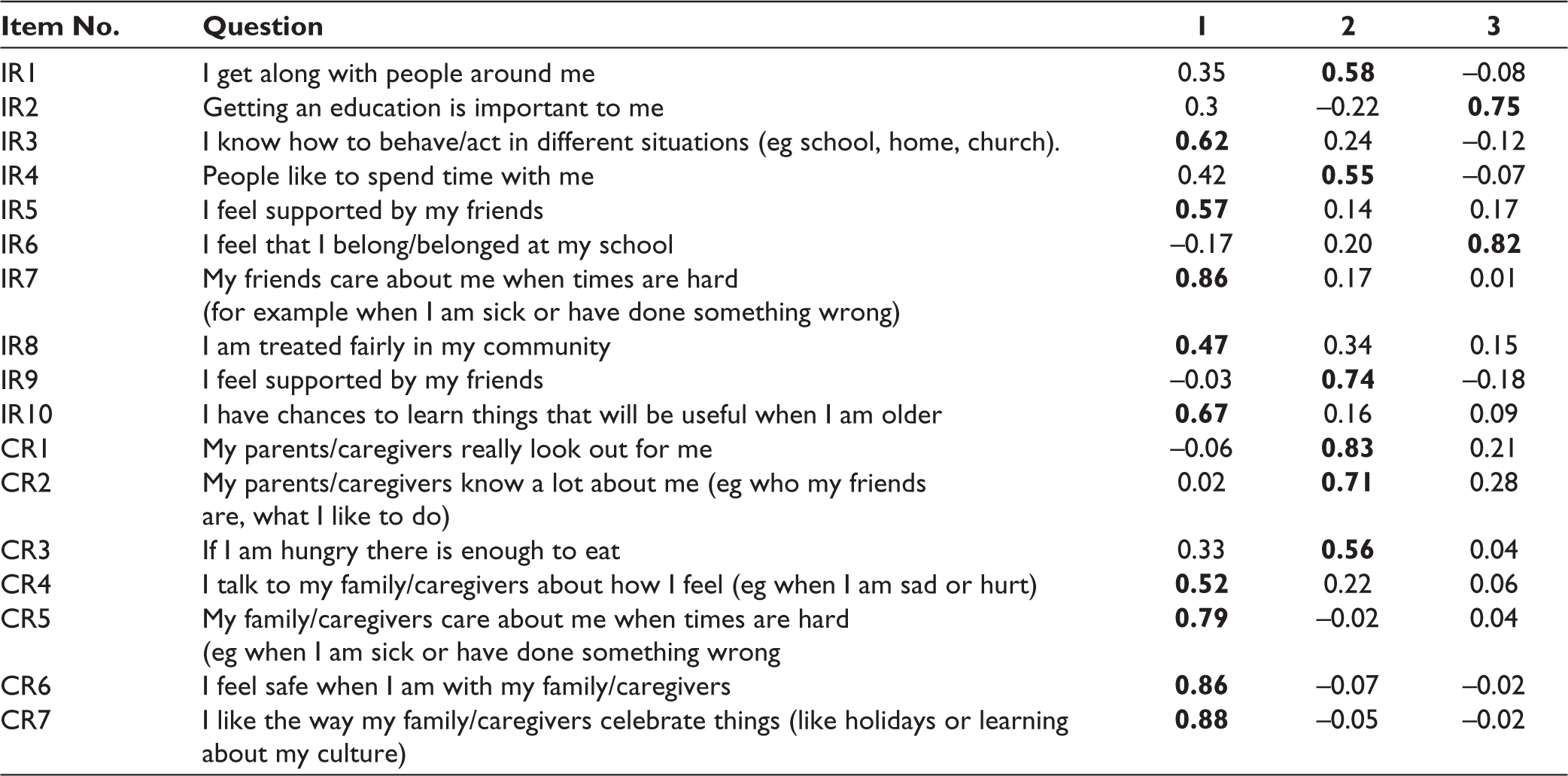
An initial principal component analysis (PCA) was run employing the Kaiser criterion for factor extraction. This indicated a three-factor solution. Bartlett’s test of sphericity was significant (χ 2 = 1643.109, d = 136, P < .001) and sampling adequacy was confirmed (KMO = 0.86) suggesting the data was appropriate for PCA. The three-factor solution was also tested using direct oblique rotation. The initial analysis is presented in Table 3. Since all the factors loaded properly none of the items were removed and this was retained as the final solution.
Rotated Component Matrix Final Three-Factor Solution, Using Direct Oblique Rotation.
Descriptive Statistics of the Final Scale.

Our first-factor individual resilience had three components in it namely personal skills, social skills and caregiver/peer support. Since several components loaded in the first factor they were split into different categories. Questions such as “I have chances to learn things that will be useful when I am older” was included in personal skills, and “I know how to behave/act in different situations (eg school, home, church)” was included in social skills and questions such as “I feel safe when I am with my family/caregivers”, “I feel supported by my friends” were included in caregiver/peer support. The second factor that emerged in the analysis included questions regarding the care and support given by the family members/caregivers and friends on a general basis and during difficult times. Hence the second factor was named as relational resilience. The final factor indicated education and belongingness to school hence the same was named as contextual resilience
In the final solution, the Individual resilience factor had an eigenvalue of 7.60 with 9 items loading onto the component (with loadings between 0.47 and 0.88), Relational resilience factor had an eigenvalue of 1.681 with 6 items loading onto the component (with loadings between 0.55 and 0.83) and Contextual resilience factor had an eigenvalue of 1.26 with 2 items loading onto the component (with loadings between 0.75 and 0.82).
Internal Consistency
Cronbach’s alpha was calculated for all three subscales. The internal consistency of the Individual resilience subscale was (α = 0.901), the relational resilience subscale was (α = 0.844) and the contextual resilience subscale was (α = 0.56). The Cronbach’s alpha for the contextual resilience subscale was less than 0.7 which was not within the “acceptable” range. 9 Hence contextual resilience subscale was removed from the analysis. The Cronbach’s alpha for the entire scale was 0.92 which shows high reliability and internal consistency.
Descriptive Statistics for the Final Scale
The mean and standard deviation for both the subscales were calculated. Males had higher individual resilience compared to females but the differences were not significant. In case of relational resilience men had a higher mean compared to females which was significant (P <.05). And the CCL population had higher self-reported individual and relational resilience compared to CNCP population and these differences were significant (P <.05).
Discussion
This study aimed to validate the psychometric properties of the Odia translated CYRM-R scale among adolescents in various CCIs. The preliminary analysis revealed an inter-item correlation ranging between 0.15 and 0.50 and thus, none of the items were removed. Further analysis using the oblique rotation method, revealed a three-factor solution in contrast to the two-factor described in the original scale. The three factors that emerged from the analysis were Individual resilience (Personal skills, social skills and peer/caregiver support), relational resilience and contextual resilience. While calculating Cronbach’s alpha, the contextual resilience subscale had lower reliability (<0.7), hence it was removed from the analysis. Finally, a 15-item scale achieved an optimal outcome in terms of the factor structure.
Even though in our study only two factors were retained in the final subscale, these factors were different from the factors that emerged in the original CYRM-R scale. The original CYRM-R scale has two factors namely inter/intra-personal resilience and caregiver resilience. Inter/intrapersonal subscale has questions regarding the individual’s thoughts and abilities about themselves and the support they received from their friends and community. Caregiver resilience included questions regarding the individual’s relationship with his/her caregiver. However, in our study, the first factor constituted of different components including the individual’s personal skills, social skills and the support they receive from their peers and caregivers. And our second subscale relational resilience covered questions regarding the care/support shown by their friends and caregivers. Hence it is evident that there is an overlap between the first and the second subscale and there is a lack of clear demarcation. This can be due to the cultural differences between the participant sample and their perception of the questions.
We also found males have better self-reported relational resilience compared to females. This is in contrast to the previous studies which show that males are more fragile and less resilient compared to females. A study by Rutter 10 found that males tend to develop more emotional and behavioural problems in response to family discords compared to females. In a study conducted among Vietnam veterans it was found that male Vietnam veterans had a 15.2% PTSD prevalence compared to female Vietnam veterans who had an 8.5% prevalence rate two decades after their service. 11 This showed that men suffered more from war-related trauma compared to females. However according to a study done by Jackson and Martin, 12 males placed in the care system had a better internal locus of control (an individual resilience component) compared to females. From these contrasting results it is evident that further research has to be done to understand the reason for these differences.
Another difference in resilience was seen between the CNCP and CCL population. The CNCP population had lower self-reported resilience (both individual and relational) compared to the CCL population. Even though previous studies have measured resilience in CNCP and CCL populations, the same has been done separately. This is the first research that validates a resilience measure (CYRM-R) among both CNCP and CCL populations within the same study. Hence this area of research warrants further investigation.
Limitations
As mentioned above, the study also found certain significant differences between the two genders and population (CNCP and CCL) which requires further research. However, it has to be kept in mind that these findings and validation have been done only among Odia speaking adolescents. Hence, further exploration must be done to find whether these differences exist cross-culturally. This study did not use measures to check the convergent and divergent validity of the scale. Hence, using measures to check the same in the future will improve the scale’s psychometric properties.
Conclusion
Hence considering its reliability and factor structure CYRM-R seems to be a valid scale to measure resilience among youth. However, the study has certain limitations as mentioned above which needs to be addressed in the future studies.
Footnotes
Acknowledgements
Ms Jothi Durairaj—for assisting in statistical analysis; all the staff members of the JAMS project
Author Contributions
Conceived study and designed analysis: AA, RE, SP
First draft: AA, RE
Review and comments: AA, SP
Declaration of Conflicting Interests
The authors declared no potential conflicts of interest with respect to the research, authorship, and/or publication of this article.
Funding
The authors disclosed receipt of the following financial support for the research, authorship, and/or publication of this article: This pilot project was funded by Grand Challenges Canada, NIHR—Global Mental Health Grand Challenge: Mental Health and Wellbeing of Young People (Grant nusmber—R-GMH-POC-2107-4395).
The funding agency had no role in the design of this study, data collection, analysis, or interpretation of the data and writing or submission of the article.
Ethical Approval
This study was approved by the Independent Ethics Committee of Schizophrenia Research Foundation (SCARF) dated March 23, 2021.
Informed Consent
The consent of the participants (children from CCIs) were taken before conducting the study.