



Abstract
Background
Scar recovery in elderly burn patients is essential for wound healing and psychological well-being. Total glycosides from Centella asiatica have gained attention for their anti-inflammatory, antioxidant, and wound-healing properties, showing promise in burn care.
Objectives
This study investigates the synergistic effects of combined nursing interventions and Asiaticosides on scar recovery and psychological well-being in patients undergoing scald scar repair. The pharmacological properties of these glycosides, including their anti-inflammatory, anti-oxidant, and wound-healing potential, are explored in the context of clinical care to enhance patient outcomes.
Materials and Methods
A cohort of 184 patients treated for scald scars between April 2023 and April 2024 was divided into two groups: an observation group receiving combined nursing interventions with Asiaticosides, and a comparison group receiving standard care. Scar assessment was conducted using the Vancouver Scar Scale (VSS), pain was measured by the Visual Analogue Scale (VAS), and psychological states were evaluated using the Self-rating Anxiety Scale (SAS) and Self-rating Depression Scale (SDS).
Results
Statistically significant improvements were observed in the observation group, including reduced VSS and VAS scores, as well as enhanced psychological states, compared to the control group (p < 0.05). The glycosides facilitated faster scar healing, reduced inflammation, and improved overall patient well-being.
Conclusion
Asiaticosides exhibit promising therapeutic potential in enhancing scar recovery and psychological health in elderly scald patients when combined with comprehensive nursing care. Further research into their mechanisms may solidify their role in integrated scald injury management.
Introduction
Burns are one of the most common wounds in the elderly, and according to statistics, the incidence of burns in the elderly is significantly higher than in other age groups. Therefore, the scald scar repair process has an important impact on the patient’s daily quality of life. As a plant extract with various pharmacological activities, the total size of Asiaticosis has attracted wide attention in recent years (Huang et al., 2021).
Asiaticoside is an effective component extracted from Asiaticoside, which mainly contains monomer components such as Asiaticoside, hydroxy asiaticoside, and snow oxalic acid (Tong et al., 2014). The Asiaticosides have a variety of pharmacological activities, including anti-inflammatory, antioxidant, anti-bacterial, wound healing promotion, anti-depression, anti-dementia, protection against spinal cord injury and degeneration of spinal cord nerve cells, anti-cerebral ischemic injury, analgesia, anti-convulsion, and other effects (Hou et al., 2016). These pharmacological activities make the Asiaticosides have potential application value in the treatment of many diseases. Scar repair of burns in the elderly is a complex process involving wound healing, scar formation, and mental health (Satheesan et al., 2012). The Asiaticosides have potential application value in the repair of scald scars in the elderly (Shen et al., 2014). The anti-inflammatory and antioxidant effects of the Asiaticosides sinica can help reduce post-traumatic inflammatory response and oxidative stress and promote wound healing (Hidalgo et al., 2017). The anti-bacterial effect of Asiaticosides can reduce the risk of infection, thus promoting the healing of wounds. The protective effect of Asiaticosides on spinal cord injury and degeneration of spinal cord nerve cells may help to improve nerve function and promote the recovery of function (Hu et al., 2022).
Patients with scald scar repair often face psychological stress and anxiety. The anti-depressant and anti-dementia effects of Asiaticosides may have a positive impact on improving the psychological state of patients (Hanapi et al., 2021). The analgesic and anti-convulsant effects of Asiaticosides can reduce the pain and discomfort of patients, thereby improving the psychological state of patients (Wu et al., 2017). In addition, the protective effect of Asiaticosides on cerebral ischemic injury may help improve the cognitive function and emotional state of patients (Liu et al., 2022). In this article, the effects of the combined nursing intervention of Asiaticoside on scar recovery and the psychological state of patients with scald scar repair were investigated in order to provide a reference for clinical practice and research.
Materials and Methods
Research Object
A total of 184 patients with scald scar repair treated in our hospital from April 2022 to April 2024 were divided into an observation group and a comparison group, 92 cases in each group, according to whether topical cutaneous application (TCA) combined nursing intervention was used. The included samples meet the requirements of evidence-based medicine and epidemiology. We have obtained the approval of the Ethics Committee of the hospital and passed the approval of the ethics certificate, and the selected patients with scalded scar repair have all given their informed consent. Based on the principle of confidentiality, we strictly keep confidential the personal information and family information of patients with burn scar repair.
Inclusion Criteria
The included patients met the grading criteria of acute radioactive skin reaction formulated by the Chinese Medical Association and were divided into 0–5 grades. Grade 0 was no skin injury; Grade I is dark red or dry peeling of the skin follicles or reduced sweating; Grade II was tender skin or bright red spots, flaky wet peeling, neutral edema; Grade III was fusion wet peeling or pitted edema outside the skin folds. Grade IV is skin ulcer or bleeding necrosis. The patient is less than 60 years old.
Exclusion Criteria
Patients with skin cancer or metabolic disease. The patient’s liver, kidney, and other important organs are not fully functional. Patients with immune deficiency diseases and autoimmune diseases. The patient has chronic internal diseases such as diabetes and hypertension. Patients with scar rupture, chronic wound, or bacterial infection. Patients with blood system disorders. The patient is a pregnant and lactating woman.
Intervention Methods
The control group received routine nursing. Prevent infection in time and change medicine on time. Assist in the formulation of dietary guidelines, exercise programs, and regular follow-up orders. Maintain aseptic operation throughout the operation, and maintain communication with patients to divert their attention and relieve their fear and tension. At the same time, closely observe whether the patient has adverse reactions; if there are adverse reactions, immediately take targeted control measures. The changes in vital signs and blood flow of the finger end were closely monitored after the operation. Replace the dressing in time to ensure that the dressing is dry and clean to avoid infection of the incision. If no symptoms such as nausea and vomiting occur after the operation, the patient can be instructed to take liquid food. For patients with facial or neck scars, fasting on the day after the operation, mainly eating liquid food within 3 days after the operation, and then gradually returning to a normal diet. Guide the patient to carry out rehabilitation training to prevent joint stiffness and contracture, and use an elastic splint to combat contracture before going to bed if necessary to promote the appearance and function recovery of the hand.
The observation group was treated with the combined nursing intervention of Asiaticosides. The patient’s position was supine, lateral, or seated, depending on the scar site of the patient. Clean the scar and disinfect it with disinfectant. Apply Snowside cream ointment (Hainan Puli Pharmaceutical Co., Ltd., approval number Z46020054) to the affected area evenly, and gently massage to promote absorption three times a day. Oral Xuejioside tablets (Shanghai Modern Pharmaceutical Co., Ltd., approval number Z20200001) are taken three times a day, four tablets each time. The nurse encouraged the patient with appropriate language, encouraged and cared for the patient, let the patient face the change of appearance with a dialectical attitude, and told the patient’s family members to encourage the patient with language to improve the patient’s negative emotions. In the process of communication with patients, we should maintain a patient attitude, carefully listen to the patients, patiently answer the questions raised by the patients, and narrow the relationship between nurses and patients. The nurse informs the patient of the necessity of drug treatment, explains the usage and dosage of the drug in detail to the patient, and pastes a note on the medicine box to mark the usage and dosage of the drug in case the patient forgets. Understand the weight and height of the patient, calculate the body mass index (BMI), and implement dietary guidance for the patient. Patients are advised not to eat spicy, irritating food, seafood, beef, mutton, and other foods. Evaluate the recovery of patients and guide the medication methods and daily nursing methods after discharge. Conduct diet and daily rest instruction. The patient was asked to return to the hospital regularly for reexamination. The nurse should follow up regularly and pay attention to the patient’s skin and functional recovery at any time.
Observation Indicators and Judgment Criteria
Psychological Rating
Self-rating Anxiety Scale (SAS) (Schneider et al., 2022) and Self-rating Depression Scale (SDS) (Cunningham et al., 2015) were used to evaluate the two groups of patients before and after the nursing intervention. Both scales include 20 items, using a 4-level scoring method, none or occasionally = 1, rarely = 2, often = 3, and mostly or continuously = 4 points. According to the Chinese norm results, the SDS standard score (total crude score multiplied by 1.25) is 100 points, the higher the total score, the more serious the degree of anxiety and depression.
Scar and Quality of Life Score
The Vancouver Scar Scale (VSS) was used to score the two groups of patients before and after nursing intervention (Finlay et al., 2017). The evaluation was conducted from four dimensions of color: blood vessel distribution, thickness, and softness, with a total score of 15 points. The lower the score, the lighter the scar.
Pain Score
A Visual Analog Scale (VAS) was used to record the degree of itching in the two groups before and after intervention (Sung & Wu, 2018). The score distribution is 0 points: no pain; 1–3 points: mild pain and itching; 4–6 points; moderate pain and pruritus; score 7–10: severe pain and pruritus.
Statistical Analysis
Statistic Package for Social Science (SPSS) 26.0 statistical software [International Business Machines Corporation (IBM), Armonk, NY, USA] was used for the included patient data. The counting data were expressed as integers or percentages. The x2 test was used for comparison between groups of categorical variables, and the rank sum test was used for ordered variables. The measurement data were represented by Mean ± Standard Deviation, and an independent sample t-test was used when the age and psychological score of patients followed a normal distribution. p value < 0.05 was considered statistically significant.
Results
General Data Analysis
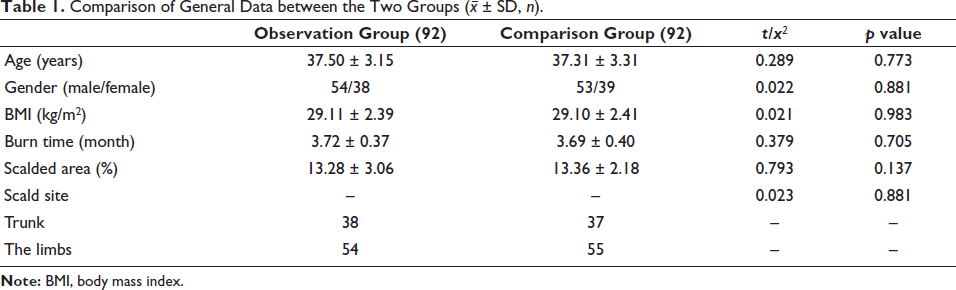
There was no significant difference in the age, gender, BMI, burn time, and burn area of the two groups of patients with scald scar repair. There was no significant statistical difference (p value > 0.05) (Table 1).
Comparison of General Data between the Two Groups (x̅ ± SD, n).
Comparison of Laboratory Indexes before and after Treatment between the Two Groups
Before treatment, these four indexes of the Observation Group were not much different from those of the Comparison Group, which were 13.73 ± 1.25 for white blood cells, 31.47 ± 7.31 for alanine aminotransferase, 132.22 ± 5.33 for hemoglobin and 174.17 ± 30.89 for platelets. However, after treatment, the four indicators of the Observation Group declined more significantly, with white blood cells dropping to 4.08 ± 0.75, alanine aminotransferase to 26.34 ± 3.16, hemoglobin to 111.51 ± 3.12, and platelets to 154.87 ± 18.26. Moreover, the Observation Group was compared with the group post-intervention leukocytes, alanine transaminase, hemoglobin, and platelets, and the difference was statistically significant, p value < 0.05 (Table 2).
Comparison of Laboratory Indexes before and after Treatment between the Two Groups (x̅ ± SD).

Comparison of Relevant Indicators between the Two Groups after Treatment
The observation group had an average time of 6.52 ± 1.01 days, while the comparison group had an average time of 5.76 ± 0.93 days. The t-test result (t = 6.353) and p value (0.019) indicate that there is a statistically significant difference between the two groups, with the comparison group showing a shorter time for pain symptoms to disappear. The observation group had an average skin healing time of 7.96 ± 1.04 days, compared to 6.74 ± 0.67 days for the comparison group. The t-test result (t = 6.944) and p value (0.045) suggest a statistically significant difference, with the comparison group having a faster skin healing time. The average length of stay for the observation group was 15.33 ± 3.24 days, while the comparison group had an average of 13.13 ± 3.11 days. The t-test result (t = 5.797) and p value (0.005) indicate a statistically significant difference, with the comparison group having a shorter length of stay. The observation group received an average total exposure dose of 30.74 ± 5.62 Gy, compared to 23.53 ± 3.12 Gy for the comparison group. The t-test result (t = 7.363) and p value (0.002) show a statistically significant difference, with the comparison group receiving a lower total exposure dose. The average duration of medication for the observation group was 9.34 ± 2.17 days, while the comparison group had an average of 8.73 ± 1.44 days. The t-test result (t = 7.371) and p value (0.011) indicate a statistically significant difference, with the comparison group having a shorter duration of medication (Table 3).
Comparison of Relevant Indicators between the Two Groups after Treatment (x̅ ± SD).

Comparison of Relevant Score between the Two Groups
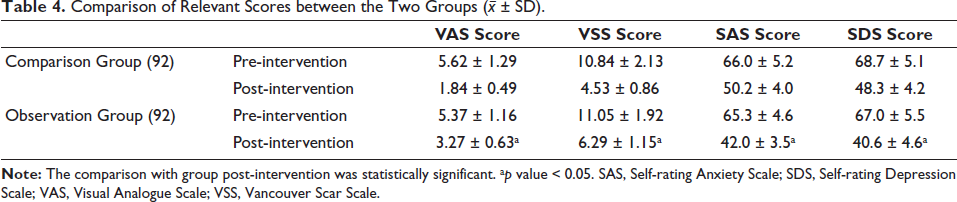
In pre-intervention, the VAS score, VSS score, SAS score, and SDS score of the Comparison Group and Observation Group were close, with no significant difference. After post-intervention, however, scores declined in both groups, but the magnitude of the decline varied, with the Observation Group improving more dramatically. The difference was statistically significant (p value < 0.05) (Table 4).
Comparison of Relevant Scores between the Two Groups (x̅ ± SD).
Discussion
As a traditional medicinal plant of the genus Asiaticosa in the umbrella family, Asiaticosa has a long history and wide application in China. Its components are mostly triterpenoids. Among them, Asiaticoside, with its rich pharmacological activity and extensive clinical effects, has become the main active component of Asiaticosa with great application prospects and great development value (Cotellese et al., 2018). In recent years, a large number of studies have confirmed that Asiaticoside has a variety of pharmacological activities such as anti-tumor, anti-venous insufficiency, anti-ulcer, wound healing promotion, anti-depression, and nerve function restoration, and has also shown pharmacological effects in cardiovascular, immune regulation, anti-inflammatory, and anti-viral aspects (Zhang et al., 2016).
Our study found that the anti-inflammatory, anti-oxidant, anti-bacterial, and wound healing effects of the total sides of Asiaticosides have a positive impact on scar recovery and the psychological status of patients and have potential application value in the repair of scald scars in the elderly. The treatment of trauma with increased doses of Asiaticosides has been practiced in Europe for hundreds of years. This traditional approach aligns with the historical use of various medicinal plants that have been recognized for their therapeutic properties. For instance, the use of Chelidonium majus, known for its anti-inflammatory and pain-relieving effects, has been documented since ancient times and continues to be explored in modern pharmacology. Similarly, the medicinal properties of Ganoderma lucidum, which has been utilized for over 2,000 years, highlight the significance of natural compounds in treating various ailments, including trauma.
The increasing interest in the bioactive components of these plants reflects a broader trend in herbal medicine, where traditional practices are being validated through scientific research. The evaluation of metal contents in widely consumed medicinal plants, such as Aloe and Ginseng, underscores the importance of understanding the nutritional and toxicological profiles of these natural remedies. As the field of herbal medicine evolves, the integration of historical knowledge with contemporary scientific inquiry may enhance the efficacy and safety of treatments involving Asiaticosides and other herbal compounds. It has been shown in the literature that stainless steel was inserted into the skin of mice to cause wounds, and the cells at the wound site were collected for biochemical examination or histological examination on the 28th day after continuous injection of Asiaticosides. The results showed that the dry weight, deoxyribonucleic acid (DNA) expression, total protein, collagen, and uronic acid contents of the cells were all increased (de Carvalho et al., 2022). The Asiaticosides can stimulate the growth of collagen compounds at a low dose and also promote the growth of glycosaminoglycan, which can accelerate the cell cycle and promote the generation of collagen tissue in human dermal fibroblasts (Fong et al., 2015). The therapeutic effect of Asiaticosides on trauma has triggered studies on its mechanism of action at the molecular and gene expression levels (Hirman et al., 2021). Complementary DNA (cDNA) micro-lattice technology studies have shown that when 30 g/mL is given in vitro culture, the gene expression profile of human dermal fibroblasts has significant changes, and the gene profile, messenger ribonucleic acid (mRNA), and protein production are significantly correlated. In addition, the increase of cellular anti-oxidant levels can also promote the formation of collagen tissues and blood vessels (Sikareepaisan et al., 2008). The present study shows that total glycosides can induce an increase in anti-oxidant content in the initial period of treatment, which is an important reason for its role in the treatment process.
Asiaticoside, a key component derived from Centella asiatica, has been shown to possess various pharmacological properties, including anti-inflammatory and anti-oxidant effects. Recent studies indicate that Asiaticoside can significantly interfere with the DNA synthesis of fibroblasts, leading to a notable inhibitory effect on their activity. This is particularly relevant in the context of radiation-induced injuries (RII), where reactive oxygen species (ROS) can cause substantial damage to cellular structures. In vitro experiments have demonstrated that Asiaticoside administration can reduce the growth inhibition of fibroblasts exposed to radiation, as well as decrease the incidence of DNA double-strand breaks (DSBs) and apoptosis in these cells. Furthermore, the protective effects of Asiaticoside extend beyond fibroblasts, as it has been shown to improve survival rates in mice subjected to radiation exposure by mitigating oxidative stress and enhancing cellular resilience. These findings suggest that Asiaticoside may serve as a promising therapeutic agent in regenerative medicine, particularly for conditions involving oxidative stress and impaired fibroblast function.
According to the study, the principle of its action is to inhibit the growth and proliferation of fibroblasts and affect collagen synthesis. It was found under an electron microscope after medication that apoptosis occurred in fibroblasts, and whether it was dose-dependent or not remains to be studied clinically (Ruslan et al., 2012). It has been reported that Asiaticoside can inhibit scar fibroblasts from entering the M phase from the S phase, reduce the phosphorylation content in fibroblasts, increase the content of Smad 7 in cells, reduce the mRNA expression of TGF-β1 in hypertrophic scars, and increase tissue inhibitors of metalloproteinases (Ranjith et al., 2021). In addition, Asiaticoside can inhibit the activity of tyrosinate, significantly inhibit the mitotic process of B16 cell growth, inhibit proliferation, and show a dose-dose effect change with the concentration gradient change of Asiaticoside, and it can induce apoptosis or death of cells, indirectly repair the skin tissue, and prevent the formation of pathological scars (Zheng et al., 2020).
Conclusion
This study demonstrates that the combined use of Asiaticosides and nursing interventions significantly improves scar recovery and psychological well-being in patients undergoing scald scar repair. The observed improvements in scar assessment, pain reduction, and psychological state indicate a synergistic effect of these interventions, suggesting that Asiaticosides may play a crucial role in the management of scald injuries. These findings highlight the potential of integrative approaches in enhancing patient outcomes and warrant further investigation into the underlying mechanisms of action for more effective and comprehensive scald injury care. In the future, we will conduct a larger multi-center clinical trial to further verify the efficacy and safety of Asiaticoside in the treatment of scars. We can gain a deeper understanding of Asiaticoside’s therapeutic potential and its role in integrated scald injury management, ultimately improving patient care and outcomes.
Footnotes
Abbreviations
DSBs: Double-strand breaks; RII: Radiation-induced injuries; ROS: Reactive oxygen species; SDS: Self-rating Depression Scale; SPSS: Statistic package for social science; VAS: Visual Analogue Scale; VSS: Vancouver Scar Scale.
Acknowledgments
We are very grateful to 964 Hospital and Jinzhou Medical University Graduate School for their support and assistance in the research.
Declaration of Conflicting Interests
The authors declared no potential conflicts of interest with respect to the research, authorship, and/or publication of this article.
Ethical Approval and Informed Consent
This study was approved by the ethics committee of The 964th Hospital of PLA Joint Logistic Support Force (Approval no. 21-EC-03). Signed written informed consents were obtained from the patients and/or guardians.
Funding
The authors received no financial support for the research, authorship, and/or publication of this article.
