




Abstract
Background
Bovine viral diarrhea/mucosal disease (BVD-MD) is widely distributed worldwide. The disease causes serious economic losses to animal husbandry every year. Finding targeted antiviral drugs proves to be an effective strategy.
Objectives
This study was based on network pharmacology and in vitro studies to analyze the potential of traditional Chinese medicine (TCM) in the treatment of BVD-MD.
Materials and Methods
The intersection targets between TCM and the disease were identified. Network topology analysis and protein–protein interaction (PPIs) networks were performed. Intersection targets were analyzed for gene ontology (GO) and Kyoto encyclopedia of genes and genomes (KEGG) enrichment. The molecular docking and molecular dynamics simulation methods were used to reveal the degree of binding of core components to key target genes. Characterization of the anti-Bovine viral diarrhea virus (BVDV) effect of TCM by cytotoxicity and in vitro studies.
Results
The results revealed the selection of five key Chinese medicines, along with 206 targets associated with BVD-MD. The toll-like receptor, PI3K-AKT, and tumor necrosis factor (TNF) signaling pathways were closely related to the five TCMs. AKT1, EGFR, HSP90AA1, and MAPK1 had good binding with quercetin, the core component of Chinese medicine. Molecular dynamics analysis showed that quercetin exhibited complex stability with AKT1. In vitro studies have demonstrated that the inhibitory effect of quercetin on BVDV is mainly in the initial phase. Quercetin inhibited the expression of AKT1.
Conclusion
The mechanism of BVDV inhibition by the core Chinese medicines is closely related to MAPK1, AKT1, TNF, and HSP90AA1, with the reduction of AKT1 ultimately affecting viral expression.
Keywords
Introduction
Bovine Viral Diarrhea Virus (BVDV) belongs to the genus Canine distemper in the family Flaviviridae. BVDV shares the genus with classical swine fever virus (CSFV) and border disease virus (BDV), exhibiting significant homology in both gene structure and antigenicity (Lindenbach et al., 2007). In addition, the distemper virus is the most closely related to the hepatitis C virus (HCV) of the genus hepatovirus (Shepard et al., 2005). Globally, bovine viral diarrhea/mucosal disease (BVD-MD) is a widespread infectious disease that affects most cattle. Because of its widespread distribution and the lack of effective treatments, this disease has evolved into a prevalent global infectious illness, standing as the most common and crucial among cattle diseases. It can cause serious economic losses to the farming industry, including immune dysfunction, coinfection, and possibly persistent infection (PI) in calves (Fulton et al., 2003; Newcomer & Givens, 2013; Newcomer et al., 2017; Newman et al., 2022). BVDV is also an important laboratory pollutant and at present, there is no effective anti-BVDV therapy to control its infection (Tan et al., 2021). Because of this, potential drug research for BVDV has aroused people’s attention (Newman et al., 2022).
The ideal antiviral drug would be a compound that specifically kills the virus without harming the organism, although such a drug has not been developed. Due to its advantages of abundant resources, inexpensive and with few adverse effects, traditional Chinese medicine (TCM) has become a research hotspot of antiviral treatment (Liu, Hu, et al., 2019; Liu, Li, et al., 2019). For example, previous studies have shown that bupleurum extract has anti-inflammatory, antiviral, immune system regulation, and other functions and can be used in the treatment of influenza A (H1N1) (Yao et al., 2018). Radix isatidis (Banananan) is a TCM with well-documented extensive antiviral activity. Enhancing antiviral capabilities and reducing inflammatory responses to a certain extent can be achieved through direct viral pathogen elimination or immune system regulation (Zhou & Zhang, 2013). Ginsenosides Rb2 and Rb3 have the potential to effectively treat distemper virus infection, including the antiviral effect of BVDV and CSFV (Tan et al., 2021). Romero et al. (2007) investigated the antiflavivirus effects of cantharidin, cephalotaxine, and homoharringtonine-natural products from TCM by utilizing BVDV as a substitute for HCV in their study. It was found that they could inhibit the production of HBV (Romero et al., 2007). With advances in molecular biotechnology, the mechanism of viral replication has been better understood, leading to the discovery of a number of new targets for antiviral therapeutics. Recent investigations have shown that herbal monomers targeting NS5B exhibit better anti-BVDV activity and are not harmful to the body (Chen et al., 2023). Hence, TCM stands as a promising candidate in anti-BVDV drug development. However, there remains a paucity of reports on its usage in BVDV treatment, with the related mechanism of action remaining unclear. To elucidate the mechanism underlying the efficacy of Chinese medicines against BVDV, we aim to conduct a comprehensive investigation utilizing network drug screening to identify potential candidates, followed by in vitro validation.
Network pharmacology is a new subject based on systems biology theory. It conducts network analysis of biological systems and selects specific signal nodes for multitarget drug molecule design (Liu, Hu, et al., 2019; Liu, Li, et al., 2019; Niu et al., 2019). It emphasizes the shift from a “single-target” to a “network target” research paradigm to construct and integrate a “disease-pathway-gene-drug” multilevel network. Network pharmacology analyzes drug interactions with specific network nodes, providing a systemic view of drug–disease interactions. Molecular docking is a preferred method for predicting the binding of a molecule (ligand) to another molecule (receptor, such as RNA or enzyme). Semi-flexible docking is employed to form stable complexes. This process is critical for explaining the mechanism of action or for screening lead compounds and thus has become one of the fundamental approaches to structure-based drug design. It is now widely used to assist in a variety of other drug discovery tasks, to help understand and master interactions between compounds and molecular targets, and for drug discovery and development (Chen et al., 2023). In this study, the target of TCM and disease targets related to BVD-MD were analyzed through network pharmacology, and the intersection target of TCM acting on BVD-MD was obtained. Then, analysis software was used to conduct molecular docking and metabolic pathway analysis of the component target, and finally, the mechanism of action of the molecular target pathway of TCM treating BVD-MD was determined. It provides a reference for further research and new drug development.
Materials and Methods
Access to Core Chinese Medicine
First, TCM ingredients were searched through the Traditional Chinese Medicine Systems Pharmacology (TCMSP) platform (
Prediction of BVD-MD Targets
Using keywords related to BVD-MD, search for relevant genes in the OMIM (
Acquisition of Intersection Target of Core Chinese Medicine and BVD-MD
The identification of intersecting points between TCM targets and disease targets is used by Venny software (
“Component–Target–Disease” Network Analysis
The drug–gene “network” file and Type file were prepared, imported into Cytoscape 3.9.0 software, and subjected to network topology analysis. The pattern, color, transparency, and size of the target were adjusted according to the Degree (number of gene connections) of gene connections, and the network diagram of “TCM components, targets, and diseases” was constructed.
PPI Network Construction and Network Topology Analysis
The protein–protein interaction (PPI) network was acquired by inputting intersection genes into the STRING database (
Enrichment Analysis of GO and KEGG
The bioinformatics open-source software Bioconductor (
Molecular Docking
Small molecules were molecularly docked to proteins AKT1 (UniProt ID: Q01314), EGFR (UniProt ID: A0A3Q1MHB0), ESR1 (UniProt ID: P49884), HSP90AA1 (UniProt ID: Q76LV2), IL1B (UniProt ID: P09428), IL6 (UniProt ID: P26892), JUN (UniProt ID: O77627), mitogen-activated protein kinases (MAPK)1 (UniProt ID: P46196), STAT3 (UniProt ID: P61635), and tumor necrosis factor (TNF) (UniProt ID: Q06599) using AutoDock Vina 1.1.2 software. Proteins were pretreated, involving the removal of water molecules and excess ligands and the addition of hydrogen atoms using PyMol 2.4. PDBQT files for docking simulations were generated using AutoDock Tools 1.5.6. Visualization was performed using PyMol 2.4 software.
Molecular Dynamics Simulation
Protein–ligand complexes were simulated using Gromacs 2022.3 molecular dynamics simulation software. We initially utilized the gradient descent method during the simulation to minimize the system’s energy, eliminating possible conformational stresses and geometric irregularities. Subsequently, we conducted canonical ensemble and constant-pressure, constant-temperature equilibrations, each consisting of 100,000 steps. We maintained a coupling constant of 0.1 ps and a duration of 100 ps to ensure the system’s stability regarding temperature and pressure. Finally, a free molecular dynamics simulation was performed, comprising 50,000,000 steps with a step size of 2 fs, spanning 100 nanoseconds, in order to capture the dynamic behavior of the system fully. The respective trajectories of complexes were analyzed from root mean square deviation (RMSD), root mean square fluctuation (RMSF), radius of gyration (Rg), and hydrogen bonds (HBs).
In Vitro Antiviral Studies
Cell Culture and Viruses
BT cells (ATCC-AC338140) were cultured in 5% horse serum (Gibco-BRL, Gaithersburg, MD, USA); CP BVDV-1a (NADL, No. VR-534).
Cell Activity Test
BT cells were inoculated in 96-well cell culture plates. DMEM serum-free medium was used to dilute Chinese Medicines to different concentrations (10, 40, 80, 100, 120, 150, 200, and 250 µmol/L). DMSO was used as a control. Then, the CCK8 cell activity assay kit was continued. The treated cells were placed in a 5% carbon dioxide incubator at 37 °C for 48 h, after which OD value (OD 450) was determined by enzymoscope to calculate the survival rate of each group of cells.
Effect of Core Chinese Medicines on BVDV Replication
In order to clarify the effect of core Chinese medicine on virus inhibition, the TCID50 method was used to determine the titer against virus in BT cells. First, the volume of Chinese medicine was quantified, and then different concentrations of Chinese medicine (40, 80, 100, 200 µmol/L) and CP BVDV disease venom were added to BT cells (Pretreatment, Posttreatment, Cotreatment), and then the cell supernatant was collected. The supernatant was inoculated on BT cells after a continuous series of 10-fold dilution. The cytopathic lesions were scored 48 h after cell infection. TCID50 was calculated by the Reed–Muench method, and qRT-PCR was performed at 24, 48, 72, and 96 h.
Effects of Core Chinese Medicines on Core Targets Induced by BVDV
Core Chinese medicine was utilized to detect the effects of BVDV-infected BT cells on core targets. BT cell monolayers in 6-well plates were washed and infected with CP BVDV at an MOI of 1. The mRNA levels of these factors were detected by qRT-PCR at 24 hpi.
Statistical Analysis
Statistical analysis was performed using GraphPad Prism 8.0 software. For all experiments, differences were considered to be statistically significant at the level of p < 0.05, * p < 0.05, ** p < 0.01, *** p < 0.001.
Results
Obtaining Results of Core Chinese Medicine
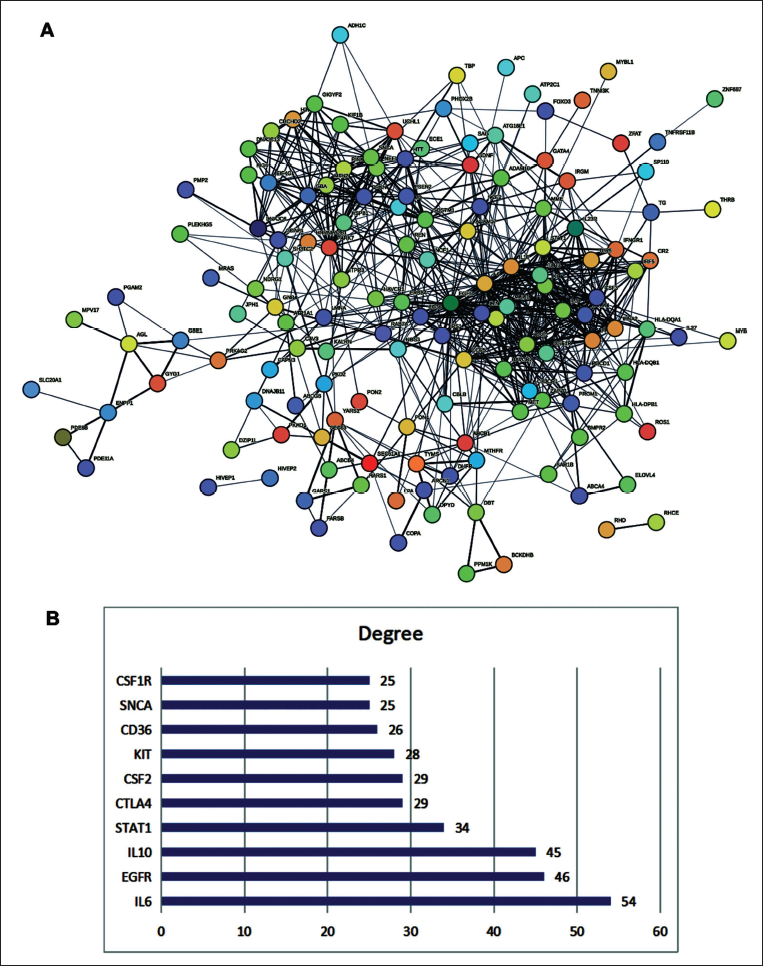
First of all, disease targets were predicted and identified, followed by constructing a PPI network and conducting network topology analysis, resulting in the identification of the top 10 core targets based on their D value ranking (Figure 1). These top 10 core targets were then inputted into the SymMap database, retrieving the corresponding relevant Chinese medicines. Furthermore, these Chinese medicines were systematically sorted and screened, identifying those most strongly correlated with the top 10 core targets. Finally, the Chinese medicines were arranged in an ascending order based on p value, presenting the following list: Ardisiae Japonicae Herba, Artemisiae Argyi Folium, Anisi Stellati Fructus, Scutellariae Barbatae Herba, Dysosma versipellis (Hance) M. Cheng, Lablab Semen Album, Ginkgo Semen, Herba Hedyotis Diffusae, Dryopteridis Crassirhizomatis Rhizoma, Bupleuri Radix. The top five Chinese medicines were selected for further analysis.
Bovine Viral Diarrhea/Mucosal Disease (BVD-MD) Core Target Protein–Protein Interaction (PPI) Network.
Construction and Comparative Analysis of Potential Target Data of Core Chinese Medicine and BVD-MD
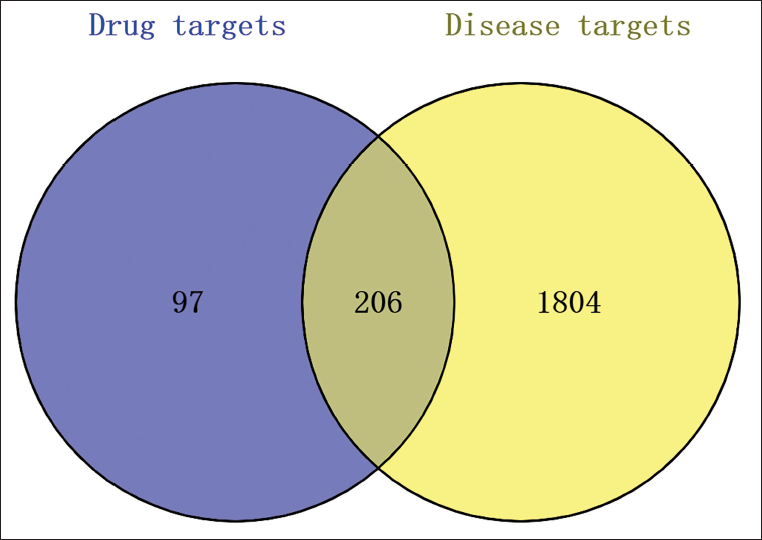
Ardisiae Japonicae Herba, Artemisiae Argyi Folium, Anisi Stellati Fructus, Scutellariae Barbatae Herba, and Lablab Semen Album were analyzed to identify the shared targets among these five Chinese medicines. The intersection between the drug targets and BVD-MD-related targets, analyzed via Venn diagram, showed 206 shared targets (Figure 2).
Quercetin Target and Bovine Viral Diarrhea/Mucosal Disease (BVD-MD) Related Pathogenesis Target Wayne Diagram.
Results of Network Analysis of Components, Targets, and Diseases
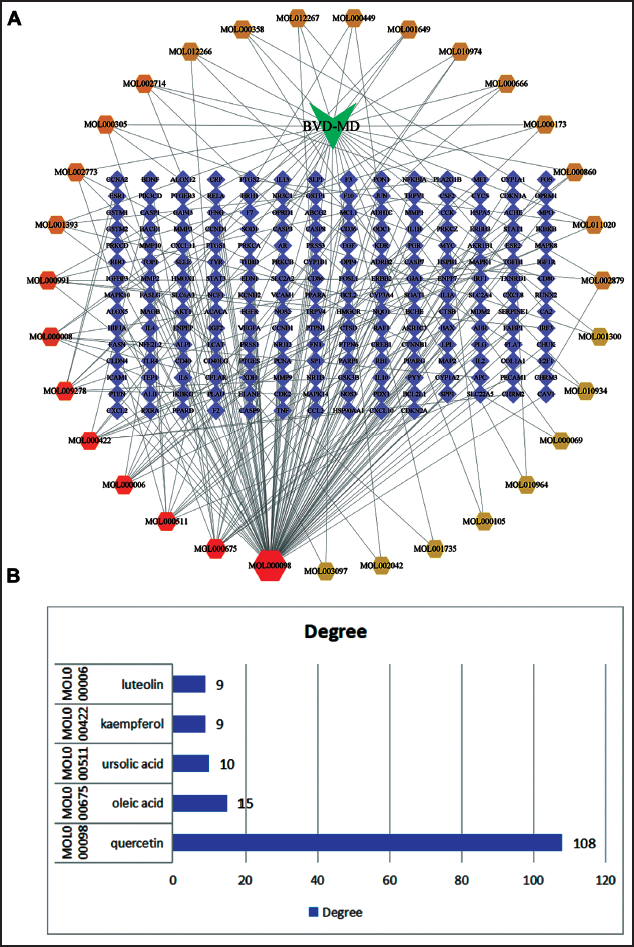
Network topology analysis was conducted to create the “component–target–disease” network map based on degree values. These results suggest that the pharmacological impact of Chinese medicine on BVD-MD involves multicomponent and multitarget interactions. Notably, quercetin emerged as a core component, associated with as many as 108 targets (Figure 3).
PPI Network Construction and Network Topology Analysis Results
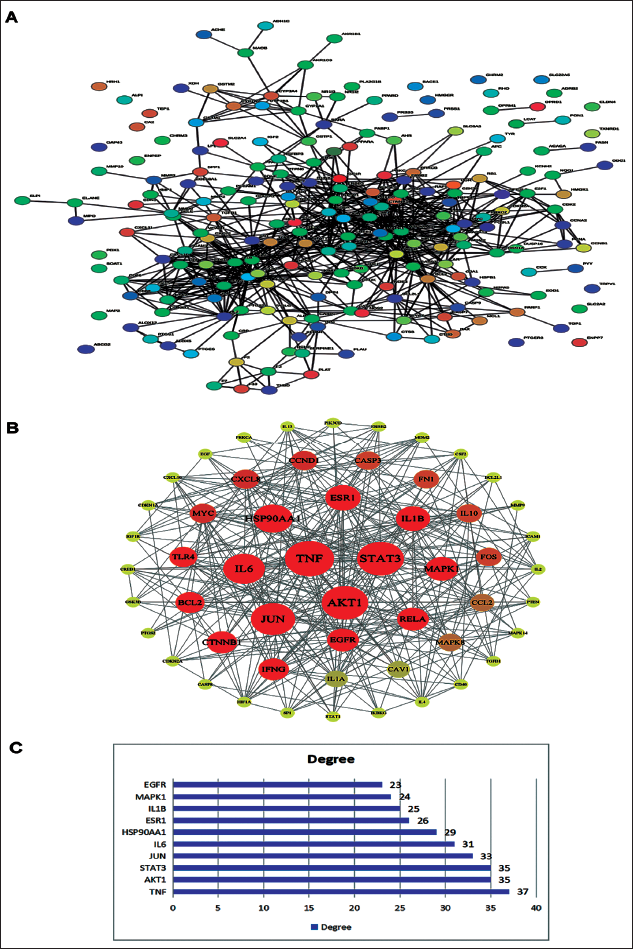
The topological parameters of the network were obtained using Cytoscape 3.9.0 software. Core targets were filtered based on degree values, resulting in the identification of key targets related to HSP90AA1, MAPK1, AKT1, EGFR, IL1B, ESR1, IL6, JUN, STAT3, and TNF (Figure 4).
Protein Interaction Network Topology Screening. The Size and Color of the Node are Related to the Value of the Degree. The Color and Size of the Nodes are Adjusted According to the Degree Value. The Darker the Color, the Larger the Node and the Greater the Representation Value.
GO and KEGG Pathway Enrichment Analyses
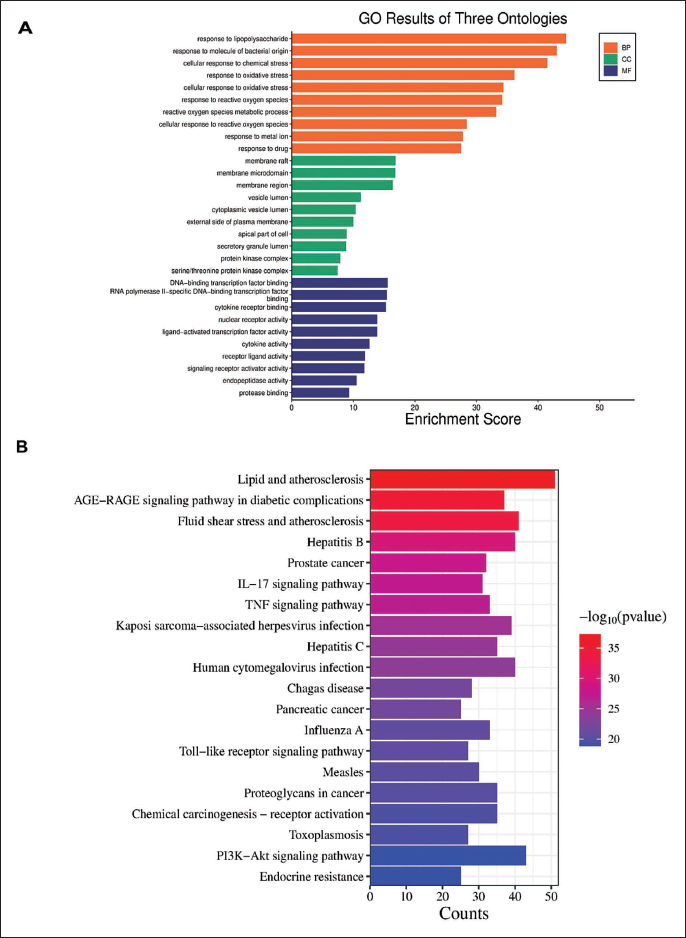
To comprehend the functions of the chosen core targets and their involvement in signaling pathways, GO and KEGG functional enrichment analyses were conducted on BP using the bioinformatics software Bioconductor. The outcomes revealed 4,715 significant GO items (p < 0.05), comprising 4,567 BP. Significantly enriched BP included responses to lipopolysaccharides and molecules of bacterial origin, cellular responses to chemical and oxidative stresses, reactive oxygen species-related processes, as well as responses to metal ions and drugs. Additionally, 55 cell composition (CC) entries were identified. The CCs were membrane raft, membrane microdomain, membrane region, vesicle lumen, cytoplasmic vesicle lumen, external side of the plasma membrane, apical part of the cell, secretory granule lumen, protein kinase complex, serine/threonine protein kinase complex. MF analysis revealed 93 entries, highlighting functions such as DNA-binding transcription factor binding, RNA polymerase II-specific DNA-binding transcription factor binding, cytokine receptor binding, nuclear receptor activity, ligand-activated transcription factor activity, cytokine activity, receptor–ligand activity, signaling receptor activator activity, endopeptidase activity, and protease binding (Figure 5A). Additionally, the KEGG pathway enrichment and screening revealed 273 significant signaling pathways (p < 0.05), prominently encompassing the TNF signaling pathway, toll-like receptor signaling pathway, and PI3K-Akt signaling pathway (Figure 5B).
Gene Ontology (GO) (A) and Kyoto Encyclopedia of Genes and Genomes (KEGG) (B) Pathway Enrichment Analysis.
Molecular Docking Result
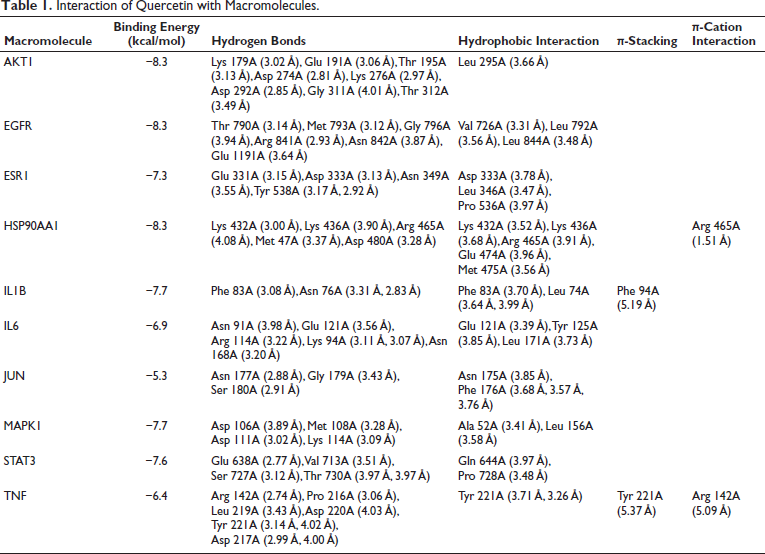
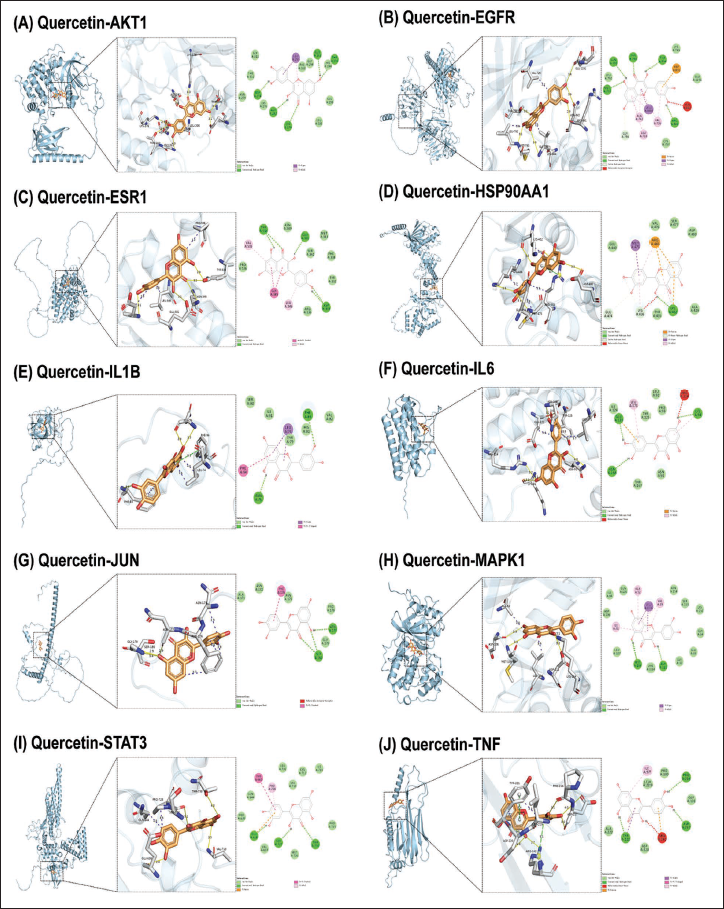
The interaction between core target and core component (quercetin) was studied by molecular docking. It is generally believed that the more stable the conformation of the ligand and receptor, the lower the energy will be, indicating the greater the possibility of interaction. The docking results in Table 1 provide details on binding energy, interaction forces, and bond lengths for molecular docking. Quercetin exhibited the lowest binding energy with AKT1, EGFR, and HSP90AA1, measured at −8.3 kcal/mol, as illustrated in Figure 6.
Interaction of Quercetin with Macromolecules.
Verification of Docking Between Small Molecules and Key Targets. (A) Quercetin-AKT; (B) Quercetin-EGFR; (C) Quercetin-ESR1; (D) Quercetin-HSP90AA1; (E) Quercetin-IL1B; (F) Quercetin-IL6; (G) Quercetin-JUN; (H) Quercetin-MAPK1; (I) Quercetin-STAT3; (J) Quercetin-TNF. The Receptor was Chosen as the Target Protein, with Quercetin Selected as the Ligand. Hydrogen Bonds, Hydrophobic Interactions, and Π-Cation/Stacking Interactions are Depicted in Yellow, Blue, and Green, Respectively.
Molecular Dynamics Simulation Results
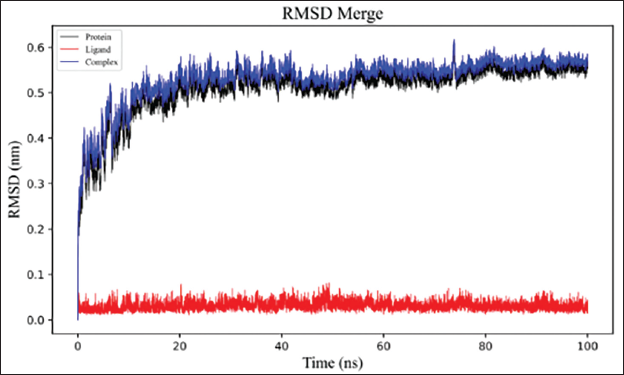
Based on the analysis of molecular docking and KEGG results, the small molecule quercetin bound to the protein receptor AKT1 was chosen for MD simulation lasting 100 ns. The RMSD curve was utilized to monitor the dynamic structural changes of the complex over time, enabling precise assessment of its stability. Figure 7 illustrates that the curve stabilizes between 20 and 100 ns, signifying the consistent stability of the small molecule–protein receptor complex during this period. The RMSD fluctuation range of the system’s complex curve stabilized at approximately 0.52 nm. This indicates minimal structural changes within the complexes and strong intermolecular interactions, ensuring their stability. This result provides valuable reference information for subsequent biochemical studies and drug design. It helps us to gain a deeper understanding of the interaction mechanisms between these molecules and how these interactions can be utilized to design more potent and stable biological drugs. The experimental data for RMSF, Rg, and HBs are provided in the supplementary information.
Root Mean Square Deviation (RMSD) Curves of Small Molecule–Protein Receptor Docking Complexes.
In Vitro Antiviral Results of Core Chinese Medicines
Results of Quercetin Cytotoxicity Assay on BT
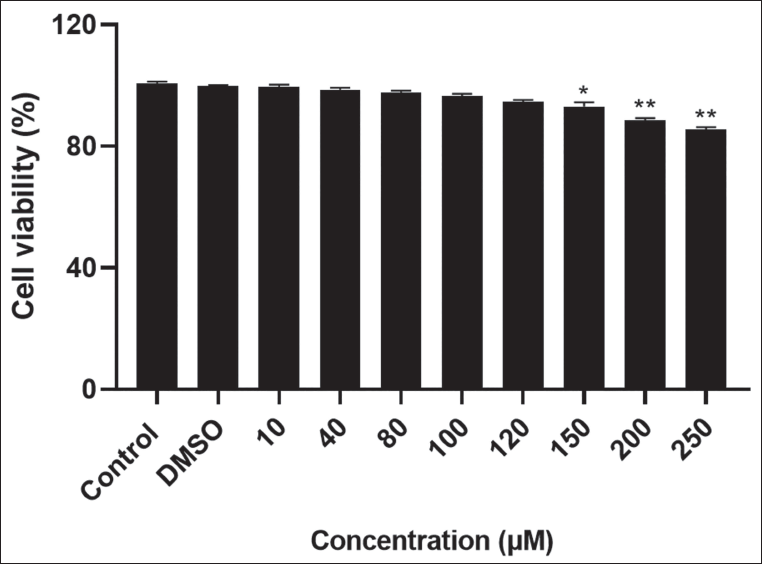
Quercetin has no major effect on cell survival, and these concentrations of 10, 40, 80, 100, and 120 µmol/L were safe for BT cells. Therefore, 100 µmol/L of quercetin were selected for subsequent experiments (Figure 8).
Cytotoxicity Results of Chinese Medicines on BT Cells. Control: Normal Cells. *** p < 0.001, ** p < 0.01, * p < 0.05, n = 3. Data were Presented as Mean ± Standard Deviation (SD).
Effect of Quercetin on the Replication of BVDV Virus
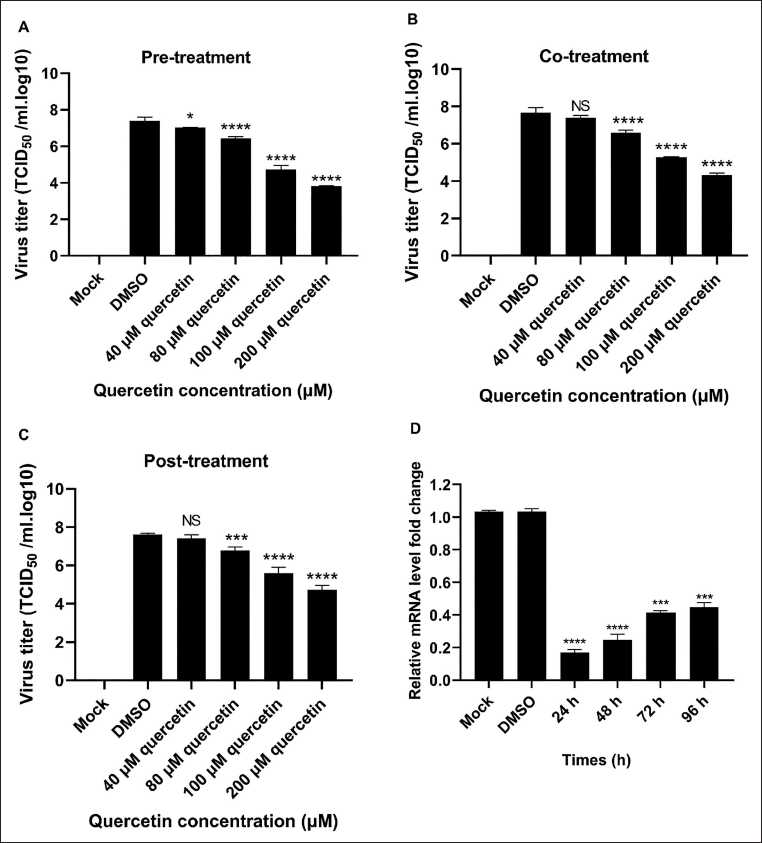
There results show that the viruses were best suppressed by adding quercetin first and then infecting the viral group (p < 0.05) (Figure 9A). The virus showed a dose-dependent decrease with increasing quercetin concentration. 100 µmol/L of quercetin were selected for subsequent experiments (Figure 9A–C). Then, the effect of quercetin on BVDV virus replication in BT cells at different times was investigated. The results showed that 24 and 48 h were the most effective in suppressing the number of viral RNA copies (p < 0.05) (Figure 9D).
Results of Chinese Medicines on Bovine Viral Diarrhea Virus (BVDV) Replication. (A) Pretreatment, (B) Cotreatment, (C) Posttreatment, (D) Effect of Quercetin on BVDV Inhibition at Different Times of Action. NS: The Difference was Not Significant. **** p < 0.001, *** p < 0.01, n = 3. Data were Presented as Mean ± Standard Deviation (SD).
Effects of Quercetin on Core Targets Induced by BVDV
The effect of quercetin on AKT1, a major target of BVDV induction, was further investigated based on molecular docking, molecular dynamics, and KEGG results (Table S1). It was found that quercetin inhibited the expression of AKT1 (p < 0.05) (Figure S1).
Discussion
Globally, BVD-MD is a widely distributed infectious disease that affects herd health and reproduction in many countries around the world, causing huge economic losses (Fray et al., 2000; Pinior et al., 2017; Richter et al., 2017). Despite vaccines being crucial for controlling various bovine viral pathogens, an effective BVD-MD vaccine is currently unavailable (Fulton et al., 2003; Newcomer et al., 2013; Newman et al., 2022). Therefore, the development of antiviral drugs has become a research hotspot, such as using virus-targeted or host-targeted approaches (Baginski et al., 2000; Branza-Nichita et al., 2001; Bukhtiyarova et al., 2001; Durantel et al., 2001; King et al., 2002; Markland et al., 2000; Sun et al., 2003; Tabarrini et al., 2006; Zitzmann et al., 1999). TCM presents a promising approach for clinical prevention and treatment due to its minimal toxic side effects, abundant medicinal sources, cost-effectiveness, immune regulatory properties, antiviral activity, symptomatic relief, and distinctive advantages in managing viral infectious diseases (Hussain et al., 2017; Martin & Ernst, 2003; Ninfali et al., 2020; Perera & Efferth, 2012). Additionally, targeting specific proteins of BVDV and employing treatments like the Chinese medicine monomer Daidzein exhibited a better antiviral efficacy without adverse effects on the host, thus providing a basis for the development of Chinese medicinal formulations against BVDV (Chen et al., 2023). However, the reports of Chinese medicines against BVDV are very limited. Therefore, in this study, we analyzed the targets of action and metabolic pathways of TCM for BVD-MD using network pharmacology and molecular docking techniques to determine the molecule–target–pathway mechanism of action of TCM for BVD-MD. In addition, in vitro studies on the anti-BVDV activity of Chinese medicines were conducted to identify Chinese medicines with significant anti-BVDV viral effects.
In this study, we first screened the top 10 herbs with the highest correlation with BVD-MD targets from the TCM library, comprising Ardisiae Japonicae Herba, Artemisiae Argyi Folium, Anisi Stellati Fructus, Scutellariae Barbatae Herba, D. versipellis (Hance) M. Cheng, Lablab Semen Album, Ginkgo Semen, Herba Hedyotis Diffusae, Dryopteridis Crassirhizomatis Rhizoma, Bupleuri Radix. Subsequently, Ardisiae Japonicae Herba, Artemisiae Argyi Folium, Anisi Stellati Fructus, Scutellariae Barbatae Herba, and Lablab Semen Album—five selected Chinese medicines—were analyzed for their core component targets associated with BVD-MD. Among them, quercetin emerged as a core component targeting up to 108 entities. Interestingly, Ardisiae Japonicae Herba, Artemisiae Argyi Folium, and Anisi Stellati Fructus all contain the main core ingredient, quercetin. Previous studies have highlighted the anti-BVDV effects of quercetin, and the present study once again demonstrates its importance as a core component for anti-BVDV properties (Chen et al., 2022). For a deeper exploration of the mechanism underlying the action of these five Chinese medicines against BVDV, this study utilized network pharmacological analysis, identifying 206 targets associated with BVD-MD in these medicines. The major core targets included EGFR, HSP90AA1, MAPK1, AKT1, and TNF. To further determine the interaction between the core targets and the core component quercetin, molecular docking analysis was performed, with AKT1 exhibiting better binding energy. The stability of the complex was further evaluated using molecular dynamics simulations, revealing quercetin and AKT1 to exhibit superior complex stability, indicating their potential as potent inhibitors. Notably, heat shock protein HSP90 (HSP) was also observed in the evaluation. The chaperone Hsp90 is virtually necessary for viral protein homeostasis and is a key host factor required for multiple phases of the viral life cycle, including viral entry, nuclear import, transcription, and replication (Geller et al., 2012; Li & Srivastava, 2004; Manzoor et al., 2014; Morimoto et al., 1992; Schlesinger, 1990; Silver & Noble, 2012; Wang et al., 2017). Therefore, HSP90 has important research value in targeting anti-BVDV.
The GO analysis results revealed that the five types of TCM primarily participate in the body’s BP to treat BVD-MD. Furthermore, the KEGG analysis indicated that these medicines influence BVD-MD through pathways such as PI3K-Akt, TNF, and toll-like receptor signaling pathways. MAPK are a major cell signaling pathway with several major branching routes: extracellular signal-regulated kinases (ERK MAPK), the c-jun N-terminal kinase or stress-activated protein kinases (JNK or SAPK), p38/MAPK, and ERK5. It is well known that a variety of viruses can activate the MAPK signaling pathway (Kumar et al., 2018; Luong et al., 2017). Research indicates that certain TCM preparations exhibit antiviral effects via the MAPK pathway (Dai et al., 2018; Wang et al., 2018). Notably, the phosphatidylinositol 3-kinase (PI3K)-Akt and mammalian target of rapamycin (mTOR) pathways stand as critical intracellular signaling cascades, influencing various facets of cellular functions (Tewari et al., 2022). Studies have confirmed that PD-1-mediated PI3K/Akt/mTOR and ERK pathways are involved in the in vitro regulation of apoptosis and proliferation of CD4 and CD8 T cells during BVDV infection (Liu et al., 2020). This study found that HSP90 and AKT are also important targets for treating BVD-MD. This may have something to do with the fact that the main core ingredient of the five Chinese medicines is quercetin. Therefore, quercetin has a certain development value in the treatment of BVD-MD. However, at present, the mechanism of quercetin anti-BVDV is still on the surface, and it is suggested that further research can be carried out in the future.
TNF, which is mainly generated by activated mononuclear/macrophage cells, serves as an important inflammatory factor, and participates in the pathological damage of some autoimmune diseases. Studies have found that after BVDV infection, exogenous factor TNF-α enhances apoptosis of BVDV-infected cells with cellular degeneration (Yamane et al., 2005). In addition, the researchers confirmed the critical role of toll-like receptors (TLRS) in the innate immune system (Zheng et al., 2020). Studies have speculated that BVDV may evade the immune response by altering the expression of TLR3 and 7 and their signaling pathways (Lee et al., 2008; Weng et al., 2015). In summary, the diversity of pathways targeted by TCM against BVDV showcases its selectivity, offering valuable insights for further elucidating the mechanisms involved in BVDV. To further prove the above-analyzed results, we conducted an in vitro TCM anti-BVDV study. Quercetin, the core component, was found to have no effect on BT cells and to have a significant inhibitory effect on BVDV. The inhibitory effect of quercetin on BVDV is mainly in the initial phase. To clarify the effect of quercetin on the main target of action induced by BVDV, further validation was carried out. The results revealed that quercetin inhibited the expression of AKT1. Therefore, TCM anti-BVDV demonstrates not only direct antiviral effects but also anti-inflammatory, immunomodulatory, and oxidative stress amelioration properties via essential pathways and core targets. This establishes a basis for targeted Chinese medicinal formulations against BVD-MD and offers reference data for future antiviral Chinese medicinal preparations within the Flaviviridae family.
Conclusion
The results of the study initially revealed the therapeutic potential of TCM for BVD-MD, and laid a good foundation for further research on its potential mechanism of action, providing new ideas for the treatment of BVD-MD. In addition, there are some shortcomings in this article. While employing networked computer technology for drug candidate screening offers advantages like shortened development time, increased success rates, and reduced research and development costs, the data may lack completeness and accuracy, necessitating validation through in vivo animal and clinical trials to confirm target and pathway predictions.
Abbreviations
BDV: Border disease virus; BP: Biological process; BVD-MD: Bovine viral diarrhea/mucosal disease; BVDV: Bovine viral diarrhea virus; CC: Cellular component; CSFV: Classical swine fever virus; DL: Drug-likeness; GO: Gene ontology; HBs: Hydrogen bonds; HCV: Hepatitis C virus; HSP: Heat shock protein; JNK: c-jun N-terminal kinase; KEGG: Kyoto encyclopedia of genes and genomes; MAPK: Mitogen-activated protein kinases; MF: Molecular function; OB: Oral availability; OMIM: Online mendelian inheritance in man; PI: Persistent infection; PI3K: Phosphatidylinositol 3-kinase; PPI: Protein–protein interaction network; Rg: Radius of gyration; RMSD, Root mean square deviation; RMSF: Root mean square fluctuation; SAPK: Stress-activated protein kinases; SymMap: Symptom mapping; TCM: Traditional Chinese medicine; TCMSP: Traditional Chinese medicine systems pharmacology; TLRS: Toll-like receptors; TNF: Tumor necrosis factor; UniProt: Universal protein.
Footnotes
Acknowledgments
The authors are sincerely thankful for the technical support provided by Institute of Livestock and Poultry Disease Diagnosis and Treatment, Branch of Animal Husbandry and Veterinary of Heilongjiang Academy of Agricultural Sciences, Animal Husbandry and Veterinary Technology Research, Development and Service Center.
Declaration of Conflicting Interest
The authors declared no potential conflicts of interest with respect to the research, authorship, and/or publication of this article.
Ethical Approval and Informed Consent
Not applicable.
Funding
The authors disclosed receipt of the following financial support for the research, authorship, and/or publication of this article: This work was supported by the comprehensive prevention and control technology of bovine herd disease and its popularization and application (ZNKT-2022-ZD03) and diagnosis and integrated prevention and control of major respiratory diseases in cattle (ZNKT-202213).
Supplementary Material

References
Supplementary Material
Please find the following supplemental material available below.
For Open Access articles published under a Creative Commons License, all supplemental material carries the same license as the article it is associated with.
For non-Open Access articles published, all supplemental material carries a non-exclusive license, and permission requests for re-use of supplemental material or any part of supplemental material shall be sent directly to the copyright owner as specified in the copyright notice associated with the article.
