




Abstract
Background
Rhubarb is a common cold-property drug that is commonly used as an effective laxative. It was first recorded in Shen Nong’s Herbal Classic.
Purpose
The LC-MS/MS metabolomics technology was used in this study to investigate the possible mechanism by which Rhubarb, a common cold property in Traditional Chinese Medicine, acts on healthy rats during different administration cycles. Discussing the effect of bitter-cold Traditional Chinese Medicine on the intestinal tract, not only guides clinical medicine better but also provides a new way to evaluate the efficacy of bitter-cold Chinese medicine objectively.
Materials and Methods
Six groups of rats (n = 6) were randomly divided into the following: the control group was fed a basal diet and given pure water; the Rhubarb group was fed a basal diet and was gavaged with Rhubarb (7.5 g/kg per day). The principal component analysis and the orthogonal partial least squares–discriminant analysis method was used to analyse the endogenous differential metabolites, the metabolite differences between rhubarb and the control group were screened, and the metabolic pathways were analysed by MetaboAnalyst.
Results
Compared with the blank control group, 20, 17, and 8 metabolites were identified in the feces of the Rhubarb group on the 7th, 14th, and 21st days, respectively, which involved linoleic acid metabolism, purine metabolism, tryptophan metabolism, and arachidonic acid metabolism.
Conclusion
Rhubarb’s pharmacological effects on gastrointestinal regulation, and antibacterial, and anti-inflammatory properties are closely related to its bitter and cold properties and may be generated through porphyrin, purine, tryptophan, and arachidonic acid metabolism pathways.
Introduction
Rhubarb (Da Huang) is a common Chinese medicinal material that is derived from the root and rhizome of the Polygonaceae plant Rheum palmatum L., Rheum tanguticum Maxim. ex Regel, or Rheum offcinale Baill (Commission, 2020). Rhubarb has a bitter flavor and cold properties. Studies have shown that it has pharmacological effects in many aspects, such as antitumor, controlling gastrointestinal flora, protecting the intestinal mucosal barrier, and anti-inflammatory (Xiang et al., 2020).
The components of Traditional Chinese Medicine (TCM) have complex and diverse characteristics, and the manifestation of the medicinal properties of TCM is the result of the comprehensive action of multicomponent, multifactor, and multitarget and is not related to a certain type of substance or component alone. Modern pharmacological studies of TCM have proved that the most essential attribute of the four properties of TCM is the regulation of the body’s material and energy metabolism. Research has found that typical Chinese herbs with cold properties (Scutellariae baicalensis Georgi, Coptis chinensis Franch.) can inhibit the body’s energy metabolism. Heat properties (Radix dried ginger, Aconitum carmichaelii Debx.) can promote the body’s energy metabolism (Tao et al., 2022). Research on the four properties should be guided by the basic theory of TCM. The systematic and holistic nature of metabolomics is in line with the holistic, dynamic, and dialectical view of the theory (Yan et al., 2016).
In the typical cold properties medicine (Rhubarb) research, fecal metabolites are used as the co-metabolites of the host and intestinal flora and the carrier of the action of Rhubarb. The changes in fecal metabolites have a certain guiding role in the study of the mechanism of action of Rhubarb. In this study, the effects of TCM with cold attributes on the physiology of normal animals were preliminarily observed from the point of view of body metabolism. Using LC-MS/MS technology to analyse endogenous metabolites in the feces, to find potential biomarkers in the fecal, and to explore the metabolic effects of Rhubarb on healthy mice from the perspective of metabolomics effects of different administration cycles on metabolism in healthy rats. It effectively guides the selection and formulation of rhubarb in clinical practice, provides a theoretical basis for the diagnosis and treatment of Chinese medicine, and is of great significance to the application and development of Chinese medicine.
Materials and Methods
Drugs and Reagents
The Rheum palmatum L. was morphologically identified as the dried stem and root of Rhubarb Rheum tanguticum Maxim. ex Regel. Rhubarb decoction was routinely prepared; 100 g of Rhubarb was soaked in 1 L of sterile deionized water, decocted twice (30 min each time), the decoction was collected, and a Millex-Gp filter was filtered and sterilized, then stored at 4°C for later use.
Animal
Specific pathogen free standard deviation (SPF SD) rats, weighing 200 ± 20 g, were purchased. Adaptive feeding on 5 days, indoor light for 12 h, 12 h to avoid light cycle feeding, given standard feeds and drinking water, and control the indoor temperature is (25 ± 1)°C, relative humidity is (50 ± 10)%, during this period of free drinking water and food.
Grouping and Administration
Thirty-six rats were divided into six groups according to the random number table method (n = 6) as follows: Control group—fed with a basal diet and gavage pure water; Rhubarb group—fed with a basal diet and gavage Rhubarb (7.5 g/kg per day). Each group of six rats fasted overnight, and feces were collected under anesthesia for 7, 14, and 21 days of sacrifice. The feces were collected, weighed, and frozen in a −80°C refrigerator immediately for further analysis.
Metabolite Extraction
A volume of 450 µL of methanol-chloroform solutions (v: v, 3:1), 10 µL internal standard (L-2-chlorophenylalanine) was added to 50 mg fecal. After 30 s of vortex mixing, add ceramic beads and grind (4 min, 45 Hz). An ultrasonic extraction was performed at a low temperature for 5 min (4°C). The mixture was centrifuged (12,000 rpm, 15 min), and a supernatant of 300 µL was collected. The supernatant was transferred to a clean EP tube, and the solvent was blown away by nitrogen, with a dry sample obtained. For the subsequent analysis, samples were stored at 80°C.
UPLC-MS Conditions
Agilent ZORBAX Eclipse Plus C18 (2.1 × 100 mm, 3.5 µm) was used for chromatographic separation. The mobile phase was composed of mobile phase A: H2O (0.1% formic acid) and mobile phase B: acetonitrile (0.1% formic acid). A flow velocity of 0.5 mL/min was used. Gradient elution parameters were set as follows: 0–1 min, 2% B; 1.0–13 min, 2% B; 13–16 min, 90% B; 16.0–16.1 min, 90% B; 16.1–20 min, 2% B. Triple TOF 5600+ (AB Sciex), an electrospray ionization source, and eluted small molecules were collected from the column in positive ion mode using high-resolution mass spectrometry. The detection parameters were set as 120°C source temperature, 500°C desolvation, 600 L/h desolvation nitrogen, and 50 L/h cone gas flow. The positive ion mode capillary ionization voltage was 3.0 kV, the sampling cone voltage was 27 eV, the extraction cone voltage was 4 eV, and the quadrupole scanning range was 50–1,500 m/z.
Data Processing and Statistical Analysis
After obtaining UPLC/Q-TOF-MS, the data is obtained through noise filtering, mass spectral peak extraction, deconvolution processing, normalization processing, and data format conversion. Data was imported into MetaboAnalyst 5.0 for multidimensional statistical analysis. The principal component analysis (PCA) score chart is used to visually represent the differences between groups, and the chemical markers with significant changes in the VIP value of orthogonal partial least squares–discriminant analysis (OPLS-DA) are screened. Kyoto Encyclopedia of Genes and Genomes enrichment analysis identified significantly enriched metabolic pathways.
Results
Total Ion Chromatogram
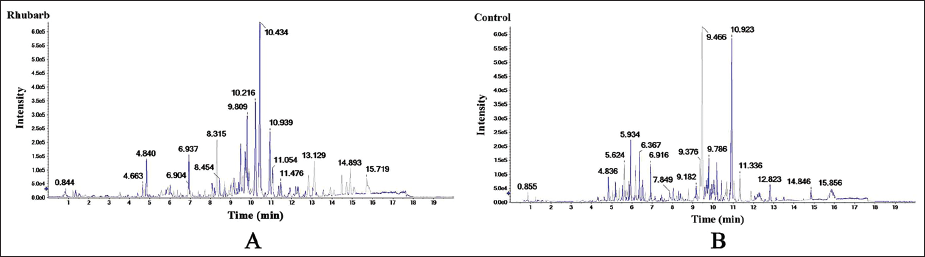
After sampling fecal samples from different groups, the UPLC/Q-TOF-MS method was used to separate and detect fecal samples and obtain the total positive ion flow (TIC) diagram. In the preliminary analysis of the metabolic profiles of each group, it can be found that the composition or peak ratio of the metabolic profiles of fecal samples in different groups changed, indicating that Rhubarb intervention caused changes in the metabolic network of the body, and the quality or quantity of its metabolites also changed accordingly. The TIC of each group under the positive ion mode is shown in Figure 1. The transverse axis is the retention time, and the longitudinal axis is the relative peak strength. It can be found that the metabolic profile of fecal samples in the control and rhubarb groups is significantly different, and the chromatogram has differences in the number, proportion, or intensity of peaks, indicating that the administration of the cold Chinese medicine Rhubarb causes changes in the metabolic network, and the quality or quantity of its metabolites also changes correspondingly.
Multivariate Statistical Analysis
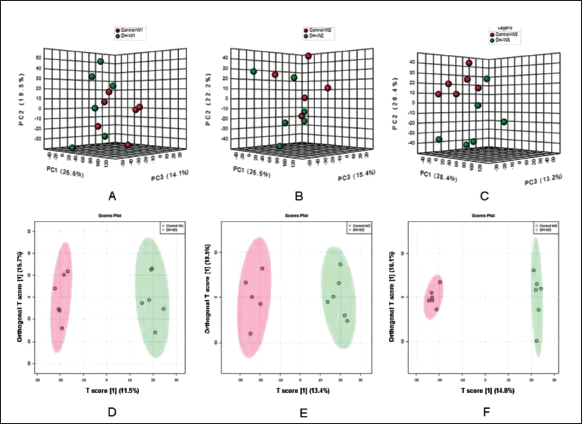
Unsupervised PCA was used to analyse the LC-MS/MS metabolism of all rat fecal samples, and the results are shown in Figure 2A–C. Observe the group clustering and intergroup distribution of each group of data; there are no outlier samples. To further show the difference between the blank group and the Rhubarb group and facilitate the subsequent screening of differential metabolites, an OPLS-DA model was established between the blank group and the Rhubarb group. Figure 2D–F) depicts the metabolic analysis results of the Rhubarb group and the blank control group after 7, 14, and 21 days using the OPLS-DA model, with red points representing the blank group and green points representing the Rhubarb group, respectively. It was found that the Rhubarb group and the blank control group had a certain tendency to aggregate into groups, and the samples of the two groups could be well separated, indicating that the metabolites in rats changed significantly under the intervention of Rhubarb. The classification model was evaluated and verified by a permutation test, and on the 7th day, Q2 = 0.584 and R2 = 0.986. On day 14, Q2 = 0.754, R2 = 0.977; on day 21, Q2 = 0.68, R2 = 0.997. R2 and Q2 are greater than or equal to 0.5, indicating an effective model.
The volcanic chart combines the results of multiple changes (FC) analysis and the t-test into a chart so that users can intuitively select important features according to biological significance, statistical significance, or both. The difference variables between the two samples were screened for the visualization of symbolic differences. The differential metabolite screening method was based on FC ≥ 1.8 combined with p ≤ 0.05 and VIP > 1.5.
Identification of Biomarkers
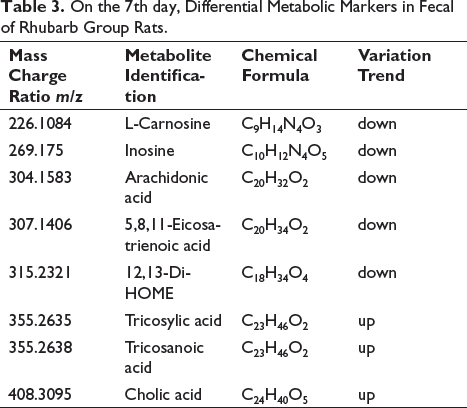
In human metabolome database (HMDB), Massbank, and other commonly used biological databases, the accurate molecular weight was retrieved. In the first week, compared with the blank control group and the Rhubarb group, 20 potential biomarkers were finally identified. There were 6 up-regulated and 14 down-regulated in the Rhubarb group. In the second week, 17 potential biomarkers were finally identified in the blank control group and Rhubarb group, with 10 up-regulated and 7 down-regulated; eight potential biomarkers were finally identified in the blank control group and Rhubarb group in the third week, with three up-regulated and five down-regulated, as shown in Tables 1–3.
On the 7th Day, Differential Metabolic Markers in the Fecal of Rhubarb Group Rats.
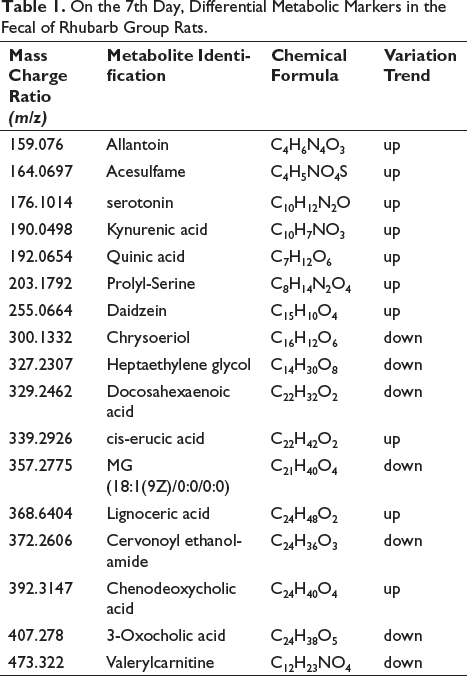
On the 7th Day, Differential Metabolic Markers in the Fecal of Rhubarb Group Rats.
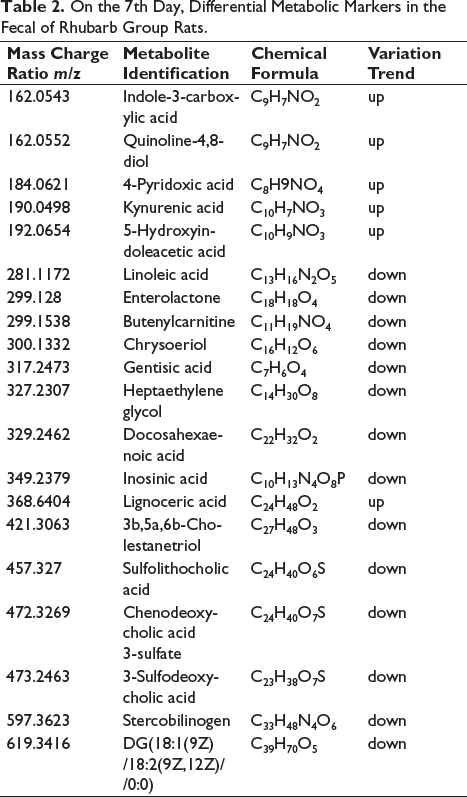
On the 7th day, Differential Metabolic Markers in Fecal of Rhubarb Group Rats.
Analysis of Metabolic Pathways
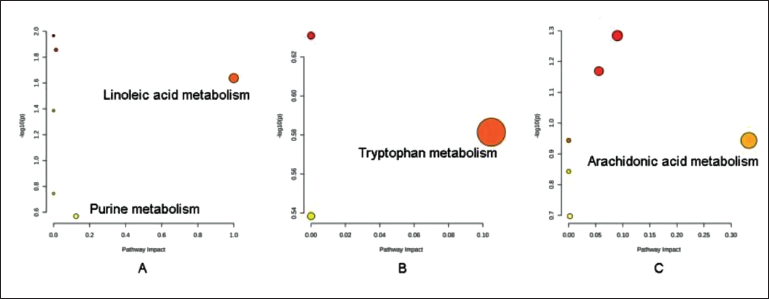
The differential metabolites screened by the above analysis methods were subjected to high-throughput metabolic pathway analysis. The results are shown in Figure 3. Metabolic pathways with impact values greater than 0.10 indicate that this pathway may be closely associated with potential target pathways. The results showed that on the seventh day, two metabolic pathways were significantly related to the metabolism of the Rhubarb group, including porphyrin metabolism and purine metabolism. On day 14, tryptophan metabolism was significantly associated with Rhubarb metabolism, and on day 21, arachidonic acid metabolism was significantly associated with Rhubarb metabolism.
Discussion
Purine metabolism encompasses the biochemical processes by which adenine and guanine are ultimately converted into uric acid through various purine metabolic enzymes within the human body. The intestinal epithelial cells play a crucial role in mediating purine metabolism within the intestines. Uric acid, a significant metabolite in purine metabolism, is derived from inosinic acid (IMP), which possesses both anti-inflammatory and proinflammatory properties. Recent studies have shown that giving IMP raises uric acid levels in a way that depends on the dose. This could change how purines are broken down in the intestines (Wada et al., 2022). To alter purine metabolism in the intestinal tract, it is hypothesized that this phenomenon may be attributed to the intricate metabolites generated by anthraquinone constituents found in Rhubarb, such as aloe emodin, chrysophanol, emodin, and Rhein, after their metabolism by intestinal bacteria. Recent research endeavors have primarily concentrated on elucidating the underlying mechanisms responsible for Rhubarb’s anti-inflammatory properties. Wu et al. (2020) found that emodin can significantly alleviate the chronic colitis caused by dextran sodium sulfate. This may be related to the reduction of uric acid levels caused by Rhein treatment, which regulates the intestinal microbiota and changes purine metabolism in the intestine to alleviate colitis. Different natural foods could cause cold or hot syndrome in mice, resulting in changes in the gastrointestinal bacterial community structure (Liang et al., 2020). Bitter cold Chinese medicine has a better effect on the syndrome of damp heat in the stomach and intestine, conforming to the theory of “treating heat syndrome with cold methods.” In this experiment, shown in Figure 4, compared with the blank group, IMP in the Rhubarb group decreased, suggesting that Rhubarb plays an anti-inflammatory role by regulating intestinal purine metabolism.
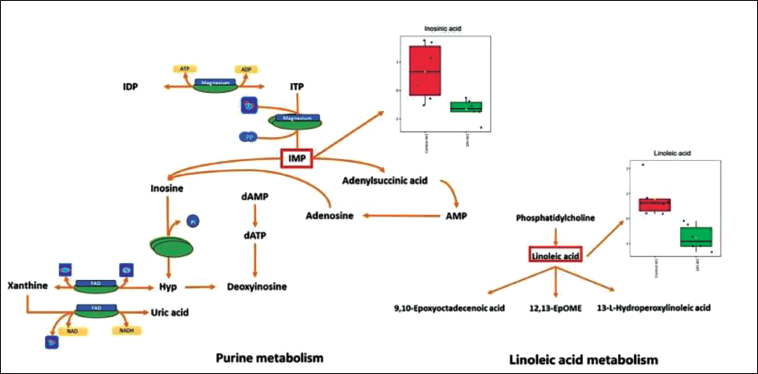
Linoleic acid is closely related to intestinal function, and intestinal flora can promote linoleic acid absorption, dehydroxylation and desaturation of bile acids, and the conversion of cholesterol to steroids. Linoleic acid is not only the main organic acid component in rhubarb but also a key metabolite of linoleic acid metabolism. Rhubarb can intervene in constipation through the metabolism of linoleic acid (Zhang, 2017). Rhubarb relief for constipation is closely associated with changes in intestinal flora (Gao et al., 2021; Yang et al., 2022). Chen (2018) intervention in mice with dysbiosis of intestinal flora using extracts of the Chinese medicine rhubarb showed an increase in the number of beneficial bacteria and a relative decrease in the abundance of harmful bacteria, which improved dysbiosis and attenuated intestinal inflammation, in response to the fact that rhubarb can pass through the intestinal flora. Studies have shown that treatment with rhubarb root extract for more than a week seems to be safe and can be recommended for patients with chronic constipation (Neyrinck et al., 2022). Linoleic acid is a synthetic precursor of arachidonic acid, and it has been shown to exert anti-inflammatory effects by down-regulating certain metabolites in the linoleic acid pathway, such as phosphatidylcholine (Wu et al., 2022). On day seven, the rhubarb group significantly down-regulated linoleic acid levels compared with the blank group, and it was hypothesized that rhubarb could affect linoleic acid metabolism and thus interfere with intestinal function.
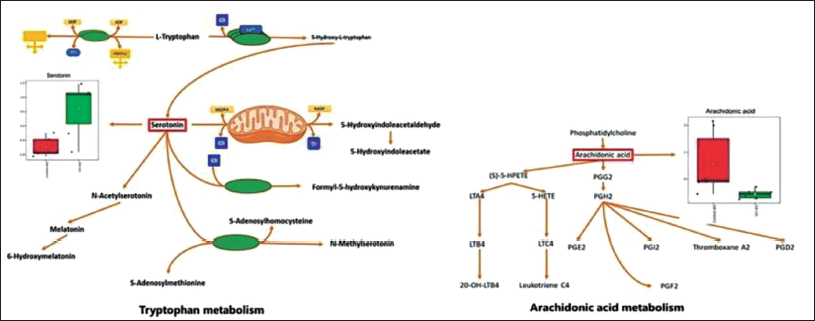
Tryptophan and its metabolites maintain intestinal homeostasis and microbial diversity. There are many physiologically essential substances made from tryptophan, including 5-HT, melatonin, and canine uridine. Serotonin (5-HT) is also a microbial metabolite found in mammalian feces and urine. In mammals, serotonin plays the role of monoamine neurotransmitters, biochemical messengers, and regulators. It is synthesized by the essential amino acid L-tryptophan. In our body, almost all 5-HT is synthesized in special intestinal endocrine cells called intestinal pheochromocytoma in the mucosa of the gastrointestinal tract, which are scattered throughout the inner lining of the gastrointestinal tract, the epithelial layer. Peripherally, serotonin, either directly or through neurons, affects the muscle movement of the intestine, bronchus, uterus, and blood vessels (Guzel and Mirowska-Guzel, 2022; Martin, Lumsden, et al., 2017). Studies have reported that serotonin may act as a medium to inhibit gastric emptying, stimulate gastric secretion with glucagon-like peptide 2, and participate in glucose metabolism with glucagon-like peptide 1 (Martin, Young, et al., 2017). As a neurotransmitter, serotonin can change the way intestines move and make them more sensitive in the brain-gut-microbe axis signaling pathway. This can cause irritable bowel syndrome. Abdominal pain and diarrhea are the main clinical symptoms of irritable bowel syndrome and intestinal flora imbalance is one of the causes of irritable bowel syndrome (Li et al., 2011; Wang et al., 2022). In the present study, cold property medicine is also accompanied by an increase in inhibitory neurotransmitters such as 5-hydroxytryptamine (Tao et al., 2022). Huang found that based on neurochemical analysis, glycine and 5-hydroxytryptamine were most associated with coolness (Huang et al., 2019). Recent discoveries have found that microbiota changes modulate the immune system by altering the metabolism of tryptophan (TRP). In mammals, TRP metabolism has been shown to exert anti-inflammatory effects, and TRP, along with its regulatory pathway, regulates inflammation. Preventing or alleviating intestinal inflammation with appropriate nutritional supplementation of TRP (Marsland, 2016; Gao et al., 2018). On day 14, the serum of the Rhubarb group was significantly up-regulated compared with that of the blank group. The laxative effect of Rhubarb may be related to the changes in intestinal flora after administration and the cold of the drug itself.
Arachidonic acid has a wide range of physiological functions in the gastrointestinal tract and appears to be associated with certain disorders of gastrointestinal integrity and function (Isselbacher, 1987). Three enzymes metabolize arachidonic acid: cyclooxygenase, lipoxygenase (Lox), and cytochrome P450 (CYP450) (Wang et al., 2019). Arachidonic acid generates monohydroperoxide eicosaenoic acid under the action of 5-Lox and then generates leukotriene (LTA4). Under the action of an enzyme, this substance will become LTD4 and LTE4 after enzyme catalysis. These substances are important chemical substances that can cause some allergic reactions and inflammation. In addition, Yu (2010) found that Rhubarb down-regulated the expression of Ltc4s and Pla2g2d, which could affect the metabolism of arachidonic acid and may have a certain anti-inflammatory effect in the study of the influence of heat and cold TCM on the whole gene expression profile of rat liver. In TCM, Huanglian Jiedu Decoction is a representative prescription for clearing heat and detoxifying. It is composed of four kinds of Chinese herbs with cold properties, namely Huanglian, Scutellaria, Phellodendri, and Gardenia.
Recent studies have shown that Huanglian Jiedu Decoction treats acute ulcerative colitis in mice by inhibiting the arachidonic acid pathway (Yuan et al., 2020). Similar studies have shown that cold property medicines are useful in treating intestinal motor dysfunction in patients with systemic inflammatory response syndrome (Shimizu et al., 2018). In this study, as shown in Figure 5, after 21 days of Rhubarb administration, Rhubarb down-regulated arachidonic acid compared with the blank group, suggesting that the cold property medicine Rhubarb can exert an anti-inflammatory effect by inhibiting the metabolic pathway of arachidonic acid.
Conclusion
A special feature of herbal medicines is the theory of four properties and five flavors. Cold, hot, warm, and cool are the four properties of herbal medicine, and sour, bitter, sweet, pungent, and salty are the five flavors. The cold and hot properties of Chinese medicine have been an effective guide to the clinical practice of TCM. There are a few general studies on literature theory, composition, property, mechanism of action, and target of cold property medicines. In this study, studying Rhubarb through endogenous metabolites may provide new ideas for modern drug development and further reference for clinical practice. The study was based on LC-MS/MS technology and a multivariate statistical analysis method to analyse the metabolic effects of different Rhubarb administrations on healthy rats. After drug administration, the feces of rats were collected for metabonomics analysis on days 7, 14, and 21, respectively. There were four target pathways involved, namely, linoleic acid metabolism, purine metabolism, tryptophan metabolism, and arachidonic acid metabolism pathways. The results of this study suggest that different dosing cycles of Rhubarb have different effects on metabolism in healthy rats. The pharmacological effects of Rhubarb on gastrointestinal regulation, antibacterial, and anti-inflammatory properties are closely related to its bitter and cold properties and may be generated through porphyrin metabolism, purine metabolism, tryptophan metabolism, and arachidonic acid metabolism pathways. In this study, four targeted pathways were analysed through endogenous differential metabolites. The next study will predict relevant potential targets by constructing a metabolomics network module, and discuss and select relevant metabolic pathway targets for subsequent verification.
Abbreviations
Authors’ Contributions
Rui Chen and Hongmei Su contributed equally and should be considered co-first authors. They carried out laboratory work including interpretation of experimental data and manuscript writing.
Jing Bai and Xueqing Duan contributed to the data and analysed the results.
For the subsequent editing and verification of the manuscript data, Guo Feng and Weiyi Tian provided the idea and project plans.
Footnotes
Declaration of Conflicting Interest
The authors declared no potential conflicts of interest concerning the research, authorship, and/or publication of this article.
Ethical Approval
All animal studies were performed as per the procedures of the Ethics Review Committee for Animal Experimentation of Guizhou University of Traditional Chinese Medicine (Approval No: 20210086).
Funding
This work was supported by the National Natural Sciences Foundation of China (No. 81360589), and the Fund project of the Science and Technology Department of Guizhou Province (No. Guizhou science and platform talents [2020] 5010).
