




Abstract
Background
Osteoporosis (OP) and type 2 diabetes (T2D) are commonly encountered metabolic disorders in clinical practice, but the comorbidity mechanism has not been clarified. This study explored the underlying mechanisms for utilizing bioinformatics methods. Furthermore, it predicted traditional Chinese medicines (TCMs) with preventive and therapeutic effects.
Materials and Methods
GSE35958 and GSE43950 were retrieved and downloaded from the GEO database, and differential expression analysis was performed to identify differentially expressed genes (DEGs) with similar expression patterns in OP and T2D. Then, the common DEGs were uploaded to the STRING database to construct a protein interaction network. Enrichment analysis of the screened genes was conducted using R language packages. Relevant TCMs were searched and screened based on gene targets using the Encyclopedia of traditional Chinese medicine (ETCM) database. Molecular docking of active ingredients of the TCMs and related gene targets was performed using AutoDock Vina software.
Results
By analyzing the gene expression microarrays, GSE35958 and GSE43950, 34 genes with the same expression pattern shared by OP and T2D were identified. Among these genes, 32 were upregulated and two were downregulated. Protein interaction network analysis revealed that tumor necrosis factor, vascular endothelial growth factor A, and CD44 might play key roles in the co-pathogenesis of T2D and OP. TCMs, including Wolfberry (枸杞), Ginseng (人参), and Yam (山药), were screened based on key genes. Molecular docking results demonstrated binding activity between all active ingredients and the related gene targets.
Conclusion
This study explored the potential molecular co-pathogenesis of OP and T2D through bioinformatic analysis and preliminarily predicted traditional herbal medicines that may have preventive and therapeutic effects.
Introduction
Osteoporosis (OP) and type 2 diabetes (T2D) are commonly encountered metabolic disorders in clinical practice. While many literatures and guidelines have primarily focused on discussing T2D and OP as independent diseases, emerging research suggests a significant connection between the two conditions (Paschou et al., 2017). A recent study indicated that 37.8% of Chinese diabetic patients suffered from OP (Si et al., 2020). T2D increases the risk of fragility fractures among patients, leading some studies to consider increased bone fragility as one of the chronic complications of diabetes (Li et al., 2019; Losada-Grande et al., 2017). Several factors, including hyperglycemia, oxidative stress, alterations in relevant cytokines and hormone levels, and the use of antidiabetic medications, have been implicated in the development of OP in individuals with T2D (Ali et al., 2022; Mo et al., 2022). However, the precise molecular mechanisms underlying this association remain unclear. Consistent with current research findings, Traditional Chinese Medicine (TCM) also acknowledges the interconnected etiology and pathophysiology of these two diseases. Guided by the principle of treating different diseases with the same therapeutic approach, there is an overlap in the medications used to manage both T2D and OP in TCM (He et al., 2021). Additionally, recent studies have reported the efficacy of combined TCM treatment for T2D-related OP (Yang et al., 2022).
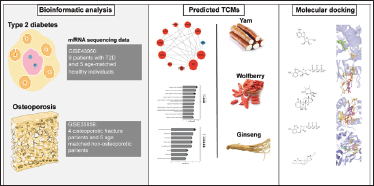
To further elucidate the interplay between these two conditions at a molecular level, this study aims to explore and integrate genetic data related to T2D and OP through bioinformatics analysis. Building upon the identified common differentially expressed genes (DEGs) in both diseases, we intend to utilize these genes as targets for screening potentially therapeutic Chinese herbal medicines, providing a theoretical foundation for subsequent clinical applications and experimental investigations. The research flowchart of this study is shown in Figure 1.
A Flow Chat of this Study.
Materials and Methods
Acquisition of DEGs
Expression microarray datasets GSE35958 and GSE43950 were downloaded from the publicly available GEO database (
Selection of Key Targets and PPI Network Construction
The intersected DEGs from both OP and T2D were obtained, and using expression patterns as a screening criterion, the common DEGs with similar expression patterns for both diseases were identified as key targets. The protein–protein interaction (PPI) network was analyzed using the String database (
Enrichment Analysis
The “clusterProfiler” and “Pathview” packages in R were used to perform the Kyoto Encyclopedia of Genes and Genomes (KEGG) and Gene Ontology (GO) enrichment analysis on the key targets. A significance threshold of p < 0.01 was applied, and the results were sorted in ascending order based on the p-values. The “ggplot2” package was used to visualize the results.
Screening of TCMs
The Encyclopedia of traditional Chinese medicine (ETCM) database (
Molecular Docking
The three-dimensional (3D) structure files of the key targets were searched and downloaded from the UniProt database (
Results
Identification of Key Targets and PPI Network Construction
Analysis of the GSE35958 and GSE43950 datasets yielded 2768 DEGs in OP and 281 DEGs in T2D, respectively (Figure 2A and B). The intersection of these gene sets was further filtered based on expression patterns, resulting in 34 common DEGs that were deemed key targets in both diseases. Among them, 32 genes showed upregulated expression, while DAZAP1 and EIF5B exhibited downregulated expression (Figure 2C and D).
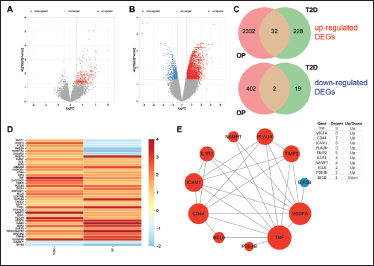
To explore the PPIs, the identified key targets were uploaded to the STRING database, and non-interacting genes were excluded from the analysis. A PPI network was constructed, revealing upregulated expression of PDE4B, NAMPT, VEGFA, IL1R1, PLAUR, ICAM1, TIMP2, CD44, TNF, and BCL6, while EIF5B showed downregulated expression. Further analysis using the CytoHubba plugin in Cytoscape software calculated the degree values and indicated that TNF, VEGFA, and CD44 exhibited the highest degree values, suggesting their crucial roles in the shared pathogenesis of T2D and OP (Figure 2E).
Enrichment Analysis Results
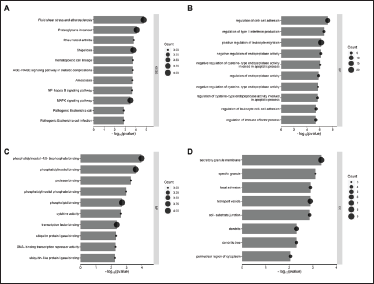
A bar chart was generated to illustrate the top 10 significantly enriched pathways from the KEGG analysis. These pathways included fluid shear stress and atherosclerosis, rheumatoid arthritis, AGE-RAGE signaling pathway in diabetic complications, NF-kappa B signaling pathway, and MAPK signaling pathway, and so on (Figure 3A). Furthermore, GO enrichment analysis was performed to identify the enriched biological processes (BP), molecular functions (MF), and cellular components (CC) of the key genes. The top 10 enriched categories based on their p-values were visualized using a bar plot. The results showed that the GO BP associated with the key genes primarily involved the regulation of cell–cell adhesion, interferon-gamma production, regulation of interferon-gamma production, regulation of leukocyte cell–cell adhesion, and leukocyte adhesion (Figure 3B). In terms of GO MF, the key genes were mainly associated with platelet-derived growth factor receptor binding, protease binding, oxidoreductase activity, and cytokine activity (Figure 3C). Additionally, the key genes were found to be involved in GO CC such as endoplasmic reticulum exit site, secretory granule membrane, specific granule, focal adhesion, and extracellular matrix (Figure 3D).
Screening of TCMs
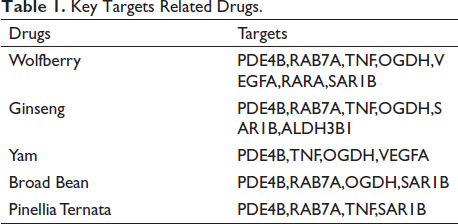
The ETCM database was searched for TCMs related to the key genes. Table 1 shows the TCMs that are associated with three or more target genes. We selected the top three herbs, namely, Wolfberry, Ginseng, and Yam for further analysis. Wolfberry and Chinese Yam are known for their nourishing and tonifying effects on the kidney yin. They are commonly used in the formulation of YouGui pill for the treatment of OP and T2DM (Wang et al., 2023). Ginseng is known for its ability to tonify the primordial qi, invigorate the spleen, nourish the lungs, and generate body fluids. It is often used as a component of Buzhong Yiqi Tang for the treatment of certain diseases (Hua et al., 2023). These medicinal herbs are associated with the most key disease targets. The key targets associated with Wolfberry include PDE4B, RAB7A, TNF, OGDH, VEGFA, RARA, and SAR1B. The key gene targets associated with Ginseng include PDE4B, RAB7A, TNF, OGDH, SAR1B, and ALDH3B1. The key gene targets associated with Chinese yam include PDE4B, TNF, OGDH, and VEGFA.
Key Targets Related Drugs.
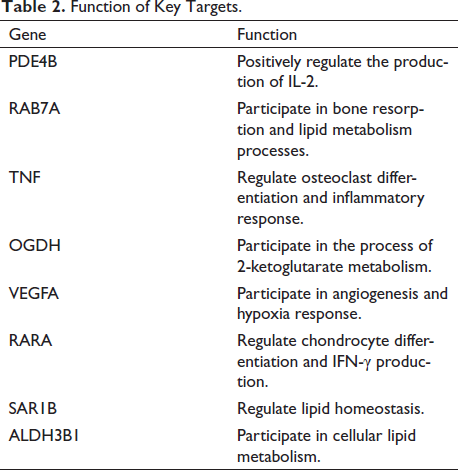
In total, this study identified eight key disease-related genes associated with these three medicinal herbs: PDE4B, RAB7A, TNF, OGDH, VEGFA, RARA, SAR1B, and ALDH3B1. Table 2 presents the protein functional annotation information of these 8 genes, obtained from the Uniprot database. They are primarily involved in processes such as bone metabolism, immune response, lipid metabolism, and oxidative stress.
Function of Key Targets.
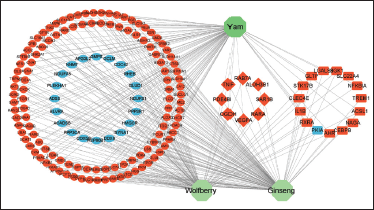
Network of TCM – Disease Target
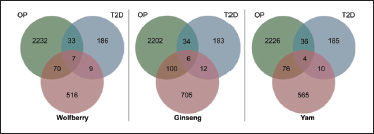
The gene targets associated with Wolfberry, Ginseng, and Yam from the ETCM database were obtained, and the interactions between them and DEGs for both OP and T2D were obtained. In addition to the key gene targets, Wolfberry was found to be associated with 70 DEGs related to OP and nine DEGs related to T2D; Ginseng was found to be associated with 100 DEGs related to OP and 12 DEGs related toT2D; Chinese Yam was found to be associated with 76 DEGs related to OP and 10 DEGs related to T2D (Figures 4 and 5).
Molecular Docking
To further validate the molecular mechanisms of Wolfberry, Ginseng, and Chinese Yam in the treatment of OP and T2D, we searched for the active ingredients related to the key target genes in the three drugs from the ETCM database. We used a drug-like index (DL) >0.18 as a criterion for screening and then downloaded the 3D structures of the active ingredients from the PubChem database as ligands. We downloaded the 3D structures of the key target genes from the UniProt database as receptors. AutoDock Vina software was used for molecular docking to preliminarily verify the binding activity between the ingredients and the core target.
The study indicates that the lower the binding energy between the small-molecule ligand and the protein receptor, the better the affinity and stability between them. A binding energy less than −4.25 kcal·mol−1 indicates a certain binding activity; less than −5.0 kcal·mol−1 indicates good binding activity; less than −7.0 kcal·mol−1 indicates strong binding activity (Table 3).
A List of the Selected Compounds and Their Targets.
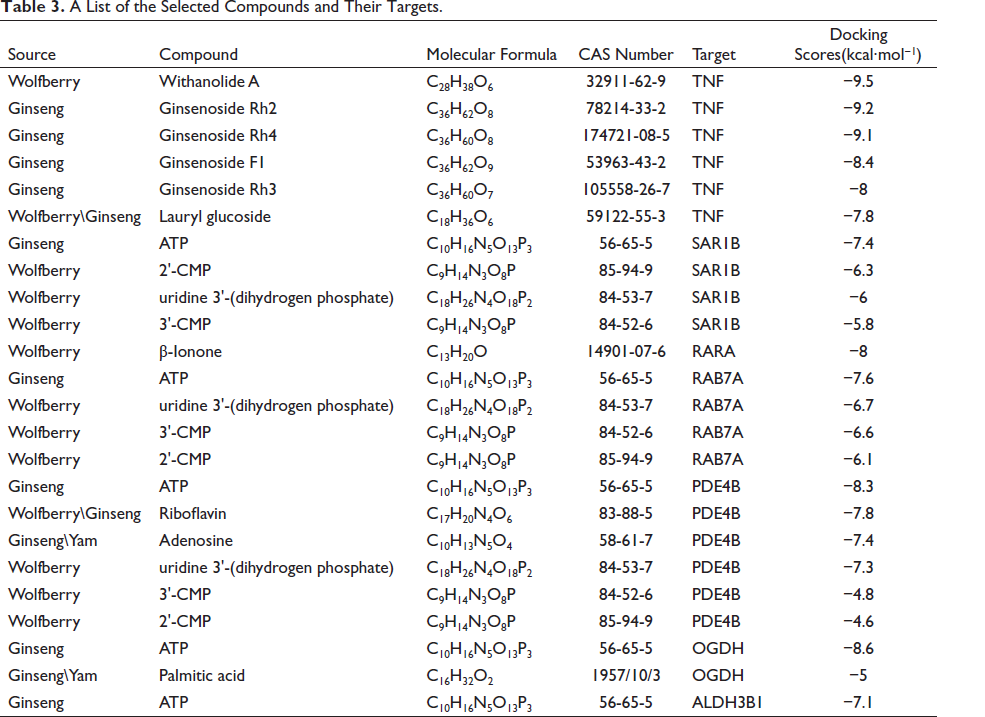
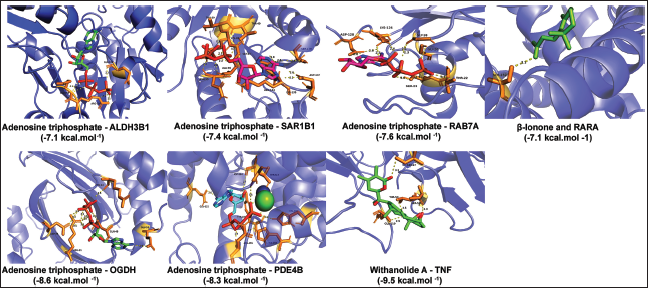
The results show that the lowest binding energies between the 16 active ingredients and their corresponding protein receptors are all less than −4.25 kcal·mol−1. Among them, the active ingredients with the lowest binding energies to the protein receptors are: Withanolide A with TNF (−9.5 kcal·mol−1), adenosine triphosphate (ATP) with SAR1B (−7.4 kcal·mol−1), β-ionone with RARA (−8.0 kcal·mol−1), ATP with RAB7A (−7.6 kcal·mol−1), ATP with PDE4B (−8.3 kcal·mol−1), ATP with OGDH (−8.6 kcal·mol−1), and ATP with ALDH3B1 (−7.1 kcal·mol−1) (Figure 6).
Molecular Models of Bioactive Ingredients and Positive Drug Binding to Gene Targets. This Figure Represents the Minimum Binding Energy Results of Molecular Docking of SAR1B, ALDH3B1, RAB7A, OGDH, PDE4B, TNF, and RARA.
Discussion
T2D and OP, two prevalent conditions among the elderly, have garnered significant attention due to their intertwined nature (Cavati et al., 2023). While extensive research has shed light on the connection between T2D and OP, the precise molecular mechanisms behind this association remain somewhat elusive, presenting considerable challenges in terms of prevention, diagnosis, and treatment strategies for individuals affected by both ailments (Liu et al., 2023). In this study, through the construction of a PPI network based on shared DEGs in both T2D and OP, pivotal positions within the network were identified for TNF, VEGFA, and CD44. TNF possesses the capability to elicit diverse intracellular signaling pathways, encompassing cell survival, apoptosis, inflammation, and immune response (Horiuchi et al., 2010). Notably, elevated levels of TNF-α in serum have been observed among individuals with T2D (Aly et al., 2020). Remarkably, TNF-α heightens insulin resistance by repressing the expression of GLUT4, a glucose transporter (Olson, 2012), and instigating serine phosphorylation of IRS-1, an insulin receptor substrate (Lu et al., 2020). Additionally, TNF-α has been shown to activate the NF-κB and PI3K/Akt signaling pathways, synergistically promoting the RANKL-induced formation of osteoclasts (Zha et al., 2018). VEGFA, a pivotal growth factor implicated in angiogenesis, exerts proproliferative and anti-apoptotic effects on endothelial cells (Guzmán et al., 2023). Intriguingly, research conducted by Brissova et al. (2014) demonstrates that exposure to doxycycline triggers VEGFA production in mouse islets, consequently reducing the number of β-cells as VEGFA levels surge. Furthermore, in vitro experiments have unveiled the involvement of VEGF in augmenting the bone resorption activity of mature osteoclasts (Nakagawa et al., 2000). CD44, a crucial component serving as a receptor for hyaluronic acid, manifests its biological significance through mediating cell aggregation, angiogenesis, endothelial cell proliferation, immune cell migration, and activation (Ponta et al., 2003). Interestingly, Ponta’s investigation reveals that CD44 knockout mice subjected to a high-fat diet do not exhibit the diminished uptake of glucose in muscle tissues observed in their wild-type counterparts (Hasib et al., 2019). Likewise, in vitro studies highlight the inhibitory impact of CD44 deficiency on osteoclast activity and functionality via the NF-κB/NFATc1 pathway (Li et al., 2015). Consequently, the upregulation of TNF, VEGFA, and CD44 emerges as a significant player in the shared pathogenesis of T2D and OP, furnishing novel targets and directions for prevention and therapeutic intervention.
Through GO enrichment analysis of 34 key genes, it was found that they were mainly involved in immune response and oxidative stress. The KEGG analysis results mainly implicated fluid shear stress and signaling pathways such as AGE-RAGE in atherosclerosis, diabetic complications, and the NF-kappa B pathway. Studies have shown a close relationship between the immune system, diabetes, and OP (Bossi et al., 2015; Srivastava et al., 2018). Oxidative stress plays an important role in the development of diabetes, its complications, and potentially induces OP. Research has shown that diabetes can lead to the generation of reactive oxygen species (ROS) and inhibition of antioxidant defense systems through various pathways such as glucose oxidation, advanced glycation end products (AGEs), and hexosamine pathways (Roumeliotis et al., 2021). ROS, in turn, can mediate bone loss through the regulation of signaling pathways such as Wnt/β-catenin, NF-κB/TNF/IL-6 (Iyer et al., 2013). An et al. have shown that the activation of ROS/MAPKs/NFκB/NLRP3 is one of the main causes of OP in diabetic patients (An et al., 2019). Previous studies have indicated that the immune system and oxidative stress play important roles in the common pathogenesis of these two diseases. However, the molecular mechanisms involved are complex, and further research is needed for clarification. Atherosclerosis is commonly regarded as a complication of diabetes, as abnormal lipid metabolism, hyperglycemic state, and AGEs among other factors, can promote its development (Poznyak et al., 2020). Furthermore, the concept of the “bone–vascular axis” has been proposed, suggesting a bidirectional flow of cells, endocrine signals, and metabolism between the vascular and skeletal systems. Metabolic abnormalities such as diabetes and hyperlipidemia may disrupt the balance of the bone–vascular axis, leading to the occurrence of both skeletal and vascular diseases (De Maré et al., 2019).
Molecular docking results showed that 15 active compounds exhibited binding activities with the related target proteins. Among them, withanolide A (from Wolfberry), ATP (from Ginseng), and β-ionone (from Wolfberry) exhibited the lowest binding affinities with seven related target proteins. Khedgikar’s study found that withanolide A induced osteoblast differentiation by inhibiting Smurf2 expression and RunX2 protein degradation through the proteasomal mechanism (Khedgikar et al., 2013). Withanolide A also has anti-inflammatory and anti-diabetic effects (Tripathi et al., 2018). ATP is an important signaling molecule for maintaining the dynamic balance of the bone matrix (Dong et al., 2020). However, research has shown impaired insulin-stimulated ATP synthesis in the skeletal muscle of T2D patients (Petersen et al., 2005), so its role in diabetic OP needs further studies. Although some studies have investigated the roles of certain active compounds in the treatment of these two diseases, their underlying molecular mechanisms remain unclear. The findings of this study may provide clues for further research into the molecular mechanisms of these three herbs and their active compounds in the treatment of T2D and OP.
Conclusion
In conclusion, bioinformatics analysis was employed to explore the potential common mechanisms between T2D and OP. Additionally, we have identified several TCMs, including Ginseng, Wolfberry, and Yam, as potential candidates based on the obtained key targets. Molecular docking results have demonstrated strong binding affinities between active components within these medications and key targets. However, this study lacks further in vitro and in vivo experiments for validation. Subsequent cell or animal experiments can be conducted to verify the collective therapeutic effects of these active components on both T2D and OP.
Summary
Explored the potential comorbidity mechanism between T2D and OP.
TCMs including Ginseng, Wolfberry, and Yam were identified as potential candidates for diabetic OP.
Abbreviations
DEGs: Differentially expressed genes; OP: Osteoporosis; T2D: Type 2 diabetes; TCM: Traditional Chinese medicine; PPI: Protein-protein interaction; DL: Drug-likeness; KEGG: Kyoto encyclopedia of genes and genomes; BP: Biological processes; MF: Molecular functions; CC: Cellular components; AGEs: Advanced glycation end products; ROS: Reactive oxygen species.
Footnotes
Acknowledgements
The authors would like to thank all the supporting staff in the Department of Pharmacy of Chengdu University of Traditional Chinese Medicine, and the Pharmaceutical Department of The First Affiliated Hospital of Chongqing Medical University for their technical assistance in this research project.
Author’s Contributions
Huawen Yang and Fanwei Luo worked on the investigation, methodology, writing (original draft), resources, and software. Zhongyu Xiong reviewed and edited the manuscript. The author(s) read and approved the final manuscript
Declaration of Conflicting Interests
The authors declared no potential conflicts of interest concerning the research, authorship, and/or publication of this article.
Funding
The author received no financial support for the research, authorship and/or publication of this article.
Statement of Ethical approval and Informed Consent
Not applicable.
