




Abstract
Background
Finding new effective substances to develop drugs against cancer or to prevent it remains a big challenge facing scientists and clinicians.
Objectives
In such an issue, we tested the anti-tumoral effect of Scorzonera undulata extracts on MCF7 cells.
Materials and Methods
Methanolic extracts of S. undulata roots (RSU) and aerial parts (ASU) from the Ha’il region were analyzed by HPLC. Their DPPH scavenging, ferric-reducing antioxidant power (FRAP) and total antioxidant potentials were evaluated. The MTT test was used to determine their cytotoxic effects on MCF7 cells using different concentrations, and their potential to induce apoptosis was determined by measuring the mitochondrial transmembrane loss of potential by flow cytometry using the JC-1 fluorescent marker.
Results
S. undulata was found to be rich in flavonoids, tannins, and polyphenols. ASU contains great amounts of apigenin and gallic acid, whereas RSU contains luteolin and chlorogenic acid as major components. The potential to scavenge DPPH and the total antioxidant activity of ASU were twofold greater than those of RSU. MCF7 cell viability was reduced by 50% at concentrations of 4.22 ± 0.06 and 5.89 ± 0.08 mg.mL−1, respectively, for ASU and RSU at 24 h. In addition, S. undulata extracts induced MCF7 cells’ death through cell lysis and apoptosis.
Conclusion
As an edible vegetable, S. undulata is worth further exploration in alternative and complementary medication as it possesses significant antioxidant and anti-cancer potentials.
Keywords
Introduction
Phytotherapy designates herb usage to cure and prevent diseases, a practice that dates back to ancient populations (Akacha et al., 2022; Leite et al., 2021; Zammel et al., 2022). Recently, there has been great concern both in alternative and complementary medicine to find and develop new, effective, and safe drugs. The medical herbarium is sought as a good healthcare system because of the potential of herbal products to achieve disease curing through acceptable bioavailability, pharmaceuticals, and pharmacokinetics (Jedli et al., 2022; Mzid et al., 2017; Watson & Preedy, 2010). It has been reported that more than 50% of recently prescribed drugs directly originate from medicinal plants (Akacha et al., 2022; Leisegang et al., 2022; Rahmouni et al., 2018). In addition to their medical value, phytotherapeutics are mostly low-cost and accessible for people, specifically in less developed regions. About 65% of the world’s population has recourse to phytotherapies (Saoudi et al., 2021; Shirwaikar et al., 2009; Zammel et al., 2022). Several scientific reports endorsed the knowledge of medicinal herbs and confirmed their beneficial effects (Akacha et al., 2022; Badraoui et al., 2020; Mzid et al., 2017).
Among diseases, cancer remains the most fearsome one (Badraoui et al., 2014; Siddiqui et al., 2022). Its treatment is still unachievable, either due to the low efficacy of treatment strategies, particularly in metastases, or the harsh outside effects of chemical drugs such as vinblastine, methotrexate, and taxol that constitute the first line to counteract the disease (Akacha et al., 2022; Badraoui et al., 2014). These were later identified in plants before their chemical synthesis as active derivatives of the natural innate products (Shehna et al., 2022). Among the anti-tumorigenic herbarium, some species from the Scorzonera genus (Asteraceae family) were assayed against several cancer cells. This genus includes 175 species, mostly edible, and is generally recognized as safe (GARS) (Meng et al., 2020; Milella et al., 2014). Scorzonera undulata deliciosa, a representative of this genus, is mainly intended as a food source. It grows naturally in Saudi Arabia, including in Ha’il, and several other parts of the world, such as North Africa and Europe. It was used as a depurative and to treat burns and snake bites (Abdelkader et al., 2010). S. undulata medicinal value encompasses several biological activities such as antimicrobial, antifungal, anti-cholesterolemia, anti-diabetic, antioxidative, etc. (Ajebli et al., 2020, 2021; Ayromlou et al., 2020). These biological activities are mainly due to its rich phytochemical composition: chlorogenic acid, lignans, quinic acid, caffeic acid, and stilbene (Küpeli Akkol et al., 2012; Çitoğlu et al., 2010). In this work, the major S. undulata phytochemicals have been determined in both root and aerial extracts. The bioavailability and pharmacokinetic attributes of the determined phytochemicals have been studied. Then the antioxidant and anticancer potentials were assessed using MCF7 cells and flow cytometry.
Materials and Methods
Plant Material and Extraction
S. undulata deliciosa specimens were collected in March 2020. Dried roots and aerial parts of the herb were finely ground and macerated in methanol (1w/20v) for 72 h. Thereafter, solvents were evaporated under low pressure in a rotary evaporator at 40°C. The final extracts were lyophilized and conserved at ambient temperature until further use.
Phytochemical Characterization of the Extract
Determination of Total Phenolic Content
Folin–Ciocalteu’s method (Badraoui et al., 2020; Dall’Acqua et al., 2020; Zammel et al., 2022) was used to measure the total phenolic content of S. undulata from Ha’il. First, 50 µL of the methanol-diluted sample or gallic acid was mixed with 400 µL of Folin–Ciocalteu’s phenol reagent (10%) at time zero. After 8 min of incubation at room temperature, 500 µL of 7.5% (w/v) Na2CO3 solution was added to the mixture. The absorbance of the resulting solution was determined at 725 nm after 60 min of incubation at room temperature. A blank sample composed of 50 µL of a 50% water–methanol solution was used and served as a negative control. The gallic acid’s absorbance concentration curve was drowned and served to determine the concentration of total phenols contained in samples [expressed as µg gallic acid equivalent (GAE)/mg of dry weight].
Total Flavonoids Content
Total flavonoid content was assessed as previously reported (Badraoui et al., 2020; Kim et al., 2003a,b). First, 500 µL of the appropriately diluted sample was added to 2 mL of distilled deionized water. Then, 150 µL of 5% sodium nitrite was added at time zero and mixed. After 6 min of incubation, 150 µL of a 10% aluminium chloride solution was added, and the solution was left to react for 6 min. Thereafter, 2 mL of 1 M sodium hydroxide was added to the mixture. After 15 min of incubation at room temperature, the absorbance of the final solution was read at 510 nm with a UV-visible spectrophotometer. Total flavonoids were measured from the catechin’s absorbance-concentration standard curve and expressed as µg catechin equivalents (CE)/mg of dry weight.
Determination of Condensed Tannins
The vanillin method, as described by Palacios et al. (2021) and Price et al. (1978), was used to quantify the condensed tannin content. Hence, 600 µL of vanillin (4% in methanol) was added to 50 µL of each sample. Then, 300 µL of HCl (8%) was added. After incubation for 2 min, the absorbance of the mixture was measured at 500 nm. A calibration curve was prepared with a solution of catechin. The results were obtained in µg of catechin equivalent per mg of dry weight (µg CE/mg DW).
HPLC Analyses of S. undulata Extracts
HPLC chromatographic analysis of phenolic compounds of S. undulata was carried out using AGILENT 1260 Infinity with a C18 column (3.5 µm; 4.6 × 250 mm) analytical column. The mobile phase was formed from 0.01% acetic acid (A) and acetonitrile (B). The gradient applied is as follows: 0 min, 10% B; 15 min, 50% B; 19 min, 100% B; 27 min, 100% B; 31 min, 10% B; 37 min, 10% B. Samples were injected at a volume of 5 µL with a fixed rate flow of 0.5 mL/min. The column furnace temperature was set at 40°C. The photodiode array was detected at a wavelength of 254, 280, and 330 nm.
Druggability, Bioavailability and Pharmacokinetics
Druggability and several pharmacokinetic properties of the S. undulata-identified compound were assessed based on their absorption, distribution, metabolism, excretion and toxicity (ADMET) attributes as previously reported (Badraoui et al., 2022; Hchicha et al., 2021; Palacios et al., 2021). The bioavailability, which depends mainly on the physico-chemical characteristics of molecular size (SIZE) and lipophilicity (LIPO) of the compounds, was also assessed (Badraoui et al., 2022; Hchicha et al., 2021).
Antioxidant Activity
DPPH Test
The DPPH assay was used to measure the radical scavenging activity of extracts using a previously reported method (Badraoui et al., 2020; Rahmouni et al., 2022). The plant extracts were prepared at a different dose (0.05−1 mg/mL) and mixed (1v/1v) with the methanolic solution of DPPH. After 20 min of incubation in the dark at room temperature, the absorbance of the solution was recorded at 515 nm. Ascorbic acid was used as a standard control and was prepared under the same conditions. The percent of DPPH radical scavenging activity was calculated using the formula given below:

A0: Absorbance of the control solution,
A1: Absorbance of plant extracts or standard solutions.
Ferric-reducing Antioxidant Power (FRAP)
The FRAP of samples was tested using the assay as previously described (Brahim et al., 2013). Briefly, 125 µL of roots and aerial part methanolic extract (1 mg/mL) were mixed with 625 µL of phosphate buffer (pH 6.6) and 625 µL of potassium ferricyanide. Later, the mixture was incubated at 50°C for 20 min, and then trichloroacetic acid (10%) was added. After centrifuging the mixture for 10 min at 3,000 rpm, the supernatant was mixed with distilled water and ferric chloride (0.1%). After 10 min of incubation, absorbance was read at 700 nm. Experiments were done in triplicate. Ascorbic acid was used as a reference.
Total Antioxidant Assay
The reducing power of extracts was determined by the phosphomolybdenum method (Senol et al., 2014). The methanolic extract of roots and aerial part (100 µL) were mixed in 1 mL of a reactional solution containing monopotassium phosphate (28 mM), sulfuric acid (0.6 M) and ammonium heptamolybdate (4 mM). After 90 min of incubation at 95°C, the solution was rapidly cooled, and its absorbance was assessed at 700 nm. Ascorbic acid was used as a standard, and the results were expressed as a percentage of inhibition.
MTT Assay
In vitro evaluation of anticancer activity by MTT assay was carried out using the MCF7 breast cancer cell line (Vergun et al., 2018). Cells were grown in 96-well plates using Roswell Park Memorial Institute (RPMI) medium containing 7% fetal bovine serum (FBS) at 37°C, 100% relative humidity, 5% CO2 and 95% air conditioning. The cells were dispersed by adding 1 mL of trypsin–EDTA solution to the culture medium. Roots or aerial part extracts were adequately diluted in DMSO in order to obtain concentrations ranging from 0.5 to 16 mg × mL−1. A concentration of 0 mg × mL−1 was used for comparison. Diluted extracts were then added to the culture medium. After 24 or 48 h of incubation, the free medium was replaced by MTT (1 mg × mL−1), and thereafter, DMSO was added at 37°C. The intensity of the developed purple color was then determined at 570 nm wavelength using a microplate spectrophotometer.
The relative viability was estimated as follows:

Flow Cytometry
Flow cytometry was carried out to evaluate an apoptosis marker, mitochondrial transmembrane potential loss, using the JC-1 kit (BD™ MitoScreen). MCF-7 cells were seeded at a density of 106 in a cell culture flask containing RPMI enriched with 5% FBS. After incubation for 24 h, cells were treated with the IC50% of MB and MP for 48 h. After incubation, cells were harvested following trypsin dissociation, washed twice with PBS, supplemented with 500 µL JC-1 dye solution, and then incubated at 37°C for 20 min in the dark. After incubation, cells were washed in PBS, centrifuged at 2,000 rpm for 10 min, and resuspended in 500 µL of incubation buffer. Fluorescence intensity, as mean channel fluorescence, was determined for 20,000 events in the FL1 channel of the Becton Dickinson FACS Canto II flow cytometer.
Statistics
Data are presented as mean ± standard deviation. Chi-square and Spearman’s correlations were carried out to compare results between groups or to evaluate curves’ regressions. SPSS for Windows 17 (IBM Corporation) was used for the statistical analysis, with a fixed confidence interval of 95%.
Results
Chemical Composition of the Extract
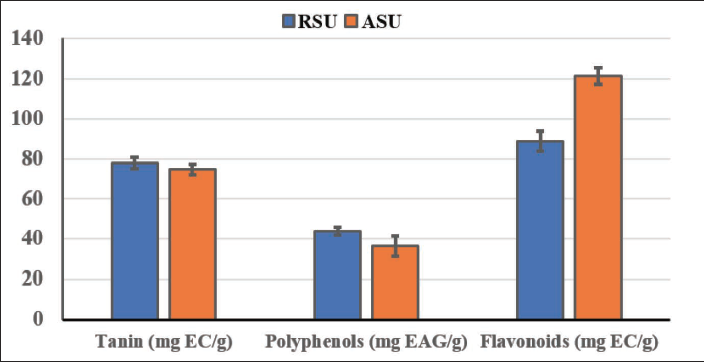
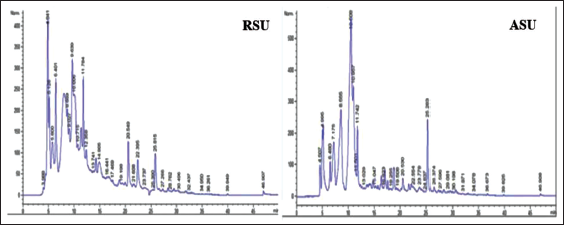
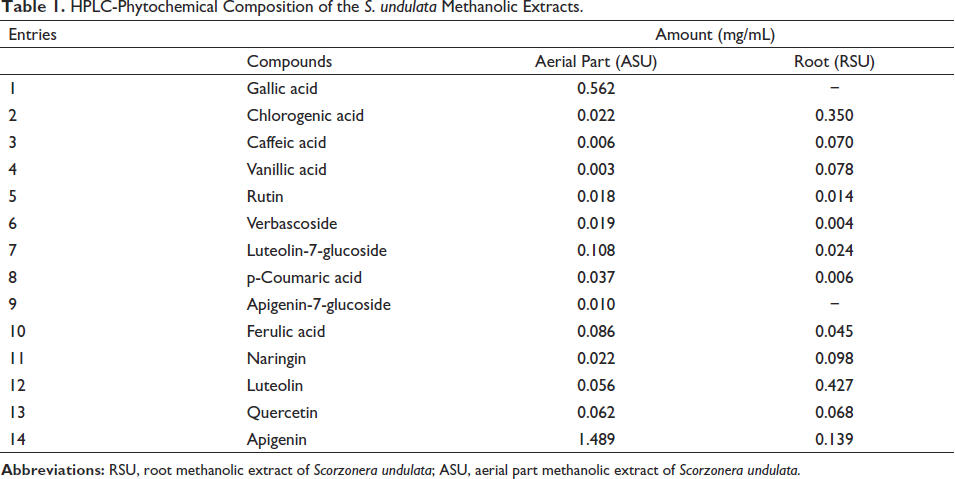
The chemical analysis shows that S. undulata methanolic extracts contain great amounts of polyphenols, flavonoids, and tannins. The extraction yields of RSU and ASU were 0.78% and 0.86%, respectively. The aerial parts of the plant were particularly enriched in flavonoids (121.61 ± 4.19 mg EC. g−1) in comparison to the roots (88.83 ± 5 mg EAG. g−1) (Figure 1). These findings were confirmed using HPLC (Figure 2 and Table 1). Fourteen different compounds, weighing from 0.003 mg × g−1 to 1.489 mg × g−1, have been sorted by HPLC analysis from the plant aerial part, where only 10 were found in the roots. The aerial part of S. undulata was characterized by apigenin-7-glucoside (0.010 mg × g−1) and gallic acid (0.562 mg × g−1), which were exclusively absent from roots, and apigenin as the main major compound (1.48 mg × g−1). In roots, luteolin (0.427 mg × g−1) and chlorogenic acid (0.350 mg × g−1) were the main phytochemicals found in the methanolic extract of S. undulata from the Ha’il region.
HPLC-Phytochemical Composition of the S. undulata Methanolic Extracts.
Druggability and Pharmacokinetics
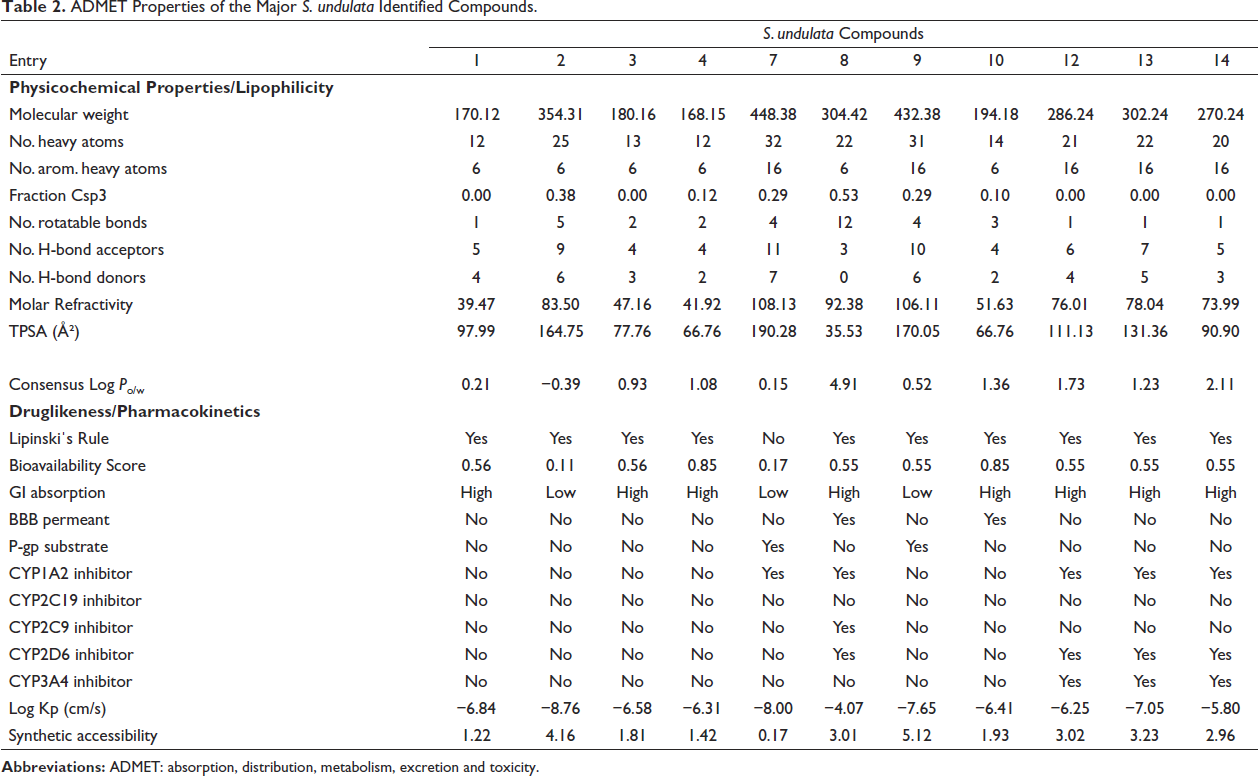
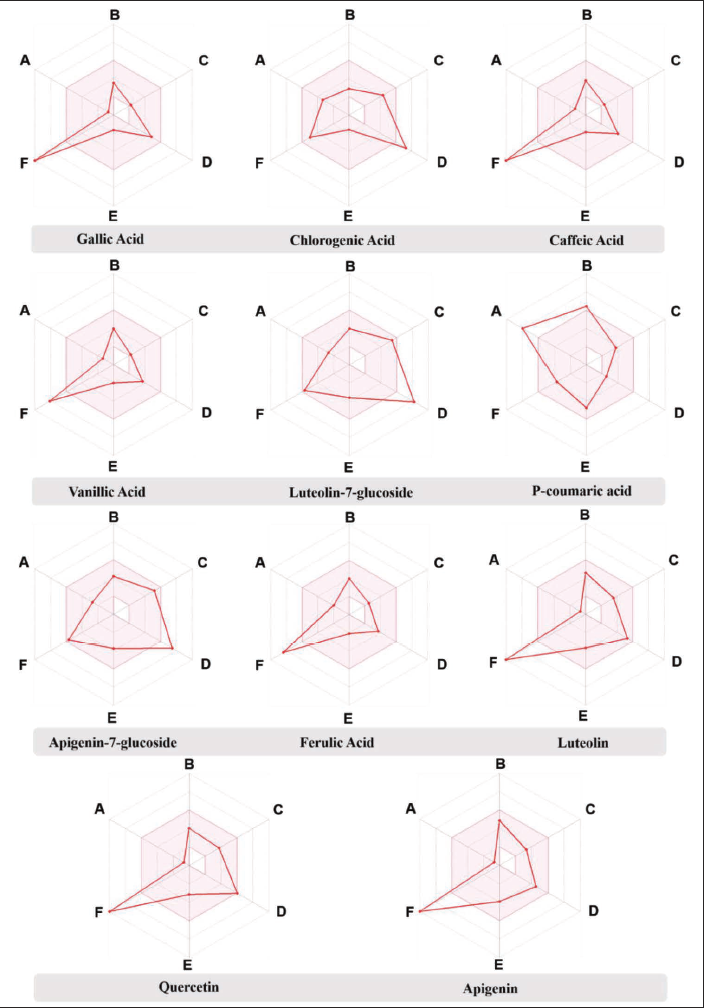
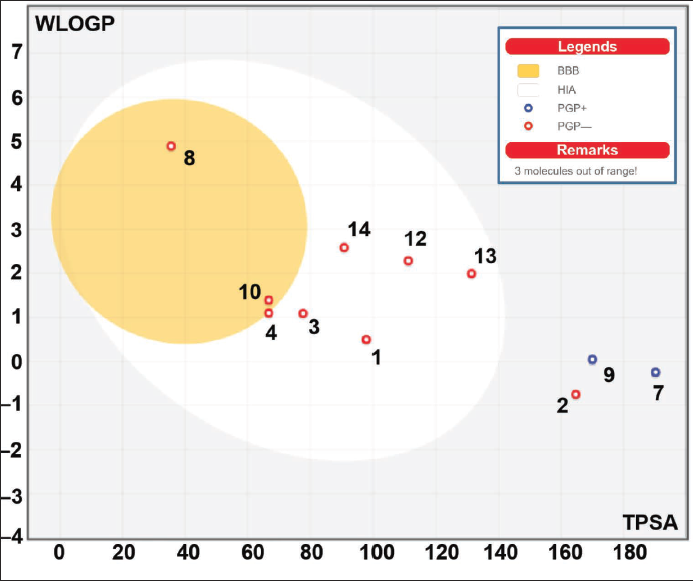
The bioavailability and pharmacokinetic analyses are reported in Table 2. Our results showed that S. undulata compounds are biologically active, as most of them meet the Lipinski rule, have low-to-moderate skin permeability, and possess acceptable bioavailability scores (BAS). These deductions were confirmed by the bioavailability polygons (Figure 3), which depended on the physicochemical properties of the compounds. While only two compounds (p-coumaric acid and ferulic acid) were BBB permeant, the majority of S. undulata-identified compounds were found to be associated with high GI absorption. The boiled egg model illustration confirmed these calculations. p-coumaric acid and ferulic acid are placed in the yellow area of BBB permeation, while the others are placed in white or grey areas for high and low GI absorption, respectively (Figure 4).
ADMET Properties of the Major S. undulata Identified Compounds.
Boiled Egg Model of S. undulata-Identified Compounds. (1) Gallic Acid; (2) Chlorogenic Acid; (3) Caffeic Acid; (4) Vanillic Acid; (5) Rutin; (6) Verbascoside; (7) Luteolin-7-Glucoside; (8) p-coumaric Acid; (9) Apigenin-7-Glucoside; (10) Ferulic Acid; (11) Naringin; (12) Luteolin; (13) Quercetin; (14) Apigenin.
Furthermore, the majority of the compounds do not behave as P-glycoprotein (P-gp) substrates, which permits us to deduce the absence of disruption in drug distribution (Badraoui et al., 2022; Hamadou et al., 2022; Zammel et al., 2022). The compound was also found safe regarding metabolism and excretion, as none of them inhibited all the assessed cytochrome P450 (CYP) isoforms: CYP1A2, CYP2C19, CYP2C9, CYP2D6, and CYP3A4. Moreover, compounds 1, 2, 3, 4, 9, and 10 inhibited none of the studied CYPs. S. undulata compounds, as identified in both SUR and SUA, are also easy to synthesize as their synthetic accessibility varied from 0.17 to 5.12.
Antioxidant Activity
The FRAP assay revealed that roots and aerial part extracts have an equitable reducing potential. At a concentration of 1 mg/mL, the two extracts proved to be powerful concerning iron reduction (OD = 0.23 ± 0.01 and OD = 0.25 ± 0.04, respectively). The DPPH free radical scavenging activity was twofold much more important for roots (0.11 ± 0.01 mg × mL−1) than the aerial part (0.23 ± 0.01 mg × mL−1). Similar to the DPPH assay, the total antioxidant test showed a weak total antioxidant capacity at 1 mg × mL−1. S. undulata root’s extract total antioxidant capacity (1.39 ± 0.13%) was twice as high as the aerial part (0.61 ± 0.20%) (Table 3).
In vitro Antioxidant Activity of Methanolic Extracts Roots (RSU) and Aerial Part (ASU) of S. undulata.

Cytotoxicity
The in vitro anti-proliferative activity of the MTT test revealed a dose-dependent inhibitory effect on MCF7 cell growth of both S. undulata extracts. The concentration inhibiting 50% of the cell proliferation was 4.22 ± 0.06 and 5.89 ± 0.08 mg × mL−1, respectively, for RSU and ASU at 24 h. The incubation of cells in the presence of ascending concentrations of the extracts for 2 days resulted in IC50%, respectively, of 2.89 ± 0.15 and 4.42 ± 0.015 mg × mL−1 (Figure 5). Microscopic slides exhibited a significant decrease in cell density following the treatment with both extracts. Dead cells, apoptotic bodies, cellular shape deformation and shrinking were also observed, both after one and two days of incubation with RSU and ASU (Figure 6).
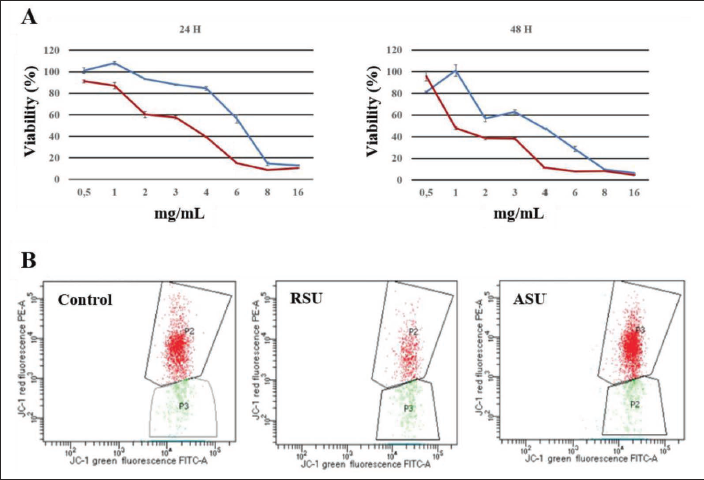
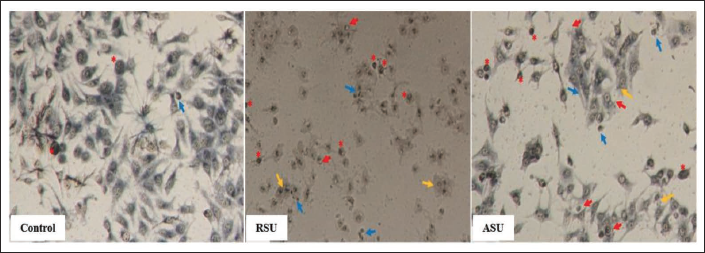
Microscopic slides (Figure 6) show an important decrease in MCF7 cells’ density after 48 h of exposure to methanolic extracts from S. undulata (MP: aerial part and MB: root). Apoptotic bodies (blue arrow), dead cells (asterisk), and cell shrinking (red arrow) and bubbling (yellow arrow) are clearly much more abundant for MCF7 cells incubated in a culture medium containing the S. undulata extracts. These results suggest that S. undulata cytotoxicity is mediated through cell lysis and an enhanced apoptosis pathway. Apoptosis was confirmed by flow cytometry using the JC-1 kit, which informs about the loss of mitochondrial transmembrane potential. These findings highlight that S. undulata extracts inhibit tumor cell proliferation by enhancing apoptosis or inducing cell lysis.
Discussion
The Scorzonera genus comprises hundreds of edible species that are very rich in bioactive molecules. All species from different areas (Ha’il, Tunisia, and others) share luteolin, rutin, apigenin, gallic acid and caffeoylquinic acid, and many other components (Ajebli et al., 2021; Badraoui et al., 2021). Accordingly, the major compounds found in the methanolic extracts were apigenin, gallic acid, chlorogenic acid and luteolin, with marked differences among the parts of the herb used. Such variation is also observed within different species and seasons (Badraoui et al., 2020; Saoudi et al., 2021; Siatka & Kašparová, 2010). In effect, gallic acid and apigenin-7 glucoside exist only in the aerial part of S. undulata ssp. deliciosa. The role of these phytochemical components in counteracting oxidative stress, microbial and fungal growth, and many health disorders has been approved (Erden et al., 2013; Harkati et al., 2010; Mzid et al., 2017). Herein, halves of DPPH radical and the ferric reducing potential were inhibited at concentrations ranging from 0.1 to 0.25 mg × mL−1 that were close to what has been recently reported (Badraoui et al., 2020; Rahmouni et al., 2022). Differences in the antioxidant capacity between RSU and ASU might be explained by the variability of their contained substances. Cytotoxicity assays revealed a dose-dependent decrease in MCF7 cell viability in response to RSU and ASU. Two pathways for cellular death were noticed: (i) cell lysis involving cellular membrane disruption, cytoplasmic bubbling and leakage; (ii) apoptosis, as highlighted by the loss of the mitochondrial transmembrane potential. According to Mostafa (2020), quercetin, myricetin, luteolin, and apigenin-O-glucoside inhibit cell signalling transduction mediated via aurora B and cyclin-dependent kinase. Consequently, cell metabolism and proliferation will be arrested, and apoptosis of MCF7 cells through inhibition of aurora B and cyclin-dependent kinases will be induced. Luteolin was also proven to induce apoptosis by activating the caspase-3 and 9 pathways, and cell cycle arrest (Cai et al., 2011; Mostafa, 2020). Its effect was augmented in the presence of quercetin. New Scorzonera components, like Biguaiascorzolides A and B, are thoroughly discovered and tested for their potential to inhibit drug-resistant cancers (Sak et al., 2016). Apigenin, however, targets the JAK/STAT pathway to block the cell cycle and induce apoptosis through the caspase mechanism. It also sensitizes cancer cells toward the tumor necrosis factor through the Bcl-2-caspase route (Ruela-de-Sousa et al., 2010; Zhu et al., 2009). In addition to its synergistic action with luteolin, quercetin enhances both cell necrosis and apoptosis (Horinaka et al., 2006). Due to their lipophilicity, polyphenols interact with cell membranes and chelate their metals. As a consequence, the cell membrane structure and its permeability will be greatly affected (Haghiac & Walle, 2005). Such interaction, specifically with the cell membrane rafts (Tarahovsky et al., 2014), might explain the pleiotropic activities of polyphenols and, in particular, the observed MCF7 cytoplasm leakage and lysis. The culminating data reveals that different components contained in S. undulata, particularly from the Ha’il region, exert synergistic anti-tumoral effects that are worth further exploration in counteracting cancer. Similar anticancer and health promotion effects have been previously reported by these compounds from Scorzonera species and others (Ajebli et al., 2021; Jedli et al., 2022; Vergun et al., 2018; Zammel et al., 2022).
These effects were also confirmed by bioavailability and pharmacokinetic analyses. ADMET and pharmacokinetics are commonly assessed to avoid drug failure at advanced stages (Badraoui et al., 2022; Jedli et al., 2022; Zammel et al., 2022). Our results showed that most of the compounds, except luteolin-7-glucoside, meet the Lipinski rule, have low to moderate skin permeability, as log Kp ranged between −4.07 and −8.76, and possess acceptable BAS. Such BAS, which ranged between 0.11 and 0.87, indicated that S. undulata is biologically active without violations or toxic outcomes. These results have been confirmed by the bioavailability of radars, which depends on the physico-chemical properties of the compounds. While only two compounds (p-coumaric acid and ferulic acid) were BBB-permeant, the majority of S. undulata-identified compounds were found to be associated with high GI absorption. The boiled egg model illustration confirmed these calculations. In fact, p-coumaric acid and ferulic acid are placed in the yellow area, while the others are placed in white or grey areas. It is also reported that the majority of the compounds do not behave as P-gp substrates, which permits deducing the absence of disruption in drug distribution (Hamadou et al., 2022; Hchicha et al., 2021; Zammel et al., 2022). These compounds that exist in S. undulata and several similar plant extracts were also found safe regarding metabolism and excretion, as none of them inhibited all the assessed cytochrome P450 (CYP) isoforms: CYP1A2, CYP2C19, CYP2C9, CYP2D6, and CYP3A4 (Badraoui et al., 2022; Mhadhbi et al., 2022; Rahmouni et al., 2022). Moreover, compounds 1, 2, 3, 4, 9 and 10 inhibited none of the studied CYPs. S. undulata compounds, as identified in both SUR and SUA, are also easy to synthesize as their synthetic accessibility varied from 0.17 to 5.12, which indicates that they are suitable drug molecules (Hamadou et al., 2022; Jabeur et al., 2022; Jedli et al., 2022; Mhadhbi et al., 2022). Further validation techniques such as molecular docking and dynamics and/or in vivo assays may confirm the anti-tumoral potential and the promising effects of S. undulata on cancer proliferation and invasion. In fact, the major limitation of the current study is the in silico and in vitro applications only.
Conclusion
S. undulata contains several chemicals that inhibit cancer cells’ development through apoptotic or lytic pathways. Since it is GARS, S. undulata might be administered to cancer patients as a dietetic supplement to help against tumor proliferation and oxidative injury. These results may also justify the ethnopharmacological use of S. undulata from the Ha’il region and other parts of the globe in several world populations. Further investigations related to these herb components’ pharmacology should be undertaken to highlight the real mechanisms of action and adequate dosages to be effective.
Abbreviations
RSU: Root methanolic extract of Scorzonera undulata; ASU: Aerial part methanolic extract of Scorzonera undulata.
Footnotes
Declaration of Conflicting Interests
The authors declared no potential conflicts of interest concerning the research, authorship, and/or publication of this article.
Funding
This research has been funded by the Scientific Research Deanship at the University of Ha’il, Saudi Arabia, through project number RD-21-016.
