




Abstract
Background
In India, cancer of the cervix is the second most common cancer in women. Nowadays, various traditional herbal formulations can be used as adjuncts during conventional cancer therapies due to their anticancer activity. Habbe Musaffi Khoon (HMK), a Unani compound formulation, is traditionally used as a blood purifier and thus used to treat boils, scabies, acne, and pimples. It is also indicated in skin diseases, Habis-ud-Dam (styptic), and therapeutically used in Nafz-ud-Dam (hemorrhagic).
Objectives
The main purpose of this work was to phytochemically characterize HMK aqueous extract (HMKaq) and determine its activity against cervical cancer cells.
Materials and Methods
HMKaq was subjected to liquid chromatography-mass spectrometry (LC-MS) and evaluated for the presence of phytocompounds. HMKaq was evaluated for its effect on the viability of cervical cancer cells (HeLa, SiHa, and C33A) and was determined by MTT assay. Trypan blue dye exclusion was used to determine the outcome of HMKaq on the growth kinetics of cervical cancer cells. The role of HMK in regulating the cell cycle was analyzed by FACS and its effect on apoptosis was evaluated by checking mitochondrial membrane potential readings of JC-1 aggregates on a microplate reader and on the mRNA expression of caspase-3 and cytochrome C was evaluated by PCR.
Results
LC-MS analysis revealed 3845 compounds, out of which 58 were the major compounds. These included phenolics, esters, fatty acids, furans, quinones, tannins, flavonoids, and terpenes. HMKaq reduced the viability and growth of the cells. It induced arrest in the cell cycle of HeLa and apoptosis in SiHa and C33A by depolarizing the membrane potential of the mitochondria and upregulation of mRNA expression of Cas3 and Cyt C.
Conclusion
HMK exhibited anticancer activity against cervical cancer cells, thereby signifying its therapeutic potential.
Keywords
Introduction
Cancer of the cervix is the second major cause of mortality among women in India (Mehrotra & Yadav, 2022) and is the fourth most frequent cancer afflicting women globally (Arbyn et al., 2019; Cohen et al., 2019; Gultekin et al., 2020; Shiraz et al., 2020). High-risk human papillomavirus (HPV) infection, especially HPV 16 and 18, is responsible for 70% of cervical cancer (Crosbie et al., 2013; Fahad et al., 2018; Hammer et al., 2016) cases.
Despite advanced therapeutics, the associated adverse effects frequently cause increased patients’ morbidity. Recent years have seen a rise in the use of herbal medicine by patients as a supplemental treatment for chemotherapy and radiotherapy-related side effects and morbidity. The Unani medicine system has become well-known among complementary medical systems because of its holistic approach to cancer care, cost-effectiveness, good therapeutic efficacy, and minimum side effects (Husain et al., 2017; Naaz & Ahmed, 2017). Numerous Unani medicines with potential anticancer activity have proven to be highly effective in both in vitro and in vivo studies (Husain et al., 2017; Keene et al., 2019; Mushir et al., 2019; Nahata, 2017; Qamar Uddin et al., 2015; Savjiyani et al., 2012).
Treatment plans in Unani medicine include either single drug or compound formulations. One such compound drug is Habbe Musaffi Khoon (HMK), consisting of 16 ingredients, including Melia azedarach, Azadirachta indica, Lawsonia inermis, Pterocarpus santalinus, Tricholepis glaberrima, Terminalia chebula, Cassia absus, Berberis aristata, Cuminum cyminum, Tephrosia purpurea, Fumaria parviflora, Piper nigrum, Coriandrum sativum, Bauhinia racemosa, Rosa damascena, and Gentiana kurroo Royle. In accordance with Unani principles, HMK is regarded as a blood purifier and is used in the treatment of boils, scabies, acne, pimples, and other skin conditions (Khan et al., 2020). HMK’s constituents have shown anti-cancer action against a number of malignancies (Azamthulla et al., 2015; Bailon-Moscoso et al., 2017; Bano et al., 2015; Dave et al., 2012; Ervina et al., 2018; Gupta et al., 2004; Kapadia et al., 2013; Nahata, 2017; Nithya et al., 2014; Padmapriya et al., 2017; Serasanambati et al., 2015). In this work, characterization of aqueous extract of HMK (HMKaq) was done using LC-MS and its anticancer activity was elucidated in HeLa, SiHa, and C33A cell lines
Materials and Methods
Plant Material and Extraction
All the ingredients for HMK were purchased from CCRUM, Hyderabad. The plant material was ground into a coarse powder and water extract was prepared in a Soxhlet apparatus. HMKaq was spun for 15 min at 13,000 rpm; the supernatant was passed through a 0.45-µm Swiney filter, followed by storage of filtrate at −80°C.
Liquid Chromatography and Mass Spectroscopy
HP LC-MS QTOF analysis for both untargeted and targeted was conducted as described previously (Gupta et al., 2004). Mass Hunter Qualitative Analysis Software Package (Agilent Technologies) and Metlin database were used to analyze the data.
Cell Culture
HeLa (HPV-18 positive), SiHa (HPV-16 positive), and C33A (HPV negative) cell lines were purchased from the American Type Culture Collection (ATCC). They were grown in DMEM having 10% FBS, 2 mM
Cell Viability
MTT assay was done to determine the effect of HMKaq on the cell viability as described previously (Choudhari et al., 2013).
Cell Growth Analysis
HeLa, SiHa, and C33A cells (1 × 10⁵ cells/mL) were plated in 24-well plates in triplicates. The next day, the cells were dosed with HMK (0–160) µg/mL and grown for 24–72 hours. The cells were collected, and viable cells were counted by the method of trypan blue dye exclusion (Choudhari et al., 2013).
Mitochondrial Membrane Potential
HeLa, SiHa, and C33A were plated at 1 × 10⁴ cells/mL in a 96-well black plate. The next day, the cells were subjected to treatment with HMKaq (0, 20, 40, 80, and 160 µg/mL) for 24 hours. The next day, after removing the medium, 1X PBS was used to wash the cells, followed by incubation for 1 hour with 0.5 µM/mL of JC-1 dye (Sigma-Aldrich, St. Louis, MO, USA) in the dark. FCCP (20 µm) was used as a positive control. A microplate reader (Fluostar Omega, BMG Labtech) was used to record the readings at 520 and 590 nm.
Quantitative Real-Time Polymerase Chain Reaction
Total RNA was isolated from treated cervical cancer cells (SiHa and C33A) using Trizol (Sigma). A volume of 5 g RNA (total) was taken for synthesizing cDNAs that were amplified with KiCqStartTM primers (Sigma) for caspase-3: F-AAAGCACTGGAATGACATC3, R-CGCATCAATTCCACAATTTC; cytochrome-c: F-AAGAACAAAGGCATCATCTG, R-GCTATTAAGTCTGCCCTTTC; and β-actin: F-GATCAAGATCATTGCTCCTC, R-TTGTCAAGAAAGGGTGTAAC. SyBrGreen Master Mix (Takara) was used for the qPCR reactions, and products were detected on 7500 Fast Real-Time PCR System (Applied Biosystems™). “Delta Cp” (∇Cp) and “delta-delta Ct” (∇∇Ct) values were calculated as described previously (Aphale et al., 2021) for determining the relative expression of Casp-3 and Cyt-c mRNA.
Cell Cycle Arrest
HeLa cells were plated at 4 × 10⁵ cells/well in 6-well plates for 24 hours, followed by overnight treatment with HMKaq (0–80 µg/mL). After trypsinization, ice-cold 70% ethanol was used to treat the cells at 20°C for 30 min, washed with 1X PBS, and incubated with RNase A (100 mg/mL) at RT for 30 min, followed by staining with PI (20 µg/mL). The DNA-PI fluorescence of stained cells was examined by FACS Calibur (BD, USA).
Statistics
The data was calculated based on three different experiments, each was done three times, and the values were plotted as mean ± SD. One-way analysis of variance (ANOVA) was used to test the differences in means using GraphPad Prism 5 (San Diego, CA, USA). *p < 0.05, **p < 0.01, and ***p < 0.001 indicated statistically significant data.
Results
LC-MS Analysis Revealed Presence of Phytocompounds
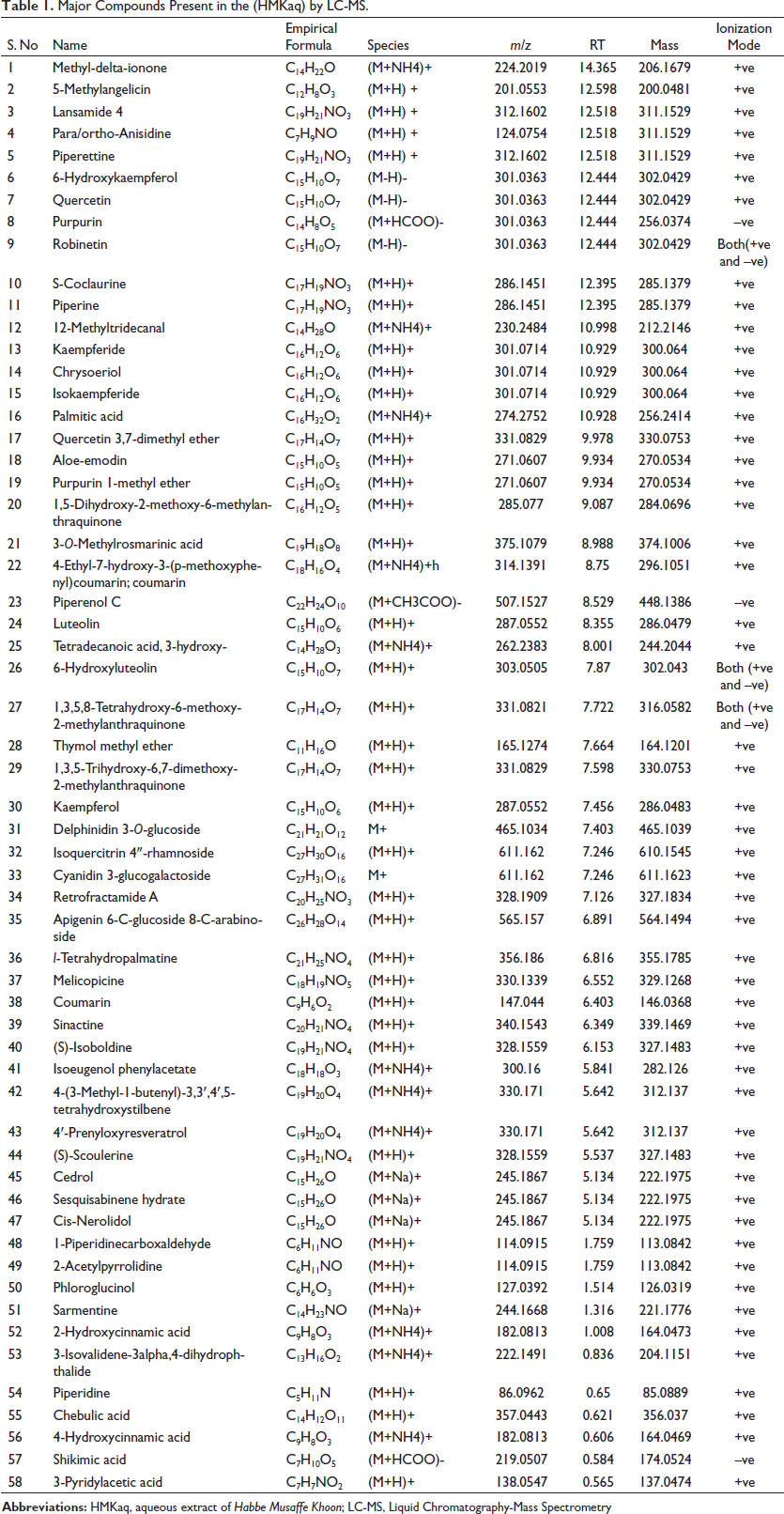
Different phytochemicals were found in HMKaq, which included high content of phenolics, esters, and fatty acids and moderate levels of furans, quinones, tannins, flavonoids, and terpenes (Supplementary Files 1 and 2). A total of 3,845 phytocompounds were present, out of which 58 were the major ones (Table 1).
Major Compounds Present in the (HMKaq) by LC-MS.
HMK Decreased the Viability and Growth Kinetics of Cervical Cancer Cells
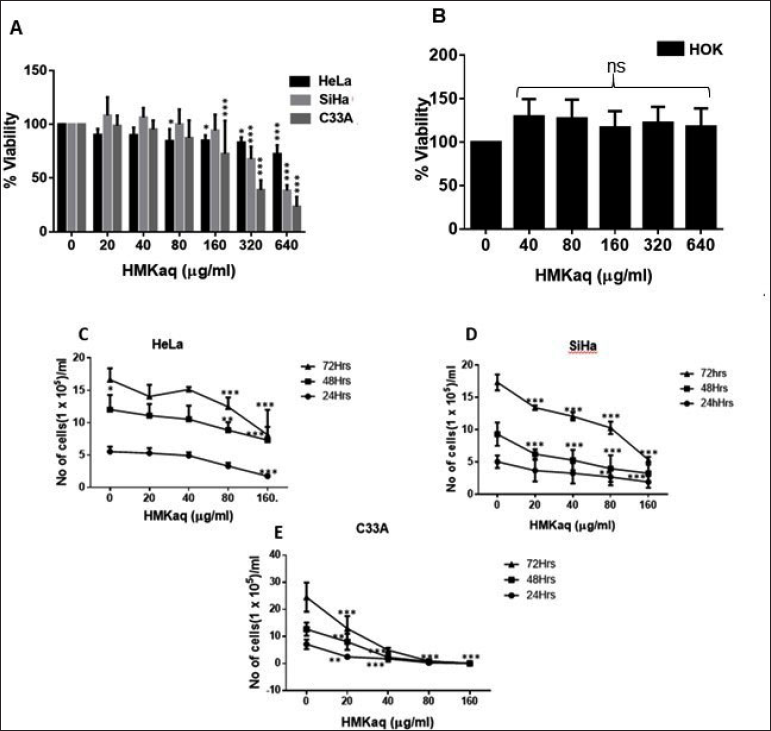
HeLa, SiHa, and C33A were subjected to treatment with different doses of HMKaq for 24 hours. At 640 µg/mL dose, the viability of HeLa, SiHa, and C33A was reduced by 27.7%, 61.68%, and 76.6%, respectively (Figure 1A). The IC50 of HMKaq was found to be 491.8 and 270.4 µg/mL in SiHa and C33A, respectively. HMK was safe in human oral keratinocytes (HOK) (Figure 1B). SiHa, HeLa, and C33A cells were subjected to treatment with HMK (0–160 µg/mL) for 24–72 hours. In HeLa, at a 160 µg/mL dose, compared with the untreated control cells, HMKaq reduced the growth of cells by 68.42 ± 0.22%, 39.19 ± 2.05%, and 51.19 ± 3.87% at 24, 48, and 72 hours, respectively (Figure 1C). In SiHa, at 160 µg/mL dose, HMKaq reduced the growth of cells by 61.98 ± 0.90%, 65.1 ± 1.33%, and 69.23 ± 0.46% at 24, 48, and 72 hours, respectively (Figure 1D). In C33A, at 160 µg/mL dose, HMKaq reduced the growth of cells by 98.83 ± 0.12%, 99.02 ± 0.13%, and 99.83 ± 0.10% at 24, 48, and 72 hours, respectively (Figure 1E). Thus, HMKaq decreased cell growth significantly.
HMKaq Regulated the Cell Growth in Different Cell Lines Through Different Mechanisms
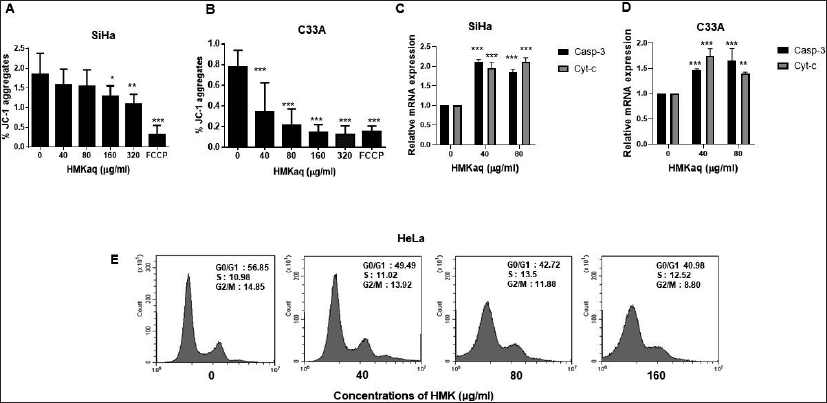
HMK decreased the percentage of JC-1 aggregates, indicative of apoptosis, in both SiHa and C33A in a dose-dependent way. In SiHa, at 160 and 320 µg/mL doses, the aggregates were decreased by 1.4- and 1.6-folds, respectively, when compared with the control untreated cells (Figure 2A). In C33A, aggregates were significantly decreased by 3.6-, 5.3-, and 6.1-folds at 80, 160, and 320 µg/mL doses related to the control untreated cells (Figure 2B). In SiHa, HMK significantly increased the mRNA expression of Caspase-3 (2.1- and 1.8-folds) and Cyt-c (1.9- and 2.1-folds) at 40 and 80 µg/mL concentrations, respectively (Figure 2C). In C33A, HMKaq significantly increased the mRNA expression of Caspase-3 (1.5- and 1.6-folds) and Cyt c (1.8- and 1.4-folds) in C33A at 40 and 80 µg/mL concentrations (Figure 2D). HMKaq did not induce apoptosis in HeLa (data not shown); however, it brought S-phase arrest in the cell cycle (Figure 2E) at 80 and 160 µg/mL.
Discussion
This study illustrated the anticancer activity of the HMKaq against HPV-positive (HeLa and SiHa) and HPV-negative (C33A) cervical cancer cell lines. Some of the individual components of HMKaq have reported activity against different cancers. Berberis aristata (Bailon-Moscoso et al., 2017; Serasanambati et al., 2015) and Sphaeranthus indicus (Nahata, 2017) have exhibited activity against breast cancer cells. Tephrosia purpurea (Padmapriya et al., 2017) showed activity against HepG2; Lawsonia inermis (Kapadia, et al., 2013) showed against skin cancer and Bauhinia racemosa (Gupta et al., 2004) has against various cancers. Pterocarpus santalinus (Azamthulla et al., 2015) has shown hepatoprotective activity, and M. azedarach (Ervina & Sukardiman, 2018) showed activity against different cancer cell lines. Previously, we have reported the anticancer activity of polyherbal formulations, Panchvalkal (Aphale et al., 2018) and HC9 (Suryavanshi et al., 2014) against cervical cancer and breast cancer, respectively.
LCMS analysis revealed that alkaloids were the major phytochemicals present in HMK, along with flavonols, stilbenes, and others. Melicopicine, an acridone alkaloid, has exhibited in vitro cytotoxic activity (Wang et al., 2014). Other isoquinoline alkaloids found in HMK included
The Unani system of medicine aims to restore human health by providing preventive, curative, and rehabilitative treatment with a holistic approach. As per Unani medicine, cancer is considered to be due to the production of excess black bile (Sawda) (Husain et al., 2017). Various Unani single drugs have been found to be effective against cancer. These include Aftimoon, Elva, Ghariqoon, Haldi, Asgandh, Zift, Halela, Balela, Bisfayej, Ustukhuddus, Tahlab/Spirulina, Kutki, and Hulba. A compound Unani formulation has shown antioxidant and cytotoxic activity in MCF-7 and showed presence of higher amounts of alkaloids, tannins, terpenoids, and saponins (Mannan et al., 2020a, 2020b). A number of Unani drugs have been reported for their efficacy and phytochemical activities (Ignacimuthu et al., 2006). However, extensive scientific validation is required to test their efficacy.
HMKaq significantly decreased the viability of HeLa, SiHa, and C33A, irrespective of their HPV status, and reduced their growth rate. Most of the polyherbal formulations exhibit anticancer activity by decreasing the viability and growth rate of cancer cells. In some of the studies conducted by our research group, polyherbal formulations such as Panchvalakala (Aphale et al., 2018, 2021) and HC9 (Suryavanshi et al., 2014) exhibited anticancer activity against cervical cancer and breast cancer cells, respectively, by decreasing their viability and growth kinetics. The results of the current investigation showed that HMKaq not only had anti-proliferative capability but also displayed safety towards non-cancerous cells. It was interesting to note that HMK did not have any significant effect on the mitochondrial membrane potential in HeLa; instead, it induced cell cycle arrest at the S phase. Contrarily, in SiHa and C33A, HMKaq induced apoptosis through mitochondrial depolarization. It increased the mRNA expression of caspase-3 and cytochrome-c in both the cell types. Cytotoxic medicines are known to kill tumor cells by apoptosis (Huang et al., 2011). Caspase-3 is an executioner caspase involved in the cleavage of various cellular proteins during apoptosis, while cytochrome-c plays a crucial role in the intrinsic apoptotic pathway (Yadav et al., 2021). Most of the chemopreventive drugs regulate cancer cell growth either by inducing G1/S or G2/M phase arrest or apoptosis (Sa & Das, 2008). Thus, HMKaq modulated the growth of cervical cancer cells by either arresting their cell cycle or by inducing apoptosis.
HMK is a Unani compound formulation, which is traditionally used as a blood purifier. It is given by Unani physicians to treat boils, scabies, acne, pimples, and other problems arising due to impurities present in the blood (Khan et al., 2020). As per Unani principles, such blood purifiers eliminate toxicity from the blood in the form of sweat, urine, and feces (Mushir et al., 2019). Blood-purifying drugs are rich in alkaloids and flavonoids that are known to block tyrosine phosphorylation, activate caspase-3 and caspase-9 activity, release cytochrome c, induce CD95 expression, and finally induce apoptosis (Mushir et al., 2019). Previously, we conducted a survey wherein we recorded the opinions of Unani physicians (Hakims) towards the proposed use of HMK as an anti-cancer drug as well as its current practice, safety, and tolerability (Khan et al., 2020). The survey revealed that, being an excellent blood purifier, HMK was frequently recommended for blood-related disorders. However, some Hakims perceived its use for the management of cancer, wherein HMK was proposed to balance the production of bodily humors (bodily fluids), whose imbalance could otherwise cause cancer. According to them, HMK, being an excellent blood purifier, could help in preventing the combustion of Sawda (Black bile), thus preventing cancer progression. Overall, our results scientifically validate that HMK was rich in anticancer phytocompounds, which could be responsible for its observed anticancer activity in the cervical cancer cells.
Conclusion
Cervical cancer is a major public health issue in India, and the existing therapeutic choices are frequently coupled with debilitating side effects and medication resistance. Unani medicine can manage cervical cancer by improving patient care and addressing patient needs holistically. Unani medicine is a valuable addition to conventional treatment approaches because of its emphasis on herbal-based remedies, personalized therapy regimens, and cost-effectiveness. However, additional scientific validation and investigation are required to fully explore the potential of Unani medicines in cancer care. This investigation revealed the anti-cancer mechanism of HMK, a Unani compound formulation, containing phytocompounds with anti-inflammatory and anticancer properties. Even though HMK holds promising anticancer potential, further studies are warranted at in vivo level to validate its anticancer activity.
Footnotes
Acknowledgments
The authors thank IRSHA, Bharati Vidyapeeth University for the support provided during the execution of this work.
Abbreviations
LC-MS: Liquid chromatography-mass spectrometry; FACS: Fluorescence-activated cell sorter; qRT-PCR: Quantitative Real-Time Polymerase Chain Reaction; ATCC: American Type Culture Collection.
Funding
The work was funded by the Ministry of AYUSH, Government of India, under the scheme Z.28015/61/2018-HPC (EMR)-AYUSH-C.
Declaration of Conflicting Interests
The authors declared no potential conflicts of interest with respect to the research, authorship, and/or publication of this article.
Statement of Informed Consent and Ethics Approval
The work involves cell line-related experiments and thus does not require ethics approval.
