




Abstract
Introduction
Lung cancer (LC) ranks among the most prevalent malignant neoplasms globally. As a Traditional Chinese medicine (TCM), Herba Epimedii has been commonly used for treating LC. However, the specific mechanism of LC remains to be elucidated.
Objectives
This research aimed to explore the mechanisms of Herba Epimedii in treating LC according to molecular docking and network pharmacology.
Materials and Methods
The active components (ACs) and targets of Herba Epimedii were screened through the Traditional Chinese Medicine Systems Pharmacology (TCMSP) database. LC targets were retrieved from GeneCards and DisGeNET databases. Cytoscape v3.9.0 was employed to construct a “drug-component-disease-target” network. The STRING database and Cytoscape 3.9.0 software were utilized to establish a PPI network. The DAVID database was used for Gene Ontology (GO) and Kyoto Encyclopedia of Genes and Genomes (KEGG) enrichment analyses. The AutoDock software was employed for molecular docking verification, and the Pymol software was applied for visual processing.
Results
Herba Epimedii acted on 108 LC treatment targets through 22 ACs. Five core components were screened, including quercetin, luteolin, kaempferol, anhydroicaritin, and 8-isopentenyl-kaempferol, while 12 core targets were screened, including TP53, AKT1, MYC, CASP3, ESR1, JUN, HIF1A, VEGFA, TNF, CCND1, EGFR, and IL-6. GO enrichment analysis mainly involved positive regulation of gene expression, positive regulation of the apoptotic process, enzyme binding, identical protein binding, macromolecular complex, nucleoplasm, etc. KEGG enrichment analysis mainly involved p53, interleukin-17, PI3K-Akt, and other signaling pathways. Five core components all demonstrated excellent binding activities with the core targets.
Conclusion
The mechanisms of Herba Epimedii in LC treatment may involve multiple components, targets, and pathways, inducing apoptosis, and inhibiting proliferation, invasion, metastasis, and drug resistance of LC cells.
Introduction
Lung cancer (LC) stands as a prominent malignancy frequently encountered in clinical settings. In 2018, the global incidence of LC reached an estimated 2.09 million cases, leading to approximately 1.76 million fatalities. These staggering figures firmly establish LC as the foremost cause of both morbidity and mortality on a global scale (Bray et al., 2018). LC immensely endangers the health and life of patients. At present, surgery, chemotherapy, radiotherapy, targeted and immunotherapy are the main treatment method for patients with LC. Due to its elusive onset, a substantial number of patients only become aware of the presence of LC when it has already progressed to an advanced stage, rendering surgical intervention unviable. Consequently, the 5-year relative survival rate for advanced-stage LC is a mere 18%, underscoring the significant challenges faced in effectively treating the disease at this late stage (Wang et al., 2020). Western medical treatment of LC is influenced by various factors such as treatment indications, potential toxicity, side effects, quality of life considerations, treatment costs, and so on. However, Traditional Chinese medicine (TCM) has demonstrated a beneficial impact by addressing these aspects. It helps in reducing treatment toxicity and enhancing treatment efficacy. Additionally, TCM has been shown to delay tumor progression, enhance patients’ quality of life, and extend overall survival rates.
Herba Epimedii is a Traditional Chinese herbal medicine derived from the dried leaves of epimedium. It belongs to the Berberidaceae family and is commonly referred to as Xian-Ling-Pi (Ma et al., 2011). Herba Epimedii was first recorded in Sheng Nong Ben Cao Jing, which had various therapeutic functions such as governing yin impotence, alleviating absolute pain, relieving stem pains, promoting urination, replenishing qi (vital energy), and improving ambition (Zhao et al., 2022). According to the Chinese Pharmacopoeia, Herba Epimedii is recognized for its ability to tonify Kidney Yang, which refers to strengthening the vital energy associated with the kidneys. It is also known for its potential in enhancing muscle and bone health. Furthermore, Herba Epimedii is believed to have properties that can dispel wind and dampness, two pathological factors in TCM. Additionally, it is suggested that Herba Epimedii can invigorate vital qi, which refers to revitalizing the body’s energy, and provide benefits in cases of deficiency and damage. It also possesses some properties that aid in removing evil qi, referring to the elimination of harmful or negative influences. Modern pharmacological studies have reported that Herba Epimedii and its active components (ACs) have been shown to contain anticarcinogenic effects against LC. Herba Epimedii alcohol extract has been shown to inhibit the tumor growth of Lewis LC in C57BL/6 mice, and has the ability to improve immune regulatory effects (Yuan et al., 2016). Icariin may inhibit the survival, invasion, and migration of human lung adenocarcinoma A549 cells by inhibiting PIM1 protein levels (Lin et al., 2019). Icariside II can reduce the immunosuppressive activity of myeloid-derived suppressor cells by down-regulating the proportion, improving the organism’s inflammatory microenvironment and hindering angiogenesis (Xu et al., 2021). Thus, it plays a significant role in the prevention and treatment of LC. The compound Xian-Ling-Pi prescription with Herba Epimedii as the main drug can prolong the survival period and improve the clinical symptoms of patients after LC surgery (Qiu et al., 1998). Herba Epimedii has been employed in clinical practice as a treatment modality for LC, and it has demonstrated positive therapeutic effects (Feng et al., 2017; Xu, 1993; Yu & Xu, 2020). However, the precise mechanism of Herba Epimedii for LC treatment is not yet fully understood.
Network pharmacology is a new subject that integrates bioinformatics, computer technology, network science, and system pharmacology (Zhang et al., 2016). Molecular docking is a simulated means to predict the interaction and reaction mechanism between receptors and ligands. Network pharmacology provides a systematic exploration of the intricate interplay among drugs, components, targets, pathways, and diseases. It elucidates the pharmacological mechanisms underlying TCM by investigating the dynamic relationships between multiple components, targets, and signaling pathways. Network pharmacology closely aligns with the fundamental principles of TCM, such as the overall concept, syndrome differentiation and treatment, and prescription compatibility. It serves as a catalyst for modernizing TCM by introducing innovative research methods and novel ideas (Zhang & Li, 2015). Based on the methods of molecular docking and network pharmacology, this research explored the mechanisms of Herba Epimedii in treating LC from the perspective of “drug-component-target-pathway-disease” in order to open up new ideas and offer a basis for subsequent research.
Materials and Methods
Screening of ACs and Targets of Herba Epimedii
The ACs of Herba Epimedii were obtained from the Traditional Chinese Medicine Systems Pharmacology (TCMSP) database (
Screening of LC-related Targets
LC targets were acquired from the GeneCards database (
Acquisition of Drug-disease Common Targets (CTs)
In Venny2.1 (
Establishment of the Herba Epimedii–AC–CT–LC Network
The ACs of Herba Epimedii and CTs of Herba Epimedii and LC were imported into Cytoscape 3.9.0 software for establishing a network diagram of Herba Epimedii-AC-CT-LC. The core ACs of Herba Epimedii were screened by degree values using the network analyzer function (NAF).
Establishment of the PPI Network
The CTs of Herba Epimedii and LC were identified using the STRING database (
GO Function and KEGG Pathway Analysis
The shared targets of Herba Epimedii and LC were determined using the David database (
Molecular Docking Verification of the Core Components and Core Targets
The PDB database (
Results
The ACs and Targets of Herba Epimedii
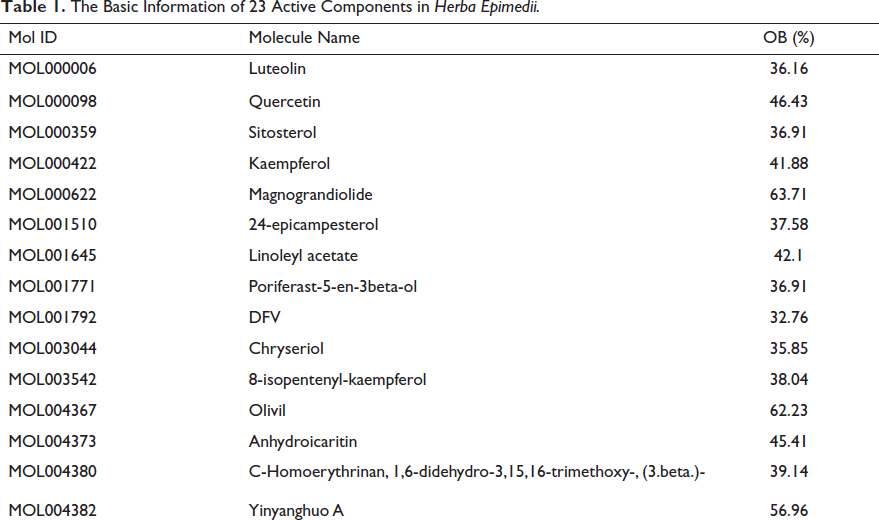
A total of 23 Herba Epimedii ACs were collected from the TCMSP database (Table 1), and 225 targets were identified.
The Basic Information of 23 Active Components in Herba Epimedii.
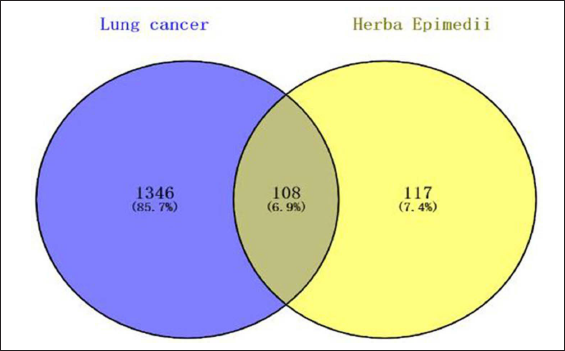
The CTs of Herba Epimedii and LC
A total of 815 and 900 LC-related targets were collected from the GeneCards and DisGeNET databases, respectively. After removing duplicates, 1454 LC targets were obtained. A total of 225 Herba Epimedii targets and 1454 LC targets were recorded, and 108 CTs of “drug disease” were identified (see Figure 1).
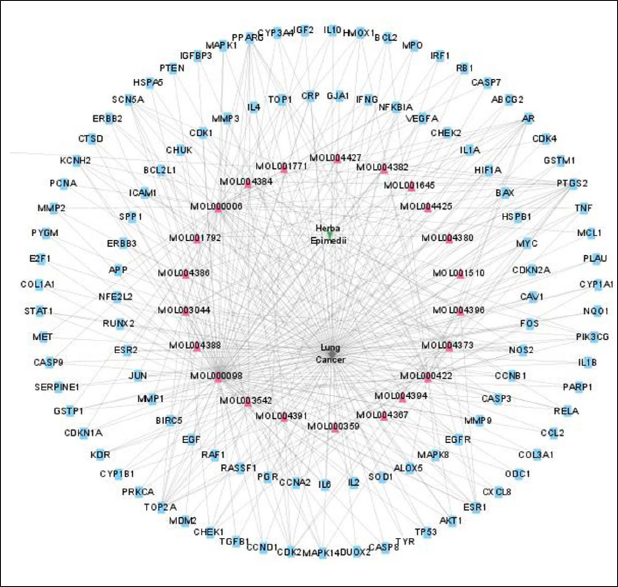
The Herba Epimedii-AC-CT-disease Network
23 ACs of Herba Epimedii and 108 CTs of Herba Epimedii and LC were recorded into Cytoscape v3.9.0, and a network diagram of Herba Epimedii-AC-CT-LC was constructed (Figure 2). The green node indicates the drug, purple nodes represent 22 ACs of the drug (the target of 1 AC does not overlap with the target of LC, so it is removed), 108 CTs are marked as blue nodes, LC is presented as a gray node, and the correlation between them is shown by a line. The NAF was run to analyze the degree value of each AC. The higher the degree value, the stronger the association with the target, and the greater the importance of the AC. The top five ACs were shown by degree value. For instance, quercetin (MOL000098) was associated with 90 targets, luteolin (MOL000006) was associated with 44 targets, kaempferol (MOL000422) was associated with 27 targets, anhydroicaritin (MOL004373) was associated with 15 targets, and 8-isopentenyl-kaempferol (MOL003542) was associated with 14 targets. This indicates that all five ACs are the core components of Herba Epimedii in treating LC.
Core Target Screening and Establishment of a PPI Network
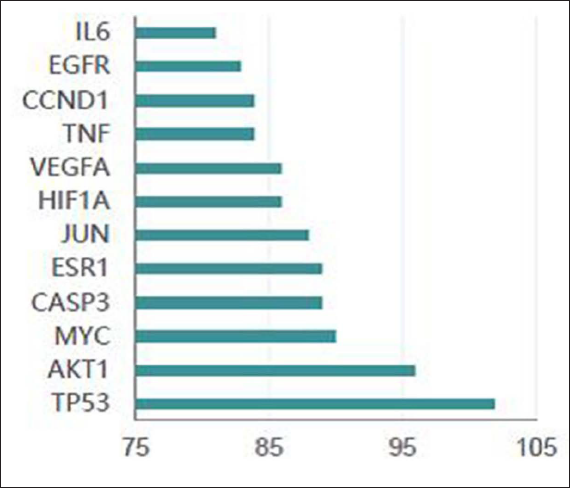
After inputting 108 CTs into the STRING database, they were imported into Cytoscape v3.9.0, facilitating the establishment of a PPI network (Figure 3). The PPI network was formed by 108 nodes. As the node display increased in size, the color display became darker, indicating a higher degree value and a stronger correlation between the target and other targets. The first 12 core targets and their corresponding degree values were as follows: tumor protein p53 (TP53) (102), RAC-alpha serine/threonine-protein kinase (AKT1) (96), v-myc avian myelocytomatosis viral oncogene homolog (MYC) (90), caspase-3 (CASP3) (89), estrogen receptor 1 (ESR1) (89), Jun proto-oncogene (JUN) (88), hypoxia-inducible factor 1 alpha (HIF1A) (86), vascular endothelial growth factor A (VEGFA) (86), tumor necrosis factor (TNF) (84), cyclin D1 (CCND1) (84), epidermal growth factor receptor (EGFR) (83), and interleukin-6 (IL-6) (81). The findings suggest that these targets are the core targets of Herba Epimedii for LC treatment (Figure 4).
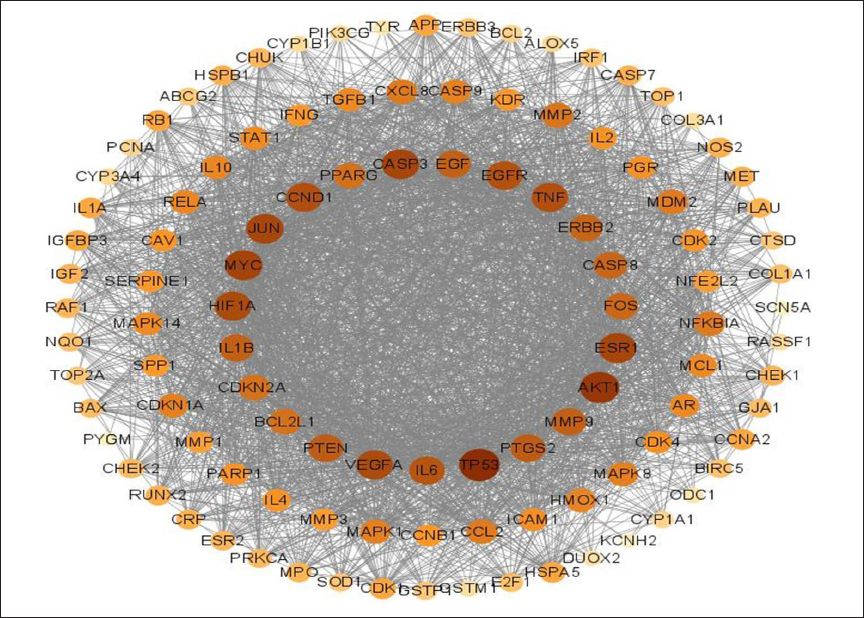
The Degree Values of the Core Targets of Herba Epimedii Therapy for Lung Cancer.
GO Function and KEGG Pathway Analyses
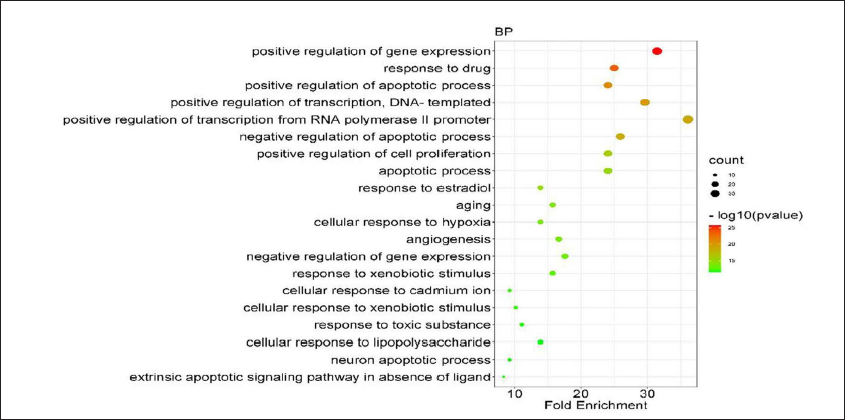
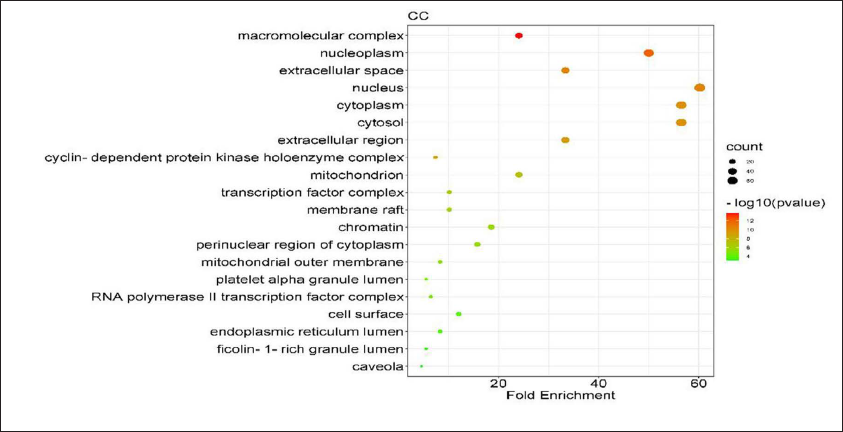
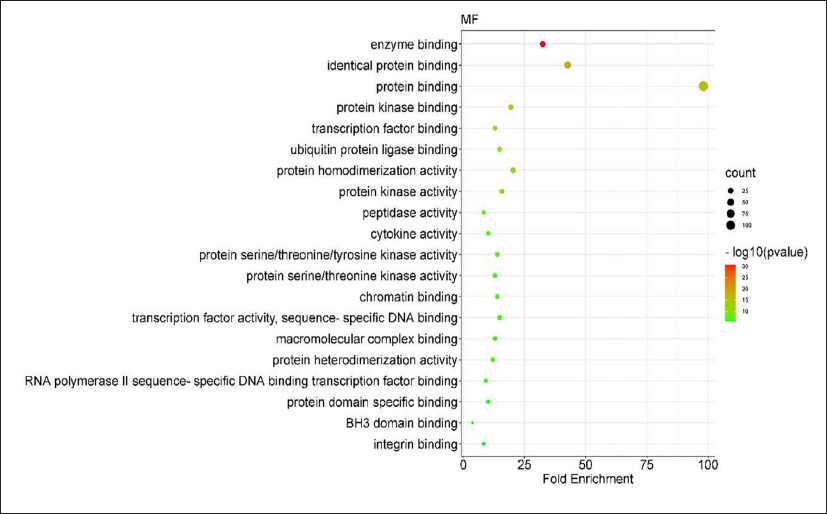
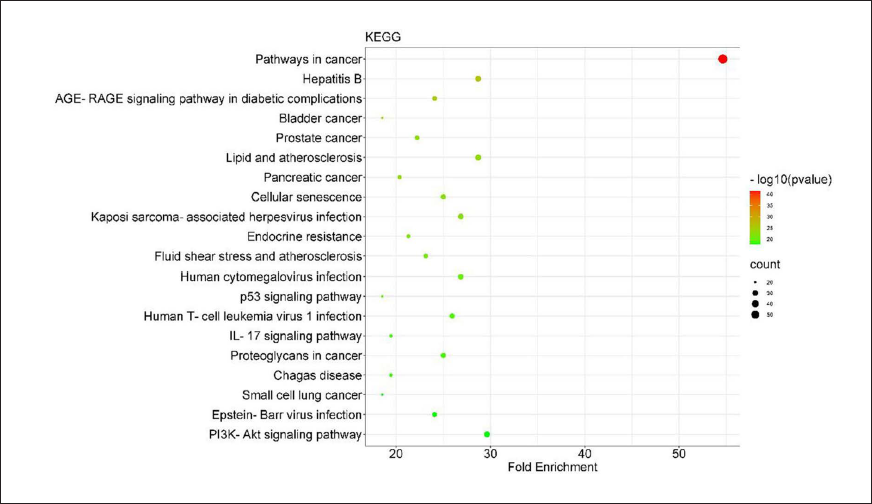
108 CTs were inputted into the DAVID database for GO function and KEGG pathway analyses. The top 20 items were chosen in ascending order of p value, respectively, and enrichment analysis bubble charts were drawn, as shown in Figures 5–8. Biological process (BP) was mainly concentrated on the positive regulation of gene expression, response to drugs, and positive regulation of the apoptotic process. Cellular component (CC) was remarkably enriched in the macromolecular complex, nucleoplasm, and extracellular space. Molecular function (MF) was mainly focused on the enzyme binding, identical protein binding, and protein binding. The CTs were mainly concentrated on cancer, hepatitis B, and other diseases. The signaling pathways associated with LC treatment by Herba Epimedii included Pathways in cancer, p53, interleukin-17 (IL-17), phosphoinositide 3-kinase-protein kinase B (PI3K-Akt), and small cell LC, etc.
Molecular Docking of the Core Components and Core Targets
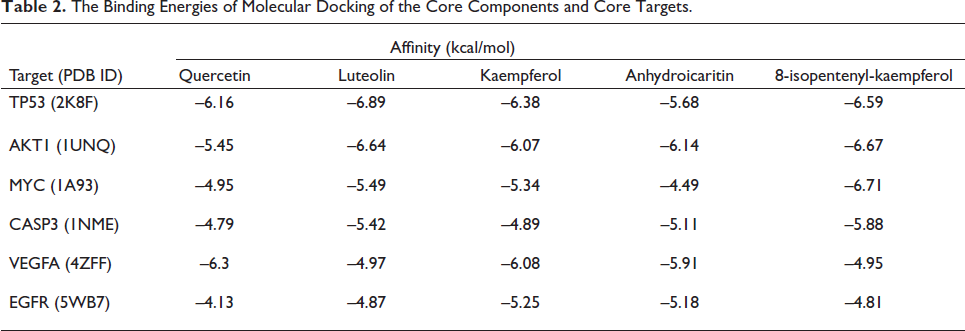
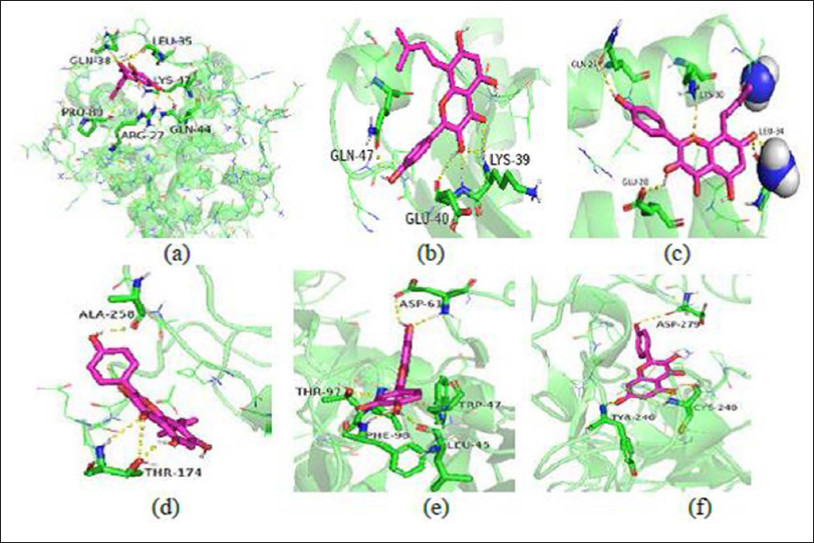
The core components of Herba Epimedii: quercetin, luteolin, kaempferol, anhydroicaritin, 8-isopentenyl-kaempferol and the screened LC core targets (TP53, AKT1, MYC, CASP3, VEGFA, EGFR) were verified by molecular docking (Table 2). Notably, the affinity of the core components of Herba Epimedii and the core targets of LC connected by hydrogen bond were strong, in which the lower the binding energy, the greater the binding activity and the better docking effect. The six target-compound pairs with the highest affinity between six core targets and five core compounds, namely, TP53-luteolin, AKT1-8-isopentenyl-kaempferol, MYC-8- isopentenyl-kaempferol, CASP3-8-isopentenyl-kaempferol, VEGFA-quercetin, and EGFR-kaempferol, were selected for visualization, as shown in Figure 9.
The Binding Energies of Molecular Docking of the Core Components and Core Targets.
Discussion
In this study, 23 ACs of Herba Epimedii in treating LC were screened out. The degree value was obtained according to the network graph of Herba Epimedii-AC-CT-LC. Five ACs were selected according to their degree values, including quercetin, luteolin, kaempferol, anhydroicaritin, and 8-isopentenyl-kaempferol. In recent literature reports, most of these components have been proven to exhibit anticarcinogenic effects. However, the anticarcinogenic effects of anhydroicaritin and 8-isopentenyl- kaempferol on LC have yet to be reported. Quercetin can induce apoptosis as well as inhibit the metastasis and invasion of LC A549 cells by down-regulating the expression levels of MMP-9 and TGF-β1 (Zhao & Zhang, 2015). Quercetin can diminish the proliferative, migrative and invasive abilities of LC A549 cells via inhibiting STAT3 signaling pathway (Li et al., 2017). Luteolin can suppress the growth of LC in cells and animal models by down-regulating the expression of LIMK1 (Zhang et al., 2021a). Luteolin can also inhibit the proliferative, migrative and invasive abilities of human LC A549 cells as well as induce apoptosis via up-regulating the expression of caspase-3 and down-regulating the expression of p-Akt, MMP2 and MMP9 (Ren et al., 2019). Kaempferol can inhibit proliferation and promote apoptosis of LC cells H1299 and A549 by inhibiting the phosphorylation of Akt, affecting the expression of Bcl-2 family proteins, and regulating CASP3 and CASP7 (Wang et al., 2021). Kaempferol can suppress proliferation, and promote apoptosis and autophagy in A549 cells via up-regulating microRNA-340 and PTEN, and inactivating PI3K-Akt pathway (Han et al., 2018). In view of these, this study implies that multi-ACs of Herba Epimedii are effective against LC by inducing apoptosis and inhibiting proliferation, invasion and metastasis of LC cells.
In the present work, 12 core targets of Herba Epimedii in treating LC were screened according to the PPI network, including AKT1, TP53, CASP3, MYC, JUN, ESR1, HIF1A, VEGFA, TNF, CCND1, EGFR, and IL-6. TP53 is a common mutated gene in non-small cell LC (NSCLC), and the mutation of TP53 can be detected in more than 80% of squamous cell carcinoma and 45% of adenocarcinoma tissues, which promotes tumor cell migration by regulating Rho GTPase protein activity (Xu et al., 2018). The abnormality of TP53 plays a major role in lung epithelial cell oncogenesis, which also induces a poorer survival prognosis and influences treatment responses of LC (Mogi & Kuwano, 2011; Steels et al., 2001; Viktorsson et al., 2005). As an oncogene, AKT1 is responsible for the occurrence and development of NSCLC. The higher its expression, the lower the differentiation degree, the higher the malignancy degree and the worse the prognosis of NSCLC (Wang et al., 2016). AKT1 can promote NSCLC cell survival, growth and migration, which may be related to the decrease in IkB-α expression and basal MEK/ERK1/2 activity (Lee et al., 2011). MYC family oncogenes are amplified and overexpressed in 20% of small-cell LCs, contributing to LC cell growth and regulating the expression of invasion, stem cell characteristics, cell cycle and apoptosis-related genes (Tokgun et al., 2020). The aberrant expression of MYC promotes tumorigenesis and progression of LC, which is associated with resistance towards therapy (Massó-Vallés et al., 2020). CASP3 is associated with TNM staging and metastasis of NSCLC, suggesting that the down-regulated expression and deletion of CASP3 can reduce tumor cell apoptosis, which is closely related to tumor genesis and progression (Li et al., 2019). VEGFA can combine with VEGFAR-2, which activate intracellular signal transduction, produce biological effects, stimulate the migration and proliferation of vascular endothelial cells, promote tumor angiogenesis, and accelerate the occurrence and development of NSCLC (Shi & Tong, 2017; Zhao et al., 2020). In NSCLC, EGFR mutations can activate downstream signaling pathways related to tumorigenesis and development (Li et al., 2021). The EGFR-TKI has emerged as the primary therapy for advanced NSCLC harboring EGFR-sensitive mutations, while a negative association exists between EGFR mutation and the presence of PD-1 and PD-L1 expression (Jiang et al., 2021). The molecular docking data of this study indicated that the core components of Herba epimedii had good binding potential with the core targets of LC (TP53, AKT1, MYC, CASP3, VEGFA, and EGFR), suggesting that Herba Epimedii played a role in suppressing LC mainly through the core targets.
The KEGG analysis in this study demonstrated that several signaling pathways (e.g., p53, IL-17, and phosphoinositide 3-kinase-protein kinase B [PI3K-Akt]) were associated with the therapeutic effect of Herba Epimedii on LC. The p53 signaling pathway serves as a crucial tumor suppressor pathway, playing a pivotal role in governing the proliferation, cell cycle regulation, invasion, and metastasis of cancer cells when activated (Lacroix et al., 2020). The p53 signaling pathway is activated, which can remarkably inhibit the invasion and metastasis of human LC A549 cells (Zhang et al., 2021b). IL-17 signaling pathway can contribute to LC metastasis and progression by promoting angiogenesis and proliferation of tumor cells (Wu et al., 2016). IL-17 can promote the metastasis and invasion of LC cells via inducing epithelial-mesenchymal transformation and activating NF-κB/ZEB1 signaling pathway (Gu et al., 2015). PI3K-Akt pathway plays vital roles in the proliferation, survival, tumor progression and chemoradiotherapy resistance of LC cells (Pu et al., 2011). It is activated by cell proliferation signals produced by the binding of transmembrane receptors and ligands, which can contribute to the proliferation and survival of NSCLC (Huang & Fu, 2015). In view of these, this study believes that Herba Epimedii can suppress the proliferation, metastasis, invasion and drug resistance of LC cells by activating p53 signaling pathway and inhibiting PI3K-Akt and IL-17 signaling pathways.
Conclusion
In summary, this research demonstrated the potential mechanisms of Herba Epimedii in LC treatment based on molecular docking and network pharmacology methods. The data revealed that quercetin, luteolin, kaempferol, anhydroicaritin, 8-isopentenyl-kaempferoland, the core ACs of Herba Epimedii, could play a critical role in LC treatment by acting TP53, AKT1, MYC, CASP3, VEGFA and EGFR. Herba Epimedii may produce curative effects on LC by regulating multiple signaling pathways (e.g., p53, IL-17, and PI3K-Akt). The findings indicated that the mechanisms of Herba Epimedii for LC treatment involved diverse components, targets, and signaling pathways. The limitations of this study were that network pharmacology might neglect the content of each component in Herba Epimedii and the possible formation of new compounds in the process of Herba Epimedii decoction. Nevertheless, molecular docking and network pharmacology methods have proven to be invaluable tools, conserving significant scientific resources and facilitating efficient screening of the key components and targets involved in the treatment of LC with Herba Epimedii. These approaches can provide valuable references for future research endeavors.
Footnotes
Abbreviations
OB: Oral bioavailability; DL: Drug-likeness; ACs: Active components; CTs: Common targets; LC: Lung cancer; PPI: Protein-protein interaction; GO: Gene ontology; KEGG: Kyoto encyclopedia of genes and genomes; PDB: Protein data bank; TCMSP: Traditional Chinese Medicine Systems Pharmacology; NAF: Network analyzer function; MF: Molecular function; CC: Cellular component.
Availability of Data and Material
The data used to support the findings of this study are available on request from the corresponding author.
Declaration of Conflicting Interests
The author declared no potential conflicts of interest with respect to the research, authorship, and/or publication of this article.
Funding
The author received no financial support for the research, authorship, and/or publication of this article.
