




Abstract
Background
Dendrobium officinale is a valuable medicinal food plant in China, and its component gigantol has various biological activities. However, due to the low extraction rate of gigantol, its application in the functional food industry is limited. This research aimed to explore an effective gigantol extraction method.
Results
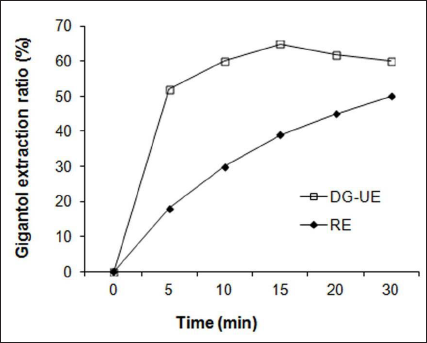
Ultrasonic-assisted dry grinding extraction of gigantol from D. officinale almost reached completion after 15 min. The extraction rate of gigantol reached 65%, which was higher than that of the conventional heating refluxing method of extraction. Most cells were broken, and particle size was approximately 410 nm when D. officinale was ground for 15 min.
Conclusion
The results indicated that ultrasonic-assisted dry grinding is a highly effective gigantol extraction method that is valuable for the efficient use and low-cost extraction of gigantol from the medicinal food plant D. officinale. Furthermore, this method will be beneficial for the future application of gigantol in the functional food industry.
Introduction
Dendrobium officinale is an edible plant that has been used in China for thousands of years (da Silva, & Ng, 2017). It is useful for medical treatment and health care. D. officinale has been proven to have significant pharmacological effects, such as inhibiting oxidation (Huang et al., 2015a), immune enhancement (Huang et al., 2015b; Lau et al., 2011), antitumor response (Sun et al., 2015; Zhao et al., 2014), improving diabetes (Hou et al., 2016), liver protection (Li et al., 2014), and others. D. officinale is frequently processed into granules, capsules, extracts, and wine as a functional health food, but can also be made into tea, squeezed to extract the juice, and stewed in soup and other dishes. D. officinale has been approved as a medicinal food plant by the National Health Commission. Wu et al. (2022) treated ICU patients with severe pneumonia with anti-infection drugs and D. officinale. It was found that after treatment, the levels of inflammatory indexes (IL-6, PCT, WBC) in the study group were lower than those in the control group, and the levels of immune function indexes (IgA, IgG, C3, C4) were higher than those in the control group, which could effectively inhibit the inflammatory reaction, regulate immune function and relieve clinical symptoms (Wu et al., 2022). Gigantol, a bibenzyl phenolic compound in D. officinale (Miyazawa et al., 1997), is often used as a quality indicator of D. officinale. Gigantol is shown to have multiple biological activities, such as antitumor response (Bhummaphan, & Chanvorachote, 2015; Unahabhokha et al., 2016), immune enhancement (Won et al., 2006), anti-cataract activity (Fang et al., 2015; Wu et al., 2015), acute myocardial infarction protection (Fan, 2022), anti-inflammatory (Wang, 2020; Zhao et al., 2022), liver protection (Xue et al., 2020; Zhang, 2021), It has broad application prospects in the food and medicine industries.
Gigantol is usually extracted by stone cutting, slicing or simply powdering the raw material and then by refluxing (Chen et al., 2022; Huang et al., 2022; Xie et al., 2018). Among these extraction methods, D. officinale is easy to float when boiled or soaked. However, the dissolution rates are low, resulting in low extraction rates of gigantol, and result in wasting D. officinale resources.
Extracting effective components from medicinal food plants is an essential part of functional food production. Due to the variety of medicinal food plants and their different properties, a reasonable extraction process and advanced technology are directly related to the consumption of materials and energy, indirectly affecting the quality and efficacy of products. There are three steps to extracting effective components (Du et al., 1999), (1) solvent wets large granules of materials and permeates into the cells; (2) soluble substances inside cells dissolve in the solvent; and (3) soluble substances diffuse from the inside of the granules, and from the surface of the materials, into the solution. Therefore, in an efficient extraction, the resistance of diffusion is large, the path of mass transfer is long, and the area of mass transfer is small.
By reducing the particle size of the materials, especially by cell-level ultrafine grinding, the diffusion resistance and path of mass transfer can be decreased, and the dissolution area can be enlarged. This is beneficial to the rapid and complete dissolution of active ingredients (Yuan et al., 1997). When the crude material has been dry-ultrafine pulverized and extracted by an ultrasonic-assisted method, the solvent can reach the plant tissues and the effective components can dissolve into the solvent rapidly. This will achieve highly effective extraction and has prospects for industrial application.
In the present study, we explore a highly effective approach to extracting gigantol based on the ultrasonic-assisted dry grinding method. Here, we first established an analysis method for gigantol. Then, we investigated the effect of crushing time on extraction rate. We also analyzed grain size distribution and the pulverized particles with different pulverizing times. Our results will improve the extraction rate of gigantol, which will be important for the efficient use of the medicinal food plant D. officinale and in reducing the cost of such extraction.
Materials and Methods
Chemicals and Reagents
All reagents or solvents used were of analytical or high-performance liquid chromatography (HPLC) grade. Absolute methanol, acetonitrile, and formic acid were purchased from Sigma-Aldrich (St. Louis, MO, USA). Gigantol standard sample was purchased from Macklin (Macklin Biochemical Technology Co., Ltd., Shanghai, China).
Plant Materials
D. officinale was used in this study. This study did not involve endangered or protected species or locations. D. officinale stem was purchased from Conba Food and Pharmaceutical (Zhejiang, China). The stem was cut into slices, freeze-dried, and stored in a vacuum pack at 4°C.
Ultrasonic-Assisted Dry Grinding Method
Lyophilized slices of D. officinale (50 g) were put into an ultrafine pulverizer. The powders (1 g) were sampled at different time points (5, 10, 15, 20, and 30 min). Methanol (95%, 30 mL) was added to the powders. The samples were ultrasonically extracted (powered at 200 W) for 30 min, centrifuged (rotation speed of 8000 rpm), and the supernatant was used to obtain gigantol extract.
Establishment of a Gigantol Analysis Method
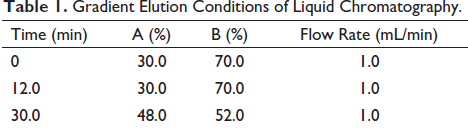
The mobile phase contained acetonitrile (A) and water (containing 0.01% trifluoroacetic acid, B). The gradient elution conditions are shown in Table 1. The column temperature, injection volume, and detection wavelength were set as 25°C,10 µL, and 280 nm, respectively.
Gradient Elution Conditions of Liquid Chromatography.
The gigantol standard sample (5 mg) was dissolved in methanol to obtain a standard stock solution (1 mg/mL). The solution was diluted with methanol to prepare standard working solutions (0.01, 0.001, 0.0001, and 0.00001 mg/mL). The peaks of the standard working solutions were determined with the aforementioned chromatographic conditions. The peak areas were plotted on the ordinate and the concentration was plotted on the abscissa to obtain a standard curve.
Grain Size Distribution Study
D. officinale powders were sampled at different time points of dry grinding (5, 10, 15, 20, and 30 min) and suspended in water. The suspensions were placed in a particle size distribution meter and tested to obtain the particle size distribution data. OriginLab (OriginLab Corporation, Northampton, MA, USA) software was used to analyze the data.
Scanning Electron Microscopy Analysis
D. officinale powders from different time points of dry grinding (5, 10, 15, 20, and 30 min) have adhered to a copper sheet and the microscopic morphologies were observed by scanning electron microscopy.
Data Analyses
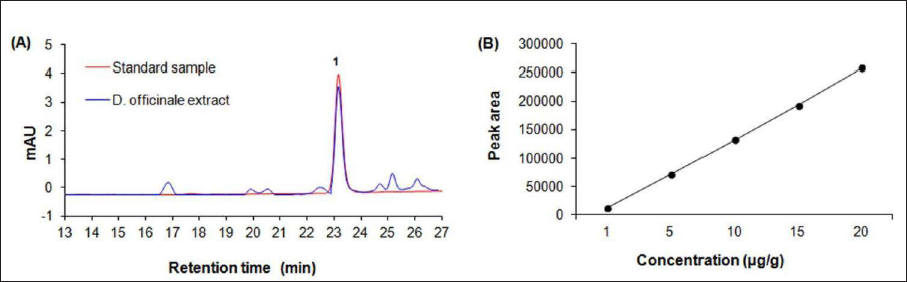
To establish a method for determining gigantol concentrations, standard samples comprising five different gigantol concentrations were tested. The relationship between peak area (Y) and gigantol concentration (X) was established based on the following equation (correlation coefficient, R2 = 0.9997), which indicated that the method could be used for the determination of gigantol concentrations.

Results and Discussion
Gigantol represents a functional factor in D. officinale. It has been proven to have antitumor activity against lung cancer. Bhummaphan and Chanvorachote (2015) found that gigantol reduced lung cancer activity by inhibiting the signal of protein kinase B (Akt), thereby reducing pluripotency and the cellular level of self-renewal factors Oct4 and Nanog (Bhummaphan & Chanvorachote, 2015). Unahabhokha et al. (2016) showed that gigantol significantly reduced the viability of lung cancer cells in isolation (Unahabhokha et al., 2016). Huang et al. (2021) also found gigantol could inhibit the proliferation of Breast Cancer (BC) cells and enhance DDP (Cisplatin)-induced apoptosis through downregulation of the phosphoinositide 3-kinase/protein kinase B/mammalian target of rapamycin (PI3K/Akt/mTOR) signaling pathway in BC cells. Fan et al. (2019) concluded that 25 and 50 mol/L gigantol could inhibit the migration and invasion ability of osteosarcoma U20S cells, and at the same time, it could inhibit the expression of NF-kB, TNF-ɑ, IL-6, PRL-3, and other proteins by transwell test. Gigantol also has immunoregulatory and anticataract activity. Won et al. (2006) found that gigantol inhibited the production of NO, PGE2, TNF-ɑ, IL-1b, and IL-6 by inhibiting activation of the NF-kB pathway of macrophage RAW264.7 induced by lipopolysaccharides. Fang et al. (2015) found that gigantol inhibited cataract formation by inhibiting the gene expression and activity of aldose reductase (AR) and iNOS, anti-cataract activity. Wu et al. (2015) found that gigantol can effectively protect human lens epithelial cells from apoptosis induced by D-galactose, and anti-cataract activity. Therefore, gigantol has a wide range of application prospects in the functional food industry. The extraction of gigantol has been explored in recent years. Xie et al. (2018) studied the effect of sections and segments on the extraction of gigantol from D. officinale. Wu et al. (2021) optimized the extraction process of gigantol by response surface methodology. However, the extraction rate of gigantol is low at present, which will be an important bottleneck limiting its wide application in the future. Ultrasound technology is a pre-treatment for the extraction of bioactive compounds as a prerequisite for food safety (Cui et al., 2021; Iftikhar et al., 2020; Jiang et al., 2021; Perera & Alzahrani, 2021; Sharma et al., 2021). Therefore, it is necessary to develop more efficient gigantol extraction methods. Here, we explore a more effective approach to extract gigantol based on the ultrasonic-assisted dry grinding method.
Establishment of a Gigantol Analysis Method
We established an HPLC method for gigantol analysis. The chromatograms of the gigantol standard sample andD. officinale extract are shown in Figure 1A, respectively. The standard curve is shown in Figure 1B. In this method, the recovery rate, average relative error, average relative deviation, and coefficient of variation were 89.1%–102.3%, 1.1%–2.3%, 1.0%–2.1%, and 2.2%–3.1%, respectively. According to these data, the recovery rate, precision, and accuracy were very good, indicating that the HPLC method for gigantol analysis is reliable. improve the detection efficiency. Although the established method is sensitive, specific, and reliable, some disadvantages such as the need for highly trained personnel and expensive instruments, complicated sample pre-processing, and high cost, make it not suitable for onsite detection (Duan et al., 2021a,b). In contrast, immunoassays (enzyme-linked immunosorbent assay and immunochromatographic assay) and fluorescent probes have the advantages of simple operation, low consumption, and low cost. They have been widely applied to food quality control (Duan et al., 2021a,b; Duan et al., 2022; Li et al., 2019; Poungmalai et al., 2021; Xiao et al., 2021), disease diagnosis (Li et al., 2021; Yang et al., 2020; Zhang et al., 2022), and environmental pollutant analysis (Li et al., 2020; Ling et al., 2021; Yu et al., 2021). Advanced testing methods of gigantol like these should be explored to simplify the operation and improve detection efficiency.
(A) High-Performance Liquid Chromatogram; (B) Standard Curve of Gigantol.
Influence of Grinding Time on Extraction Rate
We have evaluated the relationship between extraction rate and grinding time in the ultrasonic-assisted dry grinding method. The conventional heating refluxing method was also carried out for comparison. Curves depicting the gigantol extraction rate and grinding time are shown in Figure 2. The results show that the ultrasonic-assisted dry grinding extraction of gigantol almost reached completion after 15 min. The extraction rate decreased after 20 min. The extraction rate of gigantol in the d ultrasonic-assisted dry grinding extraction method at 15 min reached 65% while attaining only 5% in the conventional heating refluxing method. The total extraction rate of gigantol in the conventional heating refluxing method after 30 min was only 50%. This indicates that the extraction rate of gigantol in the ultrasonic-assisted dry grinding extraction method was higher than that of the conventional heating refluxing method. In recent years, there have been continuous efforts to find novel, simpler, sustainable, safe, greener, and cost-effective techniques to extract active natural products (More et al., 2022). The food industry is interested in assisted novel extraction techniques (Jha & Sit, 2022), such as ultrasound-assisted (Tiwari, 2015), microwave-assisted (Rodsamran & Sothornvit, 2019), and enzyme-assisted (Marathe et al., 2019). Many studies have shown that combining novel extraction strategies can be effective for rapid and efficient extraction (Chemat et al., 2017).
Grain Size Distribution Study
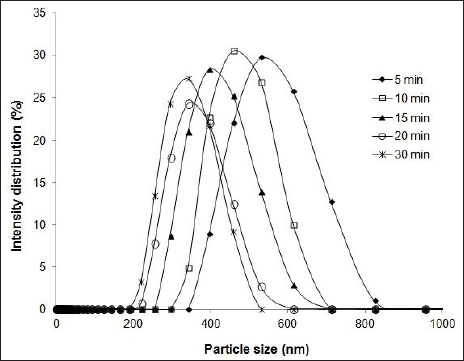
Grinding or cutting material can increase the surface area for proper mixing of materials with the solvent (water, oil, alcohol, etc.). Sample particle size has an impact on extraction efficiency (Jha & Sit, 2022). The grain size distribution was studied. These results are shown in Figure 3. It can be seen that the particle size was approximately 410 nm in size when D. officinale was ground for 15 min. Extension of the grinding time leads to the production of smaller particle sizes. The particle size after 20 min and 30 min of grinding was 356 nm and 351 nm, respectively. However, the extraction rate of gigantol did not increase significantly with the extension of grinding time after 15 min. The reason for this may be that the plant tissue was further broken into smaller particles and the surface area increased greatly, which adsorbed some gigantol and resulted in a lower extraction rate.
Particle Size Distribution of D. officinale by Ultrasonic-assisted Dry Grinding Method.
Scanning Electron Microscopy Analysis
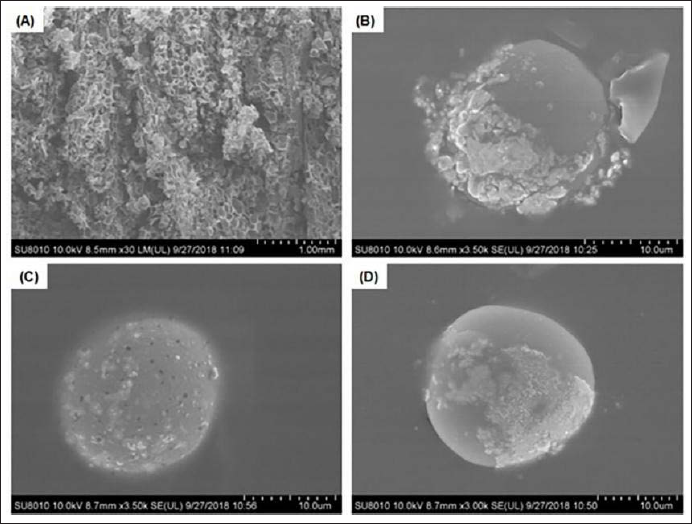
To better understand the microscopic morphologies of D. officinale particles, scanning electron microscopy analysis was performed. These results are shown in Figure 4. The original lyophilized slice of D. officinale had a defined cell structure and complete tissue. Most of the cells were broken after being ground for 5 min and the number of particles increased. The particles got smaller at 15 min and D. officinale was fragmented completely at 20 min. From the perspective of the formation process of particles, under the action of mechanical force by high-speed grinding of the raw materials, the violent impact and shear action result in the fragmentation of the plant tissues and cell walls, the particle size is gradually reduced and the surface area increased, and the intracellular molecules are released from the metrics (Fan et al., 2022). Considering the relationship between the extraction rate of gigantol and grinding time, the extraction rate at 15 min was higher than that at 20 min. Microscopically, the particle fragmentation was higher, the surface area became larger, and the adsorption capacity was enhanced, which decreased the extraction rate. This result is consistent with the above findings.
P-SEM Picures of (A) Original D. officinale Particles; (B) D. officinale Particles After Grinding for 5 min; (C) D. officinale Particles After Grinding for 15 min; (D) D. officinale Particles After Grinding for 20 min.
Conclusion
In conclusion, we explored a highly effective approach to extract gigantol based on the ultrasonic-assisted dry grinding method. When this method was used for 15 min, the extraction rate of gigantol reached 65%, and the process was near complete. However, the extraction rate of gigantol using the conventional heating refluxing method for 30 min was only 50%. These results will be important for the efficient and low-cost use of the medicinal food plant D. officinale. Additionally, it will benefit the future application of gigantol in the functional food industry.
Footnotes
Declaration of Conflicting Interests
The authors declared no potential conflicts of interest with respect to the research, authorship, and/or publication of this article.
Funding
This study was financially supported by the National Key Research and Development Program of China (2022YFC2010104), the National Natural Science Foundation of China (31501683), and the Central Public-interest Scientific Institution Basal Research Fund (S2019RCJC03).
Statement of Informed Consent and Ethical Approval
Not applicable.