




Abstract
Income growth for smallholder sunflower farmers is persistently dominating the writing due to the crop’s contribution to the national economy. Ponders are proceeding to divulge challenges going up against smallholder sunflower agriculturists around the globe. This study assesses whether the market knowledge gap hinders the income growth of smallholder sunflower farmers. Kongwa district of Tanzania is recruited as a study area. A Case study is used as a design where data were collected through interviews, Focus Group Discussion and observation from thirty (30) participants. The findings discovered that limited market knowledge attributed to an unfriendly selling system affects the income growth of smallholder sunflower farmers. Also, poverty and lack of a communication platform between the LGA and smallholder sunflower farmers are other discovered factors. The study recommends changing the modality of using middlemen to allow farmers to sell crops directly to the buying companies, establish farmer’s cooperatives and ensure continuous sharing between smallholder sunflower farmers and the LGA.
Introduction
Sunflower is one of the crops that is worldwide produced as a commercial crop. About 87% of the world’s sunflower crop is cultivated in Russia, Ukraine, Argentina, the European Union, India, China and the USA. Other countries include Canada, Turkey, Bulgaria and Romania. The remaining 13% is produced by the rest of the world (Food and Agriculture Organization [FAO] 2014).
Recently, Ukraine had the highest production volume of sunflower world in 2019/2020. Ukraine produced around 16.5 million metric tons of sunflowers. In 2021/22 it produced 17.5 million metric tons. Russia produced 15.3 million metric tons in 2019/2020. The crop produces cooking oil and largely its market includes Europe, the Middle East and the USA (Shahbandeh 2022).
Globally, the demand for edible sunflower oils is increasing. China and India are emerging markets for sunflower cooking oil (Klynveld Peat Marwick Goerdeler International 2011). However, Konyali (2017) entails that sunflower-planted areas and production decreased in the last years due to low prices mainly in Turkey and other parts of the world. In Africa, sunflowers account for 5.5% of the world’s production with strong growth experienced in the past decade (2005–14) in countries, such as Tanzania, Uganda and South Africa as revealed in the Sunflower Sector Development Strategy (SSDS) 2016–20 of Tanzania. Mostly, in Africa, the production is done by smallholder farmers. Despite the extensive engagement of smallholder farmers in crop cultivation, their income remains stagnant (Huka et al 2014). This is due to price fluctuations, poor mechanism of production and poor knowledge of the value chain (Huka et al. 2014).
In Tanzania, sunflower cultivation is traced far back to the colonial period when production focused on domestic consumption. Recently, it has changed to important commercial crops in the country. The advantages related to it, and the crop’s adaptability to a wide range of environments make it worth it. It is produced in the Eastern, Central and Southern Highlands of the country. Major regions include Njombe, Dodoma, Rukwa, Singida, Manyara, Arusha, Tabora, Iringa, Mbeya, Morogoro, Ruvuma, Kigoma and Katavi. Tanzania was ranked the 10th largest global sunflower-producing country in the world in 2013 with a production share of 2.4% and one of the largest sub-African producers (SSDS 2016–20).
The current production in Tanzania is estimated to be close to three (3) million tons per annum (Ministry of Agriculture 2018 in Ogutu 2018). Impliedly, sunflower production in Tanzania is fast growing cash crop. The production is dominated by smallholder farmers accounting for 95% of all producers. Harvesting is primarily performed manually by smallholder farmers, between May and September. After harvested, seeds are sold to local traders, both small and large, at the farm or local market; to the Agriculture Marketing Cooperatives (AMCOs) and agents operating on behalf of local processors. Small-scale processors normally sell their products locally through middlemen, whether wholesale or retail at the local market level (Maridadi, 2013). In some cases, they sell oil to larger processors. It is estimated that locally produced-sunflower oil can satisfy approximately 35%–40% of the local demand for edible sunflower oil (Food Business Africa 2018; Mgeni et al. 2019).
It is important to note here that there are no pure sunflower millers. Instead, they process and market locally produced oilseeds as available. Tanzania’s exports of sunflower products remain low. In 2014, the country exported 93.2% of its sunflower seeds to India, while a further 3.6% was sent to Myanmar and the United States. India and Rwanda accounted for 3.6% and 3.5% respectively (SSDS 2016–20). Currently, Tanzania’s top export markets for sunflower seeds are Malawi, Burundi, China, the Netherlands and Kyrgyzstan (Bank of Tanzania [BoT] 2018).
The crop contributes to the national income and is becoming a dependable commercial crop. Being produced by smallholder farmers, one would expect income growth from such farmers. However, their income growth remains a myth. Research on Poverty Alleviation (2010) entails wholesalers who buy crops before harvest are the major reason for such a catastrophe. Again, a lack of education and poor government support affect sunflower production (Mameho et al. 2014).
Moreover, Anderson et al. (2016) show poor production and dependency on rain-fed cultivation, poor use of hybrid or improved seeds—the same price if offered by buyers and the selling of products immediately after harvesting affects income growth.
Looking at the case study, Kongwa district, sunflower farming is dominant. Kongwa is endowed with plain and fertile land suitable for sunflower farming. Most farmers practice small-scale farming. The minimum farm size is two acres and twenty acres. There is an increasing demand for sunflower oil in Kongwa. The oil market is growing faster than it was expected (Sebyiga 2020).
However, crop farming is still poor, characterized by low and erratic rainfall, poor methods of farming by hand hoes, animals and minimal tractors and few farmers use manure for their farms (Sebyiga 2020; The United Republic of Tanzania 2013). Sunflower farmers in Kongwa are marked by low incomes and extreme poverty (World Food Programme 2013).
Most studies have been on farming methods, tools and government support but shallowly touched on the smallholder farmers’ knowledge of the market contributing to poor income growth. This study addresses the lacuna. It is built along two objectives; one, to assess the effect of the market knowledge of smallholder sunflower farmers on their income growth. Two, to examine the understanding of the government on smallholder sunflower farmers’ income growth.
Hindrances to Income Growth of Smallholder Sunflower Farmers: Empirical Studies
Studies have been keen to address issues related to the income growth of smallholder sunflower farmers. Sebyiga (2020) entails that farmers produce to feed oil processing machines for a few months after harvest. On a similar aspect, Mchopa and Jeckoniah (2018) advise smallholder sunflower farmers to engage in other social-economic activities to increase their income.
The SSDS (2016–20) unveils that smallholder sunflower farmers do not have significant storage facilities forcing selling as soon as possible after harvest. This affects the bargaining ability of farmers without holding power, resulting in manipulation by middlemen by pressurizing them to harvest earlier or selling soon after harvest.
Furthermore, Sintoo (2015) uncovers that low prices, unreliable markets, poor extension services, lack of market information, lack of credits and poor infrastructure affect income growth. Huka et al. (2014) insist the income of smallholder farmers depends on the price stability of their farm products.
Besides, Ugulumu and Inanga (2013) revealed that market accessibility is characterized by poor information flow among the sunflower stakeholders. Thus, the consideration of horizontal and vertical linkages between farmers and domestic buyers as well as external buyers to improve market accessibility.
Moreover, Zeng (2017) on the sunflower sector in Tanzania has proven to increase the level of sunflower production. However, the availability of quality seeds and their high price limit sunflower production. Again, lack of effective technology, poor infrastructure and lack of business linkages between large and small enterprises affect farmers’ income growth.
Additionally, Liampawe (2019) reveals poor processing skills, the poor relationship among sunflower stakeholders in the chain, the non-existence of sunflower producers’ organization, land conflict and poor market infrastructures as factors affecting the income growth of farmers.
Sunflower Marketing Channel in Tanzania
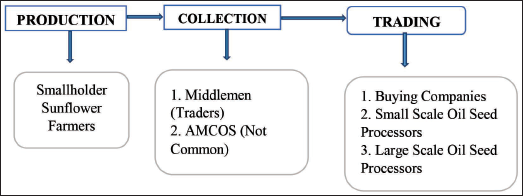
The sunflower channel is anchored along several stages. The sunflower is cultivated by smallholder farmers. After harvest, there are two ways to sell sunflowers; one; through middlemen (dominant) and two; selling directly to the market. There is an established crops/food market, usually by the LGA, from which the crops are sold (Isinika & Jeckoniah 2021). For instance, at Kongwa, there is Kibaigwa International Food Market. The market sets the minimum price for each crop on the market.
Citing middlemen, they usually buy at a lower price from farmers and sell at higher prices at the market to buy companies in bulk. Sometimes middlemen receive money for buying seeds from buying companies hence acting as their agents (Isinika & Jeckoniah 2021). They will wait until the price is high at markets to sell (Bank of Tanzania 2017).
Again, some middlemen own small-scale processing factories for which they process with inefficient technology. This is a value-adding strategy for them (Elibariki 2022).
Few farmers would sell through cooperatives, which sometimes may delay the selling. This affects farmers because they depend on sunflowers to fulfil their basic needs. Farmers wish soon after harvest to sell their crops without waiting during the peak of higher prices (Figure 1).
Existing Role of LGAs in Sunflower Marketing
LGAs in Tanzania have significant roles in sunflower marketing. They establish infrastructure like the market for selling crops. The market is essential not only to farmers but also to the LGAs because they are collecting revenue from it. LGAs through market administration give directions on the minimum price of crops depending on the world market. Also, LGAs have to ensure that the crop sold on the market meets the standards required. This is done to encourage sellers to produce crops of a high standard. Moreover, LGAs have to advise and educate farmers on the proper methods of farming. This is done through agricultural extension officers. They visit farmers, educate and encourage them (Elibariki 2022).
Johari Window: An Approach to the Study of Market Knowledge
This study applied a Johari Window approach to assessing the market knowledge of smallholder sunflower farmers and its effects on income growth. The approach was developed by American psychologists Joseph Luft and Harry Ingham in the 1950s, calling it Johari after combining their first names. It is a participatory communication approach to study group dynamics, team development and inter-group relationships (Bergquist 2009; Nofriza 2017).
Johari Window is relevant in modern studies due to its emphasis on the influence of knowledge on self-groups and other groups and their interpersonal development. It also represents the feelings, attitudes, experiences, views, skills and motivation of a certain group and another group towards the former. It assesses groups in relation to others, there is a self-group and the other group. In this case, the self-group will be small-holder sunflower farmers and the other group will be the government (Shamoa-Nir 2017).
It helped to gain market knowledge on farmers and relate it with that of the government on sunflower marketing. This was due to, in one instance, smallholder farmers selling sunflower crops to improve their income. On the other, the government is supposed to establish an enabling environment to improve farmers’ income. All these require a common understanding between both parties on the strategy to be applied. This study intends to find out the gap in this aspect and how it affects the income growth of farmers.
There are two dimensions involved in this approach, one, what the person knows about himself and is also known to others, and second, what other people know about the respective person identified in dimension one (Osmanoglu 2019). This results in four windows/dimensions/quadrants that will be used as a focus for this study.
The first quadrant elaborates information that is known by both self and others. This is mostly known as an open area (Lowes 2020). For this study, this quadrant was used to study the knowledge of both the Kongwa District Council and farmers. The second quadrant is concerned with hidden knowledge, which is an area where knowledge is known to an individual/group but not known to others. Here, the hidden area is marketing knowledge that farmers have but is not known to the LGA.
The third quadrant is their hidden knowledge. This is an area which studies information that is known to others but not to yourself. Here, the knowledge of marketing strategies is known to LGA but not known to farmers. The fourth quadrant studies knowledge which is not known to both sides. Here, the marketing knowledge is unknown to both farmers and the LGA as Table 1 shows.
Illustration of Johari Window Approach.
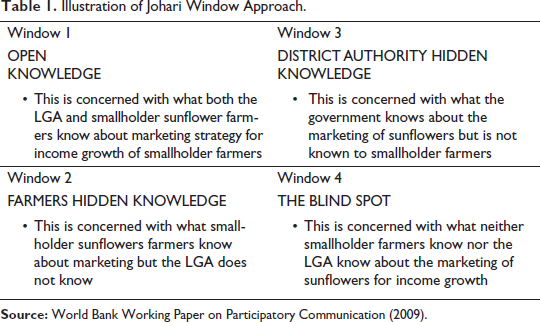
The application of this approach was essential to unveil marketing knowledge as a factor for the income growth of smallholder farmers. Also, identifying the hidden knowledge that is essential for both the LGA and smallholder sunflower farmers helps them to share so that they can improve the marketing knowledge and practices that will help smallholder sunflower farmers increase their income.
Study Methodology
Study Design
This study was built along with a case study design. This is one of the qualitative designs which is said to be powerful in studying the opinion, attitudes and perceptions of individuals about a studied phenomenon. It bears the characteristics of an in-depth study of the research problem (Bhatia 2018). The design is derived from the interpretivism philosophy of viewing epistemology, which contends that knowledge is relative and cannot be generalized. Knowledge is constructed by interpreting an individual’s opinion, behaviours, ideas and perceptions (Creswell and Poth 2016; Lauri 2019). The design suited the study since it assessed the opinion and experience of smallholder sunflower farmers and the government on the marketing of sunflowers. Hence, seeking their opinion and experience and interpreting them was essential for the completion of this project. Due to this, the essentiality of this design as provided helped to accomplish this study (Tong et al. 2012).
Selection of the Study Area
This study was conducted in the Kongwa district. Kongwa is one of the seven districts of the Dodoma region of Tanzania. It has one district council which is focused on it. The national census of 2012 shows that the district had a population of 309,973, and females 160,752 and males 149,221 with an average of 5 persons per household, though the numbers probably have increased from that time to date. The district is located in the eastern-central part of the country; it is bordered to the north by the Manyara region, to the east by the Morogoro region, to the south by the Mpwapwa district and to the west by Chamwino district (President’s Office Regional Administration and Local Government 2016).
Three villages, which are Kibaigwa, Manyata and Pandambli from two wards of Kibaigwa and Pandambili were purposely selected respectively from the study area. The selection of villages was also attributed to the fact that one of them hosts the Kibaigwa market, which is an international market for selling crops in East African countries. Also, these villages host smallholder sunflower farmers (Sebyiga 2020). However, there is the use of poor farming methods resulting in low productivity in these villages. Despite the use of poor farming methods, they have been producing and their production up to 2016 is in Table 2.
Sunflower Production Trend in Kongwa District.
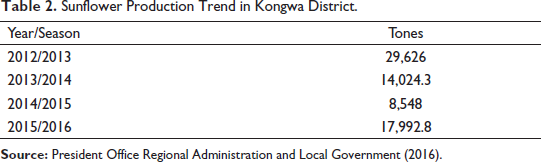
This table shows the trend of production in the district. It should be borne in mind that such tones are produced by smallholder farmers. However, their income has remained low. Hence, making Kongwa suitable for this study.
Thus, the study selected a sample from various categories of participants. Selected categories include smallholder farmers (16), District Trade Officer (DTO) (1), District Agricultural Officer (DAO) (1), Kibaigwa Ward Executive Officer (WEO) (1) and Kibaigwa Market Manager (KMM) (1). It also selected Business Middlemen (MM) (5) and Sunflower Oil Processors (SOP) (5). This made a total of 30 participants involved in this study. This sample was purposely selected so as to elicit information on the problem. This selection is supported by Yin (2014) who suggests a sample size of 25–50 for a single qualitative case.
Data Collection Methods
The in-depth interviews, Focus Group Discussion (FGD), Non-participant Observation and Documentary review were applied. The in-depth interview is a method which aims to, in-depth, collect data from participants on how they view, understand and make sense of their lives and how they assign meaning to a particular experience, events and subjects (Azad et al. 2021; Denzin and Lincoln 2011; Rubin and Rubin 2011). This method collected data from District Trade Officer, Business Middlemen, Sunflower Oil Processors, District Agricultural Officer, Kibaigwa Ward Executive Officer and Kibaigwa Market Manager.
The Non-participant observation was used in this study to assess the marketing situation in the Kibaigwa market. Under this method, the participants were not aware of the fact that they were being observed. It is said to be a powerful way of observing what is really happening in the universe because participants act without tension when they are being observed (Liu and Maitlis 2010). It specifically aimed to examine how middlemen interact with buyers in the market.
Again, FGD collected data from smallholder farmers to get their opinion, perception and experience of selling sunflowers and its effect on their income growth. FGD is accepted as a method of collecting data from many participants within a short period of time. Hence, two FGDs with eight (8) participants were formed and the discussion lasted between one to one and a half hours. FGD helped to get a consensus of participants about their marketing knowledge (Dilshad and Latif 2013; Madriz 2000; Prasad and Garcia 2017). Moreover, this study reviewed several documents. Documents reviewed included empirical studies, government reports and books related to sunflower production. Data were collected between October and December, 2021.
Data Analysis
Content analysis was applied to analyzing and presenting the study findings. Content analysis is a qualitative approach to analyzing information by systematically sorting and comparing items of information in order to analyse them. The objective of qualitative content analysis is to systematically transform a large amount of text into a highly organised and concise summary of key results (Erlingsson and Brysiewwicz 2017). Under this approach, some steps were applied. One is the identification of data sources. In this step, all sources of data were identified, including the first-hand data collected through methods identified in the data collection methods and secondary data where documents were critically analysed. Two, the development of categories. Here, categories were identified in a more understandable way. These categories were developed from the major theme of the study. Three, coding of data; in this step NVivo software was applied in coding the collected data. Four, assessing reliability; this step ensures how codes are agreed with each other. Five, analysis of data and presentation; this step ensures data is analysed and presented based on the content of each developed category.
Ethical Consideration
This research was approved by the Research and Consultancy Committee of the Local Government Training Institute to be conducted in the respective area. Again, the ethical clearance for this research was granted through the permit provided by the Permanent Secretary of the Ministry of the President’s Office of Regional Administration and Local Government (PO-RALG). The PO-RALG informed the Council Director of the Kongwa district to introduce the research team to the respective participants. After being granted permission by the Council Director, the team approached the study area for data collection.
Before embarking on the data collection exercise, the team briefly informed participants of the objective of the assignment, their importance for the research and how they are going to benefit from the research. The research team ensured that the assignment could not cause any harm to participants by ensuring confidentiality about the information they were providing. In particular, identifying characteristics of participants, such as names, was not included in the datasets. Then, the research team sought verbal informed consent from every participant who was enrolled in this assessment. However, participants had the right to refuse to participate in the assessment or withdraw at any time during the interviews, but they were strongly encouraged to participate. Moreover, the research team sought permission from the Kibaigwa market leadership to undertake the non-participant observation which was granted.
Results and Discussion
The analysis revealed several factors related to limited market knowledge, resulting in an analysis of hindrances to income growth among smallholder sunflower farmers. The revealed findings and discussion are presented below.
Knowledge Gap of the Price Increment in the Market
Smallholder farmers lack an exact understanding of the price changes at the Kibaigwa food market over the entire harvest season. This is because they do not access the market despite the fact that they are nearby. It is the middlemen that decide the price for farmers. However, farmers identify that commonly the price commences from TZS 50,000 per sack (70 kg) at the beginning of the harvest period to TZS. 100,000 at the peak of the season. This price is always set by middlemen during the buying process. There was a consensus on this argument during FGD with farmers.
Interviews with middlemen revealed that the market leadership set the minimum price of crops sold on the market, including sunflowers. This is the price they usually use as a benchmark for farmers when buying. They will deduct some amount from the recommended minimum price to buy sunflowers from farmers. In this stance, it is the middlemen who are aware of the market price and its increment. For instance, one of the sunflower middlemen revealed that,
‘…the price usually commences at TZS 55,000 per sack to TZS130, 000 at the peak of the harvest season’ (MM-4).
This shows a discrepancy between the prices at the market and what the smallholder farmers know. The study revealed that lower middlemen lower the prices so as to make a profit. In responding to this, another of the middlemen interviewed identified that,
‘…when the price is, let’s say TZS 500 per kg, I can buy at TZS 350… sell at TZS 600 to the buyer.. due to competition, of buying companies’. (MM-1)
In this chain, middlemen make huge profits at the expense of farmers. If farmers could sell directly to buying companies on the market, they could have a good selling price which is currently paid by middlemen. This could have increased their income due to selling at a reasonable market price. However, currently, it is impossible for smallholder farmers due to a lack of knowledge of the market price and its increment or fluctuation. This fact is supported by Liampawe (2019) that smallholder farmers receive price information from middlemen, thus the price increment on the market is only known to them. This makes middlemen profitable relative to smallholder farmers. Thus, this hinders the income growth of smallholder sunflower farmers.
Most Smallholder Farmers Sell at the Beginning of the Harvest Season
There was a consensus among smallholder farmers on the timing of selling the sunflower. It was revealed during FGD that they usually sell at the commencement of the harvest season, where in most cases, the selling price is low. They sell at this particular time so as to sustain their living expenses. On the other hand, the processors and middlemen, after buying, do not sell or process at the same time due to the fact that the selling is at a low price. They wait until the peak when the price is high to sell the sunflowers. This was revealed during interviews with one of the processors and middlemen.
‘…buying at the beginning gives me profit because the price is low… at the peak I process and sell products at a higher price…’ (PSOR-3). ‘…I buy at a lower price, store and then wait during scarcity… Then sell at higher price… I expand my capital for the coming harvest season…’ (MM-2).
If farmers could wait and sell at the peak when the price is high, they could make a profit on their crops. This shows how the lack of this market strategy hinders their income growth. On the other hand, processors and middlemen make a profit because they are aware of this market strategy and they utilize it effectively by taking advantage of the lack of knowledge by smallholder farmers.
The issue of selling at the beginning of the harvest season is also uncovered by Research on Poverty Alleviation (2010), which is that selling sunflowers to middlemen before or at the beginning of the harvest season hinders smallholder income growth. Also, Zilihona et al. (2013) identify that smallholder farmers sell at a low price at the beginning of the harvest season due to poor storage capacity and lack of market information. Moreover, the Sunflower Sector Development Strategy of Tanzania (2016–20), included selling sunflowers as soon as possible after harvest as a factor hindering smallholder farmers’ income growth. This is proof of the magnitude of the existing problem.
Arguably, smallholder sunflower farmers should be trained or made aware of the consequences of selling at the beginning of the harvest period and its effect on their income. Again, intervention by the government is required to ensure the issue of low storage capacity is solved so that farmers improve their income.
Hiding Buying Companies at the Market
Buying companies entails companies registered on the market as buyers of sunflower crops. The study revealed that buying companies are not known to smallholder farmers. They are just known as middlemen operating in the market. During FGD with smallholder farmers, there was a consensus on this aspect that they failed to get into contact with buyers because they were hidden by middlemen to escape the bargaining power of farmers. At this juncture, even if farmers approach the market, they will end up selling to middlemen. If you deduce the transportation cost, farmers end up without differences in price compared to when they are selling to the middlemen outside the market.
Again, when researchers visited the Kibaigwa market they observed that the buying companies are not visible in the sense that they can be accessed by farmers. The middlemen are more visible and are the ones who know where buying companies are located. In this way, middlemen are used as agents for buying companies and they get commissions from them. Arguably, if farmers have access to buying companies, they will be able to apply their bargaining power and sell at a reasonable price, which is a prerequisite for increasing their income. The issue of hiding buyers can also be reflected in Ugulumu and Inanga (2013), who consider poor communication flow between sunflower stakeholders as one of the challenges facing smallholder farmers in accessing the market. Again, the horizontal and vertical linkages of smallholder sunflower farmers and domestic as well as external buyers are inevitable in accessing the market. Thus, all buyers will be known to smallholder farmers.
Lack of Sunflower Cooperatives
Cooperatives are organizations that are used to protect the interests of farmers by selling crops to companies/individuals on their behalf of them. Cooperatives are effective marketing instruments because they are aware of the price fluctuations in the market. In this study, it was revealed that in the study area, there were no sunflower cooperatives to function on behalf of farmers. During FGD there was a consensus on the significance of establishing them like other crops, including cashew nuts. However, during interviews with the DAO, the view was that the existing approach is good for market strategy. Impliedly, the participant did not see any signs of establishing sunflower cooperatives. To cement this, the DAO remarked that,
‘…no problem with existing strategies… A problem I see is on the quality of sunflower… we can establish boards for quality to increase value’. (DAO)
Looking at the participant response, the district authority views that there is no need to establish cooperatives as the existing approach is considered to be sufficient. The study found a gap between what farmers know and experience and what the district authority knows about the marketing strategy for the sunflower crop. Perhaps it is attributed to the lack of joint discussion between district officials and smallholder farmers. Evidently, cooperatives are an effective strategy for protecting farmers’ rights and avoiding the exploitation of middlemen, just like it is applied to other crops, such as coffee, tobacco, cotton and cashew nuts, which have been successful in improving income growth of farmers engaged in such crops.
The establishment of sunflower cooperatives is supported by Ugulumu and Inanga (2013) who view the establishment of strong cooperatives as one of the solutions to the income growth of smallholder farmers. Cooperatives increase smallholder sunflower farmers’ bargaining power. Besides, Liampawe (2019) insists on the establishment of a sunflower producer organization as an important tool for making them strong bargaining power in the market.
Poor Understanding of Sunflower Value Addition Chain
Smallholder farmers still do not understand how to add value to the crop. Sunflower has many ways of adding value. For instance, it can produce cooking oil, oilcake for animal feeding and sometimes used to make fertilizers. If farmers could have been processing sunflowers themselves, they could have been making a lot of money out of it. During FGD, farmers had the consensus of the fact that they did not know the value chain. Some unveiled that they had no capital to invest in such a business. There is a need of educating farmers on the significance of value-adding to the sunflower crop. This will avoid the problem of middlemen.
This fact is supported by Liampawe (2019) who revealed that poor understanding and skills of the sunflower value-adding chain are one of the factors which draw the income growth of smallholder sunflower farmers. Some smallholder farmers sell unprocessed seeds, even those who process, produce oilseeds of low quality, unsorted and sell them in containers which are improperly labelled. The provision of education on the importance of sunflower value addition will lead to income growth.
Application of Johari Window to the Study Findings
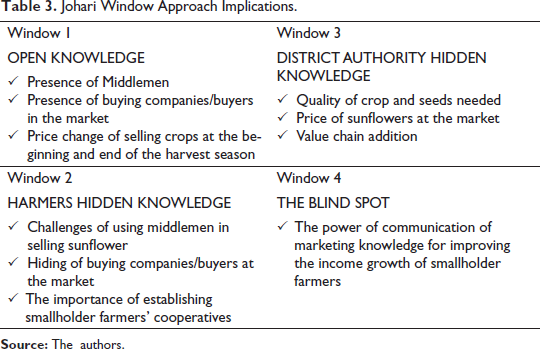
It was realized that there is an angle where the district authority and smallholder sunflower farmers have common marketing knowledge, such as the use of middlemen, the existence of buying companies and the change of prices. Again, smallholder farmers view that there are challenges to using middlemen who, among other things, are hiding buyers from the market. Besides, they think that there is a need to establish cooperatives to help them with protecting their selling rights. On the other hand, the district authority is not aware of such knowledge and thinks that there is no need for cooperatives, though it recommends the establishment of sunflower boards. Also, the district authority is aware of the quality of crop and seeds required, the production of sunflowers at the market and the value chain, adding knowledge that smallholder sunflower farmers lack.
Moreover, both the district authority and the smallholder sunflower farmers lack communication, which is essential for sharing and expanding understanding of the marketing of sunflowers. They lack a platform on which they can share marketing knowledge and ways of improving it. Sharing results in common understanding because what smallholder sunflower farmers understand is exactly what the government understand. The presence of a sharing platform is essential for improving the income growth of smallholder sunflower farmers.
However, despite the lack of communication between both parties, smallholder sunflower farmers still have limited knowledge of marketing, a thing which hinders their income growth as provided in the findings. The middlemen use a smallholder sunflower farmer’s poor knowledge to make a profit. The expression of the application of the approach is presented in Table 3.
Johari Window Approach Implications.
New Insights of the Study
From the study findings, three major insights can be revealed; one, the presence of middlemen hinders the income growth of smallholder farmers. Middlemen benefit more in the sunflower chain because they buy the crop at a lower price, store it in their storage facilities and sell it at a higher price to buyers. They also have the power to communicate with buyers and hide them from farmers. Again, they own small-scale processing factories for value addition helping them to get profit. Here, farmers have no chance of improving their income due to selling at a lower price to fulfil their basic needs.
Two, there seems to be poor communication between smallholder sunflower farmers and LGAs. The LGA is aware of the quality of the crops required, price and value addition. This knowledge is missing among smallholder sunflower farmers. The quality of crops is essential for improving farming. At the same time, value addition is essential to smallholder sunflower farmers which they seem to miss. The farmer’s knowledge and LGAs seem to differ. There seems to be a lack of communication avenues among the sunflower marketing actors. This retards the effort of sunflower farmers to improve their income.
Three, most smallholder sunflower farmers lack enough knowledge of crop marketing politics. This retards the effort of smallholder sunflower farmers to improve their income. The few who know have no power to change the selling system or they are struggling to survive within the system which is unfriendly to them.
Conclusion and Recommendations
Marketing knowledge aperture affects the income growth of smallholder sunflower farmers. This is due to the existing sunflower selling system. Also, it is attributed to poverty and the lack of a platform for communication between smallholder sunflower farmers and LGAs.
The study advises the change of the current system of using middlemen to smallholder sunflower farmers selling directly to buying companies. Also, the establishment of sunflower farmers’ cooperatives will enhance and protect their rights, access loan, sell at a reasonable price and hence, improve their income. Moreover, there should be continuous communication between the government and smallholder sunflower farmers to share and expand their selling strategies to improve farmers’ income.
Footnotes
Declaration of Conflicting Interests
The authors declared no potential conflicts of interest with respect to the research, authorship and/or publication of this article.
Funding
The authors received no financial support for the research, authorship and/or publication of this article.
